2 Samuel 20:5

Hebrew (Westminster Leningrad Codex) 2 Samuel 20:5 appears in the Hebrew Old Testament. The text above is from the Westminster Leningrad Codex. Each word links to its Strong’s number, a concise gloss, and parsing drawn from the Open Scriptures Hebrew Bible morphology. Click any word for its full Brown-Driver-Briggs (BDB) entry.
Download image
Cite this verse

2 Samuel 20:5 (World English Bible). Public Domain. Lemma interlinear Bible study tool, https://lemma.gebible.app/v/2-samuel/20/5.

Show BibTeX & RIS
BibTeX
RIS
English Translation
So Amasa went to call [the men of] Judah together; but he stayed longer than the set time which he had appointed him.
World English Bible · Public Domain
Highlights Full analysis ↓
Download a study sheet

One document with this verse’s original text, its word-by-word gloss line, the meaning frame, cross-references with their text, attributed commentary, and full source and license credits — printable, and it pastes into notes with its structure intact.

This verse Autodidact and up

Study sheet (.html) Plain text (.txt)

A passage Seminary Student

Up to 50 verses in one chapter. A passage sheet keeps up to 6 commentary sources and 12 cross-references per verse, in the order this page ranks them, and says so on the sheet whenever that leaves anything out. Ask for a single verse and you get the Autodidact verse sheet above.

Everything on this page stays free to read, with no account — the sheet is a download of what is already on screen, not access to it.

Want to remove ads? Support Godless Engineer
Compare translations 3

The same verse in 3 English versions, stacked beneath the original-language interlinear above. Click any original word for its lexicon entry.

Each is an independent rendering of the whole verse — the interlinear is not word-aligned to these translations.

Highlighted words mark where these versions differ — a whole-verse word diff, not a word-by-word alignment.

  • World English Bible Public Domain
    So Amasa went to call [the men of] Judah together; but he stayed longer than the set time which he had appointed him.
  • King James Version Public Domain
    So Amasa went to assemble the men of Judah: but he tarried longer than the set time which he had appointed him.
  • unfoldingWord Literal Text CC BY-SA 4.0
    And Amasa went to call up Judah, but he delayed beyond the appointment that he had appointed him.

unfoldingWord Literal Text — © unfoldingWord, licensed CC BY-SA 4.0. Word-aligned USFM3 via Door43 (git.door43.org/unfoldingWord/en_ult).

Versions to compare (up to 4)

3 of 4 selected

Show all 18 translations

Every available English version of this verse, each an independent rendering of the whole verse.

  • World English Bible Public Domain
    So Amasa went to call [the men of] Judah together; but he stayed longer than the set time which he had appointed him.
  • Berean Standard Bible Public Domain
    So Amasa went to summon Judah, but he took longer than the time allotted him.
  • Majority Standard Bible Public Domain
    So Amasa went to summon Judah, but he took longer than the time allotted him.
  • King James Version Public Domain
    So Amasa went to assemble the men of Judah: but he tarried longer than the set time which he had appointed him.
  • American Standard Version (1901) Public Domain
    So Amasa went to call `the men of' Judah together; but he tarried longer than the set time which he had appointed him.
  • Revised Version (1885) Public Domain
    So Amasa went to call the men of Judah together: but he tarried longer than the set time which he had appointed him.
  • Geneva Bible (1599) Public Domain
    So Amasa went to assemble Iudah, but hee taried longer then the time which he had appoynted him.
  • Douay-Rheims (1899) Public Domain
    So Amasa went to assemble the men of Juda, but he tarried beyond the set time which the king had appointed him.
  • Young's Literal Translation Public Domain
    and Amasa goeth to call Judah, and tarrieth beyond the appointed time that he had appointed him;
  • Literal Standard Version CC BY-SA 4.0
    and Amasa goes to call Judah, and tarries beyond the appointed time that he had appointed him;
  • Unlocked Literal Bible CC BY-SA 4.0
    So Amasa went to call Judah, but he was delayed beyond the time that the king had allotted for him.
  • unfoldingWord Literal Text CC BY-SA 4.0
    And Amasa went to call up Judah, but he delayed beyond the appointment that he had appointed him.
  • Darby Bible Public Domain
    So Amasa went to call together [the men of] Judah; but he delayed longer than the set time which he had appointed him.
  • World Messianic Bible Public Domain
    So Amasa went to call the men of Judah together, but he stayed longer than the set time which had been appointed to him.
  • Webster's Bible Public Domain
    So Amasa went to assemble the men of Judah: but he tarried longer than the set time which he had appointed him.
  • Free Bible Version CC BY-SA 4.0
    Amasa called up the army of Judah, but he took longer than the time he was given.
  • Bible in Basic English Public Domain
    So Amasa went to get all the men of Judah together, but he took longer than the time David had given him.
  • JPS Tanakh (1917) Public Domain
    So Amasa went to call the men of Judah together; but he tarried longer than the set time which he had appointed him.

Literal Standard Version (2020), Covenant Press — licensed CC BY-SA 4.0. Text via the HelloAO Bible API (eBible.org). Unlocked Literal Bible (unfoldingWord) — licensed CC BY-SA 4.0. Text via the HelloAO Bible API (eBible.org). unfoldingWord Literal Text — © unfoldingWord, licensed CC BY-SA 4.0. Word-aligned USFM3 via Door43 (git.door43.org/unfoldingWord/en_ult). Free Bible Version, Dr. Jonathan Gallagher — licensed CC BY-SA 4.0. Text via the HelloAO Bible API (eBible.org).

Word by word

More ways to search: Search by grammar → Find every occurrence → Compare this word →

Practice this passage: Drill this verse → Learn its vocabulary →

וייחר
yâchar
H3186
“and · to delay”
Conjunction + Verb, Qal, Sequential Imperfect, 3rd Person, Masculine, Singular
Part of Speech
Conjunction + Verb
Stem
Qal
Form
Sequential Imperfect
Person
3rd Person
Gender
Masculine
Number
Singular
Full BDB Definition

Origin: a primitive root

TWOT: 68

(Qal) to delay, tarry, defer
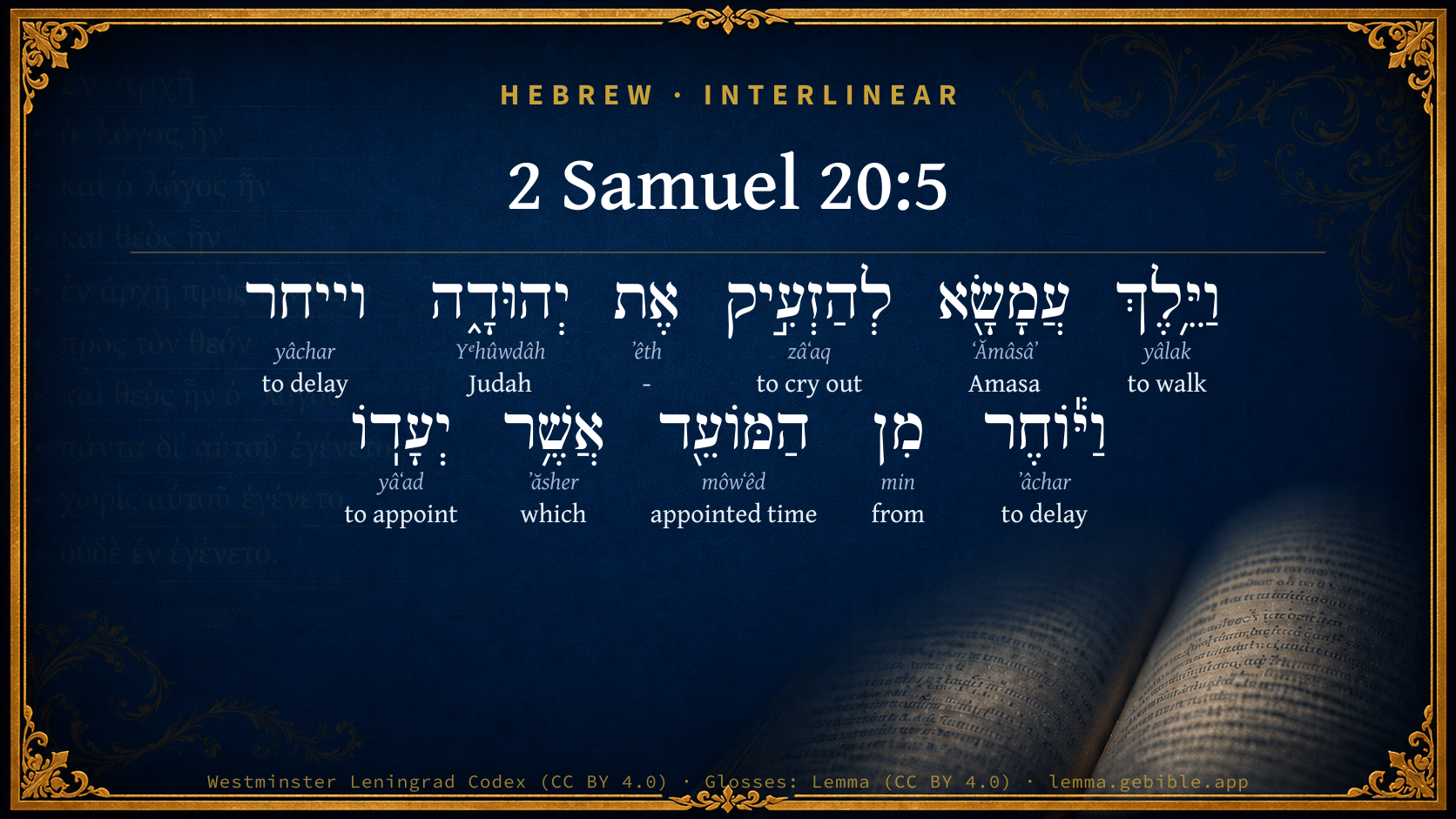
  1. וַיֵּ֥לֶךְ yâlak H3212 “and · to walk” Conjunction + Verb, Qal, Sequential Imperfect, 3rd Person, Masculine, Singular
  2. עֲמָשָׂ֖א ʻĂmâsâʼ H6021 “Amasa” Noun, Proper
  3. לְהַזְעִ֣יק zâʻaq H2199 “to cry out” Preposition + Verb, Hiphil, Infinitive Construct
  4. אֶת ʼêth H853 “-” Particle, Direct Object
  5. יְהוּדָ֑ה Yᵉhûwdâh H3063 “Judah” Noun, Proper
  6. וַיּ֕וֹחֶר ʼâchar H309 “and · to delay” Conjunction + Verb, Hiphil, Sequential Imperfect, 3rd Person, Masculine, Singular
  7. מִן min H4480 “from” Preposition
  8. הַמּוֹעֵ֖ד môwʻêd H4150 “the · appointed time” Particle, Definite Article + Noun, Common, Masculine, Singular, Absolute
  9. אֲשֶׁ֥ר ʼăsher H834 “which” Particle, Relative
  10. יְעָדֽוֹ yâʻad H3259 “to appoint · him” Verb, Qal, Perfect, 3rd Person, Masculine, Singular + Suffix, Personal, 3rd Person, Masculine, Singular

About this verse

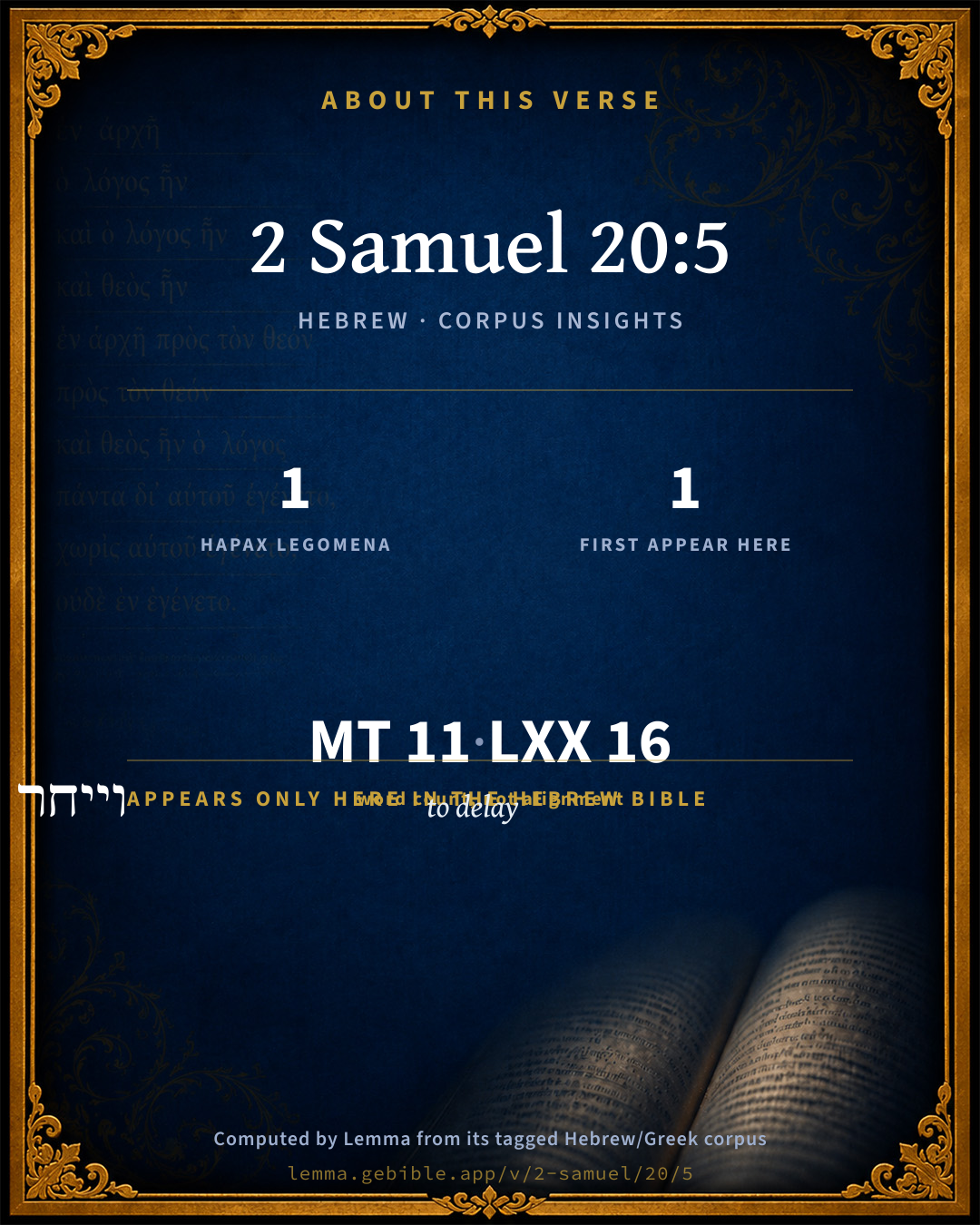
These counts appear in no published source. They are computed here, from the morphology-tagged text and Lemma’s own curated glosses. What Lemma adds →

11
words
11
distinct lemmas
Historical
section

Notable vocabulary

1 hapax legomenon — a word that appears only here in the entire Hebrew Bible:

  • וייחר to delay H3186

First appearance in Scripture

This word makes its first canonical appearance in the Hebrew Bible here:

  • וייחר to delay H3186

Shared distinctive vocabulary

עֲמָשָׂ֖א Amasa H6021 occurs in 12 verses of the Hebrew Bible. Also found in:

Grammatical profile

  • 5 verbs
  • 3 nouns
  • 1 preposition
  • 2 particles

Verb forms

  • וַיֵּ֥לֶךְ Qal · Sequential Imperfect
  • לְהַזְעִ֣יק Hiphil · Infinitive Construct
  • וייחר Qal · Sequential Imperfect
  • וַיּ֕וֹחֶר Hiphil · Sequential Imperfect
  • יְעָדֽוֹ Qal · Perfect

Hebrew & Septuagint length

In English translation the verse runs 23 words from the Hebrew and 15 from the Septuagint (LXX English) — the Septuagint runs noticeably shorter here. See the side-by-side →

A rough comparison of the two English renderings, which tokenize alike — not a word-level alignment.

Word counts can differ between the Hebrew and the Greek without any difference in meaning — e.g. the Hebrew direct-object marker אֵת has no separate Greek word, and Greek often adds the article ὁ.

In the original languages it is 11 Hebrew tokens and 16 Greek tokens — but the two are counted differently (Hebrew bundles its prefixes and suffixes into one token; the Greek is in lemma form), so that isn’t a like-for-like length.

Cross-references

2

Topical passages linked to 2 Samuel 20:5 in the Treasury of Scripture Knowledge — connected by theme and wording, ordered by reader-vote popularity; previews shown in the World English Bible.

  • 1 Samuel 13:8 He stayed seven days, according to the set time that Samuel [had appointed]: but Samuel didn't come to Gilgal; and the people were scattered from him.
  • 2 Samuel 19:13 Say you to Amasa, Aren't you my bone and my flesh? God do so to me, and more also, if you aren't captain of the host before me continually in the room of Joab.

Cross-references courtesy of OpenBible.info (CC BY 4.0).

Hebrew and Greek witnesses Masoretic Hebrew ↔ Greek Septuagint

The same verse in the two great witnesses to the Old Testament, shown verse-for-verse.

Here the Septuagint runs noticeably shorter than the Hebrew — LXX2012 (modern English Septuagint) 15 words vs World English Bible 23. A rough length comparison of the two English translations, not a word-level alignment — read both below.

These are two independent witnesses, not word-aligned to each other, and the Septuagint is shown in lemma (dictionary) form.

Hebrew 2 Samuel 20:5 Masoretic · Westminster Leningrad Codex

וַיֵּ֥לֶךְ עֲמָשָׂ֖א לְהַזְעִ֣יק אֶת יְהוּדָ֑ה וייחר וַיּ֕וֹחֶר מִן הַמּוֹעֵ֖ד אֲשֶׁ֥ר יְעָדֽוֹ

So Amasa went to call [the men of] Judah together; but he stayed longer than the set time which he had appointed him.

World English Bible · Public Domain

Greek LXX 2 Samuel 20:5 Septuagint · lemma form

καί πορεύομαι αμεσσαϊ ὁ βοάω ὁ ἰούδας καί χρονίζω ἀπό ὁ καιρός ὅς τάσσω αὐτός δαυίδ

And Amessai went to call Juda, and delayed beyond the time which David appointed him.

LXX2012 (modern English Septuagint) · Public Domain

Hebrew: Westminster Leningrad Codex (CC BY 4.0). Greek: Septuagint (public domain); English from LXX2012 (modern English Septuagint) (Public Domain). How the Septuagint differs from the Hebrew →

Targum (Aramaic paraphrase)

1

The Targum is the ancient Jewish Aramaic paraphrase of the Hebrew Scriptures — an interpretive translation, not the Hebrew text itself. Onkelos (literal) and Pseudo-Jonathan (expansive) render the Torah, and Jonathan the Prophets. Coverage is partial: where no permissively-licensed English translation exists for a verse, only the Aramaic is shown. This is verse-level text, not a word-by-word alignment to the Hebrew.

  1. Targum Jonathan Prophets (Joshua–Malachi)
    וַאֲזַל עֲמָשָׂא לְמִכְנַשׁ יַת דְבֵית יְהוּדָה וְאוֹחַר מִן זִמְנָא דַאֲמַר לֵיהּ:

    (no public-domain English translation for this verse)

    Targum Jonathan — Aramaic: “Mikraot Gedolot” (public domain). English: “Sefaria Community Translation” (CC0 1.0 (public-domain dedication)); “London "Chaldee Paraphrase," 1871” (public domain). Text via Sefaria.

Commentary

Notes on 2 Samuel 20:5 from classic Christian and Jewish commentators (each source and its license shown beneath its notes). The classic Christian expositions comment on the surrounding passage and are grouped to its opening verse, so a note may address several verses; the Jewish commentaries on the Tanakh (Rashi and others) are per-verse, so they appear only where the commentator wrote on this verse.

Lemma curates 59 commentaries, every one of them public domain or Creative Commons licensed, each selected and text-cleaned for this edition rather than reprinted as found. About our sources →

Trapp's Complete Commentary

John Trapp

2Sa 20:5 So Amasa went to assemble [the men of] Judah: but he tarried longer than the set time which he had appointed him.

Ver. 5. But he tarried longer.] Either through his own remissness, or the people’s unwillingness to be commanded by this new general.

John Trapp, A Commentary or Exposition upon All the Books of the Old and New Testament (1647–1656) — public domain. Text from a community e-Sword module.

Ellicott's Commentary for English Readers

(5) He tarried longer.—No cause is assigned for this, and various conjectures have been made. The simplest explanation may be drawn from the fact that, in 2Sa_20:8, Amasa is met on his return at Gibeon. He had therefore gone quite out of the bounds of Judah into Benjamin, and had consumed more time in consequence of exceeding his instructions. The fact suggests great doubt of his fitness for the place David had promised him. Joab appears to insinuate (in 2Sa_20:11) that Amasa was not really loyal.

A Bible Commentary for English Readers, edited by Charles John Ellicott (1878–1897) — public domain. Text from a community e-Sword module.

The Cambridge Bible for Schools and Colleges

gen. ed. J. J. S. Perowne

5. he tarried longer] Some may have resented the change of generals and distrusted Amasa; some may have been half-hearted about David’s restoration; so that he found that the task took longer than he expected.

The Cambridge Bible for Schools and Colleges (gen. ed. J. J. S. Perowne; Cambridge University Press, 1878–1918) — public domain. Text from a community e-Sword module.

John Gill's Exposition

So Amasa went to assemble the men of Judah,.... To gather, them together out of their several tribes, and bring them to Jerusalem:

but he tarried longer than the set time which he had appointed him: than the three days; whether this was owing to the remissness of Amasa, or the unwillingness of the people to serve under him, who had been Absalom's general in the late rebellion, or not having time sufficient allowed him, is not certain.

John Gill's Exposition of the Whole Bible (1746–1763) — public domain (CC PDM 1.0). Text via the HelloAO Bible API.

Albert Barnes' Notes on the Bible

He tarried - The cause of Amasa’s delay is not stated. It may have been the unwillingness of the men of Judah to place themselves under his orders, or it may have been caused by a wavering or hesitation in loyalty. This last is evidently insinuated in 2Sa 20:11, and no doubt this was the pretext, whether grounded in fact or not, by which Joab justified the murder of Amasa before David.

Albert Barnes' Notes on the Bible (1834–1885) — public domain. Text from a community e-Sword/MySword module.

Haydock's Catholic Bible Commentary

Him, owing to some insuperable difficulties. He was not long behind, since he joined the forces at Gabaon, where he was treacherously slain by the envious Joab. (Haydock)

George Leo Haydock (1774–1849), Haydock's Catholic Family Bible and Commentary, 1859 edition — public domain. Excludes Psalms (Douay-Rheims chapter numbering differs from Protestant) and Deuterocanonical books (Catholic canon only).

Matthew Poole's English Annotations

Either because the people, being wearied out by the late civil war, were not forward to engage in another; or because the soldiers had more affection to Joab than to their new general, to whose ill conduct possibly they might impute their unsuccessfulness in the last battle; or because Amasa for his own interest might seek delays, to render himself more necessary and useful to the king, and to keep up his honourable and profitable employment, which is the common policy of such men.

Matthew Poole's English Annotations on the Holy Bible (1683–1685) — public domain. Text from a community e-Sword/MySword module.

Whedon's Commentary on the Bible

Daniel D. Whedon

5. He tarried longer than the set time — He doubtless met with many and serious difficulties in collecting together the warriors of Judah, who, long accustomed to the command of Joab, were slow to follow the call of him who had been the leader of the insurgent hosts.

Daniel D. Whedon (gen. ed.), Commentary on the Old and New Testaments (1874–1909) — public domain. Text from a community e-Sword module.

The Pulpit Commentary

He tarried longer than the set time. But not longer than was to be expected. For the appointment was so surprising that everybody must have been agape with astonishment. They would naturally have expected that Amasa would he punished. Instead of this, he is commissioned to gather the militia in David"s name. And men would hesitate about joining such a leader. Was he really loyal? or would he embark them in a new rebellion? And what would Joab do? He was not a man likely to bear such a slight tamely, and David ought to have foreseen that he was sowing for himself a crop of discord and enmity.

The Pulpit Commentary (1880–1919), ed. H.D.M. Spence-Jones & Joseph S. Exell — public domain. Text from a community e-Sword module.

John Wesley's Explanatory Notes

Tarried - Either, because the people being wearied out by the late war, were not forward to engage in another: or because the soldiers had more affection to Joab, than to their new general.

John Wesley, Explanatory Notes Upon the Whole Bible (1754–1765) — public domain. Text via the GEBible commentary corpus.

Rashi

Rabbi Shlomo Yitzchaki (Rashi)

But was delayed past the appointed time. He found Rabbis who had begun to learn a tractate in the Talmud, as is stated in Sanhedrin.

Rashi on the Tanakh — English translations: “The Judaica Press complete Tanach with Rashi, translated by A. J. Rosenberg” (CC BY 4.0); “Pentateuch with Rashi's commentary by M. Rosenbaum and A.M. Silbermann, 1929-1934” (public domain); “The Metsudah Tanach series, Lakewood, N.J” (CC BY 4.0); and “The Book of Joshua, Metsudah Publications, 1997” (CC BY 4.0). Text via Sefaria.

Lesson kit

Teaching starters — assembled from the data on this page, not authored interpretation. Every prompt links to the verse data it draws on. Edit before teaching.

2 Samuel, in the Historical, opens this verse with 11 words (11 distinct Hebrew lemmas). Its most distinctive word is yâchar (“to delay”). The Greek Septuagint runs shorter here. A historical commentator’s framing appears above. Read the whole chapter for the surrounding context.

Discussion questions

  1. What does “to delay” (yâchar) contribute to the verse as a whole?
  2. This verse holds 1 word here found nowhere else in the Hebrew Bible. What might the rare word draw attention to?
  3. The word “to delay” first appears here in Scripture. What is being introduced at this debut?
  4. 2 Samuel 17:25 shares the word «Amasa» with this verse. How do the two illuminate each other?
  5. Compared with the Hebrew, the Septuagint runs shorter here. What questions does that raise?
  6. These translations render this verse differently; the difference is in the English rendering, not the original. What questions does that raise?
  7. The verb «וַיֵּ֥לֶךְ» is Qal Sequential Imperfect. How does its form color the action?
  8. Reading how Trapp's Complete Commentary and Ellicott's Commentary for English Readers read this verse, where do the two commentators agree and where do they part?

Things to notice

Reading settings

Reading text

Shown beneath each verse's original-language words.

Old Testament
Old Testament edition

Read the OT as the Masoretic Hebrew (MT) or the Greek Septuagint (LXX).

English shown for the Greek Septuagint (in the Hebrew ↔ Greek comparison).

Comparing translations? Open the Compare panel on any verse page to stack up to four side by side.