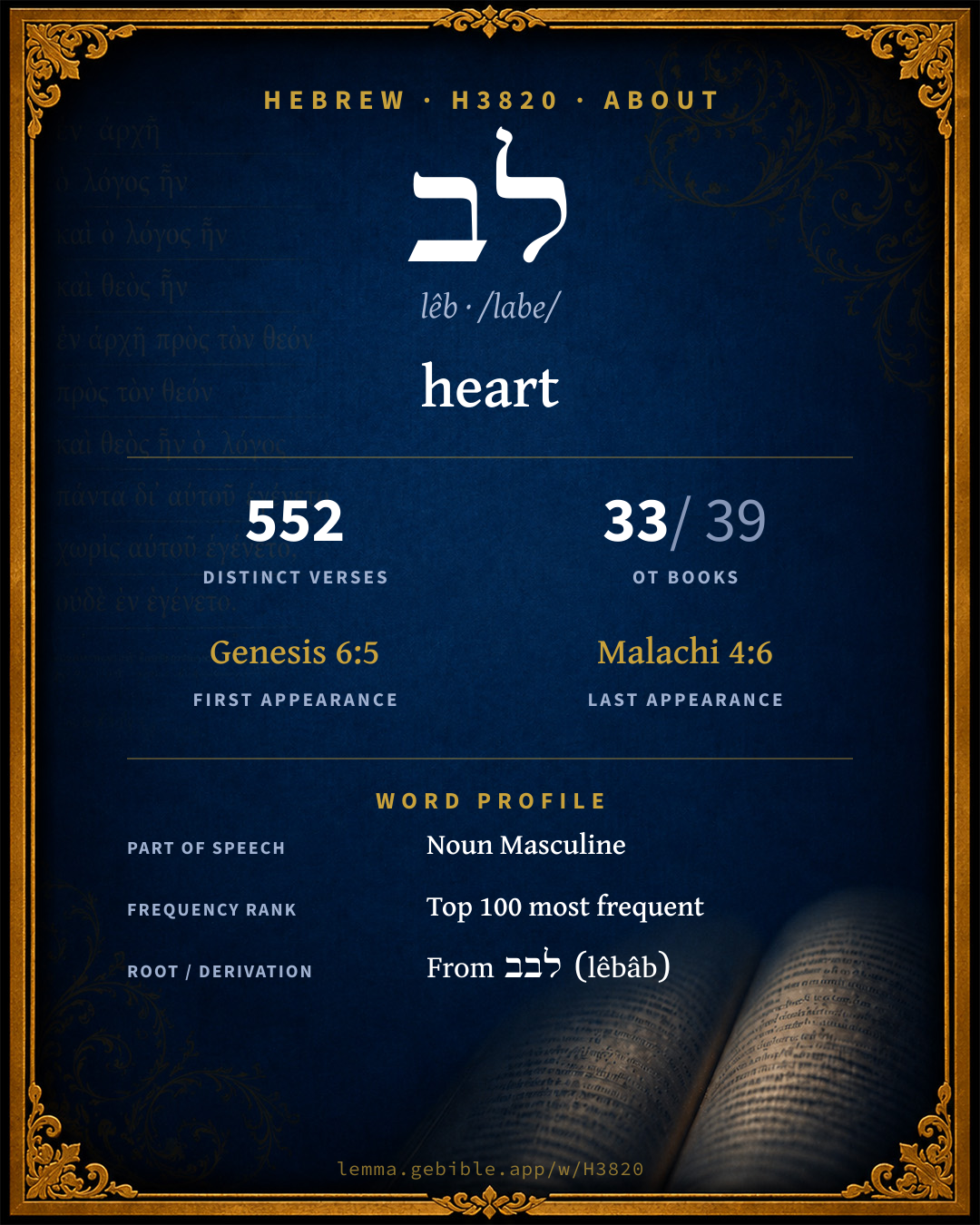
לֵב
heart
also: inner man, mind, will, understanding fuller range ↓
Full lexicon entry — Brown-Driver-Briggs (BDB)
From Brown-Driver-Briggs (BDB)
Where this word appears
See every Construct-state word in the Hebrew Bible →
Grammar key — what these labels mean
Part of speech
- Noun
- A naming word — a person, place, thing, or idea.
Noun type
- Common
- A common noun — a general class of person, place, or thing (“king,” “city,” “water”), not a specific name.
- Proper
- A name of a specific person, place, or people (e.g. Abraham, Zion, Israel).
State
- Absolute
- The independent form of a noun, not bound to a following word.
- Construct
- A noun bound to a following noun in a possessive / “of” relationship (the construct chain).
Gender
- Masculine
- Grammatically masculine.
Number
- Singular
- One.
- Plural
- More than one (in Hebrew, generally three or more).
34 verses where H3820 appears in the Construct state in the Book of Exodus. Filtered view — show all forms. Click any verse to open its interlinear word-by-word view. Verse text shown in the World English Bible for context — . Each verse’s Hebrew form is shown with its reference; the English is not keyword-highlighted, since the data carries no word-level English alignment. Use “Compare translations” on any verse to read it across multiple English versions. This concordance covers the Hebrew Bible; Septuagint (Greek Old Testament) occurrences are not indexed here.
Exodus
- Exodus 4:14 בְּ/לִבּֽ/וֹ prep + n c ms cs + sfx pers 3ms The anger of Yahweh was kindled against Moses, and he said, "What about Aaron, your brother, the Levite? I know that he can speak well. Also, behold, he comes forth to meet you. When he sees you, he will be glad in his heart.
- Exodus 4:21 לִבּ֔/וֹ n c ms cs + sfx pers 3ms Yahweh said to Moses, "When you go back into Egypt, see that you do before Pharaoh all the wonders which I have put in your hand, but I will harden his heart and he will not let the people go.
- Exodus 7:3 לֵ֣ב n c ms cs I will harden Pharaoh's heart, and multiply my signs and my wonders in the land of Egypt.
- Exodus 7:13 לֵ֣ב n c ms cs Pharaoh's heart was hardened, and he didn't listen to them; as Yahweh had spoken.
- Exodus 7:14 לֵ֣ב n c ms cs Yahweh said to Moses, "Pharaoh's heart is stubborn. He refuses to let the people go.
- Exodus 7:22 לֵב n c ms cs The magicians of Egypt did in like manner with their enchantments; and Pharaoh's heart was hardened, and he didn't listen to them; as Yahweh had spoken.
- Exodus 7:23 לִבּ֖/וֹ n c ms cs + sfx pers 3ms Pharaoh turned and went into his house, neither did he lay even this to heart.
- Exodus 8:15 לִבּ֔/וֹ n c ms cs + sfx pers 3ms But when Pharaoh saw that there was a respite, he hardened his heart, and didn't listen to them, as Yahweh had spoken.
- Exodus 8:19 לֵב n c ms cs Then the magicians said to Pharaoh, "This is the finger of God:" and Pharaoh's heart was hardened, and he didn't listen to them; as Yahweh had spoken.
- Exodus 8:32 לִבּ֔/וֹ n c ms cs + sfx pers 3ms Pharaoh hardened his heart this time also, and he didn't let the people go.
- Exodus 9:7 לֵ֣ב n c ms cs Pharaoh sent, and, behold, there was not so much as one of the cattle of the Israelites dead. But the heart of Pharaoh was stubborn, and he didn't let the people go.
- Exodus 9:12 לֵ֣ב n c ms cs Yahweh hardened the heart of Pharaoh, and he didn't listen to them, as Yahweh had spoken to Moses.
- Exodus 9:14 לִבְּ/ךָ֔ n c ms cs + sfx pers 2ms For this time I will send all my plagues against your heart, against your officials, and against your people; that you may know that there is none like me in all the earth.
- Exodus 9:21 לִבּ֖/וֹ n c ms cs + sfx pers 3ms Whoever didn't regard the word of Yahweh left his servants and his cattle in the field.
- Exodus 9:34 לִבּ֖/וֹ n c ms cs + sfx pers 3ms When Pharaoh saw that the rain and the hail and the thunders were ceased, he sinned yet more, and hardened his heart, he and his servants.
- Exodus 9:35 לֵ֣ב n c ms cs The heart of Pharaoh was hardened, and he didn't let the children of Israel go, just as Yahweh had spoken through Moses.
- Exodus 10:1 לִבּ/וֹ֙ לֵ֣ב n c ms cs + sfx pers 3ms n c ms cs Yahweh said to Moses, "Go in to Pharaoh, for I have hardened his heart, and the heart of his servants, that I may show these my signs in the midst of them,
- Exodus 10:20 לֵ֣ב n c ms cs But Yahweh hardened Pharaoh's heart, and he didn't let the children of Israel go.
- Exodus 10:27 לֵ֣ב n c ms cs But Yahweh hardened Pharaoh's heart, and he wouldn't let them go.
- Exodus 11:10 לֵ֣ב n c ms cs Moses and Aaron did all these wonders before Pharaoh, and Yahweh hardened Pharaoh's heart, and he didn't let the children of Israel go out of his land.
- Exodus 14:4 לֵב n c ms cs I will harden Pharaoh's heart, and he will follow after them; and I will get honor over Pharaoh, and over all his host; and the Egyptians shall know that I am Yahweh." They did so.
- Exodus 14:8 לֵ֤ב n c ms cs Yahweh hardened the heart of Pharaoh king of Egypt, and he pursued after the children of Israel; for the children of Israel went out with a high hand.
- Exodus 14:17 לֵ֣ב n c ms cs I, behold, I will harden the hearts of the Egyptians, and they shall go in after them: and I will get myself honor over Pharaoh, and over all his host, over his chariots, and over his horsemen.
- Exodus 15:8 בְּ/לֶב prep + n c ms cs With the blast of your nostrils the waters were piled up. The floods stood upright as a heap. The deeps were congealed in the heart of the sea.
- Exodus 25:2 לִבּ֔/וֹ n c ms cs + sfx pers 3ms "Speak to the children of Israel, that they take an offering for me. From everyone whose heart makes him willing you shall take my offering.
- Exodus 28:29 לִבּ֖/וֹ n c ms cs + sfx pers 3ms Aaron shall bear the names of the children of Israel in the breastplate of judgment on his heart, when he goes in to the holy place, for a memorial before Yahweh continually.
- Exodus 28:30 לֵ֣ב לִבּ֛/וֹ n c ms cs n c ms cs + sfx pers 3ms You shall put in the breastplate of judgment the Urim and the Thummim; and they shall be on Aaron's heart, when he goes in before Yahweh: and Aaron shall bear the judgment of the children of Israel on his heart before Yahweh continually.
- Exodus 31:6 וּ/בְ/לֵ֥ב לֵ֖ב conj + prep + n c ms cs n c ms I, behold, I have appointed with him Oholiab, the son of Ahisamach, of the tribe of Dan; and in the heart of all who are wise-hearted I have put wisdom, that they may make all that I have commanded you:
- Exodus 35:5 לִבּ֔/וֹ n c ms cs + sfx pers 3ms 'Take from among you an offering to Yahweh. Whoever is of a willing heart, let him bring it, Yahweh's offering: gold, silver, brass,
- Exodus 35:21 לִבּ֑/וֹ n c ms cs + sfx pers 3ms They came, everyone whose heart stirred him up, and everyone whom his spirit made willing, and brought Yahweh's offering, for the work of the tent of meeting, and for all of its service, and for the holy garments.
- Exodus 35:26 לִבָּ֛/ן n c ms cs + sfx pers 3fp All the women whose heart stirred them up in wisdom spun the goats' hair.
- Exodus 35:29 לִבָּ/ם֮ n c ms cs + sfx pers 3mp The children of Israel brought a freewill offering to Yahweh; every man and woman, whose heart made them willing to bring for all the work, which Yahweh had commanded to be made by Moses.
- Exodus 35:34 בְּ/לִבּ֑/וֹ prep + n c ms cs + sfx pers 3ms He has put in his heart that he may teach, both he, and Oholiab, the son of Ahisamach, of the tribe of Dan.
- Exodus 36:2 לֵ֔ב בְּ/לִבּ֑/וֹ לִבּ֔/וֹ n c ms prep + n c ms cs + sfx pers 3ms n c ms cs + sfx pers 3ms Moses called Bezalel and Oholiab, and every wise-hearted man, in whose heart Yahweh had put wisdom, even everyone whose heart stirred him up to come to the work to do it:
About this entry
At a glance — auto-summarized from this page’s data, not written by a person. Every figure links to its source below. This summary describes the numbers; it doesn’t interpret them.
“heart” is the headline sense of the Hebrew noun לב (lêb). First canonically at Genesis 6:5, it enters the text early. It turns up in 552 verses across 33 books, one of the most common footprint. Not a single-sense word: its full sense range also takes in “inner man”, “mind”, and “will”. From the same root come לבב, לבב and לב. The sections below give every sense, occurrence, and version rendering.
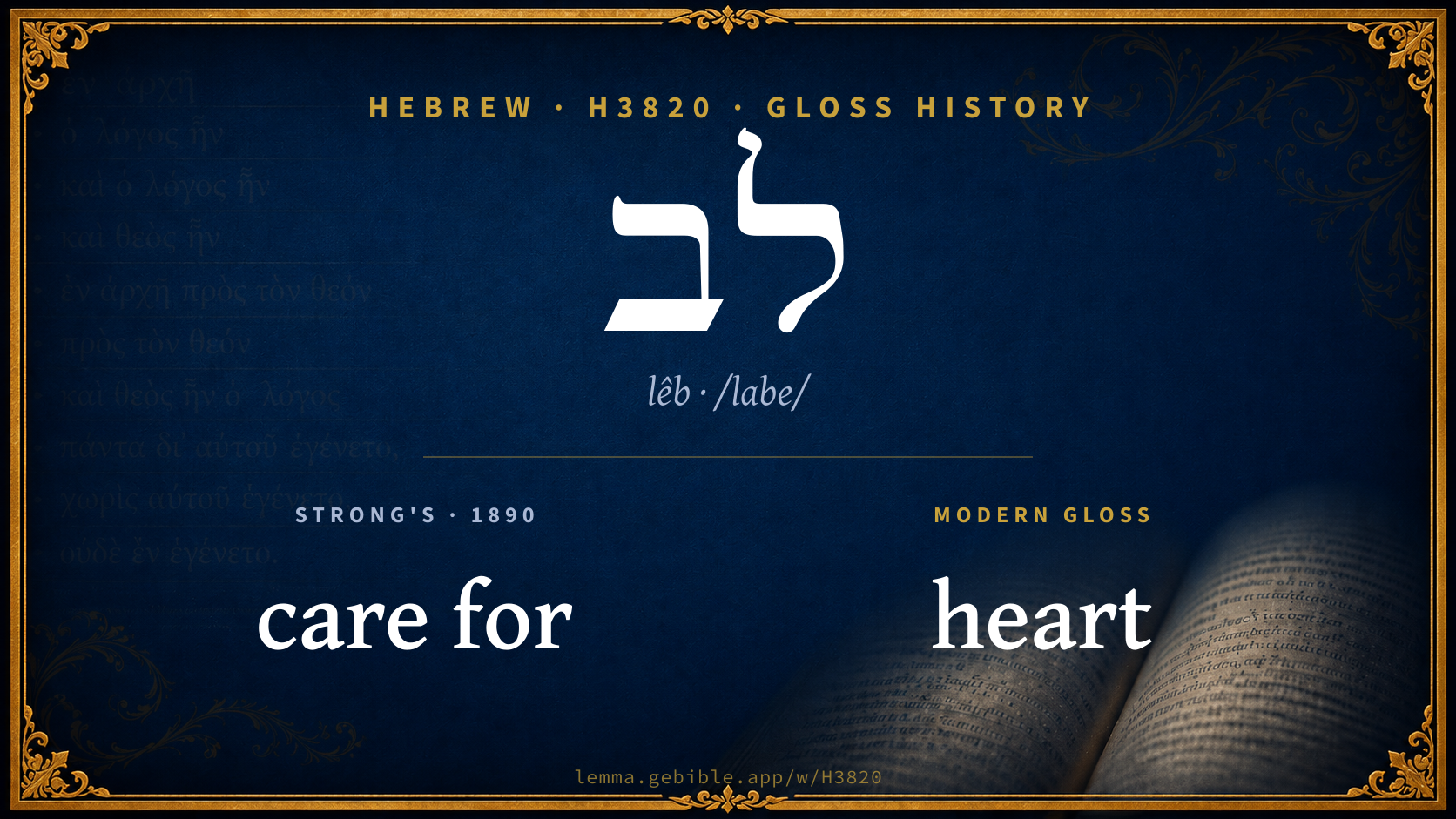
Gloss history
Strong's 1890 vs modern scholarship
About this word
Strong's H3820 catalogs a Hebrew word from the Hebrew Old Testament.
These counts are not copied from any lexicon or concordance. They are computed here, from the morphology-tagged Hebrew Old Testament. What Lemma adds →
- 552
- distinct verses
- The word appears in 552 distinct verses.
- 33 / 39
- OT books
- The word appears in 33 of 39 Old Testament books.
- #81
- by frequency
- Top 100 most frequent Hebrew words (rank 81 of 8,640 Hebrew words by occurrence).
View all 552 occurrences in the concordance →
By section of the Old Testament
By traditional corpus
Conventional, traditional groupings — biblical authorship is debated, so this is a traditional corpus grouping, not an authorship claim. Each share is this word’s portion of its verses in that division of the Hebrew canon. Each figure is a share of the word’s 552 distinct verses.
- Writings (Ketuvim) 293 verses · 53%
- Prophets (Nevi'im) 198 verses · 36%
- Torah (Pentateuch) 61 verses · 11%
How translations render this word
Counts come from each version’s own published word-to-Strong’s tagging or interlinear alignment — an approximate guide to how each version renders this word, not a word-level alignment the data otherwise carries. Because each total is that version’s own tagged count, the per-version totals vary from one another and need not match the appearance or distinct-verse counts above. These counts may also differ from a printed concordance because Lemma counts each distinctly tagged rendering and does not collapse phrase taggings into a single head-word total. This is a fixed set of word-tagged versions (KJV, ASV, BSB, ULT) and does not change with the reading translation you choose elsewhere. Each version’s license is shown beside its name below (and on Sources).
BDB lists this Strong’s number as 3 distinct words (homographs). Each count above pools all of them and is not split by sense — see the Senses section below. A low-frequency rendering may belong to a different one of those words, not the primary meaning.
- King James Version†: Heart 392×, Hearts 16×, Own heart 12×
- American Standard Version†: Heart 347×, 's heart 26×, Own heart 14×
- Berean Standard Bible†: Heart 307×, Hearts 70×, Mind 28×
- unfoldingWord Literal Text†: Heart 433×, Heart of 87×, Hearts 26×
King James Version Public Domain
Renders H3820 across 577† tagged occurrences — most commonly:
Plus other, less common renderings. Plus 69 renderings that appear only once — usually multi-word phrases or single function words the recovered tagging swept in, not distinct renderings. Not rendered by a distinct English word in 16 further occurrences.
American Standard Version Public Domain
Renders H3820 across 577† tagged occurrences — most commonly:
Plus other, less common renderings. Plus 101 renderings that appear only once — usually multi-word phrases or single function words the recovered tagging swept in, not distinct renderings.
Berean Standard Bible Public Domain
Renders H3820 across 526† tagged occurrences — most commonly:
Plus other, less common renderings. Plus 52 renderings that appear only once — usually multi-word phrases or single function words the recovered tagging swept in, not distinct renderings. Not rendered by a distinct English word in 67 further occurrences.
unfoldingWord Literal Text CC BY-SA 4.0
Renders H3820 across 610† tagged occurrences — most commonly:
Plus 31 renderings that appear only once — usually multi-word phrases or single function words the recovered tagging swept in, not distinct renderings.
22 senses and sub-senses in the full BDB
What do BDB’s symbols mean?
BDB uses these scholarly abbreviations:
| Symbol | Meaning |
|---|---|
| 𝔊 | the Septuagint (the ancient Greek translation, LXX) |
| 𝔙 | the Vulgate (the Latin translation) |
| 𝔖 | the Syriac version (the Peshitta) |
| 𝔗 | the Targum (the Aramaic translation) |
| ψ | the Psalms |
| √ | root (the underlying root or stem) |
| ‖ | parallel passage (a synonymous or contrasted parallel) |
| † | the dagger: every passage where the word occurs is cited |
The 22 senses and sub-senses the full Brown-Driver-Briggs lexicon distinguishes for this word, in lexicon order (not ranked by frequency), with BDB’s own verbatim wording and sub-sense lettering. Shown in Hebrew script with BDB’s own scholarly abbreviations. The condensed entry is in the Lexicon Entry tab. See also the Forms in the corpus table below.
לב I קַמְבֻּלָּי people of Gambulai SarowskyZAW 1912, 150–1 Je 51
לב II
- I. seldom of things, בְּלֶב־יָם in the midst of the sea Ex 15:8 Pr 23:34; 30:19; בְּלֵב יַמִּים ψ 46:3; Ez 27:4, 25, 26, 27; 28:2, 8 בלב האלה 2 S 18:14; בְּלֵב אֹיְבֵי in the midst of the enemies of ψ 45:2 (v. BrMP in loco; AV RV al. in the heart of). e.g. Exodus 15:8
- II. elsewhere of men:
- 1. the inner man in contrast with outer לבי ובשׂרי ירננו my heart and my flesh cry out ψ 84:3; ‖ מעים ψ 22:15 Je 4:19, the inner for outer מעים Je 49:22; as within the breast על לב Ex 28:3, 29, 30(×2) (P); מלב 2 K 9:24; בלב ψ 37:15 2 S 18:14; סְגוֹר לִבָּם Ho 13:8; antithesis with בָּשָׂר Pr 14:30 Ec 2:3; head Is 1:5, face Ez 14:3, 4, 7; arm Ct 8:6; hands Ez 22:14; bones ψ 102:5; eyes 1 K 9:3 (= 2 Ch 7:16) Je 22:17; ear Pr 22:17; 23:12; mouth ψ 55:22; lips Is 29:13; אֲנִי יְשֵׁינָה וְלִבִּי עֵר I slept but my heart waked Ct 5:2. e.g. Psalms 84:3
- 2. the inner man, indef., soul, comprehending mind, affections and will, with occasional emphasis of one or the other by means of certain verbs: † בכל לב 1 K 8:23 (= 2 Ch 6:14) ψ 9:2; 119:2, 10, 34, 58, 69, 145; 138:1 Pr 3:5 Je 3:10; 24:7; †עם לב 2 Ch 24:4 (see לבב 2); † כלב 2 S 7:21 (= 1 Ch 17:19) Je 3:15; תַּעֲלֻמוֹת לֵב secrets of the heart ψ 44:22; לֵב מְלָכִים אֵין חֵקֶר the heart of kings is unsearchable Pr 25:3; הַיֹּצֵר יַחַד לִבָּם ψ 33:15 etc. e.g. 1 Kings 8:23
- 3. specific reference to mind:
- a. †מִלֵּב of one’s own mind Nu 16:28; 24:13 (JE) 1 K 12:33; Ne 6:8; Ez 13:2, 17; †חֲסַר לֵב destitute of mind Pr 6:32; 7:7; 9:4, 16; 10:13, 21; 11:12; 12:11; 15:21; 17:18; 24:30; לִבּוֹ חָסֵר Ec 10:3; אֵין לֵב Je 5:21 Ho 7:11; לב אין Pr 17:16; קנה לב get a mind Pr 15:32; 19:8; כֹּחַ לב power of mind Jb 36:5; רֹחַב לב breadth of mind 1 K 5:9, גנב לב 2 S 15:6; Gn 31:20 (E? see לבב 3 a). e.g. Numbers 16:28
- b. knowledge, c. †ידע Dt 29:3; Pr 14:10; 22:17; Ec 1:17; 7:22, 25; 8:5, 16; Je 24:7; ראה ψ 66:18 Ec 1:16; חָכַם לב mind is wise Pr 23:15; †לֵב חָכָם wise mind 1 K 3:12; Pr 16:23; Ec 8:5; †חֲכַם לֵב Ex 31:6; 35:10; 36:1, 2, 8 (P) Pr 10:8; 11:29; 16:21; †חַכְמֵי לֵב Ex 28:3 (P) Jb 37:24; †חכמת לב Ex 35:25, 35 (P); לב חכמים Ec 7:4; 10:2; לב כסילים Pr 12:23; 15:7 Ec 7:4; 10:2; c. חכמה Ex 36:2 (P) 1 K 10:24 (= 2 Ch 9:23) Pr 2:10; 17:16; Ec 2:3; †לֵב נָבוֹן intelligent mind Pr 14:33; 15:14; 18:15; with הבין Pr 8:5; תְּבוּנָה Pr 2:2; שָׂ֑כֶל Jb 17:4 etc. e.g. Deuteronomy 29:3
- c. thinking, reflection, c. חשׁב ψ 140:3 Pr 16:9; מחשׁבות Gn 6:5 (J) ψ 33:11 Pr 6:18; 19:21 cf. Gn 8:21 (J); הגה muse, study Pr 15:28; 24:2; Is 33:18; 59:13; הגיון ψ 19:15; הָגוּת ψ 49:4; †שׂם לב set the mind, consider Is 41:22; Ez 44:5, c. לְ 1 S 9:20; Ez 40:4; 44:5; אֶל Ex 9:21 (J) 1 S 25:25; 2 S 18:3(×2) Jb 2:3; 34:14; עַל Jb 1:8; † שׁת לב ψ 62:10; Pr 22:17; 24:32, c. לְּ Ex 7:23 (JE) 1 S 4:20; 2 S 13:20; ψ 48:14; Pr 27:23; Je 31:21 אֶל Jb 7:17. e.g. Psalms 140:3
- d. memory †השׁיב אל לב call to mind Is 44:19; La 3:21; על לב Is 46:8; †עלה על לב come into mind (occur to one) Is 65:17; Je 3:16; 7:31; 19:5; 32:35 (cf. Acts 7:23), so בא על לב 2 Ch 7:11; †שׂם על לב lay to heart Is 42:25; 47:7; 57:1, 11; Je 12:11 Mal 2:2(×2) Dn 1:8; אל לב 2 S 13:33; 19:20 כתב על לב Je 31:33; קשׁר על לב Pr 6:21; † לוּחַ לֵב tablet of the memory Pr 3:3; 7:3 Je 17:1; נִשְׁכַּחְתִּי כְּמֵת מִלֵּב I am forgotten as a dead man out of mind ψ 31:13. e.g. Isaiah 44:19
- 4. spec. ref. to inclinations, resolutions and determinations of the will; †הכין לב set the mind 2 Ch 12:14 ψ 10:17; 78:8; Jb 11:13; †נכון לב ψ 57:8(×2) (= 108:2) 78:37; 112:7; †נתן לב לְ Ec 1:13, 17; 7:21; 8:9, 16; Pr 23:26 Dn 10:12; † נתן אל לב Ec 7:2; 9:1; Ne 2:12; 7:5 differ from Ec 7:2; 9:1 (the ‘heart’ here not being the subject’s). בלב Ex 35:34 (P) Ezr 7:27 Ec 3:11; †אֲשֶׁר־נְשָׂאוֹ לִבּוֹ whose heart stirred him up Ex 35:21; 36:2 cf. 35:26 (all P); †נְדִיב לֵב willing of mind Ex 35:5, 22 (P) 2 Ch 29:31 cf. Ex 25:2; 35:29 (P): †אחרי נטה לב inclined to follow Ju 9:3 ψ 119:112; Pr 2:2; †הטה לב 1 K 11:3 ψ 119:36; 141:4 cf. 2 S 15:13:—גְּדֹלִים חִקְקֵי־לֵב great resolves of heart Ju 5:15 etc. e.g. 2 Chronicles 12:14
- 5. spec. ref. to conscience, וַיַּךְ לֵב דָּוִד אֹתוֹ and David’s heart (conscience) smote him 1 S 24:6; מִכְשׁוֹל לֵב offence of conscience 1 S 25:31; cf. Ec 7:22. e.g. 1 Samuel 24:6
- 6. spec. ref. to moral character, God tries the heart ψ 17:3 Je 12:3; sees the heart and reins Je 20:12, tries them ψ 7:10 Je 11:20, refines them ψ 26:2; searches the heart and tries the reins Je 17:10. e.g. Psalms 17:3
- a. ישֶׁר־לִבִּי Jb 33:3; †יִשְׁרֵי לֵב ψ 7:11; 11:2; 32:11; 36:11; 64:11 (all c. דָּוִד in title), 94:15; 97:11; †לֵב שָׁלֵם 1 Ch 28:9; 29:9 Is 38:3 (all originally לבב, see לבב 6 a); נִשְׁבְּרֵי־לֵב broken of heart ψ 34:19 Is 61:1; לֵב־נִשְׁבָּר ψ 51:19; שְׁבוּרֵי לֵב ψ 147:3; לֵב נִדְכָּאִים Is 57:15; לֵב טָהוֹר clean heart ψ 51:12; †לֵב חָדָשׁ new heart Ez 18:31; 36:26 (prob. also 11:19 for אֶהָד see Co) etc. e.g. Job 33:3
- b. לֵב רָע evil heart Pr 26:23; חַנְפֵי־לֵב godless in heart Jb 36:13; עקּשׁ(י) לב perverse in heart Pr 11:20; 17:20; †תַּרְמִת לִבָּם deceit of their heart Je 14:14; 23:26; בלב ולב with a double heart ψ 12:3 etc. e.g. Proverbs 26:23
- c. seat of pride Pr 21:4; Je 48:29; 49:16; Ho 13:6; Ob 3 גְּבַהּ־לֵב Pr 16:5; גֹּבַהּ לב 2 Ch 32:26; †גָּבַהּ לֵב 2 Ch 17:6; 26:16; 32:25 ψ 131:1; Pr 18:12; Ez 28:2, 17. e.g. Proverbs 21:4
- d. the heart is uncircumcised Je 9:25 Ez 44:7, 9 and hardened: † חזּק לב Ex 4:21; 10:20, 27 (E), 9:12; 11:10; 14:4, 8, 17 (P), Jos 11:20 (D2 ?); †יֶהֱזַק לֵב Ex 7:13, 22; 8:15; 9:35 (P); חִזְּקֵי־לֵב Ez 2:4; † הקשׁה לב Ex 7:3 (P) Pr 28:14; קְשֵׁי־לֵב Ez 3:7; הכביד לב Ex 8:11, 28; 9:34; 10:1 (J); כָּבֵד לב Ex 7:14; 9:7 (J); כּבּד לב 1 S 6:6; הַשְׁמֵן לֵב־הָעָם הַזֶה make the heart of this people fat Is 6:10 (?); † שְׁרִ(י)רוּת לֵב Dt 29:18 ψ 81:13 after Je 3:17; 7:24; 9:13; 11:8; 13:10; 16:12; 18:12; 23:17; †לב האבן the heart of stone Ez 11:19; 36:26 etc. e.g. Jeremiah 9:25
- 7. for the man himself, † אמר בלב Gn 17:17 (P), 27:41 (JE), 1 K 12:26 Est 6:6 ψ 10:6, 11, 13; 14:1 (= 53:2) 35:25; 74:8; Ec 2:1, 15; 3:17, 18; Is 47:10; Ob 3; Zc 12:5; אֶל־לב Gn 8:21 (J) 1 S 27:1; † דבּר בלב Ec 2:15; אֶל־לב Gn 24:45 (J); עַל לב 1 S 1:13 (?); עִם לב Ec 1:16; נְאֻם־פֶּשַׁע לָרָשָׁע בְּקֶרֶב לִבִּי ψ 36:2. e.g. Genesis 17:17
- 8. as seat of appetites, סְעַד לב stay the heart (with bread) Gn 18:5 (J) Ju 19:5 ψ 104:15. e.g. Genesis 18:5
- 9. as seat of the emotions and passions:
- a. of joy and gladness, in various combinations of †טוב, Ju 16:25; 18:20; 19:6, 22; Ru 3:7; 1 S 25:36; 2 S 13:28;1 K 8:66 (= 2 Ch 7:10) 21:7; Est 1:10; 5:9; Pr 15:15 Ec 7:3; 9:7; 11:9; Is 65:14; various combinations of † שׂמח, Ex 4:14 (J) 1 Ch 16:10 (= ψ 105:3) ψ 4:8; 16:9; 19:9; 33:21; Pr 15:13, 30; 17:22; 27:9, 11 Ec 2:10(×2); 5:19; Ct 3:11; Is 24:7; Zc 10:7; שׂושׂ ψ 119:111; Is 66:14; La 5:15; עלץ 1 S 2:1; עלז ψ 28:7 Zp 3:14; רנן Jb 29:13; גיל ψ 13:6 Pr 24:17 Zc 10:7; of desire, ψ 21:3; 37:4; † דבּר עַל לֵב speak unto the heart (kindly) Gn 34:3; 50:21 (JE) Ju 19:3; 2 S 19:8; 2 Ch 30:22; Is 40:2; Ho 2:16; Ru 2:13. e.g. Judges 16:25
- b. of trouble 2 K 6:11; Is 65:14, sorrow Ne 2:2; Pr 14:13, pain ψ 55:5, vexation Ec 11:10, trembling Dt 28:65 (?) 1 S 28:5, faintness La 5:17; it is wounded ψ 109:22, dies within one out of fear 1 S 25:37 etc.; † לב נמס the heart melteth (in fear) 2 S 17:10 ψ 22:15 Ez 21:12; Na 2:11. e.g. 2 Kings 6:11
- 10. seat of courage: יַאֲמֵץ לִבֶּ֑ךָ let thine heart take courage ψ 27:14; אַמִּיץ לִבּוֹ Am 2:16; אַבִּירֵי לֵב stout-hearted ψ 76:6; Is 46:12; לִבּוֹ יָצוּק כְּמוֹ־אֶבֶן his heart as firm as a stone Jb 41:16; לִבּוֹ כְּלֵב הָאַרְיֵה his heart as the heart of the lion 2 S 17:10; cf. אֶת־לִבּוֹ מָצָא 2 S 7:27, מְלָאוֹ לִבּוֹ לְ׳ Est 7:5 (cf. Ec 8:11). e.g. Psalms 27:14
Senses from the full Brown-Driver-Briggs lexicon (Brown, Driver, Briggs; Oxford 1906 — public domain), digitized via Sefaria, supplemented by the OpenScriptures HebrewLexicon (CC BY 4.0). Full attribution on Sources.
Word origin
I. קַמְבֻּלָּי people of Gambulai SarowskyZAW 1912, 150–1 Je 51:1.
I. v. sub לבב infr.
II. לֵב599 n.m. Pr 23:15 (†f. Pr 12:25, from influence of נֶפֶשׁ v. De Now) inner man, mind, will, heart, abs. and cstr. לֵב Gn 8:21 + 239 times; לֶב־ Ex 15:8 + 15 times; sf. לִבִּי Gn 24:45 + 102 times; לִבְּךָ Ex 9:14 + 28 times; לִבֶּ֑ךָ Ju 19:6 + 25 times; לִבֵּךְ Is 47:7 + 7 times; לִבּוֹ Gn 6:5 + 93 times; לִבָּהּ Ju 19:3 + 7 times; לִבֵּנוּ Is 41:22 + 5 times; לִבְּכֶם Gn 18:5 + 2 times; לִבָּם Gn 42:28 + 56 times; לִבָּן Ex 35:26; לִבְּהֶן Ez 13:17; pl. לִבּוֹת ψ 7:10 Pr 15:11 + 3 times Pr.; sf. לִבֹּתָם Is 44:18; לִבּוֹתָם ψ 125:4—inner part, midst:
— Brown-Driver-Briggs (Oxford 1906, public domain), digitized via Sefaria, supplemented by the OpenScriptures HebrewLexicon (CC BY 4.0). See Sources.
Derived from לבב (lêbâb) (H3824) — heart.
Jastrow Dictionary
A second Hebrew/Aramaic lexicon for comparison, covering Aramaic and post-biblical (Talmudic, Targumic, Midrashic) usage that the biblical-Hebrew BDB does not. Matched by lemma rather than by Strong’s number, so a lemma may carry more than one Jastrow headword (shown separately below), and the entries cover usage well beyond the Bible.
לֵב
- [innermost,] heart, bosom; thought, inclination, mind &c. Sot. I, 5 היה לִבָּהּ נאה if her bosom was handsome (inciting the senses). Shebu. 26ᵃ לִבְּךָ אנסך thy heart has carried thee away against thy will, i.e. you were under the impression that you told the truth. Nidd. 3ᵇ, a. fr. לִבּוֹ נוקפו, v. נָקַף I. Men. 79ᵇ, a. e. לב ב"ד מתנה עליהן the authorities (in receiving materials for offerings) accept them with a condition at heart (that they may dispose at their discretion of what has not been used for sacrifices).—לבו גס, v. גּוּס I.—Midr. Till. to Ps. IX, 1 לבו עליו his heart is against him, he bears him a grudge.—Zeb. 21ᵃ להוציא מִלִּבָּן של צדוקים to remove (the false opinion) out of the heart of the Sadducees, i.e. to demonstrate, by practice, the rejection of their opinion; Ḥag. 23ᵃ (Ms. M. מפני הצדוקים); Yoma 2ᵃ (Ms. M. מפני הצ׳, v. Par. III, 7). Gen. R. s. 87, end (in a gloss) להוציאה מלבן של הבריות in order to remove (the bad opinion about) her out of the hearts of men, i.e. to save her reputation.—Ned. 20ᵇ, v. גָּרוּשׁ; a. v. fr.—Trnsf. a) the marrow of trees, the sap-wood. Meg. 14ᵃ; Succ. 45ᵇ as the palm-tree אין לו אלא לב אחד וכ׳ has only one ‘heart’ (sap-cells only in the stem but none in the branches), so has Israel one heart directed to his Father &c.—b) centre, central portion. Lev. R. s. 30, end לולב לִבָּהּ של וכ׳ a Lulab which is the central stalk of the palm tree, v. לוּלָב.—Pl. f. לִבּוֹת. Midr. Till. to Ps. VII ממה שאתה בוחן ל׳ וכ׳ from the fact that thou examinest hearts and reins &c.—V. לֵבָב.
לֵב ²
- Targ. Gen. VI, 5. Targ. I Chr. XII, 38; a. fr.—Ab. Zar. 55ᵃ לִבִּי ולִבָּךְ ידע myself and thyself are convinced &c. Midr. Till. to Ps. VII (ref. to תשמרם, ib. XII, 8) נטר אורייתא בלִבְּהוֹן וכ׳ guard the Law in their hearts. Midr. Till. to Ps. XXVIII, end (ref. to Gen. XXXVII, 4) מה דבל׳ הוי בפומא as they thought so did they speak, but there (II Sam. XIII, 22) מה דבל׳ לא בפומא he did not speak out what was in his heart; Gen. R. s. 84 די בלִיבְּהוֹן בפומהון; די בלִיבֵּיה בליביה what was in his heart remained there. Snh. 35ᵃ [read:] נהי דפומא כתבין ל׳ דאינשי אינשי although they (the secretaries) record the word of mouth (the vote of each judge), the heart (the impressiveness of the argument), once forgotten, remains forgotten (cannot be recalled several days after; v. Rashi in Rabb. D. S. a. l. note). Ḥull. 59ᵃ, a. fr.—אַלִּ׳ ריקנא on an empty stomach; a. v. fr.—אַלִיבָּא ד־ (אַלִּיבֵּיה), v. אַלִּיבָּא.—Pl. לִבַּיָּא, לִיבַּ׳, לְבָבַיָּא, לִבְבַיָּא, לִבְבִין, לִבְבֵי, לִי׳. Targ. Prov. XXVII, 19 לִבַּיָּא (ed. Lag. לִבֵּיהוֹן). Targ. Jer. XII, 3. Targ. II Esth. V, 1; a. fr. e.g. Genesis 37:4
A Dictionary of the Targumim, the Talmud Babli and Yerushalmi, and the Midrashic Literature (Marcus Jastrow; London, Luzac, 1903) — Public Domain. Digitized via Sefaria. Digitized via Sefaria. Full attribution on Sources.
Forms in the corpus
The 169 distinct written forms H3820 takes in the Hebrew Bible, most frequent first — each parse links to that state’s occurrences in the concordance. Hebrew forms include their vowel points and cantillation, so a single lemma takes many written forms.
The 60 most common forms are shown; 109 rarer forms follow in the full concordance.
Same root — word family
Other BDB entries built from the same root as H3820, grouped by Strong’s listed origin. These share a root / origin per the lexicon — not necessarily a shared meaning. Each links to that word’s own entry.
Derives from
Shares the same root
Derived from this word
Compare all same-root words → Showing 4 of 5 — not the complete family. They share a root, not necessarily a meaning.
Septuagint verse parallels
This word appears in 501 verses that also exist in the Greek Old Testament (Septuagint), out of the 552 Hebrew verses it occurs in. You can read those verses in Greek by switching the Old Testament edition to the Septuagint.
Read these verses in the Septuagint
- Genesis 6:5
- Exodus 4:14
- Numbers 16:28
- Deuteronomy 4:11
- Joshua 11:20
- Judges 5:9
- Ruth 2:13
- 1 Samuel 1:13
- 2 Samuel 6:16
- 1 Kings 3:9
- 2 Kings 5:26
- 1 Chronicles 12:33
This is a verse-level parallel only — the same verses exist in both the Hebrew and Greek Old Testaments. No word-level Hebrew↔Greek correspondence is claimed: the data carries no such alignment, so no Greek word is shown as this Hebrew word’s translation. Coverage is not total — the Septuagint omits the deuterocanon and renumbers the Psalms, so some Hebrew verses have no direct Greek parallel.