
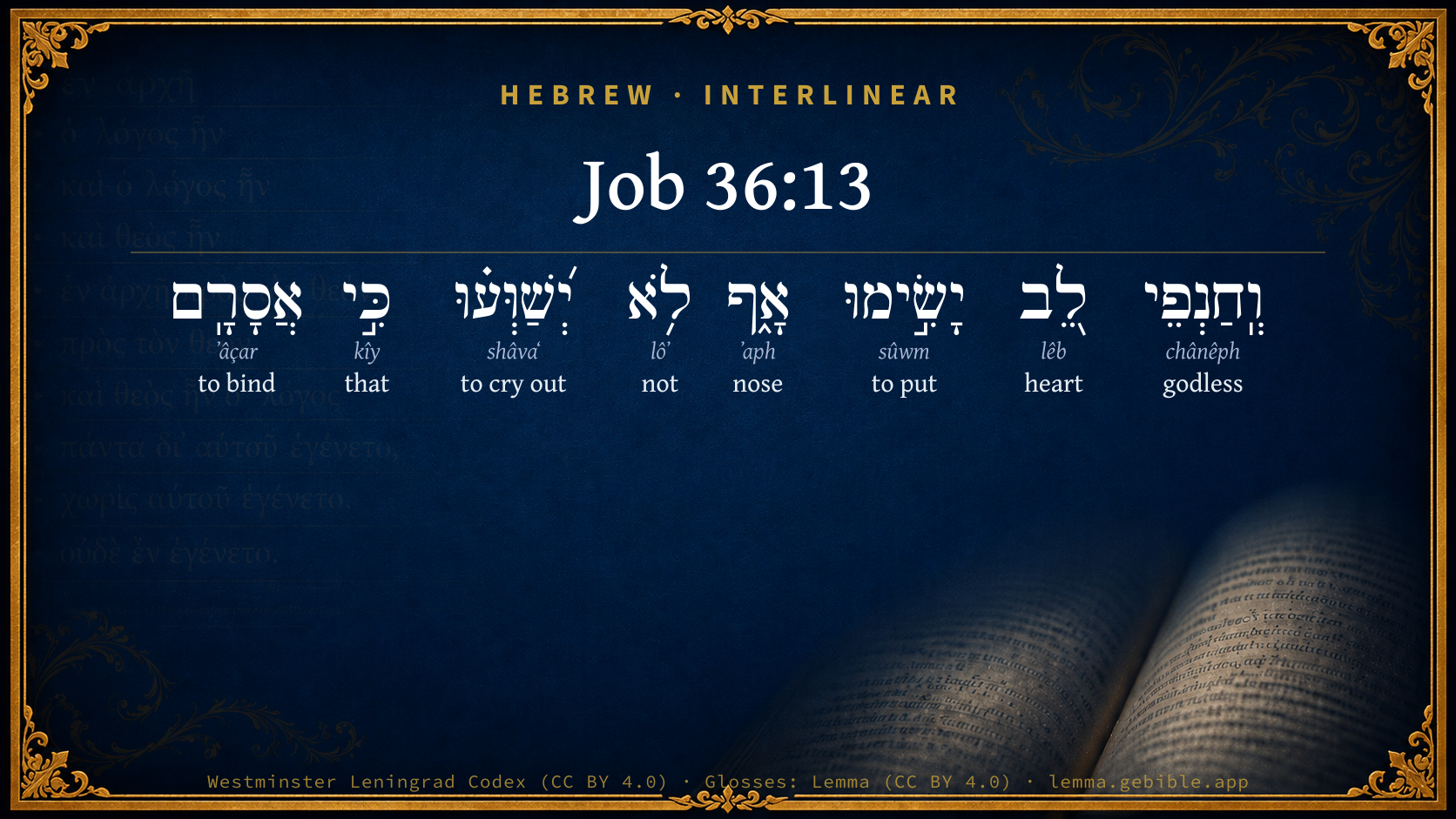
Job 36:13

Hebrew (Westminster Leningrad Codex) Job 36:13 appears in the Hebrew Old Testament. The text above is from the Westminster Leningrad Codex. Each word links to its Strong’s number, a concise gloss, and parsing drawn from the Open Scriptures Hebrew Bible morphology. Click any word for its full Brown-Driver-Briggs (BDB) entry.
Download image
Cite this verse

Job 36:13 (World English Bible). Public Domain. Lemma interlinear Bible study tool, https://lemma.gebible.app/v/job/36/13.

Show BibTeX & RIS
BibTeX
RIS
English Translation
"But those who are godless in heart lay up anger. They don't cry for help when he binds them.
World English Bible · Public Domain
Download a study sheet

One document with this verse’s original text, its word-by-word gloss line, the meaning frame, cross-references with their text, attributed commentary, and full source and license credits — printable, and it pastes into notes with its structure intact.

This verse Autodidact and up

Study sheet (.html) Plain text (.txt)

A passage Seminary Student

Up to 50 verses in one chapter. A passage sheet keeps up to 6 commentary sources and 12 cross-references per verse, in the order this page ranks them, and says so on the sheet whenever that leaves anything out. Ask for a single verse and you get the Autodidact verse sheet above.

Everything on this page stays free to read, with no account — the sheet is a download of what is already on screen, not access to it.

Want to remove ads? Support Godless Engineer
Compare translations 3

The same verse in 3 English versions, stacked beneath the original-language interlinear above. Click any original word for its lexicon entry.

Each is an independent rendering of the whole verse — the interlinear is not word-aligned to these translations.

Highlighted words mark where these versions differ — a whole-verse word diff, not a word-by-word alignment.

  • World English Bible Public Domain
    "But those who are godless in heart lay up anger. They don't cry for help when he binds them.
  • King James Version Public Domain
    But the hypocrites in heart heap up wrath: they cry not when he bindeth them.
  • unfoldingWord Literal Text CC BY-SA 4.0
    And the godless of heart keep the nose; they do not cry out when he binds them.

unfoldingWord Literal Text — © unfoldingWord, licensed CC BY-SA 4.0. Word-aligned USFM3 via Door43 (git.door43.org/unfoldingWord/en_ult).

Versions to compare (up to 4)

3 of 4 selected

Show all 18 translations

Every available English version of this verse, each an independent rendering of the whole verse.

  • World English Bible Public Domain
    "But those who are godless in heart lay up anger. They don't cry for help when he binds them.
  • Berean Standard Bible Public Domain
    The godless in heart harbor resentment; even when He binds them, they do not cry for help.
  • Majority Standard Bible Public Domain
    The godless in heart harbor resentment; even when He binds them, they do not cry for help.
  • King James Version Public Domain
    But the hypocrites in heart heap up wrath: they cry not when he bindeth them.
  • American Standard Version (1901) Public Domain
    But they that are godless in heart lay up anger: They cry not for help when he bindeth them.
  • Revised Version (1885) Public Domain
    But they that are godless in heart lay up anger: they cry not for help when he bindeth them.
  • Geneva Bible (1599) Public Domain
    But the hypocrites of heart increase the wrath: for they call not when he bindeth them.
  • Douay-Rheims (1899) Public Domain
    Dissemblers and crafty men prove the wrath of God, neither shall they cry when they are bound.
  • Young's Literal Translation Public Domain
    And the profane in heart set the face, They cry not when He hath bound them.
  • Literal Standard Version CC BY-SA 4.0
    And the profane in heart set the face, || They do not cry when He has bound them.
  • Unlocked Literal Bible CC BY-SA 4.0
    Those who are godless in heart store up their anger; they do not cry out for help even when God ties them up.
  • unfoldingWord Literal Text CC BY-SA 4.0
    And the godless of heart keep the nose; they do not cry out when he binds them.
  • Darby Bible Public Domain
    But the godless in heart heap up anger; they cry not when he bindeth them:
  • World Messianic Bible Public Domain
    “But those who are godless in heart lay up anger. They don’t cry for help when he binds them.
  • Webster's Bible Public Domain
    But the hypocrites in heart heap up wrath: they cry not when he bindeth them.
  • Free Bible Version CC BY-SA 4.0
    Those who reject God hold on to their bitterness. Even when he disciplines them they do not cry out to him for help.
  • Bible in Basic English Public Domain
    Those who have no fear of God keep wrath stored up in their hearts; they give no cry for help when they are made prisoners.
  • JPS Tanakh (1917) Public Domain
    But they that are godless in heart lay up anger; they cry not for help when He bindeth them.

Literal Standard Version (2020), Covenant Press — licensed CC BY-SA 4.0. Text via the HelloAO Bible API (eBible.org). Unlocked Literal Bible (unfoldingWord) — licensed CC BY-SA 4.0. Text via the HelloAO Bible API (eBible.org). unfoldingWord Literal Text — © unfoldingWord, licensed CC BY-SA 4.0. Word-aligned USFM3 via Door43 (git.door43.org/unfoldingWord/en_ult). Free Bible Version, Dr. Jonathan Gallagher — licensed CC BY-SA 4.0. Text via the HelloAO Bible API (eBible.org).

Word by word

More ways to search: Search by grammar → Find every occurrence → Compare this word →

Practice this passage: Drill this verse → Learn its vocabulary →

About this verse

These counts appear in no published source. They are computed here, from the morphology-tagged text and Lemma’s own curated glosses. What Lemma adds →

8
words
8
distinct lemmas
Wisdom
section

Notable vocabulary

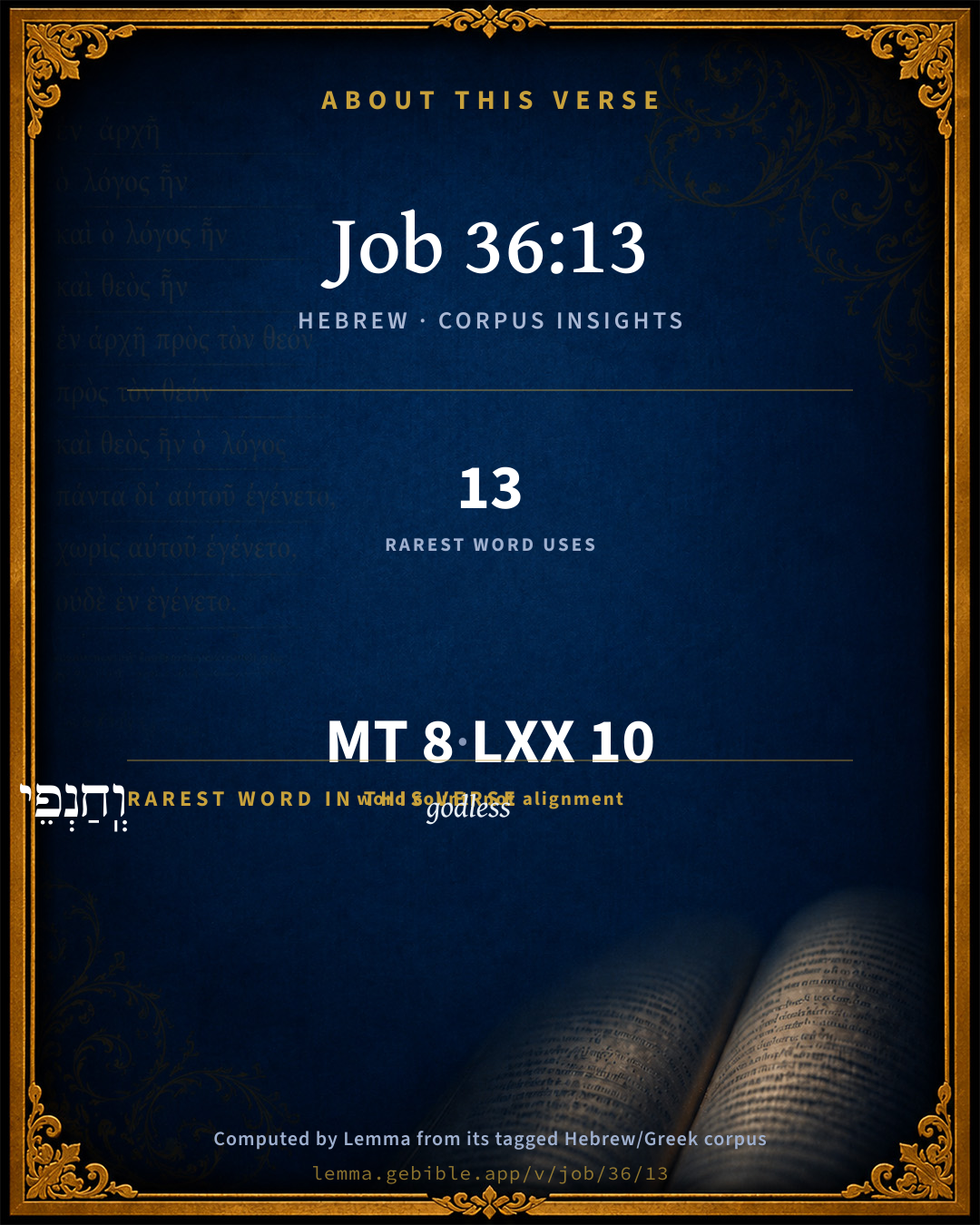
The rarest word here is וְֽחַנְפֵי godless H2611 — appearing just 13 times in the whole Hebrew Bible.

Shared distinctive vocabulary

וְֽחַנְפֵי godless H2611 occurs in 13 verses of the Hebrew Bible. Also found in:

Grammatical profile

  • 3 verbs
  • 2 nouns
  • 1 adjective
  • 1 conjunction
  • 1 particle

Verb forms

  • יָשִׂ֣ימוּ Qal · Imperfect
  • יְ֝שַׁוְּע֗וּ Piel · Imperfect
  • אֲסָרָֽם Qal · Perfect

Hebrew & Septuagint length

In English translation the verse runs 19 words from the Hebrew and 19 from the Septuagint (LXX English) — the same length.

A rough comparison of the two English renderings, which tokenize alike — not a word-level alignment.

Word counts can differ between the Hebrew and the Greek without any difference in meaning — e.g. the Hebrew direct-object marker אֵת has no separate Greek word, and Greek often adds the article ὁ.

In the original languages it is 8 Hebrew tokens and 10 Greek tokens — but the two are counted differently (Hebrew bundles its prefixes and suffixes into one token; the Greek is in lemma form), so that isn’t a like-for-like length.

Cross-references

10

Topical passages linked to Job 36:13 in the Treasury of Scripture Knowledge — connected by theme and wording, ordered by reader-vote popularity; previews shown in the World English Bible.

  • Romans 2:5 But according to your hardness and unrepentant heart you are treasuring up for yourself wrath in the day of wrath, revelation, and of the righteous judgment of God;
  • Job 27:8–10 For what is the hope of the godless, when he is cut off, When God takes away his life?
  • Job 36:8 If they are bound in fetters, And are taken in the cords of afflictions,
  • Numbers 32:14 Behold, you are risen up in your fathers' place, an increase of sinful men, to augment yet the fierce anger of Yahweh toward Israel.
  • 2 Chronicles 28:13 and said to them, You shall not bring in the captives here: for you purpose that which will bring on us a trespass against Yahweh, to add to our sins and to our trespass; for our trespass is great, and there is fierce wrath against Israel.
  • 2 Chronicles 28:22 In the time of his distress did he trespass yet more against Yahweh, this same king Ahaz.
  • Job 15:4 Yes, you do away with fear, And hinder devotion before God.
  • Job 35:9–10 "By reason of the multitude of oppressions they cry out; They cry for help by reason of the arm of the mighty.
  • Psalms 107:10 Some sat in darkness and in the shadow of death, Being bound in affliction and iron,
  • Matthew 22:12–13 and he said to him, 'Friend, how did you come in here not wearing wedding clothing?' He was speechless.

Cross-references courtesy of OpenBible.info (CC BY 4.0).

Hebrew and Greek witnesses Masoretic Hebrew ↔ Greek Septuagint

The same verse in the two great witnesses to the Old Testament, shown verse-for-verse.

These are two independent witnesses, not word-aligned to each other, and the Septuagint is shown in lemma (dictionary) form.

Hebrew Job 36:13 Masoretic · Westminster Leningrad Codex

וְֽחַנְפֵי לֵ֭ב יָשִׂ֣ימוּ אָ֑ף לֹ֥א יְ֝שַׁוְּע֗וּ כִּ֣י אֲסָרָֽם

"But those who are godless in heart lay up anger. They don't cry for help when he binds them.

World English Bible · Public Domain

Greek LXX Job 36:13 Septuagint · lemma form

καί ὑποκριτής καρδία τάσσω θυμός οὐ βοάω ὅτι δέω αὐτός

And the hypocrites in heart will array wrath against themselves; they will not cry, because he has bound them.

LXX2012 (modern English Septuagint) · Public Domain

Hebrew: Westminster Leningrad Codex (CC BY 4.0). Greek: Septuagint (public domain); English from LXX2012 (modern English Septuagint) (Public Domain). How the Septuagint differs from the Hebrew →

Commentary

Notes on Job 36:13 from classic Christian and Jewish commentators (each source and its license shown beneath its notes). The classic Christian expositions comment on the surrounding passage and are grouped to its opening verse, so a note may address several verses; the Jewish commentaries on the Tanakh (Rashi and others) are per-verse, so they appear only where the commentator wrote on this verse.

Lemma curates 59 commentaries, every one of them public domain or Creative Commons licensed, each selected and text-cleaned for this edition rather than reprinted as found. About our sources →

Trapp's Complete Commentary

John Trapp

Job 36:13 But the hypocrites in heart heap up wrath: they cry not when he bindeth them.

Ver. 13. But the hypocrites in heart heap up wrath] Or, Yet; or, Howbeit: q.d. These foul sinners, that have turned repentance into a form, and converted conversion itself into sin, though they see bad men made good and good men made better by their afflictions, and incorrigible persons destroyed before their eyes, yet they amend not by God’s hand upon them, but are the worse for it; as iron grows more cold after a heat, and as naughty boys are more stupid and more stubborn after a whipping. Hypocritis nihit stupidius. These hollow hearted ones heap up wrath against the day of wrath, as St Paul makes up this saying, Rom 2:5, which shall fall upon the Jew first, because of his pretence to religion, and then upon the Gentile. Nemo enim magis iram meretur, quam amicum simulans inimicus, saith Bernard, No man more deserveth wrath upon wrath than a feigned friend but true enemy. Such are all hypocrites, whether gross or close. And hence our Saviour’s severity against such in the Gospel, but especially Mat 23:1-39 Neither let any such goat in sheep skin think to steal on Christ’s right hand at the last day; he shall uncase such and cashier them, yea, cast them into the hottest fire of hell, whereof hypocrites are as the freeholders, and other sinners but as tenants to them, for they shall have their portion with the devil and hypocrites. Some render it, Ponunt iram, and expound it incandescunt in Deum: When they are afflicted they wax hot against God, they gather wrath, as a toad swelleth when handled, as a serpent gathereth poison to spue out at those who meddle with him.

They cry not when God binds them] Cry they do after a sort, as hogs do when to be stuck; or dogs, when tied up from their meat. Murmur they do, and expostulate a wrong with God, as those Isa 58:2-3. Non ita Deos coluimus, as that heathen hypocrite said, We have not served God so well that he should serve us no better; but pray they do not, unless it be as those hypocrites in Zec 7:1-14, who fasted to themselves, and prayed for their own ends, more to get off their chains than their sins. They bear fruit to themselves, as Ephraim, and see what comes of it.

John Trapp, A Commentary or Exposition upon All the Books of the Old and New Testament (1647–1656) — public domain. Text from a community e-Sword module.

Joseph Benson's Commentary

Job 36:13-14. But the hypocrites in heart — Such as are truly void of that piety which they profess; heap up wrath — By their impenitence and obstinacy in all conditions they treasure up God’s wrath against themselves; they cry not — Unto God for help. They live in the gross neglect of God and of prayer; when he bindeth them — Namely, with the cords of affliction expressed Job 36:8, which is mentioned as an aggravation of their wickedness; because even wicked men, if not hardened in their vices, will seek God in a time of affliction. They die in youth — They provoke God to cut them off before their time. The Hebrew is literally, Their soul dieth in youth. And their life is among the unclean — They die young because they lived among prostitutes, or sodomites, as the word,

קדשׁים, kedeshim, properly signifies: they die by some exemplary stroke of divine vengeance. Yea, and after death their life is among the unclean, the unclean spirits, the devil and his angels, for ever excluded from the New Jerusalem, into which no unclean thing shall enter.

Joseph Benson's Commentary on the Old and New Testaments (1811–1818) — public domain. Text from a community e-Sword module.

Whedon's Commentary on the Bible

Daniel D. Whedon

Strophe c — Hypocrisy of heart provokes the wrath of God — a wrath which is cumulative, since the soul defiantly resists the divine chastisement, Job_36:13-15.

13. Hypocrites — The Hebrew hhaneph frequently means also “impure.” In the opinion of some Elihu now specifies a third class.

Heap up wrath — Thus Rosenmuller, Carey, etc. Others, however, read cherish wrath, (against God.) But not the less do the “hypocrites in heart,” though they know it not, heap up wrath; or, as the apostle expresses it, treasure up unto themselves wrath against the day of wrath. Rom_2:5. “The judgments of God do not always follow crimes as thunder doth lightning.… When the sun hath shined for the space of six hours upon their tabernacles we know not what clouds the seventh may bring. And when their punishment doth come, let them make their account in the greatness of their suffering to pay the interest of that respite which hath been given them.” — HOOKER, Sermon on Joh_14:27.

They cry not, to God for pardon and help when “he bindeth them,” (as in Job_36:8,) but add to their sins “hardness and impenitence of heart.”

Daniel D. Whedon (gen. ed.), Commentary on the Old and New Testaments (1874–1909) — public domain. Text from a community e-Sword module.

Geneva Bible (1599)

Geneva Bible translators

When they are in affliction, they seek not to God for succor, as Asa in 2 Chron. 16:12; Rev. 16:11.

Which are maliciously bent against God, and flatter themselves in their vices.

Geneva Bible (1599) marginal notes — public domain. Text via Bolls.life.

Jamieson, Fausset & Brown

Robert Jamieson, A. R. Fausset & David Brown

Same sentiment as Job 36:11-12, expanded.

hypocrites--or, the ungodly [MAURER]; but "hypocrites" is perhaps a distinct class from the openly wicked (Job 36:12).

heap up wrath--of God against themselves (Rom 2:5). UMBREIT translates, "nourish their wrath against God," instead of "crying" unto Him. This suits well the parallelism and the Hebrew. But the English Version gives a good parallelism, "hypocrites" answering to "cry not" (Job 27:8, Job 27:10); "heap up wrath" against themselves, to "He bindeth them" with fetters of affliction (Job 36:8).

Jamieson, Fausset & Brown — Commentary Critical and Explanatory on the Whole Bible (1871) — public domain (CC PDM 1.0). Text via the HelloAO Bible API.

Adam Clarke's Commentary

Verse 13. But the hypocrites in heart] חנפי chanphey, the profligates, the impious, those who have neither the form nor the power of godliness. The hypocrite is he who has the form but not the power, though he wishes to be thought as inwardly righteous as he is outwardly correct; and he takes up the profession of religion only to serve secular ends. This is not the meaning of the word in the book of Job, where it frequently occurs.

They cry not] "Though he binds them, yet they cry not." They are too obstinate to humble themselves even under the mighty hand of God.

Adam Clarke's Commentary on the Bible (1810–1826) — public domain. Text from a community e-Sword/MySword module.

Ellicott's Commentary for English Readers

(13) The hypocrites in heart.—The words rather mean the godless or profane in heart.

They cry not.—That is, cry not for help.

When he bindeth them.—That is, as in Job_36:8, he has been speaking especially of one kind of affliction, like that, namely, of Joseph.

A Bible Commentary for English Readers, edited by Charles John Ellicott (1878–1897) — public domain. Text from a community e-Sword module.

The Cambridge Bible for Schools and Colleges

gen. ed. J. J. S. Perowne

13. hypocrites in heart] Rather, godless in heart; comp. ch. Job_8:13.

heap up wrath] Rather, lay up anger, i. e. in their hearts, Psa_13:2; Pro_26:24; they cherish anger at the Divine discipline (ch. Job_5:2). The “wrath” or anger referred to is their own, not that of God (Rom_2:5). The phrase does not occur elsewhere.

13, 14. Such afflictions indeed are sometimes the means of revealing what character men are of, ch. Job_5:2.

The Cambridge Bible for Schools and Colleges (gen. ed. J. J. S. Perowne; Cambridge University Press, 1878–1918) — public domain. Text from a community e-Sword module.

John Gill's Exposition

But the hypocrites in heart heap up wrath,.... Or "and the hypocrites" (s); for these are the same with the disobedient in Job 36:12; who seem to be righteous, but are not; pretend to what they have not; have a double heart, Psa 12:2, or say one thing with their mouth, and mean another thing in their hearts; or with their mouths draw nigh to God, but their hearts are far from him, Mat 15:8; and so hypocrites, at least outwardly righteous before men, but inwardly full of wickedness, as the Pharisees were, whom our Lord often calls hypocrites, Mat 15:7, these "put" or add wrath, as Aben Ezra interprets it; they increase the wrath of God; or, as we express it, heap up wrath; or, to use the apostle's phrase, treasure up wrath against the day of wrath: though some understand it of the wrath of the hypocrites against God for afflicting them; so Jarchi. When afflictions come upon them, they reproach and blaspheme; they are angry with God and are wrathful, and quarrel at his dealings with them: "they put the nose" (t); so it may be literally rendered; they erect that against God, and point it at him in a proud, haughty, wrathful, and contumacious manner;

they cry not when he bindeth them; in fetters and cords of affliction, Job 36:8; or when he corrects them, as Mr. Broughton rightly as to the sense renders it: they pray not, as Ben Gersom interprets it; whereas sanctified afflictions bring good men to the throne of grace, who have been too long absent from it: but these men cry not unto God for grace and mercy, help, assistance, and deliverance; they cry out against God, but not unto him.

(s) "et hypocritae", Montanus; "et loripedes", Schultens. (t) "ponent nasum", Montanus; "ponunt nasum". Schultens.

John Gill's Exposition of the Whole Bible (1746–1763) — public domain (CC PDM 1.0). Text via the HelloAO Bible API.

Albert Barnes' Notes on the Bible

But the hypocrites in heart heap up wrath - By their continued impiety they lay the foundation for increasing and multiplied expressions of the divine displeasure. Instead of confessing their sins when they are afflicted, and seeking for pardon: instead of returning to God and becoming truly his friends, they remaian impenitent, unconverted, and are rebellious at heart. They complain of the divine government and plans, and their feelings and conduct make it necessary for God further to interpose, until they are finally cut off and consigned to ruin. Elihu had stated what was the effect in two classes of persons who were afflicted. There were those who were truly pious, and who would receive affliction as sent from God for purposes of discipline, and who would repent and seek his mercy; Job 36:11. There were those, as a second class, who were openly wicked, and who would not be benfited by afflictions, and who would thus be cut off, Job 36:12. He says, also, that there was a third class - the class of hypocrites, who also were not profited by afflictions, and who would only by their perverseness and rebellion heap up wrath. It is “possible” that he may have designed to include Job in this number, as his three friends had done, but it seems more probable that he meant merely to suggest to Job that there was such a class, and to turn his mind to the “possibility” that he might be of the number. In explaining the design and effect of afflictions, it was at least proper to refer to this class, since it could not be doubted that there were people of this description.

They cry not when he bindeth them - They do not cry to God with the language of penitence when he binds them down by calamities; see Job 36:8.

Albert Barnes' Notes on the Bible (1834–1885) — public domain. Text from a community e-Sword/MySword module.

Haydock's Catholic Bible Commentary

Bound, in misery and evil habits. They will not have recourse to God by humble prayer, though they perceive his displeasure, and design in punishing them.

George Leo Haydock (1774–1849), Haydock's Catholic Family Bible and Commentary, 1859 edition — public domain. Excludes Psalms (Douay-Rheims chapter numbering differs from Protestant) and Deuterocanonical books (Catholic canon only).

Matthew Poole's English Annotations

The hypocrites in heart; such as are truly void of that piety which they profess; whereby he either secretly insinuates that Job was such a one; or gives him this occasion to search himself whether he were not so; or rather, admonisheth him not to carry himself like such a one, as he had hitherto done, and for which he reproved him, Job 34:8.

Heap up wrath, i.e. by their impious and obstinate carriage in all conditions, they treasure up God’s wrath against themselves.

They cry not unto God for help. They live in the gross neglect of God and of prayer.

When he bindeth them, to wit, with the cords of affliction, expressed Job 34:8, which is mentioned as an aggravation of their wickedness; because even wicked men, if not profligately bad, will seek God in time of affliction, Hos 5:15. Withal he secretly reflects upon Job as one that behaved himself like a wicked man, because though he cried out of God in way of complaint, yet he did not cry unto him by humble supplication.

Matthew Poole's English Annotations on the Holy Bible (1683–1685) — public domain. Text from a community e-Sword/MySword module.

The Pulpit Commentary

But the hypocrites in heart heap up wrath. In his vindication of God"s justice, Elihu here passes from the case of the righteous (ver. 7) to that of the "hypocrites," or rather the ungodly. They, he says, "heap up wrath," i.e. "treasure up to themselves wrath against the day of wrath", (Rom_2:5) continually intensify God"s anger against them, and, as it were, lay in a store of it, which will one day be outpoured upon them. They cry not when he bindeth them. They do not cry to him, they do not deprecate his anger, when they first find themselves bound with the "cords of affliction" (ver. 8), but allow his wrath to increase and accumulate.

The Pulpit Commentary (1880–1919), ed. H.D.M. Spence-Jones & Joseph S. Exell — public domain. Text from a community e-Sword module.

John Wesley's Explanatory Notes

Cry not - Unto God for help. Bindeth - With the cords of affliction.

John Wesley, Explanatory Notes Upon the Whole Bible (1754–1765) — public domain. Text via the GEBible commentary corpus.

Keil & Delitzsch

C. F. Keil & F. Delitzsch

13 Yet the hypocrites in heart cherish wrath,

They cry not when He hath chained them.

14 Thus their soul dieth in the vigour of youth,

And their life is like that of the unclean.

15 Yet He delivereth the sufferer by his affliction,

And openeth their ear by oppression.

He who is angry with God in his affliction, and does not humbly pray to Him, shows thereby that he is a חנף, one estranged from God (on the idea of the root, vid., i. 216), and not a צדיק. This connection renders it natural to understand not the divine wrath by אף: θησαυρίζουσιν ὀργήν (Rosenm. after Rom 2:5), or: they heap up wrath upon themselves (Wolfson, who supplies עליהם), but the impatience, discontent, and murmuring of man himself: they cherish or harbour wrath, viz., בּלבּם (comp. Job 22:22, where שׁים בלב signifies to take to heart, but at the same time to preserve in the heart). Used thus absolutely, שׂים signifies elsewhere in the book, to give attention to, Job 4:20; Job 24:12; Job 34:23, or (as Arab. wḍ‛) to lay down a pledge; here it signifies reponunt s. recondunt (with an implied in ipsis), as also Arab. šâm, fut. i, to conceal with the idea of sinking into (immittentem), e.g., the sword in the sheath. With תּמת, for ותּמת (Isa 50:2) or ותמת, the punishment which issues forth undistinguished from this frustration of the divine purpose of grace follows ἀσυνδέτως, as e.g., Hos 7:16. חיּה interchanges with נפשׁ, as Job 33:22, Job 33:28; נער (likewise a favourite word with Elihu) is intended just as Job 33:25, and in the Psa 88:16, which resembles both the Elihu section and the rest of the book. The Beth of בּקּדשׁים has the sense of aeque ac (Targ. היך), as Job 34:36, comp. תּחת, Job 34:26. Jer. translates inter effeminatos; for קדשׁים (heathenish, equivalent to קדושׁים, as כּמרים, heathenish, equivalent to כּהנים) are the consecrated men, who yielded themselves up, like the women in honour of the deity, to passive, prematurely-enervating incontinence (vid., Keil on Deu 23:18), a heathenish abomination prevailing now and again even in Israel (Kg1 14:24; Kg1 15:12; Kg1 22:47), which was connected with the worship of Astarte and Baal that was transferred from Syria, and to which allusion is here made, in accordance with the scene of the book. For the sufferer, on the other hand, who suffers not merely of necessity, but willingly, this his suffering is a means of rescue and moral purification. Observe the play upon the words יחלּץ and בּלחץ. The Beth in both instances is, in accordance with Elihu's fundamental thought, the Beth instrum.

Keil & Delitzsch — Biblical Commentary on the Old Testament (1861–1891) — public domain (CC PDM 1.0). Text via the HelloAO Bible API. (Old Testament only.)

unfoldingWord translationNotes

Door43 World Missions Community

who are godless in heart

Here the word "heart" refers to the thoughts and emotions. The phrase may indicate that the person stubbornly refuses to trust God. AT: "who refuse to trust in God" (See: Metonymy)

store up their anger

Elihu speaks of a person remaining angry as if that person stored up their anger like one would store up treasure. AT: "are always angry" (See: Metaphor)

even when God ties them up

Elihu speaks of God disciplining people as if God were tying them up with ropes. AT: "even when God punishes them" (See: Metaphor)

their lives end among the cultic prostitutes

Here "cultic prostitutes" refers to young men who served in pagan temples performing sexually immoral acts as part of their rituals. Possible meanings for this phrase are 1) the godless die because of their immoral behavior or 2) the godless die in shame and disgrace.

translationWords

godly

heart

anger

cry

God

life

unfoldingWord translationNotes — © Distant Shores Media and the Door43 World Missions Community, licensed CC BY-SA 4.0. Source: git.door43.org/Door43/en_tn.

Rashi

Rabbi Shlomo Yitzchaki (Rashi)

But the wicked of heart who are wicked—they bring about wrath; when suffering comes upon them, they curse and blaspheme,

and they do not beg mercy with supplication

when He binds them with sufferings; therefore He does not heal them.

Rashi on the Tanakh — English translations: “The Judaica Press complete Tanach with Rashi, translated by A. J. Rosenberg” (CC BY 4.0); “Pentateuch with Rashi's commentary by M. Rosenbaum and A.M. Silbermann, 1929-1934” (public domain); “The Metsudah Tanach series, Lakewood, N.J” (CC BY 4.0); and “The Book of Joshua, Metsudah Publications, 1997” (CC BY 4.0). Text via Sefaria.

Lesson kit

Teaching starters — assembled from the data on this page, not authored interpretation. Every prompt links to the verse data it draws on. Edit before teaching.

Job, in the Wisdom, opens this verse with 8 words (8 distinct Hebrew lemmas). Its most distinctive word is chânêph (“godless”). A historical commentator’s framing appears above. Read the whole chapter for the surrounding context.

Discussion questions

  1. The word chânêph carries the sense “godless.” How does it shape the verse?
  2. Job 8:13 shares the word «godless» with this verse. How do the two illuminate each other?
  3. These translations render this verse differently; the difference is in the English rendering, not the original. What questions does that raise?
  4. The verb «יָשִׂ֣ימוּ» is Qal Imperfect. How does its form color the action?
  5. Reading how Trapp's Complete Commentary and Joseph Benson's Commentary read this verse, where do the two commentators agree and where do they part?

Things to notice

Reading settings

Reading text

Shown beneath each verse's original-language words.

Old Testament
Old Testament edition

Read the OT as the Masoretic Hebrew (MT) or the Greek Septuagint (LXX).

English shown for the Greek Septuagint (in the Hebrew ↔ Greek comparison).

Comparing translations? Open the Compare panel on any verse page to stack up to four side by side.