
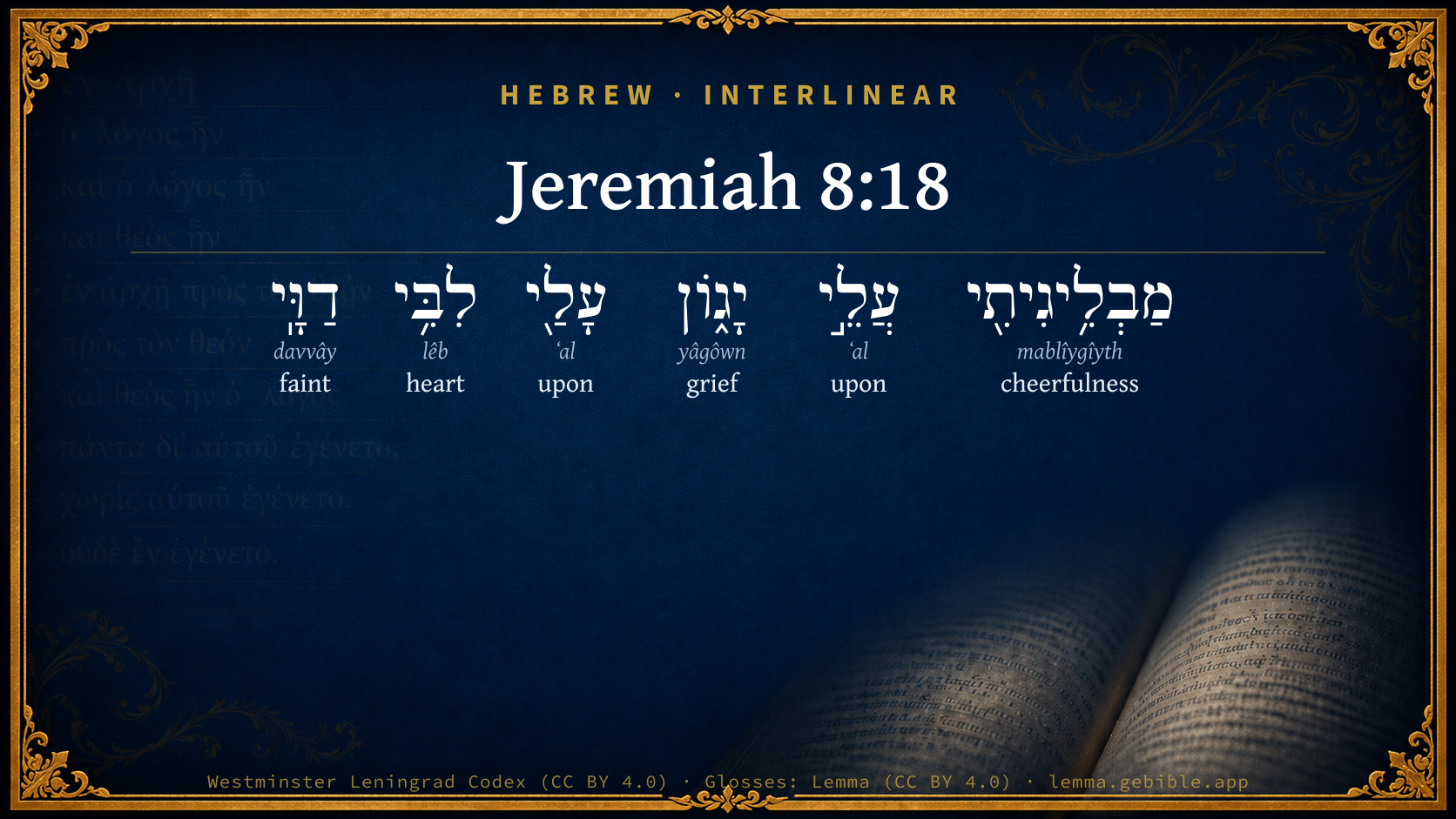
Jeremiah 8:18

Hebrew (Westminster Leningrad Codex) Jeremiah 8:18 appears in the Hebrew Old Testament. The text above is from the Westminster Leningrad Codex. Each word links to its Strong’s number, a concise gloss, and parsing drawn from the Open Scriptures Hebrew Bible morphology. Click any word for its full Brown-Driver-Briggs (BDB) entry.
Download image
Cite this verse

Jeremiah 8:18 (World English Bible). Public Domain. Lemma interlinear Bible study tool, https://lemma.gebible.app/v/jeremiah/8/18.

Show BibTeX & RIS
BibTeX
RIS
English Translation
Oh that I could comfort myself against sorrow! my heart is faint within me.
World English Bible · Public Domain
Highlights
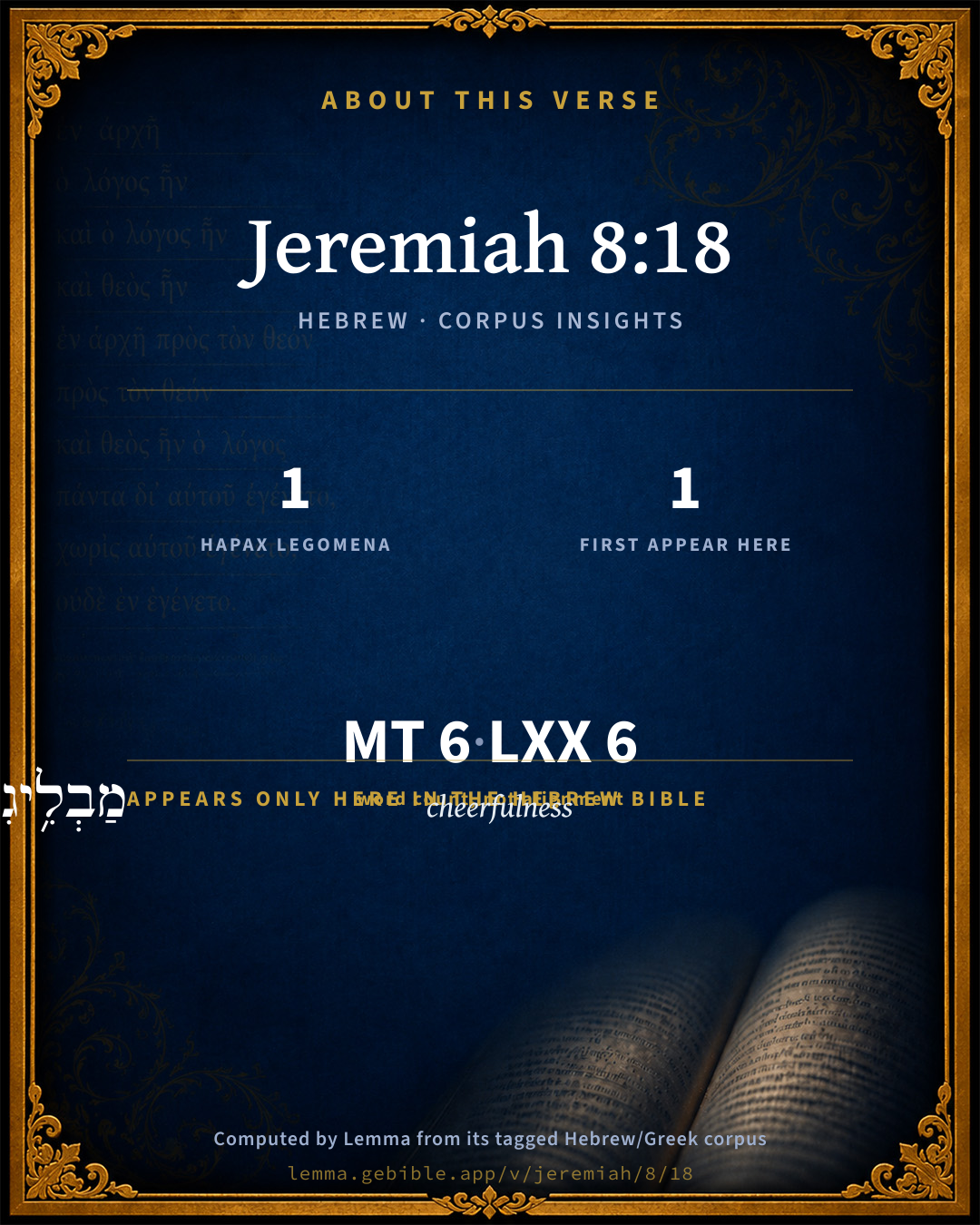
  • 1 hapax legomenon — only here in the Hebrew Bible
  • 1 first appearance in the Hebrew Bible
Full analysis ↓
Download a study sheet

One document with this verse’s original text, its word-by-word gloss line, the meaning frame, cross-references with their text, attributed commentary, and full source and license credits — printable, and it pastes into notes with its structure intact.

This verse Autodidact and up

Study sheet (.html) Plain text (.txt)

A passage Seminary Student

Up to 50 verses in one chapter. A passage sheet keeps up to 6 commentary sources and 12 cross-references per verse, in the order this page ranks them, and says so on the sheet whenever that leaves anything out. Ask for a single verse and you get the Autodidact verse sheet above.

Everything on this page stays free to read, with no account — the sheet is a download of what is already on screen, not access to it.

Want to remove ads? Support Godless Engineer
Compare translations 3

The same verse in 3 English versions, stacked beneath the original-language interlinear above. Click any original word for its lexicon entry.

Each is an independent rendering of the whole verse — the interlinear is not word-aligned to these translations.

Highlighted words mark where these versions differ — a whole-verse word diff, not a word-by-word alignment.

  • World English Bible Public Domain
    Oh that I could comfort myself against sorrow! my heart is faint within me.
  • King James Version Public Domain
    When I would comfort myself against sorrow, my heart is faint in me.
  • unfoldingWord Literal Text CC BY-SA 4.0
    Joy of me in sorrow; my heart faint within me.

unfoldingWord Literal Text — © unfoldingWord, licensed CC BY-SA 4.0. Word-aligned USFM3 via Door43 (git.door43.org/unfoldingWord/en_ult).

Versions to compare (up to 4)

3 of 4 selected

Show all 18 translations

Every available English version of this verse, each an independent rendering of the whole verse.

  • World English Bible Public Domain
    Oh that I could comfort myself against sorrow! my heart is faint within me.
  • Berean Standard Bible Public Domain
    My sorrow is beyond healing; my heart is faint within me.
  • Majority Standard Bible Public Domain
    My sorrow is beyond healing; my heart is faint within me.
  • King James Version Public Domain
    When I would comfort myself against sorrow, my heart is faint in me.
  • American Standard Version (1901) Public Domain
    Oh that I could comfort myself against sorrow! my heart is faint within me.
  • Revised Version (1885) Public Domain
    Oh that I could comfort myself against sorrow! my heart is faint within me.
  • Geneva Bible (1599) Public Domain
    I would haue comforted my selfe against sorowe, but mine heart is heauie in me.
  • Douay-Rheims (1899) Public Domain
    My sorrow is above sorrow, my heart mourneth within me.
  • Young's Literal Translation Public Domain
    My refreshing for me `is' sorrow, For me my heart `is' sick.
  • Literal Standard Version CC BY-SA 4.0
    My sorrow [is] beyond comfort, || My heart [is] sick in me.
  • Unlocked Literal Bible CC BY-SA 4.0
    My sorrow has no end, and my heart is sick.
  • unfoldingWord Literal Text CC BY-SA 4.0
    Joy of me in sorrow; my heart faint within me.
  • Darby Bible Public Domain
    My comfort in my sadness! my heart is faint in me!
  • World Messianic Bible Public Domain
    Oh that I could comfort myself against sorrow! My heart is faint within me.
  • Webster's Bible Public Domain
    When I would comfort myself against sorrow, my heart is faint in me.
  • Free Bible Version CC BY-SA 4.0
    Nothing comforts me in my suffering; I feel terrible inside.
  • Bible in Basic English Public Domain
    Sorrow has come on me! my heart in me is feeble.
  • JPS Tanakh (1917) Public Domain
    Though I would take comfort against sorrow, my heart is faint within me.

Literal Standard Version (2020), Covenant Press — licensed CC BY-SA 4.0. Text via the HelloAO Bible API (eBible.org). Unlocked Literal Bible (unfoldingWord) — licensed CC BY-SA 4.0. Text via the HelloAO Bible API (eBible.org). unfoldingWord Literal Text — © unfoldingWord, licensed CC BY-SA 4.0. Word-aligned USFM3 via Door43 (git.door43.org/unfoldingWord/en_ult). Free Bible Version, Dr. Jonathan Gallagher — licensed CC BY-SA 4.0. Text via the HelloAO Bible API (eBible.org).

Word by word

More ways to search: Search by grammar → Find every occurrence → Compare this word →

Practice this passage: Drill this verse → Learn its vocabulary →

About this verse

These counts appear in no published source. They are computed here, from the morphology-tagged text and Lemma’s own curated glosses. What Lemma adds →

6
words
5
distinct lemmas
Prophets
section

Notable vocabulary

1 hapax legomenon — a word that appears only here in the entire Hebrew Bible:

  • מַבְלִ֥יגִיתִ֖י cheerfulness H4010

First appearance in Scripture

This word makes its first canonical appearance in the Hebrew Bible here:

  • מַבְלִ֥יגִיתִ֖י cheerfulness H4010

Shared distinctive vocabulary

דַוָּֽי faint H1742 occurs in 3 verses of the Hebrew Bible. Also found in:

Grammatical profile

  • 3 nouns
  • 1 adjective
  • 2 prepositions

Repetition

A word recurs within this verse — often emphatic in Hebrew:

  • עֲלֵ֣י upon H5921 ×2

Hebrew & Septuagint length

In the original languages it is 6 Hebrew tokens and 6 Greek tokens — but the two are counted differently (Hebrew bundles its prefixes and suffixes into one token; the Greek is in lemma form), so that isn’t a like-for-like length.

Cross-references

8

Topical passages linked to Jeremiah 8:18 in the Treasury of Scripture Knowledge — connected by theme and wording, ordered by reader-vote popularity; previews shown in the World English Bible.

  • Isaiah 22:4 Therefore said I, Look away from me, I will weep bitterly; don't labor to comfort me for the destruction of the daughter of my people.
  • Jeremiah 6:24 We have heard the report of it; our hands wax feeble: anguish has taken hold of us, [and] pangs as of a woman in travail.
  • Lamentations 1:16–17 For these things I weep; my eye, my eye runs down with water; Because the comforter who should refresh my soul is far from me: My children are desolate, because the enemy has prevailed.
  • Lamentations 5:17 For this our heart is faint; For these things our eyes are dim;
  • Job 7:13–14 When I say, 'My bed shall comfort me, My couch shall ease my complaint;'
  • Jeremiah 10:19–22 Woe is me because of my hurt! my wound is grievous: but I said, Truly this is [my] grief, and I must bear it.
  • Daniel 10:16–17 Behold, one in the likeness of the sons of men touched my lips: then I opened my mouth, and spoke and said to him who stood before me, my lord, by reason of the vision my sorrows are turned on me, and I retain no strength.
  • Habakkuk 3:16 I heard, and my body trembled. My lips quivered at the voice. Rottenness enters into my bones, and I tremble in my place, Because I must wait quietly for the day of trouble, For the coming up of the people who invade us.

Cross-references courtesy of OpenBible.info (CC BY 4.0).

Hebrew and Greek witnesses Masoretic Hebrew ↔ Greek Septuagint

The same verse in the two great witnesses to the Old Testament, shown verse-for-verse.

These are two independent witnesses, not word-aligned to each other, and the Septuagint is shown in lemma (dictionary) form.

Hebrew Jeremiah 8:18 Masoretic · Westminster Leningrad Codex

מַבְלִ֥יגִיתִ֖י עֲלֵ֣י יָג֑וֹן עָלַ֖י לִבִּ֥י דַוָּֽי

Oh that I could comfort myself against sorrow! my heart is faint within me.

World English Bible · Public Domain

Greek LXX Structure differs

In the Septuagint, Jeremiah is about an eighth shorter than the Hebrew and arranges its material differently — the Oracles Against the Nations (Hebrew chapters 46–51) appear in the middle of the Greek book, after 25:13. Because the chapter and verse boundaries do not line up, a verse-for-verse comparison with the Hebrew is not shown.

A verse-for-verse comparison isn’t shown here because the chapters and verses don’t line up. Switch to the LXX edition with the MT / LXX toggle above to read the Greek directly.

On this verse, John Gill's Exposition discusses the Septuagint’s reading. Read the note in Commentary ↓

Hebrew: Westminster Leningrad Codex (CC BY 4.0). Greek: Septuagint (public domain); English from a public-domain English Septuagint. How the Septuagint differs from the Hebrew →

Targum (Aramaic paraphrase)

1

The Targum is the ancient Jewish Aramaic paraphrase of the Hebrew Scriptures — an interpretive translation, not the Hebrew text itself. Onkelos (literal) and Pseudo-Jonathan (expansive) render the Torah, and Jonathan the Prophets. Coverage is partial: where no permissively-licensed English translation exists for a verse, only the Aramaic is shown. This is verse-level text, not a word-by-word alignment to the Hebrew.

  1. Targum Jonathan Prophets (Joshua–Malachi)
    עַל דַהֲווֹ מַלְעִיגִין לְקָבַל נְבִיַיָא דְמִתְנַבָּן לְהוֹן דַוָנָא וְתֵינַחְתָּא אַיְתִי עֲלֵיהוֹן מִן קֳדָם חוֹבֵיהוֹן עֲלֵיהוֹן אֲמַר נְבִיַיָא לִבִּי דַוָי:

    (no public-domain English translation for this verse)

    Targum Jonathan — Aramaic: “Mikraot Gedolot” (public domain). English: “Sefaria Community Translation” (CC0 1.0 (public-domain dedication)); “London "Chaldee Paraphrase," 1871” (public domain). Text via Sefaria.

Commentary

Notes on Jeremiah 8:18 from classic Christian and Jewish commentators (each source and its license shown beneath its notes). The classic Christian expositions comment on the surrounding passage and are grouped to its opening verse, so a note may address several verses; the Jewish commentaries on the Tanakh (Rashi and others) are per-verse, so they appear only where the commentator wrote on this verse.

Lemma curates 59 commentaries, every one of them public domain or Creative Commons licensed, each selected and text-cleaned for this edition rather than reprinted as found. About our sources →

Trapp's Complete Commentary

John Trapp

Jer 8:18 [When] I would comfort myself against sorrow, my heart [is] faint in me.

Ver. 18. When I would comfort myself, &c.] Or, as some render it, O my comfort against sorrow, i.e., O my God; others, My recreation is joined with sorrow.

John Trapp, A Commentary or Exposition upon All the Books of the Old and New Testament (1647–1656) — public domain. Text from a community e-Sword module.

Joseph Benson's Commentary

Jer 8:18-19. When I would comfort myself, &c. — “When I would apply comfort to myself, my heart misgives me: I find great reason for my fears, and none for my hopes.” Blaney translates the verse, sorrow is upon me past my remedying; my heart within me is faint. They seem to be the words of the prophet, who had endeavoured to comfort himself in his trouble by acquiescing in the will of God; but the miseries coming on his countrymen continually occurring to his mind in all their horrors and aggravations, deprived him of all comfort, and rendered him inconsolable. Behold the voice of the cry — The bitter cries and lamentations, which methinks I hear; of the daughter of my people — To whose welfare I cannot be indifferent; because of them that dwell in a far country — Namely, their enemies the Chaldeans, who were coming against them. But the words may be rendered more agreeably to the Hebrew thus, The voice of the cry of the daughter of my people from a land afar off. Compare Isa 33:17, where the phrase in the original, ארצ מרחקים, is the same. Thus interpreted, the words express the doleful complaints of the Jews in their state of captivity, as if God had quite forsaken and disowned them. In this light many commentators understand the prophet. He “anticipates,” says Blaney, “in his imagination, the captivity of his countrymen in Babylon, a far country; and represents them there as asking, with a mixture of grief and astonishment, if there was no such being as JEHOVAH, who presided in Zion, that he so neglected his people, and suffered them to continue in such a wretched plight. Upon this complaint of theirs, God justly breaks in with a question on his part, and demands why, if they acknowledged such a protector as himself, they had deserted his service, and by going over to idols, with which they had no natural connection, had forfeited all title to his favour.” Why have they provoked me to anger? — Some translators, to render the sense more evident, supply here the words, saith God; for it is evident that it is God, and not the prophet, who speaks here, telling them that their sins were the cause of his forsaking them; and that as they provoked him to anger by their idolatries, so he would no longer defend them.

Joseph Benson's Commentary on the Old and New Testaments (1811–1818) — public domain. Text from a community e-Sword module.

Whedon's Commentary on the Bible

Daniel D. Whedon

CAPTIVITY AND SORROW, Jer_8:18-22.

18. When I would comfort, etc. — The original for “comfort” is a noun used vocatively, and occurs only here. Hence, the rendering should be, O my comfort in sorrow, my heart grows sick in me.

Daniel D. Whedon (gen. ed.), Commentary on the Old and New Testaments (1874–1909) — public domain. Text from a community e-Sword module.

Tyndale Open Study Notes

Tyndale Open Resources

8:18–9:26 The priests in the Temple expertly memorized and repeated carefully crafted prayers as rituals in the Temple worship. Repeating the precise wording of the prayers was thought to be very important; failure to do so drained the prayers of their perceived magical power. The character of the priests who uttered the prayers was considered of minor importance. The same was true of lamentations. In contrast, Jeremiah’s prayers and lamentations were spontaneous and occupied him to the depths of his being.

Tyndale Open Study Notes — © Tyndale Open Resources, licensed CC BY-SA 4.0. Text via the HelloAO Bible API.

Geneva Bible (1599)

Geneva Bible translators

Read Jer. 4:19.

Geneva Bible (1599) marginal notes — public domain. Text via Bolls.life.

Jamieson, Fausset & Brown

Robert Jamieson, A. R. Fausset & David Brown

(Isa 22:4). The lamentation of the prophet for the impending calamity of his country.

against sorrow--or, with respect to sorrow. MAURER translates, "Oh, my exhilaration as to sorrow!" that is, "Oh, that exhilaration ('comfort', from an Arabic root, to shine as the rising sun) would shine upon me as to my sorrow!"

in me--within me.

Jamieson, Fausset & Brown — Commentary Critical and Explanatory on the Whole Bible (1871) — public domain (CC PDM 1.0). Text via the HelloAO Bible API.

John Calvin's Commentaries

Interpreters explain differently the word מבלגיתי, mebelgiti. Some take מ, mem, in the sense of ב, beth; but others, with whom I agree, regard it as a servile, deriving the word from בלג, belag; and this letter is prefixed to it to shew that it is a noun. The ת, tau, also at the end, is a servile.

The Prophet then means, that he sought strength in his sorrow, but that his heart was weak He no doubt, I think, sets forth in this verse the perverse character of the people, — that they sought through their obstinacy to drive away every punishment. This could not indeed be referred to himself, or to those who were like him, as we know how fearful are God’s servants with regard to his wrath; for as the fear of God prevails in their hearts, so they are easily terrified by his judgment; but hypocrites and wicked men ever harden themselves as far as they can. They then strengthened themselves against God, and thought in this way to be conquerors. Since they thus perversely contended with God, the Prophet sets forth here the great hardness of the people: I would, he says, strengthen myself in my sorrow; but my heart is within me weak; that is, “In vain are these remedies tried; in vain have ye hitherto endeavored to strengthen yourselves, and have sought fortresses and strongholds against God; for sorrow will at length prevail, as the Lord will add troubles to troubles, so that ye must at length succumb under them.”

He means the same when he says, his heart was within him weak: “I have, “he says, “been oppressed with sorrow, when I thought I had strength enough to resist.” For thus the ungodly think manfully to act, when they madly resist God; but at length they find by the event that they in vain seek thus to strengthen themselves; for our heart, he says, will become within us weak, and debility itself will at last oppress and overwhelm us.

John Calvin's Commentaries (1540-1563) — public domain. Text from the Calvin Translation Society English edition (1840s-50s) via the Christian Classics Ethereal Library (ccel.org). Calvin's coverage is partial (roughly two-thirds of the Bible); uncommented books and verses are honest gaps, never fabricated. The 19th-century editor's footnotes and remarks are omitted so the notes are faithfully Calvin's own voice.

Ellicott's Commentary for English Readers

(18) When I would comfort myself . . .—The word translated comfort is not found elsewhere, and has been very differently understood. Taking the words as spoken after a pause, they come as a cry of sorrow following the proclamation of the judgment of Jehovah, Ah, my comfort against sorrow! (mourning for it as dead and gone); my heart is sick within me. The latter phrase is the same as in Isa_1:5.

A Bible Commentary for English Readers, edited by Charles John Ellicott (1878–1897) — public domain. Text from a community e-Sword module.

The Cambridge Bible for Schools and Colleges

gen. ed. J. J. S. Perowne

18. Oh that I could comfort myself] lit. brighten myself. The Hebrew verb occurs here only, but is found in Arabic in this sense. See further in Dr., p. 352.

The Cambridge Bible for Schools and Colleges (gen. ed. J. J. S. Perowne; Cambridge University Press, 1878–1918) — public domain. Text from a community e-Sword module.

John Gill's Exposition

Behold, the voice of the cry of the daughter of my people,.... This was what made his heart faint, such was his sympathy with his countrymen, his people in distress, whom he affectionately calls the daughter of his people, whose cry was loud, and whose voice he heard lamenting their case:

because of them that dwell in a far country; because of the Chaldeans, who came from a far country; see Jer 5:15 who were come into their land, and devoured it; through fear of them, and because of the devastation they made; hence the voice of their cry: or this is to be understood of the Jews in a far country, carried captive into Babylon, and the voice of their cry there, because of their captivity and oppression. So Abarbinel and the Targum,

"lo, the voice of the cry of the congregation of my people from a far country;''

and so read the Septuagint, Vulgate Latin, Syriac, and Arabic versions.

Is not the Lord in Zion? is not her King in her? these are the words of the people, complaining of the Lord, calling in question whether he was in Zion, and whether he was King there; and if he was, how came it to pass that he did not protect it; that he suffered the city to be taken, and the inhabitants to be carried captive?

Why have they provoked me to anger with their graven images, and with their strange vanities? that is, with their idols, and their idolatrous worship; this is the Lord's answer to them, giving a reason why he suffered the enemy to come in among them, and prevail over them, namely, their idolatry. It may be rendered, "with the vanities of a stranger" (n); of a strange people, or of a strange god.

(n) "in vanitatibus alienigenae", Montanus; "sub. populi", Vatablus; "dei alieni", Pagninus So Ben Melech.

John Gill's Exposition of the Whole Bible (1746–1763) — public domain (CC PDM 1.0). Text via the HelloAO Bible API.

Albert Barnes' Notes on the Bible

Rather, “O my comfort in sorrow: my heart faints for me.” The word translated “comfort” is by some supposed to be corrupt. With these mournful ejaculations a new strophe begins, ending with Jer 9:1, in which the prophet mourns over the miserable fate of his countrymen, among whom he had been earnestly laboring, but all in vain.

Albert Barnes' Notes on the Bible (1834–1885) — public domain. Text from a community e-Sword/MySword module.

Haydock's Catholic Bible Commentary

Me. God, Jeremias, the people, or rather Jerusalem bewails her children. (Calmet)

George Leo Haydock (1774–1849), Haydock's Catholic Family Bible and Commentary, 1859 edition — public domain. Excludes Psalms (Douay-Rheims chapter numbering differs from Protestant) and Deuterocanonical books (Catholic canon only).

Matthew Poole's English Annotations

The language of the people, being long shut up in their cities, and finding no relief, at last faint, Lam 4:17. But more probably the prophet now seems to speak his own resentments, how greatly the calamity of his people did affect him; the like Isa 22:4; when he would sometimes refresh himself with the comfortable refreshments of nature, the thoughts of his people’s misery do so afflict him, that his heart is ready to faint, to sink within him.

Matthew Poole's English Annotations on the Holy Bible (1683–1685) — public domain. Text from a community e-Sword/MySword module.

The Pulpit Commentary

Ver. 18-Jer 9:50 The captivity of Judah and the deep sorrow of Jeremiah.

When I would comfort myself, etc. The text is here extremely difficult, and if there is corruption anywhere it is in the opening of this verse. Ewald and Graf suppose an ellipsis, and render, "(Oh for) my enlivening i.e. an enlivening for me in trouble!" Hitzig more naturally renders in the vocative, "My enlivener in trouble" which he supposes to be in apposition to my heart. Do Dieu (1648) wavers between this and the view that it is an address to his wife, "Quae marito solatio est." (See, however, Jer_16:2)

Ver. 18 -Jer_9:1) Ver. 18, "When I would comfort myself," etc. All hope dies down, is crushed beneath the overwhelming evidence of the hopelessness of his people"s condition. Ver. 21: he is as if wounded, his heart is clad in the garb of deepest woe, the black raiment of the mourner. Jer_9:1: he has exhausted his power of telling forth his deep grief, his eyes refuse to weep more, though his heart be sore pierced, and the troubles of his people are unrelieved. Therefore he desires that he might weep continually.

II ITS GROUNDS.

1. They were still trusting in lying words (ver, 19), reckoning that, because the temple of Jehovah and the throne of David belonged, to them, therefore they should have been secure. Though in distant lands, in actual captivity for there the prophet contemplates them they were still imagining that the possession of the temple and David"s throne should have been their sure safeguard. It is terrible to see God"s judgments coming upon guilty men, but when these judgments themselves seem to fail in teaching the needed lesson, that is a greater sorrow still.

2. The time of redemption was over. (Ver. 20) The long harvest days, the bright summer weather symbols of all days of opportunity these were gone, The days when they might have turned to God and found deliverance, "the wrath of God had arisen against them, and there was no remedy." But what a retrospect is his who has to say as did Post Israel, The harvest is past," etc.! For:

(1) Such seasons remind us of our privileges and obligations.

(a) It is a time of fruitfulness, of great privilege, grace, and goodness. God makes man"s cup to overflow. Youth and days of gospel privilege. Sundays, sacred services, etc.

(b) It should be a time of great activity. The natural harvest and summertime is so. For:

(c) It is a season of such limited duration.

(2) But men often let these times pass away unimproved.

(a) The world hinders them.

(b) Perversion of Scripture truths.

(c) Belief that they are well enough as they are.

(d) Procrastination.

(3) But once gone, the fruits of that summer and that harvest can never be saved. Such facts as these open the floodgates of grief in hearts like that of Jeremiah.

3. He could see no means of restoration or recovery whatsoever (Ver. 22), no balm and no physician anywhere.

III ITS WORD TO ALL WHO SHOULD KNOW OR ARE THE CAUSES OF SUCH GRIEF NOW.

1. Christ"s servants should be in sympathy with the prophet"s lament. It is because we are so indifferent the world is so. "Si vis me flere flendum est," it is ever saying, but in vain, to the professing Church. Oh for the compassion of Jeremiah and yet more of Christ! If we sowed in tears we should reap in joy. If so we went forth "bearing precious seed, we shall doubtless come again rejoicing, bringing," etc.

2. But you who cause such grief, think you not that if such be the result of anticipating God"s judgments upon sin, the enduring of them must be far worse? And that is your part in them. Christ himself assured the weeping women who followed him to Calvary that the woes of them who crucified him would be worse than his own. "If they do these things in a green tree, what shall be done in the dry?

CONCLUSION. Then, instead of causing sorrow to the faithful servants of God by resisting their appeals, yield to them, and so gladden these servants, and the angels of God, and the heart of God, and the Son of God. So you yourself shall enter into the joy of your Lord. C.

The Pulpit Commentary (1880–1919), ed. H.D.M. Spence-Jones & Joseph S. Exell — public domain. Text from a community e-Sword module.

John Wesley's Explanatory Notes

Sorrow - The prophet now seems to speak, how greatly the calamity of this people affected him.

John Wesley, Explanatory Notes Upon the Whole Bible (1754–1765) — public domain. Text via the GEBible commentary corpus.

unfoldingWord translationNotes

Door43 World Missions Community

General Information:

Jeremiah and Yahweh have a conversation about the people of Judah.

My sorrow has no end

The word "my" refers to Jeremiah. The original text is unclear and is interpreted here in different ways by modern versions.

has no end

These words are an exaggeration that express the great extent of Jeremiah's sorrow. AT: "is very great" (See: Hyperbole and Generalization)

my heart is sick

Here "heart" represents Jeremiah, emphasizing his feelings and emotions. AT: "I feel sick deep down inside me" (See: Synecdoche)

Behold!

This alerts the reader to pay attention to what follows. "Pay attention!"

the daughter of my people

Jeremiah is speaking about the people of Judah in a way that shows his affection for them, as if for a daughter. See how you translated this in Jeremiah 4:11. AT: "my dear people" (See: Metaphor)

from a land far away

Possible meanings are 1) From exile. AT: "from exile in a distant land" or 2) From throughout the land of Judah. AT: "throughout our land"

Is Yahweh not in Zion? Is her king no longer there?

These two questions are similar in meaning. They imply that the people of Judah are wondering why Yahweh is not saving them. AT: "Why does Yahweh not save us if he is the king in Zion?" (See: Parallelism and Assumed Knowledge and Implicit Information and Rhetorical Question)

Why then do they provoke me to anger with their carved figures and their worthless foreign idols?

The word "me" refers to Yahweh. This question can be translated as a statement. AT: "If they want me to save them, then they must not offend me with their carved figures." (See: Rhetorical Question)

translationWords

heart

voice

Zion

king

image

worthy

alien

false god

unfoldingWord translationNotes — © Distant Shores Media and the Door43 World Missions Community, licensed CC BY-SA 4.0. Source: git.door43.org/Door43/en_tn.

Rashi

Rabbi Shlomo Yitzchaki (Rashi)

Were I to suppress my grief Heb. מבליגיתי, my suppression, and it is a noun, (mes estenimenc in O.F.). That is to say, if I said, I will suppress and keep in my grief.

my heart is sick within me From the voice of the prophecies that are revealed to me of the coming retributions.

Rashi on the Tanakh — English translations: “The Judaica Press complete Tanach with Rashi, translated by A. J. Rosenberg” (CC BY 4.0); “Pentateuch with Rashi's commentary by M. Rosenbaum and A.M. Silbermann, 1929-1934” (public domain); “The Metsudah Tanach series, Lakewood, N.J” (CC BY 4.0); and “The Book of Joshua, Metsudah Publications, 1997” (CC BY 4.0). Text via Sefaria.

Lesson kit

Teaching starters — assembled from the data on this page, not authored interpretation. Every prompt links to the verse data it draws on. Edit before teaching.

Jeremiah, in the Prophets, opens this verse with 6 words (5 distinct Hebrew lemmas). Its most distinctive word is mablîygîyth (“cheerfulness”). A historical commentator’s framing appears above. Read the whole chapter for the surrounding context.

Discussion questions

  1. What does “cheerfulness” (mablîygîyth) contribute to the verse as a whole?
  2. This verse holds 1 word here found nowhere else in the Hebrew Bible. What might the rare word draw attention to?
  3. The word “cheerfulness” first appears here in Scripture. What is being introduced at this debut?
  4. Isaiah 1:5 shares the word «faint» with this verse. How do the two illuminate each other?
  5. “upon” occurs 2× in this one verse. What is the effect of the repetition?
  6. The translations on this page render this verse differently — a whole-verse word diff, not a word-by-word alignment. What might account for the different wordings?
  7. Reading how Trapp's Complete Commentary and Joseph Benson's Commentary read this verse, where do the two commentators agree and where do they part?

Things to notice

  • 1 word in this verse appears nowhere else in the Hebrew Bible.
  • 1 word makes its first canonical appearance in Scripture here.
  • This verse counts 6 Hebrew ↔ 6 Greek words.
  • These translations choose different wording for 10 words in this verse.
  • “upon” occurs 2× in this single verse.

Reading settings

Reading text

Shown beneath each verse's original-language words.

Old Testament
Old Testament edition

Read the OT as the Masoretic Hebrew (MT) or the Greek Septuagint (LXX).

English shown for the Greek Septuagint (in the Hebrew ↔ Greek comparison).

Comparing translations? Open the Compare panel on any verse page to stack up to four side by side.