Ezekiel 20:16

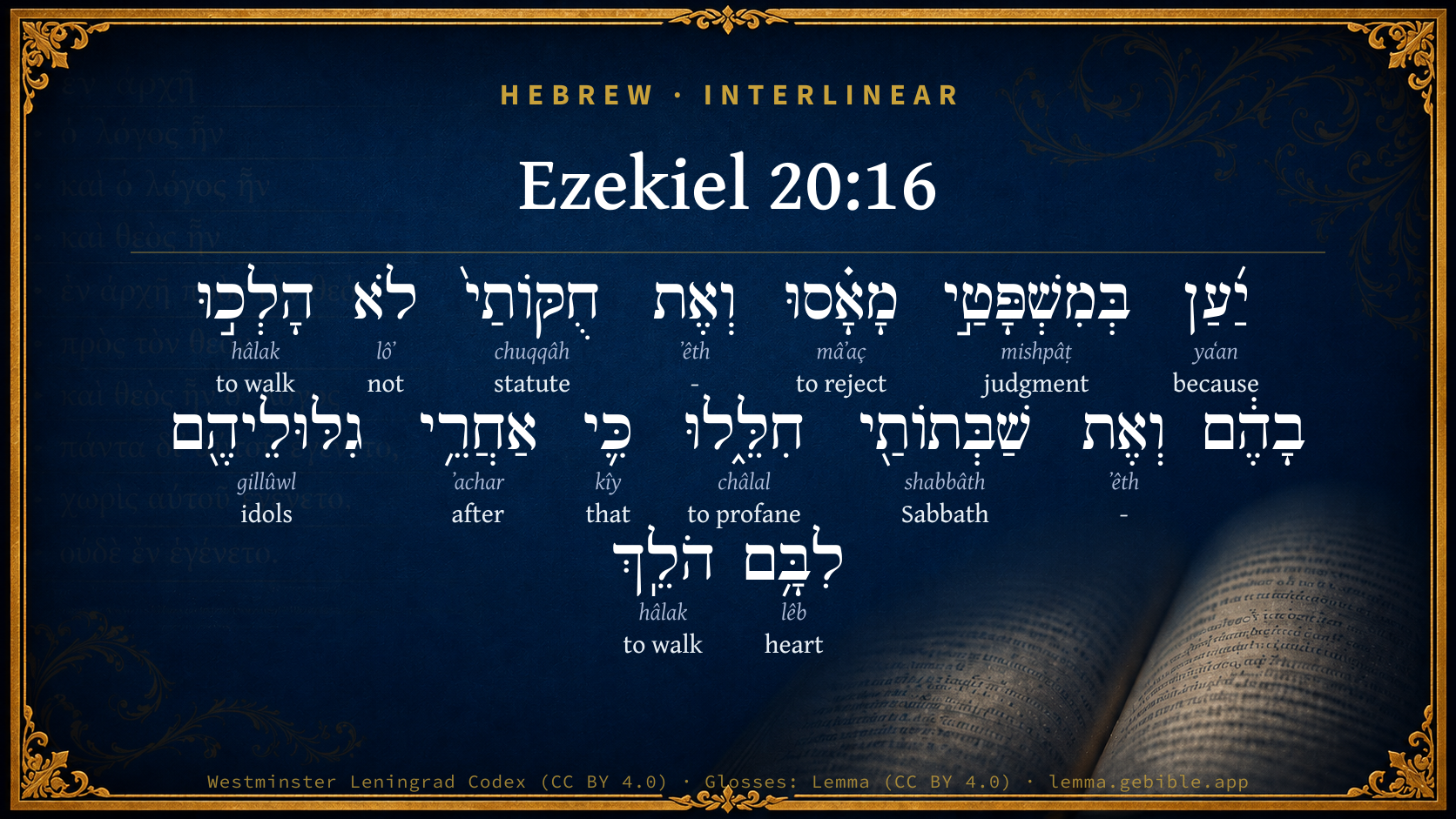
Hebrew (Westminster Leningrad Codex) Ezekiel 20:16 appears in the Hebrew Old Testament. The text above is from the Westminster Leningrad Codex. Each word links to its Strong’s number, a concise gloss, and parsing drawn from the Open Scriptures Hebrew Bible morphology. Click any word for its full Brown-Driver-Briggs (BDB) entry.
Download image
Cite this verse

Ezekiel 20:16 (World English Bible). Public Domain. Lemma interlinear Bible study tool, https://lemma.gebible.app/v/ezekiel/20/16.

Show BibTeX & RIS
BibTeX
RIS
English Translation
because they rejected my ordinances, and didn't walk in my statutes, and profaned my Sabbaths: for their heart went after their idols.
World English Bible · Public Domain
Download a study sheet

One document with this verse’s original text, its word-by-word gloss line, the meaning frame, cross-references with their text, attributed commentary, and full source and license credits — printable, and it pastes into notes with its structure intact.

This verse Autodidact and up

Study sheet (.html) Plain text (.txt)

A passage Seminary Student

Up to 50 verses in one chapter. A passage sheet keeps up to 6 commentary sources and 12 cross-references per verse, in the order this page ranks them, and says so on the sheet whenever that leaves anything out. Ask for a single verse and you get the Autodidact verse sheet above.

Everything on this page stays free to read, with no account — the sheet is a download of what is already on screen, not access to it.

Want to remove ads? Support Godless Engineer
Compare translations 3

The same verse in 3 English versions, stacked beneath the original-language interlinear above. Click any original word for its lexicon entry.

Each is an independent rendering of the whole verse — the interlinear is not word-aligned to these translations.

Highlighted words mark where these versions differ — a whole-verse word diff, not a word-by-word alignment.

  • World English Bible Public Domain
    because they rejected my ordinances, and didn't walk in my statutes, and profaned my Sabbaths: for their heart went after their idols.
  • King James Version Public Domain
    Because they despised my judgments, and walked not in my statutes, but polluted my sabbaths: for their heart went after their idols.
  • unfoldingWord Literal Text CC BY-SA 4.0
    I swore this because they had rejected my decrees and did not walk in my statutes, and they profaned my Sabbaths, since their hearts walked after their idols.

unfoldingWord Literal Text — © unfoldingWord, licensed CC BY-SA 4.0. Word-aligned USFM3 via Door43 (git.door43.org/unfoldingWord/en_ult).

Versions to compare (up to 4)

3 of 4 selected

Show all 18 translations

Every available English version of this verse, each an independent rendering of the whole verse.

  • World English Bible Public Domain
    because they rejected my ordinances, and didn't walk in my statutes, and profaned my Sabbaths: for their heart went after their idols.
  • Berean Standard Bible Public Domain
    because they kept rejecting My ordinances, refusing to walk in My statutes, and profaning My Sabbaths; for their hearts continually went after their idols.
  • Majority Standard Bible Public Domain
    because they kept rejecting My ordinances, refusing to walk in My statutes, and profaning My Sabbaths; for their hearts continually went after their idols.
  • King James Version Public Domain
    Because they despised my judgments, and walked not in my statutes, but polluted my sabbaths: for their heart went after their idols.
  • American Standard Version (1901) Public Domain
    because they rejected mine ordinances, and walked not in my statutes, and profaned my sabbaths: for their heart went after their idols.
  • Revised Version (1885) Public Domain
    because they rejected my judgments, and walked not in my statutes, and profaned my sabbaths: for their heart went after their idols.
  • Geneva Bible (1599) Public Domain
    Because they cast away my iudgments, and walked not in my statutes, but haue polluted my Sabbaths: for their heart went after their idoles.
  • Douay-Rheims (1899) Public Domain
    Because they cast off my judgments, and walked not in my statutes, and violated my sabbaths: for their heart went after idols.
  • Young's Literal Translation Public Domain
    Because against My judgments they did kick, And in My statutes they have not walked, And My sabbaths they have polluted, For after their idols their heart is going.
  • Literal Standard Version CC BY-SA 4.0
    Because they kicked against My judgments, || And they have not walked in My statutes, || And they have defiled My Sabbaths, || For their heart is going after their idols.
  • Unlocked Literal Bible CC BY-SA 4.0
    I swore this because they had rejected my decrees and did not walk in my statutes, and they profaned my Sabbaths, since their hearts walked after their idols.
  • unfoldingWord Literal Text CC BY-SA 4.0
    I swore this because they had rejected my decrees and did not walk in my statutes, and they profaned my Sabbaths, since their hearts walked after their idols.
  • Darby Bible Public Domain
    because they rejected mine ordinances and walked not in my statutes, and profaned my sabbaths: for their heart went after their idols.
  • World Messianic Bible Public Domain
    because they rejected my ordinances, and didn’t walk in my statutes, and profaned my Sabbaths; for their heart went after their idols.
  • Webster's Bible Public Domain
    Because they despised my judgments, and walked not in my statutes, but profaned my sabbaths: for their heart went after their idols.
  • Free Bible Version CC BY-SA 4.0
    because they repeatedly rejected my regulations, refused to observe my laws, and violated my Sabbaths, and because they chose to continue worshiping idols.
  • Bible in Basic English Public Domain
    Because they were turned away from my orders, and were not guided by my rules, and had no respect for my Sabbaths: for their hearts went after their images.
  • JPS Tanakh (1917) Public Domain
    because they rejected Mine ordinances, and walked not in My statutes, and profaned My sabbaths — for their heart went after their idols.

Literal Standard Version (2020), Covenant Press — licensed CC BY-SA 4.0. Text via the HelloAO Bible API (eBible.org). Unlocked Literal Bible (unfoldingWord) — licensed CC BY-SA 4.0. Text via the HelloAO Bible API (eBible.org). unfoldingWord Literal Text — © unfoldingWord, licensed CC BY-SA 4.0. Word-aligned USFM3 via Door43 (git.door43.org/unfoldingWord/en_ult). Free Bible Version, Dr. Jonathan Gallagher — licensed CC BY-SA 4.0. Text via the HelloAO Bible API (eBible.org).

Word by word

More ways to search: Search by grammar → Find every occurrence → Compare this word →

Practice this passage: Drill this verse → Learn its vocabulary →

גִלּוּלֵיהֶ֖ם
gillûwl
H1544
“idols · their”
Noun, Common, Masculine, Plural, Construct + Suffix, Personal, 3rd Person, Masculine, Plural
Part of Speech
Noun
Type
Common
Gender
Masculine
Number
Plural
State
Construct
Full BDB Definition

Origin: from H1556

TWOT: 353h

idols
  1. יַ֜עַן yaʻan H3282 “because” Conjunction
  2. בְּמִשְׁפָּטַ֣י mishpâṭ H4941 “in/at · judgments · my” Preposition + Noun, Common, Masculine, Plural, Construct + Suffix, Personal, 1st Person, Common, Singular
  3. מָאָ֗סוּ mâʼaç H3988 “to reject” Verb, Qal, Perfect, 3rd Person, Common, Plural
  4. וְאֶת ʼêth H853 “and · -” Conjunction + Particle, Direct Object
  5. חֻקּוֹתַי֙ chuqqâh H2708 “statutes · my” Noun, Common, Both, Plural, Construct + Suffix, Personal, 1st Person, Common, Singular
  6. לֹא lôʼ H3808 “not” Particle, Negative
  7. הָלְכ֣וּ hâlak H1980 “to walk” Verb, Qal, Perfect, 3rd Person, Common, Plural
  8. וְאֶת ʼêth H853 “and · -” Conjunction + Particle, Direct Object
  9. שַׁבְּתוֹתַ֖י shabbâth H7676 “Sabbaths · my” Noun, Common, Both, Plural, Construct + Suffix, Personal, 1st Person, Common, Singular
  10. חִלֵּ֑לוּ châlal H2490 “to profane” Verb, Piel, Perfect, 3rd Person, Common, Plural
  11. כִּ֛י kîy H3588 “that” Conjunction
  12. אַחֲרֵ֥י ʼachar H310 “after” Preposition
  13. לִבָּ֥ם lêb H3820 “heart · their” Noun, Common, Masculine, Singular, Construct + Suffix, Personal, 3rd Person, Masculine, Plural
  14. הֹלֵֽךְ hâlak H1980 “walking” Verb, Qal, Participle Active, Masculine, Singular, Absolute

About this verse

These counts appear in no published source. They are computed here, from the morphology-tagged text and Lemma’s own curated glosses. What Lemma adds →

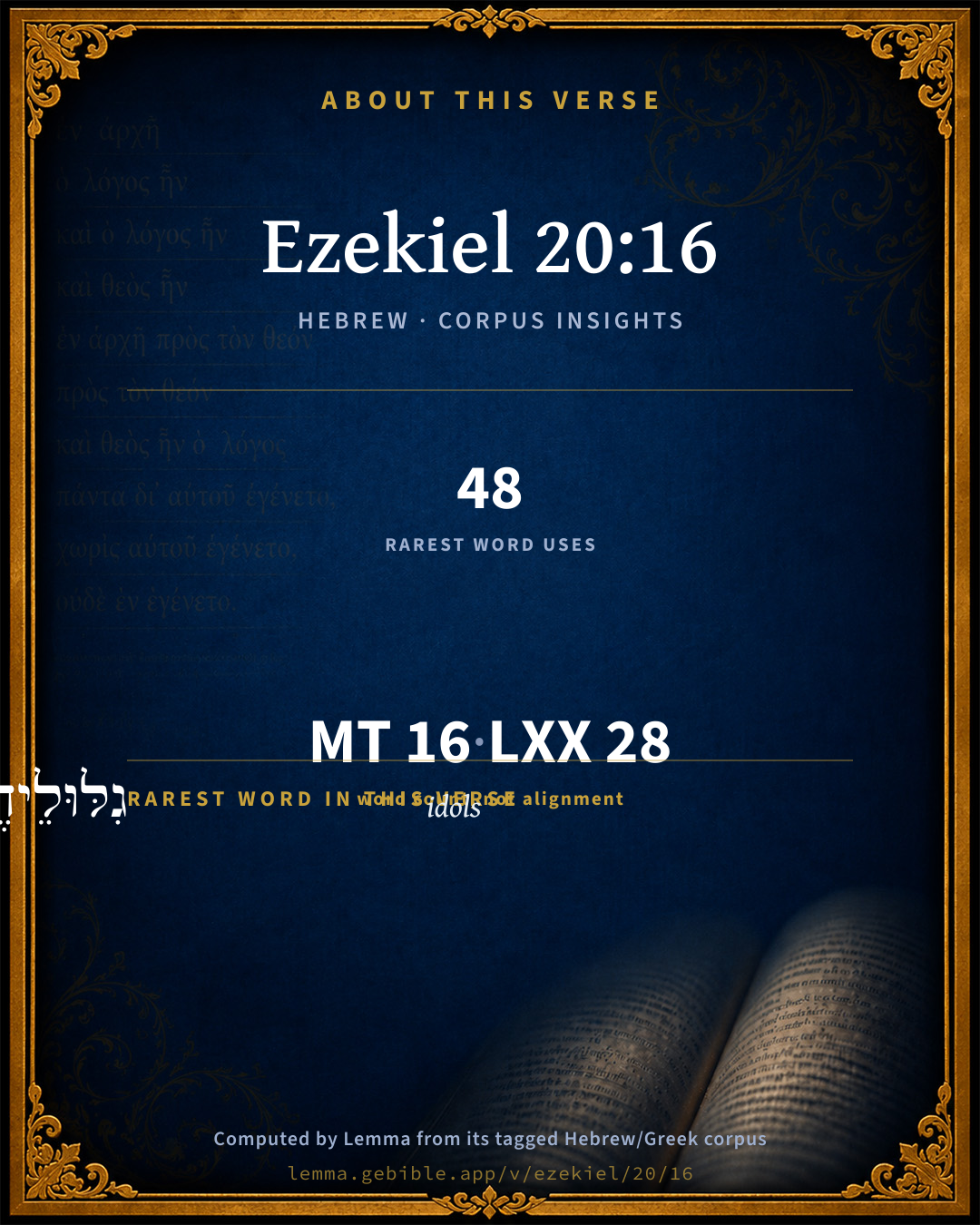
16
words
13
distinct lemmas
Prophets
section

Shared distinctive vocabulary

גִלּוּלֵיהֶ֖ם idols H1544 occurs in 45 verses of the Hebrew Bible. Also found in:

Grammatical profile

  • 4 verbs
  • 5 nouns
  • 2 prepositions
  • 2 conjunctions
  • 3 particles

Verb forms

  • מָאָ֗סוּ Qal · Perfect
  • הָלְכ֣וּ Qal · Perfect
  • חִלֵּ֑לוּ Piel · Perfect
  • הֹלֵֽךְ Qal · Participle Active

Repetition

A word recurs within this verse — often emphatic in Hebrew:

  • הָלְכ֣וּ to walk H1980 ×2

Hebrew & Septuagint length

In English translation the verse runs 22 words from the Hebrew and 23 from the Septuagint (LXX English) — closely comparable.

A rough comparison of the two English renderings, which tokenize alike — not a word-level alignment.

Word counts can differ between the Hebrew and the Greek without any difference in meaning — e.g. the Hebrew direct-object marker אֵת has no separate Greek word, and Greek often adds the article ὁ.

In the original languages it is 16 Hebrew tokens and 28 Greek tokens — but the two are counted differently (Hebrew bundles its prefixes and suffixes into one token; the Greek is in lemma form), so that isn’t a like-for-like length.

Cross-references

9

Topical passages linked to Ezekiel 20:16 in the Treasury of Scripture Knowledge — connected by theme and wording, ordered by reader-vote popularity; previews shown in the World English Bible.

  • Numbers 15:39 and it shall be to you for a fringe, that you may look on it, and remember all the commandments of Yahweh, and do them; and that you not follow after your own heart and your own eyes, after which you use to play the prostitute;
  • Ezekiel 14:3–4 Son of man, these men have taken their idols into their heart, and put the stumbling block of their iniquity before their face: should I be inquired of at all by them?
  • Ezekiel 20:8 But they rebelled against me, and would not listen to me; they did not every man cast away the abominations of their eyes, neither did they forsake the idols of Egypt. Then I said I would pour out my wrath on them, to accomplish my anger against them in the midst of the land of Egypt.
  • Exodus 32:1–8 When the people saw that Moses delayed to come down from the mountain, the people gathered themselves together to Aaron, and said to him, "Come, make us gods, which shall go before us; for as for this Moses, the man who brought us up out of the land of Egypt, we don't know what has become of him."
  • Numbers 25:2 for they called the people to the sacrifices of their gods; and the people ate, and bowed down to their gods.
  • Ezekiel 20:13–14 But the house of Israel rebelled against me in the wilderness: they didn't walk in my statutes, and they rejected my ordinances, which if a man keep, he shall live in them; and my Sabbaths they greatly profaned. Then I said I would pour out my wrath on them in the wilderness, to consume them.
  • Ezekiel 23:8 Neither has she left her prostitution since [the days of] Egypt; for in her youth they lay with her, and they handled the bosom of her virginity; and they poured out their prostitution on her.
  • Amos 5:25–26 "Did you bring to me sacrifices and offerings in the wilderness forty years, house of Israel?
  • Acts 7:39–43 to whom our fathers wouldn't be obedient, but rejected him, and turned back in their hearts to Egypt,

Cross-references courtesy of OpenBible.info (CC BY 4.0).

Hebrew and Greek witnesses Masoretic Hebrew ↔ Greek Septuagint

The same verse in the two great witnesses to the Old Testament, shown verse-for-verse.

These are two independent witnesses, not word-aligned to each other, and the Septuagint is shown in lemma (dictionary) form.

Hebrew Ezekiel 20:16 Masoretic · Westminster Leningrad Codex

יַ֜עַן בְּמִשְׁפָּטַ֣י מָאָ֗סוּ וְאֶת חֻקּוֹתַי֙ לֹא הָלְכ֣וּ בָהֶ֔ם וְאֶת שַׁבְּתוֹתַ֖י חִלֵּ֑לוּ כִּ֛י אַחֲרֵ֥י גִלּוּלֵיהֶ֖ם לִבָּ֥ם הֹלֵֽךְ

because they rejected my ordinances, and didn't walk in my statutes, and profaned my Sabbaths: for their heart went after their idols.

World English Bible · Public Domain

Greek LXX Ezekiel 20:16 Septuagint · lemma form

ἀντί ὅς ὁ δικαίωμα ἐγώ ἀποὠθέω καί ἐν ὁ πρόσταγμα ἐγώ οὐ πορεύομαι ἐν αὐτός καί ὁ σάββατον ἐγώ βεβηλόω καί ὀπίσω ὁ ἐνθύμημα ὁ καρδία αὐτός πορεύομαι

because they rejected my ordinances, and walked not in my commandments, but profaned my sabbaths, and went after the imaginations of their hearts.

LXX2012 (modern English Septuagint) · Public Domain

Hebrew: Westminster Leningrad Codex (CC BY 4.0). Greek: Septuagint (public domain); English from LXX2012 (modern English Septuagint) (Public Domain). How the Septuagint differs from the Hebrew →

Targum (Aramaic paraphrase)

1

The Targum is the ancient Jewish Aramaic paraphrase of the Hebrew Scriptures — an interpretive translation, not the Hebrew text itself. Onkelos (literal) and Pseudo-Jonathan (expansive) render the Torah, and Jonathan the Prophets. Coverage is partial: where no permissively-licensed English translation exists for a verse, only the Aramaic is shown. This is verse-level text, not a word-by-word alignment to the Hebrew.

  1. Targum Jonathan Prophets (Joshua–Malachi)
    חֲלַף דִי בְדִינַי קָצוּ וְיַת קְיָמַי לָא הַלִיכוּ בְּהוֹן וְיַת יוֹמֵי שַׁבַּיָא דִילִי אֲחִילוּ אֲרֵי בָתַר פוּלְחַן טַעֲוָתְהוֹן לִבְּהוֹן טָעֵי:

    (no public-domain English translation for this verse)

    Targum Jonathan — Aramaic: “Mikraot Gedolot” (public domain). English: “Sefaria Community Translation” (CC0 1.0 (public-domain dedication)); “London "Chaldee Paraphrase," 1871” (public domain). Text via Sefaria.

Commentary

Notes on Ezekiel 20:16 from classic Christian and Jewish commentators (each source and its license shown beneath its notes). The classic Christian expositions comment on the surrounding passage and are grouped to its opening verse, so a note may address several verses; the Jewish commentaries on the Tanakh (Rashi and others) are per-verse, so they appear only where the commentator wrote on this verse.

Lemma curates 59 commentaries, every one of them public domain or Creative Commons licensed, each selected and text-cleaned for this edition rather than reprinted as found. About our sources →

John Gill's Exposition

Because they despised my judgments, and walked not in my statutes, but polluted my sabbaths,.... Which were just causes of divine resentment and anger; See Gill on Eze 20:13;

for their heart went after their idols; which they had served in Egypt; and that led them off from the true worship and service of God; no man can serve two masters; if he holds to the one, and his heart is towards him, he will despise the other; and yet these idols were no other, as the word signifies, than dunghill gods, as in Eze 20:16; and such are all worldly things, in comparison of God, that the heart of man is going after.

John Gill's Exposition of the Whole Bible (1746–1763) — public domain (CC PDM 1.0). Text via the HelloAO Bible API.

Trapp's Complete Commentary

John Trapp

Eze 20:16 Because they despised my judgments, and walked not in my statutes, but polluted my sabbaths: for their heart went after their idols.

Ver. 16. For their heart went after their idols.] Heb., Their dungy deities; those dirty delights carried them sheer away from God and goodness. Any beloved sin will do so.

John Trapp, A Commentary or Exposition upon All the Books of the Old and New Testament (1647–1656) — public domain. Text from a community e-Sword module.

Geneva Bible (1599)

Geneva Bible translators

That is, my true religion, which I had commanded them, and gave themselves to serve me according to their own fantasies.

Geneva Bible (1599) marginal notes — public domain. Text via Bolls.life.

Jamieson, Fausset & Brown

Robert Jamieson, A. R. Fausset & David Brown

The special reason is stated by Moses (Num 13:32-33; Num 14:4) to be that they, through fear arising from the false report of the spies, wished to return to Egypt; the general reasons are stated here which lay at the root of their rejection of God's grace; namely, contempt of God and His laws, and love of idols.

their heart--The fault lay in it (Psa 78:37).

Jamieson, Fausset & Brown — Commentary Critical and Explanatory on the Whole Bible (1871) — public domain (CC PDM 1.0). Text via the HelloAO Bible API.

John Calvin's Commentaries

The reason of the oath of which mention has been made is expressed by Moses, because being frightened by a false report they wished to return to Egypt: but here a cause is assigned to their superstitions. (Numbers 13:32, 33, and Numbers 14:1-3.) But it suits each case well, since if they had been sincerely obedient to God, they would never have refused to remove their camp, and fearlessly to proceed where he commanded them. But since they first detested the land, and then terror and despair seized their minds so that they rejected the inestimable blessing of God, it is clear that not a drop of piety existed in their hearts. Although therefore the special reason why they did not enter the land of Canaan was their refusing to obey the call of God, yet the Prophet adds also their superstitions. For impiety and contempt of God was the reason why they so boldly, proudly, and furiously rejected the grace of God, and wished even to stone Moses, and then when penitent they encouraged each other to return to live again under the tyranny of Egypt. We see, therefore, how the Prophet here lays down general causes from which that impious dislike of the land proceeded, as well as the rejection of the grace of God. He says, therefore, because they had despised my judgments and had not walked in my statutes. He here inverts the order: he had formerly said that they had not walked in his statutes and had despised my judgments; but now he begins with the contempt: and have polluted my Sabbaths, because their hearts went after their idols. The sense is, that they always treated God deceitfully: and although they held that he was to be worshipped formally, yet they were always addicted to various superstitions: as also Stephen reproves them, (Acts 7:40-43,) for he agrees entirely with our Prophet. As he puts Sabbaths in the plural number, I do not interpret it so strictly as some do, thinking that the Prophet means Sabbaths of years, and afterwards the jubilee: for there were three Sabbaths among the Jews; that is, every seventh day was consecrated to God, and every seventh year, and every fiftieth. Although it is true that years were sabbatical as well as days, yet I do not think that the Prophet is making any subtle distinctions here but I take Sabbath to mean the seventh day. It now follows —

John Calvin's Commentaries (1540-1563) — public domain. Text from the Calvin Translation Society English edition (1840s-50s) via the Christian Classics Ethereal Library (ccel.org). Calvin's coverage is partial (roughly two-thirds of the Bible); uncommented books and verses are honest gaps, never fabricated. The 19th-century editor's footnotes and remarks are omitted so the notes are faithfully Calvin's own voice.

The Cambridge Bible for Schools and Colleges

gen. ed. J. J. S. Perowne

16. polluted my sabbaths] profaned.

went after their idols] Exodus 32; Numbers 25; Hos_9:10. Amo_5:25 cannot be appealed to here.

The Cambridge Bible for Schools and Colleges (gen. ed. J. J. S. Perowne; Cambridge University Press, 1878–1918) — public domain. Text from a community e-Sword module.

Matthew Poole's English Annotations

See the whole former part of this verse explained already, Eze 20:13. Their heart went after their idols; their will and affections, their zeal and resolution, were for their idols which they served in Egypt, and which they had brought with them out of Egypt.

Matthew Poole's English Annotations on the Holy Bible (1683–1685) — public domain. Text from a community e-Sword/MySword module.

The Pulpit Commentary

Their heart went after their idols. The words may point generally to the fact that the idolatrous tendencies of the people, though suppressed, were not really eradicated. The history of Baal-peor (Num_25:3-9) shows how ready they were to pass into act, and Amo_5:25, 26 implies a tradition of other like acts during the whole period of the wanderings in the wilderness.

The Pulpit Commentary (1880–1919), ed. H.D.M. Spence-Jones & Joseph S. Exell — public domain. Text from a community e-Sword module.

Lesson kit

Teaching starters — assembled from the data on this page, not authored interpretation. Every prompt links to the verse data it draws on. Edit before teaching.

Ezekiel, in the Prophets, opens this verse with 16 words (13 distinct Hebrew lemmas). Its most distinctive word is gillûwl (“idols”). A historical commentator’s framing appears above. Read the whole chapter for the surrounding context.

Discussion questions

  1. What does “idols” (gillûwl) contribute to the verse as a whole?
  2. Leviticus 26:30 shares the word «idols» with this verse. How do the two illuminate each other?
  3. “to walk” occurs 2× in this one verse. What is the effect of the repetition?
  4. The translations on this page render this verse differently — a whole-verse word diff, not a word-by-word alignment. What might account for the different wordings?
  5. The verb «מָאָ֗סוּ» is Qal Perfect. How does its form color the action?
  6. Reading how John Gill's Exposition and Trapp's Complete Commentary read this verse, where do the two commentators agree and where do they part?

Things to notice

Reading settings

Reading text

Shown beneath each verse's original-language words.

Old Testament
Old Testament edition

Read the OT as the Masoretic Hebrew (MT) or the Greek Septuagint (LXX).

English shown for the Greek Septuagint (in the Hebrew ↔ Greek comparison).

Comparing translations? Open the Compare panel on any verse page to stack up to four side by side.