
1 Samuel 24:6

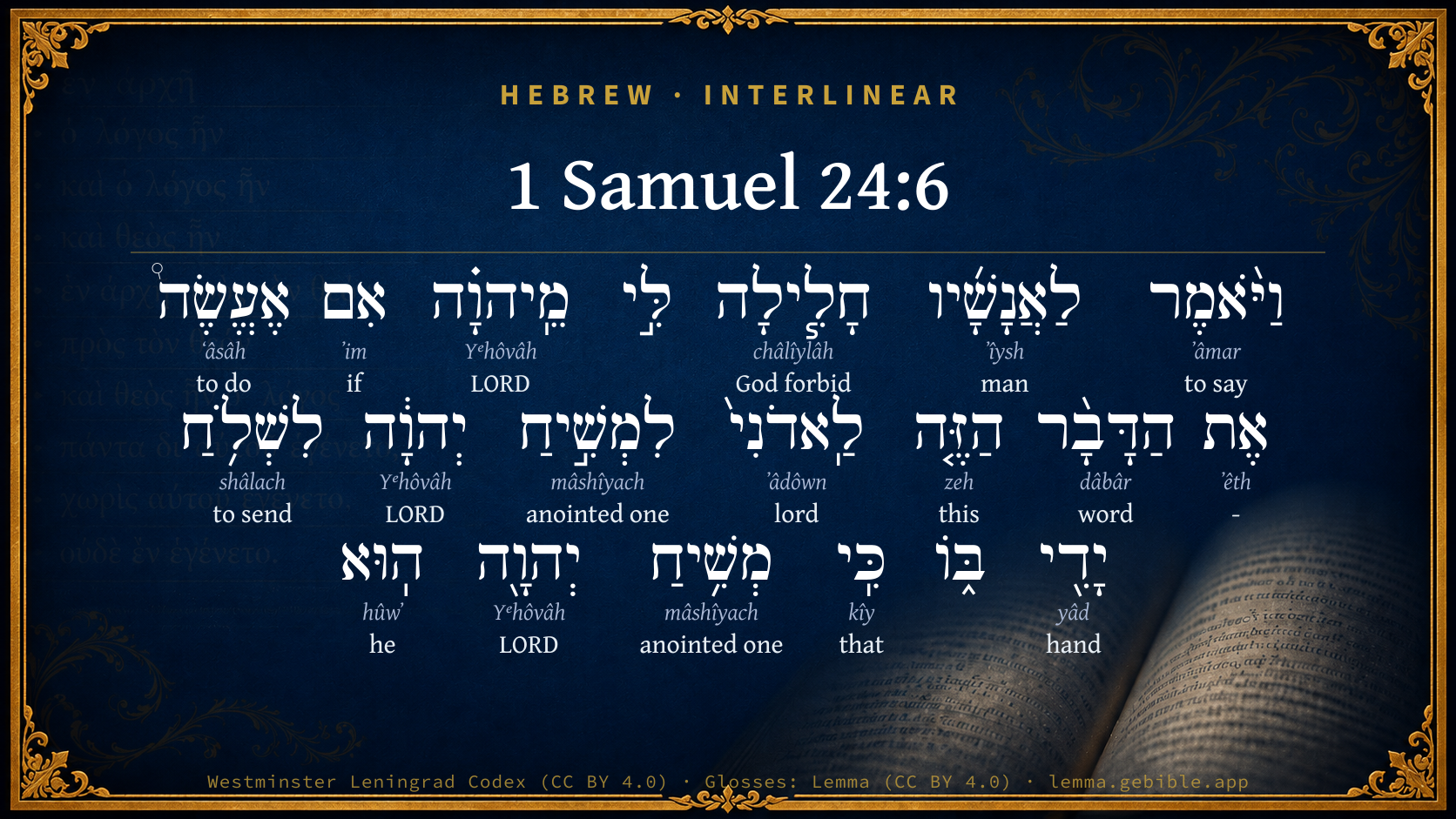
Hebrew (Westminster Leningrad Codex) 1 Samuel 24:6 appears in the Hebrew Old Testament. The text above is from the Westminster Leningrad Codex. Each word links to its Strong’s number, a concise gloss, and parsing drawn from the Open Scriptures Hebrew Bible morphology. Click any word for its full Brown-Driver-Briggs (BDB) entry.
Download image
Cite this verse

1 Samuel 24:6 (World English Bible). Public Domain. Lemma interlinear Bible study tool, https://lemma.gebible.app/v/1-samuel/24/6.

Show BibTeX & RIS
BibTeX
RIS
English Translation
He said to his men, Yahweh forbid that I should do this thing to my lord, Yahweh's anointed, to put forth my hand against him, seeing he is Yahweh's anointed.
World English Bible · Public Domain
Download a study sheet

One document with this verse’s original text, its word-by-word gloss line, the meaning frame, cross-references with their text, attributed commentary, and full source and license credits — printable, and it pastes into notes with its structure intact.

This verse Autodidact and up

Study sheet (.html) Plain text (.txt)

A passage Seminary Student

Up to 50 verses in one chapter. A passage sheet keeps up to 6 commentary sources and 12 cross-references per verse, in the order this page ranks them, and says so on the sheet whenever that leaves anything out. Ask for a single verse and you get the Autodidact verse sheet above.

Everything on this page stays free to read, with no account — the sheet is a download of what is already on screen, not access to it.

Want to remove ads? Support Godless Engineer
Compare translations 3

The same verse in 3 English versions, stacked beneath the original-language interlinear above. Click any original word for its lexicon entry.

Each is an independent rendering of the whole verse — the interlinear is not word-aligned to these translations.

Highlighted words mark where these versions differ — a whole-verse word diff, not a word-by-word alignment.

  • World English Bible Public Domain
    He said to his men, Yahweh forbid that I should do this thing to my lord, Yahweh's anointed, to put forth my hand against him, seeing he is Yahweh's anointed.
  • King James Version Public Domain
    And he said unto his men, The LORD forbid that I should do this thing unto my master, the LORD's anointed, to stretch forth mine hand against him, seeing he is the anointed of the LORD.
  • unfoldingWord Literal Text CC BY-SA 4.0
    And he said to his men, “Profane to me from Yahweh if I have done this thing to my master, to the anointed one of Yahweh, to stretch out my hand against him. For he the anointed one of Yahweh.”

unfoldingWord Literal Text — © unfoldingWord, licensed CC BY-SA 4.0. Word-aligned USFM3 via Door43 (git.door43.org/unfoldingWord/en_ult).

Versions to compare (up to 4)

3 of 4 selected

Show all 18 translations

Every available English version of this verse, each an independent rendering of the whole verse.

  • World English Bible Public Domain
    He said to his men, Yahweh forbid that I should do this thing to my lord, Yahweh's anointed, to put forth my hand against him, seeing he is Yahweh's anointed.
  • Berean Standard Bible Public Domain
    So he said to his men, “The LORD forbid that I should do such a thing to my master, the LORD’s anointed. May I never lift my hand against him, since he is the LORD’s anointed.”
  • Majority Standard Bible Public Domain
    So he said to his men, “The LORD forbid that I should do such a thing to my master, the LORD’s anointed. May I never lift my hand against him, since he is the LORD’s anointed.”
  • King James Version Public Domain
    And he said unto his men, The LORD forbid that I should do this thing unto my master, the LORD's anointed, to stretch forth mine hand against him, seeing he is the anointed of the LORD.
  • American Standard Version (1901) Public Domain
    And he said unto his men, Jehovah forbid that I should do this thing unto my lord, Jehovah's anointed, to put forth my hand against him, seeing he is Jehovah's anointed.
  • Revised Version (1885) Public Domain
    And he said unto his men, The LORD forbid that I should do this thing unto my lord, the LORD’S anointed, to put forth mine hand against him, seeing he is the LORD’S anointed.
  • Geneva Bible (1599) Public Domain
    And afterward Dauid was touched in his heart, because he had cut off the lappe which was on Sauls garment.
  • Douay-Rheims (1899) Public Domain
    After which David's heart struck him, because he had cut off the hem of Saul's robe.
  • Young's Literal Translation Public Domain
    and he saith to his men, `Far be it from me, by Jehovah; I do not do this thing to my lord -- to the anointed of Jehovah -- to put forth my hand against him, for the anointed of Jehovah he `is'.'
  • Literal Standard Version CC BY-SA 4.0
    and he says to his men, “Far be it from me, by YHWH; I do not do this thing to my lord—to the anointed of YHWH—to put forth my hand against him, for he [is] the anointed of YHWH.”
  • Unlocked Literal Bible CC BY-SA 4.0
    He said to his men, “May Yahweh forbid that I should do this thing to my master, Yahweh's anointed, to put out my hand against him, seeing he is Yahweh's anointed.”
  • unfoldingWord Literal Text CC BY-SA 4.0
    And he said to his men, “Profane to me from Yahweh if I have done this thing to my master, to the anointed one of Yahweh, to stretch out my hand against him. For he the anointed one of Yahweh.”
  • Darby Bible Public Domain
    And he said to his men, Jehovah forbid that I should do this thing to my master, Jehovah's anointed, to stretch forth my hand against him, for he is the anointed of Jehovah.
  • World Messianic Bible Public Domain
    He said to his men, “The LORD forbid that I should do this thing to my lord, the LORD’s anointed, to stretch out my hand against him, since he is the LORD’s anointed.”
  • Webster's Bible Public Domain
    \\24:5\\And it came to pass afterward, that David's heart smote him, because he had cut off Saul's skirt.
  • Free Bible Version CC BY-SA 4.0
    He told his men, “May the Lord prevent me from doing anything like this to my master, the Lord's anointed one. I will never attack him, for he is the Lord's anointed one.”
  • Bible in Basic English Public Domain
    And later, David was full of regret for cutting off Saul's skirt.
  • JPS Tanakh (1917) Public Domain
    (24-7) And he said unto his men: 'The LORD forbid it me, that I should do this thing unto my lord, the LORD'S anointed, to put forth my hand against him, seeing he is the LORD'S anointed.'

Literal Standard Version (2020), Covenant Press — licensed CC BY-SA 4.0. Text via the HelloAO Bible API (eBible.org). Unlocked Literal Bible (unfoldingWord) — licensed CC BY-SA 4.0. Text via the HelloAO Bible API (eBible.org). unfoldingWord Literal Text — © unfoldingWord, licensed CC BY-SA 4.0. Word-aligned USFM3 via Door43 (git.door43.org/unfoldingWord/en_ult). Free Bible Version, Dr. Jonathan Gallagher — licensed CC BY-SA 4.0. Text via the HelloAO Bible API (eBible.org).

Word by word

More ways to search: Search by grammar → Find every occurrence → Compare this word →

Practice this passage: Drill this verse → Learn its vocabulary →

חָלִ֧ילָה
châlîylâh
H2486
“God forbid”
Particle, Interjection + Suffix, h
Part of Speech
Particle
Type
Interjection
Full BDB Definition

Origin: a directive from H2490

TWOT: 661c

far be it (from me), God forbid that, let it not be
  1. וַיֹּ֨אמֶר ʼâmar H559 “and · to say” Conjunction + Verb, Qal, Sequential Imperfect, 3rd Person, Masculine, Singular
  2. לַאֲנָשָׁ֜יו ʼîysh H376 “to/for · men · his” Preposition + Noun, Common, Masculine, Plural, Construct + Suffix, Personal, 3rd Person, Masculine, Singular
  3. מֵֽיהוָ֗ה Yᵉhôvâh H3068 “from · LORD” Preposition + Noun, Proper
  4. אִם ʼim H518 “if” Conjunction
  5. אֶעֱשֶׂה֩ ʻâsâh H6213 “to do” Verb, Qal, Imperfect, 1st Person, Common, Singular
  6. אֶת ʼêth H853 “-” Particle, Direct Object
  7. הַדָּבָ֨ר dâbâr H1697 “the · word” Particle, Definite Article + Noun, Common, Masculine, Singular, Absolute
  8. הַזֶּ֤ה zeh H2088 “the · this” Particle, Definite Article + Pronoun, Demonstrative, Masculine, Singular
  9. לַֽאדֹנִי֙ ʼâdôwn H113 “to/for · lord · my” Preposition + Noun, Common, Masculine, Singular, Construct + Suffix, Personal, 1st Person, Common, Singular
  10. לִמְשִׁ֣יחַ mâshîyach H4899 “to/for · anointed one of” Preposition + Noun, Common, Masculine, Singular, Construct
  11. יְהוָ֔ה Yᵉhôvâh H3068 “LORD” Noun, Proper
  12. לִשְׁלֹ֥חַ shâlach H7971 “to send” Preposition + Verb, Qal, Infinitive Construct
  13. יָדִ֖י yâd H3027 “hand · my” Noun, Common, Both, Singular, Construct + Suffix, Personal, 1st Person, Common, Singular
  14. כִּֽי kîy H3588 “that” Conjunction
  15. מְשִׁ֥יחַ mâshîyach H4899 “anointed one of” Noun, Common, Masculine, Singular, Construct
  16. יְהוָ֖ה Yᵉhôvâh H3068 “LORD” Noun, Proper
  17. הֽוּא hûwʼ H1931 “he” Pronoun, Personal, 3rd Person, Masculine, Singular

About this verse

These counts appear in no published source. They are computed here, from the morphology-tagged text and Lemma’s own curated glosses. What Lemma adds →

20
words
15
distinct lemmas
Historical
section

Notable vocabulary

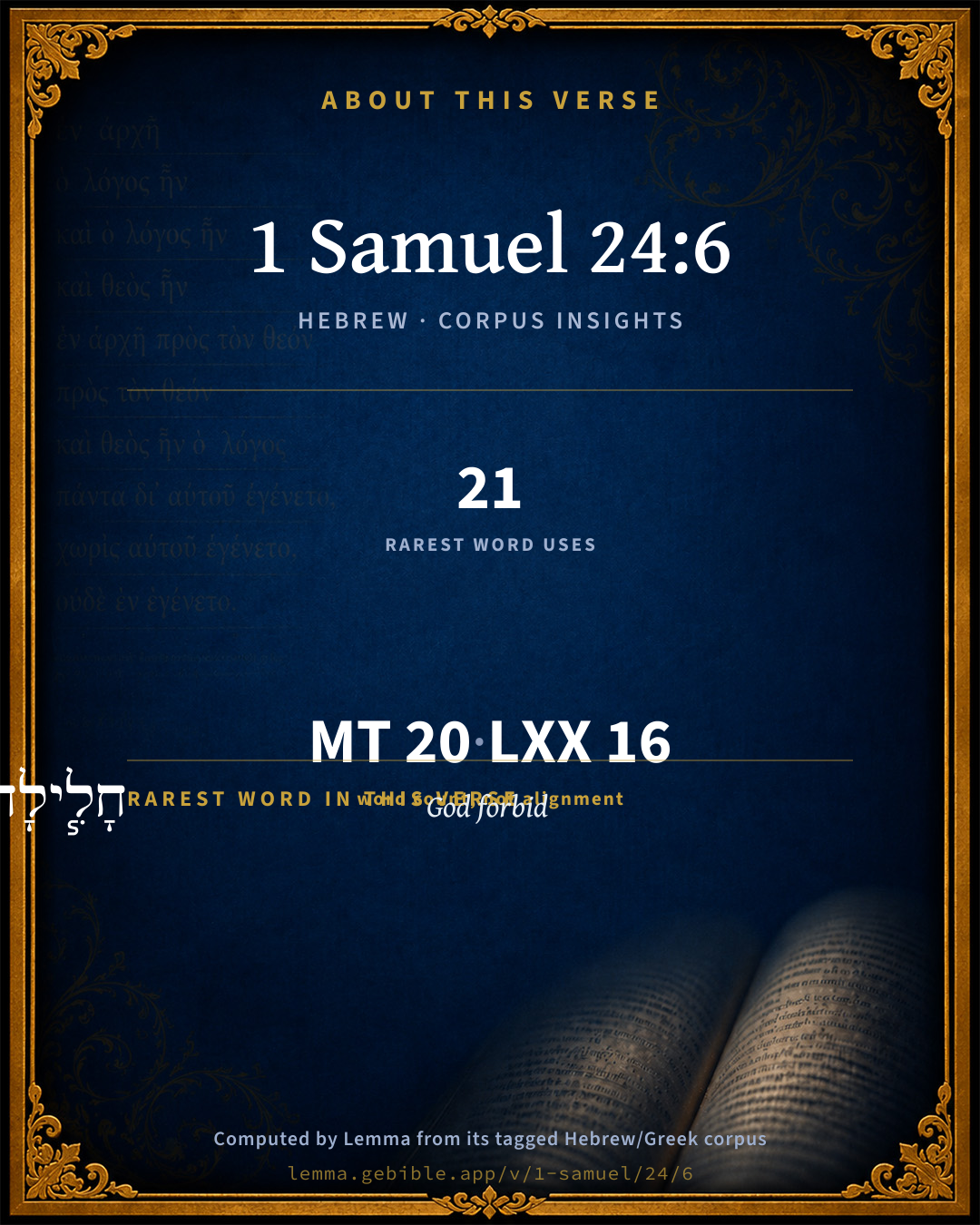
The rarest word here is חָלִ֧ילָה God forbid H2486 — appearing just 21 times in the whole Hebrew Bible.

Shared distinctive vocabulary

חָלִ֧ילָה God forbid H2486 occurs in 19 verses of the Hebrew Bible. Also found in:

Grammatical profile

  • 3 verbs
  • 9 nouns
  • 2 pronouns
  • 2 prepositions
  • 2 conjunctions
  • 2 particles

Verb forms

  • וַיֹּ֨אמֶר Qal · Sequential Imperfect
  • אֶעֱשֶׂה֩ Qal · Imperfect
  • לִשְׁלֹ֥חַ Qal · Infinitive Construct

Repetition

Words recur within this verse — often emphatic in Hebrew:

  • מֵֽיהוָ֗ה LORD H3068 ×3
  • לִמְשִׁ֣יחַ anointed one H4899 ×2

Hebrew & Septuagint length

In English translation the verse runs 30 words from the Hebrew and 22 from the Septuagint (LXX English) — closely comparable.

A rough comparison of the two English renderings, which tokenize alike — not a word-level alignment.

Word counts can differ between the Hebrew and the Greek without any difference in meaning — e.g. the Hebrew direct-object marker אֵת has no separate Greek word, and Greek often adds the article ὁ.

In the original languages it is 20 Hebrew tokens and 16 Greek tokens — but the two are counted differently (Hebrew bundles its prefixes and suffixes into one token; the Greek is in lemma form), so that isn’t a like-for-like length.

Cross-references

7

Topical passages linked to 1 Samuel 24:6 in the Treasury of Scripture Knowledge — connected by theme and wording, ordered by reader-vote popularity; previews shown in the World English Bible.

  • 2 Samuel 1:14 David said to him, How were you not afraid to put forth your hand to destroy Yahweh's anointed?
  • 1 Samuel 26:9–11 David said to Abishai, Don't destroy him; for who can put forth his hand against Yahweh's anointed, and be guiltless?
  • Job 31:29–30 "If I have rejoiced at the destruction of him who hated me, Or lifted up myself when evil found him;
  • Romans 12:14–13:2 Bless those who persecute you; bless, and don't curse.
  • 1 Kings 21:3 Naboth said to Ahab, Yahweh forbid it me, that I should give the inheritance of my fathers to you.
  • Matthew 5:44 But I tell you, love your enemies, bless those who curse you, do good to those who hate you, and pray for those who mistreat you and persecute you,
  • 1 Thessalonians 5:15 See that no one returns evil for evil to anyone, but always follow after that which is good, for one another, and for all.

Cross-references courtesy of OpenBible.info (CC BY 4.0).

Hebrew and Greek witnesses Masoretic Hebrew ↔ Greek Septuagint

The same verse in the two great witnesses to the Old Testament, shown verse-for-verse.

These are two independent witnesses, not word-aligned to each other, and the Septuagint is shown in lemma (dictionary) form.

Hebrew 1 Samuel 24:6 Masoretic · Westminster Leningrad Codex

וַיֹּ֨אמֶר לַאֲנָשָׁ֜יו חָלִ֧ילָה לִּ֣י מֵֽיהוָ֗ה אִם אֶעֱשֶׂה֩ אֶת הַדָּבָ֨ר הַזֶּ֤ה לַֽאדֹנִי֙ לִמְשִׁ֣יחַ יְהוָ֔ה לִשְׁלֹ֥חַ יָדִ֖י בּ֑וֹ כִּֽי מְשִׁ֥יחַ יְהוָ֖ה הֽוּא

He said to his men, Yahweh forbid that I should do this thing to my lord, Yahweh's anointed, to put forth my hand against him, seeing he is Yahweh's anointed.

World English Bible · Public Domain

Greek LXX 1 Samuel 24:6 Septuagint · lemma form

καί γίγνομαι μετά οὗτος καί πατάσσω καρδία δαυίδ αὐτός ὅτι ἀποαἱρέω ὁ πτερυγίον ὁ διπλοΐς αὐτός

And it came to pass after this that David's heart struck him, because he had cut off the skirt of his garment.

LXX2012 (modern English Septuagint) · Public Domain

Hebrew: Westminster Leningrad Codex (CC BY 4.0). Greek: Septuagint (public domain); English from LXX2012 (modern English Septuagint) (Public Domain). How the Septuagint differs from the Hebrew →

Targum (Aramaic paraphrase)

1

The Targum is the ancient Jewish Aramaic paraphrase of the Hebrew Scriptures — an interpretive translation, not the Hebrew text itself. Onkelos (literal) and Pseudo-Jonathan (expansive) render the Torah, and Jonathan the Prophets. Coverage is partial: where no permissively-licensed English translation exists for a verse, only the Aramaic is shown. This is verse-level text, not a word-by-word alignment to the Hebrew.

  1. Targum Jonathan Prophets (Joshua–Malachi)
    וַהֲוָה בָתַר כֵּן וְחָשׁ דָוִד בְּלִבֵּיהּ עַל דִי פְסַק יַת כַּנְפָא דִלְשָׁאוּל:

    (no public-domain English translation for this verse)

    Targum Jonathan — Aramaic: “Mikraot Gedolot” (public domain). English: “Sefaria Community Translation” (CC0 1.0 (public-domain dedication)); “London "Chaldee Paraphrase," 1871” (public domain). Text via Sefaria.

Commentary

Notes on 1 Samuel 24:6 from classic Christian and Jewish commentators (each source and its license shown beneath its notes). The classic Christian expositions comment on the surrounding passage and are grouped to its opening verse, so a note may address several verses; the Jewish commentaries on the Tanakh (Rashi and others) are per-verse, so they appear only where the commentator wrote on this verse.

Lemma curates 59 commentaries, every one of them public domain or Creative Commons licensed, each selected and text-cleaned for this edition rather than reprinted as found. About our sources →

Trapp's Complete Commentary

John Trapp

1Sa 24:6 And he said unto his men, The LORD forbid that I should do this thing unto my master, the LORD’S anointed, to stretch forth mine hand against him, seeing he [is] the anointed of the LORD.

Ver. 6. The Lord forbid that I should do this thing.] Thus he blesseth himself from such a disloyalty to his master and sovereign. The Janizaries have learned of the Jesuits to kill their king if he please them not. Peter du Moulin said truly of many of the priests of France, that they were for their loyalty not beholden to the maxims of Italy.

John Trapp, A Commentary or Exposition upon All the Books of the Old and New Testament (1647–1656) — public domain. Text from a community e-Sword module.

Tyndale Open Study Notes

Tyndale Open Resources

24:6 The Lord’s anointed one was not to be violated (26:9, 11, 16, 23; 2 Sam 1:14, 16; 19:21). David would not harm Saul even though God had anointed him to be the next king (1 Sam 16:13).

Tyndale Open Study Notes — © Tyndale Open Resources, licensed CC BY-SA 4.0. Text via the HelloAO Bible API.

Geneva Bible (1599)

Geneva Bible translators

For seeing it was his own private cause, he repented that he had touched his enemy.

Geneva Bible (1599) marginal notes — public domain. Text via Bolls.life.

Adam Clarke's Commentary

Verse 6. The Lord's anointed] However unworthily Saul was now acting, he had been appointed to his high office by God himself, and he could only be removed by the authority which placed him on the throne. Even David, who knew he was appointed to reign in his stead, and whose life Saul had often sought to destroy, did not conceive that he had any right to take away his life; and he grounds the reasons of his forbearance on this-He is my master, I am his subject. He is the Lord's anointed, and therefore sacred as to his person in the Lord's sight. It is an awful thing to kill a king, even the most untoward, when he has once been constitutionally appointed to the throne. No experiment of this kind has ever succeeded; the Lord abhors king killing. Had David taken away the life of Saul at this time, he would, in the sight of God, have been a murderer.

Adam Clarke's Commentary on the Bible (1810–1826) — public domain. Text from a community e-Sword/MySword module.

John Gill's Exposition

And he said unto his men,.... When he returned and brought the skirt of Saul's garment in his hand; or else he said this before that, though here mentioned, when they moved it to him to dispatch him, as he had a fair opportunity of doing it:

God forbid that I should do this thing unto my master, the Lord's anointed; and which he could not think of but with detestation and abhorrence, since he was his sovereign lord and master, and he a subject of his, and was anointed by the order of God, and his person sacred:

to stretch forth my hand against him; to take away his life; to cut off the skirt of his garment gave him uneasiness; but to slay him, the thought of it was shocking to him:

seeing he is the anointed of the Lord; anointed by Samuel to be king, Sa1 10:1, by order of the Lord, Sa1 9:17.

John Gill's Exposition of the Whole Bible (1746–1763) — public domain (CC PDM 1.0). Text via the HelloAO Bible API.

Haydock's Catholic Bible Commentary

Heart struck him; viz., with remorse, as fearing he had done amiss. (Challoner) --- A tender conscience is uneasy about things which are not sinful, while some stick at nothing. (Worthington) --- The action of David seemed disrespectful. (Calmet) --- "The subjects of kings adore the royal name as a divinity." (Curtius vii.) Regium nomen....pro deo colunt.

George Leo Haydock (1774–1849), Haydock's Catholic Family Bible and Commentary, 1859 edition — public domain. Excludes Psalms (Douay-Rheims chapter numbering differs from Protestant) and Deuterocanonical books (Catholic canon only).

Matthew Poole's English Annotations

He said unto his men; either, first, Before he cut off Saul’s lap. Or rather, secondly, Afterwards, when he returned with Saul’s lap in his hand, and his soldiers were enraged that he had not killed him.

This thing which you persuade me to do, even cut off Saul.

Unto my master, whom I must still own for my sovereign lord and king, to whom I owe allegiance whilst he lives, although after his death the right of the kingdom be mine.

To stretch forth mine hand against him, to wit, to kill him. A synecdochical expression. See Gen 37:22.

The anointed of the Lord, i.e. anointed by God to the kingdom; by which unction his person was made sacred and inviolable, and is so to be accounted by me, and you, and all his subjects. And as God only exalted him, and God only could pronounce a sentence of deprivation of his kingdom against him; so it belongs to God only to execute his own sentence, and actually to depose him.

Matthew Poole's English Annotations on the Holy Bible (1683–1685) — public domain. Text from a community e-Sword/MySword module.

The Pulpit Commentary

Vers. 6, 7. Seeing he is the anointed of Jehovah. David bases his allegiance to Saul on religious grounds. He was Jehovah"s Messiah, and as such his person was sacred. To this principle David steadfastly adhered (1Sa_26:9; 2Sa_1:16) The Lord forbid. Hebrew, "Far be it from me from Jehovah," i.e. for Jehovah"s sake. So David stayed his servants. The verb is a strong one, and means to crush down. It shows that David had to use all his authority to keep his men, vexed by Saul"s pursuit, from killing him.

The Pulpit Commentary (1880–1919), ed. H.D.M. Spence-Jones & Joseph S. Exell — public domain. Text from a community e-Sword module.

Rashi

Rabbi Shlomo Yitzchaki (Rashi)

Afterwards … etc.

Rashi on the Tanakh — English translations: “The Judaica Press complete Tanach with Rashi, translated by A. J. Rosenberg” (CC BY 4.0); “Pentateuch with Rashi's commentary by M. Rosenbaum and A.M. Silbermann, 1929-1934” (public domain); “The Metsudah Tanach series, Lakewood, N.J” (CC BY 4.0); and “The Book of Joshua, Metsudah Publications, 1997” (CC BY 4.0). Text via Sefaria.

Lesson kit

Teaching starters — assembled from the data on this page, not authored interpretation. Every prompt links to the verse data it draws on. Edit before teaching.

1 Samuel, in the Historical, opens this verse with 20 words (15 distinct Hebrew lemmas). Its most distinctive word is châlîylâh (“God forbid”). A historical commentator’s framing appears above. Read the whole chapter for the surrounding context.

Discussion questions

  1. The word châlîylâh carries the sense “God forbid.” How does it shape the verse?
  2. Genesis 18:25 shares the word «God forbid» with this verse. How do the two illuminate each other?
  3. “LORD” occurs 3× in this one verse. What is the effect of the repetition?
  4. These translations render this verse differently. What is at stake in choosing one wording over another?
  5. The verb «וַיֹּ֨אמֶר» is Qal Sequential Imperfect. How does its form color the action?
  6. Reading how Trapp's Complete Commentary and Tyndale Open Study Notes read this verse, where do the two commentators agree and where do they part?

Things to notice

Reading settings

Reading text

Shown beneath each verse's original-language words.

Old Testament
Old Testament edition

Read the OT as the Masoretic Hebrew (MT) or the Greek Septuagint (LXX).

English shown for the Greek Septuagint (in the Hebrew ↔ Greek comparison).

Comparing translations? Open the Compare panel on any verse page to stack up to four side by side.