
Proverbs 26:23

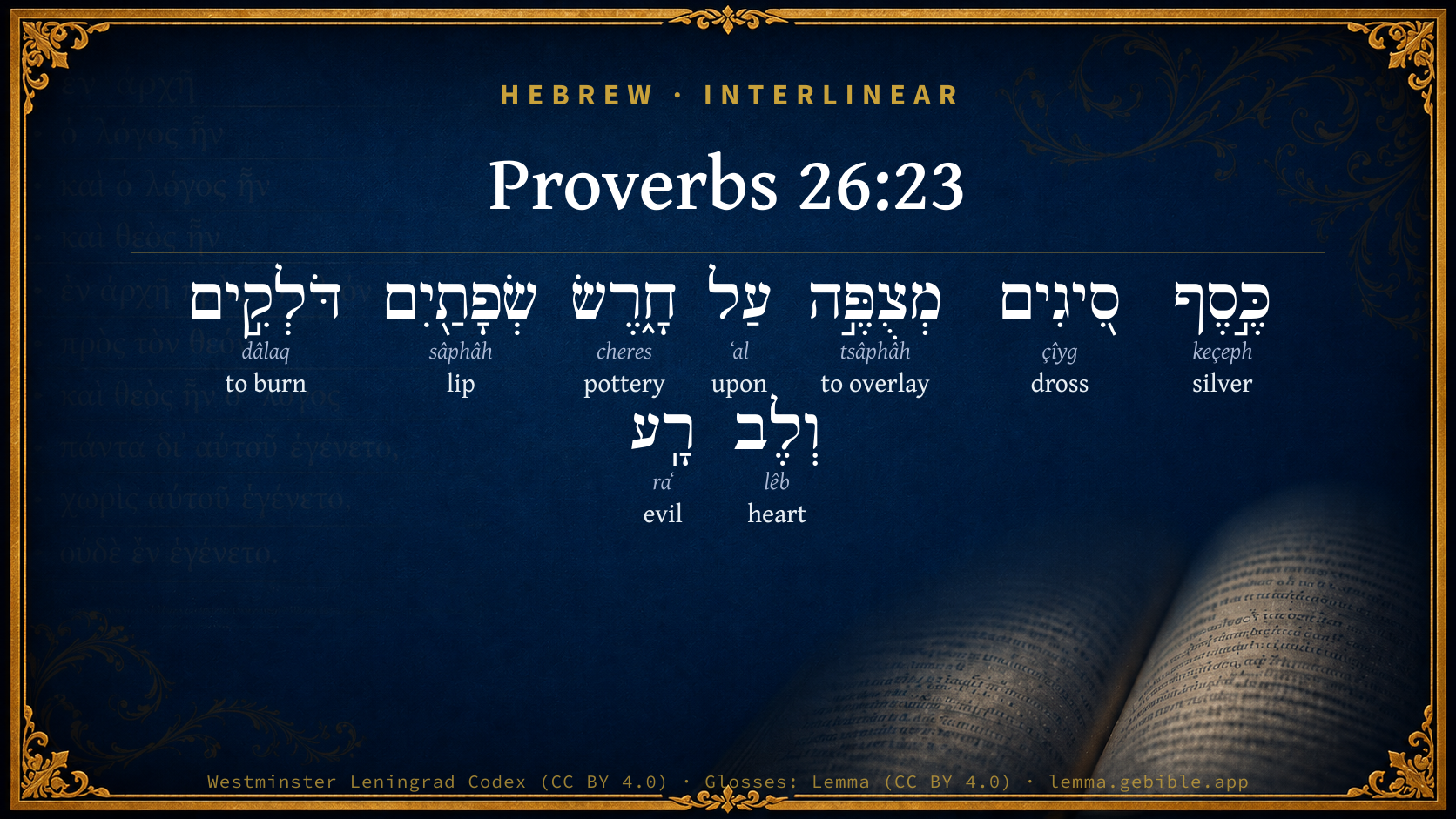
Hebrew (Westminster Leningrad Codex) Proverbs 26:23 appears in the Hebrew Old Testament. The text above is from the Westminster Leningrad Codex. Each word links to its Strong’s number, a concise gloss, and parsing drawn from the Open Scriptures Hebrew Bible morphology. Click any word for its full Brown-Driver-Briggs (BDB) entry.
Download image
Cite this verse

Proverbs 26:23 (World English Bible). Public Domain. Lemma interlinear Bible study tool, https://lemma.gebible.app/v/proverbs/26/23.

Show BibTeX & RIS
BibTeX
RIS
English Translation
Like silver dross on an earthen vessel Are the lips of a fervent one with an evil heart.
World English Bible · Public Domain
Download a study sheet

One document with this verse’s original text, its word-by-word gloss line, the meaning frame, cross-references with their text, attributed commentary, and full source and license credits — printable, and it pastes into notes with its structure intact.

This verse Autodidact and up

Study sheet (.html) Plain text (.txt)

A passage Seminary Student

Up to 50 verses in one chapter. A passage sheet keeps up to 6 commentary sources and 12 cross-references per verse, in the order this page ranks them, and says so on the sheet whenever that leaves anything out. Ask for a single verse and you get the Autodidact verse sheet above.

Everything on this page stays free to read, with no account — the sheet is a download of what is already on screen, not access to it.

Want to remove ads? Support Godless Engineer
Compare translations 3

The same verse in 3 English versions, stacked beneath the original-language interlinear above. Click any original word for its lexicon entry.

Each is an independent rendering of the whole verse — the interlinear is not word-aligned to these translations.

Highlighted words mark where these versions differ — a whole-verse word diff, not a word-by-word alignment.

  • World English Bible Public Domain
    Like silver dross on an earthen vessel Are the lips of a fervent one with an evil heart.
  • King James Version Public Domain
    Burning lips and a wicked heart are like a potsherd covered with silver dross.
  • unfoldingWord Literal Text CC BY-SA 4.0
    Silver of dross overlaid on a clay vessel burning lips and a heart of evil.

unfoldingWord Literal Text — © unfoldingWord, licensed CC BY-SA 4.0. Word-aligned USFM3 via Door43 (git.door43.org/unfoldingWord/en_ult).

Versions to compare (up to 4)

3 of 4 selected

Show all 18 translations

Every available English version of this verse, each an independent rendering of the whole verse.

  • World English Bible Public Domain
    Like silver dross on an earthen vessel Are the lips of a fervent one with an evil heart.
  • Berean Standard Bible Public Domain
    Like glaze covering an earthen vessel are burning lips and a wicked heart.
  • Majority Standard Bible Public Domain
    Like glaze covering an earthen vessel are burning lips and a wicked heart.
  • King James Version Public Domain
    Burning lips and a wicked heart are like a potsherd covered with silver dross.
  • American Standard Version (1901) Public Domain
    Fervent lips and a wicked heart Are `like' an earthen vessel overlaid with silver dross.
  • Revised Version (1885) Public Domain
    Fervent lips and a wicked heart are like an earthen vessel overlaid with silver dross.
  • Geneva Bible (1599) Public Domain
    As siluer drosse ouerlayde vpon a potsheard, so are burning lips, and an euill heart.
  • Douay-Rheims (1899) Public Domain
    Swelling lips joined with a corrupt heart, are like an earthen vessel adorned with silver dross.
  • Young's Literal Translation Public Domain
    Silver of dross spread over potsherd, `Are' burning lips and an evil heart.
  • Literal Standard Version CC BY-SA 4.0
    Silver of dross spread over potsherd, || [Are] burning lips and an evil heart.
  • Unlocked Literal Bible CC BY-SA 4.0
    Like the glaze overlaying an earthen vessel so are burning lips and an evil heart.
  • unfoldingWord Literal Text CC BY-SA 4.0
    Silver of dross overlaid on a clay vessel burning lips and a heart of evil.
  • Darby Bible Public Domain
    Ardent lips, and a wicked heart, are [as] an earthen vessel overlaid with silver dross.
  • World Messianic Bible Public Domain
    Like silver dross on an earthen vessel are the lips of a fervent one with an evil heart.
  • Webster's Bible Public Domain
    Burning lips and a wicked heart are like a potsherd covered with silver dross.
  • Free Bible Version CC BY-SA 4.0
    Smooth talking with evil intent is like a shiny lead glaze on an earthenware pot.
  • Bible in Basic English Public Domain
    Smooth lips and an evil heart are like a vessel of earth plated with silver waste.
  • JPS Tanakh (1917) Public Domain
    Burning lips and a wicked heart are like an earthen vessel overlaid with silver dross.

Literal Standard Version (2020), Covenant Press — licensed CC BY-SA 4.0. Text via the HelloAO Bible API (eBible.org). Unlocked Literal Bible (unfoldingWord) — licensed CC BY-SA 4.0. Text via the HelloAO Bible API (eBible.org). unfoldingWord Literal Text — © unfoldingWord, licensed CC BY-SA 4.0. Word-aligned USFM3 via Door43 (git.door43.org/unfoldingWord/en_ult). Free Bible Version, Dr. Jonathan Gallagher — licensed CC BY-SA 4.0. Text via the HelloAO Bible API (eBible.org).

Word by word

More ways to search: Search by grammar → Find every occurrence → Compare this word →

Practice this passage: Drill this verse → Learn its vocabulary →

About this verse

These counts appear in no published source. They are computed here, from the morphology-tagged text and Lemma’s own curated glosses. What Lemma adds →

9
words
9
distinct lemmas
Wisdom
section

Notable vocabulary

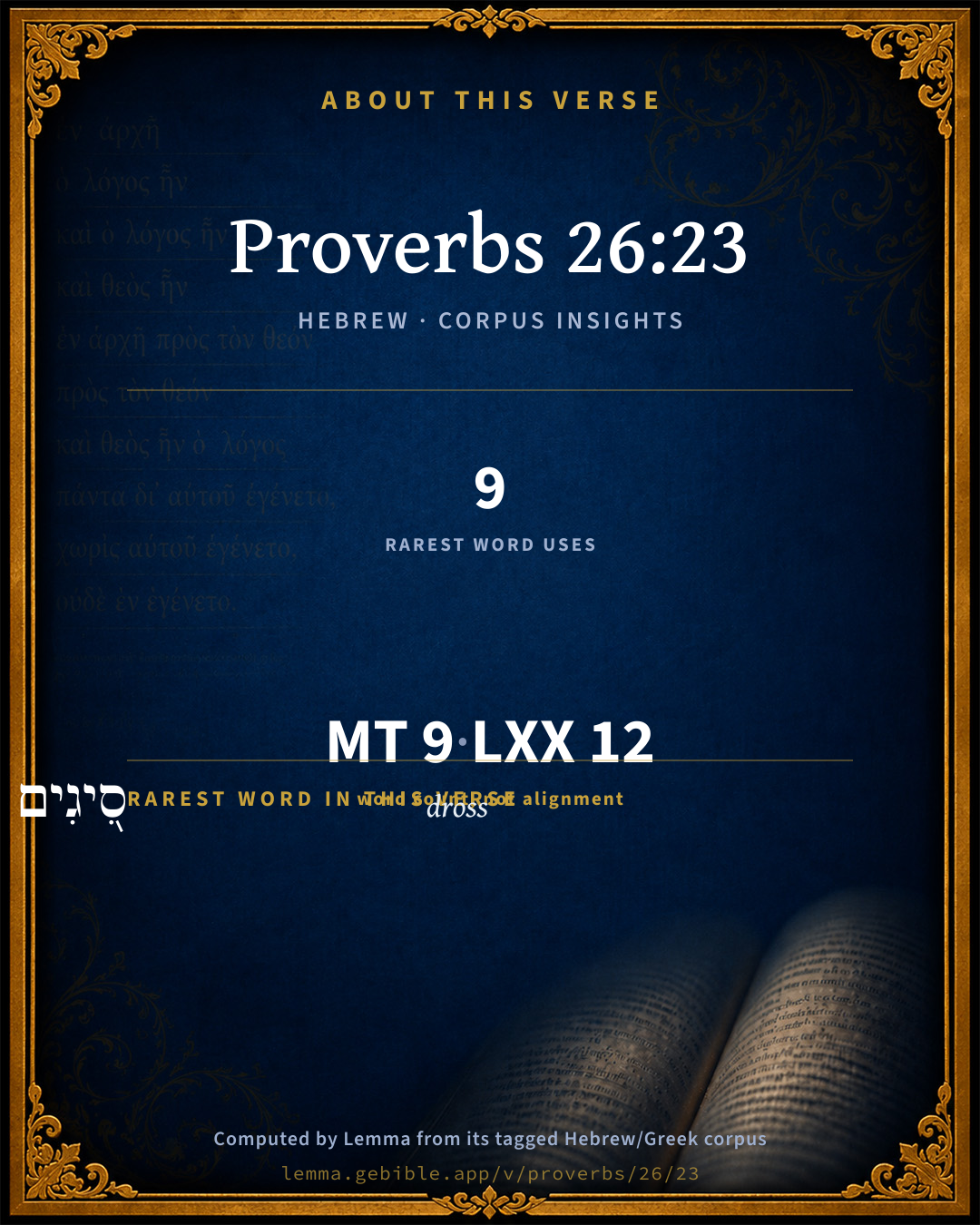
The rarest word here is סִ֭יגִים dross H5509 — appearing just 9 times in the whole Hebrew Bible.

Shared distinctive vocabulary

סִ֭יגִים dross H5509 occurs in 7 verses of the Hebrew Bible. Also found in:

Grammatical profile

  • 2 verbs
  • 5 nouns
  • 1 adjective
  • 1 preposition

Verb forms

  • מְצֻפֶּ֣ה Pual · Participle Passive
  • דֹּלְקִ֣ים Qal · Participle Active

Hebrew & Septuagint length

In English translation the verse runs 18 words from the Hebrew and 16 from the Septuagint (LXX English) — closely comparable.

A rough comparison of the two English renderings, which tokenize alike — not a word-level alignment.

Word counts can differ between the Hebrew and the Greek without any difference in meaning — e.g. the Hebrew direct-object marker אֵת has no separate Greek word, and Greek often adds the article ὁ.

In the original languages it is 9 Hebrew tokens and 12 Greek tokens — but the two are counted differently (Hebrew bundles its prefixes and suffixes into one token; the Greek is in lemma form), so that isn’t a like-for-like length.

Cross-references

7

Topical passages linked to Proverbs 26:23 in the Treasury of Scripture Knowledge — connected by theme and wording, ordered by reader-vote popularity; previews shown in the World English Bible.

  • Luke 22:47–48 While he was still speaking, behold, a multitude, and he who was called Judas, one of the twelve, was leading them. He came near to Jesus to kiss him.
  • Luke 11:39 The Lord said to him, "Now you Pharisees cleanse the outside of the cup and of the platter, but your inward part is full of extortion and wickedness.
  • Proverbs 10:18 He who hides hatred has lying lips. He who utters a slander is a fool.
  • Proverbs 25:4 Take away the dross from the silver, And material comes out for the refiner;
  • Ezekiel 33:31 They come to you as the people comes, and they sit before you as my people, and they hear your words, but don't do them; for with their mouth they show much love, but their heart goes after their gain.
  • Matthew 23:27 "Woe to you, scribes and Pharisees, hypocrites! For you are like whitened tombs, which outwardly appear beautiful, but inwardly are full of dead men's bones, and of all uncleanness.
  • 2 Samuel 20:9–10 Joab said to Amasa, Is it well with you, my brother? Joab took Amasa by the beard with his right hand to kiss him.

Cross-references courtesy of OpenBible.info (CC BY 4.0).

Hebrew and Greek witnesses Masoretic Hebrew ↔ Greek Septuagint

The same verse in the two great witnesses to the Old Testament, shown verse-for-verse.

These are two independent witnesses, not word-aligned to each other, and the Septuagint is shown in lemma (dictionary) form.

Hebrew Proverbs 26:23 Masoretic · Westminster Leningrad Codex

כֶּ֣סֶף סִ֭יגִים מְצֻפֶּ֣ה עַל חָ֑רֶשׂ שְׂפָתַ֖יִם דֹּלְקִ֣ים וְלֶב רָֽע

Like silver dross on an earthen vessel Are the lips of a fervent one with an evil heart.

World English Bible · Public Domain

Greek LXX Proverbs 26:23 Septuagint · lemma form

ἀργύριον δίδωμι μετά δόλος ὥσπερ ὄστρακον ἡγητέον χεῖλος λεῖος καρδία καλύπτω λυπηρός

Silver dishonestly given is to be considered as a potsherd: smooth lips cover a grievous heart.

LXX2012 (modern English Septuagint) · Public Domain

On this verse, The Pulpit Commentary discusses the Septuagint’s reading. Read the note in Commentary ↓

Hebrew: Westminster Leningrad Codex (CC BY 4.0). Greek: Septuagint (public domain); English from LXX2012 (modern English Septuagint) (Public Domain). How the Septuagint differs from the Hebrew →

Commentary

Notes on Proverbs 26:23 from classic Christian and Jewish commentators (each source and its license shown beneath its notes). The classic Christian expositions comment on the surrounding passage and are grouped to its opening verse, so a note may address several verses; the Jewish commentaries on the Tanakh (Rashi and others) are per-verse, so they appear only where the commentator wrote on this verse.

Lemma curates 59 commentaries, every one of them public domain or Creative Commons licensed, each selected and text-cleaned for this edition rather than reprinted as found. About our sources →

Trapp's Complete Commentary

John Trapp

Pro 26:23 Burning lips and a wicked heart [are like] a potsherd covered with silver dross.

Ver. 23. Burning lips and a wicked heart, &c.] The tongue of the righteous is as fined silver; but glossing lips upon a false heart is no better than dross upon dirt: counterfeit friends are naught on both sides, having os maledictum et cor malum, as Luther renders this text; - a bad mouth, and a worse heart. Wicked men are said to speak with a heart and a heart, {Psa 12:2, marg.} as speaking one thing and thinking another, drawing a fair glove on a foul hand. These are dangerous to be dealt withal; for, like serpents, they can sting without hissing; like cur dogs, suck your blood only with licking, and in the end kill you and cut your throats without biting: so cunning and close are they in the conveyance of their collusion. Squire, sent out of Spain to poison Queen Elizabeth, anointed the pommel of her saddle with poison secretly, and, as it were, doing somewhat else, praying with a loud voice, God save the queen. {a} When those Romish incendiaries, Gifford, Hodgeson, and others, had set Savage to work to kill the said queen, they first set forth a book to persuade the English Catholics to attempt nothing against her. So Parsons, when he had hatched that nameless villany, the gunpowder plot, set forth his book of Resolution, as if he had been wholly made up of devotion. Caveatur osculum Iscarioticum. Betware the mouth of Judus. It is the property of a godly man to speak the truth from his heart. {Psa 15:2}

{a} Camden’s Elizabeth, 57.

John Trapp, A Commentary or Exposition upon All the Books of the Old and New Testament (1647–1656) — public domain. Text from a community e-Sword module.

The Biblical Illustrator

Joseph S. Exell

Pro_26:23

Burning lips and a wicked heart are like a potsherd covered with silver dross.

Putrefaction phosphorescent

The illuminating power of phosphorus appears due to an extremely slow chemical reaction, and it is affirmed that vegetable and animal substances may grow phosphorescent at a certain stage of decomposition, or even without any appearance of putrefaction. Accredited authorities cite a host of examples of fresh or stale meats which have been seen to shine during the night with a more or less vivid clearness. Fish, and especially salt-water fish, when no longer fresh, acquire a phosphorescence which brightens during the first period, of putrefaction. Leave for two or three days dead saltwater fish in non-luminous sea-water; at the end of that time the water will be covered with a thin pellicle of fatty matter, and will soon become phosphorescent. But it is not only in material nature that we thus find brightness in combination with impurity. Genius itself has been found shining amidst moral putrefaction. (Scientific Illustrations.)

A wicked heart disguising itself

This may be meant either--

1. Of a wicked heart showing itself in burning lips, furious, passionate, outrageous words, burning in malice, and presenting those to whom, or of whom, they are spoken. Ill-words and ill-will agree together as well as a potsherd and the dross of silver, which, now that the pot is broken, and the dross separated from the silver, are fit to be thrown together to the dunghill

2. Or of a wicked heart disguising itself, with burning lips, burning with the professions of love and friendship, and even persecuting a man with flatteries; this is like a potsherd covered with the scum or dross of silver, with which one that is weak may be imposed upon, as if it were of some value, but a wise man is soon aware of the cheat. This sense agrees with the following verses. (Matthew Henry.)

The Biblical Illustrator, edited by Joseph S. Exell (c. 1880s–1900s) — public domain. Text from a community e-Sword module.

Joseph Benson's Commentary

Pro 26:23. Burning lips — Either, 1st, Lips pretending much love, that is, words delivered with a show of truth and fervent affection; or, rather, 2d, Burning with malice or hatred; that is, a slanderous or evil tongue; and a wicked heart — From whence evil thoughts and malicious words proceed; are like a potsherd covered with silver dross — Such a tongue and heart are of no real worth, although sometimes they make a show of it, as dross does of silver.

Joseph Benson's Commentary on the Old and New Testaments (1811–1818) — public domain. Text from a community e-Sword module.

The Preacher's Complete Homiletical Commentary

Joseph S. Exell (gen. ed.)

CRITICAL NOTES.—

Pro_26:23. Burning lips—i.e., “lips whence come ardent expressions of friendship.” Silver dross. Impure silver not freed from the dross.

Pro_26:24. Layeth up, rather, “prepareth,” or “meditateth.”

Pro_26:26. Congregation—i.e., “before the people assembled for judgment.” (Zöckler.)

MAIN HOMILETICS OF THE PARAGRAPH—Pro_26:23-28

COUNTERFEIT FRIENDSHIP

I. Because there are true friends in the world false men sometimes put on the garb of friendship. Because there is an abundance of genuine coin in the country men take the trouble to make counterfeit imitations of it; the existence of the good money is the cause of the existence of the bad, and the great preponderance of the good over the bad is the reason why men sometimes get imposed upon and take the bad for the good. So there is much real and true friendship in human life, and there is therefore an opportunity given to wicked men to imitate its outward expression—there are many “burning words” uttered from the depths of a sincere heart, and therefore a wicked man will sometimes utter such words for the purposes of deception. The vessel of clay covered with silver may be taken for silver, because its shape and external appearance are close imitations of the genuine article, and the fair words of the false man may effectually deceive the listener, but it is because some things are what they seem, that other things are made to seem what they are not.

II. The words of true friendship are used to reveal, and those of the false friend are employed only for concealment. There were many silver vessels in Solomon’s palace, and their bright splendour was a true revelation of their intrinsic worth and genuineness; the shining surface reflecting the light was an indication of the preciousness of the entire article. But when a clay vessel is covered with silver, the external coating is used only to cover what is beneath, and perhaps to deceive those who look on it. So when the friendship is real the ardent expressions of affection which are uttered are only a revelation of the emotions which are experienced, but when it is only a counterfeit the words are like the silver which hides instead of revealing what is beneath it. Solomon’s father thus records his experience of the language of a counterfeit friend: “His words were softer than oil, yet were they drawn swords” (Psa_55:21).

III. Because counterfeit friendship is opposed to human happiness it shall be publicly arrested and condemned. Every counterfeit has arrayed against it the force of human interest. It is to the interest of the general community that the forger should be brought to justice, and that the coiner of bad money should be severely punished. It is only by rigidly enforcing the law against such criminals that they are kept in check, and the safety of the public made tolerably secure. When such offenders are discovered their wickedness is condemned by the united voice of the commercial world. But the man who betrays another by false words is quite as great an enemy to his brother man, and ought to be as severely dealt with and as publicly and universally condemned. But it can hardly be affirmed that such is the case. If every such betrayer were dealt with by human laws we should need a large increase of judges and gaolers and prison-cells, and should find within the walls of the latter many men who are now living in mansions. And if they were only punished by being shut out from the favourable notice of their fellow-men, many would be missed from their present positions in commercial and fashionable circles. Although they are shunned, and their wickedness is abhorred by all lovers of truth and honesty, they are far from meeting at the hands of man with the contempt and condemnation which they deserve. But the forces arrayed against such men are nevertheless in operation, and though they often work secretly and slowly they are most certain to find their object, and to make him conscious of their existence. There are other agencies at work in the universe beside human agencies, and a Divine lawgiver as well as human lawgivers. And although the latter may fail to discover those who break their laws, no offender against the law of God will be able to escape public arrest and condemnation, if not before a human congregation, before a higher and more august assembly.

IV. A special form of punishment which will be the special portion of such offenders. The great principle proclaimed by Christ, “With what measure ye mete it shall be measured to you again” (Mat_7:2), is here uttered by Solomon. Every deceiver will be deceived, and one false man will become the prey of another false man. This is a law which is always and now in operation, although the punishment may not always be discernible to onlookers. But it is a work which the Almighty Judge has taken into His own hands, and many a one who is now suffering from a pitfall laid by another, knows very well in his secret soul that he is only passing through the same experience which he once prepared for another—that if what he took for a silver vessel is only clay, he has himself palmed off the counterfeit article for a genuine one.

OUTLINES AND SUGGESTIVE COMMENTS

Pro_26:28. It is not easy for us to forgive the injuries we receive; but it is far more difficult to forgive the injuries we do.—Lawson.

1. There is the inward self-reproach, arising from the workings of conscience, from which arises a secret irritability and fretfulness and unhappiness; and this produces dislike of the innocent occasion of it, instead of terminating (as it always ought to do) on self. This of course is only more injustice. True; but it is in human nature to hate with a bitter hatred the object of our own crime; as if it were a fault in that object to exist, and so to be the object on which our sin terminates.

2. The evil passions, like the good, are strengthened and increased by their exercise. If the utterance of the feelings of love serves further to inflame love, the utterance, in like manner, of the feelings of hatred tend to inflame hatred. The passion gives birth to the word and the action; and, reciprocally, the word and the action strengthen the passion.

3. The fretful uneasiness produced by the unceasing apprehension of detection and exposure, already alluded to, and of the weight of his vengeance who is the object of the lying tongue’s assaults, gives rise also to the same feeling of rankling dislike to him who is the source of it. Thus the slanderer, instead of feeling pity for the man whom his slander wounds, hates him still the more. This appears to have had a very striking exemplification in the case of our blessed Lord and His Jewish unbelieving adversaries. They “hated Him without a cause.”—Wardlaw.

The Preacher's Complete Homiletical Commentary (gen. ed. Joseph S. Exell; Funk & Wagnalls, c. 1892) — public domain (pre-1929). A full-Bible homiletical/sermon-outline anthology covering 65 of 66 books (2 John is absent from the source module). Text from a community e-Sword module.

Tyndale Open Study Notes

Tyndale Open Resources

26:23-26 People sometimes hide evil attitudes and wicked intentions through flattery. In the end, the true hatred of smooth talkers will be exposed.

Tyndale Open Study Notes — © Tyndale Open Resources, licensed CC BY-SA 4.0. Text via the HelloAO Bible API.

Geneva Bible (1599)

Geneva Bible translators

They will soon break out and utter themselves.

Geneva Bible (1599) marginal notes — public domain. Text via Bolls.life.

Matthew Henry's Commentary

This may be meant either, 1. Of a wicked heart showing itself in burning lips, furious, passionate, outrageous words, burning in malice, and persecuting those to whom, or of whom, they are spoken; ill words and ill-will agree as well together as a potsherd and the dross of silver, which, now that the pot is broken and the dross separated from the silver, are fit to be thrown together to the dunghill. 2. Or of a wicked heart disguising itself with burning lips, burning with the professions of love and friendship, and even persecuting a man with flatteries; this is like a potsherd covered with the scum or dross of silver, with which one that is weak may be imposed upon, as if it were of some value, but a wise man is soon aware of the cheat. This sense agrees with the following verses.

Matthew Henry's Commentary on the Whole Bible (1708–1710) — public domain (CC PDM 1.0). Text via the HelloAO Bible API.

Jamieson, Fausset & Brown

Robert Jamieson, A. R. Fausset & David Brown

Warm professions can no more give value to insincerity than silver coating to rude earthenware.

Jamieson, Fausset & Brown — Commentary Critical and Explanatory on the Whole Bible (1871) — public domain (CC PDM 1.0). Text via the HelloAO Bible API.

Adam Clarke's Commentary

Verse 23. Burning lips and a wicked heart] Splendid, shining, smooth lips; that is, lips which make great professions of friendship are like a vessel plated over with base metal to make it resemble silver; but it is only a vile pot, and even the outside is not pure.

Adam Clarke's Commentary on the Bible (1810–1826) — public domain. Text from a community e-Sword/MySword module.

Ellicott's Commentary for English Readers

(23) Burning lips—i.e., burning with love, while there is an evil heart within.

A potsherd covered with silver dross.—Pottery glazed with dross of silver, a well-known method of ornamentation. For similar proverbs, comp. Mat_23:27; Luk_11:39.

A Bible Commentary for English Readers, edited by Charles John Ellicott (1878–1897) — public domain. Text from a community e-Sword module.

The Cambridge Bible for Schools and Colleges

gen. ed. J. J. S. Perowne

23. burning] Better, fervent, R.V., with protestations of affection.

a potsherd covered] The rendering, an earthen vessel overlaid, R.V. makes the meaning clearer.

The Cambridge Bible for Schools and Colleges (gen. ed. J. J. S. Perowne; Cambridge University Press, 1878–1918) — public domain. Text from a community e-Sword module.

John Gill's Exposition

He that hateth dissembleth with his lips,.... He that bears a grudge in his mind, and retains hatred in his heart against any person, hides it all he can, till he has an opportunity of showing it as he would; he pretends a great deal of friendship with his lips, that his hatred might not be known; he would be thought to be a friend, when he is really an enemy; he does not choose as yet to make himself known what he is. Some render it to a sense the reverse, "the enemy", or "he that hateth, is known by his lips" (l); so the Targum, Vulgate Latin, and Syriac versions: if you carefully watch him, mark his words, and observe what he says, you will find out the hatred that lies in his heart; he cannot forbear saying something, at one time or another, which betrays the malignity of his mind;

and layeth up deceit within him; or, "though (m) he layeth up", &c. hides it as much as he can, yet it will show itself in some way or another.

(l) "agnoscetur", Montanus, Vatablus; "cognoscetur", Tigurine version; "cognoscitur", Amama, so Luther. (m) "quamvis", Luther. apud Gejerus, Baynus.

John Gill's Exposition of the Whole Bible (1746–1763) — public domain (CC PDM 1.0). Text via the HelloAO Bible API.

Albert Barnes' Notes on the Bible

Burning lips - i. e., “Lips glowing with, affection, uttering warm words of love,” joined with a malignant heart, are like a piece of broken earthenware from the furnace, which glitters with the silver drops at stick to it, but is itself worthless.

Albert Barnes' Notes on the Bible (1834–1885) — public domain. Text from a community e-Sword/MySword module.

Haydock's Catholic Bible Commentary

Dross. Hence the proud will be detested, and appear contemptible.

George Leo Haydock (1774–1849), Haydock's Catholic Family Bible and Commentary, 1859 edition — public domain. Excludes Psalms (Douay-Rheims chapter numbering differs from Protestant) and Deuterocanonical books (Catholic canon only).

Matthew Poole's English Annotations

Burning; either,

1. With love. Words delivered with show of true and fervent affection. Or rather,

2. With malice or hatred. A slanderous or evil tongue; for this word is constantly used in a bad sense, and notes the heat of rage and persecution.

Like a potsherd covered with silver dross; such a tongue and heart are of no real worth, although sometimes they make a show of it, as dross doth of silver.

Matthew Poole's English Annotations on the Holy Bible (1683–1685) — public domain. Text from a community e-Sword/MySword module.

Whedon's Commentary on the Bible

Daniel D. Whedon

23. Burning lips — Fiery professions of friendship, (Zockler,) and, especially lustful kisses. Mat_26:48.

Potsherd — A piece of broken crockery; perhaps put poetically for an earthen vessel.

Silver dross — An earthen vessel plated with silver, appearing more valuable than it really is. The proverb teaches the worthlessness of merely pretended friendship.

Daniel D. Whedon (gen. ed.), Commentary on the Old and New Testaments (1874–1909) — public domain. Text from a community e-Sword module.

The Pulpit Commentary

The next proverbs are concerned with hypocrisy. The Hebrew denotes the comparison simply by position, (see on Pro_25:11) thus: An earthen vessel (or, potsherd) overlaid with silver dross growing lips and a wicked heart. So called "silver dross" is litharge, an oxide of lead used to this day to put a glaze on pottery (comp. Ecc 38:30). The comparatively worthless article is thus made to assume a fine appearance. Thus lips that seem to burn with affection, and give the kiss of glowing, love, may mask a heart filled with envy and hatred Judas kisses and words of friendship hide the bad feelings that lurk within. Septuagint, "Silver given with guile is to be considered as a potsherd; smooth (leia ) lips hide a grievous heart". (comp. Mat_23:27)

Vers. 23-28. On guard.

Unfortunately, we have to treat men as we find them, not as we wish that they were and as their Creator meant them to be. We are compelled to learn caution as we pass on our way.

I OUR FIRST DUTY AND ITS NATURAL REWARD. Our first duty, natural to the young and the unsophisticated, is to be frank, open-minded, sincere, trustful; to say all that is in our heart, and to expect others to do the same; to believe that men mean what they say and say what they mean. And the reward of this simplicity and truthfulness on our part is an ingenuous, an unsuspicious spirit, a spirit as far removed as possible from that of cunning, of artifice, of worldliness.

II THE CORRECTION OF EXPERIENCE. All too soon we discover that we cannot act on this theory without being wounded and hurt. We find that what looks like pure silver may be nothing better than "earthenware of the coarsest kind lacquered over with silver dross." Behind the lips that burn and breathe affection for us and interest in us is a wicked heart in which are "seven abominations," in which dwells every evil imagination. We find that those who affect to be our friends when they stand in our presence are in fact our bitterest and most active enemies. We discover that our words, spoken in good faith and purity of heart, are misrepresented, and are made a sword to smite us. Experience compels caution, reticence, sometimes absolute silence.

III THE TWO MAIN EVILS AGAINST WHICH TO GUARD. These are:

1. Fair speaking which is false. The false words that are ostensibly spoken in our interest, by one that means us harm; words which would lead to trust and expectation when we should be alive with solicitude and alert to avoid the danger which impends. By these our treasure, our position, our friendship, our reputation, our happiness, may he seriously endangered.

2. Flattery. The invention and utterance of that which is not felt at all, or the careless and perhaps well-meant exaggeration of a feeling which is entertained in, the heart. Few things are more potent for harm than flattery.

(1) It is readily received.

(2) It is carefully treasured; men"s self-love prompts them to accept and to retain that which, if it were of an opposite character, they would reject.

(3) It is harmful in three different directions:

(a) It gives a wrong impression of our estate, and may lead to financial "ruin" (ver. 28).

(b) It encourages an over-estimate of our capacity, and may lead to our undertaking that for which we are incompetent, and thus to an humiliating and distressing failure.

(c) It engenders a false idea of our persona! worth, and may lead to spiritual infatuation, and thus to the ruin of ourselves.

IV THE DUTY AND THE WISDOM OF WARINESS. As these things are so, as human society does hold a large number of dissemblers (ver. 24), as it is possible that the next acquaintance we make may be an illustration of this sad fact, it follows that absolute trustfulness is a serious mistake. We must be on our guard. We must not open our hearts too freely. We must know men before we trust them. We must cultivate the art of penetration, of reading character. To be able to distinguish between the true and the false in this great sphere is a very large part of wisdom. Next to knowing God, and to acquainting ourselves with our own hearts, is the duty of studying men and discerning between the lacquered potsherd and the pure silver.

V THE DOOM OF DECEIT. To be rigorously exposed, to be unsparingly denounced, to be utterly ashamed (vers. 26, 27). C.

The Pulpit Commentary (1880–1919), ed. H.D.M. Spence-Jones & Joseph S. Exell — public domain. Text from a community e-Sword module.

John Wesley's Explanatory Notes

Burning - With malice or hatred: A slanderous or evil tongue. Dross - Such a tongue and heart are of no real worth, although sometimes they make a shew of it, as dross does of silver. 26. Deceit - With false professions of love.

John Wesley, Explanatory Notes Upon the Whole Bible (1754–1765) — public domain. Text via the GEBible commentary corpus.

Keil & Delitzsch

C. F. Keil & F. Delitzsch

The proverbs next following treat of a cognate theme, hypocrisy (the art of dissembling), which, under a shining [gleissen] exterior,

(Note: Vid., regarding gleisen (to give a deceitful appearance) and gleissen (to throw a dazzling appearance), Schmitthenner-Weigand's Deutsches Wrterbuch.)

conceals hatred and destruction:

23 Dross of silver spread over an earthen vessel -

Lips glowing with love and a base heart.

Dross of silver is the so-called gltte (French, litharge), a combination of lead and oxygen, which, in the old process of producing silver, was separated (Luther: silberschaum, i.e., the silver litharge; Lat. spuma argenti, having the appearance of foam). It is still used to glaze over potter's ware, which here (Greek, κέραμος) is briefly called חרשׂ for כּלי חרשׂ; for the vessel is better in appearance than the mere potsherd. The glossing of the earthenware is called צפּה על־חרשׂ, which is applicable to any kind of covering (צפּה, R. צף, to spread or lay out broad) of a less costly material with that which is more precious. 23a contains the figure, and 23b its subscription: שׂפתים דּלקים ולב רע. Thus, with the taking away of the Makkeph after Codd., to be punctuated: burning lips, and therewith a base heart; burning, that is, with the fire of love (Meri, אשׁ החשׁק), while yet the assurances of friendship, sealed by ardent kisses, serve only to mask a far different heart. The lxx translate דלקים [burning] by λεῖα, and thus have read חלקים [smooth], which Hitzig without reason prefers; burning lips (Jerome, incorrectly: tumentia; Luther, after Deu 32:33, חמת: Gifftiger mund = a poisonous mouth) are just flattering, and at the same time hypocritical

(Note: Schultens explains the labia flagrantia by volubiliter prompta et diserta. But one sees from the Arab. dhaluḳa, to be loose, lightly and easily moved (vid., in Fleischer's Beitrgen zur arab. Sprachkunde the explanation of the designation of the liquid expressed with the point of the tongue by dhalḳiytt, at Pro 1:26-27; cf. de Sacy's Grammar), and dalḳ, to draw out (of the sword from its scabbard), to rinse (of water), that the meaning of the Heb. דלק, to burn, from R. דל, refers to the idea of the flickering, tongue-like movement of the flame.)

lips. Regarding שׂפתים as masc., vid., p. 85; לב רע means, at Pro 25:20, animus maestus; here, inimicus. The figure is excellent: one may regard a vessel with the silver gloss as silver, and it is still earthen; and that also which gives forth the silver glance is not silver, but only the refuse of silver. Both are suitable to the comparison: the lips only glitter, the heart is false (Heidenheim).

Keil & Delitzsch — Biblical Commentary on the Old Testament (1861–1891) — public domain (CC PDM 1.0). Text via the HelloAO Bible API. (Old Testament only.)

Bridges on Proverbs

Charles Bridges

The sin here described is a disgrace to society! Yet is it often covered with a flattering garb, as the worthless potsherd with a thin coat of silver. "The tongue of the just is as choice silver." Here is only silver dross — "the heart of the wicked, which is nothing worth" (Pro 10:20 ); lips burning with warm affection, yet covering a heart filled with malice and wickedness.†1 Such were the lips of Joseph’s brethren, when "they rose up to comfort their father" under the bereavement which they had brought upon him. (Gen 37:35 .) Such was Absalom’s smooth hypocrisy. (2Sa 15:1-9 .) Such were the traitor’s lips and heart, uniting with the rest in protestations of faithfulness; yet "betraying the Son of man with a kiss."†2 An open enemy could be much better borne. (Psa 55:12 .) The cant of hypocrites, the benevolence of infidels, the smooth enticement of the false "angel of light" — all answer to this strong figure. ’Hypocrisy is spun often of a very fine thread; and the heart of man, abounding with so much hypocrisy as it doth, is the most deceitful thing, yea, and the most deceivable too, actively and passively both, of anything in the world.’†3

Often also, when the lips do not burn, there is dissembling of hatred. "Cain talked with his brother in the field," while murder was in his heart. (Gen 4:8 .) Saul pretended to honor David, while he was plotting his ruin. (1Sa 18:17, 1Sa 18:21 .) Absalom dissembled with his brother, by seeming to let him alone, for two years laying up deceit within him. (2Sa 13:22-28 .) Joab covered his murderous intentions with peaceable profession.†4

Christian prudence will guard against credulity,†5 which is in fact the "harmlessness of the dove," without "the wisdom of the serpent." (Mat 10:16 .) This weakness cost Gedaliah his life.†6 A sounder spirit saved Nehemiah from the snare of his malignant adversaries.†7 The source of this wickedness gives good reason for distrust. There are seven abominations — a great variety†8 of abominations — closely folded up in his heart, only within the ken of that heart-searching eye, "before whom all secret things are naked and open."†9 And here lies the root of the disease. ’A guileful heart makes guileful tongue and lips. It is the workhouse, where is the forge of deceit and slander; and the tongue is only the outer shop, where they are mended; and the lips the door of it; so then such ware as is made within, such and no other can be set out. From evil thoughts, evil speakings; from a deceitful heart, guileful words, well-varnished, but lined with rottenness.’†10 Oh! let this despicable character be a beacon to us to shun all approaches to false dealings. Better to risk giving offense by faithfulness (though let this, so far as conscience allows, be avoided) rather than cover our hatred by flattering words.

Dissembling never answers in the end. The Providence of God brings dark deeds to light. "The voice of Abel’s blood cried from the ground." (Gen 4:10 .) "Some men’s sins are open beforehand, going before to judgment; and some men they follow after." (1Ti 5:24 .) The hand strips off the mask, and exposes the flatterer to shame. His seven abominations shall be proclaimed, if not more privately, at last before the whole congregation, when all shall appear before men and angels as they really are, and when the hypocrite shall receive his just recompense of "everlasting contempt." (Luk 12:2 .)

Often however does retribution reach the offender in this world. ’He will fall into the pits, which he has bestowed pains to dig for his neighbor, and be crushed by the stone, which he meant to roll upon him.’†11 Even the place of sinning is sometimes made the place of punishment.†12 Those who plot mischief for others, will be overwhelmed with it themselves.†13 Moab, in attempting to curse Israel, fell himself under the curse of God.†14 Haman’s gallows for Mordecai was his own "promotion of shame."†15 The enemies of Daniel were devoured in the ruin, which they plotted against him.†16 Thus does God "take the wise in his craftiness,"†17 "the wicked in his wickedness."†18 The death of Christ, which was to be the means of warding off national judgment, was the just cause of the deprecated scourge.†19 The malice that meditates the evil, is often the cause of its own overthrow. What an Aceldama would this world be, but for the restraining grace of God! Oh! may my heart, my soul, every member, every principle, not only be restrained from hateful passions; but be imbued with the spirit of the Gospel, and consecrated to the service of God!

Footnotes:

†1 Pro 10:17. Psa 55:21 . Compare Sir 19:26-28 . See Bunyan’s description of the town of ’Fair-Speech.’

†2 Mat 26:35. Luk 22:47-48 .

†3 Bp. Sanderson’s Sermon on Gal 5:22-23 .

†4 2Sa 3:27; 2Sa 20:9-10. Compare Gen 34:15-25 . Psa 28:3 ; Psa 55:20 .

†5 Jer 9:8; Jer 12:6 . Mic 7:5 . Compare Sir 12:10-17 .

†6 Jer 40:14; Jer 41:6-7 .

†7 Neh 6:1-4.

†8 Bp. Hall. Pro 26:16 ; Pro 24:16 .

†9 Jer 17:10. Heb 4:13 .

†10 Leighton on 1Pe 3:16 .

†11 Scott.

†12 1Ki 21:19, with 2Ki 9:26 . Jer 7:31-32 .

†13 Psa 7:15.

†14 Num 22:6; Num 24:17 .

†15 Pro 3:35. Est 7:10 .

†16 Dan 6:24.

†17 Job 5:13.

†18 Pro 11:6.

†19 Joh 11:50. Mat 23:32, Mat 23:38 .

Charles Bridges, An Exposition of the Book of Proverbs (1846) — public domain. Text from a community e-Sword module.

Rashi

Rabbi Shlomo Yitzchaki (Rashi)

overlaid on earthenware Like silver dross attached to the earthenware in which it is refined, making the utensil shine as though it were silver although it has no use, so are burning lips and wicked heart, which pursue people to entice them with smooth and hypocritical talk.

and a wicked heart They appear to be friends, but they are enemies.

burning Heb. דולקים, as in “you pursued (דלקת) me so hotly” (Gen. 31:36).

Rashi on the Tanakh — English translations: “The Judaica Press complete Tanach with Rashi, translated by A. J. Rosenberg” (CC BY 4.0); “Pentateuch with Rashi's commentary by M. Rosenbaum and A.M. Silbermann, 1929-1934” (public domain); “The Metsudah Tanach series, Lakewood, N.J” (CC BY 4.0); and “The Book of Joshua, Metsudah Publications, 1997” (CC BY 4.0). Text via Sefaria.

Lesson kit

Teaching starters — assembled from the data on this page, not authored interpretation. Every prompt links to the verse data it draws on. Edit before teaching.

Proverbs, in the Wisdom, opens this verse with 9 words (9 distinct Hebrew lemmas). Its most distinctive word is çîyg (“dross”). A historical commentator’s framing appears above. Read the whole chapter for the surrounding context.

Discussion questions

  1. The word çîyg carries the sense “dross.” How does it shape the verse?
  2. Psalms 119:119 shares the word «dross» with this verse. How do the two illuminate each other?
  3. These translations render this verse differently; the difference is in the English rendering, not the original. What questions does that raise?
  4. The verb «מְצֻפֶּ֣ה» is Pual Participle Passive. How does its form color the action?
  5. Reading how Trapp's Complete Commentary and The Biblical Illustrator read this verse, where do the two commentators agree and where do they part?

Things to notice

Reading settings

Reading text

Shown beneath each verse's original-language words.

Old Testament
Old Testament edition

Read the OT as the Masoretic Hebrew (MT) or the Greek Septuagint (LXX).

English shown for the Greek Septuagint (in the Hebrew ↔ Greek comparison).

Comparing translations? Open the Compare panel on any verse page to stack up to four side by side.