
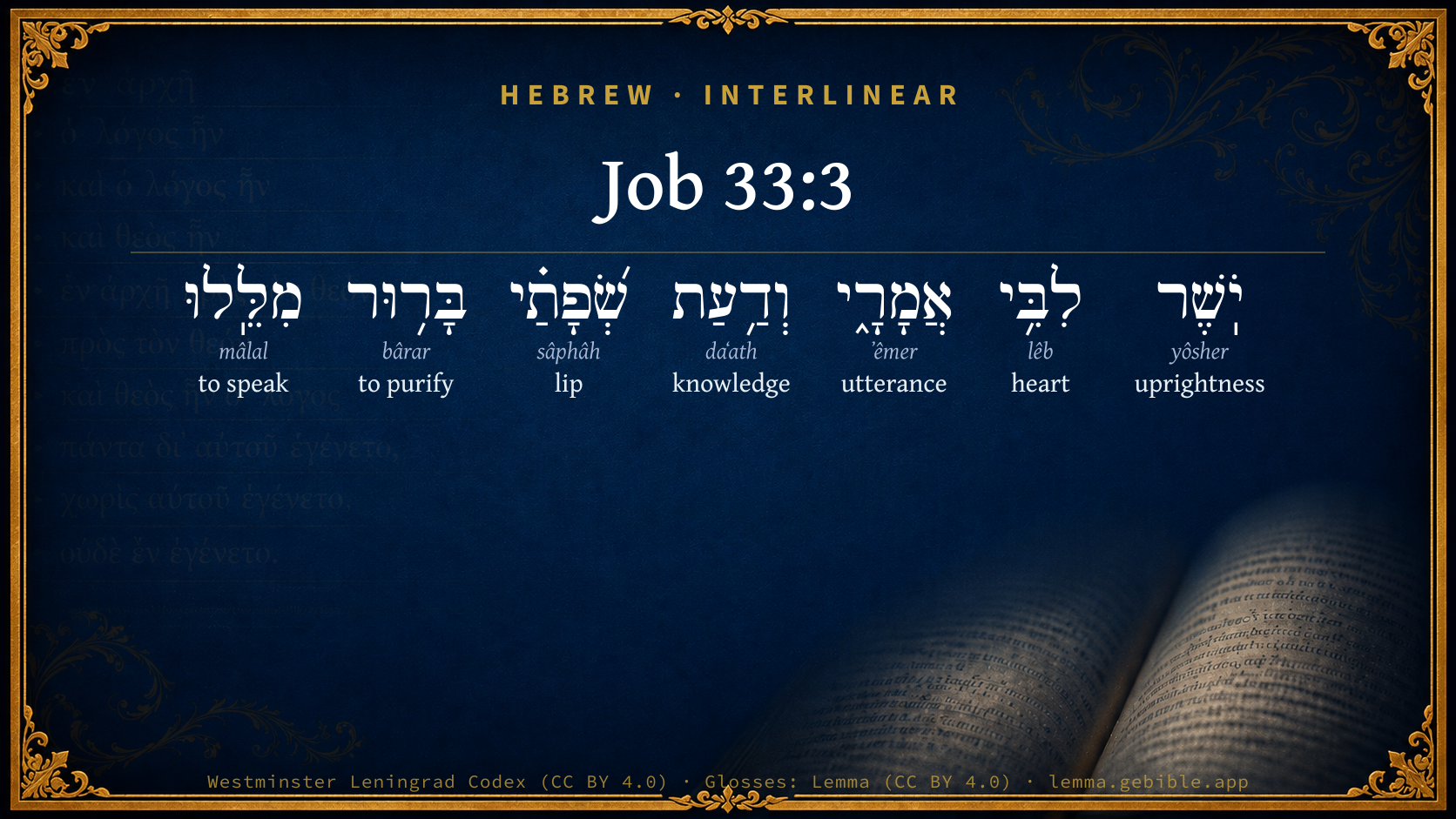
Job 33:3

Hebrew (Westminster Leningrad Codex) Job 33:3 appears in the Hebrew Old Testament. The text above is from the Westminster Leningrad Codex. Each word links to its Strong’s number, a concise gloss, and parsing drawn from the Open Scriptures Hebrew Bible morphology. Click any word for its full Brown-Driver-Briggs (BDB) entry.
Download image
Cite this verse

Job 33:3 (World English Bible). Public Domain. Lemma interlinear Bible study tool, https://lemma.gebible.app/v/job/33/3.

Show BibTeX & RIS
BibTeX
RIS
English Translation
My words shall utter the uprightness of my heart; That which my lips know they shall speak sincerely.
World English Bible · Public Domain
Download a study sheet

One document with this verse’s original text, its word-by-word gloss line, the meaning frame, cross-references with their text, attributed commentary, and full source and license credits — printable, and it pastes into notes with its structure intact.

This verse Autodidact and up

Study sheet (.html) Plain text (.txt)

A passage Seminary Student

Up to 50 verses in one chapter. A passage sheet keeps up to 6 commentary sources and 12 cross-references per verse, in the order this page ranks them, and says so on the sheet whenever that leaves anything out. Ask for a single verse and you get the Autodidact verse sheet above.

Everything on this page stays free to read, with no account — the sheet is a download of what is already on screen, not access to it.

Want to remove ads? Support Godless Engineer
Compare translations 3

The same verse in 3 English versions, stacked beneath the original-language interlinear above. Click any original word for its lexicon entry.

Each is an independent rendering of the whole verse — the interlinear is not word-aligned to these translations.

Highlighted words mark where these versions differ — a whole-verse word diff, not a word-by-word alignment.

  • World English Bible Public Domain
    My words shall utter the uprightness of my heart; That which my lips know they shall speak sincerely.
  • King James Version Public Domain
    My words shall be of the uprightness of my heart: and my lips shall utter knowledge clearly.
  • unfoldingWord Literal Text CC BY-SA 4.0
    My words the uprightness of my heart, and my lips speak pure knowledge.

unfoldingWord Literal Text — © unfoldingWord, licensed CC BY-SA 4.0. Word-aligned USFM3 via Door43 (git.door43.org/unfoldingWord/en_ult).

Versions to compare (up to 4)

3 of 4 selected

Show all 18 translations

Every available English version of this verse, each an independent rendering of the whole verse.

  • World English Bible Public Domain
    My words shall utter the uprightness of my heart; That which my lips know they shall speak sincerely.
  • Berean Standard Bible Public Domain
    My words are from an upright heart, and my lips speak sincerely what I know.
  • Majority Standard Bible Public Domain
    My words are from an upright heart, and my lips speak sincerely what I know.
  • King James Version Public Domain
    My words shall be of the uprightness of my heart: and my lips shall utter knowledge clearly.
  • American Standard Version (1901) Public Domain
    My words `shall utter' the uprightness of my heart; And that which my lips know they shall speak sincerely.
  • Revised Version (1885) Public Domain
    My words shall utter the uprightness of my heart: and that which my lips know they shall speak sincerely.
  • Geneva Bible (1599) Public Domain
    My words are in the vprightnesse of mine heart, and my lippes shall speake pure knowledge.
  • Douay-Rheims (1899) Public Domain
    My words are from my upright heart, and my lips shall speak a pure sentence.
  • Young's Literal Translation Public Domain
    Of the uprightness of my heart `are' my sayings, And knowledge have my lips clearly spoken.
  • Literal Standard Version CC BY-SA 4.0
    Of the uprightness of my heart [are] my sayings, || And my lips have clearly spoken knowledge.
  • Unlocked Literal Bible CC BY-SA 4.0
    My words come from the uprightness of my heart; my lips speak pure knowledge.
  • unfoldingWord Literal Text CC BY-SA 4.0
    My words the uprightness of my heart, and my lips speak pure knowledge.
  • Darby Bible Public Domain
    My words shall be of the uprightness of my heart, and my lips shall utter knowledge purely.
  • World Messianic Bible Public Domain
    My words will utter the uprightness of my heart. That which my lips know they will speak sincerely.
  • Webster's Bible Public Domain
    My words shall be of the uprightness of my heart: and my lips shall utter knowledge clearly.
  • Free Bible Version CC BY-SA 4.0
    My words come from my upright heart; my lips speak sincerely of what I know.
  • Bible in Basic English Public Domain
    My heart is overflowing with knowledge, my lips say what is true.
  • JPS Tanakh (1917) Public Domain
    My words shall utter the uprightness of my heart; and that which my lips know they shall speak sincerely.

Literal Standard Version (2020), Covenant Press — licensed CC BY-SA 4.0. Text via the HelloAO Bible API (eBible.org). Unlocked Literal Bible (unfoldingWord) — licensed CC BY-SA 4.0. Text via the HelloAO Bible API (eBible.org). unfoldingWord Literal Text — © unfoldingWord, licensed CC BY-SA 4.0. Word-aligned USFM3 via Door43 (git.door43.org/unfoldingWord/en_ult). Free Bible Version, Dr. Jonathan Gallagher — licensed CC BY-SA 4.0. Text via the HelloAO Bible API (eBible.org).

Word by word

More ways to search: Search by grammar → Find every occurrence → Compare this word →

Practice this passage: Drill this verse → Learn its vocabulary →

About this verse

These counts appear in no published source. They are computed here, from the morphology-tagged text and Lemma’s own curated glosses. What Lemma adds →

7
words
7
distinct lemmas
Wisdom
section

Notable vocabulary

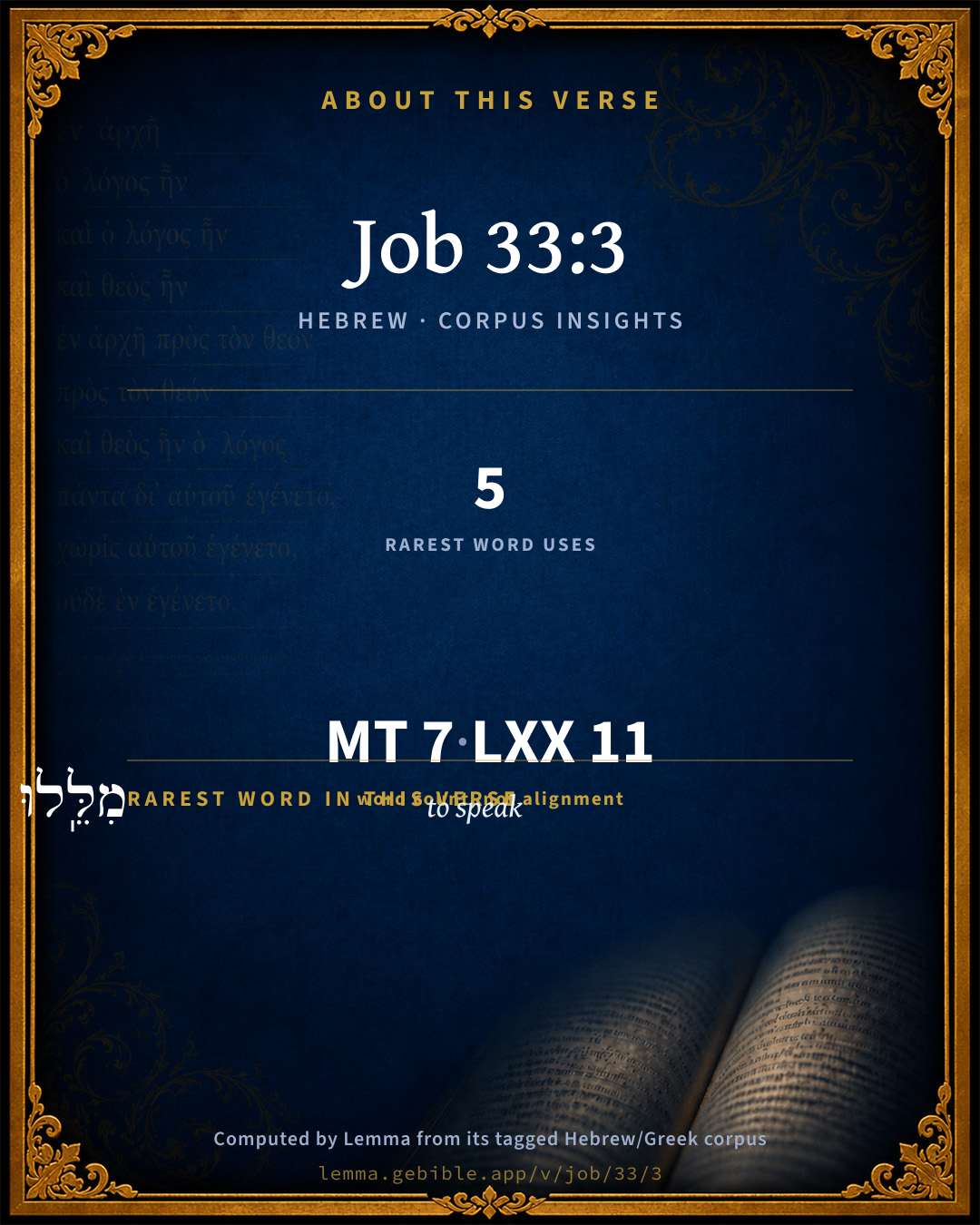
The rarest word here is מִלֵּֽלוּ to speak H4448 — appearing just 5 times in the whole Hebrew Bible.

Shared distinctive vocabulary

מִלֵּֽלוּ to speak H4448 occurs in 5 verses of the Hebrew Bible. Also found in:

Grammatical profile

  • 1 verb
  • 5 nouns
  • 1 adjective

Verb forms

  • מִלֵּֽלוּ Piel · Perfect

Hebrew & Septuagint length

In English translation the verse runs 18 words from the Hebrew and 18 from the Septuagint (LXX English) — the same length.

A rough comparison of the two English renderings, which tokenize alike — not a word-level alignment.

Word counts can differ between the Hebrew and the Greek without any difference in meaning — e.g. the Hebrew direct-object marker אֵת has no separate Greek word, and Greek often adds the article ὁ.

In the original languages it is 7 Hebrew tokens and 11 Greek tokens — but the two are counted differently (Hebrew bundles its prefixes and suffixes into one token; the Greek is in lemma form), so that isn’t a like-for-like length.

Cross-references

11

Topical passages linked to Job 33:3 in the Treasury of Scripture Knowledge — connected by theme and wording, ordered by reader-vote popularity; previews shown in the World English Bible.

  • Job 27:4 Surely my lips shall not speak unrighteousness, Neither shall my tongue utter deceit.
  • Proverbs 20:15 There is gold and abundance of rubies; But the lips of knowledge are a rare jewel.
  • 1 Thessalonians 2:3–4 For our exhortation is not of error, nor of uncleanness, nor in deception.
  • Job 6:28 Now therefore be pleased to look at me, For surely I shall not lie to your face.
  • Job 15:2 "Should a wise man answer with vain knowledge, And fill himself with the east wind?
  • Job 36:3–4 I will get my knowledge from afar, And will ascribe righteousness to my Maker.
  • Job 38:2 "Who is this who darkens counsel By words without knowledge?
  • Psalms 37:30–31 The mouth of the righteous talks of wisdom. His tongue speaks justice.
  • Proverbs 8:7–8 For my mouth speaks truth. Wickedness is an abomination to my lips.
  • Proverbs 15:2 The tongue of the wise commends knowledge, But the mouth of fools gush out folly.
  • Proverbs 15:7 The lips of the wise spread knowledge; Not so with the heart of fools.

Cross-references courtesy of OpenBible.info (CC BY 4.0).

Hebrew and Greek witnesses Masoretic Hebrew ↔ Greek Septuagint

The same verse in the two great witnesses to the Old Testament, shown verse-for-verse.

These are two independent witnesses, not word-aligned to each other, and the Septuagint is shown in lemma (dictionary) form.

Hebrew Job 33:3 Masoretic · Westminster Leningrad Codex

יֹֽשֶׁר לִבִּ֥י אֲמָרָ֑י וְדַ֥עַת שְׂ֝פָתַ֗י בָּר֥וּר מִלֵּֽלוּ

My words shall utter the uprightness of my heart; That which my lips know they shall speak sincerely.

World English Bible · Public Domain

Greek LXX Job 33:3 Septuagint · lemma form

καθαρός ἐγώ ὁ καρδία ῥῆμα σύνεσις δέ χεῖλος ἐγώ καθαρός νοέω

My heart shall be found pure by my words; and the understanding of my lips shall meditate purity.

LXX2012 (modern English Septuagint) · Public Domain

Hebrew: Westminster Leningrad Codex (CC BY 4.0). Greek: Septuagint (public domain); English from LXX2012 (modern English Septuagint) (Public Domain). How the Septuagint differs from the Hebrew →

Commentary

Notes on Job 33:3 from classic Christian and Jewish commentators (each source and its license shown beneath its notes). The classic Christian expositions comment on the surrounding passage and are grouped to its opening verse, so a note may address several verses; the Jewish commentaries on the Tanakh (Rashi and others) are per-verse, so they appear only where the commentator wrote on this verse.

Lemma curates 59 commentaries, every one of them public domain or Creative Commons licensed, each selected and text-cleaned for this edition rather than reprinted as found. About our sources →

Trapp's Complete Commentary

John Trapp

Job 33:3 My words [shall be of] the uprightness of my heart: and my lips shall utter knowledge clearly.

Ver. 3. My words shall be of the uprightness of my heart] i.e. Out of the uprightness of my heart I will deal fairly and faithfully with thee; I will carve thee a piece of my heart, without doubling or dissembling; and why should not downright truth please thee better than a smooth supparasitation {flattery}? Bees pass by roses and violets, and sit upon thyme; so should men rather heed sound rebukes, though hot and biting, than flattering discourses, which Solomon fitly calleth, "The song of fools," Ecc 7:5, a syren’s song. And another calleth a flatterer a courteous murderer, Eυνους σφακτης, that killeth in kindness, kisseth and killeth. Cavete vobis ab osculo hoc Iscariotico, Beware of this sweet poison, and covet rather those faithful wounds of a friend, Pro 27:6, as David did, Psa 141:5. And as Vespasian, who carrieth this commendation, that he was Patientissimus veri; verp patient of truth, and as Alphonsus, king of Arragon, who complained of this, that whereas of everything else he had enough, of truth he was very much scanted, there being few about him that would deal candidly and faithfully without flattery or partiality.

And my lips shall utter knowledge clearly] i.e. Simply and sincerely, plainly and perspicaciously, I will show my meaning, without either gall or guile. My discourse shall be clear and pure from all dross of deceit, as the original word signifieth. This is a praise proper to God’s Holy Word, Psa 9:9-11 Pro 30:5. And they that handle it (Tophshe Torah, Jer 2:8) may here learn not to obtrude their own conceits or conjectures for doctrinal truths; but to utter demonstrative things: not to huckster the Word of God, or corrupt it with their own mixtures, as vintners do their wines; "but as of sincerity, but as of God, in the sight of God," &c., 2Co 2:17. Let them not preach one thing and practise another, sed animentur moribus praecepta; lest some Hilary complain as once, That there were many heavenly doctrines in the people’s ears that never yet had been in the preacher’s heart.

John Trapp, A Commentary or Exposition upon All the Books of the Old and New Testament (1647–1656) — public domain. Text from a community e-Sword module.

Jamieson, Fausset & Brown

Robert Jamieson, A. R. Fausset & David Brown

I will speak according to my inward conviction.

clearly--rather, "purely"; sincerely, not distorting the truth through passion, as the friends did.

Jamieson, Fausset & Brown — Commentary Critical and Explanatory on the Whole Bible (1871) — public domain (CC PDM 1.0). Text via the HelloAO Bible API.

Adam Clarke's Commentary

Verse 3. My words shall be of the uprightness] As God has given me his Spirit, from that Spirit alone will I speak; therefore all my words shall be of uprightness, knowledge, and truth.

Knowledge clearly.] דעת ברור daath barur, pure science. I shall lay down no false positions, and I shall have no false consequences.

Adam Clarke's Commentary on the Bible (1810–1826) — public domain. Text from a community e-Sword/MySword module.

The Cambridge Bible for Schools and Colleges

gen. ed. J. J. S. Perowne

3. Reiteration of the speaker’s sincerity; he possesses what Job had desiderated on the part of his three friends, uprightness (ch. Job_6:25).

my lips shall utter knowledge clearly] lit. and the knowledge of my lips they shall utter purely, with no mixture of falsehood; his lips will express truly the sincere convictions of his mind.

The Cambridge Bible for Schools and Colleges (gen. ed. J. J. S. Perowne; Cambridge University Press, 1878–1918) — public domain. Text from a community e-Sword module.

John Gill's Exposition

My words shall be of the uprightness of my heart,.... Not that the uprightness of his heart, or his own personal integrity, should be the subject of his discourse; but what he should say would be in or out of the uprightness of his heart, with all sincerity and faithfulness; what would be the real sentiments of his mind, and not proceed from a double or insincere heart:

and my lips shall utter knowledge clearly; what knowledge he had of God, and of the perfections of his nature, and of his works in nature and grace, and of his dealings in a providential way with the sons of men; and what knowledge he had of Christ, his person, office, and grace somewhat of which speaks in this chapter; and such sort of knowledge is to be uttered, to be published, and made known to the good of others; and not to be concealed, and hid, or held, as in a prison, in unrighteousness; and to be uttered clearly, plainly, and distinctly, in words intelligible, and easy to be understood; and not in ambiguous terms, or in words of a double meaning; or which are abstruse and intricate, and serve rather to make the mysteries of Providence and grace more dark and obscure than to explain them; integrity of heart, and perspicuity of language, serve much to recommend a speaker, and both are expressed in this verse.

John Gill's Exposition of the Whole Bible (1746–1763) — public domain (CC PDM 1.0). Text via the HelloAO Bible API.

Albert Barnes' Notes on the Bible

My words shall be of the uprightness of my heart - I will speak in sincerity. I will utter nothing that shall be hollow and hypocritical. What I speak shall be the real suggestion of my heart - what I feel and know to be true. Perhaps Elihu was the more anxious to make this point entirely clear, because the three friends of Job might be supposed to have laid themselves open to the suspicion that they were influenced by passion or prejudice; that they had maintained their opinions from mere obstinacy and not from conviction; and that they had been sometimes disposed to cavil. Elihu claims that all that he was about to say would be entirely sincere.

Shall utter knowledge clearly - Shall state things just as they are, and give the true solution of the difficulties which have been felt in regard to the divine dealings. His object is to guard himself wholly from the suspicion of partiality.

Albert Barnes' Notes on the Bible (1834–1885) — public domain. Text from a community e-Sword/MySword module.

Haydock's Catholic Bible Commentary

Sentence. Some editions have scientiam, "knowledge," with the Hebrew. (Calmet)

George Leo Haydock (1774–1849), Haydock's Catholic Family Bible and Commentary, 1859 edition — public domain. Excludes Psalms (Douay-Rheims chapter numbering differs from Protestant) and Deuterocanonical books (Catholic canon only).

Matthew Poole's English Annotations

I shall not speak passionately or partially, as one resolved to defend what I have once said, whether true or false; but from an honest mind, or what I verily believe to be true, and from a sincere desire to do thee good. I shall not speak my own fancies or devices, but only that which by diligent study and Divine inspiration I know to be true, and this I shall do plainly and clearly.

Matthew Poole's English Annotations on the Holy Bible (1683–1685) — public domain. Text from a community e-Sword/MySword module.

Whedon's Commentary on the Bible

Daniel D. Whedon

3. Clearly — What he knows he will speak sincerely.

3. That “in the proposition of Job, that he suffers and yet is innocent before God, lies the consequence that man without sin is no better than the man with sin, and that the pious have no advantage.” (See Stickel, 234.) If such be the case, Job virtually denies the providence of God. For answer see page 214.

Daniel D. Whedon (gen. ed.), Commentary on the Old and New Testaments (1874–1909) — public domain. Text from a community e-Sword module.

The Pulpit Commentary

My words shall be of the uprightness of my heart. Moreover, whatever I say will be said with entire sincerity. My heart is upright, and I shall speak "from the uprightness of my heart," without pretence, deception, or concealment of any kind. And my lips shall utter knowledge clearly. I shall say only what I know" and shall endeavour to say it simply and clearly, so that no one can mistake my meaning.

The Pulpit Commentary (1880–1919), ed. H.D.M. Spence-Jones & Joseph S. Exell — public domain. Text from a community e-Sword module.

John Wesley's Explanatory Notes

My words - I will not speak passionately or partially, but from a sincere desire to do thee good. Clearly - What I speak will be plain, not hard to be understood.

John Wesley, Explanatory Notes Upon the Whole Bible (1754–1765) — public domain. Text via the GEBible commentary corpus.

Lesson kit

Teaching starters — assembled from the data on this page, not authored interpretation. Every prompt links to the verse data it draws on. Edit before teaching.

Job, in the Wisdom, opens this verse with 7 words (7 distinct Hebrew lemmas). Its most distinctive word is mâlal (“to speak”). A historical commentator’s framing appears above. Read the whole chapter for the surrounding context.

Discussion questions

  1. How does “to speak” (mâlal) shape what this verse is saying?
  2. Genesis 21:7 shares the word «to speak» with this verse. How do the two illuminate each other?
  3. The translations on this page render this verse differently — a whole-verse word diff, not a word-by-word alignment. What might account for the different wordings?
  4. The verb «מִלֵּֽלוּ» is Piel Perfect. How does its form color the action?
  5. Reading how Trapp's Complete Commentary and Jamieson, Fausset & Brown read this verse, where do the two commentators agree and where do they part?

Things to notice

Reading settings

Reading text

Shown beneath each verse's original-language words.

Old Testament
Old Testament edition

Read the OT as the Masoretic Hebrew (MT) or the Greek Septuagint (LXX).

English shown for the Greek Septuagint (in the Hebrew ↔ Greek comparison).

Comparing translations? Open the Compare panel on any verse page to stack up to four side by side.