
Jeremiah 9:25

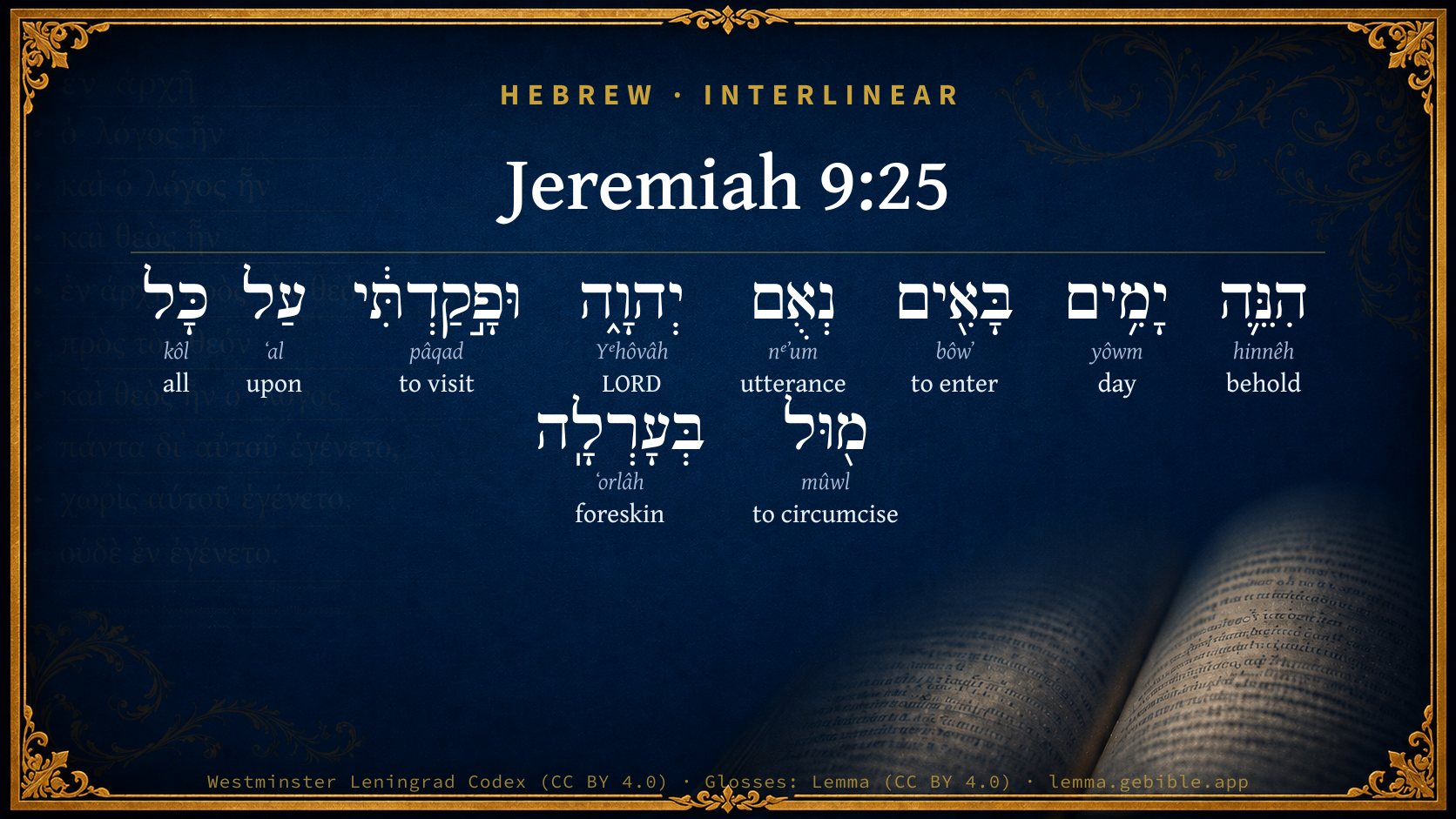
Hebrew (Westminster Leningrad Codex) Jeremiah 9:25 appears in the Hebrew Old Testament. The text above is from the Westminster Leningrad Codex. Each word links to its Strong’s number, a concise gloss, and parsing drawn from the Open Scriptures Hebrew Bible morphology. Click any word for its full Brown-Driver-Briggs (BDB) entry.
Download image
Cite this verse

Jeremiah 9:25 (World English Bible). Public Domain. Lemma interlinear Bible study tool, https://lemma.gebible.app/v/jeremiah/9/25.

Show BibTeX & RIS
BibTeX
RIS
English Translation
Behold, the days come, says Yahweh, that I will punish all those who are circumcised in [their] uncircumcision:
World English Bible · Public Domain
Download a study sheet

One document with this verse’s original text, its word-by-word gloss line, the meaning frame, cross-references with their text, attributed commentary, and full source and license credits — printable, and it pastes into notes with its structure intact.

This verse Autodidact and up

Study sheet (.html) Plain text (.txt)

A passage Seminary Student

Up to 50 verses in one chapter. A passage sheet keeps up to 6 commentary sources and 12 cross-references per verse, in the order this page ranks them, and says so on the sheet whenever that leaves anything out. Ask for a single verse and you get the Autodidact verse sheet above.

Everything on this page stays free to read, with no account — the sheet is a download of what is already on screen, not access to it.

Want to remove ads? Support Godless Engineer
Compare translations 3

The same verse in 3 English versions, stacked beneath the original-language interlinear above. Click any original word for its lexicon entry.

Each is an independent rendering of the whole verse — the interlinear is not word-aligned to these translations.

Highlighted words mark where these versions differ — a whole-verse word diff, not a word-by-word alignment.

  • World English Bible Public Domain
    Behold, the days come, says Yahweh, that I will punish all those who are circumcised in [their] uncircumcision:
  • King James Version Public Domain
    Behold, the days come, saith the LORD, that I will punish all them which are circumcised with the uncircumcised;
  • unfoldingWord Literal Text CC BY-SA 4.0
    “Behold, days coming”—the declaration of Yahweh—“when I will punish upon all of the ones being circumcised in foreskin,

unfoldingWord Literal Text — © unfoldingWord, licensed CC BY-SA 4.0. Word-aligned USFM3 via Door43 (git.door43.org/unfoldingWord/en_ult).

Versions to compare (up to 4)

3 of 4 selected

Show all 18 translations

Every available English version of this verse, each an independent rendering of the whole verse.

  • World English Bible Public Domain
    Behold, the days come, says Yahweh, that I will punish all those who are circumcised in [their] uncircumcision:
  • Berean Standard Bible Public Domain
    “Behold, the days are coming,” declares the LORD, “when I will punish all who are circumcised yet uncircumcised:
  • Majority Standard Bible Public Domain
    “Behold, the days are coming,” declares the LORD, “when I will punish all who are circumcised only in the flesh—
  • King James Version Public Domain
    Behold, the days come, saith the LORD, that I will punish all them which are circumcised with the uncircumcised;
  • American Standard Version (1901) Public Domain
    Behold, the days come, saith Jehovah, that I will punish all them that are circumcised in `their' uncircumcision:
  • Revised Version (1885) Public Domain
    Behold, the days come, saith the LORD, that I will punish all them which are circumcised in their uncircumcision;
  • Geneva Bible (1599) Public Domain
    Beholde, the dayes come, sayth the Lord, that I wil visite all them, which are circumcised with the vncircumcised:
  • Douay-Rheims (1899) Public Domain
    Behold, the days come, saith the Lord, and I will visit upon every one that hath the foreskin circumcised.
  • Young's Literal Translation Public Domain
    Lo, days are coming -- an affirmation of Jehovah, And I have laid a charge on all circumcised in the foreskin,
  • Literal Standard Version CC BY-SA 4.0
    “Behold, days are coming,” || A declaration of YHWH, || “And I have laid a charge on all circumcised in the foreskin,
  • Unlocked Literal Bible CC BY-SA 4.0
    “See, days are coming—this is Yahweh's declaration—when I will punish all the circumcised who are such only in their body.
  • unfoldingWord Literal Text CC BY-SA 4.0
    “Behold, days coming”—the declaration of Yahweh—“when I will punish upon all of the ones being circumcised in foreskin,
  • Darby Bible Public Domain
    Behold, days are coming, saith Jehovah, when I will visit all [them that are] circumcised with the uncircumcised;
  • World Messianic Bible Public Domain
    “Behold, the days come,” says the LORD, “that I will punish all those who are circumcised only in their flesh:
  • Webster's Bible Public Domain
    Behold, the days come, saith the LORD, that I will punish all them who are circumcised with the uncircumcised;
  • Free Bible Version CC BY-SA 4.0
    Watch out, for the time is coming, declares the Lord, when I will punish all who are only physically circumcised.
  • Bible in Basic English Public Domain
    See, the day is coming, says the Lord, when I will send punishment on all those who have circumcision in the flesh;
  • JPS Tanakh (1917) Public Domain
    (9-24) Behold, the days come, saith the LORD, that I will punish all them that are circumcised in their uncircumcision:

Literal Standard Version (2020), Covenant Press — licensed CC BY-SA 4.0. Text via the HelloAO Bible API (eBible.org). Unlocked Literal Bible (unfoldingWord) — licensed CC BY-SA 4.0. Text via the HelloAO Bible API (eBible.org). unfoldingWord Literal Text — © unfoldingWord, licensed CC BY-SA 4.0. Word-aligned USFM3 via Door43 (git.door43.org/unfoldingWord/en_ult). Free Bible Version, Dr. Jonathan Gallagher — licensed CC BY-SA 4.0. Text via the HelloAO Bible API (eBible.org).

Word by word

More ways to search: Search by grammar → Find every occurrence → Compare this word →

Practice this passage: Drill this verse → Learn its vocabulary →

About this verse

These counts appear in no published source. They are computed here, from the morphology-tagged text and Lemma’s own curated glosses. What Lemma adds →

10
words
10
distinct lemmas
Prophets
section

Notable vocabulary

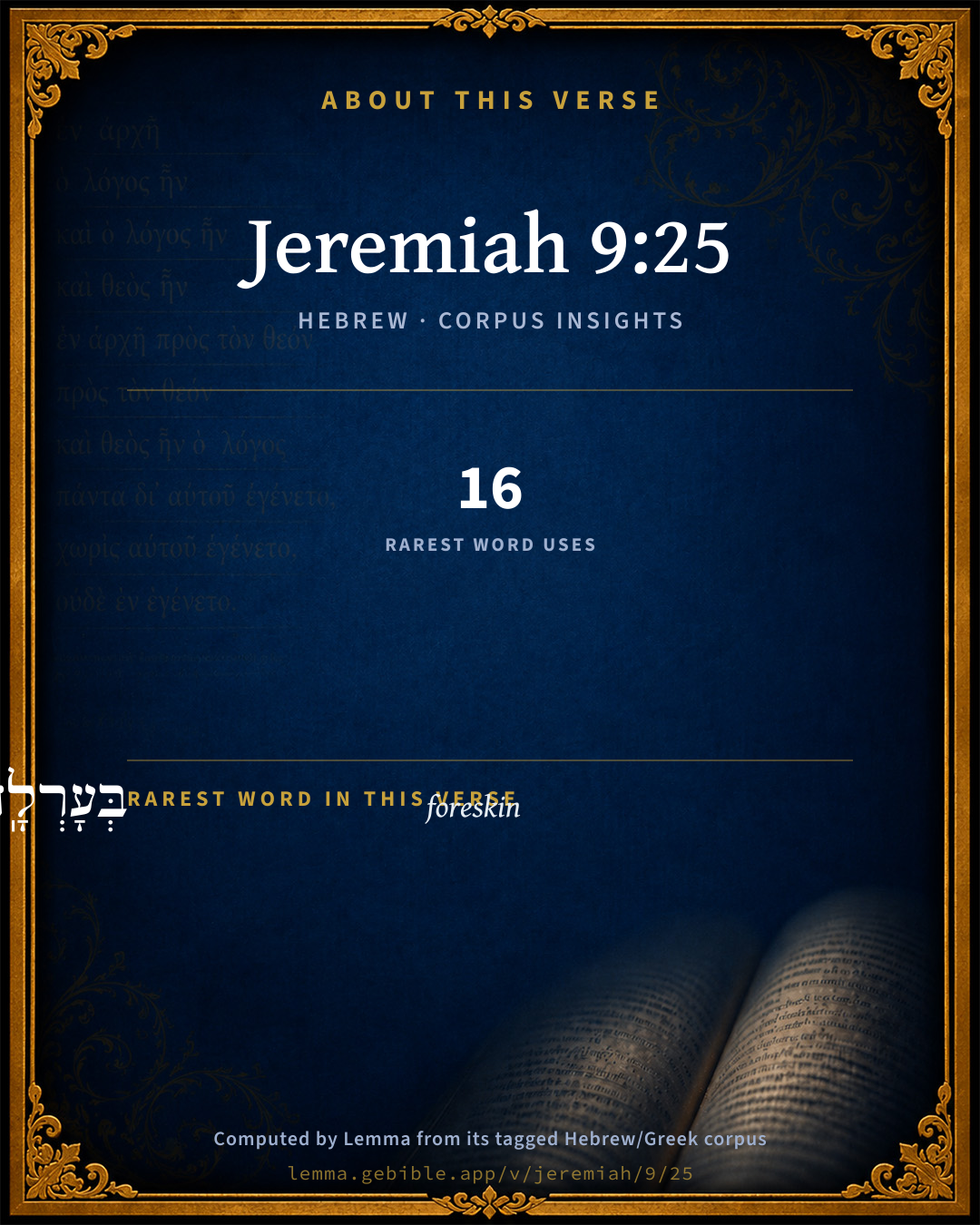
The rarest word here is בְּעָרְלָֽה foreskin H6190 — appearing just 16 times in the whole Hebrew Bible.

Shared distinctive vocabulary

בְּעָרְלָֽה foreskin H6190 occurs in 16 verses of the Hebrew Bible. Also found in:

Grammatical profile

  • 2 verbs
  • 5 nouns
  • 2 prepositions
  • 1 particle

Verb forms

  • בָּאִ֖ים Qal · Participle Active
  • וּפָ֣קַדְתִּ֔י Qal · Sequential Perfect

Cross-references

6

Topical passages linked to Jeremiah 9:25 in the Treasury of Scripture Knowledge — connected by theme and wording, ordered by reader-vote popularity; previews shown in the World English Bible.

  • Romans 2:8–9 but to those who are self-seeking, and don't obey the truth, but obey unrighteousness, will be wrath and indignation,
  • Romans 2:25–26 For circumcision indeed profits, if you are a doer of the law, but if you are a transgressor of the law, your circumcision has become uncircumcision.
  • Galatians 5:2–6 Behold, I, Paul, tell you that if you receive circumcision, Christ will profit you nothing.
  • Ezekiel 28:10 You shall die the death of the uncircumcised by the hand of strangers: for I have spoken it, says the Lord Yahweh.
  • Ezekiel 32:19–32 Whom do you pass in beauty? Go down, and be laid with the uncircumcised.
  • Amos 3:2 "You only have I chosen of all the families of the earth. Therefore I will punish you for all of your sins."

Cross-references courtesy of OpenBible.info (CC BY 4.0).

Hebrew and Greek witnesses Masoretic Hebrew ↔ Greek Septuagint

The same verse in the two great witnesses to the Old Testament, shown verse-for-verse.

These are two independent witnesses, not word-aligned to each other, and the Septuagint is shown in lemma (dictionary) form.

Hebrew Jeremiah 9:25 Masoretic · Westminster Leningrad Codex

הִנֵּ֛ה יָמִ֥ים בָּאִ֖ים נְאֻם יְהוָ֑ה וּפָ֣קַדְתִּ֔י עַל כָּל מ֖וּל בְּעָרְלָֽה

Behold, the days come, says Yahweh, that I will punish all those who are circumcised in [their] uncircumcision:

World English Bible · Public Domain

Greek LXX Structure differs

In the Septuagint, Jeremiah is about an eighth shorter than the Hebrew and arranges its material differently — the Oracles Against the Nations (Hebrew chapters 46–51) appear in the middle of the Greek book, after 25:13. Because the chapter and verse boundaries do not line up, a verse-for-verse comparison with the Hebrew is not shown.

A verse-for-verse comparison isn’t shown here because the chapters and verses don’t line up. Switch to the LXX edition with the MT / LXX toggle above to read the Greek directly.

On this verse, Keil & Delitzsch discusses the Septuagint’s reading. Read the note in Commentary ↓

Hebrew: Westminster Leningrad Codex (CC BY 4.0). Greek: Septuagint (public domain); English from a public-domain English Septuagint. How the Septuagint differs from the Hebrew →

Targum (Aramaic paraphrase)

1

The Targum is the ancient Jewish Aramaic paraphrase of the Hebrew Scriptures — an interpretive translation, not the Hebrew text itself. Onkelos (literal) and Pseudo-Jonathan (expansive) render the Torah, and Jonathan the Prophets. Coverage is partial: where no permissively-licensed English translation exists for a verse, only the Aramaic is shown. This is verse-level text, not a word-by-word alignment to the Hebrew.

  1. Targum Jonathan Prophets (Joshua–Malachi)
    עַל מִצְרָאֵי וְעַל יְהוּדָה וְעַל אֱדוֹמָאֵי וְעַל בְּנֵי עַמוֹן וְעַל מוֹאֲבָאֵי וְעַל כָּל מַקְפֵי פָתָא דְשָׁרָן בִּשְׁכוּנִין בְּמַדְבָּרָא אֲרֵי כָל עַמְמַיָא עַרְלִין בְּבִשְׂרֵהוֹן וְכָל בֵּית יִשְׂרָאֵל עַרְלִין בְּלִבְּהוֹן:

    (no public-domain English translation for this verse)

    Targum Jonathan — Aramaic: “Mikraot Gedolot” (public domain). English: “Sefaria Community Translation” (CC0 1.0 (public-domain dedication)); “London "Chaldee Paraphrase," 1871” (public domain). Text via Sefaria.

Commentary

Notes on Jeremiah 9:25 from classic Christian and Jewish commentators (each source and its license shown beneath its notes). The classic Christian expositions comment on the surrounding passage and are grouped to its opening verse, so a note may address several verses; the Jewish commentaries on the Tanakh (Rashi and others) are per-verse, so they appear only where the commentator wrote on this verse.

Lemma curates 59 commentaries, every one of them public domain or Creative Commons licensed, each selected and text-cleaned for this edition rather than reprinted as found. About our sources →

Trapp's Complete Commentary

John Trapp

Jer 9:25 Behold, the days come, saith the LORD, that I will punish all [them which are] circumcised with the uncircumcised;

Ver. 25. That I will punish all them, &c.] Promiscuously and impartially.

That are circumcised.] Some read it, The circumcised in uncircumcision. Unregenerate Israel, notwithstanding their circumcision, are to God as Ethiopians. {Amo 9:7}

John Trapp, A Commentary or Exposition upon All the Books of the Old and New Testament (1647–1656) — public domain. Text from a community e-Sword module.

Joseph Benson's Commentary

Jer 9:25-26. Behold the days come, &c. — Blaney translates these two verses, “Behold, the days are coming, saith Jehovah, that I will punish all the circumcision with the uncircumcision; Egypt, &c., and all those that have their coast insulated, those that dwell in the wilderness: for all the nations are uncircumcised, and all the house of Israel is uncircumcised in heart.” The Greek word ακροβυσια, which properly means uncircumcision, is several times used by St. Paul for the persons who are uncircumcised, as περιτομη, circumcision, is put for persons circumcised. See Rom 2:26-27; Rom 3:30. Because the Jews valued themselves so much upon their circumcision, God here tells them that, when he should send his judgments abroad into the world, they should find no more favour than those that were not circumcised; and, accordingly, in mentioning the heathen nations whom he would punish, he places Judah among them, because they were, in effect, uncircumcised as well as the heathen, contenting themselves with the outward sign of circumcision in the flesh, without seeking that internal circumcision, which is of the heart and spirit, and the purification and holiness signified thereby. By those that have their coast insulated, as Blaney renders one of the clauses of Jer 9:26, he supposes the Arabians are designed, which he thinks may be fairly concluded from the connection in which the same words. קצוצי פאה, stand with the context, in Jer 49:32. Concerning the precise meaning, however, of these words, he justly observes, “interpreters differ very greatly. Some represent them as signifying persons cut off from other people, by being thrust into a remote corner; in which light the translators of our Bible appear to have considered them, when they rendered them in the text, All that are in the utmost corners, and in the margin, cut off into corners. But all the ancient versions understand them as expressing the peculiar manner in which the Arabians cut the hair of their heads or beards,” expressed also in our marginal reading; which reading, Dr. Durel says, ought doubtless to be received into the text; the Arabs, who are meant, he thinks, by this periphrasis, being accustomed to cut their hair short, particularly about the crown of the head; and in respect to their beards, leaving only a tuft of hair growing about their chins; a practice which was forbidden to the Jews, Lev 19:27. But it seems much more probable that the words have a respect to the peninsular form of the country, surrounded on all sides by the sea, excepting only the isthmus to the north; and thus almost insulated, or cut off, from any other land.

Joseph Benson's Commentary on the Old and New Testaments (1811–1818) — public domain. Text from a community e-Sword module.

Whedon's Commentary on the Bible

Daniel D. Whedon

3. The Means of Escape from Impending Punishment. — Jer_9:25 to Jer_10:25.

25. Circumcised with the uncircumcised — Rather, circumcised in uncircumcision; literally, with the foreskin. The meaning is, God will cut off all who are really uncircumcised, and among these are included those who have received merely the outward rite.

Daniel D. Whedon (gen. ed.), Commentary on the Old and New Testaments (1874–1909) — public domain. Text from a community e-Sword module.

Keil & Delitzsch

C. F. Keil & F. Delitzsch

Thus Jer 9:24 and Jer 9:25 are connected with what precedes. The lack of righteousness is indicated by the idea מוּל בּערלה: circumcised with foreskin, i.e., not, circumcised in the foreskin (lxx, Vulg.), but circumcised and yet possessed of the foreskin. It is incorrect to translate: circumcised together with the uncircumcised (Kimchi, de W.). This is not only contrary to the usage of the language, but inconsistent with the context, since in Jer 9:25 uncircumcisedness is predicated of the heathen and of Judah. The expression is an oxymoron, thus: uncircumcised-circumcised (Ew.), intended to gather Jews and heathen into one category. This is shown by the order of the enumeration in Jer 9:24 : Egypt, Judah, Edom, etc.; whence we may see that in this reference the prophet puts Judah on the same footing with the heathen, with the Egyptians, Edomites, etc., and so mentions Judah between Egypt and Edom. From the enumeration Ew. and Ng., following the example of Jerome,

(Note: Jerome writes: multarum ex quadam parte gentium, et maxime quae Judaeae Palaestinaeque confines sunt, usque hodie populi circumciduntur, et praecipue Aegyptii et Idumaei, Ammonitae et Moabitae et omnis regio Saracenorum, quae habitat in solitudine.)

conclude that all the peoples named along with Judah practised circumcision. But neither on exegetical nor on historical grounds can this be confidently asserted. Considered from the exegetical point of view, it is contradictory of the direct statement in Jer 9:25, that all the nations are uncircumcised. We must certainly not take the words כּל־הגּוים as: all these peoples, giving the article then the force of a retrospective demonstrative; still less can they mean "all the other nations" besides those named. "All the nations" are all nations besides Israel. When these are called "uncircumcised," and Israel "uncircumcised in heart," it is as clear as can be that all nations, and so Egyptians, Edomites, etc., are called uncircumcised, i.e., in the flesh; while Israel - the whole house of Israel, i.e., Judah and the other tribes - are set over against the nations in contrast to them as being uncircumcised in heart, i.e., spiritually. From the historical view-point, too, it is impossible to prove that circumcision was in use amongst all the nations mentioned along with Judah. Only of the Egyptians does Herod. ii. 36f., 104, record that they practised circumcision; and if we accept the testimony of all other ancient authors, Herod.'s statement concerns only the priests and those initiated into the mysteries of Egypt, not the Egyptian people as a whole; cf. my Bibl. Archol. i. S. 307f. The only ground for attributing the custom of circumcision to the Moabites and Arabs, is the fact that Esau and Ishmael, the ancestors of these peoples, were circumcised. But the inference drawn therefrom is not supported by historical testimony. Indeed, so far as the Edomites are concerned, Josephus testifies directly the contrary, since in Antt. xiii. 9. 1, he tells us that when John Hyrcanus had conquered this people, he offered them the choice of forsaking their country or adopting circumcision, and that they chose the latter alternative. As to the ancient Arabs, we find in the Ztschr. fr die Kunde des Morgl. iii. S. 230, a notice of the tribe 'Advân, where we are told that the warriors of this tribe consist of uncircumcised young men along with those already circumcised. But this gives us no certain testimony to the universal prevalence of circumcision; for the notice comes from a work in which pre-and post-Mohammedan traditions are confounded. Finally, there is no historical trace of the custom of circumcision amongst the Ammonites and Moabites. קצוּצי פאה here, and Jer 25:23; Jer 49:32 : those polled, cropped at the edges of the beard and sides of the head, are such as have the hair cut from off the temples and the forehead, observing a custom which, according to Herod. iii. 8,

(Note: Τῶν τριχῶν τὴν κουρὴν κείρεσθαί φασι, καθάπερ αὐτὸν τὸν Διόνυσον κεκάρθαι, κείρονται δὲ ὑποτρόχαλα περιξηροῦντες τοὺς κροτάφους.)

was usual amongst some of the tribes of the Arabian Desert. The imitation of this practice was forbidden to the Israelites by the law, Lev 19:27; from which passage we may see that פאה refers to the head and the beard. Acc. to Jer 49:32, cf. with v. 28, the tribes meant belonged to the Kedarenes, descended according to Gen 25:13 from Ishmael. In the wilderness, i.e., the Arabian Desert to the east of Palestine. By means of the predicate "uncircumcised in heart," the whole house of Israel, i.e., the whole covenant people, is put in contrast with the heathen. Circumcision involved the obligation to walk blameless before God (Gen 17:1), and, as sign of the covenant, to keep God's commandments. If this condition was not fulfilled, if the heart remained uncircumcised, Israel lost all pre-eminence over the heathen, and was devoid of all room for glorying in the sight of God, just as the heathen were, who know not God the Lord, who have turned the truth of God into unrighteousness, and in their unrighteousness have become liable to the judgment of God.

Keil & Delitzsch — Biblical Commentary on the Old Testament (1861–1891) — public domain (CC PDM 1.0). Text via the HelloAO Bible API. (Old Testament only.)

Tyndale Open Study Notes

Tyndale Open Resources

9:25 Because arrogant sin ruled the nation, there would soon come a time when the Lord would decree a sentence of doom. • The rite of circumcision among the Hebrew people went back to Abraham (Gen 17:10-14). Through the centuries, this rite became so closely associated with being God’s covenant people that the Israelites assumed that it guaranteed their nation a lasting relationship with the Lord. Being circumcised in body is not enough, however; a person must also be circumcised . . . in spirit—radically separated from idol worship and completely committed to placing the Lord at the center of life and practice (Rom 2:25-29).

Tyndale Open Study Notes — © Tyndale Open Resources, licensed CC BY-SA 4.0. Text via the HelloAO Bible API.

Geneva Bible (1599)

Geneva Bible translators

Meaning, both Jews and Gentiles, as in this next verse he showeth the cause, read Jer. 4:4.

Geneva Bible (1599) marginal notes — public domain. Text via Bolls.life.

Jamieson, Fausset & Brown

Robert Jamieson, A. R. Fausset & David Brown

with the uncircumcised--rather, "all that are circumcised in uncircumcision" [HENDERSON]. The Hebrew is an abstract term, not a concrete, as English Version translates, and as the pious "circumcised" is. The nations specified, Egypt, Judah, &c., were outwardly "circumcised," but in heart were "uncircumcised." The heathen nations were defiled, in spite of their literal circumcision, by idolatry. The Jews, with all their glorying in their spiritual privileges, were no better (Jer 4:4; Deu 10:16; Deu 30:6; Rom 2:28-29; Col 2:11). However, Eze 31:18; Eze 32:19, may imply that the Egyptians were uncircumcised; and it is uncertain as to the other nations specified whether they were at that early time circumcised. HERODOTUS says the Egyptians were so; but others think this applies only to the priests and others having a sacred character, not to the mass of the nation; so English Version may be fight (Rom 2:28-29).

Jamieson, Fausset & Brown — Commentary Critical and Explanatory on the Whole Bible (1871) — public domain (CC PDM 1.0). Text via the HelloAO Bible API.

Adam Clarke's Commentary

Verse 25. I will punish all them which are circumcised with the uncircumcised] Do not imagine that you, because of your crimes, are the only objects of my displeasure; the circumcised and the uncircumcised, the Jew and the Gentile, shall equally feel the stroke of my justice, their transgressions being alike, after their advantages and disadvantages are duly compared. In like manner, other nations also were delivered into the hands of Nebuchadnezzar, these he immediately enumerates: Egypt and Edom, and the Moabites and the Ammonites, and the Arabians of the desert. All these nations were uncircumcised in that way which God required that rite to be practised as a sign of his covenant; and the Israelites, that did practise it as a sign of that covenant, did not attend to its spiritual meaning, for they were all uncircumcised in heart. And it may be remarked, that these people were in general confederated against the Chaldeans.

Adam Clarke's Commentary on the Bible (1810–1826) — public domain. Text from a community e-Sword/MySword module.

John Calvin's Commentaries

The Prophet, after having removed the obstacle which he saw hindered the Jews from reverently receiving the truth of God, now speaks more sharply, and performs the office of a herald in denouncing the vengeance which was at hand: Behold, he says, come shall the days, in which I will visit all the uncircumcised in uncircumcision

This passage admits of two meanings. Some interpreters take as distinct these two words, מול mul, the circumcised, בערלה, beorle, in uncircumcision; as though Jeremiah had said, “I will visit the Jews, who are circumcised, as well as the heathen nations, who are uncircumcised,” Others read them jointly, — that God threatens vengeance on the Jews and Gentiles, because they were circumcised, and still retained uncircumcision. The passage may however be thus suitably explained, — that there was a mixture, which corrupted the sacredness of circumcision, and made it like the uncircumcision of the Gentiles; as though it were thus expressed, “I will visit the circumcised with the uncircumcision,” that is, promiscuously and without any difference, as we say in our language, Pele mele. For it follows afterwards, that all were uncircumcised in heart; that is, all the Jews. We hence see that the Prophet makes circumcision and uncireumcision the same, and that he intended to render profane the sacred symbol of adoption;but he had reference to the Jews, who, being degenerated, thus adulterated God’s covenant, and at the same time violated circumcision, so that in differed nothing from uncircumcision. I therefore think, that the Jews are classed with the Gentiles, so that he ascribes even to them uncircumcision: I will then visit all the circumcised with the uncircumcision; that is, the circumcision of each is vain, and is like uncircumcision.

John Calvin's Commentaries (1540-1563) — public domain. Text from the Calvin Translation Society English edition (1840s-50s) via the Christian Classics Ethereal Library (ccel.org). Calvin's coverage is partial (roughly two-thirds of the Bible); uncommented books and verses are honest gaps, never fabricated. The 19th-century editor's footnotes and remarks are omitted so the notes are faithfully Calvin's own voice.

Ellicott's Commentary for English Readers

(25) I will punish all them which are circumcised with the uncircumcised.—The passage is difficult, but the English verse is misleading. Better, I will punish all those that are circumcised in uncircumcision—all, i.e., who have the outward sign, but not the inward purity of which it was the symbol. In the day of God’s judgments (this being the connecting link with the preceding verse) there would be no difference between the Jew and other races who like him practised circumcision on the one hand, and the outlying heathen world on the other. Here, again, Jeremiah anticipated St. Paul, “To the Jew first, and also to the Gentile; for there is no respect of persons with God” (Rom_2:9). The true circumcision is that which is “in the spirit, not in the letter” (Rom_2:29).

A Bible Commentary for English Readers, edited by Charles John Ellicott (1878–1897) — public domain. Text from a community e-Sword module.

The Cambridge Bible for Schools and Colleges

gen. ed. J. J. S. Perowne

25, 26. circumcised in their uncircumcision] probably meaning circumcised in body but not in heart. “Judah cannot rely on a rite which she shares with the heathen, indeed the corresponding inward circumcision is as lacking in her as in them,” Pe. See on Jer_4:4. The statements in Jer_9:26 are confirmed as to Egypt by Jos_5:9 (where “reproach of Egypt” means that the Egyptians would despise them as long as they remained uncircumcised), and by Herod. II. 104. The other nations, as tracing their descent from Abraham, would naturally observe the rite; so too the Arabians, as claiming Ishmael (see Gen_17:23 ff.) for ancestor. Josephus (Ant. I. xii. 2) also testifies as to these last. The Philistines, on the other hand, are frequently designated contemptuously as uncircumcised (e.g. 1Sa_14:6; 1Sa_17:26).

that have the corners of their hair polled] i.e. cut off from the temples. See also Jer_25:23, Jer_49:32. According to Herod. (III. 8) it had a religious significance with certain Arab tribes. Hence its prohibition in Lev_19:27.

the wilderness] the desert of Arabia, eastward of Palestine.

all the nations are uncircumcised] The true circumcision of the heart is as much lacking with them as with Judah.

The Cambridge Bible for Schools and Colleges (gen. ed. J. J. S. Perowne; Cambridge University Press, 1878–1918) — public domain. Text from a community e-Sword module.

John Gill's Exposition

Behold, the days come, saith the Lord,.... Or, "are coming" (h); it seems to respect the time after the Babylonish captivity, when the punishment after threatened took place, and not before:

that I will punish all them that are circumcised with the uncircumcised; Jews and Gentiles together. The circumcised. Jews trusting in their circumcision, and being, as is said in the next verse, uncircumcised in heart, were no better than the uncircumcised Gentiles; wherefore both being transgressors of the law, and despisers of the Gospel of Christ, are threatened with destruction; see Rom 2:12.

(h) "dies sunt venientes", Schmidt, Montanus; "venturi sunt", Junius & Tremellius, Piscator.

John Gill's Exposition of the Whole Bible (1746–1763) — public domain (CC PDM 1.0). Text via the HelloAO Bible API.

Albert Barnes' Notes on the Bible

All them which are circumcised ... - Rather, “all circumcised in uncircumcision,” i. e., all who though outwardly circumcised have no corresponding inward purity.

Albert Barnes' Notes on the Bible (1834–1885) — public domain. Text from a community e-Sword/MySword module.

Matthew Poole's English Annotations

I will punish, viz. by the Babylonians, all them which are circumcised: q.d. Do not think to insist upon your external privilege of circumcision, that you are Abraham’s natural seed, and thereby distinguished from other nations, as you sometimes were wont to do of the temple, that you had God in the midst of you. Do not think that shall privilege you: for you shall see it shall not be long ere I bring the Chaldeans upon those other nations, which either are circumcised in the flesh as well as you, and upon you also, who are uncircumcised in heart as well as they: or whether circumcision was lost, as being cast off by them, and so they were indeed uncircumcised; God tells them they shall fare alike: hence in the next verse he ranks Judah next to Egypt among the other uncircumcised nations; for he looks to the circumcision of the heart, not of the body; to inward worship, not outward only; therefore some read it the circumcised in uncirumcision.

Matthew Poole's English Annotations on the Holy Bible (1683–1685) — public domain. Text from a community e-Sword/MySword module.

The Pulpit Commentary

Vers. 25, 26. A further enforcement of the doctrine that no outward privileges, if dissociated from inward moral vitality, will avail.

All them which are circumcised with the uncircumcised; rather, all the circumcised in uncircumcision, or, as Ewald turns it, "all the uncircumcised-circumcised." But what does this enigmatical expression signify? Hitzig, Graf, and apparently Dr. Payne Smith, think that it has a twofold meaning: that, as applied to the Jews, it means circumcised in the flesh, but not in heart, and, as applied to the heathen, simply uncircumcised (the one-half of the phrase neutralizing the other, like "a knife without the blade," "angels with horns and hoofs," etc.). The latter meaning, however, is surely very improbable, and it would only become necessary if it were proved that circumcision was practiced by none of the nations mentioned but the Jews. This is not the case. There is no doubt that the Egyptians were circumcised in very early times (see the drawing of a bas-relief in the Temple of Chunsu at Karnak, given by Dr. Ebers in his "Egypten und die Bucher Meets"). The assertion that only the priests underwent the operation has no older evidence than that of Origen (edit. Lommatzsch, 4:138), "in whose time it is quite possible that the Egyptians, like the later Jews, sought to evade a peculiarity which exposed them to ridicule and contempt." As to the Ammonites and Moabites, we have, unfortunately, no information. With regard to the Edomites, it is true that, according to Josephus ("Antiq.," 13:9, 1), they were compelled to accept circumcision by John Hyrcanus. But it is still quite possible that, at an earlier period, the rite was practiced, just as it was among the ancient Arabs, the evidence for which is beyond question (see the writer"s article, "Circumcision," in Encyclopaedia Britannica, 9th edit.). (On the statement that "all these the nations are uncircumcised," see below.)

Vers. 25, 26. Impartial justice.

I SPECIAL PRIVILEGES DO NOT INTENSE WITH THE IMPARTIAL EXERCISE OF DIVINE JUSTICE. Judah is specially privileged, and prizes circumcision as a seal of the peculiar favor of Heaven. (Gen_17:9-14) Yet Judah must take its place in the indiscriminate catalogue of corrupt nations. If privileges are noted in God"s exercise of justice, this can only be as an aggravation of guilt. The citizens of favored nations, the heirs of rank and wealth, persons whose lives have been peculiarly successful and unvisited with the usual amount of trouble, all stand in this position. Their present happy condition is no guarantee for favor in the day of Divine judgment, but, on the contrary, a reason for regarding the ingratitude of sin as, in their case, the more culpable.

II THE OBSERVANCE OF EXTERNAL ORDINANCES HAS NO INFLUENCE ON THE IMPARTIAL EXERCISE OF DIVINE JUSTICE. Their utility is solely as regards their effect on men. They are profitable only in so far as they assist the corresponding spiritual acts, which are all that God takes note of. (Col_2:11) The circumcised in body who are not circumcised in heart will suffer just as if they had never been circumcised at all. The ordinance without the spirituality is an offence rather than a pleasing thing. It shows knowledge; it is a mockery to God. This must be so,

(1) because God is spirit, and can only be served spiritually; and

(2) because the highest justice is concerned with thoughts, motives, deeds of the soul, rather than with the ambiguous actions of the outer life.

III NO EXCEPTIONS WILL BE MADE TO THE IMPARTIAL EXERCISE OF DIVINE JUSTICE. All kinds of nations are classed together. Cultivated Egyptians and wild Arabs, scrupulous Jews and idolatrous Ammonites, all come before the same judgment-bar, all have the same fair trial-and righteous sentence.

1. The heathen are not excluded from Gods judgment; for

(1) he is the God of all the earth, and of those who ignore him as well as of those who recognize him;

(2) the heathen have a light of nature and a conscience by which to guide their conduct;

(3) God"s judgment is reasonable, and can adapt requirement to opportunity, so that the heathen will have as just treatment as those who are more privileged.

2. The Jews and professedly religious are not excluded. Many people make an utterly unwarrantable assumption that their respectability, position in the Church, etc., are such that the stern ordeal of the judgment is not for them. In his vision of judgment Christ made no such exceptions. (Mat_25:31-46)

The Pulpit Commentary (1880–1919), ed. H.D.M. Spence-Jones & Joseph S. Exell — public domain. Text from a community e-Sword module.

unfoldingWord translationNotes

Door43 World Missions Community

General Information:

These are the words of Yahweh.

See

Yahweh uses this word here to draw the people's attention to what he says next. AT: "Listen" or "Indeed" (See: Idiom)

days are coming

This is an idiom. AT: "there will be a time" (See: Idiom)

this is Yahweh's declaration

Yahweh speaks of himself by name to express the certainty of what he is declaring. See how you translated this in Jeremiah 1:8. AT: "this is what Yahweh has declared" or "this is what I, Yahweh, have declared" (See: First, Second, or Third Person)

all the circumcised who are such only in their body

This refers to the people of Israel who have entered into Yahweh's covenant by getting circumcised physically, but who have not changed their inner beings by following his laws. AT: "all those people who have changed their bodies by circumcising them but who have not changed their inner beings" (See: Metaphor)

all the people who cut the hair on their heads very short

This probably refers to people who cut their hair short in order to honor a pagan god. Some modern versions interpret this Hebrew expression as "all the people who live on the edge of the wilderness."

For all these nations are uncircumcised

The word "nations" refers to the people who live in these places. Foreigners being uncircumcised was a sign that they were not in Yahweh's covenant. AT: "For the people of these nations did not enter into a covenant with Yahweh through circumcision" (See: Metonymy and Assumed Knowledge and Implicit Information)

all the house of Israel has an uncircumcised heart

The "heart" represents a person's will and desires. An "uncircumcised heart" represents the character of a person that does not follow Yahweh and his laws. Also, the "house" of Israel refers to the people of Israel. AT: "all the people of Israel are only circumcised on the outside and have not changed their hearts" (See: Metonymy and Metaphor)

translationWords

day

punish

circumcise

body

Egypt

kingdom of Judah

Edom

Ammon

Moab

desert

nation

house

kingdom of Israel

circumcise

heart

unfoldingWord translationNotes — © Distant Shores Media and the Door43 World Missions Community, licensed CC BY-SA 4.0. Source: git.door43.org/Door43/en_tn.

Rashi

Rabbi Shlomo Yitzchaki (Rashi)

Egypt etc. These were the neighbors of Eretz Israel, and they were punished shortly after her, as it is written in Ezekiel (29), and explained in Seder Olam (ch. 26).

cast off to the corners Heb. פאה, an expression of an end, those cast off to the corner of the desert.

Rashi on the Tanakh — English translations: “The Judaica Press complete Tanach with Rashi, translated by A. J. Rosenberg” (CC BY 4.0); “Pentateuch with Rashi's commentary by M. Rosenbaum and A.M. Silbermann, 1929-1934” (public domain); “The Metsudah Tanach series, Lakewood, N.J” (CC BY 4.0); and “The Book of Joshua, Metsudah Publications, 1997” (CC BY 4.0). Text via Sefaria.

Lesson kit

Teaching starters — assembled from the data on this page, not authored interpretation. Every prompt links to the verse data it draws on. Edit before teaching.

Jeremiah, in the Prophets, opens this verse with 10 words (10 distinct Hebrew lemmas). Its most distinctive word is ʻorlâh (“foreskin”). A historical commentator’s framing appears above. Read the whole chapter for the surrounding context.

Discussion questions

  1. How does “foreskin” (ʻorlâh) shape what this verse is saying?
  2. How does Genesis 17:11, which shares the word «foreskin», read alongside this verse?
  3. These translations render this verse differently. What is at stake in choosing one wording over another?
  4. «בָּאִ֖ים» is a Qal Participle Active verb. How does that grammatical form shape the action described?
  5. Compare how Trapp's Complete Commentary and Joseph Benson's Commentary read this verse. Where do they agree or differ?

Things to notice

Reading settings

Reading text

Shown beneath each verse's original-language words.

Old Testament
Old Testament edition

Read the OT as the Masoretic Hebrew (MT) or the Greek Septuagint (LXX).

English shown for the Greek Septuagint (in the Hebrew ↔ Greek comparison).

Comparing translations? Open the Compare panel on any verse page to stack up to four side by side.