Isaiah 47:7

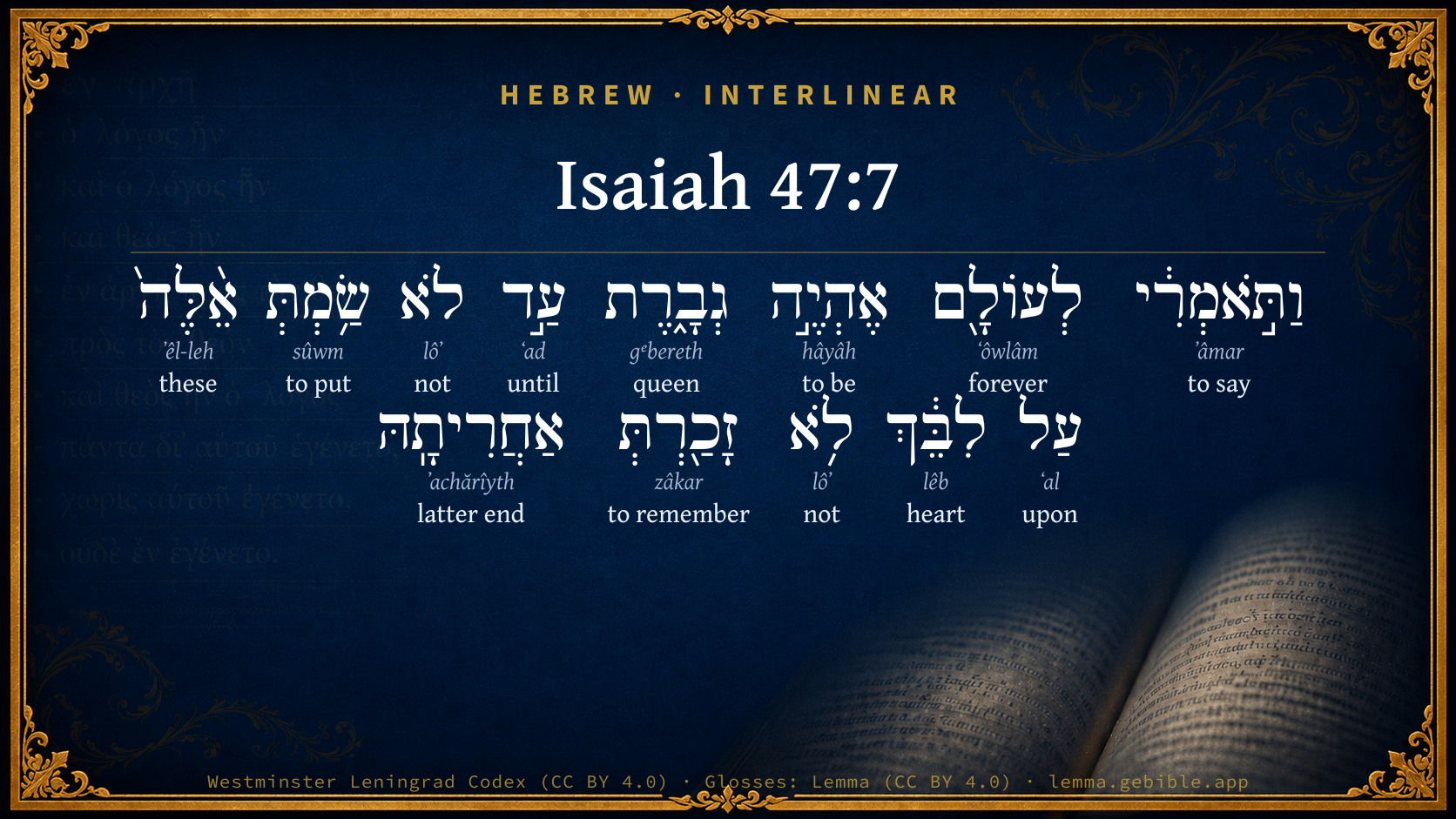
Hebrew (Westminster Leningrad Codex) Isaiah 47:7 appears in the Hebrew Old Testament. The text above is from the Westminster Leningrad Codex. Each word links to its Strong’s number, a concise gloss, and parsing drawn from the Open Scriptures Hebrew Bible morphology. Click any word for its full Brown-Driver-Briggs (BDB) entry.
Download image
Cite this verse

Isaiah 47:7 (World English Bible). Public Domain. Lemma interlinear Bible study tool, https://lemma.gebible.app/v/isaiah/47/7.

Show BibTeX & RIS
BibTeX
RIS
English Translation
You said, I shall be mistress forever; so that you did not lay these things to your heart, neither did remember the latter end of it.
World English Bible · Public Domain
Download a study sheet

One document with this verse’s original text, its word-by-word gloss line, the meaning frame, cross-references with their text, attributed commentary, and full source and license credits — printable, and it pastes into notes with its structure intact.

This verse Autodidact and up

Study sheet (.html) Plain text (.txt)

A passage Seminary Student

Up to 50 verses in one chapter. A passage sheet keeps up to 6 commentary sources and 12 cross-references per verse, in the order this page ranks them, and says so on the sheet whenever that leaves anything out. Ask for a single verse and you get the Autodidact verse sheet above.

Everything on this page stays free to read, with no account — the sheet is a download of what is already on screen, not access to it.

Want to remove ads? Support Godless Engineer
Compare translations 3

The same verse in 3 English versions, stacked beneath the original-language interlinear above. Click any original word for its lexicon entry.

Each is an independent rendering of the whole verse — the interlinear is not word-aligned to these translations.

Highlighted words mark where these versions differ — a whole-verse word diff, not a word-by-word alignment.

  • World English Bible Public Domain
    You said, I shall be mistress forever; so that you did not lay these things to your heart, neither did remember the latter end of it.
  • King James Version Public Domain
    And thou saidst, I shall be a lady for ever: so that thou didst not lay these things to thy heart, neither didst remember the latter end of it.
  • unfoldingWord Literal Text CC BY-SA 4.0
    And you said, ‘I will be a mistress forever,’ yet you did not set these on your heart; you did not remember its end. q1

unfoldingWord Literal Text — © unfoldingWord, licensed CC BY-SA 4.0. Word-aligned USFM3 via Door43 (git.door43.org/unfoldingWord/en_ult).

Versions to compare (up to 4)

3 of 4 selected

Show all 18 translations

Every available English version of this verse, each an independent rendering of the whole verse.

  • World English Bible Public Domain
    You said, I shall be mistress forever; so that you did not lay these things to your heart, neither did remember the latter end of it.
  • Berean Standard Bible Public Domain
    You said, ‘I will be queen forever.’ You did not take these things to heart or consider their outcome.
  • Majority Standard Bible Public Domain
    You said, ‘I will be queen forever.’ You did not take these things to heart or consider their outcome.
  • King James Version Public Domain
    And thou saidst, I shall be a lady for ever: so that thou didst not lay these things to thy heart, neither didst remember the latter end of it.
  • American Standard Version (1901) Public Domain
    And thou saidst, I shall be mistress for ever; so that thou didst not lay these things to thy heart, neither didst remember the latter end thereof.
  • Revised Version (1885) Public Domain
    And thou saidst, I shall be a lady for ever: so that thou didst not lay these things to thy heart, neither didst remember the latter end thereof.
  • Geneva Bible (1599) Public Domain
    And thou saidest, I shall be a ladie for euer, so that thou diddest not set thy mind to these things, neither diddest thou remember ye latter end therof.
  • Douay-Rheims (1899) Public Domain
    And thou hast said: I shall be a lady for ever: thou hast not laid these things to thy heart, neither hast thou remembered thy latter end.
  • Young's Literal Translation Public Domain
    And thou sayest, `To the age I am mistress,' While thou hast not laid these things to thy heart, Thou hast not remembered the latter end of it.
  • Literal Standard Version CC BY-SA 4.0
    And you say, I am mistress for all time, || While you have not laid these things to your heart, || You have not remembered the latter end of it.
  • Unlocked Literal Bible CC BY-SA 4.0
    You said, “I will rule forever as sovereign queen.” You did not take these things to heart, nor did you consider how they would turn out.
  • unfoldingWord Literal Text CC BY-SA 4.0
    And you said, ‘I will be a mistress forever,’ yet you did not set these on your heart; you did not remember its end. q1
  • Darby Bible Public Domain
    and thou saidst, I shall be a mistress for ever; so that thou didst not take these things to heart, thou didst not remember the end thereof.
  • World Messianic Bible Public Domain
    You said, ‘I will be a princess forever,’ so that you didn’t lay these things to your heart, nor did you remember the results.
  • Webster's Bible Public Domain
    And thou saidst, I shall be a lady for ever: so that thou didst not lay these things to thy heart, neither didst remember the latter end of it.
  • Free Bible Version CC BY-SA 4.0
    You said, “I will reign forever as the eternal queen.” But you didn't think about what was coming; you didn't remember what would happen to you in the end.
  • Bible in Basic English Public Domain
    And you said, I will be a queen for ever: you did not give attention to these things, and did not keep in mind what would come after.
  • JPS Tanakh (1917) Public Domain
    And thou saidst: 'For ever shall I be mistress'; so that thou didst not lay these things to thy heart, neither didst remember the end thereof.

Literal Standard Version (2020), Covenant Press — licensed CC BY-SA 4.0. Text via the HelloAO Bible API (eBible.org). Unlocked Literal Bible (unfoldingWord) — licensed CC BY-SA 4.0. Text via the HelloAO Bible API (eBible.org). unfoldingWord Literal Text — © unfoldingWord, licensed CC BY-SA 4.0. Word-aligned USFM3 via Door43 (git.door43.org/unfoldingWord/en_ult). Free Bible Version, Dr. Jonathan Gallagher — licensed CC BY-SA 4.0. Text via the HelloAO Bible API (eBible.org).

Word by word

More ways to search: Search by grammar → Find every occurrence → Compare this word →

Practice this passage: Drill this verse → Learn its vocabulary →

גְבָ֑רֶת
gᵉbereth
H1404
“queen”
Noun, Common, Feminine, Singular, Absolute
Part of Speech
Noun
Type
Common
Gender
Feminine
Number
Singular
State
Absolute
Full BDB Definition

Origin: from H1376

TWOT: 310e

lady, queen - mistress (of servants)
  1. וַתֹּ֣אמְרִ֔י ʼâmar H559 “and · to say” Conjunction + Verb, Qal, Sequential Imperfect, 2nd Person, Feminine, Singular
  2. לְעוֹלָ֖ם ʻôwlâm H5769 “to/for · forever” Preposition + Noun, Common, Masculine, Singular, Absolute
  3. אֶהְיֶ֣ה hâyâh H1961 “to be” Verb, Qal, Imperfect, 1st Person, Common, Singular
  4. עַ֣ד ʻad H5704 “until” Preposition
  5. לֹא lôʼ H3808 “not” Particle, Negative
  6. שַׂ֥מְתְּ sûwm H7760 “to put” Verb, Qal, Perfect, 2nd Person, Feminine, Singular
  7. אֵ֨לֶּה֙ ʼêl-leh H428 “these” Pronoun, Demonstrative, Common, Plural
  8. עַל ʻal H5921 “upon” Preposition
  9. לִבֵּ֔ךְ lêb H3820 “heart · your” Noun, Common, Masculine, Singular, Construct + Suffix, Personal, 2nd Person, Feminine, Singular
  10. לֹ֥א lôʼ H3808 “not” Particle, Negative
  11. זָכַ֖רְתְּ zâkar H2142 “to remember” Verb, Qal, Perfect, 2nd Person, Feminine, Singular
  12. אַחֲרִיתָֽהּ ʼachărîyth H319 “latter end · her” Noun, Common, Feminine, Singular, Construct + Suffix, Personal, 3rd Person, Feminine, Singular

About this verse

These counts appear in no published source. They are computed here, from the morphology-tagged text and Lemma’s own curated glosses. What Lemma adds →

13
words
12
distinct lemmas
Prophets
section

Notable vocabulary

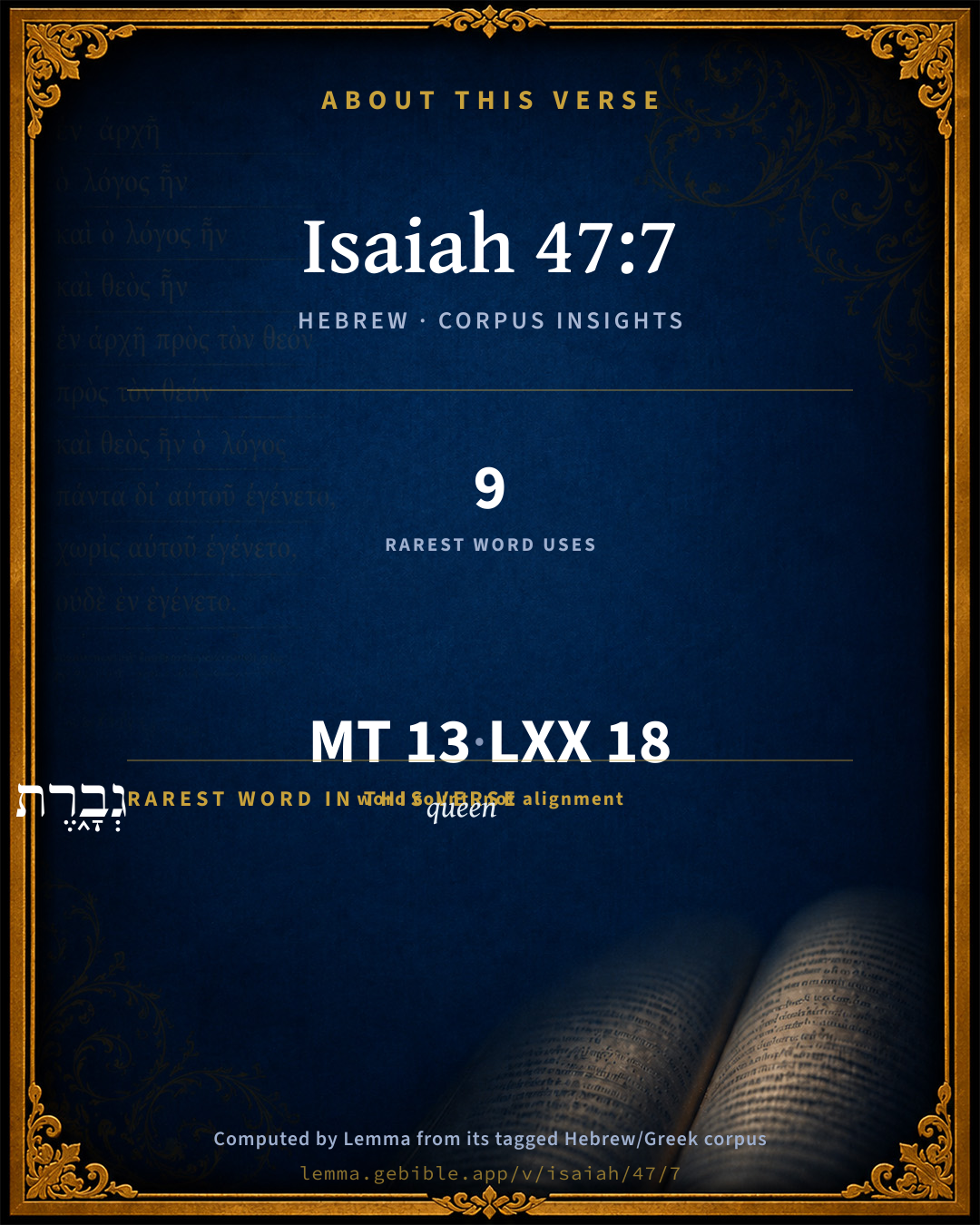
The rarest word here is גְבָ֑רֶת queen H1404 — appearing just 9 times in the whole Hebrew Bible.

Shared distinctive vocabulary

גְבָ֑רֶת queen H1404 occurs in 9 verses of the Hebrew Bible. Also found in:

Grammatical profile

  • 4 verbs
  • 4 nouns
  • 1 pronoun
  • 2 prepositions
  • 2 particles

Verb forms

  • וַתֹּ֣אמְרִ֔י Qal · Sequential Imperfect
  • אֶהְיֶ֣ה Qal · Imperfect
  • שַׂ֥מְתְּ Qal · Perfect
  • זָכַ֖רְתְּ Qal · Perfect

Repetition

A word recurs within this verse — often emphatic in Hebrew:

Hebrew & Septuagint length

In English translation the verse runs 26 words from the Hebrew and 25 from the Septuagint (LXX English) — closely comparable.

A rough comparison of the two English renderings, which tokenize alike — not a word-level alignment.

Word counts can differ between the Hebrew and the Greek without any difference in meaning — e.g. the Hebrew direct-object marker אֵת has no separate Greek word, and Greek often adds the article ὁ.

In the original languages it is 13 Hebrew tokens and 18 Greek tokens — but the two are counted differently (Hebrew bundles its prefixes and suffixes into one token; the Greek is in lemma form), so that isn’t a like-for-like length.

Cross-references

11

Topical passages linked to Isaiah 47:7 in the Treasury of Scripture Knowledge — connected by theme and wording, ordered by reader-vote popularity; previews shown in the World English Bible.

  • Deuteronomy 32:29 Oh that they were wise, that they understood this, That they would consider their latter end!
  • Isaiah 47:5 Sit you silent, and get you into darkness, daughter of the Chaldeans; for you shall no more be called The mistress of kingdoms.
  • Jeremiah 5:31 the prophets prophesy falsely, and the priests bear rule by their means; and my people love to have it so: and what will you do in the end of it?
  • Isaiah 42:25 Therefore he poured on him the fierceness of his anger, and the strength of battle; and it set him on fire round about, yet he didn't know; and it burned him, yet he didn't lay it to heart.
  • Isaiah 46:8–9 Remember this, and show yourselves men; bring it again to mind, you transgressors.
  • Ezekiel 7:3–9 Now is the end on you, and I will send my anger on you, and will judge you according to your ways; and I will bring on you all your abominations.
  • Ezekiel 28:2 Son of man, tell the prince of Tyre, Thus says the Lord Yahweh: Because your heart is lifted up, and you have said, I am a god, I sit in the seat of God, in the midst of the seas; yet you are man, and not God, though you did set your heart as the heart of God;-
  • Ezekiel 28:12–14 Son of man, take up a lamentation over the king of Tyre, and tell him, Thus says the Lord Yahweh: You seal up the sum, full of wisdom, and perfect in beauty.
  • Ezekiel 29:3 speak, and say, Thus says the Lord Yahweh: Behold, I am against you, Pharaoh king of Egypt, the great monster that lies in the midst of his rivers, that has said, My river is my own, and I have made it for myself.
  • Daniel 4:29 At the end of twelve months he was walking in the royal palace of Babylon.
  • Daniel 5:18–23 You king, the Most High God gave Nebuchadnezzar your father the kingdom, and greatness, and glory, and majesty:

Cross-references courtesy of OpenBible.info (CC BY 4.0).

Hebrew and Greek witnesses Masoretic Hebrew ↔ Greek Septuagint

The same verse in the two great witnesses to the Old Testament, shown verse-for-verse.

These are two independent witnesses, not word-aligned to each other, and the Septuagint is shown in lemma (dictionary) form.

Hebrew Isaiah 47:7 Masoretic · Westminster Leningrad Codex

וַתֹּ֣אמְרִ֔י לְעוֹלָ֖ם אֶהְיֶ֣ה גְבָ֑רֶת עַ֣ד לֹא שַׂ֥מְתְּ אֵ֨לֶּה֙ עַל לִבֵּ֔ךְ לֹ֥א זָכַ֖רְתְּ אַחֲרִיתָֽהּ

You said, I shall be mistress forever; so that you did not lay these things to your heart, neither did remember the latter end of it.

World English Bible · Public Domain

Greek LXX Isaiah 47:7 Septuagint · lemma form

καί εἶπον εἰς ὁ αἰών εἰμί ἄρχω οὐ νοέω οὗτος ἐν ὁ καρδία σύ οὐδέ μιμνήσκω ὁ ἔσχατος

and said, I shall be a princess for ever: you did not perceive these things in your heart, nor did you remember the latter end.

LXX2012 (modern English Septuagint) · Public Domain

Hebrew: Westminster Leningrad Codex (CC BY 4.0). Greek: Septuagint (public domain); English from LXX2012 (modern English Septuagint) (Public Domain). How the Septuagint differs from the Hebrew →

Targum (Aramaic paraphrase)

1

The Targum is the ancient Jewish Aramaic paraphrase of the Hebrew Scriptures — an interpretive translation, not the Hebrew text itself. Onkelos (literal) and Pseudo-Jonathan (expansive) render the Torah, and Jonathan the Prophets. Coverage is partial: where no permissively-licensed English translation exists for a verse, only the Aramaic is shown. This is verse-level text, not a word-by-word alignment to the Hebrew.

  1. Targum Jonathan Prophets (Joshua–Malachi)
    וַאֲמַרְתְּ לַעֲלָם אֱהֵי תַקִיפַת מַלְכְּוָן עַד לָא שַׁוִית אִלֵין עַל לִבִּיךְ לָא אִדְכַּרְתְּ לְסוֹפָא:

    And thou saidst, I shall be the mighty one of kingdoms, so that thou didst not lay these things to thy heart, neither didst remember the end of them.

    Targum Jonathan — Aramaic: “Mikraot Gedolot” (public domain). English: “Sefaria Community Translation” (CC0 1.0 (public-domain dedication)); “London "Chaldee Paraphrase," 1871” (public domain). Text via Sefaria.

Commentary

Notes on Isaiah 47:7 from classic Christian and Jewish commentators (each source and its license shown beneath its notes). The classic Christian expositions comment on the surrounding passage and are grouped to its opening verse, so a note may address several verses; the Jewish commentaries on the Tanakh (Rashi and others) are per-verse, so they appear only where the commentator wrote on this verse.

Lemma curates 59 commentaries, every one of them public domain or Creative Commons licensed, each selected and text-cleaned for this edition rather than reprinted as found. About our sources →

Matthew Henry's Commentary

Babylon, now doomed to ruin, is here justly upbraided with her pride, luxury, and security, in the day of her prosperity, and the confidence she had in her own wisdom and forecast, and particularly in the prognostications and counsels of the astrologers. These things are mentioned both to justify God in bringing these judgments upon her and to mortify her, and put her to so much the greater shame, under these judgments; for, when God comes forth to take vengeance, glory belongs to him, but confusion to the sinner.

I. The Babylonians are here upbraided with their pride and haughtiness, and the great conceit they had of themselves, because of their wealth and power, and the vast extent of their dominion; it was the language both of the government and of the body of the people: Thou sayest in thy heart (and God, who searches all hearts, can tell men what they say there, though they never speak it out) I am, and none else besides me, Isa 47:8, Isa 47:10. The repetition of this part of the charge intimates that they said it often, and that it was very offensive to God. It is the very word that God has often said concerning himself, I am, and none else besides me, denoting his self-existence, his infinite and incomparable perfections, and his sole supremacy. All this Babylon pretends to; and no wonder if she that assumed a power to make what gods and goddesses she pleased for the people to worship made herself one among the rest. It is presumption to say of any creature, "It is, and there is not its like, there is none besides it" (for creatures stand very nearly upon a level with one another); but it is insufferable arrogance for any to say so of themselves, and an evidence of their self-ignorance.

II. They are upbraided with their luxury and love of ease (Isa 47:8): "Thou that art given to pleasures, art a slave to them, art in them as in thy element, and, that thou mayest enjoy them without disturbance or interruption, dwellest carelessly and layest nothing to heart." Great wealth and plenty are great temptations to sensuality, and, where there is fulness of bread, there is commonly abundance of idleness. But if those that are given to pleasures, and dwell carelessly, would but hear this, that for all these things God will bring them into judgment, it would be a damp to their mirth, an allay to their pleasure, and would find them something to be in care about.

III. They are upbraided with their carnal security and their vain confidence of the perpetuity of their pomps and pleasures. This is much insisted on here. Observe,

1. The cause of their security. They thought themselves safe and out of danger, not because they were ignorant of the uncertainty of all earthly enjoyments and the inevitable fate that attends states and kingdoms as well as particular persons, but because they did not lay this to heart, did not apply it to themselves, nor give it a due consideration. They lulled themselves asleep in ease and pleasure, and dreamt of nothing else but that tomorrow should be as this day, and much more abundant. They did not remember the latter end of it - the latter end of their prosperity, that it is a fading flower, and will wither - the latter end of their iniquity, that it will be bitterness, that they day will come when their injustice and oppression must be reckoned for and punished. She did not remember her latter end (so some read it); she forgot that her day would come to fall and what would be in the end hereof. It was the ruin of Jerusalem (Lam 1:9) that she remembered not her last end, therefore she came down wonderfully; and it was Babylon's ruin too. The children of men are easy, and think themselves safe, in their sinful ways, only because they never think of death, and judgment, and their future state.

2. The ground of their security. They trusted in their wickedness and in their wisdom, Isa 47:10. (1.) Their power and wealth, which they had gotten by fraud and oppression, were their confidence: Thou hast trusted in thy wickedness, As Doeg. Psa 52:7. Many have so debauched their own consciences, and have got to such a pitch of daring wickedness, that they stick at nothing; and this they trust to carry them through those difficulties which embarrass men who make conscience of what they say and do. They doubt not but they shall be too hard for all their enemies, because they dare lie, and kill, and forswear themselves, and do any thing for their interest. Thus they trust in their wickedness to secure them, which is the only thing that will ruin them. (2.) Their policy and craft, which they called their wisdom, were their confidence. They thought they could outwit all mankind, and therefore might set all their enemies at defiance. But their wisdom and knowledge perverted them, and turned them out of the way, made them forget themselves, and the preparation necessary to be made for hereafter.

3. The expressions of their security. Three things this proud and haughty monarchy said, in her security: - (1.) "I shall be a lady for ever," Isa 47:7. She looked upon the patent of her honour to be not merely during the pleasure of the sovereign Lord, the fountain of honour, or during her own good behaviour, but to be perpetual to the present generation and their heirs and successors for ever. She was not only proud that she was a lady, but confident that she should be a lady for ever. Thus the New Testament Babylon says, I sit as a queen, and shall see no sorrow, Rev 18:7. Those ladies mistake themselves, and consider not their latter end, who think they shall be ladies for ever; for death will shortly lay their honour with them in the dust. Saints will be saints for ever, but lords and ladies will not be so for ever. (2.) "I shall not sit as a widow, in solitude and sorrow, shall never lose the power and wealth I am thus wedded to; the monarchy shall never want a monarch to espouse and protect it, and be a husband to the state; nor shall I know the loss of children," Isa 47:8. She was as confident of the continuance of the numbers of her people as of the dignity of her prince, and had no fear of being either deposed or depopulated. Those that are in the height of prosperity are apt to fancy themselves out of the reach of adverse fate. (3.) "No one sees me when I do amiss, and therefore there will be none to call me to an account," Isa 47:10. It is common for sinners to promise themselves impunity, because they promise themselves secrecy, in their wicked ways. They trust to their wicked arts and designs to stand them in stead, because they think they have carried them on so plausibly that none can discern the wickedness and deceit of them.

4. The punishment of their security. It shall be their ruin; and it will be, (1.) A complete ruin; and it will be, (1.) A complete ruin, the ruin of all their comforts and confidences: "These two things shall come upon thee (the very two things that thou didst set at defiance), loss of children and widowhood, Isa 47:9. Both thy princes and thy people shall be cut off, so that thou shalt be no more a government, no more a nation." Note, God often brings upon secure sinners those very mischiefs which they least feared and thought themselves in least danger of. "They shall come upon thee in their perfection, with all their aggravating circumstances and without any thing to allay or mitigate them." Afflictions to God's children are not afflictions in perfection. Widowhood is not to them a calamity in perfection, for they have this to comfort themselves with, that their Maker is their husband; loss of children is not, for he is better to them than ten sons. But on his enemies they come in perfection. Widowhood and loss of children are either of them great griefs, but both together great indeed. Naomi thinks she may well be called Marah when she is left both of her sons and of her husband (Rut 1:5); and yet on her these evils did not come in perfection, for she had two daughters-in-law left, that were comforts to her. But on Babylon they come in perfection; she has no comfort remaining. (2.) It will be a sudden and surprising ruin. The evil shall come in one day, nay, in a moment, which will make it much the more terrible, especially to those that were so very secure. "Evil shall come upon thee (Isa 47:11) and thou shalt have neither time nor way to provide against it, or to prepare for it; for thou shalt not know whence it rises, and therefore shalt not know where to stand upon thy guard." Thou shalt not know the morning thereof; so the Hebrew phrase is. We know just when and where the day will break and the sun rise, but we know not what the day, when it comes, will bring forth, nor when or where trouble will arise; perhaps the storm may come from that point of the compass which we little thought of. Babylon pretended to great wisdom and knowledge (Isa 47:10), but with all her knowledge she cannot foresee, nor with all her wisdom prevent, the ruin threatened: "Desolation shall come upon thee suddenly, as a thief in the night, which thou shalt not know, that is, which thou little thoughtest of." Fair warning was indeed given them, by Isaiah and other prophets of the Lord, of this desolation; but they slighted that notice, and would give no credit to it, and therefore justly is it so ordered that they should have no other notice of it, but that partly through their own security, and partly through the swiftness and subtlety of the enemy, when it came it should be a perfect surprise to them. Those that slight the warnings of the written word, let them not expect any other premonitions. (3.) It will be an irresistible ruin, and such as they will have no fence against: "Mischief shall come upon thee so suddenly that thou shalt have no time to turn thee in, so strongly that thou shalt not be able to make head against it and to put it off and save thyself." There is no opposing the judgments of God when they come with commission. Babylon herself, with all her wealth, and power, and multitude, is not able to put off the mischief that comes.

IV. They are upbraided with their divinations, their magical and astrological arts and sciences, which the Chaldeans, above any other nation, were notorious for, and from them other nations borrowed all their learning of that kind.

1. This is here spoken of as one of their provoking sins, which would bring the judgments of God upon them, Isa 47:9. "These evils shall come upon thee to punish thee for the multitude of thy sorceries, and the great abundance of thy enchantments." Witchcraft is a sin in its own nature exceedingly heinous; it is giving that honour to the devil which is due to God only, making God's enemy our guide and the father of lies our oracle. In Babylon it was a national sin, and had the protection and countenance of the government; conjurors, for aught that appears, were their privy counsellors and prime ministers of state. And shall not God visit for these things? Observe what a multitude, what a great abundance, of sorceries and enchantments there were among them. Such a bewitching sin this was that when it was once admitted it spread like wildfire, and they never knew any end of it; the deceived and the deceivers both increased strangely.

2. It is here spoken of as one of their vain confidences, which they relied much upon, but should be deceived in, for it would not serve so much as to give them notice of the judgments coming, much less to guard against them. (1.) They are here upbraided with the mighty pains they had taken about their sorceries and enchantments: Thou hast laboured in them from thy youth, Isa 47:12. They trained up their young men in these studies, and those that applied themselves to them were indefatigable in their labours about them - reading books, making observations, trying experiments. Well, let them stand up now with their enchantments, and try their skill in the critical moment. Let them make a stand, if they can, in opposition to the invading enemy; let them stand to offer their service to their country; but to what purpose? "Thou art wearied in the multitude of thy counsels of this kind (Isa 47:13); thou hast advised with them all, but hast received no satisfaction from them; the different schemes they have erected, and the different judgments they have given, have but increased thy perplexity and tired thee out." In the multitude of such counsellors there is no safety. (2.) They are upbraided with the variety they had of such kinds of people among them, Isa 47:13. They had their astrologers, or viewers of the heavens, that did not consider them, as David, to behold the wisdom and power of God in them; but, under pretence of foretelling future events by them, they viewed the heavens and forgot him that made them and set their dominion on the earth (Job 38:33), and has himself dominion over them, for he rides on the heavens. They had their star-gazers, who by the motions of the stars, their conjunctions and oppositions, read the doom of states and kingdoms. They had their monthly prognosticators, their almanac-makers, that told what weather it should be or what news they should have each month. The great stock they had of these was what they valued themselves much upon; but they were all cheats, and their art was a sham. I confess I see not how the judicial astrology which some now pretend to, by the rules of which they undertake to prophecy concerning things to come, can be distinguished from that of the Chaldeans, nor therefore how it can escape the censure and contempt which this text lays that under; yet I fear there are some who study their almanacs, and regard them and their prognostications, more than their Bibles and the prophecies there. (3.) They are upbraided with the utter inability and insufficiency of all these pretenders to do them any kindness in the day of their distress. Let them see whether with the help of their enchantments they can prevail against their enemies, or profit themselves, inspirit their own forces or dispirit those that come against them, Isa 47:12. Let them see what service those can do them who make a trade of divination: "Let them stand up, and either by their power save thee from these evils that are coming upon thee or by their foresight make such a discovery of them beforehand that thou mayest by needful precautions save thyself;" as Elisha, by notifying to the king of Israel the motions of the Syrian army, enabled him to save himself, not once nor twice, Kg2 6:10. This baffling of the diviners was literally fulfilled when, the night that Babylon was taken and Belshazzar slain, all his astrologers, soothsayers, and wise men, were quite nonplussed with the handwriting on the wall that pronounced the fatal sentence, Dan 5:8. (4.) They are upbraided with the fall of the wise men themselves in the common ruin, Isa 47:14. Those are unlikely to stand their friends in any stead who cannot secure themselves; they are as stubble at the best, worthless and useless, and they shall be as stubble before a consuming fire. The Persians, to make room for their own wise men, will cut off those of Babylon; that fire shall burn them, and they shall not deliver themselves from the power of the flame. Those can expect no other than to be devoured by their sins make themselves fuel to a devouring fire. When God kindles a fire among them it shall not be a coal to warm at, and a fire to sit before, but a coal to burn them. Or, rather, it denotes that they shall be utterly consumed by the judgments of God, burnt quite to ashes, and there shall not remain one live coal to do any body any service; for when God judges he will overcome. (5.) They are upbraided with their merchants, and those they dealt with (Isa 47:15), such as they dealt with from their youth, either, [1.] In a way of consultation. These astrologers, that dealt in the black art, they always loved to be dealing with, and they were in effect their merchants; fortune-telling was one of the best trades in Babylon, and those that followed that trade probably lived as splendidly and got as much money as the richest merchants; yet, when some of them were devoured, others fled their country, every one to his quarter, and there was none to save Babylon. Miserable comforters are they all. Or, [2.] In a way of commerce. As their astrologers, with whom they had laboured, failed them, so did their merchants; they took care to secure their own effects, and then valued not what became of Babylon. They wandered every one to his own quarter; each man shifted for his own safety, but none would offer to lend a helping hand, no, not to a city by which they had got so much money. Every one was for himself, but few for his friends. The New Testament Babylon is lamented by the merchants that were made rich by her, but they very prudently stand afar off to lament her (Rev 18:15), not willing to attempt any thing for her succour. Happy are those who by faith and prayer deal with one that will be a very present help in time of trouble!

Matthew Henry's Commentary on the Whole Bible (1708–1710) — public domain (CC PDM 1.0). Text via the HelloAO Bible API.

Trapp's Complete Commentary

John Trapp

Isa 47:7 And thou saidst, I shall be a lady for ever: [so] that thou didst not lay these [things] to thy heart, neither didst remember the latter end of it.

Ver. 7. I shall be a lady for ever.] Presumption precedeth destruction. {Psa 10:6 Rev 18:7}

So that thou didst not lay these things to thy heart.] The daughter of pride is security, and pleasure is her niece. {Isa 47:8}

Nor didst remember the latter end of it.] Heb., Her latter end. Memorare novissima tua, et in aeternum non peccabis. See Lam 1:4.

John Trapp, A Commentary or Exposition upon All the Books of the Old and New Testament (1647–1656) — public domain. Text from a community e-Sword module.

The Biblical Illustrator

Joseph S. Exell

Isa_47:7-11

And thou saidst, I shall be a lady for ever

False security

I.

THE CAUSE OF THEIR SECURITY. They did not lay this to heart (Isa_47:7), did not apply it to themselves, and give it due consideration. They lulled themselves asleep in ease and pleasure, and dreamed of nothing else but that to-morrow shall be as this day, and much more abundant. They did not remember the latter end of it--the latter end of their prosperity, that it is a fading flower and will wither; the latter end of their iniquity, that it will be bitterness; that the day will come when their injustice and oppression must be reckoned for and punished.

II. THE GROUND OF THEIR SECURITY. They trusted in their wickedness and in their wisdom (Isa_47:10).

1. Their power and wealth, which they had gotten by fraud and oppression, was their confidence.

2. Their policy and craft, which they called their wisdom, was their confidence.

III. THE EXPRESSIONS OF THEIR SECURITY. Three things this haughty monarchy said in her security.

1. I shall be a lady for ever. She looked upon the patent of her honour to be, not during the pleasure of the Sovereign Lord, the fountain of honour, or during her own good behaviour, but to be perpetual to the present generation, and their heirs and successors for ever (Rev_18:7).

2. I shall not sit as a widow, in solitude and sorrow; shall never lose that power and wealth I am thus wedded to. The monarchy shall never want a monarch to espouse and protect it, and to be a husband to the State; nor shall I know the loss of children.

3. None seeth me when I do amiss, and therefore there shall be none to call me to account. It is common for sinners to promise themselves impunity because they promise themselves secrecy in their wicked ways.

IV. THE PUNISHMENT OF THEIR SECURITY. It shall be their ruin.

1. A complete ruin; the ruin of all their comforts and confidences (Isa_47:9).

2. Sudden and surprising. The evil shall come in one day, nay in a moment. Thou shalt not know from whence it riseth, and therefore shalt not know where to stand upon thy guard. Babylon pretended to great wisdom and knowledge, but with all her knowledge cannot possess, nor with all her wisdom prevent, the ruin threatened.

3. Irresistible (Isa_47:11). (M. Henry.)

Earthly honour fleeting

Saints shall be saints for ever, but lords and ladies will not be so for ever. (M. Henry.)

Afflictions in perfection

(Isa_47:9):--Afflictions to Gods children are not afflictions in perfection; widowhood is not to them a calamity in perfection, for they have this to comfort themselves with, that their Maker is their husband. Loss of children is not, for He is better to them than ten sons. But on His enemies they come in perfection. (M. Henry.)

Sinful boasting

The utterance of proud Babylon is identical with that of the vain and self-confident in all ages. The delusion prosperity produces in such men or nations is always of this sort. This expression suggests that lengthened prosperity in the case of the ungodly leads to--

1. False security.

2. Presumption. A lady for ever, i.e in my own right; no contingency can arise to deprive me of any title and wealth.

3. Boasting. The vernacular of pride--a lady, superior to others.

4. Self-satisfaction. A lady. I am that now. None will dispute it Rev_3:17).

5. Abandonment to luxury. A lady for ever. I mean to be at ease, to enjoy life.

6. Spiritual blindness. Prosperity dazzles the eye; the future is willfully disregarded. Conclusion--Remember the desolation of self-confident Babylon-widowhood, childlessness, poverty, famine, shame, disease, insanity, exile, death. (R. A. Griffin.)

Thou didst not lay these things to thy heart

Neglected warnings

God warns before He strikes.

I. THE COURSE OF CONDUCT CONDEMNED. Thou didst not lay, &c. This insensibility to the threatened judgments of heaven is--

1. Very common.

2. Very sinful.

3. Very foolish.

4. Very dangerous.

II. THE FEARFUL JUDGMENT DENOUNCED--a type on a large scale of the overthrow of sinners.

1. The certainty of it (Isa_47:8-9).

2. The suddenness of it. In a moment (Isa_47:9).

3. The retributory character of it.

An exact proportionment of the punishment to the crime. No undue severity shown even to Babylon (Isa_47:6; Jam_2:13; Rev_18:5-6). Nor even to the chief of sinners. Always a just recompense of reward.

4. The utter hopelessness of those on whom it comes (Isa_47:12-15). (S. Thodey.)

The Biblical Illustrator, edited by Joseph S. Exell (c. 1880s–1900s) — public domain. Text from a community e-Sword module.

Joseph Benson's Commentary

Isa 47:7-8. Thou sayest, I shall be a lady for ever — I shall always be the chief city and mistress of the world, and shall never know any change of condition in this respect. If we consider that the city of Babylon had no less than one hundred gates made of solid brass; that its walls were two hundred feet high, and fifty broad, according to the lowest account given of them by historians, and, according to some, three hundred and fifty feet in height, and eighty-seven in thickness, so that six chariots could go abreast upon them; that it was defended by the river Euphrates, and supplied with provisions for many years; it might well be deemed impregnable: and “such a city as this might, with less vanity than any other, boast that she should continue for ever, if any thing human could continue for ever.” — Bishop Newton. Thou didst not lay these things to thy heart — Thy cruel usage of my people, and the heavy judgments which thou hadst reason to expect for them. Neither didst thou remember the latter end — Thou wast so puffed up with pride, and so infatuated with ease and pleasure, that thou didst not consider the instability of all worldly power and greatness, and what might and was likely to befall thee afterward. Therefore hear, thou that dwellest carelessly — And layest nothing to heart; that sayest, I am, and none else beside me — I am independent, self-sufficient, and unchangeable, and there is none, no people, state, or kingdom, that is not either subject, or far inferior to me in power and glory. I shall not sit as a widow — In solitude and sorrow: I shall not lose that wealth and dignity to which I am wedded. The kingdom shall never want a monarch to espouse and protect it, and be a husband to the state. Neither shall I know the loss of children — The diminution of the number of my people. I shall never want either a king or people to defend me from all dangers.

Joseph Benson's Commentary on the Old and New Testaments (1811–1818) — public domain. Text from a community e-Sword module.

The Preacher's Complete Homiletical Commentary

Joseph S. Exell (gen. ed.)

THE BOAST OF BABYLON

Isa_47:7. I shall be a lady for ever.

The utterance of proud Babylon is identical with that of the vain and self-confident in all ages (Rev_18:7). The delusion prosperity produces in such men, or nations, is always of this sort. This expression suggests that lengthened prosperity in the case of the ungodly leads to—

I. False security (Psa_49:6; Job_29:18). The tendency of riches and honour is to blind the heart to the future; and too often to steel it toward God. Who is so unconcerned about death as the miser? Who is so indifferent to the claims of God, as those (like Herod) who live upon the breath of popular applause? (H. E. I. 3997–4014.)

II. Presumption. “A lady for ever,” i.e., in my own right, “no contingency can arise to deprive me of my title and wealth.” The prosperous man is tempted to forget he is as dependent upon God now as he was in the days of his adversity (Pro_30:8-9).

III. Boasting. The vernacular of pride—“a lady,” superior to others. Prosperity leads its slaves to imagine they are a higher order of being. In God’s sight too!

IV. Self-satisfaction. “A lady.” “I am that now. None will dispute it. I need aim no higher. I am rich, increased in goods,” &c. (Rev_3:17). How dreadful the delusion! “Thou art wretched,” &c. (Rev_3:17).

V. Abandonment to luxury. “A lady for ever,” i.e., “I mean to be at ease, to enjoy life.” Let us beware, if our worldly position be prosperous, lest we live on the gifts, rather than on the Giver. Let us beware lest we appropriate the talents God has given us to our own ends. That is robbery. If the man who hid his Lord’s money was condemned, what shall be the doom of those who use it for self-indulgence?

VI. Spiritual blindness. The certain future of man is declared. But the vain and foolish will not consider their latter end! Prosperity dazzles the eye; the future is wilfully disregarded. The cry of the world, though uttered in other dialects and in different words, is the boast of Babylon, “I shall be a lady for ever.” The boast is its belief.

CONCLUSION.—Remember the desolation of self-confident Babylon—widowhood, childlessness, poverty, famine, shame, disease, insanity, exile, death. Nor shall the future of those who disobey the Gospel be less dreadful or severe.—R. A. Griffin: Stems and Twigs, p. 256.

THE NEGLECT OF WARNINGS

Isa_47:7. Thou didst not lay these things to heart, neither didst thou remember the latter end of it.

God warns before He strikes. He gives tokens and premonitions of His approaching judgments, before He proceeds to the fulfilment of His threatenings (Amo_3:7; Gen_18:17, &c.) He would have men forewarned that they may be forearmed; that “that day” may not come upon them unawares. He condescends to forewarn His enemies as well as His friends. The men of the old world were warned by the preaching of Noah; the inhabitants of the cities of the plain by Lot; Babylon of her doom and desolation by Isaiah and the other prophets. It was a great enhancement of the guilt of Babylon, and the cause of a great aggravation of her doom, that these merciful warnings were despised; and woe will be unto us if we follow in the same track, and neglect the warnings that are addressed to us.

I. THE COURSE OF CONDUCT CONDEMNED. “Thou didst not lay these things to heart.” Though the desolation of Babylon was distinctly foretold—by Isaiah 160 years before the event; by Jeremiah fifty years; and by Daniel when the event was just at hand—yet she took no heed. Let him that is without sin cast the first stone! This insensibility to the threatened judgments of Heaven is—

1. Very common. It is the miserable result of depravity that we delay to the last what we ought to seek first. Though God warns us in every possible way—by His Word, by His providence, by the death of friends, by the calamities that occur around us, by the consequences of sin in the family circles of others—we continue blind and thoughtless. We see this in the young; in the busy, the enterprising, the prosperous; in those who are troubled and tried; in the confirmed and hardened transgressor.

2. Very sinful. It arises from guilt, and leads to greater guilt. It cannot be a trivial thing that God should speak to man, and that man should refuse to hear.

3. Very foolish. To the Babylonians the fabric of their power seemed so fair and strong that no human power could shake it; and they were much too far gone in presumption to dread the divine indignation. Their arrogance and conceit of their extended dominion and invincible prowess was so great, that it never entered into their mind that there was One above them, or that it was possible for them to fall into such calamities as were here threatened. But Babylon was not the first, and will not be the last, in whom the saying will be made good, that “pride goeth before a fall” (Psa_10:4-6; Psa_73:11-19).

4. Very dangerous. Dangerous because it hardens the man in sin, closes the heart to all heavenly influences, and opens it to those that are earthly and carnal: commits the man to the downward road, all his habits, pursuits, and tendencies impelling him in the one direction; does the work of Satan in the soul; darkens the light of reason and conscience; paves the way for greater departures from God, and blocks up the avenues of return (H. E. I. 1446–1456, 4232–4252). Dangerous because it grieves the Holy Spirit, and provokes Him utterly to depart from us. The business of salvation must be done in God’s time. Where has He given any man leave to put off repentance for a single day? He who bids you repent at all, bids you repent to-day. Those who put off repentance for another day, have a day more to repent of, and a day less to repent in.

II. THE FEARFUL JUDGMENT DENOUNCED—a type on a large scale of the overthrow of sinners.

1. The certainty of it. “Therefore hear now this.… these two things shall come to thee.” As certainly as she was guilty, careless, and impenitent, so certainly should the wrath of Heaven fall upon her, and fall the more heavily by reason of her hardened impiety and presumption. Impenitent sinner, think of the certainty of your overthrow! It is not more certain that he that believeth shall be saved, than that he that believeth not shall be damned; that the righteous shall go away into life eternal, than that the wicked shall go away into everlasting punishment.

2. The suddenness of it. “Those two things shall come to thee in a moment, in one day.” Your ruin may come from the quarter least expected: from the treachery of an accomplice; from your nearest and dearest friend; from an unguarded word from your own lip (Isa_47:11). Nothing heightens ruin like unexpectedness. The foolish virgins left in the outer darkness; Haman overthrown at the banquet of Esther; Belshazzar feasting with his nobles when his doom was written upon the wall; the Philistines triumphing when Samson pulled down the pillars of the temple; the man without the wedding garment who had actually taken his place at the wedding feast; Jonah had made good all his plans and preliminary movements, and was asleep when the storm came on (Pro_29:1).

3. The retributory character of it. An exact proportionment of the punishment to the crime. No undue severity shown even to Babylon (Isa_47:6; Jas_2:13; Rev_18:5-6). Nor even to the chief of sinners. Always a just recompense of reward.

4. The utter hopelessness of those on whom it comes (Isa_47:12-15).

CONCLUSION.—The blessedness of those who have given wise heed to God’s merciful warnings. They have the best friend (Isa_47:4). The surest promises (Isa_48:15; Isa_48:17). A heavenly home.—Samuel Thodey.

The Preacher's Complete Homiletical Commentary (gen. ed. Joseph S. Exell; Funk & Wagnalls, c. 1892) — public domain (pre-1929). A full-Bible homiletical/sermon-outline anthology covering 65 of 66 books (2 John is absent from the source module). Text from a community e-Sword module.

Jamieson, Fausset & Brown

Robert Jamieson, A. R. Fausset & David Brown

so that--Through thy vain expectation of being a queen for ever, thou didst advance to such a pitch of insolence as not to believe "these things" (namely, as to thy overthrow, Isa 47:1-5) possible.

end of it--namely, of thy insolence, implied in her words, "I shall be a lady for ever."

Jamieson, Fausset & Brown — Commentary Critical and Explanatory on the Whole Bible (1871) — public domain (CC PDM 1.0). Text via the HelloAO Bible API.

Adam Clarke's Commentary

Verse 7. So that thou didst not - "Because thou didst not"] For עד ad, read על al; so two MSS., and one edition. And for, אחריתה acharithah, "the latter end of it," read אחריתך acharithecha, "thy latter end;" so thirteen MSS., and two editions, and the Vulgate. Both the sixth and seventh verses are wanting in one of my oldest MSS.

Adam Clarke's Commentary on the Bible (1810–1826) — public domain. Text from a community e-Sword/MySword module.

Ellicott's Commentary for English Readers

(7) Thou saidst . . .—The boastful confidence of Babylon in her own perpetuity blinded her, as it had long blinded other nations, to “these things,” scil, the Divine law that pride and cruelty bring their own Nemesis.

A Bible Commentary for English Readers, edited by Charles John Ellicott (1878–1897) — public domain. Text from a community e-Sword module.

The Cambridge Bible for Schools and Colleges

gen. ed. J. J. S. Perowne

7. Such inconsiderate cruelty can only be explained by the delusion that her supremacy was eternal, that no day of reckoning could ever come to her.

And thou saidst, I shall be &c.] Render (with a different division of clauses) And thou saidst I shall be for ever—a lady eternally (lit. “mistress of eternity”). The word here rendered “eternity” (‘ad) is taken in the received text as a conjunction (A.V. “so that,” strictly “until”). The rhythm requires it to be treated as a substantive in the genitive after “mistress.” It is used in exactly the same way in the name “Father of eternity” (ch. Isa_9:6).

these things] thy cruelties;—in what sense she failed to lay them to heart is explained by the following clause.

the latter end of it] or the issue thereof, i.e. the inevitable retribution.

8–10 a. The third strophe: Babylon’s careless confidence in her own future shall be put to shame by the suddenness of her calamities.

thou that art given to pleasures] thou voluptuous one (Cheyne). The word does not occur again. The remaining clauses of the verse recur verbatim in Zep_2:15. (of Nineveh).

that dwellest carelessly] that sittest securely.

I am and none else besides me] Rather: I and none besides. The words express Babylon’s sense of her unique position. The vocalic ending of the word for “none” (’aphṣî from ’ep̣heṣ = cessation, nothingness) cannot be the poss. suff. of 1st pers., which would give the sense “I am no more,”—the opposite of what is intended. It is probably an old case-termination which has ceased to have any significance in the Hebr. of the O.T. So again in Isa_47:10.

The Cambridge Bible for Schools and Colleges (gen. ed. J. J. S. Perowne; Cambridge University Press, 1878–1918) — public domain. Text from a community e-Sword module.

John Gill's Exposition

And thou saidst, I shall be a lady for ever,.... That her monarchy would continue in a succession of kings, that should rule over all nations to the end of the world. So mystical Babylon, when near her ruin, will say, "I sit a queen----and shall see no sorrow", Rev 18:7,

so that thou didst not lay these things to thy heart; neither the sins she had been guilty of, particularly in acting the cruel part towards the people of God; nor the evils foretold should come upon her; these she did not consider of and think upon, so as to repent of the one, and prevent the other:

neither didst remember the latter end of it; or, "thy latter end" (f); either her own latter end, the end of her wickedness which she had committed, as Jarchi; the end of her pride, that she should be humbled, as Aben Ezra and Kimchi; or her ruin and destruction, the end she should come to at last; this she never thought of, but put this evil day far from her: or she remembered not the latter end of Jerusalem, who, though a lady too, fell by her own hand; which sense Kimchi takes notice of: or she did not consider what would befall the Jews in the latter day; that God would put an end to their calamities, and deliver them out of Babylon, as he had foretold.

(f) "novissimi tui", Vatablus; who observes a various reading. In some copies it is "thy latter end"; which is followed by the Vulgate Latin.

John Gill's Exposition of the Whole Bible (1746–1763) — public domain (CC PDM 1.0). Text via the HelloAO Bible API.

Albert Barnes' Notes on the Bible

And thou saidst, I shall be a lady for ever - This passage describes the pride and self-confidence of Babylon. She was confident in her wealth; the strength of her gates and walls; and in her abundant resources to resist an enemy, or to sustain a siege. Babylon was ten miles square; and it was supposed to contain provisions enough to maintain a siege for many years. There were, moreover, no symptoms of internal decay; there were no apparent external reasons why her prosperity should not continue; there were no causes at work, which human sagacity could detect, which would prevent her continuing to any indefinite period of time.

Thou didst not lay these things to thy heart - Thou didst not consider what, under the government of a holy and just God, must be the effect of treating a captured and oppressed people in this manner. Babylon supposed, that notwithstanding her pride, and haughtiness, and oppressions, she would be able to stand forever.

Neither didst remember the latter end of it - The end of pride, arrogance, and cruelty. The sense is, that Babylon might have learned from the fate of other kingdoms that had been, like her, arrogant and cruel, what must inevitably be her own destiny. But she refused to learn a lesson from their doom. So common is it for nations to disregard the lessons which history teaches; so common for individuals to neglect the warnings furnished by the destruction of the wicked.

Albert Barnes' Notes on the Bible (1834–1885) — public domain. Text from a community e-Sword/MySword module.

Haydock's Catholic Bible Commentary

Lady. Pride goes before ruin, Proverbs xvi. 18.

George Leo Haydock (1774–1849), Haydock's Catholic Family Bible and Commentary, 1859 edition — public domain. Excludes Psalms (Douay-Rheims chapter numbering differs from Protestant) and Deuterocanonical books (Catholic canon only).

Matthew Poole's English Annotations

These things; thy cruel usages of my people, and the heavy judgments which thou hadst reason to expect for them. The latter end of it; of that lady or of Babylon, and her glory and empire, or of thyself; here being a sudden change of the person, of which I have noted many examples in this prophet. The sense is, Thou wast besotted with the sense of thy present felicity, and didst not consider, as thy duty and common discretion obliged thee, what might and was likely to befall thee afterward; thou didst neither expect a change nor prepare for it.

Matthew Poole's English Annotations on the Holy Bible (1683–1685) — public domain. Text from a community e-Sword/MySword module.

The Pulpit Commentary

And thou saidst, I shall be a lady for ever. The idea of "continuance" is one of the primary instincts of human nature. Hence we regard it as certain that the sun will rise on the morrow. We expect things to "continue in one stay," and "to-morrow to be as to-day," if not even "more abundant." Babylon was not much more arrogant than other nations when she assumed that silo would be "a lady for ever." And she had more excuse than almost any other nation. Her capital was one of the most ancient cities, if not the most ancient city in the world. (Gen_10:10 Gen_11:1-9) Though not unconquered (see the comment on ver. 1), she had yet for two millennia or more maintained a prominent position among the chief peoples of the earth, and had finally risen to a prouder eminence than any that she had previously occupied. Still, she ought to have remembered that "all things come to an end," and to have so comported herself in the time of her prosperity as not to have provoked God to anger. So that thou didst not lay these things to thy heart. "These things" must refer to the calamities about to fall upon Babylon, of which she may have heard before the end came since they had been prophesied so long previously but which she did not take to heart. The latter end of it; i.e. "the probable issue of her pride and cruelty" (Kay).

Vers. 7-11. Spiritual infatuation.

This is a striking picture of infatuation. We note

I ITS ESSENTIAL NATURE. Under the perverting influence of sin men come into a mental and spiritual condition in which everything is strange, unnatural, distorted. Something has "perverted" them (ver. 10). It is a condition in which things seem to them other than they are in which they fail to discern what ought to be quite palpable to them, in which they are subject to unhappy and hurtful delusions. Knowledge does not instruct them, facts do not affect them, reasons do not convince them, truth does not enlighten them. They are duped by semblances, betrayed by errors, ruined by the falsehoods which they entertain and cherish.

II THE FORMS WHICH IT ASSUMES.

1. An extravagant and offensive egotism. "Thou sayest in thine heart, I am, and none else beside me." It is a very common effect of sin to produce in men a sense of their own importance carried to a painfully high degree; they think and feel as if their present interests were the only things to be consulted. Everything else must make way, every one else must give way to them; their comfort, their advantage, absorbs all other considerations whatever. None else beside them is of any account.

2. A blind disregard of the future. "Neither didst remember the latter end of it." Many men regulate their lives as if they would always remain as strong and healthy as they are to-day. Many indulge in courses which tend to weakness or to dishonour, or even to utter ruin, without concerning themselves as to the goal toward which they are travelling. They know that death is in front of them, that judgment awaits them; but they do not "lay it to heart they remember not "the latter end of it.

3. An overweening estimate of their own power. "I shall be a lady for ever... I shall not sit as a widow." Men "say in their heart," "Other men have made great mistakes, but I shall avoid them; other men have suffered in their circumstances or in their health, but I shall escape; on other men judgment and penalty have fallen, but I know how to avert the blow," etc. They imagine themselves to be possessed of an ingenuity, a sagacity, a power of defeating the operation of penal laws, which does not. belong to them. No one else credits them with this extraordinary faculty; everybody else is convinced that they will he bitterly undeceived: they are infatuated by their sinful folly.

4. A belief in the excellency of animal enjoyment. They are "given to pleasures" (ver. 8). One of the infatuations of sin is that sensuous delights will satisfy a human soul. It is a complete delusion. As men yield to the temptations of the flesh they find that pleasure lessens as the craving grows: they eat, but are hungry still; they drink, but are thirsty as before. The lower gratifications do not fill the heart which God created for himself and for his service and friendship.

5. A fatuous infidelity. "None seeth me" (ver. 10).

III ITS INEVITABLE DOOM. "Therefore shall evil come upon thee," etc. (ver. 11). The doom of spiritual infatuation is:

1. Sometimes sudden. "Desolation comes suddenly;" when men are saying, "Peace, peace," then sudden destruction.

2. Often mysterious. Men do "not know whence it ariseth." Concealed beneath the surface are the seeds of sorrow and of death; they are invisible, but they are there.

3. Always inevitable. Men are "not able to put it off." Wealth cannot purchase its departure; authority cannot order it away; ingenuity cannot escape its power. A voice which none may disregard or disobey will be heart exclaiming, "Get thee into darkness" (ver. 5). C.

Due regard to consequences.

"Neither didst remember the latter end of it." The experiences of mankind have brought the conviction that moral laws are always and uniformly working, as surely as physical laws. Wrong universally leads on to ruin. Whatsoever a man sows he reaps. "Sin, when it is finished, brings forth death." This is all so certain that, if any man proposes to take any particular course in life, he may duly consider the "latter end of it he may estimate it in the light of that "latter end." He is foolish indeed if he does not take into account final issues and results. And yet this is precisely what men usually fail to do. The thief takes no account of the prison; the forger of penal servitude; or the murderer of the gallows. The proud will not see the certainty of life-humblings, or the violent the evil which the bitterness of the crushed and insulted will bring upon them. If we asked ourselves, before entering on self-willed courses, Where shall we be, what shall we be, ten years hence? we should hesitate and step back. Babylon enjoyed pride, and refused to see any consequences resulting from high-handedness and defiance of God and cruelty to man. But if the Nemesis moves slowly, it moves surely; its tread is firm, its advance is certain. The "lady for ever," in her own vain imaginations, sits down at last a desolate captive, a humbled, childless widow, the most helpless and miserable creature that Eastern imagination can conceive (vers. 8, 9). "The guilt of Babylon is intensified by her reckless arrogance. She presumed that the colossus of her power would never be broken, forgetting the danger of provoking the God of gods.

I CONSEQUENCES HELP US TO UNDERSTAND THE CHARACTER OF THE COURSES WE CHOOSE. We may be hurried into acts and scenes of life by excitement and passions; we may be deluded by the mere appearances of things as they pass. We only know what things really are as we sit down quietly and count up their issues, see them working out their results. We know sensuality thus; for he that soweth to it reaps corruption. We know frivolity thus; for it works out into a wretched unfitness for all the solemn scenes and responsibilities that must come to us all. We know pride thus, when we see it driving from us all who could render us service of love, and leaving us to suffer and die in the hands of the hireling.

II CONSEQUENCES SHOULD WARN US FROM EVIL COURSES. The drunkard should run from the cup, at the bottom of which lies the awful picture of the drunkard"s body, the drunkard"s mind, the drunkard"s home, the drunkard"s hell. And so of other deceitful sins and lusts. Alas! that men will not "consider their ways" in the light of their "latter end"! R.T.

The Pulpit Commentary (1880–1919), ed. H.D.M. Spence-Jones & Joseph S. Exell — public domain. Text from a community e-Sword module.

John Wesley's Explanatory Notes

These things - Thy cruel usages of my people, and the heavy judgments which thou hadst reason to expect for them. Nor remember - Thou didst not consider what might and was likely to befall thee afterward.

John Wesley, Explanatory Notes Upon the Whole Bible (1754–1765) — public domain. Text via the GEBible commentary corpus.

J. A. Alexander on Isaiah

Joseph Addison Alexander

“And thou saidst, Forever I shall be a mistress,” (i.e., a mistress of kingdoms), the complete phrase which occurs above in v. 5. The conjunction has its proper sense of ‘until’, as in Job 14:6; 1Sa 20:41, and the meaning of the clause is, that she had persisted in this evil course until at last it had its natural effect of blinding the mind and hardening the heart. “Thou saidst, Forever I shall be a mistress, till (at last) thou didst not lay these (things) to thy heart.” The idea of causal dependence (so that) is implied but not expressed. ‘Laying to heart’, including an exercise of intellect and feeling, occurs, with slight variations as to form, in Isa 42:25; Isa 44:19; Isa 46:8. “Thou didst not remember the end (or latter part, or issue) of it,” (i.e., of the course pursued). The apparent solecism of remembering the future may be solved by observing that the thing forgotten was the knowledge of the future once possessed, just as in common parlance we use hope in reference to the past, because we hope to find it so, or hope that something questionable now will prove hereafter to be thus or thus.

Joseph Addison Alexander, The Prophecies of Isaiah (1846–1847; New York: Scribner, 1870–1878) — public domain. Text from a community e-Sword module.

Rashi

Rabbi Shlomo Yitzchaki (Rashi)

And you said to yourself, “I will forever be a mistress, and no retribution shall come upon me,” and this thing enticed you until you did not take to heart these blows that would come upon you, and you did not remember the end of your evil that you have done.

Rashi on the Tanakh — English translations: “The Judaica Press complete Tanach with Rashi, translated by A. J. Rosenberg” (CC BY 4.0); “Pentateuch with Rashi's commentary by M. Rosenbaum and A.M. Silbermann, 1929-1934” (public domain); “The Metsudah Tanach series, Lakewood, N.J” (CC BY 4.0); and “The Book of Joshua, Metsudah Publications, 1997” (CC BY 4.0). Text via Sefaria.

Ibn Ezra

Rabbi Abraham ibn Ezra

And thou saidst, in thy heart, etc.;

but thou ought to have taken to thy heart These things, which I have done for my people.

Neither didst thou remember the latter end of it. That is, the latter end of the pride; or thou didst not remember what the future of my peculiar people was to be, when I was angry with them.

Ibn Ezra on the Tanakh — English translations: “Sefaria Community Translation” (CC0 1.0 (public-domain dedication)); “Yalkut, Sifsei Chachomim Chumash, Metsudah Publications, 2009” (CC BY 4.0); and “Commentary of Ibn Ezra on Isaiah - trans. by M. Friedlander, 1873” (public domain). Text via Sefaria.

Lesson kit

Teaching starters — assembled from the data on this page, not authored interpretation. Every prompt links to the verse data it draws on. Edit before teaching.

Isaiah, in the Prophets, opens this verse with 13 words (12 distinct Hebrew lemmas). Its most distinctive word is gᵉbereth (“queen”). A historical commentator’s framing appears above. Read the whole chapter for the surrounding context.

Discussion questions

  1. What does “queen” (gᵉbereth) contribute to the verse as a whole?
  2. How does Genesis 16:4, which shares the word «queen», read alongside this verse?
  3. What does the repetition of “not” (2× in this one verse) do in this verse?
  4. These translations render this verse differently; the difference is in the English rendering, not the original. What questions does that raise?
  5. «וַתֹּ֣אמְרִ֔י» is a Qal Sequential Imperfect verb. How does that grammatical form shape the action described?
  6. Compare how Matthew Henry's Commentary and Trapp's Complete Commentary read this verse. Where do they agree or differ?

Things to notice

Reading settings

Reading text

Shown beneath each verse's original-language words.

Old Testament
Old Testament edition

Read the OT as the Masoretic Hebrew (MT) or the Greek Septuagint (LXX).

English shown for the Greek Septuagint (in the Hebrew ↔ Greek comparison).

Comparing translations? Open the Compare panel on any verse page to stack up to four side by side.