Psalms 17:3

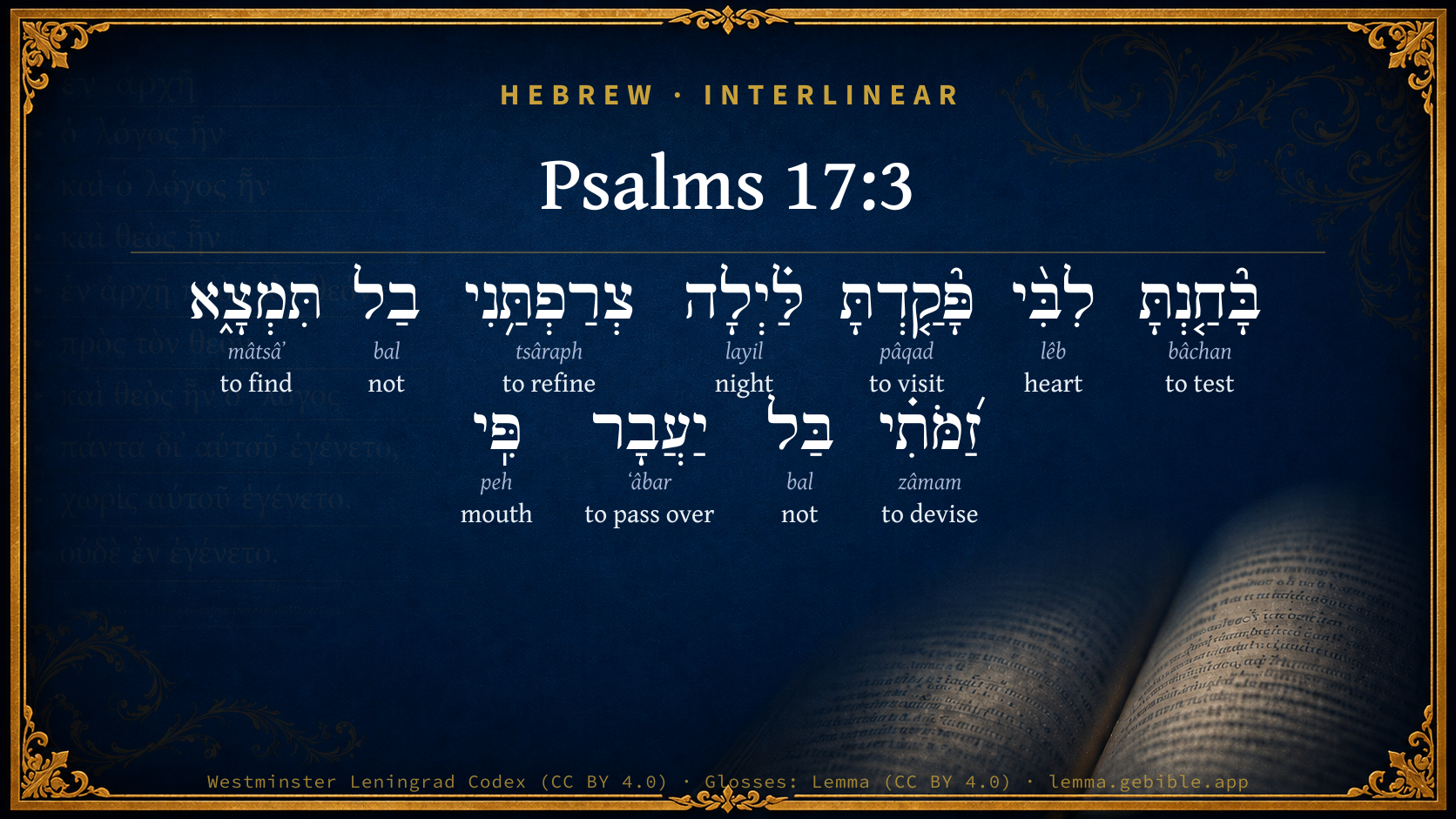
Hebrew (Westminster Leningrad Codex) Psalms 17:3 appears in the Hebrew Old Testament. The text above is from the Westminster Leningrad Codex. Each word links to its Strong’s number, a concise gloss, and parsing drawn from the Open Scriptures Hebrew Bible morphology. Click any word for its full Brown-Driver-Briggs (BDB) entry.
Download image
Cite this verse

Psalms 17:3 (World English Bible). Public Domain. Lemma interlinear Bible study tool, https://lemma.gebible.app/v/psalms/17/3.

Show BibTeX & RIS
BibTeX
RIS
English Translation
You have proved my heart; you have visited me in the night; You have tried me, and found nothing; I have resolved that my mouth shall not disobey.
World English Bible · Public Domain
Download a study sheet

One document with this verse’s original text, its word-by-word gloss line, the meaning frame, cross-references with their text, attributed commentary, and full source and license credits — printable, and it pastes into notes with its structure intact.

This verse Autodidact and up

Study sheet (.html) Plain text (.txt)

A passage Seminary Student

Up to 50 verses in one chapter. A passage sheet keeps up to 6 commentary sources and 12 cross-references per verse, in the order this page ranks them, and says so on the sheet whenever that leaves anything out. Ask for a single verse and you get the Autodidact verse sheet above.

Everything on this page stays free to read, with no account — the sheet is a download of what is already on screen, not access to it.

Want to remove ads? Support Godless Engineer
Compare translations 3

The same verse in 3 English versions, stacked beneath the original-language interlinear above. Click any original word for its lexicon entry.

Each is an independent rendering of the whole verse — the interlinear is not word-aligned to these translations.

Highlighted words mark where these versions differ — a whole-verse word diff, not a word-by-word alignment.

  • World English Bible Public Domain
    You have proved my heart; you have visited me in the night; You have tried me, and found nothing; I have resolved that my mouth shall not disobey.
  • King James Version Public Domain
    Thou hast proved mine heart; thou hast visited me in the night; thou hast tried me, and shalt find nothing; I am purposed that my mouth shall not transgress.
  • unfoldingWord Literal Text CC BY-SA 4.0
    You have examined my heart, you have visited night, you have tested me have detected nothing. I have purposed that my mouth will not transgress.

unfoldingWord Literal Text — © unfoldingWord, licensed CC BY-SA 4.0. Word-aligned USFM3 via Door43 (git.door43.org/unfoldingWord/en_ult).

Versions to compare (up to 4)

3 of 4 selected

Show all 18 translations

Every available English version of this verse, each an independent rendering of the whole verse.

  • World English Bible Public Domain
    You have proved my heart; you have visited me in the night; You have tried me, and found nothing; I have resolved that my mouth shall not disobey.
  • Berean Standard Bible Public Domain
    You have tried my heart; You have visited me in the night. You have tested me and found no evil; I have resolved not to sin with my mouth.
  • Majority Standard Bible Public Domain
    You have tried my heart; You have visited me in the night. You have tested me and found no evil; I have resolved not to sin with my mouth.
  • King James Version Public Domain
    Thou hast proved mine heart; thou hast visited me in the night; thou hast tried me, and shalt find nothing; I am purposed that my mouth shall not transgress.
  • American Standard Version (1901) Public Domain
    Thou hast proved my heart; thou hast visited me in the night; Thou hast tried me, and findest nothing; I am purposed that my mouth shall not transgress.
  • Revised Version (1885) Public Domain
    Thou hast proved mine heart; thou hast visited me in the night; thou hast tried me, and findest nothing; I am purposed that my mouth shall not transgress.
  • Geneva Bible (1599) Public Domain
    Thou hast prooued and visited mine heart in the night: thou hast tryed me, and foundest nothing: for I was purposed that my mouth should not offend.
  • Douay-Rheims (1899) Public Domain
    Thou hast proved my heart, and visited it by night, thou hast tried me by fire: and iniquity hath not been found in me.
  • Young's Literal Translation Public Domain
    Thou hast proved my heart, Thou hast inspected by night, Thou hast tried me, Thou findest nothing; My thoughts pass not over my mouth.
  • Literal Standard Version CC BY-SA 4.0
    You have proved my heart, || You have inspected by night, || You have tried me, You find nothing; My thoughts do not pass over my mouth.
  • Unlocked Literal Bible CC BY-SA 4.0
    If you test my heart, if you come to me in the night, you will purify me and will not find any evil plans; my mouth will not transgress.
  • unfoldingWord Literal Text CC BY-SA 4.0
    You have examined my heart, you have visited night, you have tested me have detected nothing. I have purposed that my mouth will not transgress.
  • Darby Bible Public Domain
    Thou hast proved my heart, thou hast visited me by night; thou hast tried me, thou hast found nothing: my thought goeth not beyond my word.
  • World Messianic Bible Public Domain
    You have proved my heart. You have visited me in the night. You have tried me, and found nothing. I have resolved that my mouth shall not disobey.
  • Webster's Bible Public Domain
    Thou hast proved my heart; thou hast visited me in the night; thou hast tried me, and shalt find nothing; I have purposed that my mouth shall not transgress.
  • Free Bible Version CC BY-SA 4.0
    You have observed my thoughts, you have visited me at night, you have examined me—and you have found nothing wrong. I promised myself I wouldn't say anything I shouldn't.
  • Bible in Basic English Public Domain
    You have put my heart to the test, searching me in the night; you have put me to the test and seen no evil purpose in me; I will keep my mouth from sin.
  • JPS Tanakh (1917) Public Domain
    Thou hast tried my heart, Thou hast visited it in the night; Thou hast tested me, and Thou findest not that I had a thought which should not pass my mouth.

Literal Standard Version (2020), Covenant Press — licensed CC BY-SA 4.0. Text via the HelloAO Bible API (eBible.org). Unlocked Literal Bible (unfoldingWord) — licensed CC BY-SA 4.0. Text via the HelloAO Bible API (eBible.org). unfoldingWord Literal Text — © unfoldingWord, licensed CC BY-SA 4.0. Word-aligned USFM3 via Door43 (git.door43.org/unfoldingWord/en_ult). Free Bible Version, Dr. Jonathan Gallagher — licensed CC BY-SA 4.0. Text via the HelloAO Bible API (eBible.org).

Word by word

More ways to search: Search by grammar → Find every occurrence → Compare this word →

Practice this passage: Drill this verse → Learn its vocabulary →

זַ֝מֹּתִ֗י
zâmam
H2161
“to devise”
Verb, Qal, Perfect, 1st Person, Common, Singular
Part of Speech
Verb
Stem
Qal
Form
Perfect
Person
1st Person
Gender
Common
Number
Singular
Full BDB Definition

Origin: a primitive root

TWOT: 556

to have a thought, devise, plan, consider, purpose - (Qal) - to consider, fix thought upon - to purpose, devise - to plot (of evil intent)
  1. בָּ֘חַ֤נְתָּ bâchan H974 “to test” Verb, Qal, Perfect, 2nd Person, Masculine, Singular
  2. לִבִּ֨י lêb H3820 “heart · my” Noun, Common, Masculine, Singular, Construct + Suffix, Personal, 1st Person, Common, Singular
  3. פָּ֘קַ֤דְתָּ pâqad H6485 “to visit” Verb, Qal, Perfect, 2nd Person, Masculine, Singular
  4. לַּ֗יְלָה layil H3915 “night” Noun, Common, Masculine, Singular, Absolute
  5. צְרַפְתַּ֥נִי tsâraph H6884 “to refine · me” Verb, Qal, Perfect, 2nd Person, Masculine, Singular + Suffix, Personal, 1st Person, Common, Singular
  6. בַל bal H1077 “not” Particle, Negative
  7. תִּמְצָ֑א mâtsâʼ H4672 “to find” Verb, Qal, Imperfect, 2nd Person, Masculine, Singular
  8. בַּל bal H1077 “not” Particle, Negative
  9. יַעֲבָר ʻâbar H5674 “to pass over” Verb, Qal, Imperfect, 3rd Person, Masculine, Singular
  10. פִּֽי peh H6310 “mouth · my” Noun, Common, Masculine, Singular, Construct + Suffix, Personal, 1st Person, Common, Singular

About this verse

These counts appear in no published source. They are computed here, from the morphology-tagged text and Lemma’s own curated glosses. What Lemma adds →

11
words
10
distinct lemmas
Wisdom
section

Notable vocabulary

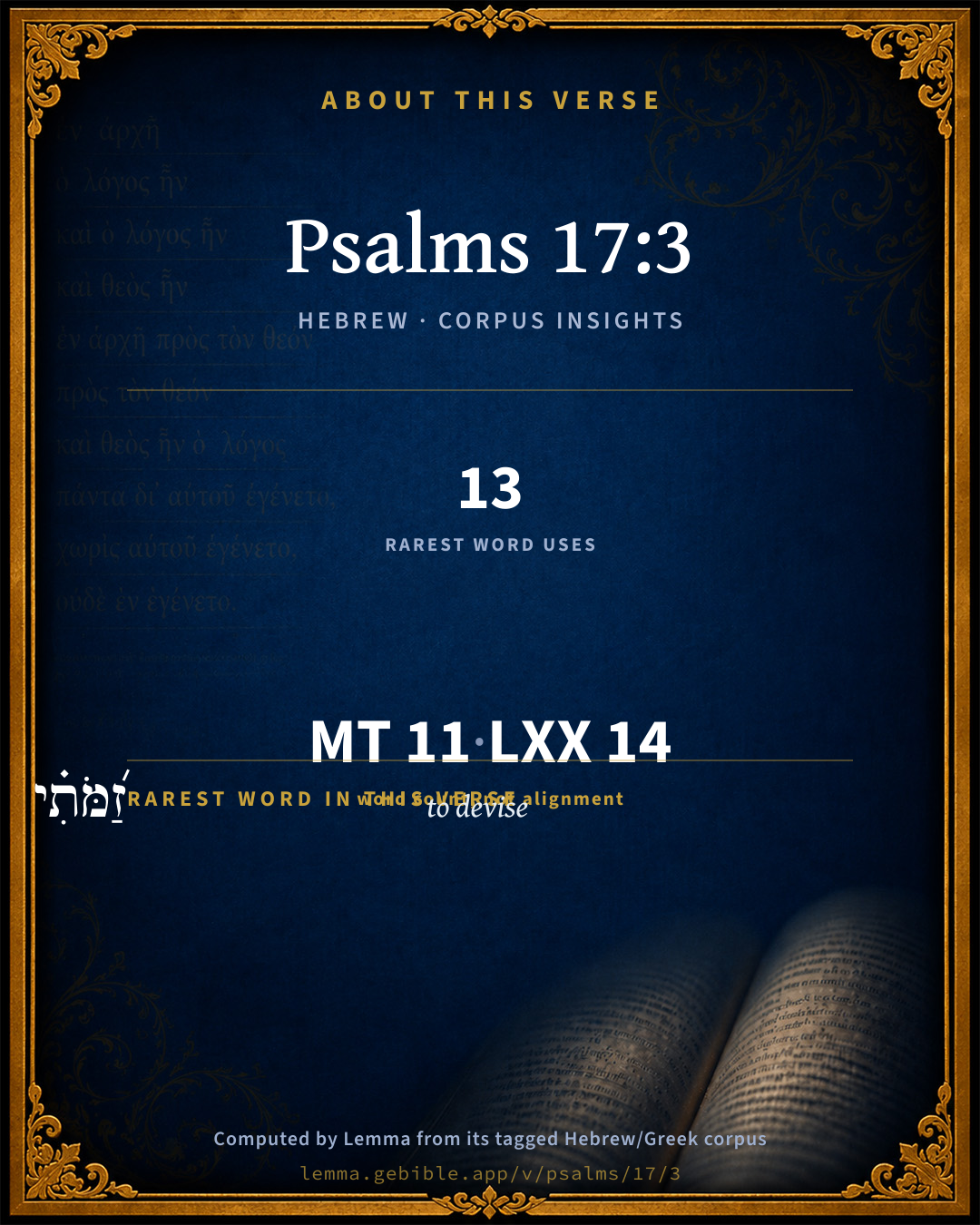
The rarest word here is זַ֝מֹּתִ֗י to devise H2161 — appearing just 13 times in the whole Hebrew Bible.

Shared distinctive vocabulary

זַ֝מֹּתִ֗י to devise H2161 occurs in 13 verses of the Hebrew Bible. Also found in:

Grammatical profile

  • 6 verbs
  • 3 nouns
  • 2 particles

Verb forms

  • בָּ֘חַ֤נְתָּ Qal · Perfect
  • פָּ֘קַ֤דְתָּ Qal · Perfect
  • צְרַפְתַּ֥נִי Qal · Perfect
  • תִּמְצָ֑א Qal · Imperfect
  • זַ֝מֹּתִ֗י Qal · Perfect
  • יַעֲבָר Qal · Imperfect

Repetition

A word recurs within this verse — often emphatic in Hebrew:

Hebrew & Septuagint length

In English translation the verse runs 28 words from the Hebrew and 36 from the Septuagint (LXX English) — closely comparable.

A rough comparison of the two English renderings, which tokenize alike — not a word-level alignment.

Word counts can differ between the Hebrew and the Greek without any difference in meaning — e.g. the Hebrew direct-object marker אֵת has no separate Greek word, and Greek often adds the article ὁ.

In the original languages it is 11 Hebrew tokens and 14 Greek tokens — but the two are counted differently (Hebrew bundles its prefixes and suffixes into one token; the Greek is in lemma form), so that isn’t a like-for-like length.

Cross-references

28

Topical passages linked to Psalms 17:3 in the Treasury of Scripture Knowledge — connected by theme and wording, ordered by reader-vote popularity; previews shown in the World English Bible.

  • Job 23:10 But he knows the way that I take. When he has tried me, I shall come forth like gold.
  • Psalms 26:2 Examine me, Yahweh, and prove me. Try my heart and my mind.
  • Acts 11:23 who, when he had come, and had seen the grace of God, was glad. He exhorted them all, that with purpose of heart they should remain near to the Lord.
  • Psalms 39:1 I said, "I will watch my ways, so that I don't sin with my tongue. I will keep my mouth with a bridle while the wicked is before me."
  • Malachi 3:2 "But who can endure the day of his coming? And who will stand when he appears? For he is like a refiner's fire, and like launderer's soap;
  • Psalms 66:10 For you, God, have tested us. You have refined us, as silver is refined.
  • Psalms 119:106 I have sworn, and have confirmed it, That I will obey your righteous ordinances.
  • Psalms 139:1 Yahweh, you have searched me, And you know me.
  • Proverbs 13:3 He who guards his mouth guards his soul. One who opens wide his lips comes to ruin.
  • Jeremiah 50:20 In those days, and in that time, says Yahweh, the iniquity of Israel shall be sought for, and there shall be none; and the sins of Judah, and they shall not be found: for I will pardon them whom I leave as a remnant.
  • Zechariah 13:9 I will bring the third part into the fire, And will refine them as silver is refined, And will test them like gold is tested. They will call on my name, and I will hear them. I will say, 'It is my people;' And they will say, 'Yahweh is my God.'"
  • 1 Samuel 24:12 Yahweh judge between me and you, and Yahweh avenge me of you; but my hand shall not be on you.
  • 1 Samuel 26:23 Yahweh will render to every man his righteousness and his faithfulness; because Yahweh delivered you into my hand today, and I wouldn't put forth my hand against Yahweh's anointed.
  • Job 24:14 The murderer rises with the light. He kills the poor and needy. In the night he is like a thief.
  • Psalms 11:5 Yahweh examines the righteous, But the wicked and him who loves violence his soul hates.
  • Psalms 16:7 I will bless Yahweh, who has given me counsel. Yes, my heart instructs me in the night seasons.
  • Psalms 44:17–21 All this has come on us, Yet have we not forgotten you, Neither have we been false to your covenant.
  • Hosea 7:6 For they have made ready their heart like an oven, While they lie in wait. Their baker sleeps all the night. In the morning it burns as a flaming fire.
  • Micah 2:1 Woe to those who devise iniquity And work evil on their beds! When the morning is light, they practice it, Because it is in the power of their hand.
  • Acts 18:9–10 The Lord said to Paul in the night by a vision, "Don't be afraid, but speak and don't be silent;
  • 1 Peter 1:7 that the proof of your faith, which is more precious than gold that perishes even though it is tested by fire, may be found to result in praise, glory, and honor at the revelation of Jesus Christ--
  • 1 Samuel 24:10 Behold, this day your eyes have seen how that Yahweh had delivered you today into my hand in the cave: and some bade me kill you; but [my eye] spared you; and I said, I will not put forth my hand against my lord; for he is Yahweh's anointed.
  • Psalms 7:4 If I have rewarded evil to him who was at peace with me (Yes, I have delivered him who without cause was my adversary),
  • Acts 16:9 A vision appeared to Paul in the night. There was a man of Macedonia standing, begging him, and saying, "Come over into Macedonia and help us."
  • 2 Corinthians 1:12 For our boasting is this: the testimony of our conscience, that in holiness and sincerity of God, not in fleshly wisdom but in the grace of God we behaved ourselves in the world, and more abundantly toward you.
  • James 3:2 For in many things we all stumble. If anyone doesn't stumble in word, the same is a perfect man, able to bridle the whole body also.
  • 1 Samuel 26:11 Yahweh forbid that I should put forth my hand against Yahweh's anointed: but now please take the spear that is at his head, and the jar of water, and let us go.
  • 1 Corinthians 4:4 For I know nothing against myself. Yet I am not justified by this, but he who judges me is the Lord.

Cross-references courtesy of OpenBible.info (CC BY 4.0).

Hebrew and Greek witnesses Masoretic Hebrew ↔ Greek Septuagint

The same verse in the two great witnesses to the Old Testament, shown verse-for-verse.

You’re reading Greek Psalm 16 (Hebrew Psalm 17). The Septuagint counts the superscription, so verse numbers can differ from the Hebrew — chapter-level alignment, not verse-by-verse. Numbering follows Rahlfs.

These are two independent witnesses, not word-aligned to each other, and the Septuagint is shown in lemma (dictionary) form.

Hebrew Psalms 17:3 Masoretic · Westminster Leningrad Codex

בָּ֘חַ֤נְתָּ לִבִּ֨י פָּ֘קַ֤דְתָּ לַּ֗יְלָה צְרַפְתַּ֥נִי בַל תִּמְצָ֑א זַ֝מֹּתִ֗י בַּל יַעֲבָר פִּֽי

You have proved my heart; you have visited me in the night; You have tried me, and found nothing; I have resolved that my mouth shall not disobey.

World English Bible · Public Domain

Greek LXX Greek Psalm 16:3 Septuagint · lemma form

δοκιμάζω ὁ καρδία ἐγώ ἐπισκέπτομαι νύξ πυρόω ἐγώ καί οὐ εὑρίσκω ἐν ἐγώ ἀδικία

You have tested my heart; you have visited me by night; you have tried me as with fire, and unrighteousness has not been found in me: I am purposed that my mouth shall not speak amiss.

LXX2012 (modern English Septuagint) · Public Domain

On this verse, Adam Clarke's Commentary discusses the Septuagint’s reading. Read the note in Commentary ↓

Hebrew: Westminster Leningrad Codex (CC BY 4.0). Greek: Septuagint (public domain); English from LXX2012 (modern English Septuagint) (Public Domain). How the Septuagint differs from the Hebrew →

Commentary

Notes on Psalms 17:3 from classic Christian and Jewish commentators (each source and its license shown beneath its notes). The classic Christian expositions comment on the surrounding passage and are grouped to its opening verse, so a note may address several verses; the Jewish commentaries on the Tanakh (Rashi and others) are per-verse, so they appear only where the commentator wrote on this verse.

Lemma curates 59 commentaries, every one of them public domain or Creative Commons licensed, each selected and text-cleaned for this edition rather than reprinted as found. About our sources →

Trapp's Complete Commentary

John Trapp

Psa 17:3 Thou hast proved mine heart; thou hast visited [me] in the night; thou hast tried me, [and] shalt find nothing; I am purposed [that] my mouth shall not transgress.

Ver. 3. Thou hast proved my heart] And knowest me to be no dissembler and traitor, as they wrongfully charge me, while they muse as they use.

Thou hast visited me in the night] In which God is wont to stir up and inmind men of his will, Job 4:13-14, as being all gathered within themselves; and when the darkness doth unmask them of worldly dissimulation.

Thou hast tried me] As metallaries do their gold and silver.

And shall find nothing] Heb. hast not found, טום deficit, saith Aben Ezra; no blot or blemish, that is, not the spot of God’s children, Deu 32:5, no dross or deceit that may not well consist with godliness.

I am purposed that my mouth shall not transgress] My general purpose is such, though I may have my particular failings. I speak my whole heart, so far as I know it. Magna est concordia cordis et oris.

John Trapp, A Commentary or Exposition upon All the Books of the Old and New Testament (1647–1656) — public domain. Text from a community e-Sword module.

The Biblical Illustrator

Joseph S. Exell

Psa_17:3

Thou hast visited me in the night.

Gods visitations in the night

God has two daily messengers of His love for men, bringing to them His gifts of love--Day and Night. Let us think of His visitations to us by night, when we are still and when He would have us reflect. The Psalm is evidently an evening Psalm.

I. How well it is that the day should close with reflection, that God should visit us thus. Rest alone would be a visitation from God, His gift. But sleep is the better when we pass to it from prayer. If a knock comes to the door at night when all is quiet how it startles us. In the day we should not notice it, but at night we needs must. And Christ may say, I came in the day but was not heard; behold, I now stand at the door and knock. It is well to reflect at the close of each day on each day. In the bustle of business we do not understand the meaning of our life. Perhaps we never shall till the bustle of all lifes days is done and we stand on the safe and quiet shore of eternity. There are, too, our own ways that need to be understood. Conscience needs to be quickened, and one day it will be. Just as the manipulations of the photographer in the dark chamber bring forth a picture which has been burnt into the plate by rays o flight before, that when completed it may be brought to light again, and men may see what manner of men they were; so in the dark chambers of the dead, in the hidden spirit world, there shall be a quickening of conscience. And God has given to us the darkness of night in which, away from busy life, we may bring forth the pictures of the day that are imprinted on conscience. Cultivate this photography of life.

II. And there is the night of trouble. God visits those who trust Him then. Let there be also in this night reflection, review. Memory is given us that we may not depend for happiness on the present. And review in this night your conduct in your joys. Ah, who is worthy of their joy? Be willing then to bear the night. Gods blessings come in the night, so says a German proverb. There is no night in which God is not near us. No, not the last eventide, the darkest of all In Christ we need not foal (T. Gasquoine, B. A.)

The religious aspects of night

There is no necessary contrast between what are called the scientific and the religious aspects of nature. Science keeps its eye upon the facts of nature, carefully verifies and measures them, and seeks to discover their exact relations to each other. Religion, too, is interested in nature, and behind each natural fact sees chiefly Him to whom both effect and cause are traceable. Religion is more necessary to us men than science, and therefore God has taught us religion first of all. The succession of day and night will illustrate what I am saying. We know the physical causes of night, but it has another and a higher meaning, and this is hinted at in our text. The religious aspects of night are many. It strikes us first of all--

I. As an interruption. It breaks in upon and suspends all human occupation. At the very least eight hours in the twenty-four, a quarter of a century in the life of a man of seventy-five, are withdrawn from the demands of labour, And as each day the shadow of night creeping around the world advances, millions of human workers hail the approaching pause in toil which is thus mercifully imposed upon them. Man might have been so fashioned as not to need this, but this enforced suspension of activity cannot but suggest a meaning. It suggests not merely the limited stock of strength at our disposal which needs thus often to be refreshed and replenished, but it also reminds us that we have a higher life than that of the activity of the day, and which shall last when all belonging to this shall have passed away.

II. Night suggests danger. The daylight is of itself protection. When it is withdrawn much becomes possible which it forbids. Night is the opportunity of wild beasts and of evil men. They ply their trade during its dark and silent hours. And thus St. Paul describes the workers of darkness as unfruitful. Our Lord compares the unexpectedness of His second coming as a thief in the night. If, indeed, St. Paul were to visit London on the afternoon of a bank holiday, it is to be feared that he would have to reconsider his remark that they that be drunken are drunken in the night. Still, on the whole, the night is the season of peril and disaster. We yet need to pray God that He would protect us from all perils and dangers of this night. For notwithstanding brilliantly lighted streets and well organised police there are yet special perils--such as those of fire in our large and lofty houses, from which the tenants of rude huts and shepherds cabins would find ready escape. It is with civilised as with savage man, God is, in the last resort, our only Protector.

III. Night is a time during which God often speaks to the soul of man. No believer in Gods existence can reasonably deny that He can communicate with the mind of man. We think sleeplessness a great misfortune, but it may be a great blessing. For never does God speak more solemnly, more persuasively to the human soul, than in the waking hours of night. Then conscience has a chance; we listen and hear no other voice. Conscience revives the past, and the eye of sense rests upon no object which can compete with and efface the awful impression. Then religion asserts its empire, and we acknowledge to ourselves with sorrow how much we have forgotten or despised that had the first of all claims upon us. See the many references in the Psalms to these holy uses of the night. One practical lesson, at least, we may remember as bearing upon this subject--the duty of storing the mind while we are yet comparatively young and strong with that which in the hours of sleeplessness and pain will enable us to rise up to God. A mind thus well stored need never fear that the waking hours of night are lost. (Canon Liddon.)

I am purposed that my mouth shall not transgress.--

Restraining the tongue

Such was the pious resolution of the Psalmist when the tongues of his enemies were transgressing both against him and his God. Silence would produce the better effect, both on his own mind and on his enemies.

I. The evil which the psalmist dreaded. Transgressing with his tongue. The tongue, indeed, is only the channel through which the depravity of the heart proceeds, but it is a channel of remarkable facility. It is liable to transgress--

1. Against God. By murmuring at the providence of God.

2. Against mankind. There are cruel expressions of malice and revenge sometimes uttered by one man against another to ruin his character. There are those who injure religion and their character by a propensity to speak with levity or bitterness. There are those who transgress by flattery-an evil more injurious than the keenest reproach sometimes.

II. The best means of avoiding this evil. If any man offend not in word, the same is a perfect man. What does this purpose imply?

1. A serious regard to Divine inspection and authority.

2. Attention to the state of the heart.

3. We should aim to cultivate religious knowledge, and promote, at every proper opportunity, religious conversation. The most likely way to preserve the tongue from evil is to employ it in what is valuable and useful Prepared by the secret exercises of piety and devotion, we shall enjoy the full delights of domestic and social life without injury and without remorse. (Homilist.)

The mouth kept front transgression

A friend of Archbishop Leighton said that, in free and frequent intercourse with him for twenty-two years, I never knew him say an idle word, or a word that had not a direct tendency to edification; and I never once saw him in any other temper but that I wished to be in at the last moment of my life.

The Biblical Illustrator, edited by Joseph S. Exell (c. 1880s–1900s) — public domain. Text from a community e-Sword module.

The Treasury of David

Charles H. Spurgeon

Ver. 3. Thou hast proved mine heart. Like Peter, David uses the argument, "Thou knowest all things, thou knowest that I love thee." It is a most assuring thing to be able to appeal at once to the Lord, and call upon our Judge to be a witness for our defence. "Beloved, if our heart condemn us not, then have we confidence toward God."

Thou hast visited me in the night. As if he had said, "Lord, thou hast entered my house at all hours; and thou hast seen me when no one else was nigh; thou hast come upon me unawares and marked my unrestrained actions, and thou knowest whether or no I am guilty of the crimes laid at my door." Happy man who can thus remember the omniscient eye, and the omnipresent visitor, and find comfort in the remembrance. We hope we have had our midnight visits from our Lord, and truly they are sweet; so sweet that the recollection of them sets us longing for more of such condescending communings. Lord, if indeed, we had been hypocrites, should we have had such fellowship, or feel such hungerings after a renewal of it?

Thou hast tried me, and shalt find nothing. Surely the Psalmist means nothing hypocritical or wicked in the sense in which his slanderers accused him; for if the Lord should put the best of his people into the crucible, the dross would be a fearful sight, and would make penitence open her sluices wide. Assayers very soon detect the presence of alloy, and when the chief of all assayers shall, at the last, say of us he has found nothing, it will be a glorious hour indeed "They are without fault before the throne of God." Even here, as viewed in our covenant Head, the Lord sees no sin in Jacob, nor perverseness in Israel; even the all detecting glance of Omniscience can see no flaw where the great Substitute covers all with beauty and perfection.

I am purposed that my mouth shall not transgress. Oh those sad lips of ours! we had need purpose to purpose if we would keep them from exceeding their bounds. The number of diseases of the tongue is as many as the diseases of all the rest of the man put together, and they are more inveterate. Hands and feet one may bind, but who can fetter the lips? iron bands may hold a madman, but what chains can restrain the tongue? It needs more than a purpose to keep this nimble offender within its proper range. Lion taming and serpent charming are not to be mentioned in the same day as tongue taming, for the tongue can no man tame. Those who have to smart from the falsehoods of others should be the more jealous over themselves; perhaps this led the Psalmist to register this holy resolution; and, moreover, he intended thereby to aver that if he had said too much in his own defence, it was not intentional, for he desired in all respects to tune his lips to the sweet and simple music of truth. Notwithstanding all this David was slandered, as if to show us that the purest innocence will be bemired by malice. There is no sunshine without a shadow, no ripe fruit unpecked by the birds.

Ver. 3. Thou hast proved mine heart:

What! take it at adventure, and not try What metal it is made of? No, not I. Should I now lightly let it pass, Take sullen lead for silver, sounding brass, Instead of solid gold, alas! What would become of it in the great day Of making jewels, it would be cast away.

The heart thou giv'st me must be such a one, As is the same throughout. I will have none But that which will abide the fire. It is not a glittering outside I desire,

Whose seeming shows do soon expire; But real worth within, which neither dross, Nor base alloys, make subject unto loss.

If, in the composition of thine heart, A stubborn, steely wilfulness have part,

That will not bow and bend to me, Save only in a mere formality

Of tinsel trimmed hypocrisy, I care not for it, though it show as fair As the first blush of the sun gilded air.

The heart that in my furnace will not melt, When it the glowing heat thereof hath felt, Turn liquid, and dissolve in tears Of true repentance for its faults, that hears My threatening voice, and never fears, Is not an heart worth having. If it be An heart of stone, it is not an heart for me.

The heart, that, cast into my furnace, spits, And sparkles in my face, fall into fits Of discontented grudging, whines When it is broken of its will, repines At the least suffering, declines My fatherly correction, is an heart On which I care not to bestow mine art.

The heart that vapours out itself in smoke, And with these cloudy shadows thinks to cloak

Its empty nakedness, how much Soever thou esteemest, it is such

As never will endure my touch.

I will bring it to my furnace, and there see What it will prove, what it is like to be.

If it be gold, it will be sure The hottest fire that can be to endure,

And I shall draw it out more pure. Affliction may refine, but cannot waste That heart wherein my love is fixed fast.

Francis Quarles.

Ver. 3. Thou hast visited me in the night, etc. In the night the soul is free from business with the world, and therefore freest for business with God; and then did God prove and visit David, that is, examine and sift him, by calling to his mind all his ways and works in former passages; and the issue of this trial was, he found nothing; not that his soul was empty of good things, or that there was nothing evil in him; but God, upon examination, found nothing of that evil in him which some men suspected him of; namely either any ill will or evil design against Saul, in reference to whom he called his cause a righteous cause, or the right (Ps 17:1); "Hear the right, O Lord." Joseph Caryl.

Ver. 3. (third clause, New Translation.) Thou hast smelted me, and found in me no dross. A metaphor taken from the smelting of metals to purify them from extraneous matter. Geddes.

Ver. 3. Proved... visited in the night... tried. Tribulation whereby, when examined, I was found righteous, is called not only night, in that it is wont to disturb with fear, but fire in that it actually burns. Augustine.

Ver. 3. I am purposed that my mouth shall not transgress. Wherefore, if thou be upon a mountain, look not backward again unto Sodom as Lot's wife did; if thou be within the ark, fly not out again into the world as Noah's crow did; if thou be well washed, return not again to the mire as the hog doth; if thou be clean, run not again to thy filth, as the dog doth; if thou be going towards the land of Canaan, think not on the flesh pots of Egypt; if thou be marching against the host of Midian, drink not of the waters of Harod; if thou be upon the housetop, come not down; if thou have set thy hand to the plough, look not behind thee; remember not those vices which are behind thee. Thomas Playfere.

Ver. 3-5. Where there is true grace, there is hatred of all sin, for hatred is pros to genod. Can a man be resolved to commit what he hates? No, for his inward aversion would secure him more against it than all outward obstacles. As this inward purpose of a good man is against all sin, so more particularly against that which doth so easily beset him. David seems in several places to be naturally inclined to lying, but he takes up a particular resolution against it: (Ps 17:3), "I am purposed that my mouth shall not transgress; "(ytmz) I have contrived to waylay and intercept the sin of lying when it hath an occasion to approach me. A good man hath not only purposes, but he endeavours to fasten and strengthen those purposes by prayer; so David (Ps 17:5), "Hold up my goings in the paths, that my footsteps slip not." He strengthens himself by stirring up a liveliness in duty, and by avoiding occasions of sin; (Ps 17:4), "I have kept me from the paths of the destroyer; "whereas, a wicked man neither steps out of the way of temptation, nor steps up to God for strength against it. Stephen Charnock.

Ver. 3. Thou hast proved mine heart. The metal, the furnace, the refiner, etc.

Ver. 3. Thou hast visited me in the night.

1. Glorious visitor.

2. Favoured individual.

3. Peculiar season.

4. Refreshing remembrance.

5. Practical result.

Ver. 3. (last sentence). Transgressions of the lip, and how to avoid them.

Psalms 17:4*

Ver. 3-5. See Psalms on "Ps 17:3" for further information.

Ver. 3-5. Where there is true grace, there is hatred of all sin, for hatred is pros to genoz. Can a man be resolved to commit what he hates? No, for his inward aversion would secure him more against it than all outward obstacles. As this inward purpose of a good man is against all sin, so more particularly against that which doth so easily beset him. David seems in several places to be naturally inclined to lying, but he takes up a particular resolution against it: (Ps 17:3), I am purposed that my mouth shall not transgress; (ytmz) I have contrived to waylay and intercept the sin of lying when it hath an occasion to approach me. A good man hath not only purposes, but he endeavours to fasten and strengthen those purposes by prayer; so David (Ps 17:5), Hold up my goings in the paths, that my footsteps slip not. He strengthens himself by stirring up a liveliness in duty, and by avoiding occasions of sin; (Ps 17:4), I have kept me from the paths of the destroyer; whereas, a wicked man neither steps out of the way of temptation, nor steps up to God for strength against it. Stephen Charnock.

Charles H. Spurgeon's The Treasury of David (1869–1885) — public domain. Psalms only. Text from a community e-Sword/MySword module.

Joseph Benson's Commentary

Psa 17:3. Thou hast proved mine heart — Or searched, or tried it, by many temptations and afflictions; by which the sincerity or hypocrisy of men’s hearts is discovered, and especially is manifest to thy all-seeing eye. Thou hast visited me in the night — Thou hast been present with me in my greatest privacies; to discover whether, in my retirement from the eyes of men, in the night season, when secrecy and solitude prompt the hypocrite to sin, I was forming any evil designs, or indulging any mischievous imaginations. Thou hast tried me — Accurately and severely, as goldsmiths do metals. And shalt find nothing — Nothing of unrighteousness in me. In the Hebrew it is only, Thou shalt not find; namely, that whereof my enemies accuse me, whether hypocrisy toward thee, or evil designs against Saul, covered with fair pretences. I am purposed — I have resolved upon deliberation, as the word here used implies; that my mouth shall not transgress — I am so far from taking any measures, or practising any thing against Saul’s life, as they charge me, that I will not wrong him so much as in word. Or, more generally, and without any particular reference to Saul, “I am so far from doing any wicked thing, that I will keep a strict watch even over my words; and though mine enemies persecute me ever so much by their evil deeds, I am resolved they shall not tempt me to speak evil.” Observe, reader, he does not say, I hope my mouth shall not transgress, or I wish it may not, but I am fully purposed that it shall not. With this bridle he kept it, Psa 39:2. Constant resolution and watchfulness against the sins of the tongue will be a good evidence of our integrity. If any man offend not in word, the same is a perfect man, Jas 3:2.

Joseph Benson's Commentary on the Old and New Testaments (1811–1818) — public domain. Text from a community e-Sword module.

Keil & Delitzsch

C. F. Keil & F. Delitzsch

David refers to the divine testing and illumination of the inward parts, which he has experienced in himself, in support of his sincerity. The preterites in Psa 17:3 express the divine acts that preceded the result בּל־תּמצא, viz., the testing He has instituted, which is referred to in צרפתּני and also בּחנתּ as a trying of gold by fire, and in פּקד as an investigation (Job 7:18). The result of the close scrutiny to which God has subjected him in the night, when the bottom of a man's heart is at once made manifest, whether it be in his thoughts when awake or in the dream and fancies of the sleeper, was and is this, that He does not find, viz., anything whatever to punish in him, anything that is separated as dross from the gold. To the mind of the New Testament believer with his deep, and as it were microscopically penetrating, insight into the depth of sin, such a confession concerning himself would be more difficult than to the mind of an Old Testament saint. For a separation and disunion of flesh and spirit, which was unknown in the same degree to the Old Testament, has been accomplished in the New Testament consciousness by the facts and operations of redemption revealed in the New Testament; although at the same time it must be remembered that in such confessions the Old Testament consciousness does not claim to be clear from sins, but only from a conscious love of sin, and from a self-love that is hostile to God.

With זמּותי David begins his confession of how Jahve found him to be, instead of finding anything punishable in him. This word is either an infinitive like חנּות (Psa 77:10) with the regular ultima accentuation, formed after the manner of the הל verbs, - in accordance with which Hitzig renders it: my thinking does not overstep my mouth, - or even 1 pers. praet., which is properly Milel, but does also occur as Milra, e.g., Deu 32:41; Isa 44:16 (vid., on Job 19:17), - according to which Bttcher translates: should I think anything evil, it dare not pass beyond my mouth, - or (since זמם may denote the determination that precedes the act, e.g., Jer 4:28; Lam 2:17): I have determined my mouth shall not transgress. This last rendering is opposed by the fact, that עבר by itself in the ethical signification "to transgress" (cf. post-biblical עברה παράβασις) is not the usage of the biblical Hebrew, and that when יעבר־פּי stand close together, פי is presumptively the object. We therefore give the preference to Bttcher's explanation, which renders זמותי as a hypothetical perfect and is favoured by Pro 30:32 (which is to be translated: and if thou thinkest evil, (lay) thy hand on thy mouth!). Nevertheless בל יעבר־פי is not the expression of a fact, but of a purpose, as the combination of בל with the future requires it to be taken. The psalmist is able to testify of himself that he so keeps evil thoughts in subjection within him, even when they may arise, that they do not pass beyond his mouth, much less that he should put them into action. But perhaps the psalmist wrote פּיך originally, "my reflecting does not go beyond Thy commandment" (according to Num 22:18; Sa1 15:24; Pro 8:29), - a meaning better suited, as a result of the search, to the nightly investigation. The ל of לפעלּות fo ל need not be the ל of reference (as to); it is that of the state or condition, as in Psa 32:6; Psa 69:22. אדם, as perhaps also in Job 31:33; Hos 6:7 (if אדם is not there the name of the first man), means, men as they are by nature and habit. בּדבר שׂפתיך does not admit of being connected with לפעלּות: at the doings of the world contrary to Thy revealed will (Hofmann and others); for פּעל בּ cannot mean: to act contrary to any one, but only: to work upon any one, Job 35:6. These words must therefore be regarded as a closer definition, placed first, of the שׁמרתּי which follows: in connection with the doings of men, by virtue of the divine commandment, he has taken care of the paths of the oppressor, viz., not to go in them; Sa1 25:21 is an instance in support of this rendering, where שׁמרתי, as in Job 2:6, means: I have kept (Nabal's possession), not seizing upon it myself. Jerome correctly translates vias latronis; for פּריץ signifies one who breaks in, i.e., one who does damage intentionally and by violence. The confession concerning himself is still continued in Psa 17:5, for the inf. absol. תּמך, if taken as imperative would express a prayer for constancy, that is alien to the circumstances described. The perfect after בּל is also against such a rendering. It must therefore be taken as inf. historicus, and explained according to Job 23:11, cf. Psa 41:13. The noun following the inf. absol., which is usually the object, is the subject in this instance, as, e.g., in Job 40:2; Pro 17:12; Ecc 4:2, and frequently. It is אשׁוּרי, and not אשּׁוּרי, אשׁור (a step) never having the שׁ dageshed, except in Psa 17:11 and Job 31:7.

Keil & Delitzsch — Biblical Commentary on the Old Testament (1861–1891) — public domain (CC PDM 1.0). Text via the HelloAO Bible API. (Old Testament only.)

J. A. Alexander on Psalms

Joseph Addison Alexander

3. (Psa 17:3) Thou hast tried my heart, hast visited (me) by night, hast assayed me; thou wilt not find; my mouth shall not exceed my thought. He still appeals to God as the judge and witness of his own sincerity. The preterites represent the process as no new one, although still continued in the present. Visited for the purpose of examination or inspection, in which specific sense the English verb is often used. By night, as the time when men's thoughts are least under restraint, and when the evil, if there be any, is most certain of detection. Purged me, as the purity of metals is tested by fire, to which process the Hebrew word is specially applied. Thou shalt not find any thing at variance with the sincerity of this profession.—The future form implies that the investigation is to be continued, but without any change in the result. —The last clause is doubtful and obscure. The common version, I am purposed (that) my mouth shall not trangress, agrees well enough with the form of the words, but is forbidden by the accents. The reversed construction, my thoughts shall not exceed my mouth (or speech), is ungrammatical; nor does either of theseconstructions suit the context so well as the first, which makes the clause a renewed profession of sincerity.

Joseph Addison Alexander, The Psalms Translated and Explained (1850) — public domain. Text from a community e-Sword module.

Tyndale Open Study Notes

Tyndale Open Resources

17:3-5 The psalmist declares his innocence (17:1) and commits himself to integrity by being open to God’s examination.

17:3 Though he is not perfect, the psalmist commits himself to the Lord. He does not want to sin through deception, flattery, or gossip (see 10:7; 15:2-3; 17:1).

Tyndale Open Study Notes — © Tyndale Open Resources, licensed CC BY-SA 4.0. Text via the HelloAO Bible API.

Geneva Bible (1599)

Geneva Bible translators

When thy Spirit examined my conscience.

I was innocent toward mine enemy both in deed and thought.

Geneva Bible (1599) marginal notes — public domain. Text via Bolls.life.

Jamieson, Fausset & Brown

Robert Jamieson, A. R. Fausset & David Brown

proved . . . visited . . . tried--His character was most rigidly tested, at all times, and by all methods, affliction and others (Psa 7:10).

purposed that, &c.--or, my mouth does not exceed my purpose; I am sincere.

Jamieson, Fausset & Brown — Commentary Critical and Explanatory on the Whole Bible (1871) — public domain (CC PDM 1.0). Text via the HelloAO Bible API.

Adam Clarke's Commentary

Verse 3. Thou hast proved mine heart] Thou well knowest whether there be any evil way in me. Thou hast given me to see many and sore trials; and yet, through thy mercy, I have preserved my integrity both to thee and to my king. Thou hast seen me in my most secret retirements, and knowest whether I have plotted mischief against him who now wishes to take away my life.

Thou hast tried me] צרפתני tseraphtani; Thou hast put me to the test, as they do metals, in order to detect their alloy, and to purify them: well expressed by the Vulgate, Igne me examinasti, "Thou hast tried me by fire;" and well paraphrased in my old Psalter, - Thu examynd me the lykkenyng of the fournas, that purges metal, and imang al this, wykednes es nout funden in me: that es, I am funden clene of syn, and so ryghtwis.-He who is saved from his sin is right wise; he has found the true wisdom.

My mouth shall not transgress.] This clause is added to the following verse by the Vulgate and Septuagint: "That my mouth may not speak according to the works of men, I have observed difficult ways because of the words of thy lips." That is, So far from doing any improper action, I have even refrained from all words that might be counted inflammatory or seditious by my adversaries; for I took thy word for the regulation of my conduct, and prescribed to myself the most painful duties, in order that I might, in every respect, avoid what would give offence either to thee or to man. Among the genuine followers of God, plots and civil broils are never found.

Adam Clarke's Commentary on the Bible (1810–1826) — public domain. Text from a community e-Sword/MySword module.

John Calvin's Commentaries

3. Thou hast proved my heart. Some are of opinion that in the three first verbs the past tense is put for the future. Others more correctly and more clearly resolve the words thus: If thou provest my heart, and visitest it by night, and examinest it thoroughly, there will not be found any deceit therein. But without making any change upon the words, they may be suitably enough explained in this way: Thou, Lord, who understandest all the secret affections and thoughts of my heart, even as it is thy peculiar prerogative to try men, knowest very well that I am not a double man, and do not cherish any deceit within. What David intended to express is certainly very evident. As he was unjustly and falsely charged with crime, and could obtain neither justice nor humanity at the hands of men, he appeals to God, requesting he would become judge in the matter. “Le requerant d’en vouloir estre le juge.” — Fr.

“Il ne sera trouve desguisement ne fraude quelconque en mon coeur.” — Fr.

This is the sense put upon this last clause by the learned Castellio, who translates it thus:- “Non deprehendes me aliud in pectore, aliud in ore habere.” “Thou shalt not find me to have one thing in my breast and another in my mouth.”

John Calvin's Commentaries (1540-1563) — public domain. Text from the Calvin Translation Society English edition (1840s-50s) via the Christian Classics Ethereal Library (ccel.org). Calvin's coverage is partial (roughly two-thirds of the Bible); uncommented books and verses are honest gaps, never fabricated. The 19th-century editor's footnotes and remarks are omitted so the notes are faithfully Calvin's own voice.

Ellicott's Commentary for English Readers

(3) In the night (as Psa_16:7).—The time of calm reflection and self-examination. Some, however, taking this verse in connection with Psa_17:15, think the poem was composed at night.

I am purposed.—The Hebrew word presents a difficulty. It is better to take it as a noun—counsels, and here, as generally, evil counsels—and join it to the preceding, not (as in the Authorised Version) the following words.

“Thou hast proved my heart,

Thou hast visited me in the night,

Thou hast found no malice in me,

My mouth doth not transgress, or

It (malice) doth not pass my mouth.”

“I offend”—that is, “neither in thought nor word.” The LXX., Vulg., Syr., Chald., and Arab. versions support this arrangement.

A Bible Commentary for English Readers, edited by Charles John Ellicott (1878–1897) — public domain. Text from a community e-Sword module.

The Cambridge Bible for Schools and Colleges

gen. ed. J. J. S. Perowne

3. Thou hast tried mine heart (Psa_7:9; Psa_11:4-5); thou hast visited me in the night, when men’s thoughts range unrestrainedly, and they appear in their true colours (Psa_36:4); thou hast proved or refined me (Psa_66:10), and findest nothing, no dross of evil purpose. But see next note.

I am purposed &c.] A difficult and much disputed clause. The A.V., retained in R.V. text, follows the Massoretic accents. It is however better to connect this and the preceding clause thus:

Thou hast proved me, and findest no evil purpose in me;

My mouth doth not transgress.

In thought, word, and deed (Psa_17:4), he has nothing to fear from the Divine scrutiny.

3–5. The bold language of a good conscience. See Introd. p. lxxxvii. Cp. Act_23:1; Act_24:16.

The Cambridge Bible for Schools and Colleges (gen. ed. J. J. S. Perowne; Cambridge University Press, 1878–1918) — public domain. Text from a community e-Sword module.

John Gill's Exposition

Thou hast proved mine heart,.... This properly belongs to God, who is the searcher of the heart and reins, and is desired by all good men; and though God has no need to make use of any means to know the heart, and what is in it; yet in order to know, or rather to make known, what is in the hearts of his people, he proves them sometimes by adversity, as he did Abraham and Job, and sometimes by prosperity, by mercies given forth in a wonderful way, as to the Israelites in the wilderness, Deu 8:2; sometimes by suffering false prophets and false teachers to be among them, Deu 13:3; and sometimes by leaving corruptions in them, and them to their corruptions, as he left the Canaanites in the land, and as he left Hezekiah to his own heart, Jdg 2:22. In one or other or more of these ways God proved the heart of David, and found him to be a man after his own heart; and in the first of these ways he proved Christ, who was found faithful to him that appointed him, and was a man approved of God;

thou hast visited me in the night; God visited and redeemed his people in the night of Jewish darkness; he visits and calls them by his grace in the night of unregeneracy; and so he visits with his gracious presence in the night of desertion; and he often visits by granting counsel, comfort, and support, in the night of affliction, which seems to be intended here; thus he visited the human nature of Christ in the midst of his sorrows and sufferings, when it was the Jews' hour and power of darkness. Elsewhere God is said to visit every morning, Job 7:18;

thou hast tried me; as silver and gold are tried in the furnace; thus the people of God, and their graces in them, are tried by afflictions; so David was tried, and in this manner Christ himself was tried; wherefore he is called the tried stone, Isa 28:16;

and shalt find nothing; or "shalt not find": which is variously supplied; some "thy desire", or what is well pleasing to thee, so Jarchi; or "thou hast not found me innocent", as Kimchi; others supply it quite the reverse, "and iniquity is not found in me", as the Septuagint, Vulgate Latin, and Ethiopic versions; or "thou hast not found iniquity in me", as the Syriac and Arabic versions; to which agrees the Chaldee paraphrase, "and thou hast not found corruption"; which must be understood, not as if there was no sin and corruption in David; for he often makes loud complaints and large confessions of his sins, and earnestly prays for the forgiveness of them; but either that there was no sin in his heart which he regarded, Psa 66:18; which he nourished and cherished, which he indulged and lived in; or rather there was no such crime found in him, which his enemies charged him with; see Psa 7:3. This is true of Christ in the fullest sense; no iniquity was ever found in him by God, by men or devils, Joh 14:30, Pe1 2:22; and also of his people, as considered in him, being justified by his righteousness, and washed in his blood, Jer 50:20; though otherwise, as considered in themselves, they themselves find sin and corruption abounding in them, Rom 7:18;

I am purposed that my mouth shall not transgress; by murmuring against God, on account of his visitation and fiery trials, or by railing at men for their false charges and accusations; this resolution was taken up by the psalmist in the strength of divine grace, and was kept by him, Psa 39:9; so Christ submitted himself patiently to the will of God without repining, and when reviled by men reviled not again, Luk 22:42; and from hence may be learned, that the laws of God may be transgressed by words as well as by works, and that the one as well as the other should be guarded against; see Psa 39:1.

John Gill's Exposition of the Whole Bible (1746–1763) — public domain (CC PDM 1.0). Text via the HelloAO Bible API.

Albert Barnes' Notes on the Bible

Thou hast proved mine heart - In this verse he refers to his own character and life in the matter under consideration, or the consciousness of his own innocence in respect to his fellow-men who are persecuting and opposing him. He appeals to the Great Searcher of hearts in proof that, in this respect, he was innocent; and he refers to different forms of trial on the part of God to show that after the most thorough search he would find, and did find, that in these respects he was an innocent man, and that his enemies had no occasion to treat him as they had done. It is still to be borne in mind here that the trial which the psalmist asks at the hand of God was not to prove that he was innocent toward him, or that he had a claim to His favor on account of his own personal holiness, but it was that he was innocent of any wrong toward those who were persecuting him, or, in other words, that after the most searching trial, even by his Maker, it would be found that he had given them no cause for treating him thus. The word here rendered “proved” means “to try, to prove, to examine,” especially metals, to test their genuineness. See Psa 7:9-10, note; Job 12:11, note. The psalmist here says that God had tried or searched “his heart.” He knew all his motives. He had examined all his desires and his thoughts. The psalmist felt assured that, after the most thorough trial, even God would not find anything in his heart that would justify the conduct of his enemies toward him.

Thou hast visited me - That is, for the purpose of inspecting my character, or of examining me. The English word “visit,” like the Hebrew, is often used to denote a visitation for the purpose of inspection and examination. The idea is, that God had come to him for the very purpose of “examining” his character.

In the night - In solitude. In darkness. When I was alone. In the time when the thoughts are less under restraint than they are when surrounded by others. In a time when it can be seen what we really are; when we do not put on appearances to deceive others.

Thou hast tried me - The word used here - צרף tsâraph - means properly “to melt, to smelt,” etc., metals, or separating the pure metal from the dross. The meaning is, that God, in examining into his character, had subjected him to a trial as searching as that employed in purifying metals by casting them into the fire.

And shalt find nothing - Thou wilt find nothing that could give occasion for the conduct of my enemies. The future tense is used here to denote that, even if the investigation were continued, God would find nothing in his heart or in his conduct that would warrant their treatment of him. He had the most full and settled determination not to do wrong to them in any respect whatever. Nothing had been found in him that would justify their treatment of him; he was determined so to live, and he felt assured that he would so live, that nothing of the kind would be found in him in time to come. “I am purposed.” I am fully resolved.

My mouth shall not transgress - Transgress the law of God, or go beyond what is right. That is, I will utter nothing which is wrong, or which can give occasion for their harsh and unkind treatment. Much as he had been provoked and injured, he was determined not to retaliate, or to give occasion for their treating him in the manner in which they were now doing. Prof. Alexander renders this “My mouth shall not exceed my thought; “but the common version gives a better idea, and is sanctioned by the Hebrew. Compare Gesenius, Lexicon.

Albert Barnes' Notes on the Bible (1834–1885) — public domain. Text from a community e-Sword/MySword module.

Matthew Poole's English Annotations

Proved, or searched, or tried it, by many and sore temptations and afflictions, whereby the sincerity or hypocrisy of men’s hearts are easily and commonly discovered, and especially by thy all-seeing eye. And that is my great comfort, that thou art witness of my innocency.

Thou hast visited me; thou hast made an inspection and inquiry into my heart.

In the night; either,

1. Metaphorically, i.e. in the time of trouble. Or,

2. Properly; when men’s minds being freed from the encumbrance and distraction of business, and from the presence and society of men, (which either lays a restraint upon them, or tempts them to use dissimulation,) do act most vigorously and freely, either upon good or evil, according to their several inclinations.

Thou hast tried me, accurately and severely, as goldsmiths do metals.

Shalt find nothing, i.e. nothing of unrighteousness. Heb. shalt not find, to wit, that whereof mine enemies accuse me, namely, hypocrisy towards thee, and evil design against Saul, covered under fair pretences, as they allege. So this general phrase is to be limited from the context, as other generals most frequently are. For he was so far from thinking himself sinless, that he often acknowledgeth his many and great sins, and particularly, that if God should enter into judgment with him, and be severe to mark iniquities, no living man could be justified, or stand before him, Psa 130:3; 143:2.

I am purposed, or, I have resolved upon deliberation, as the word implies, that my mouth shall not transgress; I am so far from practising against Saul’s life, as they charge me, that I will not wrong him so much as in a word. Some join these words with the next foregoing, and render the place thus, That which I have thought, my mouth shall not transgress, or rather, hath not transgressed, i.e. my thoughts and words always agree together. I abhor falsehood and dissimulation.

Matthew Poole's English Annotations on the Holy Bible (1683–1685) — public domain. Text from a community e-Sword/MySword module.

Whedon's Commentary on the Bible

Daniel D. Whedon

3. Proved mine heart—He accepts his afflictions as tests of his sincerity. The word prove is applied to the trying of metals. Jer_9:7; Zec_13:9.

In the night—See Psa_16:7.

Tried—A word of similar import to “proved,” in previous line. Thou hast purified me. Psa_66:10; Isa_48:10.

Shalt find nothing—No dross, no concealed iniquity upon which to ground condemnation. See Joh_14:30.

My mouth shall not transgress—I will not speak otherwise than I think and purpose. My heart and my lips shall be alike pure.

Daniel D. Whedon (gen. ed.), Commentary on the Old and New Testaments (1874–1909) — public domain. Text from a community e-Sword module.

The Pulpit Commentary

Thou hast proved mine heart. (comp. Psa_26:2 Psa_66:9 Psa_95:9 Psa_139:23) "Proved" means "tried," "tested," examined strictly, so as to know whether there was any wickedness in it or not. Thou hast visited me in the night. The night is the time when men can least escape those searching, testing thoughts which God"s providence then especially sends, to "try the very heart and reins". (Psa_7:9) Thou hast tried me., and shalt find nothing; rather, and findest nothing. The process was one begun in the past, and continuing on in the present. God was ever searching David and trying him; but "found nothing," i.e. no alloy, no base rectal, no serious flaw in his character; not that he was sinless, but that he "was sincere and earnest a true worshipper of God, not a hypocrite. I am purposed that my mouth shall not transgress. "If any man offend not in word, the same is a perfect man". (Jam_3:2) David"s resolution to "keep the door of his lips" would have a chastening influence over both his thoughts and acts.

The visits of God in the night.

The psalmist seems to have been one of the children of Israel scattered abroad. From the midst of a strange country he looks with a wistful eye towards the far-off land of his youth. Tried and persecuted by the worldly and profane, he takes refuge under the sheltering wings of Jehovah, his father"s God. If he was not David, he has the spirit of David. There are foreshadowings and foregleams of gospel times, in the ideas as to "the world," the "loving-kindness," and saving power of the Lord; and the blessed hope of satisfaction in God. This verse leads us to consider the visits of God in the night.

I REFRESHMENT. The divisions of time have to do with man. (Gen_1:5 Psa_104:20) "God has set labour and rest, As day and night to men successive, And the timely dew of sleep.

When night comes, it brings, not only relief from toil, but needed rest in sleep. In this we see the mercy of God. Like the sunshine and the rain, sleep is a common gift from God to men. Sleep also often brings return of health. How often is it said of some beloved one, with trembling hope, "If he sleep, he shall do well"! (Joh_11:12)

II PROTECTION. We associate the day with safety. (Joh_11:9) On the other hand, night is the season when not only wild beasts, but lawless men, seek their prey. (Job_24:14-17 1Th_3:7) There may be dangers unseen and unknown. (Psa_91:5, Psa_91:6) Besides, there are perils from evil thoughts and the wiles of the wicked one. But come what will, God is our sure Defence. He visits us in love and mercy. He watches over us with untiring vigilance. (Psa_121:3) The angel of judgment may be abroad, but under the shelter of the blood of the covenant we are safe. Even though God should say, "This night thy soul shall be required of thee," it will be in love, and not in wrath. Even should we be taken away in our sleep, it will be to light, and not to darkness. Hence we may say, "I will lay me down in peace, and sleep; for thou, Lord, only makest me dwell in safety". (Psa_4:8)

III INSTRUCTION. God has access to us at all times. He speaks to us continually by day, when our ears are open; but he also speaks to us, as he sees cause, by night, in dreams and visions, and when he holds our souls waking. Of this we have many examples in the Bible, and who is there who has not had some knowledge of this in his own experience? Dreams and visions are, for the most part, vain things; but there are even dreams and visions that have been found to be visits of God and turning-points in life. But it is when we have hours of sleeplessness that precious opportunities occur of communing in our hearts with God. Then there is not only quietness, but solitude. We are alone with God, and if we recognize his presence and hearken to his Word, we shall have cause to say, with thankfulness, "Thou hast visited me in the night." Sleeplessness, if prolonged, if it becomes a habit, is a sore evil; but sleepless hours may be turned to great profit. We have then the opportunity for quiet thought, for self-examination, for converse with God. Perhaps the past, with its joys and sorrows, rises before us, or we are troubled about the present or the future; but God is ever near, to counsel and to comfort us. "He giveth songs in the night". (Job_35:10) "One practical lesson at least may be remembered as bearing on this subject the duty of storing the mind, while we are yet comparatively young and strong, with that which, in the hours of sleeplessness and pain, will enable us to rise up to God. A mind well stored with Holy Scripture, with good prayers and hymns, need never feel that the waking hours of the night are lost. We may do more, for the soul"s true sanctification and peace, than many others in their own brief earthly pilgrimage" (Canon Liddon). W.F.

The Pulpit Commentary (1880–1919), ed. H.D.M. Spence-Jones & Joseph S. Exell — public domain. Text from a community e-Sword module.

John Wesley's Explanatory Notes

Proved - Or, searched or tried it, by many temptations and afflictions. Night - When mens minds being freed from the distraction of business, and from the society of men, they act more vigourously and freely, according to their several inclinations. Tried - As gold-smiths do metals. Nothing - Nothing of unrighteousness. Purposed - I have resolved, upon deliberation, as the word implies. Mouth - I am so far from practicing against Saul's life, as they charge me, that I will not wrong him so much as in a word.

John Wesley, Explanatory Notes Upon the Whole Bible (1754–1765) — public domain. Text via the GEBible commentary corpus.

unfoldingWord translationNotes

Door43 World Missions Community

If you test my heart, if you come to me in the night

Here "test my heart" means to examine my thoughts and motives. AT: "If you examine my thoughts in the night" (See: Idiom)

my mouth will not transgress

Here the mouth is spoken of as if it were capable of acting on its own. It also represents the words that a person speaks. AT: "I will not tell lies or sin with my words" (See: Personification and Synecdoche)

translationWords

test

heart

pure

evil

transgress

unfoldingWord translationNotes — © Distant Shores Media and the Door43 World Missions Community, licensed CC BY-SA 4.0. Source: git.door43.org/Door43/en_tn.

Rashi

Rabbi Shlomo Yitzchaki (Rashi)

You have tried my heart, etc. I know that I am guilty of a transgression, and, if the judgment of its punishment comes before You, I will not be declared innocent in the judgment, for You have already tried my heart.

You have visited [upon me] at night at eventide for the iniquity of Bathsheba, concerning which it is stated (in II Sam. 11:2) “And it came to pass at the time of evening, that David arose, etc.”

You have refined me You have tested me.

and not found You have not found in me Your desire.

If I think, let it not pass my mouth If it enters my thoughts again to be tried before You, let it not pass my mouth to say again, “Try me, O Lord, and test me,” as I have already said, as is written (26:2) “Try me, O Lord, and test me,” for David asked the Holy One, blessed be He, “Why do they say, ‘the God of Abraham,’ yet they do not say, ‘the God of David’?” He replied, “I tested him with ten tests, and he was found perfect.” He [David] said, “Try me and test me,” as appears in tractate Shabbath (?).

Rashi on the Tanakh — English translations: “The Judaica Press complete Tanach with Rashi, translated by A. J. Rosenberg” (CC BY 4.0); “Pentateuch with Rashi's commentary by M. Rosenbaum and A.M. Silbermann, 1929-1934” (public domain); “The Metsudah Tanach series, Lakewood, N.J” (CC BY 4.0); and “The Book of Joshua, Metsudah Publications, 1997” (CC BY 4.0). Text via Sefaria.

Radak

Rabbi David Kimhi (Radak)

Thou hast proved my heart; Thou hast visited me by night; Thou hast tried me, and findest nothing: – In that night Thou didst prove, and visit my heart, and try me and didst not find me clean. And he says:

I purposed let not my mouth transgress! – What I thought to say was: “Examine me, O Lord, and prove me” (ibid. 26:2). Oh that my mouth had not transgressed, and that I had not been one to say this thing of which I boasted and at which I stumbled! And he says:

Radak on the Tanakh — English translations: “Sefaria Community Translation” (CC0 1.0 (public-domain dedication)); “Eliyahu Munk, HaChut Hameshulash” (CC BY 4.0); “Rabbi Mike Feuer, Jerusalem Anthology” (CC BY 4.0); and “R. David Kimhi on the first book of Psalms, Translated by R.G. Finch, London, 1919” (public domain). Text via Sefaria.

Lesson kit

Teaching starters — assembled from the data on this page, not authored interpretation. Every prompt links to the verse data it draws on. Edit before teaching.

Psalms, in the Wisdom, opens this verse with 11 words (10 distinct Hebrew lemmas). Its most distinctive word is zâmam (“to devise”). A historical commentator’s framing appears above. Read the whole chapter for the surrounding context.

Discussion questions

  1. The word zâmam carries the sense “to devise.” How does it shape the verse?
  2. How does Genesis 11:6, which shares the word «to devise», read alongside this verse?
  3. What does the repetition of “not” (2× in this one verse) do in this verse?
  4. These translations render this verse differently. What is at stake in choosing one wording over another?
  5. «בָּ֘חַ֤נְתָּ» is a Qal Perfect verb. How does that grammatical form shape the action described?
  6. Compare how Trapp's Complete Commentary and The Biblical Illustrator read this verse. Where do they agree or differ?

Things to notice

Reading settings

Reading text

Shown beneath each verse's original-language words.

Old Testament
Old Testament edition

Read the OT as the Masoretic Hebrew (MT) or the Greek Septuagint (LXX).

English shown for the Greek Septuagint (in the Hebrew ↔ Greek comparison).

Comparing translations? Open the Compare panel on any verse page to stack up to four side by side.