
Zechariah 1:21

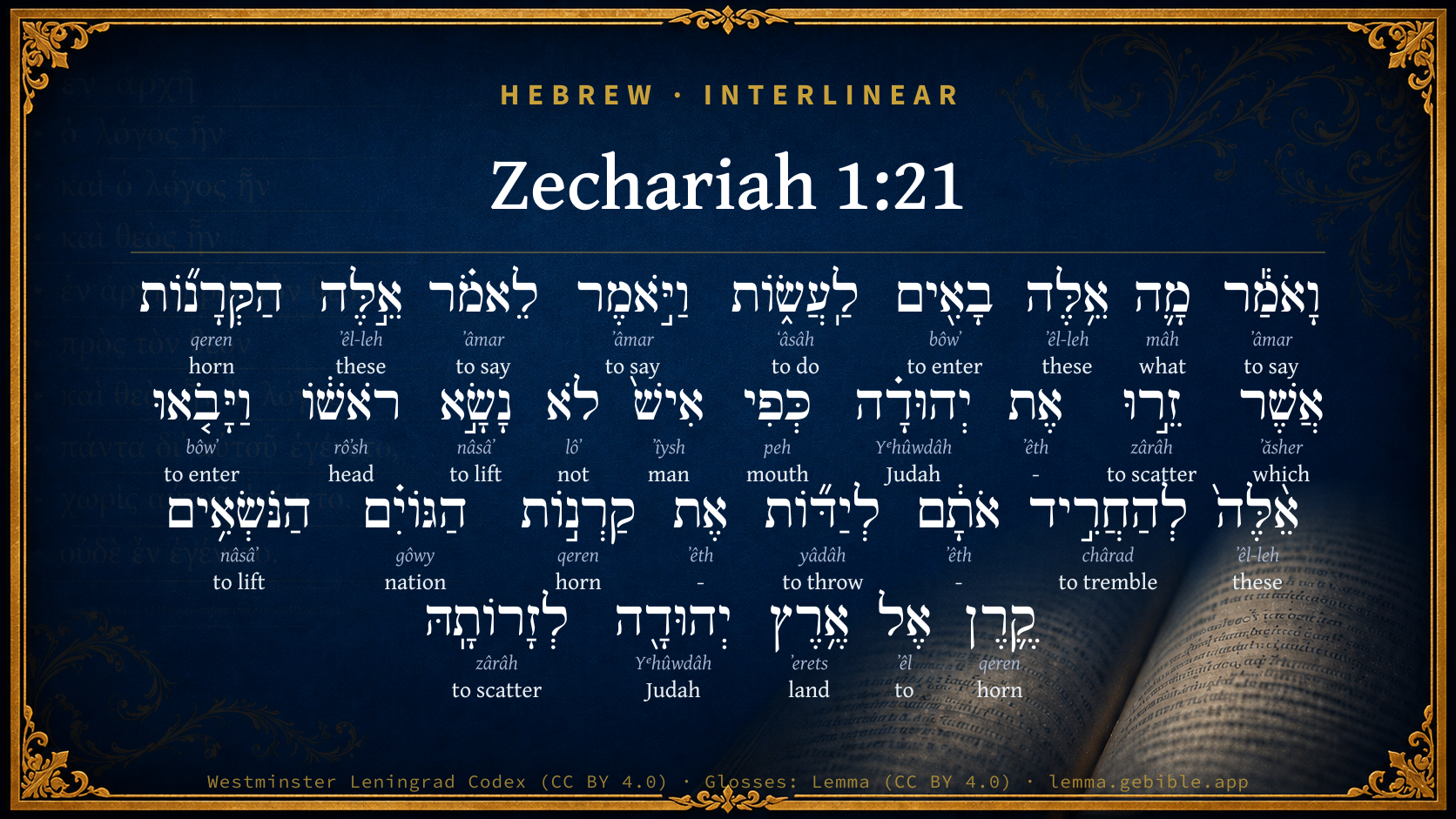
Hebrew (Westminster Leningrad Codex) Zechariah 1:21 appears in the Hebrew Old Testament. The text above is from the Westminster Leningrad Codex. Each word links to its Strong’s number, a concise gloss, and parsing drawn from the Open Scriptures Hebrew Bible morphology. Click any word for its full Brown-Driver-Briggs (BDB) entry.
Download image
Cite this verse

Zechariah 1:21 (World English Bible). Public Domain. Lemma interlinear Bible study tool, https://lemma.gebible.app/v/zechariah/1/21.

Show BibTeX & RIS
BibTeX
RIS
English Translation
Then I asked, "What are these coming to do?" He said, "These are the horns which scattered Judah, so that no man lifted up his head; but these have come to terrify them, to cast down the horns of the nations, which lifted up their horn against the land of Judah to scatter it."
World English Bible · Public Domain
Download a study sheet

One document with this verse’s original text, its word-by-word gloss line, the meaning frame, cross-references with their text, attributed commentary, and full source and license credits — printable, and it pastes into notes with its structure intact.

This verse Autodidact and up

Study sheet (.html) Plain text (.txt)

A passage Seminary Student

Up to 50 verses in one chapter. A passage sheet keeps up to 6 commentary sources and 12 cross-references per verse, in the order this page ranks them, and says so on the sheet whenever that leaves anything out. Ask for a single verse and you get the Autodidact verse sheet above.

Everything on this page stays free to read, with no account — the sheet is a download of what is already on screen, not access to it.

Want to remove ads? Support Godless Engineer
Compare translations 3

The same verse in 3 English versions, stacked beneath the original-language interlinear above. Click any original word for its lexicon entry.

Each is an independent rendering of the whole verse — the interlinear is not word-aligned to these translations.

Highlighted words mark where these versions differ — a whole-verse word diff, not a word-by-word alignment.

  • World English Bible Public Domain
    Then I asked, "What are these coming to do?" He said, "These are the horns which scattered Judah, so that no man lifted up his head; but these have come to terrify them, to cast down the horns of the nations, which lifted up their horn against the land of Judah to scatter it."
  • King James Version Public Domain
    Then said I, What come these to do? And he spake, saying, These are the horns which have scattered Judah, so that no man did lift up his head: but these are come to fray them, to cast out the horns of the Gentiles, which lifted up their horn over the land of Judah to scatter it.
  • unfoldingWord Literal Text CC BY-SA 4.0
    And I said, “What these coming to do?” And he said, “These the horns that scattered Judah, according to the mouth of a man has not lifted up his head. And these have come to terrify them, to cast down the horns of the nations, the ones lifting up a horn against the land of Judah to scatter her.”

unfoldingWord Literal Text — © unfoldingWord, licensed CC BY-SA 4.0. Word-aligned USFM3 via Door43 (git.door43.org/unfoldingWord/en_ult).

Versions to compare (up to 4)

3 of 4 selected

Show all 16 translations

Every available English version of this verse, each an independent rendering of the whole verse.

  • World English Bible Public Domain
    Then I asked, "What are these coming to do?" He said, "These are the horns which scattered Judah, so that no man lifted up his head; but these have come to terrify them, to cast down the horns of the nations, which lifted up their horn against the land of Judah to scatter it."
  • Berean Standard Bible Public Domain
    “What are these coming to do?” I asked. And He replied, “These are the horns that scattered Judah so that no one could raise his head; but the craftsmen have come to terrify them and throw down these horns of the nations that have lifted up their horns against the land of Judah to scatter it.”
  • Majority Standard Bible Public Domain
    “What are these coming to do?” I asked. And He replied, “These are the horns that scattered Judah so that no one could raise his head; but the craftsmen have come to terrify them and throw down these horns of the nations that have lifted up their horns against the land of Judah to scatter it.”
  • King James Version Public Domain
    Then said I, What come these to do? And he spake, saying, These are the horns which have scattered Judah, so that no man did lift up his head: but these are come to fray them, to cast out the horns of the Gentiles, which lifted up their horn over the land of Judah to scatter it.
  • American Standard Version (1901) Public Domain
    Then said I, What come these to do? And he spake, saying, These are the horns which scattered Judah, so that no man did lift up his head; but these are come to terrify them, to cast down the horns of the nations, which lifted up their horn against the land of Judah to scatter it.
  • Revised Version (1885) Public Domain
    Then said I, What come these to do? And he spake, saying, These are the horns which scattered Judah, so that no man did lift up his head: but these are come to fray them, to cast down the horns of the nations, which lifted up their horn against the land of Judah to scatter it.
  • Geneva Bible (1599) Public Domain
    Then said I, What come these to doe? And he answered, and said, These are the hornes, which haue scattered Iudah, so that a man durst not lift vp his head: but these are come to fray them, and to cast out the hornes of the Gentiles, which lift vp their horne ouer the land of Iudah, to scatter it.
  • Douay-Rheims (1899) Public Domain
    And I said: What come these to do? and he spoke, saying: These are the horns which have scattered Juda every man apart, and none of them lifted up his head: and these are come to fray them, to cast down the horns of the nations, that have lifted up the horn upon the land of Juda to scatter it.
  • Young's Literal Translation Public Domain
    And I say, `What `are' these coming in to do?' And He speaketh, saying: `These `are' the horns that have scattered Judah, so that no one hath lifted up his head, and these come in to trouble them, to cast down the horns of the nations who are lifting up a horn against the land of Judah -- to scatter it.'
  • Literal Standard Version CC BY-SA 4.0
    And I say, “What [are] these coming to do?” And He speaks, saying, “These [are] the horns that have scattered Judah, so that no one has lifted up his head, and these come to trouble them, to cast down the horns of the nations who are lifting up a horn against the land of Judah—to scatter it.”
  • Unlocked Literal Bible CC BY-SA 4.0
    I said, “What are these people coming to do?” He answered, and said, “These are the horns that scattered Judah so that no man would lift up his head. But the blacksmiths have come to terrify them, to cast down the horns of the nations that lifted up a horn against the land of Judah to scatter her.”
  • unfoldingWord Literal Text CC BY-SA 4.0
    And I said, “What these coming to do?” And he said, “These the horns that scattered Judah, according to the mouth of a man has not lifted up his head. And these have come to terrify them, to cast down the horns of the nations, the ones lifting up a horn against the land of Judah to scatter her.”
  • Darby Bible Public Domain
    And I said, What come these to do? And he spoke, saying, Those are the horns which scattered Judah, so that no man lifted up his head; but these are come to affright them, to cast out the horns of the nations, which lifted up the horn against the land of Judah to scatter it.
  • World Messianic Bible Public Domain
    Then I asked, “What are these coming to do?” He said, “These are the horns which scattered Judah, so that no man lifted up his head; but these have come to terrify them, to cast down the horns of the nations that lifted up their horn against the land of Judah to scatter it.”
  • Free Bible Version CC BY-SA 4.0
    “What are these men coming to do?” I asked. The angel replied, “The four horns—these nations—scattered Judah, humbling the people so that they could not lift up their heads. These craftsmen have to come to terrify these nations, and to destroy them—those who used their power against the land of Judah, scattering the people.”
  • JPS Tanakh (1917) Public Domain
    (2-4) Then said I: 'What come these to do?' And he spoke, saying: 'These — the horns which scattered Judah, so that no man did lift up his head — these then are come to frighten them, to cast down the horns of the nations, which lifted up their horn against the land of Judah to scatter it.'

Literal Standard Version (2020), Covenant Press — licensed CC BY-SA 4.0. Text via the HelloAO Bible API (eBible.org). Unlocked Literal Bible (unfoldingWord) — licensed CC BY-SA 4.0. Text via the HelloAO Bible API (eBible.org). unfoldingWord Literal Text — © unfoldingWord, licensed CC BY-SA 4.0. Word-aligned USFM3 via Door43 (git.door43.org/unfoldingWord/en_ult). Free Bible Version, Dr. Jonathan Gallagher — licensed CC BY-SA 4.0. Text via the HelloAO Bible API (eBible.org).

Word by word

More ways to search: Search by grammar → Find every occurrence → Compare this word →

Practice this passage: Drill this verse → Learn its vocabulary →

זֵ֣רוּ
zârâh
H2219
“to scatter”
Verb, Piel, Perfect, 3rd Person, Common, Plural
Part of Speech
Verb
Stem
Piel
Form
Perfect
Person
3rd Person
Gender
Common
Number
Plural
Full BDB Definition

Origin: a primitive root [compare H2114 ]

TWOT: 579

to scatter, fan, cast away, winnow, disperse, compass, spread, be scattered, be dispersed - (Qal) - to scatter - to fan, winnow - (Niphal) to be scattered, be dispersed - (Piel) - to scatter, disperse (intensive of Qal) - to winnow, sift - (Pual) to be scattered, be spread out
  1. וָאֹמַ֕ר ʼâmar H559 “and · to say” Conjunction + Verb, Qal, Sequential Imperfect, 1st Person, Common, Singular
  2. מָ֛ה mâh H4100 “what” Particle, Interrogative
  3. אֵ֥לֶּה ʼêl-leh H428 “these” Pronoun, Demonstrative, Common, Plural
  4. בָאִ֖ים bôwʼ H935 “entering” Verb, Qal, Participle Active, Masculine, Plural, Absolute
  5. לַֽעֲשׂ֑וֹת ʻâsâh H6213 “to do” Preposition + Verb, Qal, Infinitive Construct
  6. וַיֹּ֣אמֶר ʼâmar H559 “and · to say” Conjunction + Verb, Qal, Sequential Imperfect, 3rd Person, Masculine, Singular
  7. לֵאמֹ֗ר ʼâmar H559 “to say” Preposition + Verb, Qal, Infinitive Construct
  8. אֵ֣לֶּה ʼêl-leh H428 “these” Pronoun, Demonstrative, Common, Plural
  9. הַקְּרָנ֞וֹת qeren H7161 “the · horns” Particle, Definite Article + Noun, Common, Both, Plural, Absolute
  10. אֲשֶׁר ʼăsher H834 “which” Particle, Relative
  11. אֶת ʼêth H853 “-” Particle, Direct Object
  12. יְהוּדָ֗ה Yᵉhûwdâh H3063 “Judah” Noun, Proper
  13. כְּפִי peh H6310 “like/as · mouth of” Preposition + Noun, Common, Masculine, Singular, Construct
  14. אִישׁ֙ ʼîysh H376 “man” Noun, Common, Masculine, Singular, Absolute
  15. לֹא lôʼ H3808 “not” Particle, Negative
  16. נָשָׂ֣א nâsâʼ H5375 “to lift” Verb, Qal, Perfect, 3rd Person, Masculine, Singular
  17. רֹאשׁ֔וֹ rôʼsh H7218 “head · his” Noun, Common, Masculine, Singular, Construct + Suffix, Personal, 3rd Person, Masculine, Singular
  18. וַיָּבֹ֤אוּ bôwʼ H935 “and · to enter” Conjunction + Verb, Qal, Sequential Imperfect, 3rd Person, Masculine, Plural
  19. אֵ֨לֶּה֙ ʼêl-leh H428 “these” Pronoun, Demonstrative, Common, Plural
  20. לְהַחֲרִ֣יד chârad H2729 “to tremble” Preposition + Verb, Hiphil, Infinitive Construct
  21. אֹתָ֔ם ʼêth H853 “- · them” Particle, Direct Object + Suffix, Personal, 3rd Person, Masculine, Plural
  22. לְיַדּ֞וֹת yâdâh H3034 “to throw” Preposition + Verb, Piel, Infinitive Construct
  23. אֶת ʼêth H853 “-” Particle, Direct Object
  24. קַרְנ֣וֹת qeren H7161 “horns of” Noun, Common, Both, Plural, Construct
  25. הַגּוֹיִ֗ם gôwy H1471 “the · nations” Particle, Definite Article + Noun, Common, Masculine, Plural, Absolute
  26. הַנֹּשְׂאִ֥ים nâsâʼ H5375 “the · lifting” Particle, Definite Article + Verb, Qal, Participle Active, Masculine, Plural, Absolute
  27. קֶ֛רֶן qeren H7161 “horn” Noun, Common, Both, Singular, Absolute
  28. אֶל ʼêl H413 “to” Preposition
  29. אֶ֥רֶץ ʼerets H776 “land of” Noun, Common, Both, Singular, Construct
  30. יְהוּדָ֖ה Yᵉhûwdâh H3063 “Judah” Noun, Proper
  31. לְזָרוֹתָֽהּ zârâh H2219 “to scatter · her” Preposition + Verb, Piel, Infinitive Construct + Suffix, Personal, 3rd Person, Feminine, Singular

About this verse

These counts appear in no published source. They are computed here, from the morphology-tagged text and Lemma’s own curated glosses. What Lemma adds →

32
words
20
distinct lemmas
Prophets
section

Shared distinctive vocabulary

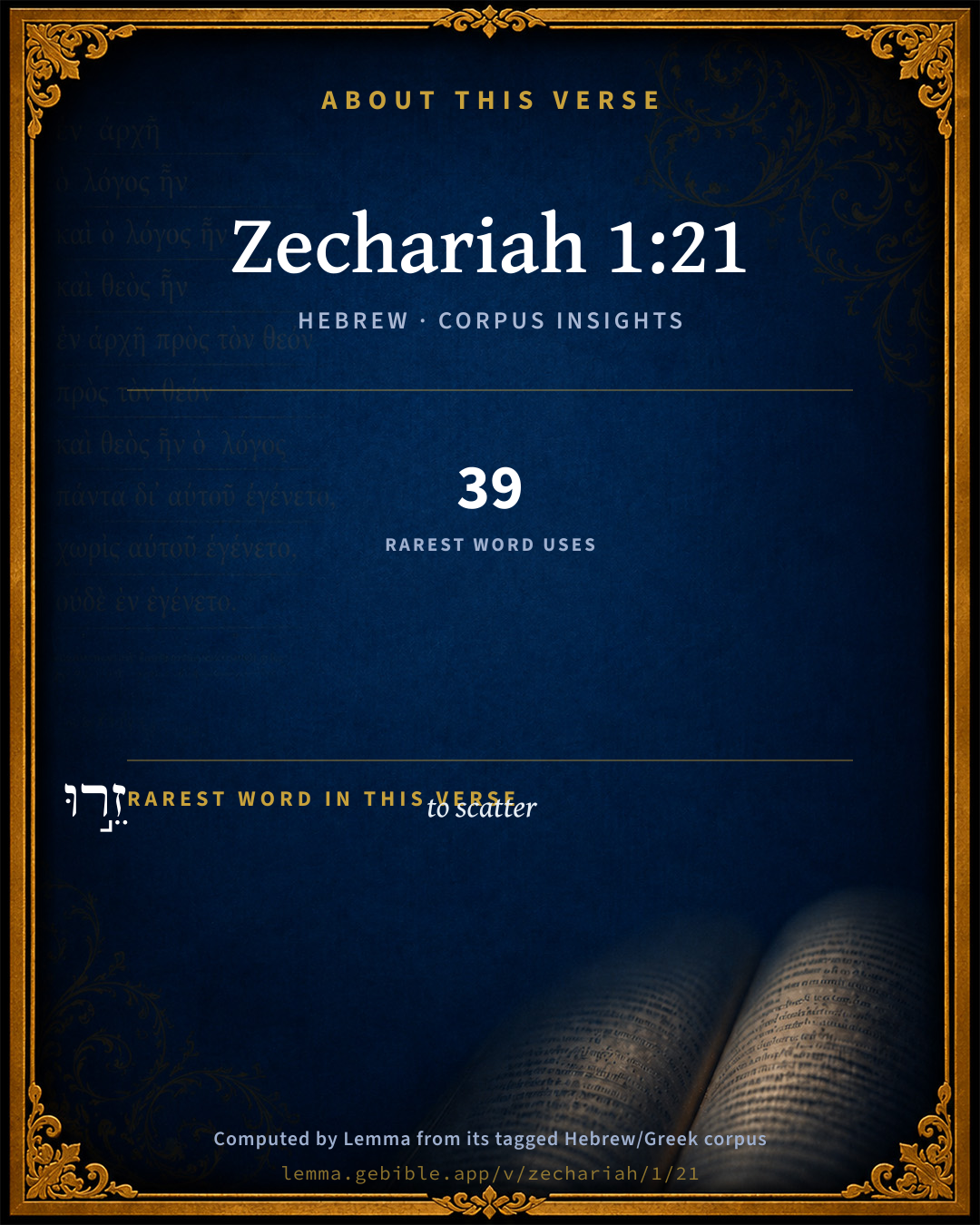
זֵ֣רוּ to scatter H2219 occurs in 38 verses of the Hebrew Bible. Also found in:

Grammatical profile

  • 12 verbs
  • 10 nouns
  • 3 pronouns
  • 1 preposition
  • 6 particles

Verb forms

  • וָאֹמַ֕ר Qal · Sequential Imperfect
  • בָאִ֖ים Qal · Participle Active
  • לַֽעֲשׂ֑וֹת Qal · Infinitive Construct
  • וַיֹּ֣אמֶר Qal · Sequential Imperfect
  • לֵאמֹ֗ר Qal · Infinitive Construct
  • זֵ֣רוּ Piel · Perfect
  • נָשָׂ֣א Qal · Perfect
  • וַיָּבֹ֤אוּ Qal · Sequential Imperfect
  • לְהַחֲרִ֣יד Hiphil · Infinitive Construct
  • לְיַדּ֞וֹת Piel · Infinitive Construct
  • הַנֹּשְׂאִ֥ים Qal · Participle Active
  • לְזָרוֹתָֽהּ Piel · Infinitive Construct

Repetition

Words recur within this verse — often emphatic in Hebrew:

  • וָאֹמַ֕ר to say H559 ×3
  • הַקְּרָנ֞וֹת horn H7161 ×3
  • בָאִ֖ים to enter H935 ×2
  • זֵ֣רוּ to scatter H2219 ×2
  • יְהוּדָ֗ה Judah H3063 ×2
  • נָשָׂ֣א to lift H5375 ×2
  • אֵ֥לֶּה these H428 ×3

Hebrew & Septuagint length

In English translation the verse runs 54 words from the Hebrew and 64 from the Septuagint (LXX English) — closely comparable.

A rough comparison of the two English renderings, which tokenize alike — not a word-level alignment.

Word counts can differ between the Hebrew and the Greek without any difference in meaning — e.g. the Hebrew direct-object marker אֵת has no separate Greek word, and Greek often adds the article ὁ.

Cross-references

5

Topical passages linked to Zechariah 1:21 in the Treasury of Scripture Knowledge — connected by theme and wording, ordered by reader-vote popularity; previews shown in the World English Bible.

  • Psalms 75:10 I will cut off all the horns of the wicked, But the horns of the righteous shall be lifted up.
  • Psalms 75:4–5 I said to the arrogant, "Don't boast;" To the wicked, "Don't lift up the horn.
  • Lamentations 2:17 Yahweh has done that which he purposed; he has fulfilled his word that he commanded in the days of old; He has thrown down, and has not pitied: He has caused the enemy to rejoice over you; he has exalted the horn of your adversaries.
  • Zechariah 1:19 I asked the angel who talked with me, "What are these?" He answered me, "These are the horns which have scattered Judah, Israel, and Jerusalem."
  • Daniel 12:7 I heard the man clothed in linen, who was above the waters of the river, when he held up his right hand and his left hand to heaven, and swore by him who lives forever that it shall be for a time, times, and a half; and when they have made an end of breaking in pieces the power of the holy people, all these things shall be finished.

Cross-references courtesy of OpenBible.info (CC BY 4.0).

Hebrew and Greek witnesses Masoretic Hebrew ↔ Greek Septuagint

The same verse in the two great witnesses to the Old Testament, shown verse-for-verse.

These are two independent witnesses, not word-aligned to each other, and the Septuagint is shown in lemma (dictionary) form.

Hebrew Zechariah 1:21 Masoretic · Westminster Leningrad Codex

וָאֹמַ֕ר מָ֛ה אֵ֥לֶּה בָאִ֖ים לַֽעֲשׂ֑וֹת וַיֹּ֣אמֶר לֵאמֹ֗ר אֵ֣לֶּה הַקְּרָנ֞וֹת אֲשֶׁר זֵ֣רוּ אֶת יְהוּדָ֗ה כְּפִי אִישׁ֙ לֹא נָשָׂ֣א רֹאשׁ֔וֹ וַיָּבֹ֤אוּ אֵ֨לֶּה֙ לְהַחֲרִ֣יד אֹתָ֔ם לְיַדּ֞וֹת אֶת קַרְנ֣וֹת הַגּוֹיִ֗ם הַנֹּשְׂאִ֥ים קֶ֛רֶן אֶל אֶ֥רֶץ יְהוּדָ֖ה לְזָרוֹתָֽהּ

Then I asked, "What are these coming to do?" He said, "These are the horns which scattered Judah, so that no man lifted up his head; but these have come to terrify them, to cast down the horns of the nations, which lifted up their horn against the land of Judah to scatter it."

World English Bible · Public Domain

Greek LXX Zechariah 1:21 Septuagint · lemma form
And I said, What are these coming to do? And he said, These are the horns that scattered Juda, and they broke Israel in pieces, and none of them lifted up his head: and these are come forth to sharpen them for their hands, even the four horns, the nations that lifted up the horn against the land of the Lord to scatter it.

LXX2012 (modern English Septuagint) · Public Domain

On this verse, Haydock's Catholic Bible Commentary discusses the Septuagint’s reading. Read the note in Commentary ↓

Hebrew: Westminster Leningrad Codex (CC BY 4.0). Greek: Septuagint (public domain); English from LXX2012 (modern English Septuagint) (Public Domain). How the Septuagint differs from the Hebrew →

Commentary

Notes on Zechariah 1:21 from classic Christian and Jewish commentators (each source and its license shown beneath its notes). The classic Christian expositions comment on the surrounding passage and are grouped to its opening verse, so a note may address several verses; the Jewish commentaries on the Tanakh (Rashi and others) are per-verse, so they appear only where the commentator wrote on this verse.

Lemma curates 59 commentaries, every one of them public domain or Creative Commons licensed, each selected and text-cleaned for this edition rather than reprinted as found. About our sources →

Trapp's Complete Commentary

John Trapp

Zec 1:21 Then said I, What come these to do? And he spake, saying, These [are] the horns which have scattered Judah, so that no man did lift up his head: but these are come to fray them, to cast out the horns of the Gentiles, which lifted up [their] horn over the land of Judah to scatter it.

Ver. 21. What come these to do?] He asketh not what they were? for by their tools or weapons he perceived they were carpenters or smiths (as some think), with iron instruments to break these iron horns; confer 1Ki 22:11. He inquireth, therefore, of their employment only. Futilous and foolish questions should be avoided, Tit 3:9.

So that no man did lift up his head] Turn head, or look cheerfully, as Luk 21:28.

But these are come to fray them] Deterere, saith the Vulgate; better deterrere, to frighten them, now that they had pushed Israel to the Lord.

To cast out, &c.] Thus Omne sub regno graviore regnum est. See Ecc 5:7. {See Trapp on "Ecc 5:7"}

John Trapp, A Commentary or Exposition upon All the Books of the Old and New Testament (1647–1656) — public domain. Text from a community e-Sword module.

Tyndale Open Study Notes

Tyndale Open Resources

1:21 humbled Judah: They literally lifted up their horns against Judah. • The Lord would cut off those horns, throw them down to the ground, and bring an end to their authority. The Judeans did not need to fear the surrounding nations.

Tyndale Open Study Notes — © Tyndale Open Resources, licensed CC BY-SA 4.0. Text via the HelloAO Bible API.

Jamieson, Fausset & Brown

Robert Jamieson, A. R. Fausset & David Brown

These are the horns--rather, Those, namely, the horns being distinguished from the "carpenters," or destroying workmen ("skilful to destroy," Exo 21:31), intended in the "these" of the question.

no man . . . lift up his head--so depressed were they with a heavy weight of evils (Job 10:15).

to fray--to strike terror into them (Eze 30:9).

lifted up . . . horn--in the haughtiness of conscious strength (Psa 75:4-5) tyrannizing over Judah (Eze 34:21).

The city shall be fully restored and enlarged (Zac 2:2-5). Recall of the exiles (Zac 2:6-7). Jehovah will protect His people and make their foes a spoil unto them (Zac 2:8-9). The nations shall be converted to Jehovah, as the result of His dwelling manifestly amidst His people (Zac 2:10-13).

Next: Zechariah Chapter 2

Jamieson, Fausset & Brown — Commentary Critical and Explanatory on the Whole Bible (1871) — public domain (CC PDM 1.0). Text via the HelloAO Bible API.

Adam Clarke's Commentary

Verse 21. These are come to fray them] To break, pound, and reduce them to powder. Fray, from the French, frayer, to rub. חרשים charashim signifies either carpenters or smiths; probably the latter are here intended, who came with hammers, files, and such like, to destroy these horns, which no doubt seemed to be of iron.

From a sensible correspondent I have received the following note: -

"The word we translate carpenters, חרשים charashim, is a root which, according to Mr. Parkhurst, denotes silent thought or attention; and in kal and hiphil, to contrive, devise secretly, or in silence; hence applied as a noun to an artificer of any kind, and to any work which disposes to silent attention. Thus, to potters' ware, Le 6:28; Job 2:8; and in many other places. So also to ploughing, De 22:10; Pr 20:4, which requires constant attention to make 'the right-lined furrow.' Let it be remembered that in ancient times such works were more esteemed than the useless ones we have learned to admire. So again, in Ge 24:21, and elsewhere, it implies to be silent, as in deep thought or great attention.

"Now it is evident that the purport of this vision is the same with the gracious declarations which precede it, viz., to express the return of the protecting mercies of God to his people, delivering them from their enemies. I should therefore be inclined to render חרשים charashim here, watchers or inspectors, in the sense which our translators have rendered the Chaldee עיר ir, a watcher, in the fourth chapter of Daniel, Da 4:13; understanding thereby 'spirits of the heavens, which go forth from standing before the Lord of all the earth,' Zec 6:5, and are described in the first vision as 'sent to walk to and fro through the earth.' This gives to the whole narrative a sublime and important sense, affording us some glimpse of the Divine government by the ministration of angels, such as Jacob was favoured with in his vision at Beth-el, and which our Saviour himself informed Nathanael constituted part of the glory of his mediatorial kingdom." - M. A. B.

Adam Clarke's Commentary on the Bible (1810–1826) — public domain. Text from a community e-Sword/MySword module.

John Calvin's Commentaries

And who are these smiths? They are also horns; for they all wish to destroy as much as they can the Church; but God does not permit them; on the contrary he excites them to mutual wars to destroy one another. Though then all these are horns, ready to assault the Church, and though it appears evident from the comparison that they are as it were furious and vicious bulls, and as much as they can unite together to scatter the Church, yet God gives hammers to two or three of them, and bids them to check the ferocity of their associates. While all these are intent on striking and dispersing the Church by their horns, the Lord calls them to a different work, and as I have said, bids them to be smiths that they may strike and break in pieces these horns, even their associates, with whom they had previously wickedly conspired. And it is certainly a wonderful instance of God’s providence, that amidst so violent and turbulent commotions the Church should take breath, though under the cross; for except these hammers had broken the horns, we must have been pierced through, not only a hundred but a thousand times, and had been dashed into fragments. But God has turned aside their strokes and assaults by his hammers, and, as I have said, has employed his enemies for this purpose.

We now then see that this prophecy was not only useful in the age of Zechariah, but that it has been so in all ages, and that it ought not to be confined to the ancient people, but extended to the whole body of the Church.

But the Prophet, by saying that he asked the angel, sets before us an example of a truly teachable disposition. Though the Lord then may not immediately explain to us his messages, there is yet no reason for us in disdain to reject what is obscure, as we see to be done by many in our day; for when any thing seems ambiguous to them, they immediately reject it, and also complain that God’s word is extremely difficult; and such blasphemies are uttered by many at this day. But the Prophet, though perplexed, did not yet morosely reject what God had showed; on the contrary, he asked the angels. Though the angels are not nigh us, or at least do not appear to us in a visible form, yet God can by other means afford us help when there is any perplexity in his word: he promises to give us the spirit of understanding and wisdom, whenever there is need; and we also know that the preaching of the word and the sacraments are helps to lead us to himself. If then we neglect not these helps which God affords us, and especially if we ask him to guide us by his Spirit, there will certainly be nothing obscure or intricate in the prophecies, which he will not, as far as it is necessary, make known to us. He does not indeed give the Spirit in an equal degree to all; but we ought to feel assured, that though prophecies may be obscure, there will yet be a sure profit derived, if we be teachable and submissive to God; for we find that Zechariah was not deprived of his request, as the angel gave him an immediate answer.

It must also be observed, that in one place he calls him Jehovah, and in another angel; and indeed he speaks thus indiscriminately of one and the same person. It hence follows that God appeared among the angels. But we must remember what I have already said, that this chief angel was the Mediator and the Head of the Church; and the same is Jehovah, for Christ, as we know, is God manifested in the flesh. There is then no wonder that the Prophet should indiscriminately call him angel and Jehovah, he being the Mediator of the Church, and also God. He is God, being of the same essence with the Father; and Mediator, having already undertaken his Mediatorial office, though not then clothed in our flesh, so as to become our brother; for the Church could not exist, nor be united to her God without a head. We hence see that Christ, as to his eternal essence, is said to be God, and that he is called an angel on account of his office, that is, of a Mediator.

The meaning is now evident: God declares that the horns were those which dispersed or scattered Judah as well as Jerusalem, and the kingdom of Israel: but that he had as many smiths, who would by force and by hammers, shatter these horns in pieces, though for a time they would greatly harass the Church. It must be also noticed that horn is to be taken differently when the number is changed: the Gentiles are called horns in the plural number to show their hardness or their strength; and they are then said to lift up their horn in the singular number to show that they ferociously exerted all their power to lay prostrate or to scatter the people of God. Then follows —

John Calvin's Commentaries (1540-1563) — public domain. Text from the Calvin Translation Society English edition (1840s-50s) via the Christian Classics Ethereal Library (ccel.org). Calvin's coverage is partial (roughly two-thirds of the Bible); uncommented books and verses are honest gaps, never fabricated. The 19th-century editor's footnotes and remarks are omitted so the notes are faithfully Calvin's own voice.

Ellicott's Commentary for English Readers

(21) Many commentators suppose that this vision refers to the future as well as the past, and that in it the objects are combined together so as to form one complete picture, without any regard to the time of their appearing in historical reality. And so they take the “four horns” to symbolise the four empires—the Assyrian, the Babylonian, the Medo-Persian, and the Græco-Macedonian. But such is not the case, as is clearly shown by this verse. It is true that the word “scattered” might, if standing alone, be taken as discharging the duties of historic and, at the same time, of prophetic perfect. But since in the dependent clause we have, “so that no man did lift up his head”—in the perfect—the word “have scattered” can refer only to the actual past. We must, therefore, reject all reference to the four monarchies which we have enumerated, because the Græco-Macedonian had not yet come into existence. If, then, the “four horns” do symbolise four monarchies, they can only be the Assyrian, Egyptian, Babylonian, and Medo-Persian. Some commentators have gone so far as to identify the four workmen with Nebuchadnezzar, Cyrus, Cambyses, and Alexander the Great. (Comp. and contrast Hag_2:22.) But it seems more probable that here (as in Zec_1:8) we must not draw too close a comparison between the symbol and the thing symbolised, and should understand the “four workmen” as merely figuring the destruction of these nations for the good of the Jewish nation, without the manner of its accomplishment being accurately defined. We may remark, in passing, that some commentators do not take the vision as referring to four distinct nations, but suppose the number four to be used in reference to all the powers hostile to Judah, from whatever quarter they may have come. The vision, a natural consequent of the preceding, is one of comfort, its object being to assure the people that as the former nations which had been hostile to Israel and Judah had been destroyed, so the present Medo-Persian monarchy, which also had at times oppressed them, should have the horn of its hostility utterly cast out, and should protect them and encourage the re-building of Jerusalem.

A Bible Commentary for English Readers, edited by Charles John Ellicott (1878–1897) — public domain. Text from a community e-Sword module.

The Cambridge Bible for Schools and Colleges

gen. ed. J. J. S. Perowne

21. he spake] i.e. the interpreting angel.

have scattered] Rather, scattered, R.V.

to fray them] Either the wild animals bearing the horns, or more probably the nations symbolised by them, are here spoken of as being “frayed,” or “panic-stricken.” In the following word, “to cast out,” the figure of the horns is perhaps resumed.

The Third Vision. The man with the measuring line. Zec_2:1-13. (Heb., 2:5–17.) The vision which describes the destruction of her enemies is followed by another, in which the consequent growth and prosperity of Jerusalem are depicted, and which in the largeness of its predictions extends into the more distant future. The prophet sees now upon the stage, or field of view, a young man with a measuring line in his hand, Zec_1:1. He asks him where he is going, and is answered, that he is going to measure Jerusalem, Zec_1:2. Upon this, the interpreting angel quits the prophet’s side and “goes forth” upon the stage in pursuit, as it would seem, of the man with the measuring line, to bid him desist from his purpose. As he does so, he is met by another angel, to whom he delegates the errand on which he himself had started, and whom he commissions in the hearing of the prophet (thus fulfilling his office as “interpreter” of the visions, and removing the false impression which the man’s answer, Zec_1:2, had created) to go and bid the “young man” cease from measuring, because Jerusalem, in its coming populousness and security, should neither admit of nor require walls, Zec_1:3-5. The exiles still remaining in Babylon are now summoned to leave her, Zec_1:6-7, for God’s judgments are about to fall upon her, Zec_1:8-9; whereas in Zion, to which they are invited to return, He will dwell, Zec_1:10-11, making it again His portion and His choice, Zec_1:12, extending its blessings to the Gentiles, Zec_1:11, confirming by the happy event the truth of this prediction, Zec_1:9; Zec_1:11, and manifesting Himself as the Judge of all the earth, Zec_1:13.

The Cambridge Bible for Schools and Colleges (gen. ed. J. J. S. Perowne; Cambridge University Press, 1878–1918) — public domain. Text from a community e-Sword module.

John Gill's Exposition

Then said I, What come these to do?.... That is, these four carpenters; for, being artificers or workmen, as the Targum renders the word, the prophet concluded there was some work for them to do:

And he spake, saying; meaning the angel that talked with him, and interpreted the visions to him:

These are the horns which have scattered Judah; not that the carpenters were the horns, for these two are distinct from, and opposite to, one another. The words should rather be rendered, "these horns which have scattered Judah", as before said, Zac 1:19,

so that no man did lift up his head; or, as the Targum paraphrases it, "did not suffer" (a man) "to go with an erect stature"; but, through oppression, sorrow, and misery, was obliged to stoop, and bow, and hang down his head:

but these are come to fray them; these carpenters are come to frighten the horns, to put terror into those kings and kingdoms;

to cast out the horns of the Gentiles; to destroy their kingdoms, and take away their power from them:

which lifted up their horns over the land of Judah to scatter it: who make use of their power, and do harm to the people of Israel, and triumph and insult over them; see Psa 75:4 all which may be applied to the ministers of the Gospel, who are workmen; and whose business it is to fight or terrify the horns, wicked men, even men in power, the enemies of Christ's church and people; by their preaching, which has made a Felix to tremble; by their prayers, which they have been more afraid of than an army of men, as Mary queen of Scots said of the prayers of John Knox; and by their good lives and conversations, which made Herod stand in fear of John the Baptist; nay, even they have been a terror to the devil himself, and have been the means of casting him, and his principalities and powers, out of the Gentile world, and out of both the bodies and souls of men; and of casting down the strong holds of sin, and of breaking in pieces the kingdom and interest of Satan, and of building up the churches of Christ; the work of these spiritual carpenters is to cut down men, comparable to strong, sturdy, and lofty trees, for the pride and haughtiness of their hearts, the stiffness and stubbornness of their wills, and for their show of goodliness and beauty: this is done by the ministry of the word, the cutting doctrines of it, accompanied with the Spirit and power of God; as it is said, "I have hewed them by the prophets, I have slain them by, the words of my mouth", Hos 6:5 whereas, when before, they grew up and stood on their own bottom, their morality, civility, and works of righteousness; now they are cut down, and die to all these things, as to any hope of salvation by them; and then, as the carpenter smooths and planes a timber he has hewed, and fitly frames it together, and joints it in, and lays it on a good foundation; so do Gospel ministers, as instruments in the hands of God, after hewing and cutting work through the ministration of the law, the killing letter, and which works wrath; speak comfortably to such souls, by directing them to the blood and righteousness of Christ for pardon of sin and justification of life; and ministerially lay them in the spiritual building, the church; or advise and exhort them to submit to the ordinances of Christ, and join themselves to Gospel churches; and, above all things, instruct them to build on Christ, the sure foundation in Zion; and ministerially lay him as the alone foundation to build upon for life and salvation, and not upon any works of righteousness done by them; and put them upon walking according to the line and rule of the divine word, in matters of worship, discipline, and conversation: and as there were in the first times of the Gospel many such builders, and have been more or less since; so there will be many more in the latter day, who will be very successfully employed in building, repairing, and beautifying the church of God; see Isa 58:12. Some by the four carpenters understand Zerubbabel, Joshua, Ezra, and Nehemiah; and so, by the four horns, those that opposed them in building the city and temple, as Rehum, Shimshai, Sanballat, and Tobiah; but these seem too inferior governors to be signified by horns; nor did they do what is here ascribed to them; rather their nations, Samaritans, Arabians, Ammonites, and Philistines, are meant.

Next: Zechariah Chapter 2

John Gill's Exposition of the Whole Bible (1746–1763) — public domain (CC PDM 1.0). Text via the HelloAO Bible API.

Haydock's Catholic Bible Commentary

Every. Hebrew, "at pleasure; none shall lift," &c. These kingdoms shall no longer prove formidable. (Calmet) --- Fray, or "terrify." Septuagint, "to sharpen them in their hands. The horns are nations," &c. (Haydock)

George Leo Haydock (1774–1849), Haydock's Catholic Family Bible and Commentary, 1859 edition — public domain. Excludes Psalms (Douay-Rheims chapter numbering differs from Protestant) and Deuterocanonical books (Catholic canon only).

Matthew Poole's English Annotations

Then, so soon as I could propose the question, immediately upon sight of the carpenters,

said I, Zechariah,

What come these to do? he saw they were men, inquires not who they were, but what was their business and design; perhaps it is fittest for us to rest also in the knowledge of what they are to do, and inquire no further who they were.

And he spake; the Lord Christ informed the prophet.

These are the horns which have scattered Judah: Christ doth in order to satisfy the inquiry first point to the four horns, of which Zec 1:18,19, as if he should have said, Look you, there are four horns which have done mischief to Judah.

So that no man did lift up his head; kept them so under, none had either strength or courage to lift up the head, and thus these horns proudly and cruelly destroyed my people.

But these, these carpenters, or smiths, are emblems of those instruments God will employ in breaking these destroyers. Here are four carpenters to break the four horns.

To fray them; to strike a fear into them first; these kingdoms, signified by horns, shall lose their courage.

To cast out the horns; then their authority and power shall be cast out easily.

The Gentiles; heathen round about Judea.

Which lifted up their horn over, have employed their arms and strength against,

the land of Judah, the whole kingdom of Judah, God’s people,

to scatter it, to drive them out of God’s inheritance, See Zec 1:19.

Matthew Poole's English Annotations on the Holy Bible (1683–1685) — public domain. Text from a community e-Sword/MySword module.

The Pulpit Commentary

And he spake. The interpreting angel spake. Which have scattered Judah. The LXX adds, "and broke Israel in pieces." Did lift up his head. These powers laid Judah prostrate. To fray them. To terrify the powers symbolized by the four horns, and disturb their self-complacent Security (ver. 15). The LXX, mistaking the sense, gives, Tou oxunai auta eiv ceirav autwn ta tessara kerata , "To sharpen them, even the four horns, in their hands." To cast out; to cast down, to overthrow these proud powers. Over (against) the land. The nations had treated Judah as a wild bull treats things that oppose him, tossing and scattering them to the wind.

The Pulpit Commentary (1880–1919), ed. H.D.M. Spence-Jones & Joseph S. Exell — public domain. Text from a community e-Sword module.

John Wesley's Explanatory Notes

He - Christ. These - He first points to the four horns. But these - These carpenters are emblems of those instruments God will employ in breaking those destroyers. Who lift up - Who employed their arms and strength against the kingdom of Judah, to drive them out of God's inheritance.

John Wesley, Explanatory Notes Upon the Whole Bible (1754–1765) — public domain. Text via the GEBible commentary corpus.

Lesson kit

Teaching starters — assembled from the data on this page, not authored interpretation. Every prompt links to the verse data it draws on. Edit before teaching.

Zechariah, in the Prophets, opens this verse with 32 words (20 distinct Hebrew lemmas). Its most distinctive word is zârâh (“to scatter”). A historical commentator’s framing appears above. Read the whole chapter for the surrounding context.

Discussion questions

  1. How does “to scatter” (zârâh) shape what this verse is saying?
  2. How does Exodus 32:20, which shares the word «to scatter», read alongside this verse?
  3. What does the repetition of “to say” (3× in this one verse) do in this verse?
  4. These translations render this verse differently. What is at stake in choosing one wording over another?
  5. «וָאֹמַ֕ר» is a Qal Sequential Imperfect verb. How does that grammatical form shape the action described?
  6. Compare how Trapp's Complete Commentary and Tyndale Open Study Notes read this verse. Where do they agree or differ?

Things to notice

Reading settings

Reading text

Shown beneath each verse's original-language words.

Old Testament
Old Testament edition

Read the OT as the Masoretic Hebrew (MT) or the Greek Septuagint (LXX).

English shown for the Greek Septuagint (in the Hebrew ↔ Greek comparison).

Comparing translations? Open the Compare panel on any verse page to stack up to four side by side.