Zechariah 1:15

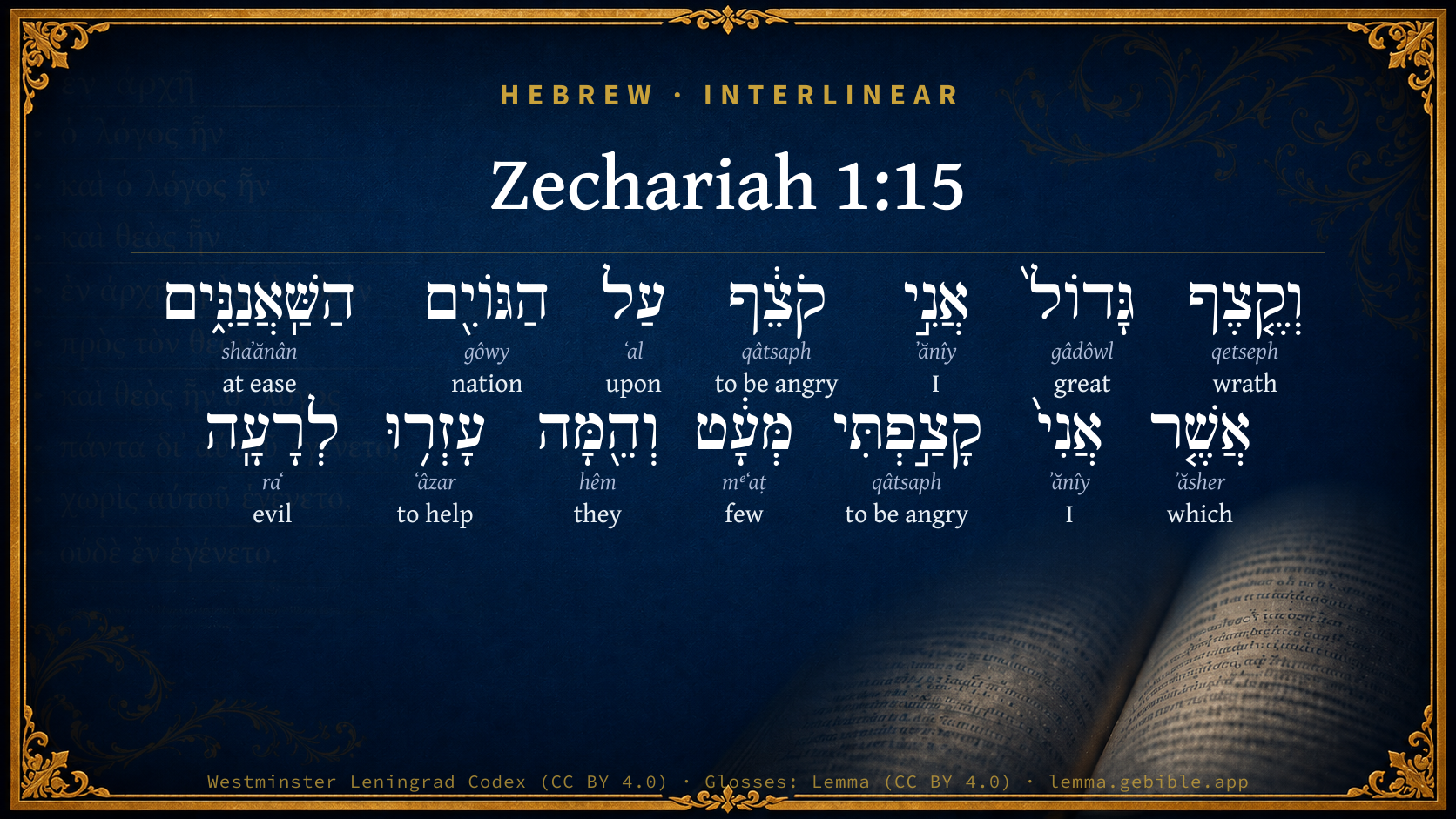
Hebrew (Westminster Leningrad Codex) Zechariah 1:15 appears in the Hebrew Old Testament. The text above is from the Westminster Leningrad Codex. Each word links to its Strong’s number, a concise gloss, and parsing drawn from the Open Scriptures Hebrew Bible morphology. Click any word for its full Brown-Driver-Briggs (BDB) entry.
Download image
Cite this verse

Zechariah 1:15 (World English Bible). Public Domain. Lemma interlinear Bible study tool, https://lemma.gebible.app/v/zechariah/1/15.

Show BibTeX & RIS
BibTeX
RIS
English Translation
I am very angry with the nations that are at ease; for I was but a little displeased, but they added to the calamity."
World English Bible · Public Domain
Download a study sheet

One document with this verse’s original text, its word-by-word gloss line, the meaning frame, cross-references with their text, attributed commentary, and full source and license credits — printable, and it pastes into notes with its structure intact.

This verse Autodidact and up

Study sheet (.html) Plain text (.txt)

A passage Seminary Student

Up to 50 verses in one chapter. A passage sheet keeps up to 6 commentary sources and 12 cross-references per verse, in the order this page ranks them, and says so on the sheet whenever that leaves anything out. Ask for a single verse and you get the Autodidact verse sheet above.

Everything on this page stays free to read, with no account — the sheet is a download of what is already on screen, not access to it.

Want to remove ads? Support Godless Engineer
Compare translations 3

The same verse in 3 English versions, stacked beneath the original-language interlinear above. Click any original word for its lexicon entry.

Each is an independent rendering of the whole verse — the interlinear is not word-aligned to these translations.

Highlighted words mark where these versions differ — a whole-verse word diff, not a word-by-word alignment.

  • World English Bible Public Domain
    I am very angry with the nations that are at ease; for I was but a little displeased, but they added to the calamity."
  • King James Version Public Domain
    And I am very sore displeased with the heathen that are at ease: for I was but a little displeased, and they helped forward the affliction.
  • unfoldingWord Literal Text CC BY-SA 4.0
    And a great anger I, I am angry with the nations that at ease, for I, I was angry a little, but they helped toward the evil.

unfoldingWord Literal Text — © unfoldingWord, licensed CC BY-SA 4.0. Word-aligned USFM3 via Door43 (git.door43.org/unfoldingWord/en_ult).

Versions to compare (up to 4)

3 of 4 selected

Show all 18 translations

Every available English version of this verse, each an independent rendering of the whole verse.

  • World English Bible Public Domain
    I am very angry with the nations that are at ease; for I was but a little displeased, but they added to the calamity."
  • Berean Standard Bible Public Domain
    but I am fiercely angry with the nations that are at ease. For I was a little angry, but they have added to the calamity.’
  • Majority Standard Bible Public Domain
    but I am fiercely angry with the nations that are at ease. For I was a little angry, but they have added to the calamity.’
  • King James Version Public Domain
    And I am very sore displeased with the heathen that are at ease: for I was but a little displeased, and they helped forward the affliction.
  • American Standard Version (1901) Public Domain
    And I am very sore displeased with the nations that are at ease; for I was but a little displeased, and they helped forward the affliction.
  • Revised Version (1885) Public Domain
    And I am very sore displeased with the nations that are at ease: for I was but a little displeased, and they helped forward the affliction.
  • Geneva Bible (1599) Public Domain
    And am greatly angrie against the carelesse heathen: for I was angrie but a litle, and they helped forward the affliction.
  • Douay-Rheims (1899) Public Domain
    And I am angry with a great anger with the wealthy nations: for I was angry a little, but they helped forward the evil.
  • Young's Literal Translation Public Domain
    And `with' great wrath I am wroth against the nations who are at ease, For I was a little wroth, and they assisted -- for evil.
  • Literal Standard Version CC BY-SA 4.0
    And [with] great wrath I am angry against the nations who are at ease, || For I was a little angry, and they assisted—for evil.
  • Unlocked Literal Bible CC BY-SA 4.0
    I am very angry with the nations that are at ease. When I was only a little angry with them, they made the disaster worse.
  • unfoldingWord Literal Text CC BY-SA 4.0
    And a great anger I, I am angry with the nations that at ease, for I, I was angry a little, but they helped toward the evil.
  • Darby Bible Public Domain
    and I am wroth exceedingly with the nations that are at ease; for I was but a little wroth, and they helped forward the affliction.
  • World Messianic Bible Public Domain
    I am very angry with the nations that are at ease; for I was but a little displeased, but they added to the calamity.”
  • Webster's Bible Public Domain
    And I am very greatly displeased with the heathen that are at ease: for I was but a little displeased, and they helped forward the affliction.
  • Free Bible Version CC BY-SA 4.0
    and I am extremely angry with the arrogant nations who think they are secure. I was only a little angry with my people, but they made the punishment far worse.
  • Bible in Basic English Public Domain
    And I am very angry with the nations who are living untroubled: for when I was only a little angry, they made the evil worse.
  • JPS Tanakh (1917) Public Domain
    and I am very sore displeased with the nations that are at ease; for I was but a little displeased, and they helped for evil.

Literal Standard Version (2020), Covenant Press — licensed CC BY-SA 4.0. Text via the HelloAO Bible API (eBible.org). Unlocked Literal Bible (unfoldingWord) — licensed CC BY-SA 4.0. Text via the HelloAO Bible API (eBible.org). unfoldingWord Literal Text — © unfoldingWord, licensed CC BY-SA 4.0. Word-aligned USFM3 via Door43 (git.door43.org/unfoldingWord/en_ult). Free Bible Version, Dr. Jonathan Gallagher — licensed CC BY-SA 4.0. Text via the HelloAO Bible API (eBible.org).

Word by word

More ways to search: Search by grammar → Find every occurrence → Compare this word →

Practice this passage: Drill this verse → Learn its vocabulary →

הַשַּֽׁאֲנַנִּ֑ים
shaʼănân
H7600
“the · at ease”
Particle, Definite Article + Adjective, Adjective, Masculine, Plural, Absolute
Part of Speech
Particle + Adjective
Type
Adjective
Gender
Masculine
Number
Plural
State
Absolute
Full BDB Definition

Origin: from H7599

TWOT: 2304a

at ease, quiet, secure (adjective) - at ease, secure - at ease, careless, wanton, arrogant - security, pride, arrogance (substantive) - one at ease - arrogance
  1. וְקֶ֤צֶף qetseph H7110 “and · wrath” Conjunction + Noun, Common, Masculine, Singular, Absolute
  2. גָּדוֹל֙ gâdôwl H1419 “great” Adjective, Adjective, Masculine, Singular, Absolute
  3. אֲנִ֣י ʼănîy H589 “I” Pronoun, Personal, 1st Person, Common, Singular
  4. קֹצֵ֔ף qâtsaph H7107 “being angry” Verb, Qal, Participle Active, Masculine, Singular, Absolute
  5. עַל ʻal H5921 “upon” Preposition
  6. הַגּוֹיִ֖ם gôwy H1471 “the · nations” Particle, Definite Article + Noun, Common, Masculine, Plural, Absolute
  7. אֲשֶׁ֤ר ʼăsher H834 “which” Particle, Relative
  8. אֲנִי֙ ʼănîy H589 “I” Pronoun, Personal, 1st Person, Common, Singular
  9. קָצַ֣פְתִּי qâtsaph H7107 “to be angry” Verb, Qal, Perfect, 1st Person, Common, Singular
  10. מְּעָ֔ט mᵉʻaṭ H4592 “few” Adverb
  11. וְהֵ֖מָּה hêm H1992 “and · they” Conjunction + Pronoun, Personal, 3rd Person, Masculine, Plural
  12. עָזְר֥וּ ʻâzar H5826 “to help” Verb, Qal, Perfect, 3rd Person, Common, Plural
  13. לְרָעָֽה raʻ H7451 “to/for · evil” Preposition + Noun, Common, Feminine, Singular, Absolute

About this verse

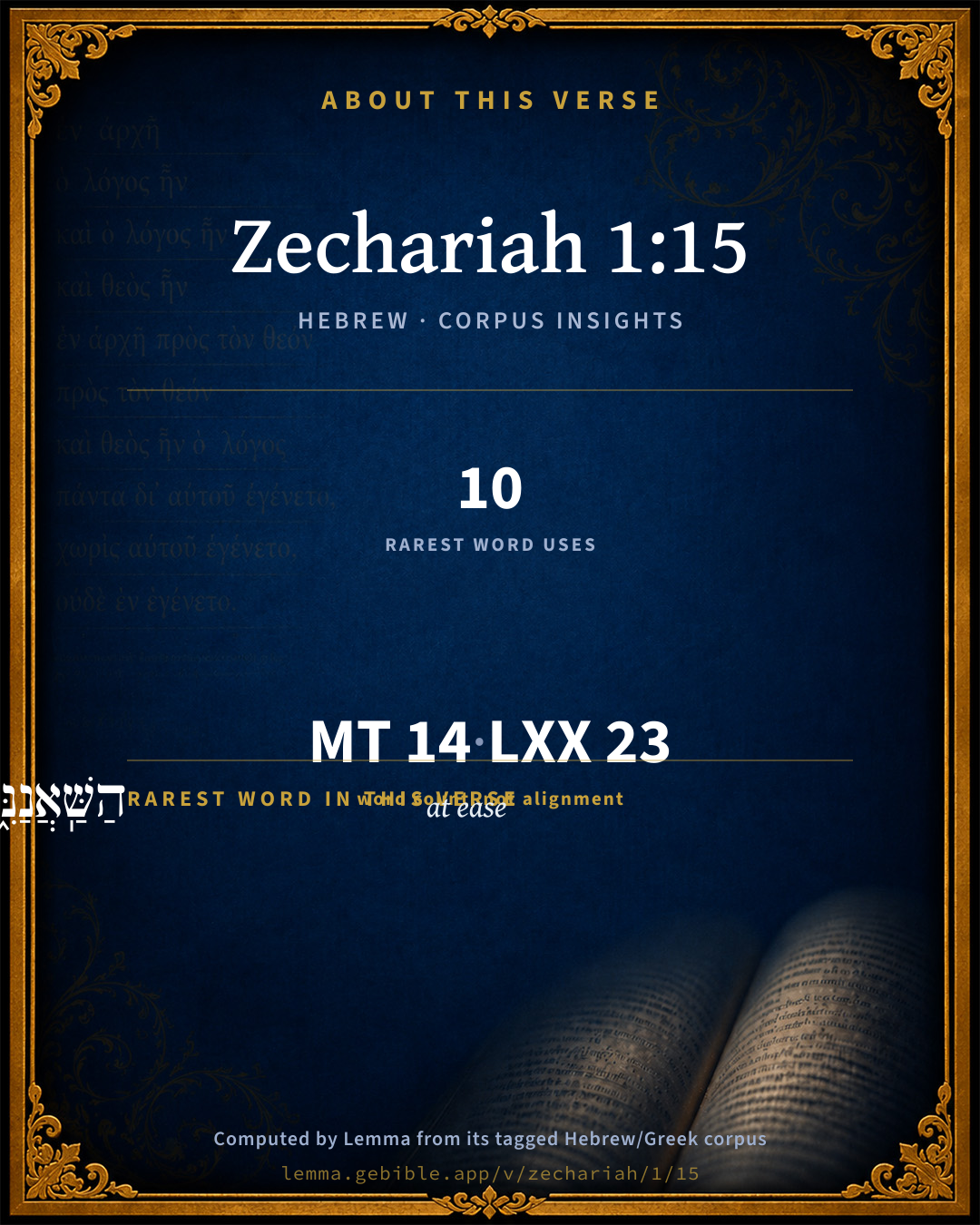
These counts appear in no published source. They are computed here, from the morphology-tagged text and Lemma’s own curated glosses. What Lemma adds →

14
words
12
distinct lemmas
Prophets
section

Notable vocabulary

The rarest word here is הַשַּֽׁאֲנַנִּ֑ים at ease H7600 — appearing just 10 times in the whole Hebrew Bible.

Shared distinctive vocabulary

הַשַּֽׁאֲנַנִּ֑ים at ease H7600 occurs in 10 verses of the Hebrew Bible. Also found in:

Grammatical profile

  • 3 verbs
  • 3 nouns
  • 2 adjectives
  • 3 pronouns
  • 1 preposition
  • 1 adverb
  • 1 particle

Verb forms

  • קֹצֵ֔ף Qal · Participle Active
  • קָצַ֣פְתִּי Qal · Perfect
  • עָזְר֥וּ Qal · Perfect

Repetition

Words recur within this verse — often emphatic in Hebrew:

  • קֹצֵ֔ף to be angry H7107 ×2
  • אֲנִ֣י I H589 ×2

Hebrew & Septuagint length

In English translation the verse runs 24 words from the Hebrew and 29 from the Septuagint (LXX English) — closely comparable.

A rough comparison of the two English renderings, which tokenize alike — not a word-level alignment.

Word counts can differ between the Hebrew and the Greek without any difference in meaning — e.g. the Hebrew direct-object marker אֵת has no separate Greek word, and Greek often adds the article ὁ.

In the original languages it is 14 Hebrew tokens and 23 Greek tokens — but the two are counted differently (Hebrew bundles its prefixes and suffixes into one token; the Greek is in lemma form), so that isn’t a like-for-like length.

Cross-references

22

Topical passages linked to Zechariah 1:15 in the Treasury of Scripture Knowledge — connected by theme and wording, ordered by reader-vote popularity; previews shown in the World English Bible.

  • Jeremiah 51:24 I will render to Babylon and to all the inhabitants of Chaldea all their evil that they have done in Zion in your sight, says Yahweh.
  • Ezekiel 25:12–17 Thus says the Lord Yahweh: Because Edom has dealt against the house of Judah by taking vengeance, and has greatly offended, and revenged himself on them;
  • Isaiah 54:8 In overflowing wrath I hid my face from you for a moment; but with everlasting loving kindness will I have mercy on you, says Yahweh your Redeemer.
  • Isaiah 47:6–9 I was angry with my people, I profaned my inheritance, and gave them into your hand: you did show them no mercy; on the aged have you very heavily laid your yoke.
  • Psalms 69:26 For they persecute him whom you have wounded. They tell of the sorrow of those whom you have hurt.
  • Psalms 83:2–5 For, behold, your enemies are stirred up. Those who hate you have lifted up their heads.
  • Psalms 123:4 Our soul is exceedingly filled with the scoffing of those who are at ease, With the contempt of the proud.
  • Isaiah 10:5–7 Ho Assyrian, the rod of my anger, the staff in whose hand is my indignation!
  • Jeremiah 48:11–13 Moab has been at ease from his youth, and he has settled on his lees, and has not been emptied from vessel to vessel, neither has he gone into captivity: therefore his taste remains in him, and his scent is not changed.
  • Obadiah 1:10–16 For the violence done to your brother Jacob, shame will cover you, and you will be cut off forever.
  • Zechariah 1:2 "Yahweh was very displeased with your fathers.
  • Zechariah 1:11 They reported to the angel of Yahweh who stood among the myrtle trees, and said, "We have walked back and forth through the earth, and, behold, all the earth is at rest and in peace."
  • Psalms 137:7 Remember, Yahweh, against the children of Edom, The day of Jerusalem; Who said, "Raze it! Raze it even to its foundation!"
  • Jeremiah 51:34–35 Nebuchadrezzar the king of Babylon has devoured me, he has crushed me, he has made me an empty vessel, he has, like a monster, swallowed me up, he has filled his maw with my delicacies; he has cast me out.
  • Ezekiel 25:3–9 and tell the children of Ammon, Hear the word of the Lord Yahweh: Thus says the Lord Yahweh, Because you said, Aha, against my sanctuary, when it was profaned; and against the land of Israel, when it was made desolate; and against the house of Judah, when they went into captivity:
  • Ezekiel 26:2 Son of man, because Tyre has said against Jerusalem, Aha, she is broken: the gate of the peoples; she is turned to me; I shall be replenished, now that she is laid waste:
  • Ezekiel 29:6–7 All the inhabitants of Egypt shall know that I am Yahweh, because they have been a staff of reed to the house of Israel.
  • Ezekiel 36:4–5 therefore, you mountains of Israel, hear the word of the Lord Yahweh: Thus says the Lord Yahweh to the mountains and to the hills, to the watercourses and to the valleys, to the desolate wastes and to the cities that are forsaken, which are become a prey and derision to the residue of the nations that are round about;
  • Amos 1:3–13 Thus says Yahweh: "For three transgressions of Damascus, yes, for four, I will not turn away its punishment; Because they have threshed Gilead with threshing instruments of iron;
  • Amos 6:1 Woe to those who are at ease in Zion, And to those who are secure on the mountain of Samaria, The notable men of the chief of the nations, To whom the house of Israel come!
  • Hebrews 12:6–7 For whom the Lord loves, he chastens, And scourges every son whom he receives."
  • Revelation 18:7–8 However much she glorified herself, and grew wanton, so much give her of torment and mourning. For she says in her heart, 'I sit a queen, and am no widow, and will in no way see mourning.'

Cross-references courtesy of OpenBible.info (CC BY 4.0).

Hebrew and Greek witnesses Masoretic Hebrew ↔ Greek Septuagint

The same verse in the two great witnesses to the Old Testament, shown verse-for-verse.

These are two independent witnesses, not word-aligned to each other, and the Septuagint is shown in lemma (dictionary) form.

Hebrew Zechariah 1:15 Masoretic · Westminster Leningrad Codex

וְקֶ֤צֶף גָּדוֹל֙ אֲנִ֣י קֹצֵ֔ף עַל הַגּוֹיִ֖ם הַשַּֽׁאֲנַנִּ֑ים אֲשֶׁ֤ר אֲנִי֙ קָצַ֣פְתִּי מְּעָ֔ט וְהֵ֖מָּה עָזְר֥וּ לְרָעָֽה

I am very angry with the nations that are at ease; for I was but a little displeased, but they added to the calamity."

World English Bible · Public Domain

Greek LXX Zechariah 1:15 Septuagint · lemma form

καί ὀργή μέγας ἐγώ ὀργίζω ἐπί ὁ ἔθνος ὁ συν ἐπιτίθημι ἀντί ὅς ἐγώ μέν ὀργίζω ὀλίγος αὐτός δέ συν ἐπιτίθημι εἰς κακός

And I am very angry with the heathen that combine to attack her: forasmuch as I indeed was a little angry, but they combined to attack her for evil.

LXX2012 (modern English Septuagint) · Public Domain

On this verse, Ellicott's Commentary for English Readers discusses the Septuagint’s reading. Read the note in Commentary ↓

Hebrew: Westminster Leningrad Codex (CC BY 4.0). Greek: Septuagint (public domain); English from LXX2012 (modern English Septuagint) (Public Domain). How the Septuagint differs from the Hebrew →

Targum (Aramaic paraphrase)

1

The Targum is the ancient Jewish Aramaic paraphrase of the Hebrew Scriptures — an interpretive translation, not the Hebrew text itself. Onkelos (literal) and Pseudo-Jonathan (expansive) render the Torah, and Jonathan the Prophets. Coverage is partial: where no permissively-licensed English translation exists for a verse, only the Aramaic is shown. This is verse-level text, not a word-by-word alignment to the Hebrew.

  1. Targum Jonathan Prophets (Joshua–Malachi)
    וּרְגַז רַב אֲנָא רָגֵיז עַל עַמְמַיָא דְשָׁרָן שְׁלֵיוָא דִי אֲנָא רַגְזֵית עַל עַמִי זְעֵיר וְאִינוּן מְסַיְעִין לְאַבְאָשָׁא:

    (no public-domain English translation for this verse)

    Targum Jonathan — Aramaic: “Mikraot Gedolot” (public domain). English: “Sefaria Community Translation” (CC0 1.0 (public-domain dedication)); “London "Chaldee Paraphrase," 1871” (public domain). Text via Sefaria.

Commentary

Notes on Zechariah 1:15 from classic Christian and Jewish commentators (each source and its license shown beneath its notes). The classic Christian expositions comment on the surrounding passage and are grouped to its opening verse, so a note may address several verses; the Jewish commentaries on the Tanakh (Rashi and others) are per-verse, so they appear only where the commentator wrote on this verse.

Lemma curates 59 commentaries, every one of them public domain or Creative Commons licensed, each selected and text-cleaned for this edition rather than reprinted as found. About our sources →

Trapp's Complete Commentary

John Trapp

Zec 1:15 And I am very sore displeased with the heathen [that are] at ease: for I was but a little displeased, and they helped forward the affliction.

Ver. 15. And I am very sore displeased with the heathen that are at ease] Heb. I am in such a heat as causeth fuming and foaming. I am boiling hot, and even ready to burst out upon them to destroy them; for the word here used hath great affinity with another word that signifieth to cut down and to destroy, 2Ki 6:6, and importeth a higher degree of displeasure, a greater height of heat, than either anger or wrath, as may be seen in that signal gradation, Deu 29:28 "The Lord rooted them out of their land in anger, and in wrath, and in great indignation." The last of these three is this word in the text, Fervore maximo ferveo, I am as hot as may be against those heathens that are at ease, at heart’s ease, that come not in trouble, like other men, neither are they plagued as better men, Psa 73:5, and are therefore secure and insolent above measure, Job 21:23, haughty and haunty, so that the Church cannot rest for them; they thrust with the shoulder and push with the horn (as afterwards, Zec 1:18-19 cf. Dan 8:4), yea, they push the diseased, Eze 34:21, which is a singular cruelty.

They help forward the addiction] They fall like dogs upon the wounded deer. This David complains of as an unsufferable grievance, Psa 69:26. For they persecute him whom thou hast smitten: and they talk to the grief of those whom thou bast wounded. God smiteth his in mercy and in measure, in the branches only, Isa 27:10, and not at the root, neque ad exitium sed ad exercitium neither for destruction but for training. (Aug.). Displeased he may be with his own, and make bloody wales upon their backs, if need be; but then he looks that others should pity them, and not lay on more load, and seek to bring them to utmost extremity. God puts his people sometimes into the hands of his enemies for correction sake. Now they commonly being enraged with haughty, revengeful, and malicious desires, exceed their commission, and so derive the mischief upon themselves, {see Pro 24:17-18} they cannot do but they must overdo (as Nebuchadnezzar, the rod in God’s hand, Isa 10:5), and thereby utterly undo themselves for ever: for their cruelty comes up to heaven, 2Ch 28:9, and God soon heareth the cry of his oppressed (for he is gracious), and avengeth himself on their pitiless enemies; standing over them and saying, as Isa 47:6 "I was wroth with my people, I have polluted mine inheritance, and given them into thine hand: thou didst show them no mercy; upon the ancient hast thou heavily laid thy yoke." And again, "Because these Philistines have dealt by revenge, and have taken vengeance with a despiteful heart, to destroy it for the old hatred: therefore I will execute great vengeances upon them with furious rebukes; and they shall know that I am the Lord, when I shall lay my vengeance upon them," Eze 25:15; Eze 25:17; Eze 26:2. Joab never pleased David better than when he made intercession for banished Absalom, for the soul of King David longed to go forth unto Absalom, 2Sa 13:39, whom yet he had very just cause to be greatly displeased with. God, in a heat, as it were, against Israel, offereth Moses a great fortune, Exo 32:10, but would have taken it very ill that Moses should have taken him at his word.

He is but a little angry with his people] And soon repenteth him of the evil; but woe be to those that help forward the indignation, that deal by God’s afflicted as the herd of deer do; which, when any of the herd is shot, the rest push him out of their company. It is said of Queen Elizabeth, that she hated, no less than did Mithridates, such as maliciously persecuted virtue forsaken of fortune. Think the same of God. He weareth his rod to the stumps, and then throws it into the fire. He sets his horseleeches to his people (when he finds them sick of a plethory of pride, when fulness hath bred forgetfulness, saturity security), and suffereth them to suck till they burst; and then treads them under his feet, and puts them away as dross, Psa 119:118-119.

John Trapp, A Commentary or Exposition upon All the Books of the Old and New Testament (1647–1656) — public domain. Text from a community e-Sword module.

Geneva Bible (1599)

Geneva Bible translators

In destroying the reprobate, I showed myself but a little angry toward my church, but the enemy would have destroyed them also, and considered not the end of my chastisements.

Geneva Bible (1599) marginal notes — public domain. Text via Bolls.life.

Jamieson, Fausset & Brown

Robert Jamieson, A. R. Fausset & David Brown

very sore displeased with the heathen--in contrast with "I was but a little displeased" with My people. God's displeasure with His people is temporary and for their chastening; with the heathen oppressors, it is final and fatal (Jer 30:11). God's instruments for chastising His people, when He has done with them, He casts into the fire.

are at ease--carnally secure. A stronger phrase than "is at rest" (Zac 1:11). They are "at ease," but as I am "sore displeased" with them, their ease is accursed. Judah is in "affliction," but as I love her and am jealous for her, she has every reason to be encouraged in prosecuting the temple work.

helped forward the affliction--afflicted My people more than I desired. The heathen sought the utter extinction of Judah to gratify their own ambition and revenge (Isa 47:6; Eze 25:3, Eze 25:6; Oba 1:10-17).

Jamieson, Fausset & Brown — Commentary Critical and Explanatory on the Whole Bible (1871) — public domain (CC PDM 1.0). Text via the HelloAO Bible API.

Adam Clarke's Commentary

Verse 15. I was but a little displeased] I was justly displeased with my people, and I gave their enemies a commission against them; but they carried this far beyond my design by oppression and cruelty; and now they shall suffer in their turn.

Adam Clarke's Commentary on the Bible (1810–1826) — public domain. Text from a community e-Sword/MySword module.

John Calvin's Commentaries

God here obviates the doubt which might have easily crept into the minds of the godly. “Why should he then give up the miserable Jews to the will of the Gentiles, and suffer these heathens at the same time to be in a quiet state and to enjoy their pleasures?” This indeed at the first view seemed very strange: if God had such a zeal towards Jerusalem, why did he not give some token at least of his favor? He therefore gives this answer, — That though the condition of the Gentiles was now better, there was yet no reason for the Jews to be discontented in their troubles, because they were to look forward to the end that was to come. It must further be noticed, that God speaks only here, and is not going forth prepared to execute his vengeance: and it is a real and just trial of faith, when God bids us to depend on his word.

The manner of speaking, used here deserves notice, God was angry with the quiet nations. It is not a superfluous repetition, when it is said, that the nations were quiet. Some render the word wealthy, but not so suitably; for as we have said before, the angel complained that while the whole world was tranquil, God severely chastised his Church alone. God then does here anticipate a temptation which would have otherwise distressed and even wholly disheartened the faithful; and he in effect says, “It is indeed true that the Gentiles all around are quiet, that there are no calamities, that there is no enemy, and that they are subject to no evils: this is no doubt true; but as I am angry, their happiness, while I am opposed to and displeased with them, is a curse.” God, then, does here elevate the thoughts of the godly, that they might know that happiness is to be found in his favor alone, and that whenever he is angry or displeased, though men may think themselves happy, and flatter themselves and exult in their condition, they are yet in a most miserable state; for all happiness is ruinous which does not flow from the fountain of God’s gratuitous love; in short, when God is not our Father, the more we abound in all kinds of blessings, the deeper we sink in all kinds of miseries. This then is the meaning, when God says that he was angry with the quiet nations.

What, then, is the application of this doctrine? That it behaved the Jews, though their condition was very hard according to the perception of men, to have yet acquiesced in the love of God, for they knew that he was their Father, and also, that though they saw their enemies happy, they were yet to regard it no otherwise than a cursed happiness. so also in the thirty-seventh Psalm, the faithful are bid not to envy the unbelieving, while they saw them flourishing in wealth and rolling in pleasures; for it behaved them to regard their end. Let us hence learn to raise up our thoughts to the contemplation of God’s hidden love, when he deals severely with us, and to be satisfied with his word, as we have there an indubitable evidence of his favor: nor let us envy our enemies and the wicked, however the whole world may applaud them, and they themselves luxuriate in their blessings, for we know that God is adverse to them.

A reason also follows, Because God was a little angry, and they helped forward the evil; that is, they exceeded moderation. The meaning is, that the reward of cruelty would be repaid to all the enemies of the Church, because they had exercised immoderate severity, when it was God’s purpose to chastise his children in a gentle and paternal manner.

It may be here first asked, How is it that God declares that he had been a little angry with his people, since his judgment, as pronounced by his servants, was most severe?

“Whosoever shall escape the famine, shall fall by the sword; whosoever shall escape the sword, shall fall among wild beasts.” (Ezekiel 14:14.)

And in many other places he declares the same, that there would be no hope of pardon to the people, but that they were all to perish; that is, the whole body: “Though Noah, Daniel, and Job,” he says, “were in this city, they shall deliver only their lives; but I will not hear their prayers for this irreclaimable people.” But the particle little, מעט, mot, must be applied to the elect: for though God in his dreadful vengeance consumed almost the whole people, yet a remnant, as we know, was preserved. This is the reason why God says, that he was but little angry with his people; for he speaks not of the reprobate and of that impure mass from which he purposed to cleanse his own house; but he has respect to his covenant. We now perceive for what purpose Zechariah says, that God was but moderately angry with his people.

But another difficulty meets us — In what sense did the nations help on the evil? For it hence follows, that the heathens were not restrained from raging immoderately and at their pleasure. And this place has been also laid hold of by that miscreant, who has been lately writing against God’s providence, holding that the wicked become wanton by means of God’s hand and power, and are not thereby restrained. But this is extremely foolish; for the Prophet here does not regard what the nations were able to do or had done; but, on the contrary, he speaks of their cruelty, that they thought that there ought to have been no end until the memory of that people had been obliterated. And this is the reason why Isaiah says, “Thou hast not seen her end.” He therefore upbraids the unbelieving, that they did not calculate rightly as to the end of the Church; for the unbelieving furiously attempted to destroy it, as though that promise could be made void, “My mercy I will not take away.” Since the unbelieving did not see her end, because it was the Lord’s will ever to preserve some remnant among his chosen people, the Prophet says, that they helped forward the evil. We now then perceive the intention of the Prophet, and see that the object is no other but to sustain the hope of the faithful, until what they heard from the mouth of God really took place. Let us proceed -

John Calvin's Commentaries (1540-1563) — public domain. Text from the Calvin Translation Society English edition (1840s-50s) via the Christian Classics Ethereal Library (ccel.org). Calvin's coverage is partial (roughly two-thirds of the Bible); uncommented books and verses are honest gaps, never fabricated. The 19th-century editor's footnotes and remarks are omitted so the notes are faithfully Calvin's own voice.

Ellicott's Commentary for English Readers

(15) But a little.—(Comp. 2Ki_20:18.) Or, for a little while. (Comp. Job_24:24.)

Helped forward the affliction.—Better, helped for evil—i.e., they not only acted as God’s instruments to chastise Israel, but even wished to annihilate them. (Comp. Isa_47:6 : “I was wroth with my people . . . thou [Babylon] didst shew them no mercy.”) LXX., for “that are at ease,” τὰ συνεπιτιθέμενα, “which combine to set upon [Israel],” and for “helped,” συνεπέθεντο “combined to set upon.”

A Bible Commentary for English Readers, edited by Charles John Ellicott (1878–1897) — public domain. Text from a community e-Sword module.

The Cambridge Bible for Schools and Colleges

gen. ed. J. J. S. Perowne

15. heathen] or, nations, R.V.

at ease] as described in Zec_1:11. The word in this verse is the same as in Isa_32:9; Isa_32:11, and Psa_123:4.

helped forward] Comp. Isa_47:6.

The Cambridge Bible for Schools and Colleges (gen. ed. J. J. S. Perowne; Cambridge University Press, 1878–1918) — public domain. Text from a community e-Sword module.

John Gill's Exposition

And I am very sore displeased with the heathen that are at ease,.... The Chaldeans and Persians, and other nations, enemies of the Jews, who were now free from war, and enjoyed great prosperity, when the state and condition of the Jews was very low and discouraging:

for I was but a little displeased: that is, with his people the Jews, for their ingratitude, idolatry, and immorality; and which displeasure he showed by suffering them to be carried into captivity; see Isa 54:8,

and they helped forward the affliction; that is, the heathens, among whom the Jews were carried captive; they added to their affliction; they oppressed them more than they ought to have done, and more than was agreeable to the will of God and right in his sight; and they insulted them in their misery, and rejoiced over them. The word in the Arabic language, signifies to "abound" (u); and the meaning is, that they abounded in bringing evil upon the people of the Jews; they multiplied their afflictions and distresses.

(u) "abundavit, multiplicavit", Golius, col. 1705. Castel. col. 2721. "Jazar, cum punctato, exuberavit, abundavit, multus fuit", Schindler. Lex. Pentaglot. col. 1307.

John Gill's Exposition of the Whole Bible (1746–1763) — public domain (CC PDM 1.0). Text via the HelloAO Bible API.

Albert Barnes' Notes on the Bible

I am sore displeased - literally “with great anger am I angered against the nations which are at ease.” The form of the words shows that the greatness of the displeasure of God against those who oppress His people, is proportionate to the great and tender love toward themselves. God had been angered indeed with His people; with their enemies He was “angered with a great anger;” and that the more, because they were at ease, in unfeeling self-enjoyment amid the miseries of others.

I was a little displeased - Little, in comparison with our deserts; little in comparison with the anger of the human instruments of His displeasure; little in comparison with theirs, who, in their anger, sought their own ends.

They helped forward the affliction - o “He is wroth with the nations at ease, because He delivered His people to be corrected, but they used cruelty toward those delivered; He wills them to be amended as a son by a schoolmaster; they set themselves to slay and punish them, as an enemy. Like that in Isaiah, “I gave them into thy hands; thou didst show them no mercy; upon the ancients hast thou very heavily laid thy yoke” Isa 47:6.

Or it may be, “helped for evil,” in order to bring about evil, as in Jeremiah, “Behold I set My face against you for evil, and to destroy all Judah” Jer 44:11, that is, as we should say, they were the instruments of God, , “cooperated in the execution of My justice toward you, but cruelly and with perverse intention. For although the Assyrians and Chaldaeans wasted the Jewish people, God so ordaining in as far as He willed through them to punish in the present the sins of His people, yet they did it, not in view of God and out of zeal for righteousness, but out of pride covetousness and with the worst ends. Hence God says by Isaiah, “Woe to Asshur, the rod of Mine anger, and the staff in his hand is Mine indignation. Howbeit he thinketh not so, but his heart is to destroy and cut off nations not a few” Isa 10:5, Isa 10:7.

Albert Barnes' Notes on the Bible (1834–1885) — public domain. Text from a community e-Sword/MySword module.

Haydock's Catholic Bible Commentary

Nations, represented as four horns, ver. 18, 19. --- Evil, through malice, and thus deserved themselves to be punished, Osee i. 4.

George Leo Haydock (1774–1849), Haydock's Catholic Family Bible and Commentary, 1859 edition — public domain. Excludes Psalms (Douay-Rheims chapter numbering differs from Protestant) and Deuterocanonical books (Catholic canon only).

Matthew Poole's English Annotations

And I; the Lord of hosts, God of Israel,

am very sore displeased with the heathen; exceedingly angry, and will show it, that they may see and feel it, my displeasure is grown up to the highest against them.

At ease; secure in their strength, sing a requiem to themselves and trouble to Israel. See Zec 1:11.

I was but a little displeased with mine own people, i.e. in comparison with the anger I bear against the heathen it was little, Psa 137

And they, the heathen, Babylonians, helped forward; attempted to destroy whom I would but correct, Isa 10; Isa 14. I whipped to smart, you wounded to blood; I did wound to bind up, you did wound to kill, &c. It is an anthropopatheia.

The affliction: it was more than they could do to provoke me here against them than their own sins did; but what I permitted for a while they did, and added to the affliction of Israel. I would prune, but they struck at the root.

Matthew Poole's English Annotations on the Holy Bible (1683–1685) — public domain. Text from a community e-Sword/MySword module.

Whedon's Commentary on the Bible

Daniel D. Whedon

15. An inevitable concomitant of Jehovah’s jealousy for Jerusalem is his wrath against the nations that have ill-treated the former.

Very sore displeased — A participial construction expressing the idea that the wrath is permanent (compare Zec_1:2).

The heathen that are at ease — R.V., “the nations.” Their continued peace (Zec_1:11) and prosperity have made them self-confident and careless (Isa_37:29).

For — This introduces the reason for the sore displeasure of Jehovah. Though he commissioned them to execute judgment upon his people, they went beyond their commission in severity and cruelty (compare Isa_10:5-7; Isa_47:6).

A little — When used adverbially this word is generally an adverb of time — a little while. The reference is evidently to the seventy years during which the nations were permitted to execute judgment upon Israel (Isa_54:8). This time limit the nations did not observe; they fancied that their success was due to their own wisdom and might; therefore they were planning to continue the oppression even after the time of visitation had expired; but Jehovah will not permit it. Even during the period of judgment they were more cruel than was in accord with the will of Jehovah; therefore his wrath is aroused, and their destruction is determined.

They helped forward the affliction — Literally, they helped for evil. They carried the affliction beyond the divine purpose, so that evil was the result. “They assisted not only as the instruments of God for the chastisement of Judah, but so that harm arose from it, inasmuch as they tried to destroy Israel altogether.”

Daniel D. Whedon (gen. ed.), Commentary on the Old and New Testaments (1874–1909) — public domain. Text from a community e-Sword module.

The Pulpit Commentary

The heathen; the nations, who were God"s instruments in punishing Israel. That are at ease. Living in proud security and self-enjoyment. (Isa_32:9, 11 Amo_6:1; comp. ver. 11) Septuagint, ta sunepitiyemena , "which join in attacking her;" Vulgate, opulentas, "wealthy," their riches giving them self-confidence. I was but a little displeased. God had been angry with his people, it is true, but only in measure, chastising them, like a parent, for their good. Others take "a little" (parum, oliga ) to mean "for a little time," in allusion to the seventy years" captivity. And they helped forward the affliction; or, in the LXX, sunepeyento eiv kaka , "helped for evil; "Vulgate, adjuverunt in malum. They exceeded their part as mere instruments in God"s hands, and wished to destroy Israel altogether, or to oppress them beyond the purposed period of their chastisement. A similar complaint is made against the Assyrians (Isa_10:5, etc.) and the Babylonians. (Isa_47:6)

The wrath of God and the wrath of man.

I GOD"S WRATH IS THE HIGHEST IN CASES. It is not a mood or passion; not the outburst of arbitrary power; but the calm expression of the Eternal Mind. He who does wrong identifies himself with the wrong, and so far must be an object of indignation. God feels towards things as they are. How different the wrath of man! (cf. Jam_4:1)

II GOD"S WRATH IS THE PUREST JUSTICE. Law must stand. Government and order must be maintained. Else anarchy. But nothing will be done beyond what is necessary for the ends of justice. God"s wrath is just, in measure and duration. How different with the wrath of man! Often carried beyond the bounds of right, and becomes oppression. Often continued beyond the limits of justice, and becomes revenge. (Isa_47:6)

III GOD"S WRATH IS THE HOLIEST LOVE. There is much in the ways of God that we cannot understand, but we should never forget what he himself has taught us as to his Spirit and purpose. (cf. Eze_33:11) God"s wrath is consistent with pity for the sufferer, mercy for the penitent, and deliverance for the oppressed. In his hand pains are disciplinary, trials are remedial, chastisements are benedictions in disguise. "The end of the Lord is merciful." But with men how often is wrath pitiless and cruel, working evil instead of good, rejoicing in destruction instead of deliverance! "Father and Lover of our souls Though darkly round thine anger rolls, Thy sunshine smiles beneath the gloom, Thou seek"st to warn us, not confound, Thy showers would pierce the hardened ground And win it to give out its brightness and perfume. (Keble) F.

The Pulpit Commentary (1880–1919), ed. H.D.M. Spence-Jones & Joseph S. Exell — public domain. Text from a community e-Sword module.

John Wesley's Explanatory Notes

A little displeased - With mine own people, that is, in comparison of the anger I bear against the Heathen. Helped forward - Attempted to destroy whom I would but correct.

John Wesley, Explanatory Notes Upon the Whole Bible (1754–1765) — public domain. Text via the GEBible commentary corpus.

Rashi

Rabbi Shlomo Yitzchaki (Rashi)

that are at ease Concerning whom these [messengers] say that they sit still and are at rest.

for I was wroth with My people, a little.

and they helped to do harm In addition to the wrath, [they helped] to do harm.

Rashi on the Tanakh — English translations: “The Judaica Press complete Tanach with Rashi, translated by A. J. Rosenberg” (CC BY 4.0); “Pentateuch with Rashi's commentary by M. Rosenbaum and A.M. Silbermann, 1929-1934” (public domain); “The Metsudah Tanach series, Lakewood, N.J” (CC BY 4.0); and “The Book of Joshua, Metsudah Publications, 1997” (CC BY 4.0). Text via Sefaria.

Lesson kit

Teaching starters — assembled from the data on this page, not authored interpretation. Every prompt links to the verse data it draws on. Edit before teaching.

Zechariah, in the Prophets, opens this verse with 14 words (12 distinct Hebrew lemmas). Its most distinctive word is shaʼănân (“at ease”). A historical commentator’s framing appears above. Read the whole chapter for the surrounding context.

Discussion questions

  1. What does “at ease” (shaʼănân) contribute to the verse as a whole?
  2. 2 Kings 19:28 shares the word «at ease» with this verse. How do the two illuminate each other?
  3. “to be angry” occurs 2× in this one verse. What is the effect of the repetition?
  4. The translations on this page render this verse differently — a whole-verse word diff, not a word-by-word alignment. What might account for the different wordings?
  5. The verb «קֹצֵ֔ף» is Qal Participle Active. How does its form color the action?
  6. Reading how Trapp's Complete Commentary and Geneva Bible (1599) read this verse, where do the two commentators agree and where do they part?

Things to notice

Reading settings

Reading text

Shown beneath each verse's original-language words.

Old Testament
Old Testament edition

Read the OT as the Masoretic Hebrew (MT) or the Greek Septuagint (LXX).

English shown for the Greek Septuagint (in the Hebrew ↔ Greek comparison).

Comparing translations? Open the Compare panel on any verse page to stack up to four side by side.