
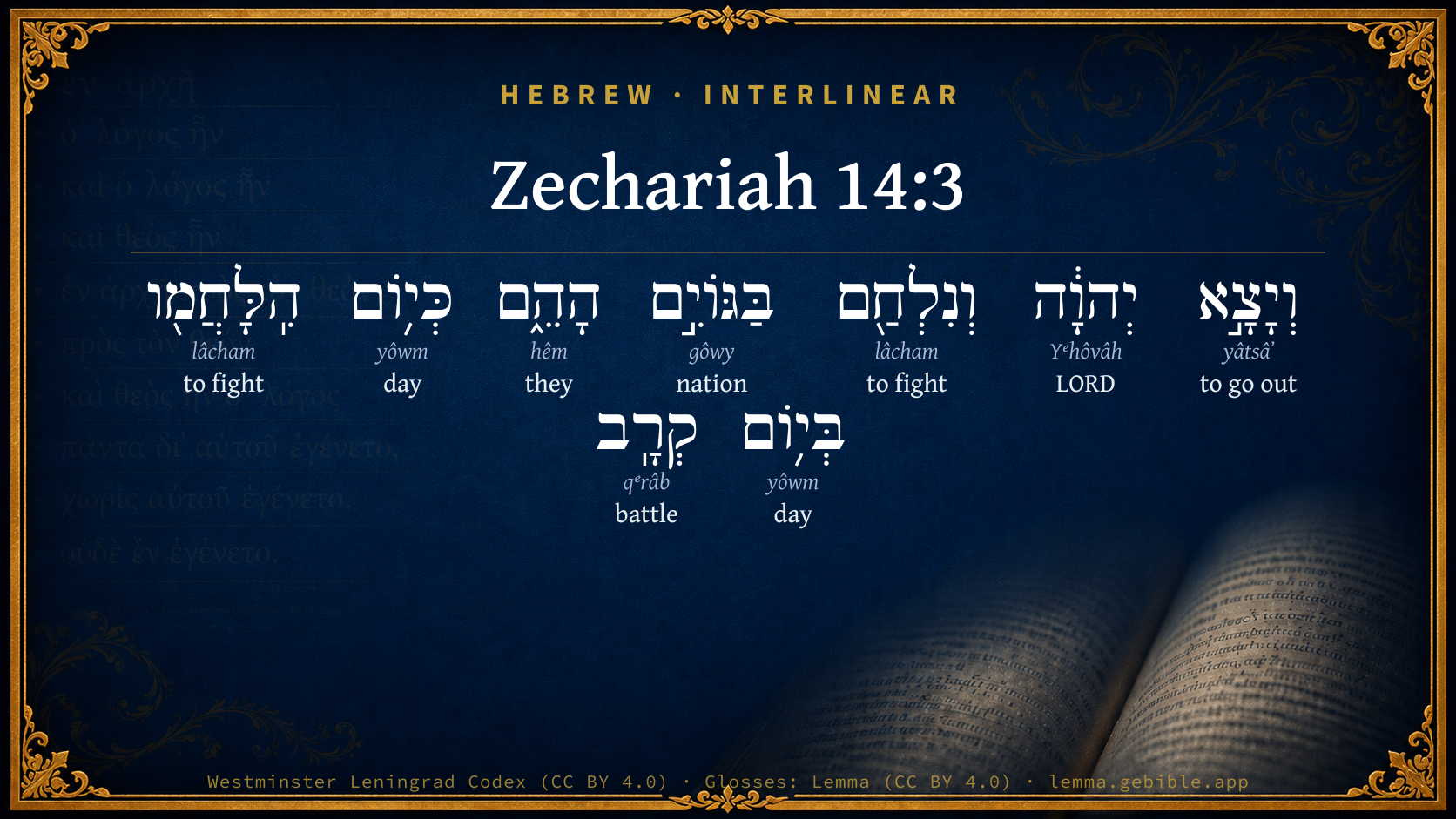
Zechariah 14:3

Hebrew (Westminster Leningrad Codex) Zechariah 14:3 appears in the Hebrew Old Testament. The text above is from the Westminster Leningrad Codex. Each word links to its Strong’s number, a concise gloss, and parsing drawn from the Open Scriptures Hebrew Bible morphology. Click any word for its full Brown-Driver-Briggs (BDB) entry.
Download image
Cite this verse

Zechariah 14:3 (World English Bible). Public Domain. Lemma interlinear Bible study tool, https://lemma.gebible.app/v/zechariah/14/3.

Show BibTeX & RIS
BibTeX
RIS
English Translation
Then Yahweh will go out and fight against those nations, as when he fought in the day of battle.
World English Bible · Public Domain
Download a study sheet

One document with this verse’s original text, its word-by-word gloss line, the meaning frame, cross-references with their text, attributed commentary, and full source and license credits — printable, and it pastes into notes with its structure intact.

This verse Autodidact and up

Study sheet (.html) Plain text (.txt)

A passage Seminary Student

Up to 50 verses in one chapter. A passage sheet keeps up to 6 commentary sources and 12 cross-references per verse, in the order this page ranks them, and says so on the sheet whenever that leaves anything out. Ask for a single verse and you get the Autodidact verse sheet above.

Everything on this page stays free to read, with no account — the sheet is a download of what is already on screen, not access to it.

Want to remove ads? Support Godless Engineer
Compare translations 3

The same verse in 3 English versions, stacked beneath the original-language interlinear above. Click any original word for its lexicon entry.

Each is an independent rendering of the whole verse — the interlinear is not word-aligned to these translations.

Highlighted words mark where these versions differ — a whole-verse word diff, not a word-by-word alignment.

  • World English Bible Public Domain
    Then Yahweh will go out and fight against those nations, as when he fought in the day of battle.
  • King James Version Public Domain
    Then shall the LORD go forth, and fight against those nations, as when he fought in the day of battle.
  • unfoldingWord Literal Text CC BY-SA 4.0
    But Yahweh will go out and wage war against those nations as when he wages war on the day of battle.

unfoldingWord Literal Text — © unfoldingWord, licensed CC BY-SA 4.0. Word-aligned USFM3 via Door43 (git.door43.org/unfoldingWord/en_ult).

Versions to compare (up to 4)

3 of 4 selected

Show all 18 translations

Every available English version of this verse, each an independent rendering of the whole verse.

  • World English Bible Public Domain
    Then Yahweh will go out and fight against those nations, as when he fought in the day of battle.
  • Berean Standard Bible Public Domain
    Then the LORD will go out to fight against those nations, as He fights in the day of battle.
  • Majority Standard Bible Public Domain
    Then the LORD will go out to fight against those nations, as He fights in the day of battle.
  • King James Version Public Domain
    Then shall the LORD go forth, and fight against those nations, as when he fought in the day of battle.
  • American Standard Version (1901) Public Domain
    Then shall Jehovah go forth, and fight against those nations, as when he fought in the day of battle.
  • Revised Version (1885) Public Domain
    Then shall the LORD go forth, and fight against those nations, as when he fought in the day of battle.
  • Geneva Bible (1599) Public Domain
    Then shall the Lord goe foorth, and fight against those nations, as when he fought in the day of battell.
  • Douay-Rheims (1899) Public Domain
    Then the Lord shall go forth, and shall fight against those nations, as when he fought in the day of battle.
  • Young's Literal Translation Public Domain
    And gone forth hath Jehovah, And He hath fought against those nations, As in the day of His fighting in a day of conflict.
  • Literal Standard Version CC BY-SA 4.0
    And YHWH has gone forth, || And He has fought against those nations, || As in the day of His fighting in a day of conflict.
  • Unlocked Literal Bible CC BY-SA 4.0
    But Yahweh will go out and wage war against those nations as when he wages war on the day of battle.
  • unfoldingWord Literal Text CC BY-SA 4.0
    But Yahweh will go out and wage war against those nations as when he wages war on the day of battle.
  • Darby Bible Public Domain
    And Jehovah will go forth and fight with those nations, as when he fought in the day of battle.
  • World Messianic Bible Public Domain
    Then the LORD will go out and fight against those nations, as when he fought in the day of battle.
  • Webster's Bible Public Domain
    Then will the LORD go forth, and fight against those nations, as when he fought in the day of battle.
  • Free Bible Version CC BY-SA 4.0
    Then the Lord will go out to fight against the nations as he fights in times of war.
  • Bible in Basic English Public Domain
    Then the Lord will go out and make war against those nations, as he did in the day of the fight.
  • JPS Tanakh (1917) Public Domain
    Then shall the LORD go forth, and fight against those nations, as when He fighteth in the day of battle.

Literal Standard Version (2020), Covenant Press — licensed CC BY-SA 4.0. Text via the HelloAO Bible API (eBible.org). Unlocked Literal Bible (unfoldingWord) — licensed CC BY-SA 4.0. Text via the HelloAO Bible API (eBible.org). unfoldingWord Literal Text — © unfoldingWord, licensed CC BY-SA 4.0. Word-aligned USFM3 via Door43 (git.door43.org/unfoldingWord/en_ult). Free Bible Version, Dr. Jonathan Gallagher — licensed CC BY-SA 4.0. Text via the HelloAO Bible API (eBible.org).

Word by word

More ways to search: Search by grammar → Find every occurrence → Compare this word →

Practice this passage: Drill this verse → Learn its vocabulary →

About this verse

These counts appear in no published source. They are computed here, from the morphology-tagged text and Lemma’s own curated glosses. What Lemma adds →

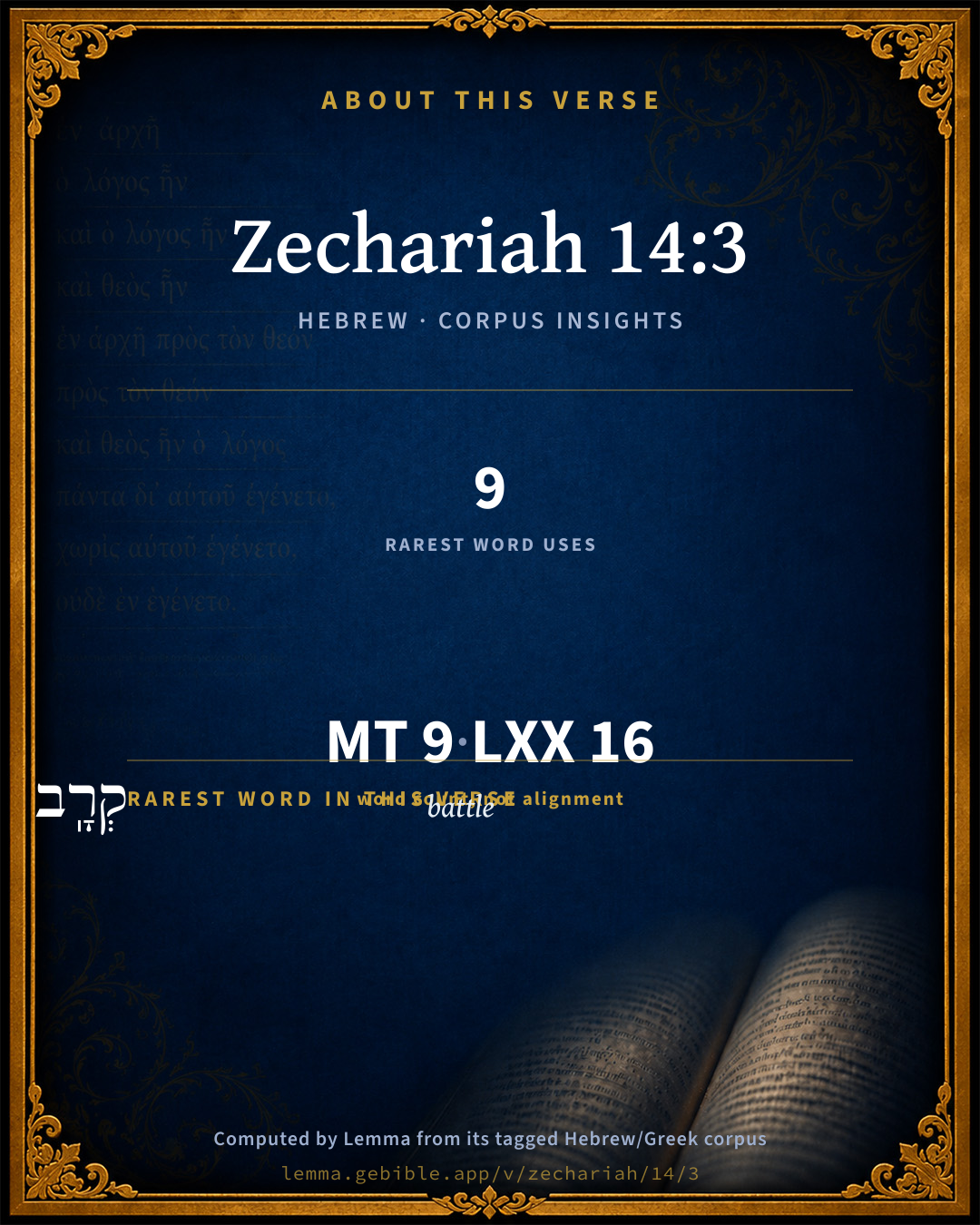
9
words
7
distinct lemmas
Prophets
section

Notable vocabulary

The rarest word here is קְרָֽב battle H7128 — appearing just 9 times in the whole Hebrew Bible.

Shared distinctive vocabulary

קְרָֽב battle H7128 occurs in 9 verses of the Hebrew Bible. Also found in:

Grammatical profile

  • 3 verbs
  • 5 nouns
  • 1 pronoun

Verb forms

  • וְיָצָ֣א Qal · Sequential Perfect
  • וְנִלְחַ֖ם Niphal · Sequential Perfect
  • הִֽלָּחֲמ֖ו Niphal · Infinitive Construct

Repetition

Words recur within this verse — often emphatic in Hebrew:

  • וְנִלְחַ֖ם to fight H3898 ×2
  • כְּי֥וֹם day H3117 ×2

Hebrew & Septuagint length

In English translation the verse runs 19 words from the Hebrew and 20 from the Septuagint (LXX English) — closely comparable.

A rough comparison of the two English renderings, which tokenize alike — not a word-level alignment.

Word counts can differ between the Hebrew and the Greek without any difference in meaning — e.g. the Hebrew direct-object marker אֵת has no separate Greek word, and Greek often adds the article ὁ.

In the original languages it is 9 Hebrew tokens and 16 Greek tokens — but the two are counted differently (Hebrew bundles its prefixes and suffixes into one token; the Greek is in lemma form), so that isn’t a like-for-like length.

Cross-references

18

Topical passages linked to Zechariah 14:3 in the Treasury of Scripture Knowledge — connected by theme and wording, ordered by reader-vote popularity; previews shown in the World English Bible.

  • Zechariah 12:9 It will happen in that day, that I will seek to destroy all the nations that come against Jerusalem.
  • Joel 3:9–17 Proclaim this among the nations: Prepare war. Stir up the mighty men. Let all the warriors draw near. Let them come up.
  • Zephaniah 3:19 Behold, at that time I will deal with all those who afflict you, and I will save those who are lame, and gather those who were driven away. I will give them praise and honor, whose shame has been in all the earth.
  • Zechariah 2:8–9 For thus says Yahweh of hosts: 'For honor he has sent me to the nations which plundered you; for he who touches you touches the apple of his eye.
  • Exodus 15:1–6 Then Moses and the children of Israel sang this song to Yahweh, and said, "I will sing to Yahweh, for he has triumphed gloriously: The horse and his rider he has thrown into the sea.
  • 2 Chronicles 20:15 and he said, Listen you, all Judah, and you inhabitants of Jerusalem, and you king Jehoshaphat: Thus says Yahweh to you, Don't be afraid you, neither be dismayed by reason of this great multitude; for the battle is not yours, but God's.
  • Daniel 2:44–45 In the days of those kings shall the God of heaven set up a kingdom which shall never be destroyed, nor shall the sovereignty of it be left to another people; but it shall break in pieces and consume all these kingdoms, and it shall stand forever.
  • Joel 3:2 I will gather all nations, And will bring them down into the valley of Jehoshaphat; And I will execute judgment on them there for my people, And for my heritage, Israel, whom they have scattered among the nations. They have divided my land,
  • Joshua 10:42 All these kings and their land did Joshua take at one time, because Yahweh, the God of Israel, fought for Israel.
  • Isaiah 63:1–6 Who is this who comes from Edom, with dyed garments from Bozrah? this who is glorious in his clothing, marching in the greatness of his strength? I who speak in righteousness, mighty to save.
  • Isaiah 66:15–16 For, behold, Yahweh will come with fire, and his chariots shall be like the whirlwind; to render his anger with fierceness, and his rebuke with flames of fire.
  • Daniel 2:34–35 You saw until a stone was cut out without hands, which struck the image on its feet that were of iron and clay, and broke them in pieces.
  • Haggai 2:21–22 "Speak to Zerubbabel, governor of Judah, saying, 'I will shake the heavens and the earth.
  • Zechariah 9:14–15 Yahweh will be seen over them; And his arrow will go flash like lightning; And the Lord Yahweh will blow the trumpet, And will go with whirlwinds of the south.
  • Zechariah 10:4–5 From him will come forth the corner-stone, From him the nail, From him the battle bow, From him every ruler together.
  • Zechariah 12:2–6 "Behold, I will make Jerusalem a cup of reeling to all the surrounding peoples, and on Judah also will it be in the siege against Jerusalem.
  • Revelation 6:4–17 Another came forth, a red horse. To him who sat on it was given power to take peace from the earth, and that they should kill one another. There was given to him a great sword.
  • Revelation 8:7–13 The first sounded, and there followed hail and fire, mixed with blood, and they were thrown to the earth. One third of the earth was burnt up, and one third of the trees were burnt up, and all green grass was burnt up.

Cross-references courtesy of OpenBible.info (CC BY 4.0).

Hebrew and Greek witnesses Masoretic Hebrew ↔ Greek Septuagint

The same verse in the two great witnesses to the Old Testament, shown verse-for-verse.

These are two independent witnesses, not word-aligned to each other, and the Septuagint is shown in lemma (dictionary) form.

Hebrew Zechariah 14:3 Masoretic · Westminster Leningrad Codex

וְיָצָ֣א יְהוָ֔ה וְנִלְחַ֖ם בַּגּוֹיִ֣ם הָהֵ֑ם כְּי֥וֹם הִֽלָּחֲמ֖ו בְּי֥וֹם קְרָֽב

Then Yahweh will go out and fight against those nations, as when he fought in the day of battle.

World English Bible · Public Domain

Greek LXX Zechariah 14:3 Septuagint · lemma form

καί ἐκἔρχομαι κύριος καί παρατάσσω ἐν ὁ ἔθνος ἐκεῖνος καθώς ἡμέρα παράταξις αὐτός ἐν ἡμέρα πόλεμος

And the Lord shall go forth, and fight with those Gentiles as when he fought in the day of war.

LXX2012 (modern English Septuagint) · Public Domain

On this verse, Joseph Benson's Commentary discusses the Septuagint’s reading. Read the note in Commentary ↓

Hebrew: Westminster Leningrad Codex (CC BY 4.0). Greek: Septuagint (public domain); English from LXX2012 (modern English Septuagint) (Public Domain). How the Septuagint differs from the Hebrew →

Targum (Aramaic paraphrase)

1

The Targum is the ancient Jewish Aramaic paraphrase of the Hebrew Scriptures — an interpretive translation, not the Hebrew text itself. Onkelos (literal) and Pseudo-Jonathan (expansive) render the Torah, and Jonathan the Prophets. Coverage is partial: where no permissively-licensed English translation exists for a verse, only the Aramaic is shown. This is verse-level text, not a word-by-word alignment to the Hebrew.

  1. Targum Jonathan Prophets (Joshua–Malachi)
    וְיִתְגְלֵי יְיָ וְיַגִיחַ קְרָבָא בְּעַמְמַיָא הָאִינוּן כְּיוֹם אַנְחוּתֵיהּ קְרָב עַל יַמָא דְסוּף:

    (no public-domain English translation for this verse)

    Targum Jonathan — Aramaic: “Mikraot Gedolot” (public domain). English: “Sefaria Community Translation” (CC0 1.0 (public-domain dedication)); “London "Chaldee Paraphrase," 1871” (public domain). Text via Sefaria.

Commentary

Notes on Zechariah 14:3 from classic Christian and Jewish commentators (each source and its license shown beneath its notes). The classic Christian expositions comment on the surrounding passage and are grouped to its opening verse, so a note may address several verses; the Jewish commentaries on the Tanakh (Rashi and others) are per-verse, so they appear only where the commentator wrote on this verse.

Lemma curates 59 commentaries, every one of them public domain or Creative Commons licensed, each selected and text-cleaned for this edition rather than reprinted as found. About our sources →

Trapp's Complete Commentary

John Trapp

Zec 14:3 Then shall the LORD go forth, and fight against those nations, as when he fought in the day of battle.

Ver. 3. Then shall the Lord go forth, and fight against those nations] Some read it, among those nations; he shall be the Archistrategus, the commander-in-chief of those armies, which he hath brought together against Jerusalem, to revenge upon her the quarrel of his covenant. But I like the other way better; because it is purposely spoken for the comfort of saints in evil times. When therefore there is dignus vindice nodus, et periculum par animo Alexandri, as he was wont to say, when it is time for God to arise, that his enemies may be scattered, and those that hate him flee before him; he will arise and have mercy upon Zion; he will awake, as in the days of old; he will come forth from his holy place to the rescue of his praying people. "There brake he the arrows of the bow, the shield, and the sword, and the battle. Selah," Psa 76:3. There he appeared "more glorious and excellent than the mountains of prey." There he did, and there he will; for this is a common and current Scriptural medium. God shall fight against those nations, the very rod of his wrath, Isa 10:9; which, after he hath worn to the stump, he will cast it into the fire. The wicked are called God’s sword, Psa 17:13. But it will fall out with them as with that sword which Hector gave Ajax: which as long as he used it against his enemies it served for help and defence; but after he began to abase it to the harm of harmless beasts it turned into his own bowels.

As when he fought in the day of battle] With his own bare hand, as it were, Isa 52:10, and in a miraculous manner, as he did for Israel at the Red Sea, for Joshua, Jehoshaphat, Hezekiah, &c., and as he shall do at that last great battle against Antichrist and his adherents, Rev 20:8-10, which is here haply pointed at. Let the Lord but arise only and his enemies shall be scattered; but if he once take hold of shield and buckler for defence, draw out the spear and sword, these weapons of offence, and appear as a man of war, Exo 15:3, or as a Lord and victor of wars (so the Chaldee there hath it), he will charge through and through, he will "burn them together," Isa 27:4, and in the same place, 2Sa 23:7.

John Trapp, A Commentary or Exposition upon All the Books of the Old and New Testament (1647–1656) — public domain. Text from a community e-Sword module.

Joseph Benson's Commentary

Zec 14:3. Then shall the Lord — After he hath sufficiently punished Jerusalem and the rest of the Jewish nations; go forth — Out of his holy place, as a warrior prepared for battle. This is spoken after the manner of men; and fight against those nations — Which had taken and destroyed Jerusalem, and oppressed his people. As when he fought in the day of battle — As in those days when he evidently fought for his people. The meaning is, that in after times God would discomfit and destroy the posterity of these nations, namely, the Roman idolaters and those under their empire; that when he had made use of them as a scourge to his people, he would execute his judgments upon them, as when he fought against the enemies of his church formerly, the Egyptians, Canaanites, and others. Observe here, reader, the instruments of God’s wrath will themselves be made the objects of it; for it will come to their turn to drink of the cup of trembling; and whom God fights against, he will be sure to overcome. It is observable that the Roman empire never flourished after the destruction of Jerusalem as it had done before; but God evidently fought against it, and against all the nations under its dominion, or in alliance with it, till at last it was subverted and destroyed, its richest cities taken and plundered, and its various provinces ravaged by the Goths and Vandals, and other barbarous invaders.

Zec 14:4-5, And his feet shall stand in that day upon the mount of Olives, &c. — It is very difficult to say to what time this prediction refers, or what is its precise meaning. Commentators are not at all agreed on the subject. Some think the passage refers to the time immediately subsequent to the destruction of Jerusalem, foretold in Zec 14:1-2, and that it is to be understood figuratively, namely, 1st, That by the Lord’s standing before Jerusalem on the east, is meant, his drawing peculiarly near to his church and people, here, as frequently elsewhere, signified by Jerusalem; and that he would be at hand to succour and save them; and would give success to, and be manifested in, the gospel preached by his apostles, who received their commission on that mount before Christ’s ascension. 2d, That by the cleaving of the mount of Olives in the midst, toward the east and toward the west, so as to make a very great valley, is meant the removing of the ceremonial law, which was like an aspiring mountain, or partition wall, between the Jews and Gentiles, and a great obstruction to the conversion of the latter, and their entrance into the church of God: but that, by the destruction of Jerusalem, this mountain should be made to cleave, as it were, in the midst, this partition wall be broken down, and God’s church, the spiritual Jerusalem, made of easy access to the Gentiles. Thus the way of the Lord would be prepared, every mountain and hill brought low, and a plain and pleasant valley, or open way of communication, be found in the place of them: see Isa 40:4. 3d, That by the valley of the mountains, is meant the gospel church, to which, as a place of refuge, many of the Jews should flee, as people fled formerly from before the earthquake here mentioned, and should hasten into it together with the Gentiles. 4th, That by this valley reaching to Azal, or, to the separate place, as the word signifies, is signified that the privileges of the church should not be limited, as formerly, to any particular nation, or people, but should be extended to all those who, in obedience to the call of God, should come out from the world, separate themselves from sinners, devote themselves to God, and become his peculiar people. And, 5th, That by the Lord’s coming, and all his saints with him, is signified the spiritual coming and extension of his kingdom, whereby a multitude of converts, both of Jewish and Gentile extraction, should be made, who, through faith working by love, should become saints, or holy persons. This, in substance, seems to be Henry’s view of the passage, as it is that of many others.

Lowth, on the other hand, interprets it literally, as follows: His feet shall stand upon the mount of Olives — “The glory of the Lord, that is, the Shechinah, or symbol of God’s presence, when it departed from the city and temple, settled itself upon the mount of Olives, Eze 11:23; so when God shall return to Jerusalem, [that is, to Jerusalem rebuilt and inhabited by the converted Jews restored to their own land, at the beginning of the millennium,] and make it the seat of his presence again, it [the Shechinah] shall return by the same way it departed, Eze 43:2. We may add, that when our Lord ascended from the mourn of Olives, the angels told his disciples, he should come again in like manner, that is, in a visible and glorious appearance, at the same place, Act 1:11-12. And the mount of Olives shall cleave, &c. — By an earthquake, such as was in the time of King Uzziah: see Amo 1:1. The middle of mount Olivet shall cleave asunder, and sink into a deep valley, so as to leave the two points, or tops of the hill, north and south, still standing. For mount Olivet, as we learn from Maundrell, had three tops, or eminences; one on the north side, another on the south, and a third in the middle, from whence Christ ascended, and where the Christians in after times erected a cross, in memory of his ascension there. And ye shall flee to the valley of the mountains — When ye see the mount of Olives cleave asunder, ye shall flee toward the valley for fear. The margin reads, The valley of my mountains, which may be understood of Zion and Moriah; but the Chaldee and LXX. read, The valley of my mountains shall be filled up; for the valley of the mountains shall join even to Azal, it shall even be filled up, as it was by the earthquake in the days of Uzziah. Josephus writes, (Ant. Jud., lib. 9. cap. 10,) ‘That before the city, at a place called Ερρωγη, [or the cleft,] one half of the mountain, on the western side, was broken off, and having rolled four furlongs toward the eastern mountain, stopped, so that the roads were choked up, and the king’s gardens.’ And the Lord my God shall come, and all the saints [or holy ones] with thee — Or with him, as the Chaldee and LXX. read.” “The words,” Lowth adds, “are a description of Christ’s coming to judgment, attended with all the holy angels, as the writers of the New Testament express it, the word קדשׁים, translated saints, often signifying angels: see Deu 33:2; so the word saints seems to be used 1Th 3:13; and St. Jdg 1:14, quoting the prophecy of Enoch, says, The Lord cometh with ten thousand of his saints, or holy ones: a place exactly parallel with this of the text.”

One observation seems needful to be made here: if the visible and personal coming of Christ be intended in these verses, it certainly cannot be his coming to raise the dead and judge the world in righteousness, because that view of the passage would not, by any means, be consistent with what is said in the two next verses concerning the continually increasing light of knowledge, holiness, and happiness in the gospel church, till, at length, at evening time it shall be quite light: but it must rather be understood of his coming to introduce, establish, and perfect his millennial reign, believed in and expected generally in the first Christian church. The reader will consider these different interpretations, and will of course adopt that which he thinks the most probable.

Joseph Benson's Commentary on the Old and New Testaments (1811–1818) — public domain. Text from a community e-Sword module.

Tyndale Open Study Notes

Tyndale Open Resources

14:3 fought in times past: An example would be the exodus from Egypt (Exod 14–15; see Isa 42:13).

Tyndale Open Study Notes — © Tyndale Open Resources, licensed CC BY-SA 4.0. Text via the HelloAO Bible API.

Geneva Bible (1599)

Geneva Bible translators

As your fathers and you have had experience both at the red sea, and at all other times.

Geneva Bible (1599) marginal notes — public domain. Text via Bolls.life.

Jamieson, Fausset & Brown

Robert Jamieson, A. R. Fausset & David Brown

Then--In Jerusalem's extremity.

as . . . in . . . day of battle--as when Jehovah fought for Israel against the Egyptians at the Red Sea (Exo 14:14; Exo 15:3). As He then made a way through the divided sea, so will He now divide in two "the Mount of Olives" (Zac 14:4).

Jamieson, Fausset & Brown — Commentary Critical and Explanatory on the Whole Bible (1871) — public domain (CC PDM 1.0). Text via the HelloAO Bible API.

Adam Clarke's Commentary

Verse 3. Then shall the Lord go forth, and fight against those nations] Against the Romans, by means of the northern nations; who shall destroy the whole empire of this once mistress of the world. But this is an obscure place.

Adam Clarke's Commentary on the Bible (1810–1826) — public domain. Text from a community e-Sword/MySword module.

John Calvin's Commentaries

Zechariah here amplifies the favor of God, — that he will go forth openly, and avowedly carry on war against all the enemies of Jerusalem. It was not indeed a small mitigation of their evils, that a part of the Church would be saved. But the Prophet declares here what is still far better, — that when God afflicted his Church, and suffered it to be violently assailed by enemies, he would become at length the avenger of all the wrongs they might have done. We know how we are wounded and tried, when God gives loose reins to the ungodly, and when they grow wanton in their wickedness and triumph, insult God, and almost spit as it were at the very clouds. When therefore the ungodly thus petulantly exult, and God in the meantime hides himself and is still, it is difficult to wait patiently for the issue. Hence the Prophet promises that God will become the avenger, after having allowed his Church to be for a time chastised by ungodly and wicked enemies.

Go forth, he says, shall Jehovah. We know the meaning of this metaphorical expression. The Prophets sometimes extend the phrase, “Go forth shall God from his holy place,” as though they said — that the Jews would find by experience that God’s name is not invoked in vain in his temple, and that it has not been said in vain, that God is seated between the cherubim. But the Prophet seems here to speak of God generally, as going forth armed from his recesses to resist the enemies of his Church. Go forth then shall God; for he had for a time concealed his power. In a like manner, we know that God hides his face from us when he brings us no help, and when we also think that we are neglected by him. As then God, as long as he hides his power, seems to be without power, hence the Prophet says here, Go forth shall Jehovah, and he will fight against these nations

By these words he intimates, that there is no reason for the faithful to envy their enemies, even when all things go on prosperously with them; for they will at length find that they cannot injure the Church without God undertaking its cause, according to what he has promised,

“I will be an enemy to thine enemies.” (Exodus 23:22.)

But as this is a thing difficult to be believed, he calls to mind ancient history, —

As in the day, he says, in which he fought in the day of battle. Some confine this part to the passage through the Red Sea; but I think that Zechariah includes all the instances which God had given to the Jews to prove that they were the objects of his care. God then, not only once, not at one time, nor in one manner, had put forth his power, that the Jews might plainly see that they became conquerors through his aid. This is what Zechariah means. He in effect says, “Both you and your fathers have long ago found that God is wont to fight for his Church; for he has honored you with innumerable victories; you have been often overwhelmed with despair, and his favor unexpectedly shone upon you, and delivered you beyond all that you hoped for: you had often to contend with the strongest enemies; they were put to flight, even when ye were wholly unequal to them in number, and yet God bestowed upon you easy victories. Since then God has so often and in such divers ways cast down your enemies, why should you not hope for the same aid still from him?”

We hence see why the Prophet now refers to the ancient battles of God, even that he might by facts confirm the Jews in their hope, and that they might not doubt but that God was endued with power sufficiently strong to subdue all the ungodly, for he loses none.

And he adds, in the day of battle, even when there is need of help from heaven. He indeed calls it the day of engagement or contest, for so the word קרב, koreb, properly means. When therefore it was necessary for God to engage with enemies, then his power appeared: “There is hence no reason for you hereafter to doubt, but that he will still prevail against your enemies.” We know that this mode of speaking is frequently and commonly used by the Prophets, that is, when they adduce examples of God’s favor and power, by which he has proved that there is in him alone sufficient help for the deliverance of his Church.

It behaves us now to apply to ourselves what is here said, for Zechariah did not only speak for the men of his age, or for those of the next generation, but he intended to furnish the Church with confidence till the end of the world, so that the faithful might not faint under any trials. Whenever then the ungodly prevail, and no hope shines on us, let us remember how often and by what various means God has wonderfully delivered his Church as it were from death; for it was not his purpose only once to help and aid his own people, but also to animate us, that we at this day may not despond, when we endure evils with which the fathers formerly struggled. He then adds —

John Calvin's Commentaries (1540-1563) — public domain. Text from the Calvin Translation Society English edition (1840s-50s) via the Christian Classics Ethereal Library (ccel.org). Calvin's coverage is partial (roughly two-thirds of the Bible); uncommented books and verses are honest gaps, never fabricated. The 19th-century editor's footnotes and remarks are omitted so the notes are faithfully Calvin's own voice.

Ellicott's Commentary for English Readers

(3) Then shall the Lord go forth.—In the hour of Israel’s direst need the Lord will appear as their champion, as of old. (Comp. Jos_10:14-42; Jos_23:3; Jdg_4:15; 1Sa_7:10; and especially 2Ch_20:15.)

A Bible Commentary for English Readers, edited by Charles John Ellicott (1878–1897) — public domain. Text from a community e-Sword module.

The Cambridge Bible for Schools and Colleges

gen. ed. J. J. S. Perowne

3. in the day of battle] Some, as Calvin, refer this generally to God’s manifold interpositions on behalf of His people, throughout the course of their history; but it is better to confine it to the first great typical interposition, when the word of command was, “Jehovah shall fight for you, and ye shall hold your peace”; and even the enemy was fain to confess, “Jehovah fighteth for them against the Egyptians,” Exo_14:14; Exo_14:25; comp. Hab_3:15. A comparison may perhaps be suggested between the dividing of the Red Sea (Psa_136:13), and of the Mount of Olives as here predicted.

The Cambridge Bible for Schools and Colleges (gen. ed. J. J. S. Perowne; Cambridge University Press, 1878–1918) — public domain. Text from a community e-Sword module.

John Gill's Exposition

Then shall the Lord go forth,.... Out of his place in heaven, either in person, or by the display of his power; that is, the Lord Jesus Christ; whose name is called the Word of God, and is the King of kings, and Lord of lords, described as a mighty warrior, Rev 19:11, &c.:

and fight against those nations, as when he fought in the day of battle: the Targum adds, "at the Red Sea"; when the Lord fought for, Israel against the Egyptians, Exo 14:25 and afterwards against the Canaanites, when they entered the land of Canaan under Joshua: thus Christ shall judge, and make war in righteousness, and overcome those that shall make war with him; and with the sharp sword that goeth out of his mouth shall smite nations, and with a rod of iron rule them, and break them to shivers, Rev 14:14 see also Eze 38:21.

John Gill's Exposition of the Whole Bible (1746–1763) — public domain (CC PDM 1.0). Text via the HelloAO Bible API.

Albert Barnes' Notes on the Bible

The Lord shall go forth and shall fight - Jerome: “Is to be taken like that in Habakkuk, ‘Thou wentest forth for the salvation of Thy people, for salvation with Thine Anointed” Hab 3:13, and in Micah, ‘For behold, the Lord cometh forth out of His place, and will come down and will tread upon the high places of the earth, and the mountains shall be molten under Him, and the valleys shall be cleft” Mic 1:3-4; and Isaiah also, “The Lord shall go forth as a mighty man; He shall stir up jealousy like a man of war; He shall cry; He shall prevail over His enemies” Isa 42:13. “God is said to ‘go forth,’ when by some wondrous deed He declares His Presence - His Deity is, as it were, laid up, so long as He holds Himself in, and does not by any token show His power. But He ‘goes forth,’ and bursts forth, when He exercises some judgment, and worketh some new work, which striketh terror.” God then will “go forth out of His place,” when He is constrained to break through His quietness and gentleness and clemency, for the amendment of sinners. He who elsewhere speaketh through the prophet, ‘I, the Lord, change not’ Mal 3:6, and to whom it is said, ‘Thou art the same’ Psa 102:28, and in the Epistle of James, ‘With whom is no change’ Jam 1:17, now ‘goeth forth’ and fighteth ‘as in the day of battle,’ when He overwhelmed Pharaoh in the Red sea; and ‘fought for Israel.’” “The Lord shall fight for you,” became the watchword of Moses Exo 14:14; Deu 1:30; 13:22; Deu 20:4 and the warrior Joshua in his old age (Jos 23:10; compare Jos 10:14, Jos 10:42; Jos 23:3), after his life’s experience Jos 10:14, Jos 10:42; Jos 23:3, and Nehemiah. “Be not afraid by reason of this great multitude” Neh 4:20, said Jahaziel, son of Zachariah, when the “Spirit of the Lord came upon” him; “for the battle is not your’s, but God’s” 2Ch 20:15.

As He fought in the day of battle - Osorius: “All wars are so disposed by the power of God, that every victory is to be referred to His counsel and will. But this is not seen so clearly, when people, elate and confident, try to transfer to themselves all or the greater part of the glory of war. Then may the war be eminently said to be the Lord’s, when no one drew sword, as it is written, “The Lord shall fight for you, and ye shall hold your peace” Exo 14:14. Of all God’s wars, in which human insolence could claim no part of the glory, none was more wondrous than that, in which Pharaoh and his army were sunk in the deep. “The Lord,” said Moses Exo 15:3, “is a man of war: the Lord is His Name.” “That day of battle” was the image of one much greater. In that, Pharaoh’s army was sunk in the deep; in this, the power of evil, in Hell: in that, what could in some measure be conquered by human strength, was subdued; in this, a tyranny unconquerable; in that, a short-lived liberty was set up; the liberty brought by Christ through subdual of the enemy, is eternal. As then the image yields to the truth, earthly goods to heavenly, things perishable to eternal, so the glory of that ancient victory sinks to nothing under the greatness of the latter.”

Albert Barnes' Notes on the Bible (1834–1885) — public domain. Text from a community e-Sword/MySword module.

Haydock's Catholic Bible Commentary

Shall. Septuagint, "will stand in battle array among," &c. (Greek: parataxetai en) though he will one day punish the victorious Romans. (Haydock) --- Now he fought with them as [the] Hebrew may signify. (Calmet) --- Various prodigies made this clear: (Josephus, Jewish Wars vii. 12, 16.) so that Titus would not receive the crown which was presented to him, as he looked upon himself only as the instrument employed by divine justice. (Philost. vi. 14.) --- This sense is given by St. Cyril, &c. (Calmet) --- In the days of Epiphanes, God defeated his projects. (Haydock)

George Leo Haydock (1774–1849), Haydock's Catholic Family Bible and Commentary, 1859 edition — public domain. Excludes Psalms (Douay-Rheims chapter numbering differs from Protestant) and Deuterocanonical books (Catholic canon only).

Matthew Poole's English Annotations

Then, after that he hath sufficiently punished Jerusalem and the rest of the Jews,

shall the Lord go forth, out of his holy place, (spoken after the manner of men,) as a warrior prepared for battle.

Fight against those nations, which had sacked Jerusalem, and oppressed his people.

As when he fought in the day of battle; as in any of those days past, when God fought for his people and gave them great victories.

Matthew Poole's English Annotations on the Holy Bible (1683–1685) — public domain. Text from a community e-Sword/MySword module.

Whedon's Commentary on the Bible

Daniel D. Whedon

3. Then — When the conflict will have reached this stage Jehovah will interfere.

Shall Jehovah go forth — To fight and destroy the nations. Why he will do this after commissioning them to execute judgment upon the city is not stated. It may be because they will go beyond their commission (compare Isa_10:7).

As when he fought in the day of battle — Refers to all the occasions in the past when Jehovah fought for Israel (Jos_10:14; Jos_10:42; Jos_23:3; Jdg_4:15, etc.). These acts of the past will be repeated.

Daniel D. Whedon (gen. ed.), Commentary on the Old and New Testaments (1874–1909) — public domain. Text from a community e-Sword module.

The Pulpit Commentary

Vers. 3-7. Then the Lord himself comes to her help, great convulsions of nature accompanying his presence.

Shall go forth. God is said to "go forth" when he manifests his power by delivering his people and punishing their enemies. (comp. Isa_26:21 Isa_42:13 Mic_1:3) As when he fought in the day of battle. The Hebrew is in general terms, "as when he fighteth in a day of battle," or, "slaughter;" Septuagint, kaywra parataxewv autou en hmera polemou , "as a day of his battle in a day of war;" Vulgate, sicut praeliatus est in die certaminis. There is nothing in the text to confine the reference to any one special interposition; it refers rather to the general course of God"s providence in defending his people, though, doubtless, the prophet has in his mind the crowning act of mercy at the Red Sea, (Exo_14:13, Exo_14:14, Exo_14:25) which is so often referred to as a typical deliverance. (comp. Isa_11:11 Jer_16:14 Jer_23:8 Hab_3:15; and above, Zec_10:11)

The Pulpit Commentary (1880–1919), ed. H.D.M. Spence-Jones & Joseph S. Exell — public domain. Text from a community e-Sword module.

John Wesley's Explanatory Notes

Then - After he hath sufficiently punished the Jews. As when he fought - As in those days when he fought for his people.

John Wesley, Explanatory Notes Upon the Whole Bible (1754–1765) — public domain. Text via the GEBible commentary corpus.

unfoldingWord translationNotes

Door43 World Missions Community

General Information:

These verses continue the description of the final war for the city of Jerusalem and of how God will save it. In this prophecy, Yahweh is described as a warrior who will come and fight in battle.

as when he wages war on the day of battle

"just as he fought battles in the past"

On that day

"At that time"

his feet will stand on the Mount of Olives

Here "feet" represents Yahweh. AT: "he will stand on the Mount of Olives" (See: Synecdoche)

The Mount of Olives will be split ... by a very great valley

This can be stated in active form. AT: "The presences of Yahweh will split the Mount of Olives ... causing there to be a very great valley" (See: Active or Passive)

translationWords

Yahweh

nation

Mount of Olives

Jerusalem

unfoldingWord translationNotes — © Distant Shores Media and the Door43 World Missions Community, licensed CC BY-SA 4.0. Source: git.door43.org/Door43/en_tn.

Rashi

Rabbi Shlomo Yitzchaki (Rashi)

like the day he waged war on the day of battle Like the day He waged war on the Red Sea.

Rashi on the Tanakh — English translations: “The Judaica Press complete Tanach with Rashi, translated by A. J. Rosenberg” (CC BY 4.0); “Pentateuch with Rashi's commentary by M. Rosenbaum and A.M. Silbermann, 1929-1934” (public domain); “The Metsudah Tanach series, Lakewood, N.J” (CC BY 4.0); and “The Book of Joshua, Metsudah Publications, 1997” (CC BY 4.0). Text via Sefaria.

Lesson kit

Teaching starters — assembled from the data on this page, not authored interpretation. Every prompt links to the verse data it draws on. Edit before teaching.

Zechariah, in the Prophets, opens this verse with 9 words (7 distinct Hebrew lemmas). Its most distinctive word is qᵉrâb (“battle”). A historical commentator’s framing appears above. Read the whole chapter for the surrounding context.

Discussion questions

  1. The word qᵉrâb carries the sense “battle.” How does it shape the verse?
  2. How does 2 Samuel 17:11, which shares the word «battle», read alongside this verse?
  3. What does the repetition of “to fight” (2× in this one verse) do in this verse?
  4. The translations on this page render this verse differently — a whole-verse word diff, not a word-by-word alignment. What might account for the different wordings?
  5. «וְיָצָ֣א» is a Qal Sequential Perfect verb. How does that grammatical form shape the action described?
  6. Compare how Trapp's Complete Commentary and Joseph Benson's Commentary read this verse. Where do they agree or differ?

Things to notice

Reading settings

Reading text

Shown beneath each verse's original-language words.

Old Testament
Old Testament edition

Read the OT as the Masoretic Hebrew (MT) or the Greek Septuagint (LXX).

English shown for the Greek Septuagint (in the Hebrew ↔ Greek comparison).

Comparing translations? Open the Compare panel on any verse page to stack up to four side by side.