
Proverbs 19:3

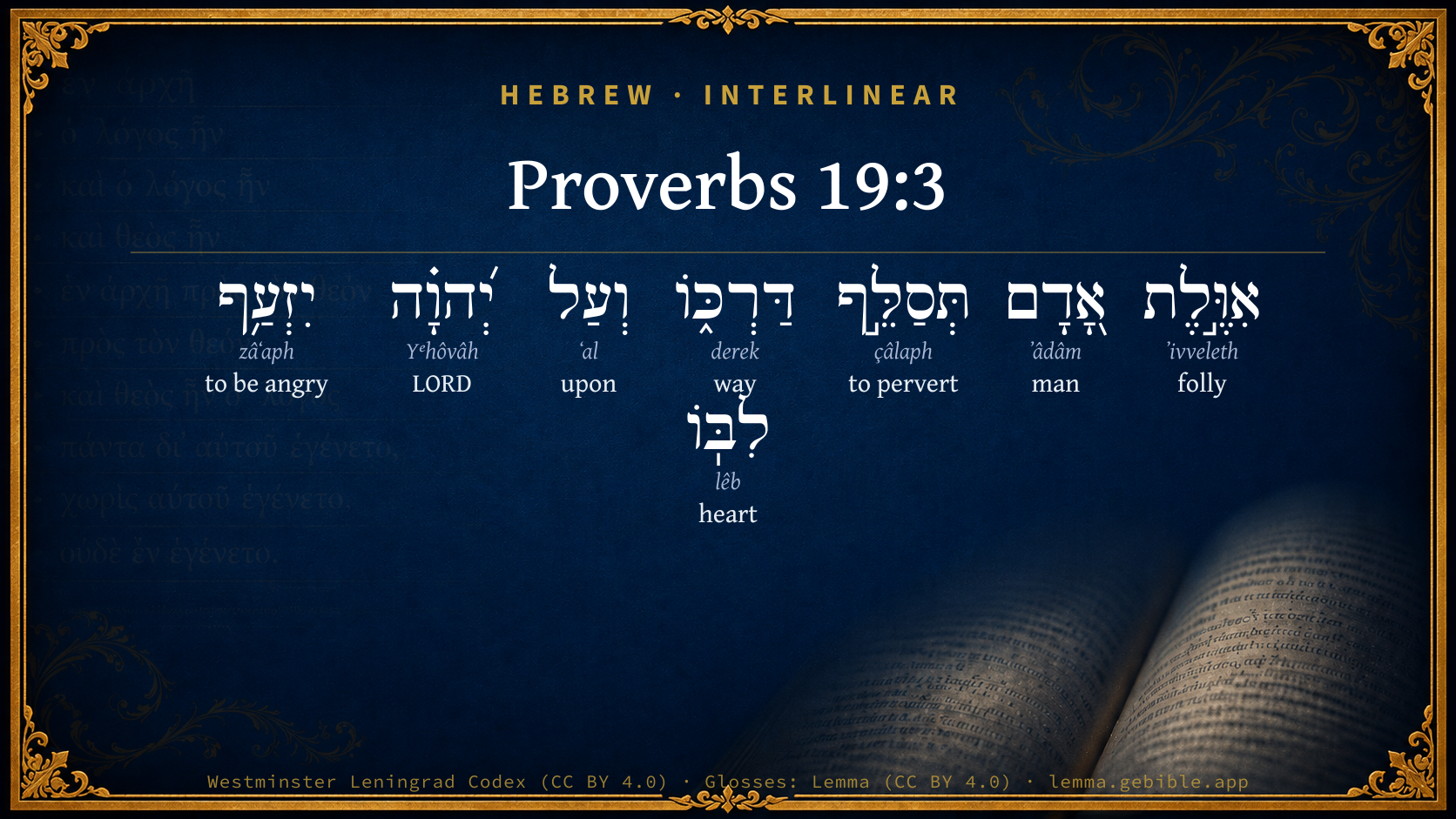
Hebrew (Westminster Leningrad Codex) Proverbs 19:3 appears in the Hebrew Old Testament. The text above is from the Westminster Leningrad Codex. Each word links to its Strong’s number, a concise gloss, and parsing drawn from the Open Scriptures Hebrew Bible morphology. Click any word for its full Brown-Driver-Briggs (BDB) entry.
Download image
Cite this verse

Proverbs 19:3 (World English Bible). Public Domain. Lemma interlinear Bible study tool, https://lemma.gebible.app/v/proverbs/19/3.

Show BibTeX & RIS
BibTeX
RIS
English Translation
The foolishness of man subverts his way; His heart rages against Yahweh.
World English Bible · Public Domain
Download a study sheet

One document with this verse’s original text, its word-by-word gloss line, the meaning frame, cross-references with their text, attributed commentary, and full source and license credits — printable, and it pastes into notes with its structure intact.

This verse Autodidact and up

Study sheet (.html) Plain text (.txt)

A passage Seminary Student

Up to 50 verses in one chapter. A passage sheet keeps up to 6 commentary sources and 12 cross-references per verse, in the order this page ranks them, and says so on the sheet whenever that leaves anything out. Ask for a single verse and you get the Autodidact verse sheet above.

Everything on this page stays free to read, with no account — the sheet is a download of what is already on screen, not access to it.

Want to remove ads? Support Godless Engineer
Compare translations 3

The same verse in 3 English versions, stacked beneath the original-language interlinear above. Click any original word for its lexicon entry.

Each is an independent rendering of the whole verse — the interlinear is not word-aligned to these translations.

Highlighted words mark where these versions differ — a whole-verse word diff, not a word-by-word alignment.

  • World English Bible Public Domain
    The foolishness of man subverts his way; His heart rages against Yahweh.
  • King James Version Public Domain
    The foolishness of man perverteth his way: and his heart fretteth against the LORD.
  • unfoldingWord Literal Text CC BY-SA 4.0
    The folly of a man will lead astray his way, and his heart will rage against Yahweh.

unfoldingWord Literal Text — © unfoldingWord, licensed CC BY-SA 4.0. Word-aligned USFM3 via Door43 (git.door43.org/unfoldingWord/en_ult).

Versions to compare (up to 4)

3 of 4 selected

Show all 18 translations

Every available English version of this verse, each an independent rendering of the whole verse.

  • World English Bible Public Domain
    The foolishness of man subverts his way; His heart rages against Yahweh.
  • Berean Standard Bible Public Domain
    A man’s own folly subverts his way, yet his heart rages against the LORD.
  • Majority Standard Bible Public Domain
    A man’s own folly subverts his way, yet his heart rages against the LORD.
  • King James Version Public Domain
    The foolishness of man perverteth his way: and his heart fretteth against the LORD.
  • American Standard Version (1901) Public Domain
    The foolishness of man subverteth his way; And his heart fretteth against Jehovah.
  • Revised Version (1885) Public Domain
    The foolishness of man subverteth his way; and his heart fretteth against the LORD.
  • Geneva Bible (1599) Public Domain
    The foolishnesse of a man peruerteth his way, and his heart freateth against the Lord.
  • Douay-Rheims (1899) Public Domain
    The folly of a man supplanteth his seeps: and he fretteth in his mind against God.
  • Young's Literal Translation Public Domain
    The folly of man perverteth his way, And against Jehovah is his heart wroth.
  • Literal Standard Version CC BY-SA 4.0
    The folly of man perverts his way, || And his heart is angry against YHWH.
  • Unlocked Literal Bible CC BY-SA 4.0
    A person's folly ruins his life and his heart rages against Yahweh.
  • unfoldingWord Literal Text CC BY-SA 4.0
    The folly of a man will lead astray his way, and his heart will rage against Yahweh.
  • Darby Bible Public Domain
    The folly of man distorteth his way, and his heart is irritated against Jehovah.
  • World Messianic Bible Public Domain
    The foolishness of man subverts his way; his heart rages against the LORD.
  • Webster's Bible Public Domain
    The foolishness of man perverteth his way: and his heart fretteth against the LORD.
  • Free Bible Version CC BY-SA 4.0
    People mess up their lives by their own stupidity, and then get angry with the Lord.
  • Bible in Basic English Public Domain
    By his foolish behaviour a man's ways are turned upside down, and his heart is bitter against the Lord.
  • JPS Tanakh (1917) Public Domain
    The foolishness of man perverteth his way; and his heart fretteth against the LORD.

Literal Standard Version (2020), Covenant Press — licensed CC BY-SA 4.0. Text via the HelloAO Bible API (eBible.org). Unlocked Literal Bible (unfoldingWord) — licensed CC BY-SA 4.0. Text via the HelloAO Bible API (eBible.org). unfoldingWord Literal Text — © unfoldingWord, licensed CC BY-SA 4.0. Word-aligned USFM3 via Door43 (git.door43.org/unfoldingWord/en_ult). Free Bible Version, Dr. Jonathan Gallagher — licensed CC BY-SA 4.0. Text via the HelloAO Bible API (eBible.org).

Word by word

More ways to search: Search by grammar → Find every occurrence → Compare this word →

Practice this passage: Drill this verse → Learn its vocabulary →

About this verse

These counts appear in no published source. They are computed here, from the morphology-tagged text and Lemma’s own curated glosses. What Lemma adds →

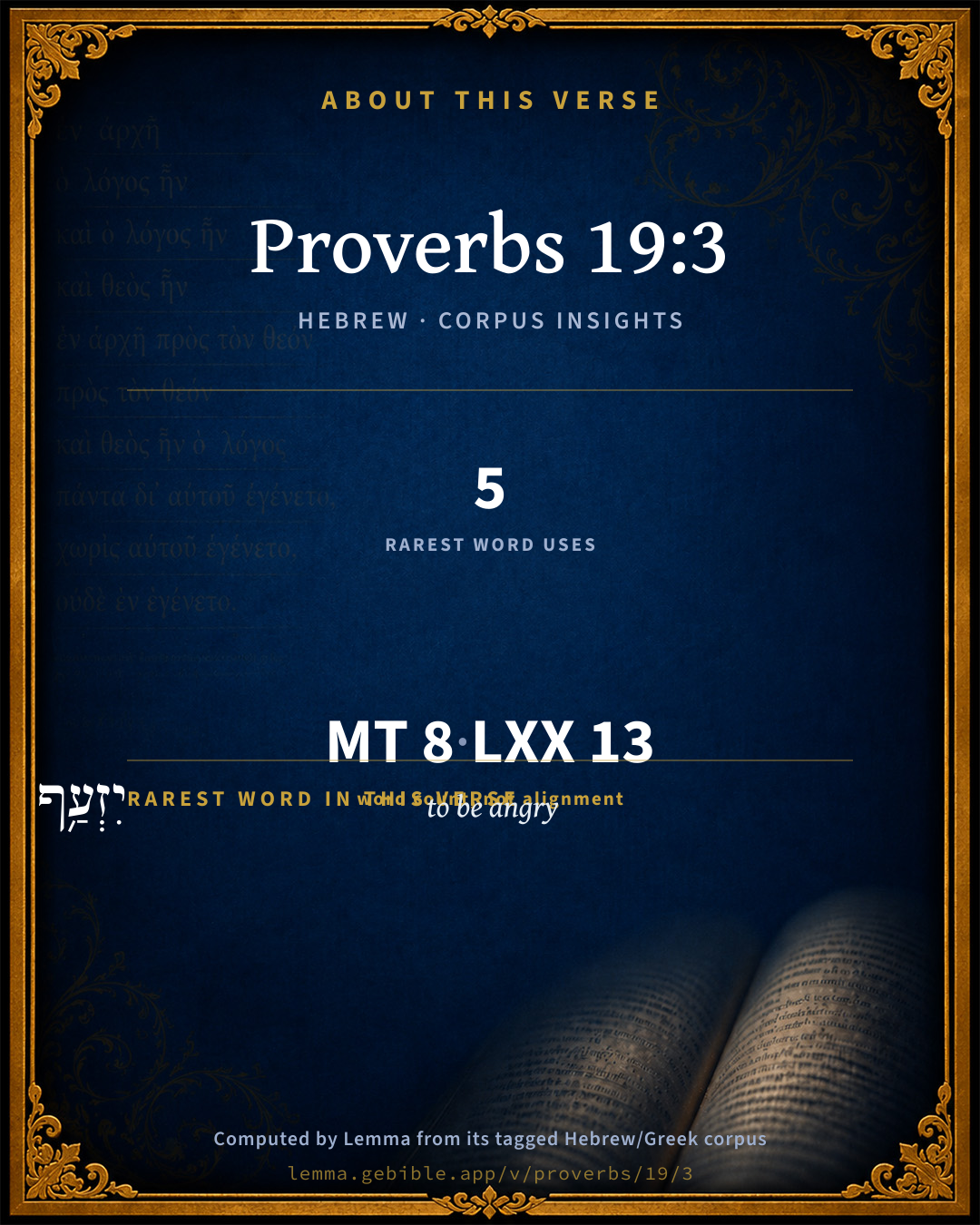
8
words
8
distinct lemmas
Wisdom
section

Notable vocabulary

The rarest word here is יִזְעַ֥ף to be angry H2196 — appearing just 5 times in the whole Hebrew Bible.

Shared distinctive vocabulary

יִזְעַ֥ף to be angry H2196 occurs in 4 verses of the Hebrew Bible. Also found in:

Grammatical profile

  • 2 verbs
  • 5 nouns
  • 1 preposition

Verb forms

  • תְּסַלֵּ֣ף Piel · Imperfect
  • יִזְעַ֥ף Qal · Imperfect

Hebrew & Septuagint length

In English translation the verse runs 12 words from the Hebrew and 15 from the Septuagint (LXX English) — closely comparable.

A rough comparison of the two English renderings, which tokenize alike — not a word-level alignment.

Word counts can differ between the Hebrew and the Greek without any difference in meaning — e.g. the Hebrew direct-object marker אֵת has no separate Greek word, and Greek often adds the article ὁ.

In the original languages it is 8 Hebrew tokens and 13 Greek tokens — but the two are counted differently (Hebrew bundles its prefixes and suffixes into one token; the Greek is in lemma form), so that isn’t a like-for-like length.

Cross-references

17

Topical passages linked to Proverbs 19:3 in the Treasury of Scripture Knowledge — connected by theme and wording, ordered by reader-vote popularity; previews shown in the World English Bible.

  • Revelation 16:9–11 People were scorched with great heat, and people blasphemed the name of God who has the power over these plagues. They didn't repent and give him glory.
  • Psalms 37:7 Rest in Yahweh, and wait patiently for him. Don't fret because of him who prospers in his way, Because of the man who makes wicked plots happen.
  • Numbers 16:19–41 Korah assembled all the congregation against them to the door of the tent of meeting: and the glory of Yahweh appeared to all the congregation.
  • 1 Samuel 22:13–23 Saul said to him, Why have you conspired against me, you and the son of Jesse, in that you have given him bread, and a sword, and have inquired of God for him, that he should rise against me, to lie in wait, as at this day?
  • Proverbs 11:3 The integrity of the upright shall guide them, But the perverseness of the treacherous shall destroy them.
  • 2 Kings 6:33 While he was yet talking with them, behold, the messenger came down to him: and he said, Behold, this evil is of Yahweh; why should I wait for Yahweh any longer?
  • 2 Chronicles 16:9–10 For the eyes of Yahweh run back and forth throughout the whole earth, to show himself strong in the behalf of them whose heart is perfect toward him. Herein you have done foolishly; for from henceforth you shall have wars.
  • Genesis 3:6–12 When the woman saw that the tree was good for food, and that it was a delight to the eyes, and that the tree was to be desired to make one wise, she took of the fruit of it, and ate; and she gave some to her husband with her, and he ate.
  • Genesis 4:5–14 but he didn't respect Cain and his offering. Cain was very angry, and the expression on his face fell.
  • Numbers 17:12–13 The children of Israel spoke to Moses, saying, Behold, we perish, we are undone, we are all undone.
  • 1 Samuel 13:13 Samuel said to Saul, You have done foolishly; you have not kept the commandment of Yahweh your God, which he commanded you: for now would Yahweh have established your kingdom on Israel forever.
  • 1 Samuel 15:23 For rebellion is as the sin of witchcraft, and stubbornness is as idolatry and teraphim. Because you have rejected the word of Yahweh, he has also rejected you from being king.
  • 1 Kings 20:42–43 He said to him, Thus says Yahweh, Because you have let go out of your hand the man whom I had devoted to destruction, therefore your life shall go for his life, and your people for his people.
  • 2 Kings 3:9–10 So the king of Israel went, and the king of Judah, and the king of Edom; and they made a circuit of seven days' journey: and there was no water for the host, nor for the animals that followed them.
  • Psalms 37:1 Don't fret because of evil-doers, Neither be envious against those who work unrighteousness.
  • Acts 13:45–46 But when the Jews saw the multitudes, they were filled with jealousy, and contradicted the things which were spoken by Paul, and blasphemed.
  • Isaiah 8:21–22 They shall pass through it, sore distressed and hungry; and it shall happen that when they shall be hungry, they shall fret themselves, and curse by their king and by their God, and turn their faces upward:

Cross-references courtesy of OpenBible.info (CC BY 4.0).

Hebrew and Greek witnesses Masoretic Hebrew ↔ Greek Septuagint

The same verse in the two great witnesses to the Old Testament, shown verse-for-verse.

These are two independent witnesses, not word-aligned to each other, and the Septuagint is shown in lemma (dictionary) form.

Hebrew Proverbs 19:3 Masoretic · Westminster Leningrad Codex

אִוֶּ֣לֶת אָ֭דָם תְּסַלֵּ֣ף דַּרְכּ֑וֹ וְעַל יְ֝הוָ֗ה יִזְעַ֥ף לִבּֽוֹ

The foolishness of man subverts his way; His heart rages against Yahweh.

World English Bible · Public Domain

Greek LXX Proverbs 19:3 Septuagint · lemma form

ἀφροσύνη ἀνήρ λυμαίνω ὁ ὁδός αὐτός ὁ δέ θεός αἰτιάομαι ὁ καρδία αὐτός

The folly of a man spoils his ways: and he blames God in his heart.

LXX2012 (modern English Septuagint) · Public Domain

On this verse, Haydock's Catholic Bible Commentary discusses the Septuagint’s reading. Read the note in Commentary ↓

Hebrew: Westminster Leningrad Codex (CC BY 4.0). Greek: Septuagint (public domain); English from LXX2012 (modern English Septuagint) (Public Domain). How the Septuagint differs from the Hebrew →

Commentary

Notes on Proverbs 19:3 from classic Christian and Jewish commentators (each source and its license shown beneath its notes). The classic Christian expositions comment on the surrounding passage and are grouped to its opening verse, so a note may address several verses; the Jewish commentaries on the Tanakh (Rashi and others) are per-verse, so they appear only where the commentator wrote on this verse.

Lemma curates 59 commentaries, every one of them public domain or Creative Commons licensed, each selected and text-cleaned for this edition rather than reprinted as found. About our sources →

Trapp's Complete Commentary

John Trapp

Pro 19:3 The foolishness of man perverteth his way: and his heart fretteth against the LORD.

Ver. 3. The foolishness of a man perverteth his way.] So that all goes cross with him, and God "walks contrary to him," {Lev 26:21} as it befell our King John, Queen Mary, and Henry IV of France. King John saw and acknowledged it in these words, Postquam, ut dixi, Deo reconciliatus, me ac mea regna (proh dolor!) Romanae subieci ecclesiae, nulla mihi prospera, sed omnia contraria advenerunt, {a} Ever since I submitted to the see of Rome, nothing hath prospered with me.

And his heart frets against the Lord.] As the cause of his calamity. Birds of prey, that have been long kept in the dark, when they get abroad, are out of measure, raging and ravenous: so are ignorant spirits; they let fly on all hands, when in durance especially, and spare not to spit their venom in the very face of God, as did Pharaoh, when that thick darkness was upon him; the king of Israel that said, "Behold this evil is of the Lord, and what should I wait for the Lord any longer?" {2Ki 6:33} Mohammed, the first emperor of the Turks, being wonderfully grieved with the dishonour and loss he had received at the last assault of Scodra, in his choler and frantic rage, most horribly blasphemed against God, saying, that it were enough for him to have care of heavenly things, and not to cross him in his worldly actions. {b}

{a} Mat. Paris.

{b} Turk. Hist., fol. 423.

John Trapp, A Commentary or Exposition upon All the Books of the Old and New Testament (1647–1656) — public domain. Text from a community e-Sword module.

The Biblical Illustrator

Joseph S. Exell

Pro_19:3

The foolishness of man perverteth his way: and his heart fretteth against the Lord.

The folly and sin of men in perverting their own way, and then fretting against God

Men are apt to charge all the afflictions which befall them upon God, whereas they bring most of them upon themselves. God is no further accessory to them than as, in the nature of things, and in the course of His wise providence, He hath established a connection between folly and suffering, between sin and misery. Homer observes that men lay those evils upon the gods which they have incurred through their own folly and perverseness. The foolishness of man signifies his want of thought and reflection; his indiscretion and rashness. It perverts his way, leads him aside from the path of wisdom and prudence, safety and happiness; by this means he brings himself into trouble, is reduced to necessity, perplexed with difficulties, or oppressed with sorrow. Then he committeth this grand error after all the rest, that his heart fretteth against the Lord. He is vexed, not at himself, but at Providence. Fretteth expresses the commotion and uneasiness there is in a discontented, ungoverned mind.

I. The general principle on which men act in this case is right and just. When they fret against the Lord they suppose that there is a God, and that He observes and interests Himself in the affairs of His creatures; and that it is a considerable part of His providential government to try, exercise, and promote the virtues of His rational creatures by the discipline of affliction.

II. The conclusion they draw is generally wrong, and their charge upon the providence of God groundless and unjust.

1. It is often the case with regard to mens health. Many complain that God denies them the health and spirits which He has given to others. But health very largely, and very directly, depends on mens management of themselves, by indulgence, fretfulness, inactivity, too close application to business, etc.

2. With regard to their circumstances in life. We see men impoverished and reduced to straits and difficulties. They complain that God brings them into straits, and embarrasses their circumstances. But most persons are really in straits through their own negligence, carelessness, or extravagance. Many are ruined in this world by an indolent temper. Cardinal de Retz used to say that misfortune was only another word for imprudence.

3. With regard to their relations in life. How many unhappy marriages there are! But they are almost always the consequence of foolish and wilful choices. Many complain that their children are idle, disobedient, and undutiful. But this is generally the result of parental inefficiency in training or in example.

4. With regard to mens minds and their religious concerns. Many who make a profession of religion are uneasy and fretful, without any external cause; but this is usually owing to their own negligence or self-willedness.

III. The folly and wickedness of such conduct. It is very absurd, for in most of these cases they have no one to blame but themselves. It likewise proceeds from ignorance of themselves. Fretfulness only tends to aggravate our afflictions and to hurt our minds. It may provoke God to bring upon us some heavier affliction. Application:

1. How much prudence, caution, and foresight are necessary for those who are setting out in life!

2. What a great and mischievous evil pride is!

3. Inquire to what your afflictions are owing.

4. Guard against the great sin of fretting against the Lord. (J. Orton.)

Mans sorrows the result of his sins

I. Illustrate the proverb.

1. As regards health.

2. As regards worldly substance.

3. As regards the vexations of domestic life.

4. From the state of the mind.

5. From the world in which we reside.

II. Instructions derivable from the proverb.

1. It instructs us with regard to sin.

2. It shows the inefficacy of mere suffering to bring a man to a proper state of thinking and feeling.

3. The disposition of the mind under sanctified affliction.

4. The reality of a moral providence.

5. Learn to look to God for His grace and guidance. (W. Jay.)

The misfortunes of men chargeable on themselves

I. Consider the external condition of man. He is placed in a world where he has by no means the disposal of the events that happen. Calamities befall us, which are directly the Divine dealing. But a multitude of evils beset us which are due to our own negligences or imprudences. Men seek to ascribe their disappointments to any cause rather than to their own misconduct, and when they can devise no other cause they lay them to the charge of Providence. They are doubly unjust towards God. When we look abroad we see more proofs of the truth of this assertion. We see great societies of men torn in pieces by intestine dissensions, tumults, and civil commotions. But did man control his passions, and form his conduct according to the dictates of wisdom, humanity, and virtue, the earth would no longer be desolated by wars and cruelties.

II. Consider the internal state of man. So far as this inward disquietude arises from the stings of conscience and the horrors of guilt, there can be no doubt of its being self-created misery, which it is impossible to impute to Heaven. But how much poison man himself infuses into the most prosperous conditions by peevishness and restlessness, by impatience and low spirits, etc. Unattainable objects pursued, intemperate passions nourished, vicious pleasures and desires indulged, God and Gods holy laws forgotten--these are the great scourges of the world; the great causes of the life of man being so embroiled and unhappy.

1. Let us be taught to look upon sin as the source of all our miseries.

2. The reality of a Divine government exercised over the world.

3. The injustice of our charging Providence with a promiscuous and unequal distribution of its favours among the good and the bad.

4. The necessity of looking up to God for direction and aid in the conduct of life. Let us hold fast the persuasion of these fundamental truths--that, in all His dispensations, God is just and good; that the cause of all the troubles we suffer is in ourselves, not in Him; that virtue is the surest guide to a happy life; and that he who forsakes this guide enters upon the path of death. (H. Blair, D. D.)

Fretting against God a frequent sin

Men are oftener guilty of this sin than they imagine. Our hearts fret against the Lord by fretting at the ministers and instruments of His providence; and therefore, when the people murmured against Moses in the wilderness, he tells them that their murmuring was not against him and his brother Aaron, but against the Lord. Instead of fretting, it is our duty to accept of the punishment of our iniquity, and to bless God that matters are not so bad with us as we deserve. If our troubles come upon us without any particular reason from our own conduct, yet reflections upon God would be very unjust. Jobs troubles were extremely grievous, and as they came upon him without cause in himself, he was made to acknowledge his great folly in reflecting upon God for his distresses. (G. Lawson, D. D.)

The untoward incidents of life must not be charged against God

Let us not charge God overhastily with the untoward incidents of life. In the main we are the manufacturers of our own life-material. If you give the weaver none but dark threads he can only fashion a sombre pattern. (J. Halsey.)

Life regarded as a wrong

George Eliot once said to a friend, with deep solemnity, that she regarded it as a wrong and misery that she had ever been born. (Oscar Browning.)

The Biblical Illustrator, edited by Joseph S. Exell (c. 1880s–1900s) — public domain. Text from a community e-Sword module.

The Expositor's Bible

CHAPTER 20

HUMAN FREEDOM

"The foolishness of man subverteth his way; And his heart fretteth against the Lord."- Pro_19:3

THERE is such a valuable expansion and commentary on this proverb in the book of Ecclesiasticus that it seems worthwhile to quote it in full:

"Say not, it is through the Lord that I fell away, for the things He hates thou shalt not do. Say not, it is He that caused me to err, for He has no use for a sinful man. Every abomination the Lord hates, neither is it lovely to those that fear Him. He Himself at the outset made Man, and left him in the power of his own control, that, if thou wilt, thou shouldst keep His commandments, and to do faithfully what is pleasing to Him. He set fire and water before thee, that thou shouldst stretch out thy hand to which thou wilt. In front of men is life and death, and whichever a man pleases shall be given to him. Because wide is the wisdom of the Lord; He is mighty in power, beholding all things; and His eyes are upon them that fear Him, and He Himself will take note of every work of man. He never enjoined any one to do wickedly, and He never gave to any one license to sin." {Ecclesiasticus 15:11-20}

It is our constant tendency to claim whatever good we do as our own doing, and to charge whatever evil we do on causes which are beyond our control, -on heredity, on circumstances of our birth and upbringing, or even on God. The Scriptures, on the other hand, regard all our good deeds as the work which God works within us, when our will is given to Him, while all our evil is ascribed to our own foolish and corrupt will, for which we are, and shall be, held responsible. This is certainly a very remarkable contrast, and we shall do well to take account of it. It is not necessary to run into any extreme statement, to deny the effects either of taints in the blood which we receive from our parents, or of early surroundings and education, or even the enormous influence which other people exercise over us in later life; but when all allowance is made for these recognized facts, the contention of the text is that what really subverts our lives is our own folly, -and not uncontrollable circumstances, -and our folly is due, not to our misfortune, but to our fault.

Now we will not attempt to deal with all the modifications and reservations and refinements which ingenuity might offer to this doctrine; however charity may require us to make allowance for others on the ground of disadvantages, it is questionable whether we help them, and it is certain that we weaken ourselves, by turning attention constantly from the central fact to the surrounding circumstances; we will therefore try to steadily look at this truth of Individual Responsibility, and lay it to heart. When we have acquitted ourselves of blame, and have obtained a discharge in the forum of our own conscience, it will be time to seek other causes of our guilt, and to "fret against the Lord."

But before we turn inwards and appeal to our own consciousness, may we not observe how absurd it is that the Lord should be charged with responsibility for our sins? What do we know of the Lord except that He hates and abominates sin? It is as the Hater of sin that He is revealed to us in ever-clearer for us from the first page of revelation to the last. But more, the most powerful proof that we possess of His existence is to be found in the voice of conscience within us; we instinctively identify Him with that stern monitor that denounces so vigorously and unsparingly all our offences against holiness. The God of revelation is from the first declared to be "He who will by no means clear the guilty, visiting the iniquity of the fathers upon the children." The God of conscience is by the very nature of the case identified with the uncompromising sentence against evil; is it not then obviously inconsistent to lay our sins to the charge of God? We are more assured of His Holiness than of His omnipotence; we cannot therefore bring His omnipotence to impeach His Holiness. We see Him as the Avenger of sin before we see Him in any other capacity; we cannot therefore bring any subsequent vision of Him to discredit the first. It is surely the dictate of plain common sense, as St. James says, that "God cannot be tempted with evil, and He Himself tempteth no man: but each man is tempted, when he is drawn away by his own lust, and enticed. Then the lust, when it hath conceived, beareth sin: and the sin, when it is full grown, bringeth forth death." {Jam_1:13-15}

Now our actual responsibility for our own sins, and the troubles which result from them, will perhaps come out in the clear light of conscience, if we regard our conduct in the following way. We must make an appeal to consciousness. There are actions which, consciousness tells us, rest entirely on our own choice, and concerning which no sophistry, however ingenious, can furnish an adequate exculpation. There was in these cases, as we well remember, the plain offer of an alternative "Fire or Water, Life or Death." We knew at the time that we were equally able to take either of them; we felt no compulsion; there was, it is true, a great tumult of conflicting motives, but when the motives were balanced and the resulting verdict was declared, we were perfectly conscious that we could, if we chose, reverse the verdict and give our judgment against it. Our first deviations from truth, from purity, from charity, come up before us as we reflect; the struggle which went on survives vividly in memory; and when we yielded to the evil power we were conscious at the time, as we remember still, that our will was to blame. As the lie glided from the lips, as the unhallowed thought was allowed to pass into act, as the rein was thrown on the neck of the evil passion, we knew that we were doing wrong, we felt that by an adequate exercise of the will we could do right. Cast your eye back on the steps by which your character was formed, on the gradual destruction of your finer feelings, on the steady decline of your spiritual instincts, on the slow deadening and searing of your moral sense. Do you not remember how deliberately you submitted to the fascinations of that dangerous friend, whom your conscience entirely disapproved? How willfully you opened and perused the pages of that foul book, which swept over your soul like a mud-torrent and left its slimy sediment there ever after? How you consciously avoided the influence of good people, made every excuse to escape the prayer, the reading, the sermon, which was to you a conscience-stirring influence, an appeal of God to the soul?

AS you retrace those fatal steps, you will be surprised to discover how entirely your own master you were at the time, although the evil deeds done then have forged a chain which limits your freedom now. If at any of those critical moments someone had said to you, Are you free to do just which of the two things you please? You would have replied at once, Why, of course I am. Indeed, if there had been any compulsion to evil, you would have rebelled against it and resisted it. It was really the complete liberty, the sense of power, the delight in following your own desire, that determined your choice. The evil companion persuaded, your conscience dissuaded, neither compelled; when the balance hung even you threw the weight of your will into the scale. The book lay open; curiosity, prurience, impurity, bade you read; your best conviction shamed you and called you away: when the-two forces pulled even, you deliberately gave your support to the evil force. The solemn voice of prayer and worship called you, moving you with mystical power, waking strange desires and hopes and aspirations; the half-mocking voice of the earth was also in your ear, tempting, luring, exciting, and when the sounds were about balanced, you raised up your own voice for the one and gave it the predominance.

Or if now in the bondage of evil you can no longer realize that you were once free, you can look at others who are now where you were then; notice even when you try to tempt your younger companions into evil, how the blush of shame, the furtive glance, the sudden collapse of resistance, plainly proves that the action is one consciously determined by an evil choice; notice how your first blasphemies, your first devil-born doubts, suggestions, and innuendoes, bring the pained expression to the face, and raise a conflict which the will has to decide. In this appeal to consciousness or to observation we must be scrupulously honest with ourselves; we must take infinite pains not to garble the evidence to suit a foregone conclusion or to excuse an accomplished fall. I think we may say that when men are honest with themselves, and in proportion as they are pure and innocent, and not yet bound hand and foot by the bondage of their own sins, they know that they have been free, that in the face of all circumstances they still stood uncommitted; that if they yielded to temptation it was their own "foolishness that subverted their way."

But now we may pass from these inward moral decisions which have determined our character and made us what we are, to the ordinary actions which form the greater part of our everyday conduct. Here again we are generally inclined to take credit for every course which has a happy issue, and for every unfortunate decision to cast the blame on others. We are reminded, however, that our misfortunes are generally the result of our own folly; we are too impatient, too hasty, too impetuous, too self-willed. "Desire without knowledge is not good, and he that hasteth with his feet misseth the way." {Pro_19:2} If we look back upon our mistakes in life, it is surprising to see how many were due to our own headstrong determination to follow our own way, and our complete disregard of the prudent counsels which our wiser friends ventured to offer us. "The way of the foolish is right in his own eyes: but he that is wise harkeneth unto counsel." {Pro_12:15} "Where there is no counsel, purposes are disappointed: but in the multitude of counselors they are established." {Pro_15:22} Hear counsel," is the command of this chapter, and receive instruction, that thou mayest be wise in thy latter end." {Pro_19:20} "Every purpose is established by counsel,"-affairs of state, whether civil {Pro_11:14} or military, {Pro_20:18} -and so by counsel a man is made strong and is able to carry out the warfare of his own personal life. {Pro_24:5-6} It is well for us therefore not only to accept counsel which is proffered to us, but to be at pains to get it, for it often lies, like the waters of a well, deep down in a mans mind, and requires some patience and skill in order to elicit it. {Pro_20:5}

Our false steps are due to a rash precipitancy which prevents us from looking at the question on all its sides, and learning the views of those who have had experience and know. The calamities which befell us were foreseen by many onlookers, and were even foretold by our friends, but we could accept no advice, no warning. And while therefore it is perfectly true that our own judgment was not sufficient to ward off the evil or prevent the faux pas, we are none the less to blame, our own foolishness has none the less subverted our way, for it was our own fault that we refused to be advised, it was our own incredible folly that made us form so wrong an idea of our wisdom.

Suppose then that in our retrospect of life and in the estimation of our errors, we mark off all those sins for which our conscience duly charges us with direct responsibility, and all those blunders which might have been avoided if we had wisely submitted to more prudent judgments than our own, what is there that remains? Can we point out any group of actions or any kind of errors which are yet unaccounted for, and may possibly be charged on some other person or thing than ourselves? Is there yet some opening by which we may escape responsibility? Are there any effectual and valid excuses that we can successfully urge?

Now it appears that all these possible excuses are netted and completely removed-and every avenue of escape is finally blocked-by this broad consideration; God is at hand as the wisest of Counselors, and we might by simple appeal to Him, and by reverently obeying His commandments, avoid all the evils and the dangers to which we are exposed. So far from being able to excuse ourselves and to lay the blame on God, it is our chief and all-inclusive fault, it is the clearest mark of our foolishness, that we do not resort to Him for help, but constantly follow our own devices; that we do not rely upon His goodness, but idly fret against Him and all His ordinances. "There are many devices in a mans heart," but over against these feeble, fluctuating, and inconsistent ideas of ours is "the counsel of the Lord, which shall stand." {Pro_19:21} "The fear of the Lord tendeth to life: and he that hath it shall abide satisfied; he shall not be visited with evil." {Pro_19:23} There is a way of life, there is a plain commandment, a law of Gods appointing: "He that keepeth the commandment keepeth his soul: but he that is careless of his ways shall." Pro_19:16 It is simply our own carelessness that is our ruin; if we would pay the slightest heed, if there were one grain of seriousness in us, we should be wise, we should get understanding, and so find good in the salvation of the soul; {Pro_19:8} we should not, as we so often do, "hear instruction, only to err from the words of knowledge." {Pro_19:27}

We may wonder at the strong conviction with which this truth was urged even under the Jewish law; it may seem to us that the requirements then were so great, and the details so numerous, and the revelation so uncertain, that a man could scarcely be held responsible if he missed the way of life through inadvertence or defective knowledge. Yet even then the path was plain, and if a man missed it he had but himself and his own folly to blame. But how much more plain and sure is everything made for us! Our Lord has not only declared the way, but He is the Way; He has not only given us a commandment to keep, but He has Himself kept it, and offers to the believing soul the powers of an inward life, by which the yoke of obedience becomes easy, and the burden of service is made light. He has become "the end of the law to everyone that believeth." He has made His offer of Himself not only general, but universal, so that no human being can say that he is excluded, or murmur that he is not able to "keep his soul." His word has gone out into all the world, and while they have not heard it, being without a law are yet a law unto themselves, and are responsible by virtue of that self-witness which God has given everywhere in Nature, in Society, and in the conscience of man, how can we sufficiently emphasize our own responsibility, to whom God has spoken in the latter days by His own Son! Surely "whoso despiseth the word bringeth destruction on himself." {Pro_13:13}

If even in that old and darker dispensation the light was so clear that it was chargeable to a mans own folly when he disobeyed, -and "judgments were prepared for scorners, and stripes for the backs of fools," {Pro_19:29}-what must come upon us who have the clearer light if we willfully and foolishly disobey? The counsel of the Lord stands sure: "There is no wisdom nor understanding nor counsel against the Lord." {Pro_21:30} No authority of wise men, no sneer of wits, no devices of the clever, can in the least avail to set aside His mighty ordinance or to excuse us from disregarding it. "The horse is prepared against the day of battle: but victory is of the Lord." {Pro_21:31} There can be no evasion, no escape. He Himself, by His own invincible power, will bring home to the hearts of the rebellious the evil of their rebellion, and will send the cruel messenger against them. {Pro_17:11}

Does it not behoove us to remember and consider? To remember our offenses, to consider our guilt and the Lords power? Here is a way of life marked out before you, and there is the way of death; here is the water held out to you, and there is the fire; and you may choose. The way of life is in the Gospel of Gods dear Son; you know that its precepts are perfect, converting the soul, and that Christ Himself is holy, such a one as the earth never bore before or since, you know too that this Holy One came to give His life a ransom for many, that He invited all to come unto Him, and promised to all who came everlasting life. You know that He did give His life a ransom, -as the Good Shepherd He gave Himself for the sheep, and then took again the life which He laid down. You know that He ever liveth to make intercession for us, and that His saving power was not exercised for the last time years and years ago, but this very day, probably just at the moment that I am now speaking to you. The way is plain, and the choice is free; the truth shines, and you can open your eyes to it; the life is offered, and you can accept it. What pretext can you give for not choosing Christ, for not coming to the truth, for not accepting the life?

Is it not clear to you that if you refuse Him that speaketh, and your way is thus subverted, -as indeed it must be, -it is your own folly that is to blame? You fret against the Lord now, and you charge Him foolishly, but some day you will see clearly that this is all a blind and a subterfuge; you will admit that the choice was open to you, and you chose amiss; that life and death were offered to you, and you preferred death.

If any question might be entertained about those who have only the light of conscience to guide them, and have not heard of the direct relation of succor and support which God is ready to give to those who depend upon Him, there can be no doubt of the complete freedom of every human being, who hears the message of the Gospel, to accept it. You may put it aside, you may decline to accept it on the ground of disinclination, or because you consider the historical evidence insufficient, but you will be the first to admit that in doing so you exercise your discretion and consciously choose the course which you take.

Nay, leaving all metaphysical discussion about the freedom of the will, I put it to you simply, Can you not, if you choose, come to Christ now?

Oh, hear counsel and receive instruction: is not the Spirit pleading with you, counseling, teaching, warning you? Do not harden your heart, do not turn away. Attend to Christ now, admit Him now, that you may be wise in your latter end. {Pro_19:20}

William Robertson Nicoll, ed., The Expositor's Bible (London: Hodder & Stoughton, 1887–1910) — public domain. 65 of 66 books (1 Corinthians is not separately keyed, as that volume carries no machine-parseable verse references); section-level commentary keyed to the opening verse. Introductory and overview sections not keyed to a specific passage are excluded.

Tyndale Open Study Notes

Tyndale Open Resources

19:3 Rather than acknowledge wrong choices and actions, fools blame the Lord.

Tyndale Open Study Notes — © Tyndale Open Resources, licensed CC BY-SA 4.0. Text via the HelloAO Bible API.

Matthew Henry's Commentary

We have here two instances of men's folly: - 1. That they bring themselves into straits and troubles, and run themselves a-ground, and embarrass themselves: The foolishness of man perverts his way. Men meet with crosses and disappointments in their affairs, and things do not succeed as they expected and wished, and it is owing to themselves and their own folly; it is their own iniquity that corrects them. 2. That when they have done so they lay the blame upon God, and their hearts fret against him, as if he had done them wrong, whereas really they wrong themselves. In fretting, we are enemies to our own peace, and become self-tormentors; in fretting against the Lord we affront him, his justice, goodness, and sovereignty; and it is very absurd to take occasion from the trouble which we pull upon our own heads by our wilfulness, or neglect, to quarrel with him, when we ought to blame ourselves, for it is our own doing. See Isa 50:1.

Matthew Henry's Commentary on the Whole Bible (1708–1710) — public domain (CC PDM 1.0). Text via the HelloAO Bible API.

Jamieson, Fausset & Brown

Robert Jamieson, A. R. Fausset & David Brown

perverteth . . . way--turns him back from right (Pro 13:6; Jam 1:13); and he blames God for his failures.

Jamieson, Fausset & Brown — Commentary Critical and Explanatory on the Whole Bible (1871) — public domain (CC PDM 1.0). Text via the HelloAO Bible API.

Adam Clarke's Commentary

Verse 3. The foolishness of man] Most men complain of cross providences, because they get into straits and difficulties through the perverseness of their ways; and thus they fret against God; whereas, in every instance, they are the causes of their own calamities. O how inconsistent is man!

Adam Clarke's Commentary on the Bible (1810–1826) — public domain. Text from a community e-Sword/MySword module.

Ellicott's Commentary for English Readers

(3) The foolishness of man perverteth his way.—A man’s own self-will (Pro_1:7) overturns his way. stops his progress, whether in temporal or spiritual matters, and then, instead of blaming himself, “his heart fretteth against the Lord.” (Comp. Isa_8:21; Rev_16:10-11.)

A Bible Commentary for English Readers, edited by Charles John Ellicott (1878–1897) — public domain. Text from a community e-Sword module.

John Gill's Exposition

The foolishness of man perverteth his way,.... The sinfulness of his heart and nature; the folly which is bound up in it causes him to go astray out of the way in which he should go, or makes things go cross with him; so that the ways he takes do not prosper, nor his schemes succeed; but everything goes against him, and he is brought into straits and difficulties;

and his heart fretteth against the Lord; laying all the blame on him; and ascribing his ill success, not to his own sin and folly, but to divine Providence, which works against him; and therefore frets and murmurs at him; and, instead of charging his own ways with folly, charges the ways of God with inequality; see Eze 18:25.

John Gill's Exposition of the Whole Bible (1746–1763) — public domain (CC PDM 1.0). Text via the HelloAO Bible API.

Albert Barnes' Notes on the Bible

The non-wisdom which, having brought about disasters by its own perverseness, then turns round and “fretteth,” i. e., angrily complains against the Providence of God.

Perverteth - Rather, “overturneth,” “maketh to fail.”

Albert Barnes' Notes on the Bible (1834–1885) — public domain. Text from a community e-Sword/MySword module.

Haydock's Catholic Bible Commentary

Fretteth. Literally, "burneth." Septuagint, "blameth." Hebrew, "his heart rageth against the Lord." (Haydock) --- Thus Adam tacitly laid the blame on him, as all those who excuse themselves on account of their temper, habits, stars, the violence of temptation, &c. (Calmet)

George Leo Haydock (1774–1849), Haydock's Catholic Family Bible and Commentary, 1859 edition — public domain. Excludes Psalms (Douay-Rheims chapter numbering differs from Protestant) and Deuterocanonical books (Catholic canon only).

Matthew Poole's English Annotations

Perverteth his way; either.

1. Enticeth him to sin. Or rather,

2. Crosseth and blasteth his designs and enterprises, and brings losses and miseries upon him. His heart fretteth against the Lord; he ascribes his unhappiness not to his own sin and folly, which is the true cause of it, but to God and his providence, against which he unjustly murmurs.

Matthew Poole's English Annotations on the Holy Bible (1683–1685) — public domain. Text from a community e-Sword/MySword module.

Whedon's Commentary on the Bible

Daniel D. Whedon

3. Perverteth his way — The primary idea is that of slipping; perhaps, makes slippery his way, and hence it is difficult to walk in because of this.

His heart fretteth — Is angry with Jehovah, though without cause, the fault being his own. He complains of Providence on account of the evil which he brings on himself. Exo_16:8; Lam_3:39.

Daniel D. Whedon (gen. ed.), Commentary on the Old and New Testaments (1874–1909) — public domain. Text from a community e-Sword module.

The Pulpit Commentary

The foolishness of man perverteth his way; rather, overturns, turns from the right direction and causes a man to fall. (Pro_13:6) It is his own folly that leads him to his ruin; but he will not see this, and blames the providence of God. And his heart fretteth against the Lord. Septuagint, "He accuseth God in his heart". (comp. Eze_18:25, 29 33:17, 20) Ecc 15:11, etc., "Say not thou, It is through the Lord that I foil away; for thou oughtest not to do the things that he hateth. Say not thou, He has caused me to err; for he hath no need of the sinful man," etc. The latter part of this important passage St. Augustine quotes thus: "Item apud Salomonem: Deus ab initio constituit hominem et reliquit eum in manu consilii sui: adjecit ei mandata et praecepta; si voles praecepta servare, servabunt te, et in posterum fidem placitam facere. Apposuit tibi aquam et ignem, ad quod vis porrige manum tuam. Ante hominem bonum et malum, vita et mors, paupertas et honestas a Domino Deo sunt" ("De Per. Just. Hom.," cap. 19, And again, "Manifestum est, quod si ad ignem manum mittit, et malum ac mors ei placet, id votuntas hominis operatur; si autem bonum et vitam diligit, non solum voluntas id agit, sed divinitus adjuvatur" ("De Gest. Pelag.," cap. 3, Homer, "Od.," 1:32, etc. "Perverse mankind! whose wills, created free, Charge all their woes on absolute decree; All to the dooming gods their guilt translate, And follies are miscalled the crimes of fate. (Pope.)

Fretting against the Lord.

This is a condition of inward rebellion, or at best of grieving over the will of God instead of submitting to it in silence if it is not yet within our power to embrace it with affection. Consider this condition in its various relations.

I IT IS POSSIBLE. It might be supposed that, however one fretted against his circumstances, he would not carry his complainings hack to God. But Moses told the Israelites that when they murmured against him they were really murmuring against God. (Exo_16:8) If we resist God"s ordinances we resist God himself. He who fires on the meanest sentry is really making war on that sentry"s sovereign. We may not intend to act the proud part of Milton"s Satan, and wage war against Heaven. Overt blasphemy and rank rebellion may be far from our thoughts. Yet complaints of our lot and resistance to Providence have the same essential character. We may even try to confine our rebellious thoughts to our own breasts, and simply fret inwardly. But to God, who reads hearts and dwells within, this is real opposition.

II IT SPRINGS FROM VARIOUS SOURCES.

1. Trouble. It is easy for Dives to talk of submission to Providence; the difficulty is with Lazarus. Job in prosperity offers glad sacrifices without constraint: will Job in adversity "curse God and die"?

2. self-will. We naturally desire to follow the way of our own choice, and when that is crossed by God"s will we are tempted to fret, as the stream frets itself against an obstruction, though it may have been flowing silently and placidly so long as it had a free course. It is just this crossing, of wills that is the test of obedience, which is easy so long as we are required only to follow the path of our own inclinations. But that cannot be always allowed.

3. Sin. Direct sinfulness resists God"s will of set purpose, just because it is his will. The evil heart will fret against God in all things.

III IT IS FOOLISH. "The foolishness of man" is at the root of this mistake.

1. We do not know what is best. It is but foolish for the fractious shim to fret against his father"s commands, for be is not yet able to judge as his father judges. All rebellion against God implies that the soul is in a position to determine questions that lie in the dark, and which only he who is resisted can answer.

2. We cannot succeed in rebellion. The poor heart that frets itself against God can but wear itself out, like the wave that breaks on the rock it can never shake. How foolish to raise our will in opposition to the Almighty!

IV IT IS CULPABLE. We must never forget that "foolishness" in the Bible stands for a defect that is more moral than intellectual. It is next door to perversity. This fretting of the heart against the Lord is foolish in the biblical sense; it is sinful.

1. He is our Master. It is our duty to obey him, whether we like it or not. When we resist ordinances of man we may be fighting for rights of liberty. But we have no liberty to claim against the Lord of all.

2. He is our Father. This murmuring against him is a sign of domestic ingratitude. Impatience under the rod is even sinful, for we know that it can only smite in love.

V IT IS DANGEROUS.

1. It means present unrest. There is peace of soul in submission; to rebel is to be plunged into turmoil and distress.

2. It leads to future ruin. The foolishness of man not only "perverteth his way," but, as the phrase may be better rendered, "hurls his way headlong, to destruction." It is like the avalanche that sweeps the mountain path, and carries all on it to an awful death.

The Pulpit Commentary (1880–1919), ed. H.D.M. Spence-Jones & Joseph S. Exell — public domain. Text from a community e-Sword module.

John Wesley's Explanatory Notes

Perverteth - Blasts his designs and enterprises. Fretteth - He ascribes his unhappiness not to his own sin, but to God and his providence.

John Wesley, Explanatory Notes Upon the Whole Bible (1754–1765) — public domain. Text via the GEBible commentary corpus.

Keil & Delitzsch

C. F. Keil & F. Delitzsch

3 The foolishness of a man overturneth his way,

And his heart is angry against Jahve.

Regarding סלף, vid., at Pro 11:3; also the Arab. signification "to go before" proceeds from the root conception pervertere, for first a letting precede, or preceding (e.g., of the paying before the delivery of that which is paid for: salaf, a pre-numbering, and then also: advanced money), consisting in the reversal of the natural order, is meant. The way is here the way of life, the walking: the folly of a man overturns, i.e., destroys, his life's-course; but although he is himself the fabricator of his own ruin, yet the ill-humour (זעף, aestuare, vid., at Psa 11:6) of his heart turns itself against God, and he blames (lxx essentially correct: αἰτιᾶται) God instead of himself, viz., his own madness, whereby he has turned the grace of God into lasciviousness, cast to the winds the instruction which lay in His providences, and frustrated the will of God desiring his good. A beautiful paraphrase of this parable is found at Sir. 15:11-20; cf. Lam 3:39.

Keil & Delitzsch — Biblical Commentary on the Old Testament (1861–1891) — public domain (CC PDM 1.0). Text via the HelloAO Bible API. (Old Testament only.)

Bridges on Proverbs

Charles Bridges

Such was the foolishness of Adam! First he perverted his way; then he charged upon God its bitter fruit. "God, making him upright," made him happy. Had he been ruled by his will, he would have continued so. But, "seeking out his own inventions" (Ecc 7:29 ), he made himself miserable. As the author of his own misery, it was reasonable, that he should fret against himself. But such was his pride and baseness, that his heart fretted against the LORD, as if he, not himself, was responsible. (Gen 3:6-12 .) Thus his first-born, when his own sin had brought "punishment" on him, fretted, as if "it were greater than he could bear." (Gen 4:8-13 .) This has been the foolishness of Adam’s children ever since. God has linked together moral and penal evil, sin and sorrow. The fool rushes into sin, and most unreasonably frets for the sorrow; as if he could "gather grapes from thorns, or figs from thistles." (Mat 7:16 .) He charges his crosses, not on his own perverseness, but on the injustice of God. (Eze 18:25 .) But God is clear from all the blame (Jas 1:13-14 ): He had shewn the better; man chooses the worse. He had warned by his word and by conscience. Man, deaf to the warning, plunges into the misery; and, while "eating the fruit of his own ways," his heart frets against the LORD. ’It is hard to have passions, and to be punished for indulging them. I could not help it. Why did he not give me grace to avoid it?’ (See Jer 7:10 .) Such is the pride and blasphemy of an unhumbled spirit. The malefactor blames the judge for his righteous sentence. (Isa 8:21-22 . Rev 16:9-11, Rev 16:21 .)

But let us look a little into this bold impeachment of God’s righteousness. ’Why did he not give me grace?’ Is then God bound to give his grace? Have we any claim upon God? Is not God’s grace his own? (Mat 20:15 . Rom 9:19-21 .) Is not the fool following his own will, and therefore responsible for his doing? Why cannot he turn to God? He will not listen or obey. The means are free before him. No force of natural impossibility hinders. His stubbornness alone is his impotency. He cannot, because he will not; and therefore, if he perish, it is not in his weakness, but in his willfulness. (Mat 23:37 . Joh 5:40 .) The worst part of his wickedness is his wicked will. It is not only that his nature is wicked, but that he is willing that it should be so. Did he but feel his moral inability, would he but look to him who is "eyes to the blind," "ears to the deaf," "feet to the lame," his healing would be sure.

This perverseness shews itself in every rising of corruption. The Pharisee mocks God by his hypocritical service, and then frets, because no good comes out of it. (Isa 58:3 . Mal 3:14 .) The proud worm cherishes a discontented humour with Providence. Either the desired comfort is withheld, or the will has been crossed. If his tongue is quiet, his heart frets. Had he been placed differently, he would have succeeded better. God therefore has the blame of his failure. Whereas it is obvious, that if he is not ready now to serve God, he needs a change of heart, not a change of place. The disease is within, and therefore would follow him through altered circumstances with the same result; leaving him as far as ever from happiness. The constant struggle of the will is to be anywhere, but where God has placed us for our best welfare.

Humbling it is to see this foolishness in the Lord’s people. Our carelessness or waywardness provokes the rod; yet the heart fretteth under the rebuke. (2Sa 6:8 .) While we shun what is positively sinful, too often we allow occasions of sin. We are found in circumstances or society, which, as experience has taught us, hinder prayer, damp the spiritual taste, and wound the conscience. If therefore we allow this willful indulgence, at least let us charge on ourselves, not on God, the bitter consequence. Often also we quarrel with what we cannot alter; thus doubling the burden, by adding guilt to our trouble. If "a fool’s contention" with his brother "calleth for strokes" (Pro 18:6 ), much more does the "murmurer and complainer" of God (Jud 1:16 ); "the man striving with his Maker" (Isa 45:9 ); or rather the child kicking against his Father’s rod, instead of "humbling himself under his mighty hand." (1Pe 5:6 .) Did he but know himself, could he but trust his God, he would look, not at the rod, but at the hand that holds it.†1 Could the heart fret to see it in his father’s hands? Should he not kiss it, even while it smites him; peacefully, yea thankfully, "accepting the punishment of his iniquity"? (Lev 26:41 .)

This turbulent insurrection against Divine Sovereignty brings its own torment. It sets all the powers of the soul out of course. There is no peace or tranquillity, but in complacency with the will of God, being fully reconciled to his disposals and dispensations. While "Ephraim was as a bullock unaccustomed to the yoke," it was only the more fretting. After that he "was turned, and instructed," and "quieted himself as a weaned child," he found ease. (Jer 31:18-19 .)

Always, therefore, let us be ready with the cry — "Shew me wherefore thou contendest with me. That which I see not, teach thou me. If I have done iniquity, I will do so no more." (Job 10:2 ; Job 34:32 .) Instead of "complaining for the punishment of our sins; let us search and try our ways, and turn again unto the LORD." "I will bear the indignation of the LORD, because I have sinned against him." (Mic 7:9 .) The extent of the evil is little known, till we are brought under the hands of God. It requires no less than his Almightiness to break the stubborn will into ready obedience. "Thy will be done" — is easily repeated, but hardly learned. If things are not "according to our mind," too often is there a struggle to break loose from the affliction; professing indeed to live by faith, yet repining at our hard condition.

So far as we regard our own happiness, our great desire should be, ’that our own will may be annihilated, and the will of God placed in its room.’†2 The discipline, therefore, that schools the will into subjection, brings with it nothing to excite one murmuring thought. So much does it lay open to us of the secrets of God’s heart towards us, and of our hidden corruptions; that, both as coming from his hand, and operating upon us, it is an invaluable blessing. Well satisfied are we, that all that God does, will appear to be right and best when the mystery is finished; that every leaf of his Providence will be expounded with the full manifestation of his glory. It will then be seen that the cross of disappointed wishes was the gracious means of saving us from ruining ourselves, and of exercising us for endurance,†3 and ultimately for enjoyment. Joy and delight indeed will it be to look back upon every step of "the right way, by which our Father has led us to the city of habitation" (Psa 107:7 ), and to mark, how needful was the discipline at every point, how suited to every exigency; and what abundant matter of praise does it furnish for that unwearied patience, with which our loving Father "suffered our manners in the wilderness." (Act 13:18 .) Meanwhile let us study God more closely in all his gracious dispensations. ’O Lord, remove our ignorance, that we may know thee; our idleness, that we may seek thee; our unbelief, that we may find and enjoy thee.’†4

Footnotes:

†1 1Sa 3:18 . 2Sa 16:11 . Psa 39:9 .

†2 Leighton on the Lord’s Prayer.

†3 ’Quos Deus amat, indurat et exercet.’ — Seneca De Providentiâ, c. 4.

†4 Bishop Hall.

Charles Bridges, An Exposition of the Book of Proverbs (1846) — public domain. Text from a community e-Sword module.

Kretzmann's Popular Commentary

Paul E. Kretzmann

v. 3. The foolishness of man perverteth his way, he himself is to be blamed if he is thrown prostrate and brought to ruin; and his heart fretteth against the Lord, murmuring against Jehovah when he has no one but himself to blame.

Paul E. Kretzmann, Popular Commentary of the Bible (1921–1924) — public domain. Text from a community e-Sword module.

unfoldingWord translationNotes

Door43 World Missions Community

his heart rages

Here a person is referred to by his "heart" to emphasize his emotions. AT: "he rages" (See: Synecdoche)

Wealth adds many friends

This means that a person who is wealthy will have many friends because wealth attracts people. The full meaning of this can be made clear. AT: "Those who are wealthy easily find many friends" (See: Assumed Knowledge and Implicit Information)

a poor person is separated from his friends

A poor person is separated from many of his friends because of his poverty. The meaning of this can be made explicit. AT: "poverty causes a person to lose his friends" (See: Assumed Knowledge and Implicit Information)

translationWords

fool

ruin

life

heart

rage

Yahweh

unfoldingWord translationNotes — © Distant Shores Media and the Door43 World Missions Community, licensed CC BY-SA 4.0. Source: git.door43.org/Door43/en_tn.

Rashi

Rabbi Shlomo Yitzchaki (Rashi)

A man’s folly perverts his way Harm comes upon him because of his sin, because his folly perverts his way and he commits sins for which he is punished; and when the trouble befalls him, his heart is wroth with the Holy One, blessed be He, and he questions the Divine standard of justice, e.g. Joseph’s brothers, who said (Gen. 42:28): “What is this that God has done to us?”

Rashi on the Tanakh — English translations: “The Judaica Press complete Tanach with Rashi, translated by A. J. Rosenberg” (CC BY 4.0); “Pentateuch with Rashi's commentary by M. Rosenbaum and A.M. Silbermann, 1929-1934” (public domain); “The Metsudah Tanach series, Lakewood, N.J” (CC BY 4.0); and “The Book of Joshua, Metsudah Publications, 1997” (CC BY 4.0). Text via Sefaria.

Lesson kit

Teaching starters — assembled from the data on this page, not authored interpretation. Every prompt links to the verse data it draws on. Edit before teaching.

Proverbs, in the Wisdom, opens this verse with 8 words (8 distinct Hebrew lemmas). Its most distinctive word is zâʻaph (“to be angry”). A historical commentator’s framing appears above. Read the whole chapter for the surrounding context.

Discussion questions

  1. How does “to be angry” (zâʻaph) shape what this verse is saying?
  2. Genesis 40:6 shares the word «to be angry» with this verse. How do the two illuminate each other?
  3. These translations render this verse differently; the difference is in the English rendering, not the original. What questions does that raise?
  4. The verb «תְּסַלֵּ֣ף» is Piel Imperfect. How does its form color the action?
  5. Reading how Trapp's Complete Commentary and The Biblical Illustrator read this verse, where do the two commentators agree and where do they part?

Things to notice

Reading settings

Reading text

Shown beneath each verse's original-language words.

Old Testament
Old Testament edition

Read the OT as the Masoretic Hebrew (MT) or the Greek Septuagint (LXX).

English shown for the Greek Septuagint (in the Hebrew ↔ Greek comparison).

Comparing translations? Open the Compare panel on any verse page to stack up to four side by side.