
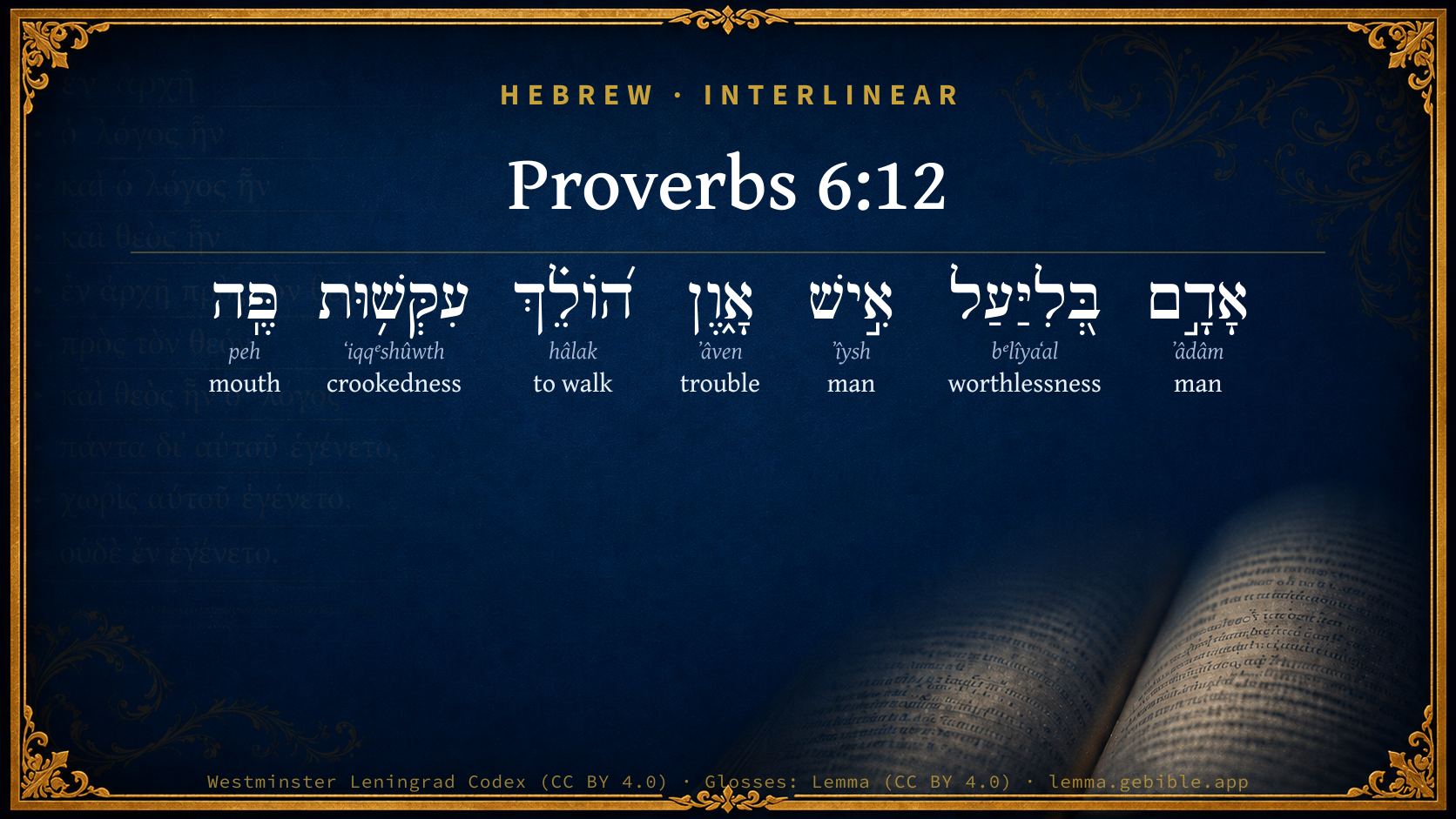
Proverbs 6:12

Hebrew (Westminster Leningrad Codex) Proverbs 6:12 appears in the Hebrew Old Testament. The text above is from the Westminster Leningrad Codex. Each word links to its Strong’s number, a concise gloss, and parsing drawn from the Open Scriptures Hebrew Bible morphology. Click any word for its full Brown-Driver-Briggs (BDB) entry.
Download image
Cite this verse

Proverbs 6:12 (World English Bible). Public Domain. Lemma interlinear Bible study tool, https://lemma.gebible.app/v/proverbs/6/12.

Show BibTeX & RIS
BibTeX
RIS
English Translation
A worthless person, a man of iniquity, Is he who walks with a perverse mouth;
World English Bible · Public Domain
Download a study sheet

One document with this verse’s original text, its word-by-word gloss line, the meaning frame, cross-references with their text, attributed commentary, and full source and license credits — printable, and it pastes into notes with its structure intact.

This verse Autodidact and up

Study sheet (.html) Plain text (.txt)

A passage Seminary Student

Up to 50 verses in one chapter. A passage sheet keeps up to 6 commentary sources and 12 cross-references per verse, in the order this page ranks them, and says so on the sheet whenever that leaves anything out. Ask for a single verse and you get the Autodidact verse sheet above.

Everything on this page stays free to read, with no account — the sheet is a download of what is already on screen, not access to it.

Want to remove ads? Support Godless Engineer
Compare translations 3

The same verse in 3 English versions, stacked beneath the original-language interlinear above. Click any original word for its lexicon entry.

Each is an independent rendering of the whole verse — the interlinear is not word-aligned to these translations.

Highlighted words mark where these versions differ — a whole-verse word diff, not a word-by-word alignment.

  • World English Bible Public Domain
    A worthless person, a man of iniquity, Is he who walks with a perverse mouth;
  • King James Version Public Domain
    A naughty person, a wicked man, walketh with a froward mouth.
  • unfoldingWord Literal Text CC BY-SA 4.0
    A man of worthlessness, a man of iniquity, one who walks perversity of mouth,

unfoldingWord Literal Text — © unfoldingWord, licensed CC BY-SA 4.0. Word-aligned USFM3 via Door43 (git.door43.org/unfoldingWord/en_ult).

Versions to compare (up to 4)

3 of 4 selected

Show all 18 translations

Every available English version of this verse, each an independent rendering of the whole verse.

  • World English Bible Public Domain
    A worthless person, a man of iniquity, Is he who walks with a perverse mouth;
  • Berean Standard Bible Public Domain
    A worthless person, a wicked man, walks with a perverse mouth,
  • Majority Standard Bible Public Domain
    A worthless person, a wicked man, walks with a perverse mouth,
  • King James Version Public Domain
    A naughty person, a wicked man, walketh with a froward mouth.
  • American Standard Version (1901) Public Domain
    A worthless person, a man of iniquity, Is he that walketh with a perverse mouth;
  • Revised Version (1885) Public Domain
    A worthless person, a man of iniquity; he walketh with a froward mouth;
  • Geneva Bible (1599) Public Domain
    The vnthriftie man and the wicked man walketh with a froward mouth.
  • Douay-Rheims (1899) Public Domain
    A man that is an apostate, an unprofitable man, walketh with a perverse mouth,
  • Young's Literal Translation Public Domain
    A man of worthlessness, a man of iniquity, Walking `with' perverseness of mouth,
  • Literal Standard Version CC BY-SA 4.0
    A man of worthlessness, a man of iniquity, || Walking [with] perverseness of mouth,
  • Unlocked Literal Bible CC BY-SA 4.0
    A worthless person—a wicked man— lives by the crookedness of his speech,
  • unfoldingWord Literal Text CC BY-SA 4.0
    A man of worthlessness, a man of iniquity, one who walks perversity of mouth,
  • Darby Bible Public Domain
    A man of Belial, a wicked person, is he that goeth about with a perverse mouth;
  • World Messianic Bible Public Domain
    A worthless person, a man of iniquity, is he who walks with a perverse mouth,
  • Webster's Bible Public Domain
    A naughty person, a wicked man, walketh with a froward mouth.
  • Free Bible Version CC BY-SA 4.0
    Rebellious and wicked people go around telling lies,
  • Bible in Basic English Public Domain
    A good-for-nothing man is an evil-doer; he goes on his way causing trouble with false words;
  • JPS Tanakh (1917) Public Domain
    A base person, a man of iniquity, is he that walketh with a froward mouth;

Literal Standard Version (2020), Covenant Press — licensed CC BY-SA 4.0. Text via the HelloAO Bible API (eBible.org). Unlocked Literal Bible (unfoldingWord) — licensed CC BY-SA 4.0. Text via the HelloAO Bible API (eBible.org). unfoldingWord Literal Text — © unfoldingWord, licensed CC BY-SA 4.0. Word-aligned USFM3 via Door43 (git.door43.org/unfoldingWord/en_ult). Free Bible Version, Dr. Jonathan Gallagher — licensed CC BY-SA 4.0. Text via the HelloAO Bible API (eBible.org).

Word by word

More ways to search: Search by grammar → Find every occurrence → Compare this word →

Practice this passage: Drill this verse → Learn its vocabulary →

About this verse

These counts appear in no published source. They are computed here, from the morphology-tagged text and Lemma’s own curated glosses. What Lemma adds →

7
words
7
distinct lemmas
Wisdom
section

Notable vocabulary

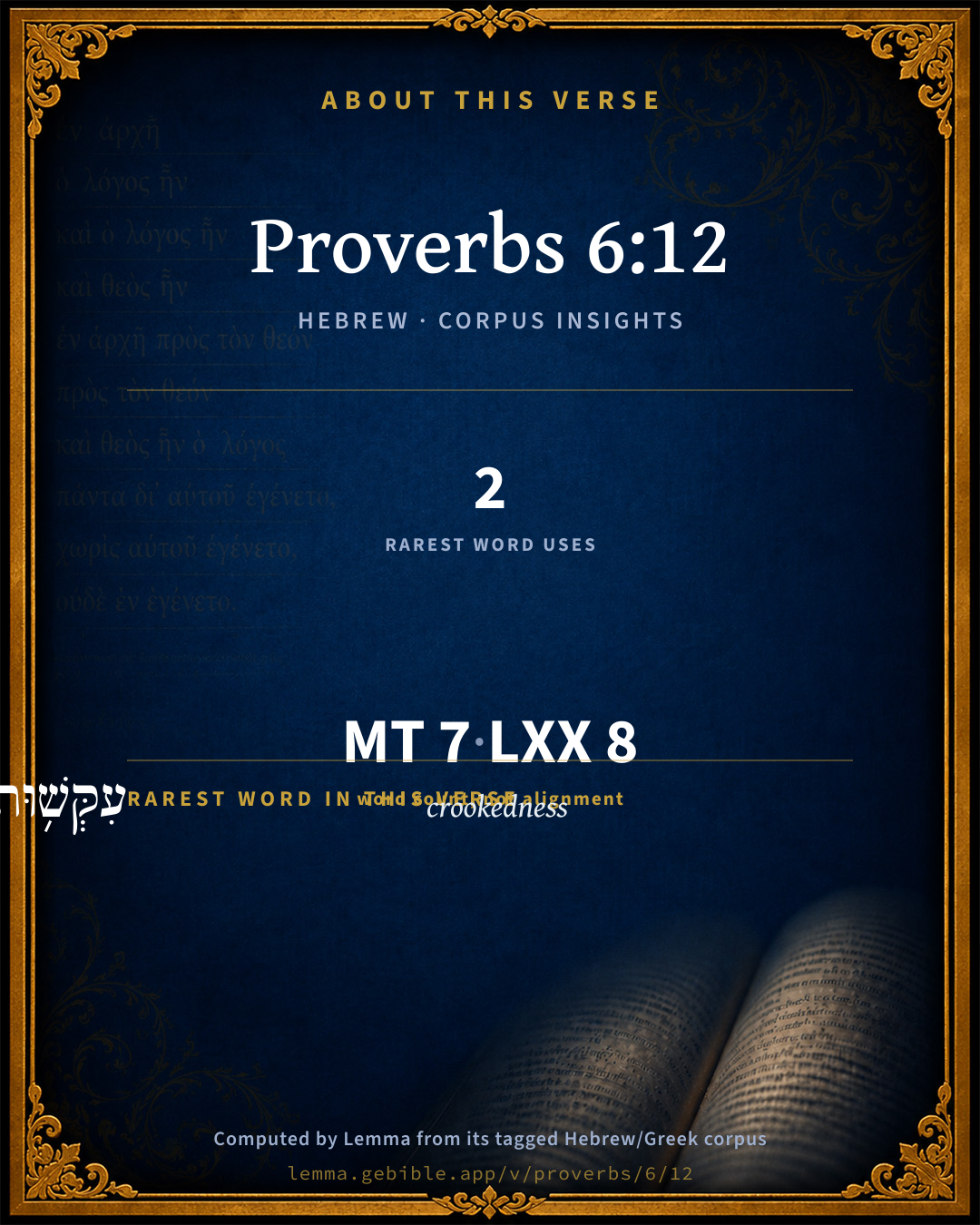
The rarest word here is עִקְּשׁ֥וּת crookedness H6143 — appearing just 2 times in the whole Hebrew Bible.

Shared distinctive vocabulary

עִקְּשׁ֥וּת crookedness H6143 occurs in 2 verses of the Hebrew Bible. Also found in:

Grammatical profile

  • 1 verb
  • 6 nouns

Verb forms

  • ה֝וֹלֵ֗ךְ Qal · Participle Active

Hebrew & Septuagint length

In English translation the verse runs 15 words from the Hebrew and 13 from the Septuagint (LXX English) — closely comparable.

A rough comparison of the two English renderings, which tokenize alike — not a word-level alignment.

Word counts can differ between the Hebrew and the Greek without any difference in meaning — e.g. the Hebrew direct-object marker אֵת has no separate Greek word, and Greek often adds the article ὁ.

In the original languages it is 7 Hebrew tokens and 8 Greek tokens — but the two are counted differently (Hebrew bundles its prefixes and suffixes into one token; the Greek is in lemma form), so that isn’t a like-for-like length.

Cross-references

22

Topical passages linked to Proverbs 6:12 in the Treasury of Scripture Knowledge — connected by theme and wording, ordered by reader-vote popularity; previews shown in the World English Bible.

  • Matthew 12:34 You offspring of vipers, how can you, being evil, speak good things? For out of the abundance of the heart, the mouth speaks.
  • Proverbs 4:24 Put away from yourself a perverse mouth. Put corrupt lips far from you.
  • Proverbs 16:27 A worthless man devises mischief. His speech is like a scorching fire.
  • 1 Timothy 5:13 Besides, they also learn to be idle, going about from house to house. Not only idle, but also gossips and busybodies, saying things which they ought not.
  • Psalms 52:2–4 Your tongue plots destruction, Like a sharp razor, working deceitfully.
  • Psalms 59:7 Behold, they spew with their mouth. Swords are in their lips, "For," they say, "who hears us?"
  • Proverbs 8:13 The fear of Yahweh is to hate evil. I hate pride, arrogance, the evil way, and the perverse mouth.
  • Proverbs 17:4 An evil-doer heeds wicked lips. A liar gives ear to a mischievous tongue.
  • Acts 20:30 Men will arise from among your own selves, speaking perverse things, to draw away the disciples after them.
  • Titus 1:10–11 For there are also many unruly men, vain talkers and deceivers, especially those of the circumcision,
  • Psalms 10:3 For the wicked boasts of his heart's cravings, He blesses the greedy, and condemns Yahweh.
  • Psalms 10:7 His mouth is full of cursing, deceit, and oppression. Under his tongue is mischief and iniquity.
  • Psalms 36:3 The words of his mouth are iniquity and deceit. He has ceased to be wise and to do good.
  • Psalms 73:8–9 They scoff and speak with malice. In arrogance, they threaten oppression.
  • Proverbs 2:12 To deliver you from the way of evil, From the men who speak perverse things;
  • Proverbs 6:14 In whose heart is perverseness, Who devises evil continually, Who always sows discord.
  • Proverbs 11:6 The righteousness of the upright shall deliver them, But the unfaithful will be trapped by evil desires.
  • James 3:6 And the tongue is a fire. The world of iniquity among our members is the tongue, which defiles the whole body, and sets on fire the course of nature, and is set on fire by Gehenna.
  • 1 Samuel 17:28 Eliab his eldest brother heard when he spoke to the men; and Eliab's anger was kindled against David, and he said, Why are you come down? and with whom have you left those few sheep in the wilderness? I know your pride, and the naughtiness of your heart; for you have come down that you might see the battle.
  • Jeremiah 24:2 One basket had very good figs, like the figs that are first-ripe; and the other basket had very bad figs, which could not be eaten, they were so bad.
  • Jeremiah 24:8–10 As the bad figs, which can't be eaten, they are so bad, surely thus says Yahweh, So will I give up Zedekiah the king of Judah, and his princes, and the residue of Jerusalem, who remain in this land, and those who dwell in the land of Egypt,
  • James 1:21 Therefore, putting away all filthiness and overflowing of wickedness, receive with humility the implanted word, which is able to save your souls.

Cross-references courtesy of OpenBible.info (CC BY 4.0).

Hebrew and Greek witnesses Masoretic Hebrew ↔ Greek Septuagint

The same verse in the two great witnesses to the Old Testament, shown verse-for-verse.

These are two independent witnesses, not word-aligned to each other, and the Septuagint is shown in lemma (dictionary) form.

Hebrew Proverbs 6:12 Masoretic · Westminster Leningrad Codex

אָדָ֣ם בְּ֭לִיַּעַל אִ֣ישׁ אָ֑וֶן ה֝וֹלֵ֗ךְ עִקְּשׁ֥וּת פֶּֽה

A worthless person, a man of iniquity, Is he who walks with a perverse mouth;

World English Bible · Public Domain

Greek LXX Proverbs 6:12 Septuagint · lemma form

ἀνήρ ἄφρων καί παράνομος πορεύομαι ὁδός οὐ ἀγαθός

A foolish man and a transgressor goes in ways that are not good.

LXX2012 (modern English Septuagint) · Public Domain

On this verse, Keil & Delitzsch discusses the Septuagint’s reading. Read the note in Commentary ↓

Hebrew: Westminster Leningrad Codex (CC BY 4.0). Greek: Septuagint (public domain); English from LXX2012 (modern English Septuagint) (Public Domain). How the Septuagint differs from the Hebrew →

Commentary

Notes on Proverbs 6:12 from classic Christian and Jewish commentators (each source and its license shown beneath its notes). The classic Christian expositions comment on the surrounding passage and are grouped to its opening verse, so a note may address several verses; the Jewish commentaries on the Tanakh (Rashi and others) are per-verse, so they appear only where the commentator wrote on this verse.

Lemma curates 59 commentaries, every one of them public domain or Creative Commons licensed, each selected and text-cleaned for this edition rather than reprinted as found. About our sources →

Matthew Henry's Commentary

Solomon here gives us,

I. The characters of one that is mischievous to man and dangerous to be dealt with. If the slothful are to be condemned, that do nothing, much more those that do ill, and contrive to do all the ill they can. It is a naughty person that is here spoken of, Heb. A man of Belial; I think it should have been so translated, because it is a term often used in scripture, and this is the explication of it. Observe,

1. How a man of Belial is here described. He is a wicked man, that makes a trade of doing evil, especially with his tongue, for he walks and works his designs with a froward mouth (Pro 6:12), by lying and perverseness, and a direct opposition to God and man. He says and does every thing, (1.) Very artfully and with design. He has the subtlety of the serpent, and carries on his projects with a great deal of craft and management (Pro 6:13), with his eyes, with his feet, with his fingers. He expresses his malice when he dares not speak out (so some), or, rather, thus he carries on his plot; those about him, whom he makes use of as the tools of his wickedness, understand the ill meaning of a wink of his eye, a stamp of his feet, the least motion of his fingers. He gives orders for evil-doing, and yet would not be thought to do so, but has ways of concealing what he does, so that he may not be suspected. He is a close man, and upon the reserve; those only shall be let into the secret that would do any thing he would have them to do. He is a cunning man, and upon the trick; he has a language by himself, which an honest man is not acquainted with, nor desires to be. (2.) Very spitefully and with ill design. It is not so much ambition or covetousness that is in his heart, as downright frowardness, malice, and ill nature. He aims not so much to enrich and advance himself as to do an ill turn to those about him. He is continually devising one mischief or other, purely for mischief-sake - a man of Belial indeed, of the devil, resembling him not only in subtlety, but in malice.

2. What his doom is (Pro 6:15): His calamity shall come and he shall be broken; he that devised mischief shall fall into mischief. His ruin shall come, (1.) Without warning. It shall come suddenly: Suddenly shall he be broken, to punish him for all the wicked arts he had to surprise people into his snares. (2.) Without relief. He shall be irreparably broken, and never able to piece again: He shall be broken without remedy. What relief can he expect that has disobliged all mankind? He shall come to his end and none shall help him, Dan 11:45.

II. A catalogue of those things which are in a special manner odious to God, all which are generally to be found in those men of Belial whom he had described in the foregoing verses; and the last of them (which, being the seventh, seems especially to be intended, because he says they are six, yea, seven) is part of his character, that he sows discord. God hates sin; he hates every sin; he can never be reconciled to it; he hates nothing but sin. But there are some sins which he does in a special manner hate; and all those here mentioned are such as are injurious to our neighbour. It is an evidence of the good-will God bears to mankind that those sins are in a special manner provoking to him which are prejudicial to the comfort of human life and society. Therefore the men of Belial must expect their ruin to come suddenly, and without remedy, because their practices are such as the Lord hates and are an abomination to him, Pro 6:16. Those things which God hates it is no thanks to us to hate in others, but we must hate them in ourselves. 1. Haughtiness, conceitedness of ourselves, and contempt of others - a proud look. There are seven things that God hates, and pride is the first, because it is at the bottom of much sin and gives rise to it. God sees the pride in the heart and hates it there; but, when it prevails to that degree that the show of men's countenance witnesses against them that they overvalue themselves and undervalue all about them, this is in a special manner hateful to him, for then pride is proud of itself and sets shame at defiance. 2. Falsehood, and fraud, and dissimulation. Next to a proud look nothing is more an abomination to God than a lying tongue; nothing more sacred than truth, nor more necessary to conversation than speaking truth. God and all good men hate and abhor lying. 3. Cruelty and blood-thirstiness. The devil was, from the beginning, a liar and a murderer (Joh 8:44), and therefore, as a lying tongue, so hands that shed innocent blood are hateful to God, because they have in them the devil's image and do him service. 4. Subtlety in the contrivance of sin, wisdom to do evil, a heart that designs and a head that devises wicked imaginations, that is acquainted with the depths of Satan and knows how to carry on a covetous, envious, revengeful plot, most effectually. The more there is of craft and management in sin the more it is an abomination to God. 5. Vigour and diligence in the prosecution of sin - feet that are swift in running to mischief, as if they were afraid of losing time or were impatient of delay in a thing they are so greedy of. The policy and vigilance, the eagerness and industry, of sinners, in their sinful pursuits, may shame us who go about that which is good so awkwardly and so coldly. 6. False-witness bearing, which is one of the greatest mischiefs that the wicked imagination can devise, and against which there is least fence. There cannot be a greater affront to God (to whom in an oath appeal is made) nor a greater injury to our neighbour (all whose interests in this world, even the dearest, lie open to an attack of this kind) than knowingly to give in a false testimony. There are seven things which God hates, and lying involves two of them; he hates it, and doubly hates it. 7. Making mischief between relations and neighbours, and using all wicked means possible, not only to alienate their affections one from another, but to irritate their passions one against another. The God of love and peace hates him that sows discord among brethren, for he delights in concord. Those that by tale-bearing and slandering, by carrying ill-natured stories, aggravating every thing that is said and done, and suggesting jealousies and evil surmises, blow the coals of contention, are but preparing for themselves a fire of the same nature.

Matthew Henry's Commentary on the Whole Bible (1708–1710) — public domain (CC PDM 1.0). Text via the HelloAO Bible API.

Ellicott's Commentary for English Readers

(k). Eleventh Discourse:—Against Deceit and Malice (Pro_6:12-19).

(12) A naughty person.—According to its original meaning, a “worthless” person, Heb. a man of Belial,

Froward mouth.—Comp. Pro_4:24.

A Bible Commentary for English Readers, edited by Charles John Ellicott (1878–1897) — public domain. Text from a community e-Sword module.

The Cambridge Bible for Schools and Colleges

gen. ed. J. J. S. Perowne

12. a naughty person] Lit. a man of Belial. The Heb. word Belial means, “of no profit,” “worthless,” and, according to the Heb. idiom, a man of, or a son of (Deu_13:13) Belial, is an unprofitable or worthless person. Here, however, the word “Belial” is in apposition with “man,” “a man (who is) worthless, a good-for-nothing fellow.” The word appears to have been personified by the later Jews, and is used in the form Belial, or Beliar, to denote Satan (2Co_6:15, where see note in this Series).

walketh] The R.V., following the Heb. pointing, is more abrupt and forcible:

A worthless person, a man of iniquity;

He walketh with a froward mouth.

Thirteenth Address. Chap. 6. Pro_6:12-19. The Worthless Person

This short section might seem at first sight to break itself into two (Pro_6:12-19). But the note of character, “he soweth discord,” repeated in Pro_6:19 from Pro_6:14, helps to identify the worthless person as being the subject throughout, and a closer examination exhibits the connection. Would you recognise the worthless man? Here is his description, Pro_6:12-14. Would you understand his end? Here is his destiny, Pro_6:15. Would you know what God, the Judge of all, sees in him to hate and punish? Here are the six, yea seven things that undo him, Pro_6:16-19. The connection is well worked out by Mr Horton, The Book of Proverbs, pp. 84–91.

The Cambridge Bible for Schools and Colleges (gen. ed. J. J. S. Perowne; Cambridge University Press, 1878–1918) — public domain. Text from a community e-Sword module.

Trapp's Complete Commentary

John Trapp

Pro 6:12 A naughty person, a wicked man, walketh with a froward mouth.

Ver. 12. A naughty person.] Lo, every idle man is a naughty man; is, or ere long will be; for by doing nothing, men learn to do evil, said the heathen. {a} And "thou wicked and slothful servant," saith our Saviour. {Mat 25:26} He puts no difference between nequam et nequaquam, an idle and an evil person. The devil also will not long suffer such a one to be idle, but will soon set him to work. Idleness is the hour of temptation.

A wicked man.] Or, An unprofitable man, vir nihili; good for nothing, but to eat, and drink, and sleep, and sport, and sit, and talk, and laugh, and be merry. These are nothing; nay, they are excrements in human society; that live in the world to no purpose, yea, to bad purpose. Oh, it is good, saith one {b} to do something whereby the world may be the better; and not to come hither merely as rats and mice, only to devour victuals, and to run squeaking up and down.

Walketh with a froward mouth.] Graditur ore perverso. Nothing more usual with idlebies than to go tattling up and down, prying, and spying, and carrying tales and rumours. {1Ti 5:13} {See Trapp on "1Ti 5:13"} It is nothing that they can do; they will say the more therefore; αργοι, περιεργοι. {2Th 3:11}

{a} Nihil agendo male agere discunt.

{b} Mr Wheatly.

John Trapp, A Commentary or Exposition upon All the Books of the Old and New Testament (1647–1656) — public domain. Text from a community e-Sword module.

The Biblical Illustrator

Joseph S. Exell

Pro_6:12

A naughty person, a wicked man, walketh with a froward mouth.

A bad man

I. The portrait of a bad man.

1. He is perverse in speech. He has no regard for truth or propriety. False, irreverent, impure, audacious.

2. He is artful in his conduct. Winketh with his eyes, etc. He expresses his base spirit in crafty and clandestine and cunning methods. He is anything but straightforward and transparent.

3. Mischievous in purpose. Deviseth mischief. Malevolence is his inspiration. He rejoiceth in evil.

II. The doom of a bad man. Therefore shall his calamity come suddenly. This doom is--

1. Certain. The moral laws of the universe and the Word of God guarantee the punishment of sin.

2. Sudden. Suddenly shall he be broken. The suddenness does not arise from want of warning, but from the neglect of warning.

3. Irremediable. Without remedy. When once his doom is fixed, there is no alteration. As the tree falls, so it must lie. (D. Thomas, D. D.)

False liberty

In human nature, as in every other, there is an innate love of freedom. But alas! in human nature, as fallen, this principle, good in itself, has taken a sadly perverse direction. It is too often the mere love of following, without restraint, our own inclinations. And while aversion to restraint is common to all, it is peculiarly strong in the bosom of youth. The freedom, not the want of it, is sometimes the thing really to be ashamed of. (R. Wardlaw.)

Naughtiness

A man of Belial. Perhaps an unthrifty man; certainly a lawless man. A man of naughtiness. A child of the devil.

I. A notoriously wicked man cares for no laws of God or man.

1. He hath stopped the mouth of his conscience with his sins.

2. He has no love to either God or man, therefore he disregards both.

3. He fears neither, and therefore slights their laws.

4. He sees many escape, and such examples harden their hearts.

II. Such a mans life is altogether wicked.

1. His thoughts are altogether earthly.

2. All his delight is in wickedness.

III. A perverse mouth is a sure mark of an ungodly man.

1. Few, or only the extremely wicked, will talk or boast of their wickedness.

2. When men are grown to this height they are beyond the Cape of Good Hope. A crooked mind will make a crooked mouth. Take heed. God hath given thee a mouth to speak to His glory, not to dishonour Him, nor to proclaim thine own shame. (Francis Taylor, B. D. )

The Biblical Illustrator, edited by Joseph S. Exell (c. 1880s–1900s) — public domain. Text from a community e-Sword module.

Joseph Benson's Commentary

Pro 6:12-15. A naughty person — Hebrew, a man of Belial, a wicked man, whose continual practice it is, in one way or other, to work wickedness; walketh with a froward mouth — Makes it his business, by lies; or flatteries, or slanders, or perjuries, to maintain himself in his idle courses. And if the slothful are to be condemned that do nothing, much more those that act wickedly, and contrive to do all the ill they can. He winketh with his eyes, &c. — He vents his wickedness, as by his speech, so also by his gestures, by which he secretly intimates what he is ashamed or afraid to express openly to his accomplices, his intentions or desires of doing some evil to some one; he teacheth with his fingers — Having declared his designs by the motion of his eyes, or feet, he points out the particular person by his fingers. Frowardness is in his heart — Perverse or wicked thoughts and desires. He soweth discord — Either out of malice against others, or out of a base design of improving it to his own advantage. Therefore shall his calamity come suddenly — And prove his utter ruin; suddenly shall he be broken — When he fancies he has conducted his matters so craftily that nobody discerns his villany, he shall, on a sudden, be looked upon as the pest of mankind, and, like a vessel broken in small pieces, shall be incurably undone.

Joseph Benson's Commentary on the Old and New Testaments (1811–1818) — public domain. Text from a community e-Sword module.

Whedon's Commentary on the Bible

Daniel D. Whedon

PICTURE OF THE WICKED MAN AND HIS DESTINY, Pro_6:12-15.

12. A naughty person — Literally, a man of Belial, or, a man of worthlessness. Compare Deu_13:13 : Jdg_19:22.

A wicked man… froward mouth — The man of worthlessness is, perhaps, the predicate, and “a wicked man” the subject, to be connected by is; and so we may render, A wicked man is a man of worthlessness. And so Noyes spiritedly renders the passage:

“A wicked man is a worthless wretch,

Who walketh with a deceitful mouth,

Who winketh with his eyes,

Speaketh with his feet,

And teacheth with his fingers.”

The picture of the wicked man, with his language of signs, is drawn as far as the close of Pro_6:14; with the therefore of Pro_6:15 commences his destiny. Miller translates, “A worthless man, utterly vain, talking with his eyes, speaking with his feet, motioning with his fingers, with upturnings in his heart, fabricating evil, will be putting forth grounds of quarrel all the time.” The last clause is translated rather freely, the rest may pass. He makes that clause the apodosis of all that precedes.

Daniel D. Whedon (gen. ed.), Commentary on the Old and New Testaments (1874–1909) — public domain. Text from a community e-Sword module.

The Preacher's Complete Homiletical Commentary

Joseph S. Exell (gen. ed.)

CRITICAL NOTES,—

Pro_6:12. A naughty person, “a worthless man.”

Pro_6:13. Teacheth, “motions.”

Pro_6:14. Frowardness, “perverseness.”

Pro_6:16. Six, yea, seven. “A peculiar proverbial form, for which Arabic and Persian gnomic literature supply numerous illustrations. Eister probably gives the simplest and most correct explanation, deriving it “purely from the exigencies of parallelism.” “The form of parallelism could not, on account of harmony, be sacrificed in any verse. But how should a parallel be found for a number? Since it was not any definite number that was the important thing, relief was found by taking one of the next adjacent numbers as the parallel to that which was chiefly in mind” (Lange’s Commentary).

Pro_6:17. A proud look, literally, “haughty eyes.”

MAIN HOMILETICS OF THE PARAGRAPH—Pro_6:12-19

A STUDENT OF INIQUITY

I. We have in these words a picture of a man so wicked that he makes it his study how to commit sin. The sin of many men, perhaps of most men, arises from thoughtlessness, weakness, or slothfulness (see Pro_6:9-10), but there are others who make sin their business, and apply themselves to it with as much diligence as the merchant gives to his trade, or the man of letters to his pursuit of knowledge. “He deviseth mischief” (Pro_6:14), “his heart deviseth wicked imaginations” (Pro_6:18). Those who wish to compass any particular end must think upon the means by which they can accomplish it. Progression in iniquity is not always accomplished without thought, and wicked men have to plan much and think deeply sometimes before their malicious devices are ripe for execution. The thief has to study his profession before he can become an accomplished burglar. The sharper must spend much time in acquiring the skill by which he preys upon less experienced gamblers. The murderer must ponder deeply how he is to do his bloody deed without detection. It cost Haman a good deal of thinking before he could devise a scheme likely to injure Mordecai. The chief priests and scribes held many consultations before they could compass the death of Christ (Mar_11:18; Mar_14:1-55, etc.). The wicked man of the text is a student of ways and means.

2. He is constant in his studies. If a man professes to make any branch of knowledge his particular study and only applies himself to it by fits and starts, we know he is not much in earnest about it, but if he is constant in his application, he demonstrates by his perseverance that he intends, if possible, to excel. The wicked man here pictured by Solomon has made up his mind not to fail through lack of continuous application, “he deviseth mischief continually” (Pro_6:14). If one plan fails, he begins to form another; when one scheme has brought the desired end, he at once sets to work at a fresh one; as a natural consequence—

3. He makes progress, “he walks with a froward mouth” (Pro_6:12), his feet become “swift in running to mischief” (Pro_6:18). The man who is always in the practice of any art can hardly stand still in it. He can hardly fail to become more and more of an adept. He sees where he might have done better yesterday and supplies the deficiency next time. And this is true of the work of wickedness as of any other work, “practice makes perfect.” There are men, for instance, who from constant practice “lie like truth.” The more the man studies how to injure his fellow-creatures, the more easily he can plan; the oftener he plans, the easier he finds it.

4. In order to carry out his designs he invents an original language (Pro_6:13). There is no member of the body which cannot become a medium to convey thought. The eye is very eloquent in this work, the hand, the lip, the finger, the whole body may do this to some extent, and are sometimes blessedly so employed when affliction has shut out our fellow-man from hearing the human voice, but this man of wickedness makes his whole body a medium for the conveyance of his evil plans and desires. He yields his “members as instruments of unrighteousness unto sin” (Rom_6:13). The common every-day language of outspoken honest men will not do to convey his thoughts, because his thoughts are against the welfare of his fellow creatures. This compels him to use a language which is comprehended only by those who are like himself. The eye can be used in this way as a more safe and swift instrument than the tongue. A look may embody a thought that would need many words to express. The glance of one wicked man to another has often been the sentence of death to many. And so, in a less degree, perhaps, with the foot and the hand, as Matthew Henry says, “Those whom he makes use of as the tools of his wickedness understand the ill meaning of a wink of his eye, a stamp of his feet, the least motion of his fingers. He gives orders for evil-doing, and yet would not be thought to do so, but has ways of concealing what he does, so that he may not be suspected.”

II. The end of such a man. (Pro_6:15.)

1. His very success will bring his ruin. The man who makes it the business of his life to lay plans against the comfort of his fellow-creatures may succeed for a time, but by-and-by he will find himself so famous, or infamous, that a reward may be offered for his person, and his very success in deceiving others in the past will possibly so throw him off his guard as to make him an easy prey to those who now lay in wait to bring him to justice. But if he escapes the messenger of human retribution, he is sure of the Divine Nemesis. God’s law and the universe are against him. In sowing discord in the world, he has sowed destruction for himself, and he must reap it. However cleverly he may have outwitted his fellow-men, he has not deceived God, and His law is that “Whatsoever a man soweth, that shall he also reap” (Eph_6:7).

2. The punishment will come when least expected. “Suddenly shall he be broken” (Pro_6:15). The thief makes it his study to find an entrance into his victim’s house when he least expects him, and he finds himself one day repaid in his own coin. When he is enjoying his fancied security an officer of justice visits him, and suddenly he is summoned to answer for his crimes. This we find is generally the case with retribution; it not only comes certainly, but at a time when it is least looked for.

3. His ruin will be complete. “He shall be broken without remedy” (Pro_6:15). The crime of murder is regarded by our code of law as one which deserves the extremest penalty which man can inflict upon man. The murderer, as a rule, is visited with a punishment which, so far as his earthly existence goes, cuts off all hope for the future. The man who is pictured to us in these verses is one who appears to have completed his character as a sinner. The number seven is often used in Scripture to denote perfection—completion; and this student of iniquity appears to have succeeded so well in his studies that there is no vice which is not found in one of the seven things which go to make up his character. His pride leads him to refuse God’s yoke, and to carve out for himself a way without reference to the will of Him in whom he lives and moves. But his lying tongue betrays a sense of weakness. He fears that his plans, though so skilfully laid, may not succeed, and therefore he has recourse to deception to help him out with them. And so cruel is he that he shrinks from no misery that he may bring upon others in the furtherance of his own designs; neither the character nor the life of his victims is spared. He is “a false witness that speaketh lies and soweth discord,” his “hands shed innocent blood.” For so diseased a member of the body politic there seems nothing left but amputation. So complete a sinner must suffer a complete ruin, Finally, that such a character should be an abomination to the Lord (Pro_6:16) is most natural, if we consider how entirely it is at variance with what God is Himself. Like seeks and loves like. The musical soul seeks and delights in those who love music. The courageous Jonathan delights in the courageous David. God is humble. He takes a right estimate of Himself and others. This is true humility. “Who is like unto the Lord our God, who dwelleth on high, who humbleth Himself to behold the things that are in heaven and in the earth?” (Psa_113:5-6). How great a contrast is He in this respect to the man of “proud look.” God is a “God of truth” (Psa_31:5), it is a blessed impossibilty with Him to lie (Tit_1:2). How can He do other than abominate a “lying tongue.” He is the Saviour of men (1Ti_4:10); this sinner seeks to destroy them. He is the Author of peace and the lover of concord; this man’s aim has been to “sow discord” even “among brethren.”

ILLUSTRATION OF Pro_6:13

It should be remembered that, in the East, when people are in the house they do not wear sandals, consequently their feet and toes are exposed. When guests wish to speak so as not to be observed by the host, they convey their meaning by the feet and toes. Does a person wish to leave the room in company with another? he lifts up one of his feet; and should the other refuse, he also lifts up a foot and suddenly puts it down again. When merchants wish to make a bargain with others without making known their terms, they sit on the ground, have a piece of cloth thrown over the lap, and then put a hand under, and thus speak with their fingers. When the Brahmins convey religious mysteries to their disciples, they teach with their fingers, having the hands concealed in the folds of their robe.—Roberts, in Biblical Treasury.

OUTLINES AND SUGGESTIVE COMMENTS

Pro_6:12. He who is nobody in deeds is often strong in words. He whose hands are idle has a tongue anything but idle; and he tries by words suited to men’s humours to win that favour which he cannot by deeds.—Cartwright.

“Walketh” implies progress in evil, as the tendency of all sin is to grow more and more inveterate.—Fausset.

Every idle man is a “naughty” man; is, or, ere long, will be, for by doing nothing men learn to do evil. And “thou wicked and slothful servant,” saith our Saviour (Mat_25:26). He putteth no difference between the idle person and the wicked person. The devil will not long suffer such an one to be idle, but will soon set him to work. Idleness is the hour of temptation.—Trapp.

Pro_6:13. He conveys his meanings, and carries on his schemes, and promotes his ends, in every sly, covert, unsuspected way.—Wardlaw.

Not speech only, but all other means by which man holds intercourse with man, are turned to instruments of fraud and falsehood. The wink which tells the accomplice that the victim is already snared, the gestures with foot and hand, half of deceit, half of mockery—these would betray him to anyone who was not blind.—Plumptre.

Pro_6:14. The wise man had showed before the outward rivulets, now he shows the inward fountain, a corrupt heart. This is added lest we should think that only outward signs and gestures are evil. If neither by outward signs nor gestures a wicked man dare express himself, yet his heart is evil—Francis Taylor.

As the agriculturist applies himself wholly to the ploughing and sowing of his land, so the froward gives himself wholly to iniquity, seeking his harvest of gain, or of enjoyment of malignity, in traducing or lying, or in praising with words whilst all the time traducing by signs.—Fausset.

Where frowardness soweth the field, what can grow but contentions only? But these are first sown in the heart by mischievous devices, and there being come to a ripeness, then are they gathered, and are again sown in the outward actions of discord, one harvest serving to bring on another until they bring the seedsman to the harvest of destruction. The force of the verse is, that when wickedness is silent outwardly, it is devising mischief inwardly, that it may practice it the more abundantly.—Jermin.

Pro_6:15. Therefore, if a thing be so ruinous; if it be a fountain of sin; if it be sending forth corruption in such a manner as to increase the mass of it, and never diminish it; if it be putting forth causes of quarrel both with God and man, then that thing must be crushed. We would expect a sharp, clean end. If it be a root, it must be threaded to its very eye, and all the life of it must be traced and crushed quite out of it in the soil.—Miller.

The word “suddenly” shows the vanity of the sinner’s hope that he shall have the time or the gift of repentance (Job_21:17-18; Psa_64:4).—Fausset.

It were pity such a villain should go without his reward. The wise man, therefore, doth not leave him without his judgment denounced, and it is a grievous one. For he that spendeth time to devise mischief shall not have time at last to devise help for the preventing of his own sudden mischief. He that by plots maketh the breaches of strife, shall at length be broken suddenly into pieces, without hope of piecing himself together again.… Of Satan it is said that he fell like lightning from heaven, the fall whereof is most sudden, and so that it never riseth again. And so cometh the calamity of malicious, froward hearts: such is the breaking fall of their destruction.—Jermin.

Pro_6:16. This, curtly, is a restatement of the picture just passed; not exactly, but ripened a little, and advanced into a more mature expression.—Miller.

It is an evidence of the good-will God bears to mankind, that those sins are in a special manner provoking to Him which are prejudicial to the comfort of human life and society.—Henry.

The things which God hateth are the things which the devil maketh. He cannot be the author and hater of the same thing. And therefore it is not man, but the wicked things in man, which God abhorreth, and which, did not man love, God would still love man, although He hateth them.—Jermin.

Pro_6:17. A proud look or “lofty eyes” might seem to have little to do with a “worthless man” (see Critical Notes on Pro_6:12), but a man is a man of emptiness solely because he is depending, in divers ways, upon himself. Humility is the very first lesson towards salvation. A man could not live a whole long life taking “a little more sleep” if he was not arrogantly depending upon something within himself. “Hands that shed innocent blood:” The movements of such a man are all deadly. The amiable may be fairly stung by such rude speech, but the wise man intends to imply that a deceived impenitence deceives and festers all about it. The worldly father that misguides his son sheds his blood. It is astonishing how much there is in the Bible of this cruel language (Psa_5:9; Isa_1:21, &c.).—Miller.

Pro_6:18. The heart underlies the seven vices which are an abomination to God, and in the midst, because it is the fountain from which evil flows in all directions.—Starke.

Pro_6:19. If the heavenly “dew descends upon the brethren that dwell together in unity” (Psalms 133), a withering blast will fall on those who, mistaking prejudice for principle, “cause divisions” for their own selfish ends (Rom_16:17-18). If we cannot attain unity of opinion, “perfectly joined together in the same mind and in the same judgment” (1Co_1:10), at least let us cultivate unity of Spirit (Php_3:16).—Bridges.

Pro_6:12-19. As respects the arrangement in which the seven manifestations of treacherous dealing are enumerated in Pro_6:16-19, it does not perfectly correspond with the order observed in Pro_6:12-14. There the series is—mouth, eyes, feet, fingers, heart, devising evil counsels, stirring up strifes; here it is eyes, tongue, hands, heart, feet, speaking lies, instigating strife. With reference to the organs which are named as the instruments in the first five forms of treacherous wickedness, in the second enumeration an order is adopted involving a regular descent; the base disposition to stir up strife, or to let loose controversy in both cases ends the series.… The six or seven vices, twice enumerated in different order and form of expression, are, at the same time, all of them manifestations of hatred against one’s neighbour, or sins against the second table of the Decalogue; yet it is not so much a general unkindness as rather an unkindness consisting and displaying itself in falseness and malice that is emphasised as their common element. And only on account of the peculiarly mischievous and ruinous character of just these sins of hatred to one’s neighbour, is he who is subject to them represented as an object of especially intense abhorrence on the part of a holy God, and as threatened with the strongest manifestations of His anger in penalties.—Dr. Zöckler, in Lange’s Commentary.

Pro_6:16-19. There is one parallel well worthy of notice between the seven cursed things here and the seven blessed things in the fifth chapter of Matthew. In the Old Testament the things are set down in the sterner form of what the Lord hates, like the “Thou shalt not” of the Decalogue. In the New Testament the form is in accordance with the gentleness of Christ. There we learn the good things that are blessed, and are left to gather thence the opposite evils that are cursed. But, making allowance for the difference in form, the first and the last of the seven are identical in the two lists. “The Lord hates a proud look” is precisely equivalent to “Blessed are the poor in spirit;” and “He that soweth discord among brethren” is the exact converse of the “peacemaker.” This coincidence must be designed. When Jesus was teaching His disciples on the Mount He seems to have had in view the similar instructions that Solomon had formerly delivered, and, while the teaching is substantially new, there is as much of allusion to the ancient Scripture as to make it manifest that the Great Teacher kept His eye upon the prophets, and sanctioned all their testimony.—Arnot.

The Preacher's Complete Homiletical Commentary (gen. ed. Joseph S. Exell; Funk & Wagnalls, c. 1892) — public domain (pre-1929). A full-Bible homiletical/sermon-outline anthology covering 65 of 66 books (2 John is absent from the source module). Text from a community e-Sword module.

Keil & Delitzsch

C. F. Keil & F. Delitzsch

There follows now a third brief series of instructions, which run to a conclusion with a deterring prospect similar to the foregoing.

12 A worthless man, a wicked man,

Is he who practiseth falsehood with his mouth;

13 Who winketh with his eyes, scrapeth with his foot,

Pointeth with his fingers.

14 Malice is in his heart,

He deviseth evil at all times,

He spreadeth strife.

15 Therefore suddenly his destruction shall come,

Suddenly shall he be destroyed, and there is no remedy.

It is a question, what is the subject and what the predicate in Pro 6:12. Thus much is clear, that upon him who is here described according to his deceitful conduct the sentence of condemnation shall fall. He who is so described is thus subject, and אדם בּליּעל is without doubt predicate. But does the complex subject begin with אישׁ און? Thus e.g., Hitzig: "A worthless man is the wicked man who...." But the interchange of עדם and אישׁ is a sign of parallel relation; and if 12b belonged attributively to אישׁ און, then since אישׁ האון is not used, it ought at least to have been continued by ההולך. The general moral categories, 12a, are thus predicates, as was indeed besides probable; the copious division of the subject demands also in point of style a more developed predicate. Pro 16:27 is simpler in plan, and also logically different. There the expression is, as is usual, אישׁ בליעל. Since אדם און is not possible, the author uses instead בליעל. This word, composed of בּלי and יעל (from יעל, ועל, to be useful, to be good for), so fully serves as one word, that it even takes the article, Sa1 25:25. It denotes worthlessness, generally in a chain of words in the genitive, but also the worthless, Job 34:18; and it is to be so taken here, for אדם does not form a constructivus, and never governs a genitive. בליעל is thus a virtual adjective (as nequam in homo nequam); the connection is like that of אדם רשׁע, Pro 11:7, and elsewhere, although more appositional than this pure attributive. Synonymous with בליעל is און (from an, to breathe), wickedness, i.e., want of all moral character. Thus worthless and wicked is he who practises deceit with his mouth (cf. Pro 4:24), i.e., who makes language the means of untruthfulness and uncharitableness. עקּשׁוּת פּה is meant in a moral sense, but without excluding that distortion of the mouth which belongs to the mimicry of the malicious. It is the accus. of the object; for הלך is also bound in a moral sense with the accusative of that which one practises, i.e., dealing with, exercises himself in, Pro 2:7; Pro 28:18, Isa 33:15.

Pro 6:13

קורץ בּעיניו is translated according to the sense: who winks (nictat) with his eyes; but that is not the proper meaning of the word, for קרץ is used not only of the eyes. Pro 10:10 (cf. Pro 16:30, qui oculos morsicat or connivet), Psa 35:19, but also of the lips, Pro 16:30. Thus Lwenstein's explanation: who opens up the eyes, is incorrect. The verb קרץ unites in it the meanings of Arab. qrts, to pinch off with a sharp implement, and Arab. qrd, with a blunt instrument (Arab. miḳraḍ, pincers). It means to pince, to nip, as Arab. ḳarṣ, pincer - e.g., ḳarṣ balskyn alarsasat, he cuts off with the knife the leaden seal - hence frequently, to nip together the eyes, provincially: to wink ("zwickern," frequent. of "zwicken," to nip) with the eyes - the action of the deceiver, who thereby gives the sign to others that they help or at least do not hinder him from bantering and mocking, belying and deceiving a third person (Fl.); cf. Ali's proverb, "O God, pardon to us the culpable winking with the eye (ramzat)," and Fleischer's notes thereon, the Proverbs of Ali, p. 100f.

That the words which follow, בּרגליו מולל, are meant of discourse, i.e., the giving of signs, with the feet, and, so to say, significant oratio pedestris (lxx, Aben-Ezra, Bertheau, Hitzig, and others), is very improbable, since the usage of language has set apart the Piel מלּל for the meaning loqui, and מולל admits another suitable signification, for מולל means in Talmudic fricare, confricare - e.g., המולל מלילות, he who grinds the parched ears of corn (b. Beza 12b; Ma'seroth, iv. 5) - after which Syr., Targ., תכס (stamping), Aq. τρίβων, Symm. προστρίβων, Jerome, (qui) terit pede, and Rashi משׁפשׁף (grinding, scratching); it means one who scrapes with his feet, draws them backwards and forwards on the ground in order thereby to give a sign to others; also the Arab. mll, levem et agilem esse, which as the synonym of Arab. sr is connected with Arab. fı̂ of the way, signifies properly to move the feet quickly hither and thither (Fl.).

(Note: The root-idea of the Arab. mall is unquietness of motion; the Arab. noun mallt signifies the glow with its flickering light and burning: glowing ashes, inner agitation, external haste; Arab. malil (מלל) is the feverish patient, but also one quickly hastening away, and generally an impatient or hasty person (vid., Wetstein in Baudissin in his Job. Tischendorfianus, vii. 6). The grinding is made by means of a quick movement hither and thither; and so also is speaking, for the instrument of speech, particularly the tongue, is set in motion. Only the meaning praecidere, circumcidere, does not connect itself with that root-idea: מל in this signification appears to be a nance of מר, stringere.)

מרה appears here, in accordance with its primary signification (projicere, sc. brachium or digitum = monstrare), connected with בּעצבּעתיו; another expression for this scornful, malicious δακτυλοδεικνεῖν is שׁלח אצבּע, Isa 58:9.

Pro 6:14

In this verse is continued the description of the subject, only once returning to the particip. The clauses are arranged independently, but logically according to the complex conception of the subject. תּהפּכות .tce are just the knaveries, i.e., the malicious wickedness which comes to light in word and deportment as עקשׁות פה. Regarding the double figure of the smithy and of agriculture underlying חרשׁ, machinari, vid., at Pro 3:29, and regarding the omission of the הוּא to חרשׁ, at Psa 7:10. The phrase שׁלּח מדנים (as Pro 6:19, Pro 16:28), to let loose disputes, so that they break forth, reminds us rather of the unfettering of the winds by Aeolus than of the casting in of the apple of discord. Instead of מדנים the Kerı̂ has מדינים; on the other hand, מדנים remains uncorrected Pro 6:19; Pro 10:12. The form מדינים occurs once, Pro 18:18, and its constr. מדיני once, Pro 19:13. Everywhere else the text has מדונים, for which the Kerı̂ has מדינים, Pro 18:19; Pro 21:9, Pro 21:19; Pro 23:29; Pro 25:24; Pro 26:21; Pro 27:15. The forms מדין and מדן are also recognised: the former stands alone without any analogous example; the latter is compared at least with מצד, Arab. masâd (Psalmen, p. 163, 3). Probably these two forms are warranted by Gen 25:2, cf. Gen 37:28, Gen 37:36, where מדין and מדן occur as the names of two sons of Abraham by Keturah. But the national name מדינים is no reason for the seven times laying aside of the regular form מדונים, i.e., מדונים, which is the plur. of מדון after the forms מאורים, מעורים, although מדוּנים, after the forms מבוּשׁים, מצוּקים, is also found.

Pro 6:15

With the 14th verse the description terminates. A worthless and a wicked person is he who does such things. The point lies in the characteristic out of which the conclusion is drawn: therefore his ruin will suddenly come upon him, etc. Regarding איד, the root-meaning of which is illustrated by Amo 2:13, vid., at Pro 1:26. פּתאם is an old accus. of an absol. פּתא, of the same meaning as פּתע, used as an adverbial accus., both originating in the root-idea of splitting, opening, breaking out and breaking forth. "Shall be broken to pieces" (as a brittle potter's vessel, Psa 2:9; Isa 30:14; Jer 29:11) is a frequent figure for the destruction (שׁבר) of an army (cf. Arab. ânksar âljysh), of a city or a state, a man. ואין continues the ישּׁבר as Pro 29:1 : there shall be as it were no means of recovery for his shattered members (Fl.). Without the Vav this אין מרפּא would be a clause conceived of accusatively, and thus adverbially: without any healing.

Keil & Delitzsch — Biblical Commentary on the Old Testament (1861–1891) — public domain (CC PDM 1.0). Text via the HelloAO Bible API. (Old Testament only.)

Tyndale Open Study Notes

Tyndale Open Resources

6:12-15 eye . . . foot . . . fingers . . . hearts: The different parts of a worthless person’s body describe overall character, not just an occasional foolish act.

Tyndale Open Study Notes — © Tyndale Open Resources, licensed CC BY-SA 4.0. Text via the HelloAO Bible API.

Geneva Bible (1599)

Geneva Bible translators

He showeth to what inconvenience the idle persons and sluggards come, by calling them unthrifty, or the men of Belial, and slanderous.

Geneva Bible (1599) marginal notes — public domain. Text via Bolls.life.

Jamieson, Fausset & Brown

Robert Jamieson, A. R. Fausset & David Brown

A naughty person--literally, "A man of Belial," or of worthlessness, that is, for good, and so depraved, or wicked (compare Sa1 25:25; Sa1 30:22, &c.). Idleness and vice are allied. Though indolent in acts, he actively and habitually (walketh) is ill-natured in speech (Pro 4:24).

Jamieson, Fausset & Brown — Commentary Critical and Explanatory on the Whole Bible (1871) — public domain (CC PDM 1.0). Text via the HelloAO Bible API.

Adam Clarke's Commentary

Verse 12. A naughty person] אדם בליעל adam beliyal, "Adam good for nothing." When he lost his innocence. A man apostata; Old MS. Bible.

A wicked man] איש און ish aven. He soon became a general transgressor after having departed from his God. All his posterity, unless restored by Divine grace, are men of Belial, and sinners by trade; and most of them, in one form or other, answer the character here given. They yield their members instruments of unrighteousness unto sin.

Adam Clarke's Commentary on the Bible (1810–1826) — public domain. Text from a community e-Sword/MySword module.

John Gill's Exposition

He winketh with his eyes,.... Not through natural infirmity, but purposely and with design; with one of his eyes, as Aben Ezra, as is usual with such persons: it is the air and gesture of a sneering and deceitful man, who gives the wink to some of his friends, sneering at the weakness of another in company; or as signifying to them some secret design of his against another, which he chooses not to declare in any other way;

he speaketh with his feet; the motions of the feet have a language; the stamping of the feet expresses rage; here it seems to intend the giving of a him to another, by privately pressing his foot with his, when he should be silent or should speak, or do this or the other thing he would have him do;

he teacheth with his fingers; by stretching them out or compressing them; and so showing either scorn and contempt (x), or rage and fury. The whole of it seems to design the secret, cunning, artful ways, which wicked men have to convey their meanings to one another, without being understood by other persons; they have a language to themselves, which they express by the motions of their eyes, feet, and fingers: and this character of art and cunning, dissimulation and deceit, fitly agrees with the man of sin, Th2 2:10. So mimics are said to speak with their hands; some have been famous in this way (y).

(x) "In hunc intende digitum", Plauti Pseudolus, Act. 4. Sc. 7. v. 45. "----aliis dat digito literas", Ennius. (y) Vid. Barthii Animadv. ad Claudian. de Consul. Mallii Paneg. v. 311.

John Gill's Exposition of the Whole Bible (1746–1763) — public domain (CC PDM 1.0). Text via the HelloAO Bible API.

Albert Barnes' Notes on the Bible

A naughty person - literally, “a man of Belial,” i. e., a worthless man (see the Deu 13:13 note). This is the portrait of the man who is not to be trusted, whose look and gestures warn against him all who can observe. His speech is tortuous and crafty; his wink tells the accomplice that the victim is already snared; his gestures with foot and hand are half in deceit, and half in mockery.

Albert Barnes' Notes on the Bible (1834–1885) — public domain. Text from a community e-Sword/MySword module.

Haydock's Catholic Bible Commentary

Apostate. Hebrew, "of Belial,["] without restraint of religion and law. (Calmet) --- Deuteronomy xiii. 13. (Menochius) --- Every one who sins through malice and particularly heretics, employ all their members to pervert others. (Worthington) --- Mouth. No reliance can be had on his promises. (Calmet)

George Leo Haydock (1774–1849), Haydock's Catholic Family Bible and Commentary, 1859 edition — public domain. Excludes Psalms (Douay-Rheims chapter numbering differs from Protestant) and Deuterocanonical books (Catholic canon only).

Matthew Poole's English Annotations

He showeth the haughtiness of his heart by the wickedness of his talk and discourses, to which he doth accustom himself, as walking implies.

Matthew Poole's English Annotations on the Holy Bible (1683–1685) — public domain. Text from a community e-Sword/MySword module.

The Pulpit Commentary

Vers. 12-19. Eleventh admonitory discourse. Warning against mischievousness as a thing hateful to God. The connection of this with the preceding discourse is not at first sight very clear, but it may be found in the fact, attested only too unhappily by experience, that sloth leads those who indulge in it to such vices as are next enumerated. The sluggard may develop into a treacherous and deceitful man, and even if such should not happen, the characteristics of the two are nearly allied, and their end is much the same. St. Paul, in his First Epistle to Timothy, observes this same combination of character, and remarks that idlers are "tattlers also and busybodies, speaking things which they ought not". (see 1Ti_6:13) The intention of the discourse is obviously to dissuade all, and especially the young, from the vices, and to preserve them from the ruin, of those men of whom "the naughty person and wicked man" is the type.

A naughty person, a wicked man, walketh with a froward mouth. The teacher begins by stating in general terms the nature and character of the man whom he now holds up as a warning to others, dud then proceeds to point out the various features in his conduct and behaviour by which he may be known. In concise terms he is described as "a naughty person, a wicked man." This is pre-eminently his character, and the first feature in it is that his life is one of wilful and injurious misreprescntation of the truth. A naughty person, a wicked man. In apposition and mutually explanatory. The grammatical arrangement of the sentences which follow, each of which is introduced by a participle, and is thus coordinate to the ethers, as well as the parallel terms, "person" (adam) and "man" (ish), determine this apposition. So Bertheau and Delitzsch. Others (as Zockler, Noyes, Kamph), however, connect the second expression with the series of characteristics which follow, and render, "A worthless person is a deceiver, who," etc., but wrongly. A naughty person (Hebrew, adam b"liyyaal); literally, a man of Belial; Vulgate, homo apostata; LXX, anh . The word "Belial" is derived from b"li, "without," and yaal, "profit" (i.e. "without profit"), or from b"li and ol, "yoke" (i.e. "without yoke"), and strictly signifies either a worthless or a lawless person. The latter derivation is, however, rejected by Gesenius and others. Its abstract signification is worthlessness, uselessness; its concrete or adjectival, worthless. The word "naughty" (Anglo-Saxon, naht, ne aht, "not anything," equivalent to "nothing"), in the sense of good-for-nothing, ne"er-do-well, adopted in the Authorized Version, exactly reproduces its strict etymological meaning. The word, however, always carries with it the idea of moral turpitude. In the present instance its meaning is determined by the appositional phrase, "a man of iniquity," or "a wicked man," and such iniquity as takes the form of mischief making, deceit, and sowing discord among brethren. The "man of Belial" is not therefore simply, as its etymological derivation would imply, a worthless individual, one who is of no use either to himself or to the community at large, but a positively wicked, iniquitous, and despicable character. The meaning of the word varies in other passages. Thus in Deu_13:13, where it first occurs, it is used to designate those who have fallen sway into idolatry, and induce others to follow their example. In this sense it corresponds with the Vulgate, apostata, as signifying a defection from the worship of the true God. Again, in 1Sa_1:16 it is applied to the profanation of sacred places. When Hannah is accused by Eli of drunkenness in God"s house at Shiloh, she replies, "Count not thine handmaid for a daughter of Belial." In the historical books (e.g. Judges, 1 Samuel, 1 Kings, 2 Chronicles), where it is of frequent occurrence, it has the general meaning of "wickedness," under whatever form it appears. So in the Psalms (Psa_18:4 Psa_41:8 Psa_101:3) and Nahum. (Nah_1:11, Nah_1:15) In the Book of Job (Job_34:18, once only) it is used adjectively and as a term of reproach, "Is it fit to say to a king, Thou art wicked b"liyyaal; i.e. "worthless"?" Individuals possessing the qualities of worthlessness, profanity, or wickedness are designated in Holy Scripture either as "sons," "children," "daughters," or "men of Belial." The word only occurs in two other passages in the Proverbs in Pro_16:27 and Pro_19:28. In the New Testament (2Co_6:15) the word "Belial" (Greek, beliar or belial ) appears as an appellative of Satan, oo ponhrov , "the evil one," as the representative of all that is bad, and as antichrist. A wicked man (Hebrew, ish aven); literally, a man of vanity or iniquity; Vulgate, vir inutilis; LXX, anhnomov . The radical idea of aven (from un, "nothing") is that of emptiness or vanity, and has much, therefore, in common with b"liyaal. Its secondary meaning, and that which it usually bears in Scripture, is iniquity. "A man of iniquity" is one who is altogether deficient in moral consciousness, and who goes about to work wickedness and do hurt and injury to others (cf. ver. 18 and Job_22:15). Walketh with a froward mouth. His first characteristic, as already observed. His whole life and conduct are marked by craftiness, deceit, perversion, and misrepresentation, and an utter want of truth. "Walking" is here, as elsewhere in Scripture, used of some particular course of conduct. So we find the LXX paraphrase, poreuetai odouv . "he enters or walks not in good ways." With a froward mouth (Hebrew, ik"shuth peh); literally, with perversity of mouth; Vulgate, ore perverse. Symmachus has streblumasi stomatov , "with perversity of mouth." The mouth, or speech, is the vehicle by which this person gives outward expression to the evil thoughts which are inwardly filling his heart. The phrase occurs before Pro_4:24. The meaning of the passage is well illustrated in Psa_10:7, "His mouth is full of misery, deceit, and fraud: under his tongue is mischief and vanity.

Vers. 12-15. A picture of spite.

I THE SPITEFUL MAN DEFINED GENERALLY. (Ver. 12) He is "naughty," the old English word being expressive; otherwise "a thing of naught," a "slight man" (Shakespeare); in German heilloss, "unsound," "unworthy," and so worthless. Gather up the sense and force of these adjectives, and we get the idea comprehensively of badness, the sensuous counterpart of which is rottenness, corruption.

II HIS CHARACTERISTICS. (Vers. 13, 14)

1. In mien and gesture and language. His mouth is twisted to a false expression, and utters false things. There is an obliquity and uncertainty in his glance. (comp. Pro_10:10) He is full of shy tricks and hints the thrust of the foot, nudges and signs with his fingers. "The shrug, the "hum!" the "ha!" those petty brands that calumny doth use" (Shakespeare).

2. In spirit perverse. It is a nature awry, inwardly deformed. Busily inventive, scheming mischief, breeding quarrels. (comp. on Pro_3:29) It is a mind naturally active and curious, which, disabled from good, swings inevitably to the other extreme.

III HIS DESTINY. An overthrow, sudden, utter, irremediable.

1. This is described constantly as the common doom of all kinds of wickedness.

2. The Bible makes sharp distinctions, and opposes characters in an absolute manner. Fine distinctions would run into the infinite. But we must make them in every particular case.

3. The doom ever stands in the relation of correspondence to the guilt. J.

Vers. 12-15. The character and doom of the abandoned.

Perhaps there is no word which more aptly designates the man who is here described than the word "abandoned." The "man of Belial" ("the naughty man") is he who is abandoned, who has abandoned himself, to the promptings of his own evil nature, to the fascinations and tyrannies of sin. Here we see the features of his character and his doom.

I THAT IN SPEECH HE IS UTTERLY UNPRINCIPLED. "He walks with a froward mouth." He continually and remorselessly uses the language of falsehood, of profanity, of lewdness, of slander. From his mouth there constantly issues that which God hates to hear, and which is offensive and shameful in the estimation of the good and pure.

II THAT IN PRACTICE HE HABITUALLY RESORTS TO LOW CUNNING. (Ver. 13) He has ways of communicating with others only known to the initiated. He cannot afford to be frank and outspoken; he must have recourse to subtlety, to low tricks, to devices which will cover his thoughts from the eye of the upright. This is

(1) degrading to himself, and

(2) disgusting to others.

III THAT IN HIS HEART HE IS POSITIVELY MALIGN. (Ver. 14) He takes a demoniacal pleasure in doing evil. It is not only that he will consent to sacrifice the claims or injure the character of others if he cannot enrich himself without so doing; it is that he finds a horrible and malignant satisfaction in compassing their ruin; he "devises mischief continually; he sows discord." To the pure it is incomprehensible that men can positively delight in impurity; to the kind it seems impossible that men can enjoy cruelty, etc. But it is the last result of a sinful course that the "froward heart" scatters mischief on every hand for the sake of the evil thing itself; to him vice and misery are themselves his reward.

IV THAT GOD WILL BRING DOWN ON HIS HEAD IRREMEDIABLE DISASTER. (Ver. 15) The man thinks he can defy his Maker, but he is deceiving himself. God is not mocked; he that sows to the flesh shall reap corruption. (Gal_6:8) He has broken away from all Divine restraints; he has thrown off him the arresting hand of a merciful Redeemer, he has silenced the voice of a pleading spirit; but God is not altogether such as we are. (Psa_50:21) He will rebuke, and he will set our sins before our souls again. The hour will come, quite unexpectedly, when judgment will overtake him. It may be

(1) public indignation, and the stern rebuke of human society; or

(2) ruin in his temporal affairs, his schemes break down and involve him in their fall, or some one of his victims turns against him; or

(3) sudden sickness and pain lay him prostrate on a bed from which he may never rise, and on which his iniquities may confront him; or

(4) death and eternity present themselves, and demand that he shall look them full in the face. C. (see Pro_29:1)

The Pulpit Commentary (1880–1919), ed. H.D.M. Spence-Jones & Joseph S. Exell — public domain. Text from a community e-Sword module.

Bridges on Proverbs

Charles Bridges

What a contrast between the inactivity of the sluggard and the unwearied diligence of the naughty person! This man of Belial (Heb.) — as if his froward mouth — itself "a world of iniquity" (Jas 3:6 ) — could not give sufficient scope for his malice, makes every member — eyes, feet, and fingers — vocal and significant (Isa 3:16 ), an active "instrument of unrighteousness." (Pro 10:10 . Rom 6:13-19 .) These, however, are only the external manifestations. Deep within lies the laboratory of evil — "the chambers of imagery," teeming with "greater and yet greater abominations." (Eze 8:8-15 . Mat 15:19 .) Frowardness†1 is in the heart. Here is the restless devising of mischief,†2 sowing discord, instead of piety and love. (Pro 10:12 .) Such a pest to society brings on himself his own ruin, suddenly and without remedy.

The sight of this all-pervading power of sin is truly affecting. How utterly powerless is any remedy save that involved in the solemn declaration — "Ye must be born again!" (Joh 3:7 . Tit 3:3-5 .)

Footnotes:

†1 ’Frowardness,’ Heb. See Poole’s Synopsis — not one by many; the heart so filled with them, that the vessel cannot hold more. Gen 6:5 . Act 13:10 .

†2 Psa 10:7-9; Psa 36:2-4 . Compare the striking figure, Hos 7:6 . Pro 16:28 . Psa 52:2 .

Charles Bridges, An Exposition of the Book of Proverbs (1846) — public domain. Text from a community e-Sword module.

unfoldingWord translationNotes

Door43 World Missions Community

A worthless person—a wicked man

These two words have the same meaning and emphasize how bad this person is. AT: "A person with no value—an evil man" (See: Doublet)

lives by the crookedness of his speech

Here lies are spoken of as speech that is crooked. AT: "constantly tells lies" (See: Metaphor)

winking his eyes, making signals with his feet and pointing with his fingers

All three of these phrases describe a way in which the evil person communicates secretly to deceive other people.

winking his eyes

If someone winks, he closes one eye very briefly as a secret signal to another person. This might be a sign of trust, of approval, or of something else.

translationWords

evil

unfoldingWord translationNotes — © Distant Shores Media and the Door43 World Missions Community, licensed CC BY-SA 4.0. Source: git.door43.org/Door43/en_tn.

Rashi

Rabbi Shlomo Yitzchaki (Rashi)

walks with a crooked mouth He walks with crooked lips.

Rashi on the Tanakh — English translations: “The Judaica Press complete Tanach with Rashi, translated by A. J. Rosenberg” (CC BY 4.0); “Pentateuch with Rashi's commentary by M. Rosenbaum and A.M. Silbermann, 1929-1934” (public domain); “The Metsudah Tanach series, Lakewood, N.J” (CC BY 4.0); and “The Book of Joshua, Metsudah Publications, 1997” (CC BY 4.0). Text via Sefaria.

Lesson kit

Teaching starters — assembled from the data on this page, not authored interpretation. Every prompt links to the verse data it draws on. Edit before teaching.

Proverbs, in the Wisdom, opens this verse with 7 words (7 distinct Hebrew lemmas). Its most distinctive word is ʻiqqᵉshûwth (“crookedness”). A historical commentator’s framing appears above. Read the whole chapter for the surrounding context.

Discussion questions

  1. How does “crookedness” (ʻiqqᵉshûwth) shape what this verse is saying?
  2. Proverbs 4:24 shares the word «crookedness» with this verse. How do the two illuminate each other?
  3. These translations render this verse differently. What is at stake in choosing one wording over another?
  4. The verb «ה֝וֹלֵ֗ךְ» is Qal Participle Active. How does its form color the action?
  5. Reading how Matthew Henry's Commentary and Ellicott's Commentary for English Readers read this verse, where do the two commentators agree and where do they part?

Things to notice

Reading settings

Reading text

Shown beneath each verse's original-language words.

Old Testament
Old Testament edition

Read the OT as the Masoretic Hebrew (MT) or the Greek Septuagint (LXX).

English shown for the Greek Septuagint (in the Hebrew ↔ Greek comparison).

Comparing translations? Open the Compare panel on any verse page to stack up to four side by side.