
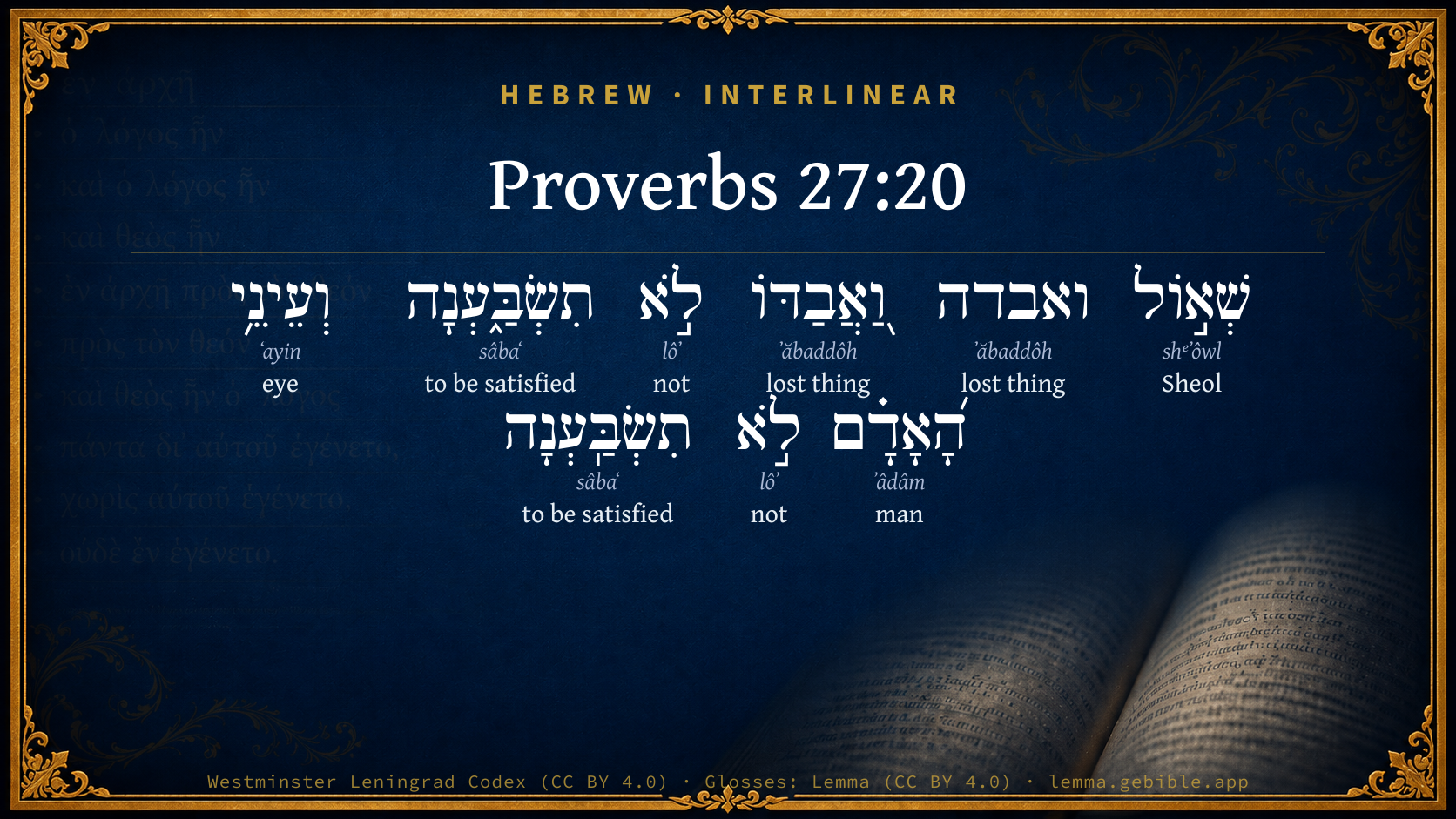
Proverbs 27:20

Hebrew (Westminster Leningrad Codex) Proverbs 27:20 appears in the Hebrew Old Testament. The text above is from the Westminster Leningrad Codex. Each word links to its Strong’s number, a concise gloss, and parsing drawn from the Open Scriptures Hebrew Bible morphology. Click any word for its full Brown-Driver-Briggs (BDB) entry.
Download image
Cite this verse

Proverbs 27:20 (World English Bible). Public Domain. Lemma interlinear Bible study tool, https://lemma.gebible.app/v/proverbs/27/20.

Show BibTeX & RIS
BibTeX
RIS
English Translation
Sheol and Abaddon are never satisfied; And a man's eyes are never satisfied.
World English Bible · Public Domain
Highlights Full analysis ↓
Download a study sheet

One document with this verse’s original text, its word-by-word gloss line, the meaning frame, cross-references with their text, attributed commentary, and full source and license credits — printable, and it pastes into notes with its structure intact.

This verse Autodidact and up

Study sheet (.html) Plain text (.txt)

A passage Seminary Student

Up to 50 verses in one chapter. A passage sheet keeps up to 6 commentary sources and 12 cross-references per verse, in the order this page ranks them, and says so on the sheet whenever that leaves anything out. Ask for a single verse and you get the Autodidact verse sheet above.

Everything on this page stays free to read, with no account — the sheet is a download of what is already on screen, not access to it.

Want to remove ads? Support Godless Engineer
Compare translations 3

The same verse in 3 English versions, stacked beneath the original-language interlinear above. Click any original word for its lexicon entry.

Each is an independent rendering of the whole verse — the interlinear is not word-aligned to these translations.

Highlighted words mark where these versions differ — a whole-verse word diff, not a word-by-word alignment.

  • World English Bible Public Domain
    Sheol and Abaddon are never satisfied; And a man's eyes are never satisfied.
  • King James Version Public Domain
    Hell and destruction are never full; so the eyes of man are never satisfied.
  • unfoldingWord Literal Text CC BY-SA 4.0
    Sheol and Abaddon are not satisfied, and the eyes of the man are not satisfied.

unfoldingWord Literal Text — © unfoldingWord, licensed CC BY-SA 4.0. Word-aligned USFM3 via Door43 (git.door43.org/unfoldingWord/en_ult).

Versions to compare (up to 4)

3 of 4 selected

Show all 18 translations

Every available English version of this verse, each an independent rendering of the whole verse.

  • World English Bible Public Domain
    Sheol and Abaddon are never satisfied; And a man's eyes are never satisfied.
  • Berean Standard Bible Public Domain
    Sheol and Abaddon are never satisfied; so the eyes of man are never satisfied.
  • Majority Standard Bible Public Domain
    Sheol and Abaddon are never satisfied; so the eyes of man are never satisfied.
  • King James Version Public Domain
    Hell and destruction are never full; so the eyes of man are never satisfied.
  • American Standard Version (1901) Public Domain
    Sheol and Abaddon are never satisfied; And the eyes of man are never satisfied.
  • Revised Version (1885) Public Domain
    Sheol and Abaddon are never satisfied; and the eyes of man are never satisfied.
  • Geneva Bible (1599) Public Domain
    The graue and destruction can neuer be full, so the eyes of man can neuer be satisfied.
  • Douay-Rheims (1899) Public Domain
    Hell and destruction are never filled: so the eyes of men are never satisfied.
  • Young's Literal Translation Public Domain
    Sheol and destruction are not satisfied, And the eyes of man are not satisfied.
  • Literal Standard Version CC BY-SA 4.0
    Sheol and destruction are not satisfied, || And the eyes of man are not satisfied.
  • Unlocked Literal Bible CC BY-SA 4.0
    Just as Sheol and Abaddon are never satisfied, so a man's eyes are never satisfied.
  • unfoldingWord Literal Text CC BY-SA 4.0
    Sheol and Abaddon are not satisfied, and the eyes of the man are not satisfied.
  • Darby Bible Public Domain
    Sheol and destruction are insatiable; so the eyes of man are never satisfied.
  • World Messianic Bible Public Domain
    Sheol and Abaddon are never satisfied; and a man’s eyes are never satisfied.
  • Webster's Bible Public Domain
    Hell and destruction are never full; so the eyes of man are never satisfied.
  • Free Bible Version CC BY-SA 4.0
    In the same way that the grave and destruction are never satisfied, human desire is never satisfied.
  • Bible in Basic English Public Domain
    The underworld and Abaddon are never full, and the eyes of man have never enough.
  • JPS Tanakh (1917) Public Domain
    The nether-world and Destruction are never satiated; so the eyes of man are never satiated.

Literal Standard Version (2020), Covenant Press — licensed CC BY-SA 4.0. Text via the HelloAO Bible API (eBible.org). Unlocked Literal Bible (unfoldingWord) — licensed CC BY-SA 4.0. Text via the HelloAO Bible API (eBible.org). unfoldingWord Literal Text — © unfoldingWord, licensed CC BY-SA 4.0. Word-aligned USFM3 via Door43 (git.door43.org/unfoldingWord/en_ult). Free Bible Version, Dr. Jonathan Gallagher — licensed CC BY-SA 4.0. Text via the HelloAO Bible API (eBible.org).

Word by word

More ways to search: Search by grammar → Find every occurrence → Compare this word →

Practice this passage: Drill this verse → Learn its vocabulary →

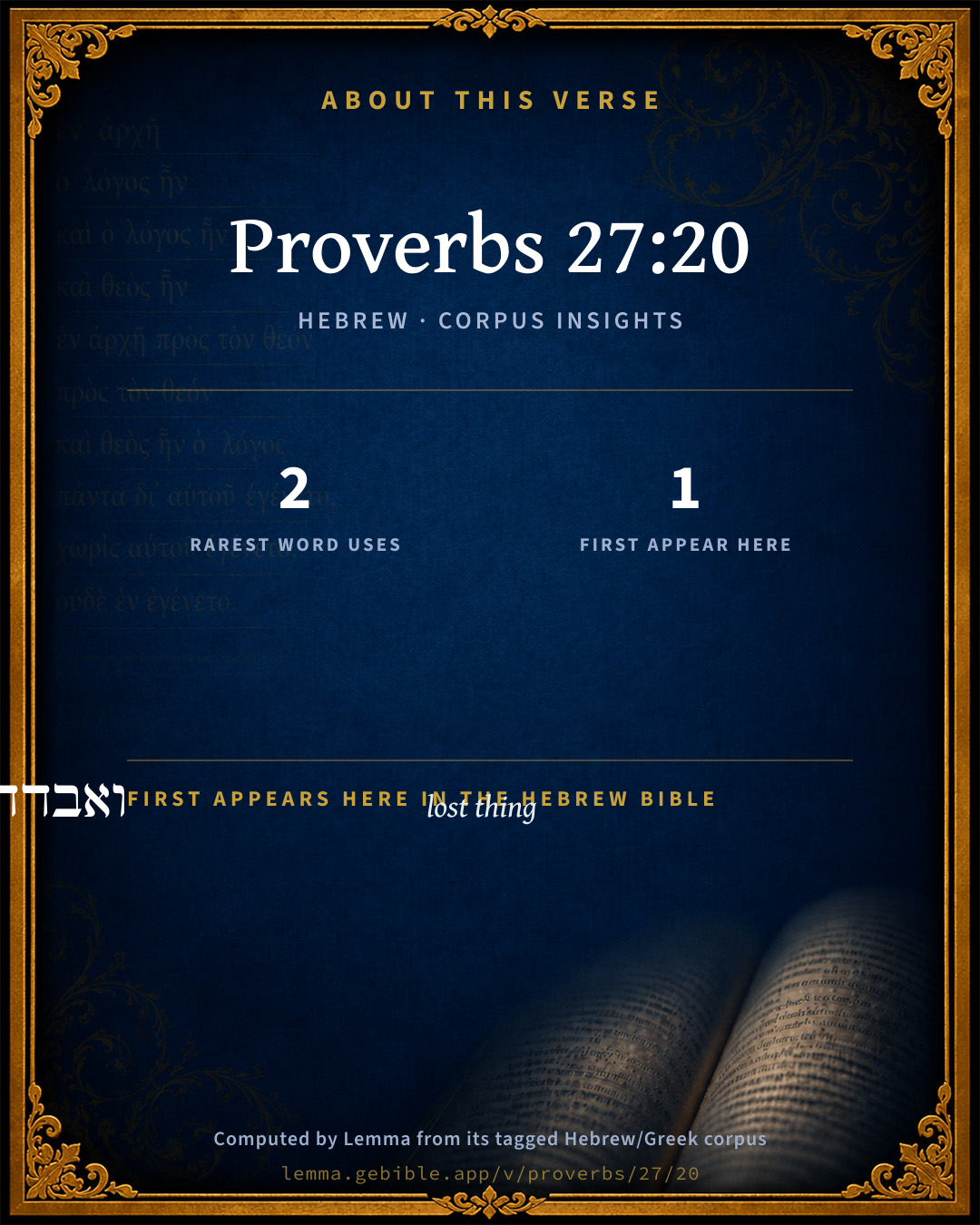
About this verse

These counts appear in no published source. They are computed here, from the morphology-tagged text and Lemma’s own curated glosses. What Lemma adds →

9
words
6
distinct lemmas
Wisdom
section

Notable vocabulary

The rarest word here is ואבדה lost thing H10 — appearing just 2 times in the whole Hebrew Bible.

First appearance in Scripture

This word makes its first canonical appearance in the Hebrew Bible here:

  • ואבדה lost thing H10

Grammatical profile

  • 2 verbs
  • 5 nouns
  • 2 particles

Verb forms

  • תִשְׂבַּ֑עְנָה Qal · Imperfect
  • תִשְׂבַּֽעְנָה Qal · Imperfect

Repetition

Words recur within this verse — often emphatic in Hebrew:

  • ואבדה lost thing H10 ×2
  • תִשְׂבַּ֑עְנָה to be satisfied H7646 ×2
  • לֹ֣א not H3808 ×2

Hebrew & Septuagint length

In English translation the verse runs 13 words from the Hebrew and 33 from the Septuagint (LXX English) — the Septuagint runs noticeably longer here. See the side-by-side →

A rough comparison of the two English renderings, which tokenize alike — not a word-level alignment.

Word counts can differ between the Hebrew and the Greek without any difference in meaning — e.g. the Hebrew direct-object marker אֵת has no separate Greek word, and Greek often adds the article ὁ.

Cross-references

12

Topical passages linked to Proverbs 27:20 in the Treasury of Scripture Knowledge — connected by theme and wording, ordered by reader-vote popularity; previews shown in the World English Bible.

  • Ecclesiastes 1:8 All things are full of weariness beyond uttering. The eye is not satisfied with seeing, nor the ear filled with hearing.
  • 1 John 2:16 For all that is in the world, the lust of the flesh, the lust of the eyes, and the pride of life, isn't the Father's, but is the world's.
  • Proverbs 30:15–16 "The leach has two daughters: 'Give, give.' "There are three things that are never satisfied; Four that don't say, 'Enough:'
  • Ecclesiastes 6:7 All the labor of man is for his mouth, and yet the appetite is not filled.
  • Habakkuk 2:5 Yes, moreover, wine is treacherous. A haughty man who doesn't stay at home, who enlarges his desire as Sheol, and he is like death, and can't be satisfied, but gathers to himself all nations, and heaps to himself all peoples.
  • Ecclesiastes 2:10–11 Whatever my eyes desired, I didn't keep from them. I didn't withhold my heart from any joy, for my heart rejoiced because of all my labor, and this was my portion from all my labor.
  • Ecclesiastes 4:8 There is one who is alone, and he has neither son nor brother. There is no end to all of his labor, neither are his eyes satisfied with wealth. For whom then, do I labor, and deprive my soul of enjoyment? This also is vanity, yes, it is a miserable business.
  • Ecclesiastes 5:10–11 He who loves silver shall not be satisfied with silver; nor he who loves abundance, with increase: this also is vanity.
  • Jeremiah 22:17 But your eyes and your heart are not but for your covetousness, and for shedding innocent blood, and for oppression, and for violence, to do it.
  • Job 26:6 Sheol is naked before God, And Abaddon has no covering.
  • Proverbs 15:11 Sheol and Abaddon are before Yahweh-- How much more then the hearts of the children of men!
  • Proverbs 23:5 Why do you set your eyes on that which is not? For it certainly sprouts wings like an eagle and flies in the sky.

Cross-references courtesy of OpenBible.info (CC BY 4.0).

Hebrew and Greek witnesses Masoretic Hebrew ↔ Greek Septuagint

The same verse in the two great witnesses to the Old Testament, shown verse-for-verse.

Here the Septuagint runs noticeably longer than the Hebrew — LXX2012 (modern English Septuagint) 33 words vs World English Bible 13. A rough length comparison of the two English translations, not a word-level alignment — read both below.

These are two independent witnesses, not word-aligned to each other, and the Septuagint is shown in lemma (dictionary) form.

Hebrew Proverbs 27:20 Masoretic · Westminster Leningrad Codex

שְׁא֣וֹל ואבדה וַ֭אֲבַדּוֹ לֹ֣א תִשְׂבַּ֑עְנָה וְעֵינֵ֥י הָ֝אָדָ֗ם לֹ֣א תִשְׂבַּֽעְנָה

Sheol and Abaddon are never satisfied; And a man's eyes are never satisfied.

World English Bible · Public Domain

Greek LXX Proverbs 27:20 Septuagint · lemma form

ᾅδης καί ἀπώλεια οὐ ἐνπίμπλημι ὡσαύτως καί ὁ ὀφθαλμός ὁ ἄνθρωπος ἄπληστος βδέλυγμα κύριος στηρίζω ὀφθαλμός καί ὁ ἀπαίδευτος ἀκρατής γλῶσσα

Hell and destruction are not filled; so also are the eyes of men insatiable. He that fixes his eye is an abomination to the Lord; and the uninstructed do not restrain their tongue.

LXX2012 (modern English Septuagint) · Public Domain

On this verse, John Gill's Exposition discusses the Septuagint’s reading. Read the note in Commentary ↓

Hebrew: Westminster Leningrad Codex (CC BY 4.0). Greek: Septuagint (public domain); English from LXX2012 (modern English Septuagint) (Public Domain). How the Septuagint differs from the Hebrew →

Commentary

Notes on Proverbs 27:20 from classic Christian and Jewish commentators (each source and its license shown beneath its notes). The classic Christian expositions comment on the surrounding passage and are grouped to its opening verse, so a note may address several verses; the Jewish commentaries on the Tanakh (Rashi and others) are per-verse, so they appear only where the commentator wrote on this verse.

Lemma curates 59 commentaries, every one of them public domain or Creative Commons licensed, each selected and text-cleaned for this edition rather than reprinted as found. About our sources →

Trapp's Complete Commentary

John Trapp

Pro 27:20 Hell and destruction are never full; so the eyes of man are never satisfied.

Ver. 20. Hell and destruction are never satisfied.] Hell and the grave have their name in Hebrew from their unsatisfiableness, being always craving more, and that with assiduity and importunity. And this fitly follows upon the former verse, as Aben Ezra well observeth, that men may be frighted by the remembrance of hell’s wide mouth gaping for them, from following the bent of their sinful natures; and that those that here have never enough, shall once have fire enough in the bottom of hell.

So the eyes of men are never satisfied.] That is, Their lusts, their carnal concupiscence. To seek to satisfy it is an endless piece of business, Quaecunque videt oculus, ea omnia desiderat avarus, saith Basil. The covetous man hankereth after all that he beholdeth; the curse of unsatisfiableness lies heavy upon him; his desire is a fire, riches a fuel, which seem to slake the fire; but, indeed, they increase it. "He that loveth silver shall never be satisfied with silver"; {Ecc 5:10} no more shall he that loveth honour, pleasure, &c. Earthly things cannot so fill the heart, but still it would have more things in number, and otherwise for manner. And therefore the particles in the Hebrew that signify and and or, come of a word that signifies to desire; {a} because the desires of a man would have this and that, and that and another; and doth also tire itself, not knowing whether to have this, or that, or the other, &c.

{a} å and, או of אוח.

John Trapp, A Commentary or Exposition upon All the Books of the Old and New Testament (1647–1656) — public domain. Text from a community e-Sword module.

Joseph Benson's Commentary

Pro 27:20. Hell and destruction are never full — The grave devours all the bodies which are put into it, and is always ready to receive and devour more and more without end; so the eyes of man are never satisfied — That is, his desires, which work and discover themselves by his eyes.

Joseph Benson's Commentary on the Old and New Testaments (1811–1818) — public domain. Text from a community e-Sword module.

The Preacher's Complete Homiletical Commentary

Joseph S. Exell (gen. ed.)

CRITICAL NOTES.—

Pro_27:20. Hell and destruction, rather “the world of the dead.” Eyes. Some understand the reference to be to the insatiableness of human passion.

MAIN HOMILETICS OF Pro_27:20

INSATIABILITY

I. A destructive force always in operation. Ever since the earth closed over the first dead body, it has been constantly opening to receive those whom death has made ready for the grave, and to-day this terrible and remorseless destroyer is as busy in our midst as ever. And we know that it will be so to the end of time; while the present dispensation lasts, men will never be able to say that death has ceased to claim the mortal part of man, or that the last grave has been dug in the vast graveyard of the world. This is a most melancholy stand-point from which to view man and his destiny. If all the human race lived to a good old age, and went down to their last earthly resting-place like a shock of corn fully ripe, death would still be a dark and dreary thing, looked at by itself, but it becomes much more appalling when it strikes men and women in the prime of life, and carries them off, often without warning, from the place where they seemed so much needed, and to which they were bound by so many ties.

II. A faculty of man always at work. The eye of man is simply an organ by which knowledge is conveyed to his mind. And his appetite for fresh mental food is not lessened by that which he has received in the past—on the contrary, it is quickened and whetted in proportion to the supply, for while an ignorant, man is often content in his ignorance, the man who has learned most is generally the most eager to learn more. And this passion in man for knowledge is not quenched by the certain consciousness he possesses that one day he must, that to-morrow he may, quit the scene of his investigations, and end his search after truth under his present conditions. Surely if men did not instinctively feel that this life is not the only one, their desire after constant intellectual growth would not be so ardent. If there was not that within them that told them that death would not end their opportunities of growing in knowledge, the contemplation of the shortness of life would paralyze the acquisitive faculty of men. But we take the strength and universality of this undying desire of man as an argument for his existence after death and the grave have taken possession of the material house in which he lived and laboured on the earth.

OUTLINES AND SUGGESTIVE COMMENTS

The eye is the avenue of growth. That growth will be eternal.… It will take in more and more and raise or sink us through eternal ages.… The terms here used are used elsewhere for anything insatiate (chap. Pro_30:16). Solomon describes a great psychological law, that the mind by its very nature sees, and by all its seeings will grow, either in one way or the other.—Miller.

The eyes, by a very natural figure, are put for the desires. Upon that which is the object of our desire, we fix our eyes; and that with an intensity of settled eagerness proportioned to the degree of the desire (chap. Pro_23:5). The meaning, then, is not merely that the sense of sight never has enough of its own peculiar enjoyments, but that the desire that is by the eye expressed is never satisfied by any amount of present gratification. The desires of men are insatiable. They set their hearts on some particular object, and long for its attainment. They fix in their mind some point of advancement in the acquisition of the world,—some measure of wealth, or of power which they think, if once realised, would satisfy them to the full. They get what they want; but they still long as before. There is ever something unattained. Having gained the summit of one eminence, they see another above it; and as they mount, their views widen and their conceptions and wishes amplify, and still more is required to fill them.—Wardlaw.

The meaning of the second clause as indicated by this parallel cannot be doubtful. It relates to the really demoniacal insatiableness of human passion, especially “the lust of the eyes.” (Comp. 1Jn_2:16; Jas_3:6; and in particular Pro_30:16; Ecc_1:8.)—Zöckler.

The Preacher's Complete Homiletical Commentary (gen. ed. Joseph S. Exell; Funk & Wagnalls, c. 1892) — public domain (pre-1929). A full-Bible homiletical/sermon-outline anthology covering 65 of 66 books (2 John is absent from the source module). Text from a community e-Sword module.

Tyndale Open Study Notes

Tyndale Open Resources

27:20 Death and Destruction: See study note on 15:11. • Human desire is never satisfied by money, power, or pleasure.

Tyndale Open Study Notes — © Tyndale Open Resources, licensed CC BY-SA 4.0. Text via the HelloAO Bible API.

Matthew Henry's Commentary

Two things are here said to be insatiable, and they are two things near of kin - death and sin. 1. Death is insatiable. The first death, the second death, both are so. The grave is not clogged with the multitude of dead bodies that are daily thrown into it, but is still an open sepulchre, and cries, Give, give. Hell also has enlarged itself, and still has room for the damned spirits that are committed to that prison. Tophet is deep and large, Isa 30:33. 2. Sin is insatiable: The eyes of man are never satisfied, nor the appetites of the carnal mind towards profit or pleasure. The eye is not satisfied with seeing, nor is he the loves silver satisfied with silver. Men labour for that which surfeits, but satisfies not; nay, it is dissatisfying; but satisfies not; nay, it is dissatisfying; such a perpetual uneasiness have men justly been doomed to ever since our first parents were not satisfied with all the trees of Eden, but they must meddle with the forbidden tree. Those whose eyes are ever toward the Lord in him are satisfied, and shall for ever be so.

Matthew Henry's Commentary on the Whole Bible (1708–1710) — public domain (CC PDM 1.0). Text via the HelloAO Bible API.

Jamieson, Fausset & Brown

Robert Jamieson, A. R. Fausset & David Brown

Men's cupidity is as insatiable as the grave.

Jamieson, Fausset & Brown — Commentary Critical and Explanatory on the Whole Bible (1871) — public domain (CC PDM 1.0). Text via the HelloAO Bible API.

Adam Clarke's Commentary

Verse 20. Hell and destruction are never full] How hideous must the soul of a covetous man be, when God compares it to hell and perdition!

The eyes of man are never satisfied.] As the grave can never be filled up with bodies, nor perdition with souls; so the restless desire, the lust of power, riches, and splendour, is never satisfied. Out of this ever unsatisfied desire spring all the changing fashions, the varied amusements, and the endless modes of getting money, prevalent in every age, and in every country.

Adam Clarke's Commentary on the Bible (1810–1826) — public domain. Text from a community e-Sword/MySword module.

Ellicott's Commentary for English Readers

(20) Hell and destruction.—See above on Pro_15:11.

The eyes of man are never satisfied.—Comp. Ecc_1:8; Ecc_4:8. God would thus teach us that in Himself only can man find complete satisfaction. (Comp. Psa_36:8-9; 1Co_2:9.)

A Bible Commentary for English Readers, edited by Charles John Ellicott (1878–1897) — public domain. Text from a community e-Sword module.

The Cambridge Bible for Schools and Colleges

gen. ed. J. J. S. Perowne

20. Hell and destruction] See Pro_15:11, note.

full] Rather, satisfied, the Heb. word being the same as at the end of the verse. Comp. Ecc_1:8; Ecc_4:8.

The Cambridge Bible for Schools and Colleges (gen. ed. J. J. S. Perowne; Cambridge University Press, 1878–1918) — public domain. Text from a community e-Sword module.

John Gill's Exposition

Though thou shouldest bray a fool in a mortar among wheat with a pestle,.... As the manna was, Num 11:8; and as wheat beat and bruised in a mortar, or ground in a mill, retains its own nature; so, let a wicked man be used ever so roughly or severely, by words, admonitions, reproofs, and counsels; or by deeds, by corrections and punishment, by hard words or blows, whether publicly or privately; in the midst of the congregation, as the Targum and Syriac version; or of the sanhedrim and council, as the Septuagint and Arabic versions;

yet will not his foolishness depart from him; his inbred depravity and natural malignity and folly will not remove, nor will he leave his course of sinning he has been accustomed to; he is stricken in vain, he will revolt more and more, Isa 1:5. Anaxarchus the philosopher was ordered by the tyrant Nicocreon to be pounded to death in a stone mortar with iron pestles (q), and which he endured with great patience.

(q) Laert. in Vit. Anaxarch. l. 9. p. 668.

John Gill's Exposition of the Whole Bible (1746–1763) — public domain (CC PDM 1.0). Text via the HelloAO Bible API.

Albert Barnes' Notes on the Bible

Hades, the world of the dead, and Destruction (Death, the destroying power, personified) have been at all times and in all countries thought of as all-devouring, insatiable (compare the marginal reference). Yet one thing is equally so, the lust of the eye, the restless craving which grows with what it feeds on Ecc 1:8.

Albert Barnes' Notes on the Bible (1834–1885) — public domain. Text from a community e-Sword/MySword module.

Haydock's Catholic Bible Commentary

Destruction. Hebrew abaddo, or abadon, chap. xv. 11., and Apocalypse ix. 11. People die, and are plunged in hell daily. --- Eyes. Avarice and ambition, Ecclesiasticus xiv. 9.

George Leo Haydock (1774–1849), Haydock's Catholic Family Bible and Commentary, 1859 edition — public domain. Excludes Psalms (Douay-Rheims chapter numbering differs from Protestant) and Deuterocanonical books (Catholic canon only).

Matthew Poole's English Annotations

Hell and destruction are never full; the grave devours all the bodies which are put into it, and is always ready to receive and devour more and more without end.

The eyes, i.e. the desires, which work and discover themselves by the eyes, 1Jo 2:16, and other senses; for otherwise the eyes in themselves are neither capable of satisfaction nor of dissatisfaction.

Matthew Poole's English Annotations on the Holy Bible (1683–1685) — public domain. Text from a community e-Sword/MySword module.

Whedon's Commentary on the Bible

Daniel D. Whedon

20. Hell — שׁאול, (sheol,) the under or unseen world — the world of the dead, sometimes used of the place of unending punishment.

Never full — Not satisfied nor satiated.

So the eyes of man — “The lust of the eye” may be taken as the type of all desire. It is insatiable. Compare Ecc_1:8; 1Jn_2:16; Pro_5:5; Pro_7:27; Pro_9:18; Pro_15:11; Pro_23:14.

Daniel D. Whedon (gen. ed.), Commentary on the Old and New Testaments (1874–1909) — public domain. Text from a community e-Sword module.

The Pulpit Commentary

Hell and destruction are never full. "Hell" is sheol, the under-world, Hades, the place of the departed; "destruction" is the great depth, the second death, personified. (see on Pro_15:11, where the terms also occur) These "are never satisfied," they are insatiable, all-devouring. (comp. Pro_30:16 Isa_5:14 Hab_2:5) So the eyes of man are never satisfied. The verb is the same in both clauses, and ought to have been so translated. The eye is taken as the representative of concupiscence in general. What is true of "the lust of the eyes" (1Jn_2:16) is true of all the senses; the craving for their gratification grows as it is fed. Therefore the senses should be carefully guarded, lest they lead to excess and transgression. "Turn away mine eyes from beholding vanity," said the psalmist, "and quicken me in thy way". (Psa_119:37) The LXX here introduces a paragraph not in the Hebrew or the Latin Versions: "He that fixes (sthrizwn ) his eye i.e. staring impudently is an abomination to the Lord, and the uninstructed restrain not their tongue."

The Pulpit Commentary (1880–1919), ed. H.D.M. Spence-Jones & Joseph S. Exell — public domain. Text from a community e-Sword module.

John Wesley's Explanatory Notes

Hell - The grave devours all the bodies which are put into it, and is always ready to receive and devour more. The eyes - The desires, which discover themselves by the eyes.

John Wesley, Explanatory Notes Upon the Whole Bible (1754–1765) — public domain. Text via the GEBible commentary corpus.

Keil & Delitzsch

C. F. Keil & F. Delitzsch

The following proverb has, in common with the preceding, the catchword האדם, and the emphatic repetition of the same expression:

20 The under-world and hell are not satisfied,

And the eyes of man are not satisfied.

A Kerı̂ ואבדון is here erroneously noted by Lwenstein, Stuart, and others. The Kerı̂ to ואבדּה is here ואבדּו, which secures the right utterance of the ending, and is altogether wanting

(Note: In Gesen. Lex. this אבדה stands to the present day under אבדה.)

in many MSS (e.g., Cod. Jaman). The stripping off of the ן from the ending ון is common in the names of persons and places (e.g., שׁלמה, lxx Σολομών and שׁלה); we write at pleasure either ow or oh (e.g., מגדּו), Olsh. 215g. אבדּה (אבדּו) of the nature of a proper name, is already found in its full form אבדּון at Pro 15:11, along with שׁאול; the two synonyms are, as was there shown, not wholly alike in the idea they present, as the underworld and realm of death, but are related to each other almost the same as Hades and Gehenna; אבדון is what is called

(Note: Vid., Frankel, Zu dem Targum der Propheten (1872), p. 25.)

in the Jonathan-Targum בּית אבדּנא, the place of destruction, i.e., of the second death (מותא תנינא). The proverb places Hades and Hell on the one side, and the eyes of man on the other, on the same line in respect of their insatiableness. To this Fleischer adds the remark: cf. the Arab. al'ayn l'a taml'aha all'a altrab, nothing fills the eyes of man but at last the dust of the grave - a strikingly beautiful expression! If the dust of the grave fills the open eyes, then they are full - fearful irony! The eye is the instrument of seeing, and consequently in so far as it always looks out after and farther, it is the instrument and the representation of human covetousness. The eye is filled, is satisfied, is equivalent to: human covetousness is appeased. But first "the desire of the eye," Jo1 2:16, is meant in the proper sense. The eyes of men are not satisfied in looking and contemplating that which is attractive and new, and no command is more difficult to be fulfilled than that in Isa 33:15, "...that shutteth his eyes from seeing evil." There is therefore no more inexhaustible means, impiae sepculationis, than the desire of the eyes.

Keil & Delitzsch — Biblical Commentary on the Old Testament (1861–1891) — public domain (CC PDM 1.0). Text via the HelloAO Bible API. (Old Testament only.)

Bridges on Proverbs

Charles Bridges

A striking picture of the two great devourers — hell and destruction (Pro 15:11 ) — never full! Hell — the grave — ever since Adam’s sin has been insatiable. It has opened its mouth to receive countless millions; and still it yawns, craving for more.†1 Generations have sunk into destruction, doing the work, and earning "the wages, of sin." Still the pit is not full. The broad mouth still opens for more.

Thus insatiable are the eyes — the desires (1Jn 2:16 ) — of man, always requiring new gratification. "He enlargeth his desire as hell, and is as death, and cannot be satisfied." His "eye is not satisfied with seeing, nor his ear filled with hearing."†2 Curiosity, love of novelty, covetousness, ambition — all these desires, like thirst in the dropsy, are aggravated in their indulgence. (Ecc 6:7 .) Man is always seeking for what he can never find, satisfaction in earthly things. He toils after his object, and when he has grasped it, he toils still; the possessor of abundance, not of happiness.†3 His best efforts only bring him a meager enjoyment, not deserving the name. The summit of ambition, when reached, is not his resting-place; only the point, whence he stretches after something higher. All the affections of fallen man are filled with unquenched thirst. He may fancy his desires to be moderate. He may set bounds to them, and flatter himself, that he shall never overpass them. But give him a world, and, like the far-famed conqueror, he will weep for another, and sink at last into a wretched eternity of unsatisfied desires.

Nor is this altogether the effect of his depravity. Corruption indeed leads us to seek rest in something short of God. But it is our nature not to find it. How can an immortal being quench his thirst but from an infinite source? The soul was originally created to find a suitable and infinite gratification in the love of its Creator. And now that it is turned aside by the fall, it has an immortal depth, that craves to be filled. Nor do we speak here of refined and educated minds. The most unlettered being, awakened to a sense of his consciousness, might breathe out Augustine’s confession — ’Thou hast made us for thyself; and our heart can have no rest, till it rests in thee.’†4 And here the gospel meets the case — "Come unto me, all ye that labor, and are heavy laden; and I will give you rest." (Mat 11:28 .) So often as the eager question starts up — "Who will shew us any good?" (Psa 4:6 ) — listen to the voice — "Ho! Every one that thirsteth, come ye to the waters. If any man thirst, let him come unto me, and drink. He that cometh to me shall never thirst."†5 Here our desires are at once increased and satisfied. A fountain of infinite fullness is at our door. We are bid welcome to a haven of rest, to a bosom of peace and love. And when new-created in the image of God, and made capable of communion with him in grace, and of enjoying him in glory, can our desires be satisfied with anything less, with anything beside? Is he not now our supreme delight, our satisfying object, never leaving us without complete satisfaction for a single moment? (Psa 16:5 . Lam 3:24 .)

Now let me ask — Have I seen God, as that, which alone is sufficient for my soul? Have I made the important discovery, that all my uneasy cravings from morning to night arise from not seeking him as my only satisfaction? Let me sit down to the richest banquet of life, and every dish will be tasteless, and without nourishment, if he is not above all, and in all. To delight in anything independent of him (Psa 73:25 ), is as if we cast him down from his throne. All is misery and delusion. Delighting in him, all ministers to our comfort, flowing from this great center. At the grand consummation how will the satisfaction of the eyes and heart be complete! — The eternity of being will be an eternity of joy — "Thine eyes shall see the King in his beauty. As for me, I will behold thy face in righteousness; I shall be satisfied, when I awake, with thy likeness." (Isa 33:17 . Psa 17:15 .)

Footnotes:

†1 Pro 30:15-16. Isa 5:14 .

†2 Hab 2:5. Ecc 1:8 . Ecc 2:1-11.

†3 Ecc 5:10-12.

’Crescit amor nummi, quantum ipsa pecunia crescit.’ — Juv. Sat. xiv. 139.

’Crescentem sequitur cura pecuniam,

Majorumque fames.’ Hor. Carm. iii. 16. Comp. ib. 24.

†4 Confess. book 1. Chap. i.

†5 Isa 55:1-2. Joh 7:37 ; Joh 6:35 .

Charles Bridges, An Exposition of the Book of Proverbs (1846) — public domain. Text from a community e-Sword module.

Scofield Reference Notes

C. I. Scofield

grave

Also; Pro 30:16, Heb. "Sheol," (See Scofield "Hab 2:5").

The Scofield Reference Bible (1917 edition), notes by C. I. Scofield — public domain. Text from a community e-Sword module.

Rashi

Rabbi Shlomo Yitzchaki (Rashi)

The grave and Gehinnom will not be sated from receiving the wicked therein, just as the eyes of a wicked man will not be sated from wandering after temptation and gratifying his lust.

Rashi on the Tanakh — English translations: “The Judaica Press complete Tanach with Rashi, translated by A. J. Rosenberg” (CC BY 4.0); “Pentateuch with Rashi's commentary by M. Rosenbaum and A.M. Silbermann, 1929-1934” (public domain); “The Metsudah Tanach series, Lakewood, N.J” (CC BY 4.0); and “The Book of Joshua, Metsudah Publications, 1997” (CC BY 4.0). Text via Sefaria.

Lesson kit

Teaching starters — assembled from the data on this page, not authored interpretation. Every prompt links to the verse data it draws on. Edit before teaching.

Proverbs, in the Wisdom, opens this verse with 9 words (6 distinct Hebrew lemmas). Its most distinctive word is ʼăbaddôh (“lost thing”). The Greek Septuagint runs longer here. A historical commentator’s framing appears above. Read the whole chapter for the surrounding context.

Discussion questions

  1. How does “lost thing” (ʼăbaddôh) shape what this verse is saying?
  2. The word “lost thing” first appears here in Scripture. What is being introduced at this debut?
  3. Ecclesiastes 1:8 shares this passage’s theme. How do the two illuminate each other?
  4. “lost thing” occurs 2× in this one verse. What is the effect of the repetition?
  5. Compared with the Hebrew, the Septuagint runs longer here. What questions does that raise?
  6. These translations render this verse differently. What is at stake in choosing one wording over another?
  7. The verb «תִשְׂבַּ֑עְנָה» is Qal Imperfect. How does its form color the action?
  8. Reading how Trapp's Complete Commentary and Joseph Benson's Commentary read this verse, where do the two commentators agree and where do they part?

Things to notice

  • 1 word makes its first canonical appearance in Scripture here.
  • These translations choose different wording for 8 words in this verse.
  • “lost thing” occurs 2× in this single verse.
  • 6 distinct Hebrew lemmas span 9 words in this verse.

Reading settings

Reading text

Shown beneath each verse's original-language words.

Old Testament
Old Testament edition

Read the OT as the Masoretic Hebrew (MT) or the Greek Septuagint (LXX).

English shown for the Greek Septuagint (in the Hebrew ↔ Greek comparison).

Comparing translations? Open the Compare panel on any verse page to stack up to four side by side.