
Proverbs 12:23

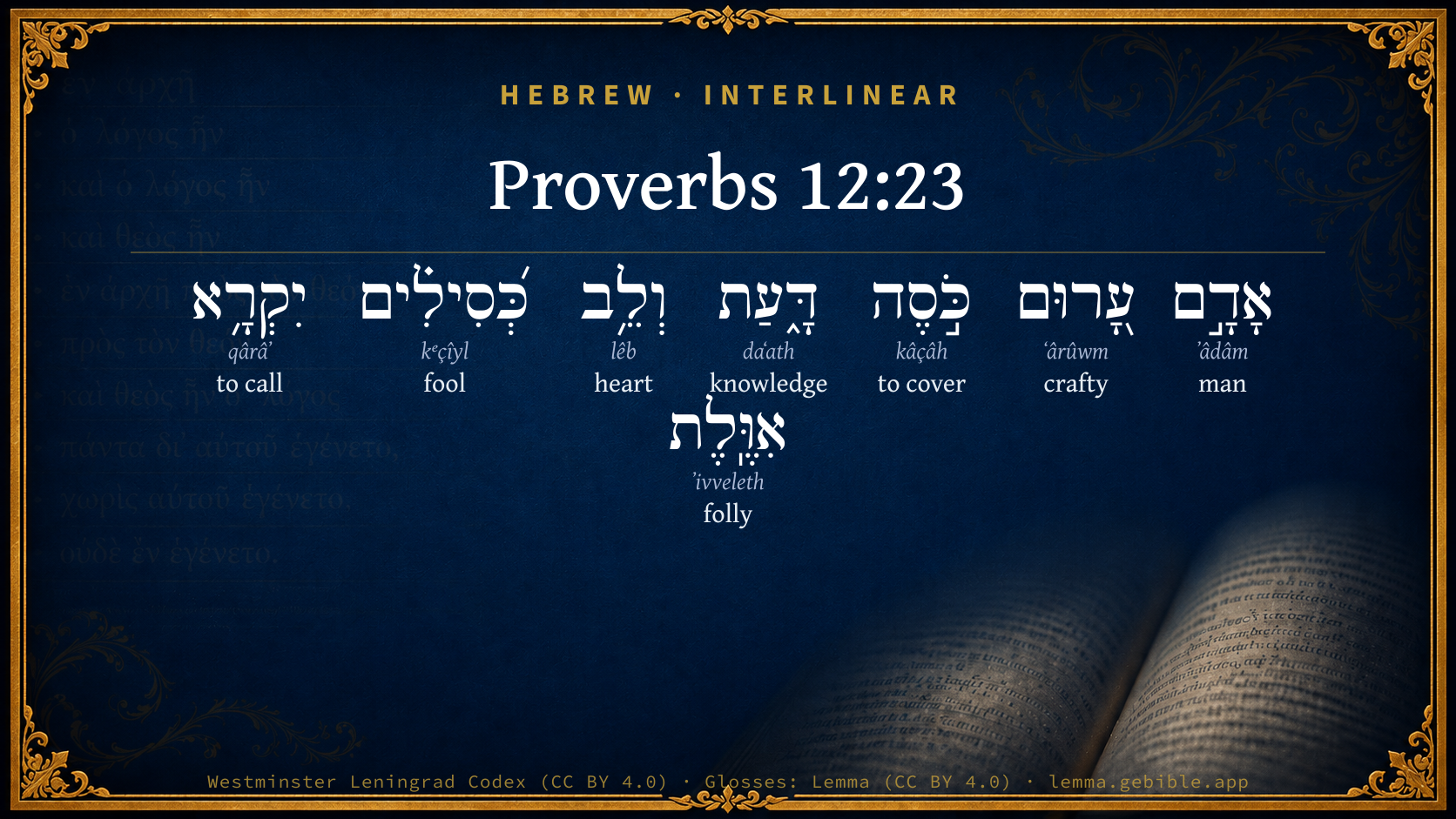
Hebrew (Westminster Leningrad Codex) Proverbs 12:23 appears in the Hebrew Old Testament. The text above is from the Westminster Leningrad Codex. Each word links to its Strong’s number, a concise gloss, and parsing drawn from the Open Scriptures Hebrew Bible morphology. Click any word for its full Brown-Driver-Briggs (BDB) entry.
Download image
Cite this verse

Proverbs 12:23 (World English Bible). Public Domain. Lemma interlinear Bible study tool, https://lemma.gebible.app/v/proverbs/12/23.

Show BibTeX & RIS
BibTeX
RIS
English Translation
A prudent man keeps his knowledge, But the hearts of fools proclaim foolishness.
World English Bible · Public Domain
Download a study sheet

One document with this verse’s original text, its word-by-word gloss line, the meaning frame, cross-references with their text, attributed commentary, and full source and license credits — printable, and it pastes into notes with its structure intact.

This verse Autodidact and up

Study sheet (.html) Plain text (.txt)

A passage Seminary Student

Up to 50 verses in one chapter. A passage sheet keeps up to 6 commentary sources and 12 cross-references per verse, in the order this page ranks them, and says so on the sheet whenever that leaves anything out. Ask for a single verse and you get the Autodidact verse sheet above.

Everything on this page stays free to read, with no account — the sheet is a download of what is already on screen, not access to it.

Want to remove ads? Support Godless Engineer
Compare translations 3

The same verse in 3 English versions, stacked beneath the original-language interlinear above. Click any original word for its lexicon entry.

Each is an independent rendering of the whole verse — the interlinear is not word-aligned to these translations.

Highlighted words mark where these versions differ — a whole-verse word diff, not a word-by-word alignment.

  • World English Bible Public Domain
    A prudent man keeps his knowledge, But the hearts of fools proclaim foolishness.
  • King James Version Public Domain
    A prudent man concealeth knowledge: but the heart of fools proclaimeth foolishness.
  • unfoldingWord Literal Text CC BY-SA 4.0
    A prudent man covers knowledge, but the heart of the stupid calls out folly.

unfoldingWord Literal Text — © unfoldingWord, licensed CC BY-SA 4.0. Word-aligned USFM3 via Door43 (git.door43.org/unfoldingWord/en_ult).

Versions to compare (up to 4)

3 of 4 selected

Show all 18 translations

Every available English version of this verse, each an independent rendering of the whole verse.

  • World English Bible Public Domain
    A prudent man keeps his knowledge, But the hearts of fools proclaim foolishness.
  • Berean Standard Bible Public Domain
    A shrewd man keeps his knowledge to himself, but a foolish heart proclaims its folly.
  • Majority Standard Bible Public Domain
    A shrewd man keeps his knowledge to himself, but a foolish heart proclaims its folly.
  • King James Version Public Domain
    A prudent man concealeth knowledge: but the heart of fools proclaimeth foolishness.
  • American Standard Version (1901) Public Domain
    A prudent man concealeth knowledge; But the heart of fools proclaimeth foolishness.
  • Revised Version (1885) Public Domain
    A prudent man concealeth knowledge: but the heart of fools proclaimeth foolishness.
  • Geneva Bible (1599) Public Domain
    A wise man concealeth knowledge: but the heart of the fooles publisheth foolishnes.
  • Douay-Rheims (1899) Public Domain
    A cautious man concealeth knowledge: and the heart of fools publisheth folly.
  • Young's Literal Translation Public Domain
    A prudent man is concealing knowledge, And the heart of fools proclaimeth folly.
  • Literal Standard Version CC BY-SA 4.0
    A prudent man is concealing knowledge, || And the heart of fools proclaims folly.
  • Unlocked Literal Bible CC BY-SA 4.0
    A prudent man conceals his knowledge, but the heart of fools shouts out folly.
  • unfoldingWord Literal Text CC BY-SA 4.0
    A prudent man covers knowledge, but the heart of the stupid calls out folly.
  • Darby Bible Public Domain
    A prudent man concealeth knowledge; but the heart of the foolish proclaimeth folly.
  • World Messianic Bible Public Domain
    A prudent man keeps his knowledge, but the hearts of fools proclaim foolishness.
  • Webster's Bible Public Domain
    A prudent man concealeth knowledge: but the heart of fools proclaimeth foolishness.
  • Free Bible Version CC BY-SA 4.0
    If you're sensible, you don't show off your knowledge, but stupid people announce their stupidity.
  • Bible in Basic English Public Domain
    A sharp man keeps back his knowledge; but the heart of foolish men makes clear their foolish thoughts.
  • JPS Tanakh (1917) Public Domain
    A prudent man concealeth knowledge; but the heart of fools proclaimeth foolishness.

Literal Standard Version (2020), Covenant Press — licensed CC BY-SA 4.0. Text via the HelloAO Bible API (eBible.org). Unlocked Literal Bible (unfoldingWord) — licensed CC BY-SA 4.0. Text via the HelloAO Bible API (eBible.org). unfoldingWord Literal Text — © unfoldingWord, licensed CC BY-SA 4.0. Word-aligned USFM3 via Door43 (git.door43.org/unfoldingWord/en_ult). Free Bible Version, Dr. Jonathan Gallagher — licensed CC BY-SA 4.0. Text via the HelloAO Bible API (eBible.org).

Word by word

More ways to search: Search by grammar → Find every occurrence → Compare this word →

Practice this passage: Drill this verse → Learn its vocabulary →

About this verse

These counts appear in no published source. They are computed here, from the morphology-tagged text and Lemma’s own curated glosses. What Lemma adds →

8
words
8
distinct lemmas
Wisdom
section

Notable vocabulary

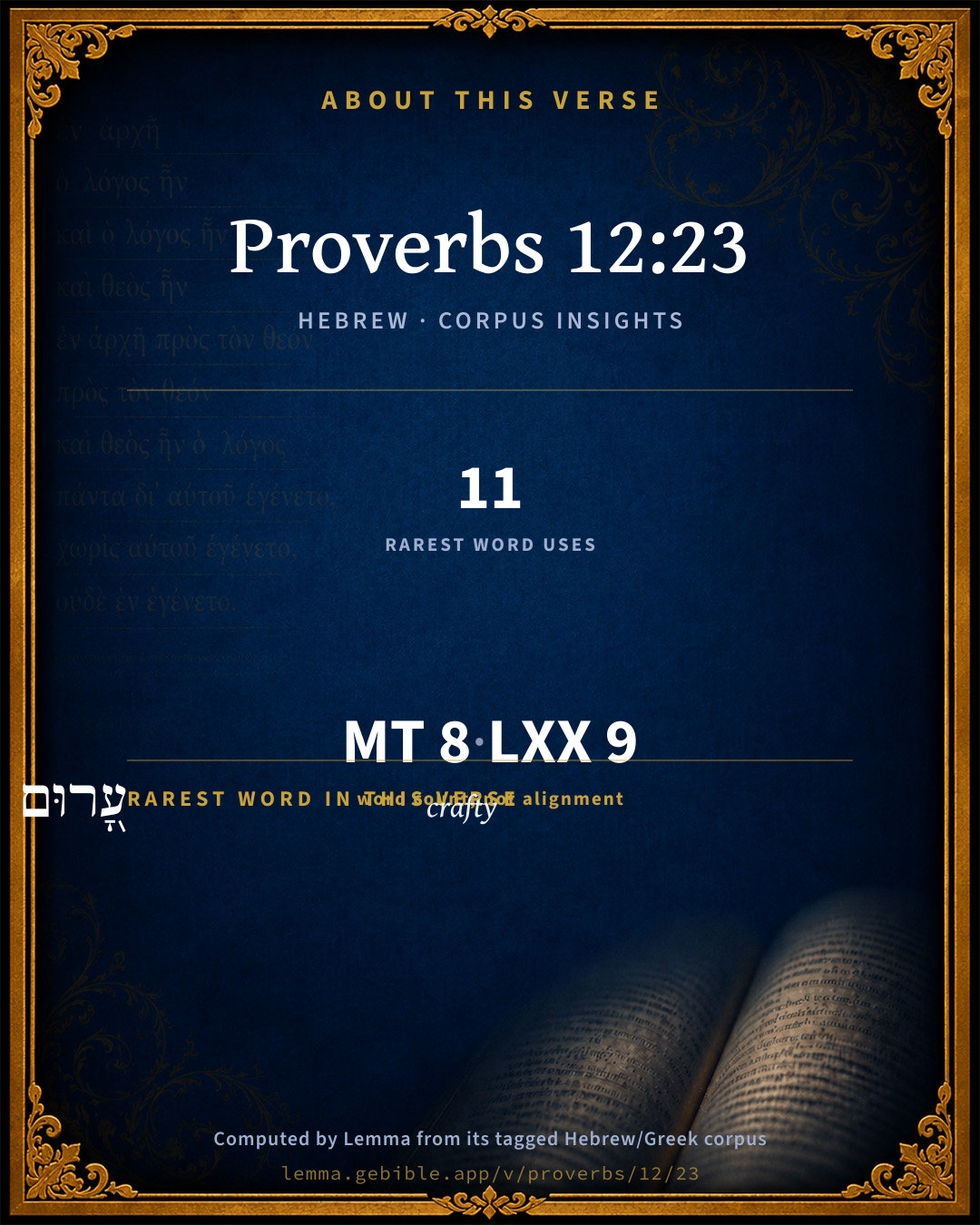
The rarest word here is עָ֭רוּם crafty H6175 — appearing just 11 times in the whole Hebrew Bible.

Shared distinctive vocabulary

עָ֭רוּם crafty H6175 occurs in 11 verses of the Hebrew Bible. Also found in:

Grammatical profile

  • 2 verbs
  • 4 nouns
  • 2 adjectives

Verb forms

  • כֹּ֣סֶה Qal · Participle Active
  • יִקְרָ֥א Qal · Imperfect

Hebrew & Septuagint length

In English translation the verse runs 13 words from the Hebrew and 17 from the Septuagint (LXX English) — closely comparable.

A rough comparison of the two English renderings, which tokenize alike — not a word-level alignment.

Word counts can differ between the Hebrew and the Greek without any difference in meaning — e.g. the Hebrew direct-object marker אֵת has no separate Greek word, and Greek often adds the article ὁ.

In the original languages it is 8 Hebrew tokens and 9 Greek tokens — but the two are counted differently (Hebrew bundles its prefixes and suffixes into one token; the Greek is in lemma form), so that isn’t a like-for-like length.

Cross-references

7

Topical passages linked to Proverbs 12:23 in the Treasury of Scripture Knowledge — connected by theme and wording, ordered by reader-vote popularity; previews shown in the World English Bible.

  • Proverbs 13:16 Every prudent man acts from knowledge, But a fool exposes folly.
  • Proverbs 10:19 In the multitude of words there is no lack of disobedience, But he who restrains his lips does wisely.
  • Proverbs 11:13 One who brings gossip betrays a confidence, But one who is of a trustworthy spirit is one who keeps a secret.
  • Proverbs 10:14 Wise men lay up knowledge, But the mouth of the foolish is near ruin.
  • Proverbs 15:2 The tongue of the wise commends knowledge, But the mouth of fools gush out folly.
  • Ecclesiastes 10:3 Yes also, when the fool walks by the way, his understanding fails him, and he says to everyone that he is a fool.
  • Ecclesiastes 10:12–14 The words of a wise man's mouth are gracious; but a fool is swallowed by his own lips.

Cross-references courtesy of OpenBible.info (CC BY 4.0).

Hebrew and Greek witnesses Masoretic Hebrew ↔ Greek Septuagint

The same verse in the two great witnesses to the Old Testament, shown verse-for-verse.

These are two independent witnesses, not word-aligned to each other, and the Septuagint is shown in lemma (dictionary) form.

Hebrew Proverbs 12:23 Masoretic · Westminster Leningrad Codex

אָדָ֣ם עָ֭רוּם כֹּ֣סֶה דָּ֑עַת וְלֵ֥ב כְּ֝סִילִ֗ים יִקְרָ֥א אִוֶּֽלֶת

A prudent man keeps his knowledge, But the hearts of fools proclaim foolishness.

World English Bible · Public Domain

Greek LXX Proverbs 12:23 Septuagint · lemma form

ἀνήρ συνετός θρόνος αἴσθησις καρδία δέ ἄφρων συνἀντάω ἀρά

An understanding man is a throne of wisdom; but the heart of fools shall meet with curses.

LXX2012 (modern English Septuagint) · Public Domain

On this verse, The Pulpit Commentary discusses the Septuagint’s reading. Read the note in Commentary ↓

Hebrew: Westminster Leningrad Codex (CC BY 4.0). Greek: Septuagint (public domain); English from LXX2012 (modern English Septuagint) (Public Domain). How the Septuagint differs from the Hebrew →

Commentary

Notes on Proverbs 12:23 from classic Christian and Jewish commentators (each source and its license shown beneath its notes). The classic Christian expositions comment on the surrounding passage and are grouped to its opening verse, so a note may address several verses; the Jewish commentaries on the Tanakh (Rashi and others) are per-verse, so they appear only where the commentator wrote on this verse.

Lemma curates 59 commentaries, every one of them public domain or Creative Commons licensed, each selected and text-cleaned for this edition rather than reprinted as found. About our sources →

Trapp's Complete Commentary

John Trapp

Pro 12:23 A prudent man concealeth knowledge: but the heart of fools proclaimeth foolishness.

Ver. 23. A prudent man concealeth knowledge,] scil., Till he finds a fit time to vent it; for then "the lips of the wise do spread abroad knowledge." {Pro 15:7} He is no niggard where there is need, but loves not to outlash. Taciturnity is a virtue with him; Tacitus a good historian, Persae magnam rem sustineri posse non credunt ab eo cui tacere grave sit; { a} - The Persians hold not him fit for great employments that cannot keep counsel, saith Curtius.

But the heart of fools proclaimeth foolishness.] In it is, and out it must: Pleni rimarum sunt, they can keep no counsel, hold no secrets, must needs tell all, whatever come of it: ut qui nec tacere nec prudenter loqui norint; they can neither hold their tongue nor use it to purpose. The moralist adviseth η σιγαν η κρεισσονα σιγης λεγειν, - either to say nothing, or that which is better than nothing. And Socrates, being asked by one how he might have the reputation of a wise man, First, said he, thou must hold thy tongue oftener than speak; secondly, thou must learn how to frame thy speeches.

{a} Curtius, lib. iv.

John Trapp, A Commentary or Exposition upon All the Books of the Old and New Testament (1647–1656) — public domain. Text from a community e-Sword module.

The Biblical Illustrator

Joseph S. Exell

Pro_12:23

A prudent man concealeth knowledge.

Concealing knowledge

I. When it is opportune (Joh_16:12).

II. When it is above the capacity of his hearers (1Co_2:2).

III. When likely to be misapplied (Mar_15:5).

IV. When sure of rejection (Mat_7:6).

V. When calculated to injure the brethren (Lev_19:16).

VI. When to utter it would be only for self-display (Pro_27:2). (R. A. Griffin.)

The Biblical Illustrator, edited by Joseph S. Exell (c. 1880s–1900s) — public domain. Text from a community e-Sword module.

Joseph Benson's Commentary

Pro 12:23. A prudent man concealeth knowledge — He doth not vain- gloriously and unseasonably utter what he knows, but keeps it in his breast till he hath a fit occasion to bring it forth for God’s glory, and the good of others; but the heart of fools proclaimeth foolishness — The heart of a foolish man induces him to make ostentation of his knowledge, whereby he betrays his ignorance and folly.

Joseph Benson's Commentary on the Old and New Testaments (1811–1818) — public domain. Text from a community e-Sword module.

The Preacher's Complete Homiletical Commentary

Joseph S. Exell (gen. ed.)

MAIN HOMILETICS OF Pro_12:23

THE CONCEALMENT OF KNOWLEDGE AND THE PROCLAMATION OF FOOLISHNESS

I. The concealment of knowledge is always a mark of self-control. It proves that a man has himself “well in hand.” He is like a skilful workman whose tools are all arranged in order, so that he can select or reject them according to his need, or the need of others. Or he resembles a skilful rider who is thoroughly master of his steed, and can either arrest his course or urge him to put forth all his speed at any moment. If a man does not possess this power over himself he can never be a king among men, and even the possession of knowledge will not prove very serviceable either to himself or others. All the treasures of his mind ought to be under the lock and key of his will, and his will under that of his conscience, for,

II. Under some circumstances the concealment of knowledge is a mark of prudence.

1. It is so when to proclaim it would feed personal vanity. To reveal our knowledge from no other motive than to let others know that we know is to sin against ourselves by ministering to our pride. In such a case to conceal our knowledge is a means of grace to a man’s own soul, and will carry with it the approbation of conscience.

2. It is also prudent to conceal knowledge when we know that it would not benefit others. It is not always seasonable to reveal even the most precious knowledge that we possess. Men are sometimes manifestly unprepared for its reception—unable to appreciate it. God concealed the gospel of salvation from the men of the early ages of the world because the “fulness of time” (Gal_4:4) had not come, by which we understand that the world then was not in a condition to profit by a revelation of it. Our Lord charged His disciples not to disclose what they had witnessed on the mount of transfiguration until “the Son of Man should be risen again from the dead” (Mat_17:9). He exhorts them also not to “cast pearls before swine” (Mat_7:6). Hence we learn that concealment of knowledge is sometimes to be preferred to a revelation of it, and that a due regard must be had to the mental and moral condition of those to whom we would impart it. The revelation of scientific truth would only bewilder people of little education and small capacity, and the revelation of even moral truth would sometimes increase men’s guilt. It would only lead them to blaspheme the God of Truth and scoff at His messengers, and thus harden them instead of enlightening them. And even when this is not the case men cannot always receive all kinds of moral truth. A parent conceals from his son when he is a boy a knowledge of things which he will reveal to him when he is a man. A wise teacher does not at once disclose to his pupil all that he desires him to learn. Both bring prudence into exercise, and give “line upon line, here a little and there a little” (Isa_28:10), following the example of the Great Father and Teacher in His dealings with His ancient people, and that of the Incarnate Son when He said to His disciples, “I have yet many things to say unto you, but ye cannot bear them now” (Joh_16:12). All who are possessors of knowledge should always remember to bring prudence into exercise in proclaiming it, whether it be Divine or human truth that they have to reveal.

III. The man who tells out all he knows without any regard to the fitness of time and circumstance proclaims only his foolishness. He is as much a proclaimer of his own folly as he who should sow seed on the high road instead of in ploughed ground. He may be very injurious to others. If a teacher of the young were to tell out all he knows about men and things to those under his care he might inflict on their spiritual nature a life-long injury. Indiscreet parents who utter all their mind and tell out all their experience in the hearing of their children not only “proclaim their foolishness,” but are a curse to their family. They are like an unskilful surgeon who takes the first instrument that comes to hand, regardless of its fitness for the needs of the patient. They are like men upon a fiery steed without power to guide him—they not only put themselves in jeopardy but endanger the well-being of others.

OUTLINES AND SUGGESTIVE COMMENTS

Not that he grudges to impart his knowledge to others, but he does not obtrude it or make a display of it, nor babble out all that he knows, in order that he may be counted wise.… The fool, trying to make a display of knowledge, only betrays foolishness. Fools, wise in their own esteem, babble out everything at random; not wisdom, which they have not, but foolishness, which they have. Proclaiming foolishness is attributed to a fool’s heart, not to his mouth, for a fool’s heart is in his mouth. He has no sense within. On the contrary, “The mouth of the wise is in their heart” (Sir_21:26)—Fausset.

The Apostle concealed his knowledge for fourteen years, and even then mentioned it reluctantly, to vindicate his own rightful claims of apostleship (2Co_12:1-6). Elihu, though “full of matter,” and longing to give vent, yet prudently concealed his knowledge, till his elders had opened his way (Job_32:6; Job_32:18-19). Circumstances may sometimes prudently dictate concealment. Abraham spared the feelings of his family, and cleared his own path, by hiding the dreadful message of his God (Gen_22:1-7). Joseph concealed his kindred for the discipline of his brethren (Gen_42:7). Esther, from a prudent regard of consequences to herself (Est_2:10). Nothing can justify speaking contrary to the truth. But we are not always obliged to tell the whole truth. Jeremiah answered all that he was bound to speak; not all that he might have spoken (Jer_38:24). In all these cases “the wise man’s heart will discern both time and judgment” (Ecc_8:5; Ecc_10:2).… The fool is dogmatical in dispute, when wiser men are cautious. He is teaching, when he ought to take the learner’s place; his self-confidence proclaiming his emptiness (1Ti_6:3-4).—Bridges.

True are the words of Paul, “knowledge puffeth up,” and the augmentation of it may only puff up the more. This produces a very anomalous and incongruous combination, a mind filled with solid information and a heart distended with the emptiness of vanity. And this generates the pedant, one of the most contemptible and disgusting of all characters—the man who is ever showing off, ever aiming at effect, ever speaking as nobody else would speak, ever dwelling on his own theme in his own terms, and in every word and look and movement, courting notice of self, as the only object of his own admiration, or worthy of the admiration of others. What a fool even the man of knowledge does at times make of himself! exemplifying the truth of the old quaint adage, “An ounce of mother wit is worth a pound of clergy.” Still it is true that, the more extensive the knowledge which a man acquires, he is, generally speaking, the more conscious of remaining ignorance, and consequently the less vain; that it is in the early stages of acquirement that self-sufficiency and conceit are most apparent. It is the empty that are usually the most prone to vain glory.—Wardlaw.

“Prudent.” subtle, from a root meaning crafty, cunning; opposed to “stupid,” literally, fat, crass. The saint has the highest craft, and the lost are more fat in mind than even the beasts around them.—Miller.

Another aspect of the truth of chap. Pro_10:14. The wise is not quick to utter even the wisdom that deserves utterance. He broods over it, tests it, lives by it.—Plumptre.

We deem them not the most thrifty husbands and wealthiest men that will lock up nothing in their coffers, nor keep anything close in their purses, but carry all their money in their hands and show it to every comer-by, and so do they that have no more matter within their hearts, than all the standers-by shall hear their lips deliver. It is a point of humility to be silent in modesty, and their words are so much more desirable, and better accepted as they are rare, and few, and seasonable. The ointment that is close kept in a box will yield a sweeter savour when it is poured out, than that which is continually open. A wine fresh from the vessel hath a better relish than that which was drawn long before there was any need of it.—Dod.

Think not silence the wisdom of fools, but, if rightly timed, the honour of wise men who have not the infirmity but the virtue of taciturnity; and speak not of the abundance, but the well-weighed thoughts of their hearts. Such silence may be eloquence, and speak thy worth above the power of words. Make such an one thy friend, in whom princes may be happy, and great counsels successful. Let him have the key of thy heart who hath the lock of his own, which no temptation can open; where thy secrets may lastingly lie, like the lamp in the urn of Olybius, alive and alight, but close and invisible.—Sir T. Browne.

The Preacher's Complete Homiletical Commentary (gen. ed. Joseph S. Exell; Funk & Wagnalls, c. 1892) — public domain (pre-1929). A full-Bible homiletical/sermon-outline anthology covering 65 of 66 books (2 John is absent from the source module). Text from a community e-Sword module.

Matthew Henry's Commentary

Note, 1. He that is wise does not affect to proclaim his wisdom, and it is his honour that he does not. He communicates his knowledge when it may turn to the edification of others, but he conceals it when the showing of it would only tend to his own commendation. Knowing men, if they be prudent men, will carefully avoid every thing that savours of ostentation, and not take all occasions to show their learning and reading, but only to use it for good purposes, and then let their own works praise them. Ars est celare artem - The perfection of art is to conceal it. 2. He that is foolish cannot avoid proclaiming his folly, and it is his shame that he cannot: The heart of fools, by their foolish words and actions, proclaims foolishness; either they do not desire to hide it, so little sense have they of good and evil, honour and dishonour, or they know not how to hide it, so little discretion have they in the management of themselves, Ecc 10:3.

Matthew Henry's Commentary on the Whole Bible (1708–1710) — public domain (CC PDM 1.0). Text via the HelloAO Bible API.

Jamieson, Fausset & Brown

Robert Jamieson, A. R. Fausset & David Brown

concealeth--by his modesty (Pro 10:14; Pro 11:13).

heart . . . proclaimeth--as his lips speak his thoughts (compare Ecc 10:3).

Jamieson, Fausset & Brown — Commentary Critical and Explanatory on the Whole Bible (1871) — public domain (CC PDM 1.0). Text via the HelloAO Bible API.

Adam Clarke's Commentary

Verse 23. A prudent man concealeth knowledge] "If a fool hold his peace he may pass for a wise man." I have known men of some learning, so intent on immediately informing a company how well cultivated their minds were, that they have passed either for insignificant pedants or stupid asses.

Adam Clarke's Commentary on the Bible (1810–1826) — public domain. Text from a community e-Sword/MySword module.

Ellicott's Commentary for English Readers

(23) A prudent man concealeth knowledge.—Till the right opportunity for bringing it forth presents itself; while “the heart of fools proclaimeth foolishness,” cannot help blurting out and displaying its ignorance and folly, which it mistakes for wisdom.

A Bible Commentary for English Readers, edited by Charles John Ellicott (1878–1897) — public domain. Text from a community e-Sword module.

The Cambridge Bible for Schools and Colleges

gen. ed. J. J. S. Perowne

23. the heart] Comp.

“The heart of fools is in their mouth;

But the mouth of wise men is their heart.” Sir_21:26.

The Cambridge Bible for Schools and Colleges (gen. ed. J. J. S. Perowne; Cambridge University Press, 1878–1918) — public domain. Text from a community e-Sword module.

John Gill's Exposition

A prudent man concealeth knowledge,.... Of things natural or divine, which he is furnished with; not but that he is willing to communicate it, as he should, at proper times, in proper places, and to proper persons; but he does not needlessly and unseasonably speak of it; he does not make a show of it, or boast and brag of it: he modestly forbears to speak of what he knows, but when there is a necessity for it, even of that which may be lawfully divulged; which is a point of prudence and modesty; otherwise it is criminal to reveal secrets, or publish what should be kept private or should not be known. Aben Ezra interprets it of a wise man's hiding his knowledge in his heart, that he may not forget it;

but the heart of fools proclaimeth foolishness; that which they have in their hearts and minds, and which they take for deep knowledge, profound and recondite learning, they proclaim with their mouths in a noisy and clamorous way; and while they declare their ill shaped notions, their incoherent and unconnected ideas of things, they betray their ignorance and folly, as ostentatious men do.

John Gill's Exposition of the Whole Bible (1746–1763) — public domain (CC PDM 1.0). Text via the HelloAO Bible API.

Albert Barnes' Notes on the Bible

Another aspect of the truth of Pro 10:14.

Albert Barnes' Notes on the Bible (1834–1885) — public domain. Text from a community e-Sword/MySword module.

Haydock's Catholic Bible Commentary

Cautious. Versutus is taken in a good, as well as in a bad sense. The wise are reserved in speaking, Proverbs xvi. 14. (Calmet)

George Leo Haydock (1774–1849), Haydock's Catholic Family Bible and Commentary, 1859 edition — public domain. Excludes Psalms (Douay-Rheims chapter numbering differs from Protestant) and Deuterocanonical books (Catholic canon only).

Matthew Poole's English Annotations

Concealeth knowledge; he doth not vain-gloriously and unseasonably utter what he knows, but keeps it in his breast till he hath a fit occasion to bring it forth for God’s glory, and the good of others.

Proclaimeth foolishness; whilst he makes ostentation of his knowledge, he betrays his ignorance and folly. Compare Ecc 10:3.

Matthew Poole's English Annotations on the Holy Bible (1683–1685) — public domain. Text from a community e-Sword/MySword module.

Whedon's Commentary on the Bible

Daniel D. Whedon

23. A prudent man — A wary or subtle man.

Concealeth knowledge — Does not tell all he knows; wisely retains his knowledge for his own benefit. Comp. Pro_10:14.

Proclaimeth foolishness — Or folly. Dr. Clarke has a sharp note on this: “I have,” he says, “known men of some learning so intent on immediately informing a company how well cultivated their minds were, that they have passed either for insignificant pedants or stupid asses.” “The heart of fools is in their mouth; but the mouth of the wise is in their heart.” Sir_21:26. Comp. Pro_10:14; Pro_13:16; Pro_15:2.

Daniel D. Whedon (gen. ed.), Commentary on the Old and New Testaments (1874–1909) — public domain. Text from a community e-Sword module.

The Pulpit Commentary

A prudent man concealeth knowledge. (ver. 16; Pro_10:14) He is not wont to utter unadvisedly what he knows, but waits for fitting opportunity, either from humility or wise caution. Of course, in some cases reticence is sinful. The LXX, reading the passage differently, renders, "A prudent man is the seat of intelligence (yronov aisyhsewv )." The heart of fools proclaimeth foolishness. (Pro_13:16 Pro_15:2) A foolish man cannot help exposing the stupid ideas that arise in his mind, which he considers wisdom. Septuagint, "The heart of fools shall meet with curses.

Concealing knowledge.

I KNOWLEDGE MUST FIRST BE POSSESSED. We cannot hide what we do not hold. The idea of secreting knowledge suggests the owning a large amount of it, or at least of knowledge of some value. The tradesman who puts all his wares in the window is not the proprietor of a large stock. It cannot be a superficial mind which conceals much knowledge. Such an action suggests a granary of truth, a storehouse of ideas, a territory rich in minerals that lie far below the surface.

II KNOWLEDGE MUST THEN BE PRIZED. Men may hide things from various motives from shame as much as from love, because the things are bad quite as much as on account of any value set upon them. Thus the criminal tries to hide the evidences of his crime buries his victim in a wood, or flings the telltale knife into a pond. But it is not with this ugly knowledge, which a man would only too gladly banish from his own mind, that we are now concerned. There are choice secrets, rare attainments, and much-valued stores of information. Such knowledge may well be kept for its own sake.

III KNOWLEDGE SHOULD NEVER BE DISPLAYED. The vanity which would make a show of knowledge is one of the weakest traits of humanity. It is usually a sign that but little is really known. A great pretence is made by the aid of a mere smattering of information cleverly arranged, like the scenery on a small stage adjusted to suggest a long vista. Such a parade of learning springs from more love of admiration than love of truth. The loyal seeker after truth will have little thought of "making an effect" by the exhibition of his mental properties. He will prize his possessions on their own account, though no one else may be aware of their existence.

IV KNOWLEDGE MAY SOMETIMES BE ABUSED. We may know damaging facts about a neighbour, and then charity will urge us to hide our knowledge. The feverish passion for gossiping tears the cloak of common decency which should cover the knowledge of what is bad. It is shocking that details of crime and vice are made familiar to millions by the blare of the newspaper trumpet. But, further, the knowledge of good things may sometimes be abused. The revelation may be premature; God did not send forth his Son till "the fulness of the times." Truth may be misapprehended. The most sacred things may be degraded by irreverent handling.

V KNOWLEDGE IS TO BE USED. We do not have it as a hidden jewel to be laid by in a secret place and forgotten. Though buried in the soul and little talked about, it is a living thing, like a seed in the soil. It is given us that it may influence our lives and become a vital part of our souls.

VI KNOWLEDGE SHOULD BE WISELY IMPARTED. We have no right to keep to ourselves any knowledge that would be helpful to our brethren. Concealment must never go so far as to hide from others the good news of God. The gospel is for the world. All Divine truth is for all honest inquirers. "He that hath ears to hear, let him hear.

Experimental truths: Prudent reserve and foolish babbling.

I PRUDENCE HAS REGARD TO TIME, PLACE, AND PERSONS; FOLLY HAS NONE.

II PRUDENCE KNOWS THAT THERE IS A TIME FOR SILENCE; THE FOOL WILL STILL BE TALKING. A quiet tongue shows a sound head.

III ANXIETY TO MAKE KNOWN OUR OPINIONS MAY BE BUT ANXIETY TO EXALT OURSELVES. Great talkers are great nuisances. The ambitious aim to shine cannot be hidden. The fool talks as if he were ambitious to be known for a fool.

IV SILENCE IS ALWAYS SEASONABLE IN REFERENCE TO SUBJECTS WE DO NOT UNDERSTAND. Were this rule observed, conversation would be generally more entertaining and more profitable. At the same time, a great many pulpits would be emptied, and publishers and printers would have a sorry time of it. (comp. 1Ti_1:6, 1Ti_1:7) Let us confess that there is a great deal of the fool in every one of us. J.

The Pulpit Commentary (1880–1919), ed. H.D.M. Spence-Jones & Joseph S. Exell — public domain. Text from a community e-Sword module.

John Wesley's Explanatory Notes

Concealeth - He does not unseasonably utter what he knows. Foolishness - Betrays his ignorance and folly.

John Wesley, Explanatory Notes Upon the Whole Bible (1754–1765) — public domain. Text via the GEBible commentary corpus.

Keil & Delitzsch

C. F. Keil & F. Delitzsch

23 A prudent man conceals knowledge,

And a heart-fool proclaims imbecility.

In 23a Pro 12:16 is repeated, only a little changed; also 16a corresponds with 23a, for, as is there said, the fool knows not how to keep his anger to himself, as here, that a heart-fool (cf. the lying mouth, 22a) proclaims (trumpets forth), or as Pro 13:16 says, displays folly without referring to himself the si tacuisses. To this forward charlatan blustering, which intends to preach wisdom and yet proclaims in the world mere folly, i.e., nonsense and imbecility, and thereby makes itself troublesome, and only to be laughed at and despised, stands in contrast the relation of the אדם ערוּם, homo callidus, who possesses knowledge, but keeps it to himself without bringing it forth till an occasion presents itself for setting it forth at the right place, at the right time, and to the right man. The right motive also regulates such silence as well as modesty. But this proverb places it under the point of view of prudence.

Keil & Delitzsch — Biblical Commentary on the Old Testament (1861–1891) — public domain (CC PDM 1.0). Text via the HelloAO Bible API. (Old Testament only.)

Bridges on Proverbs

Charles Bridges

Knowledge is a talent to be wisely, not promiscuously, communicated. (Pro 9:9 . Mat 7:6 .) In Scriptural knowledge indeed there must be no concealment of fundamental truths (Psa 40:9-10 . 1Co 15:3 ); or in declaring on suitable occasions, or to suitable persons, the gracious dealings of God to our own souls. Much harm would be done by obtruding upon the ungodly those interior matters of Christian experience, which we are invited to tell to those "that fear God." (Psa 66:16 .) Everyffor every person, or for every time. (Ecc 3:7 . Amo 5:13 .) Our blessed Lord charged upon his disciples the prudent concealment of knowledge, after his example, till a more favorable season. (Mat 16:20 ; Mat 17:9 . Joh 16:12 .) The Apostle concealed his knowledge for fourteen years, and even then mentioned it reluctantly, to vindicate his own rightful claims of Apostleship. (2Co 12:1-6 .) Elihu, though "full of matter," and longing to give vent, yet prudently concealed his knowledge, till his elders had opened his way. (Job 32:6, Job 32:18-19 .)

Circumstances also may sometimes prudently dictate concealment. Abraham spared the feelings of his family, and cleared his own path, by hiding the dreadful message of his God.†1 Joseph concealed his kindred for the discipline of his brethren (Gen 42:7 ); Esther from a prudent regard to consequences to herself. (Est 2:10 .) Nothing can justify speaking contrary to the truth. But we are not always obliged to tell the whole truth. Jeremiah answered all that he was bound to speak; not all that he might have spoken. (Jer 38:24-27 .) In all these cases "the wise man’s heart will discern both time and judgment" (Ecc 8:5 . Pro 15:2 ); cherishing at once a sound judgment and an ardent love for truth.

The fool however everywhere proclaims his foolishness. (Ecc 10:3, Ecc 10:12-14.) He imprudently opens his heart. (Jdg 16:17 .) He is dogmatical in dispute, when wiser men are cautious. He is teaching, when he ought to take the learner’s place; his self-confidence proclaiming his emptiness. (1Ti 6:3-4 .) Self distrust and humility are most important, to enable us to improve the gifts of God for his glory.

Footnotes:

†1 Gen 22:1-7. Compare Moses’ conduct, Exo 4:18 .

Charles Bridges, An Exposition of the Book of Proverbs (1846) — public domain. Text from a community e-Sword module.

Kretzmann's Popular Commentary

Paul E. Kretzmann

v. 23. A prudent man concealeth knowledge, not showing off his knowledge upon every occasion; but the heart of fools proclaimeth foolishness, they are bound to expose their nonsense by their forward manner.

Paul E. Kretzmann, Popular Commentary of the Bible (1921–1924) — public domain. Text from a community e-Sword module.

unfoldingWord translationNotes

Door43 World Missions Community

conceals his knowledge

"does not tell everything he knows"

The hand of the diligent

"Hand" represents what a person does -- his works. AT: "Diligent people" (See: Metonymy)

will be put to forced labor

"Forced labor" describes what a person must do who is not free to do what he wants. AT: "will become a slave" (See: Metonymy)

translationWords

prudence

know

heart

fool

hand

subject

labor

unfoldingWord translationNotes — © Distant Shores Media and the Door43 World Missions Community, licensed CC BY-SA 4.0. Source: git.door43.org/Door43/en_tn.

Rashi

Rabbi Shlomo Yitzchaki (Rashi)

A cunning man conceals knowledge Even in his wisdom, he is discreet—he surely conceals words of foolishness; but the heart of the fool announces foolishness aloud.

Rashi on the Tanakh — English translations: “The Judaica Press complete Tanach with Rashi, translated by A. J. Rosenberg” (CC BY 4.0); “Pentateuch with Rashi's commentary by M. Rosenbaum and A.M. Silbermann, 1929-1934” (public domain); “The Metsudah Tanach series, Lakewood, N.J” (CC BY 4.0); and “The Book of Joshua, Metsudah Publications, 1997” (CC BY 4.0). Text via Sefaria.

Lesson kit

Teaching starters — assembled from the data on this page, not authored interpretation. Every prompt links to the verse data it draws on. Edit before teaching.

Proverbs, in the Wisdom, opens this verse with 8 words (8 distinct Hebrew lemmas). Its most distinctive word is ʻârûwm (“crafty”). A historical commentator’s framing appears above. Read the whole chapter for the surrounding context.

Discussion questions

  1. How does “crafty” (ʻârûwm) shape what this verse is saying?
  2. How does Genesis 3:1, which shares the word «crafty», read alongside this verse?
  3. The translations on this page render this verse differently — a whole-verse word diff, not a word-by-word alignment. What might account for the different wordings?
  4. «כֹּ֣סֶה» is a Qal Participle Active verb. How does that grammatical form shape the action described?
  5. Compare how Trapp's Complete Commentary and The Biblical Illustrator read this verse. Where do they agree or differ?

Things to notice

Reading settings

Reading text

Shown beneath each verse's original-language words.

Old Testament
Old Testament edition

Read the OT as the Masoretic Hebrew (MT) or the Greek Septuagint (LXX).

English shown for the Greek Septuagint (in the Hebrew ↔ Greek comparison).

Comparing translations? Open the Compare panel on any verse page to stack up to four side by side.