
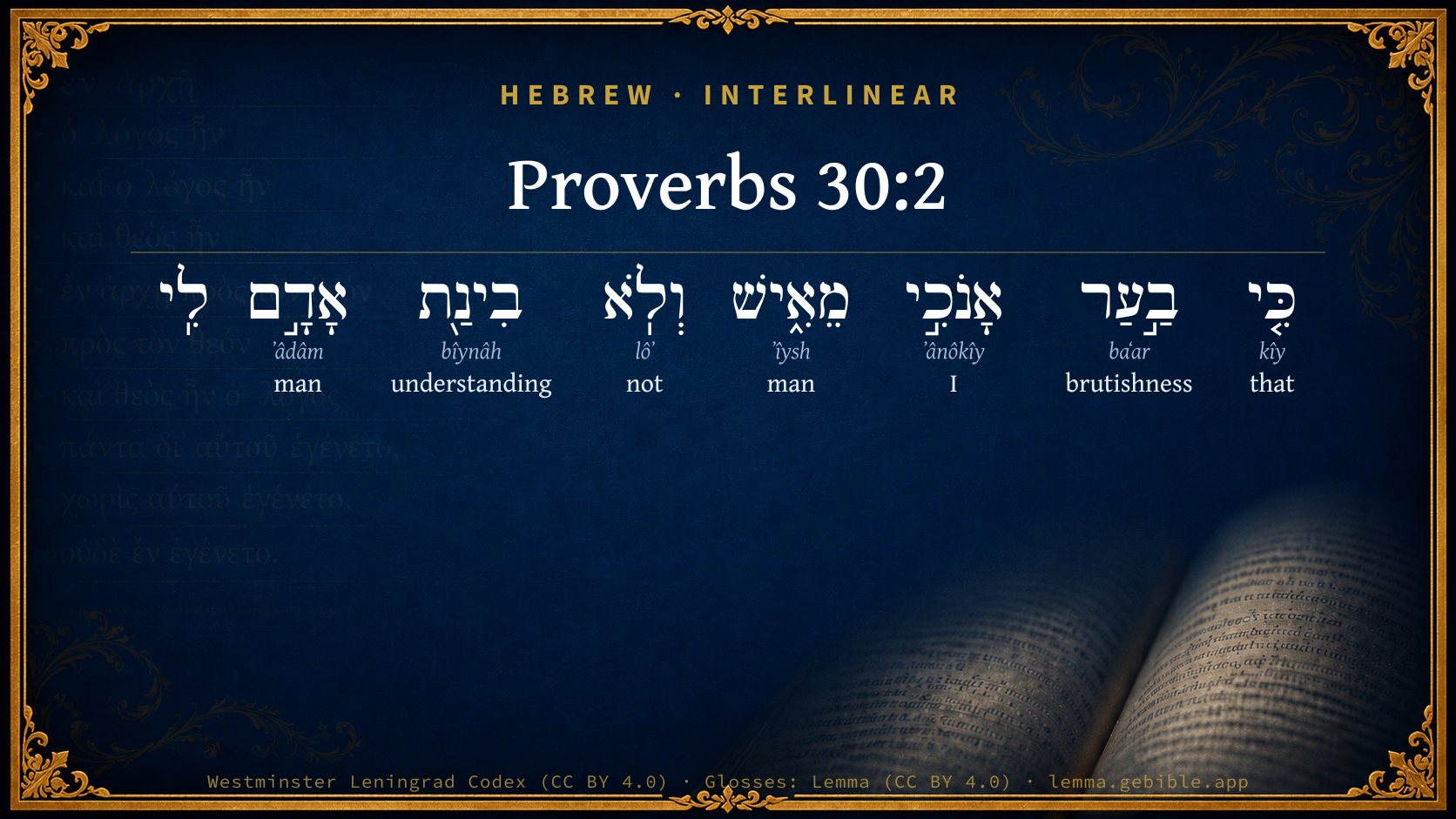
Proverbs 30:2

Hebrew (Westminster Leningrad Codex) Proverbs 30:2 appears in the Hebrew Old Testament. The text above is from the Westminster Leningrad Codex. Each word links to its Strong’s number, a concise gloss, and parsing drawn from the Open Scriptures Hebrew Bible morphology. Click any word for its full Brown-Driver-Briggs (BDB) entry.
Download image
Cite this verse

Proverbs 30:2 (World English Bible). Public Domain. Lemma interlinear Bible study tool, https://lemma.gebible.app/v/proverbs/30/2.

Show BibTeX & RIS
BibTeX
RIS
English Translation
"Surely I am the most ignorant man, And don't have a man's understanding.
World English Bible · Public Domain
Download a study sheet

One document with this verse’s original text, its word-by-word gloss line, the meaning frame, cross-references with their text, attributed commentary, and full source and license credits — printable, and it pastes into notes with its structure intact.

This verse Autodidact and up

Study sheet (.html) Plain text (.txt)

A passage Seminary Student

Up to 50 verses in one chapter. A passage sheet keeps up to 6 commentary sources and 12 cross-references per verse, in the order this page ranks them, and says so on the sheet whenever that leaves anything out. Ask for a single verse and you get the Autodidact verse sheet above.

Everything on this page stays free to read, with no account — the sheet is a download of what is already on screen, not access to it.

Want to remove ads? Support Godless Engineer
Compare translations 3

The same verse in 3 English versions, stacked beneath the original-language interlinear above. Click any original word for its lexicon entry.

Each is an independent rendering of the whole verse — the interlinear is not word-aligned to these translations.

Highlighted words mark where these versions differ — a whole-verse word diff, not a word-by-word alignment.

  • World English Bible Public Domain
    "Surely I am the most ignorant man, And don't have a man's understanding.
  • King James Version Public Domain
    Surely I am more brutish than any man, and have not the understanding of a man.
  • unfoldingWord Literal Text CC BY-SA 4.0
    “Surely, I more stupid than a man, and the understanding of man not mine.

unfoldingWord Literal Text — © unfoldingWord, licensed CC BY-SA 4.0. Word-aligned USFM3 via Door43 (git.door43.org/unfoldingWord/en_ult).

Versions to compare (up to 4)

3 of 4 selected

Show all 18 translations

Every available English version of this verse, each an independent rendering of the whole verse.

  • World English Bible Public Domain
    "Surely I am the most ignorant man, And don't have a man's understanding.
  • Berean Standard Bible Public Domain
    Surely I am the most ignorant of men, and I lack the understanding of a man.
  • Majority Standard Bible Public Domain
    Surely I am the most ignorant of men, and I lack the understanding of a man.
  • King James Version Public Domain
    Surely I am more brutish than any man, and have not the understanding of a man.
  • American Standard Version (1901) Public Domain
    Surely I am more brutish than any man, And have not the understanding of a man;
  • Revised Version (1885) Public Domain
    Surely I am more brutish than any man, and have not the understanding of a man:
  • Geneva Bible (1599) Public Domain
    Surely I am more foolish then any man, and haue not the vnderstanding of a man in me.
  • Douay-Rheims (1899) Public Domain
    I am the most foolish of men, and the wisdom of men is not with me.
  • Young's Literal Translation Public Domain
    For I am more brutish than any one, And have not the understanding of a man.
  • Literal Standard Version CC BY-SA 4.0
    For I am more brutish than anyone, || And do not have the understanding of a man.
  • Unlocked Literal Bible CC BY-SA 4.0
    Surely I am more like an animal than any human and I do not have the understanding of a human being.
  • unfoldingWord Literal Text CC BY-SA 4.0
    “Surely, I more stupid than a man, and the understanding of man not mine.
  • Darby Bible Public Domain
    Truly *I* am more stupid than any one; and I have not a man's intelligence.
  • World Messianic Bible Public Domain
    “Surely I am the most ignorant man, and don’t have a man’s understanding.
  • Webster's Bible Public Domain
    Surely I am more brutish than any man, and have not the understanding of a man.
  • Free Bible Version CC BY-SA 4.0
    I'm so stupid I'm not really a man; I can't even think like a human being.
  • Bible in Basic English Public Domain
    For I am more like a beast than any man, I have no power of reasoning like a man:
  • JPS Tanakh (1917) Public Domain
    Surely I am brutish, unlike a man, and have not the understanding of a man;

Literal Standard Version (2020), Covenant Press — licensed CC BY-SA 4.0. Text via the HelloAO Bible API (eBible.org). Unlocked Literal Bible (unfoldingWord) — licensed CC BY-SA 4.0. Text via the HelloAO Bible API (eBible.org). unfoldingWord Literal Text — © unfoldingWord, licensed CC BY-SA 4.0. Word-aligned USFM3 via Door43 (git.door43.org/unfoldingWord/en_ult). Free Bible Version, Dr. Jonathan Gallagher — licensed CC BY-SA 4.0. Text via the HelloAO Bible API (eBible.org).

Word by word

More ways to search: Search by grammar → Find every occurrence → Compare this word →

Practice this passage: Drill this verse → Learn its vocabulary →

About this verse

These counts appear in no published source. They are computed here, from the morphology-tagged text and Lemma’s own curated glosses. What Lemma adds →

8
words
7
distinct lemmas
Wisdom
section

Notable vocabulary

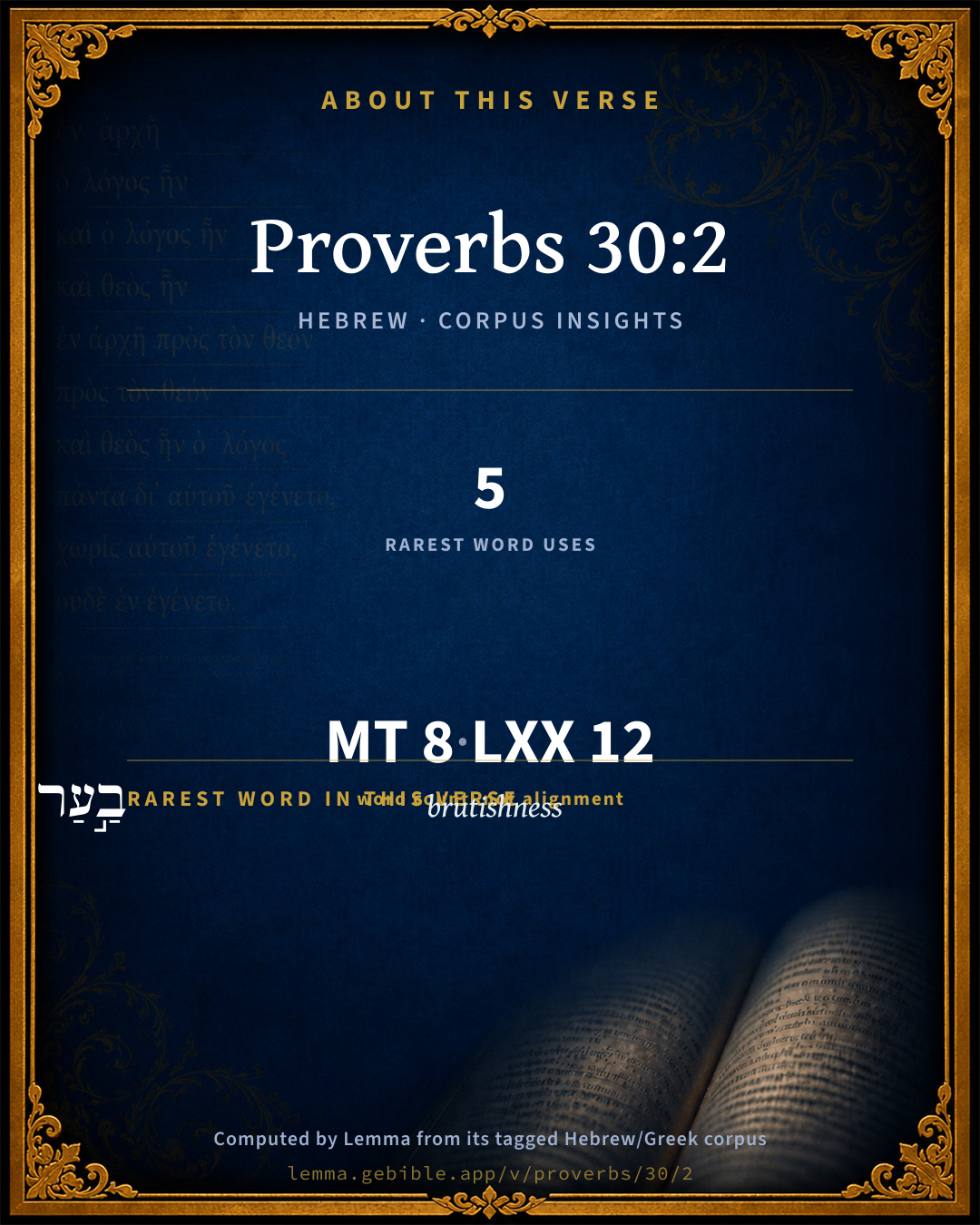
The rarest word here is בַ֣עַר brutishness H1198 — appearing just 5 times in the whole Hebrew Bible.

Shared distinctive vocabulary

בַ֣עַר brutishness H1198 occurs in 5 verses of the Hebrew Bible. Also found in:

Grammatical profile

  • 3 nouns
  • 1 adjective
  • 1 pronoun
  • 1 preposition
  • 1 conjunction
  • 1 particle

Hebrew & Septuagint length

In English translation the verse runs 13 words from the Hebrew and 19 from the Septuagint (LXX English) — the Septuagint runs noticeably longer here. See the side-by-side →

A rough comparison of the two English renderings, which tokenize alike — not a word-level alignment.

Word counts can differ between the Hebrew and the Greek without any difference in meaning — e.g. the Hebrew direct-object marker אֵת has no separate Greek word, and Greek often adds the article ὁ.

In the original languages it is 8 Hebrew tokens and 12 Greek tokens — but the two are counted differently (Hebrew bundles its prefixes and suffixes into one token; the Greek is in lemma form), so that isn’t a like-for-like length.

Cross-references

12

Topical passages linked to Proverbs 30:2 in the Treasury of Scripture Knowledge — connected by theme and wording, ordered by reader-vote popularity; previews shown in the World English Bible.

  • Psalms 73:22 I was so senseless and ignorant. I was a brute beast before you.
  • Proverbs 5:12 And say, "How I have hated instruction, And my heart despised reproof;
  • 1 Corinthians 3:18 Let no one deceive himself. If anyone thinks that he is wise among you in this world, let him become a fool, that he may become wise.
  • Job 42:3–6 You asked, 'Who is this who hides counsel without knowledge?' Therefore I have uttered that which I did not understand, Things too wonderful for me, which I didn't know.
  • Psalms 49:10 For he sees that wise men die; Likewise the fool and the senseless perish, And leave their wealth to others.
  • Psalms 92:6 A senseless man doesn't know, Neither does a fool understand this:
  • Isaiah 6:5 Then I said, "Woe is me! For I am undone, because I am a man of unclean lips, and I dwell in the midst of a people of unclean lips: for my eyes have seen the King, Yahweh of Hosts!"
  • Jeremiah 10:14 Every man is become brutish [and is] without knowledge; every goldsmith is disappointed by his engraved image; for his molten image is falsehood, and there is no breath in them.
  • Romans 11:25 For I don't desire, brothers, to have you ignorant of this mystery, so that you won't be wise in your own conceits, that a partial hardening has happened to Israel, until the fullness of the Gentiles has come in,
  • 1 Corinthians 8:2 But if anyone thinks that he knows anything, he doesn't yet know as he ought to know.
  • James 1:5 But if any of you lacks wisdom, let him ask of God, who gives to all liberally and without reproach; and it will be given to him.
  • 2 Peter 2:12–16 But these, as unreasoning creatures, born natural animals to be taken and destroyed, speaking evil in matters about which they are ignorant, will in their destroying surely be destroyed,

Cross-references courtesy of OpenBible.info (CC BY 4.0).

Hebrew and Greek witnesses Masoretic Hebrew ↔ Greek Septuagint

The same verse in the two great witnesses to the Old Testament, shown verse-for-verse.

Here the Septuagint runs noticeably longer than the Hebrew — LXX2012 (modern English Septuagint) 19 words vs World English Bible 13. A rough length comparison of the two English translations, not a word-level alignment — read both below.

These are two independent witnesses, not word-aligned to each other, and the Septuagint is shown in lemma (dictionary) form.

Hebrew Proverbs 30:2 Masoretic · Westminster Leningrad Codex

כִּ֤י בַ֣עַר אָנֹכִ֣י מֵאִ֑ישׁ וְלֹֽא בִינַ֖ת אָדָ֣ם לִֽי

"Surely I am the most ignorant man, And don't have a man's understanding.

World English Bible · Public Domain

Greek LXX Proverbs 30:2 Septuagint · lemma form

ἄφρων γάρ εἰμί πᾶς ἄνθρωπος καί φρόνησις ἄνθρωπος οὐ εἰμί ἐν ἐγώ

For I am the most simple of all men, and there is not in me the wisdom of men.

LXX2012 (modern English Septuagint) · Public Domain

Hebrew: Westminster Leningrad Codex (CC BY 4.0). Greek: Septuagint (public domain); English from LXX2012 (modern English Septuagint) (Public Domain). How the Septuagint differs from the Hebrew →

Commentary

Notes on Proverbs 30:2 from classic Christian and Jewish commentators (each source and its license shown beneath its notes). The classic Christian expositions comment on the surrounding passage and are grouped to its opening verse, so a note may address several verses; the Jewish commentaries on the Tanakh (Rashi and others) are per-verse, so they appear only where the commentator wrote on this verse.

Lemma curates 59 commentaries, every one of them public domain or Creative Commons licensed, each selected and text-cleaned for this edition rather than reprinted as found. About our sources →

Trapp's Complete Commentary

John Trapp

Pro 30:2 Surely I [am] more brutish than [any] man, and have not the understanding of a man.

Ver. 2. Surely I am more brutish than any man.] Or, Surely I have been brutish since I was a man. See how this good man vilifies, yea, nullifies himself to the utmost. This was true humility, that like true balm ever sinks to the bottom, when hypocritical, as oil, swims on the top. Humilitas, ab humo, because it lays a man flat on the ground. Agur had seen Ithiel and Ucal; hence he seeth so little by himself: "Now mine eyes have seen thee; wherefore I abhor myself." {Job 42:5} "Woe is me! for I am undone," saith Isaiah; "for mine eyes have seen the King, the Lord of hosts." {Pro 6:5} He that looks intently upon the sun hath his eyes dazzled; so he that beholds the infinite excellencies of God, considers the distance, cannot but be sensible of his own naughtiness, nothingness. It is fit the foundation should be laid deep, where the building is so high. Agur’s humility was not more low than his aims lofty: "Who hath ascended up into heaven?" It is a high pitch that he flies, for he knew well that godliness, as it begins in the right knowledge of ourselves, so it ends in the right knowledge of God.

And have not the understanding of a man.] Or, Neither is there in me the understanding that was in Adam. Man, when he came first out of God’s mint, shone most glorious in knowledge, righteousness, and holiness. Socinians feign him silly, and therein betray their own silliness. {a} He had a large measure of objective knowledge, both in natural things and supernatural; which we have lost in him. {1Co 2:14} This we should, with Agur here, sit down and bewail, as those in Ezra did the burnt temple. {Ezr 3:12}

{a} Tanta fuit Adami recens conditi stupiditas, ut maior in infantes cadere non possit. - Socin.

John Trapp, A Commentary or Exposition upon All the Books of the Old and New Testament (1647–1656) — public domain. Text from a community e-Sword module.

Joseph Benson's Commentary

Pro 30:2-3. Surely I am more brutish, &c. — This he utters from an humble and modest apprehension of his own ignorance. I neither learned wisdom — I have not been taught in the schools of wisdom; nor have the knowledge of the holy — Hebrew, קדשׁים, of holy persons, namely, of the holy prophets. I have not such divine inspirations as prophets, strictly so called, have received.

Joseph Benson's Commentary on the Old and New Testaments (1811–1818) — public domain. Text from a community e-Sword module.

Geneva Bible (1599)

Geneva Bible translators

Herein he declareth his great humility, who would not attribute any wisdom to himself, but all unto God.

Geneva Bible (1599) marginal notes — public domain. Text via Bolls.life.

Jamieson, Fausset & Brown

Robert Jamieson, A. R. Fausset & David Brown

brutish--stupid, a strong term to denote his lowly self-estimation; or he may speak of such as his natural condition, as contrasted with God's all-seeing comprehensive knowledge and almighty power. The questions of this clause emphatically deny the attributes mentioned to be those of any creature, thus impressively strengthening the implied reference of the former to God (compare Deu 30:12-14; Isa 40:12; Eph 4:8).

Jamieson, Fausset & Brown — Commentary Critical and Explanatory on the Whole Bible (1871) — public domain (CC PDM 1.0). Text via the HelloAO Bible API.

Adam Clarke's Commentary

Verse 2. Surely I am more brutish] These words can in no sense, nor by any mode of speech, be true of Solomon: for while he was the wisest of men, he could not have said that he was more brutish than any man, and had not the understanding of a man. It is saying nothing to the purpose, to say he was so independently of the Divine teaching. Had he put this in, even by innuendo, it might be legitimate: but he does not; nor is it by fair implication to be understood. Solomon is not supposed to have written the Proverbs after he fell from God. Then indeed he might have said he had been more brutish than any man. But Agur might have used these words with strict propriety, for aught we know; for it is very probable that he was a rustic, without education, and without any human help, as was the prophet Amos; and that all that he knew now was by the inspiration of the Almighty, independently of which he was rustic and uneducated.

Adam Clarke's Commentary on the Bible (1810–1826) — public domain. Text from a community e-Sword/MySword module.

Ellicott's Commentary for English Readers

(2) Surely I am more brutish than any man.—Rather, than that I can be called a man, one “formed in the image of God.” (Comp. Psa_73:22.)

A Bible Commentary for English Readers, edited by Charles John Ellicott (1878–1897) — public domain. Text from a community e-Sword module.

John Gill's Exposition

Surely I am more brutish than any man,.... "Every man is become brutish in his knowledge"; man in his original state was a knowing creature but sinning lost his knowledge, and "became like the beasts that perish"; hence we read of the "brutish among the people": but Agur thought himself not only brutish among the rest, but more brutish than any. So Plato (o) says of some souls living on earth, that they are of a brutish nature; see Jer 10:14. Or I think the words may be rendered, "a brute am I rather than a man" (p); have more of the brute than of the man, especially in the sight and presence of God; a very beast before him, or in comparison of other wise, holy, and good men; or with respect to the knowledge of spiritual, divine, and heavenly things, Psa 73:22; or "a brute was I from the time", or "ever since I was a man" (q); as soon as be was born, being born in sin, and like a wild ass's colt, Job 11:12;

and have not the understanding of a man; or "of Adam" (r); who was made after the image of God, which consisted in knowledge as well as holiness; who knew much of God, his nature, perfections, and persons; of the creatures, and the works of his hands and of all things in nature; but affecting more knowledge than he should lost in a great measure what he had, and brought his posterity in and left them in a state of blindness and ignorance, one of whose sons Agur was: or his meaning is, that he had not the understanding, as not of Adam in innocence, and of prophets and other eminent men of God, so not of ordinary men of those who had, he least share of the knowledge of divine things. Aben Ezra, who takes Ithiel and Ucal to be scholars or companions of Agur, supposes, that they asked him questions concerning the divine Being, nature, and perfections, to which he answers in this strain; showing his insufficiency to give them any instruction or satisfaction in such matters, or to discourse on such sublime subjects: or rather his view was to show the blindness and ignorance of human nature with respect to divine things he was about to treat of; and particularly to observe, that the knowledge of a Saviour, and salvation by him, were not from nature, and attainable by that; and that a man must first know himself, his own folly and ignorance, before he can have any true knowledge of Ithiel and Ucal, the mighty Saviour and Redeemer; of the need of him, and of interest in him. Some think his view is to prove that his words, his prophecy, or what he was about to say, or did say, must be owing entirely to divine inspiration; since he was of himself; and without a divine revelation, so very blind, dark, and ignorant; it could not be owing to any natural sagacity of his, who was more brutish than any; nor to any acquired knowledge, or the instruction of men, since he had none, as follows; and so with which the words begin, may be rendered "for" or "because" (s), as it usually is, "for I am more brutish, than any man", &c.

(o) De Leg. l. 10. p, 959. (p) "bardus sum prae viro", Mercerus; "brutus ego prae viro", Cocceius, Schultens. (q) "Nam brutus sum ex quo vir sum", Junius & Tremellius, so Cartwright. (r) "Nec est mihi intelligentia Adami", Cartwright. (s) "nam", Junius & Tremellius; "quia", Pagninus, Montanus; "quoniam", Michaelis.

John Gill's Exposition of the Whole Bible (1746–1763) — public domain (CC PDM 1.0). Text via the HelloAO Bible API.

Albert Barnes' Notes on the Bible

A confession of ignorance, with which compare the saying of Socrates that he was wise only so far as he knew that he knew nothing, or that of Asaph Psa 73:22.

Albert Barnes' Notes on the Bible (1834–1885) — public domain. Text from a community e-Sword/MySword module.

Haydock's Catholic Bible Commentary

With me. He speaks of what he could claim of his own, abstracting from the prophetic light. (Calmet) --- In his humility, he supposeth that others are more perfect. The wisest know best their own defects. (Worthington)

George Leo Haydock (1774–1849), Haydock's Catholic Family Bible and Commentary, 1859 edition — public domain. Excludes Psalms (Douay-Rheims chapter numbering differs from Protestant) and Deuterocanonical books (Catholic canon only).

Matthew Poole's English Annotations

You come to me with a great opinion of my wisdom, and you expect that I should inform and instruct you in all things, yea, even in the greatest mysteries: but you are much mistaken in me; I am as ignorant and foolish as other men generally are, yea, more than many others; which he utters either,

1. From a deep sense of the common corruption of human nature, and of the blindness of men’s minds in things concerning God and their own duty, and of the necessity of instruction from God’s word, and of illumination from his Spirit, without which they can never understand these matters. Or,

2. From a modest and humble apprehension of his own ignorance, which hath extorted such-like expressions even from heathen philosophers; whence Pythagoras rejected the title of a wise man when it was ascribed to him; and Socrates, though reputed the wisest man of his age, professed that he knew nothing but this, that he knew nothing.

Matthew Poole's English Annotations on the Holy Bible (1683–1685) — public domain. Text from a community e-Sword/MySword module.

Whedon's Commentary on the Bible

Daniel D. Whedon

2. Brutish — Stupid, lacking intelligence, as compared with many others. Psa_73:22.

Daniel D. Whedon (gen. ed.), Commentary on the Old and New Testaments (1874–1909) — public domain. Text from a community e-Sword module.

The Pulpit Commentary

Vers. 2 and 3 confirm what is said in ver. 1 concerning the fruitlessness of the investigation there mentioned; the more he sought and studied, the more conscious he became of his own ignorance and of God"s incomreprehensibility.

Surely I am more brutish than any man "Surely" (ki) should be "for" (see note on ver. 1). Cheyne, "I am too stupid for a man;" I am a mere irrational beast. (comp. Pro_12:1 Psa_73:22) And have not the understanding of a man. I am not worthy to be called a man, as I possess not the intellectual faculty which a man ought to have. This is not ironical, as if he did not desire the statement to be taken in its full sense, and meant to say, "Of course it is my own stupidity that is in fault;" but it is a genuine confession of incompetence to investigate the subject matter, which is too mysterious for his mental powers to penetrate. Thus Solomon acknowledges that he is but a little child, nod prays for an understanding heart. (1Ki_3:7, 1Ki_3:9; comp. RAPC Wis 9:5 Mat_11:25)

The Pulpit Commentary (1880–1919), ed. H.D.M. Spence-Jones & Joseph S. Exell — public domain. Text from a community e-Sword module.

John Wesley's Explanatory Notes

Surely - This he utters from a modest and humble apprehension of his own ignorance.

John Wesley, Explanatory Notes Upon the Whole Bible (1754–1765) — public domain. Text via the GEBible commentary corpus.

Keil & Delitzsch

C. F. Keil & F. Delitzsch

The כי now following confirms the fruitlessness of the long zealous search:

2 For I am without reason for a man,

And a man's understanding I have not.

3 And I have not learned wisdom,

That I may possess the knowledge of the All-Holy.

He who cannot come to any fixed state of consecration, inasmuch as he is always driven more and more back from the goal he aims at, thereby brings guilt upon himself as a sinner so great, that every other man stands above him, and he is deep under them all. So here Agur finds the reason why in divine things he has failed to attain unto satisfying intelligence, not in the ignorance and inability common to all men - he appears to himself as not a man at all, but as an irrational beast, and he misses in himself the understanding which a man properly might have and ought to have. The מן of מאישׁ is not the partitive, like Isa 44:11, not the usual comparative: than any one (Bttcher), which ought to be expressed by מכּל־אישׁ, but it is the negative, as Isa 52:14; Fleischer: rudior ego sum quam ut homo appeller, or: brutus ego, hominis non similis. Regarding בּער, vid., under Pro 12:1.

(Note: According to the Arab. בעיר is not a beast as grazing, but as dropping stercus (ba'r, camel's or sheep's droppings); to the R. בר, Mhlau rightly gives the meanings of separating, whence are derived the meanings of grazing as well as of removing (cleansing) (cf. Pers. thak karadn, to make clean = to make clean house, tabula rasa).)

Pro 30:3 now says that he went into no school of wisdom, and for that reason in his wrestling after knowledge could attain to nothing, because the necessary conditions to this were wanting to him. But then the question arises: Why this complaint? He must first go to school in order to obtain, according to the word "To him who hath is given," that for which he strove. Thus למדתּי refers to learning in the midst of wrestling; but למד, spiritually understood, signifies the acquiring of a kennens [knowledge] or knnens [knowledge = ability]: he has not brought it out from the deep point of his condition of knowledge to make wisdom his own, so that he cannot adjudge to himself knowledge of the all-holy God (for this knowledge is the kernel and the star of true wisdom). If we read 3b לא אדע, this would be synchronistic, nesciebam, with למדתי standing on the same line. On the contrary, the positive אדע subordinates itself to ולא־למדתי, as the Arab. fâa' lama, in the sense of (ita) ut scirem scientiam Sanctissimi, thus of a conclusion, like Lam 1:19, a clause expressive of the intention, Ewald, 347a. קדשׁים is, as at Pro 9:10, the name of God in a superlative sense, like the Arab. el-kuddûs.

Keil & Delitzsch — Biblical Commentary on the Old Testament (1861–1891) — public domain (CC PDM 1.0). Text via the HelloAO Bible API. (Old Testament only.)

Rashi

Rabbi Shlomo Yitzchaki (Rashi)

For I am more boorish Because I relied on my wisdom in a matter that the Holy One, blessed be He, is concerned lest one come to sin.

Rashi on the Tanakh — English translations: “The Judaica Press complete Tanach with Rashi, translated by A. J. Rosenberg” (CC BY 4.0); “Pentateuch with Rashi's commentary by M. Rosenbaum and A.M. Silbermann, 1929-1934” (public domain); “The Metsudah Tanach series, Lakewood, N.J” (CC BY 4.0); and “The Book of Joshua, Metsudah Publications, 1997” (CC BY 4.0). Text via Sefaria.

Lesson kit

Teaching starters — assembled from the data on this page, not authored interpretation. Every prompt links to the verse data it draws on. Edit before teaching.

Proverbs, in the Wisdom, opens this verse with 8 words (7 distinct Hebrew lemmas). Its most distinctive word is baʻar (“brutishness”). The Greek Septuagint runs longer here. A historical commentator’s framing appears above. Read the whole chapter for the surrounding context.

Discussion questions

  1. What does “brutishness” (baʻar) contribute to the verse as a whole?
  2. Psalms 49:10 shares the word «brutishness» with this verse. How do the two illuminate each other?
  3. Compared with the Hebrew, the Septuagint runs longer here. What questions does that raise?
  4. The translations on this page render this verse differently — a whole-verse word diff, not a word-by-word alignment. What might account for the different wordings?
  5. Reading how Trapp's Complete Commentary and Joseph Benson's Commentary read this verse, where do the two commentators agree and where do they part?

Things to notice

Reading settings

Reading text

Shown beneath each verse's original-language words.

Old Testament
Old Testament edition

Read the OT as the Masoretic Hebrew (MT) or the Greek Septuagint (LXX).

English shown for the Greek Septuagint (in the Hebrew ↔ Greek comparison).

Comparing translations? Open the Compare panel on any verse page to stack up to four side by side.