
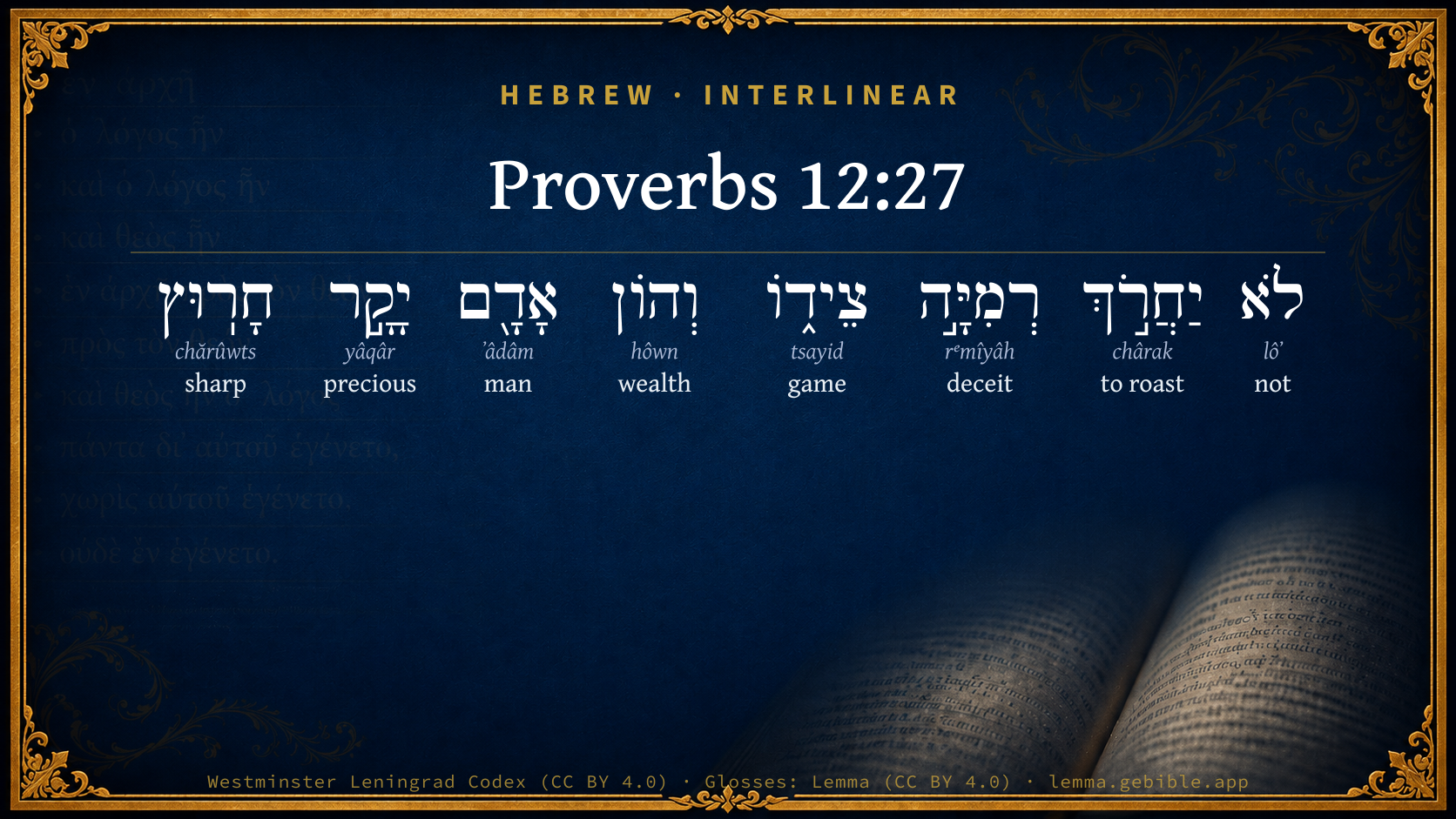
Proverbs 12:27

Hebrew (Westminster Leningrad Codex) Proverbs 12:27 appears in the Hebrew Old Testament. The text above is from the Westminster Leningrad Codex. Each word links to its Strong’s number, a concise gloss, and parsing drawn from the Open Scriptures Hebrew Bible morphology. Click any word for its full Brown-Driver-Briggs (BDB) entry.
Download image
Cite this verse

Proverbs 12:27 (World English Bible). Public Domain. Lemma interlinear Bible study tool, https://lemma.gebible.app/v/proverbs/12/27.

Show BibTeX & RIS
BibTeX
RIS
English Translation
The slothful man doesn't roast his game, But the possessions of diligent men are prized.
World English Bible · Public Domain
Highlights
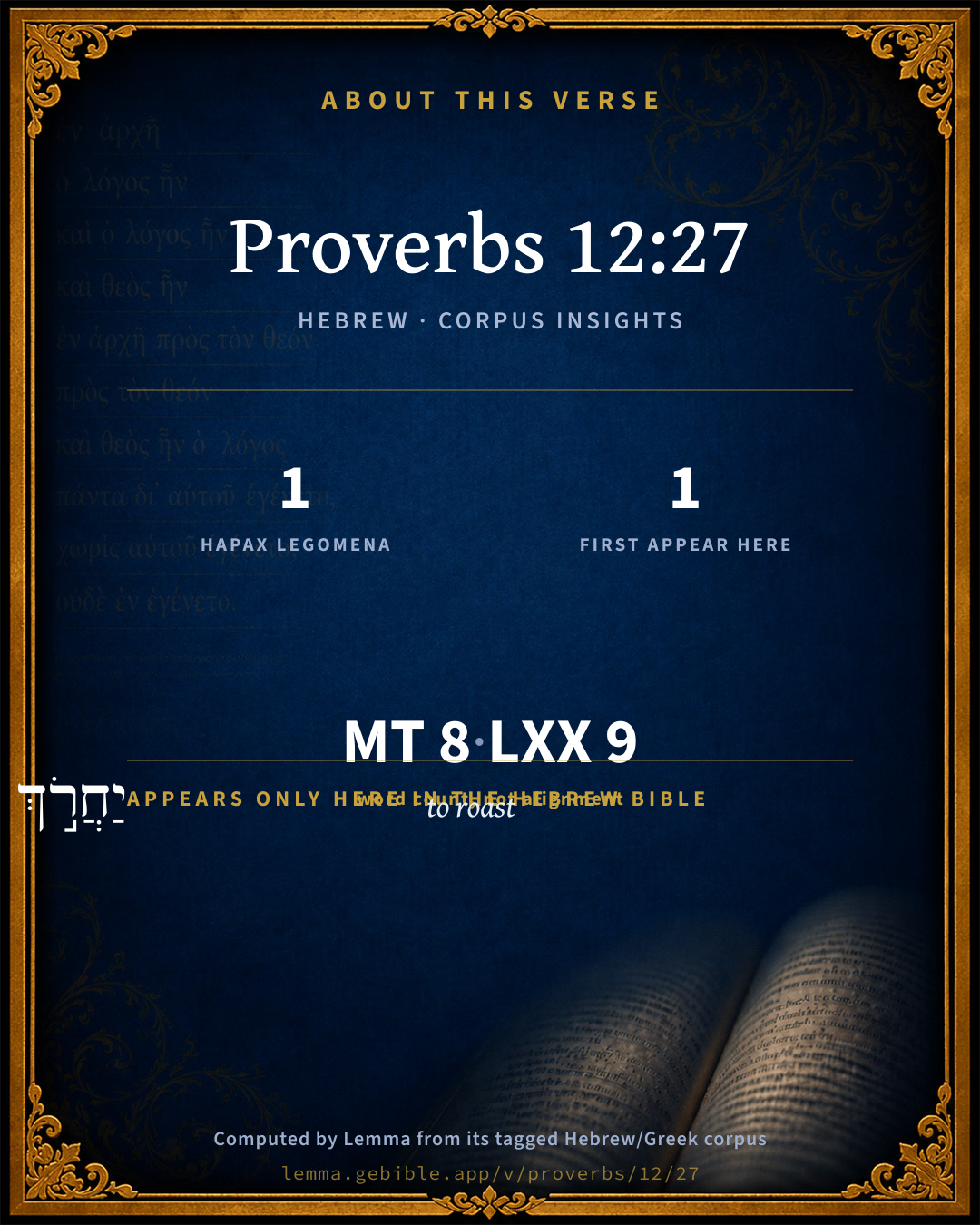
  • 1 hapax legomenon — only here in the Hebrew Bible
  • 1 first appearance in the Hebrew Bible
Full analysis ↓
Download a study sheet

One document with this verse’s original text, its word-by-word gloss line, the meaning frame, cross-references with their text, attributed commentary, and full source and license credits — printable, and it pastes into notes with its structure intact.

This verse Autodidact and up

Study sheet (.html) Plain text (.txt)

A passage Seminary Student

Up to 50 verses in one chapter. A passage sheet keeps up to 6 commentary sources and 12 cross-references per verse, in the order this page ranks them, and says so on the sheet whenever that leaves anything out. Ask for a single verse and you get the Autodidact verse sheet above.

Everything on this page stays free to read, with no account — the sheet is a download of what is already on screen, not access to it.

Want to remove ads? Support Godless Engineer
Compare translations 3

The same verse in 3 English versions, stacked beneath the original-language interlinear above. Click any original word for its lexicon entry.

Each is an independent rendering of the whole verse — the interlinear is not word-aligned to these translations.

Highlighted words mark where these versions differ — a whole-verse word diff, not a word-by-word alignment.

  • World English Bible Public Domain
    The slothful man doesn't roast his game, But the possessions of diligent men are prized.
  • King James Version Public Domain
    The slothful man roasteth not that which he took in hunting: but the substance of a diligent man is precious.
  • unfoldingWord Literal Text CC BY-SA 4.0
    A negligent one will not roast his game, but the wealth of a man precious a diligent one.

unfoldingWord Literal Text — © unfoldingWord, licensed CC BY-SA 4.0. Word-aligned USFM3 via Door43 (git.door43.org/unfoldingWord/en_ult).

Versions to compare (up to 4)

3 of 4 selected

Show all 18 translations

Every available English version of this verse, each an independent rendering of the whole verse.

  • World English Bible Public Domain
    The slothful man doesn't roast his game, But the possessions of diligent men are prized.
  • Berean Standard Bible Public Domain
    A lazy man does not roast his game, but a diligent man prizes his possession.
  • Majority Standard Bible Public Domain
    A lazy man does not roast his game, but a diligent man prizes his possession.
  • King James Version Public Domain
    The slothful man roasteth not that which he took in hunting: but the substance of a diligent man is precious.
  • American Standard Version (1901) Public Domain
    The slothful man roasteth not that which he took in hunting; But the precious substance of men `is to' the diligent.
  • Revised Version (1885) Public Domain
    The slothful man roasteth not that which he took in hunting: but the precious substance of men is to the diligent.
  • Geneva Bible (1599) Public Domain
    The deceitfull man rosteth not, that hee tooke in hunting: but the riches of the diligent man are precious.
  • Douay-Rheims (1899) Public Domain
    The deceitful man shall not find gain: but the substance of a just man shall be precious gold.
  • Young's Literal Translation Public Domain
    The slothful roasteth not his hunting, And the wealth of a diligent man is precious.
  • Literal Standard Version CC BY-SA 4.0
    The slothful does not roast his game, || And the wealth of a diligent man is precious.
  • Unlocked Literal Bible CC BY-SA 4.0
    Lazy people would not roast their own game, but the diligent man will obtain precious wealth.
  • unfoldingWord Literal Text CC BY-SA 4.0
    A negligent one will not roast his game, but the wealth of a man precious a diligent one.
  • Darby Bible Public Domain
    The slothful roasteth not what he took in hunting; but man's precious substance is to the diligent.
  • World Messianic Bible Public Domain
    The slothful man doesn’t roast his game, but the possessions of diligent men are prized.
  • Webster's Bible Public Domain
    The slothful man roasteth not that which he took in hunting: but the substance of a diligent man is precious.
  • Free Bible Version CC BY-SA 4.0
    Lazy people don't catch their prey, but if you work hard you can become rich.
  • Bible in Basic English Public Domain
    He who is slow in his work does not go in search of food; but the ready worker gets much wealth.
  • JPS Tanakh (1917) Public Domain
    The slothful man shall not hunt his prey; but the precious substance of men is to be diligent.

Literal Standard Version (2020), Covenant Press — licensed CC BY-SA 4.0. Text via the HelloAO Bible API (eBible.org). Unlocked Literal Bible (unfoldingWord) — licensed CC BY-SA 4.0. Text via the HelloAO Bible API (eBible.org). unfoldingWord Literal Text — © unfoldingWord, licensed CC BY-SA 4.0. Word-aligned USFM3 via Door43 (git.door43.org/unfoldingWord/en_ult). Free Bible Version, Dr. Jonathan Gallagher — licensed CC BY-SA 4.0. Text via the HelloAO Bible API (eBible.org).

Word by word

More ways to search: Search by grammar → Find every occurrence → Compare this word →

Practice this passage: Drill this verse → Learn its vocabulary →

About this verse

These counts appear in no published source. They are computed here, from the morphology-tagged text and Lemma’s own curated glosses. What Lemma adds →

8
words
8
distinct lemmas
Wisdom
section

Notable vocabulary

1 hapax legomenon — a word that appears only here in the entire Hebrew Bible:

  • יַחֲרֹ֣ךְ to roast H2760

First appearance in Scripture

This word makes its first canonical appearance in the Hebrew Bible here:

  • יַחֲרֹ֣ךְ to roast H2760

Shared distinctive vocabulary

רְמִיָּ֣ה deceit H7423 occurs in 15 verses of the Hebrew Bible. Also found in:

Grammatical profile

  • 1 verb
  • 4 nouns
  • 2 adjectives
  • 1 particle

Verb forms

  • יַחֲרֹ֣ךְ Qal · Imperfect

Hebrew & Septuagint length

In English translation the verse runs 15 words from the Hebrew and 15 from the Septuagint (LXX English) — the same length.

A rough comparison of the two English renderings, which tokenize alike — not a word-level alignment.

Word counts can differ between the Hebrew and the Greek without any difference in meaning — e.g. the Hebrew direct-object marker אֵת has no separate Greek word, and Greek often adds the article ὁ.

In the original languages it is 8 Hebrew tokens and 9 Greek tokens — but the two are counted differently (Hebrew bundles its prefixes and suffixes into one token; the Greek is in lemma form), so that isn’t a like-for-like length.

Cross-references

3

Topical passages linked to Proverbs 12:27 in the Treasury of Scripture Knowledge — connected by theme and wording, ordered by reader-vote popularity; previews shown in the World English Bible.

  • Proverbs 13:4 The soul of the sluggard desires, and has nothing, But the desire of the diligent shall be fully satisfied.
  • Proverbs 26:15 The sluggard buries his hand in the dish. He is too lazy to bring it back to his mouth.
  • Psalms 37:16 Better is a little that the righteous has, Than the abundance of many wicked.

Cross-references courtesy of OpenBible.info (CC BY 4.0).

Hebrew and Greek witnesses Masoretic Hebrew ↔ Greek Septuagint

The same verse in the two great witnesses to the Old Testament, shown verse-for-verse.

These are two independent witnesses, not word-aligned to each other, and the Septuagint is shown in lemma (dictionary) form.

Hebrew Proverbs 12:27 Masoretic · Westminster Leningrad Codex

לֹא יַחֲרֹ֣ךְ רְמִיָּ֣ה צֵיד֑וֹ וְהוֹן אָדָ֖ם יָקָ֣ר חָרֽוּץ

The slothful man doesn't roast his game, But the possessions of diligent men are prized.

World English Bible · Public Domain

Greek LXX Proverbs 12:27 Septuagint · lemma form

οὐ ἐπιτυγχάνω δόλιος θήρα κτῆμα δέ τίμιος ἀνήρ καθαρός

A deceitful man shall catch no game; but a blameless man is a precious possession.

LXX2012 (modern English Septuagint) · Public Domain

On this verse, The Cambridge Bible for Schools and Colleges discusses the Septuagint’s reading. Read the note in Commentary ↓

Hebrew: Westminster Leningrad Codex (CC BY 4.0). Greek: Septuagint (public domain); English from LXX2012 (modern English Septuagint) (Public Domain). How the Septuagint differs from the Hebrew →

Commentary

Notes on Proverbs 12:27 from classic Christian and Jewish commentators (each source and its license shown beneath its notes). The classic Christian expositions comment on the surrounding passage and are grouped to its opening verse, so a note may address several verses; the Jewish commentaries on the Tanakh (Rashi and others) are per-verse, so they appear only where the commentator wrote on this verse.

Lemma curates 59 commentaries, every one of them public domain or Creative Commons licensed, each selected and text-cleaned for this edition rather than reprinted as found. About our sources →

Trapp's Complete Commentary

John Trapp

Pro 12:27 The slothful [man] roasteth not that which he took in hunting: but the substance of a diligent man [is] precious.

Ver. 27. The slothful (or deceitful) man roasteth not that which he took in hunting.] He shall never enjoy his evil gotten goods; but "though he heap up silver as the dust, and prepare raiment as the clay, he may prepare it, but the just shall put it on, and the innocent shall divide the silver." {Job 27:16-17} I read of a dishonest butcher that, having stolen an ox and caused it to be dressed on his wedding day, was on that very day apprehended, and not long after executed. I read of Tecelius, the Pope’s pardon monger in Germany, that having by sale of indulgences scraped together a huge amount of money, and returning for Rome, he was met, and eased of his cash by an odd fellow, who being afterwards prosecuted for a felon, produced a pardon for future sins granted him by Tecelius himself, and being thereupon acquitted by the judge he roasted that which that other old fox had taken in hunting.

But the substance of a diligent man is precious.] Great in value, whatsoever it be in quantity; as a small boxful of pearls is more worth than mountains of pebbles. {Psa 37:16 Pro 15:16; Pro 12:2} The house of the righteous hath much treasure; though there be but curta suppellex, res augusta dotal, he is without that care in getting, fear in keeping, grief in losing, - those three fell vultures that feed continually on the heart of the rich worldling, and dissweeten all his comforts. Jabal that dwelt in tents, and tended the herds, had Jubal to his brother, the father of music. Jabal and Jubal, diligence and complacence, good husbandry and a well contenting sufficiency, dwell usually together.

John Trapp, A Commentary or Exposition upon All the Books of the Old and New Testament (1647–1656) — public domain. Text from a community e-Sword module.

The Biblical Illustrator

Joseph S. Exell

Pro_12:27

The slothful man roasteth not that which he took in hunting.

Indolence

Most hunters have the game they shot or entrapped cooked the same evening or the next day, but not so with this laggard of the text. Too lazy to rip off the hide; too lazy to kindle the fire, and put the gridiron on the coals. What are the causes of laziness, and what are its evil results?

1. Indolence often arises from the natural temperament. I do not know but that there is a constitutional tendency to this vice in every man. Some are very powerfully handicapped by this constitutional tendency.

2. Indolence is often a result of easy circumstances. Rough experience in earlier life seems to be necessary in order to make a man active and enterprising.

3. Another cause of indolence is severe discouragement. There are those around us who started life with the most sanguine expectation; but some sudden and overwhelming misfortune met them, and henceforth they have been inactive. Trouble, instead of making them more determined, has overthrown them. They have lost all self-reliance. They imagine that all men and all occurrences are against them! You cannot rouse them to action. Every great financial panic produces a large crop of such men.

4. Reverie is a cause of indolence. There are multitudes of men who expect to achieve great success in life, who are entirely unwilling to put forth any physical, moral, or intellectual effort. They have a great many eloquent theories of life. They pass their life in dreaming. Let no young man begin life with reverie. There is nothing accomplished without hard work. Do not in idleness expect something to turn up. It will turn down. Indolence and wickedness always make bad luck.

5. Bad habits are a fruitful source of indolence. Sinful indulgences shut a mans shop, and dull his tools, and steal his profits. Dissoluteness is generally the end of industry. What are the results of indolence? A marked consequence of this vice is physical disease. The healthiness of the whole natural world depends upon activity. And indolence endangers the soul. Satan makes his chief conquests over men who either have nothing to do, or, if they have, refuse to do it. Idleness not only leads a man into associations which harm his morals, but often thrusts upon him the worst kind of scepticism. Loafers are almost always infidels, or fast getting to be such. I never knew a man given up to thorough idleness that was converted. Let me tell the idler that there is no hope for him either in this world or in the world that is to come. (T. De Witt Talmage.)

Labour as enhancing the relative value of a mans possession

This applies to many things.

I. To material wealth.

II. To social position.

III. To civil liberty.

IV. To religious privileges. (Homilist.)

The castle of indolence

Thomson wrote a poem by this title. He locates the castle in a dreamy land, where every sense is steeped in the most luxurious though enervating delights. The lord of the castle was a powerful enchanter, who, by his arts, enticed thoughtless travellers within the gate, that he might destroy their strength and ruin their hopes by a ceaseless round of voluptuous pleasures.

The slothful man

1. The lazy man goes hunting. Some are full of the most bustling activity. An old mathematical professor was wont to define work as steadily overcoming resistance occurring along a fixed line. An intermittent, changing activity manifestly fails to answer the requirements of this definition.

2. The slothful man catches game when he does go hunting. Not only does he act, but he does things. But his slothfulness is made manifest in this: though he be effective, he is not efficient; for--

3. He is too lazy to cook what he does catch. The excitement of the chase is over, he is weary with dragging home his game, so the gun goes into one corner and the game into another, while the man proceeds--with a celerity which would be praiseworthy were it rightly applied--to forget all about it. He waits for the next excitement. His activity has procured no benefits to himself or any one else. There are many people who lose their labour through a disinclination to put the finishing touch to their work. Under excitement they secure certain results, which, if gathered up and made permanent, would be of immense value. But then they get weary, indifferent. They let things slide--to use an expression of the populace. All they have done gradually undoes itself. For lack of but one stone--the keystone--the arch falls. This is the application: When you commence a thing, cease not until you have gathered up the results of your labour in some form of practical and present benefit to your fellow-men. (D. C. Gilmore.)

The Biblical Illustrator, edited by Joseph S. Exell (c. 1880s–1900s) — public domain. Text from a community e-Sword module.

Joseph Benson's Commentary

Pro 12:27. The slothful man — Or, the deceitful man, as in Pro 12:24, who seeks to enrich himself, not by his industry and diligence, but by fraudulent and unjust practices; roasteth not that which he took in hunting — Is too negligent and slothful to roast, or to take care that others roast, that which he took in hunting; so that he does not enjoy the fruit of his own labour. Or, if he has roast-meat, it is not that which he himself took, in hunting; but others have taken, or procured, for him. He lives upon the fruit of their labours, and not of his own. But the substance of a diligent man is precious — As being the fruit of his own industry, and of the blessing of God upon it: hence he has comfort in the enjoyment of it: it is his own daily bread, which God gives him in answer to his prayers, and not bread, so to speak, out of other people’s mouths.

Joseph Benson's Commentary on the Old and New Testaments (1811–1818) — public domain. Text from a community e-Sword module.

The Preacher's Complete Homiletical Commentary

Joseph S. Exell (gen. ed.)

CRITICAL NOTES.—

Pro_12:27. The word translated roast does not occur in this sense elsewhere. In the Chaldee of Dan_3:27, it is used in this sense. It may be read “catcheth not his prey.” The second clause should be, “a precious treasure is diligence,” or “a diligent man.”

MAIN HOMILETICS OF Pro_12:27

I. Even the slothful man may be sometimes roused to activity. He is here represented as having made an effort, he has “taken spoil in hunting.” There are probably few men who are not sometimes roused to exertion, who do not every now and then make a start towards an industrious life, but they lack perseverance, they do not let one act of industry follow upon another so as to form industrious habits. Therefore—

II. The slothful man loses by negligence what he has gained. “He roasteth not that which he took in hunting.” He is too lazy to finish his work. He neutralises the one action by neglecting to perform the other. The food that he has taken is wasted because he is too lazy to roast it, and therefore he might as well have remained idle altogether.

III. He may thus rob an industrious man. The game which he has taken and wasted might have fallen into better hands. Another man might have taken it and put it to a good use. A man has no right thus to deprive another of what he is too lazy to put to a good use himself.

IV. A diligent habit of life is a fortune in itself.

1. It is a possession of which a man cannot be robbed by any of the mischances of life. A habit is a second nature, and if a man has once acquired the habit of a diligent improvement of his time and opportunities, he can no more lose it than he can his identity. It can be touched by no rise or fall of the market, nor affected by any commercial panic. If he is rich, he will be diligent, and if he become poor he will make the most of what still remains to him.

2. It is a source of continual satisfaction. God has made man for work, and a rightly constituted mind is never so happy as when all its powers are actively employed. It is a great source of consolation in times of sorrow to have acquired industrious, active habits, for they often help a man to forget, or to rise above his trials.

3. It makes a man, in one respect, an imitator of God. The Eternal Ruler of the universe is ever active; diligence is one of His attributes. It is the boast of the Hebrew prophet, concerning the everlasting God, that “He fainteth not, neither is weary” (Isa_40:28). Christ declares that He and His Father are unceasing in their activities: “My Father worketh hitherto, and I work” (Joh_5:17).

OUTLINES AND SUGGESTIVE COMMENTS

What a diligent man gains becomes, in his hands, precious by the use he makes of it. It is the means of further increase. And his substance becomes “precious” to others as well as to himself. It is industriously, profitably, benevolently used. In this lies the true value of a man’s substance;—not in the acquisition, but in the use.—Wardlaw.

By translating remiyah the deceitful, instead of the slothful man, which appears to be the genuine meaning of the word, we may obtain a good sense, as the Vulgate has done. “The deceitful man shall not find gain, but the substance of a (just) man shall be the price of gold.” But our version, allowing remiyah to be translated fraudulent, gives the best sense. “The fraudulent man roasteth not that which he took in hunting,” the justice of God snatching from him what he had acquired unrighteously. Coverdale translates “A dis-creatfull man schal fynde no vauntage: but he that is content with what he hath, is more worth than golde.”—A. Clarke.

The substance of a diligent man is great in value, whatsoever it be in quantity, as a small boxful of pearls is more worth than mountains of pebbles. The house of the righteous hath much treasure. He is without that care in getting, fear in keeping, grief in losing—those three fell vultures that feed continually on the heart of the rich worldling, and dis-sweeten all his comforts. Jabal, that dwelt in tents, and tended the herds, had Jubal to his brother, the father of music. Jabal and Jubal, diligence and complacence, good husbandry and a well-contenting sufficiency, dwell usually together.—Trapp.

Is not this a graphical picture of the slothful professor? He will take up religion under strong excitement. He begins a new course, and perhaps makes some advance in it. But, “having no root in himself,” his good frames and resolutions wither away (Mat_13:20-21). The continued exertion required, the violence that must be done to his deep-rooted habits, the difficulties in his new path, the invitations to present ease, all hang as a weight upon his efforts.… No present blessing can be enjoyed without grasping something beyond (Php_3:12-14). Godliness without energy loses its full reward (2Jn_1:8).—Bridges.

The impenitent, who wait for something to turn up, are the same type of lazy people as love hunting and fishing better than more regular labour. The wise man goes to the root and says, There are no such hunting gains in the spiritual world. He goes further. He seems to remind his reader that character is all that will be left for a man at the last. He seems to imply that man will bring home from his hunt nothing but “his laziness,” and would ask whether one can “roast” that like a quail or a duck. And though we start at such horrible absurdity, yet it brings out in keen light a very different possibility for diligence. Diligence can be roasted. It earns for us an eternal heaven, and yet, for all it gets, it is itself our richest dainty. “One cannot roast laziness as something he has taken in the chase; but a precious treasure of a man is a diligent one.” It is tantalising to come so near other and important renderings. Many see very plausibly a meaning like this: The slothful man roasteth not that which he took in hunting” (so far the English version), meaning that he is wasteful, and suffers what he has actually now to run to loss; “but the substance of a common man” (making the distinction as in Pro_12:14) “is precious” (that is, made account of, and kept) “by a man of diligence.” A sinner throws away treasures; a saint values the very smallest. This would be a fine sense if the verse before meant that the “saint gains from his neighbour.” Per contra, though, there are difficulties. “The slothful man” (E.V.) in the Hebrew is the “sloth” or “laziness” itself. And the word is feminine, and must be the object rather than the subject of the verb. The meaning is, that sloth cannot be roasted and eaten, but diligence can.—Miller.

The Preacher's Complete Homiletical Commentary (gen. ed. Joseph S. Exell; Funk & Wagnalls, c. 1892) — public domain (pre-1929). A full-Bible homiletical/sermon-outline anthology covering 65 of 66 books (2 John is absent from the source module). Text from a community e-Sword module.

Geneva Bible (1599)

Geneva Bible translators

Although he get much by unlawful means, yet will he not spend it upon himself.

Geneva Bible (1599) marginal notes — public domain. Text via Bolls.life.

Matthew Henry's Commentary

Here is, 1. That which may make us hate slothfulness and deceit, for the word here, as before, signifies both: The slothful deceitful man has roast meat, but that which he roasts is not what he himself took in hunting, no, it is what others took pains for, and he lives upon the fruit of their labours, like the drones in the hive. Or, if slothful deceitful men have taken any thing by hunting (as sportsmen are seldom men of business), yet they do not roast it when they have taken it; they have no comfort in the enjoyment of it; perhaps God in his providence cuts them short of it. 2. That which may make us in love with industry and honesty, that the substance of a diligent man, though it be not great perhaps, is yet precious. It comes from the blessing of God; he has comfort in it; it does him good, and his family. It is his own daily bread, not bread out of other people's mouths, and therefore he sees God gives it to him in answer to his prayer.

Matthew Henry's Commentary on the Whole Bible (1708–1710) — public domain (CC PDM 1.0). Text via the HelloAO Bible API.

Jamieson, Fausset & Brown

Robert Jamieson, A. R. Fausset & David Brown

(Compare Pro 12:24).

took in hunting--or, "his venison." He does not improve his advantages.

the substance . . . precious--or, "the wealth of a man of honor is being diligent," or "diligence."

precious--literally, "honor" (Ecc 10:1).

Jamieson, Fausset & Brown — Commentary Critical and Explanatory on the Whole Bible (1871) — public domain (CC PDM 1.0). Text via the HelloAO Bible API.

Adam Clarke's Commentary

Verse 27. The slothful man roasteth not that which he took in hunting] Because he is a slothful man, he does not hunt for prey; therefore gets none, and cannot roast, that he may eat. There is some obscurity in the original, on which the versions cast little light. Coverdale translates the whole verse thus: "A discreatfull man schal fynde no vauntage: but he that is content with what he hath, is more worth than golde." My old MS. Bible: The gylful man schal not fynd wynnynge: and the substance of a man schal ben the pris of gold.

By translating רמיה remiyah the deceitful, instead of the slothful man, which appears to be the genuine meaning of the word, we may obtain a good sense, as the Vulgate has done: "The deceitful man shall not find gain; but the substance of a (just) man shall be the price of gold." But our common version, allowing רמיה remiyah to be translated fraudulent, which is its proper meaning, gives the best sense: "The fraudulent man roasteth not that which he took in hunting," the justice of God snatching from his mouth what he had acquired unrighteously.

But the substance of a diligent man] One who by honest industry acquires all his property-is precious, because it has the blessing of God in it.

Adam Clarke's Commentary on the Bible (1810–1826) — public domain. Text from a community e-Sword/MySword module.

Ellicott's Commentary for English Readers

(27) The slothful man roasteth not that which he took in hunting.—Or, does not net, (i.e., secure) his prey; but a valuable possession to a man is diligence.

A Bible Commentary for English Readers, edited by Charles John Ellicott (1878–1897) — public domain. Text from a community e-Sword module.

The Cambridge Bible for Schools and Colleges

gen. ed. J. J. S. Perowne

27. roasteth not] i.e. will not take the trouble to dress the animal which he has caught; or, better, never catches an animal to dress.

Others, however, would render the word (which occurs nowhere else), catcheth not (R.V. marg.), or, killeth not (Maurer) his prey, οὐκ ἐπιτεύξεται, “will not (take the trouble to) catch,” LXX.

the substance &c.] Rather, the precious substance of men is to the diligent, R.V. text; or, is to be diligent, R.V. marg.; the diligent temperament is itself the treasure; κτῆμα δὲ τίμιον ἀνὴρ καθαρός, a precious possession is a man that is pure, LXX.

The Cambridge Bible for Schools and Colleges (gen. ed. J. J. S. Perowne; Cambridge University Press, 1878–1918) — public domain. Text from a community e-Sword module.

John Gill's Exposition

The slothful man roasteth not that which he took in hunting,.... Because he takes none. The slothful man takes no pains to get anything for a livelihood, by hunting or otherwise; and though he loves to live well, and eat roast meat, yet what he roasts is not what he has got himself, but what another has laboured for. It is observed (o) that fowlers burn the wings of birds taken by them, that they may not fly away; to which the allusion may be. Or, "the deceitful" (p) man, as it may be rendered; though he may get much in a fraudulent way, yet it does not prosper with him, he does not enjoy it; it is taken away from him before he can partake of it, or receive any comfort from it, or advantage by it; just as a man that has took anything in hunting, he cannot keep it; it is taken away from him, perhaps by a dog or some man, before he can roast it, and make it fit for eating. Ben Melech, from Joseph Kimchi, observes, that fowlers, when they catch fowls, burn the top of their wings, that they may not fly away at once; and they do not cut their wings off, that they may be left, and appear beautiful to them that buy them: but the slothful or deceitful man does not let the fowl remain in his hands till he burns it; for before that it flies out of his hands, and it is lost to him; which is figuratively to be understood of riches and wealth, gathered by violence and deceit, and lost suddenly. What is ill gotten does not spend well; it does not last long, it is presently gone; there is no true enjoyment of it. Or he will not shut it up within lattices (q) and reserve it, but spend it directly; see Sol 2:9;

but the substance of a diligent man is precious; what is gotten by industry and diligence, and in an honest way, is valuable; it comes with a blessing; there is comfort in the enjoyment of it, and it continues. Some render it, "the substance of a precious man is gold" (r); so the Targum,

"the substance of a man is precious gold;''

and to the same purpose the Vulgate Latin version: a diligent man grows rich; and what he gets spends well, and his substance is daily increasing.

(o) Vid. Schindler. Lexic. col. 653. (p) "vir dolosus", Pagninus, Mercerus, Gejerus, Michaelis; "fraudulentus", Montanus. (q) Vid. Stockium, p. 388. (r) "substantia hominis pretiosi est aurum", De Dieu, so some in Mercerus; "substantia hominis praestantis est aurum", Gussetius, p. 255.

John Gill's Exposition of the Whole Bible (1746–1763) — public domain (CC PDM 1.0). Text via the HelloAO Bible API.

Albert Barnes' Notes on the Bible

The word rendered “roasteth” occurs nowhere else; but the interpretation of the King James Version is widely adopted. Others render the first clause thus: “The slothful man will not secure (keep in his net) what he takes in hunting,” i. e., will let whatever he gains slip from his hands through want of effort and attention.

Albert Barnes' Notes on the Bible (1834–1885) — public domain. Text from a community e-Sword/MySword module.

Haydock's Catholic Bible Commentary

Gain. Hebrew and Septuagint, "his prey," (Calmet) or what "he took in hunting." (Protestants) (Haydock)

George Leo Haydock (1774–1849), Haydock's Catholic Family Bible and Commentary, 1859 edition — public domain. Excludes Psalms (Douay-Rheims chapter numbering differs from Protestant) and Deuterocanonical books (Catholic canon only).

Matthew Poole's English Annotations

The slothful man; or, the deceitful man, as Pro 12:24, who seeks to enrich himself by fraudulent and unjust practices.

Roasteth not that which he took in hunting; doth not enjoy the fruit of his labours or devices, either because he doth not labour, and so hath nothing to waste or enjoy; or because God ofttimes deprives him either of such ill-gotten goods, or at least of a quiet and comfortable fruition of them.

Is precious; yields him great comfort and satisfaction, partly because it abides with him, and partly because he hath God’s favour and blessing with it.

Matthew Poole's English Annotations on the Holy Bible (1683–1685) — public domain. Text from a community e-Sword/MySword module.

Whedon's Commentary on the Bible

Daniel D. Whedon

27. The slothful man roasteth not — After a somewhat careful study of this difficult passage, I incline to the following translation: The indolent man shall not “roast,” or catch, prey.

But the substance — Gain, wealth, prey, of a diligent man is precious; therefore, diligence is the best wealth. Muenscher follows the Authorized Version, and illustrates thus: It is the custom in some countries to singe and smoke dry (roast) the game taken, to preserve it. A diligent hunter in this manner preserves his game; while an indolent man, as long as his food lasts, lounges and sleeps in his hut, probably losing half of the animal by not quickly preserving or perfectly smoking it.

Daniel D. Whedon (gen. ed.), Commentary on the Old and New Testaments (1874–1909) — public domain. Text from a community e-Sword module.

The Pulpit Commentary

The slothful man (literally, sloth) roasteth not that which he took in hunting. There is some doubt concerning the correct meaning of the word translated "roasteth" ( which occurs only in the Chaldea of Dan_3:27, where it signifies "burned" or "singed," according to the traditional rendering. It seems to be a proverbial saying, implying either that a lazy man will not take the trouble to hunt, or, if he does hunt, will not prepare the food which he has taken in the chase, or that he does not enjoy it when he has gotten it. Others render, "will not start his prey;" or "catch his prey," Septuagint; or "secure his prey," i.e. will not keep in his net what he has caught, but carelessly lets it escape. The Vulgate renders, "The cheat will gain no profit." The word rendered "cheat," fraudulentus in the Latin, and doliov in the Greek, is the same as that rightly translated "slothful" (ver. 24). But the substance of a diligent man is precious; i.e. the substance which an honest, industrious man acquires by hi.s labour is stable and of real value. This second clause, however, is variously translated, Revised Version, But the precious substance of men is to the diligent, or, is to be diligent; Delitzsch, "Diligence is a man"s precious possession;" Septuagint, "A pure man is a precious possession." The Authorized Version is probably erroneous, and the rendering should be, as Delitzsch and Nowack take it, "But a precious possession of a man is diligence.

Laxity and industry.

I LAXITY GOES EMPTY HANDED. The proverb seems to call up the image of a hunter who is too lazy to pursue the game.

II INDUSTRY IS ITSELF A CAPITAL. Toil is as good as treasure; such seems to the force of the proverb. And we may be reminded of the parable of the farmer who indicated to his sons the treasure in the field; their persevering toil in digging led to their enrichment. J.

The Pulpit Commentary (1880–1919), ed. H.D.M. Spence-Jones & Joseph S. Exell — public domain. Text from a community e-Sword module.

John Wesley's Explanatory Notes

Resteth not - Does not enjoy the fruit of his labours. Precious - Yields him comfort and blessing with it.

John Wesley, Explanatory Notes Upon the Whole Bible (1754–1765) — public domain. Text via the GEBible commentary corpus.

Keil & Delitzsch

C. F. Keil & F. Delitzsch

27 The slothful pursues not his prey;

But a precious possession of a man is diligence.

The lxx, Syr., Targ., and Jerome render יחרך in the sense of obtaining or catching, but the verbal stem חרך nowhere has this meaning. When Fleischer remarks, חרך, ἅπ. λεγ., probably like לכד, properly to entangle in a noose, a net, he supports his opinion by reference to חרכּים, which signifies lattice-windows, properly, woven or knitted like a net. But חרך, whence this חרכים, appears to be equivalent to the Arab. kharḳ, fissura, so that the plur. gives the idea of a manifoldly divided (lattice-like, trellis-formed) window. The Jewish lexicographers (Menahem, Abulwald, Parchon, also Juda b. Koreish) all aim at that which is in accord with the meaning of the Aram. חרך, to singe, to roast (= Arab. ḥark): the slothful roasteth not his prey, whether (as Frst presents it) because he is too lazy to hunt for it (Berth.), or because when he has it he prepares it not for enjoyment (Ewald). But to roast is צלה, not דרך, which is used only of singeing, e.g., the hair, and roasting, e.g., ears of corn, but not of the roasting of flesh, for which reason Joseph Kimchi (vid., Kimchi's Lex.) understands צידו of wild fowls, and יחרך of the singeing of the tips of the wings, so that they cannot fly away, according to which the Venet. translates οὐ μενεῖ ... ἡ θήρα αὐτοῦ. Thus the Arab. must often help to a right interpretation of the ἅπ. λεγ.. Schultens is right: Verbum ḥarak, חרך, apud Arabes est movere, ciere, excitare, κινεῖν generatim, et speciatim excitare praedam e cubili, κινεῖν τήν θήραν. The Lat. agitare, used of the frightening up and driving forth of wild beasts, corresponds with the idea here, as e.g., used by Ovid, Metam. x. 538, of Diana:

Aut pronos lepores aue celsum in cornua cervum

Aut agitat damas.

Thus יחרך together with צידו gains the meaning of hunting, and generally of catching the prey. רמיּה is here incarnate slothfulness, and thus without ellipse equivalent to אישׁ רמיה. That in the contrasted clause חרוץ does not mean ἀποτόμως, decreed (Lwenstein), nor gold (Targ., Jerome, Venet.), nor that which is excellent (Syr.), is manifest from this contrast as well as from Pro 10:4; Pro 12:24. The clause has from its sequence of words something striking about it. The lxx placed the words in a difference order: κτῆμα δὲ τίμιον ἀνὴρ καθαρὸς (חלוץ in the sense of Arab. khâlaṣ). But besides this transposition, two others have been tried: הון אדם חרוץ יקר, the possession of an industrious man is precious, and הון יקר אדם חרוץ, a precious possession is that (supply הון) of an industrious man. But the traditional arrangement of the words gives a better meaning than these modifications. It is not, however, to be explained, with Ewald and Bertheau: a precious treasure of a man is one who is industrious, for why should the industrious man be thought of as a worker for another and not for himself? Another explanation advanced by Kimchi: a valuable possession to men is industry, has the twofold advantage that it is according to the existing sequence of the words, and presents a more intelligible thought. But can חרוּץ have the meaning of חריצוּת (the being industrious)? Hitzig reads חרוץ, to make haste (to be industrious). This is unnecessary, for we have here a case similar to Pro 10:17, where שׁמר for שׁומר is to be expected: a precious possession of a man is it that, or when, he is industrious, חרוּץ briefly for היותו חרוּץ rof yl. The accentuation fluctuates between והון־אדם יקר (so e.g., Cod. 1294), according to which the Targum translates, and והון־אדם יקר, which, according to our explanation, is to be preferred.

Keil & Delitzsch — Biblical Commentary on the Old Testament (1861–1891) — public domain (CC PDM 1.0). Text via the HelloAO Bible API. (Old Testament only.)

Bridges on Proverbs

Charles Bridges

How miserable and ruinous is the habit of sloth! It is a dead palsy, under God only to be checked by early discipline and constant resistance. Sometimes however the man makes a vigorous and successful effort. He rouses himself even to the toil of hunting. But his fit of exertion is soon over. He cannot be at the pains of preparing his prey for his repast. (Contrast Gen 27:30-31 .) He leaves it to others, perhaps even to his dogs; and quickly relapses into his beloved habit.

Is not this a graphical picture of the slothful professor? He will take up religion under a strong excitement. He begins a new course, and perhaps makes some advances in it. But "having no root in himself," his good frames and resolutions wither away. (Mat 13:20-21 .) The continued exertion required (Mat 11:12 ) ; the violence that must be done to his deep-rooted habits; the difficulties in his new path; the invitations to present ease; the delusive hope of better success at a future day — all these hang as a weight upon his efforts. So that, not knowing the only secret of resistance to his powerful enemy — earnest and persevering prayer; he grows slack, and with just life enough to feel himself dying, he sits down upon his little attainments; thus virtually throwing them away; content to lose heaven itself, if it is to be gained at such a cost. (Pro 13:4 ; Pro 21:25 ; Pro 26:15 .) What use — professor! is it to make an effort, if you do not seek the grace of perseverance? No present blessing can be enjoyed without grasping something beyond. (Php 3:12-14 .) Godliness without energy loses its full reward. (2Jn 1:8 .) The enfeebling influence of doubts and fears often arises, not from a deep feeling of corruption, but from an indolent habit, and a want of a realized conviction of the infinite stake of the soul, calling for instant and persevering labour.

Real substance (Pro 8:21 ; Pro 15:6 ) is the reward of the diligent; precious, as the fruit of his toil; and increasing by his unwearied exercise. (Mat 25:16, Mat 25:28-29 .) Live then — Christian — more in thy work — "spend and be spent" in it. Thy privileges will be enlarged. Thy substance will be enriched. Thy God will be honoured. (Joh 15:8 . Php 1:11 .) Thy crown will be secured. (2Pe 1:11 .)

Charles Bridges, An Exposition of the Book of Proverbs (1846) — public domain. Text from a community e-Sword module.

Kretzmann's Popular Commentary

Paul E. Kretzmann

v. 27. The slothful man roasteth not that which he took in hunting, literally, "catcheth not his prey," being too lazy to make use of his opportunities; but the substance of a diligent man is precious, his industry is a valuable possession and grasps the opportunities offered him.

Paul E. Kretzmann, Popular Commentary of the Bible (1921–1924) — public domain. Text from a community e-Sword module.

unfoldingWord translationNotes

Door43 World Missions Community

would not roast their own game

"Game" means animals caught and killed while hunting. And "roast" is a way of cooking food.

precious wealth

"valuable treasure"

translationWords

walk

life

die

unfoldingWord translationNotes — © Distant Shores Media and the Door43 World Missions Community, licensed CC BY-SA 4.0. Source: git.door43.org/Door43/en_tn.

Rashi

Rabbi Shlomo Yitzchaki (Rashi)

He will not roast This is connected to the above verse; that is to say that the way of the wicked will mislead him, and he will not roast the prey of his deceit.

He will not roast; he will not succeed with his deceit. As he [Solomon] spoke with a figure of prey, an expression of roasting is appropriate, for the successful hunter hunts the birds and roasts them in fire.

but the wealth of an honest man is precious Heb. יקר חרוץ. This is an inverted verse. But the wealth of a man who is honest is precious.

honest Heb. חרוץ, one who deals honestly, as in (10:4): “and the hand of those who make true decisions (חרוצים) will make [them] rich.”

Rashi on the Tanakh — English translations: “The Judaica Press complete Tanach with Rashi, translated by A. J. Rosenberg” (CC BY 4.0); “Pentateuch with Rashi's commentary by M. Rosenbaum and A.M. Silbermann, 1929-1934” (public domain); “The Metsudah Tanach series, Lakewood, N.J” (CC BY 4.0); and “The Book of Joshua, Metsudah Publications, 1997” (CC BY 4.0). Text via Sefaria.

Lesson kit

Teaching starters — assembled from the data on this page, not authored interpretation. Every prompt links to the verse data it draws on. Edit before teaching.

Proverbs, in the Wisdom, opens this verse with 8 words (8 distinct Hebrew lemmas). Its most distinctive word is chârak (“to roast”). A historical commentator’s framing appears above. Read the whole chapter for the surrounding context.

Discussion questions

  1. What does “to roast” (chârak) contribute to the verse as a whole?
  2. 1 word here appears nowhere else in the Hebrew Bible. Why might the author reach for such rare wording?
  3. This is the first place “to roast” appears in Scripture (first appears here). What does its debut here establish?
  4. How does Job 13:7, which shares the word «deceit», read alongside this verse?
  5. The translations on this page render this verse differently — a whole-verse word diff, not a word-by-word alignment. What might account for the different wordings?
  6. «יַחֲרֹ֣ךְ» is a Qal Imperfect verb. How does that grammatical form shape the action described?
  7. Compare how Trapp's Complete Commentary and The Biblical Illustrator read this verse. Where do they agree or differ?

Things to notice

Reading settings

Reading text

Shown beneath each verse's original-language words.

Old Testament
Old Testament edition

Read the OT as the Masoretic Hebrew (MT) or the Greek Septuagint (LXX).

English shown for the Greek Septuagint (in the Hebrew ↔ Greek comparison).

Comparing translations? Open the Compare panel on any verse page to stack up to four side by side.