
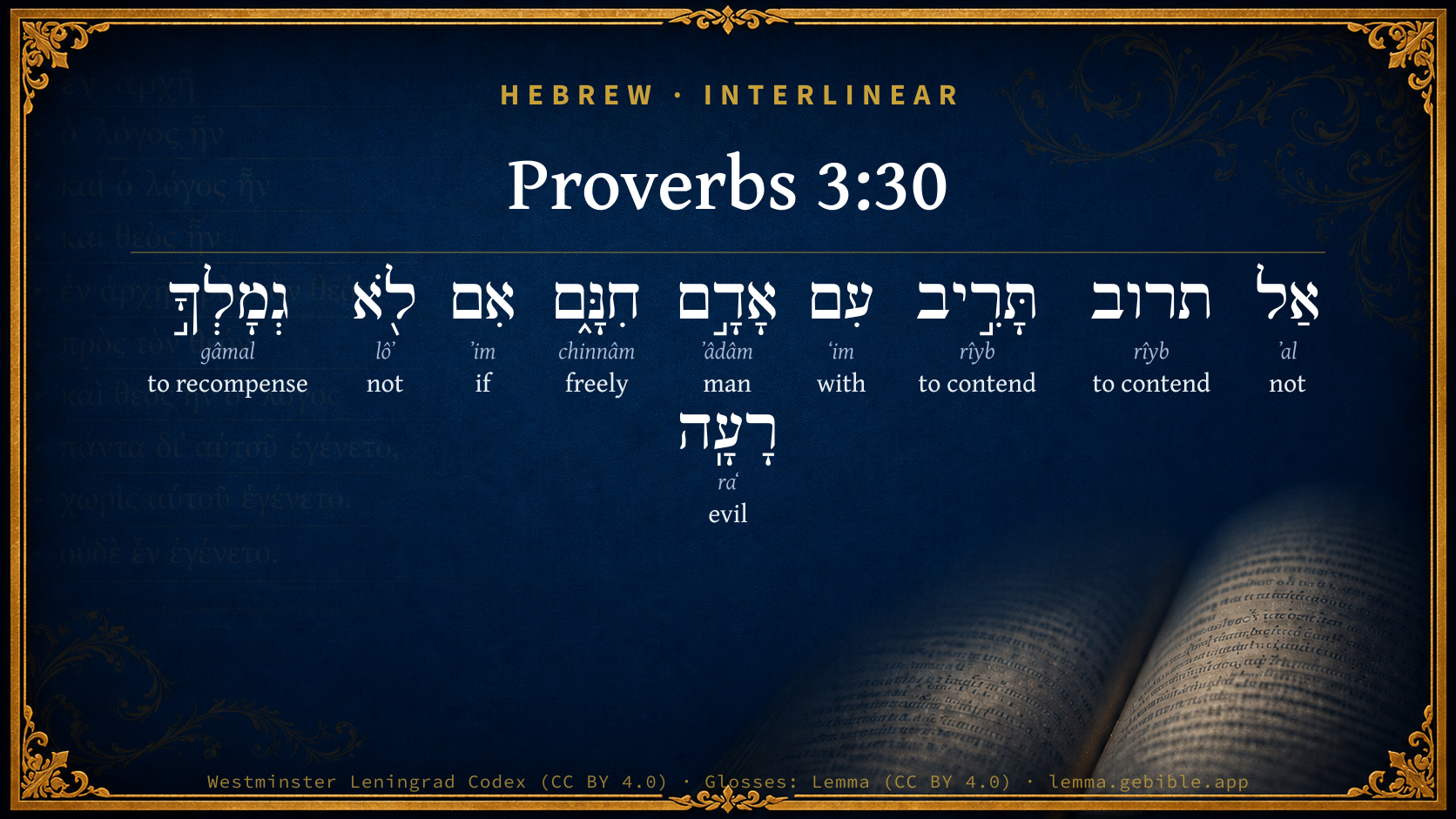
Proverbs 3:30

Hebrew (Westminster Leningrad Codex) Proverbs 3:30 appears in the Hebrew Old Testament. The text above is from the Westminster Leningrad Codex. Each word links to its Strong’s number, a concise gloss, and parsing drawn from the Open Scriptures Hebrew Bible morphology. Click any word for its full Brown-Driver-Briggs (BDB) entry.
Download image
Cite this verse

Proverbs 3:30 (World English Bible). Public Domain. Lemma interlinear Bible study tool, https://lemma.gebible.app/v/proverbs/3/30.

Show BibTeX & RIS
BibTeX
RIS
English Translation
Don't strive with a man without cause, If he has done you no harm.
World English Bible · Public Domain
Download a study sheet

One document with this verse’s original text, its word-by-word gloss line, the meaning frame, cross-references with their text, attributed commentary, and full source and license credits — printable, and it pastes into notes with its structure intact.

This verse Autodidact and up

Study sheet (.html) Plain text (.txt)

A passage Seminary Student

Up to 50 verses in one chapter. A passage sheet keeps up to 6 commentary sources and 12 cross-references per verse, in the order this page ranks them, and says so on the sheet whenever that leaves anything out. Ask for a single verse and you get the Autodidact verse sheet above.

Everything on this page stays free to read, with no account — the sheet is a download of what is already on screen, not access to it.

Want to remove ads? Support Godless Engineer
Compare translations 3

The same verse in 3 English versions, stacked beneath the original-language interlinear above. Click any original word for its lexicon entry.

Each is an independent rendering of the whole verse — the interlinear is not word-aligned to these translations.

Highlighted words mark where these versions differ — a whole-verse word diff, not a word-by-word alignment.

  • World English Bible Public Domain
    Don't strive with a man without cause, If he has done you no harm.
  • King James Version Public Domain
    Strive not with a man without cause, if he have done thee no harm.
  • unfoldingWord Literal Text CC BY-SA 4.0
    Do not contend with a man without cause if he has not done you evil.

unfoldingWord Literal Text — © unfoldingWord, licensed CC BY-SA 4.0. Word-aligned USFM3 via Door43 (git.door43.org/unfoldingWord/en_ult).

Versions to compare (up to 4)

3 of 4 selected

Show all 18 translations

Every available English version of this verse, each an independent rendering of the whole verse.

  • World English Bible Public Domain
    Don't strive with a man without cause, If he has done you no harm.
  • Berean Standard Bible Public Domain
    Do not accuse a man without cause, when he has done you no harm.
  • Majority Standard Bible Public Domain
    Do not accuse a man without cause, when he has done you no harm.
  • King James Version Public Domain
    Strive not with a man without cause, if he have done thee no harm.
  • American Standard Version (1901) Public Domain
    Strive not with a man without cause, If he have done thee no harm.
  • Revised Version (1885) Public Domain
    Strive not with a man without cause, if he have done thee no harm.
  • Geneva Bible (1599) Public Domain
    Striue not with a man causelesse, when he hath done thee no harme.
  • Douay-Rheims (1899) Public Domain
    Strive not against a man without cause, when he hath done thee no evil.
  • Young's Literal Translation Public Domain
    Strive not with a man without cause, If he have not done thee evil.
  • Literal Standard Version CC BY-SA 4.0
    Do not strive with a man without cause, || If he has not done you evil.
  • Unlocked Literal Bible CC BY-SA 4.0
    Do not argue with a person without a reason, when he has done nothing to harm you.
  • unfoldingWord Literal Text CC BY-SA 4.0
    Do not contend with a man without cause if he has not done you evil.
  • Darby Bible Public Domain
    Strive not with a man without cause, if he have done thee no harm.
  • World Messianic Bible Public Domain
    Don’t strive with a man without cause, if he has done you no harm.
  • Webster's Bible Public Domain
    Strive not with a man without cause, if he hath done thee no harm.
  • Free Bible Version CC BY-SA 4.0
    Don't quarrel with anybody for no reason, when they haven't done anything to hurt you.
  • Bible in Basic English Public Domain
    Do not take up a cause at law against a man for nothing, if he has done you no wrong.
  • JPS Tanakh (1917) Public Domain
    Strive not with a man without cause, if he have done thee no harm.

Literal Standard Version (2020), Covenant Press — licensed CC BY-SA 4.0. Text via the HelloAO Bible API (eBible.org). Unlocked Literal Bible (unfoldingWord) — licensed CC BY-SA 4.0. Text via the HelloAO Bible API (eBible.org). unfoldingWord Literal Text — © unfoldingWord, licensed CC BY-SA 4.0. Word-aligned USFM3 via Door43 (git.door43.org/unfoldingWord/en_ult). Free Bible Version, Dr. Jonathan Gallagher — licensed CC BY-SA 4.0. Text via the HelloAO Bible API (eBible.org).

Word by word

More ways to search: Search by grammar → Find every occurrence → Compare this word →

Practice this passage: Drill this verse → Learn its vocabulary →

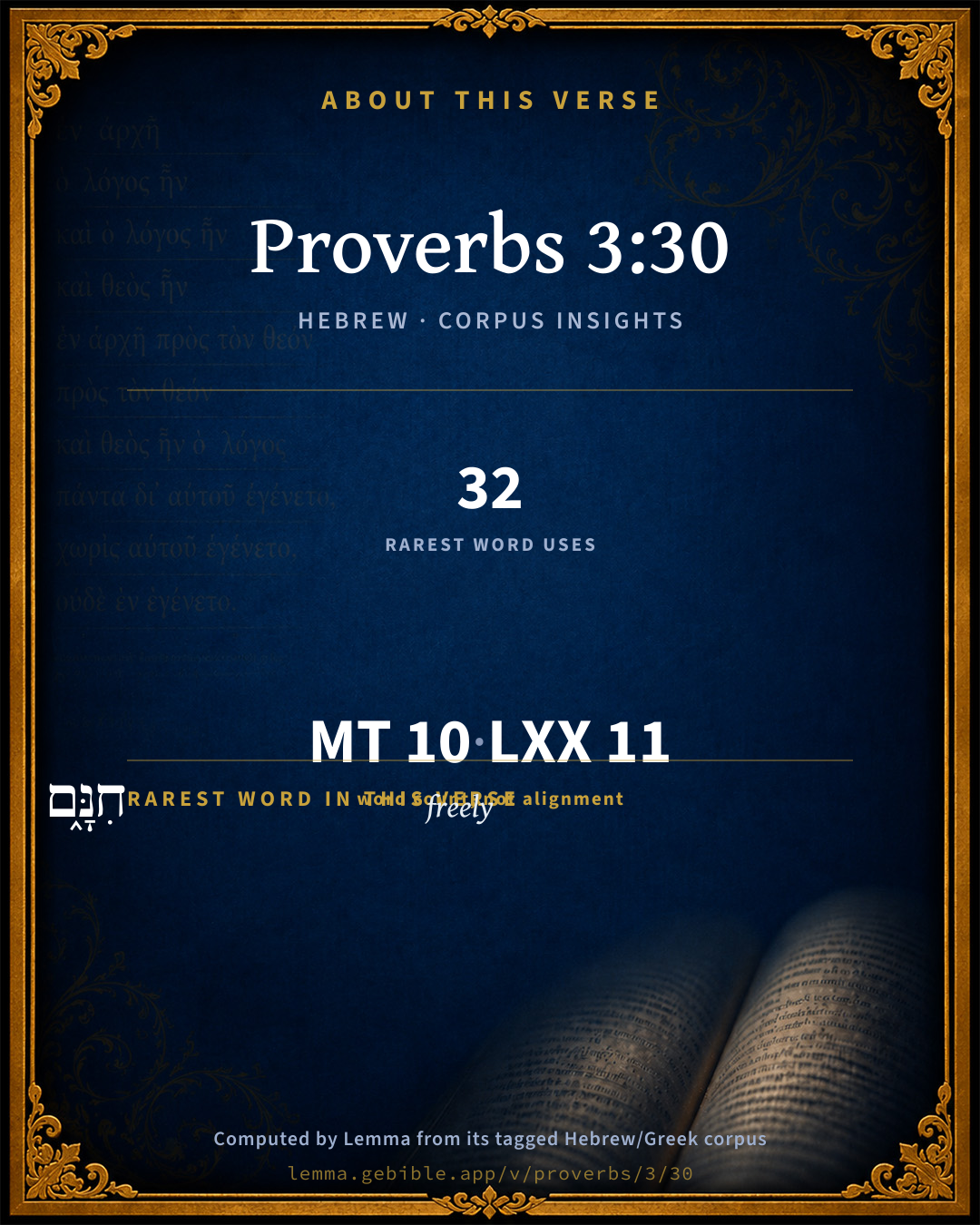
About this verse

These counts appear in no published source. They are computed here, from the morphology-tagged text and Lemma’s own curated glosses. What Lemma adds →

10
words
9
distinct lemmas
Wisdom
section

Shared distinctive vocabulary

חִנָּ֑ם freely H2600 occurs in 31 verses of the Hebrew Bible. Also found in:

Grammatical profile

  • 3 verbs
  • 2 nouns
  • 1 preposition
  • 1 conjunction
  • 1 adverb
  • 2 particles

Verb forms

  • תרוב Qal · Jussive
  • תָּרִ֣יב Qal · Jussive
  • גְמָלְךָ֣ Qal · Perfect

Repetition

A word recurs within this verse — often emphatic in Hebrew:

  • תרוב to contend H7378 ×2

Hebrew & Septuagint length

In English translation the verse runs 14 words from the Hebrew and 17 from the Septuagint (LXX English) — closely comparable.

A rough comparison of the two English renderings, which tokenize alike — not a word-level alignment.

Word counts can differ between the Hebrew and the Greek without any difference in meaning — e.g. the Hebrew direct-object marker אֵת has no separate Greek word, and Greek often adds the article ὁ.

In the original languages it is 10 Hebrew tokens and 11 Greek tokens — but the two are counted differently (Hebrew bundles its prefixes and suffixes into one token; the Greek is in lemma form), so that isn’t a like-for-like length.

Cross-references

7

Topical passages linked to Proverbs 3:30 in the Treasury of Scripture Knowledge — connected by theme and wording, ordered by reader-vote popularity; previews shown in the World English Bible.

  • 2 Timothy 2:24 The Lord's servant must not quarrel, but be gentle towards all, able to teach, patient,
  • Proverbs 29:22 An angry man stirs up strife, And a wrathful man abounds in sin.
  • Romans 12:18–21 If it is possible, as much as it is up to you, be at peace with all men.
  • Proverbs 18:6 A fool's lips come into strife, And his mouth invites beatings.
  • Proverbs 25:8–9 Don't be hasty in bringing charges to court. What will you do in the end when your neighbor shames you?
  • Proverbs 17:14 The beginning of strife is like breaching a dam, Therefore stop contention before quarreling breaks out.
  • Matthew 5:39–41 But I tell you, don't resist him who is evil; but whoever strikes you on your right cheek, turn to him the other also.

Cross-references courtesy of OpenBible.info (CC BY 4.0).

Hebrew and Greek witnesses Masoretic Hebrew ↔ Greek Septuagint

The same verse in the two great witnesses to the Old Testament, shown verse-for-verse.

These are two independent witnesses, not word-aligned to each other, and the Septuagint is shown in lemma (dictionary) form.

Hebrew Proverbs 3:30 Masoretic · Westminster Leningrad Codex

אַל תרוב תָּרִ֣יב עִם אָדָ֣ם חִנָּ֑ם אִם לֹ֖א גְמָלְךָ֣ רָעָֽה

Don't strive with a man without cause, If he has done you no harm.

World English Bible · Public Domain

Greek LXX Proverbs 3:30 Septuagint · lemma form

μή φιλεχθρέω πρός ἄνθρωπος μάτην μή τις εἰς σύ ἐργάζομαι κακός

Be not ready to quarrel with a man without a cause, lest he do you some harm.

LXX2012 (modern English Septuagint) · Public Domain

On this verse, The Pulpit Commentary discusses the Septuagint’s reading. Read the note in Commentary ↓

Hebrew: Westminster Leningrad Codex (CC BY 4.0). Greek: Septuagint (public domain); English from LXX2012 (modern English Septuagint) (Public Domain). How the Septuagint differs from the Hebrew →

Commentary

Notes on Proverbs 3:30 from classic Christian and Jewish commentators (each source and its license shown beneath its notes). The classic Christian expositions comment on the surrounding passage and are grouped to its opening verse, so a note may address several verses; the Jewish commentaries on the Tanakh (Rashi and others) are per-verse, so they appear only where the commentator wrote on this verse.

Lemma curates 59 commentaries, every one of them public domain or Creative Commons licensed, each selected and text-cleaned for this edition rather than reprinted as found. About our sources →

Trapp's Complete Commentary

John Trapp

Pro 3:30 Strive not with a man without cause, if he have done thee no harm.

Ver. 30. Strive not with a man without cause.] If men’s hurts were not bigger than their suits, there would not be half so many. It is a fault to go lightly to law, but especially with such as have done thee no harm. Zuinglius renders this text thus: Ne temere litem cum quoquam suscipias, quominus superior factus, malum tibi retribuat; others, sim mendax, nisi rependat tibi malum. How Cardinal Wolsey, when he became Lord Chancellor, paid home Sir James Paulet, for setting him by the heels, when as yet he was but a poor schoolmaster, is well known. {a} How much better Archbishop Cranmer, of whom the proverb passed, "Do my Lord of Canterbury a shrewd turn, and you shall have him your friend for ever after." And Robert Holgat, Archbishop of York, of whom it is recorded {b} that in the year 1541 he obtained a benefice in a place where one Sir Francis Askew of Lincolnshire dwelt, by whom he was much troubled and molested in law. Upon occasion of these suits, he was fain to repair to London, where being, he found means to become the king’s chaplain, and by him was made Archbishop of York, and President of the King’s Council for the North. The knight before mentioned happened to have a suit before the council there, and doubted much of hard measure from the Archbishop, whose adversary he had been. But he, remembering the rule of the gospel, to do good for evil, yielded him all favour that with justice he might, saying afterwards merrily to his friends, he was much beholden to Sir Francis Askew, for that had not he been, he must have lived a hedge priest {c} the days of his life. {d}

{a} Life of Card. Wolsey.

{b} Acts and Mon.

{c} An illiterate or uneducated priest of inferior status. (contemptuous.)

{d} Godwin’s Catalog., 625.

John Trapp, A Commentary or Exposition upon All the Books of the Old and New Testament (1647–1656) — public domain. Text from a community e-Sword module.

The Biblical Illustrator

Joseph S. Exell

Pro_3:30

Strive not with a man without a cause.

Strife

I. As a principle inherent in the soul. There is a battling instinct in every human mind. Man is made to antagonise. The principle is intended to put us into antagonism--

1. Not against existence, but against the evils of existence.

2. Not against God, but against the enemies of God.

II. As a principle liable to perversion. (D. Thomas, D.D.)

Negative goodness

Here we are called to do good negatively. The strife-loving disposition is fatal to culture, solidity of goodness, and every instinct of beneficence. Where strife is, God is not. Where there is cause of strife be careful to ascertain its true quality. It must be a cause so evident and so righteous that there can be no dispute about it. Some minds are ingenious in creating causes of strife, and they justify themselves by blinding themselves. Strength is itself a temptation. Who can be strong and yet civil? Unjust contentions degrade their authors. False accusations need further lies for their defence and support. Whom we begin by ill-treating we end by hating. (Joseph Parker, D. D.)

The Biblical Illustrator, edited by Joseph S. Exell (c. 1880s–1900s) — public domain. Text from a community e-Sword module.

Joseph Benson's Commentary

Pro 3:30-32. Strive not — Either by words before the magistrate, or otherwise by thine actions; with a man without cause — Without just and necessary cause; if he have done thee no harm — Whereby it is clearly implied, that, in case of injury, a man may, by all lawful means, defend himself. Envy thou not the oppressor — For his impunity and success in his wicked designs, and the wealth which he gains by unrighteous practices; and choose none of his ways — For what men envy in others they seek to obtain for themselves. For the froward — Or, perverse, who walks in crooked and sinful paths, as the oppressor last mentioned, opposed to the upright man, who is called right, or straight, Pro 29:27; is an abomination to the Lord — And therefore, sooner or later, must be miserable. But his secret is with the righteous — They are his friends and favourites, to whom he familiarly imparts, as men use to do to their friends, his mind and counsels, or his secret favours and comforts, to which other men are strangers.

Joseph Benson's Commentary on the Old and New Testaments (1811–1818) — public domain. Text from a community e-Sword module.

The Preacher's Complete Homiletical Commentary

Joseph S. Exell (gen. ed.)

MAIN HOMILETICS OF Pro_3:30

UNLAWFUL STRIFE FORBIDDEN

I. Strife is unlawful when no good can come from striving. The purpose or end of the strife must be the test as to whether it is right or wrong. Mere assertion of our rights or material gain is not the highest good. If Abraham had pushed the quarrel between his herdsmen and those of Lot there can be no doubt that Abraham could have established a lawful claim to a choice of the land. But the good to be gained by striving was not worthy to be compared with the harm that would have been done, and therefore Abraham nobly forbore to insist on his rights.

II. Causeless strife is a self-infliction. A man can hardly be involved in lawful strife without mental agitation, how much more when he strives without cause. When the four winds of heaven seem to meet upon the sea, the waters foam and toss in ceaseless agitation. The winds must cease to strive before the calm can come. A man involved in an unlawful quarrel is like such a troubled sea. Reason and passion, heaven and hell, contend within him for the mastery, and while the battle lasts he must be miserable.

III. Strife rarely ends with those who begin it. Man’s relationship to his fellows renders it impossible for the result of his good or evil deeds to remain with himself alone. If the head of a family enters into a quarrel, the children will probably imbibe the spirit and suffer from the consequences. If kings and rulers involve a nation in unnecessary war, they bring needless suffering upon thousands of innocent people. This consideration alone ought to make men beware of entering into a quarrel.

IV. Causeless strife in the children of God gives a false representation of their Father’s character. They are God’s representatives upon earth, they are expected to fashion their lives upon the Divine model (Mat_5:48). God is a God of peace (1Th_5:23). His contention is only with sin, and its end is the establishment of peace upon earth by righteousness.

The Preacher's Complete Homiletical Commentary (gen. ed. Joseph S. Exell; Funk & Wagnalls, c. 1892) — public domain (pre-1929). A full-Bible homiletical/sermon-outline anthology covering 65 of 66 books (2 John is absent from the source module). Text from a community e-Sword module.

Tyndale Open Study Notes

Tyndale Open Resources

3:30 While it is impossible to avoid all conflict, we are not to pick a fight.

Tyndale Open Study Notes — © Tyndale Open Resources, licensed CC BY-SA 4.0. Text via the HelloAO Bible API.

Adam Clarke's Commentary

Verse 30. Strive not with a man] Do not be of a litigious, quarrelsome spirit. Be not under the influence of too nice a sense of honour. If thou must appeal to judicial authority to bring him that wrongs thee to reason, avoid all enmity, and do nothing in a spirit of revenge. But, if he have done thee no harm, why contend with him? May not others in the same way contend with and injure thee!

Adam Clarke's Commentary on the Bible (1810–1826) — public domain. Text from a community e-Sword/MySword module.

John Gill's Exposition

Strive not with a man without cause, Either by words, in a wrangling, quarrelsome, and contentious way, for mere trifles; when there is no foundation for it, no just reason given to form a complaint, or pick a quarrel upon; or by deeds, by lawsuits, when there is nothing to proceed upon; or it is so trifling, that it is not worth while to litigate it or contend about: such, who strive either way, are far from following the example of Wisdom or Christ, and from taking his advice, Mat 12:19;

if he have done thee no harm; no real hurt to thy person, nor injury to thy substance; if he has not abused nor defrauded thee, nor taken any thing from thee by force or fraud, nor withheld from thee what is thy right and due. But otherwise the laws of God and man ought to take place; right may be sought for, and justice should be done.

John Gill's Exposition of the Whole Bible (1746–1763) — public domain (CC PDM 1.0). Text via the HelloAO Bible API.

Haydock's Catholic Bible Commentary

Cause. We may defend ourselves; but herein great discretion is necessary. (Calmet) --- Cum pari contendere anceps est: cum superiore furiosum; cum inferiore sordidum. (Seneca, Prov.)

George Leo Haydock (1774–1849), Haydock's Catholic Family Bible and Commentary, 1859 edition — public domain. Excludes Psalms (Douay-Rheims chapter numbering differs from Protestant) and Deuterocanonical books (Catholic canon only).

Matthew Poole's English Annotations

Strive not; either by words before the magistrate; or otherwise by thine actions.

Without cause; without just and necessary cause.

If he have done thee no harm; whereby he clearly implies that in case of injury a man may by all lawful means defend himself.

Matthew Poole's English Annotations on the Holy Bible (1683–1685) — public domain. Text from a community e-Sword/MySword module.

Whedon's Commentary on the Bible

Daniel D. Whedon

30. Strive not — Avoid all unnecessary litigations with men. It is often better to suffer wrong than to go to law. 1Co_6:7. What is here forbidden is unnecessary and causeless prosecutions; vexing those who have done no harm, or nothing of much moment.

Daniel D. Whedon (gen. ed.), Commentary on the Old and New Testaments (1874–1909) — public domain. Text from a community e-Sword module.

The Pulpit Commentary

The meaning of the precept in this verse is clear. We are not to strive or quarrel with a man unless he has first given us offence. So Le Clerc, "Nisi injuria prior lacessiverit." The admonition is directed against those who, from spite, jealousy, or other reasons, "stir up strife all the day long" with those who are quiet and peaceable. Strive. The Keri here reads tariv for the Khetib taruv, but without any change of meaning. The verb ruv, from which taruv, is "to strive or contend with the hand and with blows," as in Deu_33:7; or with words, as in Psa_103:9 (cf. the Vulgate, ne contendas; and the LXX, mh filecyhshv , "Do not exercise enmity," from the unusual filecyrew . Ruv is here followed by (im), as in Job_9:3 Job_40:2; and Gen_26:30 Its forensic sense, "to contend with in law," does not strictly apply here, though the precept may be taken as discouraging litigation (Lapide). Without cause (khinnam); LXX, mathn , equivalent to dwrean , in Joh_15:25; Vulgate, frustra; further explained in the concluding clause (see on Pro_1:17). If he have done thee no harm. The phrase, gumal raah, is to bring evil upon any one (Schultens). The verb gamal signifies "to do, to give, to show to any one." Holdea renders, "Surely he will return thee evil," in the sense that unprovoked attack ensures retaliation.]gut this is to ignore the negative force of im-lo, "if not." The verb sometimes means "requiting," but not in the passage before us, nor in Pro_11:17 Pro_31:12. The Vulgate renders as the Authorized Version, Cum ipse tibi nihil mali fecerit. It is to be remarked that this precept falls below the moral standard of the New Testament teaching, (see Mat_5:39-41 Rom_12:17-21 1Co_6:6-8) and of the example of our Lord, of whom it was predicted that "When he was reviled, be reviled not again; when he suffered, he threatened not". (see Isa 53)

The Pulpit Commentary (1880–1919), ed. H.D.M. Spence-Jones & Joseph S. Exell — public domain. Text from a community e-Sword module.

Keil & Delitzsch

C. F. Keil & F. Delitzsch

A third illustration of the same principle is peaceableness:

Contend not with a man without a cause,

When he has inflicted no evil upon thee.

Instead of תּרוּב, or as the Kerı̂ has amended it תּריב, the abbreviated form תּרב or תּרב would be more correct after אל; רוּב or ריב (from רב, to be compact) means to fall upon one another, to come to hand-blows, to contend. Contending and quarrelling with a man, whoever he may be, without sufficient reason, ought to be abandoned; but there exists no such reason if he has done me no harm which I have to reproach him with. גּמל רעה with the accus. or dat. of the person signifies to bring evil upon any one, malum inferre, or also referre (Schultens), for גּמל (cogn. גּמר) signifies to execute, to complete, accomplish - both of the initiative and of the requital, both of the anticipative and of the recompensing action; here in the former of these senses.

Keil & Delitzsch — Biblical Commentary on the Old Testament (1861–1891) — public domain (CC PDM 1.0). Text via the HelloAO Bible API. (Old Testament only.)

Rashi

Rabbi Shlomo Yitzchaki (Rashi)

Do not quarrel with anyone to complain about him.

if he did you no harm i.e., unless he transgressed a commandment written in the Torah. The Torah states (Lev. 19:18): “And you shall love your fellow as yourself,” but one who is wicked, you may hate.

Rashi on the Tanakh — English translations: “The Judaica Press complete Tanach with Rashi, translated by A. J. Rosenberg” (CC BY 4.0); “Pentateuch with Rashi's commentary by M. Rosenbaum and A.M. Silbermann, 1929-1934” (public domain); “The Metsudah Tanach series, Lakewood, N.J” (CC BY 4.0); and “The Book of Joshua, Metsudah Publications, 1997” (CC BY 4.0). Text via Sefaria.

Lesson kit

Teaching starters — assembled from the data on this page, not authored interpretation. Every prompt links to the verse data it draws on. Edit before teaching.

Proverbs, in the Wisdom, opens this verse with 10 words (9 distinct Hebrew lemmas). Its most distinctive word is chinnâm (“freely”). A historical commentator’s framing appears above. Read the whole chapter for the surrounding context.

Discussion questions

  1. How does “freely” (chinnâm) shape what this verse is saying?
  2. How does Genesis 29:15, which shares the word «freely», read alongside this verse?
  3. What does the repetition of “to contend” (2× in this one verse) do in this verse?
  4. The translations on this page render this verse differently — a whole-verse word diff, not a word-by-word alignment. What might account for the different wordings?
  5. «תרוב» is a Qal Jussive verb. How does that grammatical form shape the action described?
  6. Compare how Trapp's Complete Commentary and The Biblical Illustrator read this verse. Where do they agree or differ?

Things to notice

Reading settings

Reading text

Shown beneath each verse's original-language words.

Old Testament
Old Testament edition

Read the OT as the Masoretic Hebrew (MT) or the Greek Septuagint (LXX).

English shown for the Greek Septuagint (in the Hebrew ↔ Greek comparison).

Comparing translations? Open the Compare panel on any verse page to stack up to four side by side.