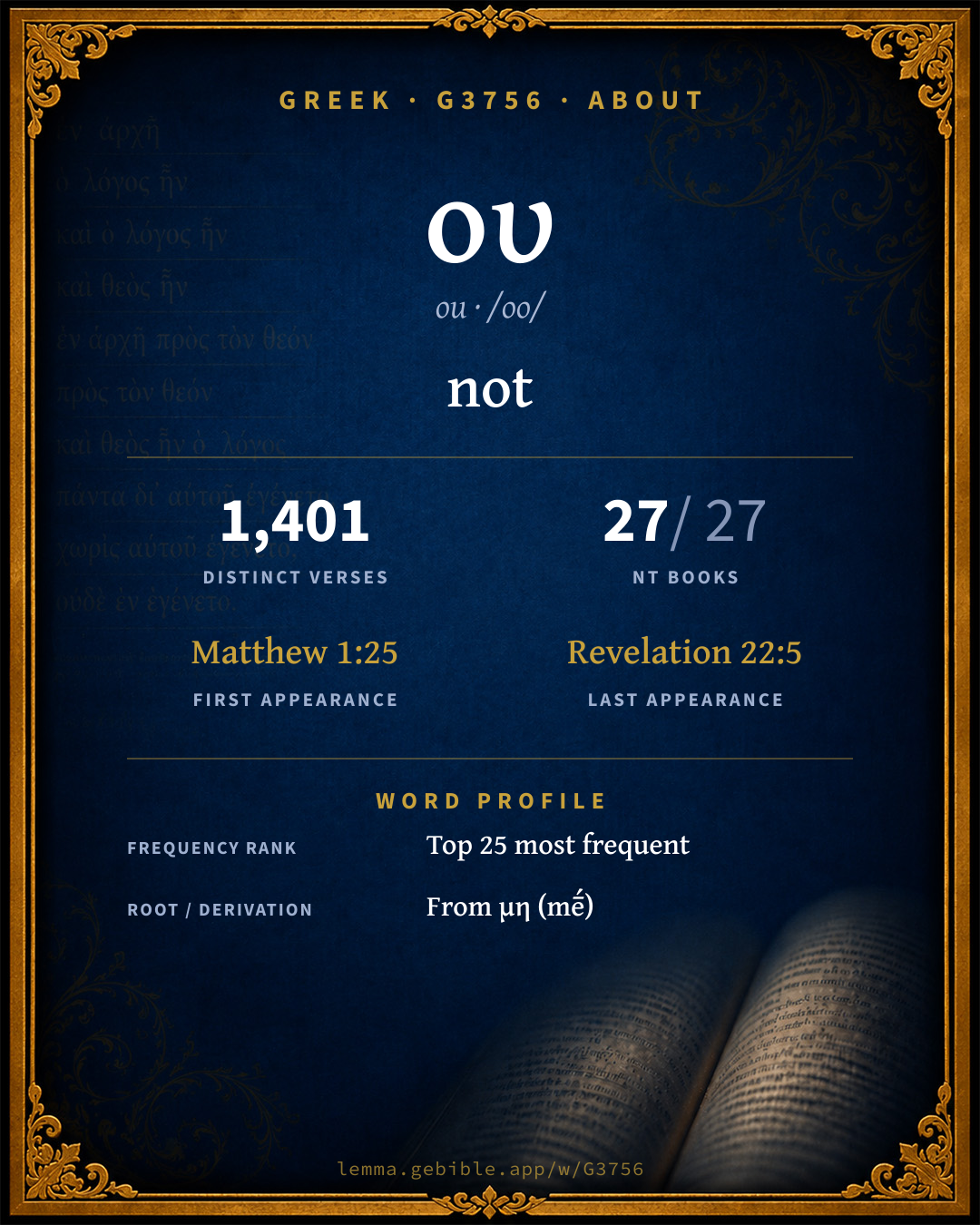
οὐ
not
Full lexicon entry — Thayer's Greek Lexicon
From Thayer's Greek Lexicon
Where this word appears
Grammar key — what these labels mean
Part of speech
- Particle
- A short, often untranslatable function word adding nuance or connection.
Degree
- Negative
- Marks a negative form.
Page 2 of 2 — showing verses 201–250 of 250 distinct verses where G3756 appears in the Book of John. Click any verse to open its interlinear word-by-word view. Verse text shown in the World English Bible for context — . Each verse’s Greek form is shown with its reference; the English is not keyword-highlighted, since the data carries no word-level English alignment. Use “Compare translations” on any verse to read it across multiple English versions. This concordance covers the Greek New Testament; Septuagint (Greek Old Testament) occurrences of this word are not indexed here.
John
- John 16:7 οὐκ ptcl neg Nevertheless I tell you the truth: It is to your advantage that I go away, for if I don't go away, the Counselor won't come to you. But if I go, I will send him to you.
- John 16:9 οὐ ptcl neg about sin, because they don't believe in me;
- John 16:12 οὐ ptcl neg "I have yet many things to tell you, but you can't bear them now.
- John 16:13 οὐ ptcl neg However when he, the Spirit of truth, has come, he will guide you into all truth, for he will not speak from himself; but whatever he hears, he will speak. He will declare to you things that are coming.
- John 16:17 οὐ ptcl neg Some of his disciples therefore said to one another, "What is this that he says to us, 'A little while, and you won't see me, and again a little while, and you will see me;' and, 'Because I go to the Father?'"
- John 16:18 οὐκ ptcl neg They said therefore, "What is this that he says, 'A little while?' We don't know what he is saying."
- John 16:19 οὐ ptcl neg Therefore Jesus perceived that they wanted to ask him, and he said to them, "Do you inquire among yourselves concerning this, that I said, 'A little while, and you won't see me, and again a little while, and you will see me?'
- John 16:23 οὐκ ptcl neg "In that day you will ask me no questions. Most assuredly I tell you, whatever you may ask of the Father in my name, he will give it to you.
- John 16:24 οὐκ ptcl neg Until now, you have asked nothing in my name. Ask, and you will receive, that your joy may be made full.
- John 16:26 οὐ ptcl neg In that day you will ask in my name; and I don't say to you, that I will pray to the Father for you,
- John 16:30 οὐ ptcl neg Now we know that you know all things, and don't need for anyone to question you. By this we believe that you came forth from God."
- John 16:32 οὐκ ptcl neg Behold, the time is coming, yes, and has now come, that you will be scattered, everyone to his own place, and you will leave me alone. Yet I am not alone, because the Father is with me.
- John 17:9 οὐ ptcl neg I pray for them. I don't pray for the world, but for those whom you have given me, for they are yours.
- John 17:14 οὐκ οὐκ ptcl neg ptcl neg I have given them your word. The world hated them, because they are not of the world, even as I am not of the world.
- John 17:15 οὐκ ptcl neg I pray not that you would take them from the world, but that you would keep them from the evil one.
- John 17:16 οὐκ οὐκ ptcl neg ptcl neg They are not of the world even as I am not of the world.
- John 17:20 Οὐ ptcl neg Not for these only do I pray, but for those also who believe in me through their word,
- John 17:25 οὐκ ptcl neg Righteous Father, the world hasn't known you, but I knew you; and these knew that you sent me.
- John 18:9 οὐκ ptcl neg that the word might be fulfilled which he spoke, "Of those whom you have given me, I have lost none."
- John 18:11 οὐ ptcl neg Jesus therefore said to Peter, "Put the sword into its sheath. The cup which the Father has given me, shall I not surely drink it?"
- John 18:17 οὐκ ptcl neg Then the maid who kept the door said to Peter, "Are you also one of this man's disciples?" He said, "I am not."
- John 18:25 οὐκ ptcl neg Now Simon Peter was standing and warming himself. They said therefore to him, "You aren't also one of his disciples, are you?" He denied it, and said, "I am not."
- John 18:26 οὐκ ptcl neg One of the servants of the high priest, being a relative of him whose ear Peter had cut off, said, "Didn't I see you in the garden with him?"
- John 18:28 οὐκ ptcl neg They led Jesus therefore from Caiaphas into the Praetorium. It was early, and they themselves didn't enter into the Praetorium, that they might not be defiled, but might eat the Passover.
- John 18:30 οὐκ ptcl neg They answered him, "If this man weren't an evildoer, we wouldn't have delivered him up to you."
- John 18:31 οὐκ ptcl neg Pilate therefore said to them, "Take him yourselves, and judge him according to your law." Therefore the Jews said to him, "It is not lawful for us to put anyone to death,"
- John 18:36 οὐκ οὐκ ptcl neg ptcl neg Jesus answered, "My Kingdom is not of this world. If my Kingdom were of this world, then my servants would fight, that I wouldn't be delivered to the Jews. But now my Kingdom is not from here."
- John 19:4 οὐχ ptcl neg Then Pilate went out again, and said to them, "Behold, I bring him out to you, that you may know that I find no basis for a charge against him."
- John 19:6 οὐχ ptcl neg When therefore the chief priests and the officers saw him, they shouted, saying, "Crucify! Crucify!" Pilate said to them, "Take him yourselves, and crucify him, for I find no basis for a charge against him."
- John 19:9 οὐκ ptcl neg He entered into the Praetorium again, and said to Jesus, "Where are you from?" But Jesus gave him no answer.
- John 19:10 οὐ οὐκ ptcl neg ptcl neg Pilate therefore said to him, "Aren't you speaking to me? Don't you know that I have power to release you, and have power to crucify you?"
- John 19:11 οὐκ ptcl neg Jesus answered, "You would have no power at all against me, unless it were given to you from above. Therefore he who delivered me to you has greater sin."
- John 19:12 οὐκ ptcl neg At this, Pilate was seeking to release him, but the Jews cried out, saying, "If you release this man, you aren't Caesar's friend! Everyone who makes himself a king speaks against Caesar!"
- John 19:15 οὐκ ptcl neg They cried out, "Away with him! Away with him! Crucify him!" Pilate said to them, "Shall I crucify your King?" The chief priests answered, "We have no king but Caesar!"
- John 19:33 οὐ ptcl neg but when they came to Jesus, and saw that he was already dead, they didn't break his legs.
- John 19:36 οὐ ptcl neg For these things happened, that the Scripture might be fulfilled, "A bone of him will not be broken."
- John 20:2 οὐκ ptcl neg Therefore she ran and came to Simon Peter, and to the other disciple whom Jesus loved, and said to them, "They have taken away the Lord out of the tomb, and we don't know where they have laid him!"
- John 20:5 οὐ ptcl neg Stooping and looking in, he saw the linen cloths lying, yet he didn't enter in.
- John 20:7 οὐ ptcl neg and the cloth that had been on his head, not lying with the linen cloths, but rolled up in a place by itself.
- John 20:13 οὐκ ptcl neg They told her, "Woman, why are you weeping?" She said to them, "Because they have taken away my Lord, and I don't know where they have laid him."
- John 20:14 οὐκ ptcl neg When she had said this, she turned around and saw Jesus standing, and didn't know that it was Jesus.
- John 20:24 οὐκ ptcl neg But Thomas, one of the twelve, called Didymus, wasn't with them when Jesus came.
- John 20:25 οὐ ptcl neg The other disciples therefore said to him, "We have seen the Lord!" But he said to them, "Unless I see in his hands the print of the nails, and put my hand into his side, I will not believe."
- John 20:30 οὐκ ptcl neg Therefore Jesus did many other signs in the presence of his disciples, which are not written in this book;
- John 21:4 οὐ ptcl neg But when day had already come, Jesus stood on the beach, yet the disciples didn't know that it was Jesus.
- John 21:5 οὔ ptcl neg Jesus therefore said to them, "Children, have you anything to eat?" They answered him, "No."
- John 21:8 οὐ ptcl neg But the other disciples came in the little boat (for they were not far from the land, but about two hundred cubits away), dragging the net full of fish.
- John 21:11 οὐκ ptcl neg Simon Peter went up, and drew the net to land, full of great fish, one hundred fifty-three; and even though there were so many, the net wasn't torn.
- John 21:18 οὐ ptcl neg Most assuredly I tell you, when you were young, you dressed yourself, and walked where you wanted to. But when you are old, you will stretch out your hands, and another will dress you, and carry you where you don't want to go."
- John 21:23 οὐκ οὐκ οὐκ ptcl neg ptcl neg ptcl neg This saying therefore went out among the brothers, that this disciple wouldn't die. Yet Jesus didn't say to him that he wouldn't die, but, "If I desire that he stay until I come, what is that to you?"
About this entry
At a glance — auto-summarized from this page’s data, not written by a person. Every figure links to its source below. This summary describes the numbers; it doesn’t interpret them.
“not” is the headline sense of the Greek word ου (ou). First canonically at Matthew 1:25, it enters the text early. It appears 1,401 verses across 27 books of the Greek New Testament, among its most common vocabulary. Related forms include μη, μηδαμως and μηδε. The sections below give every sense, occurrence, and version rendering.
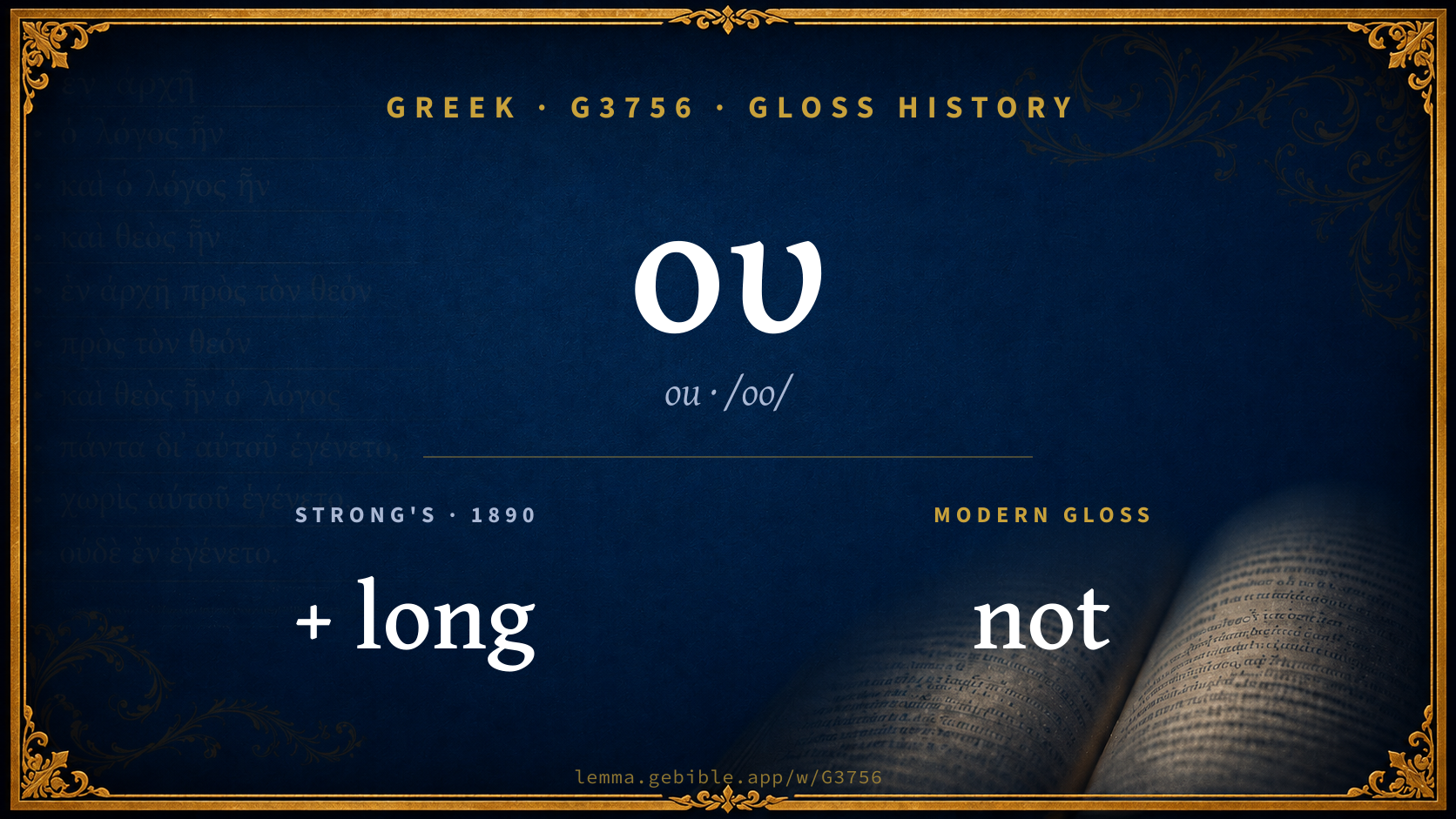
Gloss history
Strong's 1890 vs modern scholarship
About this word
Strong's G3756 catalogs a Greek word from the Greek New Testament.
These counts are not copied from any lexicon or concordance. They are computed here, from the morphology-tagged Greek New Testament. What Lemma adds →
- 1,401
- distinct verses
- The word appears in 1,401 distinct verses.
- 27 / 27
- NT books
- The word appears in 27 of 27 New Testament books.
- #11
- by frequency
- Top 25 most frequent Greek words (rank 11 of 5,347 Greek words by occurrence).
View all 1,401 occurrences in the concordance →
By section of the New Testament
By traditional corpus
Conventional, traditional groupings — biblical authorship is debated, so this is a traditional corpus grouping, not an authorship claim. Some books belong to more than one corpus (Luke is in both the Gospels and the Lukan corpus, and so on), so these shares overlap and need not total 100%. Each figure is a share of the word’s 1,401 distinct verses.
- Gospels 686 verses · 49%
- Pauline corpus 404 verses · 29%
- Johannine 348 verses · 25%
- Lukan (Luke–Acts) 256 verses · 18%
- General (Catholic) Epistles 92 verses · 7%
- Hebrews 62 verses · 4%
- Revelation 54 verses · 4%
How translations render this word
Counts come from each version’s own published word-to-Strong’s tagging or interlinear alignment — an approximate guide to how each version renders this word, not a word-level alignment the data otherwise carries. Because each total is that version’s own tagged count, the per-version totals vary from one another and need not match the appearance or distinct-verse counts above. These counts may also differ from a printed concordance because Lemma counts each distinctly tagged rendering and does not collapse phrase taggings into a single head-word total. This is a fixed set of word-tagged versions (KJV, ASV, BSB, ULT) and does not change with the reading translation you choose elsewhere. Each version’s license is shown beside its name below (and on Sources).
- King James Version: Not 1,159×, No 138×, Cannot 27×
- American Standard Version: Not 1,108×, No 165×, Is not 19×
- Berean Standard Bible: Not 365×, No 123×, Does not 26×
- unfoldingWord Literal Text: Not 1,367×, No 92×, Certainly not 89×
King James Version Public Domain
Renders G3756 across 1,506 tagged occurrences — most commonly:
Plus other, less common renderings. Plus 47 renderings that appear only once — usually multi-word phrases or single function words the recovered tagging swept in, not distinct renderings. Not rendered by a distinct English word in 31 further occurrences.
American Standard Version Public Domain
Renders G3756 across 1,534 tagged occurrences — most commonly:
Plus other, less common renderings. Plus 89 renderings that appear only once — usually multi-word phrases or single function words the recovered tagging swept in, not distinct renderings. Not rendered by a distinct English word in 1 further occurrence.
Berean Standard Bible Public Domain
Renders G3756 across 705 tagged occurrences — most commonly:
Plus other, less common renderings. Plus 46 renderings that appear only once — usually multi-word phrases or single function words the recovered tagging swept in, not distinct renderings. Not rendered by a distinct English word in 128 further occurrences.
unfoldingWord Literal Text CC BY-SA 4.0
Renders G3756 across 1,635 tagged occurrences — most commonly:
Plus other, less common renderings. Plus 21 renderings that appear only once — usually multi-word phrases or single function words the recovered tagging swept in, not distinct renderings.
Senses in Thayer's
The 1 sense Thayer's distinguishes for this word, in lexicon order (not ranked by frequency or importance). The full entry — with sub-senses — is in the Lexicon Entry tab.
- no, not; in direct questions expecting an affirmative answer
Word origin
Derived from μη (mḗ) (G3361) — not.
Also οὐκ ouk ook used before a vowel and οὐχ ouch ookh before an aspirate. A primary word; the absolutely negative (compare G3361 ) adverb; no or not : - + long nay neither never no (X man) none [can-] not + nothing + special un ([-worthy]) when + without + yet but. See also G3364 G3372 .
— Strong’s Exhaustive Concordance (1890), public domain.
Forms in the corpus
The 8 distinct written forms G3756 takes in the Greek New Testament, most frequent first — each parse links to that case’s occurrences in the concordance.
| Form | Parsing | Example | Uses |
|---|---|---|---|
| οὐκ ouk | Particle, Negative | Matthew 1:25 | 828 |
| οὐ ou | Particle, Negative | Matthew 5:14 | 660 |
| οὐχ ouch | Particle, Negative | Matthew 6:26 | 104 |
| οὔ oú | Particle, Negative | Matthew 5:37 | 14 |
| Οὐ Ou | Particle, Negative | Matthew 7:21 | 11 |
| Οὐκ Ouk | Particle, Negative | Matthew 10:24 | 4 |
| οὒ où | Particle, Negative | Matthew 5:37 | 3 |
| Οὐχ Ouch | Particle, Negative | Romans 9:6 | 2 |
Same root — word family
Other Thayer's entries built from the same root as G3756, grouped by Strong’s listed origin. These share a root / origin per the lexicon — not necessarily a shared meaning. Each links to that word’s own entry.
Derives from
Shares the same root
- μηδαμως mēdamōs G3365 by no means
- μηδε mēdé G3366 and not
- μηδεις mēdeís G3367 no one
- μηκετι mēkéti G3371 no longer
- μη ουκ mḕ ouk G3378 not ever
- μηποτε mḗpote G3379 lest
- μηπω mḗpō G3380 not yet
- μηπως mḗpōs G3381 lest
- μητε mḗte G3383 nor
- μητι mḗti G3385 whether
- μητις mḗtis G3387 let no one
Derived from this word
- μη mḗ G3361 not
- ου μη ou mḗ G3364 by no means
- ουδε oudé G3761 neither
- ουκετι oukéti G3765 no longer
- ουκουν oukoûn G3766 not therefore
- ουπω oúpō G3768 not yet
- ουτε oúte G3777 neither
- ουχι ouchí G3780 not at all
Compare all same-root words → Showing 4 of 20 — not the complete family. They share a root, not necessarily a meaning.
Septuagint usage
The same Greek word ου appears 5,233 times in the Greek Old Testament (Septuagint), across 4,158 verses in 38 books.
- 5,233
- LXX occurrences
- Tagged occurrences of this Greek word in the Septuagint.
- 4,158
- verses
- Distinct Septuagint verses containing this word.
- 38 / 39
- OT books
- The word appears in 38 of the 39 Old Testament books.
Sample Septuagint occurrences
- Genesis 2:5 οὐ
- Exodus 1:8 οὐ
- Leviticus 1:17 οὐ
- Numbers 1:47 οὐ
- Deuteronomy 1:9 οὐ
- Joshua 1:5 οὐ
- Judges 1:18 οὐ
- Ruth 2:7 οὐ
- 1 Samuel 1:2 οὐ
- 2 Samuel 1:10 οὐ
- 1 Kings 1:1 οὐ
- 2 Kings 1:4 οὐ
Septuagint occurrences (same lexeme)
Every verse where the same Strong’s number (G3756) appears in the Greek Septuagint — showing the first 50 of 4,158. Verse text shown in the World English Bible for context; the Greek form is the matched word — the English is not keyword-highlighted.
- Genesis 2:5 οὐ No plant of the field was yet in the earth, and no herb of the field had yet sprung up; for Yahweh God had not caused it to rain on the earth. There was not a man to till the ground,
- Genesis 2:17 οὐ but of the tree of the knowledge of good and evil, you shall not eat of it: for in the day that you eat of it you will surely die."
- Genesis 2:18 οὐ Yahweh God said, "It is not good that the man should be alone; I will make him a helper suitable for him."
- Genesis 2:20 οὐ The man gave names to all cattle, and to the birds of the sky, and to every animal of the field; but for man there was not found a helper suitable for him.
- Genesis 2:25 οὐ They were both naked, the man and his wife, and were not ashamed.
- Genesis 3:1 οὐ Now the serpent was more subtle than any animal of the field which Yahweh God had made. He said to the woman, "Yes, has God said, 'You shall not eat of any tree of the garden?'"
- Genesis 3:3 οὐ but of the fruit of the tree which is in the midst of the garden, God has said, 'You shall not eat of it, neither shall you touch it, lest you die.'"
- Genesis 3:4 οὐ The serpent said to the woman, "You won't surely die,
- Genesis 4:5 οὐ but he didn't respect Cain and his offering. Cain was very angry, and the expression on his face fell.
- Genesis 4:7 οὐ If you do well, will it not be lifted up? If you don't do well, sin crouches at the door. Its desire is for you, but you are to rule over it."
- Genesis 4:9 οὐ Yahweh said to Cain, "Where is Abel, your brother?" He said, "I don't know. Am I my brother's keeper?"
- Genesis 4:12 οὐ From now on, when you till the ground, it won't yield its strength to you. You shall be a fugitive and a wanderer in the earth."
- Genesis 4:15 οὐ Yahweh said to him, "Therefore whoever slays Cain, vengeance will be taken on him sevenfold." Yahweh appointed a sign for Cain, lest any finding him should strike him.
- Genesis 5:24 οὐ Enoch walked with God, and he was not, for God took him.
- Genesis 6:3 οὐ Yahweh said, "My Spirit will not strive with man forever, because he also is flesh; yet will his days be one hundred twenty years."
- Genesis 8:7 οὐ and he sent forth a raven. It went back and forth, until the waters were dried up from off the earth.
- Genesis 8:9 οὐ but the dove found no place to rest her foot, and she returned to him into the ark; for the waters were on the surface of the whole earth. He put forth his hand, and took her, and brought her to him into the ark.
- Genesis 8:12 οὐ He stayed yet another seven days, and sent forth the dove; and she didn't return to him any more.
- Genesis 8:21 οὐ Yahweh smelled the sweet savor. Yahweh said in his heart, "I will not again curse the ground any more for man's sake, because the imagination of man's heart is evil from his youth; neither will I ever again strike everything living, as I have done.
- Genesis 8:22 οὐ While the earth remains, seed time and harvest, and cold and heat, and summer and winter, and day and night shall not cease."
- Genesis 9:4 οὐ But flesh with the life of it, the blood of it, you shall not eat.
- Genesis 9:11 οὐ I will establish my covenant with you; neither will all flesh be cut off any more by the waters of the flood; neither will there any more be a flood to destroy the earth."
- Genesis 9:15 οὐ and I will remember my covenant, which is between me and you and every living creature of all flesh, and the waters will no more become a flood to destroy all flesh.
- Genesis 9:23 οὐ Shem and Japheth took a garment, and laid it on both their shoulders, went in backwards, and covered the nakedness of their father. Their faces were backwards, and they didn't see their father's nakedness.
- Genesis 11:6 οὐ Yahweh said, "Behold, they are one people, and they have all one language; and this is what they begin to do. Now nothing will be withheld from them, which they intend to do.
- Genesis 11:30 οὐ Sarai was barren. She had no child.
- Genesis 12:18 οὐ Pharaoh called Abram, and said, "What is this that you have done to me? Why didn't you tell me that she was your wife?
- Genesis 13:6 οὐ The land was not able to bear them, that they might live together: for their substance was great, so that they could not live together.
- Genesis 13:9 οὐ Isn't the whole land before you? Please separate yourself from me. If you go to the left hand, then I will go to the right. Or if you go to the right hand, then I will go to the left."
- Genesis 15:3 οὐ Abram said, "Behold, to me you have given no seed: and, behold, one born in my house is my heir."
- Genesis 15:4 οὐ Behold, the word of Yahweh came to him, saying, "This man will not be your heir, but he who will come forth out of your own body will be your heir."
- Genesis 15:10 οὐ He took him all these, and divided them in the middle, and laid each half opposite the other; but he didn't divide the birds.
- Genesis 15:13 οὐ He said to Abram, "Know for sure that your seed will live as foreigners in a land that is not theirs, and will serve them. They will afflict them four hundred years.
- Genesis 16:1 οὐ Now Sarai, Abram's wife, bore him no children. She had a handmaid, an Egyptian, whose name was Hagar.
- Genesis 16:10 οὐ The angel of Yahweh said to her, "I will greatly multiply your seed, that they will not be numbered for multitude."
- Genesis 17:5 οὐ Neither will your name any more be called Abram, but your name will be Abraham; for the father of a multitude of nations have I made you.
- Genesis 17:12 οὐ He who is eight days old will be circumcised among you, every male throughout your generations, he who is born in the house, or bought with money of any foreigner who is not of your seed.
- Genesis 17:14 οὐ The uncircumcised male who is not circumcised in the flesh of his foreskin, that soul shall be cut off from his people. He has broken my covenant."
- Genesis 17:15 οὐ God said to Abraham, "As for Sarai your wife, you shall not call her name Sarai, but her name will be Sarah.
- Genesis 18:15 οὐ Then Sarah denied, saying, "I didn't laugh," for she was afraid." He said, "No, but you did laugh."
- Genesis 18:24 οὐ What if there are fifty righteous within the city? Will you consume and not spare the place for the fifty righteous who are therein?
- Genesis 18:25 οὐ Be it far from you to do things like that, to kill the righteous with the wicked, that so the righteous should be as the wicked. May that be far from you. Shouldn't the Judge of all the earth do right?"
- Genesis 18:28 οὐ What if there will lack five of the fifty righteous? Will you destroy all the city for lack of five?" He said, "I will not destroy it, if I find forty-five there."
- Genesis 18:29 οὐ He spoke to him yet again, and said, "What if there are forty found there?" He said, "I will not do it for the forty's sake."
- Genesis 18:30 οὐ He said, "Oh don't let the Lord be angry, and I will speak. What if there are thirty found there?" He said, "I will not do it, if I find thirty there."
- Genesis 18:31 οὐ He said, "See now, I have taken it on myself to speak to the Lord. What if there are twenty found there?" He said, "I will not destroy it for the twenty's sake."
- Genesis 18:32 οὐ He said, "Oh don't let the Lord be angry, and I will speak yet but this once. What if ten are found there?" He said, "I will not destroy it for the ten's sake."
- Genesis 19:2 οὐ and he said, "See now, my lords, please turn aside into your servant's house, stay all night, wash your feet, and you will rise up early, and go on your way." They said, "No, but we will stay in the street all night."
- Genesis 19:8 οὐ See now, I have two virgin daughters. Please let me bring them out to you, and do you to them as is good in your eyes. Only don't do anything to these men, because they have come under the shadow of my roof."
- Genesis 19:19 οὐ See now, your servant has found favor in your sight, and you have magnified your loving kindness, which you have shown to me in saving my life. I can't escape to the mountain, lest evil overtake me, and I die.
These are occurrences of the same Greek lexeme (G3756) in the Septuagint — not a translation of any one Hebrew word. The store carries no word-level Hebrew↔Greek alignment, so no Hebrew original is asserted here. Counts come from the recovered LXX Strong's tagging — high-frequency vocabulary is well covered, while rare or late forms may be untagged — so they reflect tagged occurrences and may slightly undercount.