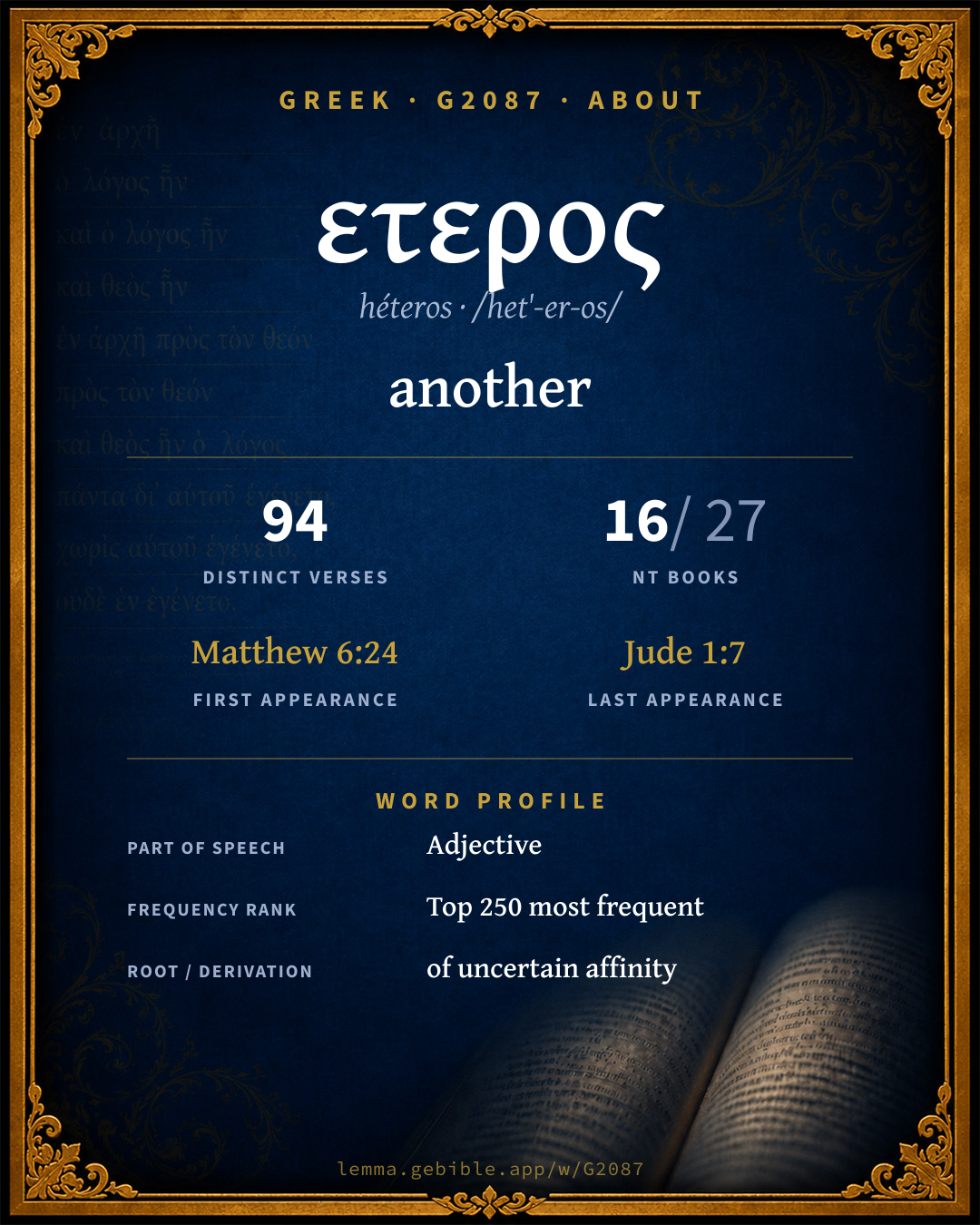
ἕτερος
another
Full lexicon entry — Thayer's Greek Lexicon
From Thayer's Greek Lexicon
Where this word appears
See every Nominative-case word in the Greek New Testament →
Grammar key — what these labels mean
Part of speech
- Adjective
- A word that describes or qualifies a noun.
Case
- Accusative
- The case of the direct object and of extent.
- Nominative
- The case of the subject (and the predicate nominative).
- Dative
- The case of the indirect object, means, or location — “to / for / with / in.”
- Genitive
- The case of source, possession, or “of” — answers “whose / from what.”
Gender
- Masculine
- Grammatically masculine.
- Neuter
- Grammatically neuter.
- Feminine
- Grammatically feminine.
Number
- Singular
- One.
- Plural
- More than one.
Grammatical forms 19 distinct
- Adjective, Accusative, Singular, Masculine 15 times (15%)
- Adjective, Nominative, Singular, Masculine 15 times (15%)
- Adjective, Dative, Singular, Masculine 10 times (10%)
- Adjective, Nominative, Singular, Neuter 7 times (7%)
- Adjective, Genitive, Singular, Masculine 6 times (6%)
- Adjective, Nominative, Plural, Masculine 6 times (6%)
- Adjective, Nominative, Singular, Feminine 6 times (6%)
- Adjective, Genitive, Plural, Masculine 5 times (5%)
+11 more forms (29 occurrences)
Parsed forms decoded from the imported morphology (Robinson–Tischendorf, public domain), counted across 99 parsed occurrences — not distinct verses.
Every verse where G2087 appears — 94 distinct verses across 16 books. Click any verse to open its interlinear word-by-word view. Verse text shown in the World English Bible for context — . Each verse’s Greek form is shown with its reference; the English is not keyword-highlighted, since the data carries no word-level English alignment. Use “Compare translations” on any verse to read it across multiple English versions. This concordance covers the Greek New Testament; Septuagint (Greek Old Testament) occurrences of this word are not indexed here.
Matthew 9 verses
- Matthew 6:24 ἕτερον ἑτέρου adj acc sg masc adj gen sg masc "No one can serve two masters, for either he will hate the one and love the other; or else he will be devoted to one and despise the other. You can't serve both God and Mammon.
- Matthew 8:21 ἕτερος adj nom sg masc Another of his disciples said to him, "Lord, allow me first to go and bury my father."
- Matthew 10:23 ἑτέραν adj acc sg fem But when they persecute you in this city, flee into the next, for most assuredly I tell you, you will not have gone through the cities of Israel, until the Son of Man has come.
- Matthew 11:3 ἕτερον adj acc sg masc and said to him, "Are you he who comes, or should we look for another?"
- Matthew 11:16 ἑτέροις adj dat pl neut "But to what shall I compare this generation? It is like children sitting in the marketplaces, who call to their companions
- Matthew 12:45 ἕτερα adj acc pl neut Then he goes, and takes with himself seven other spirits more evil than he is, and they enter in and dwell there. The last state of that man becomes worse than the first. Even so will it be also to this evil generation."
- Matthew 15:30 ἑτέρους adj acc pl masc Great multitudes came to him, having with them the lame, blind, mute, maimed, and many others, and they put them down at his feet. He healed them,
- Matthew 16:14 ἕτεροι adj nom pl masc They said, "Some say John the Baptizer, some, Elijah, and others, Jeremiah, or one of the prophets."
- Matthew 21:30 ἑτέρῳ adj dat sg masc He came to the second, and said the same thing. He answered, 'I go, sir,' but he didn't go.
Mark 1 verse
Luke 31 verses
- Luke 3:18 ἕτερα adj acc pl neut Then with many other exhortations he preached good news to the people,
- Luke 4:43 ἑτέραις adj dat pl fem But he said to them, "I must preach the good news of the Kingdom of God to the other cities also. For this reason I have been sent."
- Luke 5:7 ἑτέρῳ adj dat sg neut They beckoned to their partners in the other boat, that they should come and help them. They came, and filled both boats, so that they began to sink.
- Luke 6:6 ἑτέρῳ adj dat sg neut It also happened on another Sabbath that he entered into the synagogue and taught. There was a man there, and his right hand was withered.
- Luke 7:41 ἕτερος adj nom sg masc "A certain lender had two debtors. The one owed five hundred denarii, and the other fifty.
- Luke 8:3 ἕτεραι adj nom pl fem and Joanna, the wife of Chuzas, Herod's steward; Susanna; and many others; who ministered to them from their possessions.
- Luke 8:6 ἕτερον adj nom sg neut Other seed fell on the rock, and as soon as it grew, it withered away, because it had no moisture.
- Luke 8:7 ἕτερον adj nom sg neut Other fell amid the thorns, and the thorns grew with it, and choked it.
- Luke 8:8 ἕτερον adj nom sg neut Other fell into the good ground, and grew, and brought forth fruit one hundred times." As he said these things, he called out, "He who has ears to hear, let him hear!"
- Luke 9:29 ἕτερον adj nom sg neut As he was praying, the appearance of his face was altered, and his clothing became white and dazzling.
- Luke 9:56 ἑτέραν adj acc sg fem For the Son of Man didn't come to destroy men's lives, but to save them." They went to another village.
- Luke 9:59 ἕτερον adj acc sg masc He said to another, "Follow me!" But he said, "Lord, allow me first to go and bury my father."
- Luke 9:61 ἕτερος adj nom sg masc Another also said, "I want to follow you, Lord, but first allow me to bid farewell to those who are at my house."
- Luke 10:1 ἑτέρους adj acc pl masc Now after these things, the Lord also appointed seventy others, and sent them two by two ahead of him into every city and place, where he was about to come.
- Luke 11:16 ἕτεροι adj nom pl masc Others, testing him, sought from him a sign from heaven.
- Luke 11:26 ἕτερα adj acc pl neut Then he goes, and takes seven other spirits more evil than himself, and they enter in and dwell there. The last state of that man becomes worse than the first."
- Luke 14:19 ἕτερος adj nom sg masc "Another said, 'I have bought five yoke of oxen, and I must go try them out. Please have me excused.'
- Luke 14:20 ἕτερος adj nom sg masc "Another said, 'I have married a wife, and therefore I can't come.'
- Luke 14:31 ἑτέρῳ adj dat sg masc Or what king, as he goes to encounter another king in war, will not sit down first and consider whether he is able with ten thousand to meet him who comes against him with twenty thousand?
- Luke 16:7 ἑτέρῳ adj dat sg masc Then said he to another, 'How much do you owe?' He said, 'A hundred cors of wheat.' He said to him, 'Take your bill, and write eighty.'
- Luke 16:13 ἕτερον ἑτέρου adj acc sg masc adj gen sg masc No servant can serve two masters, for either he will hate the one, and love the other; or else he will hold to one, and despise the other. You aren't able to serve God and mammon."
- Luke 16:18 ἑτέραν adj acc sg fem Everyone who divorces his wife, and marries another, commits adultery. He who marries one who is divorced from a husband commits adultery.
- Luke 17:34 ἕτερος adj nom sg masc I tell you, in that night there will be two people in one bed. The one will be taken, and the other will be left.
- Luke 17:35 ἑτέρα adj nom sg fem There will be two grinding grain together. One will be taken, and the other will be left."
- Luke 18:10 ἕτερος adj nom sg masc "Two men went up into the temple to pray; one was a Pharisee, and the other was a tax collector.
- Luke 19:20 ἕτερος adj nom sg masc Another came, saying, 'Lord, behold, your mina, which I kept laid away in a handkerchief,
- Luke 20:11 ἕτερον adj acc sg masc He sent yet another servant, and they also beat him, and treated him shamefully, and sent him away empty.
- Luke 22:58 ἕτερος adj nom sg masc After a little while someone else saw him, and said, "You also are one of them!" But Peter answered, "Man, I am not!"
- Luke 22:65 ἕτερα adj acc pl neut They spoke many other things against him, insulting him.
- Luke 23:32 ἕτεροι adj nom pl masc There were also others, two criminals, led with him to be put to death.
- Luke 23:40 ἕτερος adj nom sg masc But the other answered, and rebuking him said, "Don't you even fear God, seeing you are under the same condemnation?
John 1 verse
Acts 18 verses
- Acts 1:20 ἕτερος adj nom sg masc For it is written in the book of Psalms, 'Let his habitation be made desolate, Let no one dwell therein,' and, 'Let another take his office.'
- Acts 2:4 ἑτέραις adj dat pl fem They were all filled with the Holy Spirit, and began to speak with other languages, as the Spirit gave them the ability to speak.
- Acts 2:13 ἕτεροι adj nom pl masc Others, mocking, said, "They are filled with new wine."
- Acts 2:40 ἑτέροις adj dat pl masc With many other words he testified, and exhorted them, saying, "Save yourselves from this crooked generation!"
- Acts 4:12 ἕτερον adj nom sg neut There is salvation in none other, for neither is there any other name under heaven, that is given among men, by which we must be saved!"
- Acts 7:18 ἕτερος adj nom sg masc until there arose a different king, who didn't know Joseph.
- Acts 8:34 ἑτέρου adj gen sg masc The eunuch answered Philip, "Who is the prophet talking about? About himself, or about someone else?"
- Acts 12:17 ἕτερον adj acc sg masc But he, beckoning to them with his hand to be silent, declared to them how the Lord had brought him out of the prison. He said, "Tell these things to James, and to the brothers." Then he departed, and went to another place.
- Acts 13:35 ἑτέρῳ adj dat sg masc Therefore he says also in another psalm, 'You will not allow your Holy One to see decay.'
- Acts 15:35 ἑτέρων adj gen pl masc But Paul and Barnabas stayed in Antioch, teaching and preaching the word of the Lord, with many others also.
- Acts 17:7 ἕτερον adj acc sg masc whom Jason has received. These all act contrary to the decrees of Caesar, saying that there is another king, Jesus!"
- Acts 17:21 ἕτερον adj acc sg neut Now all the Athenians and the strangers living there spent their time in nothing else, but either to tell or to hear some new thing.
- Acts 17:34 ἕτεροι adj nom pl masc But certain men joined with him, and believed, among whom also was Dionysius the Areopagite, and a woman named Damaris, and others with them.
- Acts 19:39 ἑτέρων adj gen pl masc But if you seek anything about other matters, it will be settled in the regular assembly.
- Acts 20:15 ἑτέρᾳ adj dat sg fem Sailing from there, we came the following day opposite Chios. The next day we touched at Samos and stayed at Trogyllium, and the day after we came to Miletus.
- Acts 23:6 ἕτερον adj nom sg neut But when Paul perceived that the one part were Sadducees and the other Pharisees, he cried out in the council, "Men and brothers, I am a Pharisee, a son of Pharisees. Concerning the hope and resurrection of the dead I am being judged!"
- Acts 27:1 ἑτέρους adj acc pl masc When it was determined that we should sail for Italy, they delivered Paul and certain other prisoners to a centurion named Julius, of the Augustan band.
- Acts 27:3 ἑτέρᾳ adj dat sg fem The next day, we touched at Sidon. Julius treated Paul kindly, and gave him permission to go to his friends and refresh himself.
Romans 8 verses
- Romans 2:1 ἕτερον adj acc sg masc Therefore you are without excuse, O man, whoever you are who judge. For in that which you judge another, you condemn yourself. For you who judge practice the same things.
- Romans 2:21 ἕτερον adj acc sg masc You therefore who teach another, don't you teach yourself? You who preach that a man shouldn't steal, do you steal?
- Romans 7:3 ἑτέρῳ ἑτέρῳ adj dat sg masc adj dat sg masc So then if, while the husband lives, she is joined to another man, she would be called an adulteress. But if the husband dies, she is free from the law, so that she is no adulteress, though she is joined to another man.
- Romans 7:4 ἑτέρῳ adj dat sg masc Therefore, my brothers, you also were made dead to the law through the body of Christ, that you would be joined to another, to him who was raised from the dead, that we might bring forth fruit to God.
- Romans 7:23 ἕτερον adj acc sg masc but I see a different law in my members, warring against the law of my mind, and bringing me into captivity under the law of sin which is in my members.
- Romans 8:39 ἑτέρα adj nom sg fem nor height, nor depth, nor any other created thing, will be able to separate us from the love of God, which is in Christ Jesus our Lord.
- Romans 13:8 ἕτερον adj acc sg masc Owe no one anything, except to love one another; for he who loves his neighbor has fulfilled the law.
- Romans 13:9 ἑτέρα adj nom sg fem For the commandments, "You shall not commit adultery," "You shall not murder," "You shall not steal," "You shall not give false testimony," "You shall not covet," and whatever other commandments there are, are all summed up in this saying, namely, "You shall love your neighbor as yourself."
1 Corinthians 10 verses
- 1 Corinthians 3:4 ἕτερος adj nom sg masc For when one says, "I follow Paul," and another, "I follow Apollos," aren't you fleshly?
- 1 Corinthians 4:6 ἑτέρου adj gen sg masc Now these things, brothers, I have in a figure transferred to myself and Apollos for your sakes, that in us you might learn not to think beyond the things which are written, that none of you be puffed up against one another.
- 1 Corinthians 6:1 ἕτερον adj acc sg masc Dare any of you, having a matter against his neighbor, go to law before the unrighteous, and not before the saints?
- 1 Corinthians 10:24 ἑτέρου adj gen sg masc Let no one seek his own, but each one his neighbor's good.
- 1 Corinthians 10:29 ἑτέρου adj gen sg masc Conscience, I say, not your own, but the other's conscience. For why is my liberty judged by another conscience?
- 1 Corinthians 12:9 ἑτέρῳ adj dat sg masc to another faith, by the same Spirit; and to another gifts of healings, by the same Spirit;
- 1 Corinthians 12:10 ἑτέρῳ adj dat sg masc and to another workings of miracles; and to another prophecy; and to another discerning of spirits; to another different kinds of languages; and to another the interpretation of languages.
- 1 Corinthians 14:17 ἕτερος adj nom sg masc For you most assuredly give thanks well, but the other person is not built up.
- 1 Corinthians 14:21 ἑτέρων adj gen pl masc In the law it is written, "By men of strange languages and by the lips of strangers I will speak to this people. Not even thus will they hear me, says the Lord."
- 1 Corinthians 15:40 ἑτέρα ἑτέρα adj nom sg fem adj nom sg fem There are also celestial bodies, and terrestrial bodies; but the glory of the celestial differs from that of the terrestrial.
2 Corinthians 2 verses
- 2 Corinthians 8:8 ἑτέρων adj gen pl masc I speak not by way of commandment, but as proving through the earnestness of others the sincerity also of your love.
- 2 Corinthians 11:4 ἕτερον ἕτερον adj acc sg neut adj acc sg neut For if he who comes preaches another Jesus, whom we did not preach, or if you receive a different spirit, which you did not receive, or a different gospel, which you did not accept, you put up with that well enough.
Galatians 3 verses
- Galatians 1:6 ἕτερον adj acc sg neut I marvel that you are so quickly deserting him who called you in the grace of Christ to a different gospel;
- Galatians 1:19 ἕτερον adj acc sg masc But of the other apostles I saw no one, except James, the Lord's brother.
- Galatians 6:4 ἕτερον adj acc sg masc But let each man test his own work, and then he will take pride in himself and not in his neighbor.
Ephesians 1 verse
Philippians 1 verse
1 Timothy 1 verse
2 Timothy 1 verse
Hebrews 5 verses
- Hebrews 5:6 ἑτέρῳ adj dat sg masc As he says also in another place, "You are a priest forever, After the order of Melchizedek."
- Hebrews 7:11 ἕτερον adj acc sg masc Now if there was perfection through the Levitical priesthood (for under it the people have received the law), what further need was there for another priest to arise after the order of Melchizedek, and not be called after the order of Aaron?
- Hebrews 7:13 ἑτέρας adj gen sg fem For he of whom these things are said belongs to another tribe, from which no one has officiated at the altar.
- Hebrews 7:15 ἕτερος adj nom sg masc This is yet more abundantly evident, if after the likeness of Melchizedek there arises another priest,
- Hebrews 11:36 ἕτεροι adj nom pl masc Others were tried by mocking and scourging, yes, moreover by bonds and imprisonment.
James 1 verse
Jude 1 verse
About this entry
At a glance — auto-summarized from this page’s data, not written by a person. Every figure links to its source below. This summary describes the numbers; it doesn’t interpret them.
“another” is the headline sense of the Greek adjective ετερος (héteros). First canonically at Matthew 6:24, it enters the text early. With 94 verses in 16 books, it is a moderately common word in the Greek New Testament. It concentrates in Luke, which alone accounts for 33% of its uses. It clusters with ετερογλωσσος, ετεροδιδασκαλεω and ετεροζυγεω under a shared root. The sections below give every sense, occurrence, and version rendering.
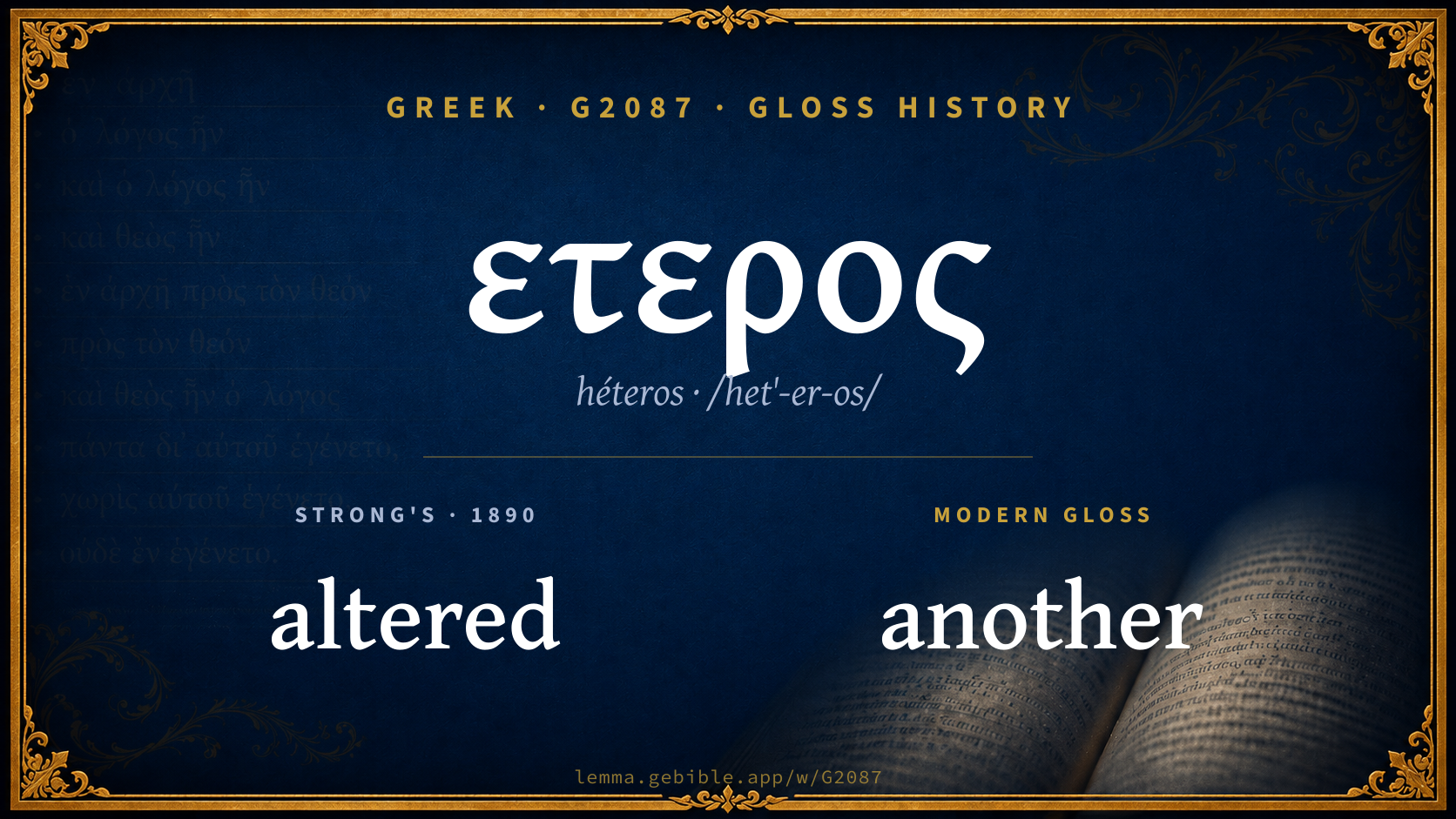
Gloss history
Strong's 1890 vs modern scholarship
About this word
Strong's G2087 catalogs a Greek word from the Greek New Testament.
These counts are not copied from any lexicon or concordance. They are computed here, from the morphology-tagged Greek New Testament. What Lemma adds →
- 94
- distinct verses
- The word appears in 94 distinct verses.
- 16 / 27
- NT books
- The word appears in 16 of 27 New Testament books.
- #171
- by frequency
- Top 250 most frequent Greek words (rank 171 of 5,347 Greek words by occurrence).
View all 94 occurrences in the concordance →
Most concentrated in
- Luke 31 verses 33%
- Acts 18 verses 19%
- 1 Corinthians 10 verses 11%
By section of the New Testament
By traditional corpus
Conventional, traditional groupings — biblical authorship is debated, so this is a traditional corpus grouping, not an authorship claim. Some books belong to more than one corpus (Luke is in both the Gospels and the Lukan corpus, and so on), so these shares overlap and need not total 100%. Each figure is a share of the word’s 94 distinct verses.
- Lukan (Luke–Acts) 49 verses · 52%
- Gospels 42 verses · 45%
- Pauline corpus 27 verses · 29%
- Hebrews 5 verses · 5%
- General (Catholic) Epistles 2 verses · 2%
- Johannine 1 verse · 1%
How translations render this word
Counts come from each version’s own published word-to-Strong’s tagging or interlinear alignment — an approximate guide to how each version renders this word, not a word-level alignment the data otherwise carries. Because each total is that version’s own tagged count, the per-version totals vary from one another and need not match the appearance or distinct-verse counts above. These counts may also differ from a printed concordance because Lemma counts each distinctly tagged rendering and does not collapse phrase taggings into a single head-word total. This is a fixed set of word-tagged versions (KJV, ASV, BSB, ULT) and does not change with the reading translation you choose elsewhere. Each version’s license is shown beside its name below (and on Sources).
- King James Version: Another 42×, Other 30×, Others 11×
- American Standard Version: Another 34×, Other 27×, Others 12×
- Berean Standard Bible: Another 31×, Other 25×, Others 17×
- unfoldingWord Literal Text: Another 32×, Other 32×, Others 13×
King James Version Public Domain
Renders G2087 across 98 tagged occurrences — most commonly:
Plus 11 renderings that appear only once — usually multi-word phrases or single function words the recovered tagging swept in, not distinct renderings. Not rendered by a distinct English word in 1 further occurrence.
American Standard Version Public Domain
Renders G2087 across 96 tagged occurrences — most commonly:
Plus 12 renderings that appear only once — usually multi-word phrases or single function words the recovered tagging swept in, not distinct renderings.
Berean Standard Bible Public Domain
Renders G2087 across 96 tagged occurrences — most commonly:
Plus 10 renderings that appear only once — usually multi-word phrases or single function words the recovered tagging swept in, not distinct renderings. Not rendered by a distinct English word in 1 further occurrence.
unfoldingWord Literal Text CC BY-SA 4.0
Renders G2087 across 107 tagged occurrences — most commonly:
Plus 15 renderings that appear only once — usually multi-word phrases or single function words the recovered tagging swept in, not distinct renderings.
Senses in Thayer's
The 1 sense Thayer's distinguishes for this word, in lexicon order (not ranked by frequency or importance). The full entry — with sub-senses — is in the Lexicon Entry tab.
- the other, another, other
Word origin
Origin: of uncertain affinity
Of uncertain affinity; (an- the) other or different : - altered else next (day) one (an-) other some strange.
— Strong’s Exhaustive Concordance (1890), public domain.
Forms in the corpus
The 15 distinct written forms G2087 takes in the Greek New Testament, most frequent first — each parse links to that case’s occurrences in the concordance.
Same root — word family
Other Thayer's entries built from the same root as G2087, grouped by Strong’s listed origin. These share a root / origin per the lexicon — not necessarily a shared meaning. Each links to that word’s own entry.
Derived from this word
- ετερογλωσσος heteróglōssos G2084 foreigner
- ετεροδιδασκαλεω heterodidaskaléō G2085 to teach differently
- ετεροζυγεω heterozygéō G2086 to be unequally yoked
- ετερως hetérōs G2088 otherwise
Compare all same-root words → Showing 4 of 5 — not the complete family. They share a root, not necessarily a meaning.
Septuagint usage
The same Greek word ετερος appears 181 times in the Greek Old Testament (Septuagint), across 156 verses in 26 books.
- 181
- LXX occurrences
- Tagged occurrences of this Greek word in the Septuagint.
- 156
- verses
- Distinct Septuagint verses containing this word.
- 26 / 39
- OT books
- The word appears in 26 of the 39 Old Testament books.
Sample Septuagint occurrences
- Genesis 4:25 ἕτερος
- Exodus 1:8 ἕτερος
- Leviticus 14:42 ἕτερος
- Numbers 14:4 ἕτερος
- Deuteronomy 4:28 ἕτερος
- Joshua 23:16 ἕτερος
- Judges 2:10 ἕτερος
- Ruth 2:8 ἕτερος
- 1 Samuel 8:8 ἕτερος
- 2 Samuel 18:26 ἕτερος
- 1 Kings 3:22 ἕτερος
- 2 Kings 5:17 ἕτερος
Septuagint occurrences (same lexeme)
Every verse where the same Strong’s number (G2087) appears in the Greek Septuagint — showing the first 50 of 156. Verse text shown in the World English Bible for context; the Greek form is the matched word — the English is not keyword-highlighted.
- Genesis 4:25 ἕτερος Adam knew his wife again. She gave birth to a son, and named him Seth. For, she said, "God has appointed me another child instead of Abel, for Cain killed him."
- Genesis 8:10 ἕτερος He stayed yet another seven days; and again he sent forth the dove out of the ark.
- Genesis 8:12 ἕτερος He stayed yet another seven days, and sent forth the dove; and she didn't return to him any more.
- Genesis 17:21 ἕτερος But my covenant I establish with Isaac, whom Sarah will bear to you at this set time in the next year."
- Genesis 26:21 ἕτερος They dug another well, and they argued over that, also. He called the name of it Sitnah.
- Genesis 26:22 ἕτερος He left that place, and dug another well. They didn't argue over that one. He called it Rehoboth. He said, "For now Yahweh has made room for us, and we will be fruitful in the land."
- Genesis 29:19 ἕτερος Laban said, "It is better that I give her to you, than that I should give her to another man. Stay with me."
- Genesis 29:27 ἕτερος Fulfill the week of this one, and we will give you the other also for the service which you will serve with me yet seven other years."
- Genesis 29:30 ἕτερος He went in also to Rachel, and he loved also Rachel more than Leah, and served with him yet seven other years.
- Genesis 30:24 ἕτερος She named him Joseph, saying, "May Yahweh add another son to me."
- Genesis 31:49 ἕτερος and Mizpah, for he said, "Yahweh watch between me and you, when we are absent one from another.
- Genesis 37:9 ἕτερος He dreamed yet another dream, and told it to his brothers, and said, "Behold, I have dreamed yet another dream: and behold, the sun and the moon and eleven stars bowed down to me."
- Genesis 41:19 ἕτερος and, behold, seven other cattle came up after them, poor and very ill-favored and lean-fleshed, such as I never saw in all the land of Egypt for ugliness.
- Genesis 42:13 ἕτερος They said, "We, your servants, are twelve brothers, the sons of one man in the land of Canaan; and, behold, the youngest is this day with our father, and one is no more."
- Genesis 43:22 ἕτερος We have brought down other money in our hand to buy food. We don't know who put our money in our sacks."
- Exodus 1:8 ἕτερος Now there arose a new king over Egypt, who didn't know Joseph.
- Exodus 16:15 ἕτερος When the children of Israel saw it, they said one to another, "What is it?" For they didn't know what it was. Moses said to them, "It is the bread which Yahweh has given you to eat."
- Exodus 20:3 ἕτερος You shall have no other gods before me.
- Exodus 22:4 ἕτερος If the stolen property is found in his hand alive, whether it is ox, donkey, or sheep, he shall pay double.
- Exodus 23:13 ἕτερος "Be careful to do all things that I have said to you; and don't invoke the name of other gods, neither let them be heard out of your mouth.
- Exodus 26:3 ἕτερος Five curtains shall be coupled together one to another; and the other five curtains shall be coupled one to another.
- Exodus 26:6 ἕτερος You shall make fifty clasps of gold, and couple the curtains one to another with the clasps: and the tent shall be a unit.
- Exodus 26:17 ἕτερος There shall be two tenons in each board, joined to one another: thus shall you make for all the boards of the tent.
- Exodus 26:28 ἕτερος The middle bar in the midst of the boards shall pass through from end to end.
- Exodus 28:7 ἕτερος It shall have two shoulder-pieces joined to the two ends of it, that it may be joined together.
- Exodus 30:9 ἕτερος You shall offer no strange incense on it, nor burnt offering, nor meal-offering; and you shall pour no drink-offering on it.
- Exodus 34:14 ἕτερος for you shall worship no other god: for Yahweh, whose name is Jealous, is a jealous God.
- Leviticus 14:42 ἕτερος They shall take other stones, and put them in the place of those stones; and he shall take other mortar, and shall plaster the house.
- Leviticus 27:20 ἕτερος If he will not redeem the field, or if he has sold the field to another man, it shall not be redeemed any more;
- Numbers 14:4 ἕτερος They said one to another, Let us make a captain, and let us return into Egypt.
- Numbers 14:24 ἕτερος but my servant Caleb, because he had another spirit with him, and has followed me fully, him will I bring into the land into which he went; and his seed shall possess it.
- Numbers 36:9 ἕτερος So shall no inheritance remove from one tribe to another tribe; for the tribes of the children of Israel shall cleave everyone to his own inheritance.
- Deuteronomy 4:28 ἕτερος There you shall serve gods, the work of men's hands, wood and stone, which neither see, nor hear, nor eat, nor smell.
- Deuteronomy 5:7 ἕτερος You shall have no other gods before me.
- Deuteronomy 6:14 ἕτερος You shall not go after other gods, of the gods of the peoples who are round about you;
- Deuteronomy 7:4 ἕτερος For he will turn away your son from following me, that they may serve other gods: so will the anger of Yahweh be kindled against you, and he will destroy you quickly.
- Deuteronomy 8:19 ἕτερος It shall be, if you shall forget Yahweh your God, and walk after other gods, and serve them, and worship them, I testify against you this day that you shall surely perish.
- Deuteronomy 11:16 ἕτερος Take heed to yourselves, lest your heart be deceived, and you turn aside, and serve other gods, and worship them;
- Deuteronomy 11:28 ἕτερος and the curse, if you shall not listen to the commandments of Yahweh your God, but turn aside out of the way which I command you this day, to go after other gods, which you have not known.
- Deuteronomy 13:3 ἕτερος you shall not listen to the words of that prophet, or to that dreamer of dreams: for Yahweh your God proves you, to know whether you love Yahweh your God with all your heart and with all your soul.
- Deuteronomy 13:7 ἕτερος of the gods of the peoples who are round about you, near to you, or far off from you, from the one end of the earth even to the other end of the earth;
- Deuteronomy 13:14 ἕτερος then shall you inquire, and make search, and ask diligently; and, behold, if it be truth, and the thing certain, that such abomination is done in the midst of you,
- Deuteronomy 17:3 ἕτερος and has gone and served other gods, and worshiped them, or the sun, or the moon, or any of the host of the sky, which I have not commanded;
- Deuteronomy 18:20 ἕτερος But the prophet, who shall speak a word presumptuously in my name, which I have not commanded him to speak, or who shall speak in the name of other gods, that same prophet shall die.
- Deuteronomy 20:5 ἕτερος The officers shall speak to the people, saying, What man is there who has built a new house, and has not dedicated it? let him go and return to his house, lest he die in the battle, and another man dedicate it.
- Deuteronomy 20:6 ἕτερος What man is there who has planted a vineyard, and has not used the fruit of it? let him go and return to his house, lest he die in the battle, and another man use the fruit of it.
- Deuteronomy 20:7 ἕτερος What man is there who has pledged to be married a wife, and has not taken her? let him go and return to his house, lest he die in the battle, and another man take her.
- Deuteronomy 24:2 ἕτερος When she is departed out of his house, she may go and be another man's [wife].
- Deuteronomy 28:14 ἕτερος and shall not turn aside from any of the words which I command you this day, to the right hand, or to the left, to go after other gods to serve them.
- Deuteronomy 28:30 ἕτερος You shall betroth a wife, and another man shall lie with her: you shall build a house, and you shall not dwell therein: you shall plant a vineyard, and shall not use the fruit of it.
These are occurrences of the same Greek lexeme (G2087) in the Septuagint — not a translation of any one Hebrew word. The store carries no word-level Hebrew↔Greek alignment, so no Hebrew original is asserted here. Counts come from the recovered LXX Strong's tagging — high-frequency vocabulary is well covered, while rare or late forms may be untagged — so they reflect tagged occurrences and may slightly undercount.