
Luke 8:6

Greek (Tischendorf 8th ed.) Luke 8:6 appears in the Greek New Testament. The text above is from the Tischendorf 8th edition. Each word links to its Strong’s number and a concise gloss. Click any word for its full Thayer’s Greek Lexicon entry.
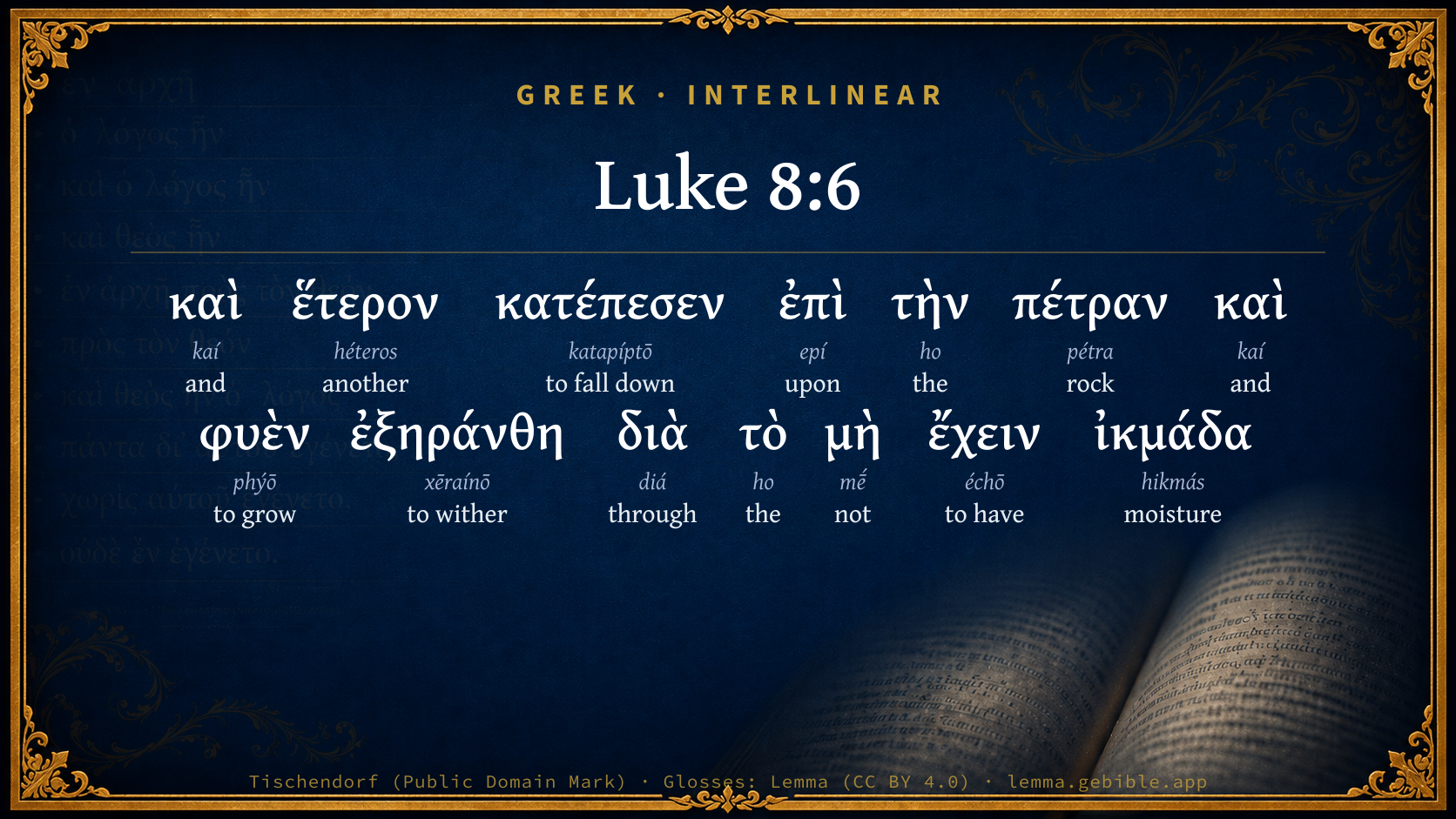
Download image
Cite this verse

Luke 8:6 (World English Bible). Public Domain. Lemma interlinear Bible study tool, https://lemma.gebible.app/v/luke/8/6.

Show BibTeX & RIS
BibTeX
RIS
English Translation
Other seed fell on the rock, and as soon as it grew, it withered away, because it had no moisture.
World English Bible · Public Domain
Highlights
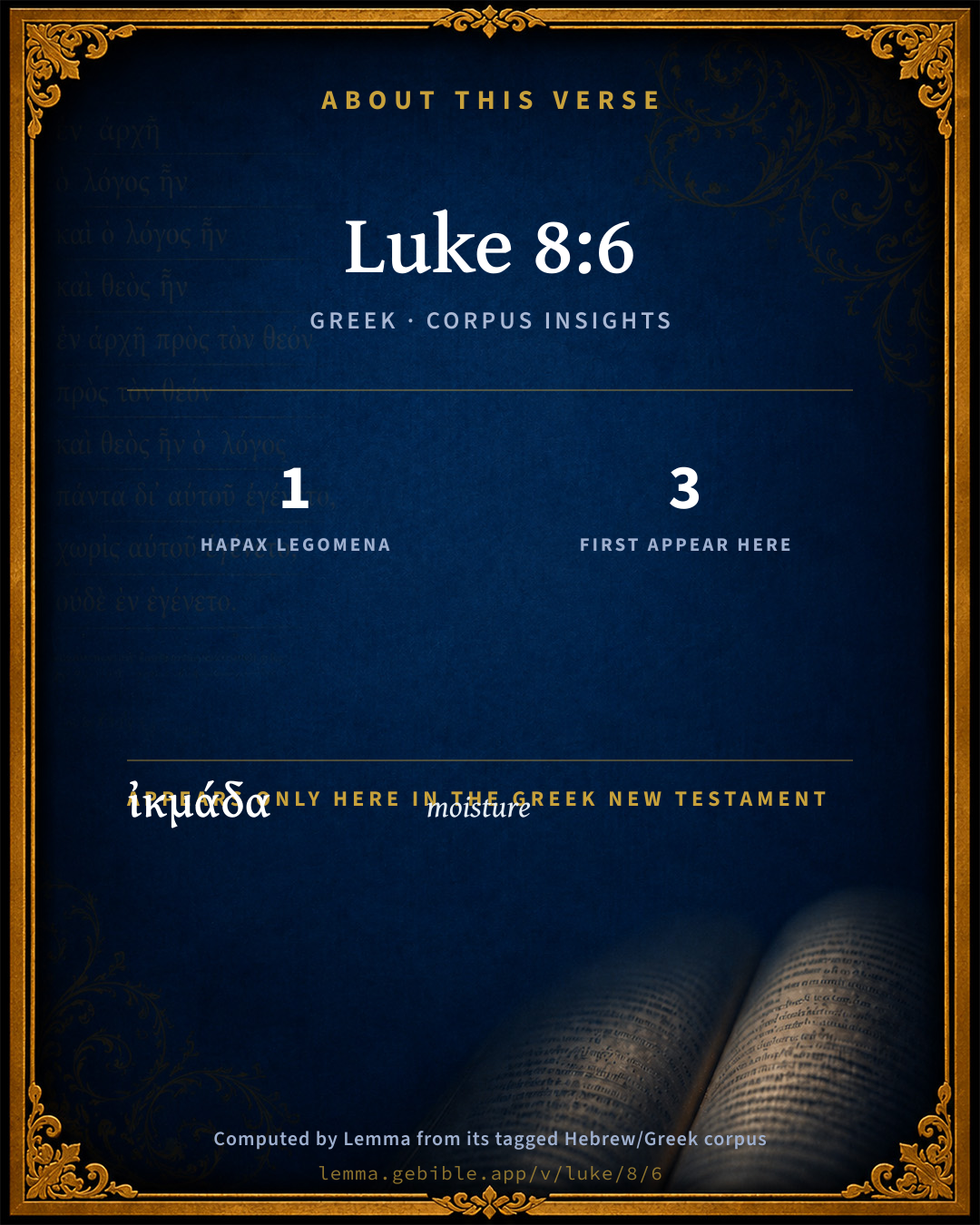
  • 1 hapax legomenon — only here in the Greek New Testament
  • 3 first appearances in the Greek New Testament
Full analysis ↓
Download a study sheet

One document with this verse’s original text, its word-by-word gloss line, the meaning frame, cross-references with their text, attributed commentary, and full source and license credits — printable, and it pastes into notes with its structure intact.

This verse Autodidact and up

Study sheet (.html) Plain text (.txt)

A passage Seminary Student

Up to 50 verses in one chapter. A passage sheet keeps up to 6 commentary sources and 12 cross-references per verse, in the order this page ranks them, and says so on the sheet whenever that leaves anything out. Ask for a single verse and you get the Autodidact verse sheet above.

Everything on this page stays free to read, with no account — the sheet is a download of what is already on screen, not access to it.

Want to remove ads? Support Godless Engineer
Compare translations 3

The same verse in 3 English versions, stacked beneath the original-language interlinear above. Click any original word for its lexicon entry.

Each is an independent rendering of the whole verse — the interlinear is not word-aligned to these translations.

Highlighted words mark where these versions differ — a whole-verse word diff, not a word-by-word alignment.

  • World English Bible Public Domain
    Other seed fell on the rock, and as soon as it grew, it withered away, because it had no moisture.
  • King James Version Public Domain
    And some fell upon a rock; and as soon as it was sprung up, it withered away, because it lacked moisture.
  • unfoldingWord Literal Text CC BY-SA 4.0
    And other seed fell on the rock, and having grown up, it withered, because it had no moisture.

unfoldingWord Literal Text — © unfoldingWord, licensed CC BY-SA 4.0. Word-aligned USFM3 via Door43 (git.door43.org/unfoldingWord/en_ult).

Versions to compare (up to 4)

3 of 4 selected

Show all 19 translations

Every available English version of this verse, each an independent rendering of the whole verse.

  • World English Bible Public Domain
    Other seed fell on the rock, and as soon as it grew, it withered away, because it had no moisture.
  • Berean Standard Bible Public Domain
    Some fell on rocky ground, and when it came up, the seedlings withered because they had no moisture.
  • Majority Standard Bible Public Domain
    Some fell on rocky ground, and when it came up, the seedlings withered because they had no moisture.
  • King James Version Public Domain
    And some fell upon a rock; and as soon as it was sprung up, it withered away, because it lacked moisture.
  • American Standard Version (1901) Public Domain
    And other fell on the rock; and as soon as it grew, it withered away, because it had no moisture.
  • Revised Version (1885) Public Domain
    And other fell on the rock; and as soon as it grew, it withered away, because it had no moisture.
  • Geneva Bible (1599) Public Domain
    And some fell on the stones, and when it was sprong vp, it withered away, because it lacked moystnesse.
  • Douay-Rheims (1899) Public Domain
    And other some fell upon a rock: and as soon as it was sprung up, it withered away, because it had no moisture.
  • Young's Literal Translation Public Domain
    `And other fell upon the rock, and having sprung up, it did wither, through not having moisture.
  • Literal Standard Version CC BY-SA 4.0
    And other fell on the rock, and having sprung up, it withered, through having no moisture.
  • Unlocked Literal Bible CC BY-SA 4.0
    Some fell on the rock, and as soon as it grew up, it withered away, because it had no moisture.
  • unfoldingWord Literal Text CC BY-SA 4.0
    And other seed fell on the rock, and having grown up, it withered, because it had no moisture.
  • Darby Bible Public Domain
    and other fell upon the rock, and having sprung up, it was dried up because it had not moisture;
  • World Messianic Bible Public Domain
    Other seed fell on the rock, and as soon as it grew, it withered away, because it had no moisture.
  • Webster's Bible Public Domain
    And some fell upon a rock; and as soon as it was sprung up, it withered, because it lacked moisture.
  • Free Bible Version CC BY-SA 4.0
    Some fell on stony ground, and once the seeds had sprouted they withered for lack of moisture.
  • Bible in Basic English Public Domain
    And some went on the rock, and when it came up it became dry and dead because it had no water.
  • Text-Critical English NT CC BY 4.0
    Other seed fell on rock, and as it grew up, it withered away because it had no moisture.
  • Tyndale New Testament (1534) Public Domain
    And some fell on ston and assone as it was spronge vp it widdred awaye because it lacked moystnes.

Literal Standard Version (2020), Covenant Press — licensed CC BY-SA 4.0. Text via the HelloAO Bible API (eBible.org). Unlocked Literal Bible (unfoldingWord) — licensed CC BY-SA 4.0. Text via the HelloAO Bible API (eBible.org). unfoldingWord Literal Text — © unfoldingWord, licensed CC BY-SA 4.0. Word-aligned USFM3 via Door43 (git.door43.org/unfoldingWord/en_ult). Free Bible Version, Dr. Jonathan Gallagher — licensed CC BY-SA 4.0. Text via the HelloAO Bible API (eBible.org).

Word by word

More ways to search: Search by grammar → Find every occurrence → Compare this word →

Practice this passage: Drill this verse → Learn its vocabulary →

About this verse

These counts appear in no published source. They are computed here, from the morphology-tagged text and Lemma’s own curated glosses. What Lemma adds →

14
words
12
distinct lemmas
Gospels
section

Notable vocabulary

1 hapax legomenon — a word that appears only here in the entire Greek New Testament:

  • ἰκμάδα moisture G2429

First appearance in Scripture

These words make their first canonical appearance in the Greek New Testament here:

  • κατέπεσεν to fall down G2667
  • φυὲν to grow G5453
  • ἰκμάδα moisture G2429

Shared distinctive vocabulary

κατέπεσεν to fall down G2667 occurs in 3 verses of the Greek New Testament. Also found in:
Repetition

Words recur within this verse:

Cross-references

12

Topical passages linked to Luke 8:6 in the Treasury of Scripture Knowledge — connected by theme and wording, ordered by reader-vote popularity; previews shown in the World English Bible.

  • Luke 8:13 Those on the rock are they who, when they hear, receive the word with joy; but these have no root, who believe for a while, then fall away in time of temptation.
  • Hebrews 3:7–8 Therefore, even as the Holy Spirit says, "Today if you will hear his voice,
  • Mark 4:5–6 Others fell on the rocky ground, where it had little soil, and immediately it sprang up, because it had no depth of soil.
  • Romans 2:4–5 Or do you despise the riches of his goodness, forbearance, and patience, not knowing that the goodness of God leads you to repentance?
  • Jeremiah 5:3 O Yahweh, don't your eyes look on truth? you have stricken them, but they were not grieved; you have consumed them, but they have refused to receive correction: they have made their faces harder than a rock; they have refused to return.
  • Ezekiel 36:26 A new heart also will I give you, and a new spirit will I put within you; and I will take away the stony heart out of your flesh, and I will give you a heart of flesh.
  • Amos 6:12 Do horses run on the rocky crags? Does one plow there with oxen? But you have turned justice into poison, And the fruit of righteousness into bitterness;
  • Matthew 13:20–21 What was sown on the rocky places, this is he who hears the word, and immediately with joy receives it;
  • Mark 4:16–17 These in like manner are those who are sown on the rocky places, who, when they have heard the word, immediately receive it with joy.
  • Hebrews 3:15 while it is said, "Today if you will hear his voice, Don't harden your hearts, as in the rebellion."
  • Ezekiel 11:19 I will give them one heart, and I will put a new spirit within you; and I will take the stony heart out of their flesh, and will give them a heart of flesh;
  • Matthew 13:5–6 Others fell on rocky ground, where they didn't have much soil, and immediately they sprang up, because they had no depth of earth.

Cross-references courtesy of OpenBible.info (CC BY 4.0).

Commentary

Notes on Luke 8:6 from classic Christian and Jewish commentators (each source and its license shown beneath its notes). The classic Christian expositions comment on the surrounding passage and are grouped to its opening verse, so a note may address several verses; the Jewish commentaries on the Tanakh (Rashi and others) are per-verse, so they appear only where the commentator wrote on this verse.

Lemma curates 59 commentaries, every one of them public domain or Creative Commons licensed, each selected and text-cleaned for this edition rather than reprinted as found. About our sources →

The Biblical Illustrator

Joseph S. Exell

Luk_8:6

And some fell upon a rock--

The shallow soil

It is evident that there is a very considerable difference between the persons whose state is signified by the shallow soil and those who are represented by the hard field-path.

By those the Word of God is not received at all--merely heard with the outward ears, and in no true sense understood; by these the Word is not only received, but received with joy. The persons now in question do not simply listen to the Word of God with pleasure and admiration, as the worldly man does, because of the outward graces in which its expression is clothed. No I their joy is a joy of the heart--they understand that which they hear, in a sense in which the worldly man understandeth it not. Its inner meaning--its spiritual beauty--is not hidden from them, as from him. They are able to discern and to appreciate it as a revelation of God, and the excellence, the purity, the righteousness, the loveliness of that which is revealed find in their hearts a powerful attraction. They listen to the gospel story and, far from only enjoying it as a beautiful story, they feel themselves drawn with cords of a man, with bands of love, by Him of whose love and labour for them the story tells. Nor does the effect of the Word end there. They not only understand, they not only feel, but they act. The love of Christ constrains them--constrains them to break away from evil habits, to exercise self-denial, to follow in many ways that which they see to be good. What more, you may ask, could be expected or desired? Is not this the very result which the Divine Sower looks and longs for? Is not this proof which cannot be gainsaid that the Divine seed has taken good root, and is fulfilling the purpose of its sowing? How can this soil be classed as unfruitful when it is actually bearing so goodly a crop? Alas 1 the Sower Himself answers our questions. It is all good while it lasts; but it endures but for a time, and all trace of it is gone long before the reapers go forth to gather in the harvest. Then they find no more fruit here than on the path, and they carry no sheaves hence, for all its past promise, to add to the store in the Masters barn. (C. S. Turner, M. A.)

On stony ground

The wayside had suggested incapacity for fruitage, resulting from a misapplication of the moral and intellectual faculties, the consequence of which was indifference to sacred things. The stony ground illustrates another and equally disastrous condition of irreligion, produced by an entirely different cause. Here the soil is good. In fact, in such places it is often of superior quality, produced by the rotting of leaves and other refuse matter in the moisture which cannot soak into the ground, But it has no depth. The seed which falls on this rich warm mould is rapidly quickened and soon germinates, shooting up with a green luxuriance that gives promise of speedy and abundant returns. The roots are thrown out all along the surface, but they can take no firm hold on the soft and yielding material, and the tap-root, which ought to penetrate deep into the subsoil to give support to the plant and find a never-drying source of moisture, is bruised and turned aside by the underlying stones against which it strikes, while the very rapidity and luxuriance of growth soon exhausts the scanty materials which nourish it. The warm sunshine which ought to give life and vigour becomes a source of injury instead, and the wilted plant droops, dies, and is forgotten long before the harvest season comes. Now we know perfectly well that such ground is far from useless; that if the proper treatment be applied it is often the most profitable, for these are just the conditions which we select or produce artificially for forcing. We want rich and rapid growth, and we know how to obtain it. Every gardener knows what special care must be bestowed upon the hot-bed to prevent the loss of all his labour. The hot, damp, shallow soil receives greedily the proffered seed, and with a marvellous quickness develops the germ. But the most assiduous attention is demanded, for these hotbed plants are far more delicate than those beside them from the same seed. They must he mulched and watered, the sunshine must be courted, but shaded off as it grows too warm, the cold air must be carefully excluded, but often discreetly admitted, and the least relaxation of all this diligence means destruction. A. sash left open, a mat removed, a single watering forgotten, and the plants wither and droop. The very same soil, if deeply dug, thoroughly drained, and well fertilized, will become permanently strong and productive. Surely we are only too familiar with the application in all its various degrees. We see all about us people in every stage and character of irreligion who were once, to some extent at least, professedly pious. It is fearful to contemplate how many such there are, and how very difficult it is to reawaken them to any interest in religion. The facility with which great numbers of persons may be made to acknowledge the influence of religious emotion is familiar to us all, and a little observation will also make us familiar with the startling disproportion of those numbers to the comparatively few who persevere. Nothing could be further from the truth than to accuse such persons of hypocrisy, for emotional characters are almost always sincere. It is precisely because their minds are so receptive, their feelings so readily impressed by eloquent and earnest appeals, that we find them yielding so readily and accepting the assurance of Gods love with a gladness as real as it is demonstrative. But they have no depth of character, and their very shallowness causes a rapid and laxuriant development of practical religion.

The drunkard is suddenly reformed; the profane swearer becomes frequent in prayer; the brawler grows peaceable and patient under insult. But one after another the old evil habits of life get the better of them, and their last state is worse than the first, because religion has become to them an experimental failure; the glowing faith which believed conversion an accomplished fact has given way to disappointment, and the man has lost all confidence in the reformatory influence and efficacy of religious belief and effort. Now if we bear in mind this warning lesson of the Master, we shall always become watchful and careful when we see any unexpectedly prompt and promising yielding to religious influence or exhortation. Beware of the quick fertility of the stony ground. (Robert Wilson, M. D.)

Stony ground

I. THE KIND OF SOIL. A kind of bad hearers, compared to stones, or stony ground.

1. For the natural hardness, which cannot be broken nor softened.

2. For their coldness: not warmed with the heat of the sun of righteousness, nor the Spirit of God, but abide cold as stones.

3. For their heaviness: a stone will not easily be removed out of his place, his proper centre is the earth.

4. For their unprofitableness, and resistance of the fruits of the earth: for as stoniness of ground by the curse upon mans sin became very noisome to the fruits of the earth, so the stoniness of heart, a part of the curse, more hinders fruits of grace than any stony ground can hinder seed cast into it.

5. As stony ground and common stones are little esteemed, but rejected of men; so this stony ground is as little respected of God. Yet herein our hard hearts are worse than stones: they increase not their hardness; but ours is daily increased by wilfulness and perverseness.

II. Now to the success OF THE SEED in this stony ground: and first, the hopeful and commendable, in the beginning--it sprung up. Which implies that of Mat_13:20, He which heareth the Word, and incontinently with joy receiveth it. Where we have four things considerable.

1. This bad ground receiveth the Word: wherein they go beyond the former hearers, who only heard the Word, but left it as soon as they heard it; let the devil, or any devouring bird eat it and take it from them, they care not.

2. This bad ground receives it incontinently (saith Matthew), when God speaks they will hear, and without delays or excuses willingly receive when God proffers.

3. These bad hearers, and stony ground receive it with joy.

4. This stony ground brings up the seed sown.

(1) Is rises to external obedience and reformation of many, perhaps most things.

(2) The seed springeth up to an outward profession, as those that hope to be saved by it, and so to an outward fellowship and communion with the saints in the Word, sacraments, and many other godly exercises, both public and private.

(3) It springeth up in the stony ground to a kind of faith, which hath in it not an enlightening only, but a taste of the heavenly gift and the powers of the world to come, by which they are partakers of the Holy Ghost; that is, something they have so like true sanctification that both themselves and others may think them truly sanctified. Some of the Israelites tasted of the fruits of the land of Canaan, and did thereby perceive what a good land it was and desired part in it, and conceived good hope of enjoying and possessing it, yet never enjoyed it, but perished in the wilderness. Learn hence how far a bad hearer may go in Christianity. A man may hear the Word with diligence, receive it with joy, believe with some assurance, grow up to high place in the profession of religion, bring forth fruits of commendable obedience, and all this while be bad ground and in damnable estate. Having spoken of the success of this seed cast into the stony ground, in the commendable hopes it gave in the beginning; now we proceed to the lamentable and doleful success in the conclusion with the reason of it, both in the words now read unto you.

1. It withered away.

2. Because it lacked moisture.

First, of the withering of these glorious professors, then of the causes. This withering is a falling away, but not all at once, but by little and little, as a leaf loseth his greenness and flourish, and withers by degrees. For the word implieth the manner of their falling. Neither is it a falling away in part, or for a time, as the disciples and Peter in the time of Christs passion; but a final falling away from all their graces, from which falls is no return or rising. Here consider four things:

1. How men wither away in grace.

2. The danger of withering.

3. Notes of a man withering.

4. The use and application of all.

For answer to the first: Men, even great professors in the Church, wither four ways.

1. In judgment.

2. In affection.

3. In practice.

4. In the use of the means.

The second is the danger of such withering: Which we shall clearly see in four particulars.

1. In respect of God they are most hateful, seeing they can find nothing more worthy forsaking than the good way, and esteem everything better worth keeping than Gods image and graces.

2. In respect of the Church: They bring scandal to the weak, and the scorn of the wicked upon themselves and all professors.

3. In respect of the sin itself: None more dangerous. For first, relapses, we say, are far more dangerous than first diseases. Secondly, Satan returning, comes with seven more wicked spirits than himself, and so he is for ever held under the power of Satan. Thirdly, this sin is commonly punished with other sins, which is Gods most fearful stroke, to which He seldom gives up His own. Fourthly, it is in the degrees of the sin against the Holy Ghost, and easily brings a man into that estate that there may be left no sacrifice for his sin.

4. In respect of the judgment that awaits and overtakes this sin. The judgment is certain. The third general thing proposed is: Notes of a man withering in grace.

And these are six.

1. A resting in a common and general hope of a good estate, without desire or endeavour to seek marks of certainty or special assurance in himself, As a foolish tradesman hopes his estate is good enough, and bears his creditors in hand it is so; but he is loath to cast up his books or come to a particular view of it. No surer argument of a man decaying.

2. An opinion of sufficiency, that he hath grace enough, he will seek no more because he pleaseth himself in his present measure; and he that careth not to increase his stock wastes of the principal. And not to go forward is to go backward.

3. A comparing of a mans self with those that are of lower and inferior graces or means.

4. A shunning or slighting of Gods ordinances; a willing excommunicating himself from the assemblies when he list. That mans strength is abating who falls from his meals. He must eat that must live. And the plant that would not wither must draw moisture daily. Or, if using public means diligently he neglect private, he is on the withering hand.

5. Secret sins ordinarily committed, not bewailed, not reformed.

6. Hatred of Gods children, and the way of just men, whether open or secret.

What be the means to keep us from withering?

1. Get sound judgment, to discern the truth from error. If we would not fall we must be grounded on the foundation of the prophets and apostles; by private reading, meditating and conferring of the Scriptures, which notably begets and confirms soundness of judgment; and by prayer, which obtains the spirit who is called the spirit of judgment. The lamp fails without oil.

2. Sound persuasion of the truth thou professest; that thou mayest not please thyself that thou hearest the truth from the mouth of the preacher; or hast it in thy Bible at home; no, nor content thyself that thou hast it in thy mouth or discourse, but that thou hast the experience of it in thine heart.

3. Sound affection and love to the truth upholds from withering in it, when the wise Christian esteems the pearl worth selling all to buy it. Love anything better than grace, thou art gone. Demas loves the world better, and easily forsakes the truth. How many lights in the beginning of their profession have been extinct by the world coming upon them.

4. Sound conscience; to which is required--

(1) sincerity;

(2) tenderness.

1. When Gods Word makes no impression or gets not within the heart to renew or reform the man, though sometimes it may scratch the outside and restrain him.

2. Neglect, or light over-passing the works of Gods mercy or justice, upon himself or others.

3. Unfeelingness of hardness, and unwillingness to feel it; no mislike of it, no desire to understand the danger of it.

4. For the maintaining their estate, credit, and favour in the world, or their lusts and pleasures, to oppose and dislike such doctrines, courses, and persons as have the word on their sides.

5. Out of resolution of following a mans own present course, whatsoever persuasion or doctrines he hears to the contrary, to fly occasions and companies which might touch or work upon his conscience.

6. Habits and customable sins, which make the heart as a pathway. A soft heart smites itself for once sinning and for small sinning.

(Thomas Taylor, D. D.)

Now the marks to know a hard heart are these:

Seeds on stony places; or, the cowardly hearer

Here is a case of great promise in the commencement. We should here take a distinct view of the nature of courage. The common notion of it is, indifference to danger. But that does not distinguish this noble principle from rashness. It properly refers to that quality of mind by which the higher sentiments overrule the dread of suffering. These sentiments are such as patriotism, philanthropy, integrity, sense of duty, and sense of right. The opposite state of mind is that which places the escaping from suffering above every consideration. And it is a person governed by that principle that is pointed out by this part of the parable. This habit of placing comfort before goodness equally facilitates the beginning and the ending of his religious life; for--

I. IT PREVENTS HIM FROM EVEN UNDERSTANDING THE THEORY OF THE GOSPEL, AND MUCH MORE FROM TRULY ACCEPTING ITS PROVISIONS. Imagine a person awakened by the law of God to an apprehension of danger; of guilt in his sight, and consequent exposure to the Divine wrath. If he would regard the testimony of God, he would find more in his case than the exposure to suffering. But such is the operation of selfishness in the human heart, that often where this sense of danger is irresistibly urged home, there is still such a magnifying of suffering as the great evil, that the attention shall be fully absorbed by that. The first consequence is--

1. He neither sees that Christ comes to save him from sin; nor that he is a sinner.

2. He misapprehends the atonement, or the ground of Christs death. This must make a superficial Christian.

3. He fails also to see the work of the Holy Spirit, and his own obsolute dependence on that Spirit for renewal and sanctification. There lies in that heart the deep, dead, broad rock of impenitence and pride. Into its compact substance no root of conviction, of repentance, of faith, of love, ever penetrated. The very thing he has bargained for is an easy service. Christ gives peace; and it is peace he wants, and not trouble. He can accordingly sail in smooth seas, and live well in fair weather with his religion. But--

II. HE CAN DO NO BETTER WITH THE PRACTICE OF THE GOSPEL THAN WITH ITS THEORY; for--

1. It requires him to struggle with sin in his own heart. The work to which Christ calls us is a progressive conquest over spiritual evils in ourselves.

2. His conflict with the world. Men of superficial religion are generally very much perplexed to know what the Scriptures mean by the world, against which they speak so severely. (E. Kirk, D. D.)

The Biblical Illustrator, edited by Joseph S. Exell (c. 1880s–1900s) — public domain. Text from a community e-Sword module.

Tyndale Open Study Notes

Tyndale Open Resources

8:6 fell among rocks: Often there was a limestone layer nine to twelve inches under the soil, so that the rain was trapped and seed sprouted quickly in the moist soil. But when the rain stopped, the sun evaporated the trapped moisture and the plant died.

Tyndale Open Study Notes — © Tyndale Open Resources, licensed CC BY-SA 4.0. Text via the HelloAO Bible API.

Expositor's Greek Testament

ed. W. Robertson Nicoll

Luk 8:6 . φυὲν , 2nd aorist participle, neuter, from ἐφύην (Alex. form), the Attic 2nd aorist being ἔφυν . ἰκμάδα ( ἰκμάς ), moisture, here only in N. T.

The Expositor's Greek Testament, edited by W. Robertson Nicoll (1897–1910) — public domain. Text from a community e-Sword module.

Ellicott's Commentary for English Readers

(6) Upon a rock.—Better, upon the rock. Note here also the use of a more accurate word than the “stony (or rocky) ground” of the other two reports, and the statement that it withered “because it lacked moisture.” This is obviously not without its force in the spiritual interpretation of the parable, the “moisture” being the dew and rain of God’s grace, without which the seed could not put forth its roots. This represents one aspect of what was lacking, as the having “no depth of earth “represents another.

A Bible Commentary for English Readers, edited by Charles John Ellicott (1878–1897) — public domain. Text from a community e-Sword module.

The Cambridge Bible for Schools and Colleges

gen. ed. J. J. S. Perowne

6. upon a rock) St Matthew and St Mark say “upon stony places,” and add its speedy growth, and its withering after sunrise from want of root; St Luke dwells rather on the lack of moisture than on the lack of soil.

The Cambridge Bible for Schools and Colleges (gen. ed. J. J. S. Perowne; Cambridge University Press, 1878–1918) — public domain. Text from a community e-Sword module.

John Gill's Exposition

And some fell upon a rock,.... Which the other evangelists call "stony places", and "stony ground"; by which are meant such hearers whose hearts are, hardened through the deceitfulness of sin, and continue so notwithstanding the preaching of the word unto them.

And as soon as it sprung up; as it did immediately, as the other evangelists say; and that for this reason, which they give, "because it had no depth of earth"; only a small crust, or shell of earth over the rock; and signifies, that these hearers had only a superficial knowledge of the word, and hastily made a profession of it, which soon came to nothing:

it withered away, because it lacked moisture; the other evangelists say, "when the sun was up, it was scorched"; meaning tribulation and persecution, the grace of God being wanting to support under fiery trials: the reason given in Matthew and Mark why it withered, is,

because it had no root; and so read the Persic and Ethiopic versions here.

John Gill's Exposition of the Whole Bible (1746–1763) — public domain (CC PDM 1.0). Text via the HelloAO Bible API.

The Pulpit Commentary

And some fell upon a rock. The picture here is not of a soil full of stones, but of a rocky portion of the corn-land where the rock is only covered with a thin layer of earth.

The Pulpit Commentary (1880–1919), ed. H.D.M. Spence-Jones & Joseph S. Exell — public domain. Text from a community e-Sword module.

Burkitt's Expository Notes on the New Testament

William Burkitt

Here we have the disciples’ question, and our Saviour’s reply: their inquiry is concerning the sense and signification of the parable, they own their ignorance, and desire better information. It is no shame for the best of ministers, yes, for the best of men, to acknowledge their own ignorance of the mysteries of religion; and to attend upon the means of instruction, in order to their farther information. In our Saviour’s answer, To you it is given to know the mysteries of the kingdom of God, etc.

Observe, 1. That the doctrines of the gospel are great mysteries.

2. That it is an invaluable privilege rightly to understand and know gospel mysteries.

3. That this privilege all are not sharers in, and partakers of, but only those to whom it is given.

4. That it is a righteous thing with God to give such persons over to farther blindness and ignorance in spiritual things, who willfully reject the truth, and shut their eyes against the evidence of it.

The Pharisees had all along shut their eyes, and said, they would not see; and now Christ closes their eyes judicially, and says they shall not see.

William Burkitt's Expository Notes on the New Testament (1700–1703) — public domain. Text from a community e-Sword module.

Cambridge Greek Testament for Schools and Colleges

6. ἐπὶ τὴν πέτραν. St Matthew and St Mark say “upon stony places,” and add its speedy growth, and its withering after sunrise from want of root; St Luke dwells rather on the lack of moisture than on the lack of soil.

Cambridge Greek Testament for Schools and Colleges (Cambridge University Press, 1896; 21 vols, various authors incl. Carr, Maclear, Plummer, Farrar, Lumby, Moule, M. R. James, Simcox) — public domain. Text from a community e-Sword module.

International Critical Commentary

6. ἐπὶ τὴν πέραν. The rock had a slight covering of soil; and hence is called τὸ πετρῶδες (Mk.) and τὰ πετρώδη (Mt.), which does not mean “stony ground,” i.e. full of stones, but “rocky ground,” i.e. with rock appearing at intervals and with “no depth of earth.” The thinness of the soil would cause rapid germination and rapid withering; but Lk omits the rapid growth. With φυέν comp. Pro 26:9; Exo 10:5; and (for the constr.) Luk 2:4. For ἰκμάδα, “moisture,” Mt. and Mk. have ῥίζαν. The word occurs Jer 17:8; Job 26:14; Jos. Ant. iii. 1, 3; but nowhere else in N.T.

International Critical Commentary — older volumes (1896–1929), various authors — public domain. Text from a community e-Sword module.

Vincent's Word Studies in the New Testament

Marvin R. Vincent

The rock [την πετραν] . Matthew has the rocky places, and Mark the rocky ground.

Sprung up [φυεν] . Lit., having sprung up. Rev., better, grew. Sprung up is Matthew's ejxaneteilen. Only here and Heb 12:15, where it is a quotation from the Septuagint. See on Mt 13:7.

Moisture [ικμαδα] . Only here in New Testament. Matthew and Mark have depth of earth. The word is the medical expression for juices of the body, of plants, and of the earth. Aristophanes, metaphorically, the juice of thought (" Clouds, " 233). Hippocrates uses this and the preceding word together, comparing the juices of the body with those of the earth.

Marvin R. Vincent, Word Studies in the New Testament (1887–1900) — public domain. Text from a community e-Sword/MySword module.

Lesson kit

Teaching starters — assembled from the data on this page, not authored interpretation. Every prompt links to the verse data it draws on. Edit before teaching.

Luke, in the Gospels, opens this verse with 14 words (12 distinct Greek lemmas). Its most distinctive word is hikmás (“moisture”). A historical commentator’s framing appears above. Read the whole chapter for the surrounding context.

Discussion questions

  1. What does “moisture” (hikmás) contribute to the verse as a whole?
  2. 1 word here appears nowhere else in the Greek New Testament. Why might the author reach for such rare wording?
  3. 3 words make their first appearance in Scripture here. What does this debut establish?
  4. How does Acts 26:14, which shares the word «to fall down», read alongside this verse?
  5. What does the repetition of “and” (2× in this one verse) do in this verse?
  6. These translations render this verse differently. What is at stake in choosing one wording over another?
  7. Compare how The Biblical Illustrator and Tyndale Open Study Notes read this verse. Where do they agree or differ?

Things to notice

  • 1 word in this verse appears nowhere else in the Greek New Testament.
  • 3 words make their first canonical appearance in Scripture here.
  • These translations choose different wording for 13 words in this verse.
  • “and” occurs 2× in this single verse.
  • 12 distinct Greek lemmas span 14 words in this verse.

Reading settings

Reading text

Shown beneath each verse's original-language words.

Old Testament
Old Testament edition

Read the OT as the Masoretic Hebrew (MT) or the Greek Septuagint (LXX).

English shown for the Greek Septuagint (in the Hebrew ↔ Greek comparison).

Comparing translations? Open the Compare panel on any verse page to stack up to four side by side.