
1 Timothy 1:10

Greek (Tischendorf 8th ed.) 1 Timothy 1:10 appears in the Greek New Testament. The text above is from the Tischendorf 8th edition. Each word links to its Strong’s number and a concise gloss. Click any word for its full Thayer’s Greek Lexicon entry.
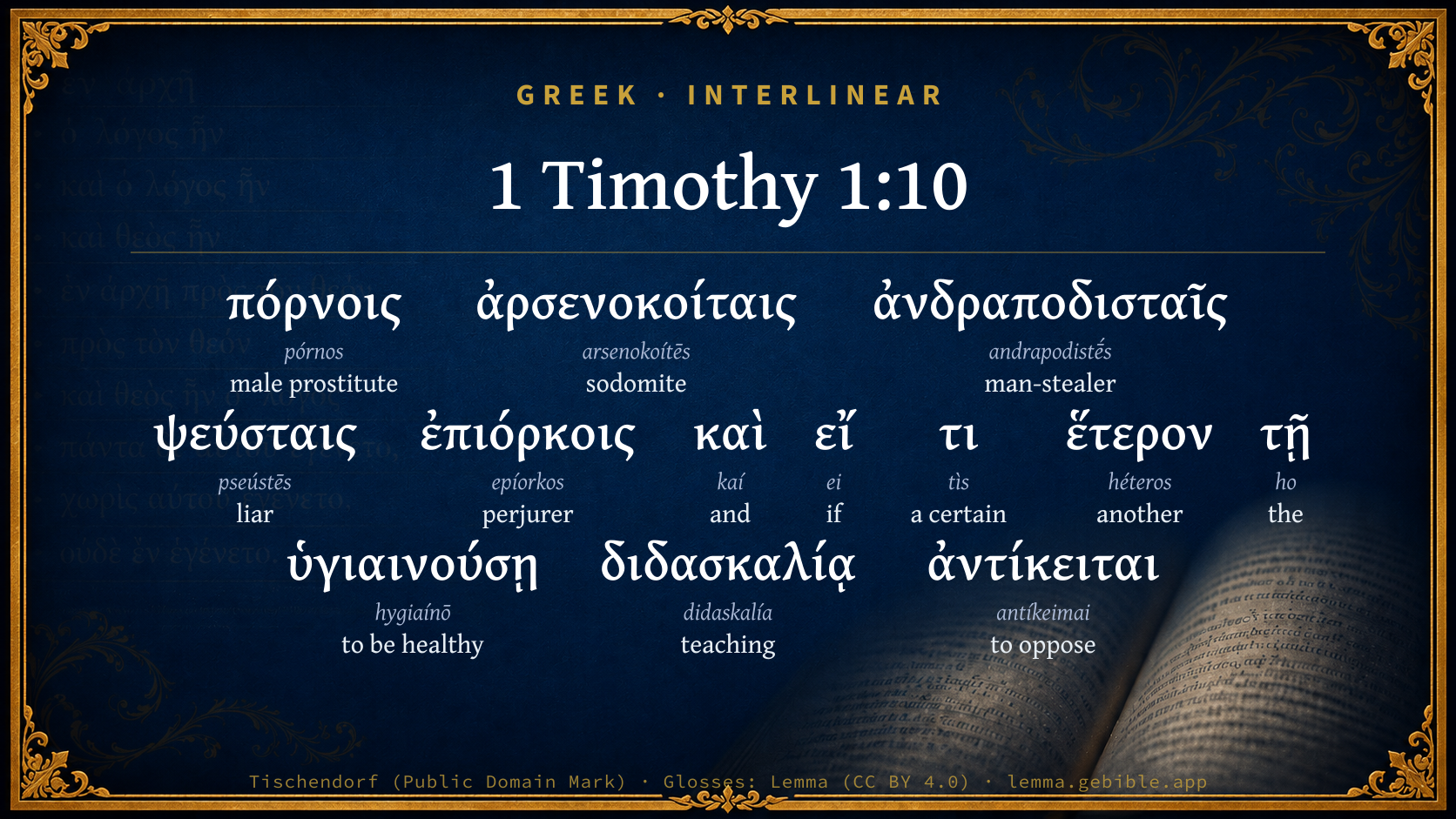
Download image
Cite this verse

1 Timothy 1:10 (World English Bible). Public Domain. Lemma interlinear Bible study tool, https://lemma.gebible.app/v/1-timothy/1/10.

Show BibTeX & RIS
BibTeX
RIS
English Translation
for the sexually immoral, for homosexuals, for slave-traders, for liars, for perjurers, and for any other thing contrary to the sound doctrine;
World English Bible · Public Domain
Highlights
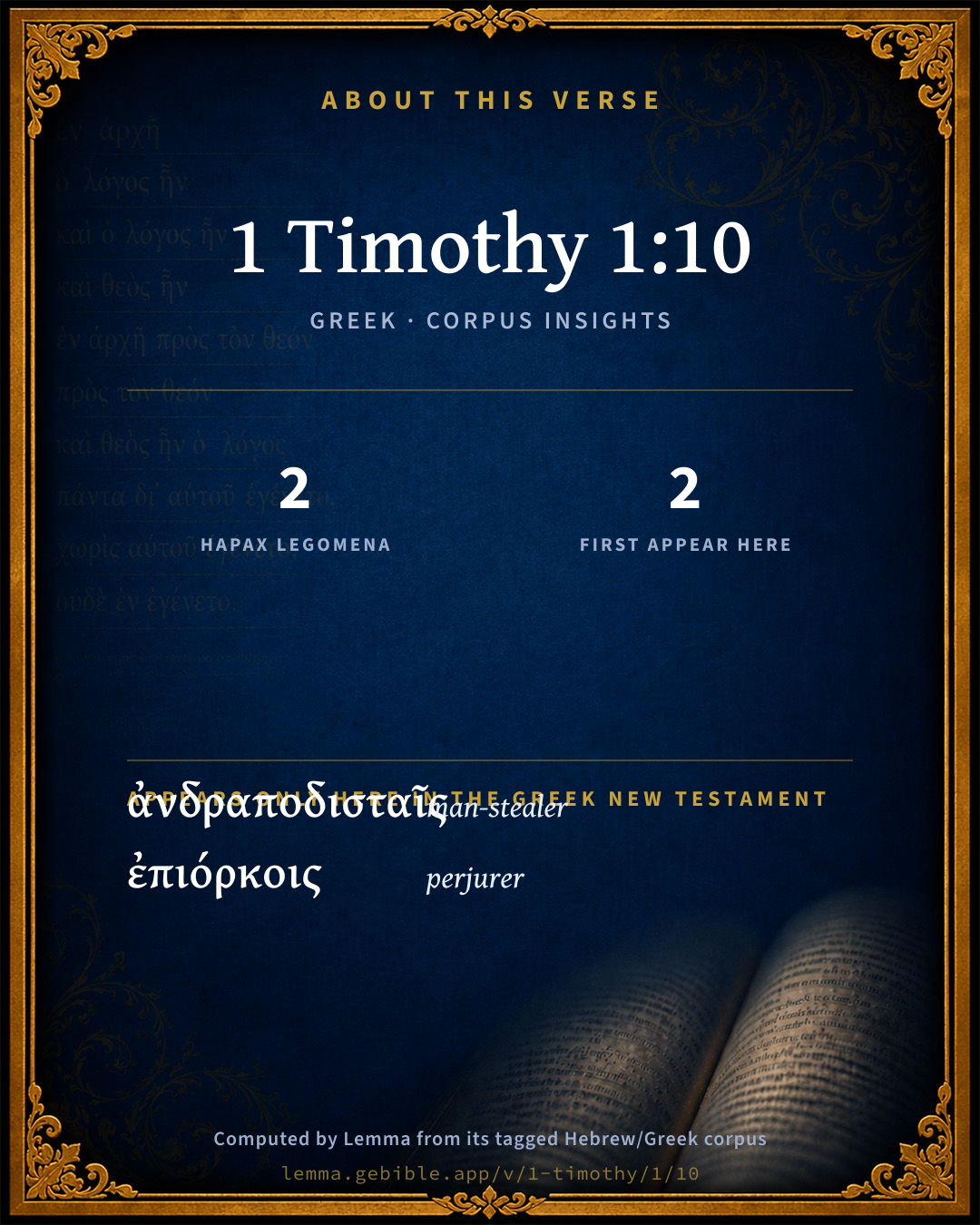
  • 2 hapax legomena — only here in the Greek New Testament
  • 2 first appearances in the Greek New Testament
Full analysis ↓
Download a study sheet

One document with this verse’s original text, its word-by-word gloss line, the meaning frame, cross-references with their text, attributed commentary, and full source and license credits — printable, and it pastes into notes with its structure intact.

This verse Autodidact and up

Study sheet (.html) Plain text (.txt)

A passage Seminary Student

Up to 50 verses in one chapter. A passage sheet keeps up to 6 commentary sources and 12 cross-references per verse, in the order this page ranks them, and says so on the sheet whenever that leaves anything out. Ask for a single verse and you get the Autodidact verse sheet above.

Everything on this page stays free to read, with no account — the sheet is a download of what is already on screen, not access to it.

Want to remove ads? Support Godless Engineer
Compare translations 3

The same verse in 3 English versions, stacked beneath the original-language interlinear above. Click any original word for its lexicon entry.

Each is an independent rendering of the whole verse — the interlinear is not word-aligned to these translations.

Highlighted words mark where these versions differ — a whole-verse word diff, not a word-by-word alignment.

  • World English Bible Public Domain
    for the sexually immoral, for homosexuals, for slave-traders, for liars, for perjurers, and for any other thing contrary to the sound doctrine;
  • King James Version Public Domain
    For whoremongers, for them that defile themselves with mankind, for menstealers, for liars, for perjured persons, and if there be any other thing that is contrary to sound doctrine;
  • unfoldingWord Literal Text CC BY-SA 4.0
    the sexually immoral, homosexuals, kidnappers, liars, perjurers, and if anything else is contrary to the healthy teaching,

unfoldingWord Literal Text — © unfoldingWord, licensed CC BY-SA 4.0. Word-aligned USFM3 via Door43 (git.door43.org/unfoldingWord/en_ult).

Versions to compare (up to 4)

3 of 4 selected

Show all 19 translations

Every available English version of this verse, each an independent rendering of the whole verse.

  • World English Bible Public Domain
    for the sexually immoral, for homosexuals, for slave-traders, for liars, for perjurers, and for any other thing contrary to the sound doctrine;
  • Berean Standard Bible Public Domain
    for the sexually immoral, for homosexuals, for slave traders and liars and perjurers, and for anyone else who is averse to sound teaching
  • Majority Standard Bible Public Domain
    for the sexually immoral, for homosexuals, for slave traders and liars and perjurers, and for anyone else who is averse to sound teaching
  • King James Version Public Domain
    For whoremongers, for them that defile themselves with mankind, for menstealers, for liars, for perjured persons, and if there be any other thing that is contrary to sound doctrine;
  • American Standard Version (1901) Public Domain
    for fornicators, for abusers of themselves with men, for menstealers, for liars, for false swearers, and if there be any other thing contrary to the sound doctrine;
  • Revised Version (1885) Public Domain
    for fornicators, for abusers of themselves with men, for menstealers, for liars, for false swearers, and if there be any other thing contrary to the sound doctrine;
  • Geneva Bible (1599) Public Domain
    To whoremongers, to buggerers, to menstealers, to lyers, to the periured, and if there be any other thing, that is contrary to wholesome doctrine,
  • Douay-Rheims (1899) Public Domain
    For fornicators, for them who defile themselves with mankind, for menstealers, for liars, for perjured persons, and whatever other thing is contrary to sound doctrine,
  • Young's Literal Translation Public Domain
    whoremongers, sodomites, men-stealers, liars, perjured persons, and if there be any other thing that to sound doctrine is adverse,
  • Literal Standard Version CC BY-SA 4.0
    whoremongers, homosexuals, enslavers, liars, perjured persons, and if there be any other thing that is adverse to sound doctrine,
  • Unlocked Literal Bible CC BY-SA 4.0
    for sexually immoral people, for homosexuals, for those who kidnap people for slaves, for liars, for false witnesses, and for whatever else is against faithful instruction.
  • unfoldingWord Literal Text CC BY-SA 4.0
    the sexually immoral, homosexuals, kidnappers, liars, perjurers, and if anything else is contrary to the healthy teaching,
  • Darby Bible Public Domain
    fornicators, sodomites, kidnappers, liars, perjurers; and if any other thing is opposed to sound teaching,
  • World Messianic Bible Public Domain
    for the sexually immoral, for homosexuals, for slave-traders, for liars, for perjurers, and for any other thing contrary to the sound doctrine,
  • Webster's Bible Public Domain
    For lewd persons, for them that defile themselves with mankind, for men-stealers, for liars, for perjured persons, and if there is any other thing that is contrary to sound doctrine,
  • Free Bible Version CC BY-SA 4.0
    for those who are sexually immoral, homosexuals, kidnappers, liars, false witnesses—and anything else that's opposed to good teachings
  • Bible in Basic English Public Domain
    For those who go after loose women, for those with unnatural desires, for those who take men prisoners, who make false statements and false oaths, and those who do any other things against the right teaching,
  • Text-Critical English NT CC BY 4.0
    fornicators, homosexuals, slave traders, liars, perjurers, and whatever else is opposed to the sound teaching
  • Tyndale New Testament (1534) Public Domain
    and whormongers: to them that defile them selves with mankynde: to menstealers: to lyars and to periured and so forth yf ther be eny other thinge that is contrary to holsome doctrine

Literal Standard Version (2020), Covenant Press — licensed CC BY-SA 4.0. Text via the HelloAO Bible API (eBible.org). Unlocked Literal Bible (unfoldingWord) — licensed CC BY-SA 4.0. Text via the HelloAO Bible API (eBible.org). unfoldingWord Literal Text — © unfoldingWord, licensed CC BY-SA 4.0. Word-aligned USFM3 via Door43 (git.door43.org/unfoldingWord/en_ult). Free Bible Version, Dr. Jonathan Gallagher — licensed CC BY-SA 4.0. Text via the HelloAO Bible API (eBible.org).

Word by word

More ways to search: Search by grammar → Find every occurrence → Compare this word →

Practice this passage: Drill this verse → Learn its vocabulary →

ἀνδραποδισταῖς
andrapodistḗs
G405
“man-stealer”
Noun, Dative, Plural, Masculine
Part of Speech
Noun
Case
Dative
Number
Plural
Gender
Masculine
Full Thayer's Definition

Origin: from a derivative of a compound of G435 and G4228

TDNT: None

1. a slave-dealer, kidnapper, man-stealer a. of one who unjustly reduces free men to slavery b. of one who steals the slaves of others and sells them
  1. πόρνοις pórnos G4205 “male prostitute” Noun, Dative, Plural, Masculine
  2. ἀρσενοκοίταις arsenokoítēs G733 “sodomite” Noun, Dative, Plural, Masculine
  3. ψεύσταις pseústēs G5583 “liar” Noun, Dative, Plural, Masculine
  4. ἐπιόρκοις epíorkos G1965 “perjurer” Adjective, Dative, Plural, Masculine
  5. καὶ kaí G2532 “and” Conjunction
  6. εἴ ei G1487 “if” Conditional
  7. τι tìs G5100 “a certain” Indefinite pronoun, Nominative, Singular, Neuter
  8. ἕτερον héteros G2087 “another” Adjective, Nominative, Singular, Neuter
  9. τῇ ho G3588 “the” Article, Dative, Singular, Feminine
  10. ὑγιαινούσῃ hygiaínō G5198 “to be healthy” Verb, Present, Active, Participle, Dative, Singular, Feminine
  11. διδασκαλίᾳ didaskalía G1319 “teaching” Noun, Dative, Singular, Feminine
  12. ἀντίκειται antíkeimai G480 “to oppose” Verb, Present, Middle or Passive deponent, Indicative, 3rd person, Singular

About this verse

These counts appear in no published source. They are computed here, from the morphology-tagged text and Lemma’s own curated glosses. What Lemma adds →

13
words
13
distinct lemmas
Pauline Epistles
section

Notable vocabulary

2 hapax legomena — words that appear only here in the entire Greek New Testament:

  • ἀνδραποδισταῖς man-stealer G405
  • ἐπιόρκοις perjurer G1965

First appearance in Scripture

These words make their first canonical appearance in the Greek New Testament here:

  • ἀνδραποδισταῖς man-stealer G405
  • ἐπιόρκοις perjurer G1965

Shared distinctive vocabulary

ἀρσενοκοίταις sodomite G733 occurs in 2 verses of the Greek New Testament. Also found in:
Cross-references

33

Topical passages linked to 1 Timothy 1:10 in the Treasury of Scripture Knowledge — connected by theme and wording, ordered by reader-vote popularity; previews shown in the World English Bible.

  • 1 Corinthians 6:9–10 Or don't you know that the unrighteous will not inherit the Kingdom of God? Don't be deceived. Neither the sexually immoral, nor idolaters, nor adulterers, nor male prostitutes, nor homosexuals,
  • Leviticus 18:22 "'You shall not lie with a man, as with a woman. That is detestible.
  • 2 Timothy 4:3 For the time will come when they will not listen to the sound doctrine, but, having itching ears, will heap up for themselves teachers after their own lusts;
  • Romans 1:26 For this reason, God gave them up to vile passions. For their women changed the natural function into that which is against nature.
  • Galatians 5:19–21 Now the works of the flesh are obvious, which are: adultery, sexual immorality, uncleanness, lustfulness,
  • Revelation 21:27 There will in no way enter into it anything profane, or one who causes an abomination or a lie, but only those who are written in the Lamb's book of life.
  • 1 Timothy 6:3 If anyone teaches a different doctrine, and doesn't consent to sound words, the words of our Lord Jesus Christ, and to the doctrine which is according to godliness,
  • Jude 1:7 Even as Sodom and Gomorrah, and the cities around them, having, in the same way as these, given themselves over to sexual immorality and gone after strange flesh, are set forth as an example, suffering the punishment of eternal fire.
  • Leviticus 20:13 If a man lies with a male, as with a woman, both of them have committed an abomination: they shall surely be put to death; their blood shall be upon them.
  • Mark 7:21–22 For from within, out of the hearts of men, proceed evil thoughts, adulteries, sexual sins, murders, thefts,
  • Titus 1:9 holding to the faithful word which is according to the teaching, that he may be able to exhort in the sound doctrine, and to convict those who contradict him.
  • Hebrews 13:4 Let marriage be held in honor among all, and let the bed be undefiled: but God will judge the sexually immoral and adulterers.
  • Revelation 21:8 But for the cowardly, unbelieving, sinners, abominable, murderers, sexually immoral, sorcerers, idolaters, and all liars, their part is in the lake that burns with fire and sulfur, which is the second death."
  • Revelation 22:15 Outside are the dogs, the sorcerers, the sexually immoral, the murderers, the idolaters, and everyone who loves and practices falsehood.
  • John 8:44 You are of your Father, the devil, and you want to do the desires of your father. He was a murderer from the beginning, and doesn't stand in the truth, because there is no truth in him. When he speaks a lie, he speaks on his own; for he is a liar, and the father of it.
  • Ephesians 5:3–6 But sexual immorality, and all uncleanness, or covetousness, let it not even be mentioned among you, as becomes saints;
  • Genesis 19:5 They called to Lot, and said to him, "Where are the men who came in to you this night? Bring them out to us, that we may have sex with them."
  • Exodus 21:16 "Anyone who kidnaps someone and sells him, or if he is found in his hand, he shall surely be put to death.
  • 2 Timothy 1:13 Hold the pattern of sound words which you have heard from me, in faith and love which is in Christ Jesus.
  • Exodus 20:7 "You shall not take the name of Yahweh your God in vain, for Yahweh will not hold him guiltless who takes his name in vain.
  • Titus 1:13 This testimony is true. For this cause, reprove them sharply, that they may be sound in the faith,
  • Titus 2:1–2 But say the things which fit sound doctrine,
  • Deuteronomy 24:7 If a man be found stealing any of his brothers of the children of Israel, and he deal with him as a slave, or sell him; then that thief shall die: so shall you put away the evil from the midst of you.
  • Hosea 4:1–2 Hear the word of Yahweh, you children of Israel; For Yahweh has a charge against the inhabitants of the land: "Indeed there is no truth, Nor goodness, Nor knowledge of God in the land.
  • Hosea 10:4 They make promises, swearing falsely in making covenants. Therefore judgment springs up like poisonous weeds in the furrows of the field.
  • Matthew 5:33–37 "Again you have heard that it was said to them of old time, 'You shall not make false vows, but shall perform to the Lord your vows,'
  • Revelation 18:13 and cinnamon, incense, perfume, frankincense, wine, olive oil, fine flour, wheat, sheep, horses, chariots, bodies, and people's souls.
  • Genesis 37:27 Come, and let's sell him to the Ishmaelites, and not let our hand be on him; for he is our brother, our flesh." His brothers listened to him.
  • Genesis 40:15 For indeed, I was stolen away out of the land of the Hebrews, and here also have I done nothing that they should put me into the dungeon."
  • Ezekiel 17:16–19 As I live, says the Lord Yahweh, surely in the place where the king dwells who made him king, whose oath he despised, and whose covenant he broke, even with him in the midst of Babylon he shall die.
  • Zechariah 5:4 I will cause it to go out," says Yahweh of Hosts, "and it will enter into the house of the thief, and into the house of him who swears falsely by my name; and it will remain in the midst of his house, and will destroy it with its timber and its stones."
  • Zechariah 8:17 and let none of you devise evil in your hearts against his neighbor, and love no false oath: for all these are things that I hate," says Yahweh.
  • Malachi 3:5 I will come near to you to judgment; and I will be a swift witness against the sorcerers, and against the adulterers, and against the perjurers, and against those who oppress the hireling in his wages, the widow, and the fatherless, and who deprive the foreigner of justice, and don't fear me," says Yahweh of Hosts.

Cross-references courtesy of OpenBible.info (CC BY 4.0).

Commentary

Notes on 1 Timothy 1:10 from classic Christian and Jewish commentators (each source and its license shown beneath its notes). The classic Christian expositions comment on the surrounding passage and are grouped to its opening verse, so a note may address several verses; the Jewish commentaries on the Tanakh (Rashi and others) are per-verse, so they appear only where the commentator wrote on this verse.

Lemma curates 59 commentaries, every one of them public domain or Creative Commons licensed, each selected and text-cleaned for this edition rather than reprinted as found. About our sources →

Tyndale Open Study Notes

Tyndale Open Resources

1:10 This list portrays the ultimate tendencies of the false teachers’ teachings, their underlying spiritual state, and the superior righteousness of the Good News (see Matt 5:20; Gal 5:22-23). • that contradicts the wholesome (or sound, healthy) teaching: See also 1 Tim 6:3-4; 2 Tim 1:13; 4:3; Titus 1:9, 13; 2:1, 8. This addition to the list is both a closing generalization and a powerful assertion. Righteousness is now defined more perfectly by the Good News than by the law, but law still speaks to all that is opposed to the Good News. The false teachers’ reliance on the law, therefore, underscores their departure from Paul’s teaching.

Tyndale Open Study Notes — © Tyndale Open Resources, licensed CC BY-SA 4.0. Text via the HelloAO Bible API.

Bengel's Gnomon

Johann Albrecht Bengel

1Ti 1:10. Ἀνδραποδισταῖς) who make free men ἀνδράποδα, slaves, by violence. They do not differ far from these, who do not levy (legally enlist) soldiers, but take them away by allurements, fraud, violence.—ἓτερον, any other thing) inconsistent with the ninth and tenth commandment.[9]—τῇ ὑγιαινούσῃ διδασκαλίᾳ, to sound doctrine) So 2Ti 4:3; Tit 1:9; Tit 2:1; and wholesome words, ch. 1Ti 6:3; 2Ti 1:13; and to be sound in regard to believers, Tit 1:13; Tit 2:2. The contrary is, νοσῶν, morbid [“doting”], ch. 1Ti 6:4; a canker, 2Ti 2:17.

[9] i.e. Our tenth divided into two, ninth and tenth. The ἐπιόρκοις and ψεύσταις answer to our ninth, Bengel’s eighth.—ED.

Bengel's Gnomon of the New Testament — English translation (T&T Clark, Edinburgh, 1860) — public domain. Text from a community e-Sword module.

Expositor's Greek Testament

ed. W. Robertson Nicoll

1Ti 1:10 . ἀνδραποδισταῖς , plagiariis (Vulg.), includes all who exploit other men and women for their own selfish ends; as πόρνοις and ἀρσενοκοίταις include all improper use of sexual relations.

διδασκαλία means the body of doctrine , the apostolic Summa Theologiæ . The noun is used absolutely, 1Ti 6:1 , or with varying epithets: ὑγιαίνουσα , sana (here, 2Ti 4:3 ; Tit 1:9 ; Tit 2:1 ); καλή , bona (1Ti 4:6 ); κατʼ εὐσέβειαν , secundum pietatem (1Ti 6:3 ); μου (2Ti 3:10 ); τοῦ σωτῆρος ἡμῶν θεοῦ (Tit 2:10 ).

It means the act of teaching in Rom 12:7 ; Rom 15:4 , 1Ti 4:13 ; 1Ti 4:16 ; 1Ti 5:17 , 2Ti 3:16 , Tit 2:7 . The term occurs fifteen times in the Pastoral Epistles in a technical Christian sense. This is in the writer’s mind even in 1Ti 4:1 , διδασκαλίαις δαιμονίων . It is found four times in the other Pauline Epistles. Of these Rom 12:7 is the nearest approach to the special connotation here.

With ὑγιαίνουσα (see reff.) compare ὑγιαίνοντες λόγοι (1Ti 6:3 ; 2Ti 1:13 ), λόγος ὑγιής (Tit 2:8 ), and ὑγιαίνειν ( ἐν ) τῇ πίστει (Tit 1:13 ; Tit 2:2 ).

The image is peculiar to the Pastoral Epistles; but it is not therefore un-Pauline, unless on the assumption that a writer never enlarges his vocabulary or ideas. Healthy, wholesome admirably describes Christian teaching, as St. Paul conceived it, in its complete freedom from casuistry or quibbles in its theory, and from arbitrary or unnatural restrictions in its practice. The terms νοσῶν as applied to false teaching (1Ti 6:4 ), and possibly γάγγραινα (2Ti 2:17 ) were suggested by contrast. See Dean Bernard’s note on this verse.

The Expositor's Greek Testament, edited by W. Robertson Nicoll (1897–1910) — public domain. Text from a community e-Sword module.

International Critical Commentary

10. ἀνδραποδίσταις] Cf. Exo 21:16, Deu 24:7, and an interesting chapter in Philo, de Spec. Legg. iv. 4, which condemns ἀνδραποδίσται as οἱ τὸ πάντων ἄριστον κτῆμα, τὴν ἐλευθερίαν, ἀφαιρουμένοι τοὺς ἔχοντας. Slavery is not condemned here, but slave trading is.

εἴ τι ἔτερον … ἀντίκειται] Perhaps a semi-conscious reminiscence of Rom 13:9 εἴ τις ἑτέρα ἐντολή, and of Gal 5:17 ταῦτα γὰρ ἀλλήλοις ἀντίκειται.

τῇ ὑγιαινούσῃ διδασκαλίᾳ] i.e. the moral teaching of the gospel; but as these sins have just been treated as sins controlled by the Mosaic Law, the gospel is thought of as absorbing in itself the Law of Moses and, we may add, the natural law written in the hearts of the heathen, which itself often, as embodied in legislation, condemned many of these vices; cf. 5:8, 1Co 5:1; so Pelag. “legem evangeliis concordare demonstrat,” and Ambrosiaster, quoted above.

ὑγιαινούσῃ]. Sanœ, doctrinœ, “sound” (cf. Luk 5:31, Luk 7:10, Luk 15:27), not “wholesome.” There may be an allusion to the diseases of the soul (cf. Plato, Rep. iv. 18; Philo, de Abr. 38, ἔτι τῶν παθῶν καὶ νοσημάτων παρευημερούντων τοὺς ὑγιαίνοντας λόγους, 2Ti 2:17 ὁ λόγος αὐτῶν ὡς γάγγραινα); but it is doubtful whether the medical reference was at this time more conscious than in our word “sound”: cf. Prov 24:76 (= 31:8) κρῖνε πάντας ὑγιῶς: ib. 13:3 ὁ φοβούμενος ἐντολὴν οὗτος ὑγιαίνει: Plut. Mor., p. 20 F, ὑγιαινούσαι περὶ θεῶν δόξαι καὶ ἀληθεῖς. The metaphor is common in and confined to the Pastoral Epistles in N.T. 6:3, 2Ti 1:13, 2Ti 4:3, Tit 1:9, Tit 1:13, Tit 1:2:1, Tit 1:2, Tit 1:8: it is of a piece with the stress on an ordered regulated life, and is found in Stoic writers: ὑγιὴς λόγος, Marc. Aur. viii. 30.

διδασκαλία] Used in N.T. only by St. Paul (except Mat 15:9, Mar 7:7 in quotation from Isa 29:13), 15 times in Past. Epp., 4 elsewhere. It varies elsewhere between the sense of “active teaching” (cf. 4:1, 13-16, 5:17, 2Ti 3:16, Tit 2:7, Rom 12:7, Rom 15:4, Col 2:22) and “the body of doctrine” (4:6, 6:1, 3, 2Ti 3:10 (?), 4:3, Tit 1:9, Tit 1:2:1, Tit 1:10, Eph 4:14): here the latter is probably right, as it implies a definite standard; but the contrast to ἐτεροδιδασκαλεῖν (3), νομοδιδάσκαλοι (7), suggests the former.

International Critical Commentary — older volumes (1896–1929), various authors — public domain. Text from a community e-Sword module.

Jamieson, Fausset & Brown

Robert Jamieson, A. R. Fausset & David Brown

whoremongers, &c.--sinners against the seventh commandment.

men-stealers--that is, slave dealers. The most heinous offense against the eighth commandment. No stealing of a man's goods can equal in atrocity the stealing of a man's liberty. Slavery is not directly assailed in the New Testament; to have done so would have been to revolutionize violently the existing order of things. But Christianity teaches principles sure to undermine, and at last overthrow it, wherever Christianity has had its natural development (Mat 7:12).

liars . . . perjured--offenders against the ninth commandment.

if there be any other thing--answering to the tenth commandment in its widest aspect. He does not particularly specify it because his object is to bring out the grosser forms of transgression; whereas the tenth is deeply spiritual, so much so indeed, that it was by it that the sense of sin, in its subtlest form of "lust," Paul tells us (Rom 7:7), was brought home to his own conscience. Thus, Paul argues, these would-be teachers of the law, while boasting of a higher perfection through it, really bring themselves down from the Gospel elevation to the level of the grossly "lawless," for whom, not for Gospel believers, the law was designed. And in actual practice the greatest sticklers for the law as the means of moral perfection, as in this case, are those ultimately liable to fall utterly from the morality of the law. Gospel grace is the only true means of sanctification as well as of justification.

sound--healthy, spiritually wholesome (Ti1 6:3; Ti2 1:13; Tit 1:13; Tit 2:2), as opposed to sickly, morbid (as the Greek of "doting" means, Ti1 6:4), and "canker" (Ti2 2:17). "The doctrine," or "teaching, which is according to godliness" (Ti1 6:3).

Jamieson, Fausset & Brown — Commentary Critical and Explanatory on the Whole Bible (1871) — public domain (CC PDM 1.0). Text via the HelloAO Bible API.

Adam Clarke's Commentary

Verse 10. For whoremongers] πορνοις. Adulterers, fornicators, and prostitutes of all sorts.

Them that defile themselves with mankind] αρσενοκοιταις. From αρσην, a male, and κοιτη, a bed; a word too bad to be explained. A sodomite.

Men-stealers] ανδραποδισταις. Slave-dealers; whether those who carry on the traffic in human flesh and blood; or those who steal a person in order to sell him into bondage; or those who buy such stolen men or women, no matter of what colour or what country; or those who sow dissensions among barbarous tribes in order that they who are taken in war may be sold into slavery; or the nations who legalize or connive at such traffic: all these are men-stealers, and God classes them with the most flagitious of mortals.

For liars] ψευσταις. They who speak for truth what they know to be false; and even they who tell the truth in such a way as to lead others to draw a contrary meaning from it.

For perjured persons] επιορκοις. From επι, against, and ορκος, an oath; such as do or leave undone any thing contrary to an oath or moral engagement, whether that engagement be made by what is called swearing, or by an affirmation or promise of any kind.

And if there be any other thing] Every species of vice and immorality, all must be necessarily included, that is contrary to sound doctrine-to the immutable moral law of God, as well as to the pure precepts of Christianity where that law is incorporated, explained, and rendered, if possible, more and more binding.

Adam Clarke's Commentary on the Bible (1810–1826) — public domain. Text from a community e-Sword/MySword module.

John Calvin's Commentaries

10 For robbers The Latin word plagium was employed by ancient writers to denote the carrying off or enticing the slave of another man, or the false sale of a freeman. Those who wish to obtain more full information on this subject may consult authors on the civil law, and especially on the Flavian Law.

Here Paul glances at several classes, which include briefly every kind of transgressions. The root is obstinacy and rebellion; which he describes by the first two words. Ungodly and sinners appear to denote transgressors of the first and second table. To these he adds the profane and impure, or those who lead a base and dissolute life. There being chiefly three ways in which men injure their neighbors, namely, violence, dishonesty, and lust, he reproves successively those three ways, as may be easily seen. First, he speaks of violence as manifested by manslayers and murderers of parents; secondly, he describes shameful uncleanness; and thirdly, he comes down to dishonesty and other crimes.

If there is anything else that is contrary to sound doctrine In this clause he maintains that his gospel is so far from being opposed to the law, that it is a powerful confirmation of it. He declares that by his preaching, he supports that very sentence which the Lord pronounced in his law, against “everything that is contrary to sound doctrine.” Hence it follows, that they who depart from the gospel, do not adhere to the spirit of the law, but merely pursue its shadow.

Sound doctrine is contrasted with frivolous questions about which he says (1 Timothy 6:3) that foolish teachers are in an unhealthy condition and which, on account of the effect produced by them, are called diseased.

John Calvin's Commentaries (1540-1563) — public domain. Text from the Calvin Translation Society English edition (1840s-50s) via the Christian Classics Ethereal Library (ccel.org). Calvin's coverage is partial (roughly two-thirds of the Bible); uncommented books and verses are honest gaps, never fabricated. The 19th-century editor's footnotes and remarks are omitted so the notes are faithfully Calvin's own voice.

Ellicott's Commentary for English Readers

(10) For menstealers.—After enumerating the transgressors of the Sixth and Seventh Commandments against murder and adultery, St. Paul speaks of a class well known in the Roman world of his day—perhaps the worst class of offenders against the Eighth Commandment—the “slave-dealers.”

For liars, for perjured persons.—In these inclusive terms St. Paul apparently reckons all who break the solemn Ninth charge given on Sinai, which forbade false witness against a neighbour. Among the sins which especially excite the hot wrath of the first inspired teachers of Christianity, “want of truth” appears singularly prominent. One after the other of the Apostles, in different language, express their deep abhorrence of this too common sin, which, in St. John’s fervid words, will suffice to exclude from the city of the blessed (Rev_22:15).

And if there be any other thing that is contrary to sound doctrine.—In this broad and general summary, with which St. Paul concludes his dreadful catalogue, the prohibition of the Tenth Commandment against “covetousness” is doubtless included. In the words “sound doctrine”—an expression peculiar to this group of Epistles—a sharp contrast is suggested to the “sickly and unhealthy” teaching of the false teachers, with their foolish legends and allegories—a teaching which suggested controversy and useless disputes, and had no practical influence at all upon life.

A Bible Commentary for English Readers, edited by Charles John Ellicott (1878–1897) — public domain. Text from a community e-Sword module.

The Cambridge Bible for Schools and Colleges

gen. ed. J. J. S. Perowne

10. whoremongers, for them that defile themselves with mankind] breakers of the seventh commandment.

menstealers] breakers of the eighth commandment, the grossest theft; punishable with death, Exo_21:16, by the Mosaic code, as also among the Greeks.

perjured persons] breakers of the ninth commandment. Cf. Lev_19:12.

and if there be any other thing that is contrary to sound doctrine] breakers of the tenth commandment as an inclusive summary embracing all sides and all aspects of each part of the duty to one’s neighbour, ‘not to covet nor desire other men’s goods, but to learn and labour truly to get mine own living and to do my duty.’ The mode of expression and the use of the particle are quite St Paul’s; cf. Rom_13:9, ‘and if there be any other commandment,’ Php_4:8, ‘if there be any virtue and any praise.’

sound doctrine] With R.V. render the sound doctrine. The word for ‘doctrine’ occurs 15 times in these epistles, against seven times in the rest of the N. T.; a mark that the original simple concrete word ‘teaching’ is gradually becoming the settled abstract term ‘doctrine.’ But it is still too soon for the idea of this general abstraction which is conveyed to our mind by the phrase ‘sound doctrine.’ The insertion of the article (according to the Greek) gives us just an English equivalent of the middle stage which the phrase has reached.

The nearest to the use of the Past. Epp. is Eph_4:14, where we ought to read ‘every wind of the doctrine,’ the article referring to all the work of apostles, prophets, evangelists and teachers just spoken of.

sound] ‘healthful,’ an epithet occurring with ‘doctrine’ or ‘words’ six times in these epistles and nowhere else; in contrast to a different form of error from any previously described, ‘the sickly (ch. 1Ti_6:4) and morbid (2Ti_2:17) teaching of Jewish gnosis,’ Ellicott.

The Cambridge Bible for Schools and Colleges (gen. ed. J. J. S. Perowne; Cambridge University Press, 1878–1918) — public domain. Text from a community e-Sword module.

John Gill's Exposition

For whoremongers,.... Fornicators and adulterers, who were transgressors of the seventh command, Exo 20:14 these God will judge, and such shall have their portion in the lake that burns with fire and brimstone:

for them that defile themselves with mankind; who are guilty of sodomy; such, according to the law, were to die, Lev 18:22 the wrath of God was revealed from heaven in a very visible and remarkable manner against this abomination, by raining fire and brimstone upon Sodom and Gomorrah, and upon the cities of the plain, who defiled themselves in this way:

for men stealers; who decoyed servants or free men, and stole them away, and sold them for slaves; see the laws against this practice, and the punishment such were liable to, in Exo 21:16. This practice was condemned by the Flavian law among the Romans (i), and was not allowed of among the Grecians (k); the death with which such were punished was strangling, according to the Jews (l):

for liars; who speak what is false, against their own knowledge and conscience, and with a design to deceive; who lie against their neighbours, and act falsely and deceitfully in trade and merchandise, as well as speak that which is not true; see Lev 6:2.

for perjured persons; who take a false oath on any account, and bear false witness against their neighbour. Now upon, and against all, and each of these, the law lies, as an accusing, threatening, and cursing law:

and if there be any other thing that is contrary to sound doctrine; the law lies against it, takes notice of it, charges with it, condemns and punishes for it: by "sound doctrine" is meant the doctrine of the Gospel, which is in itself pure and incorrupt, and is the cause of soundness and health to others; it is health to the navel, and marrow to the bones; its doctrines are the wholesome words of Christ, and by them souls are nourished up unto eternal life; when the errors and heresies of men are in themselves rotten and corrupt, and also eat as do a canker. Here it may be observed, that there is an entire harmony and agreement between the Gospel and the law, rightly understood and used; what is contrary to the one, is also to the other; the Gospel no more countenances sin than the law does; and whatever is repugnant to the Gospel is liable to be punished by the law,

(i) Pompon. Laetus de Leg. Rom. p. 154. (k) Philostrat. Vit. Apollon. l. 8. c. 3. (l) Misna Sanhedria, c. 10. sect. 1. & Maimon. Hilch. Geniba, c. 9. sect. 1.

John Gill's Exposition of the Whole Bible (1746–1763) — public domain (CC PDM 1.0). Text via the HelloAO Bible API.

Trapp's Complete Commentary

John Trapp

10 For whoremongers, for them that defile themselves with mankind, for menstealers, for liars, for perjured persons, and if there be any other thing that is contrary to sound doctrine;

Ver. 10. For menstealers] That steal away other men’s children; so those that steal other men’s books and writings, and set them out in their own name; as one dealt by Diagoras, who thereupon, out of discontent (because he that had done it was not presently stricken with a thunderbolt), became an atheist. (Diod. Sic.) So Fabricius stole Tremellius’ Syriac translation, Villa Vincantius stole Hyperius’ Treatise De ratione studii Theologici, and Possevinus recently translated Dr James’s Cyprianus redivivus into his Apparatus Theologicus, and made it his own doing. Sic vos non vobis.

And if there be any other thing] For the apostle took no delight to mention more of this cursed crew; but leaves them to the law to handle and hamper them, as unruly beasts, dogs, lions, leopards, are chained and caged up that they may not do mischief.

John Trapp, A Commentary or Exposition upon All the Books of the Old and New Testament (1647–1656) — public domain. Text from a community e-Sword module.

Albert Barnes' Notes on the Bible

For whoremongers - Lev 19:29; Lev 20:5.

For them that defile themselves with mankind - Sodomites. See the evidence that this crime abounded in ancient times, in the notes on Rom 1:27. It was forbidden by the law of Moses, and was punishable with death; Lev 20:13.

For menstealers - The word here used - ἀνδρᾶποδιστής andrapodistēs - occurs nowhere else in the New Testament. It properly means one who steals another for the purpose of making him a slave - a kidnapper. This is the common way in which people are made slaves. Some, indeed, are taken in war and sold as slaves, but the mass of those who have been reduced to servitude have become slaves by being kidnapped. Children are stolen from their parents, or wives from their husbands, or husbands from their wives, or parents from their children, or whole families are stolen together. None become slaves voluntarily, and consequently the whole process of making slaves partakes of the nature of theft of the worst kind. What theft is like that of stealing a man’s children, or his wife, or his father or mother? The guilt of manstealing is incurred essentially by those who purchase those who are thus stolen - as the purchaser of a stolen horse, knowing it to be so, participates in the crime. A measure of that criminality also adheres to all who own slaves, and who thus maintain the system - for it is a system known to have been originated by theft. This crime was expressly forbidden by the law of God, and was made punishable with death; Exo 21:16; Deu 24:7.

For liars - Lev 6:2-4; Lev 19:11.

For perjured persons - Those who swear falsely; Lev 19:12; Lev 6:3; Exo 20:7.

And if there be any other thing that is contrary to sound doctrine - To sound or correct teaching - for so the word doctrine means. The meaning is, if there is anything else that is opposed to the instruction which the law of God gives.

Albert Barnes' Notes on the Bible (1834–1885) — public domain. Text from a community e-Sword/MySword module.

Matthew Poole's English Annotations

The two next terms express violaters of the seventh commandment, whether by fornication, adultery, incest, sodomy, or any beastly lusts.

Men-stealers; the word signifieth such as carry men into captivity, or make slaves of them in the first place; it signifies also any stealing of men. It is probable the first of these is the man-stealing principally intended, being the most common sin by pirates at sea, and soldiers at land; yet not excluding any other stealing of men from their relations, which he instanceth in, as one of the highest violations of the eighth commandment. By

liars he meaneth such as knowingly speak what is false, especially to the prejudice of others. By

perjured persons he means such as swear falsely. And cause it would be too long to reckon up all kinds of sinners, he comprehends them all in a general phrase, and if there

be any other thing that is contrary to sound doctrine, that is, the holy and pure truth of God, that is not corrupted, but judges aright of good and evil: for these he saith the law is made, that is, to deter from such crimes, or to condenm for them; but not to terrify such who either never were guilty of such flagitious crimes, or if they have been guilty, yet are now washed, and sanctified, and justified in the name of the Lord Jesus, and by the Spirit of God, as the apostle speaks, 1Co 6:11. The law (as the apostle here saith) was never made to terrify, or to condemn and affright, these, for, Rom 8:1; There is no condemnation to those that are in Christ Jesus, who walk not after the flesh, but after the Spirit.

Matthew Poole's English Annotations on the Holy Bible (1683–1685) — public domain. Text from a community e-Sword/MySword module.

Whedon's Commentary on the Bible

Daniel D. Whedon

10. Perjured—Who either break a sworn engagement, or swear to a falsehood in point of fact.

Any other—Stopping with the ninth commandment, the apostle generalizes against all that contradicts sound doctrine. Sound is literally healthful in opposition to diseased. So sound doctrine, 2Ti_4:3; and Tit_2:1. This is one of the phrases peculiar to the pastoral epistles. This arises from the fact that in Paul’s most truthful view the Jewish fables and genealogies and heresies, which were invading the Church, were mental imbecilities, arising from and resulting in a sickly state of mind. And against these brain diseases the healthful doctrine, the faithful saying, of the gospel were the corrective.

Daniel D. Whedon (gen. ed.), Commentary on the Old and New Testaments (1874–1909) — public domain. Text from a community e-Sword module.

The Pulpit Commentary

Fornicators for whoremongers, A.V; abusers of themselves with men for them that defile themselves with mankind, A.V; false swearers for perjured persons. A.V; contrary for that is contrary, A.V; the sound for sound, A.V Pornoiv ajrsenokoitaiv. The latter word is only found in the New Testament here and 1Co_6:9. and nowhere else; but the reference is torsenov Lev_18:22, where the two words a and koith occur, though not in actual composition. jAndrapodistaiv, men-stealers; only here in the New Testament, but very common, with its many kindred forms, ajndrapodizein ajndrapodismov, ajndrapodon, etc., in classical Greek. The last word is found once in the LXX, viz. in RAPC 3Ma 7:5. The crime of man-stealing is denounced Exo_21:16; staiv Deu_24:7. Yeu ejpiorkoiv, liars, false swearers. The latter word only occurs here in the New Testament the verb ejpiorkew ina Mat_5:33 and twice in the LXX, where ejpiorki is also found; (RAPC Wis 14:25) all are common in classical Greek. The reference is tonein Lev_19:11, Lev_19:12. The order of the offences, as above noted, is that of the Decalogue. The sound doctrine. The article is better omitted, as in the A V This is one of the many phrases peculiar to the pastoral Epistles. Though the verb uJgiani occurs three times in St. Luke"s Gospel and once in 3Jn_1:2 in its literal sense of bodily health, it is only in the pastoral Epistles that it is applied to doctrine (see 1Ti_6:3; 2Ti_1:13 2Ti_4:3; Tit_1:9, 13 2:1, 2; and note on. 2Ti_4:3)

The Pulpit Commentary (1880–1919), ed. H.D.M. Spence-Jones & Joseph S. Exell — public domain. Text from a community e-Sword module.

John Wesley's Explanatory Notes

Manstealers - The worst of all thieves, in comparison of whom, highwaymen and housebreakers are innocent. What then are most traders in negroes, procurers of servants for America, and all who list soldiers by lies, tricks, or enticements?

John Wesley, Explanatory Notes Upon the Whole Bible (1754–1765) — public domain. Text via the GEBible commentary corpus.

The People's New Testament

B. W. Johnson

10. Men-stealers. Those who stole men and sold them into slavery. Contrary to sound doctrine. Everything is forbidden which is opposed to the gospel.

B. W. Johnson's The People's New Testament with Notes (1889–1891) — public domain. Electronic text from the Christian Classics Ethereal Library (CCEL) ThML edition.

Cambridge Greek Testament for Schools and Colleges

10. πόρνοις, ἀρσενοκοίταις. Fornicators, sodomites; the most repulsive forms of the violation of the Seventh Commandment. Cp. 1Co 6:9.

ἀνδραποδισταῖς. Men-stealers. A man’s most precious possession is himself, and the worst form of thieving (condemned in the Eighth Commandment) is that practised by slave-dealers, whose booty is not things, but persons. Thus Philo (de Spec. Leg. IV. 4) has a section περὶ ἀνδραποδιστῶν, whom he explains to be the worst kind of thieves. This crime, again, was punishable with death according to the Pentateuchal Code (Exo 21:16; Deu 24:7), though the word ἀνδραποδιστής is not found elsewhere in the Greek Bible.

ψεύσταις, ἐπιόρκοις. Liars, perjurers. To suppress the truth is a form of ‘false witness,’ but the worst form is a false charge made on oath. ἐπίορκος is not found again in the N.T.; but cp. Mat 5:33.

καὶ εἴ τι ἕτερον κ.τ.λ. Only those sins have been enumerated of which human law can take cognisance, and so violations of the Tenth Commandment are not specified in this dreadful catalogue. The concluding phrase is very like Rom 13:9 καὶ εἴ τις ἑτέρα ἑντολή κ.τ.λ., and is quite in St Paul’s manner.

τῇ ὑγιαινούσῃ διδασκαλίᾳ. To sound doctrine. This remarkable metaphor, according to which the true doctrine is wholesome, and the false, diseased, is repeated again and again in the Pastoral Epistles. We have ὑγιαίνουσα διδασκαλία here; 2Ti 4:3; Tit 1:9; Tit 2:1; ὑγιαίνοντες λόγοι 1Ti 6:3; 2Ti 1:13; ὑγιαίνειν τῇ πίστει 2Ti 1:13; Tit 2:2; λόγος ὑγιής Tit 2:8; and in 2Ti 2:17 the false λόγος is compared to a γάγγραινα. It has been suggested that this medical phraseology may be due to the influence of St Luke the physician. Again, it might be urged that such language only continues the metaphor by which in earlier letters of St Paul the Christian Society is compared to a body. When the Body of Christ is in a sound condition, the expression of its belief will be healthy; and if it be diseased, the false doctrine will be like a gangrene eating into its vitals. But in truth the comparison of the soundness of the moral and spiritual judgement to the health of the body is not so far-fetched or so novel as to need elaborate explanation. In Greek literature it is common. Clement of Alexandria, commenting on ch. 1Ti 6:3 (Strom, I. 8), quotes in illustration a line of Euripides (Phoen. 473) in which the ἄδικος λόγος is said to be νοσῶν ἐν αὑτῷ. Plato, in a famous passage (Republ. IV. 18), explains ἀρετὴ μὲν ἄρα, ὡς ἔοικεν, ὑγίειά τέ τις ἂν εἴη καὶ κάλλος καὶ εὐεξία ψυχῆς, κακία δὲ νόσος τε καὶ αἶσχος καὶ ἀσθένεια. (Cp. also Plutarch Vir. mor. 2.) And so in the LXX. of Pro 31:8 (xxiv. 76) we have κρῖνε πάντας ὑγιῶς, as parallel to κρῖνε δικαίως. But we perhaps come nearest to the metaphor as used in the Pastorals in the Stoic idea that the πάθη were diseases, which the wise man should eradicate by every means in his power. So in Philo we have the very phrase of St Paul anticipated: ἔτι τῶν παθῶν καὶ νοσημάτων παρευημερούντων τοὺς ὑγιαίνοντας λόγους (de Abrah. 38), i.e. ‘the passions and diseases prevailing over the sound λόγοι.’ And with this well accords the language of the Collect for St Luke’s Day, where we pray that “by the wholesome medicines of the doctrine delivered by him, all the diseases of our souls may be healed.”

The word διδασκαλία is used with peculiar frequency in the Pastorals, occurring 13 times in the sense of doctrine, as in Eph 4:14; Col 2:22. (Cp. Mat 15:9.) It is found twice (1Ti 4:13, where see note, and 1Ti 5:17) in the sense of instruction or art of teaching, as in Rom 12:7; Rom 15:4. It was natural that, in the development of the Church’s life, the word for teaching should gradually come to be used for the content of the teaching, the doctrine taught. See note on 1Ti 4:13.

Cambridge Greek Testament for Schools and Colleges (Cambridge University Press, 1896; 21 vols, various authors incl. Carr, Maclear, Plummer, Farrar, Lumby, Moule, M. R. James, Simcox) — public domain. Text from a community e-Sword module.

Vincent's Word Studies in the New Testament

Marvin R. Vincent

Them that defile themselves with mankind [αρσενοκοιταις] . Only here and 1Co 6:9. o LXX, o Class.

Menstealers [ανδραποδισταις] . N. T. o. Once in LXX Ellicott remarks that this is a repulsive and exaggerated violation of the eighth commandment, as ajrsenokoitein is of the seventh. The penalty of death is attached to it, Exo 21:16.

Perjured persons [επιορκοις] . N. T. o. Once in LXX, Zec 5:3. See Lev 19:12.

Is contrary to [αντικειται] . Lit. Lies opposite to. Used by Paul and Luke. See Luk 13:17; Gal 5:17.

The sound doctrine [τη υγιαινουση διδασκαλια] . A phrase peculiar to the Pastorals. Ugiainein to be in good health, Luk 5:31; Luk 7:10; 3 James

1Ti 1:2o P. Quite frequent in LXX, and invariably in the literal sense. Often in salutations or dismissals. See 2 Macc 110; 9 19; 2Sa 14:8; Exo 4:18. In the Pastorals, the verb, which occurs eight times, is six times associated with didaskalia teaching, or logoi words, and twice with ejn th pistei or th pistei in the faith. The sound teaching (comp. didach teaching, 2Ti 4:2; Tit 1:9) which is thus commended is Paul 's, who teaches in Christ 's name and by his authority (2Ti 1:13; 2Ti 2:2, 8). In all the three letters it is called ajlh. qeia or hJ ajlhqeia the truth, the knowledge [επιγνωσις] of which is bound up with salvation. See 1Ti 2:4; 2Ti 2:25; 2Ti 3:7; Tit 1:1. As truth it is sound or healthful. It is the object of faith. To be sound in the faith is, practically, to follow [παρακολουθειν] sound teaching or the truth. The subjective characteristic of Christians is eujsebeia or qeosebeia godliness or piety 1Ti 2:2, 10; 1Ti 3:16; 1Ti 4:7, 8; 1Ti 6:6, 11); and the teaching and knowledge of the truth are represented as kat' eujsebeian according to godliness 1Ti 6:3; Tit 1:1). Comp. eujsebein to show piety, 1Ti 5:4. eujsebwv zhn to live godly, 2Ti 3:12; Tit 2:12; and bion diagein ejn pash eujsebeia to lead a life in all godliness, 1Ti 2:2. The contents of this sound teaching which is according to godliness are not theoretical or dogmatic truth, but Christian ethics, with faith and love. See 1Ti 1:14; 1Ti 2:15; 1Ti 4:12; 1Ti 6:11; 2Ti 1:13; 2Ti 3:10; Tit 2:2. Alhqeia truth is used of moral things, rather than in the high religious sense of Paul. Comp., for instance, Rom 3:7; Rom 9:1; 1Co 5:8; 2Co 4:2; 2Co 11:10; Gal 2:5; Eph 4:21, 24; and 2Ti 2:25, 26; 2Ti 3:7 (comp. 2Ti 5:1 - xciv. 3, 4; Tit 1:12 (comp. Tit 5:11, 15); Tit 2:4 (comp. 5 1, 3); Tit 3:1. Whoever grasps the truth has faith 2Ti 1:13; 2Ti 2:18; 2Ti 3:8; Tit 1:3 f.). That the ethical character of faith is emphasized, appears from the numerous expressions regarding the false teachers, as 1Ti 1:19; 1Ti 4:1; 1Ti 5:8, 12; 1Ti 6:10, 21. There is a tendency to objectify faith, regarding it as something believed rather than as the act of believing. See 1Ti 1:19; 1Ti 4:1; 1Ti 6:10, 21; Tit 1:4. In comparing the ideal of righteousness ver. 9) with that of Paul, note that it is not denied that Christ is the source of true righteousness; but according to Paul, the man who is not under the law is the man who lives by faith in Christ. Paul emphasizes this. It is faith in Christ which sets one free from the law. Here, the man for whom the law is not made (ver. 9) is the man who is ethically conformed to the norm of sound teaching. The two conceptions do not exclude each other : the sound teaching is according to the gospel (ver. 11), but the point of emphasis is shifted.

Marvin R. Vincent, Word Studies in the New Testament (1887–1900) — public domain. Text from a community e-Sword/MySword module.

Lesson kit

Teaching starters — assembled from the data on this page, not authored interpretation. Every prompt links to the verse data it draws on. Edit before teaching.

1 Timothy, in the Pauline Epistles, opens this verse with 13 words (13 distinct Greek lemmas). Its most distinctive word is andrapodistḗs (“man-stealer”). A historical commentator’s framing appears above. Read the whole chapter for the surrounding context.

Discussion questions

  1. How does “man-stealer” (andrapodistḗs) shape what this verse is saying?
  2. 2 words here appear nowhere else in the Greek New Testament. Why might the author reach for such rare wording?
  3. 2 words make their first appearance in Scripture here. What does this debut establish?
  4. How does 1 Corinthians 6:9, which shares the word «sodomite», read alongside this verse?
  5. The translations on this page render this verse differently — a whole-verse word diff, not a word-by-word alignment. What might account for the different wordings?
  6. Compare how Tyndale Open Study Notes and Bengel's Gnomon read this verse. Where do they agree or differ?

Things to notice

  • 2 words in this verse appear nowhere else in the Greek New Testament.
  • 2 words make their first canonical appearance in Scripture here.
  • These translations choose different wording for 23 words in this verse.
  • 13 distinct Greek lemmas span 13 words in this verse.

Reading settings

Reading text

Shown beneath each verse's original-language words.

Old Testament
Old Testament edition

Read the OT as the Masoretic Hebrew (MT) or the Greek Septuagint (LXX).

English shown for the Greek Septuagint (in the Hebrew ↔ Greek comparison).

Comparing translations? Open the Compare panel on any verse page to stack up to four side by side.