
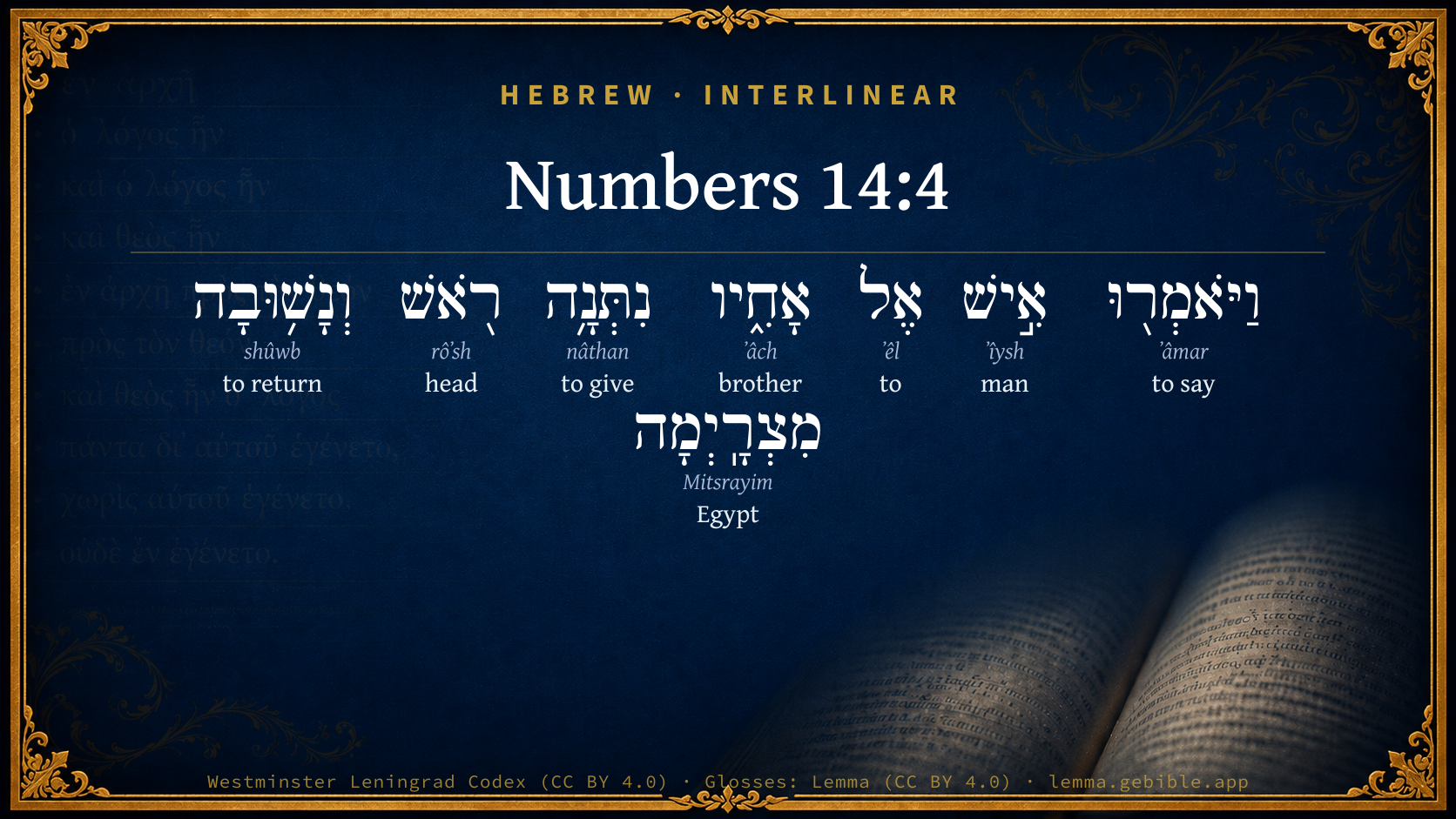
Numbers 14:4

Hebrew (Westminster Leningrad Codex) Numbers 14:4 appears in the Hebrew Old Testament. The text above is from the Westminster Leningrad Codex. Each word links to its Strong’s number, a concise gloss, and parsing drawn from the Open Scriptures Hebrew Bible morphology. Click any word for its full Brown-Driver-Briggs (BDB) entry.
Download image
Cite this verse

Numbers 14:4 (World English Bible). Public Domain. Lemma interlinear Bible study tool, https://lemma.gebible.app/v/numbers/14/4.

Show BibTeX & RIS
BibTeX
RIS
English Translation
They said one to another, Let us make a captain, and let us return into Egypt.
World English Bible · Public Domain
Download a study sheet

One document with this verse’s original text, its word-by-word gloss line, the meaning frame, cross-references with their text, attributed commentary, and full source and license credits — printable, and it pastes into notes with its structure intact.

This verse Autodidact and up

Study sheet (.html) Plain text (.txt)

A passage Seminary Student

Up to 50 verses in one chapter. A passage sheet keeps up to 6 commentary sources and 12 cross-references per verse, in the order this page ranks them, and says so on the sheet whenever that leaves anything out. Ask for a single verse and you get the Autodidact verse sheet above.

Everything on this page stays free to read, with no account — the sheet is a download of what is already on screen, not access to it.

Want to remove ads? Support Godless Engineer
Compare translations 3

The same verse in 3 English versions, stacked beneath the original-language interlinear above. Click any original word for its lexicon entry.

Each is an independent rendering of the whole verse — the interlinear is not word-aligned to these translations.

Highlighted words mark where these versions differ — a whole-verse word diff, not a word-by-word alignment.

  • World English Bible Public Domain
    They said one to another, Let us make a captain, and let us return into Egypt.
  • King James Version Public Domain
    And they said one to another, Let us make a captain, and let us return into Egypt.
  • unfoldingWord Literal Text CC BY-SA 4.0
    And they said, a man to his brother, “We shall give a head, and we shall return to Egypt.”

unfoldingWord Literal Text — © unfoldingWord, licensed CC BY-SA 4.0. Word-aligned USFM3 via Door43 (git.door43.org/unfoldingWord/en_ult).

Versions to compare (up to 4)

3 of 4 selected

Show all 18 translations

Every available English version of this verse, each an independent rendering of the whole verse.

  • World English Bible Public Domain
    They said one to another, Let us make a captain, and let us return into Egypt.
  • Berean Standard Bible Public Domain
    So they said to one another, “Let us appoint a leader and return to Egypt.”
  • Majority Standard Bible Public Domain
    So they said to one another, “Let us appoint a leader and return to Egypt.”
  • King James Version Public Domain
    And they said one to another, Let us make a captain, and let us return into Egypt.
  • American Standard Version (1901) Public Domain
    And they said one to another, Let us make a captain, and let us return into Egypt.
  • Revised Version (1885) Public Domain
    And they said one to another, Let us make a captain, and let us return into Egypt.
  • Geneva Bible (1599) Public Domain
    And they said one to another, Let vs make a Captaine and returne into Egypt.
  • Douay-Rheims (1899) Public Domain
    And they said one to another: Let us appoint a captain, and let us return into Egypt.
  • Young's Literal Translation Public Domain
    And they say one unto another, `Let us appoint a head, and turn back to Egypt.'
  • Literal Standard Version CC BY-SA 4.0
    And they say to one another, “Let us appoint a head and return to Egypt.”
  • Unlocked Literal Bible CC BY-SA 4.0
    They said to each another, “Let us choose another leader, and let us return to Egypt.”
  • unfoldingWord Literal Text CC BY-SA 4.0
    And they said, a man to his brother, “We shall give a head, and we shall return to Egypt.”
  • Darby Bible Public Domain
    And they said one to another, Let us make a captain, and let us return to Egypt.
  • World Messianic Bible Public Domain
    They said to one another, “Let’s choose a leader, and let’s return into Egypt.”
  • Webster's Bible Public Domain
    And they said one to another, Let us make a captain, and let us return into Egypt.
  • Free Bible Version CC BY-SA 4.0
    They said to one another, “Let's choose a new leader and go back to Egypt.”
  • Bible in Basic English Public Domain
    And they said to one another, Let us make a captain over us, and go back to Egypt.
  • JPS Tanakh (1917) Public Domain
    And they said one to another: 'Let us make a captain, and let us return into Egypt.'

Literal Standard Version (2020), Covenant Press — licensed CC BY-SA 4.0. Text via the HelloAO Bible API (eBible.org). Unlocked Literal Bible (unfoldingWord) — licensed CC BY-SA 4.0. Text via the HelloAO Bible API (eBible.org). unfoldingWord Literal Text — © unfoldingWord, licensed CC BY-SA 4.0. Word-aligned USFM3 via Door43 (git.door43.org/unfoldingWord/en_ult). Free Bible Version, Dr. Jonathan Gallagher — licensed CC BY-SA 4.0. Text via the HelloAO Bible API (eBible.org).

Word by word

More ways to search: Search by grammar → Find every occurrence → Compare this word →

Practice this passage: Drill this verse → Learn its vocabulary →

רֹ֖אשׁ
rôʼsh
H7218
“head”
Noun, Common, Masculine, Singular, Absolute
Part of Speech
Noun
Type
Common
Gender
Masculine
Number
Singular
State
Absolute
Full BDB Definition

Origin: from an unused root apparently meaning to shake

TWOT: 2097

head, top, summit, upper part, chief, total, sum, height, front, beginning - head (of man, animals) - top, tip (of mountain) - height (of stars) - chief, head (of man, city, nation, place, family, priest) - head, front, beginning - chief, choicest, best - head, division, company, band - sum
  1. וַיֹּאמְר֖וּ ʼâmar H559 “and · to say” Conjunction + Verb, Qal, Sequential Imperfect, 3rd Person, Masculine, Plural
  2. אִ֣ישׁ ʼîysh H376 “man” Noun, Common, Masculine, Singular, Absolute
  3. אֶל ʼêl H413 “to” Preposition
  4. אָחִ֑יו ʼâch H251 “brother · his” Noun, Common, Masculine, Singular, Construct + Suffix, Personal, 3rd Person, Masculine, Singular
  5. נִתְּנָ֥ה nâthan H5414 “to give” Verb, Qal, Cohortative, 1st Person, Common, Plural
  6. וְנָשׁ֥וּבָה shûwb H7725 “and · to return” Conjunction + Verb, Qal, Cohortative, 1st Person, Common, Plural
  7. מִצְרָֽיְמָה Mitsrayim H4714 “Egypt · toward” Noun, Proper + Suffix, Demonstrative

About this verse

These counts appear in no published source. They are computed here, from the morphology-tagged text and Lemma’s own curated glosses. What Lemma adds →

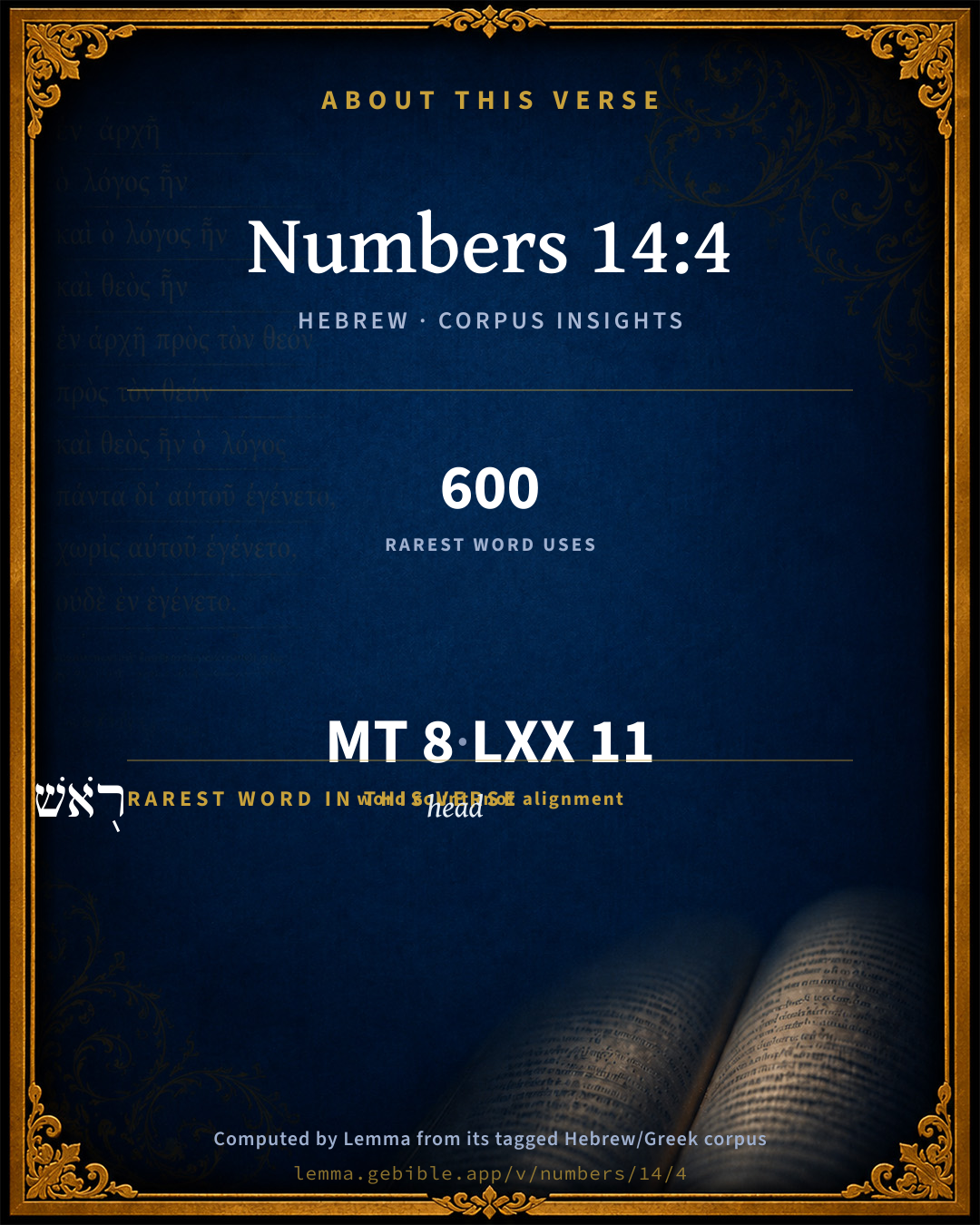
8
words
8
distinct lemmas
Pentateuch
section

Grammatical profile

  • 3 verbs
  • 4 nouns
  • 1 preposition

Verb forms

  • וַיֹּאמְר֖וּ Qal · Sequential Imperfect
  • נִתְּנָ֥ה Qal · Cohortative
  • וְנָשׁ֥וּבָה Qal · Cohortative

Hebrew & Septuagint length

In English translation the verse runs 16 words from the Hebrew and 15 from the Septuagint (LXX English) — closely comparable.

A rough comparison of the two English renderings, which tokenize alike — not a word-level alignment.

Word counts can differ between the Hebrew and the Greek without any difference in meaning — e.g. the Hebrew direct-object marker אֵת has no separate Greek word, and Greek often adds the article ὁ.

In the original languages it is 8 Hebrew tokens and 11 Greek tokens — but the two are counted differently (Hebrew bundles its prefixes and suffixes into one token; the Greek is in lemma form), so that isn’t a like-for-like length.

Cross-references

8

Topical passages linked to Numbers 14:4 in the Treasury of Scripture Knowledge — connected by theme and wording, ordered by reader-vote popularity; previews shown in the World English Bible.

  • Acts 7:39 to whom our fathers wouldn't be obedient, but rejected him, and turned back in their hearts to Egypt,
  • Nehemiah 9:16–17 But they and our fathers dealt proudly and hardened their neck, and didn't listen to your commandments,
  • Deuteronomy 17:16 Only he shall not multiply horses to himself, nor cause the people to return to Egypt, to the end that he may multiply horses; because Yahweh has said to you, You shall henceforth return no more that way.
  • Luke 17:32 Remember Lot's wife!
  • Deuteronomy 28:68 Yahweh will bring you into Egypt again with ships, by the way of which I said to you, You shall see it no more again: and there you shall sell yourselves to your enemies for bondservants and for bondmaids, and no man shall buy you.
  • Hebrews 11:15 If indeed they had been thinking of that country from which they went out, they would have had enough time to return.
  • Hebrews 10:38–39 But the righteous will live by faith. If he shrinks back, my soul has no pleasure in him."
  • 2 Peter 2:21–22 For it would be better for them not to have known the way of righteousness, than, after knowing it, to turn back from the holy commandment delivered to them.

Cross-references courtesy of OpenBible.info (CC BY 4.0).

Hebrew and Greek witnesses Masoretic Hebrew ↔ Greek Septuagint

The same verse in the two great witnesses to the Old Testament, shown verse-for-verse.

These are two independent witnesses, not word-aligned to each other, and the Septuagint is shown in lemma (dictionary) form.

Hebrew Numbers 14:4 Masoretic · Westminster Leningrad Codex

וַיֹּאמְר֖וּ אִ֣ישׁ אֶל אָחִ֑יו נִתְּנָ֥ה רֹ֖אשׁ וְנָשׁ֥וּבָה מִצְרָֽיְמָה

They said one to another, Let us make a captain, and let us return into Egypt.

World English Bible · Public Domain

Greek LXX Numbers 14:4 Septuagint · lemma form

καί εἶπον ἕτερος ὁ ἕτερος δίδωμι ἀρχηγός καί ἀποστρέφω εἰς αἴγυπτος

And they said one to another, Let us make a ruler, and return into Egypt.

LXX2012 (modern English Septuagint) · Public Domain

Hebrew: Westminster Leningrad Codex (CC BY 4.0). Greek: Septuagint (public domain); English from LXX2012 (modern English Septuagint) (Public Domain). How the Septuagint differs from the Hebrew →

Targum (Aramaic paraphrase)

2

The Targum is the ancient Jewish Aramaic paraphrase of the Hebrew Scriptures — an interpretive translation, not the Hebrew text itself. Onkelos (literal) and Pseudo-Jonathan (expansive) render the Torah, and Jonathan the Prophets. Coverage is partial: where no permissively-licensed English translation exists for a verse, only the Aramaic is shown. This is verse-level text, not a word-by-word alignment to the Hebrew.

  1. Targum Onkelos Torah (Genesis–Deuteronomy)
    וַאֲמָרוּ גְבַר לַאֲחוֹהִי נְמַנֵי רֵישָׁא וּנְתוּב לְמִצְרָיִם

    (no public-domain English translation for this verse)

    Targum Onkelos — Aramaic: “Onkelos Genesis” (public domain); “Onkelos Exodus” (public domain); “Onkelos Leviticus” (public domain); “Onkelos Numbers” (public domain); “Onkelos Deuteronomy” (public domain). English: “Sefaria Community Translation” (CC0 1.0 (public-domain dedication)); “J.W. Etheridge. The Targums of Onkelos and Jonathan Ben Uzziel on the Pentateuch. London: Longmans, Green, 1862” (public domain). Text via Sefaria.

  2. Targum Pseudo-Jonathan Torah (Genesis–Deuteronomy)
    וַאֲמָרוּ גְבַר לְאָחוֹי נְמַנֵי עֲלָן מְלִיךְ לְרֵישׁ וְנָתוּב לְמִצְרַיִם

    And one man said to his brother, Let us appoint a king over us for a chief, and return to Mizraim.

    Targum Pseudo-Jonathan — Aramaic: “Targum Jonathan on Genesis” (public domain); “Targum Jonathan on Exodus” (public domain); “Targum Jonathan on Leviticus” (public domain); “Targum Jonathan on Numbers” (public domain); “Targum Jonathan on Deuteronomy” (public domain). English: “The Targum of Jonathan ben Uzziel, trans. J. W. Etheridge, London, 1862” (public domain). Text via Sefaria.

Commentary

Notes on Numbers 14:4 from classic Christian and Jewish commentators (each source and its license shown beneath its notes). The classic Christian expositions comment on the surrounding passage and are grouped to its opening verse, so a note may address several verses; the Jewish commentaries on the Tanakh (Rashi and others) are per-verse, so they appear only where the commentator wrote on this verse.

Lemma curates 59 commentaries, every one of them public domain or Creative Commons licensed, each selected and text-cleaned for this edition rather than reprinted as found. About our sources →

Trapp's Complete Commentary

John Trapp

Num 14:4 And they said one to another, Let us make a captain, and let us return into Egypt.

Ver. 4. Let us make a captain.] Thus they proceeded from bad to worse. Passions, like heavy bodies down steep hills, once in motion move themselves, and know no ground but the bottom. Whether this people did make them such a captain, for such a purpose, is uncertain; but howsoever their very intention of doing it, is charged upon them, as if they had done it. {Neh 9:16-17}

John Trapp, A Commentary or Exposition upon All the Books of the Old and New Testament (1647–1656) — public domain. Text from a community e-Sword module.

The Biblical Illustrator

Joseph S. Exell

Num_14:4

Let us return into Egypt.

The rewards of the future not to be slighted because of a present inconvenience

The proposition of the people illustrates anew the principle that all sin is a species of insanity. They proposed to go back to Egypt. How did they suppose they were going to get back? Could they expect to live in the wilderness without the manna which God gave them? Could they overcome Amalek without Moses to intercede in their behalf? Would God be more likely to deliver them in a cowardly retreat than in a loyal advance? Could they hope again for water to flow from the rock to quench their thirst? or for favouring winds to open a new path through the Red Sea? When some departed from the Saviour, He said to His disciples, Will ye also go away? and they returned the pathetic answer, Lord, to whom shall we go? Thou hast the words of eternal life. But, alas! the children of Israel were ready to go back from the promised land to the dangers of the wilderness and to the hopeless bondage of Egypt. In the words of Matthew Henry, They wish rather to die criminals under Gods justice than live conquerors in His favour. How base were the spirits in those degenerate Israelites, who, rather than die (if it came to the worst) like soldiers in the field of honour, with their swords in their hands, desire to die like rotten sheep in the wilderness! Similar paradoxes in the conduct of sinners abound in the world. A slight present danger or inconvenience is suffered to blind the eyes to great rewards in the future. A small hazard before us is likely to seem far greater than much more serious dangers behind us. Under the smart of present ills, we are ever ready to shut our eyes to the innumerable ills we know not of. The miners of England cursed the inventor of the safety-lamp because, in reducing the hazard to their lives, it diminished also their wages. Multitudes of young people attempt to evade the trials and self-denials of the ministerial calling or of missionary work, by choosing some profession or business that is more lucrative or gratifying to their ambitions. In this they fail to remember that there is a poverty in other callings than the ministry; that the high-road of selfishness is through a wilderness strewn with the carcasses of those who have fallen hopeless by the way. What is Wall Street but a maelstrom around which are circling innumerable vessels fated to augment the debris of countless wrecks already in the vortex? What is the path to worldly glory and fame but a crowded throroughfare of hungry and thirsty men, the majority of whom are moving on to inevitable disappointment? On the other hand, the path of the righteous, whatever its present shadows, shines brighter and brighter unto the perfect day. (G. Frederick Wright.)

The folly of impatience

1. It was the greatest folly in the world to wish themselves in Egypt, or to think if they were there it would be better with them than it was. If they durst not go forward to Canaan, yet better be as they were than go back to Egypt. What did they want? What had they to complain of? They had plenty, and peace, and rest; were under a good government, had good company, had the tokens of Gods presence with them, and enough to make them easy even in the wilderness, if they had but hearts to be content. But whither were they thus fond to go to mend themselves? To Egypt! Had they so soon forgot the sore bondage they were in there? Like brute beasts, they mind only that which is present, and their memories, with the other powers of reason, are sacrificed to their passions.(Psa_106:7). We find it threatened (Deu_28:68) as the completing of their misery, that they should be brought into Egypt again, and yet that is it they here wish for. Sinners are enemies to themselves, and those that walk not in Gods counsels consult their own mischief and ruin.

2. It was a most senseless, ridiculous thing to talk of returning thither through the wilderness. Could they expect that Gods cloud would lead them or His manna attend them?

(1) The folly of discontent and impatience under the crosses of our outward condition. But is there any place or condition in this world that has not something in it to make us uneasy if we are disposed to be so? The way to better our condition is to get our spirits into a better frame.

(2) The folly of apostacy from the ways of God. Heaven is the Canaan set before us, a land flowing with milk and honey: those that bring up ever so ill report of it cannot but say that it is indeed a good land, only it is hard to get to it. (Matthew Henry, D. D.)

To retreat is to perish

To retreat is to perish. You have most of you read the story of the boy in an American village who climbed the wall of the famous Natural Bridge, and cut his name in the rock above the initials of his fellows, and then became suddenly aware of the impossibility of descending. Voices shouted, Do not look down, try arid reach the top. His only hope was to go right up, up, up, till he landed on the top. Upward was terrible, but downward was destruction. Now, we are all of us in a like condition. By the help of God we have cut our way to positions of usefulness, and to descend is death. To us forward means upward; and therefore forward and upward let us go. While we prayed this morning we committed ourselves beyond all recall. We did that most heartily when we first preached the gospel, and publicly declared, I am my Lords, and He is mine. We put our hand to the plough: thank God, we have not looked back yet. (C. H. Spurgeon.)

The Biblical Illustrator, edited by Joseph S. Exell (c. 1880s–1900s) — public domain. Text from a community e-Sword module.

Joseph Benson's Commentary

Num 14:4. A captain — Instead of Moses, one who will be more faithful to our interest than he. Nehemiah tells us they actually appointed them a captain. Into Egypt — Stupendous madness, insolence, and ingratitude! Had not God both delivered them from Egypt by a train of unparalleled wonders, and followed them ever since with continued miracles of mercy? But whence should they have protection against the hazards, and provisions against all the wants of the wilderness? Could they expect either God’s cloud to cover and guide them, or manna from heaven to feed them? Who could conduct them over the Red sea? Or, if they went another way, who should defend them against those nations whose borders they were to pass? What entertainment could they expect from the Egyptians, whom they had deserted and brought to so much ruin?

Joseph Benson's Commentary on the Old and New Testaments (1811–1818) — public domain. Text from a community e-Sword module.

Adam Clarke's Commentary

Verse 4. Let us make a captain] Here was a formal renunciation of the authority of Moses, and flat rebellion against God. And it seems from Ne 9:17 that they had actually appointed another leader, under whose direction they were about to return to Egypt. How astonishing is this! Their lives were made bitter, because of the rigour with which they were made to serve in the land of Egypt; and yet they are willing, yea eager, to get back into the same circumstances again! Great evils, when once some time past, affect the mind less than present ills, though much inferior. They had partly forgot their Egyptian bondage, and now smart under a little discouragement, having totally lost sight of their high calling, and of the power and goodness of God.

Adam Clarke's Commentary on the Bible (1810–1826) — public domain. Text from a community e-Sword/MySword module.

John Gill's Exposition

And they said one to another, let us make a captain,.... An head over them instead of Moses, who they knew would never take the government and care of them, should they resolve to return to Egypt as they proposed, and besides were now so disaffected to him, that they might not care he should. Captains they had over their several tribes, but they chose to have one chief commander and general over them all; Nehemiah says they did appoint one; which they either actually did, or this proposal was interpreted as if really put in execution, they being so desirous of it, and bent upon it; wherefore their will is taken for the deed, and so understood; see Neh 9:17,

and let us return into Egypt: which was downright madness, as some interpreters have justly observed; they must not only expect to be deserted by Moses, through whose means so many miracles had been wrought for them, and who was so wise and faithful a governor of them; and by Aaron their priest, who offered their sacrifices, and prayed for them, and blessed them; and by such a valiant general as Joshua, who had fought for them against their enemies; but by the Lord himself, so that they could not expect the manna to be continued as food for them, nor the pillar of cloud and fire as a guide unto them, nor to be protected from their enemies, on the borders of whose countries they must pass; so that their destruction in the wilderness seemed inevitable; and if they could have surmounted these and other difficulties, what manner of reception could they expect to find in Egypt, on whose account all the firstborn of man and beast among them were slain, whom they had spoiled of their riches, and whose king and his army, and in it perhaps the, flower of the nation, were drowned in the Red sea, for their sakes? What therefore could they think of, if they had any sober thought at all, but utter ruin, should they return there again?

John Gill's Exposition of the Whole Bible (1746–1763) — public domain (CC PDM 1.0). Text via the HelloAO Bible API.

Haydock's Catholic Bible Commentary

Captain, instead of Moses, whom they could not bring over to their criminal design, no more than Aaron, Josue, Caleb, &c. (Haydock) --- Some imagine the rebels wanted to choose themselves a king, (Calmet) or even another god. (Drusius) --- Every community acknowledges the necessity of having one at the head. (Worthington)

George Leo Haydock (1774–1849), Haydock's Catholic Family Bible and Commentary, 1859 edition — public domain. Excludes Psalms (Douay-Rheims chapter numbering differs from Protestant) and Deuterocanonical books (Catholic canon only).

Matthew Poole's English Annotations

A captain, instead of Moses, one who will be more faithful to our interest than he. This was but a purpose or desire, and yet it is imputed to them as if they had done it, Neh 9:16,17, they appointed a captain, &c., even as Abraham’s purpose to offer up Isaac is reckoned for the deed, Heb 11:17.

Let us return into Egypt. Stupendous madness! Whence should they have protection against the many hazards, and provision against all the wants of the wilderness? Could they expect either God’s cloud to cover and guide them, or manna from Heaven to lead them? Who should conduct them over the Red Sea? or, if they went another way, who should defend them against those nations whose borders they were to pass? What entertainment could they expect if the Egyptians, whom they had deserted and brought to so much ruin?

Matthew Poole's English Annotations on the Holy Bible (1683–1685) — public domain. Text from a community e-Sword/MySword module.

Whedon's Commentary on the Bible

Daniel D. Whedon

4. Make a captain — This is the repudiation of both Moses and Jehovah. According to Nehemiah (Neh_9:17) they actually “appointed a captain to return to their bondage.” On the low level of mere naturalism they feel no more need of God.

Daniel D. Whedon (gen. ed.), Commentary on the Old and New Testaments (1874–1909) — public domain. Text from a community e-Sword module.

The Pulpit Commentary

Let us make a captain, and let us return into Egypt. Although this was only proposed in the wildness of their distress, yet it was a height of rebellion to which they had never risen before. They had lamented that they had not died in Egypt, and they had wished themselves back in Egypt, but they had never proposed to take any overt steps towards returning thither. Nothing less than an entire and deliberate revolt was involved in the wish to elect a captain for themselves, for the angel of the covenant was the Captain of the Lord"s host. (Jos_5:14, Jos_5:15) The proposal to depose him, and to choose another in his place, marked the extremity of the despair, the unbelief, and the ingratitude of the people.

A vain proposition.

Very briefly and comprehensively put, with an appearance of decision and unanimity, but nevertheless utterly vain with respect to both matters mentioned in it.

I THE MAKING OF A CAPTAIN. They could call a man a captain, but that would not make him one. The power of election may be a great privilege, but it is greater negatively than positively. No election can make a fool into a wise man, or a coward into a hero, any more than it can make the moon give the light of the sun, or thorns to produce grapes. Election may give a man opportunity only to show decisively that he is not able to use it. On the other hand, no election can give the most capable of men the power to do impossibilities. Captains are not made in this way at all. The true captain is he who, having been-faithful in that which is least, finds his way on by natural attraction to that which is greater. He is not so much elected as recognized. There is much significance from this point of view in Christ"s words: "Ye have not chosen me, but I have chosen you." The Israelites had rejected the word of the Lord and the leader he had chosen, and what wisdom was there in them to find a better leader for themselves? Even as God, for his own purposes, chooses men after his own heart, such as his penetrating, unerring eye sees can be trained and fashioned in the right way, so men make choice after their hearts only to show their folly and ignorance, and that oftentimes right speedily. The true election is to elect ourselves to follow the good, the true, the noble, and the wise, and only them so far as they are plainly following Christ. (Heb_12:1-4)

II THE RETURN TO EGYPT. The land they had been through and knew was even less accessible than the unvisited land of which they had such exaggerated fears. Where should they get provision without God to give them manna? and would not Egypt be even more hostile than Canaan? By this time the name Israel had become connected in the Egyptian mind with disaster of every sort. What sort of men then were these to talk of the welfare of wife and children when they proposed a step which would bring them into the direst destitution? Even while they spoke God was sustaining them and their families with bread from heaven. It was even from his manna that these rebels were made strong against him. Proud-hearted, vain, conceited man will propose the most silly ventures rather than submit to God. He is the last refuge, in more senses than one, of the perplexed. Anywhere, into any absurdity and refuge of lies, rather than give up the darling lusts of the heart, and face the necessities of true repentance. Every man is trying to return to Egypt who, having been disappointed in one earth-born hope, straightway proceeds to indulge another. It is poor work, when we find ourselves checked by difficulties in living a better life, to give up in despair. To make the future as the past is impossible; it must either be better or worse. God helps the man who steadily and strenuously keeps his face towards Canaan. Y.

The Pulpit Commentary (1880–1919), ed. H.D.M. Spence-Jones & Joseph S. Exell — public domain. Text from a community e-Sword module.

John Wesley's Explanatory Notes

A captain - Instead of Moses, one who will be more faithful to our interest than he. Into Egypt - Stupendous madness! Whence should they have protection against the hazards, and provision against all the wants of the wilderness? Could they expect either God's cloud to cover and guide them, or Manna from heaven to feed them? Who could conduct them over the Red-sea? Or, if they went another way, who should defend them against those nations whose borders they were to pass? What entertainment could they expect from the Egyptians, whom they had deserted and brought to so much ruin?

John Wesley, Explanatory Notes Upon the Whole Bible (1754–1765) — public domain. Text via the GEBible commentary corpus.

unfoldingWord translationNotes

Door43 World Missions Community

They said to each another

This refers to the people of Israel.

lay facedown

"lay down with their faces touching the ground." Moses and Aaron did this to show that they were humbling themselves before God. They feared that God might punish the people for rebelling against him. AT: "lay facedown in humility to God" or "lay facedown to pray to God" (See: Symbolic Action)

translationWords

assembly

unfoldingWord translationNotes — © Distant Shores Media and the Door43 World Missions Community, licensed CC BY-SA 4.0. Source: git.door43.org/Door43/en_tn.

Rashi

Rabbi Shlomo Yitzchaki (Rashi)

נתנה ראש LET US MAKE A CAPTAIN — Understand this as the Targum does: Let us appoint a chief — i.e. let us set a king over us. But our Rabbis explain the word ראש to denote idol-worship (i.e. that they intended to turn to idolatry) (cf. Sanhedrin 107a).

Rashi on the Tanakh — English translations: “The Judaica Press complete Tanach with Rashi, translated by A. J. Rosenberg” (CC BY 4.0); “Pentateuch with Rashi's commentary by M. Rosenbaum and A.M. Silbermann, 1929-1934” (public domain); “The Metsudah Tanach series, Lakewood, N.J” (CC BY 4.0); and “The Book of Joshua, Metsudah Publications, 1997” (CC BY 4.0). Text via Sefaria.

Lesson kit

Teaching starters — assembled from the data on this page, not authored interpretation. Every prompt links to the verse data it draws on. Edit before teaching.

Numbers, in the Pentateuch, opens this verse with 8 words (8 distinct Hebrew lemmas). Its most distinctive word is rôʼsh (“head”). A historical commentator’s framing appears above. Read the whole chapter for the surrounding context.

Discussion questions

  1. How does “head” (rôʼsh) shape what this verse is saying?
  2. How does Acts 7:39, which shares this passage’s theme, read alongside this verse?
  3. These translations render this verse differently; the difference is in the English rendering, not the original. What questions does that raise?
  4. «וַיֹּאמְר֖וּ» is a Qal Sequential Imperfect verb. How does that grammatical form shape the action described?
  5. Compare how Trapp's Complete Commentary and The Biblical Illustrator read this verse. Where do they agree or differ?

Things to notice

Reading settings

Reading text

Shown beneath each verse's original-language words.

Old Testament
Old Testament edition

Read the OT as the Masoretic Hebrew (MT) or the Greek Septuagint (LXX).

English shown for the Greek Septuagint (in the Hebrew ↔ Greek comparison).

Comparing translations? Open the Compare panel on any verse page to stack up to four side by side.