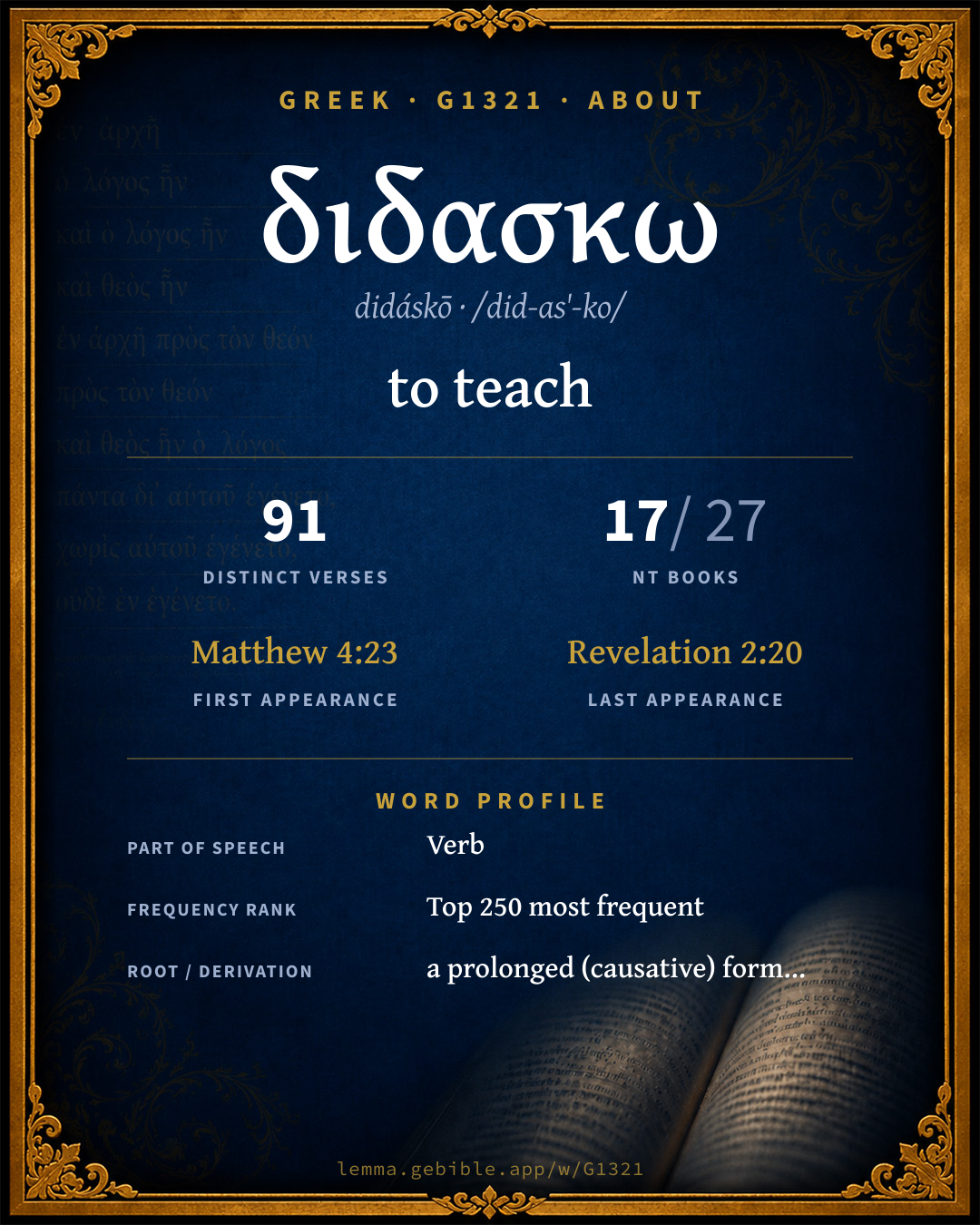
διδάσκω
to teach
‘to teach’ is one of 8 main senses fuller range ↓
Full lexicon entry — Thayer's Greek Lexicon
From Thayer's Greek Lexicon
Where this word appears
See every Present-tense verb in the Greek New Testament →
Grammar key — what these labels mean
Part of speech
- Verb
- An action or state-of-being word.
Tense
- Present
- Ongoing or general action in present time (imperfective aspect).
- Imperfect
- Continuous or repeated action in past time (“was writing”).
- Aorist
- Action viewed as a simple whole, without regard to duration — often past (perfective aspect).
- Future
- Action expected in future time.
Voice
- Active
- The subject performs the action.
- Passive
- The subject receives the action.
Mood
- Participle
- A verbal adjective (“writing,” “having written”).
- Indicative
- States a fact or asks a factual question (the mood of reality).
- Infinitive
- A verbal noun (“to write”), unmarked for person or number.
- Subjunctive
- Expresses probability, purpose, or possibility (the mood of contingency).
- Imperative
- Expresses a command or request.
Case
- Nominative
- The case of the subject (and the predicate nominative).
- Dative
- The case of the indirect object, means, or location — “to / for / with / in.”
- Genitive
- The case of source, possession, or “of” — answers “whose / from what.”
Person
- 3rd person
- The one spoken about (“he / she / it / they”).
- 2nd person
- The one addressed (“you”).
- 1st person
- The speaker (“I / we”).
Gender
- Masculine
- Grammatically masculine.
Number
- Singular
- One.
- Plural
- More than one.
Grammatical forms 24 distinct
- Verb, Present, Active, Participle, Nominative, Singular, Masculine 23 times (24%)
- Verb, Imperfect, Active, Indicative, 3rd person, Singular 14 times (14%)
- Verb, Present, Active, Infinitive 13 times (13%)
- Verb, Present, Active, Participle, Nominative, Plural, Masculine 9 times (9%)
- Verb, Present, Active, Indicative, 2nd person, Singular 7 times (7%)
- Verb, Aorist, Active, Indicative, 3rd person, Singular 3 times (3%)
- Verb, Aorist, Active, Infinitive 3 times (3%)
- Verb, Aorist, Passive, Indicative, 2nd person, Plural 3 times (3%)
+16 more forms (22 occurrences)
Parsed forms decoded from the imported morphology (Robinson–Tischendorf, public domain), counted across 97 parsed occurrences — not distinct verses.
Every verse where G1321 appears — 91 distinct verses across 17 books. Click any verse to open its interlinear word-by-word view. Verse text shown in the World English Bible for context — . Each verse’s Greek form is shown with its reference; the English is not keyword-highlighted, since the data carries no word-level English alignment. Use “Compare translations” on any verse to read it across multiple English versions. This concordance covers the Greek New Testament; Septuagint (Greek Old Testament) occurrences of this word are not indexed here.
Matthew 13 verses
- Matthew 4:23 διδάσκων pres act ptcp nom sg masc Jesus went about in all Galilee, teaching in their synagogues, preaching the Gospel of the Kingdom, and healing every disease and every sickness among the people.
- Matthew 5:2 ἐδίδασκεν impf act ind 3sg He opened his mouth and taught them, saying,
- Matthew 5:19 διδάξῃ διδάξῃ aor act subj 3sg aor act subj 3sg Whoever, therefore, shall break one of these least commandments, and teach others to do so, shall be called least in the Kingdom of Heaven; but whoever shall do and teach them shall be called great in the Kingdom of Heaven.
- Matthew 7:29 διδάσκων pres act ptcp nom sg masc for he taught them with authority, and not like the scribes.
- Matthew 9:35 διδάσκων pres act ptcp nom sg masc Jesus went about all the cities and the villages, teaching in their synagogues, and preaching the Gospel of the Kingdom, and healing every disease and every sickness among the people.
- Matthew 11:1 διδάσκειν pres act inf It happened that when Jesus had finished directing his twelve disciples, he departed from there to teach and preach in their cities.
- Matthew 13:54 ἐδίδασκεν impf act ind 3sg Coming into his own country, he taught them in their synagogue, so that they were astonished, and said, "Where did this man get this wisdom, and these mighty works?
- Matthew 15:9 διδάσκοντες pres act ptcp nom pl masc And in vain do they worship me, Teaching as doctrine rules made by men.'"
- Matthew 21:23 διδάσκοντι pres act ptcp dat sg masc When he had come into the temple, the chief priests and the elders of the people came to him as he was teaching, and said, "By what authority do you do these things? Who gave you this authority?"
- Matthew 22:16 διδάσκεις pres act ind 2sg They sent their disciples to him, along with the Herodians, saying, "Teacher, we know that you are honest, and teach the way of God in truth, no matter who you teach, for you aren't partial to anyone.
- Matthew 26:55 διδάσκων pres act ptcp nom sg masc In that hour Jesus said to the multitudes, "Have you come out as against a robber with swords and clubs to seize me? I sat daily in the temple teaching, and you didn't arrest me.
- Matthew 28:15 ἐδιδάχθησαν aor pass ind 3pl So they took the money and did as they were told. This saying was spread abroad among the Jews, and continues until this day.
- Matthew 28:20 διδάσκοντες pres act ptcp nom pl masc teaching them to observe all things that I commanded you. Behold, I am with you always, even to the end of the age." Amen.
Mark 17 verses
- Mark 1:21 ἐδίδασκεν impf act ind 3sg They went into Capernaum, and immediately on the Sabbath day he entered into the synagogue and taught.
- Mark 1:22 διδάσκων pres act ptcp nom sg masc They were astonished at his teaching, for he taught them as having authority, and not as the scribes.
- Mark 2:13 ἐδίδασκεν impf act ind 3sg He went out again by the seaside. All the multitude came to him, and he taught them.
- Mark 4:1 διδάσκειν pres act inf Again he began to teach by the seaside. A great multitude was gathered to him, so that he entered into a boat in the sea, and sat down. All the multitude were on the land by the sea.
- Mark 4:2 ἐδίδασκεν impf act ind 3sg He taught them many things in parables, and told them in his teaching,
- Mark 6:2 διδάσκειν pres act inf When the Sabbath had come, he began to teach in the synagogue, and many hearing him were astonished, saying, "Where did this man get these things?" and, "What is the wisdom that is given to this man, that such mighty works come about by his hands?
- Mark 6:6 διδάσκων pres act ptcp nom sg masc He marveled because of their unbelief. He went around the villages teaching.
- Mark 6:30 ἐδίδαξαν aor act ind 3pl The apostles gathered themselves together to Jesus, and they told him all things, whatever they had done, and whatever they had taught.
- Mark 6:34 διδάσκειν pres act inf Jesus came out, saw a great multitude, and he had compassion on them, because they were like sheep without a shepherd, and he began to teach them many things.
- Mark 7:7 διδάσκοντες pres act ptcp nom pl masc But in vain do they worship me, Teaching as doctrines the commandments of men.'
- Mark 8:31 διδάσκειν pres act inf He began to teach them that the Son of Man must suffer many things, and be rejected by the elders, the chief priests, and the scribes, and be killed, and after three days rise again.
- Mark 9:31 ἐδίδασκεν impf act ind 3sg For he was teaching his disciples, and said to them, "The Son of Man is being handed over to the hands of men, and they will kill him; and when he is killed, on the third day he will rise again."
- Mark 10:1 ἐδίδασκεν impf act ind 3sg He arose from there and came into the borders of Judea and beyond the Jordan. Multitudes came together to him again. As he usually did, he was again teaching them.
- Mark 11:17 ἐδίδασκεν impf act ind 3sg He taught, saying to them, "Isn't it written, 'My house will be called a house of prayer for all the nations?' But you have made it a den of robbers!"
- Mark 12:14 διδάσκεις pres act ind 2sg When they had come, they asked him, "Teacher, we know that you are honest, and don't defer to anyone; for you aren't partial to anyone, but truly teach the way of God. Is it lawful to pay taxes to Caesar, or not?
- Mark 12:35 διδάσκων pres act ptcp nom sg masc Jesus responded, as he taught in the temple, "How is it that the scribes say that the Christ is the son of David?
- Mark 14:49 διδάσκων pres act ptcp nom sg masc I was daily with you in the temple teaching, and you didn't arrest me. But this is so that the Scriptures might be fulfilled."
Luke 15 verses
- Luke 4:15 ἐδίδασκεν impf act ind 3sg He taught in their synagogues, being glorified by all.
- Luke 4:31 διδάσκων pres act ptcp nom sg masc He came down to Capernaum, a city of Galilee. He was teaching them on the Sabbath day,
- Luke 5:3 ἐδίδασκεν impf act ind 3sg He entered into one of the boats, which was Simon's, and asked him to put out a little from the land. He sat down and taught the multitudes from the boat.
- Luke 5:17 διδάσκων pres act ptcp nom sg masc It happened on one of those days, that he was teaching; and there were Pharisees and teachers of the law sitting by, who had come out of every village of Galilee, Judea, and Jerusalem. The power of the Lord was with him to heal them.
- Luke 6:6 διδάσκειν pres act inf It also happened on another Sabbath that he entered into the synagogue and taught. There was a man there, and his right hand was withered.
- Luke 11:1 δίδαξον ἐδίδαξεν aor act impv 2sg aor act ind 3sg It happened, that when he finished praying in a certain place, one of his disciples said to him, "Lord, teach us to pray, just as John also taught his disciples."
- Luke 12:12 διδάξει fut act ind 3sg for the Holy Spirit will teach you in that same hour what you must say."
- Luke 13:10 διδάσκων pres act ptcp nom sg masc He was teaching in one of the synagogues on the Sabbath day.
- Luke 13:22 διδάσκων pres act ptcp nom sg masc He went on his way through cities and villages, teaching, and traveling on to Jerusalem.
- Luke 13:26 ἐδίδαξας aor act ind 2sg Then you will begin to say, 'We ate and drink in your presence, and you taught in our streets.'
- Luke 19:47 διδάσκων pres act ptcp nom sg masc He was teaching daily in the temple, but the chief priests and the scribes and the leading men among the people sought to destroy him.
- Luke 20:1 διδάσκοντος pres act ptcp gen sg masc It happened on one of those days, as he was teaching the people in the temple and preaching the Gospel, that the priests and scribes came to him with the elders.
- Luke 20:21 διδάσκεις διδάσκεις pres act ind 2sg pres act ind 2sg They asked him, "Teacher, we know that you say and teach what is right, and aren't partial to anyone, but truly teach the way of God.
- Luke 21:37 διδάσκων pres act ptcp nom sg masc Every day Jesus was teaching in the temple, and every night he would go out and spend the night on the mountain that is called Olivet.
- Luke 23:5 διδάσκων pres act ptcp nom sg masc But they insisted, saying, "He stirs up the people, teaching throughout all Judea, beginning from Galilee even to this place."
John 10 verses
- John 6:59 διδάσκων pres act ptcp nom sg masc These things he said in the synagogue, as he taught in Capernaum.
- John 7:14 ἐδίδασκεν impf act ind 3sg But when it was now the midst of the feast, Jesus went up into the temple and taught.
- John 7:28 διδάσκων pres act ptcp nom sg masc Jesus therefore cried out in the temple, teaching and saying, "You both know me, and know where I am from. I have not come of myself, but he who sent me is true, whom you don't know.
- John 7:35 διδάσκειν pres act inf The Jews therefore said among themselves, "Where will this man go that we won't find him? Will he go to the Dispersion among the Greeks, and teach the Greeks?
- John 8:2 ἐδίδασκεν impf act ind 3sg Now very early in the morning, he came again into the temple, and all the people came to him. He sat down, and taught them.
- John 8:20 διδάσκων pres act ptcp nom sg masc Jesus spoke these words in the treasury, as he taught in the temple. Yet no one arrested him, because his hour had not yet come.
- John 8:28 ἐδίδαξέν aor act ind 3sg Jesus therefore said to them, "When you have lifted up the Son of Man, then you will know that I am he, and I do nothing of myself, but as my Father taught me, I say these things.
- John 9:34 διδάσκεις pres act ind 2sg They answered him, "You were altogether born in sins, and do you teach us?" They threw him out.
- John 14:26 διδάξει fut act ind 3sg But the Counselor, the Holy Spirit, whom the Father will send in my name, he will teach you all things, and will remind you of all that I said to you.
- John 18:20 ἐδίδαξα aor act ind 1sg Jesus answered him, "I spoke openly to the world. I always taught in synagogues, and in the temple, where the Jews always meet. I said nothing in secret.
Acts 16 verses
- Acts 1:1 διδάσκειν pres act inf The first book I wrote, Theophilus, concerned all that Jesus began both to do and to teach,
- Acts 4:2 διδάσκειν pres act inf being upset because they taught the people and proclaimed in Jesus the resurrection from the dead.
- Acts 4:18 διδάσκειν pres act inf They called them, and charged them not to speak at all nor teach in the name of Jesus.
- Acts 5:21 ἐδίδασκον impf act ind 3pl When they heard this, they entered into the temple about daybreak, and taught. But the high priest came, and those who were with him, and called the council together, and all the senate of the children of Israel, and sent to the prison to have them brought.
- Acts 5:25 διδάσκοντες pres act ptcp nom pl masc One came and told them, "Behold, the men whom you put in prison are in the temple, standing and teaching the people."
- Acts 5:28 διδάσκειν pres act inf saying, "Didn't we strictly charge you not to teach in this name? Behold, you have filled Jerusalem with your teaching, and intend to bring this man's blood on us."
- Acts 5:42 διδάσκοντες pres act ptcp nom pl masc Every day, in the temple and at home, they never stopped teaching and preaching Jesus, the Christ.
- Acts 11:26 διδάξαι aor act inf When he had found him, he brought him to Antioch. It happened, that for a whole year they were gathered together with the assembly, and taught many people. The disciples were first called Christians in Antioch.
- Acts 15:1 ἐδίδασκον impf act ind 3pl Some men came down from Judea and taught the brothers, "Unless you are circumcised after the custom of Moses, you can't be saved."
- Acts 15:35 διδάσκοντες pres act ptcp nom pl masc But Paul and Barnabas stayed in Antioch, teaching and preaching the word of the Lord, with many others also.
- Acts 18:11 διδάσκων pres act ptcp nom sg masc He lived there a year and six months, teaching the word of God among them.
- Acts 18:25 ἐδίδασκεν impf act ind 3sg This man had been instructed in the way of the Lord; and being fervent in spirit, he spoke and taught accurately the things concerning Jesus, although he knew only the baptism of John.
- Acts 20:20 διδάξαι aor act inf how I didn't shrink from declaring to you anything that was profitable, teaching you publicly and from house to house,
- Acts 21:21 διδάσκεις pres act ind 2sg They have been informed about you, that you teach all the Jews who are among the Gentiles to forsake Moses, telling them not to circumcise their children neither to walk after the customs.
- Acts 21:28 διδάσκων pres act ptcp nom sg masc crying out, "Men of Israel, help! This is the man who teaches all men everywhere against the people, and the law, and this place. Moreover, he also brought Greeks into the temple, and has defiled this holy place!"
- Acts 28:31 διδάσκων pres act ptcp nom sg masc preaching the Kingdom of God, and teaching the things concerning the Lord Jesus Christ with all boldness, without hinderance.
Romans 2 verses
- Romans 2:21 διδάσκων διδάσκεις pres act ptcp nom sg masc pres act ind 2sg You therefore who teach another, don't you teach yourself? You who preach that a man shouldn't steal, do you steal?
- Romans 12:7 διδάσκων pres act ptcp nom sg masc or service, let us give ourselves to service; or he who teaches, to his teaching;
1 Corinthians 2 verses
- 1 Corinthians 4:17 διδάσκω pres act ind 1sg Because of this I have sent Timothy to you, who is my beloved and faithful child in the Lord, who will remind you of my ways which are in Christ, even as I teach everywhere in every assembly.
- 1 Corinthians 11:14 διδάσκει pres act ind 3sg Doesn't even nature itself teach you that if a man has long hair, it is a dishonor to him?
Galatians 1 verse
Ephesians 1 verse
Colossians 3 verses
- Colossians 1:28 διδάσκοντες pres act ptcp nom pl masc whom we proclaim, admonishing every man and teaching every man in all wisdom, that we may present every man perfect in Christ Jesus;
- Colossians 2:7 ἐδιδάχθητε aor pass ind 2pl rooted and built up in him, and established in the faith, even as you were taught, abounding in it in thanksgiving.
- Colossians 3:16 διδάσκοντες pres act ptcp nom pl masc Let the word of Christ dwell in you richly; in all wisdom teaching and admonishing one another with psalms, hymns, and spiritual songs, singing with grace in your heart to the Lord.
2 Thessalonians 1 verse
1 Timothy 3 verses
- 1 Timothy 2:12 διδάσκειν pres act inf But I don't permit a woman to teach, nor to exercise authority over a man, but to be in quietness.
- 1 Timothy 4:11 δίδασκε pres act impv 2sg Command and teach these things.
- 1 Timothy 6:2 δίδασκε pres act impv 2sg Those who have believing masters, let them not despise them, because they are brothers, but rather let them serve them, because those who partake of the benefit are believing and beloved. Teach and exhort these things.
2 Timothy 1 verse
Titus 1 verse
Hebrews 2 verses
- Hebrews 5:12 διδάσκειν pres act inf For when by reason of the time you ought to be teachers, you again need to have someone teach you the rudiments of the first principles of the oracles of God. You have come to need milk, and not solid food.
- Hebrews 8:11 διδάξωσιν aor act subj 3pl They will not teach every man his fellow citizen, Every man his brother, saying, 'Know the Lord,' For all will know me, From the least of them to the greatest of them.
1 John 1 verse
Revelation 2 verses
- Revelation 2:14 ἐδίδασκεν impf act ind 3sg But I have a few things against you, because you have there some who hold the teaching of Balaam, who taught Balak to throw a stumbling block before the children of Israel, to eat things sacrificed to idols, and to commit sexual immorality.
- Revelation 2:20 διδάσκει pres act ind 3sg But I have this against you, that you tolerate your woman, Jezebel, who calls herself a prophetess. She teaches and seduces my servants to commit sexual immorality, and to eat things sacrificed to idols.
About this entry
At a glance — auto-summarized from this page’s data, not written by a person. Every figure links to its source below. This summary describes the numbers; it doesn’t interpret them.
At its core, διδασκω (didáskō) means “to teach.” Catalogued under 8 senses, its meaning is not single-sense. It turns up in 91 verses across 17 books, a moderately common footprint. Scripture first uses it in Matthew 4:23. It shares a root with διδακτος, διδασκαλος and διδαχη. Each statement above links to its evidence; the full detail follows below.
Gloss history
Strong's 1890 vs modern scholarship
About this word
Strong's G1321 catalogs a Greek word from the Greek New Testament.
These counts are not copied from any lexicon or concordance. They are computed here, from the morphology-tagged Greek New Testament. What Lemma adds →
- 91
- distinct verses
- The word appears in 91 distinct verses.
- 17 / 27
- NT books
- The word appears in 17 of 27 New Testament books.
- #174
- by frequency
- Top 250 most frequent Greek words (rank 174 of 5,347 Greek words by occurrence).
View all 91 occurrences in the concordance →
By section of the New Testament
By traditional corpus
Conventional, traditional groupings — biblical authorship is debated, so this is a traditional corpus grouping, not an authorship claim. Some books belong to more than one corpus (Luke is in both the Gospels and the Lukan corpus, and so on), so these shares overlap and need not total 100%. Each figure is a share of the word’s 91 distinct verses.
- Gospels 55 verses · 60%
- Lukan (Luke–Acts) 31 verses · 34%
- Pauline corpus 15 verses · 16%
- Johannine 13 verses · 14%
- Hebrews 2 verses · 2%
- Revelation 2 verses · 2%
- General (Catholic) Epistles 1 verse · 1%
How translations render this word
Counts come from each version’s own published word-to-Strong’s tagging or interlinear alignment — an approximate guide to how each version renders this word, not a word-level alignment the data otherwise carries. Because each total is that version’s own tagged count, the per-version totals vary from one another and need not match the appearance or distinct-verse counts above. These counts may also differ from a printed concordance because Lemma counts each distinctly tagged rendering and does not collapse phrase taggings into a single head-word total. This is a fixed set of word-tagged versions (KJV, ASV, BSB, ULT) and does not change with the reading translation you choose elsewhere. Each version’s license is shown beside its name below (and on Sources).
- King James Version: Teach 21×, Teaching 20×, Taught 16×
- American Standard Version: Teaching 22×, Teach 20×, Taught 19×
- Berean Standard Bible: Teach 26×, Teaching 20×, Taught 10×
- unfoldingWord Literal Text: Teaching 34×, Teach 19×, He was teaching 7×
King James Version Public Domain
Renders G1321 across 97 tagged occurrences — most commonly:
Plus 14 renderings that appear only once — usually multi-word phrases or single function words the recovered tagging swept in, not distinct renderings. Not rendered by a distinct English word in 2 further occurrences.
American Standard Version Public Domain
Renders G1321 across 96 tagged occurrences — most commonly:
Plus 14 renderings that appear only once — usually multi-word phrases or single function words the recovered tagging swept in, not distinct renderings.
Berean Standard Bible Public Domain
Renders G1321 across 97 tagged occurrences — most commonly:
Plus 15 renderings that appear only once — usually multi-word phrases or single function words the recovered tagging swept in, not distinct renderings.
unfoldingWord Literal Text CC BY-SA 4.0
Renders G1321 across 102 tagged occurrences — most commonly:
Plus 18 renderings that appear only once — usually multi-word phrases or single function words the recovered tagging swept in, not distinct renderings.
8 senses in Thayer's, in lexicon order
The 8 senses Thayer's distinguishes for this word, in lexicon order (not ranked by frequency or importance). The full entry — with sub-senses — is in the Lexicon Entry tab.
- to hold discourse with others in order to instruct them, deliver didactic discourses
- to be a teacher
- to discharge the office of a teacher, conduct one's self as a teacher
- to impart instruction
- instill doctrine into one
- the thing taught or enjoined
- to explain or expound a thing
- to teach one something
Word origin
Origin: a prolonged (causative) form of a primary verb dao (to learn)
A prolonged (causative) form of a primary verb δάω daō (to learn ); to teach (in the same broad application): - teach.
— Strong’s Exhaustive Concordance (1890), public domain.
Forms in the corpus
The 25 distinct written forms G1321 takes in the Greek New Testament, most frequent first — each parse links to that tense’s occurrences in the concordance.
Same root — word family
Other Thayer's entries built from the same root as G1321, grouped by Strong’s listed origin. These share a root / origin per the lexicon — not necessarily a shared meaning. Each links to that word’s own entry.
Derived from this word
Compare all same-root words → They share a root, not necessarily a meaning.
Septuagint usage
The same Greek word διδασκω appears 79 times in the Greek Old Testament (Septuagint), across 77 verses in 16 books.
- 79
- LXX occurrences
- Tagged occurrences of this Greek word in the Septuagint.
- 77
- verses
- Distinct Septuagint verses containing this word.
- 16 / 39
- OT books
- The word appears in 16 of the 39 Old Testament books.
Sample Septuagint occurrences
- Deuteronomy 4:1 διδάσκω
- Judges 3:2 διδάσκω
- 2 Samuel 1:18 διδάσκω
- 1 Chronicles 5:18 διδάσκω
- 2 Chronicles 17:7 διδάσκω
- Ezra 7:10 διδάσκω
- Job 6:24 διδάσκω
- Psalms 17:35 διδάσκω
- Proverbs 1:23 διδάσκω
- Ecclesiastes 12:9 διδάσκω
- Song of Solomon 3:8 διδάσκω
- Isaiah 9:14 διδάσκω
Septuagint occurrences (same lexeme)
Every verse where the same Strong’s number (G1321) appears in the Greek Septuagint — showing the first 50 of 77. Verse text shown in the World English Bible for context; the Greek form is the matched word — the English is not keyword-highlighted.
- Deuteronomy 4:1 διδάσκω Now, Israel, listen to the statutes and to the ordinances, which I teach you, to do them; that you may live, and go in and possess the land which Yahweh, the God of your fathers, gives you.
- Deuteronomy 4:10 διδάσκω the day that you stood before Yahweh your God in Horeb, when Yahweh said to me, Assemble me the people, and I will make them hear my words, that they may learn to fear me all the days that they live on the earth, and that they may teach their children.
- Deuteronomy 4:14 διδάσκω Yahweh commanded me at that time to teach you statutes and ordinances, that you might do them in the land where you go over to possess it.
- Deuteronomy 5:31 διδάσκω But as for you, stand you here by me, and I will speak to you all the commandment, and the statutes, and the ordinances, which you shall teach them, that they may do them in the land which I give them to possess it.
- Deuteronomy 6:1 διδάσκω Now this is the commandment, the statutes, and the ordinances, which Yahweh your God commanded to teach you, that you might do them in the land where you go over to possess it;
- Deuteronomy 11:19 διδάσκω You shall teach them your children, talking of them, when you sit in your house, and when you walk by the way, and when you lie down, and when you rise up.
- Deuteronomy 20:18 διδάσκω that they not teach you to do after all their abominations, which they have done to their gods; so would you sin against Yahweh your God.
- Deuteronomy 31:19 διδάσκω Now therefore write you this song for you, and teach you it the children of Israel: put it in their mouths, that this song may be a witness for me against the children of Israel.
- Deuteronomy 31:22 διδάσκω So Moses wrote this song the same day, and taught it the children of Israel.
- Deuteronomy 32:44 διδάσκω Moses came and spoke all the words of this song in the ears of the people, he and Joshua the son of Nun.
- Judges 3:2 διδάσκω only that the generations of the children of Israel might know, to teach them war, at the least such as before knew nothing of it:
- 2 Samuel 1:18 διδάσκω (and he bade them teach the children of Judah [the song of] the bow: behold, it is written in the book of Jashar):
- 2 Samuel 22:35 διδάσκω He teaches my hands to war, So that my arms do bend a bow of brass.
- 1 Chronicles 5:18 διδάσκω The sons of Reuben, and the Gadites, and the half-tribe of Manasseh, of valiant men, men able to bear buckler and sword, and to shoot with bow, and skillful in war, were forty-four thousand seven hundred and sixty, that were able to go forth to war.
- 1 Chronicles 25:7 διδάσκω The number of them, with their brothers who were instructed in singing to Yahweh, even all who were skillful, was two hundred eighty-eight.
- 2 Chronicles 17:7 διδάσκω Also in the third year of his reign he sent his princes, even Ben Hail, and Obadiah, and Zechariah, and Nethanel, and Micaiah, to teach in the cities of Judah;
- 2 Chronicles 17:9 διδάσκω They taught in Judah, having the book of the law of Yahweh with them; and they went about throughout all the cities of Judah, and taught among the people.
- Ezra 7:10 διδάσκω For Ezra had set his heart to seek the law of Yahweh, and to do it, and to teach in Israel statutes and ordinances.
- Ezra 18:8 διδάσκω
- Job 6:24 διδάσκω "Teach me, and I will hold my peace; Cause me to understand wherein I have erred.
- Job 8:10 διδάσκω Shall they not teach you, tell you, And utter words out of their heart?
- Job 10:2 διδάσκω I will tell God, 'Do not condemn me, Show me why you contend with me.
- Job 13:23 διδάσκω How many are my iniquities and sins? Make me know my disobedience and my sin.
- Job 21:22 διδάσκω "Shall any teach God knowledge, Seeing he judges those who are high?
- Job 22:2 διδάσκω "Can a man be profitable to God? Surely he who is wise is profitable to himself.
- Job 32:8 διδάσκω But there is a spirit in man, And the breath of the Almighty gives them understanding.
- Job 33:4 διδάσκω The Spirit of God has made me, And the breath of the Almighty gives me life.
- Job 33:33 διδάσκω If not, listen to me: Hold your peace, and I will teach you wisdom."
- Job 36:2 διδάσκω "Bear with me a little, and I will show you; For I still have something to say on God's behalf.
- Job 37:19 διδάσκω Teach us what we shall tell him; For we can't make our case by reason of darkness.
- Job 42:4 διδάσκω You said, 'Listen, now, and I will speak; I will question you, and you will answer me.'
- Psalms 17:35 διδάσκω
- Psalms 17:36 διδάσκω
- Psalms 24:4 διδάσκω He who has clean hands and a pure heart; Who has not lifted up his soul to falsehood, And has not sworn deceitfully.
- Psalms 24:5 διδάσκω He shall receive a blessing from Yahweh, Righteousness from the God of his salvation.
- Psalms 24:9 διδάσκω Lift up your heads, you gates; Yes, lift them up, you everlasting doors: The King of glory will come in.
- Psalms 33:12 διδάσκω Blessed is the nation whose God is Yahweh, The people whom he has chosen for his own inheritance.
- Psalms 50:15 διδάσκω Call on me in the day of trouble. I will deliver you, and you will honor me."
- Psalms 70:17 διδάσκω
- Psalms 93:10 διδάσκω
- Psalms 93:12 διδάσκω
- Psalms 118:12 διδάσκω They surrounded me like bees. They are quenched like the burning thorns. In the name of Yahweh I cut them off.
- Psalms 118:26 διδάσκω Blessed is he who comes in the name of Yahweh! We have blessed you out of the house of Yahweh.
- Psalms 118:64 διδάσκω
- Psalms 118:66 διδάσκω
- Psalms 118:68 διδάσκω
- Psalms 118:99 διδάσκω
- Psalms 118:108 διδάσκω
- Psalms 118:124 διδάσκω
- Psalms 118:135 διδάσκω
These are occurrences of the same Greek lexeme (G1321) in the Septuagint — not a translation of any one Hebrew word. The store carries no word-level Hebrew↔Greek alignment, so no Hebrew original is asserted here. Counts come from the recovered LXX Strong's tagging — high-frequency vocabulary is well covered, while rare or late forms may be untagged — so they reflect tagged occurrences and may slightly undercount.