
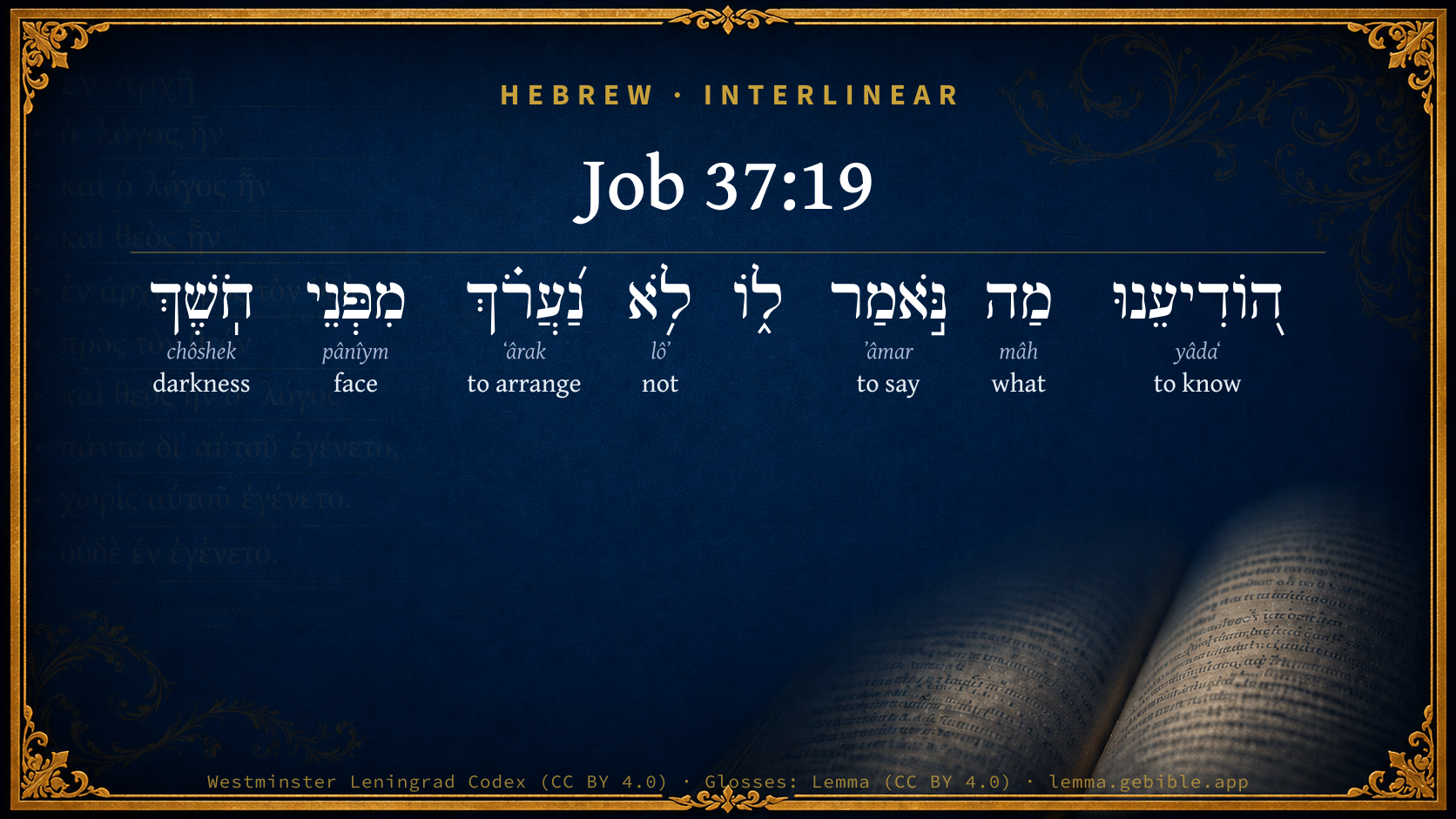
Job 37:19

Hebrew (Westminster Leningrad Codex) Job 37:19 appears in the Hebrew Old Testament. The text above is from the Westminster Leningrad Codex. Each word links to its Strong’s number, a concise gloss, and parsing drawn from the Open Scriptures Hebrew Bible morphology. Click any word for its full Brown-Driver-Briggs (BDB) entry.
Download image
Cite this verse

Job 37:19 (World English Bible). Public Domain. Lemma interlinear Bible study tool, https://lemma.gebible.app/v/job/37/19.

Show BibTeX & RIS
BibTeX
RIS
English Translation
Teach us what we shall tell him; For we can't make our case by reason of darkness.
World English Bible · Public Domain
Download a study sheet

One document with this verse’s original text, its word-by-word gloss line, the meaning frame, cross-references with their text, attributed commentary, and full source and license credits — printable, and it pastes into notes with its structure intact.

This verse Autodidact and up

Study sheet (.html) Plain text (.txt)

A passage Seminary Student

Up to 50 verses in one chapter. A passage sheet keeps up to 6 commentary sources and 12 cross-references per verse, in the order this page ranks them, and says so on the sheet whenever that leaves anything out. Ask for a single verse and you get the Autodidact verse sheet above.

Everything on this page stays free to read, with no account — the sheet is a download of what is already on screen, not access to it.

Want to remove ads? Support Godless Engineer
Compare translations 3

The same verse in 3 English versions, stacked beneath the original-language interlinear above. Click any original word for its lexicon entry.

Each is an independent rendering of the whole verse — the interlinear is not word-aligned to these translations.

Highlighted words mark where these versions differ — a whole-verse word diff, not a word-by-word alignment.

  • World English Bible Public Domain
    Teach us what we shall tell him; For we can't make our case by reason of darkness.
  • King James Version Public Domain
    Teach us what we shall say unto him; for we cannot order our speech by reason of darkness.
  • unfoldingWord Literal Text CC BY-SA 4.0
    Teach us what we shall say to him; we can not array, from the face of darkness.

unfoldingWord Literal Text — © unfoldingWord, licensed CC BY-SA 4.0. Word-aligned USFM3 via Door43 (git.door43.org/unfoldingWord/en_ult).

Versions to compare (up to 4)

3 of 4 selected

Show all 18 translations

Every available English version of this verse, each an independent rendering of the whole verse.

  • World English Bible Public Domain
    Teach us what we shall tell him; For we can't make our case by reason of darkness.
  • Berean Standard Bible Public Domain
    Teach us what we should say to Him; we cannot draw up our case when our faces are in darkness.
  • Majority Standard Bible Public Domain
    Teach us what we should say to Him; we cannot draw up our case because of our darkness.
  • King James Version Public Domain
    Teach us what we shall say unto him; for we cannot order our speech by reason of darkness.
  • American Standard Version (1901) Public Domain
    Teach us what we shall say unto him; `For' we cannot set `our speech' in order by reason of darkness.
  • Revised Version (1885) Public Domain
    Teach us what we shall say unto him; for we cannot order our speech by reason of darkness.
  • Geneva Bible (1599) Public Domain
    Tell vs what we shall say vnto him: for we can not dispose our matter because of darknes.
  • Douay-Rheims (1899) Public Domain
    Shew us what we may say to him: for we are wrapped up in darkness.
  • Young's Literal Translation Public Domain
    Let us know what we say to Him, We set not in array because of darkness.
  • Literal Standard Version CC BY-SA 4.0
    Let us know what we say to Him, || We do not set in array because of darkness.
  • Unlocked Literal Bible CC BY-SA 4.0
    Teach us what we should say to him, for we cannot lay out our arguments in order because of the darkness of our minds.
  • unfoldingWord Literal Text CC BY-SA 4.0
    Teach us what we shall say to him; we can not array, from the face of darkness.
  • Darby Bible Public Domain
    Teach us what we shall say unto him! We cannot order [our words] by reason of darkness.
  • World Messianic Bible Public Domain
    Teach us what we will tell him, for we can’t make our case by reason of darkness.
  • Webster's Bible Public Domain
    Teach us what we shall say to him; for we cannot order our speech by reason of darkness.
  • Free Bible Version CC BY-SA 4.0
    So why don't you teach us what to tell God? We cannot make our case because we are in the dark!
  • Bible in Basic English Public Domain
    Make clear to me what we are to say to him; we are unable to put our cause before him, because of the dark.
  • JPS Tanakh (1917) Public Domain
    Teach us what we shall say unto Him; for we cannot order our speech by reason of darkness.

Literal Standard Version (2020), Covenant Press — licensed CC BY-SA 4.0. Text via the HelloAO Bible API (eBible.org). Unlocked Literal Bible (unfoldingWord) — licensed CC BY-SA 4.0. Text via the HelloAO Bible API (eBible.org). unfoldingWord Literal Text — © unfoldingWord, licensed CC BY-SA 4.0. Word-aligned USFM3 via Door43 (git.door43.org/unfoldingWord/en_ult). Free Bible Version, Dr. Jonathan Gallagher — licensed CC BY-SA 4.0. Text via the HelloAO Bible API (eBible.org).

Word by word

More ways to search: Search by grammar → Find every occurrence → Compare this word →

Practice this passage: Drill this verse → Learn its vocabulary →

נַ֝עֲרֹ֗ךְ
ʻârak
H6186
“to arrange”
Verb, Qal, Imperfect, 1st Person, Common, Plural
Part of Speech
Verb
Stem
Qal
Form
Imperfect
Person
1st Person
Gender
Common
Number
Plural
Full BDB Definition

Origin: a primitive root

TWOT: 1694

to arrange, set or put or lay in order, set in array, prepare, order, ordain, handle, furnish, esteem, equal, direct, compare - (Qal) - to arrange or set or lay in order, arrange, state in order, set forth (a legal case), set in place - to compare, be comparable - (Hiphil) to value, tax
  1. ה֭וֹדִיעֵנוּ yâdaʻ H3045 “know · us” Verb, Hiphil, Imperative, 2nd Person, Masculine, Singular + Suffix, Personal, 1st Person, Common, Plural
  2. מַה mâh H4100 “what” Particle, Interrogative
  3. נֹּ֣אמַר ʼâmar H559 “to say” Verb, Qal, Imperfect, 1st Person, Common, Plural
  4. לֹ֥א lôʼ H3808 “not” Particle, Negative
  5. מִפְּנֵי pânîym H6440 “from · face(s) of” Preposition + Noun, Common, Both, Plural, Construct
  6. חֹֽשֶׁךְ chôshek H2822 “darkness” Noun, Common, Masculine, Singular, Absolute

About this verse

These counts appear in no published source. They are computed here, from the morphology-tagged text and Lemma’s own curated glosses. What Lemma adds →

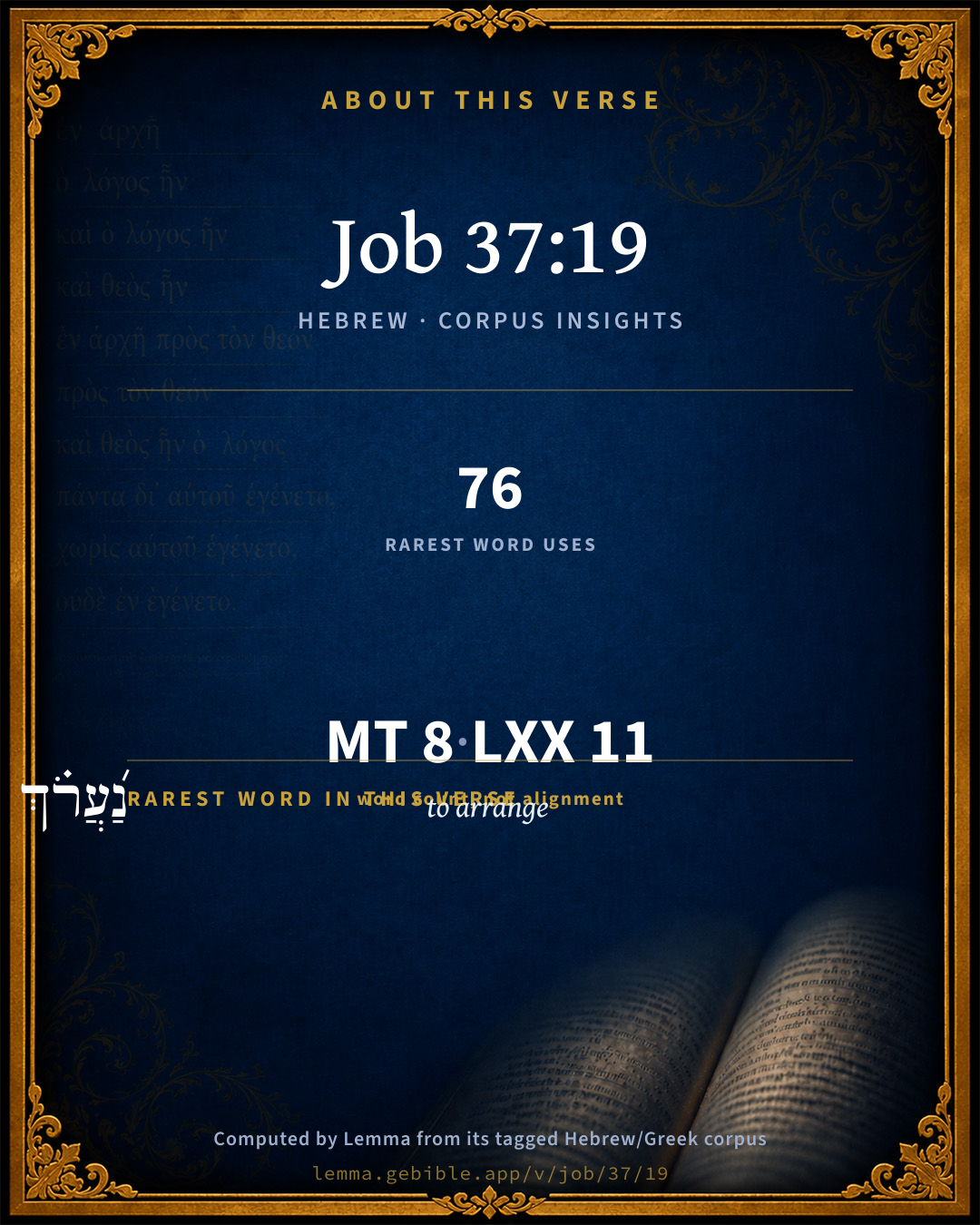
8
words
7
distinct lemmas
Wisdom
section

Grammatical profile

  • 3 verbs
  • 2 nouns
  • 1 preposition
  • 2 particles

Verb forms

  • ה֭וֹדִיעֵנוּ Hiphil · Imperative
  • נֹּ֣אמַר Qal · Imperfect
  • נַ֝עֲרֹ֗ךְ Qal · Imperfect

Hebrew & Septuagint length

In English translation the verse runs 17 words from the Hebrew and 16 from the Septuagint (LXX English) — closely comparable.

A rough comparison of the two English renderings, which tokenize alike — not a word-level alignment.

Word counts can differ between the Hebrew and the Greek without any difference in meaning — e.g. the Hebrew direct-object marker אֵת has no separate Greek word, and Greek often adds the article ὁ.

In the original languages it is 8 Hebrew tokens and 11 Greek tokens — but the two are counted differently (Hebrew bundles its prefixes and suffixes into one token; the Greek is in lemma form), so that isn’t a like-for-like length.

Cross-references

13

Topical passages linked to Job 37:19 in the Treasury of Scripture Knowledge — connected by theme and wording, ordered by reader-vote popularity; previews shown in the World English Bible.

  • Job 12:3 But I have understanding as well as you; I am not inferior to you: Yes, who doesn't know such things as these?
  • Job 13:3 "Surely I would speak to the Almighty. I desire to reason with God.
  • Job 13:6 Hear now my reasoning. Listen to the pleadings of my lips.
  • Job 26:14 Behold, these are but the outskirts of his ways. How small a whisper do we hear of him! But the thunder of his power who can understand?"
  • Job 28:20–21 Whence then comes wisdom? Where is the place of understanding?
  • Job 38:2 "Who is this who darkens counsel By words without knowledge?
  • Job 42:3 You asked, 'Who is this who hides counsel without knowledge?' Therefore I have uttered that which I did not understand, Things too wonderful for me, which I didn't know.
  • Psalms 73:16–17 When I tried to understand this, It was too painful for me;
  • Psalms 73:22 I was so senseless and ignorant. I was a brute beast before you.
  • Psalms 139:6 This knowledge is beyond me. It's lofty. I can't attain it.
  • Proverbs 30:2–4 "Surely I am the most ignorant man, And don't have a man's understanding.
  • 1 Corinthians 13:12 For now we see in a mirror, dimly, but then face to face. Now I know in part, but then I will know fully, even as I was also fully known.
  • 1 John 3:2 Beloved, now we are children of God, and it is not yet revealed what we will be. But we know that, when he is revealed, we will be like him; for we will see him just as he is.

Cross-references courtesy of OpenBible.info (CC BY 4.0).

Hebrew and Greek witnesses Masoretic Hebrew ↔ Greek Septuagint

The same verse in the two great witnesses to the Old Testament, shown verse-for-verse.

These are two independent witnesses, not word-aligned to each other, and the Septuagint is shown in lemma (dictionary) form.

Hebrew Job 37:19 Masoretic · Westminster Leningrad Codex

ה֭וֹדִיעֵנוּ מַה נֹּ֣אמַר ל֑וֹ לֹ֥א נַ֝עֲרֹ֗ךְ מִפְּנֵי חֹֽשֶׁךְ

Teach us what we shall tell him; For we can't make our case by reason of darkness.

World English Bible · Public Domain

Greek LXX Job 37:19 Septuagint · lemma form

διά τίς διδάσκω ἐγώ τίς εἶπον αὐτός καί παύω πολύς λέγω

Therefore teach me, what shall we say to him? and let us cease from saying much.

LXX2012 (modern English Septuagint) · Public Domain

Hebrew: Westminster Leningrad Codex (CC BY 4.0). Greek: Septuagint (public domain); English from LXX2012 (modern English Septuagint) (Public Domain). How the Septuagint differs from the Hebrew →

Commentary

Notes on Job 37:19 from classic Christian and Jewish commentators (each source and its license shown beneath its notes). The classic Christian expositions comment on the surrounding passage and are grouped to its opening verse, so a note may address several verses; the Jewish commentaries on the Tanakh (Rashi and others) are per-verse, so they appear only where the commentator wrote on this verse.

Lemma curates 59 commentaries, every one of them public domain or Creative Commons licensed, each selected and text-cleaned for this edition rather than reprinted as found. About our sources →

Trapp's Complete Commentary

John Trapp

Job 37:19 Teach us what we shall say unto him; [for] we cannot order [our speech] by reason of darkness.

Ver. 19. Teach us what we shall say unto him] A notable scoff, a sharp sarcasm. Verba sunt urgentis et insultantis; q.d. Velim ut e tot argumentis, Job 23:4, aliqua nunc proferas, I would that thou wouldst bring out some of those many arguments thou didst brag of; for we are at a fault; neither can we (such is our ignorance) find what to say in thy just defence, had we never so good a mind to it.

For we cannot order our speech by reason of darkness] We are benighted and word bound; forced to acknowledge our ignorance, our infancy, and to complain (as Anaxagoras afterwards did), omnia esse circumfusa tenebris; and (as Empedocles) angustas esse sensuum semitas, that we are far to seek of what to say in this case, and ready to think that silence would be our safest eloquence.

John Trapp, A Commentary or Exposition upon All the Books of the Old and New Testament (1647–1656) — public domain. Text from a community e-Sword module.

The Biblical Illustrator

Joseph S. Exell

Job_37:19-24

Teach us what we shall say unto Him.

Man and God

I. Suggestions concerning man.

1. The sublimest act, speaking to God. Teach us what we shall say unto Him; for we cannot order our speech by reason of darkness. Shall it be told Him that I speak? If a man speak, surely he shall be swallowed up. Speaking to God is an act implying a belief in the personality, presence, and susceptibility of God. Concerning this act, Elihu here intimates three things:

(1) A conscious unfitness for it.

(2) A conscious necessity for it. Has there ever lived a man who has not felt at times the necessity of communing with God?

(3) The conscious solemnity of the act. If a man speak, surely he shall be swallowed up, or destroyed. Is there any act more sublimely awful than the act of speaking to God?

2. A sad tendency. This is suggested in the words, Men see not the bright light which is in the clouds. Although the reference here is of course to the physical fact, it is certainly suggestive of the mental tendency, which is very strong in some, to look at the dark side of things. You see this tendency--

(1) In the sceptic, in relation to the dark things of revelation.

(2) In the refiner, in relation to Gods providence.

(3) In the misanthrope, in relation to the character of his fellow men.

(4) In the desponding Christian, in relation to his own experience.

II. Declarations concerning God. There are four facts concerning God here declared; and as they have been noticed more than once before, it will be sufficient just to mention them.

1. His greatness is referred to. With God is terrible majesty.

2. His inscrutability is referred to. We cannot find Him out.

3. His righteousness. He is excellent in power and in judgment, and in plenty of justice.

4. His independency. He respecteth not any that are wise of heart. (Homilist.)

The Biblical Illustrator, edited by Joseph S. Exell (c. 1880s–1900s) — public domain. Text from a community e-Sword module.

Geneva Bible (1599)

Geneva Bible translators

That is, our ignorance: signifying that Job was so presumptuous, that he would control the works of God.

Geneva Bible (1599) marginal notes — public domain. Text via Bolls.life.

Jamieson, Fausset & Brown

Robert Jamieson, A. R. Fausset & David Brown

Men cannot explain God's wonders; we ought, therefore, to be dumb and not contend with God. If Job thinks we ought, "let him teach us, what we shall say."

order--frame.

darkness--of mind; ignorance. "The eyes are bewilderingly blinded, when turned in bold controversy with God towards the sunny heavens" (Job 37:18) [UMBREIT].

Jamieson, Fausset & Brown — Commentary Critical and Explanatory on the Whole Bible (1871) — public domain (CC PDM 1.0). Text via the HelloAO Bible API.

Adam Clarke's Commentary

Verse 19. Teach us what we shall say unto him?] Thou pretendest to be so very wise, and to know every thing about God, pray make us as wise as thyself, that we may be able to approach with thy boldness the Sovereign of the world; and maintain our cause with thy confidence before him. As for our parts, we are ignorant; and, on all these subjects, are enveloped with darkness. Mr. Good translates: -

"Teach us how we may address him,

When arrayed in robes of darkness."

It is a strong and biting irony, however we take it.

Adam Clarke's Commentary on the Bible (1810–1826) — public domain. Text from a community e-Sword/MySword module.

Ellicott's Commentary for English Readers

(19) Teach us what we shall say unto (or, concerning) him—i.e., the sun. “He is altogether hidden by the clouds; but is he gone? is he not still there behind them?”

A Bible Commentary for English Readers, edited by Charles John Ellicott (1878–1897) — public domain. Text from a community e-Sword module.

The Cambridge Bible for Schools and Colleges

gen. ed. J. J. S. Perowne

19. This thought of the strong expanse of heaven stretched out by God suggests to Elihu His unspeakable greatness and unsearchableness, and he demands of Job with what words of man such a Being is to be addressed, if one sought to contend with Him.

by reason of darkness] That is, of understanding—in presence of the unsearchableness of God.

The Cambridge Bible for Schools and Colleges (gen. ed. J. J. S. Perowne; Cambridge University Press, 1878–1918) — public domain. Text from a community e-Sword module.

John Gill's Exposition

Teach us what we shall say unto him,.... To this wonder working God, of whose common works of nature we know so little; how we should reason with him about his works of Providence, when we know so little of these:

for we cannot order our speech by reason of darkness; by reason of darkness in themselves, which is in all men naturally, and even in the saints in this state of imperfection; and by reason of the clouds and darkness which are about the Lord himself, who is incomprehensible in his nature and perfections; and by reason of the darkness cast about his providential dealings with men, so that they are unsearchable and past finding out; and the best of men are at a loss how to order their speech, or discourse with God concerning these things.

John Gill's Exposition of the Whole Bible (1746–1763) — public domain (CC PDM 1.0). Text via the HelloAO Bible API.

Albert Barnes' Notes on the Bible

Teach us what we shall say unto him - This seems to be addressed to Job. It is the language of Elihu, implying that he was overawed with a sense of the majesty and glory of such a God. He knew not in what manner, or with what words to approach such a Being, and he asks Job to inform him, if he knew.

We cannot order our speech by reason of darkness - Job had repeatedly professed a desire to bring his cause directly before God, and to argue it in his presence. He felt assured that if he could do that, he should be able so to present it as to obtain a decision in his favor; see Job 13:3, note; Job 13:18-22, notes. Elihu now designs, indirectly, to censure that confidence. He says that he and his friends were so overawed by the majesty of God, and felt themselves so ignorant and so ill qualified to judge of him and his works, that they would not know what to say. They were in darkness. They could not understand even the works of his hands which were directly before them, and the most common operations of nature were inscrutable to them. How then could they presume to arraign God? How could they manage a cause before him with any hope of success? It is scarcely necessary to say, that the state of mind referred to here by Elihu is that which should be cultivated, and that the feelings which he expresses are those with which we should approach the Creator. We need someone to teach us. We are surrounded by mysteries which we cannot comprehend, and we should, therefore, approach our Maker with profound reverence and submission

Albert Barnes' Notes on the Bible (1834–1885) — public domain. Text from a community e-Sword/MySword module.

Haydock's Catholic Bible Commentary

Darkness. Thou who art so learned, give us some information, what we may blame in the works of God. Cutting irony! (Calmet)

George Leo Haydock (1774–1849), Haydock's Catholic Family Bible and Commentary, 1859 edition — public domain. Excludes Psalms (Douay-Rheims chapter numbering differs from Protestant) and Deuterocanonical books (Catholic canon only).

Matthew Poole's English Annotations

Unto him, i.e. unto God, either by way of apology for thee; or rather, by way of debate and disputation with him about his counsels and ways: about which we know not what to say, and therefore are willing to be taught by thee, who pretendest to such exquisite knowledge of these matters. So it is a reproof of his presumption and arrogance.

We cannot order our speech; we know neither with what words or matter, nor in what method and manner, to maintain discourse with him, or plead against him. The words our speech are easily understood out of the former clause of the verse.

By reason of darkness; both because of the darkness of the matter, God’s counsels and ways being a great depth, and far out of our reach; and because of the darkness or blindness of our minds.

Matthew Poole's English Annotations on the Holy Bible (1683–1685) — public domain. Text from a community e-Sword/MySword module.

Whedon's Commentary on the Bible

Daniel D. Whedon

19. We cannot order our speech — Literally, We cannot set in order.

This is evidently a stern rebuke of Job for his boastful declarations in Job_13:18, and in Job_23:4, that he had set in order his cause: — the same word (ערךְ) being used in all three cases, and furnishing an instance among the many in this speech that it is an integral portion of the work.

By reason of darkness — The reference is to the darkness of the understanding. Umbreit suggests that the sense of the preceding verse should lead us to think of the bewildering blinding of the eyes when they are turned, in a bold controversy with the Almighty, towards the sunny heavens.

Daniel D. Whedon (gen. ed.), Commentary on the Old and New Testaments (1874–1909) — public domain. Text from a community e-Sword module.

The Pulpit Commentary

Teach us what we shall say unto him. Elihu indulges in irony. If thou art so wise as thou pretendest to be, then he pleased to "teach us." We acknowledge our ignorance we cannot order our speech by reason of darkness. Enlighten us, if thou canst.

The prayer for prayer.

Seeing Jesus in prayer, and noticing how different his prayer was from theirs, the disciples besought him to reach them to pray. (Luk_11:1) Their request implied a high estimation of true prayer, and at the same time a deep sense of their own inability to pray aright. The same feelings are expressed to us by Elihu.

I WHAT IS REQUIRED IN TRUE PRAYER. The greatness of God suggests to Elihu the importance of speaking to God in the right way. The vastness and splendour of the heavens, as well as the majesty of the thunder and the government of the cloud, impress us with the majesty of God; and yet his greatest glory is not seen in these phenomena, hut it is revealed in his moral rule and his fatherly goodness. It would be a foolish thing for us to shrink from approaching God on account of his majesty in the physical universe. He is not like a stately monarch who surrounds himself with the ceremony of a court. Formal manners are an abomination in prayer. God does not look for the courtier"s obsequiousness; he seeks the child"s confidence. At the same time, his kingly state is crowned by holiness. We have to approach him in awe of his purity. He dwells in light eternal. This fact, much more than his power and wide sway over the physical universe, calls for a deeply reverent spirit in prayer. Then the spiritual nature of God requires spiritual worship, and we must be true in heart if we would pray acceptably.

II THE DIFFICULTY OF ATTAINING TO TRUE PRAYER. Elihu and the disciples of Christ both felt this difficulty. Job"s friend gives the cause of it we cannot order our speech by reason of darkness.

1. Ignorance. We do not know what God wills; nor do we know our own hearts. Not only is the spiritual realm strange to us; we even need to know what are our needs.

2. Sin. This is the darkness that really hinders and ruins prayer. The father is not vexed at his child"s helpless prattle when the child is loving and obedient. He does not look for pompous phrases; he prefers the natural, simple outpouring of the child"s heart. But he is grieved at duplicity, insincerity, unreality. When our hearts are far from God we cannot pray acceptably to him. The great difficulty is want of sympathy with God; want of sympathy is the one hindrance to all human intercourse, and it is the one thing that prevents us from praying acceptably.

III THE WAY TO REACH TRUE PRAYER. This is by prayer. We must pray to be taught to pray. The confession of our inability to pray is the first step towards doing so acceptably. Pride and self-sufficiency keep us back from the right spirit of prayer. We have to learn to bow our wills as well as to bend our knees. But the prayer to be taught this lesson may be answered in unexpected ways. We may learn what we should say to God in a school of adversity. Humbled and subdued by sorrow, we may be brought down to the right spirit of prayer in the experience from which we shrink with dismay. Or perhaps the lesson may come through more directly spiritual influences. We need to contemplate the character of God in order to pray to him aright. The revelation of God in Christ shows us how we should approach God. When we see Jesus we learn how to pray. W.F.A.

The Pulpit Commentary (1880–1919), ed. H.D.M. Spence-Jones & Joseph S. Exell — public domain. Text from a community e-Sword module.

John Wesley's Explanatory Notes

Teach us - If thou canst. Say unto him - Of these things. Order - To maintain discourse with him, both because of the darkness of the matter, God's counsels being a great depth; and because of the darkness of our minds.

John Wesley, Explanatory Notes Upon the Whole Bible (1754–1765) — public domain. Text via the GEBible commentary corpus.

Rashi

Rabbi Shlomo Yitzchaki (Rashi)

Let us know what we shall say to Him To the Holy One, blessed be He, when we contend with Him. We will not be able to set up a case with Him because of the darkness which conceals and surrounds Him.

Rashi on the Tanakh — English translations: “The Judaica Press complete Tanach with Rashi, translated by A. J. Rosenberg” (CC BY 4.0); “Pentateuch with Rashi's commentary by M. Rosenbaum and A.M. Silbermann, 1929-1934” (public domain); “The Metsudah Tanach series, Lakewood, N.J” (CC BY 4.0); and “The Book of Joshua, Metsudah Publications, 1997” (CC BY 4.0). Text via Sefaria.

Lesson kit

Teaching starters — assembled from the data on this page, not authored interpretation. Every prompt links to the verse data it draws on. Edit before teaching.

Job, in the Wisdom, opens this verse with 8 words (7 distinct Hebrew lemmas). Its most distinctive word is ʻârak (“to arrange”). A historical commentator’s framing appears above. Read the whole chapter for the surrounding context.

Discussion questions

  1. What does “to arrange” (ʻârak) contribute to the verse as a whole?
  2. How does Job 12:3, which shares this passage’s theme, read alongside this verse?
  3. These translations render this verse differently; the difference is in the English rendering, not the original. What questions does that raise?
  4. «ה֭וֹדִיעֵנוּ» is a Hiphil Imperative verb. How does that grammatical form shape the action described?
  5. Compare how Trapp's Complete Commentary and The Biblical Illustrator read this verse. Where do they agree or differ?

Things to notice

Reading settings

Reading text

Shown beneath each verse's original-language words.

Old Testament
Old Testament edition

Read the OT as the Masoretic Hebrew (MT) or the Greek Septuagint (LXX).

English shown for the Greek Septuagint (in the Hebrew ↔ Greek comparison).

Comparing translations? Open the Compare panel on any verse page to stack up to four side by side.