
1 Timothy 4:11

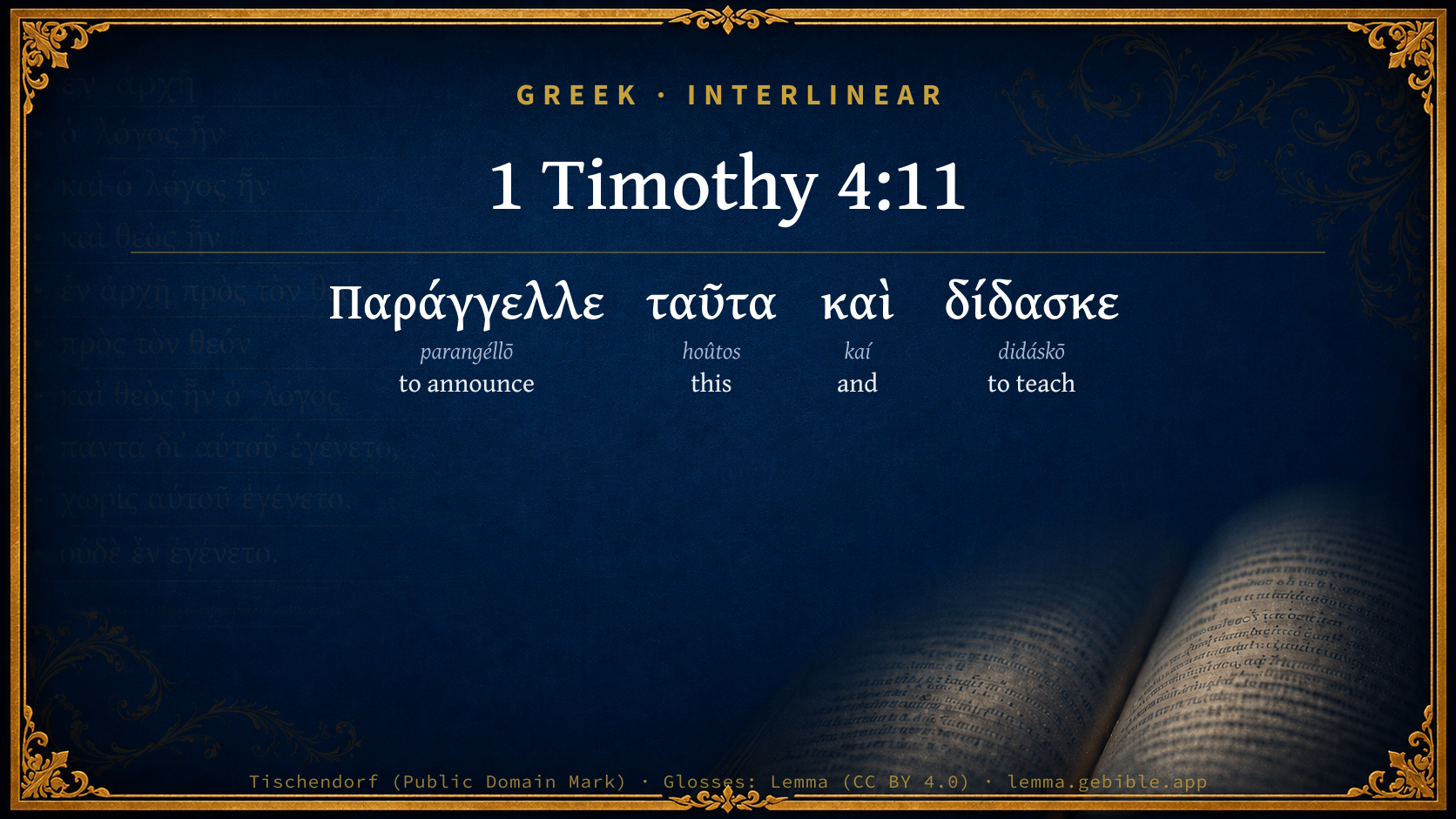
Greek (Tischendorf 8th ed.) 1 Timothy 4:11 appears in the Greek New Testament. The text above is from the Tischendorf 8th edition. Each word links to its Strong’s number and a concise gloss. Click any word for its full Thayer’s Greek Lexicon entry.
Download image
Cite this verse

1 Timothy 4:11 (World English Bible). Public Domain. Lemma interlinear Bible study tool, https://lemma.gebible.app/v/1-timothy/4/11.

Show BibTeX & RIS
BibTeX
RIS
English Translation
Command and teach these things.
World English Bible · Public Domain
Download a study sheet

One document with this verse’s original text, its word-by-word gloss line, the meaning frame, cross-references with their text, attributed commentary, and full source and license credits — printable, and it pastes into notes with its structure intact.

This verse Autodidact and up

Study sheet (.html) Plain text (.txt)

A passage Seminary Student

Up to 50 verses in one chapter. A passage sheet keeps up to 6 commentary sources and 12 cross-references per verse, in the order this page ranks them, and says so on the sheet whenever that leaves anything out. Ask for a single verse and you get the Autodidact verse sheet above.

Everything on this page stays free to read, with no account — the sheet is a download of what is already on screen, not access to it.

Want to remove ads? Support Godless Engineer
Compare translations 3

The same verse in 3 English versions, stacked beneath the original-language interlinear above. Click any original word for its lexicon entry.

Each is an independent rendering of the whole verse — the interlinear is not word-aligned to these translations.

Highlighted words mark where these versions differ — a whole-verse word diff, not a word-by-word alignment.

  • World English Bible Public Domain
    Command and teach these things.
  • King James Version Public Domain
    These things command and teach.
  • unfoldingWord Literal Text CC BY-SA 4.0
    Command and teach these things.

unfoldingWord Literal Text — © unfoldingWord, licensed CC BY-SA 4.0. Word-aligned USFM3 via Door43 (git.door43.org/unfoldingWord/en_ult).

Versions to compare (up to 4)

3 of 4 selected

Show all 19 translations

Every available English version of this verse, each an independent rendering of the whole verse.

  • World English Bible Public Domain
    Command and teach these things.
  • Berean Standard Bible Public Domain
    Command and teach these things.
  • Majority Standard Bible Public Domain
    Command and teach these things.
  • King James Version Public Domain
    These things command and teach.
  • American Standard Version (1901) Public Domain
    These things command and teach.
  • Revised Version (1885) Public Domain
    These things command and teach.
  • Geneva Bible (1599) Public Domain
    These things warne and teache.
  • Douay-Rheims (1899) Public Domain
    These things command and teach.
  • Young's Literal Translation Public Domain
    Charge these things, and teach;
  • Literal Standard Version CC BY-SA 4.0
    Charge these things, and teach;
  • Unlocked Literal Bible CC BY-SA 4.0
    Proclaim and teach these things.
  • unfoldingWord Literal Text CC BY-SA 4.0
    Command and teach these things.
  • Darby Bible Public Domain
    Enjoin and teach these things.
  • World Messianic Bible Public Domain
    Command and teach these things.
  • Webster's Bible Public Domain
    These things command and teach.
  • Free Bible Version CC BY-SA 4.0
    This is what you should teach. Tell everyone to follow your instructions.
  • Bible in Basic English Public Domain
    Let these be your orders and your teaching.
  • Text-Critical English NT CC BY 4.0
    Command and teach these things.
  • Tyndale New Testament (1534) Public Domain
    Suche thynges commaunde and teache.

Literal Standard Version (2020), Covenant Press — licensed CC BY-SA 4.0. Text via the HelloAO Bible API (eBible.org). Unlocked Literal Bible (unfoldingWord) — licensed CC BY-SA 4.0. Text via the HelloAO Bible API (eBible.org). unfoldingWord Literal Text — © unfoldingWord, licensed CC BY-SA 4.0. Word-aligned USFM3 via Door43 (git.door43.org/unfoldingWord/en_ult). Free Bible Version, Dr. Jonathan Gallagher — licensed CC BY-SA 4.0. Text via the HelloAO Bible API (eBible.org).

Word by word

More ways to search: Search by grammar → Find every occurrence → Compare this word →

Practice this passage: Drill this verse → Learn its vocabulary →

Παράγγελλε
parangéllō
G3853
“to announce”
Verb, Present, Active, Imperative, 2nd person, Singular
Part of Speech
Verb
Tense
Present
Voice
Active
Mood
Imperative
Person
2nd person
Number
Singular
Full Thayer's Definition

Origin: from G3844 and the base of G32

TDNT: 17:41,8

1. to transmit a message along from one to another, to declare, announce 2. to command, order, charge
  1. ταῦτα hoûtos G3778 “this” Demonstrative pronoun, Accusative, Plural, Neuter
  2. καὶ kaí G2532 “and” Conjunction
  3. δίδασκε didáskō G1321 “to teach” Verb, Present, Active, Imperative, 2nd person, Singular

About this verse

These counts appear in no published source. They are computed here, from the morphology-tagged text and Lemma’s own curated glosses. What Lemma adds →

4
words
4
distinct lemmas
Pauline Epistles
section

Shared distinctive vocabulary

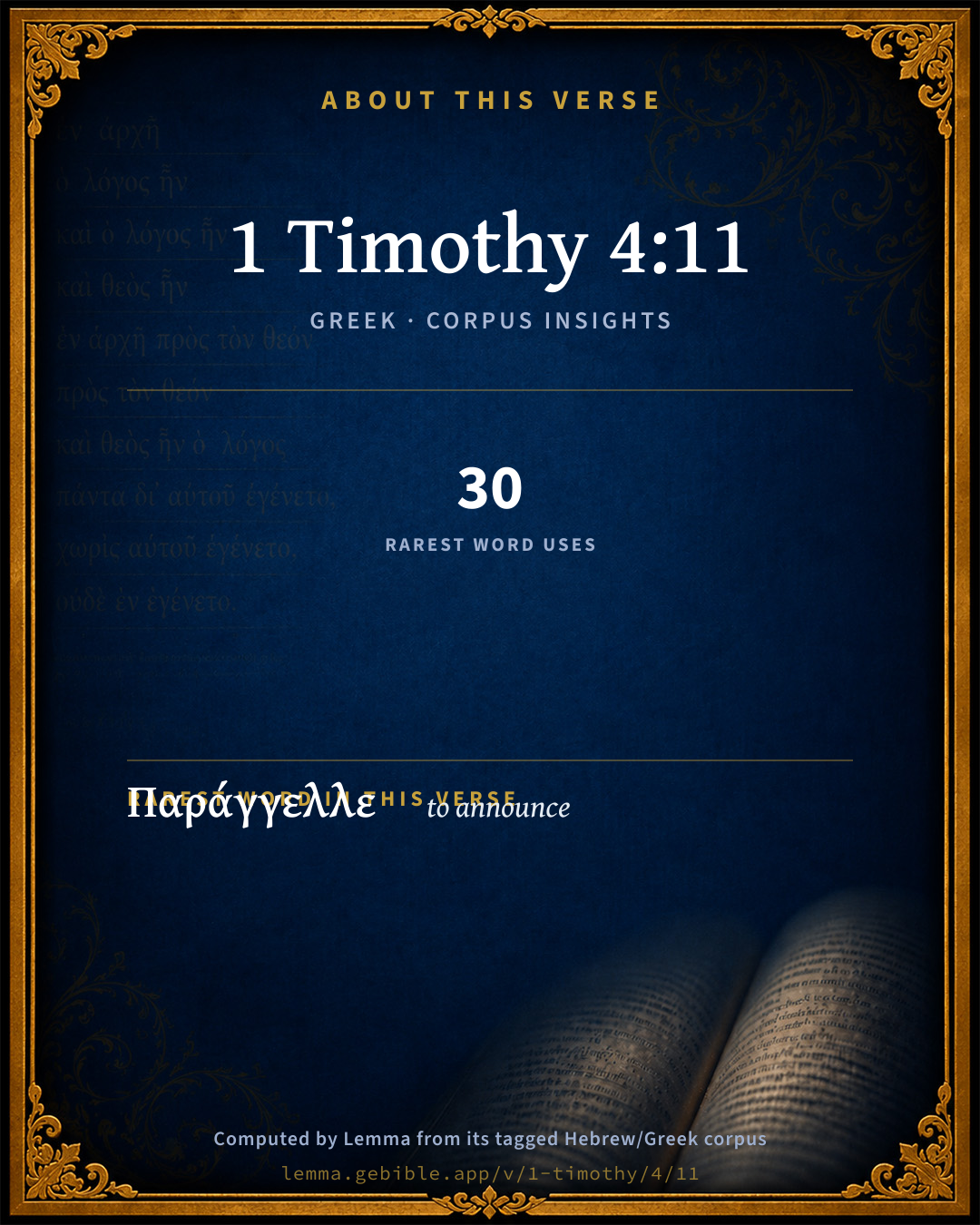
Παράγγελλε to announce G3853 occurs in 30 verses of the Greek New Testament. Also found in:
Cross-references

5

Topical passages linked to 1 Timothy 4:11 in the Treasury of Scripture Knowledge — connected by theme and wording, ordered by reader-vote popularity; previews shown in the World English Bible.

  • 1 Timothy 6:2 Those who have believing masters, let them not despise them, because they are brothers, but rather let them serve them, because those who partake of the benefit are believing and beloved. Teach and exhort these things.
  • 2 Timothy 4:2 preach the word; be urgent in season and out of season; reprove, rebuke, and exhort, with all patience and teaching.
  • 1 Timothy 5:7 Also command these things, that they may be without reproach.
  • Titus 2:15 Say these things and exhort and reprove with all authority. Let no man despise you.
  • Titus 3:8 This saying is faithful, and concerning these things I desire that you affirm confidently, so that those who have believed God may be careful to maintain good works. These things are good and profitable to men;

Cross-references courtesy of OpenBible.info (CC BY 4.0).

Commentary

Notes on 1 Timothy 4:11 from classic Christian and Jewish commentators (each source and its license shown beneath its notes). The classic Christian expositions comment on the surrounding passage and are grouped to its opening verse, so a note may address several verses; the Jewish commentaries on the Tanakh (Rashi and others) are per-verse, so they appear only where the commentator wrote on this verse.

Lemma curates 59 commentaries, every one of them public domain or Creative Commons licensed, each selected and text-cleaned for this edition rather than reprinted as found. About our sources →

The Biblical Illustrator

Joseph S. Exell

1Ti_4:11-16

These things command and teach.

Characteristics of the Christian teacher

With true affection, and with heavenly wisdom, Paul exhorts his son in the faith to be mindful of his conduct and character. Here, as well as elsewhere, the apostle exhorts to--

I. The maintenance of moral dignity.

1. The tendency of Timothy was to yield rather than to command, to sacrifice truth for the sake of peace, and to lessen his own authority by morbid self-depreciation. Probably this is not so common amongst us as self-confidence; but it is a serious fault, and may be a grievous hindrance to usefulness. Unless you believe yourself to be capable of doing something better than you are now doing you will hesitate to attempt it. If you cannot trust God to help you through an onerous duty, you will be in danger of evading it. Much noble service has been lost to the Church and to the world by a foolish self-depreciation. I remember one who became a very successful man telling me that his early youth was blighted by this morbid tendency, and that he owed all his prosperity to a wise-hearted, loving, motherly woman, who took pity on the sensitive, shrinking lad, and made him believe in himself as one gifted by God to do something in the world. Let no man despise thy youth. Be manly, and brave, and firm, lest you sacrifice interests which God has entrusted to your charge.

2. But the way to overcome the disadvantage of youth in the opinion of others, and to gain influence over them, is clearly suggested here. It is not to be done by noisy self-assertion, by the evident desire to be prominent, but by becoming, through Divine grace, an exemplar of real Christian worth. Be thou an example of the believer, in word, in conversation (or behaviour), in charity, in faith, in purity. (The phrase in spirit is properly omitted from the revised Version.)

(1) It is through our word that we chiefly manifest to others the nature of our tuner life, and the tone and temper thus exhibited either weakens or strengthens our influence for good.

(2) But words must be in harmony with conduct, and he would be a poor maintainer of Christs cause whose words were admirable while his general behaviour was frivolous or faulty.

(3) Nor is it enough to watch over our words and behaviour, but we must pay regard to motive and impulse, because we have to do with and to bear witness for the great Searcher of hearts, and should see that love and faith are the twin motive powers of Our life--love which really cares for the interests of others, faith which lays hold upon the strength and wisdom of an unseen yet everpresent God.

(4) And added to all these must be unquestioned purity, which will make us so scrupulous about moral improprieties that the breath of slander will fade away instantly from the polished shield of our reputation, and will keep the inner life clear and chaste, while it gives us the fulfilment of the Lords words, Blessed are the pure in heart, for they shall see God.

II. Again, preparation for Christian work is inculcated here as well as maintenance of moral dignity. The apostle appears to have expected an early return to Ephesus, and hence writes.

1. Till I come give attention to the reading, to the exhortation, to the teaching. The reference is primarily to the public duties of the Christian teacher. The reading of Holy Scripture in religious assemblies, which had been transferred from the synagogue, formed no inconsiderable part of the public worship of those days, as any one can imagine who reflects on the cost and rarity of manuscripts. Exhortation was often heard--appeals to affection and to enthusiasm, which led many a believer to give himself up entirely to the service of the Lord. And coincident with this was steady consecutive teaching, by means of which Gods Word was expounded, applied, and illustrated.

2. But the work to which Timothy was called required in the first place a gift, which the apostle says was given him instrumentally--by prophecy, with the laying on of the hands of the presbytery. The word used for gift denotes that it came from the Holy Spirit, with whom it is always associated in Pauls writings. These two--the gift of God and the recognition of it by the Church--should ever be combined in the pastor who is working for Christ.

3. But he is foolish and sinful who relies on the possession of a gift or the recognition of it by others. Neglected, the gift will perish, and the life of promise will end in miserable failure. The phrase rendered give thyself wholly to them might be more literally translated be in them--have your life in such thoughts and truths; let them constitute the atmosphere you breathe, and then your religious work will not be a something artificial and foreign to your nature, hut the necessary outcome of your inward life.

4. Give heed, then, unto thyself and unto the doctrine. Cultivate such gifts as you have, and use them without stint in your Masters service; and see to it that the teaching you give is not the chance utterance of a thoughtless mind, but the product of earnest thinking and of believing prayer.

III. Finally, Paul looked to see in Timothy (and God looks to see in us) readliness for the promised reward.

1. It is no small blessing which is promised in the 15th verse, that thy profiting (or rather thy progress) may appear unto all. You should be a living epistle, known and read of all men.

2. Nay, more than this, Thou shalt both save thyself and them that hear thee. A traveller who was sinking from exhaustion in a snowstorm on the mountain saw his companion suddenly drop helpless at his side; straightway his own peril was forgotten, and, flinging himself beside him, he chafed his hands and rubbed his chest; and by the effort which brought life back to the dying he kept himself alive--he saved both himself and the friend beside him. For your own sake, and for the sake of others, spend and be spent in this glorious service, and not only will your own life be the fuller here, but heaven itself will be made incomparably more full of joy. (A. Rowland, LL. B.)

Let no man despise thy youth.--

On the duties of youth

1. Among the good qualities of the young which first discover themselves, and which we regard as the sure indications of everything excellent in morals, is a nice sense of what is good and what is evil, what is truly praiseworthy and what is not, with an early and earnest attention to the forming of their principles. When embarked on the ocean of life innumerable dangers will surround them, and various temptations, under the specious forms of pleasure, will assail their hearts. To rush blindly on in a course so perilous, without either the benefits of experience or the guidance of wisdom, must quickly lead to inextricable difficulties perhaps, if not to misery and ruin. But, to descend from general reflections to the discussion of a few particular subjects, permit me to observe that too great confidence in our own strength is always dangerous, and sometimes fatal. But modesty in youth should be a natural virtue; it should be derived from other, more abundant sources than mere reflection, a feeling of comparative ignorance, or a sense of common propriety; it should spring spontaneously from sensibility--from a heart alive to every sentiment of shame, before it has been hackneyed in the ways of men or rendered callous by a long intercourse with the world. Among the more innocent excesses of youthful passions and the less dangerous delusions of the mind may be ranked the extravagancies of hope and expectation. But the loss of some distant good, however heightened by the powers of imagination or overrated by the blind partiality of our hearts, is by no means the only, or most important evil, that springs from this vain exaltation of the mind. From being so long conversant with imaginary happiness we lose our relish for that which is real. The mind also, soured with disappointments and irritated by frequent vexations, becomes, at a more advanced period, incapable of sharing in the social intercourses of life. At the same time that they should take particular care to avoid the many false and artificial notions of life, which we are but too eager to embrace with blind credulity (and which, for that reason, indeed, the fanciful writers of romance are but too apt to communicate), they ought to acquire those enlarged ideas of men and things which have their foundation in truth, and, in some measure, supply the want of experience by habits of thought and reflection. Above all, they should have recourse to the blessed gospel of our Lord and Saviour Christ, and deeply impress their hearts with those Divine truths which illumine the natural mind of man, as the rays of the sun enlighten the globe. What I would next warn young persons against is an inordinate love of pleasure. Suffer me to conclude by observing that every age and condition brings with it, beside the ordinary obligations of virtue and religion, certain peculiar and appropriate duties--duties to which young persons must diligently attend if they wish that no man should despise their youth, and which the aged must duly cultivate and regularly practise if they would have the hoary head found in the way of righteousness and reverenced as a crown of glory. There are also a thousand secondary graces of character, which must be studied, and a thousand indirect modes of temptation to be guarded against, if we wish to make any considerable advances towards perfection and to lead a godly, righteous, and sober life. (J. Hewlett, M. A.)

The least man in the ministry not to be contemned

As in a building, some bring stones, some timber, others mortar, and some perhaps bring only nails--yet these are useful; these serve to fasten the work in the building: thus the Church of God is a spiritual building. Some ministers bring stones--are more eminent and useful; others, timber; others, less--they have but a nail in the work; yet all serve for the good of the building. The least star gives light, the least drop moistens, the least minister is no less than an angel, the least nail in the ministry serves for the fastening of souls unto Christ. There is some use to be made even of the lowest parts of men; the weakest minister may help to strengthen ones faith. Though all are not apostles, all are not evangelists, all have not the same dexterous abilities in the work, yet all edify; and oftentimes so it cometh to pass that God crowns his labours, and sends most fish into his net, who, though he may be less skilful, is more faithful, and though he have less of the brain, yet he may have more of the heart, and therefore not to be contemned. (J. Spencer.)

Achievements of youth

It is often late ere genius shows itself; just as often, however, does distinction come early. Thus at twenty-two Gladstone was a member of Parliament, and at twenty-four Lord of the Treasury. Bright never went to school after he was fifteen. Sir Robert Peel entered Parliament at twenty-one, and was Lord of the Admiralty at twenty-three. Charles James Fox became a legislator at nineteen--an age when young men are given to breaking rather than to making laws. Bacon graduated at Cambridge when he was sixteen, and was called to the bar at twenty-four. Washington was a distinguished colonel at twenty-two. Napoleon commanded the army of Italy at twenty-five. Before he was seventeen Shelley was already an author--had translated the half of Plinys Natural History, and had written a number of wild romances. (Palace Journal.)

Youth not to be despised

Mr. Spurgeon began his remarkable career early enough to preach with a juvenile face many astonishingly effective sermons. His fiftieth anniversary, just celebrated, recalls an anecdote worth repetition. Mr. Spurgeon was asked, in what to most preachers would have been salad days, to deliver a discourse in a near village. Accordingly he went. On meeting the pastor, whose name was Brown, that good old gentleman was sadly disconcerted at his supplys youthful appearance. Well, well, said he to Mr. Spurgeon, I really did not dream that you were only a boy. I would not have asked you to preach for me if I had thought so. Oh! well, said Mr. Spurgeon, laughing, I can go back. But Mr. Brown would not permit this, and into the pulpit his boyish guest ascended. How he comported himself is thus narrated: Mr. Brown planted himself on the pulpit stairs. Mr. Spurgeon read a lesson from the Proverbs, and upon coming to the passage, Grey hairs are a crown of glory to a man, he said he doubted that, for he knew a man with a grey head who could hardly be civil. But the passage went on to say: If it be found in the way of righteousness, and that, he said, was a different thing. When he came down from the pulpit Mr. Brown said to him: Bless your heart, I have been thirty years a minister, and I was never better pleased with a sermon; but you are the sauciest dog that ever barked in a pulpit; and they were always good friends afterwards.

The Biblical Illustrator, edited by Joseph S. Exell (c. 1880s–1900s) — public domain. Text from a community e-Sword module.

Whedon's Commentary on the Bible

Daniel D. Whedon

b. Timothy directed to complete his self-qualification for this charge, 1Ti_4:11-16.

11. These things—Embracing the whole epistle thus far, as the nature of the directions shows.

Command—Applying to the Church organization in ii, and 1Ti_3:1-13.

Teach—Applying to the doctrines of all the preceding paragraphs.

Daniel D. Whedon (gen. ed.), Commentary on the Old and New Testaments (1874–1909) — public domain. Text from a community e-Sword module.

The Pulpit Commentary

Command (paraggelle; see 1Ti_1:3, note; 5:7; 6:13, 17). It is used very frequently in the Gospels of our Lord"s commands to the apostles and others, and by St. Paul of his own apostolic directions to the Churches. (1Th_4:11; 2Th_3:4, 2Th_3:6, etc.)

Vers. 11, 12.

A series of admonitions for the guidance of Timothy.

I TIMOTHY IS ENJOINED TO EXERCISE A DUE AUTHORITY. "These things command and teach." He is to instruct the Church at Ephesus with all authority in all that concerned the nature of true piety, the dangers to be guarded against, and the duties to be faithfully discharged.

II TIMOTHY IS ENJOINED TO CULTIVATE A GRAVITY OF DEPORTMENT THAT WOULD MAKE HIS YOUTH RESPECTED. "Let no man despise thy youth.

1. Timothy was only relatively a young man. It is highly probable that he was very young when he first joined the apostle (Act_16:1-3) perhaps nearly twenty-five years of age and as eleven years had since intervened, he would probably now be about forty years old.

2. As Timothy had to give counsel to persons much older than himself, (1Ti_5:1) and even to call them to account (ver. 19), it was necessary that he should cultivate a gravity of manner that would admit of his age being forgotten. Perhaps, also, as he was of a rather timid disposition more disposed to obey than to command the counsel of the apostle was more needed. He must be firm and manly, and destitute of every aspect or element of pretentious assumption.

III TIMOTHY IS ENJOINED TO BECOME A PATTERN TO ALL BELIEVERS. "But become thou a pattern of the believers in word, in behavior, in love, in faith, in purity." Thus would he counteract any disadvantage arising from his youth. He was to be a pattern in all the leading characteristics of the Christian minister.

1. In word.

(1) As to his public teaching, which must be according to God"s. Word, showing in it uncorruptness, gravity, sincerity, sound speech that could not be condemned.

(2) As to social intercourse, which must be

(a) not corrupt, vain, or foolish;

(b) but always with grace, seasoned with salt wise, grave, edifying.

2. In behavior." In the Church, the family, the world, he must maintain a deportment becoming the gospel of Christ, in all godliness and honesty, with simplicity and godly sincerity, so as to stop the mouths of gainsayers and earn a good report from them that are without.

3. In love, in faith." These are the two motive forces of the Christian life to influence both the speech and conduct of the minister. The one is set in motion by the other; for "faith worketh by love.

(1) He is to be a pattern in love to God and man, without which, even if he has the tongue of angels, he is nothing.

(2) In faith, in the grace of faith, in the doctrine of faith, in the profession of faith.

4. In purity." The minister must be pure in life, in thought, in language, and in all his relations to the world. T.C.

Vers. 11-16.

Directions to Timothy.

I DIRECTION FOUNDED ON PRECEDING CONTEXT. "These things command and teach." What was enjoined on him he was to hold up before the community over which he presided at Ephesus. He was to command, or hold up before them, an authoritative standard of conduct. This was to be characteristically godliness; not a working on the mere human ground, but a bringing God into connection with the life, cherishing proper feelings towards him, and observing his rules. He was also to teach, or hold up before them, revealed views of truth. While laying down faith as the condition of salvation, he was not to forget to set forth God as the Savior of all men.

II DIRECTION WITH REFERENCE TO HIS YOUTH. "Let no man despise thy youth; but be thou an ensample to them that believe, in word, in manner of life, in love, in faith, in purity." Timothy was a youth, still living with his parents, when Paul first took him as his companion. After the lapse of perhaps fifteen years, he is still regarded as a young man. We may understand that he was still young for the work entrusted to him; he was young to instruct, and, it might be, to exhort (1Ti_5:1) elders (many of them old men). A young minister is placed in the same position; he has to speak to men whose experience goes far beyond his. He has in this respect a difficult position to fill, and it becomes him to consider well the course he takes, and, if need be, to take counsel of more experienced men in the ministry, so that he shall have thus the gravity of years, and shall give none occasion to despise him on account of his youth. The idea of a minister is that he is to be an ensample to them that believe, especially to them over whom he is placed. There are five things in which he is to lead the way. The first two go together. There is the external life of word. A minister is to have the right tone in his private utterances (what seem principally to be referred to as public utterances are introduced in the next verse); he is to be able to direct the minds of others away from trifles to important matters. There is also the external life of deed. His actions are to go along with his words; he is to give direction by the very way in which he acts. Word and deed reveal the inner life, the motive forces of which are next expressed. There is the motive force of love. He is impelled by love for an unseen Savior, and for souls purchased by him. There is also the motive force of faith. He is impelled by what faith reveals, viz. a Master to whom he is responsible, whose honor he is to be careful of, whose reward for faithfulness he is earnestly to covet. Thus moved in his inner being, then, as the fifth and last thing, his life is characterized by purity. He does not receive the contamination of the world, but a pervading holy influence from a source above the world. The young minister who seeks to go before his people in these five things is taking the right plan of placing himself above being despised for his youth.

III DIRECTION AS TO HIS USE OF THE SCRIPTURES. "Till I come, give heed to reading, to exhortation, to teaching." Timothy was not so much a resident minister as Paul"s assistant, which involved his moving from place to place. The special arrangement by which he presided over the central Church of Ephesus was to continue in force until Paul"s arrival, which was expected at no distant date. Meantime he was to give his attention to his public duties. There was first of all the reading of the Scriptures. This was carried down from the Jewish synagogue, in which the Old Testament Scriptures were regularly read. And the Christian Church, in the lifetime of the apostles, being under infallible guidance, we can understand that parts of the New Testament would gradually be introduced into the Christian sanctuary. This public reading of the Scriptures served a purpose then beyond what it does now. There were very few copies of the sacred Books to be obtained then. Members of Churches were, therefore, to a great extent, dependent for their Bible knowledge on what was publicly read. Meetings would require to be frequent, and a large place in these meetings would require to be given to mere reading, in order that the people might become familiar with the exact language of Scripture. With reading was associated exhortation and teaching. We are to understand this as being on the basis of what was read. "Scripture is the fountain of all wisdom, from which pastors ought to draw whatever t hey bring before their flock" (Calvin). There was exhortation to duty, or an appeal to the feelings, conscience, to influence men to be decided for Christ, and to keep closely by the Law of Christ. And there was teaching of truth, or the opening up of Scripture in its facts and principles, to show especially what Christ was and had effected for them. It was possible to combine the hortatory and instructive, though at one time attention would be directed more to appeals, at another time more to explanations.

IV DIRECTION AS TO THE USE OF HIS GIFT. "Neglect not the gift that is in thee, which was given thee by prophecy, with the laying-on of the hands of the presbytery." There is reference to his ordination, which probably took place years before he was assigned his present work in Ephesus. At that interesting time the ministerial gift, or the power of governing and the power of handling the Word, was imparted to him. Not that he was altogether without qualification before; for there were prophecies going before on him, apparently founded on the proof that he was making of himself. But then, in all its authoritativeness, and in the fullness of the qualification in a special influence of the Spirit, the gift was imparted to him. There were two coexistent circumstances which entered into the ordination. The first was extraordinary in its nature, viz. prophecy, or any inspired utterance. Apparently it amounted to an intimation to the assembled congregation that Timothy was really called, and there and then fully endowed. The second concomitant, or circumstance entering into the ordination, was the laying-on of the hands of the presbytery. This was ordinary, and therefore continues to be connected with ordination, prophecy being represented by the ordination prayer and address. The presbytery then apparently consisted of the elders of the particular congregation in "connection with which the ordination took place. As we learn from the Second Epistle, Paul was associated with them. It is to be noted that ruling elders took part in ordaining a teaching elder. The imposition of hands is symbolic of the impartation of a gift. Christ employs those who have been themselves gifted by him to be the medium of imparting his gift to others. The ministerial gift Timothy was not to neglect or to allow to be unused. We have read of fishes inhabiting the water of a dark cave that, never needing to use their eyes, eventually, after successive generations of them, a modification has been produced in their organism. And there not being the need, nature has ceased to make provision for it, the strange spectacle being presented of an eyeless race. So, for want of use, pleading for Christ would become a lost gift to him.

V DIRECTION AS TO HIS APPLYING HIMSELF. "Be diligent in these things; give thyself wholly to them; that thy progress may be manifest unto all." Paul had not the idea that a communication of the Holy Spirit superseded application. After saying that the gift in Timothy was not to lie unused, he now says that he was to be diligent in these things, viz. in the duties of his calling, as set down in the thirteenth verse. And, in the way of strengthening this, he adds that he was to give himself wholly to them. A minister has to make himself thoroughly acquainted with the meaning of Scripture, in order that he may open it to others. He has to know how to apply Scripture truth to the wants of his people, that he may incite them to right action. This he cannot well do along with the demands of a secular business. He needs to have his whole time to devote to it, and he needs, in the time that he has, to put out to purpose his whole strength. Close application will soon tell. His profiting will appear in a more skilful handling of the Word, in a more earnest pleading with souls.

VI RECAPITULATION WITH ENFORCEMENT. "Take heed to thyself, and to thy teaching. Continue in these things; for in doing this thou shalt save both thyself and them that hear thee." He first recapitulates what was said in ver. 12. "Take heed to thyself." A minister is to take heed to himself, that he is really a subject of saving grace, that he is making satisfactory increase in grace, that his conduct does not run counter to his teaching. He next recapitulates what is said in ver. 13. "And to thy teaching." A minister is to see that he makes every endeavor to bring out the meaning of the Word of God, and to bring it to bear upon the wants of his hearers. Having thus recapitulated, he makes it stronger by adding, "Continue in these things," viz. in his private and public exercises. And a minister is encouraged to do this by the consideration that, in doing this, he shall save the souls of them that hear him. He shall reach his end; and what a felicity to be the means, under God, of saving souls! He can only expect to do this by exacting from himself a high standard of living and of preaching. And, through this, he shall reach the end of his own salvation. He has to win or lose, as well as his hearers. "And many shall say at that day, Lord, have we not prophesied in thy Name?" who shall be answered with, "I never knew you; depart from me, ye that work iniquity." He has the same evil heart to contend with. "Sin dwelleth in us when we have preached never so much against it; one degree prepareth the heart for another, and one sin inclineth the mind to more." He may expect to be more severely tempted than others, as the honor of Christ lies more on him than on others. R.F.

The Pulpit Commentary (1880–1919), ed. H.D.M. Spence-Jones & Joseph S. Exell — public domain. Text from a community e-Sword module.

Bengel's Gnomon

Johann Albrecht Bengel

1Ti 4:11. [37] Ταῦτα) these things, dismissing all other things.

[37] Πιστῶν, of believers) who place their hope in the living God.—V. g.

Bengel's Gnomon of the New Testament — English translation (T&T Clark, Edinburgh, 1860) — public domain. Text from a community e-Sword module.

Meyer's Critical & Exegetical Commentary

Heinrich August Wilhelm Meyer

1Ti_4:11. Παράγγελλε ταῦτα καὶ δίδασκε] Timothy is to proclaim to the community that which Paul has enjoined to him. Ταῦτα refers not only to what is in 1Ti_4:10 (according to Hofmann: to Gods living power and willingness to help), but to everything that has been said previously in regard to εὐσέβεια. The two verbs παραγγέλλειν and διδάσκειν tell how he is to proclaim these things. They are not distinguished from each other as referring, the one to private, the other to public instruction, nor as expressing, the one, generally public proclamation, the other, more especially exact instruction, explanation, information (Matthies); but παραγγέλλειν, which in the N. T. has constantly the sense of command, indicates that Timothy is to hold up these things (ταῦτα) to the community as the standard of their conduct.

Meyer — Critical and Exegetical Commentary on the New Testament — English translation by Peter Christie, edited by Frederick Crombie (T&T Clark, 1880) — public domain. Text from a community e-Sword module.

Expositor's Greek Testament

ed. W. Robertson Nicoll

1Ti 4:11-16 . Silent example or mild suggestion will not do in every case. There are many occasions when it will be necessary for you to speak out, with the authority given to you at your ordination. At the same time, do not forget that the charismatic gift will die if it be neglected. Give yourself wholly to the cultivation of your character; so will you save yourself and those committed to your charge.

1Ti 4:11 . παράγγελλε : In point of time, teaching precedes commanding . The tone of command can only be used in relation to fundamentals which have been accepted, but are in danger of being forgotten. Similar directions recur in 1Ti 5:7 and 1Ti 6:3 .

The Expositor's Greek Testament, edited by W. Robertson Nicoll (1897–1910) — public domain. Text from a community e-Sword module.

Jamieson, Fausset & Brown

Robert Jamieson, A. R. Fausset & David Brown

These truths, to the exclusion of those useless and even injurious teachings (Ti1 4:1-8), while weighing well thyself, charge also upon others.

Jamieson, Fausset & Brown — Commentary Critical and Explanatory on the Whole Bible (1871) — public domain (CC PDM 1.0). Text via the HelloAO Bible API.

Adam Clarke's Commentary

Verse 11. These things command and teach.] Let it be the sum and substance of thy preaching, that true religion is profitable for both worlds; that vice destroys both body and soul; that Christ tasted death for every man; and that he saves to the uttermost all them that believe in his name.

Adam Clarke's Commentary on the Bible (1810–1826) — public domain. Text from a community e-Sword/MySword module.

John Calvin's Commentaries

11 Instruct and teach these things He means that the doctrine is of such a kind, that men ought not to be weary of it, though they heard it every day. There are, no doubt, other things to be taught; but there is emphasis in the demonstrative these; for it means that they are not things of small importance, of which it is enough to take a passing and brief notice; but, on the contrary, that they deserve to be repeated every day, because they cannot be too much inculcated. A prudent pastor ought, therefore, to consider what things are chiefly necessary, that he may dwell on them. Nor is there reason to dread that it shall become wearisome; for whosoever is of God will gladly hear frequently those things which need to be so often uttered.

John Calvin's Commentaries (1540-1563) — public domain. Text from the Calvin Translation Society English edition (1840s-50s) via the Christian Classics Ethereal Library (ccel.org). Calvin's coverage is partial (roughly two-thirds of the Bible); uncommented books and verses are honest gaps, never fabricated. The 19th-century editor's footnotes and remarks are omitted so the notes are faithfully Calvin's own voice.

Ellicott's Commentary for English Readers

(11) These things command and teach.—“These things”—i.e., the real meaning of “godliness,” that practical everyday piety which, in contradistinction to the severe and strained asceticism of a limited and narrow section of society, should enter into all homes and influence all lives without distinction of class or race, age or sex. “These things” in the Church of Ephesus must form a part of the public commands and charges to the congregations, must likewise enter into private Christian teaching.

A Bible Commentary for English Readers, edited by Charles John Ellicott (1878–1897) — public domain. Text from a community e-Sword module.

The Cambridge Bible for Schools and Colleges

gen. ed. J. J. S. Perowne

11. These things command and teach] The link between the paragraphs. ‘Lay down against all comers the true Gospel; shew no boyish shrinking; on every side of conduct and character command imitation.’

The Cambridge Bible for Schools and Colleges (gen. ed. J. J. S. Perowne; Cambridge University Press, 1878–1918) — public domain. Text from a community e-Sword module.

John Gill's Exposition

These things command and teach. What are to be commanded, command, and what are to be taught, teach; command to refuse and reject all profane and fabulous doctrines, and exhort to the exercise of true godliness, and teach the profitableness of that, and declare the promises made unto it, and assert the truth and acceptableness of them; command, order, and encourage believers to labour and suffer reproach for the sake of Christ, and his Gospel, in hope of enjoying the said promises, and teach them to trust in the God of their lives, and the Saviour of all men; and whereas to this authoritative way of teaching, Timothy's youth might be objected by himself, and others; it follows,

These things command and teach. What are to be commanded, command, and what are to be taught, teach; command to refuse and reject all profane and fabulous doctrines, and exhort to the exercise of true godliness, and teach the profitableness of that, and declare the promises made unto it, and assert the truth and acceptableness of them; command, order, and encourage believers to labour and suffer reproach for the sake of Christ, and his Gospel, in hope of enjoying the said promises, and teach them to trust in the God of their lives, and the Saviour of all men; and whereas to this authoritative way of teaching, Timothy's youth might be objected by himself, and others; it follows,

1 Timothy 4:12

ti1 4:12

ti1 4:12

ti1 4:12Let no man despise thy youth,.... Timothy was now a young man; some think he was about three and twenty years of age; but he might be older, and yet be so called. Saul is said to be a young man, when he held the clothes of them that stoned Stephen, when he must be at least thirty years of age, some say thirty five; since thirty years after that he styles himself Paul the aged, when he must be sixty years of age and upwards, Act 7:58. Young men are sometimes honoured by God with great gifts, for usefulness both in church and state, as Samuel, David, Solomon, Daniel, and his companions: nor should they be despised on account of their age, when they have gifts suitable to their office, and behave well in it, but, on the contrary, ought to be esteemed for their works' sake; and such should take care that no man has an opportunity or reason to treat them with contempt on that account: the apostle's sense is, either that Timothy, being in office, should not suffer any man to use him contemptuously; but exert his power and authority, and magnify his office, and not allow men to trample upon him, or use him ill, though he was a young man; which sense suits with the preceding words: or rather his meaning is, that he would have him so conduct and behave himself, as he had taught him to behave, in the house and church of God, and so fill up his place and office, and live such an exemplary life and conversation, that there might be no occasion for any to despise his age, or him, on the account of it: and this agrees with what follows,

but be thou an example of the believers; the members of the church, before called brethren, from their relation to one another, and here believers, from their concern with Christ, the object of their faith; a more honourable character cannot be given of men, though treated with great contempt in this age of infidelity. The Mahometans would engross this character to themselves, calling themselves the believers, and reckoning all others infidels; but to them only it belongs, who believe in Christ unto righteousness and life everlasting. Now sometimes young men may be examples to older ones; and all that are in office in the church, especially in the ministry, whether old or young, should be ensamples to the flock, and that in the following things: "in word"; meaning either the word of truth, the doctrine of the Gospel; by delivering that which is according to the rule of God's word, showing in it uncorruptness, gravity, and sincerity, and by holding it fast; all which may for the imitation of others, to receive the pure doctrine and retain it: or rather this may respect common discourse; which should not be corrupt, filthy, nor foolish; but should be always with grace, Seasoned with salt, or should be grave and serious, wise and prudent, pleasant, profitable, and edifying.

In conversation; in the family, church, and world; which should be as becomes the Gospel of Christ, in all godliness and honesty, with simplicity and godly sincerity; so as to adorn the doctrine of God our Saviour, recommend it to others, stop the mouths of gainsayers, and obtain a good report of them that are without.

In charity; in love to God, to Christ, and one another; without which, if a man has the tongue of men and angels, or ever such great and excellent gifts, he is nothing.

In spirit; in the exercise of spiritual gifts; in spiritual talk and conversation; and in fervency of spirit, or true zeal for the honour of God, the glory of the Redeemer, the spread of his Gospel, truths, and ordinances, and the support of the same. This clause is wanting in the Alexandrian and Claromontane copies, and in the Vulgate Latin, Syriac, and Ethiopic versions.

In faith; in the exercise of the grace of faith; in holding fast the profession of faith; and in retaining the doctrine of faith, with all integrity, faithfulness, and constancy, standing fast in it, striving and contending for it.

In purity; or chastity of body, in opposition to all impurity of the flesh, by fornication, adultery, and the like; which was very proper to be suggested to a young man: though this may also have respect to all that is before said, as to purity of language, conversation, love, zeal, and faith.

John Gill's Exposition of the Whole Bible (1746–1763) — public domain (CC PDM 1.0). Text via the HelloAO Bible API.

Trapp's Complete Commentary

John Trapp

11 These things command and teach.

Ver. 11. These things command and teach] Teach the tractable, command the obstinate, lay God’s charge upon all.

John Trapp, A Commentary or Exposition upon All the Books of the Old and New Testament (1647–1656) — public domain. Text from a community e-Sword module.

Albert Barnes' Notes on the Bible

These things command and teach - As important doctrines, and as embracing the sum of the Christian system. It follows from this, that a minister of the gospel is solemnly bound to teach that there is a sense in which God is the Saviour of all people. He is just as much bound to teach this, as he is that only those will be saved who believe. It is a glorious truth - and it is a thing for which a man should unceasingly give thanks to God that he may go and proclaim that He has provided salvation for all, and is willing that all should come and live.

Albert Barnes' Notes on the Bible (1834–1885) — public domain. Text from a community e-Sword/MySword module.

Matthew Poole's English Annotations

All the things before mentioned, in this or the former parts of this Epistle, he willeth Timothy to make the matter of his sermons and other discourses.

Matthew Poole's English Annotations on the Holy Bible (1683–1685) — public domain. Text from a community e-Sword/MySword module.

Fairbairn on Ezekiel, Jonah & the Pastoral Epistles

Patrick Fairbairn

Ver. 11. From the beginning of this new section to the end of the chapter, we have a series of practical exhortations to Timothy respecting his personal bearing and character: Charge these things, and teach; the things, namely, which had been mentioned in the immediately preceding verses, and which concerned the whole church of Christ—involving serious dangers to be guarded against, and lines of duty to be resolutely pursued. On Timothy’s part, therefore, there were both charges to be given respecting them, and principles as to truth and error to be taught.

Patrick Fairbairn — An Exposition of Ezekiel (1851), Jonah (1849), and The Pastoral Epistles (1874) — public domain. Text from a community e-Sword module.

Burkitt's Expository Notes on the New Testament

William Burkitt

Still our apostle proceeds in farther direction and advice to Timothy, both as to his preaching and his practice, both as to his doctrine and conversation.

1. As to his preaching, he requires it to be done with due authority: These things command and teach, that is, these things teach commandingly, and with a necessary authority; the ministers of God speak from God, therefore may command from God.

2. As to his conversation, he exhorts him to exercise such a becoming gravity in his deportment, that, though he was very young, none might despise him or his function because of his youth: where piety and modesty meet in young ministers, it will preserve their youth from contempt; and where levity and vanity are found, it will expose not only youth, but gray hairs also, to contempt and scorn.

3. He directs them to be not only a precedent to all ministers, but a pattern to all believers: Be thou an example of the believers, and that,

1. In word, or speech; look that thy discourse be wise and instructive, not idle and impertinent, much less frothy and profane, but let something for edification always drop from thy lips.

2. In conversation, look that thy gravity be beyond thy years, make up in thy deportment what is wanting in thy age observe a just equality, neither too amusing nor too prostrate, behave not thyself neither above nor below thyself.

3. In charity, show benevolence and exercise beneficence towards all mankind, according to thy ability and opportunity: nothing gives a minister a greater advantage for the success of his labours than charitable distributions; this gives us a throne in the hearts of our people, when wisely managed.

4. In spirit, that is, in zeal and warmth of spirit, in fervency and affection, in an active and sprightly zeal for the glory of God and the good of souls, such a zeal as may render thee industrious in feeding, governing, and instructing thy flock.

5. In faith, that is, in fidelity to, and constancy in, the true religion, not enduring either to be huffed or wheedled out of the truth; for it is a sacred depositum, an holy treasure, which we must transmit to our posterity, as our forefathers did to us with their precious blood.

6. In purity, in chastity and cleanliness, abstaining from sensual lusts, from wantonness and worldly-mindedness; choose spiritual delights now, for they are the entertainment which we must live upon to eternal ages.

By all this we see how much it is in a minister’s own power to procure a due esteem to himself, at least to prevent his own contempt, since an holy and exemplary deportment, faithful and constant labours, never fail to do that in some measure: but if we fail here, what other methods soever we use, we shall find God making good his threatening, 1Sa 2:30, that they which despise him shall be lightly esteemed; nor will any titles, dignities, or pre- eminences above others, secure the guilty from the efficacy of this curse, which will cleave to their persons, yea, to their memories, like a girdle to their loins.

William Burkitt's Expository Notes on the New Testament (1700–1703) — public domain. Text from a community e-Sword module.

The People's New Testament

B. W. Johnson

11. These things. Especially what has been embraced in verses 8–10.

B. W. Johnson's The People's New Testament with Notes (1889–1891) — public domain. Electronic text from the Christian Classics Ethereal Library (CCEL) ThML edition.

unfoldingWord translationNotes

Door43 World Missions Community

Proclaim and teach these things

"Command and teach these things" or "Command and teach these things I just mentioned"

Let no one despise your youth

"Do not let anyone consider you less important because you are young"

attend to the reading, to the exhortation, and to the teaching

The words "reading," "exhortation," and "teaching" can be translated with verbal phrases. The implied information can also be supplied in translation AT: "continue reading the scripture to the people, exhorting the people, and teaching the people" (See: Abstract Nouns and Assumed Knowledge and Implicit Information)

translationWords

preach

teach

love

faith

pure

exhort

unfoldingWord translationNotes — © Distant Shores Media and the Door43 World Missions Community, licensed CC BY-SA 4.0. Source: git.door43.org/Door43/en_tn.

Cambridge Greek Testament for Schools and Colleges

11–16. ii. TIMOTHY’S DUTY IN RESPECT OF HIS PERSONAL CONDUCT

11. παράγγελλε ταῦτα. These things command; sc. the mode and measure of bodily discipline which has been under discussion. The recurrence is noteworthy of the somewhat vague ταῦτα (1Ti 3:14, 1Ti 4:6; 1Ti 4:15, 1Ti 5:7, 1Ti 6:3) as the counterpart to the trivial teachings which are repudiated.

καὶ δίδασκε. And teach; i.e. the doctrine on which the practical rules of discipline depend. δίδασκε refers to the theory of conduct, παράγγελλε to practice.

Cambridge Greek Testament for Schools and Colleges (Cambridge University Press, 1896; 21 vols, various authors incl. Carr, Maclear, Plummer, Farrar, Lumby, Moule, M. R. James, Simcox) — public domain. Text from a community e-Sword module.

Alford’s Greek Testament

Henry Alford

11.] Command (see ch. 1:3) these things (viz. those insisted on since ver.7) and teach them.

Henry Alford, The Greek Testament (1849–1861) — public domain. Text from a community e-Sword module.

International Critical Commentary

11. παράγγελλε] “ut fiant, δίδασκε quomodo fiant,” Pelagius. παραγγέλλειν does not occur in Titus, and is perhaps more suitable to Timothy’s age—“hand on my message.” Contrast Tit 2:15 (Ramsay, Expositor, 1910, p. 331).

International Critical Commentary — older volumes (1896–1929), various authors — public domain. Text from a community e-Sword module.

Lesson kit

Teaching starters — assembled from the data on this page, not authored interpretation. Every prompt links to the verse data it draws on. Edit before teaching.

1 Timothy, in the Pauline Epistles, opens this verse with 4 words (4 distinct Greek lemmas). Its most distinctive word is parangéllō (“to announce”). A historical commentator’s framing appears above. Read the whole chapter for the surrounding context.

Discussion questions

  1. How does “to announce” (parangéllō) shape what this verse is saying?
  2. How does Matthew 10:5, which shares the word «to announce», read alongside this verse?
  3. Compare how The Biblical Illustrator and Whedon's Commentary on the Bible read this verse. Where do they agree or differ?

Reading settings

Reading text

Shown beneath each verse's original-language words.

Old Testament
Old Testament edition

Read the OT as the Masoretic Hebrew (MT) or the Greek Septuagint (LXX).

English shown for the Greek Septuagint (in the Hebrew ↔ Greek comparison).

Comparing translations? Open the Compare panel on any verse page to stack up to four side by side.