
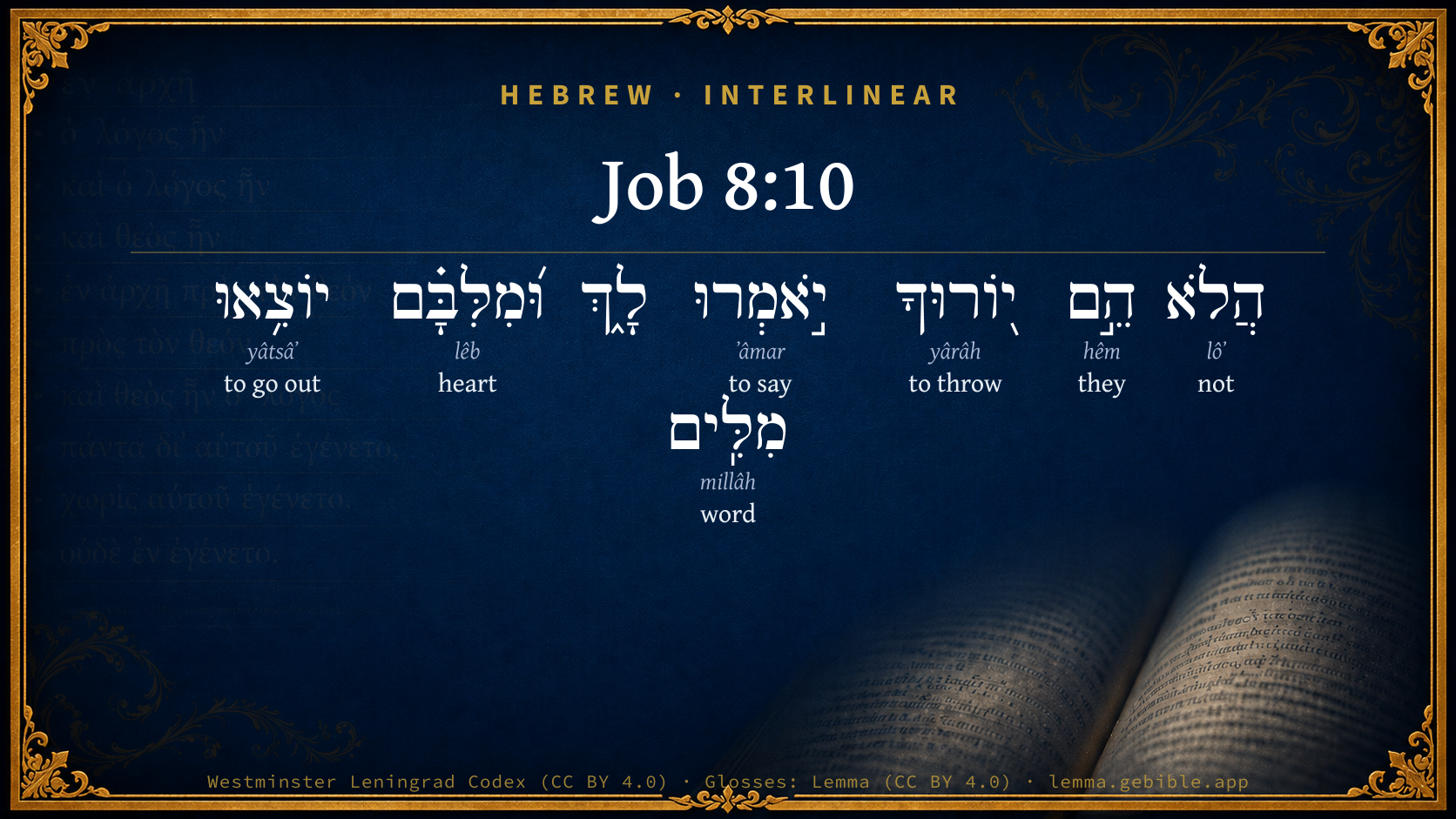
Job 8:10

Hebrew (Westminster Leningrad Codex) Job 8:10 appears in the Hebrew Old Testament. The text above is from the Westminster Leningrad Codex. Each word links to its Strong’s number, a concise gloss, and parsing drawn from the Open Scriptures Hebrew Bible morphology. Click any word for its full Brown-Driver-Briggs (BDB) entry.
Download image
Cite this verse

Job 8:10 (World English Bible). Public Domain. Lemma interlinear Bible study tool, https://lemma.gebible.app/v/job/8/10.

Show BibTeX & RIS
BibTeX
RIS
English Translation
Shall they not teach you, tell you, And utter words out of their heart?
World English Bible · Public Domain
Download a study sheet

One document with this verse’s original text, its word-by-word gloss line, the meaning frame, cross-references with their text, attributed commentary, and full source and license credits — printable, and it pastes into notes with its structure intact.

This verse Autodidact and up

Study sheet (.html) Plain text (.txt)

A passage Seminary Student

Up to 50 verses in one chapter. A passage sheet keeps up to 6 commentary sources and 12 cross-references per verse, in the order this page ranks them, and says so on the sheet whenever that leaves anything out. Ask for a single verse and you get the Autodidact verse sheet above.

Everything on this page stays free to read, with no account — the sheet is a download of what is already on screen, not access to it.

Want to remove ads? Support Godless Engineer
Compare translations 3

The same verse in 3 English versions, stacked beneath the original-language interlinear above. Click any original word for its lexicon entry.

Each is an independent rendering of the whole verse — the interlinear is not word-aligned to these translations.

Highlighted words mark where these versions differ — a whole-verse word diff, not a word-by-word alignment.

  • World English Bible Public Domain
    Shall they not teach you, tell you, And utter words out of their heart?
  • King James Version Public Domain
    Shall not they teach thee, and tell thee, and utter words out of their heart?
  • unfoldingWord Literal Text CC BY-SA 4.0
    Will they not teach you? They will speak to you, and from their hearts they will bring forth words.

unfoldingWord Literal Text — © unfoldingWord, licensed CC BY-SA 4.0. Word-aligned USFM3 via Door43 (git.door43.org/unfoldingWord/en_ult).

Versions to compare (up to 4)

3 of 4 selected

Show all 18 translations

Every available English version of this verse, each an independent rendering of the whole verse.

  • World English Bible Public Domain
    Shall they not teach you, tell you, And utter words out of their heart?
  • Berean Standard Bible Public Domain
    Will they not teach you and tell you, and speak from their understanding?
  • Majority Standard Bible Public Domain
    Will they not teach you and tell you, and speak from their understanding?
  • King James Version Public Domain
    Shall not they teach thee, and tell thee, and utter words out of their heart?
  • American Standard Version (1901) Public Domain
    Shall not they teach thee, and tell thee, And utter words out of their heart?
  • Revised Version (1885) Public Domain
    Shall not they teach thee, and tell thee, and utter words out of their heart?
  • Geneva Bible (1599) Public Domain
    Shall not they teach thee and tell thee, and vtter the wordes of their heart?
  • Douay-Rheims (1899) Public Domain
    And they shall teach thee: they shall speak to thee, and utter words out of their hearts.
  • Young's Literal Translation Public Domain
    Do they not shew thee -- speak to thee, And from their heart bring forth words?
  • Literal Standard Version CC BY-SA 4.0
    Do they not show you—speak to you, || And from their heart bring forth words?
  • Unlocked Literal Bible CC BY-SA 4.0
    Will they not teach you and tell you? Will they not speak words from their hearts?
  • unfoldingWord Literal Text CC BY-SA 4.0
    Will they not teach you? They will speak to you, and from their hearts they will bring forth words.
  • Darby Bible Public Domain
    Shall not they teach thee, [and] tell thee, and utter words out of their heart?
  • World Messianic Bible Public Domain
    Shall they not teach you, tell you, and utter words out of their heart?
  • Webster's Bible Public Domain
    Will they not teach thee, and tell thee, and utter words out of their heart?
  • Free Bible Version CC BY-SA 4.0
    Won't they teach you and explain what they know?
  • Bible in Basic English Public Domain
    Will they not give you teaching, and say words of wisdom to you?
  • JPS Tanakh (1917) Public Domain
    Shall not they teach thee, and tell thee, and utter words out of their heart?

Literal Standard Version (2020), Covenant Press — licensed CC BY-SA 4.0. Text via the HelloAO Bible API (eBible.org). Unlocked Literal Bible (unfoldingWord) — licensed CC BY-SA 4.0. Text via the HelloAO Bible API (eBible.org). unfoldingWord Literal Text — © unfoldingWord, licensed CC BY-SA 4.0. Word-aligned USFM3 via Door43 (git.door43.org/unfoldingWord/en_ult). Free Bible Version, Dr. Jonathan Gallagher — licensed CC BY-SA 4.0. Text via the HelloAO Bible API (eBible.org).

Word by word

More ways to search: Search by grammar → Find every occurrence → Compare this word →

Practice this passage: Drill this verse → Learn its vocabulary →

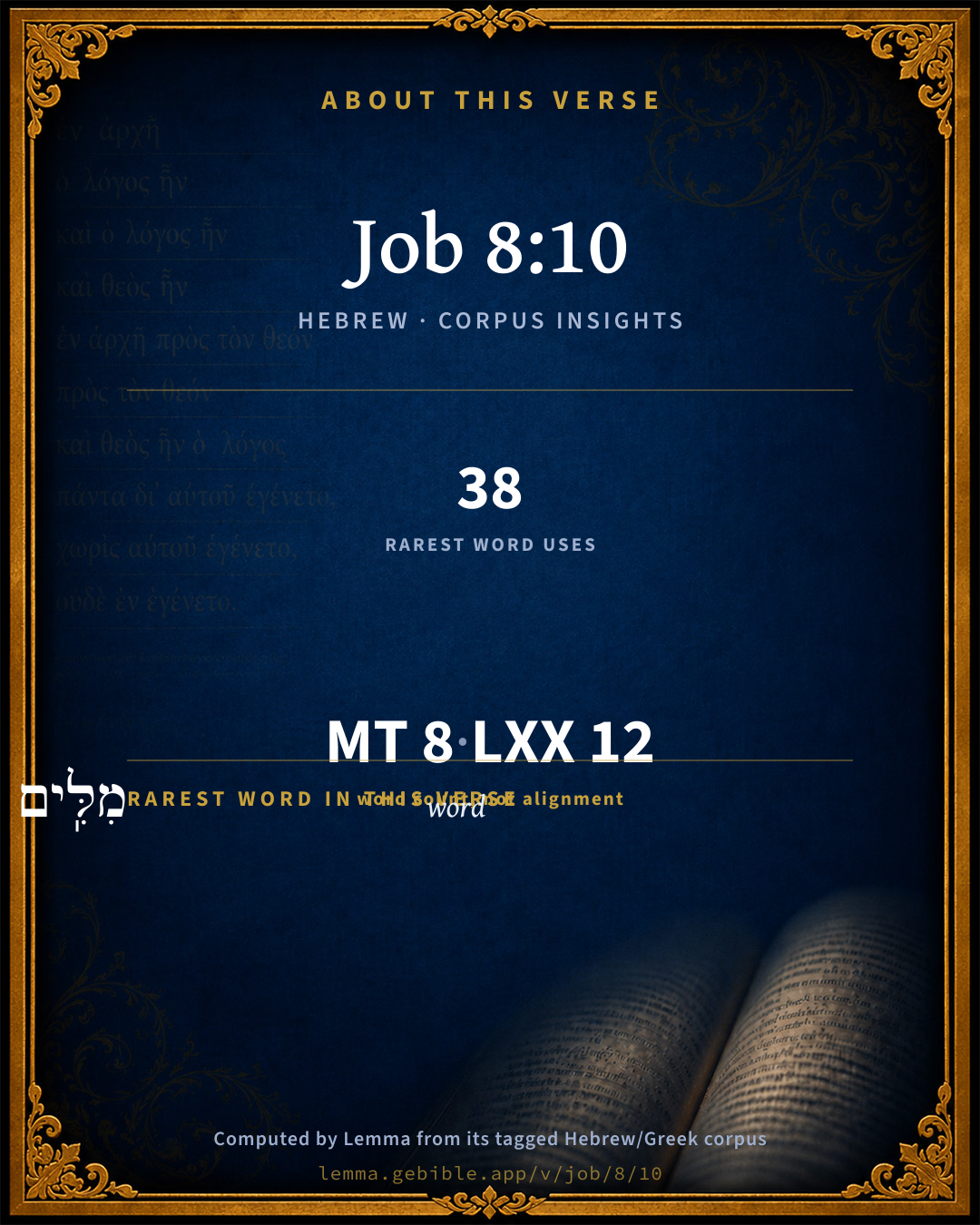
About this verse

These counts appear in no published source. They are computed here, from the morphology-tagged text and Lemma’s own curated glosses. What Lemma adds →

8
words
7
distinct lemmas
Wisdom
section

Shared distinctive vocabulary

מִלִּֽים word H4405 occurs in 38 verses of the Hebrew Bible. Also found in:

Grammatical profile

  • 3 verbs
  • 2 nouns
  • 1 pronoun
  • 1 preposition
  • 1 particle

Verb forms

  • י֭וֹרוּךָ Hiphil · Imperfect
  • יֹ֣אמְרוּ Qal · Imperfect
  • יוֹצִ֥אוּ Hiphil · Imperfect

Hebrew & Septuagint length

In English translation the verse runs 14 words from the Hebrew and 16 from the Septuagint (LXX English) — closely comparable.

A rough comparison of the two English renderings, which tokenize alike — not a word-level alignment.

Word counts can differ between the Hebrew and the Greek without any difference in meaning — e.g. the Hebrew direct-object marker אֵת has no separate Greek word, and Greek often adds the article ὁ.

In the original languages it is 8 Hebrew tokens and 12 Greek tokens — but the two are counted differently (Hebrew bundles its prefixes and suffixes into one token; the Greek is in lemma form), so that isn’t a like-for-like length.

Cross-references

10

Topical passages linked to Job 8:10 in the Treasury of Scripture Knowledge — connected by theme and wording, ordered by reader-vote popularity; previews shown in the World English Bible.

  • Proverbs 18:15 The heart of the discerning gets knowledge. The ear of the wise seeks knowledge.
  • Matthew 12:35 The good man out of his good treasure brings out good things, and the evil man out of his evil treasure brings out evil things.
  • Deuteronomy 6:7 and you shall teach them diligently to your children, and shall talk of them when you sit in your house, and when you walk by the way, and when you lie down, and when you rise up.
  • Deuteronomy 11:19 You shall teach them your children, talking of them, when you sit in your house, and when you walk by the way, and when you lie down, and when you rise up.
  • Job 12:7–8 "But ask the animals, now, and they shall teach you; The birds of the sky, and they shall tell you.
  • Job 32:7 I said, 'Days should speak, And multitude of years should teach wisdom.'
  • Psalms 145:4 One generation will commend your works to another, And will declare your mighty acts.
  • Proverbs 16:23 The heart of the wise instructs his mouth, And adds learning to his lips.
  • Hebrews 11:4 By faith, Abel offered to God a more excellent sacrifice than Cain, through which he had testimony given to him that he was righteous, God bearing witness with respect to his gifts; and through it he, being dead, still speaks.
  • Hebrews 12:1 Therefore let us also, seeing we are surrounded by so great a cloud of witnesses, lay aside every weight and the sin which so easily entangles us, and let us run with patience the race that is set before us,

Cross-references courtesy of OpenBible.info (CC BY 4.0).

Hebrew and Greek witnesses Masoretic Hebrew ↔ Greek Septuagint

The same verse in the two great witnesses to the Old Testament, shown verse-for-verse.

These are two independent witnesses, not word-aligned to each other, and the Septuagint is shown in lemma (dictionary) form.

Hebrew Job 8:10 Masoretic · Westminster Leningrad Codex

הֲלֹא הֵ֣ם י֭וֹרוּךָ יֹ֣אמְרוּ לָ֑ךְ וּ֝מִלִּבָּ֗ם יוֹצִ֥אוּ מִלִּֽים

Shall they not teach you, tell you, And utter words out of their heart?

World English Bible · Public Domain

Greek LXX Job 8:10 Septuagint · lemma form

ἦ οὐ οὗτος σύ διδάσκω καί ἀναἀγγέλλω καί ἐκ καρδία ἐκἄγω ῥῆμα

shall not these teach you, and report to you, and bring out words from their heart?

LXX2012 (modern English Septuagint) · Public Domain

On this verse, John Gill's Exposition discusses the Septuagint’s reading. Read the note in Commentary ↓

Hebrew: Westminster Leningrad Codex (CC BY 4.0). Greek: Septuagint (public domain); English from LXX2012 (modern English Septuagint) (Public Domain). How the Septuagint differs from the Hebrew →

Commentary

Notes on Job 8:10 from classic Christian and Jewish commentators (each source and its license shown beneath its notes). The classic Christian expositions comment on the surrounding passage and are grouped to its opening verse, so a note may address several verses; the Jewish commentaries on the Tanakh (Rashi and others) are per-verse, so they appear only where the commentator wrote on this verse.

Lemma curates 59 commentaries, every one of them public domain or Creative Commons licensed, each selected and text-cleaned for this edition rather than reprinted as found. About our sources →

Trapp's Complete Commentary

John Trapp

Job 8:10 Shall not they teach thee, [and] tell thee, and utter words out of their heart?

Ver. 10. Shall they not teach thee, and tell thee] They, that is, the forefathers, Job 8:8, these, though dead and gone, yet by their records and monuments, by their apopthegms and oracles (for the words of dying men are living oracles), do still teach us and tell us their minds, as if they were yet living, Heb 11:4 Luk 16:29. Books are mute matters, silent voices. The way to be wise, said a heathen, is to converse with the dead, τοις νεκροις συγχρωτιζειν. Histories are faithful counsellors, and by the reading of them many young men have attained to more understanding than their elders; as Augustus, Theodosius, Macarius, who was surnamed παιδαριογερων, the old youth, for his wisdom and gravity above his years, gotten by reading and prayer, as saith Nicephorus.

And utter words out of their heart?] Discourses dug out of their own hearts, things new and old, thrown out of that good treasure, e cordibus, non e codicibus, they were egregie cordati homines, hearty good men, and their speeches were heart sprung, dipped in their hearts, and there recalled ad limam, priusquam ad linguam, weighed before uttered. They spake not as thou dost, Job, rashly and at random; judiciously, solidly, oraculously conduct them therefore, and as they speak from their own heart, so let them speak to thine. With the ancient is wisdom, and in length of days understanding, Job 12:12.

John Trapp, A Commentary or Exposition upon All the Books of the Old and New Testament (1647–1656) — public domain. Text from a community e-Sword module.

Joseph Benson's Commentary

Job 8:10. Shall not they teach thee? — Assuredly they will inform thee that it is as we say. And utter words out of their heart — Not partially, but sincerely, speaking their inward thoughts; not rashly, but from deep consideration; not by hearsay from others, but their own knowledge and experience.

Joseph Benson's Commentary on the Old and New Testaments (1811–1818) — public domain. Text from a community e-Sword module.

Jamieson, Fausset & Brown

Robert Jamieson, A. R. Fausset & David Brown

teach thee-- Job 6:24 had said, "Teach me." Bildad, therefore, says, "Since you want teaching, inquire of the fathers. They will teach thee."

utter words--more than mere speaking; "put forth well-considered words."

out of their heart--from observation and reflection; not merely, from their mouth: such, as Bildad insinuates, were Job's words. Job 8:11-13 embody in poetic and sententious form (probably the fragment of an old poem) the observation of the elders. The double point of comparison between the ungodly and the paper-reed is: 1. the luxuriant prosperity at first; and, 2. the sudden destruction.

Jamieson, Fausset & Brown — Commentary Critical and Explanatory on the Whole Bible (1871) — public domain (CC PDM 1.0). Text via the HelloAO Bible API.

Adam Clarke's Commentary

Verse 10. Shall not they teach thee] Wilt thou not treat their maxims with the utmost deference and respect? They utter words from their heart - what they say is the fruit of long and careful experience.

Adam Clarke's Commentary on the Bible (1810–1826) — public domain. Text from a community e-Sword/MySword module.

The Cambridge Bible for Schools and Colleges

gen. ed. J. J. S. Perowne

10. words out of their heart] Words not the result of hasty and superficial generalizing, but of an experience which the lengthened lives of these men had enabled them to pass through, and the principles learned in which had sunk into their heart. The “heart” is in Heb. the deepest part of human nature, whether intellect or feeling. There is an implied condemnation in all this of the new principles which Job was setting forth, what a subsequent speaker calls his “doctrine,” ch. Job_11:4, principles based on nothing but his own single experience and instance.

The Cambridge Bible for Schools and Colleges (gen. ed. J. J. S. Perowne; Cambridge University Press, 1878–1918) — public domain. Text from a community e-Sword module.

John Gill's Exposition

Can the rush grow up without mire?.... No, at least not long, or so as to lift up his head on high, as the word signifies (a); the rush or bulrush, which seems to be meant, delights in watery places, and has its name in Hebrew from its absorbing or drinking up water; it grows in moist and watery clay, or in marshy places, which Jarchi says is the sense of the word here used; the Septuagint understands it of the "paper reed", which, as Pliny (b) observes, grows in the marshy places of Egypt, and by the still waters of the river Nile:

can the flag grow without water? or "the sedge" (c); which usually grows in moist places, and on the banks of rivers; this unless in such places, or if without water, cannot grow long, or make any very large increase, or come to maturity; so some (d) render it, "if the rush should grow up without", &c. then it would be with it as follows.

(a) "an attollit se", Junius & Tremellius, Piscator, Cocceius; "an superbiet", so some; Beza, Schultens. (b) Nat. Hist. l. 13. c. 11. (c) "carectum", V. L. "ulva", Junius & Tremellius, Piscator, Schmidt, Michaelis, Schultens. (d) Sic Bar Tzemach & Belgae.

John Gill's Exposition of the Whole Bible (1746–1763) — public domain (CC PDM 1.0). Text via the HelloAO Bible API.

Albert Barnes' Notes on the Bible

Shall not they teach thee - The results of human conduct, and the great principles on which God governs the world.

And utter words out of their heart - Dr. Good renders this,

“And well forth the sayings of their wisdom,”

And supposes it means that the words of wisdom would proceed from them as water bubbles from a fountain. But this, I think, is a mere conceit. The true sense is, that they would not speak that merely which comes from the mouth, or that which comes upper most, and without reflection - as the Greeks say, λέγειν πᾶν ὅ τι ἐπὶ στόμα ἔλθῃ legein pan ho ti epi stoma elthē; or, as the Latins, Quicquid in buccam venerit loqui - to speak whatever comes in the mouth; but they would utter that which came from the heart - which was sincere, and the result of deep and prolonged reflection. Perhaps, also, Bildad means to insinuate that Job had uttered what was uppermost in his mind, without taking time for reflection.

Albert Barnes' Notes on the Bible (1834–1885) — public domain. Text from a community e-Sword/MySword module.

Matthew Poole's English Annotations

Assuredly they will inform thee that it is as we say.

Out of their heart; not partially, but sincerely, speaking their inward thoughts; not rashly, but from deep consideration; not by hearsay from others, but their own knowledge and experience.

Matthew Poole's English Annotations on the Holy Bible (1683–1685) — public domain. Text from a community e-Sword/MySword module.

Whedon's Commentary on the Bible

Daniel D. Whedon

10. Shall not they teach thee — Job had confidently said, (Job_6:24,) Teach me, and Bildad adduces a most remarkable passage out of the heart of ancient times. He summons the fathers, that they may deal Job a crushing blow. In the early history of most nations knowledge was preserved in the form of proverbs, maxims, and apothegms. Lacking the advantage of circulated books for the transmission of thought, they compressed it into as small a compass as possible, that it might be more easily remembered, and thus preserved for the generations to come. We have before us fragments of a poem (Job_8:11-19) that probably came to Bildad from a very remote age. Some have conjectured that they may be relics of some primeval revelation. The imagery employed, as well as the Egyptian words gome, (Coptic, kam,) reed, (papyrus,) and ahhou, (flag,) satisfy Carey and others that this ancient lay was composed in Egypt.

Daniel D. Whedon (gen. ed.), Commentary on the Old and New Testaments (1874–1909) — public domain. Text from a community e-Sword module.

The Pulpit Commentary

Shall not they teach thee, and tell thee, and utter words out of their heart (see the comment on ver. 8).

The Pulpit Commentary (1880–1919), ed. H.D.M. Spence-Jones & Joseph S. Exell — public domain. Text from a community e-Sword module.

John Wesley's Explanatory Notes

Utter - Not partially, but sincerely, speaking their inward thoughts; not rashly, but from deep consideration; not by hearsay, but their own knowledge.

John Wesley, Explanatory Notes Upon the Whole Bible (1754–1765) — public domain. Text via the GEBible commentary corpus.

Lesson kit

Teaching starters — assembled from the data on this page, not authored interpretation. Every prompt links to the verse data it draws on. Edit before teaching.

Job, in the Wisdom, opens this verse with 8 words (7 distinct Hebrew lemmas). Its most distinctive word is millâh (“word”). A historical commentator’s framing appears above. Read the whole chapter for the surrounding context.

Discussion questions

  1. How does “word” (millâh) shape what this verse is saying?
  2. 2 Samuel 23:2 shares the word «word» with this verse. How do the two illuminate each other?
  3. These translations render this verse differently. What is at stake in choosing one wording over another?
  4. The verb «י֭וֹרוּךָ» is Hiphil Imperfect. How does its form color the action?
  5. Reading how Trapp's Complete Commentary and Joseph Benson's Commentary read this verse, where do the two commentators agree and where do they part?

Things to notice

Reading settings

Reading text

Shown beneath each verse's original-language words.

Old Testament
Old Testament edition

Read the OT as the Masoretic Hebrew (MT) or the Greek Septuagint (LXX).

English shown for the Greek Septuagint (in the Hebrew ↔ Greek comparison).

Comparing translations? Open the Compare panel on any verse page to stack up to four side by side.