
Psalms 118:26

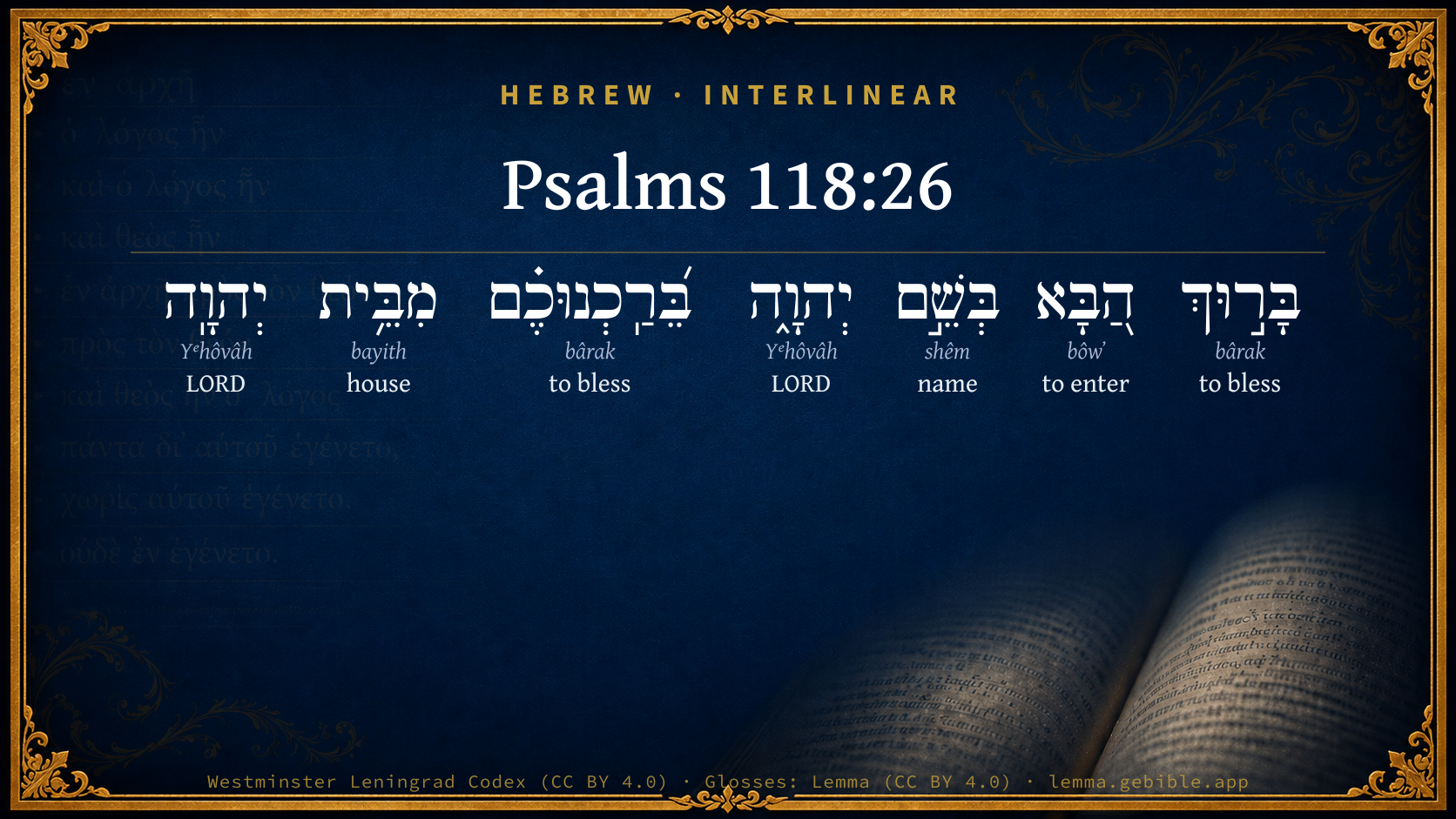
Hebrew (Westminster Leningrad Codex) Psalms 118:26 appears in the Hebrew Old Testament. The text above is from the Westminster Leningrad Codex. Each word links to its Strong’s number, a concise gloss, and parsing drawn from the Open Scriptures Hebrew Bible morphology. Click any word for its full Brown-Driver-Briggs (BDB) entry.
Download image
Cite this verse

Psalms 118:26 (World English Bible). Public Domain. Lemma interlinear Bible study tool, https://lemma.gebible.app/v/psalms/118/26.

Show BibTeX & RIS
BibTeX
RIS
English Translation
Blessed is he who comes in the name of Yahweh! We have blessed you out of the house of Yahweh.
World English Bible · Public Domain
Download a study sheet

One document with this verse’s original text, its word-by-word gloss line, the meaning frame, cross-references with their text, attributed commentary, and full source and license credits — printable, and it pastes into notes with its structure intact.

This verse Autodidact and up

Study sheet (.html) Plain text (.txt)

A passage Seminary Student

Up to 50 verses in one chapter. A passage sheet keeps up to 6 commentary sources and 12 cross-references per verse, in the order this page ranks them, and says so on the sheet whenever that leaves anything out. Ask for a single verse and you get the Autodidact verse sheet above.

Everything on this page stays free to read, with no account — the sheet is a download of what is already on screen, not access to it.

Want to remove ads? Support Godless Engineer
Compare translations 3

The same verse in 3 English versions, stacked beneath the original-language interlinear above. Click any original word for its lexicon entry.

Each is an independent rendering of the whole verse — the interlinear is not word-aligned to these translations.

Highlighted words mark where these versions differ — a whole-verse word diff, not a word-by-word alignment.

  • World English Bible Public Domain
    Blessed is he who comes in the name of Yahweh! We have blessed you out of the house of Yahweh.
  • King James Version Public Domain
    Blessed be he that cometh in the name of the LORD: we have blessed you out of the house of the LORD.
  • unfoldingWord Literal Text CC BY-SA 4.0
    Blessed is the one coming in the name of Yahweh; we bless you from the house of Yahweh.

unfoldingWord Literal Text — © unfoldingWord, licensed CC BY-SA 4.0. Word-aligned USFM3 via Door43 (git.door43.org/unfoldingWord/en_ult).

Versions to compare (up to 4)

3 of 4 selected

Show all 18 translations

Every available English version of this verse, each an independent rendering of the whole verse.

  • World English Bible Public Domain
    Blessed is he who comes in the name of Yahweh! We have blessed you out of the house of Yahweh.
  • Berean Standard Bible Public Domain
    Blessed is he who comes in the name of the LORD. From the house of the LORD we bless you.
  • Majority Standard Bible Public Domain
    Blessed is he who comes in the name of the LORD. From the house of the LORD we bless you.
  • King James Version Public Domain
    Blessed be he that cometh in the name of the LORD: we have blessed you out of the house of the LORD.
  • American Standard Version (1901) Public Domain
    Blessed be he that cometh in the name of Jehovah: We have blessed you out of the house of Jehovah.
  • Revised Version (1885) Public Domain
    Blessed be he that cometh in the name of the LORD: we have blessed you out of the house of the LORD.
  • Geneva Bible (1599) Public Domain
    Blessed be he, that commeth in the Name of the Lord: wee haue blessed you out of the house of the Lord.
  • Douay-Rheims (1899) Public Domain
    Blessed be he that cometh in the name Lord. We have blessed you out of the house of the Lord.
  • Young's Literal Translation Public Domain
    Blessed `is' he who is coming In the name of Jehovah, We blessed you from the house of Jehovah,
  • Literal Standard Version CC BY-SA 4.0
    Blessed [is] He who is coming || In the Name of YHWH, || We blessed you from the house of YHWH,
  • Unlocked Literal Bible CC BY-SA 4.0
    Blessed is he who comes in the name of Yahweh; we bless you from the house of Yahweh.
  • unfoldingWord Literal Text CC BY-SA 4.0
    Blessed is the one coming in the name of Yahweh; we bless you from the house of Yahweh.
  • Darby Bible Public Domain
    Blessed be he that cometh in the name of Jehovah. We have blessed you out of the house of Jehovah.
  • World Messianic Bible Public Domain
    Blessed is he who comes in the LORD’s name! We have blessed you out of the LORD’s house.
  • Webster's Bible Public Domain
    Blessed be he that cometh in the name of the LORD: we have blessed you out of the house of the LORD.
  • Free Bible Version CC BY-SA 4.0
    May the one who comes in the power of the Lord by blessed! We bless you from the house of the Lord!
  • Bible in Basic English Public Domain
    A blessing be on him who comes in the name of the Lord; we give you blessing from the house of the Lord.
  • JPS Tanakh (1917) Public Domain
    Blessed be he that cometh in the name of the LORD; we bless you out of the house of the LORD.

Literal Standard Version (2020), Covenant Press — licensed CC BY-SA 4.0. Text via the HelloAO Bible API (eBible.org). Unlocked Literal Bible (unfoldingWord) — licensed CC BY-SA 4.0. Text via the HelloAO Bible API (eBible.org). unfoldingWord Literal Text — © unfoldingWord, licensed CC BY-SA 4.0. Word-aligned USFM3 via Door43 (git.door43.org/unfoldingWord/en_ult). Free Bible Version, Dr. Jonathan Gallagher — licensed CC BY-SA 4.0. Text via the HelloAO Bible API (eBible.org).

Word by word

More ways to search: Search by grammar → Find every occurrence → Compare this word →

Practice this passage: Drill this verse → Learn its vocabulary →

About this verse

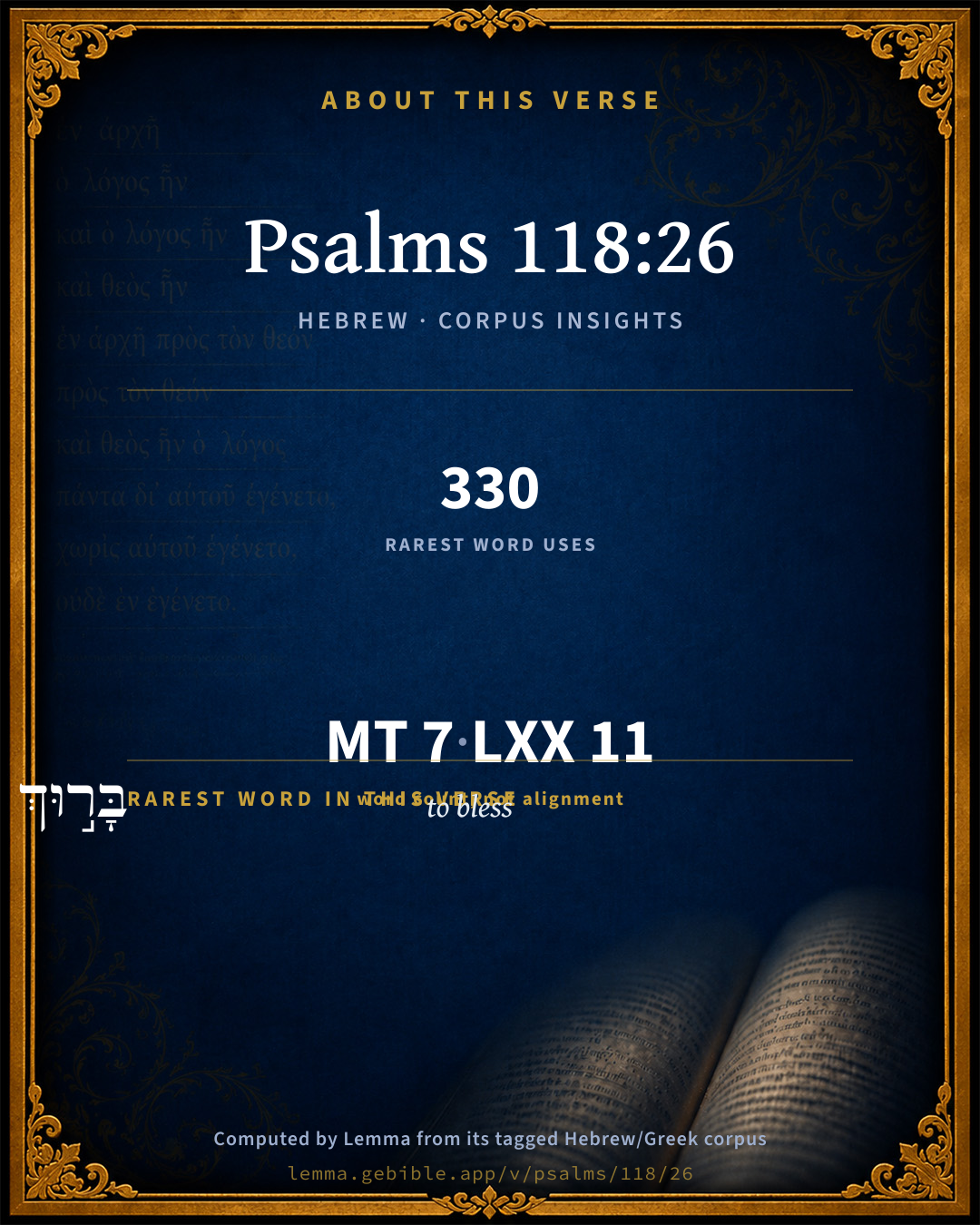
These counts appear in no published source. They are computed here, from the morphology-tagged text and Lemma’s own curated glosses. What Lemma adds →

7
words
5
distinct lemmas
Wisdom
section

Grammatical profile

  • 3 verbs
  • 4 nouns

Verb forms

  • בָּר֣וּךְ Qal · Participle Passive
  • הַ֭בָּא Qal · Participle Active
  • בֵּ֝רַֽכְנוּכֶ֗ם Piel · Perfect

Repetition

Words recur within this verse — often emphatic in Hebrew:

  • בָּר֣וּךְ to bless H1288 ×2
  • יְהוָ֑ה LORD H3068 ×2

Hebrew & Septuagint length

In English translation the verse runs 20 words from the Hebrew and 22 from the Septuagint (LXX English) — closely comparable.

A rough comparison of the two English renderings, which tokenize alike — not a word-level alignment.

Word counts can differ between the Hebrew and the Greek without any difference in meaning — e.g. the Hebrew direct-object marker אֵת has no separate Greek word, and Greek often adds the article ὁ.

In the original languages it is 7 Hebrew tokens and 11 Greek tokens — but the two are counted differently (Hebrew bundles its prefixes and suffixes into one token; the Greek is in lemma form), so that isn’t a like-for-like length.

Cross-references

10

Topical passages linked to Psalms 118:26 in the Treasury of Scripture Knowledge — connected by theme and wording, ordered by reader-vote popularity; previews shown in the World English Bible.

  • Luke 19:38 saying, "Blessed is the King who comes in the name of the Lord! Peace in heaven, and glory in the highest!"
  • Matthew 21:9 The multitudes who went before him, and who followed kept shouting, "Hosanna to the son of David! Blessed is he who comes in the name of the Lord! Hosanna in the highest!"
  • Matthew 23:39 For I tell you, you will not see me from now on, until you say, 'Blessed is he who comes in the name of the Lord!'"
  • John 12:13 they took the branches of the palm trees, and went out to meet him, and cried out, "Hosanna! Blessed is he who comes in the name of the Lord, the King of Israel!"
  • Mark 11:9–10 Those who went in front, and those who followed, cried out, "Hosanna! Blessed is he who comes in the name of the Lord!
  • Luke 13:35 Behold, your house is left to you desolate. I tell you, you will not see me, until you say, 'Blessed is he who comes in the name of the Lord!'"
  • Psalms 129:8 Neither do those who go by say, "The blessing of Yahweh be on you. We bless you in the name of Yahweh."
  • Psalms 134:3 May Yahweh bless you from Zion; Even he who made heaven and earth.
  • Numbers 6:23–26 "Speak to Aaron and to his sons, saying, 'This is how you shall bless the children of Israel.' You shall tell them,
  • Zechariah 4:7 Who are you, great mountain? Before Zerubbabel you are a plain; and he will bring out the capstone with shouts of 'Grace, grace, to it!'"

Cross-references courtesy of OpenBible.info (CC BY 4.0).

Hebrew and Greek witnesses Masoretic Hebrew ↔ Greek Septuagint

The same verse in the two great witnesses to the Old Testament, shown verse-for-verse.

You’re reading Greek Psalm 117 (Hebrew Psalm 118). The Septuagint counts the superscription, so verse numbers can differ from the Hebrew — chapter-level alignment, not verse-by-verse. Numbering follows Rahlfs.

These are two independent witnesses, not word-aligned to each other, and the Septuagint is shown in lemma (dictionary) form.

Hebrew Psalms 118:26 Masoretic · Westminster Leningrad Codex

בָּר֣וּךְ הַ֭בָּא בְּשֵׁ֣ם יְהוָ֑ה בֵּ֝רַֽכְנוּכֶ֗ם מִבֵּ֥ית יְהוָֽה

Blessed is he who comes in the name of Yahweh! We have blessed you out of the house of Yahweh.

World English Bible · Public Domain

Greek LXX Greek Psalm 117:26 Septuagint · lemma form

εὐλογέω ὁ ἔρχομαι ἐν ὄνομα κύριος εὐλογέω σύ ἐκ οἶκος κύριος

Blessed is he that comes in the name of the Lord: we have blessed you out of the house of the Lord.

LXX2012 (modern English Septuagint) · Public Domain

Hebrew: Westminster Leningrad Codex (CC BY 4.0). Greek: Septuagint (public domain); English from LXX2012 (modern English Septuagint) (Public Domain). How the Septuagint differs from the Hebrew →

Commentary

Notes on Psalms 118:26 from classic Christian and Jewish commentators (each source and its license shown beneath its notes). The classic Christian expositions comment on the surrounding passage and are grouped to its opening verse, so a note may address several verses; the Jewish commentaries on the Tanakh (Rashi and others) are per-verse, so they appear only where the commentator wrote on this verse.

Lemma curates 59 commentaries, every one of them public domain or Creative Commons licensed, each selected and text-cleaned for this edition rather than reprinted as found. About our sources →

Trapp's Complete Commentary

John Trapp

Psa 118:26 Blessed [be] he that cometh in the name of the LORD: we have blessed you out of the house of the LORD.

Ver. 26. Blessed be he that cometh] Blessed be Christ. Vivat Christus eiusque insignia, said John Clark of Melda, when, for declaring against the Pope’s indulgencies, he was burnt in the forehead with a hot iron (Scultet. Annul.).

We have blessed you out of the house of the Lord] Thus say the priests to the people. Ministers must bless those that bless Christ, saying, "Grace be with all them that love our Lord Jesus Christ in sincerity," Eph 6:24; as if any do not, let him be Anathema Maranatha, 1Co 16:22.

John Trapp, A Commentary or Exposition upon All the Books of the Old and New Testament (1647–1656) — public domain. Text from a community e-Sword module.

The Biblical Illustrator

Joseph S. Exell

Psa_118:26

Blessed be He that cometh in the name of the Lord.

Christ received with great joy

The words are an acclamation of the people, declaring and setting forth the welcome of Christ to all believing souls; their joy and rejoicing conceived upon the coming of Christ among them; their gratulation and thanksgiving for Christs appropinquation and coming nigh unto them; their vote and exoptation of all prosperity., blessed and happy success to Christ in His kingdom. Christs coming proves most joyful to them that lovingly receive and entertain Him. In the words we have in the general two things considerable--

1. A gratulation uttered by the people, Blessed be He that cometh in the name of the Lord.

2. A benediction pronounced by the ministers of the Lord, We have blessed you out of the house of the Lord. In the gratulation there is--

(1) The agent, the people, they bless, they rejoice, they are thankful for Christs coming. Man hath greatest cause of all creatures to rejoice in and for the coming of Christ Jesus.

(2) There is the act, Blessed, praised, exalted, magnified be Christ. Christ, is worthy to be celebrated with all praises for His coming to us.

(3) There is the manner of their gratulation, blessed, expressed--

(i.) By way of thanksgiving and rejoicing, and--

(ii.) By way of exoptation and wishing. Whosoever truly rejoiceth in Christ doth also wish well to the cause and kingdom of Christ.

(4) There is the party coming, He who is the Son of God by eternal generation, and by grace of hvpostatical union, the Prince of the kings of the earth by authority and dominion; He who is the Head of the Church by spiritual jurisdiction; He who is the Redeemer of man by the merit of His obedience and passion; He who is the Conqueror over hell, death, sin, and Satan by His resurrection; He who by His office is the Prophet instructing us, the King commanding and defending us, and the Priest offering Himself a sacrifice for us; He who is the Mediator between God and us by His intercession, the fountain of all mercy, grace, and peace unto us by Divine ordination. Blessed be He, welcome be He, in Him let our souls rejoice, His coming let us entertain with the chiefest and strength of our rejoicing. The Lord Jesus ought to be the prime and complete object of mans joyfulness.

(5) Here is His motion, cometh. Christ as God is everywhere, and neither goes nor comes, but fills all places; yet He cometh by His laws and ordinances, as a Prince by His proclamations; He cometh by His ministers, as a King by His ambassadors; He cometh by His incarnation, as a brother taking our nature upon Him; He cometh by His gifts and graces bestowed on us, as a friend cometh by his love-tokens; He cometh by His Word and Gospel, as the sun cometh by his light, enlightening us, as a king cometh by his sceptre binding, bowing, and inclining our hearts unto obedience. (A. Grosse.)

The coming deliverer

During the dark days of the struggle for Italian liberty the people generally looked upon Garibaldi as their invincible deliverer. Prisoners, hurried away to loathsome dungeons, would be cheered as they passed along the streets by friends whispering in their ears, Courage, Garibaldi is coming! Men would steal out at night and chalk on the wails and pavements, Garibaldi is coming! And when the news of his approach near to a city was announced the people broke out into the rapturous shout, Garibaldi is coming! He came, and Italy broke her political and religious fetters never to be so enslaved again. A greater than Garibaldi is coming to Gods people. The Desire of all nations is on the way. Jesus is coming, coming to reign, and His kingdom is of icy, peace, blessing eternal. (H. O. Mackey.)

We have blessed you out of the house of the Lord.

A benediction uttered by the ministers of the Lord

1. The parties blessing, the ministers of the Lord; we, who are called of God to this sacred function, who are appointed to make prayer and supplication for you, to pronounce a blessing upon you. Holy and faithful ministers are the instrumental causes of great blessings to Gods Church and servants.

2. Here is their act, an act of blessing, We have blessed. Ministers bless the people sometime by way of vote and exoptation, prayer and supplication; sometime by way of vocal pronunciation, pronouncing good things in the name of God upon them; sometime by way of prophecy and prediction, foretelling great blessings to come; sometime by way of doctrine and instruction. They declare and open the blessings which God hath prepared for them, and the Lord by them, as by His ministerial instruments, communicates His grace and blessing to the people. It must be the care of ministers so to demean themselves in their function that they prove a blessing to the people.

3. Here is the object or parties blessed, you; you to whom Christs coming is acceptable, you who wish well to Christs kingdom, you who readily endeavour the exaltation of Christs name and Gospel, we have blessed you. The labours of Gods ministers prove a blessing only to such people as rejoice in, and endeavour the advancement of, the Gospel.

4. Here is the place from whence they blessed the people, out of the house of theLord, the place of Gods public worship, where His saints are assembled, His ordinances sincerely handled, His name invocated, His Word preached, and religious duties celebrated. God useth to dispense His spiritual blessings in the public and sacred assemblies. (A. Grosse.)

The Biblical Illustrator, edited by Joseph S. Exell (c. 1880s–1900s) — public domain. Text from a community e-Sword module.

Joseph Benson's Commentary

Psa 118:26. Blessed be he that cometh — Namely, unto us, from whom he was long banished; or, unto the throne; or, he that cometh from his Father into the world, namely, the Messiah, known by the name of him that cometh, or was to come: see the margin. In the name of the Lord — By command and commission from him, and for his service and glory. We earnestly pray that God would bless his person and government, and all his enterprises. We have blessed you out of the house of the Lord — We, who are the Lord’s ministers, attending upon him in his house, and appointed to bless in his name, (Num 6:23,) do pray for, and, in God’s name, pronounce his blessing upon thee, and upon thy kingdom. So these are the words of the priests.

Joseph Benson's Commentary on the Old and New Testaments (1811–1818) — public domain. Text from a community e-Sword module.

J. A. Alexander on Psalms

Joseph Addison Alexander

26. (Psa 118:26) Blessed be he that cometh in the name of Jehovah! We bless you from the house of Jehovah. According to the accents, the construction of the first clause is, blessed, in the name of Jehovah, be he that cometh. This agrees exactly with the frequent mention of blessing in the name of Jehovah. See below, Psa 129:8, and compare Numbers 27, Deu 21:5, 2Sa 6:18. He that cometh is commonly and not improbably supposed to have meant primarily the people or their representatives, to whom, as they approach the sacred spot, these words were to be uttered. There were other thoughts, however, which the words could hardly fail to suggest, for example that of Israel coming back from exile, that of God coming back to his forsaken people, and at least in the most enlightened minds, that of the great Deliverer, to whose coming all the rest was but preparatory, to whom the name was afterwards given as a standing appellation, in allusion either to this passage or to Mal 3:1, or to both, and to whom this very sentence was applied by the multitude who witnessed and attended Christ's triumphal entrance into the Holy City. See Mat 21:9.

Joseph Addison Alexander, The Psalms Translated and Explained (1850) — public domain. Text from a community e-Sword module.

Tyndale Open Study Notes

Tyndale Open Resources

118:26 The one who comes in the name of the Lord brings the Lord’s complete victory (see 118:10-12). • During Jesus’ triumphant entry into Jerusalem, the crowds called out various blessings, including phrases taken from this verse (Matt 21:9; Mark 11:9; Luke 19:38; John 12:13). Jesus himself quoted this passage as he wept over Jerusalem (Matt 23:39; Luke 13:35).

Tyndale Open Study Notes — © Tyndale Open Resources, licensed CC BY-SA 4.0. Text via the HelloAO Bible API.

Geneva Bible (1599)

Geneva Bible translators

Which are the Priests, and have the charge thereof, as Num. 6:23.

Geneva Bible (1599) marginal notes — public domain. Text via Bolls.life.

Adam Clarke's Commentary

Verse 26. We have blessed you] The answer of the Levities to the king.

Adam Clarke's Commentary on the Bible (1810–1826) — public domain. Text from a community e-Sword/MySword module.

Ellicott's Commentary for English Readers

(26) Blessed . . .—These words of welcome are probably spoken by the Levite in charge, to the procession approaching the gates. According to Rabbinical writings, pilgrim caravans were thus welcomed on their arrival at Jerusalem.

A Bible Commentary for English Readers, edited by Charles John Ellicott (1878–1897) — public domain. Text from a community e-Sword module.

The Cambridge Bible for Schools and Colleges

gen. ed. J. J. S. Perowne

26. The priests in the Temple bless the entering procession. Blessed in the name of Jehovah be he that entereth! The accentuation rightly connects in the name of Jehovah with blessed. Cp. Psa_129:8; Deu_21:5; 2Sa_6:18.

With these words and with the Hosanna[77] (‘save now’) of the preceding verse, the multitudes greeted Jesus as He rode into Jerusalem (Mat_21:9). The Psalm may already have received a Messianic interpretation. Hosanna was a “God save the king” (Psa_20:9); and “he that cometh” was a title of the Messiah (Mat_11:3). The disciples, expanding the original, shouted “Blessed is the king that cometh in the name of the Lord” (Luk_19:38; cp. Mar_11:10).

[77] Hosanna (ὡσαννά) represents a contracted form הוֹשַׁע־נָּא (cp. Psa_86:2), hôshã‘-nnâ, which was substituted for the fuller form הוֹשִׁיעָה נָּא hôshî‘âh nnâ used in the Psalm. See Dalman, Gramm. des Jüd. Pal. Aram. p. 198.

The Cambridge Bible for Schools and Colleges (gen. ed. J. J. S. Perowne; Cambridge University Press, 1878–1918) — public domain. Text from a community e-Sword module.

John Gill's Exposition

O give thanks unto the Lord, for he is good,.... And thus the psalm ends as it began; there having been given many instances of the divine goodness, in hearing and delivering the psalmist when in distress; saving him from his enemies, when compassed about with them; sparing his life, when in great danger; and especially in making the stone rejected by the builders the head of the corner;

for his mercy endureth for ever; the above instances are proofs of it; and still it continues, and will for evermore. Here ends the great "Hallel", or hymn, sung at the passover and other festivals.

Next: Psalms Chapter 119

John Gill's Exposition of the Whole Bible (1746–1763) — public domain (CC PDM 1.0). Text via the HelloAO Bible API.

Albert Barnes' Notes on the Bible

Blessed be he that cometh in the name of the Lord - See the notes at Mat 21:9. This is the language of those who had charge of the sanctuary, addressing him who came in the name of the Lord to present his thank-offering. It is the language of welcome; the assurance that his offering would be acceptable to God. It was applicable to the Messiah, as coming in the name of the Lord, and was so used by the multitudes Mat 21:9, and by the Saviour himself Mat 23:39; but this use of the language does not prove that it had original reference to him. The Old Testament abounds in language which may thus be employed to express ideas under the Christian dispensation; but this does not prove that all such language was originally designed to refer to that dispensation.

We have blessed you out of the house of the Lord - We, the priests, the ministers of religion, have pronounced and do pronounce you blessed. We welcome your approach. You may come freely with your thank-offering. It will be accepted of the Lord. You come under our benediction, and the benediction of God.

Albert Barnes' Notes on the Bible (1834–1885) — public domain. Text from a community e-Sword/MySword module.

Matthew Poole's English Annotations

Blessed be he; we earnestly pray that God would bless his person and government, and all his enterprises. That cometh, to wit, unto us, from whom he was long banished; or unto the throne; or from his Father into the world; the Messias, who is known by the name of him that cometh or was to come, as Mat 11:3; 21:9; Luk 7:20; 13:35; Joh 12:13, and of whom this very word is used, Gen 49:10; Isa 35:4. He who is about to come, or will certainly come. In the name of the Lord; by command and commission from him, and for his service and glory.

We have blessed you out of the house of the Lord; we who are the Lord’s ministers, attending upon him in his house, and appointed to bless in his name, Num 6:23; Deu 10:8, do pray for, and in God’s name pronounce, his blessing upon thee. So these are the words of the priests.

Matthew Poole's English Annotations on the Holy Bible (1683–1685) — public domain. Text from a community e-Sword/MySword module.

The Treasury of David

Charles H. Spurgeon

Ver. 26. Blessed is he that cometh in the name of the LORD. The difference between Christ and Antichrist is to be noticed, because Christ did not come in his own name, but in the name of the Father; of which he himself testified, Joh 5:43, "I am come in my Father's name, and ye receive me not; if another shall come in his own name, him ye will receive." Thus all faithful ministers of the Church must not come in their own name, or the name of Baal, or of Mammon and their own belly, but in the name of God, with a lawful call; concerning which see Heb 5:1-14 Re 10:1-11 15: 1-8. Solomon Gesner.

Psalms 118:27*

Charles H. Spurgeon's The Treasury of David (1869–1885) — public domain. Psalms only. Text from a community e-Sword/MySword module.

Whedon's Commentary on the Bible

Daniel D. Whedon

26. Blessed be he that cometh—Originally the salutation given by the body of the Levite singers on the temple hill, who received the procession; (Psa_118:19-20 : see introduction;) afterward the welcome of the Jerusalem Jews to the pilgrims coming to attend the festivals. Its higher import was in Christ, worshipped by the people, (see Psa_118:25,) “as being the longed for guest of the feast.”—Delitzsch. It was also the common form of religious salutation, (Rth_2:4; Psa_129:8,) only, perhaps, it should be transposed, “Blessed, in the name of Jehovah, is he that cometh.” According to Mat_23:39, the Jewish nation are to extend this welcome to Christ as the condition of his triumphant return to them. This psalm, says Bishop Alexander, (Bampton Lectures, 1876,) “was provided as a song expressive of welcome to Messiah,” and truly it answers to the history of John (Joh_12:12-15) as face answers to face in a glass.

Daniel D. Whedon (gen. ed.), Commentary on the Old and New Testaments (1874–1909) — public domain. Text from a community e-Sword module.

The Pulpit Commentary

Blessed be he that cometh in the Name of the Lord. Once more a voice issues from the interior of the temple (comp. ver. 20). The priestly choir there stationed to receive the procession, blesses it as coming "in the Name of the Lord;" i.e. for a religious purpose, and with pious intentions. We have blessed you, they say (or, rather perhaps, we bless you) out of the house of the Lord. "The house of the Lord is the fountain and the treasury of all blessing" (Hengstenberg).

The Pulpit Commentary (1880–1919), ed. H.D.M. Spence-Jones & Joseph S. Exell — public domain. Text from a community e-Sword module.

John Wesley's Explanatory Notes

Blessed - We pray that God would bless his person and government. Cometh - To the throne; or from his Father into the world: who is known by the name of him that cometh or was to come, and of whom this very word is used, Gen. xlix, 10 Isaiah xxxv, 4. Name - By commission from him. We - We who are the Lord's ministers attending upon him in his house, and appointed to bless in his name, Num. vi, 23 Deut. x, 8. So these are the words of the priests.

John Wesley, Explanatory Notes Upon the Whole Bible (1754–1765) — public domain. Text via the GEBible commentary corpus.

unfoldingWord translationNotes

Door43 World Missions Community

Blessed is he who comes in the name of Yahweh

Here the priests begin to address the king.

he who comes in the name of Yahweh

Here the word "name" represents Yahweh's power. AT: "the one who comes in the power of the Yahweh" (See: Metonymy)

we bless you from the house of Yahweh

Here the priests address the people.

the house of Yahweh

The word "house" refers to the temple. AT: "Yahweh's temple" (See: Metonymy)

he has given us light

The writer speaks of Yahweh blessing his people as if Yahweh were shining a light on them. AT: "he has blessed us" (See: Metaphor)

bind the sacrifice with cords

"tie the sacrifice with rope"

You are my God

Here the writer begins to speak again and addresses Yahweh directly.

translationWords

bless

name

house of God

light

bind

sacrifice

horn

altar

unfoldingWord translationNotes — © Distant Shores Media and the Door43 World Missions Community, licensed CC BY-SA 4.0. Source: git.door43.org/Door43/en_tn.

Rashi

Rabbi Shlomo Yitzchaki (Rashi)

Blessed be he who has come in the name of the Lord They will say to those who bring the first fruits and to those who perform the pilgrimages.

we have blessed you we have blessed you.

Rashi on the Tanakh — English translations: “The Judaica Press complete Tanach with Rashi, translated by A. J. Rosenberg” (CC BY 4.0); “Pentateuch with Rashi's commentary by M. Rosenbaum and A.M. Silbermann, 1929-1934” (public domain); “The Metsudah Tanach series, Lakewood, N.J” (CC BY 4.0); and “The Book of Joshua, Metsudah Publications, 1997” (CC BY 4.0). Text via Sefaria.

Lesson kit

Teaching starters — assembled from the data on this page, not authored interpretation. Every prompt links to the verse data it draws on. Edit before teaching.

Psalms, in the Wisdom, opens this verse with 7 words (5 distinct Hebrew lemmas). Its most distinctive word is bârak (“to bless”). A historical commentator’s framing appears above. Read the whole chapter for the surrounding context.

Discussion questions

  1. What does “to bless” (bârak) contribute to the verse as a whole?
  2. Luke 19:38 shares this passage’s theme. How do the two illuminate each other?
  3. “to bless” occurs 2× in this one verse. What is the effect of the repetition?
  4. These translations render this verse differently. What is at stake in choosing one wording over another?
  5. The verb «בָּר֣וּךְ» is Qal Participle Passive. How does its form color the action?
  6. Reading how Trapp's Complete Commentary and The Biblical Illustrator read this verse, where do the two commentators agree and where do they part?

Things to notice

Reading settings

Reading text

Shown beneath each verse's original-language words.

Old Testament
Old Testament edition

Read the OT as the Masoretic Hebrew (MT) or the Greek Septuagint (LXX).

English shown for the Greek Septuagint (in the Hebrew ↔ Greek comparison).

Comparing translations? Open the Compare panel on any verse page to stack up to four side by side.