
Job 42:4

Hebrew (Westminster Leningrad Codex) Job 42:4 appears in the Hebrew Old Testament. The text above is from the Westminster Leningrad Codex. Each word links to its Strong’s number, a concise gloss, and parsing drawn from the Open Scriptures Hebrew Bible morphology. Click any word for its full Brown-Driver-Briggs (BDB) entry.
Download image
Cite this verse

Job 42:4 (World English Bible). Public Domain. Lemma interlinear Bible study tool, https://lemma.gebible.app/v/job/42/4.

Show BibTeX & RIS
BibTeX
RIS
English Translation
You said, 'Listen, now, and I will speak; I will question you, and you will answer me.'
World English Bible · Public Domain
Download a study sheet

One document with this verse’s original text, its word-by-word gloss line, the meaning frame, cross-references with their text, attributed commentary, and full source and license credits — printable, and it pastes into notes with its structure intact.

This verse Autodidact and up

Study sheet (.html) Plain text (.txt)

A passage Seminary Student

Up to 50 verses in one chapter. A passage sheet keeps up to 6 commentary sources and 12 cross-references per verse, in the order this page ranks them, and says so on the sheet whenever that leaves anything out. Ask for a single verse and you get the Autodidact verse sheet above.

Everything on this page stays free to read, with no account — the sheet is a download of what is already on screen, not access to it.

Want to remove ads? Support Godless Engineer
Compare translations 3

The same verse in 3 English versions, stacked beneath the original-language interlinear above. Click any original word for its lexicon entry.

Each is an independent rendering of the whole verse — the interlinear is not word-aligned to these translations.

Highlighted words mark where these versions differ — a whole-verse word diff, not a word-by-word alignment.

  • World English Bible Public Domain
    You said, 'Listen, now, and I will speak; I will question you, and you will answer me.'
  • King James Version Public Domain
    Hear, I beseech thee, and I will speak: I will demand of thee, and declare thou unto me.
  • unfoldingWord Literal Text CC BY-SA 4.0
    ‘Listen, now, and I will speak; I will question you, and you will inform me.’

unfoldingWord Literal Text — © unfoldingWord, licensed CC BY-SA 4.0. Word-aligned USFM3 via Door43 (git.door43.org/unfoldingWord/en_ult).

Versions to compare (up to 4)

3 of 4 selected

Show all 18 translations

Every available English version of this verse, each an independent rendering of the whole verse.

  • World English Bible Public Domain
    You said, 'Listen, now, and I will speak; I will question you, and you will answer me.'
  • Berean Standard Bible Public Domain
    You said, ‘Listen now, and I will speak. I will question you, and you shall inform Me.’
  • Majority Standard Bible Public Domain
    You said, ‘Listen now, and I will speak. I will question you, and you shall inform Me.’
  • King James Version Public Domain
    Hear, I beseech thee, and I will speak: I will demand of thee, and declare thou unto me.
  • American Standard Version (1901) Public Domain
    Hear, I beseech thee, and I will speak; I will demand of thee, and declare thou unto me.
  • Revised Version (1885) Public Domain
    Hear, I beseech thee, and I will speak; I will demand of thee, and declare thou unto me.
  • Geneva Bible (1599) Public Domain
    Heare, I beseech thee, and I will speake: I will demaunde of thee, and declare thou vnto me.
  • Douay-Rheims (1899) Public Domain
    Hear, and I will speak: I will ask thee, and do thou tell me.
  • Young's Literal Translation Public Domain
    `Hear, I pray thee, and I -- I do speak, I ask thee, and cause thou me to know.'
  • Literal Standard Version CC BY-SA 4.0
    Please hear, and I speak; [You said], I ask you, and you cause Me to know.
  • Unlocked Literal Bible CC BY-SA 4.0
    You said to me, 'Listen, now, and I will speak; I will ask you things, and you will tell me.'
  • unfoldingWord Literal Text CC BY-SA 4.0
    ‘Listen, now, and I will speak; I will question you, and you will inform me.’
  • Darby Bible Public Domain
    Hear, I beseech thee, and I will speak: I will demand of thee, and inform me.
  • World Messianic Bible Public Domain
    You said, ‘Listen, now, and I will speak; I will question you, and you will answer me.’
  • Webster's Bible Public Domain
    Hear, I beseech thee, and I will speak: I will ask of thee, and declare thou to me.
  • Free Bible Version CC BY-SA 4.0
    You told me, ‘Listen to me, I am going to speak. I am going to question you, and you must answer me.’
  • Bible in Basic English Public Domain
    Give ear to me, and I will say what is in my mind; I will put questions to you, and you will give me the answers.
  • JPS Tanakh (1917) Public Domain
    Hear, I beseech Thee, and I will speak; I will demand of Thee, and declare Thou unto me.

Literal Standard Version (2020), Covenant Press — licensed CC BY-SA 4.0. Text via the HelloAO Bible API (eBible.org). Unlocked Literal Bible (unfoldingWord) — licensed CC BY-SA 4.0. Text via the HelloAO Bible API (eBible.org). unfoldingWord Literal Text — © unfoldingWord, licensed CC BY-SA 4.0. Word-aligned USFM3 via Door43 (git.door43.org/unfoldingWord/en_ult). Free Bible Version, Dr. Jonathan Gallagher — licensed CC BY-SA 4.0. Text via the HelloAO Bible API (eBible.org).

Word by word

More ways to search: Search by grammar → Find every occurrence → Compare this word →

Practice this passage: Drill this verse → Learn its vocabulary →

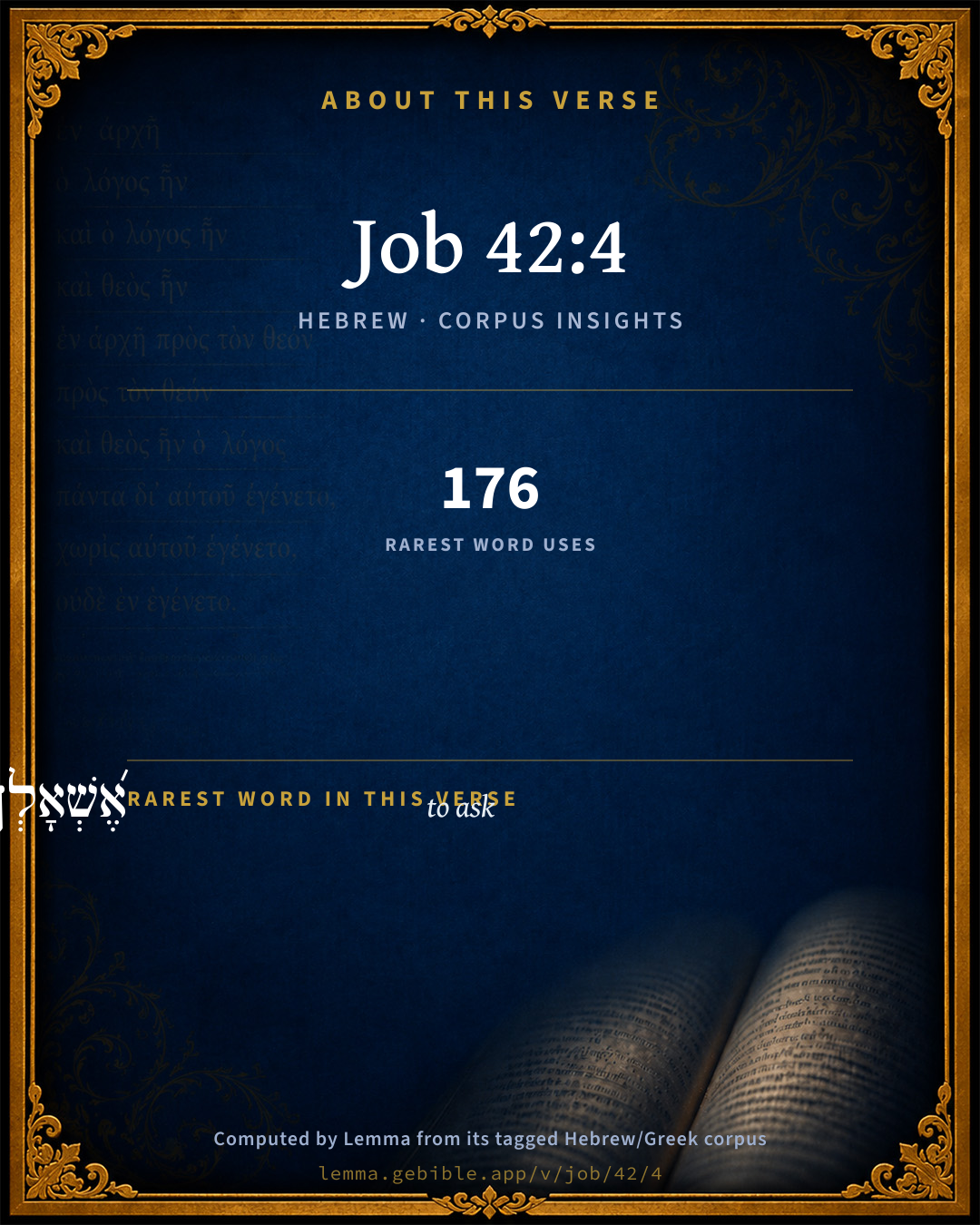
אֶ֝שְׁאָלְךָ֗
shâʼal
H7592
“to ask · you”
Verb, Qal, Imperfect, 1st Person, Common, Singular + Suffix, Personal, 2nd Person, Masculine, Singular
Part of Speech
Verb
Stem
Qal
Form
Imperfect
Person
1st Person
Gender
Common
Number
Singular
Full BDB Definition

Origin: a primitive root

TWOT: 2303

to ask, enquire, borrow, beg - (Qal) - to ask, ask for - to ask (as a favour), borrow - to enquire, enquire of - to enquire of, consult (of deity, oracle) - to seek - (Niphal) to ask for oneself, ask leave of absence - (Piel) - to enquire, enquire carefully - to beg, practise beggary - (Hiphil) - to be given on request - to grant, make over to, let (one) ask (successfully) or give or lend on request (then) grant or make over to
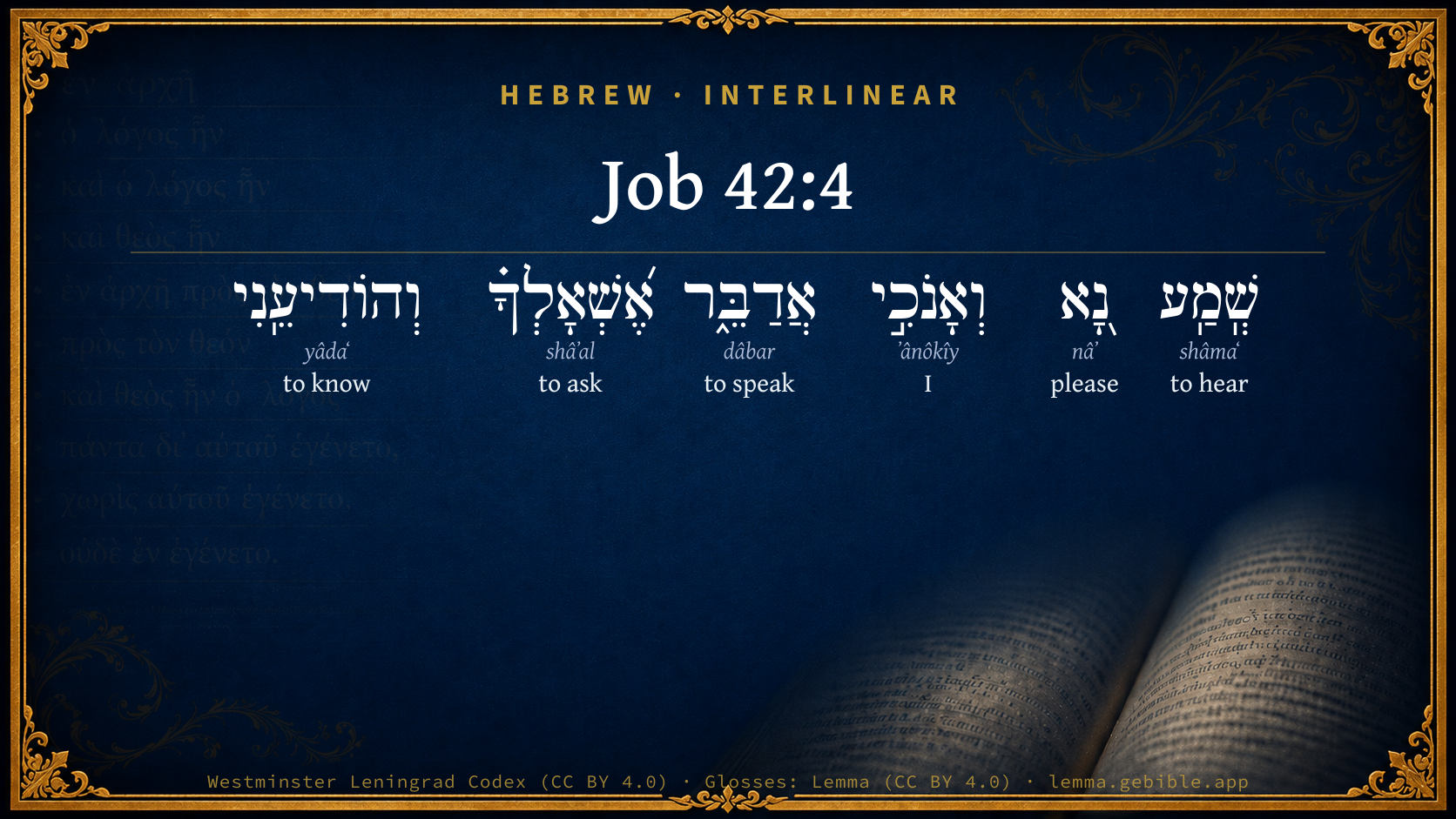
  1. שְֽׁמַֽע shâmaʻ H8085 “hear” Verb, Qal, Imperative, 2nd Person, Masculine, Singular
  2. נָ֭א nâʼ H4994 “please” Particle, Exhortation
  3. וְאָנֹכִ֣י ʼânôkîy H595 “and · I” Conjunction + Pronoun, Personal, 1st Person, Common, Singular
  4. אֲדַבֵּ֑ר dâbar H1696 “to speak” Verb, Piel, Imperfect, 1st Person, Common, Singular
  5. וְהוֹדִיעֵֽנִי yâdaʻ H3045 “and · know · me” Conjunction + Verb, Hiphil, Imperative, 2nd Person, Masculine, Singular + Suffix, Personal, 1st Person, Common, Singular

About this verse

These counts appear in no published source. They are computed here, from the morphology-tagged text and Lemma’s own curated glosses. What Lemma adds →

6
words
6
distinct lemmas
Wisdom
section

Grammatical profile

  • 4 verbs
  • 1 pronoun
  • 1 particle

Verb forms

  • שְֽׁמַֽע Qal · Imperative
  • אֲדַבֵּ֑ר Piel · Imperfect
  • אֶ֝שְׁאָלְךָ֗ Qal · Imperfect
  • וְהוֹדִיעֵֽנִי Hiphil · Imperative

Hebrew & Septuagint length

In English translation the verse runs 17 words from the Hebrew and 20 from the Septuagint (LXX English) — closely comparable.

A rough comparison of the two English renderings, which tokenize alike — not a word-level alignment.

Word counts can differ between the Hebrew and the Greek without any difference in meaning — e.g. the Hebrew direct-object marker אֵת has no separate Greek word, and Greek often adds the article ὁ.

Cross-references

4

Topical passages linked to Job 42:4 in the Treasury of Scripture Knowledge — connected by theme and wording, ordered by reader-vote popularity; previews shown in the World English Bible.

  • Job 40:7 "Now brace yourself like a man. I will question you, and you will answer me.
  • Job 38:3 Brace yourself like a man, For I will question you, then you answer me!
  • Genesis 18:30–32 He said, "Oh don't let the Lord be angry, and I will speak. What if there are thirty found there?" He said, "I will not do it, if I find thirty there."
  • Genesis 18:27 Abraham answered, "See now, I have taken it on myself to speak to the Lord, who am but dust and ashes.

Cross-references courtesy of OpenBible.info (CC BY 4.0).

Hebrew and Greek witnesses Masoretic Hebrew ↔ Greek Septuagint

The same verse in the two great witnesses to the Old Testament, shown verse-for-verse.

These are two independent witnesses, not word-aligned to each other, and the Septuagint is shown in lemma (dictionary) form.

Hebrew Job 42:4 Masoretic · Westminster Leningrad Codex

שְֽׁמַֽע נָ֭א וְאָנֹכִ֣י אֲדַבֵּ֑ר אֶ֝שְׁאָלְךָ֗ וְהוֹדִיעֵֽנִי

You said, 'Listen, now, and I will speak; I will question you, and you will answer me.'

World English Bible · Public Domain

Greek LXX Job 42:4 Septuagint · lemma form

ἀκούω δέ ἐγώ κύριος ἵνα καΐἐγώ λαλέω ἐρωτάω δέ σύ σύ δέ ἐγώ διδάσκω

But hear me, O Lord, that I also may speak: and I will ask you, and do you teach me.

LXX2012 (modern English Septuagint) · Public Domain

Hebrew: Westminster Leningrad Codex (CC BY 4.0). Greek: Septuagint (public domain); English from LXX2012 (modern English Septuagint) (Public Domain). How the Septuagint differs from the Hebrew →

Commentary

Notes on Job 42:4 from classic Christian and Jewish commentators (each source and its license shown beneath its notes). The classic Christian expositions comment on the surrounding passage and are grouped to its opening verse, so a note may address several verses; the Jewish commentaries on the Tanakh (Rashi and others) are per-verse, so they appear only where the commentator wrote on this verse.

Lemma curates 59 commentaries, every one of them public domain or Creative Commons licensed, each selected and text-cleaned for this edition rather than reprinted as found. About our sources →

The Cambridge Bible for Schools and Colleges

gen. ed. J. J. S. Perowne

4. hear, I beseech thee] Or, hear now, and I will speak. The words are not an entreaty on the part of Job that the Almighty would further instruct him; they are a repetition of the words of the Lord (ch. Job_38:3, Job_40:7). The verse is closely connected with Job_42:5, which suggests under what feeling Job repeats the words of God to him. He recites the divine challenge and puts it away from him—“Declare unto thee! (Job_42:4) that be far from me; I had heard of thee with the hearing of the ear, but now mine eye seeth thee” (Job_42:5). This is more natural than to suppose Job_42:4 uttered with a kind of self-irony, as if Job, in repeating the words of the divine challenge, also entered into the ironical spirit of it. In either case Job_42:5 has a half-apologetic meaning, accounting for Job’s former rashness.

The Cambridge Bible for Schools and Colleges (gen. ed. J. J. S. Perowne; Cambridge University Press, 1878–1918) — public domain. Text from a community e-Sword module.

Trapp's Complete Commentary

John Trapp

Job 42:4 Hear, I beseech thee, and I will speak: I will demand of thee, and declare thou unto me.

Ver. 4. Hear, I beseech thee, and I will speak] We have had his confession; follow now his petition here, his humiliation and reformation, Job 42:6. These are the parts and properties of true repentance, that fair daughter of a foul mother, sin. But had not Job promised to speak no more, to proceed no farther? Job 40:4-5. How then doth he say here, I beseech, and I will speak? The answer is easy; he would speak no more so rashly and unadvisedly as he had done, to God’s dishonour, and the offence of his best friends. But he would not spare to speak supplications, as here, and to set forth his humble docility, to give glory to God, and to take shame to himself, &c.; such a silence he knew would be sinful, and savour of a dumb devil. He therefore addresseth himself to God, 1. For audience and acceptance; 2. For advice and direction. In all which he renounceth his own wisdom, and delivereth himself up wholly to God, to be taught and led into all truth and holiness. The matter, we see, is well amended with Job, since, challenging God into the schools, he once said, "Then call thou me, and I will answer; or let me speak, and answer thou me," Job 13:22. So afterwards Peter, when penitent, turned his crowing into crying; and Paul, his breathing out threatenings against the saints, into "Lord, what wilt thou have me to do?" Act 9:1; Act 9:6.

I will demand of thee, and declare thou unto me] As a dutiful and docible scholar, who should be Zητητικος, I will ask thee questions, and hang upon thy holy lips for an answer.

John Trapp, A Commentary or Exposition upon All the Books of the Old and New Testament (1647–1656) — public domain. Text from a community e-Sword module.

Joseph Benson's Commentary

Job 42:4. Hear, I beseech thee — Hear and accept my humble and penitent confession. I will demand of thee — Hebrew, אשׁאלךְ, eshaleka, interrogabo te, I will inquire, ask, or make my petition to thee. I will no more dispute the matter with thee, but beg information from thee. The words which God had uttered to Job by way of challenge, Job returns to him in the way of submission.

Joseph Benson's Commentary on the Old and New Testaments (1811–1818) — public domain. Text from a community e-Sword module.

Geneva Bible (1599)

Geneva Bible translators

He showeth that he will be God’s scholar to learn of him.

Geneva Bible (1599) marginal notes — public domain. Text via Bolls.life.

Jamieson, Fausset & Brown

Robert Jamieson, A. R. Fausset & David Brown

When I said, "Hear," &c., Job's demand (Job 13:22) convicted him of being "without knowledge." God alone could speak thus to Job, not Job to God: therefore he quotes again God's words as the groundwork of retracting his own foolish words.

Jamieson, Fausset & Brown — Commentary Critical and Explanatory on the Whole Bible (1871) — public domain (CC PDM 1.0). Text via the HelloAO Bible API.

Ellicott's Commentary for English Readers

(4) Hear, I beseech thee.—This cannot in like manner be appropriately assigned to Job, but, as in Job_38:3; Job_40:7, must be referred to God; then the confession of Job_42:5-6 comes in very grandly. How much of our knowledge of God is merely hearsay? and it is not till the experimental teaching of the Holy Ghost has revealed God to our consciences that we really see Him with the inward eye. The confession of Job, therefore, is the confession of every converted man. Compare in a much later and very different, and yet analogous sphere, the confession of St. Paul (Gal_1:16).

A Bible Commentary for English Readers, edited by Charles John Ellicott (1878–1897) — public domain. Text from a community e-Sword module.

John Gill's Exposition

I have heard of thee by the hearing of the ear,.... From his ancestors, who in a traditionary way had handed down from one to another what they knew of God, his will and worship, his works and ways; and from those who had the care of his education, parents and tutors, who had instilled the principles of religion, and the knowledge of divine things, into him very early; and from such as might instruct in matters of religion in a public manner; and both by ordinary and extraordinary revelation made unto him, as was sometimes granted to men in that age in which Job lived; see Job 4:16. Though he had heard more of God through his speaking to him out of the whirlwind than ever he did before, to which he had attentively listened; and the phrase, hearing by or with the hearing of the ear, denotes close attention; see Eze 44:5;

but now mine eye seeth thee; thy Shechinah, as Jarchi; thy divine glory and Majesty; the Logos, the Word or Son of God, who now appeared in an human form, and spake to Job out of the whirlwind; and whom he saw with the eyes of his body, as several of the patriarchs had seen him, and which is the sense of an ancient writer (n); though no doubt he saw him also with the eyes of his understanding, and had a clearer sight of his living Redeemer, the Messiah, than ever he had before; and saw more of God in Christ, of his nature, perfections, and glory, than ever he had as yet seen; and what he had heard of him came greatly short of what he now saw; particularly he had a more clear and distinct view of the sovereignty, wisdom, goodness, and justice of God in the dealings of his providence with the children of men, and with himself, to which now he humbly submitted.

(n) Euseb. Demonstr. Evangel. l. 1. c. 5. p. 11.

John Gill's Exposition of the Whole Bible (1746–1763) — public domain (CC PDM 1.0). Text via the HelloAO Bible API.

Albert Barnes' Notes on the Bible

Hear, I beseech thee, and I will speak - This is the language of humble, docile submission. On former occasions he had spoken confidently and boldly of God; he had called in question the equity of his dealings with him; he had demanded that he might be permitted to carry his cause before him, and argue it there himself; Notes, Job 13:3, and notes Job 13:20-22. Now he is wholly changed. His is the submissive language of a docile child, and he begs to be permitted to sit down before God, and humbly to inquire of him what was truth. “This is true religion.”

I will demand of thee - Or rather, “I will ask of thee.” The word “demand” implies more than there is of necessity in the original word (שׁאל shâ'al). That means simply “to ask,” and it may be done with the deepest humility and desire of instruction. That was now the temper of Job.

And declare thou unto me - Job was not now disposed to debate the matter, or to enter into a controversy with God. He was willing to sit down and receive instruction from God, and earnestly desired that he would “teach” him of his ways. It should be added, that very respectable critics suppose that in this verse Job designs to make confession of the impropriety of his language on former occasions, in the presumptuous and irreverent manner in which he had demanded a trial of argument with God. It would then require to be rendered as a quotation from his own words formerly.

“I have indeed uttered what I understood not,

Things too wonderful for me, which I know not,

(When I said) Hear now, I will speak,

I will demand of thee, and do thou teach me”

This is adopted by Umbreit, and has much in its favor that is plausible; but on the whole the usual interpretation seems to be most simple and proper.

Albert Barnes' Notes on the Bible (1834–1885) — public domain. Text from a community e-Sword/MySword module.

Matthew Poole's English Annotations

Hear and accept my humble and penitent confession and recantation.

I will demand of thee; or, and inquire, to wit, counsel or instruction, as a scholar doth of his master, as the following words note. I will no more saucily dispute the matter with thee, but beg information from thee. The words which God had uttered to Job by way of challenge, Job 38:3; 40:7, Job returns to him again in way of submission.

Matthew Poole's English Annotations on the Holy Bible (1683–1685) — public domain. Text from a community e-Sword/MySword module.

Whedon's Commentary on the Bible

Daniel D. Whedon

4. Hear, I beseech… declare thou unto me — הודיעני. Literally, make me to know. This verse cites the words of God, (Job_38:3; Job_40:7,) showing the profound impression they had made upon Job. Umbreit and Hitzig, on the other hand, against most commentators, represent Job as reproducing the substance of his own foolish demands of God. “Job’s want of understanding,” says the former, “was shown by this demand addressed to God. God alone could thus speak to Job, but not Job to him.” Such an interpretation loses its force upon a proper view of the last word, hodhi’heni, “make me to know;” or, “declare thou unto me.” Job is not “anxious to put questions to Jehovah in order to penetrate deeper into the knowledge of the divine power and wisdom:” (thus Delitzsch.) On the contrary, he would sit docile at the feet of the Almighty. True contrition is always attended with a teachable disposition. The proud Saul, arrested of God, is ready to go anywhere to be taught by God. (Act_9:6.)

Daniel D. Whedon (gen. ed.), Commentary on the Old and New Testaments (1874–1909) — public domain. Text from a community e-Sword module.

The Pulpit Commentary

Hear, I beseech thee, and I will speak; I will demand of thee, and declare thou unto me, Job refers to God"s words in Job_38:3 and Job_40:7, and realizes the humbling effect which they had had on him. They made him feel how little he knew on the subject of God"s works and ways, and how little competent he was to judge them. Hence he bursts into the confession

The Pulpit Commentary (1880–1919), ed. H.D.M. Spence-Jones & Joseph S. Exell — public domain. Text from a community e-Sword module.

John Wesley's Explanatory Notes

Hear - Hear and accept my humble confession. Inquire - I will no more dispute the matter with thee, but beg information from thee. The words which God had uttered to Job by way of challenge, Job returns to him in way of submission.

John Wesley, Explanatory Notes Upon the Whole Bible (1754–1765) — public domain. Text via the GEBible commentary corpus.

unfoldingWord translationNotes

Door43 World Missions Community

but now my eye sees you

The eyes represent seeing, and seeing represents understanding. AT: "but now I really understand you" (See: Metaphor)

despise myself

Job's self is a metonym for what he said. AT: "I despise the things I said" (See: Metonymy)

despise

intensely dislike

I repent in dust and ashes

Sitting in dust and ashes is a symbolic act showing the person is sorry. (See: Symbolic Action)

translationWords

repent

unfoldingWord translationNotes — © Distant Shores Media and the Door43 World Missions Community, licensed CC BY-SA 4.0. Source: git.door43.org/Door43/en_tn.

Lesson kit

Teaching starters — assembled from the data on this page, not authored interpretation. Every prompt links to the verse data it draws on. Edit before teaching.

Job, in the Wisdom, opens this verse with 6 words (6 distinct Hebrew lemmas). Its most distinctive word is shâʼal (“to ask”). A historical commentator’s framing appears above. Read the whole chapter for the surrounding context.

Discussion questions

  1. How does “to ask” (shâʼal) shape what this verse is saying?
  2. How does Job 40:7, which shares this passage’s theme, read alongside this verse?
  3. The translations on this page render this verse differently — a whole-verse word diff, not a word-by-word alignment. What might account for the different wordings?
  4. «שְֽׁמַֽע» is a Qal Imperative verb. How does that grammatical form shape the action described?
  5. Compare how The Cambridge Bible for Schools and Colleges and Trapp's Complete Commentary read this verse. Where do they agree or differ?

Things to notice

Reading settings

Reading text

Shown beneath each verse's original-language words.

Old Testament
Old Testament edition

Read the OT as the Masoretic Hebrew (MT) or the Greek Septuagint (LXX).

English shown for the Greek Septuagint (in the Hebrew ↔ Greek comparison).

Comparing translations? Open the Compare panel on any verse page to stack up to four side by side.