Romans 12:7

Greek (Tischendorf 8th ed.) Romans 12:7 appears in the Greek New Testament. The text above is from the Tischendorf 8th edition. Each word links to its Strong’s number and a concise gloss. Click any word for its full Thayer’s Greek Lexicon entry.
Download image
Cite this verse

Romans 12:7 (World English Bible). Public Domain. Lemma interlinear Bible study tool, https://lemma.gebible.app/v/romans/12/7.

Show BibTeX & RIS
BibTeX
RIS
English Translation
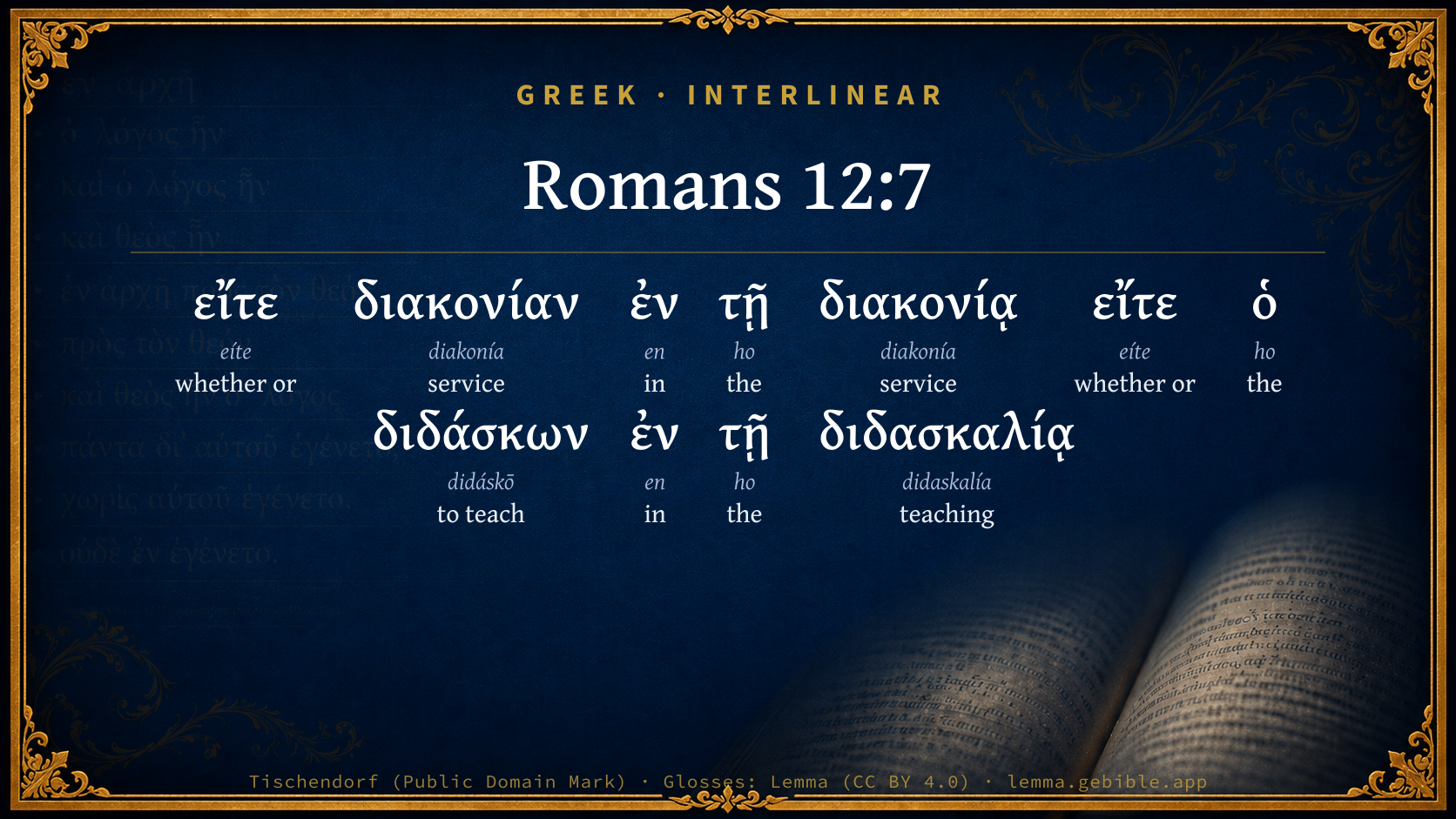
or service, let us give ourselves to service; or he who teaches, to his teaching;
World English Bible · Public Domain
Download a study sheet

One document with this verse’s original text, its word-by-word gloss line, the meaning frame, cross-references with their text, attributed commentary, and full source and license credits — printable, and it pastes into notes with its structure intact.

This verse Autodidact and up

Study sheet (.html) Plain text (.txt)

A passage Seminary Student

Up to 50 verses in one chapter. A passage sheet keeps up to 6 commentary sources and 12 cross-references per verse, in the order this page ranks them, and says so on the sheet whenever that leaves anything out. Ask for a single verse and you get the Autodidact verse sheet above.

Everything on this page stays free to read, with no account — the sheet is a download of what is already on screen, not access to it.

Want to remove ads? Support Godless Engineer
Compare translations 3

The same verse in 3 English versions, stacked beneath the original-language interlinear above. Click any original word for its lexicon entry.

Each is an independent rendering of the whole verse — the interlinear is not word-aligned to these translations.

Highlighted words mark where these versions differ — a whole-verse word diff, not a word-by-word alignment.

  • World English Bible Public Domain
    or service, let us give ourselves to service; or he who teaches, to his teaching;
  • King James Version Public Domain
    Or ministry, let us wait on our ministering: or he that teacheth, on teaching;
  • unfoldingWord Literal Text CC BY-SA 4.0
    if service, in the service; if the one teaching, in the teaching;

unfoldingWord Literal Text — © unfoldingWord, licensed CC BY-SA 4.0. Word-aligned USFM3 via Door43 (git.door43.org/unfoldingWord/en_ult).

Versions to compare (up to 4)

3 of 4 selected

Show all 19 translations

Every available English version of this verse, each an independent rendering of the whole verse.

  • World English Bible Public Domain
    or service, let us give ourselves to service; or he who teaches, to his teaching;
  • Berean Standard Bible Public Domain
    if it is serving, let him serve; if it is teaching, let him teach;
  • Majority Standard Bible Public Domain
    if it is serving, let him serve; if it is teaching, let him teach;
  • King James Version Public Domain
    Or ministry, let us wait on our ministering: or he that teacheth, on teaching;
  • American Standard Version (1901) Public Domain
    or ministry, `let us give ourselves' to our ministry; or he that teacheth, to his teaching;
  • Revised Version (1885) Public Domain
    or ministry, let us give ourselves to our ministry; or he that teacheth, to his teaching;
  • Geneva Bible (1599) Public Domain
    Or an office, let vs waite on the office: or he that teacheth, on teaching:
  • Douay-Rheims (1899) Public Domain
    Or ministry, in ministering; or he that teacheth, in doctrine;
  • Young's Literal Translation Public Domain
    or ministration -- `In the ministration!' or he who is teaching -- `In the teaching!'
  • Literal Standard Version CC BY-SA 4.0
    or ministry, in the ministry; or he who is teaching, in the teaching;
  • Unlocked Literal Bible CC BY-SA 4.0
    If one's gift is service, let him serve. If one has the gift of teaching, let him teach.
  • unfoldingWord Literal Text CC BY-SA 4.0
    if service, in the service; if the one teaching, in the teaching;
  • Darby Bible Public Domain
    or service, [let us occupy ourselves] in service; or he that teaches, in teaching;
  • World Messianic Bible Public Domain
    or service, let’s give ourselves to service; or he who teaches, to his teaching;
  • Webster's Bible Public Domain
    Or ministry, let us wait on our ministering: or he that teacheth, on teaching:
  • Free Bible Version CC BY-SA 4.0
    If it's the ministry of service then you should serve; if teaching then you should teach;
  • Bible in Basic English Public Domain
    Or the position of a Deacon of the church, let a man give himself to it; or he who has the power of teaching, let him make use of it;
  • Text-Critical English NT CC BY 4.0
    if it is service, he should serve; if it is teaching, he should teach;
  • Tyndale New Testament (1534) Public Domain
    Let him that hath an office wayte on his office. Let him that teacheth take hede to his doctrine.

Literal Standard Version (2020), Covenant Press — licensed CC BY-SA 4.0. Text via the HelloAO Bible API (eBible.org). Unlocked Literal Bible (unfoldingWord) — licensed CC BY-SA 4.0. Text via the HelloAO Bible API (eBible.org). unfoldingWord Literal Text — © unfoldingWord, licensed CC BY-SA 4.0. Word-aligned USFM3 via Door43 (git.door43.org/unfoldingWord/en_ult). Free Bible Version, Dr. Jonathan Gallagher — licensed CC BY-SA 4.0. Text via the HelloAO Bible API (eBible.org).

Word by word

More ways to search: Search by grammar → Find every occurrence → Compare this word →

Practice this passage: Drill this verse → Learn its vocabulary →

About this verse

These counts appear in no published source. They are computed here, from the morphology-tagged text and Lemma’s own curated glosses. What Lemma adds →

11
words
6
distinct lemmas
Pauline Epistles
section

Notable vocabulary

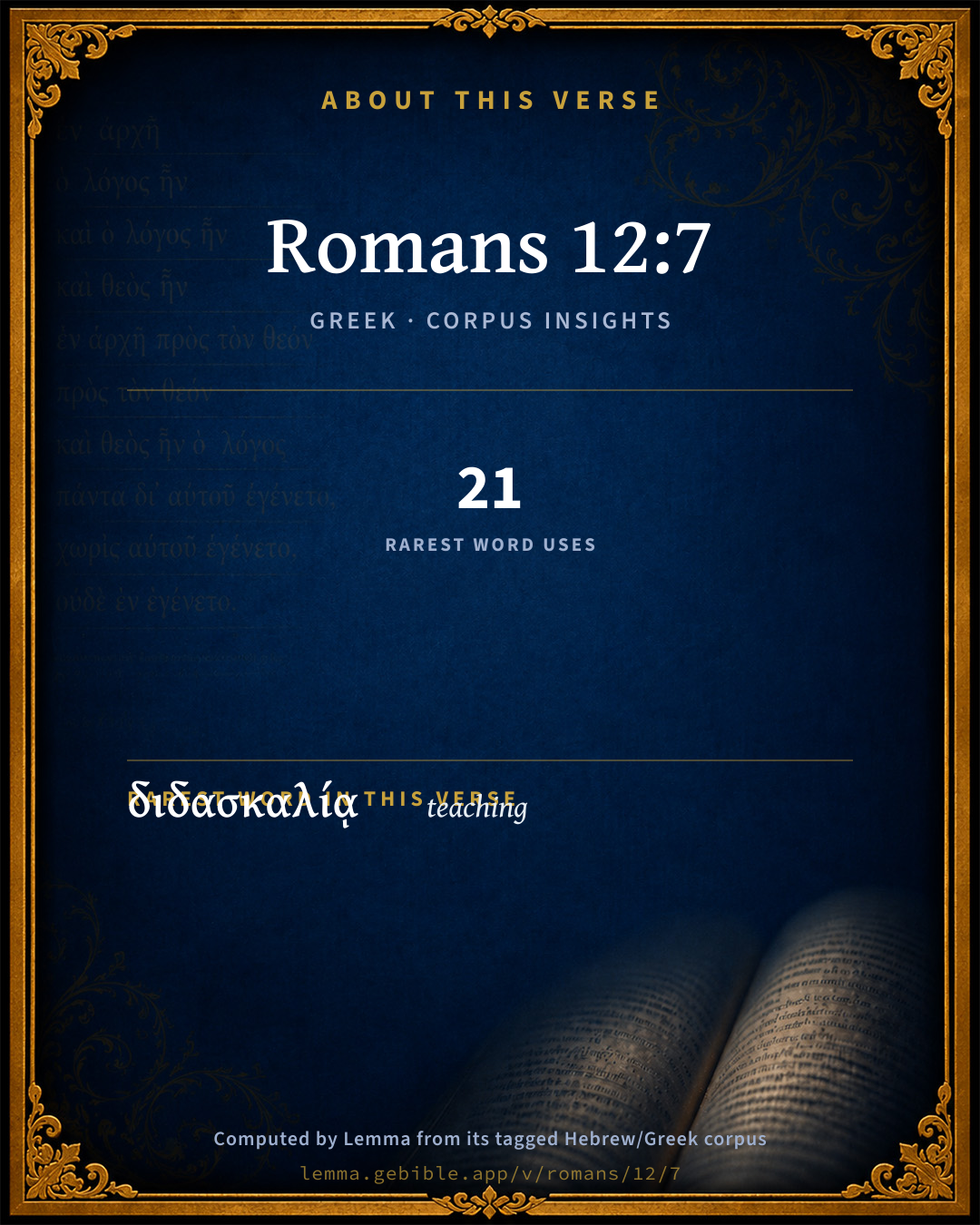
The rarest word here is διδασκαλίᾳ teaching G1319 — appearing just 21 times in the whole Greek New Testament.

Shared distinctive vocabulary

διδασκαλίᾳ teaching G1319 occurs in 21 verses of the Greek New Testament. Also found in:

Repetition

Words recur within this verse:

  • εἴτε whether or G1535 ×2
  • διακονίαν service G1248 ×2
  • τῇ the G3588 ×3
  • ἐν in G1722 ×2

Cross-references

29

Topical passages linked to Romans 12:7 in the Treasury of Scripture Knowledge — connected by theme and wording, ordered by reader-vote popularity; previews shown in the World English Bible.

  • Acts 13:1 Now in the assembly that was at Antioch there were some prophets and teachers: Barnabas, Simeon who was called Niger, Lucius of Cyrene, Manaen the foster-brother of Herod the tetrarch, and Saul.
  • Ephesians 4:11 He gave some to be apostles; and some, prophets; and some, evangelists; and some, shepherds and teachers;
  • 1 Timothy 5:17 Let the elders who rule well be counted worthy of double honor, especially those who labor in the word and in teaching.
  • 2 Timothy 4:2 preach the word; be urgent in season and out of season; reprove, rebuke, and exhort, with all patience and teaching.
  • Psalms 34:11 Come, you children, listen to me. I will teach you the fear of Yahweh.
  • Psalms 51:13 Then I will teach transgressors your ways. Sinners shall be converted to you.
  • Ezekiel 3:17–21 Son of man, I have made you a watchman to the house of Israel: therefore hear the word at my mouth, and give them warning from me.
  • Matthew 24:45–47 "Who then is the faithful and wise servant, whom his lord has set over his household, to give them their food in due season?
  • Matthew 28:19 Therefore go, and make disciples of all nations, baptizing them in the name of the Father and of the Son and of the Holy Spirit,
  • Luke 12:42–44 The Lord said, "Who then is the faithful and wise steward, whom his lord will set over his household, to give them their portion of food at the right times?
  • Acts 20:28 Take heed, therefore, to yourselves, and to all the flock, in which the Holy Spirit has made you overseers, to shepherd the assembly of the Lord and God which he purchased with his own blood.
  • Galatians 6:6 But let him who is taught in the word share all good things with him who teaches.
  • Colossians 1:28–29 whom we proclaim, admonishing every man and teaching every man in all wisdom, that we may present every man perfect in Christ Jesus;
  • Colossians 4:17 Tell Archippus, "Take heed to the ministry which you have received in the Lord, that you fulfill it."
  • 1 Timothy 2:7 to which I was appointed a preacher and an apostle (I am telling the truth in Christ, not lying), a teacher of the Gentiles in faith and truth.
  • 1 Timothy 3:2 The overseer therefore must be without reproach, the husband of one wife, temperate, sensible, modest, hospitable, good at teaching;
  • 1 Timothy 4:16 Pay attention to yourself, and to your teaching. Continue in these things, for in doing this you will save both yourself and those who hear you.
  • 2 Timothy 2:2 The things which you have heard from me among many witnesses, commit the same to faithful men, who will be able to teach others also.
  • 2 Timothy 2:24 The Lord's servant must not quarrel, but be gentle towards all, able to teach, patient,
  • Deuteronomy 33:10 They shall teach Jacob your ordinances, Israel your law: They shall put incense before you, Whole burnt offering on your altar.
  • 1 Samuel 12:23 Moreover as for me, far be it from me that I should sin against Yahweh in ceasing to pray for you: but I will instruct you in the good and the right way.
  • Ecclesiastes 12:9 Further, because the Preacher was wise, he still taught the people knowledge. Yes, he pondered, sought out, and set in order many proverbs.
  • Isaiah 21:8 He cried as a lion: Lord, I stand continually on the watch-tower in the day-time, and am set in my ward whole nights;
  • Ezekiel 33:7–9 So you, son of man, I have set you a watchman to the house of Israel; therefore hear the word at my mouth, and give them warning from me.
  • John 3:2 The same came to him by night, and said to him, "Rabbi, we know that you are a teacher come from God, for no one can do these signs that you do, unless God is with him."
  • Acts 6:1 Now in those days, when the number of the disciples was multiplying, a complaint arose from the Grecian Jews against the Hebrews because their widows were neglected in the daily service.
  • Acts 20:20 how I didn't shrink from declaring to you anything that was profitable, teaching you publicly and from house to house,
  • 1 Corinthians 12:28 God has set some in the assembly: first apostles, second prophets, third teachers, then miracle workers, then gifts of healings, helps, governments, and various kinds of languages.
  • 1 Peter 5:1–4 I exhort the elders among you, as a fellow elder, and a witness of the sufferings of Christ, and who will also share in the glory that will be revealed.

Cross-references courtesy of OpenBible.info (CC BY 4.0).

Commentary

Notes on Romans 12:7 from classic Christian and Jewish commentators (each source and its license shown beneath its notes). The classic Christian expositions comment on the surrounding passage and are grouped to its opening verse, so a note may address several verses; the Jewish commentaries on the Tanakh (Rashi and others) are per-verse, so they appear only where the commentator wrote on this verse.

Lemma curates 59 commentaries, every one of them public domain or Creative Commons licensed, each selected and text-cleaned for this edition rather than reprinted as found. About our sources →

Tyndale Open Study Notes

Tyndale Open Resources

12:7 teacher: The gift of teaching comes third in the list of gifts in 1 Cor 12:28 and fifth in Eph 4:11. While prophets communicate to the community a message received directly from God, teachers address the church on the basis of studying the word of God.

Tyndale Open Study Notes — © Tyndale Open Resources, licensed CC BY-SA 4.0. Text via the HelloAO Bible API.

Bengel's Gnomon

Johann Albrecht Bengel

Rom 12:7. Εἴτε, or) This word is thrice repeated by the figure Ploce [end.] Do, what thou art doing, in earnest, in order that the reality may correspond to [keep] its own name [that what you do, may correspond to what you profess to do], Ecc 9:10. The principle of the subsequent sentiments is the same.[131]

[131] Ἐν τῇ διακονίᾳ, on the ministry) Let not the minister assume too much to himself and after all not fully discharge his duty.—V. g.

Bengel's Gnomon of the New Testament — English translation (T&T Clark, Edinburgh, 1860) — public domain. Text from a community e-Sword module.

Hodge's Commentary on Romans, Ephesians & First Corinthians

Charles Hodge

Rom_12:7

Or ministry, let us wait on our ministering; or he that teacheth, on teaching. The terms minister and ministry (διάκονος; and διακονία, deacon and deaconship) are used in the New Testament both in a general and a restricted sense. In the former, they are employed in reference to all classes of ecclesiastical officers, even the apostles; see 1Co_3:5; 2Co_6:4; Eph_3:7; Eph_6:21; Col_1:7, Col_1:23; 1Ti_4:6; Act_1:17, Act_1:25; Act_20:24; Rom_11:13; 1Co_12:5; 2Co_4:1, etc. In the latter, they are used in reference to a particular class of officers, to whom were committed the management of the external affairs of the church, the care of the poor, attention to the sick, etc.; see Act_6:1-3; Phi_1:1; 1Ti_3:8-13, etc. It is doubtful in which of these senses the latter of the above-mentioned words is here used by the apostle, most probably in the restricted sense. The apostle exhorts different classes of officers to attend to their own peculiar vocation, and to exercise their own gifts, without intruding into the sphere of others, or envying their superior endowments. The deacons, therefore, were to attend to the poor and the sick, and not attempt to exercise the office of teachers. Luther, and many others, give the words their wide sense. Hat jemand ein Amt, so warte er des Amtes: If a man has an office, let him attend to it. But this would render unnecessary the specifications which follow. The apostle, in this context, refers to definite ecclesiastical offices in connection with ordinary Christian duties. That is, he exhorts both church officers and private Christians.

He that teacheth, on teaching. Teachers are elsewhere expressly distinguished from prophets, 1Co_12:28, 1Co_12:29 : God hath set some in the church: first, apostles; secondarily, prophets; thirdly, teachers. Are all apostles? are all prophets? are all teachers? are all workers of miracles? And in this passage they are not to be confounded, nor is teaching to be regarded, in this place, as one part of prophesying. As remarked above on Rom_12:6, the teachers were distinguished from prophets, inasmuch as the former were not necessarily inspired, and were a regular and permanent class of officers. Those who had the gift of prophecy were to exercise it aright; those who were called to the office of deacons, were to devote themselves to their appropriate duties; and those who had the gift of teaching were to teach.

Charles Hodge — Commentary on Romans (1835), First Corinthians (1857), and Ephesians (1856) — public domain. Text from a community e-Sword module.

Geneva Bible (1599)

Geneva Bible translators

Whose office only is to expound the Scriptures.

Geneva Bible (1599) marginal notes — public domain. Text via Bolls.life.

Jamieson, Fausset & Brown

Robert Jamieson, A. R. Fausset & David Brown

Or ministry, let us wait on--"be occupied with."

our ministering--The word here used imports any kind of service, from the dispensing of the word of life (Act 6:4) to the administering of the temporal affairs of the Church (Act 6:1-3). The latter seems intended here, being distinguished from "prophesying," "teaching," and "exhorting."

or he that teacheth--Teachers are expressly distinguished from prophets, and put after them, as exercising a lower function (Act 13:1; Co1 12:28-29). Probably it consisted mainly in opening up the evangelical bearings of Old Testament Scripture; and it was in this department apparently that Apollos showed his power and eloquence (Act 18:24).

Jamieson, Fausset & Brown — Commentary Critical and Explanatory on the Whole Bible (1871) — public domain (CC PDM 1.0). Text via the HelloAO Bible API.

Adam Clarke's Commentary

Verse 7. Or ministry] διακονια simply means the office of a deacon; and what this office was, see in Clarke's note on "Ac 6:4", where the subject is largely discussed.

Or he that teacheth] The teacher, διδασκαλος, was a person whose office it was to instruct others, who thereby catechizing, or simply explaining the grand truths of Christianity.

Adam Clarke's Commentary on the Bible (1810–1826) — public domain. Text from a community e-Sword/MySword module.

Ellicott's Commentary for English Readers

(7) Ministry.—The word used is the technical term for the discharge of the office of deacon. The institution of this office is described in Act_6:1-5. Its object was to provide for the practical business as opposed to the spiritual ministrations of the Church. It included more especially the distribution of alms and the care of the poor, the sick, widows, etc. The functions of the diaconate are called “serving tables” (i.e., in the literal sense, “providing food” for those who needed it) in Act_6:2-3, and “helps” in 1Co_12:28.

Let us wait on . . .—These words are supplied in the English, “Let us be absorbed in, devoted to, our ministering.”

He that teacheth.—Comp. 1Co_12:28; Eph_4:11; 1Ti_5:17. It would seem from the first of these passages (“thirdly teachers”) that teaching was considered as a special office, though not, perhaps, confined to special persons.

A Bible Commentary for English Readers, edited by Charles John Ellicott (1878–1897) — public domain. Text from a community e-Sword module.

The Cambridge Bible for Schools and Colleges

gen. ed. J. J. S. Perowne

7. ministry—ministering] Lit. whether service, in the service. The word rendered “ministry” is diaconia; (same word as Rom_11:13, where it means the apostolic service). It is a largely inclusive word; the main fixed idea being that of active, “practical,” duty in the Church, of whatever kind or degree. Almost any work other than that of inspired utterance, or miracle-working, may be included in it here.—“In the service:”—i.e. “let us be really in it; devoted to it.” So “in the teaching,” “in the exhortation,” just below. In 1Ti_4:15, the Gr. rendered “Give thyself wholly to them,” is lit. “Be in these things.”

he that teacheth] In 1Co_12:28-29, (see too Eph_4:11,) “teachers” are mentioned as a class of commissioned workers in the Church. Perhaps they were specially the expositors of revealed truth; those who devoted themselves to explaining the application (to belief and practice) of the Scriptures and of the apostolic preaching.

on teaching] Lit. in the teaching. See last note but one.

The Cambridge Bible for Schools and Colleges (gen. ed. J. J. S. Perowne; Cambridge University Press, 1878–1918) — public domain. Text from a community e-Sword module.

John Gill's Exposition

Or ministry, let us wait on our ministry,.... The word sometimes signifies the whole ecclesiastical ministry, even the office of apostleship, as well as the ordinary ministration of the Gospel; see Act 1:17; but here "deaconship", or the office of ministering to the poor saints, as in Act 6:1, being a distinct office from prophesying: or preaching the word, and should be used, exercised, and attended to with diligence, care, and constancy; for such who are appointed to this office, are chosen not only to a place of honour, but of service and business, in which they should behave with prudence, sobriety, and humility:

or he that teacheth, on teaching. The gift of prophesying or preaching is subdivided into "teaching" and "exhorting"; the one belongs to "teachers" or doctors, the other to "pastors"; as the distinction is in Eph 4:11, not that different officers and offices are intended, but different branches of the same office; and one man's talent may lie more in the one, and another man's in the other; and accordingly each should in his preaching attend to the gift which is most peculiar to him: if his gift lies in teaching, let him constantly employ himself in that with all sobriety and "teaching" does not design an office in the school, but in the church; it is not teaching divinity as men teach logic, rhetoric, and other arts and sciences, in the schools; but an instructing of churches and the members thereof in the doctrines of the Gospel, in order to establish and build them up in their most holy faith; see Co1 12:28; it chiefly lies in a doctrinal way of preaching, in opening, explaining, and defending the doctrines of Christ, as distinct from the practical part of the ministry of the word, and the administration of ordinances, in which the pastor is employed as well as in this.

John Gill's Exposition of the Whole Bible (1746–1763) — public domain (CC PDM 1.0). Text via the HelloAO Bible API.

Trapp's Complete Commentary

John Trapp

7 Or ministry, let us wait on our ministering: or he that teacheth, on teaching;

Ver. 7. Or ministry] Take it either largely for the whole ministry, as 1Co 12:5; Act 1:24-26; or more strictly for the office of a deacon, as Act 6:1-6.

John Trapp, A Commentary or Exposition upon All the Books of the Old and New Testament (1647–1656) — public domain. Text from a community e-Sword module.

Albert Barnes' Notes on the Bible

Or ministry - διακονίαν diakonian. This word properly means service of any kind; Luk 10:40. It is used in religion to denote the service which is rendered to Christ as the Master. It is applied to all classes of ministers in the New Testament, as denoting their being the servants of Christ; and it is used particularly to denote that class who from this word were called deacons, that is, those who had the care of the poor, who provided for the sick, and who watched over the external matters of the church. In the following places it is used to denote the ministry, or service, which Paul and the other apostles rendered in their public work; Act 1:17, Act 1:25; Act 6:4; Act 12:25; Act 20:24; Act 21:19; Rom 11:13; Rom 15:31; 2Co 5:18; 2Co 6:3; Eph 4:12; 1Ti 1:12. In a few places this word is used to denote the function which the deacons fulfilled; Act 6:1; Act 11:29; 1Co 16:15; 2Co 11:8. In this sense the word “deacon” διάκονος diakonos is most commonly used, as denoting the function which was performed in providing for the poor and administering the alms of the church. It is not easy to say in what sense it is used here. I am inclined to the opinion that he did not refer to those who were appropriately called deacons, but to those engaged in the function of the ministry of the word; whose business it was to preach, and thus to serve the churches. In this sense the word is often used in the New Testament, and the connection seems to demand the same interpretation here.

On our ministering - Let us be wholly and diligently occupied in this. Let this be our great business, and let us give entire attention to it. Particularly the connection requires us to understand this as directing those who ministered not to aspire to the office and honors of those who prophesied. Let them not think of themselves more highly than they ought, but be engaged entirely in their own appropriate work.

He that teacheth - This word denotes those who instruct, or communicate knowledge. It is clear that it is used to denote a class of persons different, in some respects, from those who prophesied and from those who exhorted. But in what this difference consisted, is not clear. Teachers are mentioned in the New Testament in the grade next to the prophets; Act 13:1; 1Co 12:28-29; Eph 4:11. Perhaps the difference between the prophets, the ministers, the teachers, and the exhorters was this, that the first spake by inspiration; the second engaged in all the functions of the ministry properly so called, including the administration of the sacraments; the teachers were employed in communicating instruction simply, teaching the doctrines of religion, but without assuming the function of ministers; and the fourth exhorted, or entreated Christians to lead a holy life, without making it a particular subject to teach, and without pretending to administer the ordinances of religion.

The fact that teachers are so often mentioned in the New Testament, shows that they were a class by themselves. It may be worthy of remark that the churches in New England had, at first, a class of people who were called teachers. One was appointed to this office in every church, distinct from the pastor, whose proper business it was to instruct the congregation in the doctrines of religion. The same thing exists substantially now in most churches, in the appointment of Sunday school teachers, whose main business it is to instruct the children in the doctrines of the Christian religion. It is an office of great importance to the church; and the exhortation of the apostle may be applied to them: that they should be assiduous, constant, diligent their teaching; that they should confine themselves to their appropriate place; and should feel that their office is of great importance in the church of God; and remember that this is his arrangement, designed to promote the edification of his people.

Albert Barnes' Notes on the Bible (1834–1885) — public domain. Text from a community e-Sword/MySword module.

Matthew Poole's English Annotations

Ministry; under this word are comprehended all ordinary ecclesiastical functions, which afterwards divideth into two sorts; the first relating to the word; the second, to other pious works.

Let us wait on our ministering: the words, let us wait, are not in the text, but fitly supplied: q.d. Let all that be called to the office of the ministry be diligent in it, and attend to it: see Act 20:28; 1Pe 5:2.

Teaching, in the latter end of this verse, and exhortation, in the beginning of the next, are mentioned as the two great works of those that minister and labour in the word and doctrine. Some think they are distinct offices; see Eph 4:11; and that in the primitive church, where they had variety of ministers, some had the office of teachers, and chiefly exercised themselves in instructing their hearers in the principles of religion, in laying down sound doctrine and confuting of errors: others had the office of pastors, and attended chiefly to exhortation and admonition; pressing points of practice, and making application thereof. Others think that they are distinct gifts, but not diverse offices; some have a gift to teach that have none to exhort, and e contra. The apostle, Rom 12:6, calls them differing gifts: sometimes these two are found in the same persons, and they are excellently gifted both for teaching and exhorting.

Matthew Poole's English Annotations on the Holy Bible (1683–1685) — public domain. Text from a community e-Sword/MySword module.

Whedon's Commentary on the Bible

Daniel D. Whedon

7. Ministry—The Greek term from which deacon and deaconship are derived. (See note on Act_6:1.) The office, though not well defined, seems to include the performance of the secular and manual needs of the Church, though the individual was often endowed for higher functions and performed them.

Teacheth—As a catechist or expositor of Old Testament truths, or of the history and teachings of Jesus. (Luk_1:4.) The Sunday-school teacher of the present day fulfils very much the same duty.

And there is, we think, very good reason to suppose that Sunday was the day selected for much of the performance of the duty.

Daniel D. Whedon (gen. ed.), Commentary on the Old and New Testaments (1874–1909) — public domain. Text from a community e-Sword module.

John Wesley's Explanatory Notes

Ministering - As deacons. He that teacheth - Catechumens; for whom particular instructers were appointed. He that exhorteth - Whose peculiar business it was to urge Christians to duty, and to comfort them in trials.

John Wesley, Explanatory Notes Upon the Whole Bible (1754–1765) — public domain. Text via the GEBible commentary corpus.

Godbey's Commentary on the New Testament

William B. Godbey

7. “Whether the deaconate, in the deaconate.” In the constitution of the visible church, the deacon has charge of all the temporal interests, including ministerial support, care of the sanctuary and everything else, while at the same time he preaches and witnesses for God. Those who “stay by the stuff” receive just as much as those who go to the war. “Whether he that teacheth, in teaching.” The church is the school of Christ, where all the members are taught the Word of the Lord. God always raises up competent teachers for His people, that they may not be ignorant, but proficient in His blessed Word. At this point you can always see the line between the true and the fallen church, as you can not teach dead people. The popular churches of the present day have lost every trace of the didactic peculiarity of God’s church, so eminent and conspicuous in the apostolic age. An old ex-missionary from Bishop Taylor’s work in India told me that the heathen Hindus are better posted in the Scripture than the Christians in America, because they attend the Bible schools, which are constantly conducted seven days in the week in heathen lands. What an awful delinquency in the home church now rapidly heathenizing our own people!

William B. Godbey, Commentary on the New Testament (1896–1900) — public domain. Text from a community e-Sword module.

McGarvey & Pendleton's Commentaries

J. W. McGarvey

or ministry, let us give ourselves to our ministry; or he that teacheth, to his teaching [Most of the spiritual gifts of Paul's day were either wholly supernatural or shaded into the miraculous, and, as miracles have ceased, it becomes hard for us to-day to accurately define gifts which have passed away. "Ministry" (diakonia) is derived from the Greek word for deacon, and probably described such services as deacons ( Phi_1:1 ; Rom_16:1 ) then rendered. The order, "apostles, prophets, teachers, miracles, then gifts of hearings, helps, governments" ( 1Co_12:28 ), compared with the order here--viz., prophecy, ministry, teaching, exhorting, giving--suggests that miracles of healing may have been part of the ministry (comp. 1 Pet 4:11), as well as caring for the poor, serving tables, etc. ( Act_6:1-6 ; 1Ti_3:8-13 ). Teaching was probably much the same as that of to-day, only the teacher had to remember the verbal instruction of the apostles and prophets ( 2Th_2:15 ; 2Ti_1:13 ; 2Ti_2:2 ; 2Ti_3:10 ; 2 Tim 14) until the same was reduced to writing as we now have it in the Scriptures];

J. W. McGarvey (with Philip Y. Pendleton), Commentaries on the New Testament (The Fourfold Gospel, 1914; Acts; and the epistles) — public domain. Text from a community e-Sword/MySword module.

The People's New Testament

B. W. Johnson

7. Or ministry. If instead of prophecy, our gift be the more lowly one of ministering, let us give our time and attention to it. The word rendered “ministry” is Diakonia, “Deaconship,” service. Or he that teacheth. The work of an elder, or bishop, who must be “apt to teach.” If this was one's work, his soul must be put into it.

B. W. Johnson's The People's New Testament with Notes (1889–1891) — public domain. Electronic text from the Christian Classics Ethereal Library (CCEL) ThML edition.

Cambridge Greek Testament for Schools and Colleges

7. εἴτε διακονίαν κ.τ.λ. Sc. ὦμεν; cf. 1Ti 4:15, ἐν τούτοις ἴσθι; so with the next two clauses, thoroughness and devotion are insisted upon.

διακονίαν. The widest word for service, including the functions of apostles, prophets, etc., but here probably of personal service in the community; cf. Phoebe Rom 16:1. ἐν τῇ διακ., the special way of serving given to each.

ὁ διδάσκων. The change of form probably merely the result of instinctive literary feeling. The teacher is distinguished from the prophet (Act 13:1; 1Co 12:28; Eph 4:11) perhaps as expounding, elucidating and systematically imparting truth rather than discovering and declaring it. It is of course a distinction of functions not of persons. See above, Rom 12:6.

ἐν τῇ διδασκαλίᾳ. Cf. 1Ti 4:13; 1Ti 4:16. The act or practice of teaching, not the thing taught (so generally in the Pastoral Epp.).

Cambridge Greek Testament for Schools and Colleges (Cambridge University Press, 1896; 21 vols, various authors incl. Carr, Maclear, Plummer, Farrar, Lumby, Moule, M. R. James, Simcox) — public domain. Text from a community e-Sword module.

Alford’s Greek Testament

Henry Alford

7. διακονίαν] any subordinate ministration in the Church. In Act 6:1 and 4, we have the word applied both to the lower ministration, that of alms and food, and to the higher, the διακ. τοῦ λόγου, which belonged to the Apostles. But here it seems to be used in a more restricted sense, from its position as distinct from prophecy, teaching, exhortation, &c.

ἐν τῇ διακ.] Let us confine ourselves humbly and orderly to that kind of ministration to which God’s providence has appointed us, as profitable members of the body.

ὁ διδάσκων] The prophet spoke under immediate inspiration; the διδάσκαλος under inspiration working by the secondary instruments of his will and reason and rhetorical powers. Paul himself seems ordinarily, in his personal ministrations, to have used διδασκαλία. He is nowhere called a prophet, but appears as distinguished from them in several places: e.g. Act 11:27; Act 21:10, and apparently 13:1. Of course this does not affect the appearance of prophecies, commonly so called; in his writings. The inspired διδάσκαλος would speak, though not technically προφητείας, yet the mind of the Spirit in all things: not to mention that the apostolic office was one in dignity and fulness of inspiration far surpassing any of the subordinate ones, and in fact including them all.

ἐν τῇ διδασκαλίᾳ] as before: he is to teach in the sphere, within the bounds, of the teaching allotted to him by God,—or for which God has given him the faculty.

Henry Alford, The Greek Testament (1849–1861) — public domain. Text from a community e-Sword module.

International Critical Commentary

7. διακονίαν, ‘if we have the gift of ministry, let us use it in ministering to the community, and not attempt ambitiously to prophesy or exhort.’ διακονία was used either generally of all Christian ministrations (so Rom 11:13; 1Co 12:5; Eph 4:12, &c.) or specially of the administration of alms and attendance to bodily wants (1Co 16:15; 2Co 8:4, &c.). Here the opposition to προφητεία, διδασκαλία, παράκλησις seems to demand the more confined sense.

ὁ διδάσκων. St. Paul here substitutes a personal phrase because ἔχειν διδασκαλίαν would mean, not to impart, but to receive instruction.

International Critical Commentary — older volumes (1896–1929), various authors — public domain. Text from a community e-Sword module.

Vincent's Word Studies in the New Testament

Marvin R. Vincent

Ministering [διακονια] . Let us wait on is supplied. Lit., or ministry in our ministry. The word appears in the New Testament always in connection with the service of the Christian Church, except Luk 10:40, of Martha 's serving; Heb 1:14, of the ministry of angels, and 2Co 3:7, of the ministry of Moses. Within this limit it is used, 1. Of service in general, including all forms of christian ministration tending to the good of the christian body (1Co 12:5; Eph 4:13; 2Ti 4:11). Hence, 2. Of the apostolic office and its administration; (a) generally (Act 20:24; 2Co 4:1; 1Ti 1:12); or (b) defined as a ministry of reconciliation, of the word, of the Spirit, of righteousness (2Co 5:18; Act 6:4; 2Co 3:8, 9). It is not used of the specific office of a deacon; but the kindred word diakonov occurs in that sense (Phi 1:1; 1Ti 3:8, 12). As the word is employed in connection with both the higher and lower ministrations in the Church (see Act 6:1, 4), it is difficult to fix its precise meaning here; yet as it is distinguished here from prophecy, exhortation, and teaching, it may refer to some more practical, and, possibly, minor form of ministry. Moule says : "Almost any work other than that of inspired utterance or miracle - working may be included in it here." So Godet : "An activity of a practical nature exerted in action, not in word." Some limit it to the office of deacon.

Teaching. Aimed at the understanding.

Marvin R. Vincent, Word Studies in the New Testament (1887–1900) — public domain. Text from a community e-Sword/MySword module.

Lesson kit

Teaching starters — assembled from the data on this page, not authored interpretation. Every prompt links to the verse data it draws on. Edit before teaching.

Romans, in the Pauline Epistles, opens this verse with 11 words (6 distinct Greek lemmas). Its most distinctive word is didaskalía (“teaching”). A historical commentator’s framing appears above. Read the whole chapter for the surrounding context.

Discussion questions

  1. What does “teaching” (didaskalía) contribute to the verse as a whole?
  2. Matthew 15:9 shares the word «teaching» with this verse. How do the two illuminate each other?
  3. “whether or” occurs 2× in this one verse. What is the effect of the repetition?
  4. These translations render this verse differently; the difference is in the English rendering, not the original. What questions does that raise?
  5. Reading how Tyndale Open Study Notes and Bengel's Gnomon read this verse, where do the two commentators agree and where do they part?

Things to notice

  • These translations choose different wording for 12 words in this verse.
  • “whether or” occurs 2× in this single verse.
  • 6 distinct Greek lemmas span 11 words in this verse.

Reading settings

Reading text

Shown beneath each verse's original-language words.

Old Testament
Old Testament edition

Read the OT as the Masoretic Hebrew (MT) or the Greek Septuagint (LXX).

English shown for the Greek Septuagint (in the Hebrew ↔ Greek comparison).

Comparing translations? Open the Compare panel on any verse page to stack up to four side by side.