
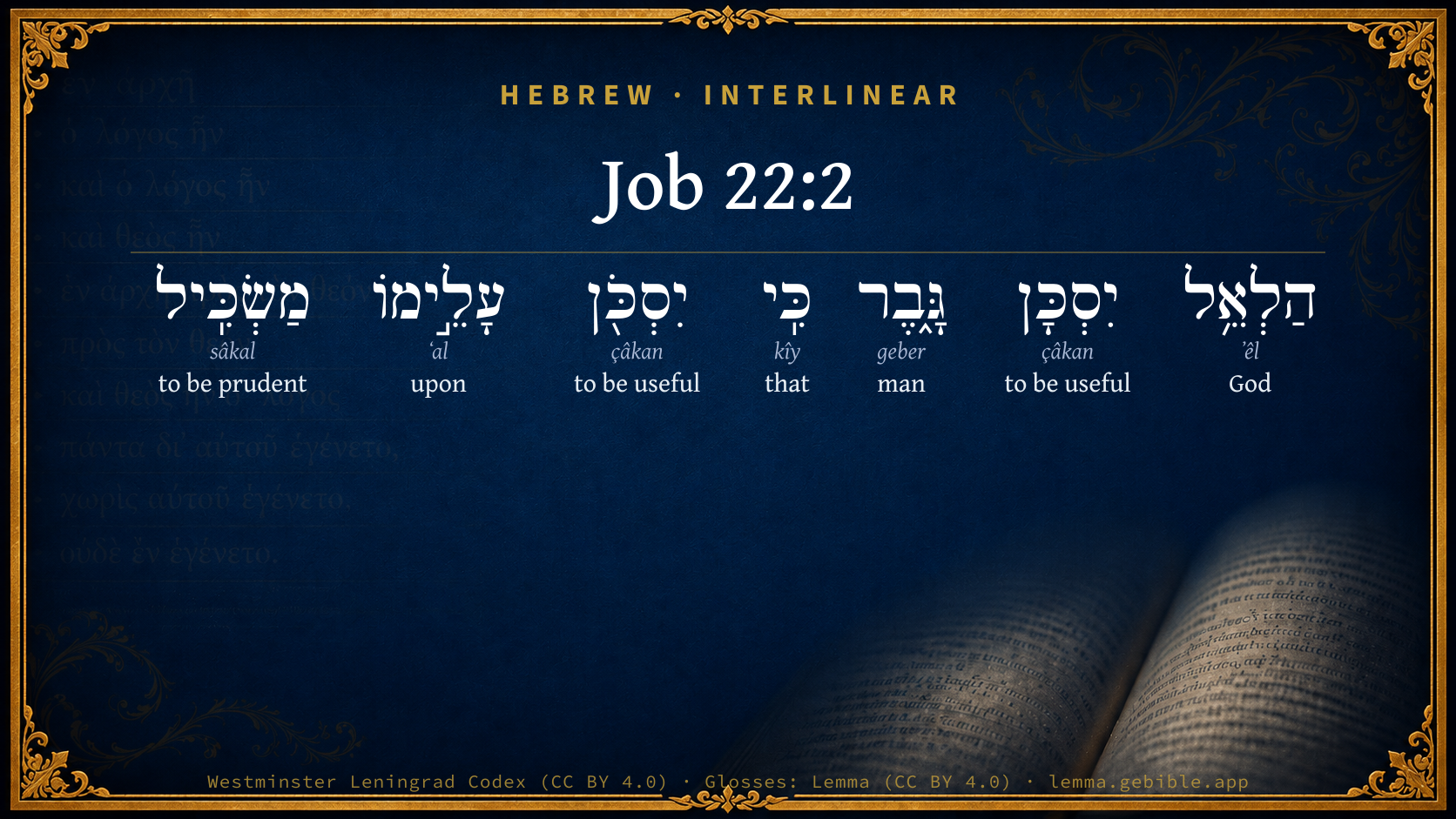
Job 22:2

Hebrew (Westminster Leningrad Codex) Job 22:2 appears in the Hebrew Old Testament. The text above is from the Westminster Leningrad Codex. Each word links to its Strong’s number, a concise gloss, and parsing drawn from the Open Scriptures Hebrew Bible morphology. Click any word for its full Brown-Driver-Briggs (BDB) entry.
Download image
Cite this verse

Job 22:2 (World English Bible). Public Domain. Lemma interlinear Bible study tool, https://lemma.gebible.app/v/job/22/2.

Show BibTeX & RIS
BibTeX
RIS
English Translation
"Can a man be profitable to God? Surely he who is wise is profitable to himself.
World English Bible · Public Domain
Download a study sheet

One document with this verse’s original text, its word-by-word gloss line, the meaning frame, cross-references with their text, attributed commentary, and full source and license credits — printable, and it pastes into notes with its structure intact.

This verse Autodidact and up

Study sheet (.html) Plain text (.txt)

A passage Seminary Student

Up to 50 verses in one chapter. A passage sheet keeps up to 6 commentary sources and 12 cross-references per verse, in the order this page ranks them, and says so on the sheet whenever that leaves anything out. Ask for a single verse and you get the Autodidact verse sheet above.

Everything on this page stays free to read, with no account — the sheet is a download of what is already on screen, not access to it.

Want to remove ads? Support Godless Engineer
Compare translations 3

The same verse in 3 English versions, stacked beneath the original-language interlinear above. Click any original word for its lexicon entry.

Each is an independent rendering of the whole verse — the interlinear is not word-aligned to these translations.

Highlighted words mark where these versions differ — a whole-verse word diff, not a word-by-word alignment.

  • World English Bible Public Domain
    "Can a man be profitable to God? Surely he who is wise is profitable to himself.
  • King James Version Public Domain
    Can a man be profitable unto God, as he that is wise may be profitable unto himself?
  • unfoldingWord Literal Text CC BY-SA 4.0
    “Can a man be useful to God? For the one being wise is useful to himself.

unfoldingWord Literal Text — © unfoldingWord, licensed CC BY-SA 4.0. Word-aligned USFM3 via Door43 (git.door43.org/unfoldingWord/en_ult).

Versions to compare (up to 4)

3 of 4 selected

Show all 18 translations

Every available English version of this verse, each an independent rendering of the whole verse.

  • World English Bible Public Domain
    "Can a man be profitable to God? Surely he who is wise is profitable to himself.
  • Berean Standard Bible Public Domain
    “Can a man be of use to God? Can even a wise man benefit Him?
  • Majority Standard Bible Public Domain
    “Can a man be of use to God? Can even a wise man benefit Him?
  • King James Version Public Domain
    Can a man be profitable unto God, as he that is wise may be profitable unto himself?
  • American Standard Version (1901) Public Domain
    Can a man be profitable unto God? Surely he that is wise is profitable unto himself.
  • Revised Version (1885) Public Domain
    Can a man be profitable unto God? surely he that is wise is profitable unto himself.
  • Geneva Bible (1599) Public Domain
    May a man be profitable vnto God, as he that is wise, may be profitable to himselfe?
  • Douay-Rheims (1899) Public Domain
    Can man be compared with God, even though he were of perfect knowledge?
  • Young's Literal Translation Public Domain
    To God is a man profitable, Because a wise man to himself is profitable?
  • Literal Standard Version CC BY-SA 4.0
    “Is a man profitable to God, || Because a wise man is profitable to himself?
  • Unlocked Literal Bible CC BY-SA 4.0
    “Can a man be useful to God? Can a wise man be useful to him?
  • unfoldingWord Literal Text CC BY-SA 4.0
    “Can a man be useful to God? For the one being wise is useful to himself.
  • Darby Bible Public Domain
    Can a man be profitable to ùGod? surely it is unto himself that the wise man is profitable.
  • World Messianic Bible Public Domain
    “Can a man be profitable to God? Surely he who is wise is profitable to himself.
  • Webster's Bible Public Domain
    Can a man be profitable to God, as he that is wise may be profitable to himself?
  • Free Bible Version CC BY-SA 4.0
    “How can anyone be of help to God? Even wise people are only helpful to themselves.
  • Bible in Basic English Public Domain
    Is it possible for a man to be of profit to God? No, for a man's wisdom is only of profit to himself.
  • JPS Tanakh (1917) Public Domain
    Can a man be profitable unto God? Or can he that is wise be profitable unto Him?

Literal Standard Version (2020), Covenant Press — licensed CC BY-SA 4.0. Text via the HelloAO Bible API (eBible.org). Unlocked Literal Bible (unfoldingWord) — licensed CC BY-SA 4.0. Text via the HelloAO Bible API (eBible.org). unfoldingWord Literal Text — © unfoldingWord, licensed CC BY-SA 4.0. Word-aligned USFM3 via Door43 (git.door43.org/unfoldingWord/en_ult). Free Bible Version, Dr. Jonathan Gallagher — licensed CC BY-SA 4.0. Text via the HelloAO Bible API (eBible.org).

Word by word

More ways to search: Search by grammar → Find every occurrence → Compare this word →

Practice this passage: Drill this verse → Learn its vocabulary →

About this verse

These counts appear in no published source. They are computed here, from the morphology-tagged text and Lemma’s own curated glosses. What Lemma adds →

7
words
6
distinct lemmas
Wisdom
section

Notable vocabulary

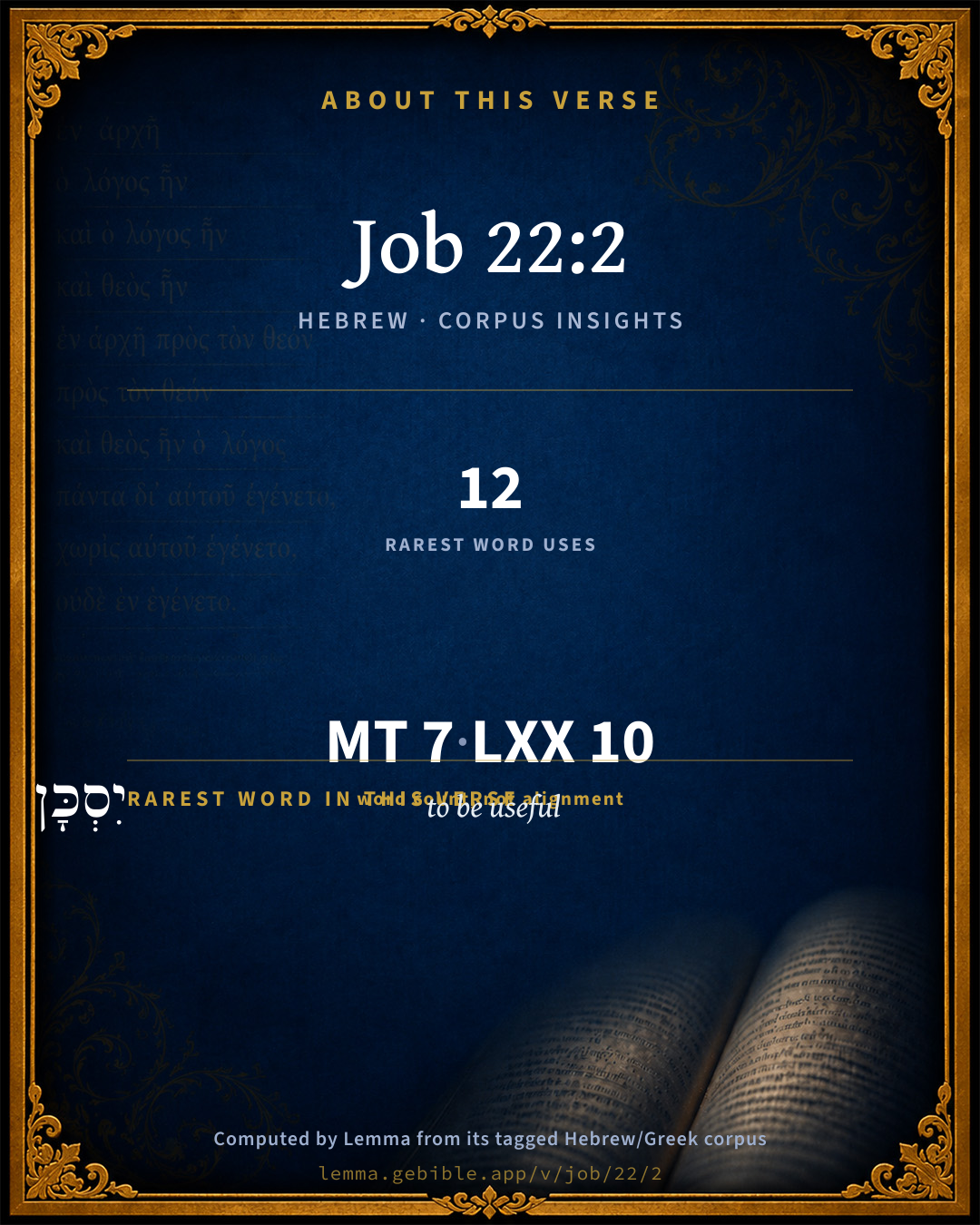
The rarest word here is יִסְכָּן to be useful H5532 — appearing just 12 times in the whole Hebrew Bible.

Shared distinctive vocabulary

יִסְכָּן to be useful H5532 occurs in 10 verses of the Hebrew Bible. Also found in:

Grammatical profile

  • 3 verbs
  • 2 nouns
  • 1 preposition
  • 1 conjunction

Verb forms

  • יִסְכָּן Qal · Imperfect
  • יִסְכֹּ֖ן Qal · Imperfect
  • מַשְׂכִּֽיל Hiphil · Participle Active

Repetition

A word recurs within this verse — often emphatic in Hebrew:

  • יִסְכָּן to be useful H5532 ×2

Hebrew & Septuagint length

In English translation the verse runs 16 words from the Hebrew and 10 from the Septuagint (LXX English) — the Septuagint runs noticeably shorter here. See the side-by-side →

A rough comparison of the two English renderings, which tokenize alike — not a word-level alignment.

Word counts can differ between the Hebrew and the Greek without any difference in meaning — e.g. the Hebrew direct-object marker אֵת has no separate Greek word, and Greek often adds the article ὁ.

In the original languages it is 7 Hebrew tokens and 10 Greek tokens — but the two are counted differently (Hebrew bundles its prefixes and suffixes into one token; the Greek is in lemma form), so that isn’t a like-for-like length.

Cross-references

11

Topical passages linked to Job 22:2 in the Treasury of Scripture Knowledge — connected by theme and wording, ordered by reader-vote popularity; previews shown in the World English Bible.

  • Luke 17:10 Even so you also, when you have done all the things that are commanded you, say, 'We are unworthy servants. We have done our duty.'"
  • Galatians 6:7–8 Don't be deceived. God is not mocked, for whatever a man sows, that will he also reap.
  • Job 35:6–8 If you have sinned, what effect do you have against him? If your transgressions are multiplied, what do you do to him?
  • Psalms 16:2 My soul, you have said to Yahweh, "You are my Lord. Apart from you I have no good thing."
  • Proverbs 3:13–18 Happy is the man who finds wisdom, The man who gets understanding.
  • Job 21:15 What is the Almighty, that we should serve him? What profit should we have, if we pray to him?'
  • Proverbs 4:7–9 Wisdom is supreme. Get wisdom. Yes, though it costs all your possessions, get understanding.
  • Proverbs 9:12 If you are wise, you are wise for yourself. If you mock, you alone will bear it.
  • Ecclesiastes 7:11–12 Wisdom is as good as an inheritance. Yes, it is more excellent for those who see the sun.
  • Matthew 5:29 If your right eye causes you to stumble, pluck it out and throw it away from you. For it is more profitable for you that one of your members should perish, than for your whole body to be cast into Gehenna.
  • Deuteronomy 10:13 to keep the commandments of Yahweh, and his statutes, which I command you this day for your good?

Cross-references courtesy of OpenBible.info (CC BY 4.0).

Hebrew and Greek witnesses Masoretic Hebrew ↔ Greek Septuagint

The same verse in the two great witnesses to the Old Testament, shown verse-for-verse.

Here the Septuagint runs noticeably shorter than the Hebrew — LXX2012 (modern English Septuagint) 10 words vs World English Bible 16. A rough length comparison of the two English translations, not a word-level alignment — read both below.

These are two independent witnesses, not word-aligned to each other, and the Septuagint is shown in lemma (dictionary) form.

Hebrew Job 22:2 Masoretic · Westminster Leningrad Codex

הַלְאֵ֥ל יִסְכָּן גָּ֑בֶר כִּֽי יִסְכֹּ֖ן עָלֵ֣ימוֹ מַשְׂכִּֽיל

"Can a man be profitable to God? Surely he who is wise is profitable to himself.

World English Bible · Public Domain

Greek LXX Job 22:2 Septuagint · lemma form

πότερον οὐ ὁ κύριος εἰμί ὁ διδάσκω σύνεσις καί ἐπιστήμη

Is it not the Lord that teaches understanding and knowledge?

LXX2012 (modern English Septuagint) · Public Domain

Hebrew: Westminster Leningrad Codex (CC BY 4.0). Greek: Septuagint (public domain); English from LXX2012 (modern English Septuagint) (Public Domain). How the Septuagint differs from the Hebrew →

Commentary

Notes on Job 22:2 from classic Christian and Jewish commentators (each source and its license shown beneath its notes). The classic Christian expositions comment on the surrounding passage and are grouped to its opening verse, so a note may address several verses; the Jewish commentaries on the Tanakh (Rashi and others) are per-verse, so they appear only where the commentator wrote on this verse.

Lemma curates 59 commentaries, every one of them public domain or Creative Commons licensed, each selected and text-cleaned for this edition rather than reprinted as found. About our sources →

Trapp's Complete Commentary

John Trapp

Job 22:2 Can a man be profitable unto God, as he that is wise may be profitable unto himself?

Ver. 2. Can a man be profitable unto God] No, neither doth Job say he can, but the contrary, Job 21:22. Howbeit the God of glory, as he is called, Act 7:2, although his glory is as himself, infinite and eternal, and, therefore, not capable of our addition or detraction (the sun would shine though all the world were blind), yet, to try how we prize his glory, and what we will do for him, he hath declared that he accounteth himself made glorious by us when we get so far as to conceive of him above all creatures.

As he that is wise may be profitable unto himself?] Or, But he that is wise, &c. See Pro 9:12, which Solomon seemeth to have taken hence. Natural reason taught Plautus to bring in a countryman animating his son cheerfully to follow his business thus, Thou ploughest, harrowest, sowest, and reapest for thyself; to thee shall this labour bring in joy. The word here rendered wise sometimes signifieth prosperous, quod prudentibus omnia feliciter cedant, because prudent persons do usually prosper. Prudentiam felicitas fere sequitur, Isa 52:13.

John Trapp, A Commentary or Exposition upon All the Books of the Old and New Testament (1647–1656) — public domain. Text from a community e-Sword module.

Joseph Benson's Commentary

Job 22:2. Can a man be profitable unto God — That is, add any thing to his perfection or felicity? namely, by his righteousness, as the next verse shows. Why then dost thou insist so much upon thy own righteousness, as if thou didst oblige God by it; or, as if he could not, without injustice, afflict thee, who supposest thyself to be a righteous person? As, or because, he that is wise — He that is a truly righteous and good man; may be profitable to himself — Does much good to himself; promotes his own peace, and honour, and happiness, by his goodness. Because a wise man receives great benefit by his virtue, shall we think that God is a gainer by it too?

Joseph Benson's Commentary on the Old and New Testaments (1811–1818) — public domain. Text from a community e-Sword module.

Whedon's Commentary on the Bible

Daniel D. Whedon

Hitzig divides the chapter into three double strophes. First double strophe — THE BILL OF ACCUSATIONS, Job_22:2-11.

a. A syllogistic proof that Job’s sufferings are the merited punishment of his sins, Job_22:2-5.

2. As — כי, but, or nay but. Zockler finds in this series of questions a perfect syllogism, of which Job_22:2-3 form the major premiss; Job_22:4 the minor premiss; Job_22:5 the conclusion, to wit, that Job must be a great sinner. The fallacy lies in the minor premiss. All trust in works of merit is rooted in the idea that man can profit God.

Wise… profitable unto himself — The second clause implies a negative answer to the question of profitableness, and should be rendered, the wise man profiteth himself. He is the gainer, not God. Scott cites a like sentiment from Sophocles: “What good man is not a friend to himself.” See sermon, in loc., by Dr. South, on “The Impossibility of Man’s Meriting of God.”

Daniel D. Whedon (gen. ed.), Commentary on the Old and New Testaments (1874–1909) — public domain. Text from a community e-Sword module.

Tyndale Open Study Notes

Tyndale Open Resources

22:2-3 Eliphaz did not understand that God would gain pleasure from Job’s righteousness (1:8; 2:3), as he does from every righteous person (1 Chr 29:17; Ps 147:10-11; Prov 11:1, 20; 12:22). God would also gain glory from Job’s steadfast faith, which emphasized the lie behind Satan’s challenge (Job 1:9-12; 2:4-6). • Job steadfastly claimed that he was perfect (23:10-12), as did God himself (1:1, 8; 2:3).

Tyndale Open Study Notes — © Tyndale Open Resources, licensed CC BY-SA 4.0. Text via the HelloAO Bible API.

Geneva Bible (1599)

Geneva Bible translators

Though man were just, yet God could have no profit of this his justice: and therefore when he punished him, he hath no regard to his justice, but to his sin.

Geneva Bible (1599) marginal notes — public domain. Text via Bolls.life.

Jamieson, Fausset & Brown

Robert Jamieson, A. R. Fausset & David Brown

as he that is wise--rather, yea the pious man profiteth himself. So "understanding" or "wise"--pious (Dan 12:3, Dan 12:10; Psa 14:2) [MICHAELIS].

Jamieson, Fausset & Brown — Commentary Critical and Explanatory on the Whole Bible (1871) — public domain (CC PDM 1.0). Text via the HelloAO Bible API.

Adam Clarke's Commentary

Verse 2. Can a man be profitable unto God] God does not afflict thee because thou hast deprived him of any excellency. A man may be profitable to a man, but no man can profit his Maker. He has no interest in thy conduct; he does not punish thee because thou hast offended and deprived him of some good. Thy iniquities are against justice, and justice requires thy punishment.

Adam Clarke's Commentary on the Bible (1810–1826) — public domain. Text from a community e-Sword/MySword module.

Ellicott's Commentary for English Readers

(2) As he that is wise.—It is probably an independent statement: “Surely he that is wise is profitable, &c.”

A Bible Commentary for English Readers, edited by Charles John Ellicott (1878–1897) — public domain. Text from a community e-Sword module.

The Cambridge Bible for Schools and Colleges

gen. ed. J. J. S. Perowne

2. This verse reads,

Can a man be profitable unto God?

Nay, he that is wise is profitable unto himself.

A man’s actions cannot affect God; the advantage of wisdom, that is, prudent and right conduct, can only accrue to a man himself.

2–5. God’s treatment of men cannot be due to any respect which He has to Himself, for He is too lofty to be affected by anything human. He deals with men according to their ways, and Job’s afflictions can be due only to his sin.

The Cambridge Bible for Schools and Colleges (gen. ed. J. J. S. Perowne; Cambridge University Press, 1878–1918) — public domain. Text from a community e-Sword module.

John Gill's Exposition

Is it any pleasure to the Almighty that thou art righteous?.... It is not; the Lord indeed takes pleasure in his people, not as sinners, but as righteous; and as they are considered such in Christ, he is well pleased for his righteousness' sake, and with it, being agreeable to his nature, will, and law; and with his people in Christ, in whom they are accepted, having imputed the righteousness of his Son unto them, and so they stand before him unblamable and irreprovable, and he takes pleasure in the work of his own hands upon them, called the good pleasure of his will, in the new man formed after his image in righteousness and true holiness, in the graces of his Spirit, and in the exercise of them, faith, hope, love, humility, fear of God, &c. it is a pleasure to him to hear their prayers and praises, and to observe their ready and cheerful obedience to his will; but then all this gives him no new pleasure, or adds anything to the complacency of his mind; he would have had as much delight and pleasure within himself, if there had never been an holy angel in heaven, or a righteous man on earth; he has no such pleasure in either as to be made more happy thereby, or so as to receive any "gain" or profit from it, as the next clause explains it. Some render it, "that thou justifiest thyself" (k), or "that thou art just", or "seemest to be righteous to thyself" (l); a self-righteous person is not pleasing to God; it is no pleasure to him when a man seeks for justification by his own works, or reckons them his righteousness; the publican that confessed his sin was rather justified with God than the Pharisee that applauded his own righteousness; such that are conceited of their own righteousness, and despise others, are an offence to God, a "smoke in his nose", Isa 65:5; for the righteousness of such is not real righteousness in the account of God, and according to his law; it has only the shadow and appearance of one, but is not truly so; and besides, to seek righteousness this way is going contrary to the revealed will of God, to the Gospel scheme of justification by faith in Christ's righteousness, without the works of the law, and is a setting aside his righteousness, and frustrating and making null and void the death of Christ, and therefore can never be pleasing in the sight of God:

or is it gain to him that thou makest thy ways perfect? no man's ways are perfect before God, even the best of men have detects in their works, and failings in their walk and conversations: some men's ways are indeed clean in their own eyes, and perfect in their own conceit; and if Eliphaz thought Job such an one, he was mistaken, see Job 9:20; there are others, who are in a sense unblamable in their walk and conversation; that is, are not guilty of any notorious crime, but exercise a conscience void of offence towards God and man, walk in all the commandments and ordinances of the Lord blameless; and yet this is no "gain" to God; for what does such a man give to him? or what does he receive of his hands? see Job 35:7. This was indeed Job's case and character.

(k) "quod justifices te", Junius & Tremellius. (l) "Quum Justus es apud teipsum", Schmidt; "quod tibi justus esse videris", Michaelis.

John Gill's Exposition of the Whole Bible (1746–1763) — public domain (CC PDM 1.0). Text via the HelloAO Bible API.

Albert Barnes' Notes on the Bible

Can a man be profitable unto God? - Can a man confer any favor on God, so as to lay him under obligation? Eliphaz supposes that Job sets up a “claim” to the favor of God, because he was of service to him, or because God had something to fear if he was cut off. He maintains, therefore, that a man can confer no favor on God, so as to lay him under obligation. God is independent and supreme. He has nothing to gain if man is righteous - he has nothing to apprehend if he is punished. He is not dependent at all on man.

As he that is wise - Margin, or, “if he may be profitable, doth his goodness depend thereon.” The meaning of the passage is, a wise man may promote his own advantage, but he cannot be of advantage to God. All the result of his wisdom must terminate on himself, and not on God; compare Psa 16:2. Of the correctness of this sentiment there can be no doubt. It accords with reason, and with all that is said in the Scriptures. God is too great to be benefited by man. He is infinite in all his perfections; he is the original fountain of blessedness; he is supremely wise; he has all resources in himself, and he cannot be dependent on his creatures. He cannot, therefore, be deterred from punishing them by any dread which he has of losing their favor - he cannot be induced to bless them because they have laid him under obligation. Eliphaz meant this as a reply to what Job had said. He had maintained, that God did “not” treat people according to their character in this life, but that, in fact, the wicked were often prospered, and suffered to live long. Eliphaz at once “infers,” that if this were so, it must be because they could render themselves “serviceable” to God, or because he must have something to dread by punishing them. In the general sentiment, he was right; in the “inference” he was wrong - since Job had not affirmed that they are spared from any such cause, and since many other “reasons” may be assigned.

Albert Barnes' Notes on the Bible (1834–1885) — public domain. Text from a community e-Sword/MySword module.

Haydock's Catholic Bible Commentary

Knowledge. How then canst thou dispute with God?

George Leo Haydock (1774–1849), Haydock's Catholic Family Bible and Commentary, 1859 edition — public domain. Excludes Psalms (Douay-Rheims chapter numbering differs from Protestant) and Deuterocanonical books (Catholic canon only).

Matthew Poole's English Annotations

Be profitable unto God, i.e. add any thing to his perfection or felicity, to wit, by his righteousness, as the next verse shows. Why then dost thou insist so much upon thy own righteousness, as if thou didst oblige God by it, or as if he could not without injury afflict thee? who supposest thyself to be a righteous person, though indeed thou art not so, as he saith, Job 22:5,6, &c.; but if thou wert really so, God is not thy debtor for it.

As; or, because; or, but; or, yea rather: so this latter clause is to be read without an interrogation, and the former with it.

He that is wise may be profitable to himself: a wise or good man (for these in Scripture use are one and the same) doth much good to himself; he promotes his own peace, and honour, and happiness by his goodness; and having so great a reward for his virtue, God is not indebted to him, but he is indebted to God for it.

Matthew Poole's English Annotations on the Holy Bible (1683–1685) — public domain. Text from a community e-Sword/MySword module.

The Pulpit Commentary

HOMILIES BY R. GREEN Vers. 2-11. The impartiality of the Divine judgment.

Eliphaz knows of no tense for suffering but sin. Doubtless sin transgression of Divine laws does lie deeply buried in the causes of human suffering. This is the fruitful seed from which widespread harvests of suffering grow. But it is not within the power of man to fix on the actual offender. Suffering occurs in a thousand instances where not the sufferer but another is the offender. To charge home, therefore, upon every sufferer the cause of his sufferings is an error. Into this error Job"s friends foil. But Eliphaz proclaims a great truth in affirming the judgment of God to be unbiassed. No unworthy motives move him in his decisions. They are true and righteous altogether. The impartiality of the Divine judgments is

I ASSURED BY THE INVIOLABILITY OF THE DIVINE RIGHTEOUSNESS. The character of the Most High is the utmost refuge of the human thought. It is the basis of human confidence. That Name is absolutely unimpeachable. No difficulty in the Divine ways or in our interpretation of them can for a moment check our assurance of the Divine sanctity and justice. On this rock all hope is built. As now we repose on it, so in our thoughts of the future. The final as the present judgments of God are and can be only true and righteous. The sanctity of the Divine Name is the assurance of the unimpeachable rectitude of the Divine ways. The impartiality of the Divine judgments is therefore

II A GROUND OF CONFIDENT APPEAL BY THE UNJUSTLY ACCUSED. In calmness he may wait who knows himself to be unrighteously accused, slandered. It is hard to bear the unjust accusations of men, and all the more if we have no means at hand by which to vindicate ourselves. To the final adjudication we may safely appeal. There justice will be done. There the righteousness of the righteous shall shine out as the sun, or as the stars in the Black night. The human judgment errs; it is swayed by false words, by base motive, by ignorance, by want of integrity. But high above the imperfectness of the human rises the Divine judgment, calm and profound, pure as a sea of glass. To that judgment Job has again referred himself now in strong Confidence, now in fear; though, in moments of weakness, he has seemed to impugn it. The impartiality of the Divine judgment is

III A SOURCE OF TRUE COMFORT FOR TEE SORROWFUL. Ever there lies deep in the heart of the suffering the hope that some counterbalancing good shall follow. To the full round of scriptural teaching we are indebted for the clear light that we have on this subject. "There is a God that judgeth in the earth." "There is a reward for the righteous." Weeping may endure through life, and turn it into a long night, but a morning of joy breaketh, when tears shall be wiped away. Though men are tried, yet shall they come forth as gold purified in the fire. To the final Divine award, when God will render to every man according to his works, the patient sufferer may commit himself in calmness of hope. The impartiality of the Divine judgment stands in contrast to the error and imperfection of all human judgment. The human knowledge is partial, the human motives liable to be warped; therefore the human decisions are often unjust. Thus was it with Job. His friend accused him in severe terms. "Is not thy wickedness great? and thine iniquities infinite?" Then in severe words he names his offences, and adds," Therefore snares are round about thee, and sudden fear troubleth thee." Such was not the Divine judgment, as the sequel declares. Hence shines forth the lesson to the sufferer and the falsely accused, to abide calmly in hope of the righteous judgment of God. R.G.

HOMILIES BY W.F. ADENEY Ver. 2. Whether man can be profitable to God.

Here is a question to which Eliphaz only expects a negative answer. Let us look at the grounds of the question, its difficulties, and the possible solution of it.

I THE GROUNDS OF THE QUESTION. With many persons such a question never occurs. They do not dream of becoming profitable to God, nor do they wish to be of real service to him. Their only desire is that they may be profitable to them. Even in religion their great idea is to save their own souls. When they think of God at all, it is to consider what they may get from him for their own advantage. Any idea of sacrificing themselves to God and rendering him disinterested service has never dawned upon their consciousness. But when a true Christian spirit is aroused in the heart of a man, he must look beyond himself; he must desire to show his gratitude to God by some act of service; he must wish in some way to be profitable to God. It will be a pain to him to find that he can only receive bounties from God and can never render him any return. Thus there will arise within him an earnest question as to whether indeed he can do anything that will really be useful to God.

II THE DIFFICULTIES OF THE QUESTION. These come from two main sources from man"s littleness, and from God"s greatness.

1. Man"s littleness.

(1) In knowledge. How can we discover what will be profitable to God? Have not men often done for religion what has really neither pleased God nor helped his cause?

(2) In power. We are limited, imperfect, feeble creatures. All We have is directly derived from the goodness of God. How, then, can we find means with which to give him beck any service?

(3) In goodness. Sin mars all we touch. Our sacrifice is defiled, our service is corrupt. We do not approach him with clean hands and pure hearts. How, then, can he accept our service?

2. God"s greatness. It would seem that our slight service would be simply lost in the vast sea of Divine activities. It would be like a drop of water added to the ocean. Indeed, it would be no real addition; for God is infinite, his resources are boundless. He can do all things without an effort. Therefore he cannot need our service.

III THE POSSIBLE SOLUTION OF THE QUESTION. Even if we cannot find this we should believe that it exists, because God calla us to serve him, and he would not do so if effective service were impossible. He could not desire us to waste our strength in work which was exhausting to ourselves and yet not useful to him, while we were simply aiming at serving him in obedience to his command. That would be a cruel mockery. Therefore we must believe that God does account our service profitable. Further, there are some ways in which we can see that it is so.

1. Through the love of God. The parent is delighted to receive the small ministries of his child, though he does not absolutely need them, and though they may really cost him more in first furnishing the means and then helping the accomplishment, than they are worth when regarded from a commercial standpoint. But love adds a value of its own. God delights to receive the service of his children. He waits for it and makes it valuable by the condescension which gives it a place in his plans.

2. By helping our fellow-men. We serve God when we serve our human brothers. Though in the infinity of his resources he does not lack anything, they lack many things. Yet God rejoices in what benefits any of his creatures. Thus we may become profitable to God by being profitable to our neighbours. W.F.A. (Mat_25:40)

The Pulpit Commentary (1880–1919), ed. H.D.M. Spence-Jones & Joseph S. Exell — public domain. Text from a community e-Sword module.

John Wesley's Explanatory Notes

Can, &c. - Why dost thou insist so much upon thy own righteousness, as if thou didst oblige God by it.

John Wesley, Explanatory Notes Upon the Whole Bible (1754–1765) — public domain. Text via the GEBible commentary corpus.

Rashi

Rabbi Shlomo Yitzchaki (Rashi)

Eliphaz’s replyDoes a man benefit God Will a man avail and benefit for the need and the benefit of the Creator when he teaches the people knowledge and wisdom? The first יִסְכָּן is an expression of benefit [or pleasure], like (I Kings 1:2), “and she shall be to him a warmer (סֹכֶנֶת).” The second is an expression of teaching [or accustoming], like (Num. 22:30), “Have I ever been in the habit (ההסכן הסכנתי)?” The former may also be interpreted as an expression of teaching, thus: Does a man learn for the good of the Creator and for His need when he learns wisdom?

Rashi on the Tanakh — English translations: “The Judaica Press complete Tanach with Rashi, translated by A. J. Rosenberg” (CC BY 4.0); “Pentateuch with Rashi's commentary by M. Rosenbaum and A.M. Silbermann, 1929-1934” (public domain); “The Metsudah Tanach series, Lakewood, N.J” (CC BY 4.0); and “The Book of Joshua, Metsudah Publications, 1997” (CC BY 4.0). Text via Sefaria.

Lesson kit

Teaching starters — assembled from the data on this page, not authored interpretation. Every prompt links to the verse data it draws on. Edit before teaching.

Job, in the Wisdom, opens this verse with 7 words (6 distinct Hebrew lemmas). Its most distinctive word is çâkan (“to be useful”). The Greek Septuagint runs shorter here. A historical commentator’s framing appears above. Read the whole chapter for the surrounding context.

Discussion questions

  1. The word çâkan carries the sense “to be useful.” How does it shape the verse?
  2. How does Numbers 22:30, which shares the word «to be useful», read alongside this verse?
  3. What does the repetition of “to be useful” (2× in this one verse) do in this verse?
  4. The Septuagint runs shorter here than the Hebrew. What might account for the difference?
  5. The translations on this page render this verse differently — a whole-verse word diff, not a word-by-word alignment. What might account for the different wordings?
  6. «יִסְכָּן» is a Qal Imperfect verb. How does that grammatical form shape the action described?
  7. Compare how Trapp's Complete Commentary and Joseph Benson's Commentary read this verse. Where do they agree or differ?

Things to notice

Reading settings

Reading text

Shown beneath each verse's original-language words.

Old Testament
Old Testament edition

Read the OT as the Masoretic Hebrew (MT) or the Greek Septuagint (LXX).

English shown for the Greek Septuagint (in the Hebrew ↔ Greek comparison).

Comparing translations? Open the Compare panel on any verse page to stack up to four side by side.