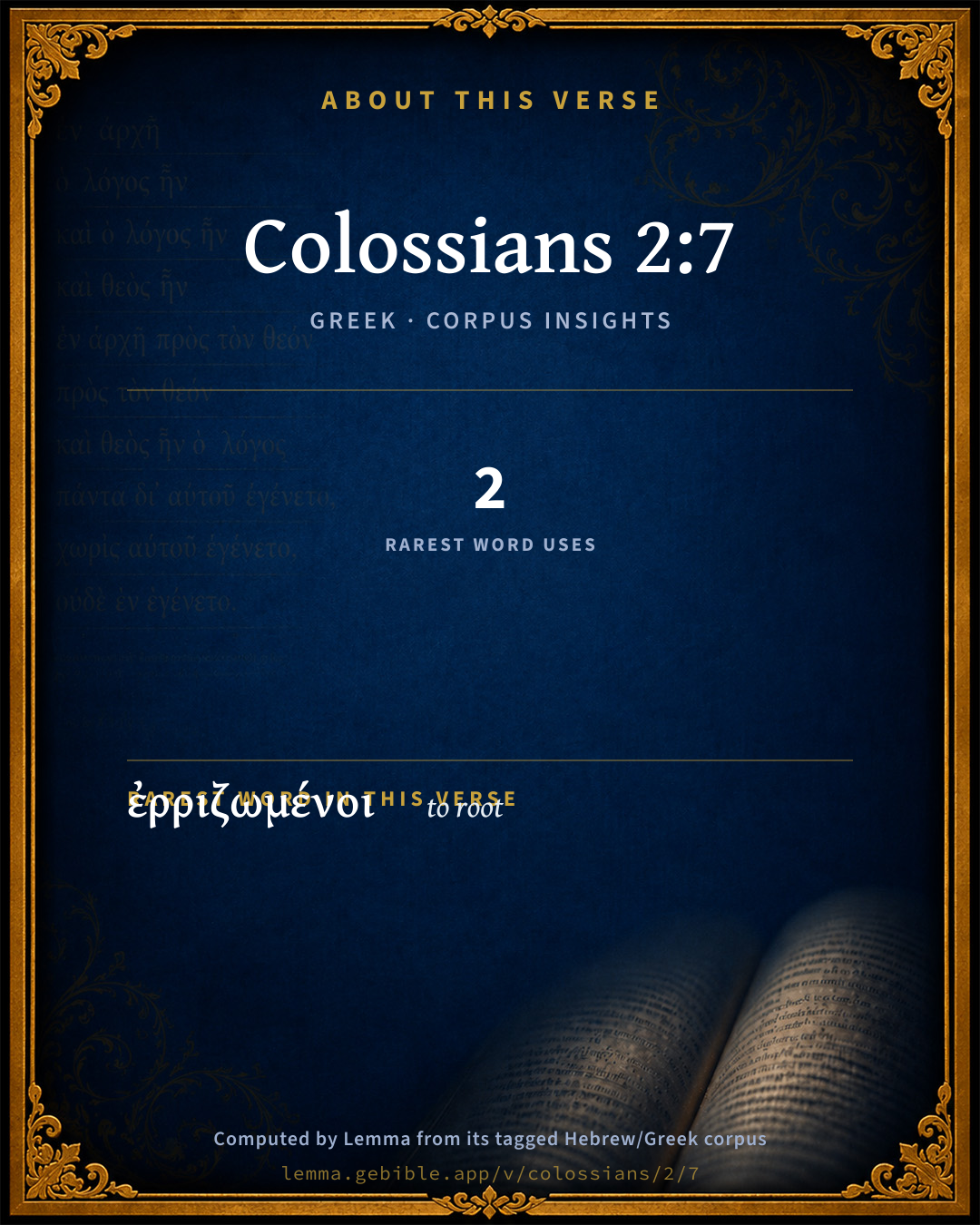
Colossians 2:7

Greek (Tischendorf 8th ed.) Colossians 2:7 appears in the Greek New Testament. The text above is from the Tischendorf 8th edition. Each word links to its Strong’s number and a concise gloss. Click any word for its full Thayer’s Greek Lexicon entry.
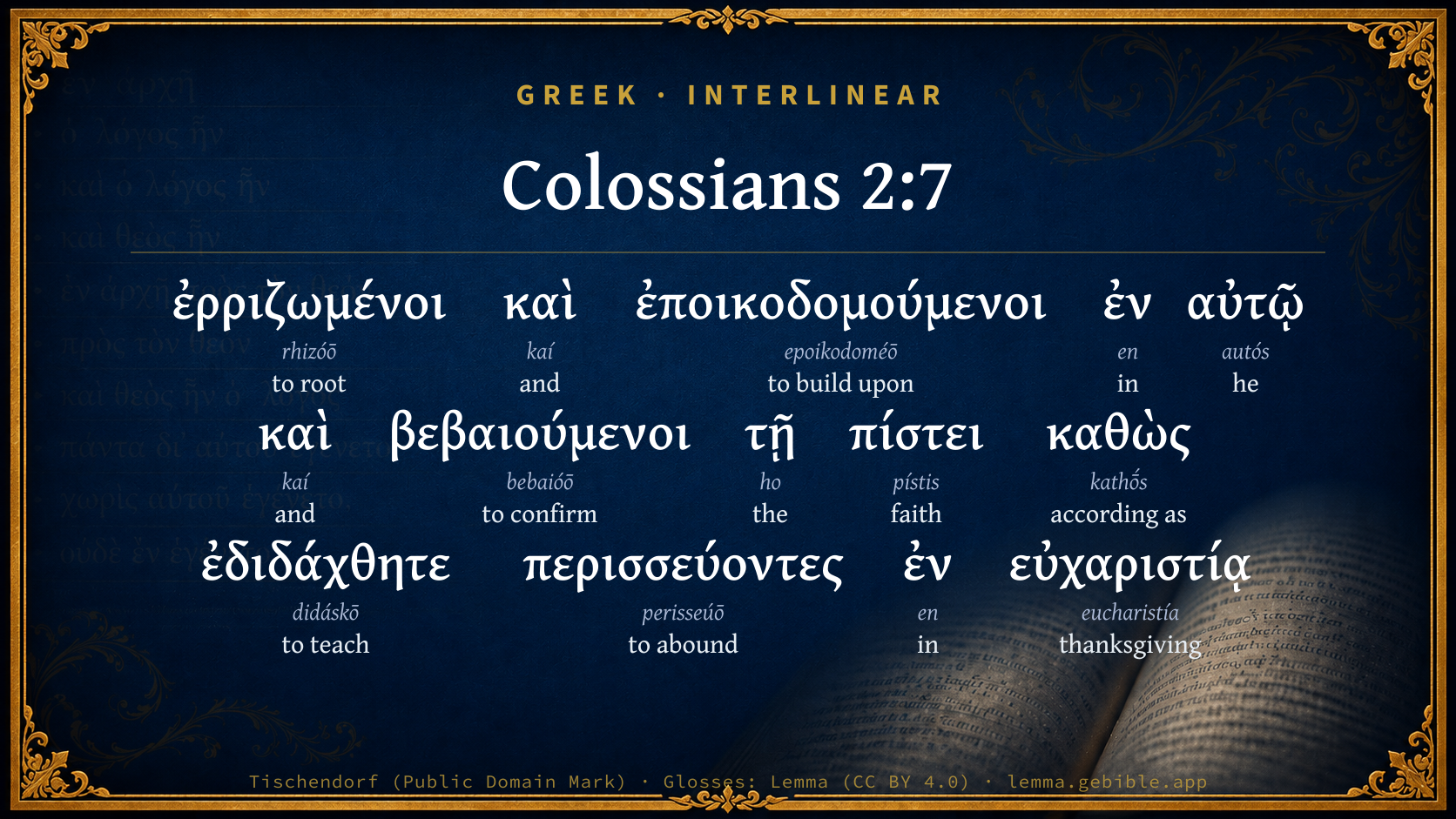
Download image
Cite this verse

Colossians 2:7 (World English Bible). Public Domain. Lemma interlinear Bible study tool, https://lemma.gebible.app/v/colossians/2/7.

Show BibTeX & RIS
BibTeX
RIS
English Translation
rooted and built up in him, and established in the faith, even as you were taught, abounding in it in thanksgiving.
World English Bible · Public Domain
Download a study sheet

One document with this verse’s original text, its word-by-word gloss line, the meaning frame, cross-references with their text, attributed commentary, and full source and license credits — printable, and it pastes into notes with its structure intact.

This verse Autodidact and up

Study sheet (.html) Plain text (.txt)

A passage Seminary Student

Up to 50 verses in one chapter. A passage sheet keeps up to 6 commentary sources and 12 cross-references per verse, in the order this page ranks them, and says so on the sheet whenever that leaves anything out. Ask for a single verse and you get the Autodidact verse sheet above.

Everything on this page stays free to read, with no account — the sheet is a download of what is already on screen, not access to it.

Want to remove ads? Support Godless Engineer
Compare translations 3

The same verse in 3 English versions, stacked beneath the original-language interlinear above. Click any original word for its lexicon entry.

Each is an independent rendering of the whole verse — the interlinear is not word-aligned to these translations.

Highlighted words mark where these versions differ — a whole-verse word diff, not a word-by-word alignment.

  • World English Bible Public Domain
    rooted and built up in him, and established in the faith, even as you were taught, abounding in it in thanksgiving.
  • King James Version Public Domain
    Rooted and built up in him, and stablished in the faith, as ye have been taught, abounding therein with thanksgiving.
  • unfoldingWord Literal Text CC BY-SA 4.0
    being rooted and built up in him and confirmed in the faith just as you were taught, abounding in thanksgiving.

unfoldingWord Literal Text — © unfoldingWord, licensed CC BY-SA 4.0. Word-aligned USFM3 via Door43 (git.door43.org/unfoldingWord/en_ult).

Versions to compare (up to 4)

3 of 4 selected

Show all 19 translations

Every available English version of this verse, each an independent rendering of the whole verse.

  • World English Bible Public Domain
    rooted and built up in him, and established in the faith, even as you were taught, abounding in it in thanksgiving.
  • Berean Standard Bible Public Domain
    rooted and built up in Him, established in the faith as you were taught, and overflowing with thankfulness.
  • Majority Standard Bible Public Domain
    rooted and built up in Him, established in the faith as you were taught, and overflowing in it with thankfulness.
  • King James Version Public Domain
    Rooted and built up in him, and stablished in the faith, as ye have been taught, abounding therein with thanksgiving.
  • American Standard Version (1901) Public Domain
    rooted and builded up in him, and established in your faith, even as ye were taught, abounding in thanksgiving.
  • Revised Version (1885) Public Domain
    rooted and builded up in him, and stablished in your faith, even as ye were taught, abounding in thanksgiving.
  • Geneva Bible (1599) Public Domain
    Rooted and built in him, and stablished in the faith, as ye haue bene taught, abouding therein with thankesgiuing.
  • Douay-Rheims (1899) Public Domain
    Rooted and built up in him, and confirmed in the faith, as also you have learned, abounding in him in thanksgiving.
  • Young's Literal Translation Public Domain
    being rooted and built up in him, and confirmed in the faith, as ye were taught -- abounding in it in thanksgiving.
  • Literal Standard Version CC BY-SA 4.0
    being rooted and built up in Him, and confirmed in the faith, as you were taught—abounding in it in thanksgiving.
  • Unlocked Literal Bible CC BY-SA 4.0
    Be rooted in him, be built on him, be established in faith just as you were taught, and abound in thanksgiving.
  • unfoldingWord Literal Text CC BY-SA 4.0
    being rooted and built up in him and confirmed in the faith just as you were taught, abounding in thanksgiving.
  • Darby Bible Public Domain
    rooted and built up in him, and assured in the faith, even as ye have been taught, abounding in it with thanksgiving.
  • World Messianic Bible Public Domain
    rooted and built up in him and established in the faith, even as you were taught, abounding in it in thanksgiving.
  • Webster's Bible Public Domain
    Rooted and built up in him, and established in the faith, as ye have been taught, abounding in it with thanksgiving.
  • Free Bible Version CC BY-SA 4.0
    grounded in him and built up by him. May your trust in him continue to grow strong, following what you were taught, full of gratitude to God.
  • Bible in Basic English Public Domain
    Rooted and based together in him, strong in the faith which the teaching gave you, giving praise to God at all times.
  • Text-Critical English NT CC BY 4.0
    being rooted and built up in him and established in the faith, just as you were taught, abounding in it with thanksgiving.
  • Tyndale New Testament (1534) Public Domain
    roted and bylt in him and stedfaste in the fayth as ye have learned: and therin be plenteous in gevynge thankes.

Literal Standard Version (2020), Covenant Press — licensed CC BY-SA 4.0. Text via the HelloAO Bible API (eBible.org). Unlocked Literal Bible (unfoldingWord) — licensed CC BY-SA 4.0. Text via the HelloAO Bible API (eBible.org). unfoldingWord Literal Text — © unfoldingWord, licensed CC BY-SA 4.0. Word-aligned USFM3 via Door43 (git.door43.org/unfoldingWord/en_ult). Free Bible Version, Dr. Jonathan Gallagher — licensed CC BY-SA 4.0. Text via the HelloAO Bible API (eBible.org).

Word by word

More ways to search: Search by grammar → Find every occurrence → Compare this word →

Practice this passage: Drill this verse → Learn its vocabulary →

ἐρριζωμένοι
rhizóō
G4492
“to root”
Verb, Perfect, Passive, Participle, Nominative, Plural, Masculine
Part of Speech
Verb
Tense
Perfect
Voice
Passive
Mood
Participle
Case
Nominative
Number
Plural
Gender
Masculine
Full Thayer's Definition

Origin: from G4491

TDNT: 22:31,0

1. to cause to strike root, to strengthen with roots, to render firm, to fix, establish, cause a person or a thing to be thoroughly grounded
  1. καὶ kaí G2532 “and” Conjunction
  2. ἐποικοδομούμενοι epoikodoméō G2026 “to build upon” Verb, Present, Passive, Participle, Nominative, Plural, Masculine
  3. ἐν en G1722 “in” Preposition
  4. αὐτῷ autós G846 “he” Personal pronoun, Dative, Singular, Masculine
  5. καὶ kaí G2532 “and” Conjunction
  6. βεβαιούμενοι bebaióō G950 “to confirm” Verb, Present, Passive, Participle, Nominative, Plural, Masculine
  7. τῇ ho G3588 “the” Article, Dative, Singular, Feminine
  8. πίστει pístis G4102 “faith” Noun, Dative, Singular, Feminine
  9. καθὼς kathṓs G2531 “according as” Adverb
  10. ἐδιδάχθητε didáskō G1321 “to teach” Verb, Aorist, Passive, Indicative, 2nd person, Plural
  11. περισσεύοντες perisseúō G4052 “to abound” Verb, Present, Active, Participle, Nominative, Plural, Masculine
  12. ἐν en G1722 “in” Preposition
  13. εὐχαριστίᾳ eucharistía G2169 “thanksgiving” Noun, Dative, Singular, Feminine

About this verse

These counts appear in no published source. They are computed here, from the morphology-tagged text and Lemma’s own curated glosses. What Lemma adds →

14
words
12
distinct lemmas
Pauline Epistles
section

Notable vocabulary

The rarest word here is ἐρριζωμένοι to root G4492 — appearing just 2 times in the whole Greek New Testament.

Shared distinctive vocabulary

ἐρριζωμένοι to root G4492 occurs in 2 verses of the Greek New Testament. Also found in:

Repetition

Words recur within this verse:

Cross-references

29

Topical passages linked to Colossians 2:7 in the Treasury of Scripture Knowledge — connected by theme and wording, ordered by reader-vote popularity; previews shown in the World English Bible.

  • Ephesians 3:17 that Christ may dwell in your hearts through faith; to the end that you, being rooted and grounded in love,
  • Jeremiah 17:8 For he shall be as a tree planted by the waters, who spreads out its roots by the river, and shall not fear when heat comes, but its leaf shall be green; and shall not be careful in the year of drought, neither shall cease from yielding fruit.
  • Ephesians 2:20–22 being built on the foundation of the apostles and prophets, Christ Jesus himself being the chief cornerstone;
  • John 15:4–5 Remain in me, and I in you. As the branch can't bear fruit by itself, unless it remains in the vine, so neither can you, unless you remain in me.
  • Colossians 1:23 if it is so that you continue in the faith, grounded and steadfast, and not moved away from the hope of the Gospel which you heard, which is being proclaimed in all creation under heaven; of which I, Paul, was made a servant.
  • 2 Peter 3:17–18 You therefore, beloved, knowing these things beforehand, beware lest, being carried away with the error of the wicked, you fall from your own steadfastness.
  • 2 Thessalonians 2:17 comfort your hearts and establish you in every good work and word.
  • Matthew 7:24–25 "Everyone therefore who hears these words of mine, and does them, I will liken him to a wise man, who built his house on a rock.
  • Colossians 1:12–13 giving thanks to the Father, who made us fit to be partakers of the inheritance of the saints in light;
  • Ephesians 5:20 giving thanks always concerning all things in the name of our Lord Jesus Christ, to God, even the Father;
  • Isaiah 61:3 to appoint to those who mourn in Zion, to give to them a garland for ashes, the oil of joy for mourning, the garment of praise for the spirit of heaviness; that they may be called trees of righteousness, the planting of Yahweh, that he may be glorified.
  • Psalms 1:3 He will be like a tree planted by the streams of water, That brings forth its fruit in its season, Whose leaf also does not wither. Whatever he does shall prosper.
  • Psalms 92:13 They are planted in Yahweh's house. They will flourish in our God's courts.
  • Romans 16:25
  • 1 Corinthians 15:58 Therefore, my beloved brothers, be steadfast, immovable, always abounding in the Lord's work, because you know that your labor is not in vain in the Lord.
  • Hebrews 13:15 Through him, then, let us offer up a sacrifice of praise to God continually, that is, the fruit of lips which make confession to his name.
  • 1 Peter 5:10 But may the God of all grace, who called you to his eternal glory by Christ Jesus, after you have suffered a little while, perfect, establish, strengthen, and settle you.
  • Jude 1:24 Now to him who is able to keep them from stumbling, and to present you faultless before the presence of his glory in great joy,
  • Romans 11:17–18 But if some of the branches were broken off, and you, being a wild olive, were grafted in among them, and became partaker with them of the root and of the richness of the olive tree;
  • 1 Corinthians 3:9–15 For we are God's fellow workers. You are God's farming, God's building.
  • Colossians 3:17 Whatever you do, in word or in deed, do all in the name of the Lord Jesus, giving thanks to God the Father, through him.
  • 1 Thessalonians 5:18 In everything give thanks, for this is the will of God in Christ Jesus toward you.
  • Ezekiel 17:23–24 in the mountain of the height of Israel will I plant it; and it shall bring forth boughs, and bear fruit, and be a goodly cedar: and under it shall dwell all birds of every wing; in the shade of the branches of it shall they dwell.
  • Luke 6:48 He is like a man building a house, who dug and went deep, and laid a foundation on the rock. When a flood arose, the stream broke against that house, and could not shake it, because it was founded on the rock.
  • Ephesians 4:21 if indeed you heard him, and were taught in him, even as truth is in Jesus:
  • 2 Corinthians 1:21 Now he who establishes us with you in Christ, and anointed us, is God;
  • 1 Peter 2:4–6 coming to him, a living stone, rejected indeed by men, but chosen by God, precious.
  • Jude 1:12 These are hidden rocky reefs in your love feasts when they feast with you, shepherds who without fear feed themselves; clouds without water, carried along by winds; autumn leaves without fruit, twice dead, plucked up by the roots;
  • Jude 1:20 But you, beloved, keep building up yourselves on your most holy faith, praying in the Holy Spirit.

Cross-references courtesy of OpenBible.info (CC BY 4.0).

Commentary

Notes on Colossians 2:7 from classic Christian and Jewish commentators (each source and its license shown beneath its notes). The classic Christian expositions comment on the surrounding passage and are grouped to its opening verse, so a note may address several verses; the Jewish commentaries on the Tanakh (Rashi and others) are per-verse, so they appear only where the commentator wrote on this verse.

Lemma curates 59 commentaries, every one of them public domain or Creative Commons licensed, each selected and text-cleaned for this edition rather than reprinted as found. About our sources →

Bengel's Gnomon

Johann Albrecht Bengel

Col 2:7. Ἐῤῥιζωμένοι, rooted) Eph 3:18. Time past instead of the commencement.[6]—ἘΠΟΙΚΟΔΟΜΟΎΜΕΝΟΙ) The present, as being even still in progress, Act 20:32.—ἘΝ ΑὐΤῷ, in Him) in Jesus Christ, as Lord. In the faith is the parallel, which presently follows.—ἐν εὐχαριστίᾳ, with thanksgiving) This constitutes and shows the lawful and joyful use of (external) things, which some burden with prohibitions, Col 2:21; 1Co 10:30; 1Ti 4:3-4.

[6] i.e. Their faith was already long established, not merely beginning.—ED.

Bengel's Gnomon of the New Testament — English translation (T&T Clark, Edinburgh, 1860) — public domain. Text from a community e-Sword module.

Expositor's Greek Testament

ed. W. Robertson Nicoll

Col 2:7 . ἐρριζωμένοι καὶ ἐποικοδομούμενοι : “rooted and built up”. The metaphor changes from περιπατ ., and again from ἐρριζ ., though Lightfoot points out that the term “to root” is not infrequently applied to buildings. More important is the change in tense, the perfect participle expressing an abiding result, the present a continuous process. ἐν αὐτῷ probably belongs to both. We should not (with Schenkel, Hofm.) place a full stop at περιπ . and take the participles with βλέπετε , which would be intolerably awkward. βεβαιούμενοι τῇ πίστει : “stablished in faith,” also the present of continuous process. Meyer and Lightfoot take the dative as instrumental, but it seems best with most recent commentators to take it as a dative of reference ( cf. Col 2:5 ). καθὼς ἐδιδάχθητε : cf. καθὼς ἐμάθετε , Col 1:7 . The words define τῇ πίστει . περισσεύοντες ἐν εὐχαριστίᾳ . Oltramare notes that “thankfulness is a preservative against the new doctrines,” since they remove Christ from His true place. The emphasis on thankfulness is very marked in this Epistle.

The Expositor's Greek Testament, edited by W. Robertson Nicoll (1897–1910) — public domain. Text from a community e-Sword module.

Jamieson, Fausset & Brown

Robert Jamieson, A. R. Fausset & David Brown

Rooted-- (Eph 3:17).

built up--Greek, "being builded up." As "rooted" implies their vitality; so "builded up," massive solidity. As in the Song of Solomon, when one image is not sufficient to express the varied aspects of divine truth, another is employed to supply the idea required. Thus "walking," a third image (Col 2:6), expresses the thought which "rooted" and "built," though each suggesting a thought peculiar to itself, could not express, namely, onward motion. "Rooted" is in the past tense, implying their first conversion and vital grafting "in Him." "Built up" is present (in the Greek), implying their progressive increase in religion by union with Him. Eph 2:20 refers to the Church; but the passage here to their individual progress in edification (Act 20:32).

stablished--confirmed.

as--"even as."

abounding therein with thanksgiving--advancing to fuller maturity (compare Col 2:2) in the faith, "with thanksgiving" to God as the gracious Author of this whole blessing.

Jamieson, Fausset & Brown — Commentary Critical and Explanatory on the Whole Bible (1871) — public domain (CC PDM 1.0). Text via the HelloAO Bible API.

Adam Clarke's Commentary

Verse 7. Rooted and built up in him] It is not usual with the apostle to employ this double metaphor, taken partly from the growth of a tree and the increase of a building. They are to be rooted; as the good seed had been already sown, it is to take root, and the roots are to spread far, wide, and deep. They are to be grounded; as the foundation has already been laid, they are to build thereon. In the one case, they are to bear much fruit; in the other, they are to grow up to be a habitation of God through the Spirit. See the notes on Eph 2:21; Eph 2:22; Eph 3:17.

Abounding therein with thanksgiving.] No limitation is ever set to the operations of God on the soul, or to the growth of the soul in the knowledge, love, and image of God. Those who are brought into such a state of salvation should abound in gratitude and loving obedience, as they grow in grace.

Adam Clarke's Commentary on the Bible (1810–1826) — public domain. Text from a community e-Sword/MySword module.

John Calvin's Commentaries

7. And confirmed in the faith. He now repeats without a figure the same thing that he had expressed by metaphors, — that the prosecution of the way, the support of the root, and of the foundation, is firmness and steadfastness of faith. And observe, that this argument is set before them in consequence of their having been well instructed, in order that they may safely and confidently secure their footing in the faith with which they had been made acquainted.

Abounding. He would not have them simply remain immovable, but would have them grow every day more and more. When he adds, with thanksgiving, he would have them always keep in mind from what source faith itself proceeds, that they may not be puffed up with presumption, but may rather with fear repose themselves in the gift of God. And, unquestionably, ingratitude is very frequently the reason why we are deprived of the light of the gospel, as well as of other divine favors.

John Calvin's Commentaries (1540-1563) — public domain. Text from the Calvin Translation Society English edition (1840s-50s) via the Christian Classics Ethereal Library (ccel.org). Calvin's coverage is partial (roughly two-thirds of the Bible); uncommented books and verses are honest gaps, never fabricated. The 19th-century editor's footnotes and remarks are omitted so the notes are faithfully Calvin's own voice.

Ellicott's Commentary for English Readers

(7) Rooted and built up in him.—There is a significant change of tense in the original, having been rooted—i.e. (as in Eph_3:17), “rooted and grounded” in Him once for all, and being built up continually on that Foundation. (Comp. 1Co_3:9-15.) St. Paul bids them seek not only the first basis of their faith, but their continual growth, in Christ alone, by continual “strengthening in the faith” which rests in Him. We may remember that in the Gnostic teaching faith was held good for the beginner or the common herd, “knowledge” was the bright particular jewel of those who went on to perfection.

Abounding (or, overflowing) therein with thanksgiving.—The metaphor is changed. The cup of faith, filled to the full, runs over in that thanksgiving which is the expression both of faith and love.

A Bible Commentary for English Readers, edited by Charles John Ellicott (1878–1897) — public domain. Text from a community e-Sword module.

The Cambridge Bible for Schools and Colleges

gen. ed. J. J. S. Perowne

7. rooted] A perfect participle. It recurs Eph_3:17, the only other place in which St Paul uses precisely this metaphor, which combines the thought of fixity with that of derived and developing life from a genial source. There, as here, the metaphor of building (more frequent with St Paul) appears, in the Greek, beside this other.

built up] See the last remark. The Greek is a present participle, to be expressed in (not quite classical) English by, being built up. See for a close parallel Eph_2:22; and cp. Col_1:23 above.—The compound verb here gives the thought of building upon, and the reference might be taken to be to Christ as the Foundation (1Co_3:11). But the phrase “in Him” just below suggests here another of the many sides of His relation to the “building”; and leads us to explain this of the internal “building up” of the community as new members join it and cohere with it; and also of the individual, as layers (so to speak) of experience and spiritual character accrue in his life and walk. The present participle is thus clearly suitable.

in Him] as He is the “Stone of the angle” (Eph_2:20) “in” which the converging lines of structure hold together. Cp. Col_1:17.—But this imagery must not be pressed too far, for “in Him” relates here to “rooted” as well as “built up.”

stablished] Again a present participle.

in the faith] Omit “in,” and render, with Lightfoot, and R.V. margin, by your faith. Their faith, their submissive personal reliance on their Lord, would “strike their root downward” and compact their spiritual structure; and so it would make them continuously more stable. “Faith is, as it were, the cement of the building” (Lightfoot).

as ye have been taught] Better, as ye were taught, when Epaphras evangelized them. Then they learnt Whom to believe in, and how to believe in Him, for righteousness and life.

abounding] A favourite word with St Paul. It occurs five times in Philippians. Nothing short of spiritual wealth, and its full employment, ever satisfies him.

therein] In your faith, regarded as “the sphere” of the sense of “abundance.” Loyal reliance on the all-sufficient Christ was to be largely, fully, exercised.

with thanksgiving] Lit., “in thanksgiving.” Thanksgiving was to attend, to surround, this large exercise of faith. It would do so as a matter of reason; for the possession of such an Object of faith was indeed ground enough for holy gratitude. And it would do so also as a matter of experience; for there is no surer secret for a glad thankfulness than full habitual reliance on the Christ of God.

“The words [“thankful, give thanks, thanksgiving”] occur in St Paul’s writings alone of the apostolic Epistles. In this Epistle especially the duty of thanksgiving assumes a peculiar prominence by being made a refrain, as here and in Col_3:15; Col_3:17, Col_4:2; see also Col_1:12” (Lightfoot).

The Cambridge Bible for Schools and Colleges (gen. ed. J. J. S. Perowne; Cambridge University Press, 1878–1918) — public domain. Text from a community e-Sword module.

John Gill's Exposition

Rooted and built up in him,.... By these metaphors, the apostle expresses the safe and happy state of these believers; and which he makes use of as arguments, to engage them to walk on in Christ, and as pointing out the manner in which they should. Believers are sometimes compared to trees, and are trees of righteousness, the planting of the Lord; and their root is Christ, from whence as such they spring, and by whom they are filled with the fruits of righteousness; in him they are to abide, keep close unto him, and walk in him; deriving all their life, nourishment, fruitfulness, grace, and perseverance in it, from him as their root: they are also sometimes compared to a building, to an house, a temple, an habitation for God; and Christ is the sure and only foundation on which they are laid, and where they are safe and secure; and, being fitly joined together, grow up as an holy temple to the Lord; and this being their case, they are to go on laying the whole stress of their salvation on him, building their faith and hope of eternal glory entirely upon him; and building up one another also on their most holy faith, of which he is the substance, as it follows:

and stablished in the faith: that of Christ, or in the doctrine of faith which respects Christ: the apostle here expresses the same thing without a figure, which he had signified by the two foregoing metaphors, and explains what he means by them; namely, that they were well settled and grounded in their faith in Christ, and thoroughly instructed and established in the doctrines of the Gospel; and a very good thing it is to have the heart established with grace, both as a principle and a doctrine; which is God's work, and was the happy case of these persons; wherefore it became them to act as such, and not be like children tossed to and fro with every wind of doctrine, or carried about with divers and strange doctrines, but abide by those which had been preached to them by the faithful ministers of Christ, and they had received: as

ye have been taught: by Epaphras their minister, and others; and therefore should not listen to false teachers, and to a contrary doctrine taught by them; considering of whom they had learnt the true doctrine, what evidence it carried with it, and what use it had been of to them, in convincing, converting, comforting, instructing, and establishing them: and therefore should be

abounding therein with thanksgiving; that is, in the faith; as in the grace, so in the doctrine of faith; for as saints are to abound in the work of the Lord, and in every good work, and in the exercise of every grace, so in the knowledge of truth; see Co2 8:7; and to make use of all means for the increase of, and growth in Gospel grace and light, and the knowledge of a crucified Christ, which is meant by abounding: for all which there is great reason for thanksgiving; both for the unspeakable gift of Christ, who is received as such by faith, and in whom believers are rooted and built up; and for faith itself, which is the gift of God; and also for the Gospel, and the truths of it; and for every degree of spiritual light in it, and knowledge of it.

John Gill's Exposition of the Whole Bible (1746–1763) — public domain (CC PDM 1.0). Text via the HelloAO Bible API.

Trapp's Complete Commentary

John Trapp

7 Rooted and built up in him, and stablished in the faith, as ye have been taught, abounding therein with thanksgiving.

Ver. 7. Abounding therein with thanksgiving] Thankfulness for smaller measures of grace gets more. Efficacissimum genus est rogandi, gratias agere. (Plin. Panegyr.)

John Trapp, A Commentary or Exposition upon All the Books of the Old and New Testament (1647–1656) — public domain. Text from a community e-Sword module.

Albert Barnes' Notes on the Bible

Rooted ...in him - As a tree strikes its roots deep in the earth, so our faith should strike deep into the doctrine respecting the Saviour. See the phrase used here explained in the parallel place in Eph 3:17.

And established in the faith, as ye have been taught - To wit, by the founders of the church, and by those faithful ministers who had succeeded them; Notes, Col 1:7.

Abounding therein with thanksgiving - Expressing overflowing thanks to God that you have been made acquainted with truths so precious and glorious. If there is any thing for which we ought to be thankful, it is for the knowledge of the great truths respecting our Lord and Saviour.

Albert Barnes' Notes on the Bible (1834–1885) — public domain. Text from a community e-Sword/MySword module.

Haydock's Catholic Bible Commentary

Rooted and built up in him, who is the head of all, your Redeemer, and author of your salvation, not upon Angels. (Witham)

George Leo Haydock (1774–1849), Haydock's Catholic Family Bible and Commentary, 1859 edition — public domain. Excludes Psalms (Douay-Rheims chapter numbering differs from Protestant) and Deuterocanonical books (Catholic canon only).

Matthew Poole's English Annotations

Rooted and built up in him; showing how they should abide and persevere in the faith, by continuing in him as branches do in the root, Joh 15:4, and resting upon him as a building upon the foundation, Isa 28:16; 1Co 3:11; Eph 2:22.

And stablished in the faith; and being firm and settled in the faith, as 1Pe 5:10; he adds this, not only to clear the metaphorical expressions before, but to show that they should be growing stronger as to the internal habit, Psa 92:13,14. He repeats as it were in a parenthesis,

as ye have been taught; upon the matter, the same with as ye have received Christ in the former verse; for greater caution to them, who might be apt to have itching ears, that they should not be listening to any novel doctrines, but abide in the faith of Christ.

Abounding therein with thanksgiving; setting down with themselves, according to the superabounding grace they had, Rom 5:20, with 1Co 4:8, to abound and increase therein, 1Co 15:58; 2Pe 1:8; having herein all the saving knowledge desirable, without need of the addition of aught any other way; being thankful to God that he had revealed such a Christ, his Christ, to them, for they could not have a better or another.

Matthew Poole's English Annotations on the Holy Bible (1683–1685) — public domain. Text from a community e-Sword/MySword module.

Whedon's Commentary on the Bible

Daniel D. Whedon

7. Rooted—Changing the figure, but always keeping Christ as the element in which this life is lived, we are rooted in him as a tree strikes its roots deep into the soil and becomes better nourished and more immovable, built up in him, as a building upon a rock, adding stone to stone, thus steadily and solidly growing; established, confirmed in the way of faith, just as it was taught at the outset; and abounding in that faith with deep gratitude to God.

The apostle having thus unfolded the divine idea of redemption, and reminded the Colossians of their experimental knowledge of its verity, proceeds next to an examination of the particular system offered them in its stead.

Daniel D. Whedon (gen. ed.), Commentary on the Old and New Testaments (1874–1909) — public domain. Text from a community e-Sword module.

The Pulpit Commentary

Rooted and builded up in him (Col_1:23 Col_2:5; Eph_2:20, 21 3:18 4:16; 1Co_3:9-12; Luk_6:47, Luk_6:48) "Rooted" is perfect participle, in, plying an abiding fact ("fast rooted"); while "builded up" (literally, upon or unto) is in the present tense of a continued process, the prefix ejpi also implying growth and gain. (Col_1:6, 10 2:19) Meyer and Ellicott view ejn aujtw as a mere complement of the latter participle: "being builded in him." This weakens the force of both prepositions (ejpi and ejn), and the emphasis of the repeated "in him." The ideas of planting and building are similarly combined in 1Co_3:9; Eph_3:18; and rooted is a figure applied to buildings in ether Greek writers (Lightfoot). "Christ is the ground for the roots below, and the foundation for the building above" (Meyer). And stablished in (or, by) your faith, according as ye were taught (Col_1:5-7, Col_1:23; 1Co_1:6-8; 1Th_3:2 1Th_4:1; 2Th_2:13; 1Pe_5:9, 1Pe_5:10) "En before pistei ("faith") is struck out in the Revised Text, and is probably a correct gloss. The instrumental dative, preferred by Meyer and Lightfoot, does not accord so well with ver. 5 and Col_1:23 (comp. Php_1:27; 1Ti_5:8; 2Ti_4:7 1Pe_5:9) "Stablished" (bebaioumenoi, being kept firm) is present in tense, like "builded up" (ver. 6, see note): comp. (Rom_4:16; Php_1:7; zw, Heb_3:6 Heb_6:19 Heb_13:9) and distinguish from sthri to make stable, fix firmly. In "as ye were taught" the apostle reminds his readers again of their first lessons in the gospel (Col_1:5-7, see notes; 2Th_2:15) Abounding in it, with thanksgiving; or, abounding in thanksgiving (Col_1:3, 12 3:15, 17 4:2; Eph_5:4, Eph_5:20; 1Th_5:18; Heb_13:15) The Revisers relegate "in it (your faith)" to the margin, following the judgment of Tischendorf and Tregelles; while Westcott and Hort, Alford, Ellicott, Lightfoot, retain the words in the text. The reading "in him," found in the Vulgate and leading Western documents, throws doubt on these words; but it is difficult to see why they should have been inserted if not authentic, and they might easily be confused by a copyist with the foregoing "in him." The second ejn, if ejn aujth be retained, becomes ejn of accompaniment, and may be rendered "with," as in Col_1:29; Eph_6:2. (On "thanksgiving," see note, Col_1:12)

The Pulpit Commentary (1880–1919), ed. H.D.M. Spence-Jones & Joseph S. Exell — public domain. Text from a community e-Sword module.

John Wesley's Explanatory Notes

Rooted in him - As the vine. Built - On the sure foundation.

John Wesley, Explanatory Notes Upon the Whole Bible (1754–1765) — public domain. Text via the GEBible commentary corpus.

The People's New Testament

B. W. Johnson

7. Rooted. Your life growing out of Christ as a tree out of the soil. As ye have been taught. The point of the exhortation is to cling to the gospel as it has been taught them.

B. W. Johnson's The People's New Testament with Notes (1889–1891) — public domain. Electronic text from the Christian Classics Ethereal Library (CCEL) ThML edition.

Cambridge Greek Testament for Schools and Colleges

7. [ἐν αὐτῇ] ἐν εὐχαριστίᾳ. The reading is very uncertain, for though in itself ἐν αὐτῇ is more difficult yet its undoubted presence in Col 4:2 makes it possible that it was introduced thence.

It is found in BDcH**KL(P) Syr.Pesh. and Harcl. (on the reading of H see [Dean] J. Arm. Robinson, Euthaliana, p. 69), but omitted by א*ACH*, many cursives, amiat. Boh., and apparently Chrys. in his commentary.

ἐν εὐχαριστίᾳ is omitted by P.

Observe that ἐν αὐτῷ is read by אcD* 1 vulg. Syr.Harcl.mg. The external evidence is too weak for this, but the unique phrase would not have been readily developed out of ἐν αὐτῇ. Cf. Col 3:17.

7. ἐρριζωμένοι, “rooted,” τουτέστι πεπηγότες, Chrys. This and the following participles describe the condition and mode of their daily life (περιπατεῖτε) in much the same way as καρποφοροῦντες, etc. follow the περιπατῆσαι in Col 1:10. Is it, too, wholly accidental that in both passages the figure of a tree is used, in Col 1:10 the thought of spiritual activity, and in our verse that of fixity and immovableness being severally prominent, according to the claims of the contexts?

Observe the perfect, an abiding state. Contrast Jud 1:12.

For the figure of being rooted cf. Sir 24:12 (16), καὶ ἐρρίζωσα ἐν λαῷ δεδοξασμένῳ, “I (Wisdom) took root in a people that was glorified,” R.V. (Hebrew not extant). It is connected with the figure of building also in Eph 3:17; cf. Sir 3:9 (11), κατάρα δὲ μητρὸς ἐκριζοῖ θεμέλια (but Heb. תנתשׁ נטע = “plucketh up a plant”).

καὶ ἐποικοδομούμενοι, “and being built up.” “ἐρριζ. Praeteritum, pro initio. ἐποικοδ. Praesens, etiam in progressu” (Beng.). The thought of foundation occurs in Col 1:23, but the process of being built is mentioned only here in this Epistle, and indeed, in its strict sense, only here and Eph 2:20-21 in St Paul’s writings (contrast 1Co 3:10-14). Elsewhere in the N.T. Act 9:31 (of the Church), Act 20:32; 1Pe 2:5; Jud 1:20. In the last three passages it refers to the “edification” of individuals, as doubtless here. The ἐπί apparently denotes addition to what is already built, our “build up.”

ἐν αὐτῷ. With both ἐρριζ. and ἐποικοδ. Cf. Eph 2:20 sqq. Christ is regarded first as the soil in which they are rooted, and secondly as the ideal temple in whom they cohere (cf. Col 1:17 for the natural world).

καὶ βεβαιούμενοι, “and being made firm.” Used of persons only four times in the N.T., 1Co 1:8; 2Co 1:21; Heb 13:9, and our passage. Of these 2Co 1:21 almost certainly, and 1Co 1:8 possibly, employ it in the sense of “making sure,” a legal meaning found also in Heb 2:3 (sim. βεβαίωσις, Heb 6:16; βέβαιος, Heb 2:2; Heb 9:17; cf. further Deissmann, Bible Studies, p. 107), but there is no trace of this technical connotation here, or in Heb 13:9; cf. Psalms 40(41):12.

τῇ πίστει, “in (your) faith.” For the article see Col 1:23 note on τῇ πίστει. It is not at all easy to determine the force of the dative.

(1) It may be “by (your) faith,” the dative of the instrument. “Faith is, as it were, the cement of the building: compare Clem. Rom. § 22, ταῦτα δὲ πάντα βεβαιοῖ ἡ ἐν Χριστῷ πίστις” (Lightfoot). Cf. Heb 13:9. Yet (2) “in (your) faith,” the dative of the “part, attribute, etc., in respect of which anything takes place” (Blass, Gram. § 38. 2), is more probable, cf. Act 16:5, and, probably, Jud 1:20.

For there has been no mention as yet of the means of growth, and in Col 2:5 the stedfastness of their faith is already mentioned, so that it is natural for St Paul to insist on it again.

καθ. ἐδιδάχθητε. To be taken with all three participles (so apparently Lightfoot). The Colossians had been taught that they should be firmly rooted in Christ and grow in Him, as well as be strengthened in their faith generally.

περισσεύοντες. If ἐν αὐτῇ is to be omitted this is subordinate in thought to the whole clause ἐρριζ.… ἐδιδάχθητε.

If that is to be accepted it is subordinate to καὶ βεβαιούμενοι τῇ πίστει only.

[ἐν αὐτῇ]. See notes on Textual Criticism.

Cf. Col 4:2, τῇ προσευχῇ προσκαρτερεῖτε, γρηγοροῦντες ἐν αὐτῇ ἐν εὐχαριστίᾳ. That is likely to be a passage often impressed on people’s minds by preachers, so that it would readily suggest the addition of ἐν αὐτῇ here, even though that passage comes later in this epistle. In itself, we should be inclined to say, “abounding in faith” is as suitable an expression as “abounding in hope,” Rom 15:13, and yet even there abundance is not predicated of the immediately preceding “believing.” Was there something in περισσεύειν which led St Paul not to speak of it in connexion with faith itself?

ἐν εὐχαριστίᾳ. Observe the important place that thanksgiving holds in this Epistle, the verb thrice (Col 1:3; Col 1:12, Col 3:17), the substantive twice (here and Col 4:2), the adjective once (Col 3:15).

Probably Bengel is right in thinking that our passage purposely contrasts the Christian’s thanksgiving over everything (cf. Col 3:17) with the lack of liberty to be found in the false teaching, Col 2:16; Col 2:21. Compare 1Co 10:30; 1Ti 4:3-4.

Cambridge Greek Testament for Schools and Colleges (Cambridge University Press, 1896; 21 vols, various authors incl. Carr, Maclear, Plummer, Farrar, Lumby, Moule, M. R. James, Simcox) — public domain. Text from a community e-Sword module.

International Critical Commentary

7. ἐρριζωμένοι καὶ ἐποικοδομούμενοι. The propriety of the tenses is to be observed; the settled state, which is the antecedent condition of περιπατατεῖν ἐν αὐτῷ, is expressed by the perfect; the continual development which is always advancing, by the present. The three figures are disparate, the apostle’s thoughts being occupied with the lesson to be enforced, without regard to the consistency of his metaphor; see Eph 3:18. Some commentators put a stop at περιπατεῖτε, connecting the participles with the following ver. 8 a construction which leaves ἐν αὐτῷ π. very isolated.

The ἐπι- in ἐποικοδ. probably does not convey “the accessory idea of the foundation,” which would not agree well with ἐν; besides, it is clear from περιπατεῖτε and ἐρριζ. that the apostle has not before him the distinct figure of a building, but is using the word as St. Jude does, ver. 20, ἐποικοδομοῦντες ἑαυτοὺς τῇ ἁγιωτάτῃ ὑμῶν πίστει, in the derived ethical sense “being built up.” Lightfoot remarks that in this Epistle and that to the Ephesians, Christ is represented rather as the binding element than as the foundation of the building; see Eph 2:20.

βεβαιούμενοι qualifies the idea of both the preceding participles. The present gives the idea “being more and more stablished.”

τῇ πίστει is taken by Meyer and Lightfoot as an instrumental dative, “by your faith.” “Faith,” says the latter, “is, as it were, the cement of the building.” But this is to press unduly the metaphor in ἐποικοδ., which, as we have seen, is not intended any more than the other two verbs to convey a definite picture. There is no question here of the instrument, and τῇ πίστει is better taken as a dative of reference, as in Jud 1:20. There πίστις was that which needed βεβαίωσις. καθὼς ἐδιδάχθητε, “even as ye were taught,” i.e. so that ye continue firm and true to the lessons which ye were taught by Epaphras; cf. 1:7, not “taught to be established by or in your faith.”

περισσεύοντες ἐν εὐχαριστίᾳ. “Abounding in thanksgiving.” If ἐν αὐτῇ is read after περισς., then ἐν εὐχ. is “with thanksgiving,” although even with this reading some expositors interpret “in your faith abounding in thanksgiving.”

τῇ πίστει without ἐν, B D* 17 al., Vulg., Ambrosiaster, Theoph. ἐν τῇ πίστει, א Do K L P, most MSS., Chrys., al. ἐν πίστει, A C 672. ἐν would readily come in from the impression made by the repeated ἐν in the context.

ἐν αὐτῇ is added after περισσεύοντες in B Dc K L most MSS., Syr-Pesh, Arm., Chrys. Also אc D* 1 d e f, Vulg., Syr., mg. have ἐν αὐτῷ. The words are absent from א* A C 17 and some other MSS., Amiat., Fuld.., Eth. The words are omitted in the text of RV. but retained in the marginal reading. They may have been added originally from a recollection of 4:2, where we have ἐν αὐτῇ ἐν εὐχαριστίᾳ. This is rather more probable than that they were omitted because περισσεύοντες was thought to be sufficiently defined by ἐν εὐχαριστίᾳ. So Weiss.

International Critical Commentary — older volumes (1896–1929), various authors — public domain. Text from a community e-Sword module.

Vincent's Word Studies in the New Testament

Marvin R. Vincent

Rooted - built up [ερριζωμενοι - εποικοδομουμενοι] . Note the change of metaphor from the solidity of military array to walking, rooting of a tree, and then to building. The metaphors of rooting and being founded occur together, Eph 3:17. Compare 1Co 3:9. In Jer 1:10, ejkrizoun to root out is applied to a kingdom, and the words to build and to plant follow. It must be said that rJizow to cause to take root is often used in the sense of firmness or fixedness without regard to its primary meaning. Built up. The preposition ejpi upon indicates the placing of one layer upon another. See on Act 20:32, and 1Co 3:9. Compare 1Co 3:10 - 14; Eph 2:20. note also the change of tenses : having been rooted (perfect participle), being (in process of) built up and strengthened (present participle).

In Him [εν αυτω] . Rather than upon Him, as might have been expected. In this and in the Ephesian epistle, Christ is represented as the sphere within which the building goes on. Compare Eph 2:20. The whole upbuilding of the Church proceeds within the compass of Christ 's personality, life, and power.

Thanksgiving [ευχαριστια] . For Paul 's emphasis on thanksgiving, see Rom 1:21; Rom 14:6; 2Co 1:11; 2Co 4:15; 2Co 9:11, 12; Eph 5:20; 1Ti 2:1, etc. Eujcaristov thankful, eujcaristein to give thanks, eujcaristia thanksgiving, are found only in Paul 's writings.

Marvin R. Vincent, Word Studies in the New Testament (1887–1900) — public domain. Text from a community e-Sword/MySword module.

Lightfoot's Colossians and Philemon

J. B. Lightfoot

7. ἐρριζωμένοι] Two points may be noticed here; (1) The expressive change of tenses; ἐρριζωμένοι ‘firmly rooted’ once for all, ἐποικοδομούμενοι, βεβαιούμενοι, ‘built up and strengthened’ from hour to hour. (2) The rapid transition of metaphor, περιπατεῖτε, ἐρῥιζωμένοι, ἐποικοδομούμενοι, the path, the tree, the building: comp. Ephes. iii. 17 ἐρριζωμένοι καὶ τεθεμελιωμένοι. The metaphors of the plant and the building occur together in 1 Cor. iii. 9 Θεοῦ γεώργιον, Θεοῦ οἰκοδομή. The transition in this passage is made easier by the fact that ῥιζοῦν (Plut. Mor. 321 D), ἐκριζοῦν (Jer. i. 10, 1 Macc. v. 51), πρόρριζος (Jos. B.J. vii. 8. 7), etc., are not uncommonly used of cities and buildings.

ἐποικοδομούμενοι] ‘being built up,’ as in 1 Cor. iii. 10–14. After this verb we might have expected ἐπ’ αὐτῷ or ἐπ’ αὐτόν (1 Cor. iii. 12) rather than ἐν αὐτῷ; but in this and the companion epistle Christ is represented rather as the binding element than as the foundation of the building: e.g. Ephes. ii. 20 ἐποικοδομηθέντες ἐπὶ τῷ θεμελίῳ τῶν ἀποστόλων καὶ προφητῶν, ὄντος ἀκρογωνιαίου αὐτοῦ Χριστοῦ Ἰησοῦ, ἐν ᾧ πᾶσα [ἡ] οἰκοδομὴ αὔξει εἰς ναὸν ἅγιον ἐν Κυρίῳ, ἐν ᾧ καὶ ὑμεῖς συνοικοδομεῖσθε. The ἐπὶ in ἐποικοδομεῖν does not necessarily refer to the original foundation, but may point to the continued progress of the building by successive layers, as e.g. [Aristot.] Rhet. ad Alex. 4 (p. 1426) ἐποικοδομοῦντα τὸ ἕτερον ὡς ἐπὶ τὸ ἕτερον αὔξειν. Hence ἐποικοδομεῖν is frequently used absolutely, ‘to build up’ (e.g. Jude 20, Polyb. iii. 27, 4), as here. The repetition of ἐν αὐτῷ emphasizes the main idea of the passage, and indeed of the whole epistle.

τῇ πίστει] ‘by your faith’, the dative of the instrument; comp. Heb. xiii. 9 καλὸν γὰρ χάριτι βεβαιοῦσθαι τὴν καρδίαν. Faith is, as it were, the cement of the building: comp. Clem. Rom. 22 ταῦτα πάντα βεβαιοῖ ἡ ἐν Χριστῷ πίστις.

καθὼς ἐδιδάχθητε] i.e. ‘remaining true to the lessons which you received from Epaphras, and not led astray by any later pretenders’: comp. i. 6, 7 ἐν ἀληθείᾳ, καθὼς ἐμάθετε ἀπὸ Ἐπαφρᾶ.

ἐν αὐτῇ κ.τ.λ.] The same ending occurs in iv. 2. Thanksgiving is the end of all human conduct, whether exhibited in words or in works. For the stress laid on thanksgiving in St Paul’s epistles generally, see the note on Phil. iv. 6. The words εὐχάριστος, εὐχαριστεῖν, εὐχαριστία, occur in St Paul’s writings alone of the Apostolic epistles. In this epistle especially the duty of thanksgiving assumes a peculiar prominence by being made a refrain, as here and in iii. 15, 17, iv. 2: see also i. 12.

J. B. Lightfoot, St Paul's Epistles to the Colossians and Philemon: a revised text with introductions, notes and dissertations (London: Macmillan, 1875) — public domain. Electronic text from Project Gutenberg (ebook #50857). Covers Colossians and Philemon only (the verse-by-verse notes; introductions and dissertations are omitted); Lightfoot's companion Galatians and Philippians volumes are not included, as the available public-domain scans carry garbled Greek that cannot be faithfully reproduced.

Lesson kit

Teaching starters — assembled from the data on this page, not authored interpretation. Every prompt links to the verse data it draws on. Edit before teaching.

Colossians, in the Pauline Epistles, opens this verse with 14 words (12 distinct Greek lemmas). Its most distinctive word is rhizóō (“to root”). A historical commentator’s framing appears above. Read the whole chapter for the surrounding context.

Discussion questions

  1. How does “to root” (rhizóō) shape what this verse is saying?
  2. How does Ephesians 3:18, which shares the word «to root», read alongside this verse?
  3. What does the repetition of “and” (2× in this one verse) do in this verse?
  4. These translations render this verse differently; the difference is in the English rendering, not the original. What questions does that raise?
  5. Compare how Bengel's Gnomon and Expositor's Greek Testament read this verse. Where do they agree or differ?

Things to notice

Reading settings

Reading text

Shown beneath each verse's original-language words.

Old Testament
Old Testament edition

Read the OT as the Masoretic Hebrew (MT) or the Greek Septuagint (LXX).

English shown for the Greek Septuagint (in the Hebrew ↔ Greek comparison).

Comparing translations? Open the Compare panel on any verse page to stack up to four side by side.