Judges 3:2

Hebrew (Westminster Leningrad Codex) Judges 3:2 appears in the Hebrew Old Testament. The text above is from the Westminster Leningrad Codex. Each word links to its Strong’s number, a concise gloss, and parsing drawn from the Open Scriptures Hebrew Bible morphology. Click any word for its full Brown-Driver-Briggs (BDB) entry.
Download image
Cite this verse

Judges 3:2 (World English Bible). Public Domain. Lemma interlinear Bible study tool, https://lemma.gebible.app/v/judges/3/2.

Show BibTeX & RIS
BibTeX
RIS
English Translation
only that the generations of the children of Israel might know, to teach them war, at the least such as before knew nothing of it:
World English Bible · Public Domain
Download a study sheet

One document with this verse’s original text, its word-by-word gloss line, the meaning frame, cross-references with their text, attributed commentary, and full source and license credits — printable, and it pastes into notes with its structure intact.

This verse Autodidact and up

Study sheet (.html) Plain text (.txt)

A passage Seminary Student

Up to 50 verses in one chapter. A passage sheet keeps up to 6 commentary sources and 12 cross-references per verse, in the order this page ranks them, and says so on the sheet whenever that leaves anything out. Ask for a single verse and you get the Autodidact verse sheet above.

Everything on this page stays free to read, with no account — the sheet is a download of what is already on screen, not access to it.

Want to remove ads? Support Godless Engineer
Compare translations 3

The same verse in 3 English versions, stacked beneath the original-language interlinear above. Click any original word for its lexicon entry.

Each is an independent rendering of the whole verse — the interlinear is not word-aligned to these translations.

Highlighted words mark where these versions differ — a whole-verse word diff, not a word-by-word alignment.

  • World English Bible Public Domain
    only that the generations of the children of Israel might know, to teach them war, at the least such as before knew nothing of it:
  • King James Version Public Domain
    Only that the generations of the children of Israel might know, to teach them war, at the least such as before knew nothing thereof;
  • unfoldingWord Literal Text CC BY-SA 4.0
    only for the knowing of the generations of the sons of Israel, to teach them warfare, only who previously had not known them,

unfoldingWord Literal Text — © unfoldingWord, licensed CC BY-SA 4.0. Word-aligned USFM3 via Door43 (git.door43.org/unfoldingWord/en_ult).

Versions to compare (up to 4)

3 of 4 selected

Show all 18 translations

Every available English version of this verse, each an independent rendering of the whole verse.

  • World English Bible Public Domain
    only that the generations of the children of Israel might know, to teach them war, at the least such as before knew nothing of it:
  • Berean Standard Bible Public Domain
    if only to teach warfare to the subsequent generations of Israel, especially to those who had not known it formerly:
  • Majority Standard Bible Public Domain
    if only to teach warfare to the subsequent generations of Israel, especially to those who had not known it formerly:
  • King James Version Public Domain
    Only that the generations of the children of Israel might know, to teach them war, at the least such as before knew nothing thereof;
  • American Standard Version (1901) Public Domain
    only that the generations of the children of Israel might know, to teach them war, at the least such as beforetime knew nothing thereof:
  • Revised Version (1885) Public Domain
    only that the generations of the children of Israel might know, to teach them war, at the least such as beforetime knew nothing thereof;
  • Geneva Bible (1599) Public Domain
    Only to make the generations of the children of Israel to know, and to teach them warre, which doutles their predecessors knew not)
  • Douay-Rheims (1899) Public Domain
    That afterwards their children might learn to fight with their enemies, and to be trained up to war:
  • Young's Literal Translation Public Domain
    (only for the sake of the generations of the sons of Israel's knowing, to teach them war, only those who formerly have not known them) --
  • Literal Standard Version CC BY-SA 4.0
    (only for the sake of the generations of the sons of Israel knowing, to teach them war, only those who formerly have not known them)—
  • Unlocked Literal Bible CC BY-SA 4.0
    (He did this to teach warfare to the new generation of the Israelites who had not known it before.)
  • unfoldingWord Literal Text CC BY-SA 4.0
    only for the knowing of the generations of the sons of Israel, to teach them warfare, only who previously had not known them,
  • Darby Bible Public Domain
    it was only that the generations of the people of Israel might know war, that he might teach war to such at least as had not known it before.
  • World Messianic Bible Public Domain
    only that the generations of the children of Israel might know, to teach them war, at least those who knew nothing of it before:
  • Webster's Bible Public Domain
    Only that the generations of the children of Israel might know to teach them war, at the least such as before knew nothing of it;)
  • Free Bible Version CC BY-SA 4.0
    (He did so to teach warfare to the later generations of Israel, particularly to those who had not previously experienced it.)
  • Bible in Basic English Public Domain
    Only because of the generations of the children of Israel, for the purpose of teaching them war--only those who up till then had no experience of it;
  • JPS Tanakh (1917) Public Domain
    only that the generations of the children of Israel might know, to teach them war, at the least such as beforetime knew nothing thereof;

Literal Standard Version (2020), Covenant Press — licensed CC BY-SA 4.0. Text via the HelloAO Bible API (eBible.org). Unlocked Literal Bible (unfoldingWord) — licensed CC BY-SA 4.0. Text via the HelloAO Bible API (eBible.org). unfoldingWord Literal Text — © unfoldingWord, licensed CC BY-SA 4.0. Word-aligned USFM3 via Door43 (git.door43.org/unfoldingWord/en_ult). Free Bible Version, Dr. Jonathan Gallagher — licensed CC BY-SA 4.0. Text via the HelloAO Bible API (eBible.org).

Word by word

More ways to search: Search by grammar → Find every occurrence → Compare this word →

Practice this passage: Drill this verse → Learn its vocabulary →

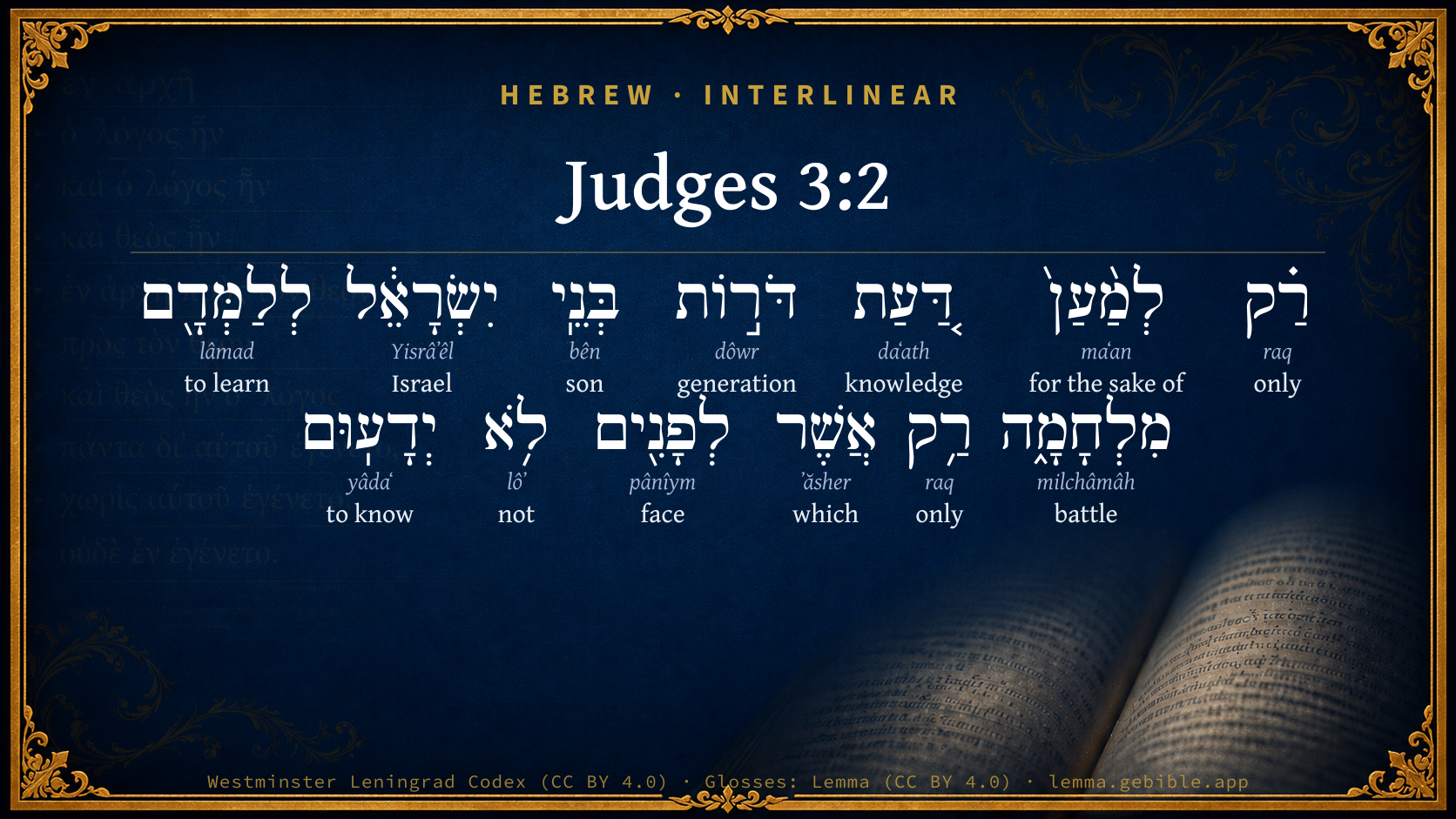
לְלַמְּדָ֖ם
lâmad
H3925
“to learn · them”
Preposition + Verb, Piel, Infinitive Construct + Suffix, Personal, 3rd Person, Masculine, Plural
Part of Speech
Preposition + Verb
Stem
Piel
Form
Infinitive Construct
Full BDB Definition

Origin: a primitive root

TWOT: 1116

to learn. teach, exercise in - (Qal) to learn - (Piel) to teach - (Pual) to be taught, be trained
  1. רַ֗ק raq H7535 “only” Particle, Accusative
  2. לְמַ֨עַן֙ maʻan H4616 “for the sake of” Preposition
  3. דַּ֚עַת daʻath H1847 “knowledge” Verb, Qal, Infinitive Construct
  4. דֹּר֣וֹת dôwr H1755 “generations of” Noun, Common, Masculine, Plural, Construct
  5. בְּנֵֽי bên H1121 “sons of” Noun, Common, Masculine, Plural, Construct
  6. יִשְׂרָאֵ֔ל Yisrâʼêl H3478 “Israel” Noun, Proper
  7. מִלְחָמָ֑ה milchâmâh H4421 “battle” Noun, Common, Feminine, Singular, Absolute
  8. רַ֥ק raq H7535 “only” Particle, Accusative
  9. אֲשֶׁר ʼăsher H834 “which” Particle, Relative
  10. לְפָנִ֖ים pânîym H6440 “to/for · face(s)” Preposition + Noun, Common, Both, Plural, Absolute
  11. לֹ֥א lôʼ H3808 “not” Particle, Negative
  12. יְדָעֽוּם yâdaʻ H3045 “to know · them” Verb, Qal, Perfect, 3rd Person, Common, Plural + Suffix, Personal, 3rd Person, Masculine, Plural

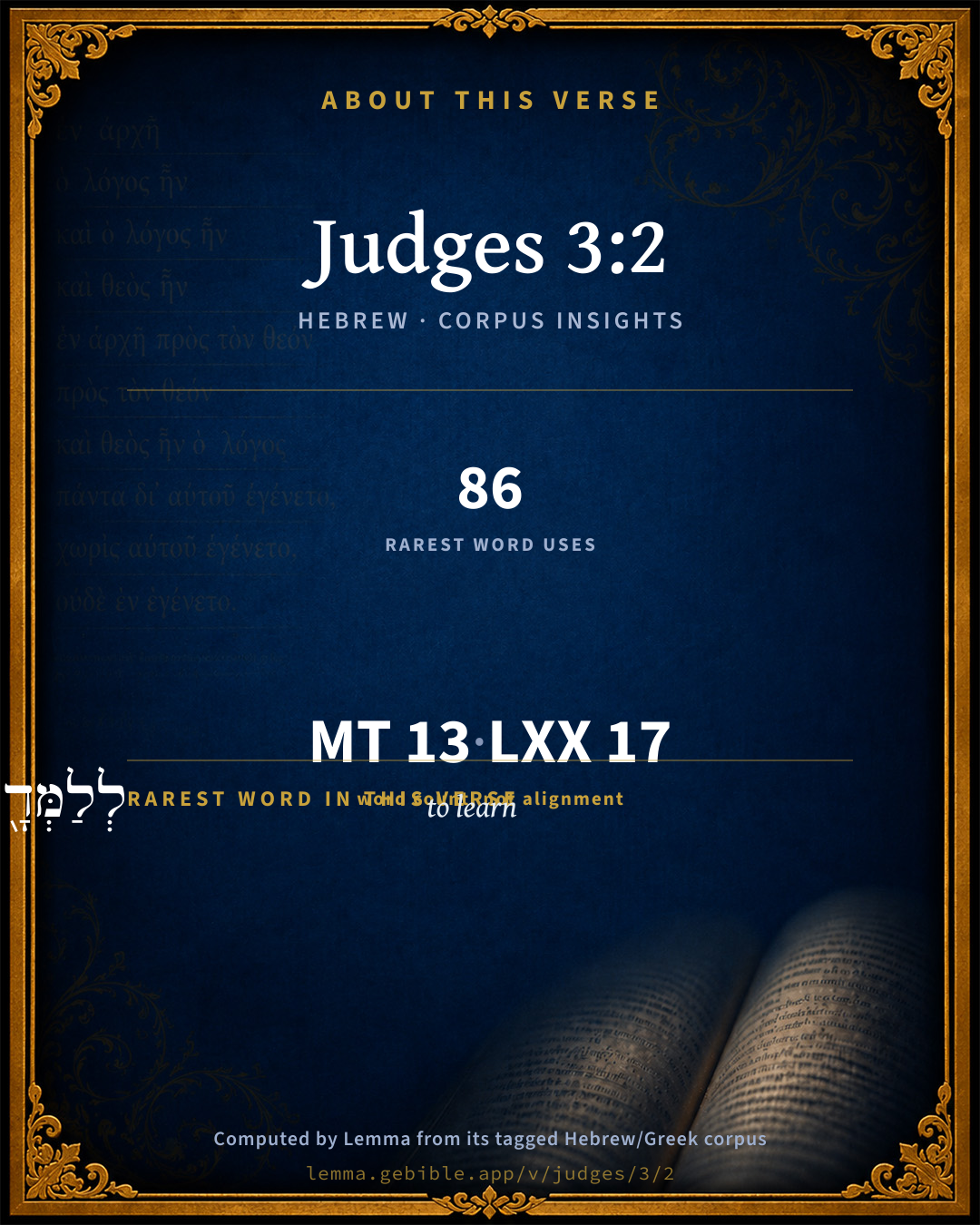
About this verse

These counts appear in no published source. They are computed here, from the morphology-tagged text and Lemma’s own curated glosses. What Lemma adds →

13
words
12
distinct lemmas
Historical
section

Grammatical profile

  • 3 verbs
  • 5 nouns
  • 1 preposition
  • 4 particles

Verb forms

  • דַּ֚עַת Qal · Infinitive Construct
  • לְלַמְּדָ֖ם Piel · Infinitive Construct
  • יְדָעֽוּם Qal · Perfect

Repetition

A word recurs within this verse — often emphatic in Hebrew:

  • רַ֗ק only H7535 ×2

Hebrew & Septuagint length

In English translation the verse runs 25 words from the Hebrew and 21 from the Septuagint (LXX English) — closely comparable.

A rough comparison of the two English renderings, which tokenize alike — not a word-level alignment.

Word counts can differ between the Hebrew and the Greek without any difference in meaning — e.g. the Hebrew direct-object marker אֵת has no separate Greek word, and Greek often adds the article ὁ.

In the original languages it is 13 Hebrew tokens and 17 Greek tokens — but the two are counted differently (Hebrew bundles its prefixes and suffixes into one token; the Greek is in lemma form), so that isn’t a like-for-like length.

Cross-references

11

Topical passages linked to Judges 3:2 in the Treasury of Scripture Knowledge — connected by theme and wording, ordered by reader-vote popularity; previews shown in the World English Bible.

  • 2 Timothy 2:3 You therefore must endure hardship, as a good soldier of Christ Jesus.
  • Genesis 2:17 but of the tree of the knowledge of good and evil, you shall not eat of it: for in the day that you eat of it you will surely die."
  • Genesis 3:5 for God knows that in the day you eat it, your eyes will be opened, and you will be like God, knowing good and evil."
  • Genesis 3:7 Both of their eyes were opened, and they knew that they were naked. They sewed fig leaves together, and made themselves aprons.
  • 2 Chronicles 12:8 Nevertheless they shall be his servants, that they may know my service, and the service of the kingdoms of the countries.
  • Matthew 10:34–39 "Don't think that I came to send peace on the earth. I didn't come to send peace, but a sword.
  • John 16:33 I have told you these things, that in me you may have peace. In the world you have oppression; but cheer up! I have overcome the world."
  • 1 Corinthians 9:26–27 I therefore run like that, as not uncertainly. I fight like that, as not beating the air,
  • Ephesians 6:11–18 Put on the whole armor of God, that you may be able to stand against the wiles of the devil.
  • 1 Timothy 6:12 Fight the good fight of faith. Lay hold of the eternal life to which you were called, and you confessed the good confession in the sight of many witnesses.
  • 2 Timothy 4:7 I have fought the good fight. I have finished the course. I have kept the faith.

Cross-references courtesy of OpenBible.info (CC BY 4.0).

Hebrew and Greek witnesses Masoretic Hebrew ↔ Greek Septuagint

The same verse in the two great witnesses to the Old Testament, shown verse-for-verse.

These are two independent witnesses, not word-aligned to each other, and the Septuagint is shown in lemma (dictionary) form.

Hebrew Judges 3:2 Masoretic · Westminster Leningrad Codex

רַ֗ק לְמַ֨עַן֙ דַּ֚עַת דֹּר֣וֹת בְּנֵֽי יִשְׂרָאֵ֔ל לְלַמְּדָ֖ם מִלְחָמָ֑ה רַ֥ק אֲשֶׁר לְפָנִ֖ים לֹ֥א יְדָעֽוּם

only that the generations of the children of Israel might know, to teach them war, at the least such as before knew nothing of it:

World English Bible · Public Domain

Greek LXX Judges 3:2 Septuagint · lemma form

πλήν διά ὁ γενεά υἱός ἰσραήλ ὁ διδάσκω αὐτός πόλεμος πλήν ὁ ἔμπροσθεν αὐτός οὐ γιγνώσκω αὐτός

Only for the sake of the generations of Israel, to teach them war, only the men before them knew them not.

LXX2012 (modern English Septuagint) · Public Domain

On this verse, Ellicott's Commentary for English Readers discusses the Septuagint’s reading. Read the note in Commentary ↓

Hebrew: Westminster Leningrad Codex (CC BY 4.0). Greek: Septuagint (public domain); English from LXX2012 (modern English Septuagint) (Public Domain). How the Septuagint differs from the Hebrew →

Targum (Aramaic paraphrase)

1

The Targum is the ancient Jewish Aramaic paraphrase of the Hebrew Scriptures — an interpretive translation, not the Hebrew text itself. Onkelos (literal) and Pseudo-Jonathan (expansive) render the Torah, and Jonathan the Prophets. Coverage is partial: where no permissively-licensed English translation exists for a verse, only the Aramaic is shown. This is verse-level text, not a word-by-word alignment to the Hebrew.

  1. Targum Jonathan Prophets (Joshua–Malachi)
    לְחוֹד בְּדִיל דְיֵדְעוּן דָרַיָא דִבְנֵי יִשְׂרָאֵל לַאֲלָפוּתְהוֹן קְרָבָא לְחוֹד דְמִלְקַדְמִין לָא הֲווֹ יָדְעִין:

    (no public-domain English translation for this verse)

    Targum Jonathan — Aramaic: “Mikraot Gedolot” (public domain). English: “Sefaria Community Translation” (CC0 1.0 (public-domain dedication)); “London "Chaldee Paraphrase," 1871” (public domain). Text via Sefaria.

Commentary

Notes on Judges 3:2 from classic Christian and Jewish commentators (each source and its license shown beneath its notes). The classic Christian expositions comment on the surrounding passage and are grouped to its opening verse, so a note may address several verses; the Jewish commentaries on the Tanakh (Rashi and others) are per-verse, so they appear only where the commentator wrote on this verse.

Lemma curates 59 commentaries, every one of them public domain or Creative Commons licensed, each selected and text-cleaned for this edition rather than reprinted as found. About our sources →

Trapp's Complete Commentary

John Trapp

Jdg 3:2 Only that the generations of the children of Israel might know, to teach them war, at the least such as before knew nothing thereof;

Ver. 2. Might know, to teach them war.] At their own costs and to their damage, say some, that they might experiment what an evil and bitter thing war is; called therefore "evil" by an antonomasia {Isa 45:7} Others sense it thus; Those nations were left, that Israel might not rust through long rest, but have occasion to train up their children in martial discipline. Marcet sine adversario virtus. Slay them not, lest my people forget. Scipio persuaded his Romans not to ruin Carthage, lest their youth should lack exercise and grow wanton with too much ease.

John Trapp, A Commentary or Exposition upon All the Books of the Old and New Testament (1647–1656) — public domain. Text from a community e-Sword module.

Joseph Benson's Commentary

Jdg 3:2. Only that the generations, &c. — Le Clerc and some other versions, instead of only put and, this seeming to be a new and additional reason alleged why God left some of the Canaanitish nations in the land, namely, that the Israelites might be inured to war and hardship, and thereby be preserved from sinking into sloth and luxury; and that by the neighbourhood of such warlike enemies, and a knowledge of the danger they were in from them, they might never be carnally secure, but stand continually on their guard, and keep close to that God of whose protection and aid they had such great and constant need.

Joseph Benson's Commentary on the Old and New Testaments (1811–1818) — public domain. Text from a community e-Sword module.

Geneva Bible (1599)

Geneva Bible translators

For they trusted in God, and he fought for them.

Geneva Bible (1599) marginal notes — public domain. Text via Bolls.life.

Adam Clarke's Commentary

Verse 2. That - Israel might know, to teach them war] This was another reason why the Canaanites were left in the land, that the Israelites might not forget military discipline, but habituate themselves to the use of arms, that they might always be able to defend themselves against their foes. Had they been faithful to God, they would have had no need of learning the art of war; but now arms became a sort of necessary substitute for that spiritual strength which had departed from them. Thus Gods in his judgments leaves one iniquitous nation to harass and torment another. Were all to turn to God, men need learn war no more.

Adam Clarke's Commentary on the Bible (1810–1826) — public domain. Text from a community e-Sword/MySword module.

Ellicott's Commentary for English Readers

(2) Only that the generations of the children of Israel might know, to teach them war.—The LXX. here render, “Only because of the generations of the children of Israel to teach them war.” The Vulgate is here a mere paraphrase, and the translations vary. The meaning seems to be, “Only that He (Jehovah) might know the generations of the children of Israel, to teach them war.” The expression resembles 2Ch_32:31. The “teaching them war” doubtless implies the lesson that they could only learn successfully by the help of God.

As before knew nothing thereof.—That is, “knew nothing of those nations, or of those wars.”

A Bible Commentary for English Readers, edited by Charles John Ellicott (1878–1897) — public domain. Text from a community e-Sword module.

The Cambridge Bible for Schools and Colleges

gen. ed. J. J. S. Perowne

2. might know] The verb, instead of governing a direct object, is followed by a fresh clause to teach them war; the LXX relieves the awkwardness by omitting might know, ‘only for the sake of the generations … to teach them war.’ The incompleteness of the conquest was not a punishment for Israel’s unfaithfulness to the covenant (Jdg_2:20-21), nor a test of Israel’s steadfastness (Jdg_2:23, Jdg_3:4-6), but a discipline1[24] designed to train Israel to hold its own and ascribe its victories to Jehovah’s help.

[24] Cf. Livy 39:1. Is hostis (the Ligures) velut natus ad continendam inter magnorum intervalla bellorum Romanis militarem disciplinam erat.

at the least such] only such; the repetition is clumsy; the rest of the verse looks like an explanatory gloss.

The Cambridge Bible for Schools and Colleges (gen. ed. J. J. S. Perowne; Cambridge University Press, 1878–1918) — public domain. Text from a community e-Sword module.

John Gill's Exposition

Only that the generations of the children of Israel might know and teach them war,.... That is, the following nations were left in the land, that the young generations of Israel might by their wars and conflicts with them learn the art of war, and be inured to martial discipline; which, if none had been left to engage with, they had been ignorant of: besides, their fathers in Joshua's time, as Jarchi and Kimchi observe, had no need to learn the art of war, for God fought for them; they did not get possession of the land by their own arm, and by their sword, but by the power of God in a miraculous way; but now this was not to be expected, and the Canaanites were left among them to expel, that they might be trained up in the knowledge of warlike affairs, and so be also capable of teaching their children the military art; which they should make use of in obeying the command of God, by driving out the remains of the Canaanites, and not give themselves up to sloth and indolence; though some think that the meaning is, that God left these nations among them, that they might know what war was, and the sad effects of it; and the difference of fighting with their enemies alone, as other men, and the Lord fighting along with them, and for them, as he did for their fathers:

at least such as before knew nothing thereof; being either unborn, or at an age incapable of bearing arms, or learning the art of war.

John Gill's Exposition of the Whole Bible (1746–1763) — public domain (CC PDM 1.0). Text via the HelloAO Bible API.

Haydock's Catholic Bible Commentary

And be. Hebrew, "at least, such as before knew nothing thereof." Though war be in itself an evil, the passions of men render it necessary, and God makes use of it as a scourge, to punish the wicked, and at the same time to keep all under due restraint. (Haydock) --- Too long a peace has proved sometimes fatal to states and to the virtue of individuals. In adversity we call upon God, and adhere to him with greater fervour and constancy. The Jews were so prone to evil, that, if they were permitted to enjoy tranquility for a few years, they presently forgot themselves and the author of all their good, and even turned their backs upon the only true God. Their enemies forced them to have recourse to Him. (Calmet)

George Leo Haydock (1774–1849), Haydock's Catholic Family Bible and Commentary, 1859 edition — public domain. Excludes Psalms (Douay-Rheims chapter numbering differs from Protestant) and Deuterocanonical books (Catholic canon only).

Matthew Poole's English Annotations

Might know, to teach them war; that by the neighbourhood of such warlike potent enemies, they might be purged from sloth and security, and obliged to inure themselves to martial exercises, and to stand continually upon their guard, and consequently to keep close to that God whose assistance they had so great and constant need of.

Matthew Poole's English Annotations on the Holy Bible (1683–1685) — public domain. Text from a community e-Sword/MySword module.

Whedon's Commentary on the Bible

Daniel D. Whedon

2. Only that — This verse defines more fully the purpose of God in leaving the heathen nations to prove Israel. The mind of the writer reverts to the word left, in the previous verse, and the grammatical connexion is, left, only that the generations… might know. That is, they were left for the further discipline of Israel, that Israel might experience and realize what could be learned in no other way.

To teach them war — This clause also depends on left in the previous verse. The nations were left to teach Israel the art of war by obliging them to fight for their possessions, and thus acquire a knowledge of military tactics and skill which would be greatly needed in the times approaching. Thus, too, this younger generation might learn what it had cost to get possession of Canaan, and thereby appreciate the heroism of the fathers.

At the least such as — Rather, only because, giving the reason for teaching them war. Render: Only because they did not before know them. That is, previously they did not properly understand and appreciate the wars of Canaan. The sacrifices and mighty deeds of the fathers could only be learned by passing through similar conflicts with the same old foes.

Daniel D. Whedon (gen. ed.), Commentary on the Old and New Testaments (1874–1909) — public domain. Text from a community e-Sword module.

John Wesley's Explanatory Notes

Teach them war - That by the neighbourhood of such warlike enemies, they might be purged from sloth and security, and obliged them to innure themselves to martial exercises, and to stand continually upon their guard, and consequently to keep close to that God whose assistance they had so great and constant need of.

John Wesley, Explanatory Notes Upon the Whole Bible (1754–1765) — public domain. Text via the GEBible commentary corpus.

Rashi

Rabbi Shlomo Yitzchaki (Rashi)

Only so that they should know. For this alone, He permitted these nations to remain, so that future generations of the Bnei Yisroel might grasp the consequence of iniquity—for it was now necessary for them to undergo martial training.

Whereas earlier when they stood worshiping Adonoy.

This was unknown. These wars and the art of battle. It was unnecessary.

Rashi on the Tanakh — English translations: “The Judaica Press complete Tanach with Rashi, translated by A. J. Rosenberg” (CC BY 4.0); “Pentateuch with Rashi's commentary by M. Rosenbaum and A.M. Silbermann, 1929-1934” (public domain); “The Metsudah Tanach series, Lakewood, N.J” (CC BY 4.0); and “The Book of Joshua, Metsudah Publications, 1997” (CC BY 4.0). Text via Sefaria.

Lesson kit

Teaching starters — assembled from the data on this page, not authored interpretation. Every prompt links to the verse data it draws on. Edit before teaching.

Judges, in the Historical, opens this verse with 13 words (12 distinct Hebrew lemmas). Its most distinctive word is lâmad (“to learn”). A historical commentator’s framing appears above. Read the whole chapter for the surrounding context.

Discussion questions

  1. How does “to learn” (lâmad) shape what this verse is saying?
  2. How does 2 Timothy 2:3, which shares this passage’s theme, read alongside this verse?
  3. What does the repetition of “only” (2× in this one verse) do in this verse?
  4. These translations render this verse differently. What is at stake in choosing one wording over another?
  5. «דַּ֚עַת» is a Qal Infinitive Construct verb. How does that grammatical form shape the action described?
  6. Compare how Trapp's Complete Commentary and Joseph Benson's Commentary read this verse. Where do they agree or differ?

Things to notice

Reading settings

Reading text

Shown beneath each verse's original-language words.

Old Testament
Old Testament edition

Read the OT as the Masoretic Hebrew (MT) or the Greek Septuagint (LXX).

English shown for the Greek Septuagint (in the Hebrew ↔ Greek comparison).

Comparing translations? Open the Compare panel on any verse page to stack up to four side by side.