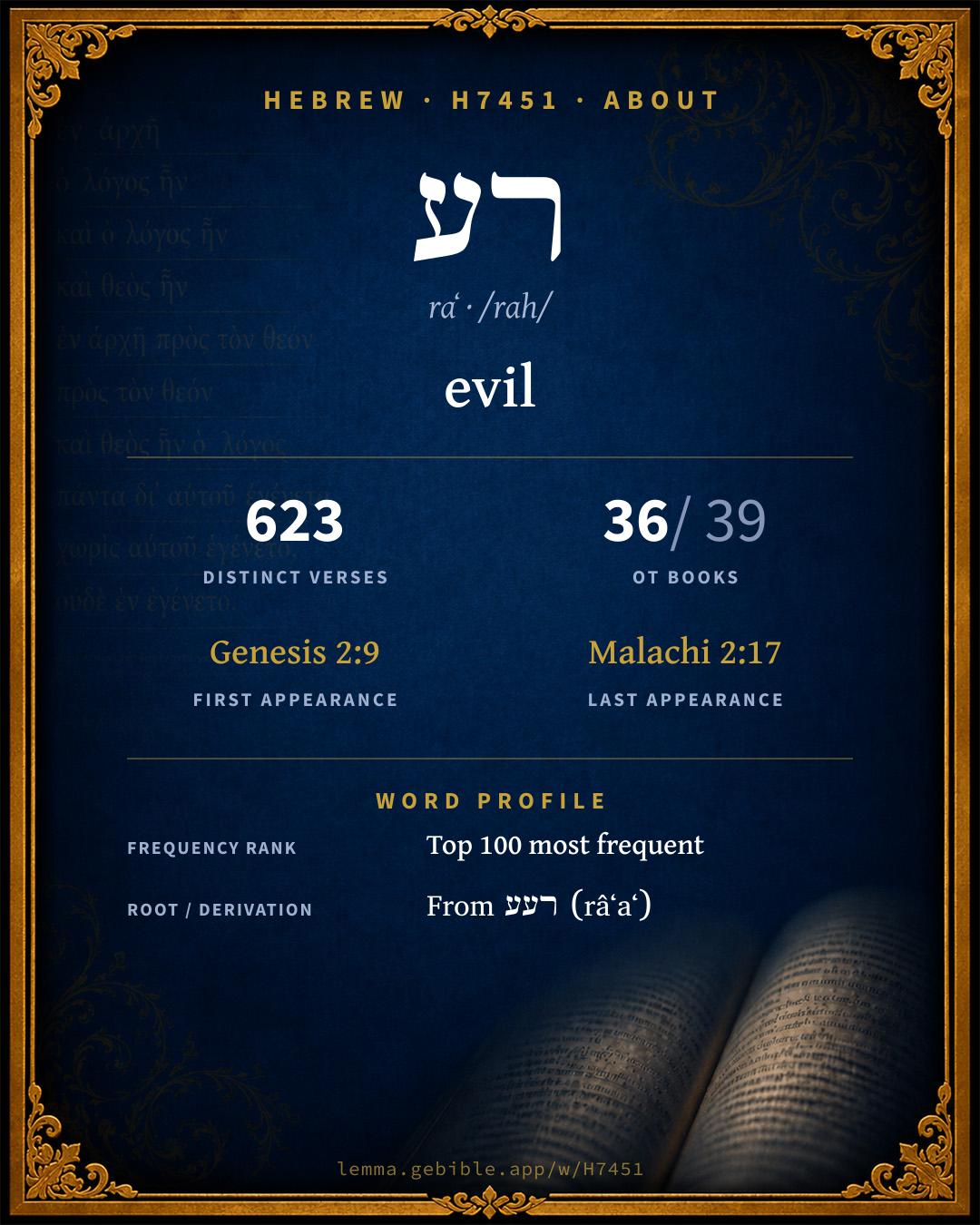
רַע
evil
‘evil’ is one of 3 main senses fuller range ↓
Full lexicon entry — Brown-Driver-Briggs (BDB)
From Brown-Driver-Briggs (BDB)
Where this word appears
See every Absolute-state word in the Hebrew Bible →
Grammar key — what these labels mean
Part of speech
- Adjective
- A word that describes or qualifies a noun.
- Noun
- A naming word — a person, place, thing, or idea.
- Verb
- An action or state-of-being word.
Noun type
- Common
- A common noun — a general class of person, place, or thing (“king,” “city,” “water”), not a specific name.
Stem
- Qal
- The basic, simple active stem — the plain form of the verb (“he wrote”). Here: ‘trans.’
Form
- Perfect
- A completed action or state — Hebrew marks aspect (completeness) more than strict tense (“he wrote”).
State
- Absolute
- The independent form of a noun, not bound to a following word.
- Construct
- A noun bound to a following noun in a possessive / “of” relationship (the construct chain).
Person
- 3rd Person
- The one spoken about (“he / she / it / they”).
Gender
- Masculine
- Grammatically masculine.
- Feminine
- Grammatically feminine.
Number
- Singular
- One.
- Plural
- More than one (in Hebrew, generally three or more).
3 verses where H7451 appears in the Construct state in the Book of Ecclesiastes. Filtered view — show all forms. Click any verse to open its interlinear word-by-word view. Verse text shown in the World English Bible for context — . Each verse’s Hebrew form is shown with its reference; the English is not keyword-highlighted, since the data carries no word-level English alignment. Use “Compare translations” on any verse to read it across multiple English versions. This concordance covers the Hebrew Bible; Septuagint (Greek Old Testament) occurrences are not indexed here.
Ecclesiastes
- Ecclesiastes 5:13 רָעָ֣ה לְ/רָעָתֽ/וֹ n c fs prep + n c fs cs + sfx pers 3ms There is a grievous evil which I have seen under the sun: wealth kept by its owner to his harm.
- Ecclesiastes 7:15 בְּ/רָעָתֽ/וֹ prep + n c fs cs + sfx pers 3ms All this have I seen in my days of vanity: there is a righteous man who perishes in his righteousness, and there is a wicked man who lives long in his evil-doing.
- Ecclesiastes 8:6 רָעַ֥ת n c fs cs For there is a time and procedure for every purpose, although the misery of man is heavy on him.
About this entry
At a glance — auto-summarized from this page’s data, not written by a person. Every figure links to its source below. This summary describes the numbers; it doesn’t interpret them.
The Hebrew word רע centers on the idea of “evil.” Its earliest occurrence is Genesis 2:9. It appears 623 verses across 36 books of the Hebrew Bible, among its most common vocabulary. Its meaning spans more than one sense — see its full sense range. It clusters with רעע, מרע and רע under a shared root. Dig into 623-verse concordance and the renderings breakdown below.
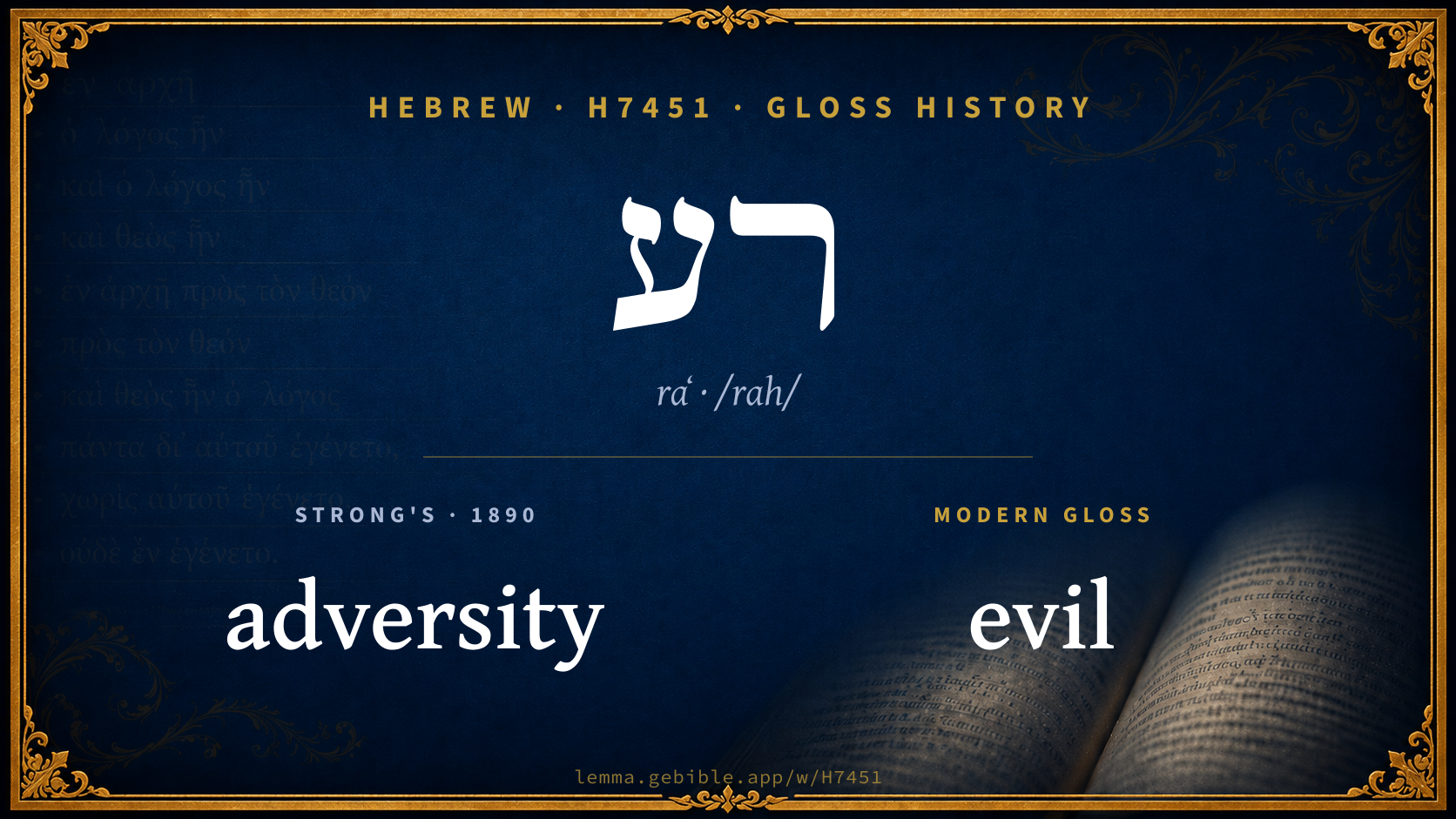
Gloss history
Strong's 1890 vs modern scholarship
About this word
Strong's H7451 catalogs a Hebrew word from the Hebrew Old Testament.
These counts are not copied from any lexicon or concordance. They are computed here, from the morphology-tagged Hebrew Old Testament. What Lemma adds →
- 623
- distinct verses
- The word appears in 623 distinct verses.
- 36 / 39
- OT books
- The word appears in 36 of 39 Old Testament books.
- #73
- by frequency
- Top 100 most frequent Hebrew words (rank 73 of 8,640 Hebrew words by occurrence).
View all 623 occurrences in the concordance →
By section of the Old Testament
By traditional corpus
Conventional, traditional groupings — biblical authorship is debated, so this is a traditional corpus grouping, not an authorship claim. Each share is this word’s portion of its verses in that division of the Hebrew canon. Each figure is a share of the word’s 623 distinct verses.
- Prophets (Nevi'im) 312 verses · 50%
- Writings (Ketuvim) 221 verses · 35%
- Torah (Pentateuch) 90 verses · 14%
How translations render this word
Counts come from each version’s own published word-to-Strong’s tagging or interlinear alignment — an approximate guide to how each version renders this word, not a word-level alignment the data otherwise carries. Because each total is that version’s own tagged count, the per-version totals vary from one another and need not match the appearance or distinct-verse counts above. These counts may also differ from a printed concordance because Lemma counts each distinctly tagged rendering and does not collapse phrase taggings into a single head-word total. This is a fixed set of word-tagged versions (KJV, ASV, BSB, ULT) and does not change with the reading translation you choose elsewhere. Each version’s license is shown beside its name below (and on Sources).
BDB lists this Strong’s number as 6 distinct words (homographs). Each count above pools all of them and is not split by sense — see the Senses section below. A low-frequency rendering may belong to a different one of those words, not the primary meaning.
- King James Version†: Evil 308×, Wickedness 39×, Was evil 26×
- American Standard Version†: Evil 241×, Was evil 51×, Wickedness 32×
- Berean Standard Bible†: Evil 247×, Disaster 72×, Harm 28×
- unfoldingWord Literal Text†: Evil 341×, Harm 49×, Bad 34×
King James Version Public Domain
Renders H7451 across 657† tagged occurrences — most commonly:
Plus other, less common renderings. Plus 118 renderings that appear only once — usually multi-word phrases or single function words the recovered tagging swept in, not distinct renderings. Not rendered by a distinct English word in 6 further occurrences.
American Standard Version Public Domain
Renders H7451 across 655† tagged occurrences — most commonly:
Plus other, less common renderings. Plus 165 renderings that appear only once — usually multi-word phrases or single function words the recovered tagging swept in, not distinct renderings.
Berean Standard Bible Public Domain
Renders H7451 across 651† tagged occurrences — most commonly:
Plus other, less common renderings. Plus 98 renderings that appear only once — usually multi-word phrases or single function words the recovered tagging swept in, not distinct renderings. Not rendered by a distinct English word in 13 further occurrences.
unfoldingWord Literal Text CC BY-SA 4.0
Renders H7451 across 644† tagged occurrences — most commonly:
Plus other, less common renderings. Plus 46 renderings that appear only once — usually multi-word phrases or single function words the recovered tagging swept in, not distinct renderings.
36 senses and sub-senses in the full BDB
Hebrew verbs can shift meaning by stem (binyan): Qal is the basic action, Niphal is often passive or reflexive, Piel often intensifies or makes it factitive, and Hiphil is typically causative. The senses below are grouped under the stem BDB assigns to each. This entry also uses Hithpael (reflexive or reciprocal).
What do BDB’s symbols mean?
BDB uses these scholarly abbreviations:
| Symbol | Meaning |
|---|---|
| 𝔊 | the Septuagint (the ancient Greek translation, LXX) |
| 𝔙 | the Vulgate (the Latin translation) |
| 𝔖 | the Syriac version (the Peshitta) |
| 𝔗 | the Targum (the Aramaic translation) |
| ψ | the Psalms |
| √ | root (the underlying root or stem) |
| ‖ | parallel passage (a synonymous or contrasted parallel) |
| † | the dagger: every passage where the word occurs is cited |
The 36 senses and sub-senses the full Brown-Driver-Briggs lexicon distinguishes for this word, in lexicon order (not ranked by frequency), with BDB’s own verbatim wording and sub-sense lettering. Shown in Hebrew script with BDB’s own scholarly abbreviations. The condensed entry is in the Lexicon Entry tab. See also the Forms in the corpus table below.
רע I pasture, tend, graze (Assyrian rêʾû vb. pasture, n. ruler, TelAm. ruh̬i (as Canaanism) WklNo. 181, 11
Qal
- Pf. 3 ms. consec. וְרָעָה Mi 5:3 +, 1 s. sf. consec. וּרְעִיתִים Ez 34:13, 3 pl. sf. consec. וְרָעוּם Je 23:4, etc.; Impf. 3 ms. יִרְעֶה Is 27:10 +, juss. יֵרַע Jb 20:26, sf. יִעֶנָּה ψ 80:14, וַיִּרְעֵם ψ 78:72 (וַיִּר׳ Hiph. van d. H.), etc.; Imv. ms. רְעֵה Mi 7:14 +, sf. רְעֵם ψ 28:9; fs. רְעִי Ct 1:8; mpl. רְעוּ Gn 29:7; Inf. cstr. לִרְעוֹת 37:12 +, etc.; Pt. רֹעֶה 30:36 +, sf. רֹעִי ψ 23:1 +; fs. רֹעָה Gn 29:9 Pr 25:19, etc.;— e.g. Micah 5:3
- 1. trans.
- a. pasture, tend (pascere), lit., c. acc. צֹאן Gn 30:31, 36; 37:12 (all J), Ex 3:1 (E), 1 S 17:15; 25:16 Is 61:5, acc. of asses Gn 36:24 (P), kids Ct 1:8; acc. (צפּאן) om. Gn 29:7; 37:13 (ב loc.) v 16 (all J), Ct 1:7 (‖ חִרְבִּיץ), Jb 24:2 (𝔊 Me Siegf Bu וְרֹעוֹ);—metaph. גֹּרֶן וָיֶקֶב לֹא יִרְעֵם Ho 9:2, but read יֵדָעֵם 𝔊 We Now GASm; מָוֶת יִרְעֵם ψ 49:15. e.g. Genesis 30:31
- b. fig. of י׳, acc. pers., Gn 48:15 (E) God, who shepherded me; c. acc. of people, as flock Ho 4:16 Is 40:11 Mi 7:14 (בְּשִׁבְטֶ֑ן), Ez 34:13 (pregn., c. אֶל loc.), v 14, 15 (+ הִרְבִּיץ), v 16 ψ 28:9. e.g. Genesis 48:15
- c. fig. of ruler, and teacher, acc. of people, as flock, 2 S 5:2 = 1 Ch 11:2; 2 S 7:7 = 1 Ch 17:6, ψ 78:72 Je 3:15; 23:2, 4; Ez 34:2, 3, 8, 10, 23(×2); Zc 11:4, 7(×2), 9; of guiding, שִׂפְתֵי צַדִּיק יִרְעוּ רַבִּים Pr 10:21; c. ב of people ψ 78:71; abs. Mi 5:3; c. acc. pers. reflex. pastured (fed, enriched) themselves Ez 34:2, 8, 10 e.g. 2 Samuel 5:2
- d. especially pt. רֹעֶח, etc., as subst. = shepherd, herdsman: (1) lit., רֹעֵה צֹאן Gn 4:2; 46:32, 34; 47:3 (all J), רֹעֶח בַּצּ׳ 37:2 (E), 1 S 16:11; 17:34; רֹעֵי מִקְנֶה Gn 13:7(×2) (J); (ה)ר׳ alone, sg. Am 3:12 + 7 times (all in sim.); רֹעָה shepherdess, Gn 29:9 (J); כִּלִי רֹעֶה אֱוִילִי Zc 11:15 (v. כְּלִי 2 c), as symbol; pl. (הָ)רֹעִים Am 1:2; Ex 2:17, 19 (J), 1 S 21:8 (אַבִּיר הָר׳; Gr Dr Bu Kit Löhr א׳ הָרָצִים; 𝔊 LagBN 45 HPS אֹבִּיל הָעֲיָרִים, but cf. We) + 8 times + Is 31:4 (sim.), 38:12 (read רֹעִים for רֹעִי Perles29 Du CheHpt cf. Di), cf. (sf.) Gn 13:8(×2) (J); כְּלִי הָרֹעִים 1 S 17:40 (v. כְּלִי 3);—בֵּית־עֵקֶד הָרֹעִים, v. p. 112. (2) fig. of ruler (as often Assyrian; cf. Gk. (Homer) ποιμένα λαῶν), abs. sg. Je 17:16 fig. of prophet (but Aq Symm 𝔖 Gie Du Co מֵרָעָה). Zc 10:2; 11:16; 13:7b + 8 times Je Ez; sf. of י׳, דֹעִי Is 44:28 (of Cyrus), Zc 13:7a (read רֹעִי הָאֱוִילִי We Now GASm); abs. pl. Is 56:11; Je 2:8; 3:15; Mi 5:4 Zc 10:3; 11:5, 8 + 18 times Je Ez 34, + (of Assyrian leaders) Na 3:18; רֹעֵי יִשׂ׳ Ez 34:2; רֹעֵי צֹאנוֹ Is 63:11 (but read רֹעֵה [of Moses] 𝔊 𝔗 Di Du al.). (3) epith. of י׳: י׳ רֹעִי ψ 23:1, רֹעֵה יִשׂ׳ 80:2, רֹעֶה אֶבֶן יִשׂ׳, Gn 49:24 (poem in J; read cstr. רֹעֵה, cf. Comm.); מֵרֹעֶה אֶחָד Ec 12:11 DeWild, president of assembly of sages Siegf SS e.g. Genesis 4:2
- 2. intrans. feed, graze:
- a. lit. of cows, sheep, etc.: c. ב loc. Gn 41:2, 18 (E), 1 Ch 27:29; c. acc. of pasture Is 30:23; c. עַל loc. Zp 2:7 (עֲלֵי הַיָּם for MT עֲלֵיהֶם, v. Now); אֶל־מוּל loc. Ex 34:3 (J); abs. Is 5:17; 11:7 (‖ רבץ; but v. II. רעה infr.) 27:10 (‖ id.), 65:25 Jon 3:7; Jb 1:14. e.g. Genesis 41:2
- b. fig. of idolater, Is 44:20 he feedeth on ashes (acc.); cf. Ho 12:2 Ephr. feedeth on wind (acc.); פִּי כְסִילִים יִר׳ אִוֶּלֶת Pr 15:14 (so Vrss Qr; Kt פני for פי) the mouth of fools feeds on folly (Toy; Buhl √ II. רעה, Gerber 162 sub III. רעה); in Ct, c. ב loc., fig. of lover Ct 2:16; 6:2, 3; of breasts (like gazelles) 4:5. e.g. Isaiah 44:20
- c. fig., of Isr. as flock Is 14:30 (‖ רבץ), read (י—ַ)בְּכָרִי in my pasture(s), for MT בְּכוֹרֵי, Koppe Ew Di Du (otherwise CheHpt., cf. Marti); Zp 3:13 (‖ id.); c. עַל־דְּרָכִים Is 49:9; c. acc. of pasture-land Je 50:19; Mi 7:14; Ez 34:14b (+ אֶל loc.), v 18, 19; hence crop, strip, i.e. devastate, of conqueror, c. acc. of land Mi 5:5, cf. אֶת־יָדוֹ Je 6:3; so יִרְעוּךְ קָדְקֹד 2:16; acc. of Isr. under fig. of vine (subj. foes, as beasts) ψ 80:14. e.g. Isaiah 14:30
- d. subj. wind, c. acc. pers. Je 22:22, i.e. drive them away; subj. fire, c. acc. rei, יֵרַע Jb 20:26, but read perhaps יֵרָע, Niph. (Ol Di Hoffm Siegf Bu; otherwise Du).—רֹעֶה עֲקָרָה 24:21 is difficult; Bu הֵרַע for ר׳; more radical conj. in Du. e.g. Jeremiah 22:22
Niphal
- poss. Jb 20:26, v. 2 d supr. e.g. Job 20:26
Hiphil
- ψ 78:72 van d. H., v. 1 c supr. e.g. Psalms 78:72
רע II ob. associate with (cf. Schulthess69 ff. but also NöZMG liv (1900), 154 f.
Qal
- Imv. ms. וּרְעֵה אֱמוּנָה ψ 37:3 cherish faithfulness (Hup-Now RV Che Du Dr); > feed securely (Bae; i. רעה; feed on (his) faithfulness Am RV); Pt. רֹעֶה כְסִילִים Pr 13:20 one associating with fools, so ר׳ זֹלְלִים 28:7, ר׳ זוֹנוֹת 29:3 (Thes al. think these fig. from I. רעה, v. 2 b). e.g. Psalms 37:3
Hithpael
- 2 ms. אַל־תִּתְרַע אֶת־בַּעַל אָ֑ף Pr 22:24 do not make companionship with a bad-tempered man; perhaps also 3 fpl. תִּתְרָעֶינָה Is 11:7 (LagOr i. 21; Deceased Wife’s Sister 399 Brd Du CheHpt) cow and bear shall be each other’s companions; + Inf. cstr. הִתְרָעֹת Pr 18:24 (Toy, for MT הִתְרֹעֵעַ) there are [יֵשׁ for אִישׁ] friends (merely) to be companions (v. II. רעע ad fin.). e.g. Proverbs 22:24
רע III denom.
Piel
- be a special friend;—Pf. 3 ms. מֵרֵעֵהוּ אֲשֶׁר רֵעָה לוֹ Ju 14:20 his comrade who had been ‘best man’ (GFM) to him. e.g. Judges 14:20
רע IV I. רַע226 adj. bad, evil (distinction from n., and vb. Pf. 3 ms., is sometimes not easy, and opinions differ)
- 1. bad, disagreeable, malignant: of a woman, רָעָה בְּעֵינֵי Ex 21:8 (E; perhaps, with changed accent, vb. 3 fs. רָ֫עָה) disagreeable, unpleasing in the eyes of, pl. Gn 28:8 (P); of poisionous herb 2 K 4:41, malignant boils Dt 28:35; Jb 2:7, diseases Dt 7:15; 28:59; 2 Ch 21:19 Ec 6:2, deadly sword ψ 144:10, arrows Ez 5:16, severe judgments 14:21, wonders Dt 6:22; מַלְאֲכֵי רָעִים ψ 78:49 = fierce messengers (of God; Ew§ 287 a Ges§ 130 e), wild beasts Gn 37:20, 33 (JE) Lv 26:6 (H) Ez 5:17; 14:15, 21; 34:25; unclean thing Dt 23:10. e.g. Exodus 21:8
- 2. bad, unpleasant, giving pain, unhappiness, misery: ימים רעים evil days (of trial and hardship) Gn 47:9 (P) Pr 15:15; עִנְיָן רע Ec 1:13; 5:13; עִנְיַן 4:8, cf. 2:17; 9:3; הַמַּעֲשֶׂה הָרָע 4:3; הדבר הרע evil report Ex 33:4 (J), so דִּבָּה רָעָה Gn 37:2 (JE) Nu 14:37 (P), שׁם רע Dt 22:14, 19; Ne 6:13, שְׁמוּעָה רָעָה Je 49:23 ψ 112:7; of things: painful discipline Pr 15:10, evil occurrence 1 K 5:18, evil(-bringing) net Ec 9:12, instruments Is 32:7: כל הדבר הרע Jos 23:15 (D) all evil (injurious) things; רַע it is bad, harmful Is 3:11; Je 2:19; of speech, דבּר, רע או טוב Gn 24:50 (J) in prov., speak bad or good = anything at all, טטוב עד רע 31:24, 29 (E), לְמֵרָע ועד טוב 2 S 13:22, of the divine spirit as producing an ecstatic state of frenzy and violence 1 S 16:14, 15, 16, 23; 18:10; 19:9 (see רוּחַ 9). e.g. Genesis 47:9
- 3. evil, displeasing עָשָׂה רָ֔ע בְּעֵינֵי סַרְנֵי פְלִשְׁתִּים 1 S 29:7. e.g. 1 Samuel 29:7
- 4. bad of its kind, land Nu 13:19 (J), place 20:5 (JE), waters 2 K 2:19, figs Je 24:2, 3(×2), 8, kine Gn 41:3, 4, 19, 20, 21, 27 (E), מוּם רע Dt 15:21, cf. 17:1. e.g. Numbers 13:19
- 5. bad, i. e. of low value Lv 27:10(×2), 12, 14, 33 (H), cf. Mal 1:8(×2); רַע רַע יֹאמַר הַקּוֹנֶה Pr 20:14(×2). e.g. Leviticus 27:10
- 6. + מִן comp., worse than, 2 S 19:8; as superl., רָעֵי גוֹיִם Ez 7:24 worst of nations (del. Co). e.g. 2 Samuel 19:8
- 7. sad, unhappy: לֶב־רָ֑ע sad heart (cf. opp. טוב, יטב) Pr 25:20; of face Gn 40:7 (E) Ne 2:2; רע לְפָנָין v 1. e.g. Proverbs 25:20
- 8. הָשַׁב מַחֲשֶׁבֶת(ה)רָעָה devise evil (hurtful) device Ez 38:10; Est 9:25. e.g. Ezekiel 38:10
- 9. bad, unkind, vicious in disposition or temper: וְלֵב־רָ֑ע when the mind is vicious, harmful Pr 26:23; רַע עָ֑יִן one evil of eye Pr 23:6; 28:22; רוּחַ רָעָה Ju 9:23 bad temper. e.g. Proverbs 26:23
- 10. ethically bad, evil, wicked:
- a. in gen., אם טוב ואם רע Ec 12:14 whether good or bad. e.g. Ecclesiastes 12:14
- b. of persons, אישׁ רע 1 S 30:22; אדם רע ψ 140:2; המן הרע הזה Est 7:6 this wicked Haman, so רָ֑ע = evil man ψ 10:15, Jb 21:30; Pr 11:21; 12:13; 24:20, רָעִים = evil men Gn 13:13 (J) Je 6:29; 15:21; Ez 30:12 Jb 35:12; Pr 4:14; 12:12; 14:19; 15:3; רָעוֹת evil women Je 2:33; שׁכנים רעים 12:14 evil neighbours; of הַדּוֹר Dt 1:35, הָעָם Je 13:10; הָעֵדָה Nu 14:27, 35 (P), המשׁפחה Je 8:3; רַע כְּעֵינֵי י׳ wicked in the eyes of י׳ Gn 38:7 (JE) = 1 Ch 2:3; עָשָׂה הָרָע בְּעֵינֵי י׳ Nu 32:13 (R) Dt 4:25; 9:18; 17:2; 31:29; Ju 2:11 + 48 times, + (c. sf. of God) 2 K 21:15 Is 65:12; 66:4; Je 7:30; 32:30 ψ 51:6; 2 S 12:9, prob. also Je 18:10 (read הָרָע for הָרָעָה). e.g. 1 Samuel 30:22
- c. of thoughts, יֵצֶר Gn 6:5; 8:21 (J), הַלֵּב הָרָע Je 3:17; 7:24; 11:8; 16:12; 18:12; words, רעות Pr 15:28. e.g. Genesis 6:5
- d. deeds, actions, עשׂה (כ)דבר הרע Dt 13:12; 17:5; 19:20; Ne 13:17; עשׂה הרעות Je 3:5; דבר רע ψ 64:6; 141:4 Ec 8:3, 5; דברים 1 S 2:23; 2 K 17:11; דֶּרֶךְ 1 K 13:33; Je 18:11; 23:22 + 11 times; דרכים 2 K 17:13; 2 Ch 7:14; Ez 20:44; 33:11; 36:31; Zc 1:4; מעשׂינוּ Ezr 9:13; מעללים Zc 1:4 Ne 9:35 (cf. רֹעַ 4); בֶּצַע רע Hb 2:9; מרוצתם Je 23:10; (ה)תועבות (ה)רעות Ez 6:11; 8:9 (del. Co); כִּי רָעוֹת בִּמְגוּרָם ψ 55:16 for evil deeds are in their dwelling. e.g. Deuteronomy 13:12
רע V
- 1. evil, distress, adversity: יָרֵא רַע fear evil ψ 23:4 Zp 3:15; בּוֹרֵא רָ֑ע Is 45:7 (of God), הביא רע 31:2; מתאננים רַע Nu 11:1 (J) murmuring respecting distress (see Di); אם טוב ואם רע Je 42:6 whether prosperity or adversity; יוֹם רע Am 6:3 day of calamity; יְמֵי רע ψ 49:6; 94:13; כי טוב קויתי ויבא רע Jb 30:26; בְּרָע in adversity Ex 5:19 (E) ψ 10:6; יִפֹּל בְּרָ֑ע Pr 13:17; אֶרְאֶה בָרָ֑ע Gn 44:34 (J); בכל־רע Pr 5:14, מכל רע Gn 48:16 (E) ψ 121:7; v. also Mi 1:12 ψ 140:12 Jb 5:19; 31:29; Pr 12:21; 19:23. e.g. Psalms 23:4
- 2. evil, injury, wrong: Hb 2:9; Jb 2:10; Pr 21:10; עשׂה רע, + עִם pers. Gn 31:29 (E); ל pers. Je 39:12; as obj. of חשּׁב Ho 7:15, חרשׁ Pr 6:14; 12:20; 14:22, השׁיב ψ 54:7, גמל 7:5 Pr 31:12, בקּשׁ 17:11, שׁלּם 20:22, אמר ψ 41:6, דבּר 109:20; דבּר בְּרָע 73:8 speak about injury; לֹא יִתְנַכֵּא טוֹב כִּי אִם רָ֑ע 1 K 22:8, 18 = 2 Ch (18:7 לְרָעָה), 18:17 לְרָ֑ע; לרע for harm, injury Is 59:7; Je 7:6; 25:7 ψ 56:6 Pr 1:16; 21:12; Ec 8:9; רַע יֵרוֹעַ Pr 11:15 (but read רֹעַ Gr SS, v. Toy). e.g. Habakkuk 2:9
- 3. ethical evil, Dt 30:15; 2 S 14:17; Is 5:20; Am 5:14; Mi 7:3 + 10 times; עשׂה רע 2 K 21:9; 2 Ch 12:14; 33:9; Ne 9:28 + 8 times; פֹּעֲלֵי רע Mi 2:1; אהב רע 3:2 (Qr), ψ 52:5; שׂנא רע Am 5:15 ψ 97:10 Pr 8:13; מאס רע ψ 36:5; מאס ברע Is 7:15, 16; בִּעֵר הרע מִן consume evil from Dt 13:6 + 8 times Dt; לֹא יְגֻרְךָ רָ֑ע ψ 5:5 (adj. = evil man Hup De al.); ידע טוב ורע Gn 2:9, 17; 3:5, 22 (all J), Dt 1:39; סר מֵרָע Is 59:15 ψ 34:15; 37:27; Pr 3:7 + 8 times; כי ברע הוא Ex 32:22 (J) he is set on evil; רע רשׁעים ψ 7:10; רע מעללים 1 S 25:3, cf. Mi 3:4 (v. רֹעַ 3); דִּבְרֵי רָע deeds of evil Je 5:28; תַּהְפֻּכוֹת רָ֑ע Pr 2:14; אֹרַח רע ψ 119:101; עֲצַת רע Ez 11:2; מֵחְשְׁבוֹת רע Pr 15:26; אִישׁ רע 29:6; אַנְשֵׁי רע 28:5; אֵשֶׁת רע 6:24 (but read רֵעַ Gr Bi Toy). e.g. Deuteronomy 30:15
רע VI evil, misery, distress, injury
- 1. evil, misery, distress: פַּחַד רָעָה Pr 1:33, באה (ה)רעה Ez 7:5(×2); c. עַל Is 47:11 (read באה for בא), Je 5:12 + 5 times; c. אֶל Je 2:3; 51:60; †הביא רעה Je 4:6 1 K 21:29; + אֶל 2 S 17:14 + 8 times K Je; + עַל 1 K 9:9 = 2 Ch 7:22, Je 19:3 + 6 times Je + 8 times; + אֶל et על Je 19:15; 36:31; יוֹם רעה 17:17, 18 + 5 times; יְמֵי הרעה †Ec 12:1 (i.e., spring days, fatal to old people, Wetzst in De Koh. 447); רָעוֹת evils Dt 31:17(×2), 21 (JE), 32:23 (poem), ψ 34:20; 40:13; 88:4; עֵת רָעָה Am 5:13; Je 2:27, 28 + 5 times; †ראה ברעה Nu 11:15 (JE) Ob 13; Est 8:6; †ראה רעה Je 44:17 ψ 90:15; Pr 22:3 = 27:12; †יפול ברעה 17:20; 28:14; †בְּרָעָה Je 44:29 (J) Pr 14:32; 24:16; Ne 1:3; 1 Ch 7:23 ψ 107:26; ברעותיכם 141:5; נִחַם עַל רָעָה Ex 32:12, 14 (J) Je 8:6 + 6 times; c. אֶל 2 S 24:16; Je 26:3, 13, 19; 42:10. e.g. Proverbs 1:33
- 2. evil, injury, wrong: †עשׂה רעה 2 S 12:18; Je 26:19; 41:11; c. עִם Gn 26:29 (J) Ju 15:3; 2 S 13:16; c. את Ju 11:27; c. ל 1 S 6:9; 1 K 2:44 + 4 times; c. אֶל Je 44:7; obj. of vbs. חשׁב Gn 50:20 (E) Je 36:3; 48:2 + 7 times; †חרשׁ 1 S 23:9; Pr 3:29; הֵשִׁיב Gn 50:15 (E) Ju 9:56, 57 + 4 times; †גמל Gn 50:17 (E) 1 S 24:18 (17); Is 3:9; Pr 3:30; בקשׁ Nu 35:23 (P); 1 S 24:10 (9); 25:26 + 4 times; †שׁלּם Gn 44:4 (J); Je 18:20; 51:24 ψ 35:12; 38:21; לְרָעָה for harm Gn 31:52; Ex 23:2 (E); Dt 29:20; Ju 2:15; 2 S 18:32; Je 21:10 + 8 times Je, Am 9:4; Zc 1:15; Pr 6:18; Ec 5:12; בְּרָעָתֶ֑ךָ 2 S 16:8 in thy mischief; בְּרָעָה Ex 32:12 (J) for mischief; רָעָה רַבָּה Ec 2:21; רָעָה חוֹלָה Ec 5:12, 15. e.g. 2 Samuel 12:18
- 3. ethical evil, 1 S 12:17, 19; 24:12; 26:18; Is 47:10; Je 2:19 + 13 times Je, + 18 times, + foll.: עָשָׂה (הָ)רָעָה Gn 39:9; Dt 31:18 (J) + 5 times + Je 18:10 (Kt, but Qr רע); מַעֲשֵׂה רעה Ec 8:11; אהב רעה Mi 3:2 (Kt); שׁוּב מרעה Je 18:8; 23:14; 44:5; בִּעֵר רעה מ׳ Ju 20:13 (v ii. רַע 3); מִפְּנֵי רָעָה Je 7:12; 44:3; מפני רָעַת רעתכם Ho 10:15; בגלל ר׳ Je 11:17; על כל ר׳ 1:16; 32:32; 33:5; מֵר׳ ψ 107:34 Je 12:4; אַנְשֵׁי רָעָה Pr 24:1. e.g. 1 Samuel 12:17
Senses from the full Brown-Driver-Briggs lexicon (Brown, Driver, Briggs; Oxford 1906 — public domain), digitized via Sefaria, supplemented by the OpenScriptures HebrewLexicon (CC BY 4.0). Full attribution on Sources.
Word origin
I. vb. pasture, tend, graze (Assyrian rêʾû vb. pasture, n. ruler, TelAm. ruh̬i (as Canaanism) WklNo. 181, 11; Arabic رَدَى, Ethiopic ርዕየ Aramaic רְעָא, ܪܥܳܐ, all = BH);—
II. vb. prob. associate with (cf. Schulthess69 ff. but also NöZMG liv (1900), 154 f.; Assyrian ruʾa, ruttu, neighbour, fellow (m. et f.; cf. JägerBAS i.483, 486); so Bed. أُرْعُوَّةٌ master, owner, WallinZMG v (1851), 9 JayakarJA xxi. 851; Ethiopic መርዓ: marriage; Arabic رَاعِى, راعيها, Ethiopic አርዑት: yoke; NH רֵעוּת friendship is from BH רֵעַ);—
II. I. רַע226 adj. bad, evil (distinction from n., and vb. Pf. 3 ms., is sometimes not easy, and opinions differ);—ms. רַע Gn 6:5 +; רָ֑ע 31:24 +; pl. רָעִים 13:13 +; cstr. רָעֵי Ez 7:24 (del. Co); fs. רָעָה Gn 37:2 + 37 times (this form usually noun), pl. רָעוֹת 28:8 + 14 times; רָעֹת 41:27 (18 times noun);—
III. n.m. Jb 30:26 evil, distress, misery, injury, calamity;—abs. רַע Nu 11:1 +, בְּרָע Ex 5:19 +, רָ֑ע Gn 48:16 +;—
IV. n.f. evil, misery, distress, injury;—abs. ר׳ Gn 26:29 +; cstr. רָעַת 6:5 +; sf. רָֽעָתִי ψ 35:4 +; רָעָֽתְךָ 1 K 2:44 +; רָֽעָתֵכִי Je 11:15 (text dub.); רָֽעַתְכֶם 1 S 12:17, etc.; pl. רָעוֹת Dt 31:17 +; רָעֹת Je 44:9 Ex 23:2; sf. רָעוֹתֵיכֶם 1 S 10:19 +, etc.;—
— Brown-Driver-Briggs (Oxford 1906, public domain), digitized via Sefaria, supplemented by the OpenScriptures HebrewLexicon (CC BY 4.0). See Sources.
Derived from רעע (râʻaʻ) (H7489) — to do evil.
Jastrow Dictionary
A second Hebrew/Aramaic lexicon for comparison, covering Aramaic and post-biblical (Talmudic, Targumic, Midrashic) usage that the biblical-Hebrew BDB does not. Matched by lemma rather than by Strong’s number, so a lemma may carry more than one Jastrow headword (shown separately below), and the entries cover usage well beyond the Bible.
רַע I
- [shaken,] weak, sick; bad; (noun) evil. Ber. 7ᵃ מפני מה … ורע לו why is there a righteous man who fares well, and another righteous man who fares badly? Ib. 23ᵃ (ref. to Koh. IV, 17) בין טוב לרע וכ׳ they cannot distinguish between good and evil, and want to offer a sacrifice before me? Kidd. 40ᵃ (ref. to Is. III, 11) וכי יש רשע רע ויש שאינו רע is there a bad wicked man and a wicked man that is not bad?; רע לשמים ורע לבריות וכ׳ one bad in his relation to heaven (irreligious) and bad to men is a bad wicked man &c. Ohol. XVIII, 6 שכחן רע whose strength is feeble, v. כֹּחַ. Ab. II, 9 חבר רע a bad companion; לב רע a bad heart; a. v. fr.—Fem. רָעָה bad; (noun) evil. Ib., a. fr. עין ר׳, v. עַיִן. Sabb. 11ᵃ כל ד׳ ולא אשה ר׳ any evil, only not a bad wife. Ber. 61ᵃ אחת … ואחת יועצתו לר׳ one (kidney) counsels for good, the other for evil. Y. Shek. I, beg. 45ᵈ לטובה … לר׳ וכ׳ for a good purpose—‘every liberal-hearted’ (Ex. XXXV, 22), for a bad purpose—‘the whole people’ (ib. XXXII, 3). Hor. 10ᵇ אפי׳ טובתם … ר׳ היא וכ׳ even the good which wicked men do is an evil with the righteous (they do not enjoy it); Yeb. 103ᵃ sq. Koh. R. to V, 12, v. חוֹלָה I. Ber. l. c. (ref. to Koh. IV, 17) אל תהי … אם על ר׳ הם מביאים be not like the fools who sin and offer a sacrifice, not knowing whether they offer it for the good they have done or for the evil; a. v. fr.—Pl. רָעִים; רָעוֹת. Keth. 110ᵇ (quot. fr. Ben Sira) כל ימי עני ר׳ all the days of a poor man are bad; Snh. 101ᵃ. Y. Ber. V, 8ᵈ bot., v. חָצַף. Ex. R. s. 42 (ref. to Jer. II, 13) ושתי ר׳ עשו לבד have they committed no more than two evils?; a. v. fr. e.g. Ecclesiastes 4:17
רַע II
- to be evil, v. רָעַע.
רַע III
- ch. = אֲרַע, v. לרַע
רֵעַ
- , v. רֵיעַ
A Dictionary of the Targumim, the Talmud Babli and Yerushalmi, and the Midrashic Literature (Marcus Jastrow; London, Luzac, 1903) — Public Domain. Digitized via Sefaria. Digitized via Sefaria. Full attribution on Sources.
Forms in the corpus
The 228 distinct written forms H7451 takes in the Hebrew Bible, most frequent first — each parse links to that state’s occurrences in the concordance. Hebrew forms include their vowel points and cantillation, so a single lemma takes many written forms.
The 60 most common forms are shown; 168 rarer forms follow in the full concordance.
Same root — word family
Other BDB entries built from the same root as H7451, grouped by Strong’s listed origin. These share a root / origin per the lexicon — not necessarily a shared meaning. Each links to that word’s own entry.
Derives from
Shares the same root
Proper names from this root
People and places named from this root — a name, not an additional meaning of the word.
Compare all same-root words → Showing 4 of 6 — not the complete family. 1 of the same-root words is a proper name (a person or place). They share a root, not necessarily a meaning.
Septuagint verse parallels
This word appears in 574 verses that also exist in the Greek Old Testament (Septuagint), out of the 623 Hebrew verses it occurs in. You can read those verses in Greek by switching the Old Testament edition to the Septuagint.
Read these verses in the Septuagint
- Genesis 2:9
- Exodus 5:19
- Leviticus 26:6
- Numbers 11:1
- Deuteronomy 1:35
- Joshua 23:15
- Judges 2:11
- 1 Samuel 2:23
- 2 Samuel 3:39
- 1 Kings 1:52
- 2 Kings 2:19
- 1 Chronicles 2:3
This is a verse-level parallel only — the same verses exist in both the Hebrew and Greek Old Testaments. No word-level Hebrew↔Greek correspondence is claimed: the data carries no such alignment, so no Greek word is shown as this Hebrew word’s translation. Coverage is not total — the Septuagint omits the deuterocanon and renumbers the Psalms, so some Hebrew verses have no direct Greek parallel.