
Ezekiel 30:12

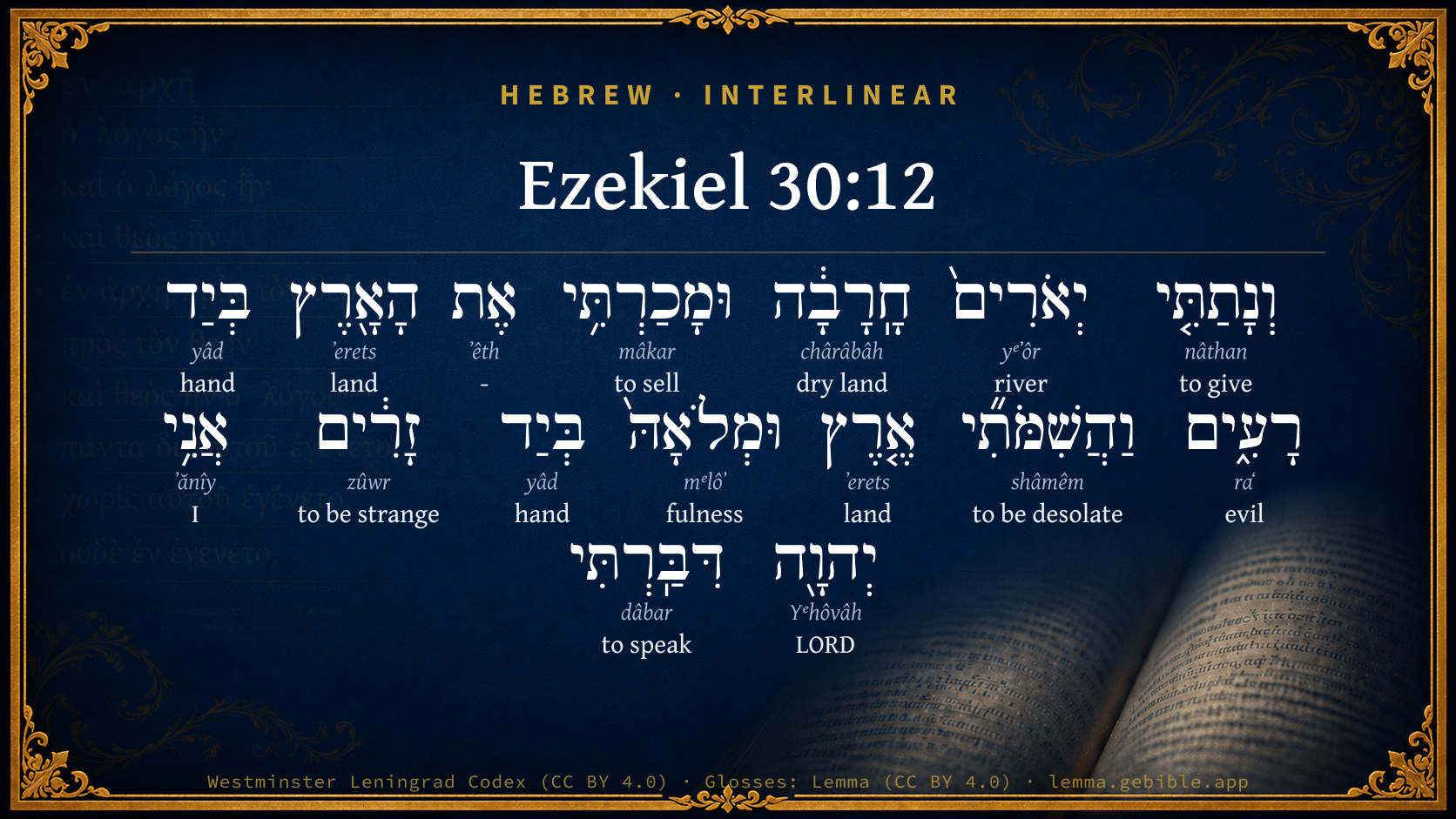
Hebrew (Westminster Leningrad Codex) Ezekiel 30:12 appears in the Hebrew Old Testament. The text above is from the Westminster Leningrad Codex. Each word links to its Strong’s number, a concise gloss, and parsing drawn from the Open Scriptures Hebrew Bible morphology. Click any word for its full Brown-Driver-Briggs (BDB) entry.
Download image
Cite this verse

Ezekiel 30:12 (World English Bible). Public Domain. Lemma interlinear Bible study tool, https://lemma.gebible.app/v/ezekiel/30/12.

Show BibTeX & RIS
BibTeX
RIS
English Translation
I will make the rivers dry, and will sell the land into the hand of evil men; and I will make the land desolate, and all that is therein, by the hand of strangers: I, Yahweh, have spoken it.
World English Bible · Public Domain
Download a study sheet

One document with this verse’s original text, its word-by-word gloss line, the meaning frame, cross-references with their text, attributed commentary, and full source and license credits — printable, and it pastes into notes with its structure intact.

This verse Autodidact and up

Study sheet (.html) Plain text (.txt)

A passage Seminary Student

Up to 50 verses in one chapter. A passage sheet keeps up to 6 commentary sources and 12 cross-references per verse, in the order this page ranks them, and says so on the sheet whenever that leaves anything out. Ask for a single verse and you get the Autodidact verse sheet above.

Everything on this page stays free to read, with no account — the sheet is a download of what is already on screen, not access to it.

Want to remove ads? Support Godless Engineer
Compare translations 3

The same verse in 3 English versions, stacked beneath the original-language interlinear above. Click any original word for its lexicon entry.

Each is an independent rendering of the whole verse — the interlinear is not word-aligned to these translations.

Highlighted words mark where these versions differ — a whole-verse word diff, not a word-by-word alignment.

  • World English Bible Public Domain
    I will make the rivers dry, and will sell the land into the hand of evil men; and I will make the land desolate, and all that is therein, by the hand of strangers: I, Yahweh, have spoken it.
  • King James Version Public Domain
    And I will make the rivers dry, and sell the land into the hand of the wicked: and I will make the land waste, and all that is therein, by the hand of strangers: I the LORD have spoken it.
  • unfoldingWord Literal Text CC BY-SA 4.0
    I will make the rivers into dry ground, and I will sell the land into the hand of wicked men. I will make the land and its fullness desolate by the hand of strangers—I, Yahweh, have spoken.

unfoldingWord Literal Text — © unfoldingWord, licensed CC BY-SA 4.0. Word-aligned USFM3 via Door43 (git.door43.org/unfoldingWord/en_ult).

Versions to compare (up to 4)

3 of 4 selected

Show all 18 translations

Every available English version of this verse, each an independent rendering of the whole verse.

  • World English Bible Public Domain
    I will make the rivers dry, and will sell the land into the hand of evil men; and I will make the land desolate, and all that is therein, by the hand of strangers: I, Yahweh, have spoken it.
  • Berean Standard Bible Public Domain
    I will make the streams dry up and sell the land to the wicked. By the hands of foreigners I will bring desolation upon the land and everything in it. I, the LORD, have spoken.
  • Majority Standard Bible Public Domain
    I will make the streams dry up and sell the land to the wicked. By the hands of foreigners I will bring desolation upon the land and everything in it. I, the LORD, have spoken.
  • King James Version Public Domain
    And I will make the rivers dry, and sell the land into the hand of the wicked: and I will make the land waste, and all that is therein, by the hand of strangers: I the LORD have spoken it.
  • American Standard Version (1901) Public Domain
    And I will make the rivers dry, and will sell the land into the hand of evil men; and I will make the land desolate, and all that is therein, by the hand of strangers: I, Jehovah, have spoken it.
  • Revised Version (1885) Public Domain
    And I will make the rivers dry, and will sell the land into the hand of evil men; and I will make the land desolate, and all that is therein, by the hand of strangers: I the LORD have spoken it.
  • Geneva Bible (1599) Public Domain
    And I will make the riuers drye, and fell the land into the hands of the wicked, and I will make the land waste, and all that therein is by the hands of strangers: I the Lord haue spoken it.
  • Douay-Rheims (1899) Public Domain
    And I will make the channels of the rivers dry, and will deliver the land into the hand of the wicked: and will lay waste the land and all that is therein by the hands of strangers, I the Lord have spoken it.
  • Young's Literal Translation Public Domain
    And I have made floods a dry place, And I have sold the land into the hand of evil doers, And I have made desolate the land, And its fulness, by the hand of strangers, I, Jehovah, have spoken.
  • Literal Standard Version CC BY-SA 4.0
    And I have made floods a dry place, || And I have sold the land into the hand of evildoers, || And I have made the land desolate, || And its fullness, by the hand of strangers, || I, YHWH, have spoken.
  • Unlocked Literal Bible CC BY-SA 4.0
    I will make the rivers into dry ground, and I will sell the land into the hand of wicked men. I will make the land and its fullness desolate by the hand of strangers—I, Yahweh, have spoken.
  • unfoldingWord Literal Text CC BY-SA 4.0
    I will make the rivers into dry ground, and I will sell the land into the hand of wicked men. I will make the land and its fullness desolate by the hand of strangers—I, Yahweh, have spoken.
  • Darby Bible Public Domain
    And I will make the rivers dry, and sell the land into the hand of the wicked; and I will make the land desolate, and all that is therein, by the hand of strangers: I Jehovah have spoken [it].
  • World Messianic Bible Public Domain
    I will make the rivers dry, and will sell the land into the hand of evil men. I will make the land desolate, and all that is therein, by the hand of foreigners. I, the LORD, have spoken it.”
  • Webster's Bible Public Domain
    And I will make the rivers dry, and sell the land into the hand of the wicked: and I will make the land waste, and all that is in it, by the hand of strangers: I the LORD have spoken it.
  • Free Bible Version CC BY-SA 4.0
    I will dry up the rivers and sell the land to wicked people. Using these foreigners I will ruin the land and everything in it. I the Lord have spoken.
  • Bible in Basic English Public Domain
    And I will make the Nile streams dry, and will give the land into the hands of evil men, causing the land and everything in it to be wasted by the hands of men from a strange country: I the Lord have said it.
  • JPS Tanakh (1917) Public Domain
    And I will make the rivers dry, and will give the land over into the hand of evil men; and I will make the land desolate, and all that is therein, by the hand of strangers; I the LORD have spoken it.

Literal Standard Version (2020), Covenant Press — licensed CC BY-SA 4.0. Text via the HelloAO Bible API (eBible.org). Unlocked Literal Bible (unfoldingWord) — licensed CC BY-SA 4.0. Text via the HelloAO Bible API (eBible.org). unfoldingWord Literal Text — © unfoldingWord, licensed CC BY-SA 4.0. Word-aligned USFM3 via Door43 (git.door43.org/unfoldingWord/en_ult). Free Bible Version, Dr. Jonathan Gallagher — licensed CC BY-SA 4.0. Text via the HelloAO Bible API (eBible.org).

Word by word

More ways to search: Search by grammar → Find every occurrence → Compare this word →

Practice this passage: Drill this verse → Learn its vocabulary →

חָֽרָבָ֔ה
chârâbâh
H2724
“dry land”
Noun, Common, Feminine, Singular, Absolute
Part of Speech
Noun
Type
Common
Gender
Feminine
Number
Singular
State
Absolute
Full BDB Definition

Origin: from H2720

TWOT: 731e

dry land, dry ground
  1. וְנָתַתִּ֤י nâthan H5414 “and · to give” Conjunction + Verb, Qal, Sequential Perfect, 1st Person, Common, Singular
  2. יְאֹרִים֙ yᵉʼôr H2975 “rivers” Noun, Common, Masculine, Plural, Absolute
  3. וּמָכַרְתִּ֥י mâkar H4376 “and · to sell” Conjunction + Verb, Qal, Sequential Perfect, 1st Person, Common, Singular
  4. אֶת ʼêth H853 “-” Particle, Direct Object
  5. הָאָ֖רֶץ ʼerets H776 “the · land” Particle, Definite Article + Noun, Common, Both, Singular, Absolute
  6. בְּיַד yâd H3027 “in/at · hand of” Preposition + Noun, Common, Both, Singular, Construct
  7. רָעִ֑ים raʻ H7451 “evil” Adjective, Adjective, Masculine, Plural, Absolute
  8. וַהֲשִׁמֹּתִ֞י shâmêm H8074 “and · to be desolate” Conjunction + Verb, Hiphil, Sequential Perfect, 1st Person, Common, Singular
  9. אֶ֤רֶץ ʼerets H776 “land” Noun, Common, Both, Singular, Absolute
  10. וּמְלֹאָהּ֙ mᵉlôʼ H4393 “and · fulness · her” Conjunction + Noun, Common, Masculine, Singular, Construct + Suffix, Personal, 3rd Person, Feminine, Singular
  11. בְּיַד yâd H3027 “in/at · hand of” Preposition + Noun, Common, Both, Singular, Construct
  12. זָרִ֔ים zûwr H2114 “strange” Adjective, Adjective, Masculine, Plural, Absolute
  13. אֲנִ֥י ʼănîy H589 “I” Pronoun, Personal, 1st Person, Common, Singular
  14. יְהוָ֖ה Yᵉhôvâh H3068 “LORD” Noun, Proper
  15. דִּבַּֽרְתִּי dâbar H1696 “to speak” Verb, Piel, Perfect, 1st Person, Common, Singular

About this verse

These counts appear in no published source. They are computed here, from the morphology-tagged text and Lemma’s own curated glosses. What Lemma adds →

16
words
14
distinct lemmas
Prophets
section

Notable vocabulary

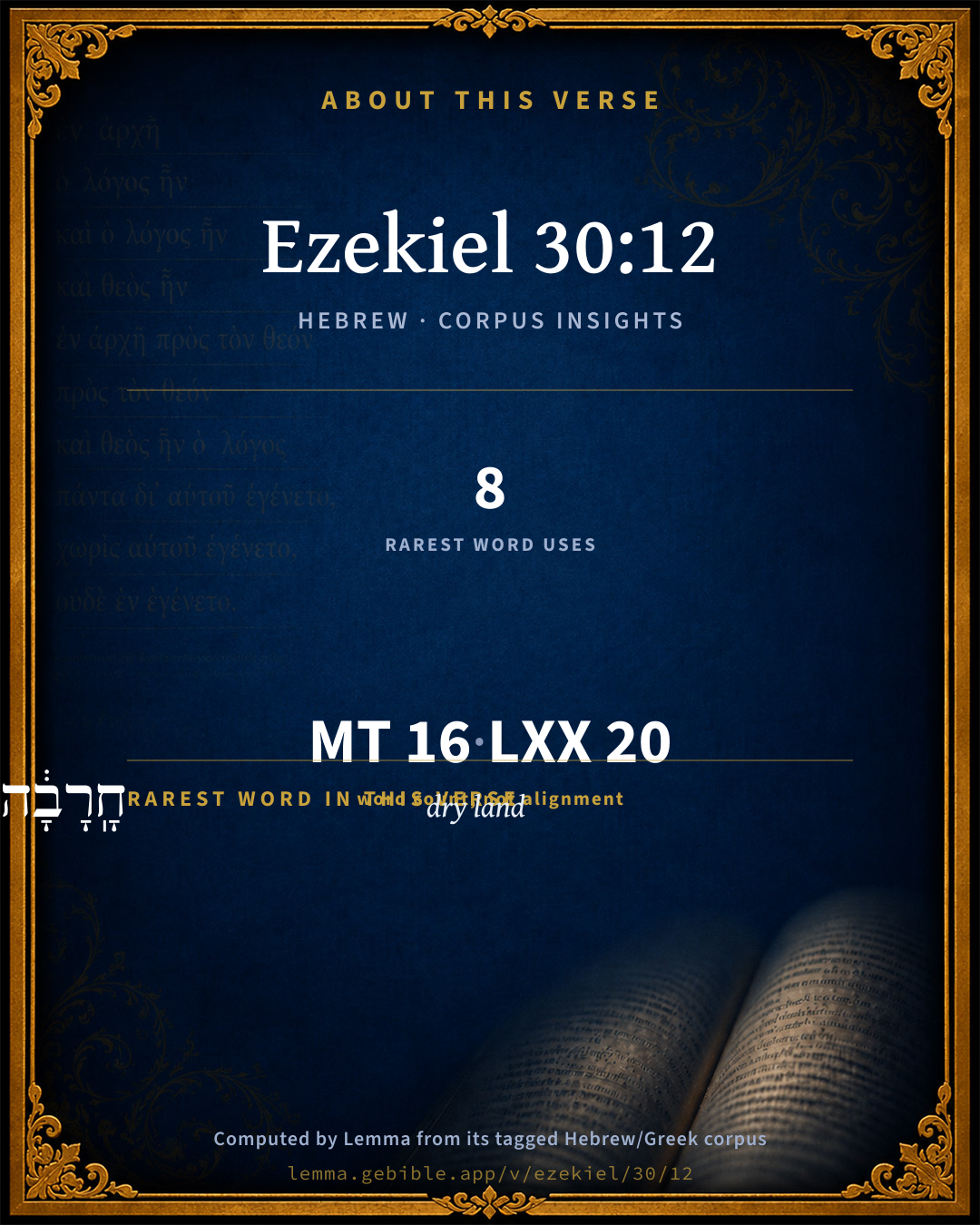
The rarest word here is חָֽרָבָ֔ה dry land H2724 — appearing just 8 times in the whole Hebrew Bible.

Shared distinctive vocabulary

חָֽרָבָ֔ה dry land H2724 occurs in 7 verses of the Hebrew Bible. Also found in:

Grammatical profile

  • 4 verbs
  • 8 nouns
  • 2 adjectives
  • 1 pronoun
  • 1 particle

Verb forms

  • וְנָתַתִּ֤י Qal · Sequential Perfect
  • וּמָכַרְתִּ֥י Qal · Sequential Perfect
  • וַהֲשִׁמֹּתִ֞י Hiphil · Sequential Perfect
  • דִּבַּֽרְתִּי Piel · Perfect

Repetition

Words recur within this verse — often emphatic in Hebrew:

  • הָאָ֖רֶץ land H776 ×2
  • בְּיַד hand H3027 ×2

Hebrew & Septuagint length

In English translation the verse runs 39 words from the Hebrew and 27 from the Septuagint (LXX English) — the Septuagint runs noticeably shorter here. See the side-by-side →

A rough comparison of the two English renderings, which tokenize alike — not a word-level alignment.

Word counts can differ between the Hebrew and the Greek without any difference in meaning — e.g. the Hebrew direct-object marker אֵת has no separate Greek word, and Greek often adds the article ὁ.

In the original languages it is 16 Hebrew tokens and 20 Greek tokens — but the two are counted differently (Hebrew bundles its prefixes and suffixes into one token; the Greek is in lemma form), so that isn’t a like-for-like length.

Cross-references

12

Topical passages linked to Ezekiel 30:12 in the Treasury of Scripture Knowledge — connected by theme and wording, ordered by reader-vote popularity; previews shown in the World English Bible.

  • Ezekiel 29:3 speak, and say, Thus says the Lord Yahweh: Behold, I am against you, Pharaoh king of Egypt, the great monster that lies in the midst of his rivers, that has said, My river is my own, and I have made it for myself.
  • Judges 2:14 The anger of Yahweh was kindled against Israel, and he delivered them into the hands of spoilers who despoiled them; and he sold them into the hands of their enemies round about, so that they could not any longer stand before their enemies.
  • Isaiah 19:4–10 I will give over the Egyptians into the hand of a cruel lord; and a fierce king shall rule over them, says the Lord, Yahweh of Hosts.
  • Isaiah 44:27 who says to the deep, Be dry, and I will dry up your rivers;
  • Jeremiah 50:38 A drought is on her waters, and they shall be dried up; for it is a land of engraved images, and they are mad over idols.
  • Jeremiah 51:36 Therefore thus says Yahweh: Behold, I will plead your cause, and take vengeance for you; and I will dry up her sea, and make her fountain dry.
  • Ezekiel 28:10 You shall die the death of the uncircumcised by the hand of strangers: for I have spoken it, says the Lord Yahweh.
  • Ezekiel 29:9–10 The land of Egypt shall be a desolation and a waste; and they shall know that I am Yahweh. Because he has said, The river is mine, and I have made it;
  • Ezekiel 31:12 Strangers, the terrible of the nations, have cut him off, and have left him: on the mountains and in all the valleys his branches are fallen, and his boughs are broken by all the watercourses of the land; and all the peoples of the earth are gone down from his shadow, and have left him.
  • Nahum 1:4 He rebukes the sea, and makes it dry, and dries up all the rivers. Bashan languishes, and Carmel; and the flower of Lebanon languishes.
  • 1 Corinthians 10:26 for "the earth is the Lord's, and its fullness."
  • Revelation 16:12 The sixth poured out his bowl on the great river, the Euphrates. Its water was dried up, that the way might be made ready for the kings that come from the sunrise.

Cross-references courtesy of OpenBible.info (CC BY 4.0).

Hebrew and Greek witnesses Masoretic Hebrew ↔ Greek Septuagint

The same verse in the two great witnesses to the Old Testament, shown verse-for-verse.

Here the Septuagint runs noticeably shorter than the Hebrew — LXX2012 (modern English Septuagint) 27 words vs World English Bible 39. A rough length comparison of the two English translations, not a word-level alignment — read both below.

These are two independent witnesses, not word-aligned to each other, and the Septuagint is shown in lemma (dictionary) form.

Hebrew Ezekiel 30:12 Masoretic · Westminster Leningrad Codex

וְנָתַתִּ֤י יְאֹרִים֙ חָֽרָבָ֔ה וּמָכַרְתִּ֥י אֶת הָאָ֖רֶץ בְּיַד רָעִ֑ים וַהֲשִׁמֹּתִ֞י אֶ֤רֶץ וּמְלֹאָהּ֙ בְּיַד זָרִ֔ים אֲנִ֥י יְהוָ֖ה דִּבַּֽרְתִּי

I will make the rivers dry, and will sell the land into the hand of evil men; and I will make the land desolate, and all that is therein, by the hand of strangers: I, Yahweh, have spoken it.

World English Bible · Public Domain

Greek LXX Ezekiel 30:12 Septuagint · lemma form

καί δίδωμι ὁ ποταμός αὐτός ἔρημος καί ἀποὀλλύω ὁ γῆ καί ὁ πλήρωμα αὐτός ἐν χείρ ἀλλότριος ἐγώ κύριος λαλέω

And I will make their rivers desolate, and will destroy the land and the fulness of it by the hands of strangers: I the Lord have spoken.

LXX2012 (modern English Septuagint) · Public Domain

Hebrew: Westminster Leningrad Codex (CC BY 4.0). Greek: Septuagint (public domain); English from LXX2012 (modern English Septuagint) (Public Domain). How the Septuagint differs from the Hebrew →

Targum (Aramaic paraphrase)

1

The Targum is the ancient Jewish Aramaic paraphrase of the Hebrew Scriptures — an interpretive translation, not the Hebrew text itself. Onkelos (literal) and Pseudo-Jonathan (expansive) render the Torah, and Jonathan the Prophets. Coverage is partial: where no permissively-licensed English translation exists for a verse, only the Aramaic is shown. This is verse-level text, not a word-by-word alignment to the Hebrew.

  1. Targum Jonathan Prophets (Joshua–Malachi)
    וְאֶתֵּן נַהֲרֵיהוֹן יַבֶּשְׁתָּא וְאֶמְסַר יַת אַרְעָא בְּיַד מַבְאֲשִׁין וְאַצְדֵי אַרְעָא וּמְלָהָא בְּיַד רְשִׁיעִין אֲנָא יְיָ גְזָרִית בְּמֵימְרִי:

    (no public-domain English translation for this verse)

    Targum Jonathan — Aramaic: “Mikraot Gedolot” (public domain). English: “Sefaria Community Translation” (CC0 1.0 (public-domain dedication)); “London "Chaldee Paraphrase," 1871” (public domain). Text via Sefaria.

Commentary

Notes on Ezekiel 30:12 from classic Christian and Jewish commentators (each source and its license shown beneath its notes). The classic Christian expositions comment on the surrounding passage and are grouped to its opening verse, so a note may address several verses; the Jewish commentaries on the Tanakh (Rashi and others) are per-verse, so they appear only where the commentator wrote on this verse.

Lemma curates 59 commentaries, every one of them public domain or Creative Commons licensed, each selected and text-cleaned for this edition rather than reprinted as found. About our sources →

Trapp's Complete Commentary

John Trapp

Eze 30:12 And I will make the rivers dry, and sell the land into the hand of the wicked: and I will make the land waste, and all that is therein, by the hand of strangers: I the LORD have spoken [it].

Ver. 12. And I will make the rivers dry.] The Chaldees shall drink them up; {as 2Ki 19:24} or I will dry them up, for a punishment of your vain trust in them, and boasting of them. {Eze 29:3; Eze 29:9}

And sell the land.] Pass it away utterly from you. "The earth is the Lord’s"; he is the true proprietary.

John Trapp, A Commentary or Exposition upon All the Books of the Old and New Testament (1647–1656) — public domain. Text from a community e-Sword module.

Tyndale Open Study Notes

Tyndale Open Resources

30:12 I will dry up the Nile River: Egypt was completely dependent on the Nile for its prosperity, so having the Nile dry up would threaten the Egyptians’ livelihoods.

Tyndale Open Study Notes — © Tyndale Open Resources, licensed CC BY-SA 4.0. Text via the HelloAO Bible API.

Jamieson, Fausset & Brown

Robert Jamieson, A. R. Fausset & David Brown

rivers--the artificial canals made from the Nile for irrigation. The drying up of these would cause scarcity of grain, and so prepare the way for the invaders (Isa 19:5-10).

Jamieson, Fausset & Brown — Commentary Critical and Explanatory on the Whole Bible (1871) — public domain (CC PDM 1.0). Text via the HelloAO Bible API.

Adam Clarke's Commentary

Verse 12. I will make the rivers dry] As the overflowing of the Nile was the grand cause of fertility to Egypt, the drying it up, or preventing that annual inundation, must be the cause of dearth, famine, &c. By rivers, we may understand the various canals cut from the Nile to carry water into the different parts of the land. When the Nile did not rise to its usual height these canals were quite dry.

Adam Clarke's Commentary on the Bible (1810–1826) — public domain. Text from a community e-Sword/MySword module.

Ellicott's Commentary for English Readers

(12) Make the rivers dry—i.e., the canals of Egypt, by which the land was irrigated, and on which its fertility depended. It may also include the comparative drying, the lessening of the inundation of the Nile, which occurred from time to time, and was the cause of the various famines in Egypt mentioned in Scripture.

A Bible Commentary for English Readers, edited by Charles John Ellicott (1878–1897) — public domain. Text from a community e-Sword module.

The Cambridge Bible for Schools and Colleges

gen. ed. J. J. S. Perowne

12. make the rivers dry] Cf. Isa_19:5-6. The expression is scarcely figurative (Isa_44:27); the drying up of her rivers would be the severest calamity that could befall Egypt, as indeed in all her history whenever her canal system has been allowed to fall into disrepair the country has sunk into wretchedness.

hand of the wicked] Or, of evil men, ch. Eze_7:24; Jer_15:21; cf. Isa_19:4 “a cruel lord.”

The Cambridge Bible for Schools and Colleges (gen. ed. J. J. S. Perowne; Cambridge University Press, 1878–1918) — public domain. Text from a community e-Sword module.

John Gill's Exposition

And I will make the rivers dry,.... Egypt was a country that abounded with rivers; however, with canals cut from the river Nile; its wealth and riches very much depended here on, partly on account of the multitude of fishes taken out of them, and the paper reeds that grew upon their banks; but chiefly because the whole land, was watered by them, and made exceeding fruitful, rain being not so common in it; so that to dry up the riven was in effect to take away their substance and dependence; besides, hereby the way was made easy and passable for the enemy; there was nothing to obstruct him, he could overrun and ravage the land at pleasure:

and sell the land into the hand of the wicked; the Chaldeans under Nebuchadnezzar, who were wicked idolaters, men of flagitious lives, and of merciless and cruel dispositions; who would show no favour to the inhabitants of the land, when delivered up to them, which is called a selling it; for, as things sold are delivered to the buyer, so should this land be to them; which though they had no right to it before, yet by the event of war, and disposal of divine Providence, came to have a property in it, given them by him who is the proprietor of all lands; and after them into the hands of the Persians, under Cambyses, and Ochus; who were very wicked and cruel princes, and may be reckoned among the terrible or violent ones of the nations in the preceding verse; and then into the hands of the Grecian, Romans, Saracen, Mamaluck, and now the Turks, all very wicked people:

and I will make the land waste, and all that is therein, by the hand of strangers; the Babylonians, people of another country and distant, of another language, and with whom they had no commerce, alliance, and friendship, and so would not spare them, and their land, when in their possession; and so all the rest above mentioned, into whose hands they successively fell:

I the Lord have spoken it; determined it, prophesied of it; and it shall come to pass, as it did accordingly.

John Gill's Exposition of the Whole Bible (1746–1763) — public domain (CC PDM 1.0). Text via the HelloAO Bible API.

Haydock's Catholic Bible Commentary

Dry. The canals were obstructed (Calmet) which rendered cavalry useless. (Herodotus ii. 108.)

George Leo Haydock (1774–1849), Haydock's Catholic Family Bible and Commentary, 1859 edition — public domain. Excludes Psalms (Douay-Rheims chapter numbering differs from Protestant) and Deuterocanonical books (Catholic canon only).

Matthew Poole's English Annotations

I will make the rivers dry; either by some extraordinary drought, or rather by means of that mighty lake, which drew so much water from Nilus, that all their canals were ever after shallow, and the lake, as the oracle foretold, helped their enemy, and hurt their friends; or the Chaldeans might divert them, and so their fortified towns would want one great defence.

Sell the land: God gave it, here he sells; the one is proper, the other a borrowed expression; indeed God seems to pay wages with it, Eze 29:19,20; but hereby is intimated, that as sellers deliver into the hand of the buyer, so God would deliver Egypt into the hand of Nebuchadrezzar, as surely as if he had bought it. arid we may conclude the Chaldean as a buyer will make the most of all he buys.

Of the wicked; not of just and compassionate, but of injurious and merciless men. Strangers, who leave nothing they can carry away, eat up, or spoil.

I the Lord have spoken it; it is the decree and edict of Heaven, which cannot be broken.

Matthew Poole's English Annotations on the Holy Bible (1683–1685) — public domain. Text from a community e-Sword/MySword module.

Whedon's Commentary on the Bible

Daniel D. Whedon

12. Rivers dry — The Nile canals (note Eze_29:3; compare Isa_19:5-6).

Daniel D. Whedon (gen. ed.), Commentary on the Old and New Testaments (1874–1909) — public domain. Text from a community e-Sword module.

The Pulpit Commentary

I will make the rivers dry. The rivers are the Nile-blanches of the Delta, and their being dried up points, perhaps, literally to a failure in the inundation of the Nile on which its fertility depended; figuratively to a like failure of all its sources of prosperity.

The Pulpit Commentary (1880–1919), ed. H.D.M. Spence-Jones & Joseph S. Exell — public domain. Text from a community e-Sword module.

John Wesley's Explanatory Notes

The rivers dry - Probably the Chaldeans diverted them, and so their fortified towns wanted one great defense. Sell - Give it up entirely.

John Wesley, Explanatory Notes Upon the Whole Bible (1754–1765) — public domain. Text via the GEBible commentary corpus.

unfoldingWord translationNotes

Door43 World Missions Community

General Information:

These are Yahweh's words about Egypt.

I will make the rivers into dry ground

"I will dry up the rivers of Egypt"

I will sell the land into the hand of wicked men

Yahweh will give the Babylonians control over Egypt just as a person who sells something gives the one who buys it control over that thing. AT: "I will give control of the land to wicked men" (See: Metaphor)

I will make the land and its fullness desolate by the hand of strangers

Here "hand of strangers" represents the actions of strangers. "I will cause people from another nation to destroy the land and everything in it" (See: Metonymy)

its fullness

"everything in the land"

translationWords

hand

evil

desolate

unfoldingWord translationNotes — © Distant Shores Media and the Door43 World Missions Community, licensed CC BY-SA 4.0. Source: git.door43.org/Door43/en_tn.

Rashi

Rabbi Shlomo Yitzchaki (Rashi)

And I shall make the rivers the land of the rivers; that is, Egypt.

and I shall sell as the Targum renders: and I shall deliver.

Rashi on the Tanakh — English translations: “The Judaica Press complete Tanach with Rashi, translated by A. J. Rosenberg” (CC BY 4.0); “Pentateuch with Rashi's commentary by M. Rosenbaum and A.M. Silbermann, 1929-1934” (public domain); “The Metsudah Tanach series, Lakewood, N.J” (CC BY 4.0); and “The Book of Joshua, Metsudah Publications, 1997” (CC BY 4.0). Text via Sefaria.

Lesson kit

Teaching starters — assembled from the data on this page, not authored interpretation. Every prompt links to the verse data it draws on. Edit before teaching.

Ezekiel, in the Prophets, opens this verse with 16 words (14 distinct Hebrew lemmas). Its most distinctive word is chârâbâh (“dry land”). The Greek Septuagint runs shorter here. A historical commentator’s framing appears above. Read the whole chapter for the surrounding context.

Discussion questions

  1. What does “dry land” (chârâbâh) contribute to the verse as a whole?
  2. How does Genesis 7:22, which shares the word «dry land», read alongside this verse?
  3. What does the repetition of “land” (2× in this one verse) do in this verse?
  4. The Septuagint runs shorter here than the Hebrew. What might account for the difference?
  5. The translations on this page render this verse differently — a whole-verse word diff, not a word-by-word alignment. What might account for the different wordings?
  6. «וְנָתַתִּ֤י» is a Qal Sequential Perfect verb. How does that grammatical form shape the action described?
  7. Compare how Trapp's Complete Commentary and Tyndale Open Study Notes read this verse. Where do they agree or differ?

Things to notice

Reading settings

Reading text

Shown beneath each verse's original-language words.

Old Testament
Old Testament edition

Read the OT as the Masoretic Hebrew (MT) or the Greek Septuagint (LXX).

English shown for the Greek Septuagint (in the Hebrew ↔ Greek comparison).

Comparing translations? Open the Compare panel on any verse page to stack up to four side by side.