1 Kings 11:6

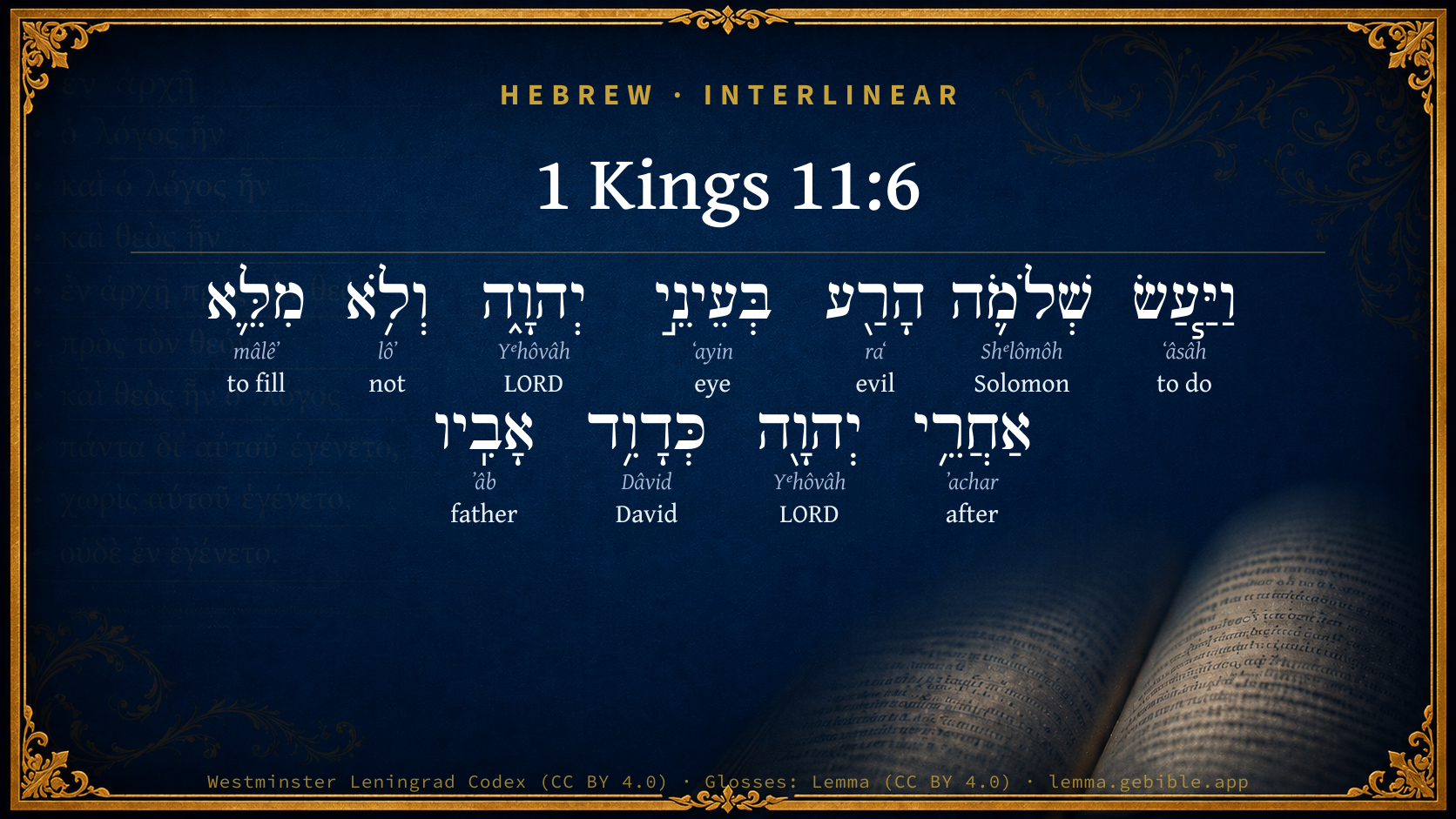
Hebrew (Westminster Leningrad Codex) 1 Kings 11:6 appears in the Hebrew Old Testament. The text above is from the Westminster Leningrad Codex. Each word links to its Strong’s number, a concise gloss, and parsing drawn from the Open Scriptures Hebrew Bible morphology. Click any word for its full Brown-Driver-Briggs (BDB) entry.
Download image
Cite this verse

1 Kings 11:6 (World English Bible). Public Domain. Lemma interlinear Bible study tool, https://lemma.gebible.app/v/1-kings/11/6.

Show BibTeX & RIS
BibTeX
RIS
English Translation
Solomon did that which was evil in the sight of Yahweh, and didn't go fully after Yahweh, as did David his father.
World English Bible · Public Domain
Download a study sheet

One document with this verse’s original text, its word-by-word gloss line, the meaning frame, cross-references with their text, attributed commentary, and full source and license credits — printable, and it pastes into notes with its structure intact.

This verse Autodidact and up

Study sheet (.html) Plain text (.txt)

A passage Seminary Student

Up to 50 verses in one chapter. A passage sheet keeps up to 6 commentary sources and 12 cross-references per verse, in the order this page ranks them, and says so on the sheet whenever that leaves anything out. Ask for a single verse and you get the Autodidact verse sheet above.

Everything on this page stays free to read, with no account — the sheet is a download of what is already on screen, not access to it.

Want to remove ads? Support Godless Engineer
Compare translations 3

The same verse in 3 English versions, stacked beneath the original-language interlinear above. Click any original word for its lexicon entry.

Each is an independent rendering of the whole verse — the interlinear is not word-aligned to these translations.

Highlighted words mark where these versions differ — a whole-verse word diff, not a word-by-word alignment.

  • World English Bible Public Domain
    Solomon did that which was evil in the sight of Yahweh, and didn't go fully after Yahweh, as did David his father.
  • King James Version Public Domain
    And Solomon did evil in the sight of the LORD, and went not fully after the LORD, as did David his father.
  • unfoldingWord Literal Text CC BY-SA 4.0
    And Solomon did evil in the eyes of Yahweh, and he was not full after Yahweh like David his father.

unfoldingWord Literal Text — © unfoldingWord, licensed CC BY-SA 4.0. Word-aligned USFM3 via Door43 (git.door43.org/unfoldingWord/en_ult).

Versions to compare (up to 4)

3 of 4 selected

Show all 18 translations

Every available English version of this verse, each an independent rendering of the whole verse.

  • World English Bible Public Domain
    Solomon did that which was evil in the sight of Yahweh, and didn't go fully after Yahweh, as did David his father.
  • Berean Standard Bible Public Domain
    So Solomon did evil in the sight of the LORD; unlike his father David, he did not follow the LORD completely.
  • Majority Standard Bible Public Domain
    So Solomon did evil in the sight of the LORD; unlike his father David, he did not follow the LORD completely.
  • King James Version Public Domain
    And Solomon did evil in the sight of the LORD, and went not fully after the LORD, as did David his father.
  • American Standard Version (1901) Public Domain
    And Solomon did that which was evil in the sight of Jehovah, and went not fully after Jehovah, as did David his father.
  • Revised Version (1885) Public Domain
    And Solomon did that which was evil in the sight of the LORD, and went not fully after the LORD, as did David his father.
  • Geneva Bible (1599) Public Domain
    So Salomon wrought wickednesse in the sight of the Lord, but continued not to follow the Lord, as did Dauid his father.
  • Douay-Rheims (1899) Public Domain
    And Solomon did that which was net pleasing before the Lord, and did not fully follow the Lord, as David his father.
  • Young's Literal Translation Public Domain
    and Solomon doth the evil thing in the eyes of Jehovah, and hath not been fully after Jehovah, like David his father.
  • Literal Standard Version CC BY-SA 4.0
    and Solomon does evil in the eyes of YHWH, and has not been fully after YHWH, like his father David.
  • Unlocked Literal Bible CC BY-SA 4.0
    Solomon did what was evil in the sight of Yahweh; he did not fully follow Yahweh as David his father had done.
  • unfoldingWord Literal Text CC BY-SA 4.0
    And Solomon did evil in the eyes of Yahweh, and he was not full after Yahweh like David his father.
  • Darby Bible Public Domain
    And Solomon did evil in the sight of Jehovah, and followed not fully Jehovah, as David his father.
  • World Messianic Bible Public Domain
    Solomon did that which was evil in the LORD’s sight, and didn’t go fully after the LORD, as David his father did.
  • Webster's Bible Public Domain
    And Solomon did evil in the sight of the LORD, and went not fully after the LORD, as did David his father.
  • Free Bible Version CC BY-SA 4.0
    This was how Solomon did evil in the Lord's sight, and was not completely dedicated to the Lord as his father David was.
  • Bible in Basic English Public Domain
    And Solomon did evil in the eyes of the Lord, not walking in the Lord's ways with all his heart as David his father did.
  • JPS Tanakh (1917) Public Domain
    And Solomon did that which was evil in the sight of the LORD, and went not fully after the LORD, as did David his father.

Literal Standard Version (2020), Covenant Press — licensed CC BY-SA 4.0. Text via the HelloAO Bible API (eBible.org). Unlocked Literal Bible (unfoldingWord) — licensed CC BY-SA 4.0. Text via the HelloAO Bible API (eBible.org). unfoldingWord Literal Text — © unfoldingWord, licensed CC BY-SA 4.0. Word-aligned USFM3 via Door43 (git.door43.org/unfoldingWord/en_ult). Free Bible Version, Dr. Jonathan Gallagher — licensed CC BY-SA 4.0. Text via the HelloAO Bible API (eBible.org).

Word by word

More ways to search: Search by grammar → Find every occurrence → Compare this word →

Practice this passage: Drill this verse → Learn its vocabulary →

מִלֵּ֛א
mâlêʼ
H4390
“to fill”
Verb, Piel, Perfect, 3rd Person, Masculine, Singular
Part of Speech
Verb
Stem
Piel
Form
Perfect
Person
3rd Person
Gender
Masculine
Number
Singular
Full BDB Definition

Origin: a primitive root

TWOT: 1195

to fill, be full - (Qal) - to be full - fulness, abundance (participle) - to be full, be accomplished, be ended - to consecrate, fill the hand - (Niphal) - to be filled, be armed, be satisfied - to be accomplished, be ended - (Piel) - to fill - to satisfy - to fulfil, accomplish, complete - to confirm - (Pual) to be filled - (Hithpael) to mass themselves against
  1. וַיַּ֧עַשׂ ʻâsâh H6213 “and · to do” Conjunction + Verb, Qal, Sequential Imperfect, 3rd Person, Masculine, Singular
  2. שְׁלֹמֹ֛ה Shᵉlômôh H8010 “Solomon” Noun, Proper
  3. הָרַ֖ע raʻ H7451 “the · evil” Particle, Definite Article + Adjective, Adjective, Masculine, Singular, Absolute
  4. בְּעֵינֵ֣י ʻayin H5869 “in/at · eyes of” Preposition + Noun, Common, Both, Dual, Construct
  5. יְהוָ֑ה Yᵉhôvâh H3068 “LORD” Noun, Proper
  6. וְלֹ֥א lôʼ H3808 “and · not” Conjunction + Particle, Negative
  7. אַחֲרֵ֥י ʼachar H310 “after” Preposition
  8. יְהוָ֖ה Yᵉhôvâh H3068 “LORD” Noun, Proper
  9. כְּדָוִ֥ד Dâvid H1732 “like/as · David” Preposition + Noun, Proper
  10. אָבִֽיו ʼâb H1 “father · his” Noun, Common, Masculine, Singular, Construct + Suffix, Personal, 3rd Person, Masculine, Singular

About this verse

These counts appear in no published source. They are computed here, from the morphology-tagged text and Lemma’s own curated glosses. What Lemma adds →

11
words
10
distinct lemmas
Historical
section

Grammatical profile

  • 2 verbs
  • 6 nouns
  • 1 adjective
  • 1 preposition
  • 1 particle

Verb forms

  • וַיַּ֧עַשׂ Qal · Sequential Imperfect
  • מִלֵּ֛א Piel · Perfect

Repetition

A word recurs within this verse — often emphatic in Hebrew:

  • יְהוָ֑ה LORD H3068 ×2

Hebrew & Septuagint length

In English translation the verse runs 22 words from the Hebrew and 41 from the Septuagint (LXX English) — the Septuagint runs noticeably longer here. See the side-by-side →

A rough comparison of the two English renderings, which tokenize alike — not a word-level alignment.

Word counts can differ between the Hebrew and the Greek without any difference in meaning — e.g. the Hebrew direct-object marker אֵת has no separate Greek word, and Greek often adds the article ὁ.

Cross-references

3

Topical passages linked to 1 Kings 11:6 in the Treasury of Scripture Knowledge — connected by theme and wording, ordered by reader-vote popularity; previews shown in the World English Bible.

  • Numbers 14:24 but my servant Caleb, because he had another spirit with him, and has followed me fully, him will I bring into the land into which he went; and his seed shall possess it.
  • Joshua 14:8 Nevertheless my brothers who went up with me made the heart of the people melt; but I wholly followed Yahweh my God.
  • Joshua 14:14 Therefore Hebron became the inheritance of Caleb the son of Jephunneh the Kenizzite to this day; because that he wholly followed Yahweh, the God of Israel.

Cross-references courtesy of OpenBible.info (CC BY 4.0).

Hebrew and Greek witnesses Masoretic Hebrew ↔ Greek Septuagint

The same verse in the two great witnesses to the Old Testament, shown verse-for-verse.

Here the Septuagint runs noticeably longer than the Hebrew — LXX2012 (modern English Septuagint) 41 words vs World English Bible 22. A rough length comparison of the two English translations, not a word-level alignment — read both below.

These are two independent witnesses, not word-aligned to each other, and the Septuagint is shown in lemma (dictionary) form.

Hebrew 1 Kings 11:6 Masoretic · Westminster Leningrad Codex

וַיַּ֧עַשׂ שְׁלֹמֹ֛ה הָרַ֖ע בְּעֵינֵ֣י יְהוָ֑ה וְלֹ֥א מִלֵּ֛א אַחֲרֵ֥י יְהוָ֖ה כְּדָוִ֥ד אָבִֽיו

Solomon did that which was evil in the sight of Yahweh, and didn't go fully after Yahweh, as did David his father.

World English Bible · Public Domain

Greek LXX 1 Kings 11:6 Septuagint · lemma form

καί ὁ ἀστάρτη βδέλυγμα σιδώνιος

And thus he acted towards all his strange wives, who burnt incense and sacrificed to their idols. 6 And Solomon did that which was evil in the sight of the Lord: he went not after the Lord, as David his father.

LXX2012 (modern English Septuagint) · Public Domain

Hebrew: Westminster Leningrad Codex (CC BY 4.0). Greek: Septuagint (public domain); English from LXX2012 (modern English Septuagint) (Public Domain). How the Septuagint differs from the Hebrew →

Targum (Aramaic paraphrase)

1

The Targum is the ancient Jewish Aramaic paraphrase of the Hebrew Scriptures — an interpretive translation, not the Hebrew text itself. Onkelos (literal) and Pseudo-Jonathan (expansive) render the Torah, and Jonathan the Prophets. Coverage is partial: where no permissively-licensed English translation exists for a verse, only the Aramaic is shown. This is verse-level text, not a word-by-word alignment to the Hebrew.

  1. Targum Jonathan Prophets (Joshua–Malachi)
    וַעֲבַד שְׁלֹמֹה דְבִישׁ קֳדָם יְיָ וְלָא אַשְׁלִים בָּתַר דַחַלְתָּא דַייָ כְּדָוִד אֲבוּהִי:

    (no public-domain English translation for this verse)

    Targum Jonathan — Aramaic: “Mikraot Gedolot” (public domain). English: “Sefaria Community Translation” (CC0 1.0 (public-domain dedication)); “London "Chaldee Paraphrase," 1871” (public domain). Text via Sefaria.

Commentary

Notes on 1 Kings 11:6 from classic Christian and Jewish commentators (each source and its license shown beneath its notes). The classic Christian expositions comment on the surrounding passage and are grouped to its opening verse, so a note may address several verses; the Jewish commentaries on the Tanakh (Rashi and others) are per-verse, so they appear only where the commentator wrote on this verse.

Lemma curates 59 commentaries, every one of them public domain or Creative Commons licensed, each selected and text-cleaned for this edition rather than reprinted as found. About our sources →

Trapp's Complete Commentary

John Trapp

1Ki 11:6 And Solomon did evil in the sight of the LORD, and went not fully after the LORD, as [did] David his father.

Ver. 6. And Solomon did evil.] Howbeit that evil one touched him not, {1Jn 5:18} sc., with a deadly touch: he was not transformed into sin’s image.

And went not fully after the Lord.] Heb., Fulfilled not after the Lord. Some render it, He persevered not in following the Lord, and therehence infer his utter apostasy. Bellarmine reckoneth him among reprobates; and he is commonly pictured by the Papists half in heaven and half in hell. But Hilary {a} holdeth him a saint, and numbereth him with Moses and Peter, who sinned indeed, but repented and received mercy. {See Trapp on "Ecc 1:1"} {See Trapp on "Ecc 1:2"}

{a} In Ps. cxxvi.

John Trapp, A Commentary or Exposition upon All the Books of the Old and New Testament (1647–1656) — public domain. Text from a community e-Sword module.

The Biblical Illustrator

Joseph S. Exell

1Ki_11:6

Solomon did evil in the sight of the Lord.

Solomon the brilliant failure

The character of Solomon is unique--one of the loftiest and saddest of the sacred volume. Grand in its stately strength and towering height--sad in its demoralisation and fall. A morning fair and bright as ever dawned on mortal vision--high noon golden and glowing, flashing its glories far and wide--an evening clouded and mournful, with wailing winds and muttering thunders. Is it not the type of many another life? What were the causes that produced this mournful decline, and overhung with darkest clouds the closing years of a life beginning with such high promise? We approach this question with the more eager interest, because the principles upon which character is built, and the influences effecting its demoralisation, are generically the same in all ages. Men are rotting inwardly to-day, and the pillars of their characters crumbling to decay, from the very same influences that wrought the ruin of Solomon. Moreover, this fact of the decline and fall of character, once lofty and apparently strong, is but the commonest occurrence in modern society. We do well to study its insidious causes.

1. First, then, the superior endowments of Solomon became a snare to him, as they are liable to prove to every gifted nature. Great talents involve great liabilities. Every being is subject to inexorable laws, which cannot be violated with impunity; God secures no man from the legitimate penalties of their violation. One of these laws is that which requires the improvement of talent as a necessary condition of increasing or even retaining it. When God gave Solomon that priceless largess of wisdom He did not exempt him from this law, nor take the work of preserving his character and insuring his ultimate well-being into his own hands. It is a fatal delusion that there is a mysterious gift of God, called Grace, which allows a man to sleep on the lap of some fair Delilah, without being shorn of the locks of his strength--a magic power that holds a man to the right against his own deliberate choice.

2. Another cause wrought with insidious influence to effect his overthrow. Solomon was the dupe of that prince of deceptive devils, misnamed Policy. It was from motives of policy, doubtless, that he entered into alliance with Egypts king; it was from motives of policy that he married the daughter of that king, and took to his bosom his first heathen wife. Did ever man or woman marry from policy--political, financial, or social interest--that in the end did not find it the most miserable policy that ever mortal pursued, yielding its bitter fruits of sorrow and sin? There is but one bond that can ever bind two human hearts together in union strong and holy enough for the marriage relation; and that golden bond is Love--true, pure, uncalculating, heaven-born love.

3. In estimating the causes of Solomons decline, we must also remember the danger that attends great worldly prosperity. Human nature is too weak to bear, unharmed, great elevation. Dazzled and blinded by the splendour of rank and honour and power and wealth, man reels and falls from the giddy height.

4. But finally Solomon fell, a willing victim to the seductive charms of pleasure and carnal indulgence. One sentence of the Inspired Volume reveals to us this fatal cause: Solomon loved many strange women: . . . his wives turned away his heart after other gods; and his heart was not perfect with the Lord his God. Of all the insidious, corrupting, dangerous influences that ever wrought the ruin of man, the influence of a bad woman is the most fatal and irremediable. How powerless are reason and learning to preserve character in the light of such a history as this! How weak is human nature in its best and strongest estate! Who can trust his own heart when such as Solomon fall? Can you, young man? Are you stronger, safer than he, leaning on that broken staff? Let us learn to beware of the beginnings of sin. Not suddenly did this mighty prince fall. Young man, take care that no worm secretly gnaws at the staff of support on which you lean. What of Solomons final state? Saved or lost? The good God only knows. In the series of frescoes on the walls of the Campo Santo, at Pisa, he is represented, in the resurrection, as looking doubtfully to the right and to the left, not knowing on which side his lot will be east. If he wrote the Book of Ecclesiastes, as it is probable he did, he saw at least the folly of his sins. Let us listen to the deep-toned voice of warning that comes to us from his inspired wisdom--sadly illustrated by his uninspired life--Fear God, and keep His commandments. (C. H. Payne, D. D.)

Solomons fall

I. Neither age nor experience brings any release to a man from his exposure to sin. For it came to pass, when Solomon was old, that his wives turned away his heart after other gods. There is no fool worse than an old fool. Wise man it was who said, Count no one safe or happy till he dies.

II. It is possible for even a devout man to become a practical idolater in his secret heart. For Solomon went after Ashtoreth, the goddess of the Zidonians. We are solemnly warned against idols in our hearts, three times in one chapter, by a prophet. Idolatry is still a possible sin to dread.

III. Progress by steps of persistent advance into deeper sin may always be expected when one has taken quick start away from the right and towards wrong. Then did Solomon build a high place for Chemosh, the abomination of Moab, etc. There is nothing more to be feared than the unperceived inroad of what might be termed a little sin. The old parable relates that the trees of the forest once held a solemn parliament, wherein they consulted concerning the innumerable wrongs which the axe, first and last, had done unto them and their neighbours. They insisted that this dangerous implement of steel had no power of its own; and they therefore instantly passed an enactment that no tree should hereafter be allowed to furnish any blade with a helve on pain of being itself cut down to the root. So the axe journeyed through the forests, begging but a bit of wood from the oak, from the ash, from the cedar, from the elm, from even the willow and the poplar; but a stern denial met it at each turn; not one would lend it so much as a splinter from its branches. At last, it desired just this small indulgence: give it but a chip--a mere handle with which it could trim away useless boughs, or cut off briers and bushes, for such suckers, as was well known, only used up the juices of the ground; they always hindered the growth of any thrifty tree and obscured its fairness and beauty. The forest win, impressed with such moderation in the argument; it agreed that the axe in this instance might be supplied with one fragment which a storm had riven from an unfortunate sapling--a mere little stick, lying there, which no one prized and no one dreaded. But the instant that keen edge of steel was fitted with any sort of a handle, it struck off the branch of a sturdy oak at a stroke, then hewed itself a new helve at its will; and down went the elms, over toppled the cedars, and the hills grew bare as never before. The time for all defence was passed when the forest surrendered.

IV. The guilt of all transgression is in the sight of a holy god aggravated by past warnings given. And the Lord was angry with Solomon, because his heart was turned from the Lord God of Israel, etc.

V. Retribution gathers up the entire history of the sinner, even if it is discharged in one act. Wherefore the Lord said unto Solomon, Forasmuch as this is done of thee, and thou has not kept My covenant and My statutes which I have commanded thee, I will surely rend the kingdom from thee, and will give it to thy servant. Henceforward it would do no good for this rejected monarch to awake himself to paternal zeal, and try to build up the fortunes of his shattered realm for his children. It is often worth while to attempt to avert a great catastrophe; but one of the punishments sometimes inflicted for sin is the denial to the sinners of all success in after usefulness.

VI. It may be possible to misunderstand and even pervert Gods forbearance into excuse for further sin. Notwithstanding, in thy days I will not do it for David thy fathers sake: but I will rend it out of the hand of thy sore Howbeit, I will not rend away all the kingdom; but will give one tribe to thy son, for David My servants sake, and for Jerusalems sake which I have chosen. On the shore of eternal history stands this beacon-light for human warning. The wisest man in the world lived to behave like a fool! ( C. S. Robinson, D. D.)

Solomons, life; its spiritual significance

I. The co-existence of good and evil in the same human soul. So long as we are in this world, this is more or less the case with the best of us; evil is not perhaps entirely subdued, until this mortal puts on immortality. In heaven evil is not found in alliance with good in any heart, nor in hell is good found in alliance with evil. Their co-existence is only in the human heart, whilst here. This fact should always be recognised by us in estimating the characters of our fellow-men. A man is not to be pronounced utterly bad because he has committed a wrong, nor completely good because he has performed some virtuous deeds. Who can understand his errors? Cleanse Thou us from secret faults.

II. The energy of the degenerating tendency in human nature. There seems to be in all men a something, call it original sin, depravity, or what you like, which urges to the wrong; a law in the members warring against the laws of the Spirit. You see this force in the case of Solomon. It was in him stronger than three things.

1. It was stronger than the influence of parental piety.

2. The degenerating force within him proved stronger even than his own religious convictions.

3. It proved stronger, moreover, than his own clearest conceptions of duty.

III. The utter insufficiency of all earthly good to satisfy the mind. I said in my heart, go to now, I will prove thee with mirth, therefore enjoy pleasure: and behold this also is vanity.

IV. The superiority of true thoughts to all the other productions of man. Solomon was an active man, and accomplished many material works while here; but what were they all compared with his thoughts contained in the Book of Proverbs?

1. What are they as to their utility?

2. What are they as to their duration? Where now is his throne of ivory and gold? etc. (Homilist.)

The Biblical Illustrator, edited by Joseph S. Exell (c. 1880s–1900s) — public domain. Text from a community e-Sword module.

John Gill's Exposition

And Solomon did evil in the sight of the Lord,.... As idolatry is, nothing more provoking to him:

and went not fully after the Lord, as did David his father; for though he did not relinquish the worship of the true God, and the service of the temple, yet inasmuch as he worshipped other gods besides, or connived at the worship of them, he did not wholly, and constantly, and solely serve the Lord, as his father did.

John Gill's Exposition of the Whole Bible (1746–1763) — public domain (CC PDM 1.0). Text via the HelloAO Bible API.

Matthew Poole's English Annotations

i. e. Did not worship God wholly and solely, but joined idols with him.

Matthew Poole's English Annotations on the Holy Bible (1683–1685) — public domain. Text from a community e-Sword/MySword module.

The Pulpit Commentary

And Solomon did evil in the sight of the Lord (cf., Jud_1:2:11 3:7, etc.) and went not fully alemi aOl s.c. tkll. A pregnant expression found also Num_14:24 Num_32:11, Num_32:12; Deu_1:36 after the Lord, as did David his father.

The Pulpit Commentary (1880–1919), ed. H.D.M. Spence-Jones & Joseph S. Exell — public domain. Text from a community e-Sword module.

John Wesley's Explanatory Notes

Did evil - That is, did not worship God wholly, but joined idols with him.

John Wesley, Explanatory Notes Upon the Whole Bible (1754–1765) — public domain. Text via the GEBible commentary corpus.

Lesson kit

Teaching starters — assembled from the data on this page, not authored interpretation. Every prompt links to the verse data it draws on. Edit before teaching.

1 Kings, in the Historical, opens this verse with 11 words (10 distinct Hebrew lemmas). Its most distinctive word is mâlêʼ (“to fill”). The Greek Septuagint runs longer here. A historical commentator’s framing appears above. Read the whole chapter for the surrounding context.

Discussion questions

  1. The word mâlêʼ carries the sense “to fill.” How does it shape the verse?
  2. How does Numbers 14:24, which shares this passage’s theme, read alongside this verse?
  3. What does the repetition of “LORD” (2× in this one verse) do in this verse?
  4. The Septuagint runs longer here than the Hebrew. What might account for the difference?
  5. The translations on this page render this verse differently — a whole-verse word diff, not a word-by-word alignment. What might account for the different wordings?
  6. «וַיַּ֧עַשׂ» is a Qal Sequential Imperfect verb. How does that grammatical form shape the action described?
  7. Compare how Trapp's Complete Commentary and The Biblical Illustrator read this verse. Where do they agree or differ?

Things to notice

Reading settings

Reading text

Shown beneath each verse's original-language words.

Old Testament
Old Testament edition

Read the OT as the Masoretic Hebrew (MT) or the Greek Septuagint (LXX).

English shown for the Greek Septuagint (in the Hebrew ↔ Greek comparison).

Comparing translations? Open the Compare panel on any verse page to stack up to four side by side.