Ezekiel 38:10

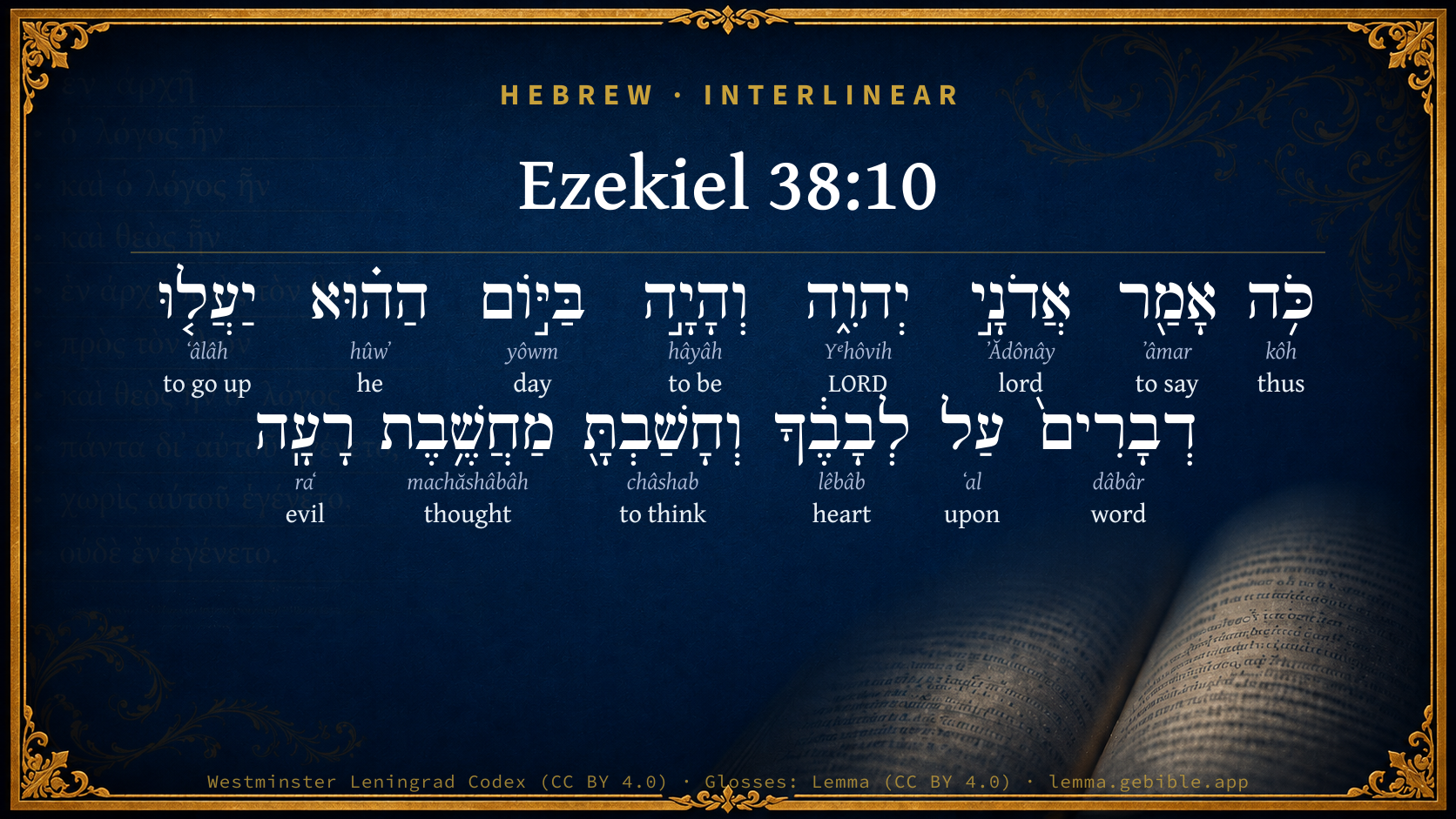
Hebrew (Westminster Leningrad Codex) Ezekiel 38:10 appears in the Hebrew Old Testament. The text above is from the Westminster Leningrad Codex. Each word links to its Strong’s number, a concise gloss, and parsing drawn from the Open Scriptures Hebrew Bible morphology. Click any word for its full Brown-Driver-Briggs (BDB) entry.
Download image
Cite this verse

Ezekiel 38:10 (World English Bible). Public Domain. Lemma interlinear Bible study tool, https://lemma.gebible.app/v/ezekiel/38/10.

Show BibTeX & RIS
BibTeX
RIS
English Translation
Thus says the Lord Yahweh: It shall happen in that day, that things shall come into your mind, and you shall devise an evil device:
World English Bible · Public Domain
Download a study sheet

One document with this verse’s original text, its word-by-word gloss line, the meaning frame, cross-references with their text, attributed commentary, and full source and license credits — printable, and it pastes into notes with its structure intact.

This verse Autodidact and up

Study sheet (.html) Plain text (.txt)

A passage Seminary Student

Up to 50 verses in one chapter. A passage sheet keeps up to 6 commentary sources and 12 cross-references per verse, in the order this page ranks them, and says so on the sheet whenever that leaves anything out. Ask for a single verse and you get the Autodidact verse sheet above.

Everything on this page stays free to read, with no account — the sheet is a download of what is already on screen, not access to it.

Want to remove ads? Support Godless Engineer
Compare translations 3

The same verse in 3 English versions, stacked beneath the original-language interlinear above. Click any original word for its lexicon entry.

Each is an independent rendering of the whole verse — the interlinear is not word-aligned to these translations.

Highlighted words mark where these versions differ — a whole-verse word diff, not a word-by-word alignment.

  • World English Bible Public Domain
    Thus says the Lord Yahweh: It shall happen in that day, that things shall come into your mind, and you shall devise an evil device:
  • King James Version Public Domain
    Thus saith the Lord GOD; It shall also come to pass, that at the same time shall things come into thy mind, and thou shalt think an evil thought:
  • unfoldingWord Literal Text CC BY-SA 4.0
    The Lord Yahweh says this: It will happen on that day that plans will form in your heart, and you will devise wicked schemes.’

unfoldingWord Literal Text — © unfoldingWord, licensed CC BY-SA 4.0. Word-aligned USFM3 via Door43 (git.door43.org/unfoldingWord/en_ult).

Versions to compare (up to 4)

3 of 4 selected

Show all 18 translations

Every available English version of this verse, each an independent rendering of the whole verse.

  • World English Bible Public Domain
    Thus says the Lord Yahweh: It shall happen in that day, that things shall come into your mind, and you shall devise an evil device:
  • Berean Standard Bible Public Domain
    This is what the Lord GOD says: On that day, thoughts will arise in your mind, and you will devise an evil plan.
  • Majority Standard Bible Public Domain
    This is what the Lord GOD says: On that day, thoughts will arise in your mind, and you will devise an evil plan.
  • King James Version Public Domain
    Thus saith the Lord GOD; It shall also come to pass, that at the same time shall things come into thy mind, and thou shalt think an evil thought:
  • American Standard Version (1901) Public Domain
    Thus saith the Lord Jehovah: It shall come to pass in that day, that things shall come into thy mind, and thou shalt devise an evil device:
  • Revised Version (1885) Public Domain
    Thus saith the Lord GOD: It shall come to pass in that day, that things shall come into thy mind, and thou shalt devise an evil device:
  • Geneva Bible (1599) Public Domain
    Thus saith the Lord God, Euen at ye same time shall many things come into thy minde, and thou shalt thinke euil thoughts.
  • Douay-Rheims (1899) Public Domain
    Thus saith the Lord God: In that day projects shall enter into thy heart, and thou shalt conceive a mischievous design.
  • Young's Literal Translation Public Domain
    Thus said the Lord Jehovah: And it hath come to pass in that day, Come up do things on thy heart, And thou hast thought an evil thought,
  • Literal Standard Version CC BY-SA 4.0
    Thus said Lord YHWH: And it has come to pass in that day, || Things come up on your heart, || And you have thought an evil thought,
  • Unlocked Literal Bible CC BY-SA 4.0
    The Lord Yahweh says this: It will happen on that day that plans will form in your heart, and you will devise wicked schemes.'
  • unfoldingWord Literal Text CC BY-SA 4.0
    The Lord Yahweh says this: It will happen on that day that plans will form in your heart, and you will devise wicked schemes.’
  • Darby Bible Public Domain
    Thus saith the Lord Jehovah: It shall even come to pass in that day that things shall come into thy mind, and thou shalt think an evil thought;
  • World Messianic Bible Public Domain
    “‘The Lord GOD says: “It will happen in that day that things will come into your mind, and you will devise an evil plan.
  • Webster's Bible Public Domain
    Thus saith the Lord GOD; It shall also come to pass, that at the same time shall things come into thy mind, and thou shalt think an evil thought:
  • Free Bible Version CC BY-SA 4.0
    This is what the Lord God says: On that day you will start thinking about things in your mind, and you will come up with an evil plan.
  • Bible in Basic English Public Domain
    This is what the Lord has said: In that day it will come about that things will come into your mind, and you will have thoughts of an evil design:
  • JPS Tanakh (1917) Public Domain
    Thus saith the Lord GOD: It shall come to pass in that day, that things shall come into thy mind, and thou shalt devise an evil device;

Literal Standard Version (2020), Covenant Press — licensed CC BY-SA 4.0. Text via the HelloAO Bible API (eBible.org). Unlocked Literal Bible (unfoldingWord) — licensed CC BY-SA 4.0. Text via the HelloAO Bible API (eBible.org). unfoldingWord Literal Text — © unfoldingWord, licensed CC BY-SA 4.0. Word-aligned USFM3 via Door43 (git.door43.org/unfoldingWord/en_ult). Free Bible Version, Dr. Jonathan Gallagher — licensed CC BY-SA 4.0. Text via the HelloAO Bible API (eBible.org).

Word by word

More ways to search: Search by grammar → Find every occurrence → Compare this word →

Practice this passage: Drill this verse → Learn its vocabulary →

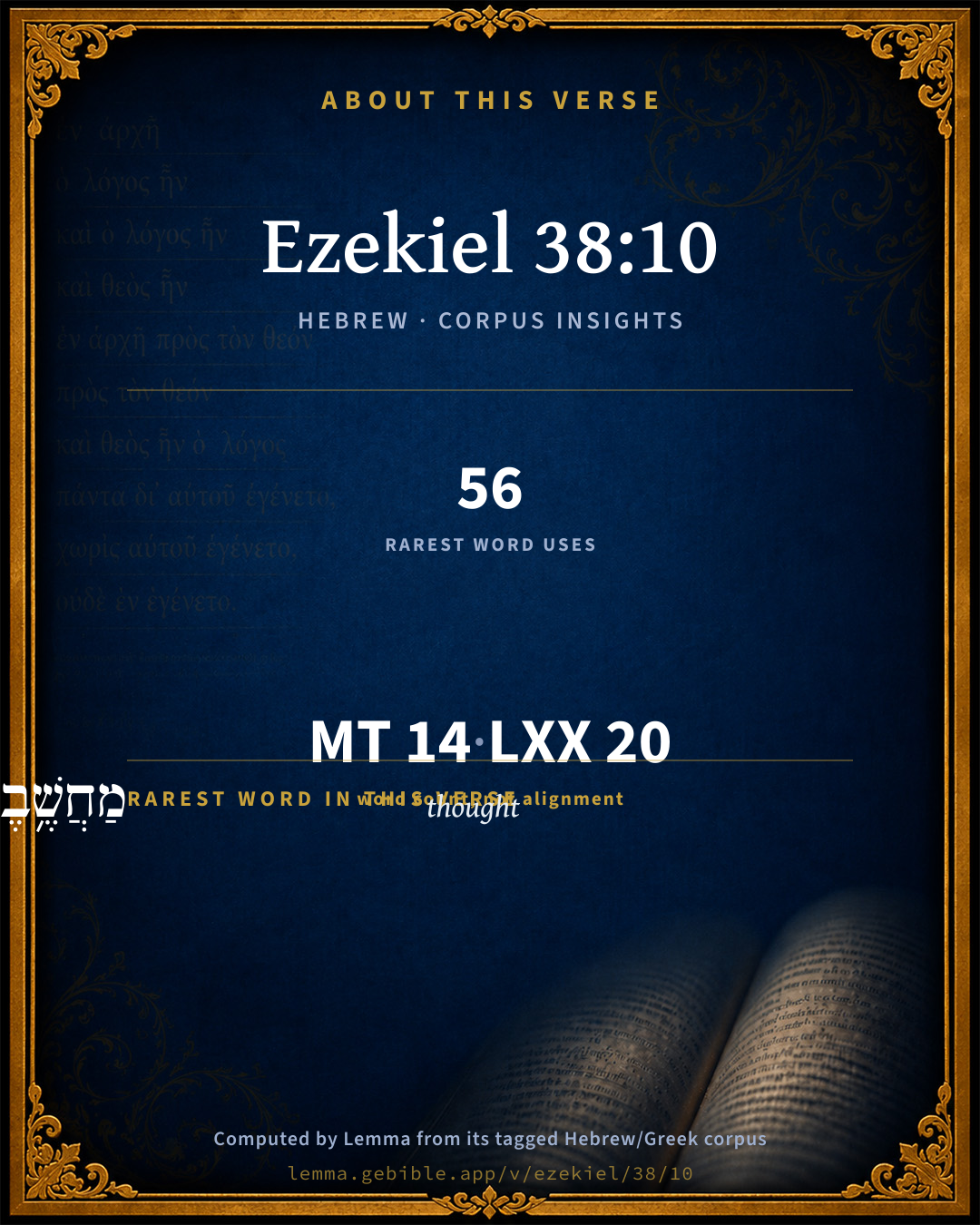
מַחֲשֶׁ֥בֶת
machăshâbâh
H4284
“thought of”
Noun, Common, Feminine, Singular, Construct
Part of Speech
Noun
Type
Common
Gender
Feminine
Number
Singular
State
Construct
Full BDB Definition

Origin: from H2803

TWOT: 767d

thought, device - thought - device, plan, purpose - invention
  1. כֹּ֥ה kôh H3541 “thus” Adverb
  2. אָמַ֖ר ʼâmar H559 “to say” Verb, Qal, Perfect, 3rd Person, Masculine, Singular
  3. אֲדֹנָ֣י ʼĂdônây H136 “Lord · my” Noun, Common, Masculine, Plural, Construct + Suffix, Personal, 1st Person, Common, Singular
  4. יְהוִ֑ה Yᵉhôvih H3069 “LORD” Noun, Proper
  5. וְהָיָ֣ה hâyâh H1961 “and · to be” Conjunction + Verb, Qal, Sequential Perfect, 3rd Person, Masculine, Singular
  6. בַּיּ֣וֹם yôwm H3117 “in/at the · day” Preposition, Determined + Noun, Common, Masculine, Singular, Absolute
  7. הַה֗וּא hûwʼ H1931 “the · he” Particle, Definite Article + Pronoun, Personal, 3rd Person, Masculine, Singular
  8. יַעֲל֤וּ ʻâlâh H5927 “to go up” Verb, Qal, Imperfect, 3rd Person, Masculine, Plural
  9. דְבָרִים֙ dâbâr H1697 “words” Noun, Common, Masculine, Plural, Absolute
  10. עַל ʻal H5921 “upon” Preposition
  11. לְבָבֶ֔ךָ lêbâb H3824 “heart · your” Noun, Common, Masculine, Singular, Construct + Suffix, Personal, 2nd Person, Masculine, Singular
  12. וְחָשַׁבְתָּ֖ châshab H2803 “and · to think” Conjunction + Verb, Qal, Sequential Perfect, 2nd Person, Masculine, Singular
  13. רָעָֽה raʻ H7451 “evil” Adjective, Adjective, Feminine, Singular, Absolute

About this verse

These counts appear in no published source. They are computed here, from the morphology-tagged text and Lemma’s own curated glosses. What Lemma adds →

14
words
14
distinct lemmas
Prophets
section

Shared distinctive vocabulary

מַחֲשֶׁ֥בֶת thought H4284 occurs in 52 verses of the Hebrew Bible. Also found in:

Grammatical profile

  • 4 verbs
  • 6 nouns
  • 1 adjective
  • 1 pronoun
  • 1 preposition
  • 1 adverb

Verb forms

  • אָמַ֖ר Qal · Perfect
  • וְהָיָ֣ה Qal · Sequential Perfect
  • יַעֲל֤וּ Qal · Imperfect
  • וְחָשַׁבְתָּ֖ Qal · Sequential Perfect

Hebrew & Septuagint length

In English translation the verse runs 25 words from the Hebrew and 28 from the Septuagint (LXX English) — closely comparable.

A rough comparison of the two English renderings, which tokenize alike — not a word-level alignment.

Word counts can differ between the Hebrew and the Greek without any difference in meaning — e.g. the Hebrew direct-object marker אֵת has no separate Greek word, and Greek often adds the article ὁ.

In the original languages it is 14 Hebrew tokens and 20 Greek tokens — but the two are counted differently (Hebrew bundles its prefixes and suffixes into one token; the Greek is in lemma form), so that isn’t a like-for-like length.

Cross-references

15

Topical passages linked to Ezekiel 38:10 in the Treasury of Scripture Knowledge — connected by theme and wording, ordered by reader-vote popularity; previews shown in the World English Bible.

  • Psalms 36:4 He plots iniquity on his bed. He sets himself in a way that is not good; He doesn't abhor evil.
  • Micah 2:1 Woe to those who devise iniquity And work evil on their beds! When the morning is light, they practice it, Because it is in the power of their hand.
  • Psalms 83:3–4 They conspire with cunning against your people. They plot against your cherished ones.
  • Psalms 139:2 You know my sitting down and my rising up. You perceive my thoughts from afar.
  • Proverbs 6:14 In whose heart is perverseness, Who devises evil continually, Who always sows discord.
  • Proverbs 6:18 A heart that devises wicked schemes, Feet that are swift in running to mischief,
  • Proverbs 12:2 A good man shall obtain favor from Yahweh, But he will condemn a man of wicked devices.
  • Proverbs 19:21 There are many plans in a man's heart, But Yahweh's counsel will prevail.
  • Isaiah 10:7 However he doesn't mean so, neither does his heart think so; but it is in his heart to destroy, and to cut off not a few nations.
  • Mark 7:21 For from within, out of the hearts of men, proceed evil thoughts, adulteries, sexual sins, murders, thefts,
  • John 13:2 After supper, the devil having already put into the heart of Judas Iscariot, Simon's son, to betray him,
  • Acts 5:3 But Peter said, "Ananias, why has Satan filled your heart to lie to the Holy Spirit, and to keep back part of the price of the land?
  • Acts 5:9 But Peter asked her, "How is it that you have agreed together to tempt the Spirit of the Lord? Behold, the feet of those who have buried your husband are at the door, and they will carry you out."
  • Acts 8:22 Repent therefore of this, your wickedness, and ask God if perhaps the thought of your heart may be forgiven you.
  • 1 Corinthians 4:5 Therefore judge nothing before the time, until the Lord comes, who will both bring to light the hidden things of darkness, and reveal the counsels of the hearts. Then each man will get his praise from God.

Cross-references courtesy of OpenBible.info (CC BY 4.0).

Hebrew and Greek witnesses Masoretic Hebrew ↔ Greek Septuagint

The same verse in the two great witnesses to the Old Testament, shown verse-for-verse.

These are two independent witnesses, not word-aligned to each other, and the Septuagint is shown in lemma (dictionary) form.

Hebrew Ezekiel 38:10 Masoretic · Westminster Leningrad Codex

כֹּ֥ה אָמַ֖ר אֲדֹנָ֣י יְהוִ֑ה וְהָיָ֣ה בַּיּ֣וֹם הַה֗וּא יַעֲל֤וּ דְבָרִים֙ עַל לְבָבֶ֔ךָ וְחָשַׁבְתָּ֖ מַחֲשֶׁ֥בֶת רָעָֽה

Thus says the Lord Yahweh: It shall happen in that day, that things shall come into your mind, and you shall devise an evil device:

World English Bible · Public Domain

Greek LXX Ezekiel 38:10 Septuagint · lemma form

ὅδε λέγω κύριος κύριος καί εἰμί ἐν ὁ ἡμέρα ἐκεῖνος ἀναβαίνω ῥῆμα ἐπί ὁ καρδία σύ καί λογίζομαι λογισμός πονηρός

Thus says the Lord God; It shall also come to pass in that day, that thoughts shall come up into your heart, and you shall devise evil devices.

LXX2012 (modern English Septuagint) · Public Domain

On this verse, Keil & Delitzsch discusses the Septuagint’s reading. Read the note in Commentary ↓

Hebrew: Westminster Leningrad Codex (CC BY 4.0). Greek: Septuagint (public domain); English from LXX2012 (modern English Septuagint) (Public Domain). How the Septuagint differs from the Hebrew →

Targum (Aramaic paraphrase)

1

The Targum is the ancient Jewish Aramaic paraphrase of the Hebrew Scriptures — an interpretive translation, not the Hebrew text itself. Onkelos (literal) and Pseudo-Jonathan (expansive) render the Torah, and Jonathan the Prophets. Coverage is partial: where no permissively-licensed English translation exists for a verse, only the Aramaic is shown. This is verse-level text, not a word-by-word alignment to the Hebrew.

  1. Targum Jonathan Prophets (Joshua–Malachi)
    כִּדְנַן אֲמַר יְיָ אֱלֹהִים וִיהֵי בְּעִדָנָא הַהִיא יִסְקוּן הִרְהוּרִין עַל לִבָּךְ וּתְחַשֵׁב מַחְשְׁבָן בִּישָׁן:

    (no public-domain English translation for this verse)

    Targum Jonathan — Aramaic: “Mikraot Gedolot” (public domain). English: “Sefaria Community Translation” (CC0 1.0 (public-domain dedication)); “London "Chaldee Paraphrase," 1871” (public domain). Text via Sefaria.

Commentary

Notes on Ezekiel 38:10 from classic Christian and Jewish commentators (each source and its license shown beneath its notes). The classic Christian expositions comment on the surrounding passage and are grouped to its opening verse, so a note may address several verses; the Jewish commentaries on the Tanakh (Rashi and others) are per-verse, so they appear only where the commentator wrote on this verse.

Lemma curates 59 commentaries, every one of them public domain or Creative Commons licensed, each selected and text-cleaned for this edition rather than reprinted as found. About our sources →

Ellicott's Commentary for English Readers

(10) Think an evil thought.—In Eze_38:10-14 the motives of Gog in his attack upon Israel are fully exposed. It is to be remembered that in Eze_38:4, and again in Eze_38:16, the leading of this foe against the Church is represented as God’s own act; here it is explained that God did this by allowing him to follow out the devices of his own heart.

A Bible Commentary for English Readers, edited by Charles John Ellicott (1878–1897) — public domain. Text from a community e-Sword module.

The Cambridge Bible for Schools and Colleges

gen. ed. J. J. S. Perowne

10–13. Gog’s invasion prompted by his own evil purposes

10. It shall also come to pass] Read: It shall come to pass at that time that things shall come &c. The “also” of A.V. suggests an additional thing to Eze_38:1-9, whereas it is only the same thing from another point of view. Eze_38:10 seq. are parallel to Eze_38:1-9, not a consequence e.g. of Eze_38:4.

shall things come] lit., words, i.e. purposes. Isa_8:10 “speak a word and it shall not stand.” Cf. Eze_14:3.

think an evil thought] As marg. conceive an evil purpose.

The Cambridge Bible for Schools and Colleges (gen. ed. J. J. S. Perowne; Cambridge University Press, 1878–1918) — public domain. Text from a community e-Sword module.

Trapp's Complete Commentary

John Trapp

Eze 38:10 Thus saith the Lord GOD; It shall also come to pass, [that] at the same time shall things come into thy mind, and thou shalt think an evil thought:

Ver. 10. Things shall come into thy mind.] Ascendent verba super cor tuum. Thou shalt machinate mischief, but it shall fall on thine own pate. Oh pray, pray, said a holy man once, Pontifex enim Romanus et Concilium Tridentinum mira moliuntur, for the Pope and his Council of Trent are hatching strange businesses.

John Trapp, A Commentary or Exposition upon All the Books of the Old and New Testament (1647–1656) — public domain. Text from a community e-Sword module.

The Biblical Illustrator

Joseph S. Exell

Eze_38:10

Shall things come into thy mind?

The Prince of Meshech; or, thought and sterling character

There is much mystery about the Prince of Meshech. Anyhow, there was much terror spread by him and his people when they overran Israel. Malicious intentions were fostered by the prince. Many things came into his mind, and among them a special evil thought. His intention was to go up against the defenceless, to take a spoil and to take a prey. God rebuked him and threatened that Divine fury should come in his face. Evil thoughts reveal our characters and bring Divine condemnation. God looks at the thoughts, and measures the man by his thoughts. All men have a character of some sort. It is something that attaches itself to us as closely as our shadow. We cannot separate ourselves from the one any more than from the other. The general tone of the thoughts determines the real character, whether of the Prince of Meshech or a peasant of the mountains.

I. The constituents of a really sterling character.

1. In a man of real worth there will be transparency of life. He will be easily seen through,--not in the sense of being detected, but of being so upright that there shall be nothing wrong to detect. Some only pretend to be transparent, like the cobwebbed, unwashed, dust-covered window, opening into some close alley. These affect an openness of life, and yield to practices of which it would be a shame to speak. Others are transparent, because pure; and are like the beautiful rose window in the Cathedral at Amiens, where there is such a charming combination of colours that even the suns rays passing through it are tinged with a brighter glory.

2. In the man of sterling character there will be a ready recognition of the supremacy of conscience. Too many have double consciences, one for church life, the other for commerce; one for the sanctuary, the other for the shop and the counting house. They forget that that which they approve in the one must be carried out in the other. If they have principles, let them cling to them; if they claim to be men of sterling worth, let them bow ever before conscience.

3. In the man of sterling character there must ever be a recognition of the value, and the actual possession of real piety. Morality apart from reverence for God is self-glory. It may even produce pride. Pride generally takes up its abode where piety is not enshrined. Pride hides from us our real state in Gods sight. Pride hinders from the acceptance of the Gospel of love and mercy.

4. The man of sterling character must love truth and purity for their own sake. To be good because it brings gain, or pious because it pays, or religious because it is respectable, is hypocrisy. There are inseparable advantages attaching to the possession of good character. Solomon said, A good name is better than precious ointment. The Divine approval will be followed by mens approval, and in this the reward of character will come. But apart from this, we should seek to be true, noble, and pious, for the sake of goodness and truth itself.

II. The way in which true piety of character may be obtained. The desired possession will not be obtained as by some lucky stroke of business. It must grow. To obtain it among our fellows is easy when we deserve it. A steady course of uprightness and purity will bring it. We must not be spasmodic in our goodness. We must watch little things, avoid habits that offend in the slightest degree. Getting rid of these things, we must retain our individuality. We must not measure ourselves by other persons, and think because we live just after the same manner, and on the same moral plane as some others, that therefore we are good enough. There are higher possibilities in the nature of each. There is room for, and should be enthusiasm--enthusiasm for the truth, for the welfare of humanity, for the glory of God our Father, and of Christ our Saviour. The Prince of Meshech had those around him who were ready to approve his dastardly intention, when he said, I will go up, etc. The mind is coloured by the thoughts and sayings of those surrounding us, even as the lake is blue or greyish according to the qualities of the mountains down the sides of which the streams and torrents flow that fill it. How important then that we should seek to associate chiefly with Christians, and ever keep ourselves surrounded by Christian influences. There is a Persian fable which tells us that a man one day picked up a piece of scented clay, and said to it, What are you; are you musk? No, I am only a poor piece of clay, but I have been near a beautiful rose, and it has given me its own sweet smell. Keep, therefore, in the society of the good, and live as near as possible to Christ, and then you will gain such purity and nobility of nature that the world will take knowledge of you that you have been with Him. Let me say that we should beware of seeking to build up character in our own strength. Christs example, Christs sacrifice, Christs pardon, Christs help, Christs love, Christ Himself, in the fulness of His power, these form the only true and safe foundation. (F. Hastings, M. A.)

.

The Biblical Illustrator, edited by Joseph S. Exell (c. 1880s–1900s) — public domain. Text from a community e-Sword module.

Joseph Benson's Commentary

Eze 38:10-13. It shall come to pass at the same time — The time when my people are gathered together, settled in peace in their own land, and think themselves secure; shall things come into thy mind — Mischievous things; and thou shalt think an evil thought — Shalt entertain a malicious design for the destruction of my people. And thou shalt say — Wilt resolve in thyself; I will go up — I will invade with all my forces; the land of unwalled villages — A people weak, and destitute of any considerable defences. To them that are at rest — Who would willingly be quiet, and suspect as little evil from others as they intend against others, and who trust in the protection of their God, who hath promised they shall dwell safely. Dwelling without walls, &c. — That is, having no sufficient fortifications to defend them against the force of an enemy. To take a spoil, &c. — With the thoughts of taking a large spoil without any difficulty. To turn thy hand upon the desolate places — To go against, or fall upon, a country which had lain a long time desolate, but which has been peopled again, and come into a flourishing condition. Judea is very plainly marked out by this land, which Gog is here represented as designing to attack, because it lay open to be invaded. That dwell in the midst of the land — Hebrew, in the navel of the land, that is, in Jerusalem, which stood nearly in the middle of Judea, and was situate upon a rising ground, which the Hebrew metaphorically expresses by the navel. Sheba and Dedan, and the merchants of Tarshish — These were people that traded much, the two former dwelling in the east, and the merchants of Tarshish often sailing from the Spanish coasts into the eastern parts, as having commerce with Tyre, which bordered upon Judea. “These merchants, as soon as they heard of this intended invasion, came into Gog’s camp as to a market, to buy both persons and goods which should come into the conqueror’s power.”

With all the young lions thereof — Their kings and princes, as the Targum understands it; or their chief merchants, who are described as so many princes, (Isa 23:8,) and are called lions because of the injustice and oppression they too commonly practised in their commerce.

Joseph Benson's Commentary on the Old and New Testaments (1811–1818) — public domain. Text from a community e-Sword module.

Keil & Delitzsch

C. F. Keil & F. Delitzsch

Account of the motive by which Gog was induced to undertake his warlike expedition, and incurred guilt, notwithstanding the fact that he was led by God, and in consequence of which he brought upon himself the judgment of destruction that was about to fall upon him. - Eze 38:10. Thus saith the Lord Jehovah, It shall come to pass in that day, that things will come up in thy heart, and thou wilt devise an evil design, Eze 38:11. And say, I will go up into the open country, I will come upon the peaceful ones, who are all dwelling in safety, who dwell without walls, and have not bars and gates, Eze 38:12. To take plunder and to gather spoil, to bring back thy hand against the ruins that are inhabited again, and against a people gathered out of the nations, carrying on trade and commerce, who dwell on the navel of the earth. Eze 38:13. Sabaea and Dedan, and the merchants of Tarshish, and all her young lions, will say to thee, Dost thou come to take plunder? Hast thou gathered thy multitude of people to take spoil? Is it to carry away gold and silver, to take possession and gain, to plunder a great spoil? Eze 38:14. Therefore prophesy, son of man, and say to Gog, Thus saith the Lord Jehovah, Is it not so? On that day, when my people Israel dwelleth in security, thou wilt observe it, Eze 38:15. And come from thy place from the extreme north, thou and many peoples with thee, all riding upon horses, a great crowd and a numerous army, Eze 38:16. And wilt march against my people Israel, to cover the land like a cloud; at the end of the days it will take place; then shall I lead thee against my land, that the nations may know me, when I sanctify myself upon thee before their eyes, O Gog. - In Eze 38:10 דּברים are not words, but things which come into his mind. What things these are, we learn from Eze 38:11 and Eze 38:12; but first of all, these things are described as evil thoughts or designs. Gog resolves to fall upon Israel, now living in peace and security, and dwelling in open unfortified places, and to rob and plunder it. ארץ , literally, land of plains, i.e., a land which has no fortified towns, but only places lying quite exposed (see the comm. on Zac 2:8); because its inhabitants are living in undisturbed peace and safe repose, and therefore dwell in places that have no walls with gates and bars (cf. Jdg 18:7; Jer 49:31). This description of Israel's mode of life also points beyond the times succeeding the Babylonian captivity to the Messianic days, when the Lord will have destroyed the horses and war-chariots and fortresses (Mic 5:9), and Jerusalem will be inhabited as an open country because of the multitude of the men and cattle, and the Lord will be a wall of fire round about her (Zac 2:8-9). For Eze 38:12, compare Isa 10:6. להשׁיב ידך is not dependent upon אעלה, like the preceding infinitives, but is subordinate to אמרתּ אעלה וגו: "thou sayest, I will go up...to turn thy hand." השׁיב, to bring back, is to be explained from the fact that the heathen had already at an earlier period turned their hand against the towns of Israel, and plundered their possessions and goods. חרבות נושׁבות in this connection are desolate places which are inhabited again, and therefore have been rebuilt (cf. Eze 12:20; Eze 26:19). מקנה and קנין are synonyms; and מקנה does not mean flocks or herds, but gain, possession (cf. Gen 36:6; Gen 31:18; Gen 34:23). One motive of Gog for making the attack was to be found in the possessions of Israel; a second is given in the words: who dwell upon the navel of the earth. This figurative expression is to be explained from Eze 5:5 : "Jerusalem in the midst of the nations." This navel is not a figure denoting the high land, but signifies the land situated in the middle of the earth, and therefore the land most glorious and most richly blessed; so that they who dwell there occupy the most exalted position among the nations. A covetous desire for the possessions of the people of God, and envy at his exalted position in the centre of the world, are therefore the motives by which Gog is impelled to enter upon his predatory expedition against the people living in the depth of peace. This covetousness is so great, that even the rich trading populations of Sabaea, Dedan, and Tarshish (cf. Eze 27:22, Eze 27:20, and Eze 27:12) perceive it, and declare that it is this alone which has determined Gog to undertake his expedition. The words of these peoples (Eze 38:13) are not to be taken as expressing their sympathies (Kliefoth), but serve to give prominence to the obvious thirst for booty which characterizes the multitude led by Gog. כּפיריה, their young lions, are the rapacious rulers of these trading communities, according to Eze 19:3 and Eze 32:2. - Eze 38:14 introduces the announcement of the punishment, which consists of another summary account of the daring enterprise of Gog and his hosts (cf. Eze 38:14, Eze 38:15, and Eze 38:16 with Eze 38:4-9), and a clear statement of the design of God in leading him against His people and land. תּדע (Eze 38:14, close), of which different renderings have been given, does not mean, thou wilt experience, or be aware of, the punishment; but the object is to be taken from the context: thou wilt know, or perceive, sc. that Israel dwells securely, not expecting any hostile invasion. The rendering of the lxx (ἐγερθήσῃ) does not furnish any satisfactory ground for altering תּדע into תער = תּעור (Ewald, Hitzig). With the words 'והביאותיך וגו (Eze 38:16) the opening thought of the whole picture (Eze 38:4) is resumed and defined with greater precision, for the purpose of attaching to it the declaration of the design of the Lord in bringing Gog, namely, to sanctify Himself upon him before the eyes of the nations (cf. Eze 38:23 and Eze 36:23).

Keil & Delitzsch — Biblical Commentary on the Old Testament (1861–1891) — public domain (CC PDM 1.0). Text via the HelloAO Bible API. (Old Testament only.)

Tyndale Open Study Notes

Tyndale Open Resources

38:10 The Lord’s “hook” in Gog’s “jaw” (38:4) would consist of Gog’s own wicked scheme to destroy the defenseless and unsuspecting Israelites and capture their plunder (cp. Ps 76:10).

Tyndale Open Study Notes — © Tyndale Open Resources, licensed CC BY-SA 4.0. Text via the HelloAO Bible API.

Geneva Bible (1599)

Geneva Bible translators

That is, to molest and destroy the Church.

Geneva Bible (1599) marginal notes — public domain. Text via Bolls.life.

Jamieson, Fausset & Brown

Robert Jamieson, A. R. Fausset & David Brown

an evil thought--as to attacking God's people in their defenseless state.

Jamieson, Fausset & Brown — Commentary Critical and Explanatory on the Whole Bible (1871) — public domain (CC PDM 1.0). Text via the HelloAO Bible API.

Adam Clarke's Commentary

Verse 10. Shall things come into thy mind, and thou shalt think an evil thought] Antiochus purposed to invade and destroy Egypt, as well as Judea; see Da 11:31-32; Da 11:36. This Calmet interprets of Cambyses, his cruelties in Egypt, and his evil design to destroy the Israelites.

Adam Clarke's Commentary on the Bible (1810–1826) — public domain. Text from a community e-Sword/MySword module.

John Gill's Exposition

And thou shall say,.... What came into his mind, and what he thought of; this he shall say to his privy counsellors and ministers of state; or to the generals and officers of his army; or to his confederates and allies, and even to them all, to have their opinion and approbation of it; and to encourage them to join him, and go with him:

I will go up to the land of unwalled villages; a land which has nothing but villages in it, and those no walls about them to protect them: this he said by way of contempt; and the Septuagint and Arabic versions render it "the abject land"; and to observe how easily he could conquer it, there being nothing in his way to hinder him, or give him trouble:

I will go to them that are at rest, and dwell safely: as the Jews will do in the latter day, when they shall own and acknowledge the Messiah, Jer 23:5, and dwell in their own land, where they will be quiet and peaceable, and think and do no harm to any, nor mistrust their neighbours doing any harm to them; but shall live in the utmost tranquillity and security; and which Gog or the Turks will take the advantage of; and from hence promise themselves an easy conquest of them:

all of them dwelling without walls, and having neither bars nor gates; no walls to their cities; no gates to walls; nor bars to gates; but without either; being under the protection of God, and putting their trust in him, who is a wall of fire round about his people; and is better to them, than gates with bars.

John Gill's Exposition of the Whole Bible (1746–1763) — public domain (CC PDM 1.0). Text via the HelloAO Bible API.

Matthew Poole's English Annotations

At the same time that the people are gathered together, settling in peace, before they have secured themselves, much like the dragon waiting on the child-bearing woman with purpose to devour her child.

Things come into thy mind; projects or designs for mischief, as appears Eze 38:11.

Thou shalt think an evil thought; and these mischievous thoughts thou shalt so manage, as to forecast how they may, and to set on the execution till they do, take effect. If Antiochus Epiphanes be this Gag, Daniel, in Eze 11:24,25, foretells the like thing of him against Egypt.

Matthew Poole's English Annotations on the Holy Bible (1683–1685) — public domain. Text from a community e-Sword/MySword module.

The Pulpit Commentary

Thou shalt think an evil thought; "conceive a mischievous purpose" (margin); or, devise an evil device (Revised Version). The ultimate responsibility for Gog"s expedition should rest on Gog himself, who should be impelled thereto by his own lust of conquest. Ezekiel here recognizes what the Bible is full of, the duality of existence, according to which man is both a free agent, acting out his own thoughts and plans, and an unconscious instrument in the hands of God carrying out his counsels and designs.

An evil thought.

I AS EVIL THOUGHT MAY COME UNBIDDEN. "Things come into" the mind. Like a bird of passage from a distant continent, like a stray seed dropped into a well-tilled garden, like a breath of infection on a healthy person, evil may come from without unsought and even unsuspected. Every one must be conscious of the way in which a thought will flash into his mind. But often a suggestion of evil may come from some visible external thing. An evil sight will suggest an evil thought; therefore we need to pray that God may turn away our eyes from beholding vanity. Bad companions will prompt evil thoughts; therefore we have to be on our guard as to what society we frequent. We cannot but be in the world, though we should not be of it. Sights and sounds of evil assail us on every side in visible occurrences, in conversation, in newspapers, in books. It is impossible to bar every avenue against the intrusion of an evil thought. It may come to the purest soul.

II AN EVIL THOUGHT IS A DANGEROUS GUEST. The Americans and the Australians are much concerned at the character of persons who pour into their territories from the overflowing population of Europe. Hence their regulations setting conditions to the reception of emigrants. We cannot always prevent the incoming of evil thoughts, but we must beware of the mischief of their presence when they have come.

1. An evil thought tends to spread. It is like the little leaven that leavens the whole lump, like the worthless seed which, growing up, produces a host of new seeds, and so makes the weeds take possession of the soil. A striking idea starts a whole chain of thoughts.

2. An evil thought tends to rouse an evil desire. The active evil from without appeals to the latent evil within the soul. Thus while in one place St. James writes of Satan as our tempter, (Jam_4:7) in another hesays that we are tempted by our own evil desires. (Jam_1:14) The evil thought is most dangerous because it is lodged in an evil nature. Unhappily, the seed of evil falls on congenial soil. The germ of sin attacks one who has what the doctors would call a sinful diatehsis, a temperament that is naturally prone to sin.

III AN EVIL THOUGHT SHOULD BE QUICKLY EXPELLED. We cannot prevent its coming; but we may refuse to give it quarter. If we harbor it we consent to its presence, and take the guilt of it on ourselves. Thus we make it no longer a foreign intruder, but our own thought. The practical question is how may the evil thought be cast out?

1. Directly, by resisting it. We should pray against an evil thought, and firmly set our foot upon it when it has come near to us.

2. Indirectly, by encouraging a better thought. An empty mind is always ready to receive bad guests. The last state of the house from which the evil spirit was cast out became worse than the first, because, though it was swept and garnished, it was left empty. (Mat_12:44) There are plants the very vigor of which, when they are once well established, will prevent the growth of weeds among them; in the struggle for existence they are stronger than the weeds. The presence of Christ in the heart is the best antidote to evil thoughts.

An evil device.

We have been taught by the Divine Master, Christ, that it is from within that human conduct takes its origin. It is the heart which is the source alike of good and of evil The tree bears fruit, whether sound and wholesome and palatable, or harsh and useless; the living well, the fountain, sends forth streams, whether sweet and cheering, or bitter and polluted. So the thoughts, intents, and devices of the heart find their expression in the words which reach men"s ears and in the deeds which draw men"s eyes. God, who knew the inmost nature of men, as well as their individual and political acts, revealed the secret spring of the malicious efforts of the foes of Israel, saying, "It shall come to pass in that day, that things shall come into thy mind, and that thou shalt devise an evil device.

I PASSIONS PROMPTS THE EVIL DEVICE. There is in all men"s nature a principle assuming various forms impulse, propensity, passion. If there were no such principle, we cannot see how human life could go forward. It is the spring, the motive power, of the machine. It is not implanted within us in order that it may be eradicated, but in order that it may be governed, directed, controlled. In itself it is not bad. But passions become bad when misdirected and uncontrolled by reason and conscience.

II CHOICE ADOPTS IT. Anger, lust, or some other passion prompts to a certain course of action. The mischief is wrought when the man, in the exercise of choice, accepts as the motive of his action, and identifies himself with, a passion, the indulgence of which works evil, preferring such a principle of action to a higher and better one. The device thus adopted by the enemies of Israel was a device of selfish passion, only to be indulged at the expense of justice and good feeling.

III SINFUL HABIT NOURISHES IT. It is not a single feeling, a single purpose, which usually accounts for a man"s, a nation"s, evil ways. The mischief, when isolated, might be checked. But it is too often fostered and thus encouraged, complicated, and multiplied, as the mind broods upon it. A mere fancy becomes, when encouraged, a desire; a desire, when encouraged, becomes a settled purpose.

IV SINFUL ACTIVITY EXECUTES IT. The desire does not long remain such; it tends to its satisfaction. The device is a means to an end, and achieves itself. God"s mercies are permitted, in some cases and to some extent, to "bring wicked devices to pass." For wise purposes, the Ruler of all suffers men not only to think evil thoughts, but to accomplish evil deeds.

V GOD CAN AND OFTEN DOES FRUSTRATE IT. The oft-quoted proverb is a true one, "Man proposes, God disposes." The All-wise has his own plans, the Almighty has his own means; and the wisdom and the power of men, measured against the Divine resources, will surely be brought to nothing. "Hitherto shalt thou go, and no further; and hero shall thy proud waves be stayed." There is no occasion for the people of Christ to be dismayed or overmuch distressed when evil devices enter into the minds of their adversaries. All is known to their Divine Friend and Protector, who is abundantly able to defend and to deliver his own. "He taketh the wise in their own craftiness," their wisdom is seen to be but folly. "In quietness and in confidence shall be your strength;" "The Lord shall fight for you, and ye shall hold your peace." The enemy may devise; but he will not be suffered to execute his devices. T.

The Pulpit Commentary (1880–1919), ed. H.D.M. Spence-Jones & Joseph S. Exell — public domain. Text from a community e-Sword module.

Kretzmann's Popular Commentary

Paul E. Kretzmann

The Sentence of Destruction upon Gog

v. 10. Thus saith the Lord God, It shall also come to pass that at the same time shall things come into thy mind, wicked counsels aganist the people of God, and thou shalt think an evil thought, proposing a plan to attack the children of the Lord in their apparently defenseless state,

v. 11. and thou shalt say, I will go up to the land of unwalled villages, for the people of God seem to the enemies to be occupying dwelling-places that are not fortified; I will go to them that are at rest, quietly, seemingly without apprehending any danger, that dwell safely, as though secure from every enemy, all of them dwelling without walls and having neither bars nor gates, depending upon the fact that the Lord Himself is their Tower of defense,

v. 12. to take a spoil and to take a prey, the Hebrew text, at this point, showing a fine play on words which emphasize the grasping nature of the enemies, to turn thine hand upon the desolate places that are now inhabited, the many congregations that would be assembled in Messianic times, and upon the people that are gathered out of the nations, the picture of the restoration being still employed, which have gotten cattle and goods and dwell in the midst of the land, literally, "upon the navel of the earth," in an elevated and fruitful country.

v. 13. Sheba, or Arabia Felix, and Dedan, Arabian merchant tribes, and the merchants of Tarshish, of Tartessus in Spain, with all the young lions therof, the trading nations known for their covetousness, shall say unto thee, Art thou come to take a spoil? Hast thou gathered thy company to take a prey? to carry away silver and gold, to take away cattle and goods, to take a great spoil? That is what the enemies of the Lord constantly have in mind: to bring harm and destruction upon the congregations of the Lord’s Church, to deprive them of the blessings which the Lord gave them.

v. 14. Therefore, son of man, prophesy and say unto Gog, to the aggregation of all the enemies of the Lord and of His holy Church, Thus saith the Lord God, the supreme Ruler of the universe, In that day when My people of Israel dwelleth safely, shalt thou not know it? The enemies would indeed find out that the merchant nations had spoken truly, that the spiritual Israel was open to spoil and robbery.

v. 15. And thou shalt come from thy place out of the north parts, thou and many people with thee, as described in the first part of the chapter, all of them riding upon horses, a great company and a mighty army;

v. 16. and thou shalt come up against My people of Israel, in an attack intended to overthrow the power of the Church, as a cloud to cover the land,

v. 9. ; it shall be in the latter days, in the Messianic era and in that particular period preceding the Last Judgment, and I will bring thee against My land, the Lord expressly permitting this attack upon His children, that the heathen may know Me when I shall be sanctified in thee, O Gog, before their eyes, for the judgment of the Lord in the overthrow of the enemies of His Church will reveal His almighty power to all men, as He also said to Pharaoh. Cf Exo 9:16.

v. 17. Thus saith the Lord God, Art thou he of whom I have spoken in old time by My servants, the prophets of Israel, which prophesied In those days many years that I would bring thee against them? It is a most emphatic way of affirming that the attack of the forces of unbelief was not unexpected, but was altogether in line with various statements of earlier prophets concerning the day of Jehovah’s judgment upon the heathen. Cf Isa 25:5-10; Isa 26:21; Jer 30:23-24.

v. 18. And it shall come to pass at the same time when Gog shall come against the land of Israel, at the time of the last great apostasy, saith the Lord God, that My fury shall come up in My face, as in the heavy breathing of an angry person.

v. 19. For in My jealousy and in the fire of My wrath have I spoken, Surely in that day there shall be a great shaking, a mighty quaking, in the land of Israel, wherever His spiritual children are living in the assembly of the saints,

v. 20. so that the fishes of the sea, and the fowls of the heaven, and the beasts of the field, and all creeping things that creep upon the earth, and all the men that are upon the face of the earth shall shake at My presence, as He appears for His great Judgment, and the mountains shall be thrown down, and the steep places, the cliffs, shall fall, and every wall shall fall to the ground, everything that rose up in opposition to the Lord,

v. 21. And I will call for a sword against him throughout all My mountains, saith the Lord God, so that the enemy would be overthrown in the Lord’s specific domain, in the Church into which he has presumed to penetrate; every man’s sword shall be against his brother, so that the enemies would really conquer themselves.

v. 22. And I will plead against him with pestilence, the second great scourge of war, and with blood, the description in this verse being reminiscent of the plagues of Egypt; and I will rain upon him and upon his bands and upon the many people that are with him, an overflowing rain, as in a mighty cloudburst, sweeping everything before it, and great hailstones, fire, and brimstone, as in the destruction of Sodom and Gomorrah.

v. 23. Thus will I magnify Myself, proving His greatness and His power, and sanctify Myself, for in the final analysis all this would redound to the glory of his holy name; and I will be known in the eyes of many nations, and they shall know that I am the Lord. While it is true that the enemies of the Church are mighty and terrible, it remains true, on the other hand, that the Lord of the Church is far mightier and will eventually overthrow all the hosts that try to break and hinder This gracious and good will on earth.

Paul E. Kretzmann, Popular Commentary of the Bible (1921–1924) — public domain. Text from a community e-Sword module.

unfoldingWord translationNotes

Door43 World Missions Community

Connecting Statement:

Yahweh continues speaking to Gog.

on that day that

"at that time"

plans will form in your heart ... you will devise wicked schemes

These phrases mean the same thing and can be combined into a single phrase. AT: "you will plan to do something very evil" (See: Doublet)

plans will form in your heart

Here "heart" refers to his thinking. This can be stated in active form. AT: "you will think of plans" (See: Metonymy)

I will

Gog will not do these things alone. His army will do most of them. AT: "My army and I will" (See: Synecdoche)

the open land

The following phrases explain that this refers to a land without walls or bars or gates.

capture booty and steal plunder

These phrases mean the same thing and can be combined into a single phrase. AT: "take away all their valuable possessions" (See: Doublet)

bring my hand

Here "hand" refers to Gog's military power. (See: Metonymy)

against the ruins

Here "ruins" refers to the people who live in the destroyed cities. AT: "against the people who live in the ruins" (See: Metonymy)

at the center of the earth

"in the middle of the most important countries in the world"

translationWords

Lord Yahweh

heart

evil

life

gate

hand

ruin

nation

unfoldingWord translationNotes — © Distant Shores Media and the Door43 World Missions Community, licensed CC BY-SA 4.0. Source: git.door43.org/Door43/en_tn.

Rashi

Rabbi Shlomo Yitzchaki (Rashi)

words will enter Thoughts will arise.

a thought of evil to wage war against Me.

Rashi on the Tanakh — English translations: “The Judaica Press complete Tanach with Rashi, translated by A. J. Rosenberg” (CC BY 4.0); “Pentateuch with Rashi's commentary by M. Rosenbaum and A.M. Silbermann, 1929-1934” (public domain); “The Metsudah Tanach series, Lakewood, N.J” (CC BY 4.0); and “The Book of Joshua, Metsudah Publications, 1997” (CC BY 4.0). Text via Sefaria.

Lesson kit

Teaching starters — assembled from the data on this page, not authored interpretation. Every prompt links to the verse data it draws on. Edit before teaching.

Ezekiel, in the Prophets, opens this verse with 14 words (14 distinct Hebrew lemmas). Its most distinctive word is machăshâbâh (“thought”). A historical commentator’s framing appears above. Read the whole chapter for the surrounding context.

Discussion questions

  1. The word machăshâbâh carries the sense “thought.” How does it shape the verse?
  2. How does Genesis 6:5, which shares the word «thought», read alongside this verse?
  3. These translations render this verse differently. What is at stake in choosing one wording over another?
  4. «אָמַ֖ר» is a Qal Perfect verb. How does that grammatical form shape the action described?
  5. Compare how Ellicott's Commentary for English Readers and The Cambridge Bible for Schools and Colleges read this verse. Where do they agree or differ?

Things to notice

Reading settings

Reading text

Shown beneath each verse's original-language words.

Old Testament
Old Testament edition

Read the OT as the Masoretic Hebrew (MT) or the Greek Septuagint (LXX).

English shown for the Greek Septuagint (in the Hebrew ↔ Greek comparison).

Comparing translations? Open the Compare panel on any verse page to stack up to four side by side.