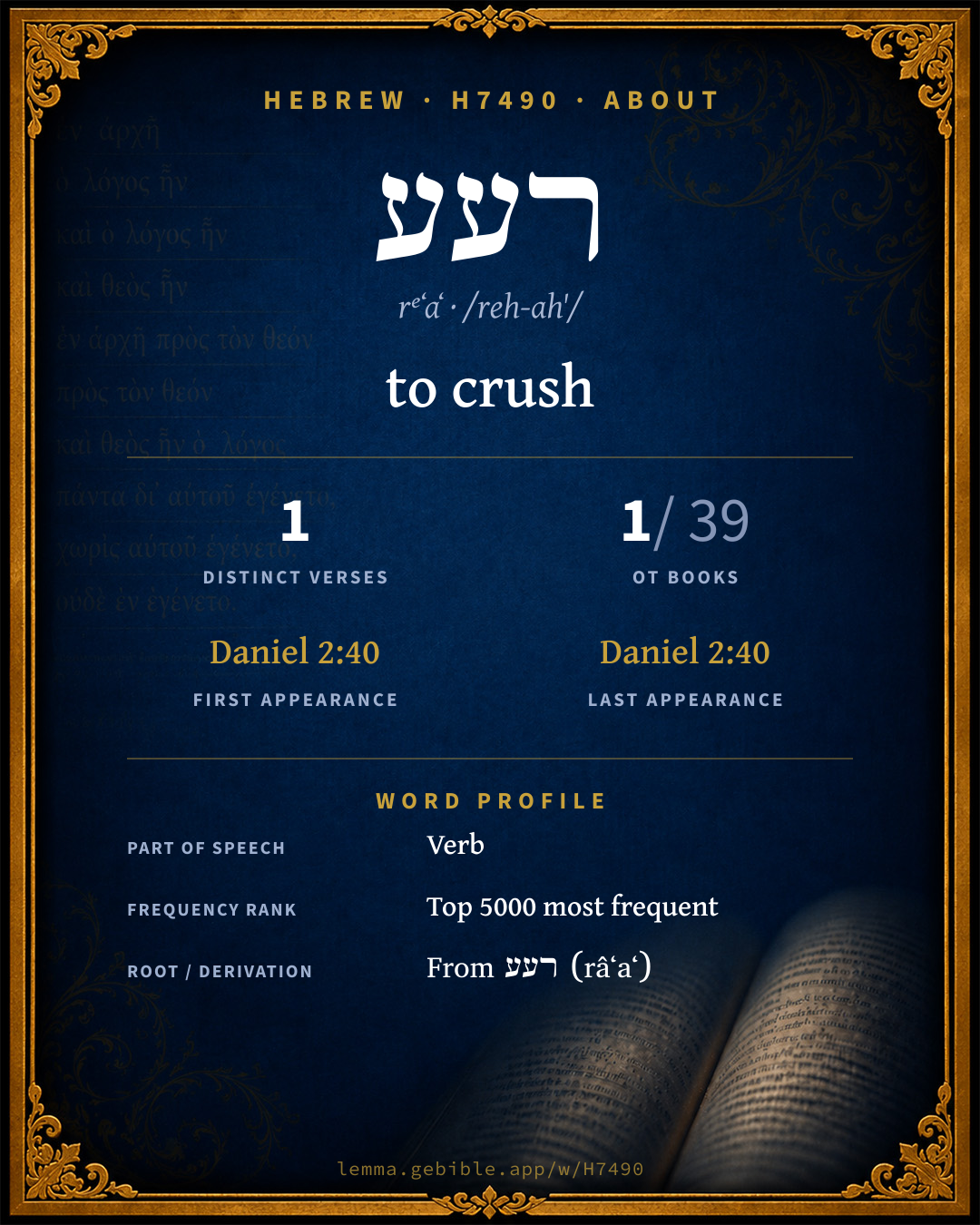
רְעַע
to crush
Full lexicon entry — Brown-Driver-Briggs (BDB)
From Brown-Driver-Briggs (BDB)
Where this word appears
Grammar key — what these labels mean
Part of speech
- Verb
- An action or state-of-being word.
Stem
- Qal
- The basic, simple active stem — the plain form of the verb (“he wrote”).
Form
- Imperfect
- An incomplete, ongoing, or future action (“he will / would write”).
- Participle Active
- A verbal adjective expressing ongoing or characteristic action (“writing / one who writes”).
State
- Absolute
- The independent form of a noun, not bound to a following word.
Person
- 3rd Person
- The one spoken about (“he / she / it / they”).
Gender
- Feminine
- Grammatically feminine.
- Masculine
- Grammatically masculine.
Number
- Singular
- One.
Grammatical forms
- Verb, Qal, Imperfect, 3rd Person, Feminine, Singular 1 time (50%)
- Verb, Qal, Participle Active, Masculine, Singular, Absolute 1 time (50%)
Parsed forms decoded from the imported morphology (morphhb / Westminster Leningrad Codex — WLC text public domain, morphhb tagging CC BY 4.0), counted across 2 parsed occurrences — not distinct verses.
Every verse where H7490 appears — 1 distinct verse across 1 book. Click any verse to open its interlinear word-by-word view. Verse text shown in the World English Bible for context — . Each verse’s Hebrew form is shown with its reference; the English is not keyword-highlighted, since the data carries no word-level English alignment. Use “Compare translations” on any verse to read it across multiple English versions. This concordance covers the Hebrew Bible; Septuagint (Greek Old Testament) occurrences are not indexed here.
Daniel 1 verse
About this entry
At a glance — auto-summarized from this page’s data, not written by a person. Every figure links to its source below. This summary describes the numbers; it doesn’t interpret them.
רעע — transliterated rᵉʻaʻ — is a Hebrew verb carrying the sense “to crush.” The Hebrew Bible uses it only 1 verse. More than three-quarters of its appearances fall in Daniel. It occurs only once, in Daniel 2:40. It shares a root with רעע, מרע and רע. Each statement above links to its evidence; the full detail follows below.
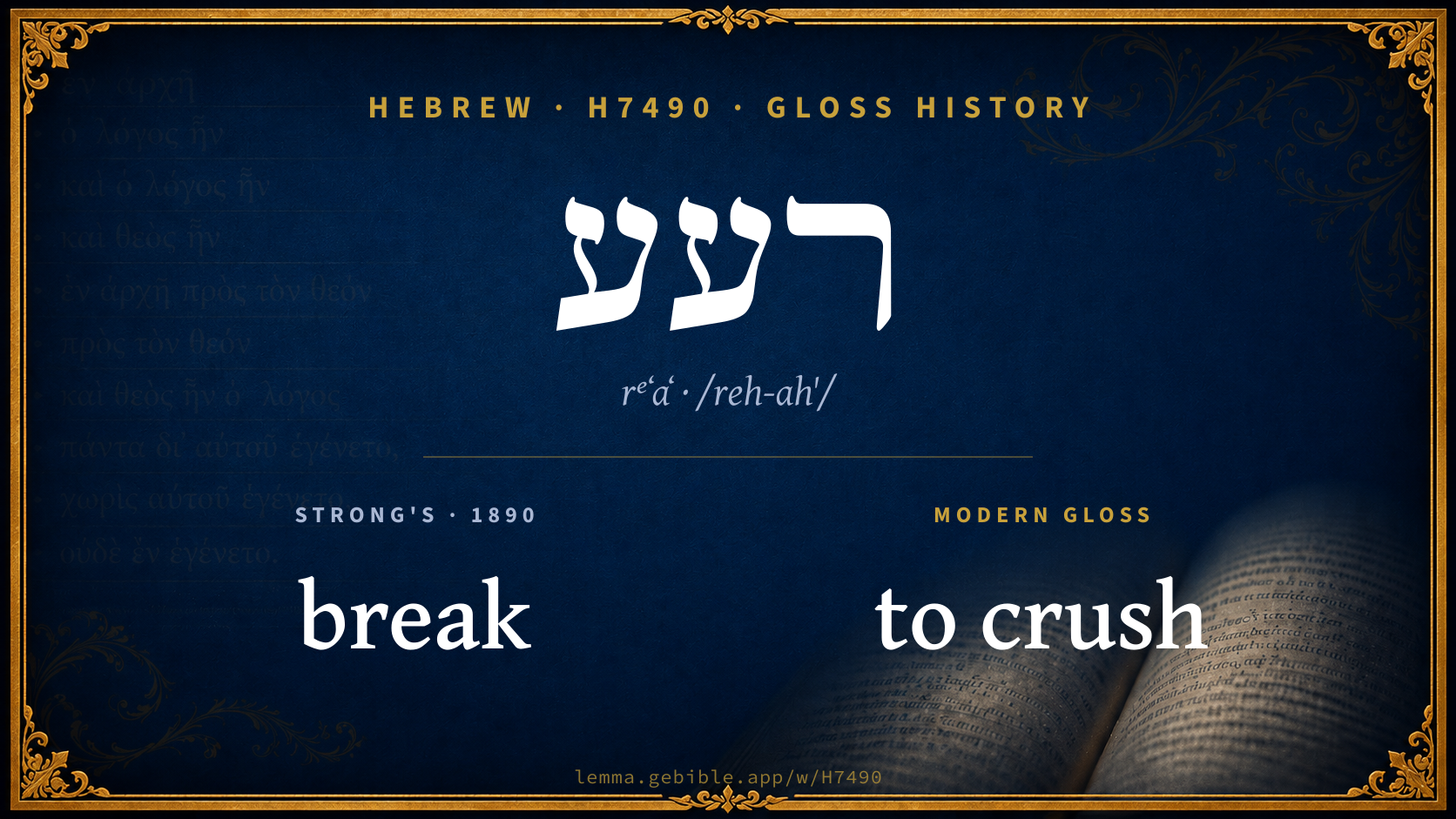
Gloss history
Strong's 1890 vs modern scholarship
About this word
Strong's H7490 catalogs a Hebrew word from the Hebrew Old Testament.
These counts are not copied from any lexicon or concordance. They are computed here, from the morphology-tagged Hebrew Old Testament. What Lemma adds →
- 1
- distinct verses
- The word appears in 1 distinct verse.
- 1 / 39
- OT books
- The word appears in 1 of 39 Old Testament books.
- #4,807
- by frequency
- Top 5000 most frequent Hebrew words (rank 4,807 of 8,640 Hebrew words by occurrence).
View all 1 occurrence in the concordance →
Most concentrated in
- Daniel 1 verse 100%
By section of the Old Testament
By traditional corpus
Conventional, traditional groupings — biblical authorship is debated, so this is a traditional corpus grouping, not an authorship claim. Each share is this word’s portion of its verses in that division of the Hebrew canon. Each figure is a share of the word’s 1 distinct verse.
- Writings (Ketuvim) 1 verse · 100%
How translations render this word
Counts come from each version’s own published word-to-Strong’s tagging or interlinear alignment — an approximate guide to how each version renders this word, not a word-level alignment the data otherwise carries. Because each total is that version’s own tagged count, the per-version totals vary from one another and need not match the appearance or distinct-verse counts above. These counts may also differ from a printed concordance because Lemma counts each distinctly tagged rendering and does not collapse phrase taggings into a single head-word total. This is a fixed set of word-tagged versions (KJV, ASV, BSB, ULT) and does not change with the reading translation you choose elsewhere. Each version’s license is shown beside its name below (and on Sources).
- King James Version: Breaketh 1×, Bruise 1×
- American Standard Version: Crush 1×, Crusheth 1×
- Berean Standard Bible: Crush 1×, Crushes 1×
- unfoldingWord Literal Text: Break 1×, Breaks into pieces 1×, Pieces 1×
King James Version Public Domain
Renders H7490 across 2 tagged occurrences — most commonly:
American Standard Version Public Domain
Renders H7490 across 2 tagged occurrences — most commonly:
Berean Standard Bible Public Domain
Renders H7490 across 2 tagged occurrences — most commonly:
unfoldingWord Literal Text CC BY-SA 4.0
Renders H7490 across 3 tagged occurrences — most commonly:
Senses in BDB
The 1 sense BDB distinguishes for this word, in lexicon order (not ranked by frequency or importance). The full entry — with sub-senses — is in the Lexicon Entry tab.
- (Peal) to crush, break, shatter
Word origin
[ רְעַע ] vb. crush, shatter
— Brown-Driver-Briggs (Oxford 1906, public domain), digitized via Sefaria, supplemented by the OpenScriptures HebrewLexicon (CC BY 4.0). See Sources.
Derived from רעע (râʻaʻ) (H7489) — to do evil.
Jastrow Dictionary
A second Hebrew/Aramaic lexicon for comparison, covering Aramaic and post-biblical (Talmudic, Targumic, Midrashic) usage that the biblical-Hebrew BDB does not. Matched by lemma rather than by Strong’s number, so a lemma may carry more than one Jastrow headword (shown separately below), and the entries cover usage well beyond the Bible.
רָעַע
- (b. h.) [to bring in close contact, v. רֵיעַ,]
- 1. to strike against, shatter, impair. —Part. pass. רָעוּעַ; f. רְעוּעָה; pl. רְעוּעִים, רְעוּעִין; רְעוּעוֹת impaired, defective; in a ruinous state, threatening, opp. בריא sound. Kidd. 39ᵇ סולם ר׳ a broken ladder. Kel. III, 5 הר׳ a cracked vessel. Taan. 20ᵇ מפולת שאמרו בריאות ולא ר׳ the falling of houses which they mention (ib. III, 4) means the falling of sound buildings, but not of such as were out of repair; a. fr.
- 2. (neut. verb) רַע, imperf. יֵרַע to be injurious, evil; רע ל־ to grieve, displease. B. Mets. 84ᵇ בני אל ירע לך my son, let it not grieve thee; a. e.
- to shatter, break.—Part. pass. מְרוֹעָע; f. מְרוֹעַעַת; pl. מְרוֹעָעִים, מְרוֹעָעִין; מְרוֹעָעוֹת. Koh. R. to III, 2 השרוי בבית המר׳ he who dwells in a threatening house; Y. Sabb. II, 5ᵇ top מְרוֹעֲרַע (fr. רִעְרֵעַ). Gen. R. s. 32 קנקנים מר׳, v. קַנְקָן I. Y. Taan. III, 66ᵈ top מְרוֹעֲרָעִים threatening buildings; a. fr.
- , Hithpol. הִתְרוֹעֵעַ, Nithpol. נִתְרוֹעֵעַ to be shaken, cracked, become defective. Men. 53ᵇ (ref. to Jer. XI, 16) מקול מיליהן … נִיתְרָעֲעוּ דליותיהן וכ׳ from the sound of the words of the spies were the branches (young men) of Israel broken; Yalk. Jer. 289 נרתעו (read: נִתְרָעוּ). Sot. 48ᵃ (play on ערה, Zeph. II, 14) אפי׳ בית … מִתְרוֹעֵעַ even a house which lies in a thicket of cedars will be shaken; Yalk. Is. 292 מתנועע (corr. acc.). Y. Snh. X, 27ᵈ bot. לכיפה … כיון שנִתְרוֹעֲעָה אחת מהן נִתְרוֹעֲעוּ כולן like a heap of stones, when one of them is shaken (disturbed), all of them are shaken; Y. M. Kat. III, 83ᶜ שנִתְרַעְרְעָה … נִתְרַעְרְעוּ (fr. רערע); Gen. R. s. 100 וכולה מִתְרוֹעַעַת; a. e. e.g. Jeremiah 11:16
- 1. to shake, impair. Y. Shebi. X, 39ᵈ top מֵירַע כוחן it impairs their prerogatives; ib. מוֹרַע (fr. יָרַע). Y. Pes. VII, 34ᵈ top שהוֹרַעְתָּ כחו וכ׳ whose standing thou declarest impaired in the case of an ascertained uncleanness. Ex. R. s. 8 הֵרֵעוּ לנפשם they did harm to themselves; a. e.—V. הֲרָעָה.
- 2. to be evil; ה׳ ל־ to displease. Tanḥ. Sh’laḥ 5; Num. R. s. 167 וה׳ לאביו and it displeased his father; a. e.—[
- 3. to join, combine, v. רָעָהPi.]
- , or הוֹרַע (fr. יָרַע) to be shaken, impaired. Kidd. 20ᵇ, sq. ה׳ כחו his prerogative is impaired, v. יָפֶה. B. Kam. 44ᵃ; a. fr.
רְעַע
- , to shatter, break. Targ. Jud. IX, 53 ורָעַת (Levita ורְעִיעַת; some ed. ורעתת, corr. acc.). Targ. Y. II, Ex. XV, 6 רָעָא (some ed. רעע, corr. acc.). Targ. Job XX, 19 (ed. Wil. רָעַע Pa.); a. e.—Part. pass. רְעִיעַ, רְעִיעָא; f. רְעִיעָא, רְעִיעֲתָא. Targ. Is. XLII, 3. Targ. Koh. XII, 6; a. e.—Taan. 20ᵇ אשיתא ר׳ Ms. M. (ed. רעועה h.) a threatening wall. Ib. ביתא ר׳ a ruinous-looking house; a. fr.
- same. Targ. Job XX, 10. Ib. 19, v. supra; a. e.
- to do harm. Ib. XXIV, 21 מֵרַע (Ms. מְיָירַע; h. text רֹעֶה).
- 1. to be shaken, broken; be afraid. Targ. Y. Deut. XX, 3 (Var. תִּתְיָרְע׳).
- 2. to be shaken, impaired. Hor. 12ᵃ ומִיתְרַע מזליה and his luck may be shaken, v. רִיעַ II. B. Bath. 59ᵃ דתִיתְרַע וכ׳, v. אֲשִׁיתָא. Ḥull. 10ᵃ סכין אִיתְרְעָאִי וכ׳ the status of the knife has been impaired (the knife having been found notched after slaughtering), but the status of the slaughtered animal (the presumption of its ritual fitness) has not been shaken, v. רֵיעוּתָא.
A Dictionary of the Targumim, the Talmud Babli and Yerushalmi, and the Midrashic Literature (Marcus Jastrow; London, Luzac, 1903) — Public Domain. Digitized via Sefaria. Digitized via Sefaria. Full attribution on Sources.
Forms in the corpus
The 2 distinct written forms H7490 takes in the Hebrew Bible, most frequent first — each parse links to that stem’s occurrences in the concordance. Hebrew forms include their vowel points and cantillation, so a single lemma takes many written forms.
| Form | Parsing | Example | Uses |
|---|---|---|---|
| וְ/תֵרֹֽעַ | Verb, Qal, Imperfect, 3rd Person, Feminine, Singular | Daniel 2:40 | 1 |
| מְרָעַ֥ע | Verb, Qal, Participle Active, Masculine, Singular, Absolute | Daniel 2:40 | 1 |
Same root — word family
Other BDB entries built from the same root as H7490, grouped by Strong’s listed origin. These share a root / origin per the lexicon — not necessarily a shared meaning. Each links to that word’s own entry.
Derives from
Shares the same root
Compare all same-root words → Showing 4 of 5 — not the complete family. They share a root, not necessarily a meaning.
Septuagint verse parallels
This word appears in 1 verse that also exists in the Greek Old Testament (Septuagint), out of the 1 Hebrew verse it occurs in. You can read those verses in Greek by switching the Old Testament edition to the Septuagint.
Read these verses in the Septuagint
This is a verse-level parallel only — the same verses exist in both the Hebrew and Greek Old Testaments. No word-level Hebrew↔Greek correspondence is claimed: the data carries no such alignment, so no Greek word is shown as this Hebrew word’s translation. Coverage is not total — the Septuagint omits the deuterocanon and renumbers the Psalms, so some Hebrew verses have no direct Greek parallel.