Hosea 10:15

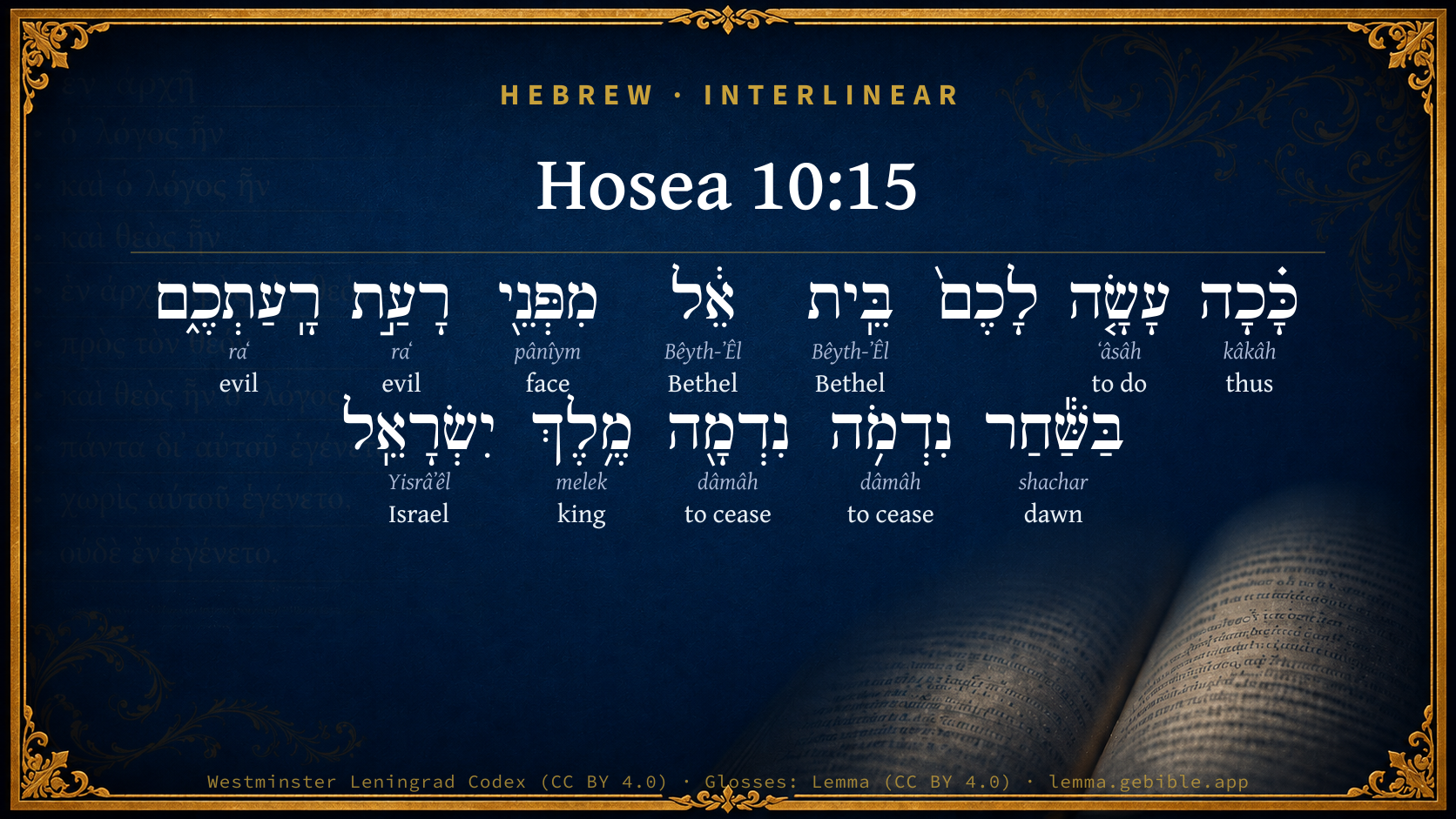
Hebrew (Westminster Leningrad Codex) Hosea 10:15 appears in the Hebrew Old Testament. The text above is from the Westminster Leningrad Codex. Each word links to its Strong’s number, a concise gloss, and parsing drawn from the Open Scriptures Hebrew Bible morphology. Click any word for its full Brown-Driver-Briggs (BDB) entry.
Download image
Cite this verse

Hosea 10:15 (World English Bible). Public Domain. Lemma interlinear Bible study tool, https://lemma.gebible.app/v/hosea/10/15.

Show BibTeX & RIS
BibTeX
RIS
English Translation
So Bethel will do to you because of your great wickedness. At daybreak the king of Israel will be destroyed.
World English Bible · Public Domain
Download a study sheet

One document with this verse’s original text, its word-by-word gloss line, the meaning frame, cross-references with their text, attributed commentary, and full source and license credits — printable, and it pastes into notes with its structure intact.

This verse Autodidact and up

Study sheet (.html) Plain text (.txt)

A passage Seminary Student

Up to 50 verses in one chapter. A passage sheet keeps up to 6 commentary sources and 12 cross-references per verse, in the order this page ranks them, and says so on the sheet whenever that leaves anything out. Ask for a single verse and you get the Autodidact verse sheet above.

Everything on this page stays free to read, with no account — the sheet is a download of what is already on screen, not access to it.

Want to remove ads? Support Godless Engineer
Compare translations 3

The same verse in 3 English versions, stacked beneath the original-language interlinear above. Click any original word for its lexicon entry.

Each is an independent rendering of the whole verse — the interlinear is not word-aligned to these translations.

Highlighted words mark where these versions differ — a whole-verse word diff, not a word-by-word alignment.

  • World English Bible Public Domain
    So Bethel will do to you because of your great wickedness. At daybreak the king of Israel will be destroyed.
  • King James Version Public Domain
    So shall Bethel do unto you because of your great wickedness: in a morning shall the king of Israel utterly be cut off.
  • unfoldingWord Literal Text CC BY-SA 4.0
    Thus he will do to you, Bethel, from the face of the evil of your evil. At the dawn, the king of Israel being destroyed, will be destroyed.

unfoldingWord Literal Text — © unfoldingWord, licensed CC BY-SA 4.0. Word-aligned USFM3 via Door43 (git.door43.org/unfoldingWord/en_ult).

Versions to compare (up to 4)

3 of 4 selected

Show all 18 translations

Every available English version of this verse, each an independent rendering of the whole verse.

  • World English Bible Public Domain
    So Bethel will do to you because of your great wickedness. At daybreak the king of Israel will be destroyed.
  • Berean Standard Bible Public Domain
    Thus it will be done to you, O Bethel, because of your great wickedness. When the day dawns, the king of Israel will be utterly cut off.
  • Majority Standard Bible Public Domain
    Thus it will be done to you, O Bethel, because of your great wickedness. When the day dawns, the king of Israel will be utterly cut off.
  • King James Version Public Domain
    So shall Bethel do unto you because of your great wickedness: in a morning shall the king of Israel utterly be cut off.
  • American Standard Version (1901) Public Domain
    So shall Beth-el do unto you because of your great wickedness: at daybreak shall the king of Israel be utterly cut off.
  • Revised Version (1885) Public Domain
    So shall Beth-el do unto you because of your great wickedness: at daybreak shall the king of Israel be utterly cut off.
  • Geneva Bible (1599) Public Domain
    So shall Beth-el doe vnto you, because of your malicious wickednes: in a morning shall the King of Israel be destroied.
  • Douay-Rheims (1899) Public Domain
    So hath Bethel done to you, because of the evil of your iniquities.
  • Young's Literal Translation Public Domain
    Thus hath Beth-El done to you, Because of the evil of your wickedness, In the dawn cut off utterly is a king of Israel!
  • Literal Standard Version CC BY-SA 4.0
    Thus has Beth-El done to you, || Because of the evil of your wickedness, || In the dawn a king of Israel is utterly cut off!”
  • Unlocked Literal Bible CC BY-SA 4.0
    So it will happen to you, Bethel, because of your great wickedness. At daybreak the king of Israel will be completely cut off.”
  • unfoldingWord Literal Text CC BY-SA 4.0
    Thus he will do to you, Bethel, from the face of the evil of your evil. At the dawn, the king of Israel being destroyed, will be destroyed.
  • Darby Bible Public Domain
    So shall Bethel do unto you because of the wickedness of your wickedness: at day-break shall the king of Israel utterly be cut off.
  • World Messianic Bible Public Domain
    So Bethel will do to you because of your great wickedness. At daybreak the king of Israel will be destroyed.
  • Webster's Bible Public Domain
    So shall Beth-el do to you because of your great wickedness: in a morning shall the king of Israel be utterly cut off.
  • Free Bible Version CC BY-SA 4.0
    This is what will happen to you, Bethel, because of your great wickedness. At dawn, the king of Israel will be utterly destroyed.
  • Bible in Basic English Public Domain
    So will Beth-el do to you because of your evil-doing; at dawn will the king of Israel be cut off completely.
  • JPS Tanakh (1917) Public Domain
    So hath Beth-el done unto you because of your great wickedness; at daybreak is the king of Israel utterly cut off.

Literal Standard Version (2020), Covenant Press — licensed CC BY-SA 4.0. Text via the HelloAO Bible API (eBible.org). Unlocked Literal Bible (unfoldingWord) — licensed CC BY-SA 4.0. Text via the HelloAO Bible API (eBible.org). unfoldingWord Literal Text — © unfoldingWord, licensed CC BY-SA 4.0. Word-aligned USFM3 via Door43 (git.door43.org/unfoldingWord/en_ult). Free Bible Version, Dr. Jonathan Gallagher — licensed CC BY-SA 4.0. Text via the HelloAO Bible API (eBible.org).

Word by word

More ways to search: Search by grammar → Find every occurrence → Compare this word →

Practice this passage: Drill this verse → Learn its vocabulary →

נִדְמֹ֥ה
dâmâh
H1820
“to cease”
Verb, Niphal, Infinitive Absolute
Part of Speech
Verb
Stem
Niphal
Form
Infinitive Absolute
Full BDB Definition

Origin: a primitive root

TWOT: 438

to cease, cause to cease, cut off, destroy, perish - (Qal) - to cease - to cause to cease, destroy - (Niphal) - to be cut off - to be undone, be cut off at sight of the theophany
  1. כָּ֗כָה kâkâh H3602 “thus” Adverb
  2. עָשָׂ֤ה ʻâsâh H6213 “to do” Verb, Qal, Perfect, 3rd Person, Masculine, Singular
  3. בֵּֽית Bêyth-ʼÊl H1008 “Bethel” Noun, Proper
  4. אֵ֔ל Bêyth-ʼÊl H1008 “Bethel” Noun, Proper
  5. מִפְּנֵ֖י pânîym H6440 “from · face(s) of” Preposition + Noun, Common, Both, Plural, Construct
  6. רָעַ֣ת raʻ H7451 “evil of” Noun, Common, Feminine, Singular, Construct
  7. רָֽעַתְכֶ֑ם raʻ H7451 “evil · your” Noun, Common, Feminine, Singular, Construct + Suffix, Personal, 2nd Person, Masculine, Plural
  8. בַּשַּׁ֕חַר shachar H7837 “in/at the · dawn” Preposition, Determined + Noun, Common, Masculine, Singular, Absolute
  9. נִדְמָ֖ה dâmâh H1820 “to cease” Verb, Niphal, Perfect, 3rd Person, Masculine, Singular
  10. מֶ֥לֶךְ melek H4428 “king of” Noun, Common, Masculine, Singular, Construct
  11. יִשְׂרָאֵֽל Yisrâʼêl H3478 “Israel” Noun, Proper

About this verse

These counts appear in no published source. They are computed here, from the morphology-tagged text and Lemma’s own curated glosses. What Lemma adds →

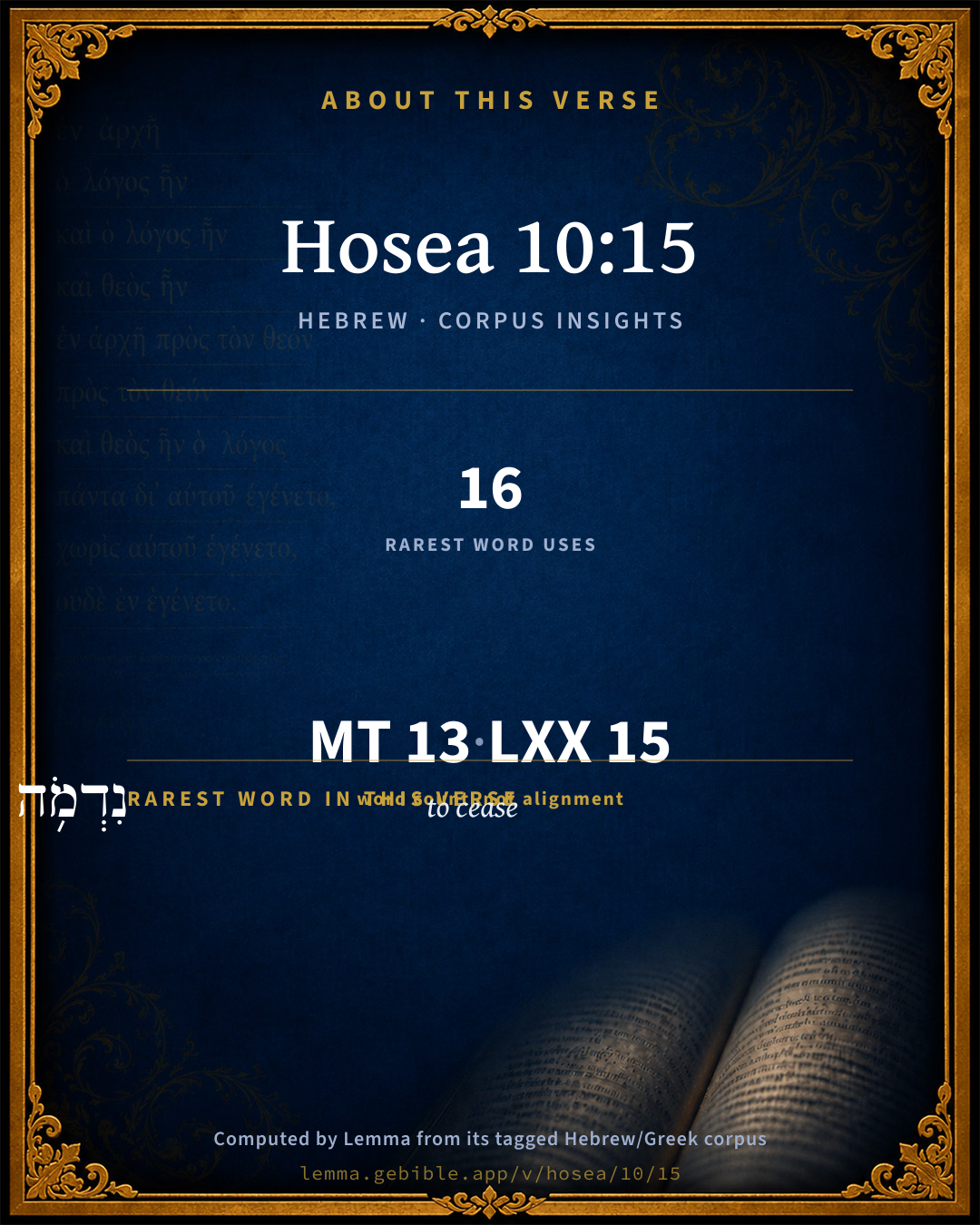
13
words
9
distinct lemmas
Prophets
section

Notable vocabulary

The rarest word here is נִדְמֹ֥ה to cease H1820 — appearing just 16 times in the whole Hebrew Bible.

Shared distinctive vocabulary

נִדְמֹ֥ה to cease H1820 occurs in 14 verses of the Hebrew Bible. Also found in:

Grammatical profile

  • 3 verbs
  • 8 nouns
  • 1 preposition
  • 1 adverb

Verb forms

  • עָשָׂ֤ה Qal · Perfect
  • נִדְמֹ֥ה Niphal · Infinitive Absolute
  • נִדְמָ֖ה Niphal · Perfect

Repetition

Words recur within this verse — often emphatic in Hebrew:

  • בֵּֽית Bethel H1008 ×2
  • רָעַ֣ת evil H7451 ×2
  • נִדְמֹ֥ה to cease H1820 ×2

Hebrew & Septuagint length

In English translation the verse runs 20 words from the Hebrew and 17 from the Septuagint (LXX English) — closely comparable.

A rough comparison of the two English renderings, which tokenize alike — not a word-level alignment.

Word counts can differ between the Hebrew and the Greek without any difference in meaning — e.g. the Hebrew direct-object marker אֵת has no separate Greek word, and Greek often adds the article ὁ.

In the original languages it is 13 Hebrew tokens and 15 Greek tokens — but the two are counted differently (Hebrew bundles its prefixes and suffixes into one token; the Greek is in lemma form), so that isn’t a like-for-like length.

Cross-references

6

Topical passages linked to Hosea 10:15 in the Treasury of Scripture Knowledge — connected by theme and wording, ordered by reader-vote popularity; previews shown in the World English Bible.

  • Hosea 10:5 The inhabitants of Samaria will be in terror for the calves of Beth Aven; For its people will mourn over it, Along with its priests who rejoiced over it, For its glory, because it has departed from it.
  • Hosea 10:7 Samaria and her king float away, Like a twig on the water.
  • Amos 7:9–17 The high places of Isaac will be desolate, the sanctuaries of Israel will be laid waste; and I will rise against the house of Jeroboam with the sword."
  • Romans 7:13 Did then that which is good become death to me? May it never be! But sin, that it might be shown to be sin, by working death to me through that which is good; that through the commandment sin might become exceeding sinful.
  • Isaiah 16:14 But now Yahweh has spoken, saying, Within three years, as the years of a hireling, the glory of Moab shall be brought into contempt, with all his great multitude; and the remnant shall be very small and of no account.
  • Hosea 10:3 Surely now they will say, "We have no king; for we don't fear Yahweh; And the king, what can he do for us?"

Cross-references courtesy of OpenBible.info (CC BY 4.0).

Hebrew and Greek witnesses Masoretic Hebrew ↔ Greek Septuagint

The same verse in the two great witnesses to the Old Testament, shown verse-for-verse.

These are two independent witnesses, not word-aligned to each other, and the Septuagint is shown in lemma (dictionary) form.

Hebrew Hosea 10:15 Masoretic · Westminster Leningrad Codex

כָּ֗כָה עָשָׂ֤ה לָכֶם֙ בֵּֽית אֵ֔ל מִפְּנֵ֖י רָעַ֣ת רָֽעַתְכֶ֑ם בַּשַּׁ֕חַר נִדְמֹ֥ה נִדְמָ֖ה מֶ֥לֶךְ יִשְׂרָאֵֽל

So Bethel will do to you because of your great wickedness. At daybreak the king of Israel will be destroyed.

World English Bible · Public Domain

Greek LXX Hosea 10:15 Septuagint · lemma form

οὕτως ποιέω σύ οἶκος ὁ ἰσραήλ ἀπό πρόσωπον κακία σύ ὄρθρος ἀποῥίπτω ἀποῥίπτω βασιλεύς ἰσραήλ

thus will I do to you, O house of Israel, because of the unrighteousness of your sins.

LXX2012 (modern English Septuagint) · Public Domain

On this verse, Haydock's Catholic Bible Commentary discusses the Septuagint’s reading. Read the note in Commentary ↓

Hebrew: Westminster Leningrad Codex (CC BY 4.0). Greek: Septuagint (public domain); English from LXX2012 (modern English Septuagint) (Public Domain). How the Septuagint differs from the Hebrew →

Targum (Aramaic paraphrase)

1

The Targum is the ancient Jewish Aramaic paraphrase of the Hebrew Scriptures — an interpretive translation, not the Hebrew text itself. Onkelos (literal) and Pseudo-Jonathan (expansive) render the Torah, and Jonathan the Prophets. Coverage is partial: where no permissively-licensed English translation exists for a verse, only the Aramaic is shown. This is verse-level text, not a word-by-word alignment to the Hebrew.

  1. Targum Jonathan Prophets (Joshua–Malachi)
    כֵּן גְרָמוּ לְכוֹן חוֹבִין דְחַבְתּוּן בְּבֵית אֵל מִן קֳדָם בִּישׁוּת עוֹבָדֵיכוֹן בְּסוֹפָא בְּהִית וְאִתְכְּנַע מַלְכָּא דְיִשְׂרָאֵל:

    (no public-domain English translation for this verse)

    Targum Jonathan — Aramaic: “Mikraot Gedolot” (public domain). English: “Sefaria Community Translation” (CC0 1.0 (public-domain dedication)); “London "Chaldee Paraphrase," 1871” (public domain). Text via Sefaria.

Commentary

Notes on Hosea 10:15 from classic Christian and Jewish commentators (each source and its license shown beneath its notes). The classic Christian expositions comment on the surrounding passage and are grouped to its opening verse, so a note may address several verses; the Jewish commentaries on the Tanakh (Rashi and others) are per-verse, so they appear only where the commentator wrote on this verse.

Lemma curates 59 commentaries, every one of them public domain or Creative Commons licensed, each selected and text-cleaned for this edition rather than reprinted as found. About our sources →

Trapp's Complete Commentary

John Trapp

Hos 10:15 So shall Bethel do unto you because of your great wickedness: in a morning shall the king of Israel utterly be cut off.

Ver. 15. So shall Bethel do unto you] i.e. The idolatry that you have committed at Bethel, by a synedoche of the place, this shall undo you. Or, So shall he do unto you, O inhabitants of Bethel. Bethel shall be made a Betharbel. They that take not example by others shall be made an example to others. Lege historiam, ne fias historia.

Because of your great wickedness] Heb. the wickedness of your wickedness, the iniquity of your sin, the foolishness of your madness, Ecc 7:25, your idolatry especially, that wickedness with a witness. Let us (by God’s example) learn to lay load upon our sins, and not to extenuate, but to aggravate them against ourselves.

In a morning shall the king of Israel be utterly cut off] This was fulfilled in Hoshea, the last king of Israel, 2Ki 17:6, cut off in a morning, that is, in a moment, as foam, or a bubble upon the waters. The morning light lasteth not long, but shineth on to the perfect day. Or, in a morning, when some hope appears, and some comfort is expected, as Psa 30:6, it is but a lightning before death.

“ Accidit in puncto, quod non speratur in anno. ”

“It happend in a monbecause it was not kfor in that year.”

Contrarily, the saints at evening time have light, Zec 14:7. {See Trapp on "Zec 14:7"}

John Trapp, A Commentary or Exposition upon All the Books of the Old and New Testament (1647–1656) — public domain. Text from a community e-Sword module.

Jamieson, Fausset & Brown

Robert Jamieson, A. R. Fausset & David Brown

So shall Beth-el do unto you--Your idolatrous calf at Beth-el shall be the cause of a like calamity befalling you.

your great wickedness--literally, "the wickedness of your wickedness."

in a morning--speedily as quickly as the dawn is put to flight by the rising sun (Hos 6:4; Hos 13:3; Psa 30:5).

king--Hoshea.

Next: Hosea Chapter 11

Jamieson, Fausset & Brown — Commentary Critical and Explanatory on the Whole Bible (1871) — public domain (CC PDM 1.0). Text via the HelloAO Bible API.

Adam Clarke's Commentary

Verse 15. So shall Beth-el do unto you] This shall be the consequence of your idolatry.

In a morning shall the king of Israel utterly be cut off.] Suddenly, unexpectedly. Hoshea, the king of Israel, shall be cut off by the Assyrians. There are some allusions to facts in this chapter, which cannot be easily verified, as we have not sufficient acquaintance with the history of those times.

Adam Clarke's Commentary on the Bible (1810–1826) — public domain. Text from a community e-Sword/MySword module.

John Calvin's Commentaries

We explained yesterday Hosea 10:14, in which the Prophet denounced the vengeance of God on his people, such as they had experienced either when the country was laid waste by the army of Shalmanezar, or when some other slaughter was made. From the words, we certainly learn that a battle had been fought in Arbel, which was a town, as we have said, beyond Jordan. But the Prophet shows also how much had been the atrocity of that battle, and how grievous and dreadful would be that slaughter which he now threatens to the people, by saying that even the mother had been violently thrown upon her children. And the Prophet also shows that God’s vengeance would be just, because the Israelites had provoked God by their superstitions.

He then points out in the last verse the cause why the Lord would deal so severely with his people; and his manner of speaking ought to be observed. So, he says, shall Bethel do unto you He might have said, ‘So will God do unto you;’ but he more distinctly shows that the evil, or the cause of the evil, was in themselves; Bethel, he says, shall do this unto you. It is certain that the war did not arise from Bethel; but as they had corrupted the worship of God by worshipping the calf, the Prophet says, that the Assyrian was not, properly speaking, the author of this slaughter, but that it was to be imputed to that corruption which had arisen in Bethel. Bethel then shall do this unto you

But he adds, Because of wickedness — of your wickedness Some give this explanation, “Because of the wickedness of wickedness,” by which is expressed something extreme, as the genitive case is often used by the Hebrews in the place of the superlative degree; but it may be viewed as a simple repetition, “This shall be for wickedness — your wickedness, and it shall be so, that ye may not be able to transfer the blame to any other cause; for ye are yourselves the authors of all the evils.”

He says, in the last place, In a morning shall the king of Israel be utterly cut off, or, by perishing shall perish. The Prophet means by these words, that the Lord would so punish the people of Israel, that it would appear plain enough, that it was not done by man or by chance; for the Lord would suddenly overturn that kingdom which had been so well fortified, which flourished so much in wealth and power. Cut off then in a morning, or in one morning, shall be the king of Israel. Some read, “as the morning,” instead of, “in a morning,” כשחר, cashicher, בשחר, beshicher. ‘The king of Israel shall perish like the dawn;’ for the dawn, we know, immediately disappears when the sun rises: the sun brings with it the full day, and then the dawn immediately passes away. But the other is the more correct reading, as it has also been more commonly received, that is, “In a morning, or in one morning, shall the king of Israel perish;” as we say in French, Cela n’est que pour un desiuner For that proud people thought that no adversity could happen to them for many years, as they had a blind confidence in their own strength. The Prophet derides this madness, and says, that the slaughter would be sudden, that the king would in a moment be destroyed, though he thought himself well supplied with soldiers and all other defences. Now follows —

John Calvin's Commentaries (1540-1563) — public domain. Text from the Calvin Translation Society English edition (1840s-50s) via the Christian Classics Ethereal Library (ccel.org). Calvin's coverage is partial (roughly two-thirds of the Bible); uncommented books and verses are honest gaps, never fabricated. The 19th-century editor's footnotes and remarks are omitted so the notes are faithfully Calvin's own voice.

Ellicott's Commentary for English Readers

(15) King . . . Cut off.—The close of the kingdom (721 B.C.), already more than once referred to (comp. Hos_10:7), is here prophesied. Translate, So shall He do to you at Bethel.

In the morning.—Should be, in the early morning Hoshea was utterly cut off, leaving neither root nor branch.

A Bible Commentary for English Readers, edited by Charles John Ellicott (1878–1897) — public domain. Text from a community e-Sword module.

The Cambridge Bible for Schools and Colleges

gen. ed. J. J. S. Perowne

15. So shall Beth-el, &c.] Such is the awful judgment of which the idolatry of Bethel is the cause.

your great wickedness] Lit., ‘your wickedness of wickedness’, with which some compare the phrases ‘song of songs’, ‘holy of holies.’ But it is more natural to suppose that the word ‘wickedness’ was written twice over by accident.

in a morning] Rather, in the dawn. The meaning is that when the morning-grey appears, the king will be found to be cut off. All has happened as quickly as time seems to have passed when we awake (comp. Psa_90:6, ‘they become as a sleep’).

The Cambridge Bible for Schools and Colleges (gen. ed. J. J. S. Perowne; Cambridge University Press, 1878–1918) — public domain. Text from a community e-Sword module.

John Gill's Exposition

So shall Bethel do unto you, because of your great wickedness,.... Or, "because of the evil of your evil" (s); their extreme wickedness, and exceeding sinfulness; the evil of evils they were guilty of was their idolatry, their worshipping the calf at Bethel; and this was the cause of all their ruin: God was the cause of it; the king of Assyria the instrument; but the procuring or meritorious cause was their abominable wickedness at Bethel; which therefore should be as Betharbel; yea, the whole land should be, on the account of that, like unto it, or be spoiled as that was. Or the words may be rendered, "so will he do unto you, O Bethel" (t); that is, either God, or Shalman or Shalmaneser, shall do the same to Bethel as he did to Betharbel; utterly destroy it and its inhabitants, showing no mercy to age or sex;

in a morning shall the king of Israel be utterly cut off; meaning Hoshea the last king of Israel, and the kingdom entirely destroyed; so that afterwards there was no more king in Israel, nor has been to this day; there was not only an utter destruction of that king, but of all kingly power and government, and ever since the children of Israel have been without a king, Hos 3:4; and this was to be done, and was done, in a "morning": in the beginning of his reign, as Joseph Kimchi; but this seems not so well to agree with the history, since it was in the ninth year of his reign that Samaria was taken: but the sense is, either that it would be certainly done, as sure as the morning came; or suddenly and quickly, as the morning light breaks forth; or in the morning of prosperity, when they were expecting light and good days, from their alliance with the king of Egypt, against the king of Assyria.

(s) "propter malitiam malitiae vestrae", Pagninus, Cocceius, Schmidt. (t) "sic faciet vobis, Deus, O Bethel", Drusius; "sic faciet vobis Salman, O Bethel", Schmidt.

Next: Hosea Chapter 11

John Gill's Exposition of the Whole Bible (1746–1763) — public domain (CC PDM 1.0). Text via the HelloAO Bible API.

Albert Barnes' Notes on the Bible

So shall Bethel do unto you - God was the judge, who condemned them so to suffer from the enemy. The Assyrian was the instrument of the wrath of God. But, in order to point out the moral government of God, the prophet says, neither that God did it, nor that the Assyrian did it, but Bethel, once “the house of God,” now the place where they dishonored God, “because of your great wickedness,” literally, “the wickedness of your wickedness.” In their wickedness itself, there was an essence of wickedness, malice within malice.

In a morning shall the king of Israel be cut off - Hoshea was cut off finally, leaving neither root nor branch. His kingdom perished; he left no memorial. Like the morning, he seemed to dawn on the troubles of his people: he sinned against God: and “in a morning,” the kingdom, in “the multitude of” whose “mighty men” he trusted, “was cut off” forever.

Albert Barnes' Notes on the Bible (1834–1885) — public domain. Text from a community e-Sword/MySword module.

Haydock's Catholic Bible Commentary

Bethel. This place, defiled by an idol, shall be the scene of your misery. Septuagint, "So I will treat you, O house of Israel," &c., (Haydock) which is not in Hebrew (St. Jerome) but seems as good. (Haydock) --- Hebrew adds here properly, (Calmet) "Presently, or in the morning, shall the king of Israel be utterly cut off," which we have in the next chapter.

George Leo Haydock (1774–1849), Haydock's Catholic Family Bible and Commentary, 1859 edition — public domain. Excludes Psalms (Douay-Rheims chapter numbering differs from Protestant) and Deuterocanonical books (Catholic canon only).

Matthew Poole's English Annotations

So; mercilessly and universally min.

Beth-el; one place put for every one, and the place put for the idolatry committed there.

Do; procure, bring your idolatry and sins, do all this evil against you.

Unto you, O Samaritans, and the rest of the ten tribes.

Because of your great wickedness: this idolatry, and the concomitant sins, are here summed up in their total sum,

great wickedness, exceeding great.

In a morning; suddenly, or so soon as it is day; possibly the Assyrians might assault the city towards morning, and master it.

Shall the king of Israel, Hoshea,

utterly be cut off; his power broken, for his life was spared, and he made a prisoner, 2Ki 17:4.

Matthew Poole's English Annotations on the Holy Bible (1683–1685) — public domain. Text from a community e-Sword/MySword module.

The Pulpit Commentary

So shall Bethel do unto you because of your great wickedness (margin, the evil of your evil): in a morning shall the King of Israel utterly be cut off. Their coming sufferings were all traceable to their sin. Bethel, the principal place of calf-worship, was the cause of their coming calamities, not the place itself, but the wickedness of which it was the scene. The real cause was the great and crowning wickedness practiced there. Bethel, once the house of God, would in consequence become another Beth-arbel, the house of the ambush of God. In the morning, when perhaps a season of prosperity seemed beginning to dawn, or at an early dale and in a speedy manner, quickly as the morning dawn gives place before the rising sun, the king, Hoshea, or perhaps no particular king, but merely the representative of the royal office, would be cut off-entirely cut off. Thus their main refuge would come to an ignominious end, bringing along with it the frustration of all their hopes and the conclusion of their mistaken and misplaced confidences.

The Pulpit Commentary (1880–1919), ed. H.D.M. Spence-Jones & Joseph S. Exell — public domain. Text from a community e-Sword module.

John Wesley's Explanatory Notes

Beth-el - The idolatry committed there. Do - Procure all this evil against you. In a morning - Possibly the Assyrians might assault the city towards morning and master it.

John Wesley, Explanatory Notes Upon the Whole Bible (1754–1765) — public domain. Text via the GEBible commentary corpus.

Rashi

Rabbi Shlomo Yitzchaki (Rashi)

So has Bethel done to you The calf in Bethel has brought about all this retribution upon you.

the evil of your wickedness Heb., lit. the evil of your evil. Because of the evil of your wickedness, the sins of your evil intention.

at dawn the king of Israel has been silenced Heb. נִדְמֹה נִדְמָה. He has sunk into a deep sleep as though it were night; i.e. he has no strength. Now why has all this come about? For when Israel was young, devoid of all good, I loved him.

Rashi on the Tanakh — English translations: “The Judaica Press complete Tanach with Rashi, translated by A. J. Rosenberg” (CC BY 4.0); “Pentateuch with Rashi's commentary by M. Rosenbaum and A.M. Silbermann, 1929-1934” (public domain); “The Metsudah Tanach series, Lakewood, N.J” (CC BY 4.0); and “The Book of Joshua, Metsudah Publications, 1997” (CC BY 4.0). Text via Sefaria.

Lesson kit

Teaching starters — assembled from the data on this page, not authored interpretation. Every prompt links to the verse data it draws on. Edit before teaching.

Hosea, in the Prophets, opens this verse with 13 words (9 distinct Hebrew lemmas). Its most distinctive word is dâmâh (“to cease”). A historical commentator’s framing appears above. Read the whole chapter for the surrounding context.

Discussion questions

  1. What does “to cease” (dâmâh) contribute to the verse as a whole?
  2. How does Psalms 49:12, which shares the word «to cease», read alongside this verse?
  3. What does the repetition of “Bethel” (2× in this one verse) do in this verse?
  4. These translations render this verse differently. What is at stake in choosing one wording over another?
  5. «עָשָׂ֤ה» is a Qal Perfect verb. How does that grammatical form shape the action described?
  6. Compare how Trapp's Complete Commentary and Jamieson, Fausset & Brown read this verse. Where do they agree or differ?

Things to notice

Reading settings

Reading text

Shown beneath each verse's original-language words.

Old Testament
Old Testament edition

Read the OT as the Masoretic Hebrew (MT) or the Greek Septuagint (LXX).

English shown for the Greek Septuagint (in the Hebrew ↔ Greek comparison).

Comparing translations? Open the Compare panel on any verse page to stack up to four side by side.