Exodus 5:19

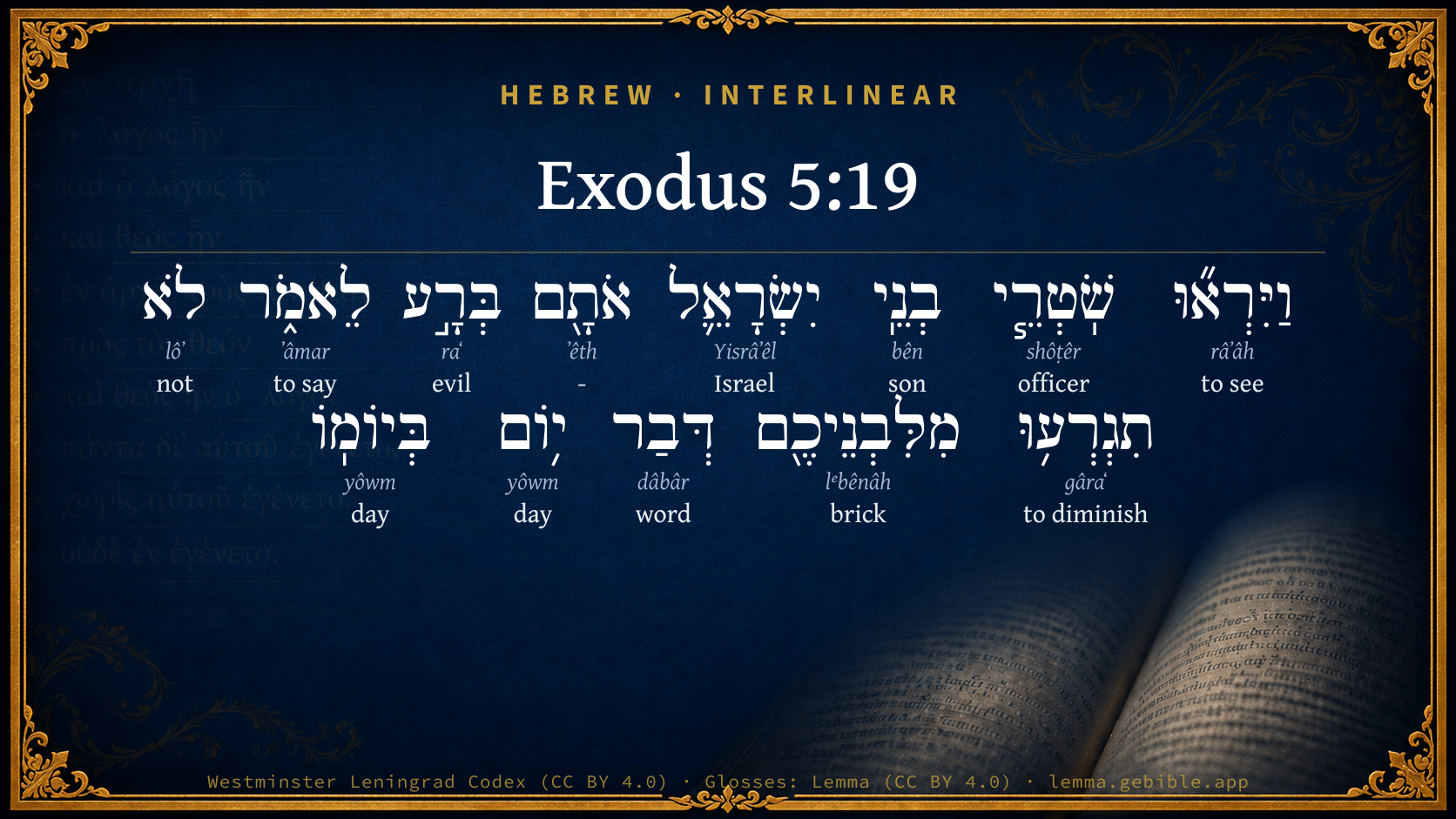
Hebrew (Westminster Leningrad Codex) Exodus 5:19 appears in the Hebrew Old Testament. The text above is from the Westminster Leningrad Codex. Each word links to its Strong’s number, a concise gloss, and parsing drawn from the Open Scriptures Hebrew Bible morphology. Click any word for its full Brown-Driver-Briggs (BDB) entry.
Download image
Cite this verse

Exodus 5:19 (World English Bible). Public Domain. Lemma interlinear Bible study tool, https://lemma.gebible.app/v/exodus/5/19.

Show BibTeX & RIS
BibTeX
RIS
English Translation
The officers of the children of Israel saw that they were in trouble, when it was said, "You shall not diminish anything from your daily quota of bricks!"
World English Bible · Public Domain
Download a study sheet

One document with this verse’s original text, its word-by-word gloss line, the meaning frame, cross-references with their text, attributed commentary, and full source and license credits — printable, and it pastes into notes with its structure intact.

This verse Autodidact and up

Study sheet (.html) Plain text (.txt)

A passage Seminary Student

Up to 50 verses in one chapter. A passage sheet keeps up to 6 commentary sources and 12 cross-references per verse, in the order this page ranks them, and says so on the sheet whenever that leaves anything out. Ask for a single verse and you get the Autodidact verse sheet above.

Everything on this page stays free to read, with no account — the sheet is a download of what is already on screen, not access to it.

Want to remove ads? Support Godless Engineer
Compare translations 3

The same verse in 3 English versions, stacked beneath the original-language interlinear above. Click any original word for its lexicon entry.

Each is an independent rendering of the whole verse — the interlinear is not word-aligned to these translations.

Highlighted words mark where these versions differ — a whole-verse word diff, not a word-by-word alignment.

  • World English Bible Public Domain
    The officers of the children of Israel saw that they were in trouble, when it was said, "You shall not diminish anything from your daily quota of bricks!"
  • King James Version Public Domain
    And the officers of the children of Israel did see that they were in evil case, after it was said, Ye shall not minish ought from your bricks of your daily task.
  • unfoldingWord Literal Text CC BY-SA 4.0
    And the officers of the sons of Israel saw themselves in distress regarding the saying, “You shall not reduce the day-by-day task from your bricks.”

unfoldingWord Literal Text — © unfoldingWord, licensed CC BY-SA 4.0. Word-aligned USFM3 via Door43 (git.door43.org/unfoldingWord/en_ult).

Versions to compare (up to 4)

3 of 4 selected

Show all 18 translations

Every available English version of this verse, each an independent rendering of the whole verse.

  • World English Bible Public Domain
    The officers of the children of Israel saw that they were in trouble, when it was said, "You shall not diminish anything from your daily quota of bricks!"
  • Berean Standard Bible Public Domain
    The Israelite foremen realized they were in trouble when they were told, “You must not reduce your daily quota of bricks.”
  • Majority Standard Bible Public Domain
    The Israelite foremen realized they were in trouble when they were told, “You must not reduce your daily quota of bricks.”
  • King James Version Public Domain
    And the officers of the children of Israel did see that they were in evil case, after it was said, Ye shall not minish ought from your bricks of your daily task.
  • American Standard Version (1901) Public Domain
    And the officers of the children of Israel did see that they were in evil case, when it was said, Ye shall not diminish aught from your bricks, `your' daily tasks.
  • Revised Version (1885) Public Domain
    And the officers of the children of Israel did see that they were in evil case, when it was said, Ye shall not minish aught from your bricks, your daily tasks.
  • Geneva Bible (1599) Public Domain
    Then the officers of the children of Israel sawe them selues in an euill case, because it was saide, Ye shall diminish nothing of your bricke, nor of euery dayes taske.
  • Douay-Rheims (1899) Public Domain
    And the officers of the children of Israel saw that they were in evil case, because it was said to them: There shall not a whit be diminished of the bricks for every day.
  • Young's Literal Translation Public Domain
    And the authorities of the sons of Israel see them in affliction, saying, `Ye do not diminish from your bricks; the matter of a day in its day.'
  • Literal Standard Version CC BY-SA 4.0
    And the authorities of the sons of Israel see them in affliction, saying, “You do not diminish from your bricks; the matter of a day in its day.”
  • Unlocked Literal Bible CC BY-SA 4.0
    The Israelite foremen saw that they were in trouble when they were told, “You must not reduce the daily number of bricks.”
  • unfoldingWord Literal Text CC BY-SA 4.0
    And the officers of the sons of Israel saw themselves in distress regarding the saying, “You shall not reduce the day-by-day task from your bricks.”
  • Darby Bible Public Domain
    And the officers of the children of Israel saw [that] it stood ill with them, because it was said, Ye shall not diminish anything from your bricks, the daily work.
  • World Messianic Bible Public Domain
    The officers of the children of Israel saw that they were in trouble when it was said, “You shall not diminish anything from your daily quota of bricks!”
  • Webster's Bible Public Domain
    And the officers of the children of Israel saw that they were in evil case, after it was said, Ye shall not diminish aught from your bricks of your daily task.
  • Free Bible Version CC BY-SA 4.0
    The Israelite supervisors realized they were in trouble when they were told, “You must not reduce the daily production of bricks.”
  • Bible in Basic English Public Domain
    Then the responsible men of the children of Israel saw that they were purposing evil when they said, The number of bricks which you have to make every day will be no less than before.
  • JPS Tanakh (1917) Public Domain
    And the officers of the children of Israel did see that they were set on mischief, when they said: 'Ye shall not diminish aught from your bricks, your daily task.'

Literal Standard Version (2020), Covenant Press — licensed CC BY-SA 4.0. Text via the HelloAO Bible API (eBible.org). Unlocked Literal Bible (unfoldingWord) — licensed CC BY-SA 4.0. Text via the HelloAO Bible API (eBible.org). unfoldingWord Literal Text — © unfoldingWord, licensed CC BY-SA 4.0. Word-aligned USFM3 via Door43 (git.door43.org/unfoldingWord/en_ult). Free Bible Version, Dr. Jonathan Gallagher — licensed CC BY-SA 4.0. Text via the HelloAO Bible API (eBible.org).

Word by word

More ways to search: Search by grammar → Find every occurrence → Compare this word →

Practice this passage: Drill this verse → Learn its vocabulary →

מִלִּבְנֵיכֶ֖ם
lᵉbênâh
H3843
“from · bricks · your”
Preposition + Noun, Common, Feminine, Plural, Construct + Suffix, Personal, 2nd Person, Masculine, Plural
Part of Speech
Preposition + Noun
Type
Common
Gender
Feminine
Number
Plural
State
Construct
Full BDB Definition

Origin: from H3835

TWOT: 1074g

tile, brick - brick - tile - pavement
  1. וַיִּרְא֞וּ râʼâh H7200 “and · to see” Conjunction + Verb, Qal, Sequential Imperfect, 3rd Person, Masculine, Plural
  2. שֹֽׁטְרֵ֧י shôṭêr H7860 “officer” Verb, Qal, Participle Active, Masculine, Plural, Construct
  3. בְנֵֽי bên H1121 “sons of” Noun, Common, Masculine, Plural, Construct
  4. יִשְׂרָאֵ֛ל Yisrâʼêl H3478 “Israel” Noun, Proper
  5. אֹתָ֖ם ʼêth H853 “- · them” Particle, Direct Object + Suffix, Personal, 3rd Person, Masculine, Plural
  6. בְּרָ֣ע raʻ H7451 “in/at · evil” Preposition + Adjective, Adjective, Masculine, Singular, Absolute
  7. לֵאמֹ֑ר ʼâmar H559 “to say” Preposition + Verb, Qal, Infinitive Construct
  8. לֹא lôʼ H3808 “not” Particle, Negative
  9. תִגְרְע֥וּ gâraʻ H1639 “to diminish” Verb, Qal, Imperfect, 2nd Person, Masculine, Plural
  10. דְּבַר dâbâr H1697 “word of” Noun, Common, Masculine, Singular, Construct
  11. י֥וֹם yôwm H3117 “day” Noun, Common, Masculine, Singular, Absolute
  12. בְּיוֹמֽוֹ yôwm H3117 “in/at · day · his” Preposition + Noun, Common, Masculine, Singular, Construct + Suffix, Personal, 3rd Person, Masculine, Singular

About this verse

These counts appear in no published source. They are computed here, from the morphology-tagged text and Lemma’s own curated glosses. What Lemma adds →

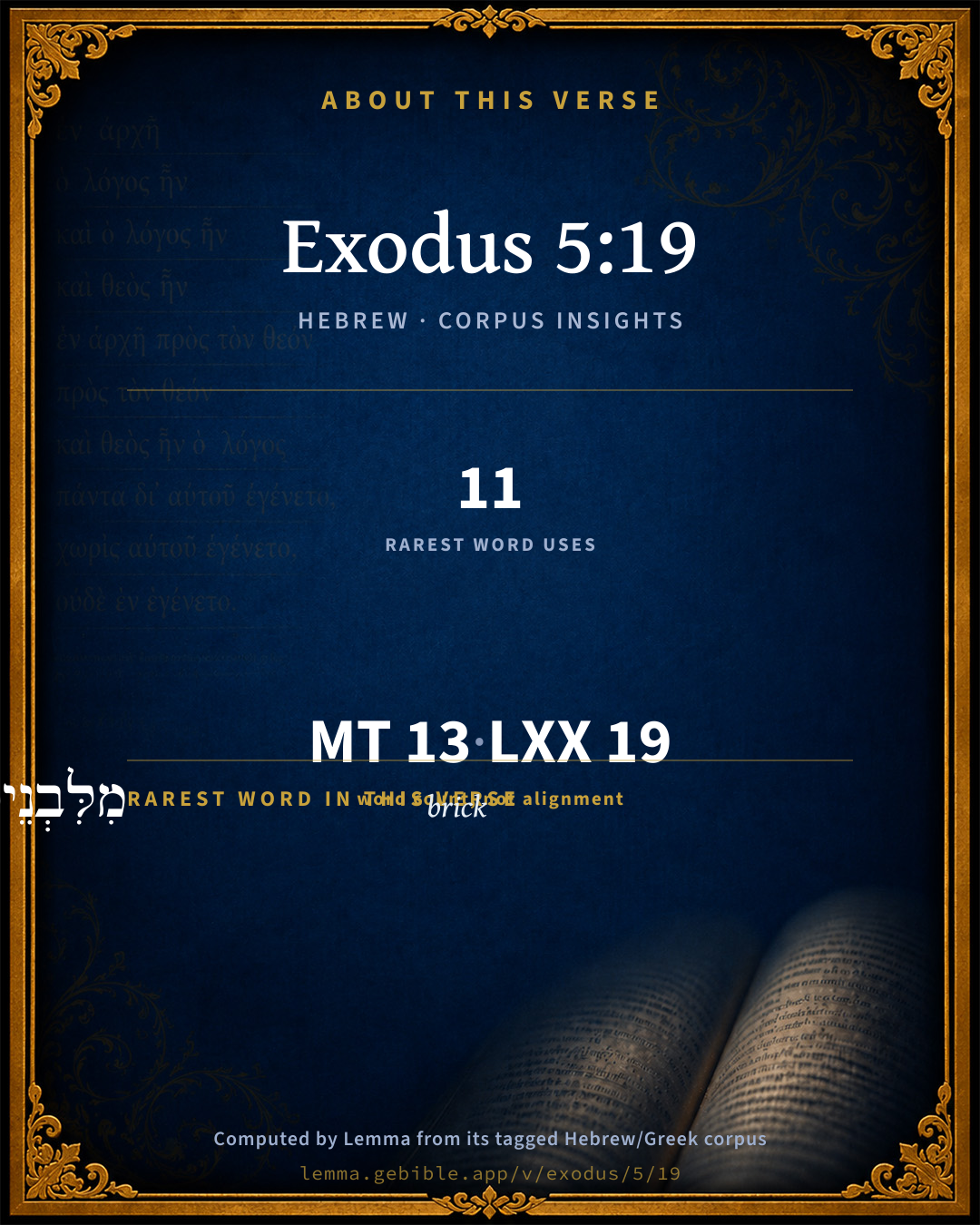
13
words
12
distinct lemmas
Pentateuch
section

Notable vocabulary

The rarest word here is מִלִּבְנֵיכֶ֖ם brick H3843 — appearing just 11 times in the whole Hebrew Bible.

Shared distinctive vocabulary

מִלִּבְנֵיכֶ֖ם brick H3843 occurs in 10 verses of the Hebrew Bible. Also found in:

Grammatical profile

  • 4 verbs
  • 6 nouns
  • 1 adjective
  • 2 particles

Verb forms

  • וַיִּרְא֞וּ Qal · Sequential Imperfect
  • שֹֽׁטְרֵ֧י Qal · Participle Active
  • לֵאמֹ֑ר Qal · Infinitive Construct
  • תִגְרְע֥וּ Qal · Imperfect

Repetition

A word recurs within this verse — often emphatic in Hebrew:

  • י֥וֹם day H3117 ×2

Hebrew & Septuagint length

In English translation the verse runs 28 words from the Hebrew and 28 from the Septuagint (LXX English) — the same length.

A rough comparison of the two English renderings, which tokenize alike — not a word-level alignment.

Word counts can differ between the Hebrew and the Greek without any difference in meaning — e.g. the Hebrew direct-object marker אֵת has no separate Greek word, and Greek often adds the article ὁ.

In the original languages it is 13 Hebrew tokens and 19 Greek tokens — but the two are counted differently (Hebrew bundles its prefixes and suffixes into one token; the Greek is in lemma form), so that isn’t a like-for-like length.

Cross-references

3

Topical passages linked to Exodus 5:19 in the Treasury of Scripture Knowledge — connected by theme and wording, ordered by reader-vote popularity; previews shown in the World English Bible.

  • Ecclesiastes 4:1 Then I returned and saw all the oppressions that are done under the sun: and, behold, the tears of those who were oppressed, and they had no comforter; and on the side of their oppressors there was power; but they had no comforter.
  • Ecclesiastes 5:8 If you see the oppression of the poor, and the violent taking away of justice and righteousness in a district, don't marvel at the matter: for one official is eyed by a higher one; and there are officials over them.
  • Deuteronomy 32:36 For Yahweh will judge his people, Repent himself for his servants; When he sees that [their] power is gone, There is none [remaining], shut up or left at large.

Cross-references courtesy of OpenBible.info (CC BY 4.0).

Hebrew and Greek witnesses Masoretic Hebrew ↔ Greek Septuagint

The same verse in the two great witnesses to the Old Testament, shown verse-for-verse.

These are two independent witnesses, not word-aligned to each other, and the Septuagint is shown in lemma (dictionary) form.

Hebrew Exodus 5:19 Masoretic · Westminster Leningrad Codex

וַיִּרְא֞וּ שֹֽׁטְרֵ֧י בְנֵֽי יִשְׂרָאֵ֛ל אֹתָ֖ם בְּרָ֣ע לֵאמֹ֑ר לֹא תִגְרְע֥וּ מִלִּבְנֵיכֶ֖ם דְּבַר י֥וֹם בְּיוֹמֽוֹ

The officers of the children of Israel saw that they were in trouble, when it was said, "You shall not diminish anything from your daily quota of bricks!"

World English Bible · Public Domain

Greek LXX Exodus 5:19 Septuagint · lemma form

ὁράω δέ ὁ γραμματεύς ὁ υἱός ἰσραήλ ἑαυτοῦ ἐν κακός λέγω οὐ ἀπολείπω ὁ πλινθεία ὁ καταἥκω ὁ ἡμέρα

And the accountants of the children of Israel saw themselves in an evil plight, men saying, You⌃ shall not fail to deliver the daily rate of the brick-making.

LXX2012 (modern English Septuagint) · Public Domain

Hebrew: Westminster Leningrad Codex (CC BY 4.0). Greek: Septuagint (public domain); English from LXX2012 (modern English Septuagint) (Public Domain). How the Septuagint differs from the Hebrew →

Targum (Aramaic paraphrase)

2

The Targum is the ancient Jewish Aramaic paraphrase of the Hebrew Scriptures — an interpretive translation, not the Hebrew text itself. Onkelos (literal) and Pseudo-Jonathan (expansive) render the Torah, and Jonathan the Prophets. Coverage is partial: where no permissively-licensed English translation exists for a verse, only the Aramaic is shown. This is verse-level text, not a word-by-word alignment to the Hebrew.

  1. Targum Onkelos Torah (Genesis–Deuteronomy)
    וַחֲזוֹ סָרְכֵי בְנֵי יִשְׂרָאֵל יָתְהוֹן בְּבִישׁ לְמֵימָר לָא תִמְנְעוּן מִלִבְנֵיכוֹן פִּתְגַם יוֹם בְּיוֹמֵהּ:

    (no public-domain English translation for this verse)

    Targum Onkelos — Aramaic: “Onkelos Genesis” (public domain); “Onkelos Exodus” (public domain); “Onkelos Leviticus” (public domain); “Onkelos Numbers” (public domain); “Onkelos Deuteronomy” (public domain). English: “Sefaria Community Translation” (CC0 1.0 (public-domain dedication)); “J.W. Etheridge. The Targums of Onkelos and Jonathan Ben Uzziel on the Pentateuch. London: Longmans, Green, 1862” (public domain). Text via Sefaria.

  2. Targum Pseudo-Jonathan Torah (Genesis–Deuteronomy)
    וְחָמוּן סַרְכֵי בְנֵי יִשְרָאֵל יַתְהוֹן בְּבִישׁ לְמֵימָר לָא תִמְנְעוּן מִלִבְנֵיכוֹן דְפִתְגַם יוֹם בְּיוֹמֵי

    And the foremen of the sons of Israel saw that they were in evil, (in his) saying, Ye are not to withhold the assignment of your bricks from day to day.

    Targum Pseudo-Jonathan — Aramaic: “Targum Jonathan on Genesis” (public domain); “Targum Jonathan on Exodus” (public domain); “Targum Jonathan on Leviticus” (public domain); “Targum Jonathan on Numbers” (public domain); “Targum Jonathan on Deuteronomy” (public domain). English: “The Targum of Jonathan ben Uzziel, trans. J. W. Etheridge, London, 1862” (public domain). Text via Sefaria.

Commentary

Notes on Exodus 5:19 from classic Christian and Jewish commentators (each source and its license shown beneath its notes). The classic Christian expositions comment on the surrounding passage and are grouped to its opening verse, so a note may address several verses; the Jewish commentaries on the Tanakh (Rashi and others) are per-verse, so they appear only where the commentator wrote on this verse.

Lemma curates 59 commentaries, every one of them public domain or Creative Commons licensed, each selected and text-cleaned for this edition rather than reprinted as found. About our sources →

Trapp's Complete Commentary

John Trapp

Exo 5:19 And the officers of the children of Israel did see [that] they [were] in evil [case], after it was said, Ye shall not minish [ought] from your bricks of your daily task.

Ver. 19. In evil case.] For their evil courses. {Eze 23:8; Eze 20:5; Eze 20:7-8 Jos 24:14} It is written as a heavy curse of God, {Lev 26:17} "If ye still trespass against me, I will set princes over you that shall hate you": Mischievous, odious princes; odious to God, malignant to the people.

John Trapp, A Commentary or Exposition upon All the Books of the Old and New Testament (1647–1656) — public domain. Text from a community e-Sword module.

Geneva Bible (1599)

Geneva Bible translators

Or, looked sad on them, which said.

Geneva Bible (1599) marginal notes — public domain. Text via Bolls.life.

Adam Clarke's Commentary

Verse 19. Did see that they were in evil case] They saw that they could neither expect justice nor mercy; that their deliverance was very doubtful, and their case almost hopeless.

Adam Clarke's Commentary on the Bible (1810–1826) — public domain. Text from a community e-Sword/MySword module.

The Cambridge Bible for Schools and Colleges

gen. ed. J. J. S. Perowne

19. in evil case] in having to tell their people that there was to be no abatement from their daily task.

The description here given of Egyptian brick-making is well illustrated from the monuments. The accompanying illustration (given more completely in Wilk.-B. i. 344) from the tomb of Rekhmâra, vizier of Thothmes III (1503–1449 b.c.), at ‘Abd el-Ḳurnah, opposite to Luxor, represents Asiatic captives making bricks for the temple of Amon at Thebes. On the left we see men drawing water from a tank to moisten the mud: elsewhere there are men carrying the mud in baskets, kneading it with their feet, placing it in moulds (which would usually be stamped with the name of the reigning king), exposing the bricks to dry, piling them up in rows, and building a wall with them; in the lower picture we notice an Egyptian ‘taskmaster’ with hid rod. The gangs of slaves, or captives, engaged upon such work, were organized almost like an army: they were under the superintendence of ‘standard-bearers,’ chosen out of the Egyptian army (corresponding to the ‘taskmasters’ here), and they had also officers of their own (corresponding to the shôṭerim), who were responsible to the standard-bearers. See Erman, pp. 417 f., 128. At Tell el-Maskhuta, the site of Pithom (Exo_1:11), M. Naville found bricks, some made with chopped straw or reed, and some without it (Pithom, p. 11b). Most Egyptian bricks, however, do not contain straw; and Petrie (Egypt and Israel, 30) think that the straw here asked for was for dipping the hand in, or sprinkling over the still soft bricks, that they might not stick.

The Cambridge Bible for Schools and Colleges (gen. ed. J. J. S. Perowne; Cambridge University Press, 1878–1918) — public domain. Text from a community e-Sword module.

John Gill's Exposition

And the officers of the children of Israel did see that they were in evil case,.... In a bad condition and circumstances, and that there was no likelihood of their getting out of them, since Pharaoh treated them after this manner; they saw not only that the common people were in a bad condition, in great bondage, misery, and distress, to be obliged to get straw to make brick, and carry in their full tale as before; but that they themselves were in a bad situation, since for the deficiency in their people they were like to be beaten for it from time to time:

after it was said, ye shall not minish ought from your bricks of your daily task; after this had been said and confirmed by Pharaoh, they had no hope of things being better with them, but looked upon their unhappy lot as irretrievable.

John Gill's Exposition of the Whole Bible (1746–1763) — public domain (CC PDM 1.0). Text via the HelloAO Bible API.

Matthew Poole's English Annotations

Did see that they were in evil case, or, looked upon them with sadness, or with an evil eye, i.e. with a sorrowful and angry countenance, as those that could obtain no relaxation for themselves or for their brethren.

Matthew Poole's English Annotations on the Holy Bible (1683–1685) — public domain. Text from a community e-Sword/MySword module.

The Pulpit Commentary

The officers did see that they were in evil case. See the "Introductory paragraph" to this section, and comp. ver.

21.

HOMILIES BY D. YOUNG Vers. 19-21. Thoughtless smiters of a brother in adversity.

This whole chapter particularly abounds in illustrations of human ignorance and error. We have seen in what dense darkness was the mind of Pharaoh; and under what utter misapprehensions he multiplied the sorrows of Israel. Now we are introduced to the leaders of Israel, treating Moses with equal injustice, because they are not able to see the difference between the human instrument and the Divine hand that holds it. No more than Pharaoh can they pierce through Moses to the mighty God behind him. It says in Exo_4:31, that when the people saw the signs they believed; here is conduct which shows for how little their faith counted. As soon as they were set to make bricks without straw, their faith utterly vanished. Yet surely the truth of God remained. Present human cruelty, let it press ever so hard, cannot alter past manifestations of Divine power. The God who gave his Son the parable of the Sower was prepared for such a lapse into unbelief on the part of his people. His signs were like the seeds which found no depth of earth; when persecution arose because of the message of Moses, the people were straightway offended. Consider

I IN WHAT A STATE OF MIND MOSES WOULD BE WHEN THESE OFFICERS ATTACKED HIM. We know from his own language (vers. 22, 23)what his state of mind was after the attack; but even before it he must have been a prey to deep grief and gloomy apprehensions. We may be sure that when these officers came upon him, they did not find proofs of indifference and carelessness in his face. lie must have been very popular just after he had wrought the signs; as popular as Jesus was after he had fed the five thousand. Aaron, doubtless, had been instructed by him to enlarge on the history of Abraham, Isaac and Jacob, and bring out into the boldest relief the terms of the Divine promises. Thus the confidence and expectation of the people a reception altogether beyond his hopes would lift him also into a confidence and expectation all the more precious because of his previous despondency. And now, as he sees the condition of his brethren, that despondency is more painful than ever. No imagination of ours can exaggerate the perplexity and sadness into which Moses would be thrown.

II THUS WE ARE CALLED TO NOTICE THE INDIFFERENCE OF MOSES" BRETHREN TO HIS PAINFUL POSITION. He thought a great deal more upon their Sorrows than they did upon his. The grief of selfish people, in the reckless abandonment with which it speaks and acts, furnishes as painful evidence as we can find of the extent to which human nature has fallen from its first estate. It is a greedy, insatiable feeling. It is an awful thing to consider that the very concentration of our thoughts on our own sufferings makes us to increase the sufferings of others. Why, even when others are to blame, we might safely leave them to the observant, unforgetting God, to their own consciences, and to the ultimate harvest which every doer of wrong must reap; and very often they are not to blame at all. If only these smarting Israelites had been able, in a right spirit, to look at the heart of Moses, they would have seen occasion for supporting him with the greatest tenderness, gratitude, and patient endurance. What right had they to complain of Moses? lie had told them a coherent, straightforward story, given them the signs; and they, in return, had believed him for the very works" sake. If there is any time when we should be slow to speak, it is in our sorrow. We do well then to be silent, until such times as God has purged out of our minds all selfish desires and groundless expectations. When all these are gone, and the truth which he alone can plant is also ripened, then we shall be able to say, "It was good for us to be afflicted;" at present Israel said that it was bad as bad as bad could be and Moses was the convenient person on whom they could lay the blame.

III THESE OFFICERS HAD NOT INSIGHT ENOUGH TO LOOK BEYOND FIRST CONSEQUENCES. They could not look through the pain of the present to a future which was only attainable through that present. Thus the disciples spoke in deep perplexity and disappointment concerning their missing Master as if he had vanished like a dream, of the night. "We trusted that it had been he which should have redeemed Israel. So they spoke, not having appreciated his recent word, "Except a corn of wheat fall into the ground and die, it abideth alone." We shall do well to consider in every enterprise, that first consequences are very deceptive. When they bring hardship we must not, therefore, turn back; when they bring pleasure, we must not therefore conclude that still greater pleasures lie beyond. Israel had no right to make any assumptions whatever as to the first consequences of Moses" visit to Pharaoh. The true and only safe position for Israel to take up was this: "Here are these signs; they are signs that Jehovah has sent Moses, and is with him; let us accept them in full and patient reliance." A man does not dispute the truth of the finger-post which points him into the right road, because soon after he has passed it he comes to a worse bit of travelling than any he has had before. There is a profound and admonitory generalisation in that way of indicating Christian experience which puts the Slough of Despond so early in the pilgrim"s journey: and if first consequences that bring hardship are to be mistrusted, surely we must be even more cautious when the first consequences are full of pleasure. Though we be told to remember our Creator in the days of our youth his claims, his expectations, and his judgment-day the danger is that we shall only too easily forget all this, and remember only that we are strong, ambitious, able to enjoy, and with abundant opportunities for enjoyment. We must always mistrust the mere pleasure of our senses; the pleasure of tastes and likings. Liking a thing is never a sufficient reason for doing it; disliking never a sufficient reason for refusing to do it. God appeals to our prudence, to our conscience, to our pity, to our fears, but never to our tastes. And. be it ever remembered, that there is one first consequence which never deceives nor disappoints those who put themselves in the way of it. Do that which is right in the sight of God, and there is an immediate and pure pleasure at the heart, which all the waves and. billows of adversity cannot wash away. For instance, we cannot believe for a moment that Moses regretted his compliance with the commands of Jehovah. They had been clear and imperative, steady and unrelaxing in their pressure on his conscience. The pain from the reproaches of Israel was bad enough; but it would have been a far worse pain, if he had sought to flee from the test of the burning bush, and, Jonah-like, bury himself with his sheep in the very depths of the wilderness. Y.

The Pulpit Commentary (1880–1919), ed. H.D.M. Spence-Jones & Joseph S. Exell — public domain. Text from a community e-Sword module.

Keil & Delitzsch

C. F. Keil & F. Delitzsch

When the Israelitish overlookers saw that they were in evil (בּרע as in Psa 10:6, i.e., in an evil condition), they came to meet Moses and Aaron, waiting for them as they came out from the king, and reproaching them with only making the circumstances of the people worse.

Keil & Delitzsch — Biblical Commentary on the Old Testament (1861–1891) — public domain (CC PDM 1.0). Text via the HelloAO Bible API. (Old Testament only.)

unfoldingWord translationNotes

Door43 World Missions Community

when they were told

This can be stated in active form. AT: "when Pharaoh told them" (See: Active or Passive)

palace

This is a very large house that a king lives in.

you have made us offensive

The Egyptians responded to the Israelites the same way they would respond to a foul odor. AT: "you have caused them to hate us" (See: Metaphor)

have put a sword in their hand to kill us

Here "a sword" represents an opportunity to destroy enemies. AT: "have given them a reason to kill us" (See: Metonymy)

translationWords

Moses

Aaron

Pharaoh

Yahweh

unfoldingWord translationNotes — © Distant Shores Media and the Door43 World Missions Community, licensed CC BY-SA 4.0. Source: git.door43.org/Door43/en_tn.

Rashi

Rabbi Shlomo Yitzchaki (Rashi)

ויראו שטרי בני ישראל The meaning is: AND THE BAILIFFS OF THE CHILDREN OF ISRAEL DID SEE [THEM] i. e. their fellow-lsraelites who were ruled by them,

ברע — they saw them in the misfortune and trouble that befell them, because they had to make the labour hard upon them. לאמר לא תגרעו וגו׳ BY SAYING, YE SHALL NOT DIMINISH etc.

Rashi on the Tanakh — English translations: “The Judaica Press complete Tanach with Rashi, translated by A. J. Rosenberg” (CC BY 4.0); “Pentateuch with Rashi's commentary by M. Rosenbaum and A.M. Silbermann, 1929-1934” (public domain); “The Metsudah Tanach series, Lakewood, N.J” (CC BY 4.0); and “The Book of Joshua, Metsudah Publications, 1997” (CC BY 4.0). Text via Sefaria.

Lesson kit

Teaching starters — assembled from the data on this page, not authored interpretation. Every prompt links to the verse data it draws on. Edit before teaching.

Exodus, in the Pentateuch, opens this verse with 13 words (12 distinct Hebrew lemmas). Its most distinctive word is lᵉbênâh (“brick”). A historical commentator’s framing appears above. Read the whole chapter for the surrounding context.

Discussion questions

  1. The word lᵉbênâh carries the sense “brick.” How does it shape the verse?
  2. How does Genesis 11:3, which shares the word «brick», read alongside this verse?
  3. What does the repetition of “day” (2× in this one verse) do in this verse?
  4. These translations render this verse differently; the difference is in the English rendering, not the original. What questions does that raise?
  5. «וַיִּרְא֞וּ» is a Qal Sequential Imperfect verb. How does that grammatical form shape the action described?
  6. Compare how Trapp's Complete Commentary and Geneva Bible (1599) read this verse. Where do they agree or differ?

Things to notice

Reading settings

Reading text

Shown beneath each verse's original-language words.

Old Testament
Old Testament edition

Read the OT as the Masoretic Hebrew (MT) or the Greek Septuagint (LXX).

English shown for the Greek Septuagint (in the Hebrew ↔ Greek comparison).

Comparing translations? Open the Compare panel on any verse page to stack up to four side by side.