
Isaiah 59:7

Hebrew (Westminster Leningrad Codex) Isaiah 59:7 appears in the Hebrew Old Testament. The text above is from the Westminster Leningrad Codex. Each word links to its Strong’s number, a concise gloss, and parsing drawn from the Open Scriptures Hebrew Bible morphology. Click any word for its full Brown-Driver-Briggs (BDB) entry.
Download image
Cite this verse

Isaiah 59:7 (World English Bible). Public Domain. Lemma interlinear Bible study tool, https://lemma.gebible.app/v/isaiah/59/7.

Show BibTeX & RIS
BibTeX
RIS
English Translation
Their feet run to evil, and they make haste to shed innocent blood: their thoughts are thoughts of iniquity; desolation and destruction are in their paths.
World English Bible · Public Domain
Download a study sheet

One document with this verse’s original text, its word-by-word gloss line, the meaning frame, cross-references with their text, attributed commentary, and full source and license credits — printable, and it pastes into notes with its structure intact.

This verse Autodidact and up

Study sheet (.html) Plain text (.txt)

A passage Seminary Student

Up to 50 verses in one chapter. A passage sheet keeps up to 6 commentary sources and 12 cross-references per verse, in the order this page ranks them, and says so on the sheet whenever that leaves anything out. Ask for a single verse and you get the Autodidact verse sheet above.

Everything on this page stays free to read, with no account — the sheet is a download of what is already on screen, not access to it.

Want to remove ads? Support Godless Engineer
Compare translations 3

The same verse in 3 English versions, stacked beneath the original-language interlinear above. Click any original word for its lexicon entry.

Each is an independent rendering of the whole verse — the interlinear is not word-aligned to these translations.

Highlighted words mark where these versions differ — a whole-verse word diff, not a word-by-word alignment.

  • World English Bible Public Domain
    Their feet run to evil, and they make haste to shed innocent blood: their thoughts are thoughts of iniquity; desolation and destruction are in their paths.
  • King James Version Public Domain
    Their feet run to evil, and they make haste to shed innocent blood: their thoughts are thoughts of iniquity; wasting and destruction are in their paths.
  • unfoldingWord Literal Text CC BY-SA 4.0
    Their feet run to evil, and they hasten to pour out innocent blood. Their thoughts thoughts of iniquity; destruction and breaking in their highways.

unfoldingWord Literal Text — © unfoldingWord, licensed CC BY-SA 4.0. Word-aligned USFM3 via Door43 (git.door43.org/unfoldingWord/en_ult).

Versions to compare (up to 4)

3 of 4 selected

Show all 18 translations

Every available English version of this verse, each an independent rendering of the whole verse.

  • World English Bible Public Domain
    Their feet run to evil, and they make haste to shed innocent blood: their thoughts are thoughts of iniquity; desolation and destruction are in their paths.
  • Berean Standard Bible Public Domain
    Their feet run to evil; they are swift to shed innocent blood. Their thoughts are sinful thoughts; ruin and destruction lie in their wake.
  • Majority Standard Bible Public Domain
    Their feet run to evil; they are swift to shed innocent blood. Their thoughts are sinful thoughts; ruin and destruction lie in their wake.
  • King James Version Public Domain
    Their feet run to evil, and they make haste to shed innocent blood: their thoughts are thoughts of iniquity; wasting and destruction are in their paths.
  • American Standard Version (1901) Public Domain
    Their feet run to evil, and they make haste to shed innocent blood: their thoughts are thoughts of iniquity; desolation and destruction are in their paths.
  • Revised Version (1885) Public Domain
    Their feet run to evil, and they make haste to shed innocent blood: their thoughts are thoughts of iniquity; desolation ard destruction are in their paths.
  • Geneva Bible (1599) Public Domain
    Their feete runne to euill, and they make haste to shed innocent blood: their thoughts are wicked thoughts: desolation and destruction is in their paths.
  • Douay-Rheims (1899) Public Domain
    Their feet run to evil, and make haste to shed innocent blood: their thoughts are unprofitable thoughts: wasting and destruction are in their ways.
  • Young's Literal Translation Public Domain
    Their feet to evil do run, And they haste to shed innocent blood, Their thoughts `are' thoughts of iniquity, Spoiling and destruction `are' in their highways.
  • Literal Standard Version CC BY-SA 4.0
    Their feet run to evil, || And they hurry to shed innocent blood, || Their thoughts [are] thoughts of iniquity, || Spoiling and destruction [are] in their highways.
  • Unlocked Literal Bible CC BY-SA 4.0
    Their feet run to evil, and they run to pour out innocent blood. Their thoughts are thoughts of sin; violence and destruction are their roads.
  • unfoldingWord Literal Text CC BY-SA 4.0
    Their feet run to evil, and they hasten to pour out innocent blood. Their thoughts thoughts of iniquity; destruction and breaking in their highways.
  • Darby Bible Public Domain
    Their feet run to evil, and they make haste to shed innocent blood; their thoughts are thoughts of iniquity; wasting and destruction are in their paths;
  • World Messianic Bible Public Domain
    Their feet run to evil, and they hurry to shed innocent blood. Their thoughts are thoughts of iniquity. Desolation and destruction are in their paths.
  • Webster's Bible Public Domain
    Their feet run to evil, and they make haste to shed innocent blood: their thoughts are thoughts of iniquity; wasting and destruction are in their paths.
  • Free Bible Version CC BY-SA 4.0
    They run to do evil; they're quick to murder innocent people. Their minds are full of sinful thoughts; they only cause havoc and destruction.
  • Bible in Basic English Public Domain
    Their feet go quickly to evil, and they take delight in the death of the upright; their thoughts are thoughts of sin; wasting and destruction are in their ways.
  • JPS Tanakh (1917) Public Domain
    Their feet run to evil, and they make haste to shed innocent blood; their thoughts are thoughts of iniquity, desolation and destruction are in their paths.

Literal Standard Version (2020), Covenant Press — licensed CC BY-SA 4.0. Text via the HelloAO Bible API (eBible.org). Unlocked Literal Bible (unfoldingWord) — licensed CC BY-SA 4.0. Text via the HelloAO Bible API (eBible.org). unfoldingWord Literal Text — © unfoldingWord, licensed CC BY-SA 4.0. Word-aligned USFM3 via Door43 (git.door43.org/unfoldingWord/en_ult). Free Bible Version, Dr. Jonathan Gallagher — licensed CC BY-SA 4.0. Text via the HelloAO Bible API (eBible.org).

Word by word

More ways to search: Search by grammar → Find every occurrence → Compare this word →

Practice this passage: Drill this verse → Learn its vocabulary →

שֹׁ֥ד
shôd
H7701
“violence”
Noun, Common, Masculine, Singular, Absolute
Part of Speech
Noun
Type
Common
Gender
Masculine
Number
Singular
State
Absolute
Full BDB Definition

Origin: from H7736

TWOT: 2331a

havoc, violence, destruction, devastation, ruin - violence, havoc (as social sin) - devastation, ruin
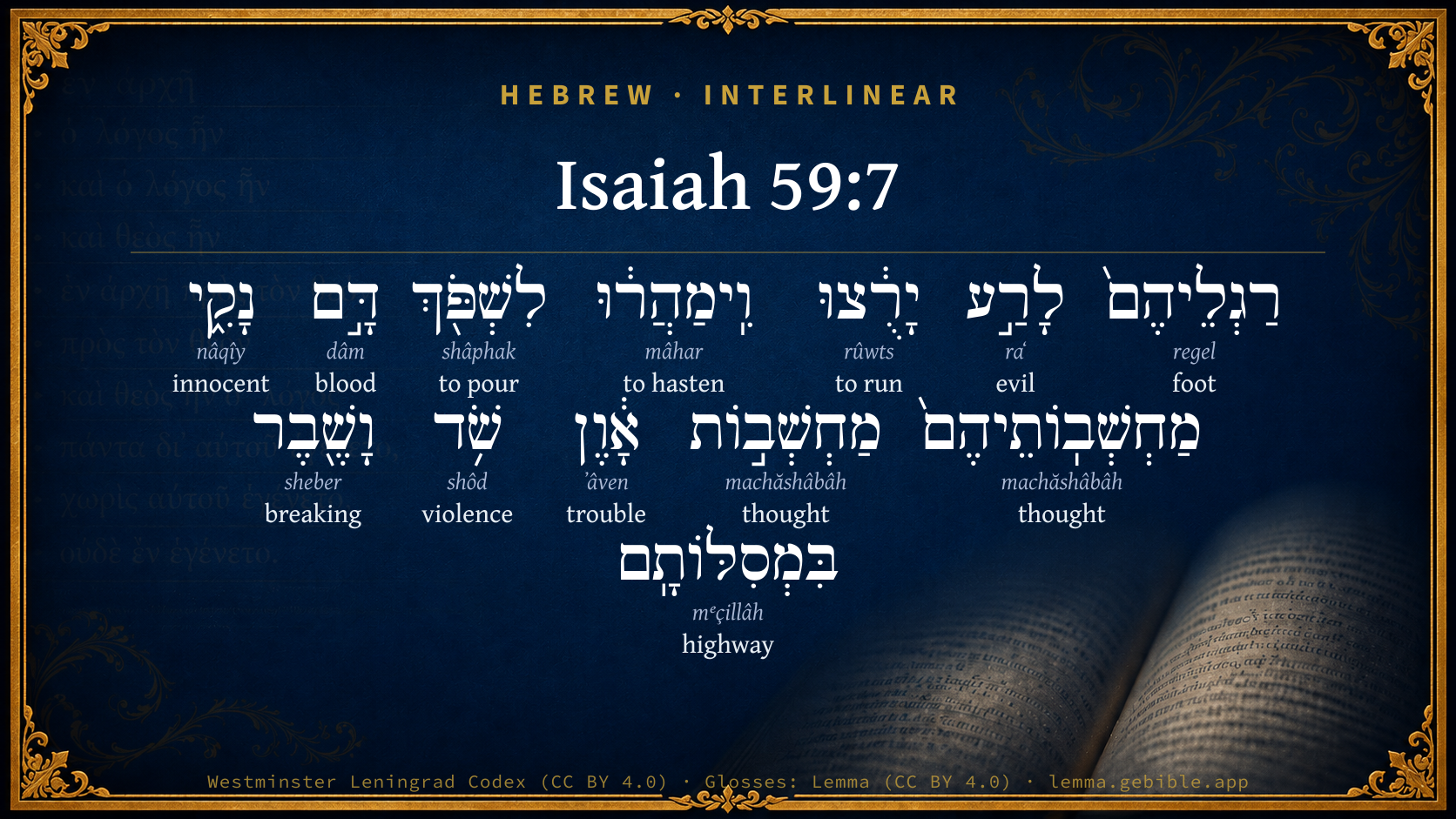
  1. רַגְלֵיהֶם֙ regel H7272 “feet · their” Noun, Common, Feminine, Dual, Construct + Suffix, Personal, 3rd Person, Masculine, Plural
  2. לָרַ֣ע raʻ H7451 “to/for the · evil” Preposition, Determined + Adjective, Adjective, Masculine, Singular, Absolute
  3. יָרֻ֔צוּ rûwts H7323 “to run” Verb, Qal, Imperfect, 3rd Person, Masculine, Plural
  4. וִֽימַהֲר֔וּ mâhar H4116 “and · to hasten” Conjunction + Verb, Piel, Imperfect, 3rd Person, Masculine, Plural
  5. לִשְׁפֹּ֖ךְ shâphak H8210 “to pour” Preposition + Verb, Qal, Infinitive Construct
  6. דָּ֣ם dâm H1818 “blood” Noun, Common, Masculine, Singular, Absolute
  7. נָקִ֑י nâqîy H5355 “innocent” Adjective, Adjective, Masculine, Singular, Absolute
  8. מַחְשְׁבֽוֹתֵיהֶם֙ machăshâbâh H4284 “thoughts · their” Noun, Common, Feminine, Plural, Construct + Suffix, Personal, 3rd Person, Masculine, Plural
  9. מַחְשְׁב֣וֹת machăshâbâh H4284 “thoughts of” Noun, Common, Feminine, Plural, Construct
  10. אָ֔וֶן ʼâven H205 “trouble” Noun, Common, Masculine, Singular, Absolute
  11. וָשֶׁ֖בֶר sheber H7667 “and · breaking” Conjunction + Noun, Common, Masculine, Singular, Absolute
  12. בִּמְסִלּוֹתָֽם mᵉçillâh H4546 “in/at · highways · their” Preposition + Noun, Common, Feminine, Plural, Construct + Suffix, Personal, 3rd Person, Masculine, Plural

About this verse

These counts appear in no published source. They are computed here, from the morphology-tagged text and Lemma’s own curated glosses. What Lemma adds →

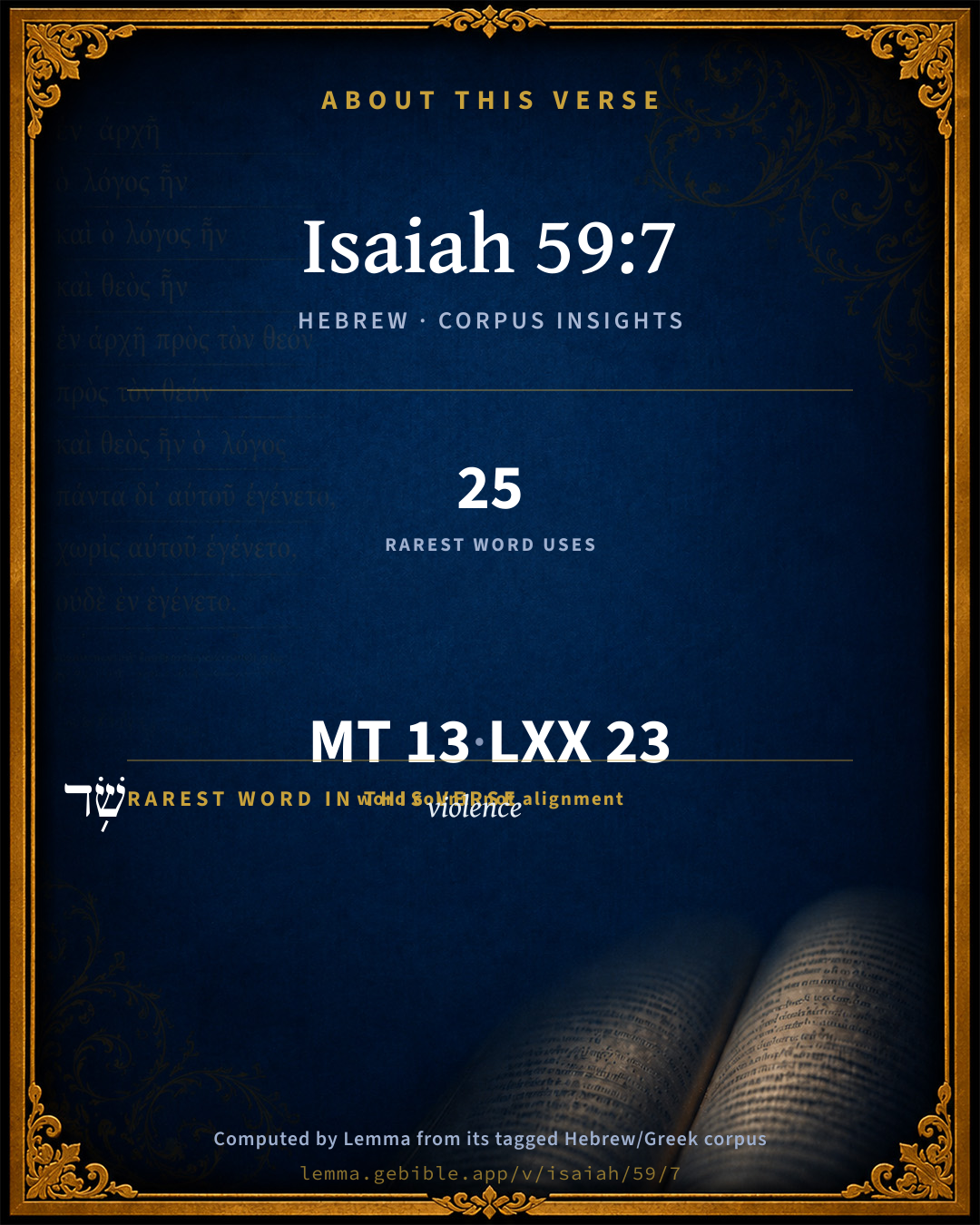
13
words
12
distinct lemmas
Prophets
section

Notable vocabulary

The rarest word here is שֹׁ֥ד violence H7701 — appearing just 25 times in the whole Hebrew Bible.

Shared distinctive vocabulary

שֹׁ֥ד violence H7701 occurs in 24 verses of the Hebrew Bible. Also found in:

Grammatical profile

  • 3 verbs
  • 8 nouns
  • 2 adjectives

Verb forms

  • יָרֻ֔צוּ Qal · Imperfect
  • וִֽימַהֲר֔וּ Piel · Imperfect
  • לִשְׁפֹּ֖ךְ Qal · Infinitive Construct

Repetition

A word recurs within this verse — often emphatic in Hebrew:

  • מַחְשְׁבֽוֹתֵיהֶם֙ thought H4284 ×2

Hebrew & Septuagint length

In English translation the verse runs 26 words from the Hebrew and 24 from the Septuagint (LXX English) — closely comparable.

A rough comparison of the two English renderings, which tokenize alike — not a word-level alignment.

Word counts can differ between the Hebrew and the Greek without any difference in meaning — e.g. the Hebrew direct-object marker אֵת has no separate Greek word, and Greek often adds the article ὁ.

In the original languages it is 13 Hebrew tokens and 23 Greek tokens — but the two are counted differently (Hebrew bundles its prefixes and suffixes into one token; the Greek is in lemma form), so that isn’t a like-for-like length.

Cross-references

15

Topical passages linked to Isaiah 59:7 in the Treasury of Scripture Knowledge — connected by theme and wording, ordered by reader-vote popularity; previews shown in the World English Bible.

  • Proverbs 6:17 Haughty eyes, a lying tongue, Hands that shed innocent blood;
  • Romans 3:15–17 "Their feet are swift to shed blood.
  • Proverbs 1:16 For their feet run to evil. They hurry to shed blood.
  • Mark 7:21–22 For from within, out of the hearts of men, proceed evil thoughts, adulteries, sexual sins, murders, thefts,
  • Proverbs 15:26 Yahweh detests the thoughts of the wicked, But the thoughts of the pure are pleasing.
  • Proverbs 24:9 The schemes of folly are sin. The mocker is detested by men.
  • Isaiah 59:3 For your hands are defiled with blood, and your fingers with iniquity; your lips have spoken lies, your tongue mutters wickedness.
  • Isaiah 60:18 Violence shall no more be heard in your land, desolation nor destruction within your borders; but you shall call your walls Salvation, and your gates Praise.
  • Jeremiah 22:17 But your eyes and your heart are not but for your covetousness, and for shedding innocent blood, and for oppression, and for violence, to do it.
  • Lamentations 4:13 [It is] because of the sins of her prophets, [and] the iniquities of her priests, That have shed the blood of the just in the midst of her.
  • Ezekiel 9:9 Then said he to me, The iniquity of the house of Israel and Judah is exceeding great, and the land is full of blood, and the city full of wrestling [of judgment]: for they say, Yahweh has forsaken the land, and Yahweh doesn't see.
  • Ezekiel 22:6 Behold, the princes of Israel, everyone according to his power, have been in you to shed blood.
  • Acts 8:20–22 But Peter said to him, "May your silver perish with you, because you thought you could obtain the gift of God with money!
  • Revelation 17:6 I saw the woman drunken with the blood of the saints, and with the blood of the martyrs of Jesus. When I saw her, I wondered with great amazement.
  • Matthew 23:31–37 Therefore you testify to yourselves that you are children of those who killed the prophets.

Cross-references courtesy of OpenBible.info (CC BY 4.0).

Hebrew and Greek witnesses Masoretic Hebrew ↔ Greek Septuagint

The same verse in the two great witnesses to the Old Testament, shown verse-for-verse.

These are two independent witnesses, not word-aligned to each other, and the Septuagint is shown in lemma (dictionary) form.

Hebrew Isaiah 59:7 Masoretic · Westminster Leningrad Codex

רַגְלֵיהֶם֙ לָרַ֣ע יָרֻ֔צוּ וִֽימַהֲר֔וּ לִשְׁפֹּ֖ךְ דָּ֣ם נָקִ֑י מַחְשְׁבֽוֹתֵיהֶם֙ מַחְשְׁב֣וֹת אָ֔וֶן שֹׁ֥ד וָשֶׁ֖בֶר בִּמְסִלּוֹתָֽם

Their feet run to evil, and they make haste to shed innocent blood: their thoughts are thoughts of iniquity; desolation and destruction are in their paths.

World English Bible · Public Domain

Greek LXX Isaiah 59:7 Septuagint · lemma form

ὁ δέ πούς αὐτός ἐπί πονηρία τρέχω ταχινός ἐκχέω αἷμα καί ὁ διαλογισμός αὐτός διαλογισμός ἄφρων σύντριμμα καί ταλαιπωρία ἐν ὁ ὁδός αὐτός

And their feet run to wickedness, swift to shed blood; their thoughts also are thoughts of murder; destruction and misery are in their ways;

LXX2012 (modern English Septuagint) · Public Domain

Hebrew: Westminster Leningrad Codex (CC BY 4.0). Greek: Septuagint (public domain); English from LXX2012 (modern English Septuagint) (Public Domain). How the Septuagint differs from the Hebrew →

Targum (Aramaic paraphrase)

1

The Targum is the ancient Jewish Aramaic paraphrase of the Hebrew Scriptures — an interpretive translation, not the Hebrew text itself. Onkelos (literal) and Pseudo-Jonathan (expansive) render the Torah, and Jonathan the Prophets. Coverage is partial: where no permissively-licensed English translation exists for a verse, only the Aramaic is shown. This is verse-level text, not a word-by-word alignment to the Hebrew.

  1. Targum Jonathan Prophets (Joshua–Malachi)
    רַגְלֵיהוֹן לְמֶעְבַּד דְבִישׁ רַהֲטִין וּמוֹחִין לְמִשְׁפַּךְ דַם זַכַּאי עֶשְׁתּוֹנֵיהוֹן עֶשְׁתּוֹנֵי אוֹנָס בִּזָא וּתְבָרָא בְּכִבְשֵׁיהוֹן:

    Their feet run to do that which is evil, and they make haste to shed innocent blood: their thoughts are thoughts of violence, plunder and destruction are in their paths.

    Targum Jonathan — Aramaic: “Mikraot Gedolot” (public domain). English: “Sefaria Community Translation” (CC0 1.0 (public-domain dedication)); “London "Chaldee Paraphrase," 1871” (public domain). Text via Sefaria.

Commentary

Notes on Isaiah 59:7 from classic Christian and Jewish commentators (each source and its license shown beneath its notes). The classic Christian expositions comment on the surrounding passage and are grouped to its opening verse, so a note may address several verses; the Jewish commentaries on the Tanakh (Rashi and others) are per-verse, so they appear only where the commentator wrote on this verse.

Lemma curates 59 commentaries, every one of them public domain or Creative Commons licensed, each selected and text-cleaned for this edition rather than reprinted as found. About our sources →

Trapp's Complete Commentary

John Trapp

Isa 59:7 Their feet run to evil, and they make haste to shed innocent blood: their thoughts [are] thoughts of iniquity; wasting and destruction [are] in their paths.

Ver. 7. Their feet run to evil, &c.] They trot apace toward hell; they take long strides, as if they feared lest hell should be full before they come thither.

And they make haste to shed innocent blood.] This is taken from Pro 1:16, and fitly applied by St Paul to the whole race of mankind, {Rom 3:15} since by nature there is never a better of us; we are all in a pickle: Ecce hic telas arantarum et ova aspidum explicat. {a}

Wasting and destruction are in their paths.] A metaphor from torrents or tempests; or from a pestilence that sweepeth all, as now it doth at Genoa, and as it did not long since at Naples.

{a} A Lapide.

John Trapp, A Commentary or Exposition upon All the Books of the Old and New Testament (1647–1656) — public domain. Text from a community e-Sword module.

The Biblical Illustrator

Joseph S. Exell

Isa_59:7

Their feet run to evil

A picture of moral corruption

This verse and the first part of the following have been interwoven by Paul, in Rom_3:15-17, into his description of universal moral corruption.

The representation of life as a road, and of ones mode of action as a manner of walking, is a common feature in gnomic compositions, where its terminology has been fully developed. From the beginning of verse 7, one may perceive that steadfast believers, during the exile, were persecuted even to death by their fellow-countrymen who had forgotten God. The verbs run and hasten depict the delight felt in wickedness, when the conscience is completely asleep. (F. Delitzsch, D. D.)

The Biblical Illustrator, edited by Joseph S. Exell (c. 1880s–1900s) — public domain. Text from a community e-Sword module.

Joseph Benson's Commentary

Isa 59:7-8. Their feet run to evil — This seems to be taken from Pro 1:16; where see the note. He had spoken of their hands, fingers, lips, tongues, &c., before, and now he speaks of their feet, to show that they were wholly set upon mischief. Their thoughts are thoughts of iniquity — Their minds and hearts are wholly set upon committing wickedness, and doing injuries: they not only do evil, but do it deliberately. Wasting and destruction are in their paths — In what way or work soever they are engaged, it all tends to ruin and destruction. It is a metaphor taken from an overspreading torrent, or sweeping plague, or from beasts of prey, that tear and devour whatever comes in their way. The way of peace they know not — They live in continual contentions and discords, and break in pieces the very bonds of society. And there is no judgment — No justice, equity, faith, or integrity, which are the foundation of judgment; in their goings — In their conduct or actions. They have made them crooked paths — They have turned aside from the way of God’s commandments, which are a plain and straight way, into the crooked and winding paths of craft, subtlety, and selfishness. Whosoever goeth therein shall know no peace — Shall experience none. Whosoever shall do as they do, and be turbulent and perverse as they are, will have as little peace within, or happiness without, as they have.

Joseph Benson's Commentary on the Old and New Testaments (1811–1818) — public domain. Text from a community e-Sword module.

Keil & Delitzsch

C. F. Keil & F. Delitzsch

This evil doing of theirs rises even to hatred, the very opposite of that love which is well-pleasing to God. "Their feet run to evil, and make haste to shed innocent blood: their thoughts are thoughts of wickedness; wasting and destruction are in their paths." Paul has interwoven this passage into his description of the universal corruption of morals, in Rom 3:15-17. The comparison of life to a road, and of a man's conduct to walking, is very common in proverbial sayings. The prophet has here taken from them both his simile and his expressions. We may see from Isa 59:7, that during the captivity the true believers were persecuted even to death by their countrymen, who had forgotten God. The verbs ירוּצוּ and וימהרוּ (the proper reading, with metheg, not munach, under the מ) depict the pleasure taken in wickedness, when the conscience is thoroughly lulled to sleep.

Keil & Delitzsch — Biblical Commentary on the Old Testament (1861–1891) — public domain (CC PDM 1.0). Text via the HelloAO Bible API. (Old Testament only.)

Tyndale Open Study Notes

Tyndale Open Resources

59:7-8 Paul quotes from these verses in his description of the depravity of all people (Rom 3:15-17). • Misery and destruction: The people lamented being victims of oppression (Isa 51:19), yet they were oppressors themselves.

Tyndale Open Study Notes — © Tyndale Open Resources, licensed CC BY-SA 4.0. Text via the HelloAO Bible API.

Jamieson, Fausset & Brown

Robert Jamieson, A. R. Fausset & David Brown

feet--All their members are active in evil; in Isa 59:3, the "hands, fingers, lips, and tongue," are specified.

run . . . haste-- (Rom 3:15). Contrast David's "running and hasting" in the ways of God (Psa 119:32, Psa 119:60).

thoughts--not merely their acts, but their whole thoughts.

Jamieson, Fausset & Brown — Commentary Critical and Explanatory on the Whole Bible (1871) — public domain (CC PDM 1.0). Text via the HelloAO Bible API.

Ellicott's Commentary for English Readers

(7) Their feet run to evil.—Note the parallelisms, entirely after the manner of Isaiah, with Pro_1:16; Pro_16:17. So the four words “paths,” “goings,” “ways,” and “paths” (another word in the Hebrew) are all from the same book.

A Bible Commentary for English Readers, edited by Charles John Ellicott (1878–1897) — public domain. Text from a community e-Sword module.

The Cambridge Bible for Schools and Colleges

gen. ed. J. J. S. Perowne

7. their thoughts are thoughts of iniquity (or evil)] corresponding to their deeds, Isa_59:6.

wasting and destruction] as ch. Isa_51:19, Isa_60:18; an alliteration in the Hebr.

in their paths] Lit. in their highways, cf. Pro_16:17.

7, 8. Cf. Pro_1:16; Rom_3:15-17.

The Cambridge Bible for Schools and Colleges (gen. ed. J. J. S. Perowne; Cambridge University Press, 1878–1918) — public domain. Text from a community e-Sword module.

John Gill's Exposition

Their feet run to evil,.... Make haste to commit all manner of sin, and particularly that which follows, with great eagerness and swiftness, taking delight and pleasure therein, and continuing in it; it is their course of life. The words seem to be taken out of Pro 1:16 and are quoted with the following by the Apostle Paul, Rom 3:15 to prove the general corruption of mankind:

and they make haste to shed innocent blood: in wars abroad or at home, in quarrels and riots, or through the heat of persecution; which if it does not directly touch men's lives, yet issues in the death of many that fall under the power of it; and which persecutors are very eager and hasty in the prosecution of. The phrase fitly describes their temper and conduct:

their thoughts are thoughts of iniquity: their thoughts are continually devising things vain and sinful in themselves, unprofitable to them, and pernicious to others: their thoughts, words, and actions being evil; their tongue, lips, hands, and feet being employed in sin, show their general depravity:

wasting and destruction are in their paths: they waste and destroy all they meet with in their ways, their fellow creatures and their substance; and the ways they walk in lead to ruin and destruction, which will be their portion for evermore.

John Gill's Exposition of the Whole Bible (1746–1763) — public domain (CC PDM 1.0). Text via the HelloAO Bible API.

Albert Barnes' Notes on the Bible

Their feet run to evil - In accordance with the design of the prophet to show the entireness of their depravity, he states that all their members were employed in doing evil. In Isa 59:3-6. he had remarked that depravity had extended to their hands, their fingers, their lips, and their tongue; he here states that their feet also were employed in doing evil. Instead of treading the paths of righteousness, and hastening to execute purposes of mercy and justice, they were employed in journeyings to execute plans of iniquity. The words ‘run,’ and ‘make haste,’ are designed to intimate the intensity of their purpose to do wrong. They did not walk slowly; they did not even take time to deliberate; but such was their desire of wrong-doing, that they hastened to execute their plans of evil. People usually walk slowly and with a great deal of deliberation when any good is to be done; they walk rapidly, or they run with haste and alacrity when evil is to be accomplished. This passage is quoted by the apostle Paul Rom 3:15, and is applied to the Jews of his own time as proof of the depraved character of the entire nation.

They make haste to shed innocent blood - No one can doubt that this was the character of the nation in the time of Manasseh (see the Introduction, Section 3). It is not improbable that the prophet refers to the bloody and cruel reign of this prince. That it was also the character of the nation when Isaiah began to prophesy is apparent from Isa 1:15-21.

Their thoughts - That is, their plans and purposes are evil. It is not merely that evil is done, but they intended that it should be done. They had no plan for doing good; and they were constantly laying plans for evil.

Wasting - That is, violence, oppression, destruction. It means that the government was oppressive and tyrannical; and that it was the general character of the nation that they were regardless of the interests of truth and righteousness.

And destruction - Margin, ‘Breaking.’ The word commonly means breaking or breach; then a breaking down, or destruction, as of a kingdom Lam 2:11; Lam 3:47; or of individuals Isa 1:28. Here it means that they broke down or trampled on the rights of others.

Are in their paths - Instead of marking their ways by deeds of benevolence and justice, they could be tracked by cruelty and blood. The path of the wicked through the earth can be seen usually by the desolations which they make. The path of conquerors can be traced by desolated fields, and smouldering ruins, and forsaken dwelling-places, and flowing blood; and the course of all the wicked can be traced by the desolations which they make in their way.

Albert Barnes' Notes on the Bible (1834–1885) — public domain. Text from a community e-Sword/MySword module.

Matthew Poole's English Annotations

Their feet run to evil: this seems to be taken from Pro 1:16. See Poole "Pro 1:16". He had spoken of their hands, lips, and heart, &c. before, and now of their feet, to show that they were wholly set upon mischief.

Their thoughts, i.e. their heart and mind, is set upon doing wrong and injury; they not only do evil, but do it deliberately. You have the wicked described by this kind of working of their thoughts, Psa 64:6; they meditate on little or nothing else.

Wasting and destruction are in their paths; a metaphor put for the behaviours and carriages of men; in what way or work soever they are engaged, it all tends to ruin and destruction. A metaphor taken from an overspreading torrent, or sweeping plague, or beasts of prey, that tear and devour whatsoever comes in their way.

Matthew Poole's English Annotations on the Holy Bible (1683–1685) — public domain. Text from a community e-Sword/MySword module.

Whedon's Commentary on the Bible

Daniel D. Whedon

7, 8. Before this, depravity had involved hands, fingers, lips, tongue; now the feet are added.

Make haste — Running and making “haste” to do evil. To indicate further degrees in depravity, citations are made from Pro_1:16; and in both verses Paul (Rom_3:15-17) finds a fitting citation for utter depravity. Not only things they touch and speak of are polluted, but their ways are made crooked for working greater lengths of destruction. Corresponding retribution follows.

Way of peace they know not — No peace do they have; no judgment, or, better, no sense of right, is in their goings; that is, along their whole pathway of life.

Daniel D. Whedon (gen. ed.), Commentary on the Old and New Testaments (1874–1909) — public domain. Text from a community e-Sword module.

The Pulpit Commentary

Their feet run to evil. It is, however, only too true that they have a power to work evil. They cannot construct, their devices fall through, their "spinning" is to no purpose; but they can, in a rough and blind way, do enormous mischief. "Their feet run to evil rush to it at full speed brook no delay, but hurry on into act. It is an easy thing to shed innocent blood; and those who are conscious of constructive impotence are very apt to seek compensation by doing destructive work, which at least shows that they have a power of some kind. Hence "Reigns of Terror" when revolutions are at the last gasp. The strong expressions with respect to shedding innocent blood, used here and in 2Ki_21:16 and 2Ki_24:4, seem to imply something like a massacre of the more godly Israelites by the ungodly in Manasseh"s time. Wasting and destruction. (compare the "destruction and misery" of Rom_3:16, which is a quotation of the present passage)

Sin in thoughts.

"Their thoughts are thoughts of iniquity.

I THE IMPORTANCE OF A MAN"S THOUGHTS. A man is as his thoughts. This is the fact and truth on which we may dwell. Any one who would truly judge his fellow-mart must know his secrets and judge his thoughts. Therefore man"s judgment of his fellowman is always imperfect and uncertain. God alone can judge perfectly, because he is the Discerner of the thoughts and intents of the heart." There is an impression resting on the minds of many religious persons that they have no control over the suggestions that are made to their minds, and no responsibility for the contents of their thoughts, only for the cherishing of the thought and dwelling upon it, and letting it take shape in action; or, as the Apostle James puts it, only when "lust is allowed to conceive, and bring forth sin." This, however, is true only within very narrow limits, and it is altogether healthier for us to accept a large measure of responsibility, even for the contents of our minds; for only then shall we be likely to watch over what goes in as over what goes out. The importance that attaches to our thoughts may be seen:

1. In our observation of men. We misjudge because we cannot readthoughts.

2. In the experiences of friendship. We trust our friend more than outsiderscan do, because, in some measure, we do know his thoughts.

3. In view of the heart-searching claims of God, who desires truth in the inward parts." Sin does not consist in mere act; it really lies at the back of the action in the thought, the intention, and the motive that inspire it.

4. In consideration of the work of Divine redemption; which is really a heart-regeneration, a purifying of the very springs of thought and feeling. It seeks out the fountains and cleanses them.

II THE CONTROL A MAN MAY HAVE OVER HIS THOUGHTS.

1. He has control over the materials of thought. Thought is really the comparison, selection, and association of the actual contents of our minds, under the guidance of our wills. All that has impressed us during our lives, by the eye, the ear, or the feeling, has passed into our mental treasury. Then we may take some care as to what goes in. We need not go into scenes or read books which will leave behind bad impressions.

2. We have control over the processes of thought. We can deliberately choose to think about evil things; we can start such thoughts, we can dwell on them, we can follow them on their foul way, we can collect from our associations things that match them. And, in a similar way, we can dwell upon and encourage the good. If our will is a renewed and sanctified will, then we shall find it may gain presidency over our thoughts, so that we may choose and follow only that which is good. R.T.

The Pulpit Commentary (1880–1919), ed. H.D.M. Spence-Jones & Joseph S. Exell — public domain. Text from a community e-Sword module.

John Wesley's Explanatory Notes

Wasting - They meditate on little or nothing else. Paths - In what way or work soever they are engaged, it all tends to ruin and destruction.

John Wesley, Explanatory Notes Upon the Whole Bible (1754–1765) — public domain. Text via the GEBible commentary corpus.

J. A. Alexander on Isaiah

Joseph Addison Alexander

“Their feet to evil will run, and they will hasten to shed innocent blood; their thoughts are thoughts of mischief (or iniquity); wasting and ruin are in their paths.” The first clause expresses not a mere disposition, but an eager proclivity to wrong. The word translated thoughts has here and elsewhere the specific sense of purposes, contrivances, devices. Their paths are the paths in which their feet run to evil and make haste to shed innocent blood. The two nouns combined in the last clause strictly denote desolation and crushing, (i.e., utter ruin). With this verse compare Pro 1:16, and the evil way of Isa 55:7 above.

Joseph Addison Alexander, The Prophecies of Isaiah (1846–1847; New York: Scribner, 1870–1878) — public domain. Text from a community e-Sword module.

unfoldingWord translationNotes

Door43 World Missions Community

General Information:

Isaiah continues speaking to the people of Israel.

Their feet run to evil

Here people are represented by their "feet." This speaks of them doing something quickly as their feet running to it. AT: "They are quick to do evil things" (See: Synecdoche and Metaphor)

are their roads

"roads" represents their way of life. AT: "are all they do" (See: Metaphor)

there is no justice in their paths

"paths" represents their way of life. AT: "they never do what is just" or "everything they do is unjust" (See: Metaphor)

They have made crooked paths

"Crooked paths" represents the way of life that is corrupt. AT: "They say and do dishonest things. They are devious" (See: Metaphor)

translationWords

evil

innocent

blood

sin

peace

just

unfoldingWord translationNotes — © Distant Shores Media and the Door43 World Missions Community, licensed CC BY-SA 4.0. Source: git.door43.org/Door43/en_tn.

Ibn Ezra

Rabbi Abraham ibn Ezra

Their thoughts are thoughts of iniquity, of wasting and destruction in their paths, that is, in the paths which they go. The second half of the verse contains the same idea as the first half.

Ibn Ezra on the Tanakh — English translations: “Sefaria Community Translation” (CC0 1.0 (public-domain dedication)); “Yalkut, Sifsei Chachomim Chumash, Metsudah Publications, 2009” (CC BY 4.0); and “Commentary of Ibn Ezra on Isaiah - trans. by M. Friedlander, 1873” (public domain). Text via Sefaria.

Lesson kit

Teaching starters — assembled from the data on this page, not authored interpretation. Every prompt links to the verse data it draws on. Edit before teaching.

Isaiah, in the Prophets, opens this verse with 13 words (12 distinct Hebrew lemmas). Its most distinctive word is shôd (“violence”). A historical commentator’s framing appears above. Read the whole chapter for the surrounding context.

Discussion questions

  1. The word shôd carries the sense “violence.” How does it shape the verse?
  2. Job 5:21 shares the word «violence» with this verse. How do the two illuminate each other?
  3. “thought” occurs 2× in this one verse. What is the effect of the repetition?
  4. These translations render this verse differently. What is at stake in choosing one wording over another?
  5. The verb «יָרֻ֔צוּ» is Qal Imperfect. How does its form color the action?
  6. Reading how Trapp's Complete Commentary and The Biblical Illustrator read this verse, where do the two commentators agree and where do they part?

Things to notice

Reading settings

Reading text

Shown beneath each verse's original-language words.

Old Testament
Old Testament edition

Read the OT as the Masoretic Hebrew (MT) or the Greek Septuagint (LXX).

English shown for the Greek Septuagint (in the Hebrew ↔ Greek comparison).

Comparing translations? Open the Compare panel on any verse page to stack up to four side by side.