
Deuteronomy 28:59

Hebrew (Westminster Leningrad Codex) Deuteronomy 28:59 appears in the Hebrew Old Testament. The text above is from the Westminster Leningrad Codex. Each word links to its Strong’s number, a concise gloss, and parsing drawn from the Open Scriptures Hebrew Bible morphology. Click any word for its full Brown-Driver-Briggs (BDB) entry.
Download image
Cite this verse

Deuteronomy 28:59 (World English Bible). Public Domain. Lemma interlinear Bible study tool, https://lemma.gebible.app/v/deuteronomy/28/59.

Show BibTeX & RIS
BibTeX
RIS
English Translation
then Yahweh will make your plagues wonderful, and the plagues of your seed, even great plagues, and of long continuance, and sore sicknesses, and of long continuance.
World English Bible · Public Domain
Download a study sheet

One document with this verse’s original text, its word-by-word gloss line, the meaning frame, cross-references with their text, attributed commentary, and full source and license credits — printable, and it pastes into notes with its structure intact.

This verse Autodidact and up

Study sheet (.html) Plain text (.txt)

A passage Seminary Student

Up to 50 verses in one chapter. A passage sheet keeps up to 6 commentary sources and 12 cross-references per verse, in the order this page ranks them, and says so on the sheet whenever that leaves anything out. Ask for a single verse and you get the Autodidact verse sheet above.

Everything on this page stays free to read, with no account — the sheet is a download of what is already on screen, not access to it.

Want to remove ads? Support Godless Engineer
Compare translations 3

The same verse in 3 English versions, stacked beneath the original-language interlinear above. Click any original word for its lexicon entry.

Each is an independent rendering of the whole verse — the interlinear is not word-aligned to these translations.

Highlighted words mark where these versions differ — a whole-verse word diff, not a word-by-word alignment.

  • World English Bible Public Domain
    then Yahweh will make your plagues wonderful, and the plagues of your seed, even great plagues, and of long continuance, and sore sicknesses, and of long continuance.
  • King James Version Public Domain
    Then the LORD will make thy plagues wonderful, and the plagues of thy seed, even great plagues, and of long continuance, and sore sicknesses, and of long continuance.
  • unfoldingWord Literal Text CC BY-SA 4.0
    then Yahweh will cause extraordinary afflictions—your plagues and the plagues of your seed great and enduring plagues and great and enduring sicknesses.

unfoldingWord Literal Text — © unfoldingWord, licensed CC BY-SA 4.0. Word-aligned USFM3 via Door43 (git.door43.org/unfoldingWord/en_ult).

Versions to compare (up to 4)

3 of 4 selected

Show all 18 translations

Every available English version of this verse, each an independent rendering of the whole verse.

  • World English Bible Public Domain
    then Yahweh will make your plagues wonderful, and the plagues of your seed, even great plagues, and of long continuance, and sore sicknesses, and of long continuance.
  • Berean Standard Bible Public Domain
    He will bring upon you and your descendants extraordinary disasters, severe and lasting plagues, and terrible and chronic sicknesses.
  • Majority Standard Bible Public Domain
    He will bring upon you and your descendants extraordinary disasters, severe and lasting plagues, and terrible and chronic sicknesses.
  • King James Version Public Domain
    Then the LORD will make thy plagues wonderful, and the plagues of thy seed, even great plagues, and of long continuance, and sore sicknesses, and of long continuance.
  • American Standard Version (1901) Public Domain
    then Jehovah will make thy plagues wonderful, and the plagues of thy seed, even great plagues, and of long continuance, and sore sicknesses, and of long continuance.
  • Revised Version (1885) Public Domain
    then the LORD will make thy plagues wonderful, and the plagues of thy seed, even great plagues, and of long continuance, and sore sicknesses, and of long continuance.
  • Geneva Bible (1599) Public Domain
    The the Lord wil make thy plagues wonderfull, and the plagues of thy seede, euen great plagues and of long continuance, and sore diseases, and of long durance.
  • Douay-Rheims (1899) Public Domain
    The Lord shall increase thy plagues, and the plagues of thy seed, plagues great and lasting, infirmities grievous and perpetual.
  • Young's Literal Translation Public Domain
    then hath Jehovah made wonderful thy strokes, and the strokes of thy seed -- great strokes, and stedfast, and evil sicknesses, and stedfast.
  • Literal Standard Version CC BY-SA 4.0
    then YHWH has made your strokes extraordinary, and the strokes [against] your seed [are] great strokes that are persisting and severe sicknesses that are persisting.
  • Unlocked Literal Bible CC BY-SA 4.0
    then Yahweh will make your plagues terrible, and those of your descendants; they will be great plagues, of long duration, and severe diseases, of long duration.
  • unfoldingWord Literal Text CC BY-SA 4.0
    then Yahweh will cause extraordinary afflictions—your plagues and the plagues of your seed great and enduring plagues and great and enduring sicknesses.
  • Darby Bible Public Domain
    then Jehovah will make thy plagues wonderful, and the plagues of thy seed, great and persistent plagues and evil and persistent sicknesses;
  • World Messianic Bible Public Domain
    then the LORD will make your plagues and the plagues of your offspring fearful, even great plagues, and of long duration, and severe sicknesses, and of long duration.
  • Webster's Bible Public Domain
    Then the LORD will make thy plagues wonderful, and the plagues of thy seed, even great plagues, and of long continuance, and severe sicknesses, and of long continuance.
  • Free Bible Version CC BY-SA 4.0
    he will bring down on you and your descendants unbelievable disasters, intense and long-lasting diseases, and terrible and incurable sicknesses.
  • Bible in Basic English Public Domain
    Then the Lord your God will make your punishment, and the punishment of your seed, a thing to be wondered at; great punishments and cruel diseases stretching on through long years.
  • JPS Tanakh (1917) Public Domain
    then the LORD will make thy plagues wonderful, and the plagues of thy seed, even great plagues, and of long continuance, and sore sicknesses, and of long continuance.

Literal Standard Version (2020), Covenant Press — licensed CC BY-SA 4.0. Text via the HelloAO Bible API (eBible.org). Unlocked Literal Bible (unfoldingWord) — licensed CC BY-SA 4.0. Text via the HelloAO Bible API (eBible.org). unfoldingWord Literal Text — © unfoldingWord, licensed CC BY-SA 4.0. Word-aligned USFM3 via Door43 (git.door43.org/unfoldingWord/en_ult). Free Bible Version, Dr. Jonathan Gallagher — licensed CC BY-SA 4.0. Text via the HelloAO Bible API (eBible.org).

Word by word

More ways to search: Search by grammar → Find every occurrence → Compare this word →

Practice this passage: Drill this verse → Learn its vocabulary →

וָחֳלָיִ֥ם
chŏlîy
H2483
“and · sicknesses”
Conjunction + Noun, Common, Masculine, Plural, Absolute
Part of Speech
Conjunction + Noun
Type
Common
Gender
Masculine
Number
Plural
State
Absolute
Full BDB Definition

Origin: from H2470

TWOT: 655a

sickness
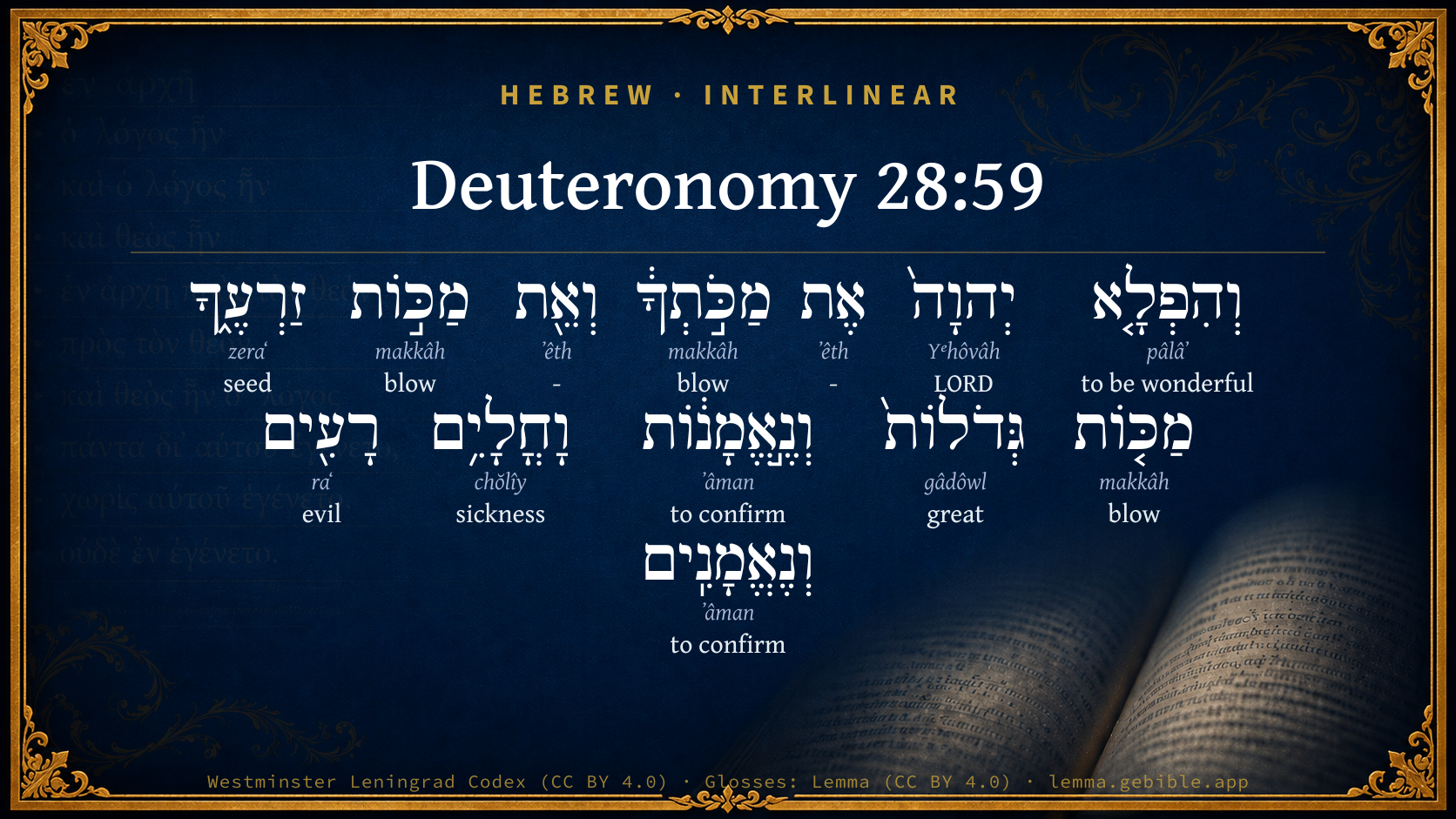
  1. וְהִפְלָ֤א pâlâʼ H6381 “and · to be wonderful” Conjunction + Verb, Hiphil, Sequential Perfect, 3rd Person, Masculine, Singular
  2. יְהוָה֙ Yᵉhôvâh H3068 “LORD” Noun, Proper
  3. אֶת ʼêth H853 “-” Particle, Direct Object
  4. מַכֹּ֣תְךָ֔ makkâh H4347 “blows · your” Noun, Common, Feminine, Plural, Construct + Suffix, Personal, 2nd Person, Masculine, Singular
  5. וְאֵ֖ת ʼêth H853 “and · -” Conjunction + Particle, Direct Object
  6. מַכּ֣וֹת makkâh H4347 “blows of” Noun, Common, Feminine, Plural, Construct
  7. זַרְעֶ֑ךָ zeraʻ H2233 “seed · your” Noun, Common, Masculine, Singular, Construct + Suffix, Personal, 2nd Person, Masculine, Singular
  8. מַכּ֤וֹת makkâh H4347 “blows” Noun, Common, Feminine, Plural, Absolute
  9. גְּדֹלוֹת֙ gâdôwl H1419 “great” Adjective, Adjective, Feminine, Plural, Absolute
  10. וְנֶ֣אֱמָנ֔וֹת ʼâman H539 “and · confirming” Conjunction + Verb, Niphal, Participle Active, Feminine, Plural, Absolute
  11. רָעִ֖ים raʻ H7451 “evil” Adjective, Adjective, Masculine, Plural, Absolute
  12. וְנֶאֱמָנִֽים ʼâman H539 “and · confirming” Conjunction + Verb, Niphal, Participle Active, Masculine, Plural, Absolute

About this verse

These counts appear in no published source. They are computed here, from the morphology-tagged text and Lemma’s own curated glosses. What Lemma adds →

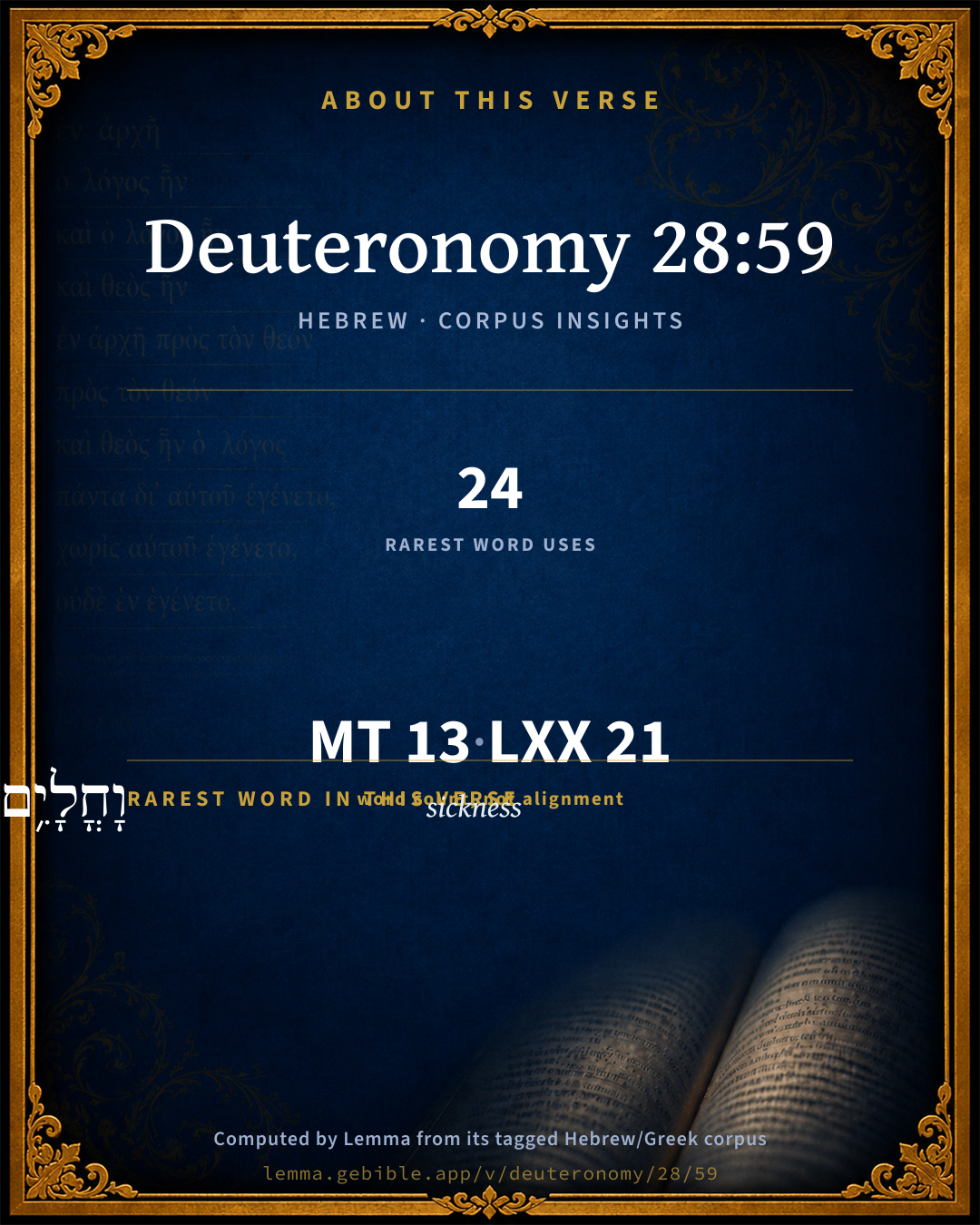
13
words
9
distinct lemmas
Pentateuch
section

Notable vocabulary

The rarest word here is וָחֳלָיִ֥ם sickness H2483 — appearing just 24 times in the whole Hebrew Bible.

Shared distinctive vocabulary

וָחֳלָיִ֥ם sickness H2483 occurs in 22 verses of the Hebrew Bible. Also found in:

Grammatical profile

  • 3 verbs
  • 6 nouns
  • 2 adjectives
  • 2 particles

Verb forms

  • וְהִפְלָ֤א Hiphil · Sequential Perfect
  • וְנֶ֣אֱמָנ֔וֹת Niphal · Participle Active
  • וְנֶאֱמָנִֽים Niphal · Participle Active

Repetition

Words recur within this verse — often emphatic in Hebrew:

  • מַכֹּ֣תְךָ֔ blow H4347 ×3
  • וְנֶ֣אֱמָנ֔וֹת to confirm H539 ×2

Hebrew & Septuagint length

In English translation the verse runs 27 words from the Hebrew and 22 from the Septuagint (LXX English) — closely comparable.

A rough comparison of the two English renderings, which tokenize alike — not a word-level alignment.

Word counts can differ between the Hebrew and the Greek without any difference in meaning — e.g. the Hebrew direct-object marker אֵת has no separate Greek word, and Greek often adds the article ὁ.

In the original languages it is 13 Hebrew tokens and 21 Greek tokens — but the two are counted differently (Hebrew bundles its prefixes and suffixes into one token; the Greek is in lemma form), so that isn’t a like-for-like length.

Cross-references

13

Topical passages linked to Deuteronomy 28:59 in the Treasury of Scripture Knowledge — connected by theme and wording, ordered by reader-vote popularity; previews shown in the World English Bible.

  • Mark 13:19 For in those days there will be oppression, such as there has not been the like from the beginning of the creation which God created until now, and never will be.
  • Deuteronomy 28:46 and they shall be on you for a sign and for a wonder, and on your seed forever.
  • Deuteronomy 29:20–28 Yahweh will not pardon him, but then the anger of Yahweh and his jealousy will smoke against that man, and all the curse that is written in this book shall lie on him, and Yahweh will blot out his name from under the sky.
  • Deuteronomy 31:17–18 Then my anger shall be kindled against them in that day, and I will forsake them, and I will hide my face from them, and they shall be devoured, and many evils and troubles shall come on them; so that they will say in that day, Haven't these evils come on us because our God is not among us?
  • Deuteronomy 32:22 For a fire is kindled in my anger, Burns to the lowest Sheol, Devours the earth with its increase, Sets on fire the foundations of the mountains.
  • Deuteronomy 32:26 I said, I would scatter them afar, I would make the memory of them to cease from among men;
  • 1 Kings 9:7–9 then will I cut off Israel out of the land which I have given them; and this house, which I have made holy for my name, will I cast out of my sight; and Israel shall be a proverb and a byword among all peoples.
  • 1 Kings 16:3–4 behold, I will utterly sweep away Baasha and his house; and I will make your house like the house of Jeroboam the son of Nebat.
  • Lamentations 1:9 Her filthiness was in her skirts; she didn't remember her latter end; Therefore is she come down wonderfully; she has no comforter: See, Yahweh, my affliction; for the enemy has magnified himself.
  • Lamentations 1:12 Is it nothing to you, all you who pass by? Look, and see if there be any sorrow like my sorrow, which is brought on me, With which Yahweh has afflicted [me] in the day of his fierce anger.
  • Lamentations 4:12 The kings of the earth didn't believe, neither all the inhabitants of the world, That the adversary and the enemy would enter into the gates of Jerusalem.
  • Daniel 9:12 He has confirmed his words, which he spoke against us, and against our judges who judged us, by bringing on us a great evil; for under the whole sky has not been done as has been done on Jerusalem.
  • Hosea 3:4 For the children of Israel shall abide many days without king, and without prince, and without sacrifice, and without sacred stone, and without ephod or idols.

Cross-references courtesy of OpenBible.info (CC BY 4.0).

Hebrew and Greek witnesses Masoretic Hebrew ↔ Greek Septuagint

The same verse in the two great witnesses to the Old Testament, shown verse-for-verse.

These are two independent witnesses, not word-aligned to each other, and the Septuagint is shown in lemma (dictionary) form.

Hebrew Deuteronomy 28:59 Masoretic · Westminster Leningrad Codex

וְהִפְלָ֤א יְהוָה֙ אֶת מַכֹּ֣תְךָ֔ וְאֵ֖ת מַכּ֣וֹת זַרְעֶ֑ךָ מַכּ֤וֹת גְּדֹלוֹת֙ וְנֶ֣אֱמָנ֔וֹת וָחֳלָיִ֥ם רָעִ֖ים וְנֶאֱמָנִֽים

then Yahweh will make your plagues wonderful, and the plagues of your seed, even great plagues, and of long continuance, and sore sicknesses, and of long continuance.

World English Bible · Public Domain

Greek LXX Deuteronomy 28:59 Septuagint · lemma form

καί παραδοξάζω κύριος ὁ πληγή σύ καί ὁ πληγή ὁ σπέρμα σύ πληγή μέγας καί θαυμαστός καί νόσος πονηρός καί πιστός

then the Lord shall magnify your plagues, and the plagues of your seed, great and wonderful plagues, and evil and dwelling diseases.

LXX2012 (modern English Septuagint) · Public Domain

Hebrew: Westminster Leningrad Codex (CC BY 4.0). Greek: Septuagint (public domain); English from LXX2012 (modern English Septuagint) (Public Domain). How the Septuagint differs from the Hebrew →

Targum (Aramaic paraphrase)

2

The Targum is the ancient Jewish Aramaic paraphrase of the Hebrew Scriptures — an interpretive translation, not the Hebrew text itself. Onkelos (literal) and Pseudo-Jonathan (expansive) render the Torah, and Jonathan the Prophets. Coverage is partial: where no permissively-licensed English translation exists for a verse, only the Aramaic is shown. This is verse-level text, not a word-by-word alignment to the Hebrew.

  1. Targum Onkelos Torah (Genesis–Deuteronomy)
    וְיַפְרַשׁ יְיָ יָת מְחָתָךְ וְיָת מָחַת בְּנָיךְ מָחָן רַבְרְבָן וּמְהֵימְנָן וּמַכְתְּשִׁין בִּישִׁין וּמְהֵימְנִין

    (no public-domain English translation for this verse)

    Targum Onkelos — Aramaic: “Onkelos Genesis” (public domain); “Onkelos Exodus” (public domain); “Onkelos Leviticus” (public domain); “Onkelos Numbers” (public domain); “Onkelos Deuteronomy” (public domain). English: “Sefaria Community Translation” (CC0 1.0 (public-domain dedication)); “J.W. Etheridge. The Targums of Onkelos and Jonathan Ben Uzziel on the Pentateuch. London: Longmans, Green, 1862” (public domain). Text via Sefaria.

  2. Targum Pseudo-Jonathan Torah (Genesis–Deuteronomy)
    וִיכַסֵי מֵימְרָא דַיְיָ מִנְכוֹן רוּחַ קוּדְשָׁא כַּד יֵיתוּן מַחְתִין עֲלֵיכוֹן וּמַחְתִין עַל בְּנֵיכוֹן מַחַן רַבְרְבִין וּמְהֵימְנָן דְלָא לְמִשְׁבַּקְכוֹן וּמַרְעִין בִּישִׁין וּמְהֵימְנִין דְמִתְעַתְּקִין עַל גוּשְׁמֵיכוֹן

    the Word of the Lord will hide the Holy Spirit from you, when the plagues come upon you and your children, great and continuous plagues which will not leave you, and grievous and continual evils that will grow old upon your bodies;

    Targum Pseudo-Jonathan — Aramaic: “Targum Jonathan on Genesis” (public domain); “Targum Jonathan on Exodus” (public domain); “Targum Jonathan on Leviticus” (public domain); “Targum Jonathan on Numbers” (public domain); “Targum Jonathan on Deuteronomy” (public domain). English: “The Targum of Jonathan ben Uzziel, trans. J. W. Etheridge, London, 1862” (public domain). Text via Sefaria.

Commentary

Notes on Deuteronomy 28:59 from classic Christian and Jewish commentators (each source and its license shown beneath its notes). The classic Christian expositions comment on the surrounding passage and are grouped to its opening verse, so a note may address several verses; the Jewish commentaries on the Tanakh (Rashi and others) are per-verse, so they appear only where the commentator wrote on this verse.

Lemma curates 59 commentaries, every one of them public domain or Creative Commons licensed, each selected and text-cleaned for this edition rather than reprinted as found. About our sources →

Trapp's Complete Commentary

John Trapp

Deu 28:59 Then the LORD will make thy plagues wonderful, and the plagues of thy seed, [even] great plagues, and of long continuance, and sore sicknesses, and of long continuance.

Ver. 59. And of long continuance.] So that thy living shall be no better than to lie a-dying.

John Trapp, A Commentary or Exposition upon All the Books of the Old and New Testament (1647–1656) — public domain. Text from a community e-Sword module.

The Cambridge Bible for Schools and Colleges

gen. ed. J. J. S. Perowne

59. plagues] As in Deu_28:61, Deu_29:22 (21), Lev_26:21. In Deu_25:3 the word is used of stripes. In Deu_26:8 another word is used for plague.

wonderful] Extraordinary or exceptional.

of long continuance] Lit. faithful, sure, assured, usually in a moral sense; but in 1Sa_25:28 of an assured house or dynasty; and in Isa_33:6, Jer_15:18 (of unfailing waters). Cp. below Deu_28:66.

The Cambridge Bible for Schools and Colleges (gen. ed. J. J. S. Perowne; Cambridge University Press, 1878–1918) — public domain. Text from a community e-Sword module.

John Gill's Exposition

And it shall come to pass, that as the Lord rejoiced over you to do you good,.... The Word of the Lord, as the Targum of Jonathan; who with great delight and pleasure in them brought them out of Egypt, conducted them through the wilderness, protecting them and providing all good things for them; and brought them into the land of Canaan, a land flowing with milk and honey, and settled them there; and gave them judges and kings, priests and prophets, for a long series of time, with other innumerable blessings he bestowed upon them:

and to multiply you; so that they became as the stars of heaven, and the sand of the sea, as before observed:

so the Lord will rejoice over you to destroy you and to bring you to nought; take as much pleasure in their ruin and destruction, whereby his justice would be glorified, and the honour of his laws preserved, as before in bestowing good things on them, in which mercy and kindness were displayed:

and ye shall be plucked from off the land whither thou goest to possess it; in a violent manner, by their enemies, and against their wills, they being loath to leave it. The Emperor Adrian, to prevent their insurrections and rebellions, which had given him a great deal of trouble, ordered by an edict that no Jew should come into Jerusalem, nor into the land of Judea, or be seen in it, which is observed by several writers (m); by which means the country was cleared of them. In later times some of them did get thither again, but they were but few. Benjamin of Tudela, a Jew of the twelfth century, travelled into several parts of the world in quest of his countrymen, and particularly into Judea, and his view was to magnify his people; and yet owns he found at Jerusalem only two hundred persons, whose employment was dyeing wool, and dwelt in a corner of the town under the tower of David; and but twelve at Bethlehem, three at Maresha, at Shunem indeed three hundred, none at Gilead, two at Nob, who were dyers, three at Ramah, one at Joppa, none at Jafne, where had been a famous academy, none at Ashdod, and at Tiberias about fifty (n). And our countryman Sandys (o), who travelled into Judea in the seventeenth century, says,"here be some Jews, yet inherit they no part of the land, but in their own country do live as aliens.''

(m) Justin Martyr, Tertullian, Eusebius. See Dr. Newton ut supra. (Prophesies, vol. 1. Dissert. 7. sect. 6. p. 186.) (n) Itinerar. p. 41-53. (o) Travels, sect. 3. p. 114. Ed. 5.

John Gill's Exposition of the Whole Bible (1746–1763) — public domain (CC PDM 1.0). Text via the HelloAO Bible API.

Haydock's Catholic Bible Commentary

Increase. Hebrew, distinguish, or render thy plagues wonderful. (Calmet) --- Perpetual. Hebrew, "lasting." (Haydock) See ver. 27.

George Leo Haydock (1774–1849), Haydock's Catholic Family Bible and Commentary, 1859 edition — public domain. Excludes Psalms (Douay-Rheims chapter numbering differs from Protestant) and Deuterocanonical books (Catholic canon only).

Rashi

Rabbi Shlomo Yitzchaki (Rashi)

והפלא ה' את מכתך THEN THE LORD WILL DISTINGUISH THY PLAGUES — He will afflict you with plagues exceptional and quite different from other plagues.

ונאמנות (lit., trustworthy, reliable), i.e. certain to chastise you — certain to perform the task entrusted to them.

Rashi on the Tanakh — English translations: “The Judaica Press complete Tanach with Rashi, translated by A. J. Rosenberg” (CC BY 4.0); “Pentateuch with Rashi's commentary by M. Rosenbaum and A.M. Silbermann, 1929-1934” (public domain); “The Metsudah Tanach series, Lakewood, N.J” (CC BY 4.0); and “The Book of Joshua, Metsudah Publications, 1997” (CC BY 4.0). Text via Sefaria.

Lesson kit

Teaching starters — assembled from the data on this page, not authored interpretation. Every prompt links to the verse data it draws on. Edit before teaching.

Deuteronomy, in the Pentateuch, opens this verse with 13 words (9 distinct Hebrew lemmas). Its most distinctive word is chŏlîy (“sickness”). A historical commentator’s framing appears above. Read the whole chapter for the surrounding context.

Discussion questions

  1. How does “sickness” (chŏlîy) shape what this verse is saying?
  2. How does Deuteronomy 7:15, which shares the word «sickness», read alongside this verse?
  3. What does the repetition of “blow” (3× in this one verse) do in this verse?
  4. The translations on this page render this verse differently — a whole-verse word diff, not a word-by-word alignment. What might account for the different wordings?
  5. «וְהִפְלָ֤א» is a Hiphil Sequential Perfect verb. How does that grammatical form shape the action described?
  6. Compare how Trapp's Complete Commentary and The Cambridge Bible for Schools and Colleges read this verse. Where do they agree or differ?

Things to notice

Reading settings

Reading text

Shown beneath each verse's original-language words.

Old Testament
Old Testament edition

Read the OT as the Masoretic Hebrew (MT) or the Greek Septuagint (LXX).

English shown for the Greek Septuagint (in the Hebrew ↔ Greek comparison).

Comparing translations? Open the Compare panel on any verse page to stack up to four side by side.