
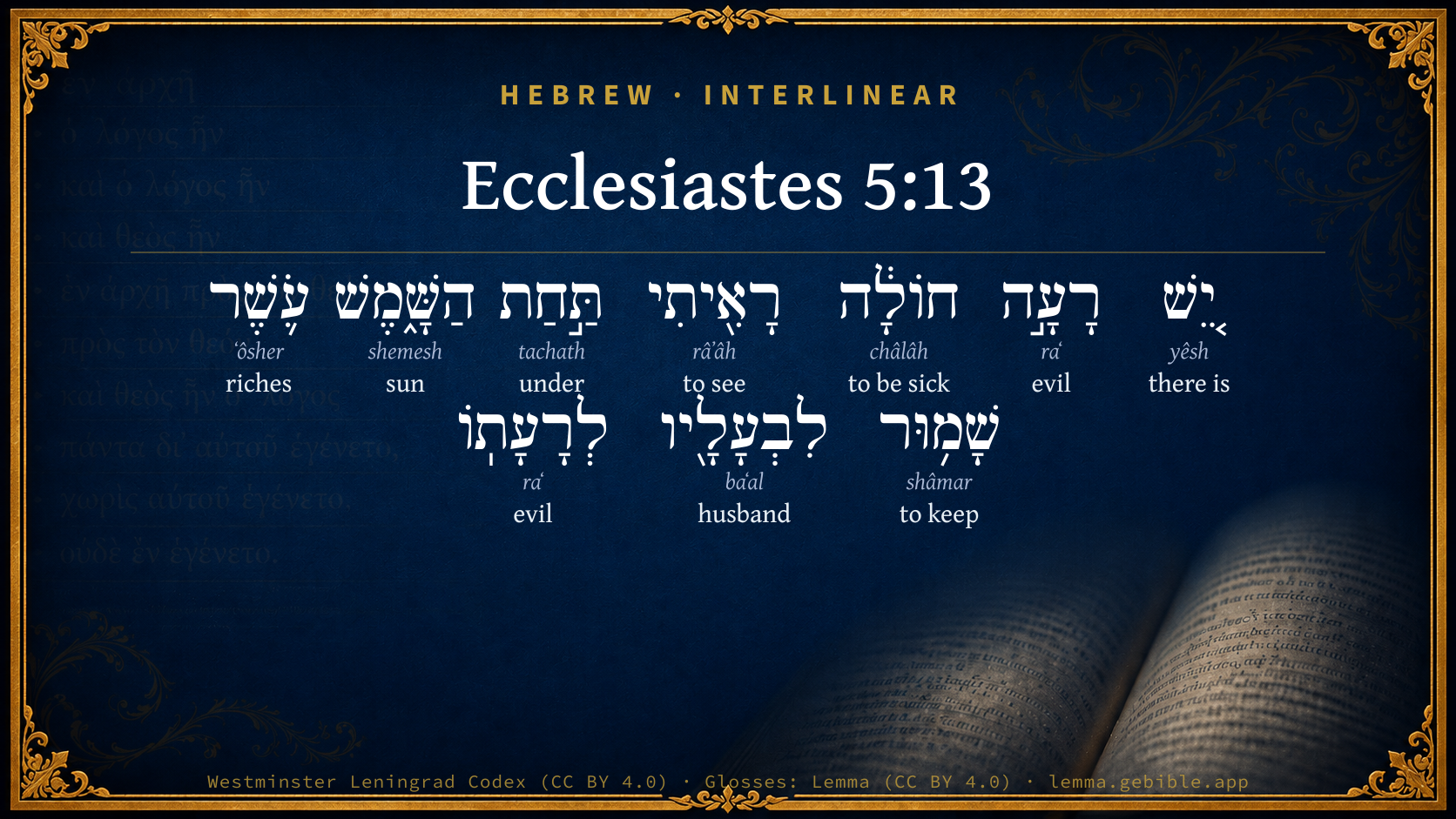
Ecclesiastes 5:13

Hebrew (Westminster Leningrad Codex) Ecclesiastes 5:13 appears in the Hebrew Old Testament. The text above is from the Westminster Leningrad Codex. Each word links to its Strong’s number, a concise gloss, and parsing drawn from the Open Scriptures Hebrew Bible morphology. Click any word for its full Brown-Driver-Briggs (BDB) entry.
Download image
Cite this verse

Ecclesiastes 5:13 (World English Bible). Public Domain. Lemma interlinear Bible study tool, https://lemma.gebible.app/v/ecclesiastes/5/13.

Show BibTeX & RIS
BibTeX
RIS
English Translation
There is a grievous evil which I have seen under the sun: wealth kept by its owner to his harm.
World English Bible · Public Domain
Download a study sheet

One document with this verse’s original text, its word-by-word gloss line, the meaning frame, cross-references with their text, attributed commentary, and full source and license credits — printable, and it pastes into notes with its structure intact.

This verse Autodidact and up

Study sheet (.html) Plain text (.txt)

A passage Seminary Student

Up to 50 verses in one chapter. A passage sheet keeps up to 6 commentary sources and 12 cross-references per verse, in the order this page ranks them, and says so on the sheet whenever that leaves anything out. Ask for a single verse and you get the Autodidact verse sheet above.

Everything on this page stays free to read, with no account — the sheet is a download of what is already on screen, not access to it.

Want to remove ads? Support Godless Engineer
Compare translations 3

The same verse in 3 English versions, stacked beneath the original-language interlinear above. Click any original word for its lexicon entry.

Each is an independent rendering of the whole verse — the interlinear is not word-aligned to these translations.

Highlighted words mark where these versions differ — a whole-verse word diff, not a word-by-word alignment.

  • World English Bible Public Domain
    There is a grievous evil which I have seen under the sun: wealth kept by its owner to his harm.
  • King James Version Public Domain
    There is a sore evil which I have seen under the sun, namely, riches kept for the owners thereof to their hurt.
  • unfoldingWord Literal Text CC BY-SA 4.0
    There is a sickening misfortune I have seen under the sun: Wealth kept by its master to his harm.

unfoldingWord Literal Text — © unfoldingWord, licensed CC BY-SA 4.0. Word-aligned USFM3 via Door43 (git.door43.org/unfoldingWord/en_ult).

Versions to compare (up to 4)

3 of 4 selected

Show all 18 translations

Every available English version of this verse, each an independent rendering of the whole verse.

  • World English Bible Public Domain
    There is a grievous evil which I have seen under the sun: wealth kept by its owner to his harm.
  • Berean Standard Bible Public Domain
    There is a grievous evil I have seen under the sun: wealth hoarded to the harm of its owner,
  • Majority Standard Bible Public Domain
    There is a grievous evil I have seen under the sun: wealth hoarded to the harm of its owner,
  • King James Version Public Domain
    There is a sore evil which I have seen under the sun, namely, riches kept for the owners thereof to their hurt.
  • American Standard Version (1901) Public Domain
    There is a grievous evil which I have seen under the sun, `namely', riches kept by the owner thereof to his hurt:
  • Revised Version (1885) Public Domain
    There is a grievous evil, which I have seen under the sun, namely, riches kept by the owner thereof to his hurt:
  • Geneva Bible (1599) Public Domain
    And these riches perish by euill trauel, and he begetteth a sonne, and in his hand is nothing.
  • Douay-Rheims (1899) Public Domain
    For they are lost with very great affliction: he hath begotten a son, who shall be in extremity of want.
  • Young's Literal Translation Public Domain
    There is a painful evil I have seen under the sun: wealth kept for its possessor, for his evil.
  • Literal Standard Version CC BY-SA 4.0
    There is a painful evil I have seen under the sun: wealth kept for its possessor, for his evil.
  • Unlocked Literal Bible CC BY-SA 4.0
    There is an evil that I have seen under the sun: riches hoarded by the owner, resulting in his own misery.
  • unfoldingWord Literal Text CC BY-SA 4.0
    There is a sickening misfortune I have seen under the sun: Wealth kept by its master to his harm.
  • Darby Bible Public Domain
    There is a grievous evil that I have seen under the sun: riches kept for the owners thereof to their hurt;
  • World Messianic Bible Public Domain
    There is a grievous evil which I have seen under the sun: wealth kept by its owner to his harm.
  • Webster's Bible Public Domain
    \\5:14\\But those riches perish by evil labor: and he begetteth a son, and there is nothing in his hand.
  • Free Bible Version CC BY-SA 4.0
    I observed something here that is really sickening: people who hoard money damage themselves.
  • Bible in Basic English Public Domain
    And I saw the destruction of his wealth by an evil chance; and when he became the father of a son he had nothing in his hand.
  • JPS Tanakh (1917) Public Domain
    (5-12) There is a grievous evil which I have seen under the sun, namely, riches kept by the owner thereof to his hurt;

Literal Standard Version (2020), Covenant Press — licensed CC BY-SA 4.0. Text via the HelloAO Bible API (eBible.org). Unlocked Literal Bible (unfoldingWord) — licensed CC BY-SA 4.0. Text via the HelloAO Bible API (eBible.org). unfoldingWord Literal Text — © unfoldingWord, licensed CC BY-SA 4.0. Word-aligned USFM3 via Door43 (git.door43.org/unfoldingWord/en_ult). Free Bible Version, Dr. Jonathan Gallagher — licensed CC BY-SA 4.0. Text via the HelloAO Bible API (eBible.org).

Word by word

More ways to search: Search by grammar → Find every occurrence → Compare this word →

Practice this passage: Drill this verse → Learn its vocabulary →

עֹ֛שֶׁר
ʻôsher
H6239
“riches”
Noun, Common, Masculine, Singular, Absolute
Part of Speech
Noun
Type
Common
Gender
Masculine
Number
Singular
State
Absolute
Full BDB Definition

Origin: from H6238

TWOT: 1714a

wealth, riches
  1. יֵ֚שׁ yêsh H3426 “there is” Particle, Demonstrative
  2. רָעָ֣ה raʻ H7451 “evil” Noun, Common, Feminine, Singular, Absolute
  3. חוֹלָ֔ה châlâh H2470 “being sick” Verb, Qal, Participle Active, Feminine, Singular, Absolute
  4. רָאִ֖יתִי râʼâh H7200 “to see” Verb, Qal, Perfect, 1st Person, Common, Singular
  5. תַּ֣חַת tachath H8478 “under” Preposition
  6. הַשָּׁ֑מֶשׁ shemesh H8121 “the · sun” Particle, Definite Article + Noun, Common, Both, Singular, Absolute
  7. שָׁמ֥וּר shâmar H8104 “kept” Verb, Qal, Participle Passive, Masculine, Singular, Absolute
  8. לִבְעָלָ֖יו baʻal H1167 “to/for · husbands · his” Preposition + Noun, Common, Masculine, Plural, Construct + Suffix, Personal, 3rd Person, Masculine, Singular
  9. לְרָעָתֽוֹ raʻ H7451 “to/for · evil · his” Preposition + Noun, Common, Feminine, Singular, Construct + Suffix, Personal, 3rd Person, Masculine, Singular

About this verse

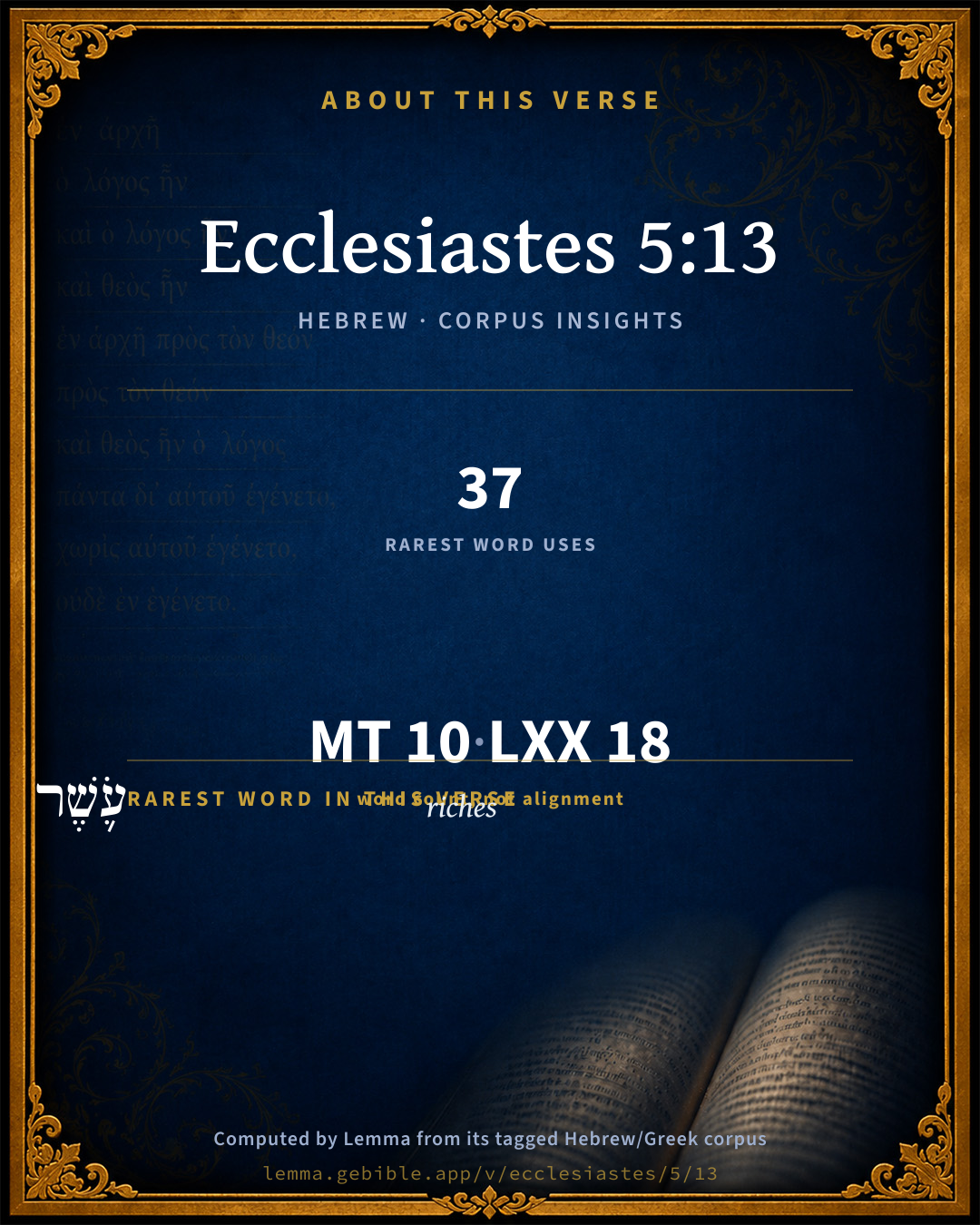
These counts appear in no published source. They are computed here, from the morphology-tagged text and Lemma’s own curated glosses. What Lemma adds →

10
words
9
distinct lemmas
Wisdom
section

Shared distinctive vocabulary

עֹ֛שֶׁר riches H6239 occurs in 36 verses of the Hebrew Bible. Also found in:

Grammatical profile

  • 3 verbs
  • 5 nouns
  • 1 preposition
  • 1 particle

Verb forms

  • חוֹלָ֔ה Qal · Participle Active
  • רָאִ֖יתִי Qal · Perfect
  • שָׁמ֥וּר Qal · Participle Passive

Repetition

A word recurs within this verse — often emphatic in Hebrew:

  • רָעָ֣ה evil H7451 ×2

Hebrew & Septuagint length

In English translation the verse runs 20 words from the Hebrew and 22 from the Septuagint (LXX English) — closely comparable.

A rough comparison of the two English renderings, which tokenize alike — not a word-level alignment.

Word counts can differ between the Hebrew and the Greek without any difference in meaning — e.g. the Hebrew direct-object marker אֵת has no separate Greek word, and Greek often adds the article ὁ.

In the original languages it is 10 Hebrew tokens and 18 Greek tokens — but the two are counted differently (Hebrew bundles its prefixes and suffixes into one token; the Greek is in lemma form), so that isn’t a like-for-like length.

Cross-references

25

Topical passages linked to Ecclesiastes 5:13 in the Treasury of Scripture Knowledge — connected by theme and wording, ordered by reader-vote popularity; previews shown in the World English Bible.

  • Ecclesiastes 6:1–2 There is an evil which I have seen under the sun, and it is heavy on men:
  • Luke 18:22–23 When Jesus heard these things, he said to him, "You still lack one thing. Sell all that you have, and distribute it to the poor. You will have treasure in heaven. Come, follow me."
  • Genesis 19:14 Lot went out, and spoke to his sons-in-law, who were pledged to marry his daughters, and said, "Get up! Get out of this place, for Yahweh will destroy the city." But he seemed to his sons-in-law to be joking.
  • Luke 16:22–23 It happened that the beggar died, and that he was carried away by the angels to Abraham's bosom. The rich man also died, and was buried.
  • James 5:1–4 Come now, you rich, weep and howl for your miseries that are coming on you.
  • Genesis 14:16 He brought back all the goods, and also brought back his relative, Lot, and his goods, and the women also, and the people.
  • Proverbs 1:11–13 If they say, "Come with us, Let's lay in wait for blood; Let's lurk secretly for the innocent without cause;
  • Proverbs 1:19 So are the ways of everyone who is greedy for gain. It takes away the life of its owners.
  • Proverbs 1:32 For the backsliding of the simple will kill them. The careless ease of fools will destroy them.
  • Proverbs 11:4 Riches don't profit in the day of wrath, But righteousness delivers from death.
  • Proverbs 11:24–25 There is one who scatters, and increases yet more. There is one who withholds more than is appropriate, but gains poverty.
  • Ecclesiastes 4:8 There is one who is alone, and he has neither son nor brother. There is no end to all of his labor, neither are his eyes satisfied with wealth. For whom then, do I labor, and deprive my soul of enjoyment? This also is vanity, yes, it is a miserable business.
  • Ecclesiastes 8:9 All this have I seen, and applied my mind to every work that is done under the sun. There is a time in which one man has power over another to his hurt.
  • Isaiah 32:6–8 For the fool will speak folly, and his heart will work iniquity, to practice profanity, and to utter error against Yahweh, to make empty the soul of the hungry, and to cause the drink of the thirsty to fail.
  • Zephaniah 1:18 Neither their silver nor their gold will be able to deliver them in the day of Yahweh's wrath, but the whole land will be devoured by the fire of his jealousy; for he will make an end, yes, a terrible end, of all those who dwell in the land.
  • Luke 12:16–21 He spoke a parable to them, saying, "The ground of a certain rich man brought forth abundantly.
  • Luke 16:1–13 He also said to his disciples, "There was a certain rich man who had a manager. An accusation was made to him that this man was wasting his possessions.
  • Luke 16:19 "Now there was a certain rich man, and he was clothed in purple and fine linen, living in luxury every day.
  • Genesis 13:5–11 Lot also, who went with Abram, had flocks, and herds, and tents.
  • Genesis 19:26 But his wife looked back from behind him, and she became a pillar of salt.
  • Genesis 19:31–38 The firstborn said to the younger, "Our father is old, and there is not a man in the earth to come in to us after the manner of all the earth.
  • Isaiah 2:20 In that day, men shall cast away their idols of silver, And their idols of gold, Which have been made for themselves to worship, To the moles and to the bats;
  • Luke 19:8 Zacchaeus stood and said to the Lord, "Behold, Lord, half of my goods I give to the poor. If I have wrongfully exacted anything of anyone, I restore four times as much."
  • 1 Timothy 6:9–10 But those who are determined to be rich fall into a temptation and a snare and many foolish and harmful lusts, such as drown men in ruin and destruction.
  • James 2:5–7 Listen, my beloved brothers. Didn't God choose those who are poor in this world to be rich in faith, and heirs of the Kingdom which he promised to those who love him?

Cross-references courtesy of OpenBible.info (CC BY 4.0).

Hebrew and Greek witnesses Masoretic Hebrew ↔ Greek Septuagint

The same verse in the two great witnesses to the Old Testament, shown verse-for-verse.

These are two independent witnesses, not word-aligned to each other, and the Septuagint is shown in lemma (dictionary) form.

Hebrew Ecclesiastes 5:13 Masoretic · Westminster Leningrad Codex

יֵ֚שׁ רָעָ֣ה חוֹלָ֔ה רָאִ֖יתִי תַּ֣חַת הַשָּׁ֑מֶשׁ עֹ֛שֶׁר שָׁמ֥וּר לִבְעָלָ֖יו לְרָעָתֽוֹ

There is a grievous evil which I have seen under the sun: wealth kept by its owner to his harm.

World English Bible · Public Domain

Greek LXX Ecclesiastes 5:13 Septuagint · lemma form

καί ἀποὀλλύω ὁ πλοῦτος ἐκεῖνος ἐν περισπασμός πονηρός καί γεννάω υἱός καί οὐ εἰμί ἐν χείρ αὐτός οὐδείς

And that wealth shall perish in an evil trouble: and the man begets a son, and there is nothing in his hand.

LXX2012 (modern English Septuagint) · Public Domain

On this verse, The Pulpit Commentary discusses the Septuagint’s reading. Read the note in Commentary ↓

Hebrew: Westminster Leningrad Codex (CC BY 4.0). Greek: Septuagint (public domain); English from LXX2012 (modern English Septuagint) (Public Domain). How the Septuagint differs from the Hebrew →

Commentary

Notes on Ecclesiastes 5:13 from classic Christian and Jewish commentators (each source and its license shown beneath its notes). The classic Christian expositions comment on the surrounding passage and are grouped to its opening verse, so a note may address several verses; the Jewish commentaries on the Tanakh (Rashi and others) are per-verse, so they appear only where the commentator wrote on this verse.

Lemma curates 59 commentaries, every one of them public domain or Creative Commons licensed, each selected and text-cleaned for this edition rather than reprinted as found. About our sources →

Trapp's Complete Commentary

John Trapp

Ecc 5:13 There is a sore evil [which] I have seen under the sun, [namely], riches kept for the owners thereof to their hurt.

Ver. 13. There is a sore evil.] Or, An evil disease, {a} such as breaks the sleep, hinc pallor et genae pendulae, item furiales somni et inquies nocturna, {b} causing paleness, leanness, restlessness by night. This disease is the dropsy or bulimy of covetousness, as seldom cured as heresy, frenzy, jealousy, which three are held incurable maladies.

Riches kept for the owners thereof to their hurt.] Worldlings sit abrood upon their wealth, and hatch to their hurt, as the silly bird doth the eggs of the cockatrice. Riches are called "goods," but it hath been well observed that he that first called them so was a better husband [husbandman] than divine. Such a husband was he in the gospel, who reckoned upon "much goods laid up for many years." But how come these "goods" to prove evil to the owners but by the evil usage of them? Riches in themselves are of an indifferent nature, and it is through men’s corruption, ut magna sit cognatio et nominis et rei divitiis et vitiis, that riches are weapons of wickedness - engines of evil. "He that getteth riches, and not by right, shall die a poor fool." {Jer 17:11}

“ Dum peritura parat, per male parts perit. ”

He that keepeth his riches - having no quick silver, no current money - when God calls him to part with them for pious and charitable uses, keepeth them to his own greatest hurt. For the rust of his canker eaten gold shall rise up in judgment against him at that great day. {Jas 5:3}

“ Sic plates nimia congesta pecunia cura

Strangulat ” - Juvenal, sat. 10.

{See Trapp on "Pro 1:19"}

{a} Mala infirmitas. - Pagn.

{b} Plin.

John Trapp, A Commentary or Exposition upon All the Books of the Old and New Testament (1647–1656) — public domain. Text from a community e-Sword module.

Joseph Benson's Commentary

Ecc 5:13-14. There is a sore evil, &c. — “There is another thing, which is very calamitous, and may rather be called a grievous plague than a mere affliction; that these very treasures, which men have heaped up with a great deal of care, from thence expecting their felicity, prove, in the issue, their utter undoing;” being incentives to pride, luxury, and other hurtful lusts, which waste their bodies, shorten their lives, and destroy their souls; and being also great temptations to tyrants or thieves to take away their lives, in order to possess their property. Nay, it often happens, that “some of these miserable men are murdered by their servants, and even by their own children, with a view to become masters of their riches; which riches bring them also at last to the same or like destruction.” — Bishop Patrick. But — Or for, or moreover, as the Hebrew particle may be rendered; those riches perish — If they be kept, it is to the owner’s hurt, and if not, they are lost to his grief; by evil travail — By some wicked practices, either his own, or of other men. And he begetteth a son, and there is nothing, &c. — Either, 1st, In the father’s power to leave to his son, for whose sake he engaged in, and went through, all those hard labours; which is a great aggravation of his grief and misery. Or, 2d, In the son’s possession after the father’s death.

Joseph Benson's Commentary on the Old and New Testaments (1811–1818) — public domain. Text from a community e-Sword module.

The Preacher's Complete Homiletical Commentary

Joseph S. Exell (gen. ed.)

CRITICAL NOTES.—

Ecc_5:13. To their hurt] Inasmuch as they, at length, lose those possessions (Ecc_5:14). The owner is more unhappy than if he had never possessed at all.

Ecc_5:17. Eateth in darkness] A spirit of melancholy darkening the whole life.

MAIN HOMILETICS OF THE PARAGRAPH.—Ecc_5:13-17

THE MISERIES OF HIM WHO SURVIVES THE WRECK OF HIS FORTUNES

“There is a sore evil which I have seen under the sun, namely, riches kept for the owners thereof to their hurt. But those riches perish by evil travail, and he begetteth a son, and there is nothing in his hand. As he came forth of his mother’s womb, naked shall he return to go as he came, and shall take nothing of his labour, which he may carry away in his hand. And this also is a sore evil, that in all points as he came, so shall he go: and what profit hath he that hath laboured for the wind? All his days also he eateth in darkness, and he hath much sorrow and wrath with his sickness.”—Ecc_5:13-17.

In these reflections upon the vanity of riches, the Royal Preacher is supposing the case of one who has no internal consolations. When riches are flown, how is it with such a man?

I. He is placed in a Worse Position than if He had never been Prosperous. (Ecc_5:13-14.)

1. There is the painful sense of failure. He rejoiced in his treasures, made them his stronghold and boast; but now they have perished, and he is left without defence. The results of his labour and anxieties are lost. What he had lived for is now vanished from him. He is oppressed with the distress of failure.

2. There are the sorrows of memory. The remembrance of the past deepens the gloom of the present and turns it into pain. It is an unspeakable sorrow for a man to be forced to look at his greatness and prosperity only through the aid of memory and long reflections. Riches, when they have departed, are not absolutely hidden in the buried past. The memory of them arises to hurt and afflict the mind. How can a man in the land of poverty, where he is a stranger and an exile, sing the song of prosperity? He must hang his harp upon the willows, and weep the tears of memory.

3. There is the oppressive feeling of impotency to satisfy his ambitious desires. When he possessed wealth, he formed bright designs for the future which that wealth could accomplish. Reckoning upon the stability of his riches, he thought to build up his house; and, through the flourishing generations of his family, transmit his splendour and magnificence to posterity. But now the time has come when his favourite child is there, but no splendid mansion is for him. The heir is present, but the heritage has gone. (Ecc_5:14.) There is a sense of departed power which is altogether overwhelming, and which is unknown to those who never possessed it. To be unable to perform what was once easily within our power is vexation and sorrow.

II. He is brought Face to Face with the most Solemn Aspects of Life. If we direct our attention to the two extremes of human life, we are made to front facts of dread solemnity. Our utter nakedness, both upon our arrival here and our departure hence, is one of the saddest facts of existence. (Ecc_5:15.) Death strips us of all our time-garments, and we go naked into eternity. Thus the grandeur of the world is but a vain show—the passing shadow of a cloud! This solemn truth is forgotten in the excitement of pleasure, quite inaudible amidst the tumult of the passions. But when a man is stripped of his fortune, the solemn facts of life assert themselves and he is forced to listen to their voice.

1. How near are the fountains of sorrow! In the midst of worldly enjoyments, if men only reflected deeply upon the solemn aspects of existence, how soon would the heart heave with emotion! The fairest pleasures of the world are but hastily snatched from the borders of misery and pain.

2. What a teacher is adversity—imparting a due solemnity to the mind! Affliction gains audience for truths which failed to secure a hearing in the time of prosperity. Death is indeed the great teacher, opening the eyes of man upon the higher mysteries; yet death is only the completion of that entire stripping of all earthly possessions which process adversity had begun.

3. How great the folly of trusting in wealth! It may depart long before us, thus afflicting us with the memory of joys now no longer ours. Or, if it stays, yet we must be rudely torn from it, and go into eternity with nothing in our hand. (Ecc_5:15.) It is unwise to put our entire trust in that which must fail us it the last necessity.

III. He becomes a Prey to Melancholy. (Ecc_5:17.) All what he trusted and delighted in is gone, and having no inward sources of comfort, a thick gloom settles upon his soul. It may be said of this inward condition,

1. That it darkens for him the scenes of life. There is light on every side, yet the darkness within him spreads itself over the whole scene of his life. The outward world takes the mood of our soul, be it merry or sad. In the gloomy seasons of our temper, it is in vain that nature strives to please. The darkness of the soul can overwhelm the light and glory of the world.

2. That it is moral disease. It is a sorrowful portion—the sickness of the soul. In health, all the bodily organs work together in harmony, and we are not directly conscious of the process. The man is said to be whole. But in disease, one or more organs, by becoming a seat of pain, assert their separate existence. Thus disease is disorder—a want of wholeness. This fact holds strict analogy with moral unsoundness. When some painful truths are forced upon the soul without any countervailing good, it indicates moral disease. In this soul-sickness, there is “sorrow and wrath.” There can be no health in the soul when there is no peace.

3. It forebodes the last gloomy days of one who is entirely devoted to the present life. For the soul without the comforts of religion, this darkness is but the shadow of death. Without God, there cannot be the light of joy, truth, and love.

SUGGESTIVE COMMENTS ON THE VERSES

Ecc_5:13. Wealth is often the ruin of its possessor. Like that king of Cyprus who made himself so rich that he became a tempting spoil, and who, rather than lose his treasures, embarked them in perforated ships; but, wanting courage to draw the plugs, ventured back to land and lost both his money and his life. So a fortune is a great perplexity to its owner, and is no defence in times of danger. And very often, by enabling him to procure all that heart can wish, it pierces him through with many sorrows [Dr. J. Hamilton].

The base love of gain, when long indulged by success, multiplies the snares that will entrap and even fatally injure the soul.

The worshipper of Mammon will in the end be crushed beneath the fall of his idol.

Continued prosperity exposes a man to the vices of luxurious indulgence, neglect of religion, and a foolish confidence in his own greatness.

He whose heart has been bound up with his wealth can ill bear the loss of it. Having no inward resources, his condition is poor indeed. He is cast into the roaring tide of adversity; and he has no courage, strength, or skill, to stem the danger and gain a place of safety.

It is the highest wisdom to seek the true riches, which place a man above the accidents of life.

Ecc_5:14. The Lord hath many ways to blast covetous men’s idols. He can make use of the injustice and avarice of spoilers and oppressors, the deceitfulness of friends, and the prodigality of children to make their riches perish [Nisbet].

The memory of vanished joys is a bitter draught to those who have no spring of heavenly life and consolation within.

All earthly supports of the heart may soon fail us, and they must fail in the last extremity.

Virtue and knowledge are the best heritage we can leave to our children. In all things else, they may be but the heirs of misery and disappointment.

Riches give a man power to command the service of many, and to summon the ministers of comfort. But how soon may the sceptre be snatched from his hand. His necessities and ambitious desires continue, but the power is gone.

Ecc_5:15. At both ends of human life, all social distinctions are levelled.

The hand of death rends away our time-garments. We must leave here, on these shores of life, all the outward circumstances of wealth, and the soul be stripped for her last voyage.

He who by the stroke of adversity is denuded of his fortune, is hereby reminded of that utter desolation to which he shall be brought by the rifling hands of death.

Mental wealth, spiritual character—all that is truly within us, we can take away when we part for ever from the world. But our environment of wealth and grandeur must be left behind.

Alexander the Great is said to have ordered that, as he was carried forth to burial, his hands should “be exposed, that all mankind might see how empty they were.”

Adversity clears a man’s view of the most solemn and saddest facts of our nature. It is well if we lay them to heart, so that we may be rich in the wealth of immortality when death robs us of the passing treasures of this life.

Seeing that we go away naked, and can carry nothing hence with us, we should look upon nothing as our own; we should be careful to go away clothed with Christ’s righteousness, and adorned with His grace, which is the durable riches, which whosoever hath shall not be found naked in death nor after it [Nisbet].

Here, we walk beneath appearances; but in eternity, we must stand forth in our true reality.

Ecc_5:16. The thought of the preceding verse is here repeated, but with greater emphasis. The spiritual teachers of mankind find it necessary to repeat great truths.

The covetous man when life is ended is reduced to his first condition; he possesses absolutely nothing.

The riches of selfish and covetous men,

1. Give them anxiety and vexation in life;

2. Forsake them in death;

3. Accuse them before the bar of God.

The labours of man without God have no solid worth—no lasting profit. When at the close of life he looks upon them, he finds that they vanish into thin air. They were but appearances under the hollow image of a form.

If covetous worldlings would commune often with their own hearts, they could not but see their way to be no less unreasonable and unprofitable for attaining to happiness, than if a man would make it the business of his life to gather wind, which cannot be held though it be among his hands, nor can satisfy him though he could hold it [Nisbet].

Ecc_5:17. When the power to enjoy is gone, and increasing infirmities produce fretfulness and inward misery, how vain are all the circumstances of wealth and grandeur!

Through the medium of our melancholy feelings, the fairest scenes of life appear to be overspread with gloom, True joy is within. The sun only shines for the happy.

As years roll on, the present world does not grow brighter and more joyous to him who lives entirely for it. Days of darkness await him.

You pass a staiely mansion, and as the powdered menials are closing the shutters of the brilliant room, and you see the sumptuous table spread and the fire-light flashing on vessels of gold and silver, perhaps no pang of envy pricks your bosom, but a glow of gratulation for a moment fills it. Happy people who tread carpets so soft, and who swim through halls so splendid! But, some future day, when the candles are lighted and the curtains drawn in that self-same apartment, it is your lot to be within; and as the invalid owner is wheeled to his place at the table, and as dainties are handed round of which he dares not taste, and as the guests interchange cold courtesy, and all is stiff magnificence and conventional inanity—your fancy cannot help flying off to some humbler spot with which you are more familiar, and “where quiet with contentment makes her home” [Dr. J. Hamilton].

Fretfulness and vexation wait on avarice.

The Preacher's Complete Homiletical Commentary (gen. ed. Joseph S. Exell; Funk & Wagnalls, c. 1892) — public domain (pre-1929). A full-Bible homiletical/sermon-outline anthology covering 65 of 66 books (2 John is absent from the source module). Text from a community e-Sword module.

Tyndale Open Study Notes

Tyndale Open Resources

5:13-14 Hoarding riches . . . everything is lost: Possessions are transitory and can be lost for any number of reasons.

Tyndale Open Study Notes — © Tyndale Open Resources, licensed CC BY-SA 4.0. Text via the HelloAO Bible API.

Geneva Bible (1599)

Geneva Bible translators

He doth not enjoy his father’s riches.

Geneva Bible (1599) marginal notes — public domain. Text via Bolls.life.

Jamieson, Fausset & Brown

Robert Jamieson, A. R. Fausset & David Brown

Proofs of God's judgments even in this world (Pro 11:31). The rich oppressor's wealth provokes enemies, robbers, &c. Then, after having kept it for an expected son, he loses it beforehand by misfortune ("by evil travail"), and the son is born to be heir of poverty. Ecc 2:19, Ecc 2:23 gives another aspect of the same subject.

Jamieson, Fausset & Brown — Commentary Critical and Explanatory on the Whole Bible (1871) — public domain (CC PDM 1.0). Text via the HelloAO Bible API.

Adam Clarke's Commentary

Verse 13. Riches kept for the owners thereof to their hurt.] This may be the case through various causes:

1. He may make an improper use of them, and lose his health by them.

2. He may join in an unfortunate partnership and lose all.

3. His riches may excite the desire of the robber; and he may spoil him of his goods, and even take away his life.

4. Or, he may leave them to his son, who turns profligate, spends the whole, and ruins both his body and soul. I have seen this again and again.

Adam Clarke's Commentary on the Bible (1810–1826) — public domain. Text from a community e-Sword/MySword module.

Ellicott's Commentary for English Readers

(13) Sore evil.—Ecc_6:2; Jer_14:17; Nah_3:19.

A Bible Commentary for English Readers, edited by Charles John Ellicott (1878–1897) — public domain. Text from a community e-Sword module.

The Cambridge Bible for Schools and Colleges

gen. ed. J. J. S. Perowne

13. riches kept for the owners thereof] Yet another aspect of the evils attendant on riches is brought before us, as in ch. Ecc_2:18-19. Not only do they fail to give any satisfying joy, but the man who reckoned on founding a family and leaving his heaped-up treasures to his son gains nothing but anxieties and cares, loses his wealth by some unforeseen chance, and leaves his son a pauper. By some commentators the possessive pronoun in “his hand” (Ecc_5:14) is referred to the father. The crowning sorrow for him is that he begets a son and then dies himself in poverty. The upshot of the two constructions is, of course, practically the same.

The Cambridge Bible for Schools and Colleges (gen. ed. J. J. S. Perowne; Cambridge University Press, 1878–1918) — public domain. Text from a community e-Sword module.

John Gill's Exposition

There is a sore evil which I have seen under the sun,.... Or "an evil sickness" (m). A sinful disease in the person with whom it is found, and very disagreeable to others to behold; it is enough to make one sick to see it; and what he is about to relate he himself was an eyewitness of:

namely, riches kept for the owners thereof to their hurt; laid up in barns and granaries, as the fruits of the earth; or in chests and coffers, as gold and silver, for the use and service of the owners of them; and which yet have been to their real injury; being either used by them in a luxurious and intemperate way, so have brought diseases on their bodies, and damnation to their souls; or not used at all for their own good, or the good of others, which brings the curse of God upon them, to their ruin and destruction, both here and hereafter: and oftentimes so it is, and which no doubt had fallen under the observation of Solomon, that some who have been great misers, and have hoarded up their substance, without using them themselves, or sharing them with others, have not only been plundered of them, but, for the sake of them, their lives have been taken away in a most barbarous manner, by cutthroats and villains; sometimes by their own servants, nay, even by their own children. Riches ill gotten and ill used are very prejudicial to the owners; and if they are well got, but ill used, or not used at all, greatly hurt the spiritual and eternal state of men; it is a difficult thing for a rich man to enter into the kingdom of heaven, and a covetous man cannot; if a professor, the word he hears is choked and made unprofitable; he errs from the faith, and pierces himself through with many sorrows now, and is liable to eternal damnation hereafter. The Targum interprets it of a man that gathers riches, and does no good with them; but keeps them to himself, to do himself evil in the world to come.

(m) "morbus malus", Tigurine version, Vatablus.

John Gill's Exposition of the Whole Bible (1746–1763) — public domain (CC PDM 1.0). Text via the HelloAO Bible API.

Haydock's Catholic Bible Commentary

Affliction. Hebrew, "by an evil affair," or accident. (Calmet) --- Who. Hebrew, "and there is nothing in his hand." (Haydock) --- As temporal riches prove detrimental to their owners, so do false philosophy and heresy to those who follow them. (St. Jerome) (Worthington)

George Leo Haydock (1774–1849), Haydock's Catholic Family Bible and Commentary, 1859 edition — public domain. Excludes Psalms (Douay-Rheims chapter numbering differs from Protestant) and Deuterocanonical books (Catholic canon only).

Matthew Poole's English Annotations

Because they frequently are the instruments and occasions both of their present and eternal destruction, as they feed their pride or luxury, or other hurtful lusts, which waste the body, and shorten the life, and damn the soul; and as they are great temptations to tyrants or thieves, yea, sometimes to relations, or servants, or others, to take away their lives, that they may get their riches.

Matthew Poole's English Annotations on the Holy Bible (1683–1685) — public domain. Text from a community e-Sword/MySword module.

Whedon's Commentary on the Bible

Daniel D. Whedon

13. Riches kept for the owners, etc. — Better, Wealth kept for its owner to his hurt. Not by its owner, and there is no plural here. The allusion is to riches hoarded by a parent for his heir, the present owner. Much may be said of the doubtful benefit of inherited wealth, but the sore evil here intended is the one mentioned in the immediately following verses.

Daniel D. Whedon (gen. ed.), Commentary on the Old and New Testaments (1874–1909) — public domain. Text from a community e-Sword module.

The Pulpit Commentary

Vers. 13-17. Another view of the evils attendant upon riches is here presented: the owner may lose them at a stroke, and leave nothing for his children. This thought is presented in different lights.

There is also a sore evil which I have seen under the sun (so ver. 16). The fact that follows is, of course, not universally true, but occasionally seen, and is a very bitter evil. The Septuagint calls it ajrjrJwstia; the Vulgate, infirmitas. Riches kept for the owners thereof to their hurt; rather, preserved by the possessor, hoarded and guarded, only to bring their lord added grief when by some reverse of fortune he loses them, as explained in what follows.

The Pulpit Commentary (1880–1919), ed. H.D.M. Spence-Jones & Joseph S. Exell — public domain. Text from a community e-Sword module.

John Wesley's Explanatory Notes

To their hurt - Because they frequently are the occasions both of their present and eternal destruction.

John Wesley, Explanatory Notes Upon the Whole Bible (1754–1765) — public domain. Text via the GEBible commentary corpus.

Keil & Delitzsch

C. F. Keil & F. Delitzsch

"There is a sore evil which I have seen under the sun, riches kept by their possessor to his hurt: the same riches perish by an evil event; and he hath begotten a son, thus this one hath nothing in his hand." There is a gradation of evils. חולה רעה (cf. רע חלי ר, Ecc 6:2) is not an ordinary, but a morbid evil, i.e., a deep hurtful evil; as a wound, not a common one, but one particularly severe and scarcely curable, is called נחלה, e.g., Nah 3:19. השׁ ... רא is, as at Ecc 10:5, an ellipt. relat. clause; cf. on the other hand, Ecc 6:1; the author elsewhere uses the scheme of the relat. clause without relat. pron. (vid., under Ecc 1:13; Ecc 3:16); the old language would use ראיתיה, instead of ראיתי, with the reflex. pron. The great evil consists in this, that riches are not seldom kept by their owner to his own hurt. Certainly שׁמוּר ל can also mean that which is kept for another, Sa1 9:24; but how involved and constrained is Ginsburg's explanation: "hoarded up (by the rich man) for their (future) owner," viz., the heir to whom he intends to leave them! That ל can be used with the passive as a designation of the subj., vid., Ewald, 295c; certainly it corresponds as little as מן, with the Greek ὑπό, but in Greek we say also πλοῦτος φυλαχθεὶς τῷ κεκτημένῳ, vid., Rost's Syntax, 112. 4. The suff. of lera'atho refers to be'alav, the plur. form of which can so far remain out of view, that we even say adonim qosheh, Isa 19:4, etc. "To his hurt," i.e., at the last suddenly to lose that which has been carefully guarded. The narrative explanation of this, "to his hurt," begins with vav explic. Regarding 'inyan ra'. It is a casus adversus that is meant, such a stroke upon stroke as destroyed Job's possessions. The perf. והו supposes the case that the man thus suddenly made poor is the father of a son; the clause is logically related to that which follows as hypothet. antecedent, after the scheme. Gen 33:13. The loss of riches would of itself make one who is alone unhappy, for the misfortune to be poor is less than the misfortunes to be rich and then to become poor; but still more unfortunate is the father who thought that by well-guarded wealth he had secured the future of his son, and who now leaves him with an empty hand.

What now follows is true of this rich man, but is generalized into a reference to every rich man, and then is recorded as a second great evil. As a man comes naked into the world, so also he departs from it again without being able to take with him any of the earthly wealth he has acquired.

Keil & Delitzsch — Biblical Commentary on the Old Testament (1861–1891) — public domain (CC PDM 1.0). Text via the HelloAO Bible API. (Old Testament only.)

unfoldingWord translationNotes

Door43 World Missions Community

under the sun

This refers to things that are done on earth. See how you translated this in Ecclesiastes 1:3. AT: "on the earth" (See: Idiom)

riches hoarded by the owner

This can be stated in active form. AT: "an owner hoards riches" (See: Active or Passive)

through bad luck

Possible meanings are 1) "through misfortune" or 2) "through a bad business deal."

his own son, one whom he has fathered, is left with nothing in his hands

Here the phrase "in his hands" represents ownership. This can be stated in active form. AT: "he leaves no possession for his own son" (See:Metonymy and Active or Passive)

translationWords

evil

hand

unfoldingWord translationNotes — © Distant Shores Media and the Door43 World Missions Community, licensed CC BY-SA 4.0. Source: git.door43.org/Door43/en_tn.

Rashi

Rabbi Shlomo Yitzchaki (Rashi)

who will have nothing in his hand not even the merit of his fathers.

Rashi on the Tanakh — English translations: “The Judaica Press complete Tanach with Rashi, translated by A. J. Rosenberg” (CC BY 4.0); “Pentateuch with Rashi's commentary by M. Rosenbaum and A.M. Silbermann, 1929-1934” (public domain); “The Metsudah Tanach series, Lakewood, N.J” (CC BY 4.0); and “The Book of Joshua, Metsudah Publications, 1997” (CC BY 4.0). Text via Sefaria.

Lesson kit

Teaching starters — assembled from the data on this page, not authored interpretation. Every prompt links to the verse data it draws on. Edit before teaching.

Ecclesiastes, in the Wisdom, opens this verse with 10 words (9 distinct Hebrew lemmas). Its most distinctive word is ʻôsher (“riches”). A historical commentator’s framing appears above. Read the whole chapter for the surrounding context.

Discussion questions

  1. How does “riches” (ʻôsher) shape what this verse is saying?
  2. How does Genesis 31:16, which shares the word «riches», read alongside this verse?
  3. What does the repetition of “evil” (2× in this one verse) do in this verse?
  4. These translations render this verse differently; the difference is in the English rendering, not the original. What questions does that raise?
  5. «חוֹלָ֔ה» is a Qal Participle Active verb. How does that grammatical form shape the action described?
  6. Compare how Trapp's Complete Commentary and Joseph Benson's Commentary read this verse. Where do they agree or differ?

Things to notice

Reading settings

Reading text

Shown beneath each verse's original-language words.

Old Testament
Old Testament edition

Read the OT as the Masoretic Hebrew (MT) or the Greek Septuagint (LXX).

English shown for the Greek Septuagint (in the Hebrew ↔ Greek comparison).

Comparing translations? Open the Compare panel on any verse page to stack up to four side by side.