
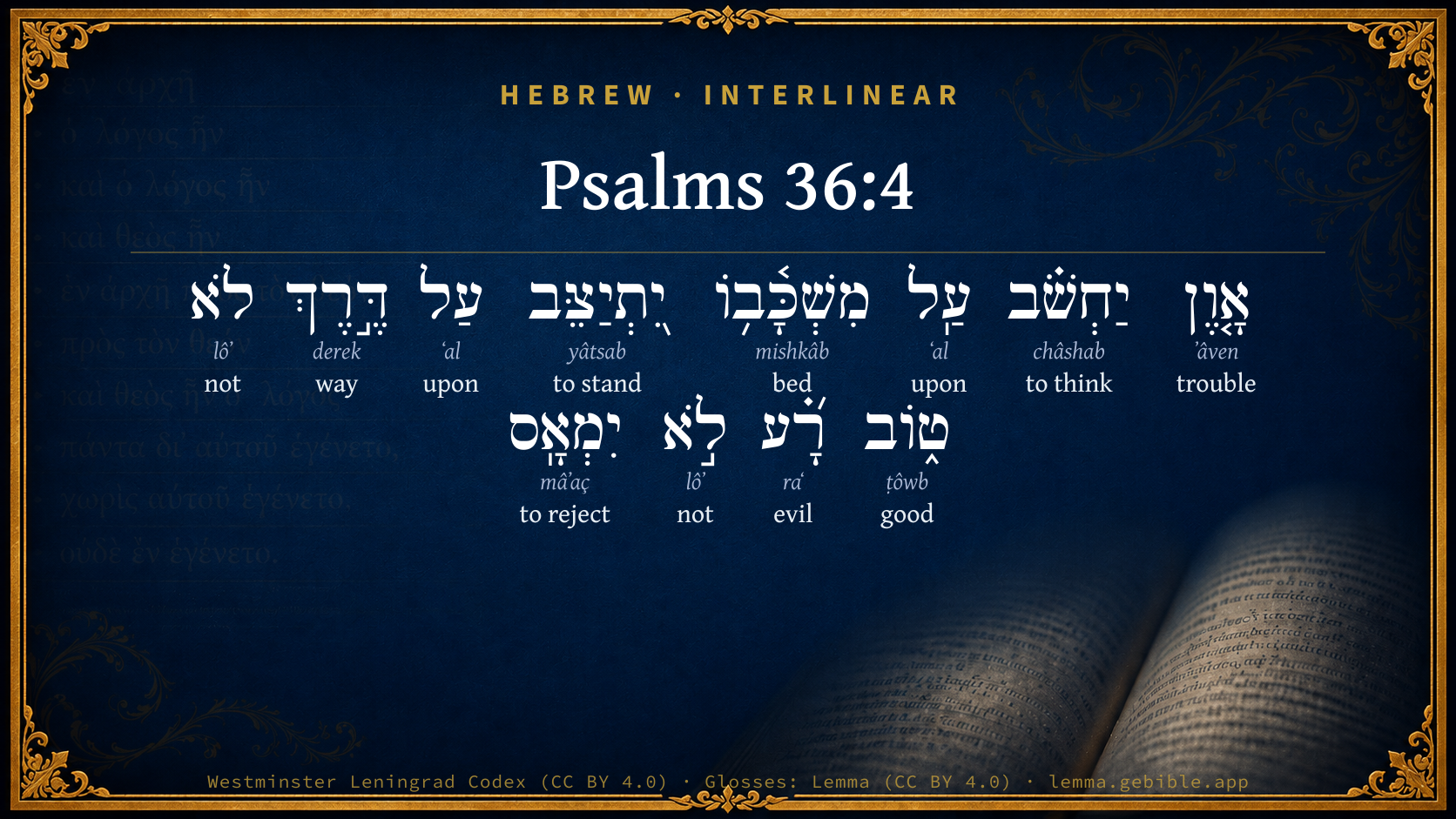
Psalms 36:4

Hebrew (Westminster Leningrad Codex) Psalms 36:4 appears in the Hebrew Old Testament. The text above is from the Westminster Leningrad Codex. Each word links to its Strong’s number, a concise gloss, and parsing drawn from the Open Scriptures Hebrew Bible morphology. Click any word for its full Brown-Driver-Briggs (BDB) entry.
Download image
Cite this verse

Psalms 36:4 (World English Bible). Public Domain. Lemma interlinear Bible study tool, https://lemma.gebible.app/v/psalms/36/4.

Show BibTeX & RIS
BibTeX
RIS
English Translation
He plots iniquity on his bed. He sets himself in a way that is not good; He doesn't abhor evil.
World English Bible · Public Domain
Download a study sheet

One document with this verse’s original text, its word-by-word gloss line, the meaning frame, cross-references with their text, attributed commentary, and full source and license credits — printable, and it pastes into notes with its structure intact.

This verse Autodidact and up

Study sheet (.html) Plain text (.txt)

A passage Seminary Student

Up to 50 verses in one chapter. A passage sheet keeps up to 6 commentary sources and 12 cross-references per verse, in the order this page ranks them, and says so on the sheet whenever that leaves anything out. Ask for a single verse and you get the Autodidact verse sheet above.

Everything on this page stays free to read, with no account — the sheet is a download of what is already on screen, not access to it.

Want to remove ads? Support Godless Engineer
Compare translations 3

The same verse in 3 English versions, stacked beneath the original-language interlinear above. Click any original word for its lexicon entry.

Each is an independent rendering of the whole verse — the interlinear is not word-aligned to these translations.

Highlighted words mark where these versions differ — a whole-verse word diff, not a word-by-word alignment.

  • World English Bible Public Domain
    He plots iniquity on his bed. He sets himself in a way that is not good; He doesn't abhor evil.
  • King James Version Public Domain
    He deviseth mischief upon his bed; he setteth himself in a way that is not good; he abhorreth not evil.
  • unfoldingWord Literal Text CC BY-SA 4.0
    He devises iniquity on his bed; he stations himself on the not-good road; he does not reject evil.

unfoldingWord Literal Text — © unfoldingWord, licensed CC BY-SA 4.0. Word-aligned USFM3 via Door43 (git.door43.org/unfoldingWord/en_ult).

Versions to compare (up to 4)

3 of 4 selected

Show all 18 translations

Every available English version of this verse, each an independent rendering of the whole verse.

  • World English Bible Public Domain
    He plots iniquity on his bed. He sets himself in a way that is not good; He doesn't abhor evil.
  • Berean Standard Bible Public Domain
    Even on his bed he plots wickedness; he sets himself on a path that is not good; he fails to reject evil.
  • Majority Standard Bible Public Domain
    Even on his bed he plots wickedness; he sets himself on a path that is not good; he fails to reject evil.
  • King James Version Public Domain
    He deviseth mischief upon his bed; he setteth himself in a way that is not good; he abhorreth not evil.
  • American Standard Version (1901) Public Domain
    He deviseth iniquity upon his bed; He setteth himself in a way that is not good; He abhorreth not evil.
  • Revised Version (1885) Public Domain
    He deviseth iniquity upon his bed; he setteth himself in a way that is not good; he abhorreth not evil.
  • Geneva Bible (1599) Public Domain
    Hee imagineth mischiefe vpon his bed: he setteth himselfe vpon a way, that is not good, and doeth not abhorre euill.
  • Douay-Rheims (1899) Public Domain
    The words of his mouth are iniquity and guile: he would not understand that he might do well.
  • Young's Literal Translation Public Domain
    Iniquity he deviseth on his bed, He stationeth himself on a way not good, Evil he doth not refuse.'
  • Literal Standard Version CC BY-SA 4.0
    He devises iniquity on his bed, || He stations himself on a way not good, || He does not refuse evil.”
  • Unlocked Literal Bible CC BY-SA 4.0
    While he lies in bed, he plans ways to sin; he sets out on an evil way; he does not reject evil.
  • unfoldingWord Literal Text CC BY-SA 4.0
    He devises iniquity on his bed; he stations himself on the not-good road; he does not reject evil.
  • Darby Bible Public Domain
    He deviseth wickedness up on his bed; he setteth himself in a way that is not good: he abhorreth not evil.
  • World Messianic Bible Public Domain
    He plots iniquity on his bed. He sets himself in a way that is not good. He doesn’t abhor evil.
  • Webster's Bible Public Domain
    \\36:3\\The words of his mouth are iniquity and deceit: he hath ceased to be wise, and to do good.
  • Free Bible Version CC BY-SA 4.0
    Even when they're lying in bed they think up evil schemes. They commit themselves to a way of life that is no good. They choose evil, and don't reject it.
  • Bible in Basic English Public Domain
    He gives thought to evil on his bed; he takes a way which is not good; he is not a hater of evil.
  • JPS Tanakh (1917) Public Domain
    (36-5) He deviseth iniquity upon his bed; he setteth himself in a way that is not good; he abhorreth not evil.

Literal Standard Version (2020), Covenant Press — licensed CC BY-SA 4.0. Text via the HelloAO Bible API (eBible.org). Unlocked Literal Bible (unfoldingWord) — licensed CC BY-SA 4.0. Text via the HelloAO Bible API (eBible.org). unfoldingWord Literal Text — © unfoldingWord, licensed CC BY-SA 4.0. Word-aligned USFM3 via Door43 (git.door43.org/unfoldingWord/en_ult). Free Bible Version, Dr. Jonathan Gallagher — licensed CC BY-SA 4.0. Text via the HelloAO Bible API (eBible.org).

Word by word

More ways to search: Search by grammar → Find every occurrence → Compare this word →

Practice this passage: Drill this verse → Learn its vocabulary →

מִשְׁכָּ֫ב֥וֹ
mishkâb
H4904
“bed · his”
Noun, Common, Masculine, Singular, Construct + Suffix, Personal, 3rd Person, Masculine, Singular
Part of Speech
Noun
Type
Common
Gender
Masculine
Number
Singular
State
Construct
Full BDB Definition

Origin: from H7901

TWOT: 2381c

a lying down, couch, bier, act of lying - couch, bed - act of lying, lying down or sleeping room, bedroom - lying down (for sexual contact)
  1. אָ֤וֶן ʼâven H205 “trouble” Noun, Common, Masculine, Singular, Absolute
  2. יַחְשֹׁ֗ב châshab H2803 “to think” Verb, Qal, Imperfect, 3rd Person, Masculine, Singular
  3. עַֽל ʻal H5921 “upon” Preposition
  4. יִ֭תְיַצֵּב yâtsab H3320 “to stand” Verb, Hithpael, Imperfect, 3rd Person, Masculine, Singular
  5. עַל ʻal H5921 “upon” Preposition
  6. דֶּ֣רֶךְ derek H1870 “way” Noun, Common, Both, Singular, Absolute
  7. לֹא lôʼ H3808 “not” Particle, Negative
  8. ט֑וֹב ṭôwb H2896 “good” Adjective, Adjective, Masculine, Singular, Absolute
  9. רָ֝֗ע raʻ H7451 “evil” Adjective, Adjective, Masculine, Singular, Absolute
  10. לֹ֣א lôʼ H3808 “not” Particle, Negative
  11. יִמְאָֽס mâʼaç H3988 “to reject” Verb, Qal, Imperfect, 3rd Person, Masculine, Singular

About this verse

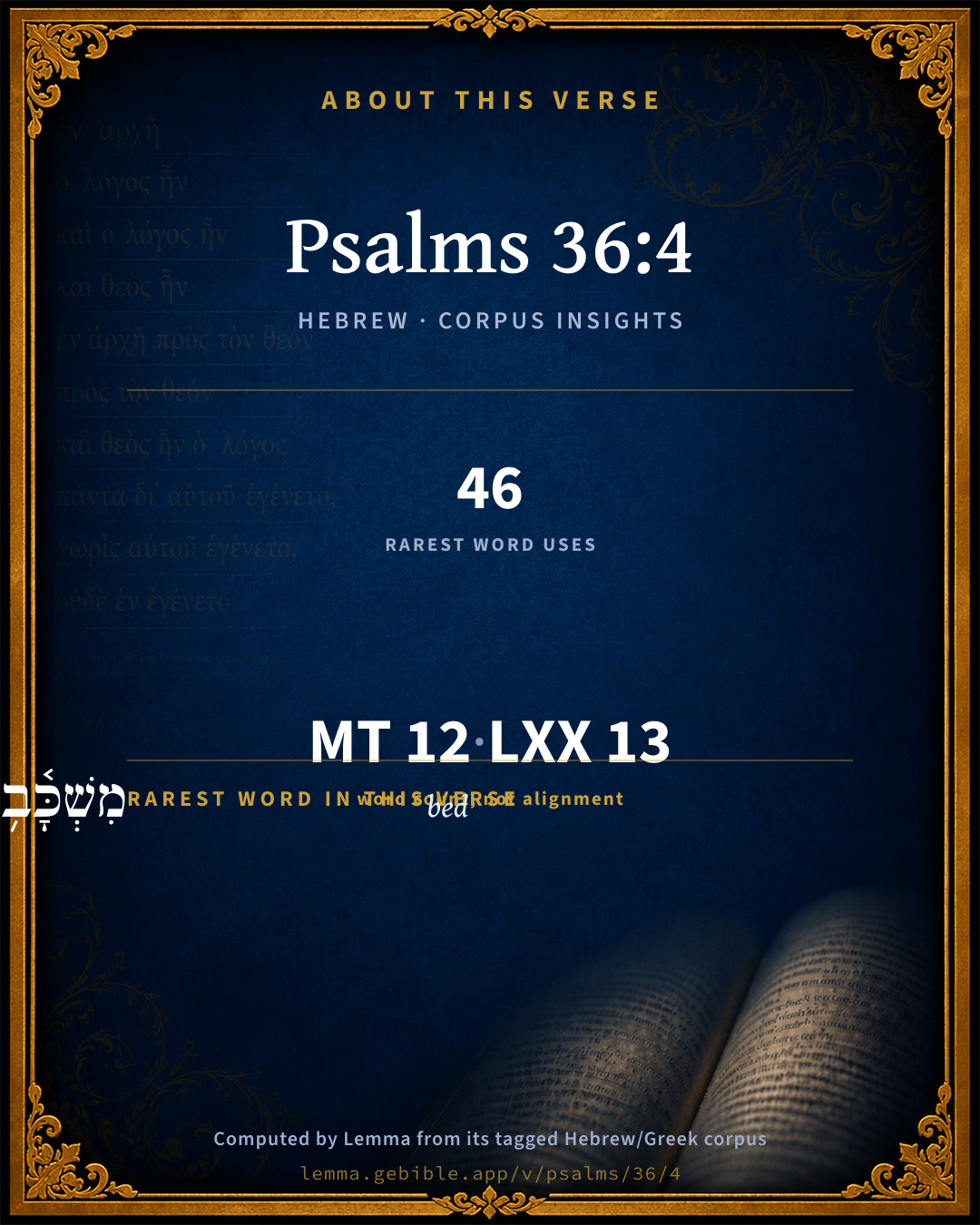
These counts appear in no published source. They are computed here, from the morphology-tagged text and Lemma’s own curated glosses. What Lemma adds →

12
words
10
distinct lemmas
Wisdom
section

Shared distinctive vocabulary

מִשְׁכָּ֫ב֥וֹ bed H4904 occurs in 44 verses of the Hebrew Bible. Also found in:

Grammatical profile

  • 3 verbs
  • 3 nouns
  • 2 adjectives
  • 2 prepositions
  • 2 particles

Verb forms

  • יַחְשֹׁ֗ב Qal · Imperfect
  • יִ֭תְיַצֵּב Hithpael · Imperfect
  • יִמְאָֽס Qal · Imperfect

Repetition

Words recur within this verse — often emphatic in Hebrew:

Hebrew & Septuagint length

In English translation the verse runs 20 words from the Hebrew and 18 from the Septuagint (LXX English) — closely comparable.

A rough comparison of the two English renderings, which tokenize alike — not a word-level alignment.

Word counts can differ between the Hebrew and the Greek without any difference in meaning — e.g. the Hebrew direct-object marker אֵת has no separate Greek word, and Greek often adds the article ὁ.

In the original languages it is 12 Hebrew tokens and 13 Greek tokens — but the two are counted differently (Hebrew bundles its prefixes and suffixes into one token; the Greek is in lemma form), so that isn’t a like-for-like length.

Cross-references

22

Topical passages linked to Psalms 36:4 in the Treasury of Scripture Knowledge — connected by theme and wording, ordered by reader-vote popularity; previews shown in the World English Bible.

  • Proverbs 4:16 For they don't sleep, unless they do evil. Their sleep is taken away, unless they make someone fall.
  • Micah 2:1 Woe to those who devise iniquity And work evil on their beds! When the morning is light, they practice it, Because it is in the power of their hand.
  • Isaiah 65:2 I have spread out my hands all the day to a rebellious people, who walk in a way that is not good, after their own thoughts;
  • Romans 12:9 Let love be without hypocrisy. Abhor that which is evil. Cling to that which is good.
  • Psalms 97:10 You who love Yahweh, hate evil. He preserves the souls of his saints. He delivers them out of the hand of the wicked.
  • Matthew 27:1 Now when morning had come, all the chief priests and the elders of the people took counsel against Jesus to put him to death:
  • Acts 23:12 When it was day, some of the Jews banded together, and bound themselves under a curse, saying that they would neither eat nor drink until they had killed Paul.
  • Revelation 2:2 "I know your works, and your toil and perseverance, and that you can't tolerate evil men, and have tested those who call themselves apostles, and they are not, and found them false.
  • Amos 5:15 Hate evil, love good, And establish justice in the courts. It may be that Yahweh, the God of hosts, will be gracious to the remnant of Joseph."
  • Micah 6:8 He has shown you, O man, what is good. What does Yahweh require of you, but to act justly, To love mercy, and to walk humbly with your God?
  • Romans 1:32 who, knowing the ordinance of God, that those who practice such things are worthy of death, not only do the same, but also approve of those who practice them.
  • 1 Samuel 19:11 Saul sent messengers to David's house, to watch him, and to kill him in the morning: and Michal, David's wife, told him, saying, If you don't save your life tonight, tomorrow you will be slain.
  • Esther 5:14 Then said Zeresh his wife and all his friends to him, Let a gallows be made fifty cubits high, and in the morning speak you to the king that Mordecai may be hanged thereon: then go you in merrily with the king to the banquet. The thing pleased Haman; and he caused the gallows to be made.
  • Esther 6:4 The king said, "Who is in the court?" Now Haman was come into the outward court of the king's house, to speak to the king to hang Mordecai on the gallows that he had prepared for him.
  • Job 15:16 How much less one who is abominable and corrupt, A man who drinks iniquity like water!
  • Psalms 38:12 They also who seek after my life lay snares. Those who seek my hurt speak mischievous things, And meditate deceits all day long.
  • Psalms 52:3 You love evil more than good, Lying rather than speaking the truth. Selah.
  • Proverbs 24:23 These also are sayings of the wise. To show partiality in judgment is not good.
  • Jeremiah 6:16 Thus says Yahweh, Stand you in the ways and see, and ask for the old paths, where is the good way; and walk therein, and you shall find rest for your souls: but they said, We will not walk [therein].
  • Jeremiah 8:6 I listened and heard, but they didn't speak aright: no man repents him of his wickedness, saying, What have I done? everyone turns to his course, as a horse that rushes headlong in the battle.
  • Jeremiah 9:2–9 Oh that I had in the wilderness a lodging-place of wayfaring men; that I might leave my people, and go from them! for they are all adulterers, an assembly of treacherous men.
  • Hosea 7:6–7 For they have made ready their heart like an oven, While they lie in wait. Their baker sleeps all the night. In the morning it burns as a flaming fire.

Cross-references courtesy of OpenBible.info (CC BY 4.0).

Hebrew and Greek witnesses Masoretic Hebrew ↔ Greek Septuagint

The same verse in the two great witnesses to the Old Testament, shown verse-for-verse.

You’re reading Greek Psalm 35 (Hebrew Psalm 36). The Septuagint counts the superscription, so verse numbers can differ from the Hebrew — chapter-level alignment, not verse-by-verse. Numbering follows Rahlfs.

These are two independent witnesses, not word-aligned to each other, and the Septuagint is shown in lemma (dictionary) form.

Hebrew Psalms 36:4 Masoretic · Westminster Leningrad Codex

אָ֤וֶן יַחְשֹׁ֗ב עַֽל מִשְׁכָּ֫ב֥וֹ יִ֭תְיַצֵּב עַל דֶּ֣רֶךְ לֹא ט֑וֹב רָ֝֗ע לֹ֣א יִמְאָֽס

He plots iniquity on his bed. He sets himself in a way that is not good; He doesn't abhor evil.

World English Bible · Public Domain

Greek LXX Greek Psalm 35:4 Septuagint · lemma form

ὁ ῥῆμα ὁ στόμα αὐτός ἀνομία καί δόλος οὐ βούλομαι συνἵημι ὁ ἀγαθύνω

He devises iniquity on his bed; he gives himself to every evil way; and does not abhor evil.

LXX2012 (modern English Septuagint) · Public Domain

Hebrew: Westminster Leningrad Codex (CC BY 4.0). Greek: Septuagint (public domain); English from LXX2012 (modern English Septuagint) (Public Domain). How the Septuagint differs from the Hebrew →

Commentary

Notes on Psalms 36:4 from classic Christian and Jewish commentators (each source and its license shown beneath its notes). The classic Christian expositions comment on the surrounding passage and are grouped to its opening verse, so a note may address several verses; the Jewish commentaries on the Tanakh (Rashi and others) are per-verse, so they appear only where the commentator wrote on this verse.

Lemma curates 59 commentaries, every one of them public domain or Creative Commons licensed, each selected and text-cleaned for this edition rather than reprinted as found. About our sources →

Trapp's Complete Commentary

John Trapp

Psa 36:4 He deviseth mischief upon his bed; he setteth himself in a way [that is] not good; he abhorreth not evil.

Ver. 4. He deviseth mischief upon his bed] He bendeth his wits and beateth his brains, perdius et pernox, breaking his sleep to plot and plough, to contrive and effect mischief. Vanity or villany is his whole study. He is always either weaving spiders’ webs or hatching cockatrices’ eggs.

He setteth himself in a way that is not good] And there meaneth to keep him, as the word importeth; set he is, and he will not be removed, being every whit as good as ever he meaneth to be. Statuit se; there you left him, and there you may find him, for he is no changeling; and that is a piece of his silly glory.

He abhorreth not evil] Sed studiosissime amplectitur, but doeth wickedly with hands earnestly, and taketh long strides towards hell, which is but a little before him, as if he feared it would be full ere he came thither (Jun.). If he do abstain from any wickedness, yet he abhorreth it not. It is for the evil consequents of sin (viz. shame, loss, punishment) that he forbeareth it; and not because it is offensivum Dei, et aversivum a Dei, an offence against God, and a turning away from God; that is no argument at all to him, sed fertur laxis habenis in quaevis flagitia, but he is hurried headlong into all wickedncsses, as vultures fly swiftly to the most stinking carcases.

John Trapp, A Commentary or Exposition upon All the Books of the Old and New Testament (1647–1656) — public domain. Text from a community e-Sword module.

The Biblical Illustrator

Joseph S. Exell

Psa_36:4

He deviseth mischief upon his bed; he setteth himself in a way that is not good.

The state and condition of an habitual sinner

I. The character of an habitual sinner. He is one who deviseth mischief upon his bed, his hours of leisure are employed upon it.

1. The time of retirement is the fittest and most likely season for religious influences to take place, and to have a due effect (Psa_119:55). If ever our reason re-asserts its authority, it should be when there is nothing from without to interrupt its pretensions, or to oppose its claim. If ever religion can raise up our souls to God, it should be when our souls are free from all external impediments.

2. When this time of solitude and leisure is misapplied to contrivances for vice, it must needs improve those ill dispositions which it finds in the mind, and overspread it more and more with the contagion of sin.

II. To give some accounts, and to show some cause of his thus proceeding; of the abuse he puts upon his hours of leisure. He setteth himself in a way that is not good.

1. The abuse of a trust reposed in us all by a gracious Providence. We have a work to do, and a time assigned us for it. The work is improving our souls, and disposing all our faculties to a ripeness and capacity for eternal bliss. But how great will be the guilt which is contracted when the time allotted us to do the work of Him who sent us into this world for His glory, is employed to His dishonour, and in disobedience to His laws! To somewhat to forget, but more to betray a trust.

2. He who makes no advances forwards will certainly go backwards; he who has not laid in a fit provision for a good use of his time will certainly put it to a bad one. The ground we might gain in virtue will be gained to vice.

III. A further aggravation, and indeed a further reason of his sin. He abhorreth not evil. His affections are all wrong turned; and, being so, it is no great wonder that they should run riot upon wickedness.

1. That he abhorreth not evil is an aggravation of his sin, for it implies that his reason is subdued to it, and grace extinguished. It is a common progress to defend upon principle what had its rise from frailty; to proceed from infirmity to wilful guilt; and, from sinning against conviction, to sin away all conviction.

2. If a man loves and likes it, he will, at one time or other, be gained upon to embrace it. For a state of neutrality between vice and virtue is impracticable, and impossible to human nature. He who abhorreth not evil will soon abhor that which is good. (N. Marshall, D. D.)

The Biblical Illustrator, edited by Joseph S. Exell (c. 1880s–1900s) — public domain. Text from a community e-Sword module.

The Treasury of David

Charles H. Spurgeon

Ver. 4. He deviseth mischief upon his bed. His place of rest becomes the place for plotting. His bed is a hot bed for poisonous weeds. God fearing men meditate upon God and his service; but when men turn all their thoughts and inventive faculties towards evil, their godlessness is proved to a demonstration. He hath the devil for his bed fellow who lies abed and schemes how to sin. God is far from him. He setteth himself in a way that is not good. When he gets up he resolutely and persistently pursues the mischief which he planned. The worst of ways he prefers for his walking, for he has taught his heart to love filthiness, having accustomed himself to revel in it in imagination. He abhorreth not evil. So far from having a contempt and abhorrence for evil, he even rejoices in it, and patronises it. He never hates a wrong thing because it is wrong, but he meditates on it, defends it, and practises it. What a portrait of a graceless man these few verses afford us! His jauntiness of conscience, his licentiousness of speech, his intentness upon wrong doing, his deliberate and continued preference of iniquity, and withal his atheistic heart, are all photographed to the life. Lord, save us from being such.

Ver. 3-4: See Psalms on "Ps 36:4" for further information.

Ver. 4. He deviseth mischief upon his bed. As the man that fears God communes with his heart upon his bed, that he may not sin, no, not in his heart; so the man that fears not God, devises how he may plot and perform sin willingly. David Dickson.

Ver. 4. Upon his bed. Most diligently does Ayguan follow up the scriptural expressions concerning a bed, and tell us that there are six different beds of wickednessthat of luxury, that of avarice, of ambition, of greediness, of torpor, and of cruelty, and he illustrates them all by examples from Scripture. J. M. Neale.

Ver. 4. He setteth himself in a way that is not good. To wait to sin is to sin deliberately, yea, to wait to sin resolvedly. That sin is exceedingly sinfully committed which we set and prepare ourselves to commit. David, describing a wicked man, saith, He setteth himself in a way that is not good; that is, in an evil way: he doth not only fall into sin (that may be the case of a good man), but he takes or chooseth an evil way, and then sets or settles himself in it, resolving not to leave it, no, nor to be beaten out of it. Sin may be said to wait for a godly man, that is, Satan waits and watches his season to tempt him unto sin; but a godly man doth not wait nor watch to sin. It is bad enough to be overtaken with sin, or with a fault (as the apostle speaks, Ga 6:1); but to be taken with sin, and so to wait for a season to take our fill of it, is as bad as bad can be. Joseph Caryl.

Ver. 4. He setteth himself in a way that is not good. Proud sinners have strongest conceit that they go right, at least in the way of their choice. Satan blindeth them so, that they mistake both the end and the way: in their count they are running to heaven, when they are posting to hell: he serveth them kindly with fresh post horses. Sometimes he mounts them on drunkenness, and when they have run a stage on that beastliness, he can mount them on lechery. Again, he can refresh them with avarice; and if they be weary of that slow jade, he setteth them on lofty ambition, and to make them more spirited he can horse them on restless contention. Every one seeth not Satan's enquiry: there is no complexion or disposition, but he hath a fit horse for it, and that of itself. Every man's predominant is a beast of Satan's saddling and providing to carry men to hell. The way is one, the post master is one, he is to be found at every stage, mounting his gallants, their horses are all of one kind though not of one colour. Happy is the man whom God dismounts in that evil way, and more happy is he who taketh with that stay, and turneth his course to heaven. William Struther.

Ver. 4. He abhorreth not. i.e., is far enough from rejecting any instrument, however sinful, for attaining his purposes. J. J. Stewart Perowne.

Ver. 4. Diligence in doing evil, a mark of deep depravity. W.S. Plumer.

Ver. 4. The abuse of retirement to wicked purposes, a sure characteristic of an habitual sinner. N. Marshall.

Ver. 4. The sinner on his bed, in his conduct, in his heart; and to this, in his death, and in his doom.

Ver. 4. (second clause). Ways which are not good.

Ver. 4. (last clause). Neutrality condemned.

Psalms 36:5*

Charles H. Spurgeon's The Treasury of David (1869–1885) — public domain. Psalms only. Text from a community e-Sword/MySword module.

J. A. Alexander on Psalms

Joseph Addison Alexander

5. (Psa 36:4). Falsehood he will meditate upon his bed; he will take his stand upon a way not good; evil he will not abjure. The first words , both in this and the preceding verse, does not mean mere false speaking, but a false character, one not according to the truth, of which the divine will is the standard. It is therefore nearly equivalent to wickedness. The futures express present habit and a settled purpose of continuance. While he continues what he is, he will continue thus to act. On his bed, by night, the natural season of reflection. Or the idea may be, that instead of sleeping he spends the hours of rest in meditating evil, or contriving mischief.—The verb to set himself, or take his stand, is the same that occurred before in Psalms 2, and implies both a settled purpose and the commencement of its execution.—A way not good is an example of the figure called meiosis, in which more meant than is expressed, although suggested by the context. The idea really conveyed to every reader is that of an extremely bad way, or the worst way possible.—The last verb means to reject or renounce with contempt and abhorrence. See above, on Psa 15:4.

Joseph Addison Alexander, The Psalms Translated and Explained (1850) — public domain. Text from a community e-Sword module.

Geneva Bible (1599)

Geneva Bible translators

By describing at large the nature of the reprobate, he admonisheth the godly to beware of these vices.

Geneva Bible (1599) marginal notes — public domain. Text via Bolls.life.

Adam Clarke's Commentary

Verse 4. He deviseth mischief upon his bed] He seeks the silent and undisturbed watches of the night, in order to fix his plans of wickedness.

He setteth himself] Having laid his plans, he fixes his purpose to do what is bad; and he does it without any checks of conscience or abhorrence of evil. He is bent only on mischief, and lost to all sense of God and goodness. A finished character of a perfect sinner.

Adam Clarke's Commentary on the Bible (1810–1826) — public domain. Text from a community e-Sword/MySword module.

John Calvin's Commentaries

4. He meditates iniquity upon his bed Here the sacred writer shows that the wickedness of the ungodly man is of a secret and very determined character. It sometimes happens that many, who otherwise are not disposed to wickedness, err and fall into sin, because occasion presents itself all on a sudden; but David tells us, that the wicked, even when they are withdrawn from the sight of men, and in retirement, form schemes of mischief; and thus, although there is not presented before them any temptation, or the evil example of others to excite them to it, they, of their own accord, devise mischief, and urge themselves to it without being impelled by any thing else. Since he describes the reprobate by this distinguishing mark of character, that they devise mischief upon their beds, true believers should learn from this to exercise themselves when alone in meditations of a different nature, and to make their own life the subject of examination, so that they may exclude all evil thoughts from their minds. The Psalmist next refers to their stubbornness, declaring that they set themselves in a crooked and perverse way; that is to say, they purposely and wilfully harden themselves in doing evil. Finally, he adds the reason of their doing this: They abhor not evil Wilfully shutting their eyes, they rush forward in their headlong course till they spontaneously yield themselves the slaves of wickedness. Let us now shortly state the contrast between the ungodly and the people of God, contained in the preceding verses. The former deceive themselves by flattery; the latter exercise over themselves a strict control, and examine themselves with a rigid scrutiny: the former, throwing loose the reins, rush headlong into evil; the latter are restrained by the fear of God: the former cloak or disguise their offenses by sophistry, and turn light into darkness; the latter willingly acknowledge their guilt, and by a candid confession are brought to repentance: the former reject all sound judgment; the latter always desire to vindicate themselves by coming to the open light of day: the former upon their bed invent various ways of doing evil; the latter are sedulously on their guard that they may not devise or stir up within themselves any sinful desire: the former indulge a deep and fixed contempt of God; the latter willingly cherish a constant displeasure at their sins.

John Calvin's Commentaries (1540-1563) — public domain. Text from the Calvin Translation Society English edition (1840s-50s) via the Christian Classics Ethereal Library (ccel.org). Calvin's coverage is partial (roughly two-thirds of the Bible); uncommented books and verses are honest gaps, never fabricated. The 19th-century editor's footnotes and remarks are omitted so the notes are faithfully Calvin's own voice.

The Cambridge Bible for Schools and Colleges

gen. ed. J. J. S. Perowne

4. mischief] Iniquity, as in Psa_36:3; Psa_36:12.

upon his bed] In the stillness of the night, the time for repentance (Psa_4:4), and recollection of God (Psa_63:6), he is restlessly planning his crimes. For illustration see Mic_2:1 ff.

he setteth himself &c.] Evil courses are his deliberate choice; conscience is blunted, and wrong excites no abhorrence. Cp. Psa_1:1; Pro_16:29; Isa_65:2.

The Cambridge Bible for Schools and Colleges (gen. ed. J. J. S. Perowne; Cambridge University Press, 1878–1918) — public domain. Text from a community e-Sword module.

John Gill's Exposition

He deviseth mischief upon his bed,.... He casts about in his mind on his pillow, when at leisure from all employment; and consults and contrives schemes how to compass his lusts, and to do injury to others, without doing which he cannot sleep;

he setteth himself in a way that is not good, in an evil way, which he chooses and delights in, and determines to continue in, he leaving the paths of righteousness to walk in the ways of darkness:

he abhorreth not evil; which is to be abhorred both because of its nature and effects; see Rom 12:9; but on the contrary he loves it, takes pleasure in doing it, and in them that commit it: thus, by his thoughts, words, and actions, he appears to be devoid of the fear of God.

John Gill's Exposition of the Whole Bible (1746–1763) — public domain (CC PDM 1.0). Text via the HelloAO Bible API.

Albert Barnes' Notes on the Bible

He deviseth mischief upon his bed - Margin, as in Hebrew: “vanity.” That is, when he lies down; when he is wakeful at night; he plots some scheme of iniquity - some vain, wicked enterprise. So in Pro 4:16, “For they sleep not, except they have done mischief; and their sleep is taken away, unless they cause some to fall.”

He setteth himself - That is, he takes his stand or his position; he assumes this attitude. See Psa 2:2, “The kings of the earth “set themselves,”” where the same word occurs. The meaning is that what is done by him is the result of a calm and deliberate purpose. It is not the effect of passion or temporary excitement, but it is a deliberate act in which the mind is made up to do the thing. The conduct here referred to is thus distinguished from rash and hasty acts, showing that this is the settled character of the man.

In a way that is not good - In a bad or wicked way; in a way in which no good can be found; in conduct which allows of no redeeming or mitigating circumstances, and for which there can be no apology.

He abhorreth not evil - He has no aversion to evil. He is not in any manner deterred from doing anything because it is wrong. The fact that it is sinful is not allowed to be a consideration affecting his mind in determining what he shall do. In other words, the moral quality of an action does not influence him at all in making up his mind as to how he shall act. If it is right, it is by accident, and not because he prefers the right; if it is wrong, that fact does not in any way hinder him from carrying his purpose into execution. This is, of course, the very essence of depravity.

Albert Barnes' Notes on the Bible (1834–1885) — public domain. Text from a community e-Sword/MySword module.

Matthew Poole's English Annotations

He deviseth mischief upon his bed; which notes that he doth it,

1. Constantly and unweariedly, preferring it before his own rest.

2. Earnestly and seriously, when his mind is freed from all outward distractions, and wholly at leisure to attend that business about which it is employed: compare Psa 4:4.

3. Freely, from his own inclination, when none are present to provoke him to it.

He setteth himself; he doth not repent of his wicked devices, but resolutely proceeds to execute them, and persists therein.

That is not good, i.e. which is very bad, as this phrase is used, 1Sa 2:24; Pro 20:23; 24:23, and elsewhere.

He abhorreth not evil: though he sometimes pretends remorse, and desists from his violent practices against me, as Saul did; yet he doth not truly repent of nor abhor his sin, and therefore is ready to return to it, when any occasion offers itself.

Matthew Poole's English Annotations on the Holy Bible (1683–1685) — public domain. Text from a community e-Sword/MySword module.

The Pulpit Commentary

He deviseth mischief upon his bed; rather, he deviseth iniquity the same word as in the preceding verse. In the night, when he should be looked in innocent slumber, he lies awake, devising wicked schemes against others. (comp. Pro_4:16 Mic_2:1) He setteth himself in a way that is not good. More correct than the Prayer-book Version, "He hath set himself in no good way." The wicked man is not merely negatively bad; he determinately chooses a path of life that is evil. He abhorroth not evil. He has no aversion to it, no horror of it, no shrinking from it. Whether a thing is right or wrong is to him a matter of complete indifference. So callous is he, so hardened.

The portrait of the godless man.

"He abhorreth not evil." This dark trait is the crowning stroke in the portrait here drawn of the godless man. If a man does not hate evil, it is certain he loves not good. Those twin precepts are like stems from one root. (Rom_12:9, "Abhor... cleave What a man loves and follows shows what he will be; but what he hates shows what he is.

I HATRED OF SIN IS A MORE SEARCHING MORAL TEST THAN ADMIRATION OF GOODNESS. True, any real love for goodness, desire after righteousness and holiness, shows a man not yet hopelessly bad. But there is a weak approval of good, with no earnest effort to follow it, which only amounts to self-condemnation. To recognize the right, true, good, kind, honourable path, and yet not choose it, is even a distinct step downward. Power to say "No" is the decisive test of strength of moral character. Good, if followed at all, must be pursued actively uphill. But to go wrong you need hut yield, and drift with the stream. "The kingdom of heaven suffereth violence". (Mat_11:12)

II Hence HATRED OF SIN IS AN ESSENTIAL AND GLORIOUS FEATURE OF GOD"S CHARACTER. (Hab_1:13 Jer_44:4 Pro_6:16) If men had power to stop the mischief and suffering caused by sin, they would think lightly of sin itself. It is because God does not think lightly of sin that he does not interfere to prevent the. misery. If the stream is to flow clean, the fountain must be cleansed. God will not make an evil tree bear good fruit. Suffering is the divinely ordained penalty, warning men off from sin, tracking men out in their sins, calling men to repent of sin, witnessing to God"s hatred of sin. (Rom_6:23) But this is only one side. Misery, suffering, death, are no arbitrary infliction; no artificially contrived punishment. They are sin"s natural result. Want of love to God and to man, ripening into "enmity against God"; (Rom_8:7) and that self-indulgence and self-worship which practically are enmity to men, cannot but bear the bitter fruit of misery and death. (Rom_6:21 Gal_5:19-21) A world of perfect joy and lasting happiness must be a world from which sin is eternally shut out. (Rev_21:27 Rev_22:15)

III This note of warning is one SPECIALLY NEEDED BY THE TIMES WE LIVE IN. Modem society is strong (stronger than at any past epoch) in benevolence, kindliness; pity for the suffering, the fallen, even the guilty. It is weak on the sterner side indignation against wrong, contempt of falsehood, stern zeal for justice, hatred of evil. We may see this in social life, in commercial life, in political life, in Church life, in theology. We like to "make things pleasant." We persuade ourselves that sin is no such very great evil; that God will not he very hard on it. We forget that the most tremendous denunciations of sin and of sinners are from the loving lips of our Saviour himself. "Ye that love the Lord, hate evil!". (Psa_97:10)

The Pulpit Commentary (1880–1919), ed. H.D.M. Spence-Jones & Joseph S. Exell — public domain. Text from a community e-Sword module.

John Wesley's Explanatory Notes

Deviseth - Freely, from his own inclination, when none are present to provoke him to it.

John Wesley, Explanatory Notes Upon the Whole Bible (1754–1765) — public domain. Text via the GEBible commentary corpus.

Rashi

Rabbi Shlomo Yitzchaki (Rashi)

he refrained from learning to improve He refrained from contemplating to improve his deeds.

Rashi on the Tanakh — English translations: “The Judaica Press complete Tanach with Rashi, translated by A. J. Rosenberg” (CC BY 4.0); “Pentateuch with Rashi's commentary by M. Rosenbaum and A.M. Silbermann, 1929-1934” (public domain); “The Metsudah Tanach series, Lakewood, N.J” (CC BY 4.0); and “The Book of Joshua, Metsudah Publications, 1997” (CC BY 4.0). Text via Sefaria.

Lesson kit

Teaching starters — assembled from the data on this page, not authored interpretation. Every prompt links to the verse data it draws on. Edit before teaching.

Psalms, in the Wisdom, opens this verse with 12 words (10 distinct Hebrew lemmas). Its most distinctive word is mishkâb (“bed”). A historical commentator’s framing appears above. Read the whole chapter for the surrounding context.

Discussion questions

  1. How does “bed” (mishkâb) shape what this verse is saying?
  2. How does Genesis 49:4, which shares the word «bed», read alongside this verse?
  3. What does the repetition of “upon” (2× in this one verse) do in this verse?
  4. These translations render this verse differently. What is at stake in choosing one wording over another?
  5. «יַחְשֹׁ֗ב» is a Qal Imperfect verb. How does that grammatical form shape the action described?
  6. Compare how Trapp's Complete Commentary and The Biblical Illustrator read this verse. Where do they agree or differ?

Things to notice

Reading settings

Reading text

Shown beneath each verse's original-language words.

Old Testament
Old Testament edition

Read the OT as the Masoretic Hebrew (MT) or the Greek Septuagint (LXX).

English shown for the Greek Septuagint (in the Hebrew ↔ Greek comparison).

Comparing translations? Open the Compare panel on any verse page to stack up to four side by side.