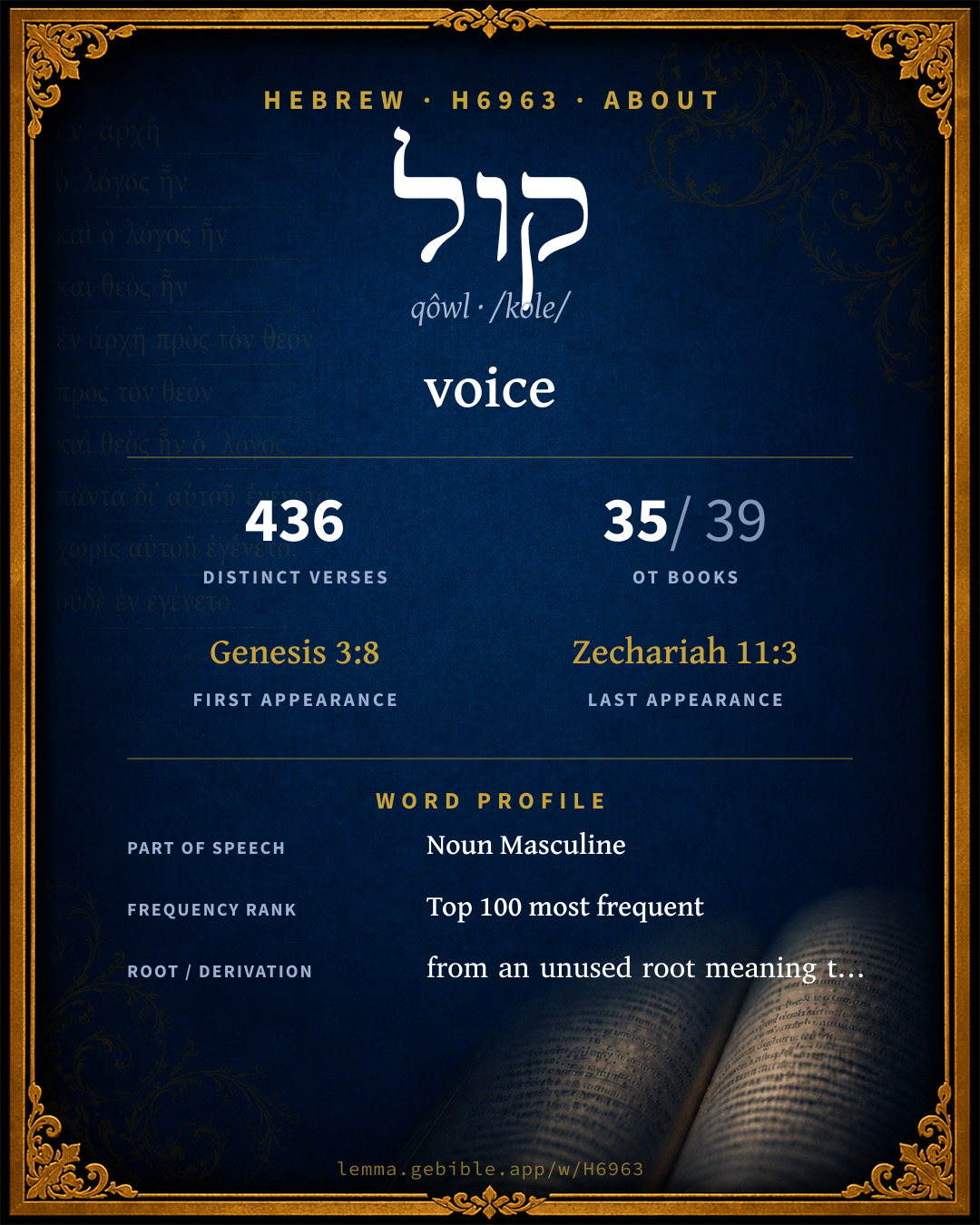
קוֹל
voice
also: sound, noise fuller range ↓
Full lexicon entry — Brown-Driver-Briggs (BDB)
From Brown-Driver-Briggs (BDB)
Where this word appears
See every Construct-state word in the Hebrew Bible →
Grammar key — what these labels mean
Part of speech
- Noun
- A naming word — a person, place, thing, or idea.
Noun type
- Common
- A common noun — a general class of person, place, or thing (“king,” “city,” “water”), not a specific name.
State
- Construct
- A noun bound to a following noun in a possessive / “of” relationship (the construct chain).
- Absolute
- The independent form of a noun, not bound to a following word.
Gender
- Masculine
- Grammatically masculine.
Number
- Singular
- One.
- Plural
- More than one (in Hebrew, generally three or more).
Grammatical forms
- Noun, Common, Masculine, Singular, Construct 418 times (83%)
- Noun, Common, Masculine, Singular, Absolute 76 times (15%)
- Noun, Common, Masculine, Plural, Absolute 10 times (2%)
- Noun, Common, Masculine, Plural, Construct 2 times (0%)
Parsed forms decoded from the imported morphology (morphhb / Westminster Leningrad Codex — WLC text public domain, morphhb tagging CC BY 4.0), counted across 506 parsed occurrences — not distinct verses.
Page 3 of 3 — showing verses 401–436 of 436 distinct verses where H6963 appears, across 35 books. Click any verse to open its interlinear word-by-word view. Verse text shown in the World English Bible for context — . Each verse’s Hebrew form is shown with its reference; the English is not keyword-highlighted, since the data carries no word-level English alignment. Use “Compare translations” on any verse to read it across multiple English versions. This concordance covers the Hebrew Bible; Septuagint (Greek Old Testament) occurrences are not indexed here.
Ezekiel 24 verses
- Ezekiel 27:28 לְ/ק֖וֹל prep + n c ms cs At the sound of the cry of your pilots the suburbs shall shake.
- Ezekiel 27:30 בְּ/קוֹלָ֔/ם prep + n c ms cs + sfx pers 3mp and shall cause their voice to be heard over you, and shall cry bitterly, and shall cast up dust on their heads, they shall wallow themselves in the ashes:
- Ezekiel 31:16 מִ/קּ֤וֹל prep + n c ms cs I made the nations to shake at the sound of his fall, when I cast him down to Sheol with those who descend into the pit; and all the trees of Eden, the choice and best of Lebanon, all that drink water, were comforted in the lower parts of the earth.
- Ezekiel 33:4 ק֤וֹל n c ms cs then whoever hears the sound of the trumpet, and doesn't take warning, if the sword come, and take him away, his blood shall be on his own head.
- Ezekiel 33:5 ק֨וֹל n c ms cs He heard the sound of the trumpet, and didn't take warning; his blood shall be on him; whereas if he had taken warning, he would have delivered his soul.
- Ezekiel 33:32 ק֖וֹל n c ms Behold, you are to them as a very lovely song of one who has a pleasant voice, and can play well on an instrument; for they hear your words, but they don't do them.
- Ezekiel 37:7 ק֤וֹל n c ms So I prophesied as I was commanded: and as I prophesied, there was a noise, and, behold, an earthquake; and the bones came together, bone to its bone.
- Ezekiel 43:2 וְ/קוֹל֗/וֹ כְּ/קוֹל֙ conj + n c ms cs + sfx pers 3ms prep + n c ms cs Behold, the glory of the God of Israel came from the way of the east: and his voice was like the sound of many waters; and the earth shined with his glory.
Daniel 6 verses
- Daniel 8:16 קוֹל n c ms cs I heard a man's voice between [the banks of] the Ulai, which called, and said, Gabriel, make this man to understand the vision.
- Daniel 9:10 בְּ/ק֖וֹל prep + n c ms cs neither have we obeyed the voice of Yahweh our God, to walk in his laws, which he set before us by his servants the prophets.
- Daniel 9:11 בְּ/קֹלֶ֑/ךָ prep + n c ms cs + sfx pers 2ms Yes, all Israel have transgressed your law, even turning aside, that they should not obey your voice: therefore has the curse been poured out on us, and the oath that is written in the law of Moses the servant of God; for we have sinned against him.
- Daniel 9:14 בְּ/קֹלֽ/וֹ prep + n c ms cs + sfx pers 3ms Therefore has Yahweh watched over the evil, and brought it on us; for Yahweh our God is righteous in all his works which he does, and we have not obeyed his voice.
- Daniel 10:6 וְ/ק֥וֹל כְּ/ק֥וֹל conj + n c ms cs prep + n c ms cs his body also was like the beryl, and his face as the appearance of lightning, and his eyes as flaming torches, and his arms and his feet like burnished brass, and the voice of his words like the voice of a multitude.
- Daniel 10:9 ק֣וֹל ק֣וֹל n c ms cs n c ms cs Yet heard I the voice of his words; and when I heard the voice of his words, then was I fallen into a deep sleep on my face, with my face toward the ground.
Joel 3 verses
- Joel 2:5 כְּ/ק֣וֹל כְּ/קוֹל֙ prep + n c ms cs prep + n c ms cs Like the noise of chariots on the tops of the mountains do they leap, Like the noise of a flame of fire that devours the stubble, As a strong people set in battle array.
- Joel 2:11 קוֹל/וֹ֙ n c ms cs + sfx pers 3ms Yahweh thunders his voice before his army; For his forces are very great; For he is strong who obeys his command; For the day of Yahweh is great and very awesome, And who can endure it?
- Joel 3:16 קוֹל֔/וֹ n c ms cs + sfx pers 3ms Yahweh will roar from Zion, And thunder from Jerusalem; And the heavens and the earth will shake; But Yahweh will be a refuge to his people, And a stronghold to the children of Israel.
Amos 3 verses
- Amos 1:2 קוֹל֑/וֹ n c ms cs + sfx pers 3ms He said: "Yahweh will roar from Zion, And utter his voice from Jerusalem; And the pastures of the shepherds will mourn, And the top of Carmel will wither."
- Amos 2:2 בְּ/ק֥וֹל prep + n c ms cs But I will send a fire on Moab, And it will devour the palaces of Kerioth; And Moab will die with tumult, with shouting, and with the sound of the trumpet;
- Amos 3:4 קוֹל/וֹ֙ n c ms cs + sfx pers 3ms Will a lion roar in the thicket, When he has no prey? Does a young lion cry out of his den, If he has caught nothing?
Jonah 2 verses
- Jonah 2:2 קוֹלִֽ/י n c ms cs + sfx pers 1cs He said, "I called because of my affliction to Yahweh. He answered me. Out of the belly of Sheol I cried. You heard my voice.
- Jonah 2:9 בְּ/ק֤וֹל prep + n c ms cs But I will sacrifice to you with the voice of thanksgiving. I will pay that which I have vowed. Salvation belongs to Yahweh."
Micah 2 verses
Nahum 3 verses
- Nahum 2:7 כְּ/ק֣וֹל prep + n c ms cs It is decreed: she is uncovered, she is carried away; and her handmaids moan as with the voice of doves, beating on their breasts.
- Nahum 2:13 ק֥וֹל n c ms cs "Behold, I am against you," says Yahweh of Hosts, "and I will burn her chariots in the smoke, and the sword will devour your young lions; and I will cut off your prey from the earth, and the voice of your messengers will no longer be heard."
- Nahum 3:2 ק֣וֹל וְ/ק֖וֹל n c ms cs conj + n c ms cs The noise of the whip, the noise of the rattling of wheels, prancing horses, and bounding chariots,
Habakkuk 2 verses
- Habakkuk 3:10 קוֹל֔/וֹ n c ms cs + sfx pers 3ms The mountains saw you, and were afraid. The tempest of waters passed by. The deep roared and lifted up its hands on high.
- Habakkuk 3:16 לְ/קוֹל֙ prep + n c ms I heard, and my body trembled. My lips quivered at the voice. Rottenness enters into my bones, and I tremble in my place, Because I must wait quietly for the day of trouble, For the coming up of the people who invade us.
Zephaniah 4 verses
- Zephaniah 1:10 ק֤וֹל n c ms cs In that day, says Yahweh, there will be the noise of a cry from the fish gate, a wailing from the second quarter, and a great crashing from the hills.
- Zephaniah 1:14 ק֚וֹל n c ms cs The great day of Yahweh is near. It is near, and hurries greatly, the voice of the day of Yahweh. The mighty man cries there bitterly.
- Zephaniah 2:14 ק֠וֹל n c ms Herds will lie down in the midst of her, all the animals of the nations. Both the pelican and the porcupine will lodge in its capitals. Their calls will echo through the windows. Desolation will be in the thresholds, for he has laid bare the cedar beams.
- Zephaniah 3:2 בְּ/ק֔וֹל prep + n c ms She didn't obey the voice. She didn't receive correction. She didn't trust in Yahweh. She didn't draw near to her God.
Haggai 1 verse
Zechariah 2 verses
- Zechariah 6:15 בְּ/ק֖וֹל prep + n c ms cs Those who are far off shall come and build in the temple of Yahweh; and you shall know that Yahweh of hosts has sent me to you. This will happen, if you will diligently obey the voice of Yahweh your God."'"
- Zechariah 11:3 ק֚וֹל ק֚וֹל n c ms cs n c ms cs A voice of the wailing of the shepherds! For their glory is destroyed: a voice of the roaring of young lions! For the pride of the Jordan is ruined.
About this entry
At a glance — auto-summarized from this page’s data, not written by a person. Every figure links to its source below. This summary describes the numbers; it doesn’t interpret them.
At its core, קול (qôwl) means “voice.” Scripture first uses it in Genesis 3:8. Spanning 436 verses in 35 books, it ranks among the common words of the Hebrew Bible. Not a single-sense word: its full sense range also takes in “sound” and “noise”. From the same root come קל and קוליה. Dig into 436-verse concordance and the renderings breakdown below.
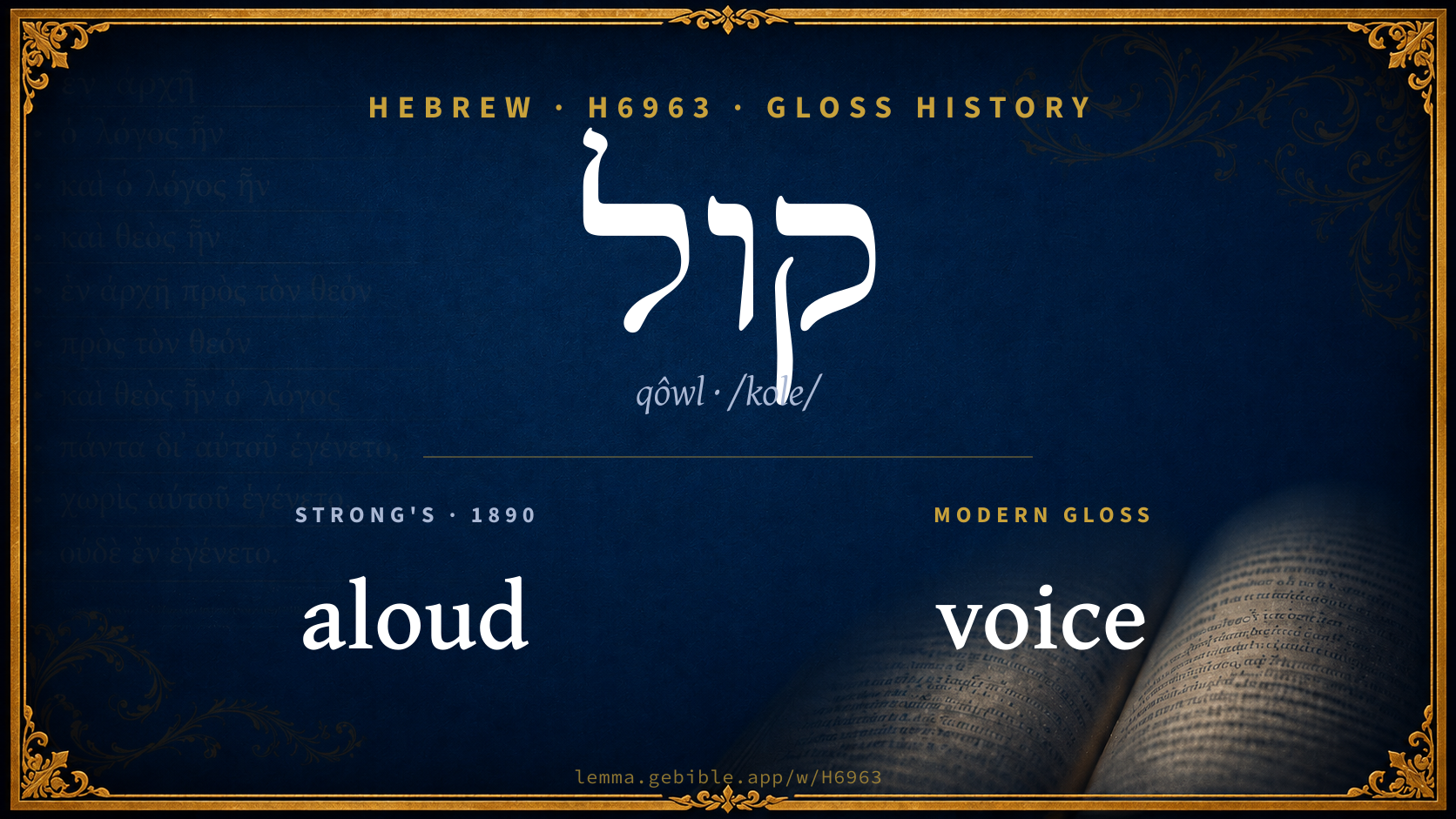
Gloss history
Strong's 1890 vs modern scholarship
About this word
Strong's H6963 catalogs a Hebrew word from the Hebrew Old Testament.
These counts are not copied from any lexicon or concordance. They are computed here, from the morphology-tagged Hebrew Old Testament. What Lemma adds →
- 436
- distinct verses
- The word appears in 436 distinct verses.
- 35 / 39
- OT books
- The word appears in 35 of 39 Old Testament books.
- #98
- by frequency
- Top 100 most frequent Hebrew words (rank 98 of 8,640 Hebrew words by occurrence).
View all 436 occurrences in the concordance →
Most concentrated in
- Jeremiah 64 verses 15%
- Psalms 54 verses 12%
- Deuteronomy 35 verses 8%
By section of the Old Testament
By traditional corpus
Conventional, traditional groupings — biblical authorship is debated, so this is a traditional corpus grouping, not an authorship claim. Each share is this word’s portion of its verses in that division of the Hebrew canon. Each figure is a share of the word’s 436 distinct verses.
- Prophets (Nevi'im) 226 verses · 52%
- Writings (Ketuvim) 120 verses · 28%
- Torah (Pentateuch) 90 verses · 21%
How translations render this word
Counts come from each version’s own published word-to-Strong’s tagging or interlinear alignment — an approximate guide to how each version renders this word, not a word-level alignment the data otherwise carries. Because each total is that version’s own tagged count, the per-version totals vary from one another and need not match the appearance or distinct-verse counts above. These counts may also differ from a printed concordance because Lemma counts each distinctly tagged rendering and does not collapse phrase taggings into a single head-word total. This is a fixed set of word-tagged versions (KJV, ASV, BSB, ULT) and does not change with the reading translation you choose elsewhere. Each version’s license is shown beside its name below (and on Sources).
BDB lists this Strong’s number as 3 distinct words (homographs). Each count above pools all of them and is not split by sense — see the Senses section below. A low-frequency rendering may belong to a different one of those words, not the primary meaning.
- King James Version†: Voice 349×, Sound 36×, Noise 33×
- American Standard Version†: Voice 297×, Sound 35×, Noise 30×
- Berean Standard Bible†: Voice 191×, Sound 62×, Voices 22×
- unfoldingWord Literal Text†: Voice 196×, Voice of 107×, Sound of 84×
King James Version Public Domain
Renders H6963 across 496† tagged occurrences — most commonly:
Plus 56 renderings that appear only once — usually multi-word phrases or single function words the recovered tagging swept in, not distinct renderings. Not rendered by a distinct English word in 10 further occurrences.
American Standard Version Public Domain
Renders H6963 across 498† tagged occurrences — most commonly:
Plus other, less common renderings. Plus 94 renderings that appear only once — usually multi-word phrases or single function words the recovered tagging swept in, not distinct renderings.
Berean Standard Bible Public Domain
Renders H6963 across 425† tagged occurrences — most commonly:
Plus other, less common renderings. Plus 51 renderings that appear only once — usually multi-word phrases or single function words the recovered tagging swept in, not distinct renderings. Not rendered by a distinct English word in 78 further occurrences.
unfoldingWord Literal Text CC BY-SA 4.0
Renders H6963 across 503† tagged occurrences — most commonly:
Plus 34 renderings that appear only once — usually multi-word phrases or single function words the recovered tagging swept in, not distinct renderings.
21 senses and sub-senses in the full BDB
What do BDB’s symbols mean?
BDB uses these scholarly abbreviations:
| Symbol | Meaning |
|---|---|
| 𝔊 | the Septuagint (the ancient Greek translation, LXX) |
| 𝔙 | the Vulgate (the Latin translation) |
| 𝔖 | the Syriac version (the Peshitta) |
| 𝔗 | the Targum (the Aramaic translation) |
| ψ | the Psalms |
| √ | root (the underlying root or stem) |
| ‖ | parallel passage (a synonymous or contrasted parallel) |
| † | the dagger: every passage where the word occurs is cited |
The 21 senses and sub-senses the full Brown-Driver-Briggs lexicon distinguishes for this word, in lexicon order (not ranked by frequency), with BDB’s own verbatim wording and sub-sense lettering. Shown in Hebrew script with BDB’s own scholarly abbreviations. The condensed entry is in the Lexicon Entry tab. See also the Forms in the corpus table below.
קול I (sometimes, c. pref. et suff., קֹל)506 n.m. Gn 39
- 1. sound: especially
- a. of human voice Jos 6:10; 2 K 7:10; in speech Gn 27:22(×2) 1 S 1:13; 24:17; 26:17(×2); recognized (הִכִּיר) v 17 Je 18:3; יְפֵה ק׳ Ez 33:32 pleasant of voice, cf. Ct 2:14(×2); 8:13; in singing Ex 32:18; 2 S 19:36; Is 52:8, calling Ju 9:7, shouting Ex 32:17; 1 S 4:6(×2) 1 K 1:40; Ezr 3:13; rejoicing Je 7:34(×4) = 16:9; 25:10; 33:11; praise ψ 66:8; 26:7; Jo 2:10; laughter Je 30:19; weeping Gn 21:16; Ju 2:4; 1 S 11:4; Ru 1:9, 14; Ezr 3:13; outcry Gn 39:15, 18; 1 S 4:14; Je 8:19, distress, lament Je 9:18; Ez 27:30; Zc 11:3 ψ 102:6, supplication ψ 28:2, 6; 31:23; 86:6; adv. ק׳ אֶחָד with one voice Ex 24:3; 2 Ch 5:13, ק׳ גָּדוֹל loud voice 2 S 15:23 + (cf. בְּק׳ ג׳ Gn 39:14; 1 S 28:12 +), ק׳ רָם †Dt 27:14; נָשָׂא ק׳ Gn 21:16 + (v. נָשָׂא 1 b (5)), הֵרִים ק׳ 39:15 + (v. רום Hiph.); on ק׳ as independ. nom., sq. subj. + vb. of calling ψ 3:5; 27:7; 142:2 v. Ges§ 144 m. e.g. Joshua 6:10
- b. of י׳ Gn 3:8; 10; Is 6:8; Ex 19:19; 1 K 19:13; Mi 6:9; Ez 10:5 (cf. also 2 b) +; adv. ק׳ גָּדוֹל Dt 5:19; Ez 9:1; ק׳ דְּמָמָה דַקָּה 1 K 19:12. e.g. Genesis 3:8
- c. of seraph Is 6:4. e.g. Isaiah 6:4
- d. of angel Dn 8:16 (ק׳ אָדָם) i.e. in human speech, cf. Bev); ק׳ דְּבָרָיו 10:6, 9(×2). e.g. Daniel 8:16
- e. of animals: bleating of sheep 1 S 15:14; lowing of cattle v 14 Je 9:9, neighing of horses 8:16, roaring of lion Am 3:4 Je 2:15 +, hissing of serpent 46:22 (in sim.), singing of birds Na 2:8; Zp 2:14; ψ 104:12; Ct 2:12; Ec 12:4. e.g. 1 Samuel 15:14
- f. exclamation, at beginning of cl., a sound of …! = hark! Gn 4:10; Is 13:4; 40:3; 52:8; Je 4:15; 10:22; 50:28; Ct 2:8; 5:2 (Ges§ 146 b). e.g. Genesis 4:10
- 2. sound:
- a. of instrument, especially ק׳ (הַ)שֹּׁפָר Ex 9:16; 20:18 (Gi v 15) Am 2:2; 1 K 1:41 +, חֲצֹצְרוֹת וגו׳ 2 Ch 5:13; כִּנּוֹר Ez 26:13; עוּגָב Jb 21:12; of פַּעֲמֹנִים on high priest’s robe Ex 28:35. e.g. Exodus 9:16
- b. thunder-clap or peal (cf. Dr 1 S 12:17), קוֹל י׳ (or קוֹלוֹ) Am 1:2 Is 30:30; 31 Je 10:13 = 51:16, Jo 2:11; 4:16 ψ 18:14 = 2 S 22:14, ψ 29:3–5, 7–9; 46:7 Jb 37:4 (cf. 1 S 7:10 ψ 77:18, 19; 104:7), so especially pl. abs. (v. supr.) †Ex 9:23, 28, 29, 33, 34; 19:16; 20:18 (Gi v 15), 1 S 7:10; 12:17, 18 Jb 28:26 = 38:25. e.g. 1 Samuel 12:17
- c. קוֹל רַגְלֶיהָ 1 K 14:6 cf. 2 K 6:32, and (prob.) Gn 3:8; also ק׳ (הַ)צְּעָדָה 2 S 5:24 = 1 Ch 14:15; of runners 2 K 11:13; 2 Ch 23:12. e.g. 1 Kings 14:6
- d. stamping of hoofs Je 47:3; Ez 26:10 (+ chariots, etc.), cf. 1 K 1:41. e.g. Jeremiah 47:3
- e. of chariots Na 3:2; Jo 2:5; wheels Ez 3:13; whip Na 3:2. e.g. Nahum 3:2
- f. of sea, and great waters Hb 3:10; Ez 1:24; 43:2 ψ 93:3, 4, cf. Je 50:42 (in sim.); ק׳ צִנּוֹרֶיךָ ψ 42:8. e.g. Habakkuk 3:10
- g. earthquake Ez 37:7. e.g. Ezekiel 37:7
- h. a fall Je 49:21; Ez 26:15; 31:16. e.g. Jeremiah 49:21
- i. of a multitude 1 S 4:14; Is 13:4; Ez 23:42. e.g. 1 Samuel 4:14
- j. din of war Ex 32:17; Je 50:22, 46; 51:55; La 2:7. k. of wings Ez 1:24; 3:13; 10:5. l. flame Jo 2:5; crackling of thorns Ec 7:6; rustling of leaves Lv 26:36. m. mill-stones Je 25:10; Ec 12:4. e.g. Exodus 32:17
- 3. of articulate speech, things said:
- a. (1) often of human advice, command, entreaty Gn 3:17; 4:23 Ex 3:18; 4:1, 9 Dt 1:45; 21:18(×2), 20 1 S 2:25; 8:7, 9 2 S 12:18; ק׳ דִּבְרֵיכֶם Dt 1:34; 5:25; even of written words 2 K 10:6; so also ק׳ הָאֹת Ex 4:8(×2) voice (teaching) of the sign. (2) of a report Gn 45:16; Ec 10:20. (3) of a proclamation Ex 36:6 (P); 2 Ch 24:9; 30:5; 36:22 = Ezr 1:1, Ezr 10:7; Ne 8:15. (4) ק׳ אָלָה Lv 5:1 utterance of adjuration. e.g. Genesis 3:17
- b. often (especially Dt Je) of words of י׳ Gn 22:18; 26:5 Ex 5:2; 15:26; 19:5 Dt 8:20; 9:23; 13:5, 19 +, Ju 2:2, 20; 6:10 1 S 12:14, 15; 15:1, 19, 20, 22 Je 3:13, 25; 7:23 +; of מַלְאַךְ י׳ Ex 23:21, 22.—קֹל Je 3:9 v. sub קלל. e.g. Genesis 22:18
קול II [m.] lightness, frivolity (so Vrss Ki Gie
Senses from the full Brown-Driver-Briggs lexicon (Brown, Driver, Briggs; Oxford 1906 — public domain), digitized via Sefaria, supplemented by the OpenScriptures HebrewLexicon (CC BY 4.0). Full attribution on Sources.
Word origin
I. (sometimes, c. pref. et suff., קֹל)506 n.m. Gn 39:14 sound, voice;—abs. קוֹל Gn 4:10 + (הַקֹּל 27:22; 45:16); cstr. קוֹל 3:8 + (וְקֹל Ex 19:16, לְקֹל 4:8(×2)); sf. קוֹלִי 1 S 26:17 +, קוֹלְךָ Ju 18:25 +, etc. (קֹלִי Gn 22:18, קֹלֶ֑ךָ Ex 3:18, etc.); pl. (usually of thunder) קֹלֹת Ex 9:23 + 4 times, קוֹלֹת 20:18 (Gi v 15), קֹלוֹת 1 S 2:17 + 5 times;—
I. n.[m.] lightness, frivolity (so Vrss Ki Gie; Gf thinks = קָלוֹן; > = voice);—מִקֹּל זְנוּתָהּ Je 3:9.—קֹל voice, v. קוֹל.
— Brown-Driver-Briggs (Oxford 1906, public domain), digitized via Sefaria, supplemented by the OpenScriptures HebrewLexicon (CC BY 4.0). See Sources.
Origin: from an unused root meaning to call aloud
Jastrow Dictionary
A second Hebrew/Aramaic lexicon for comparison, covering Aramaic and post-biblical (Talmudic, Targumic, Midrashic) usage that the biblical-Hebrew BDB does not. Matched by lemma rather than by Strong’s number, so a lemma may carry more than one Jastrow headword (shown separately below), and the entries cover usage well beyond the Bible.
קוֹל
- v. קהל) voice, call, sound. Ker. 6ᵃ; Pes. 26ᵃ ק׳ מראה וריח וכ׳ the enjoyment of sound, sight or smell does not come under the category of misuse of sacred property (מְעַילָה). Zeb. 88ᵇ יבא דבר שבק׳ ויכפר על ק׳ הרע let that which is accompanied by sound (the high priest’s robe) bring atonement for evil sound (evil talk). Gen. R. s. 17 קוֹלָהּ הולך woman’s voice is penetrating. Pes. 56ᵃ בק׳ רם in a loud voice, opp. בחשאי. Keth. 16ᵃ bot. יש לה ק׳ is spoken about, is known among people; a. v. fr.—בת ק׳, v. בַּת I.—Pl. קוֹלוֹת, constr. קוֹלֵי. Ex. R. s. 5 הקול יוצא ונחלק לשבעים ק׳ וכ׳ the voice (of revelation) went forth and was divided into seventy voices corresponding to seventy languages. Ber. 15ᵇ בקולי ק׳ under loud cries; a. fr.—[קול מזמסיא, v. מַזְיָא.]
קוּל
- to be light, v. קִיל.
קוּל ²
- (preced.; v. קָלַל)
- 1. light matter. — Pl. קוּלִּין, constr. קוּלֵּי. Sabb. 29ᵃ ומק׳ מטלניות שנו כאן and they teach here rules about one of the pettiest kinds of strips. Ib. 39ᵇ חוץ מק׳ מטלניות except the rule concerning the lightest kinds &c.
- 2. lenient practice, opp. חוֹמֶר. Ḥall. IV, 5 נמצא חומרו קוּלּוֹ consequently the stricter opinion (of R. Akiba) implies the eventual lenient ruling. Y. ib. 59ᵈ bot. קולו חומרו the lenient rule implies eventually the stricter rule. Snh. XI, 2 נמצא חומרו קולו his severer offence (in giving a practical decision without authorization to teach) is the cause of his acquittal from responsibility.—Pl. קוּלִּים, קוּלִּין. Y. Snh. XI, 30ᵃ bot. Ḥull. 43ᵇ bot. מקוּלֵּי בית שמאי ומק׳ וכ׳ he that follows the school of Shammai where its rulings are the easier, and again the school of Hillel where its rulings are the easier. Ib. 44ᵃ כקוּלֵּיהֶן, v. חוֹמֶר I. Keth. 110ᵇ מקולי כתובה וכ׳ they taught here one of the lenient practices concerning the wife’s dowry; a. e.—קוּלּוֹת (fr. קוּלָּה) light, minor sins. Y. Snh. X, 28ᵇ top קוּלּוֹתָיו … חומרותיו וכ׳ Ahab’s minor offences were as heavy as Jeroboam’s heaviest sins; (Bab. ib. 102ᵇ קַלּוֹת … כחמורות).
A Dictionary of the Targumim, the Talmud Babli and Yerushalmi, and the Midrashic Literature (Marcus Jastrow; London, Luzac, 1903) — Public Domain. Digitized via Sefaria. Digitized via Sefaria. Full attribution on Sources.
Forms in the corpus
The 174 distinct written forms H6963 takes in the Hebrew Bible, most frequent first — each parse links to that state’s occurrences in the concordance. Hebrew forms include their vowel points and cantillation, so a single lemma takes many written forms.
The 60 most common forms are shown; 114 rarer forms follow in the full concordance.
Same root — word family
Other BDB entries built from the same root as H6963, grouped by Strong’s listed origin. These share a root / origin per the lexicon — not necessarily a shared meaning. Each links to that word’s own entry.
Derived from this word
Proper names from this root
People and places named from this root — a name, not an additional meaning of the word.
Compare all same-root words → 1 of the same-root words is a proper name (a person or place). They share a root, not necessarily a meaning.
Septuagint verse parallels
This word appears in 411 verses that also exist in the Greek Old Testament (Septuagint), out of the 436 Hebrew verses it occurs in. You can read those verses in Greek by switching the Old Testament edition to the Septuagint.
Read these verses in the Septuagint
- Genesis 3:8
- Exodus 3:18
- Leviticus 5:1
- Numbers 7:89
- Deuteronomy 1:34
- Joshua 5:6
- Judges 2:2
- Ruth 1:9
- 1 Samuel 1:13
- 2 Samuel 3:32
- 1 Kings 1:40
- 2 Kings 4:31
This is a verse-level parallel only — the same verses exist in both the Hebrew and Greek Old Testaments. No word-level Hebrew↔Greek correspondence is claimed: the data carries no such alignment, so no Greek word is shown as this Hebrew word’s translation. Coverage is not total — the Septuagint omits the deuterocanon and renumbers the Psalms, so some Hebrew verses have no direct Greek parallel.