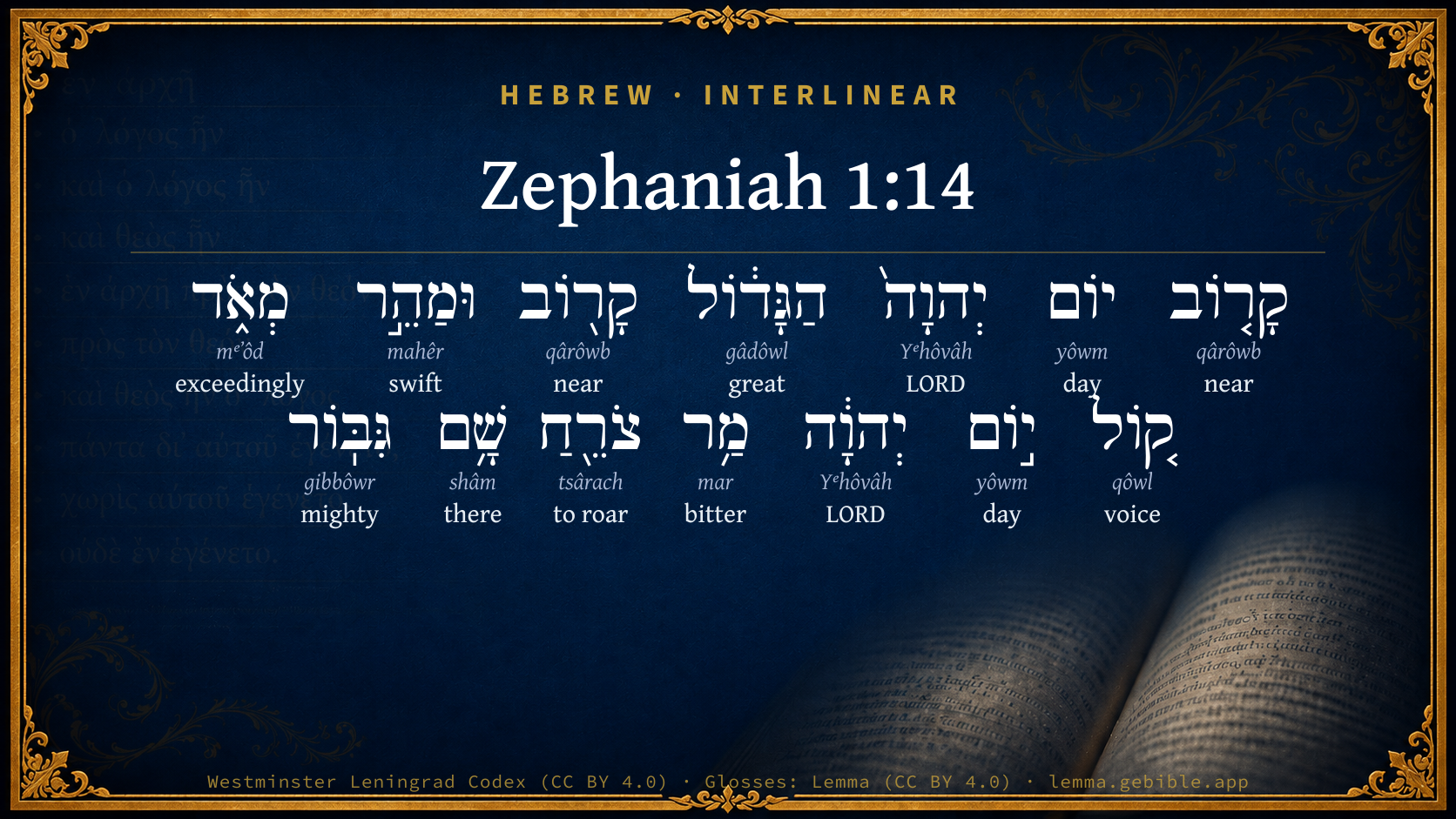
Zephaniah 1:14

Hebrew (Westminster Leningrad Codex) Zephaniah 1:14 appears in the Hebrew Old Testament. The text above is from the Westminster Leningrad Codex. Each word links to its Strong’s number, a concise gloss, and parsing drawn from the Open Scriptures Hebrew Bible morphology. Click any word for its full Brown-Driver-Briggs (BDB) entry.
Download image
Cite this verse

Zephaniah 1:14 (World English Bible). Public Domain. Lemma interlinear Bible study tool, https://lemma.gebible.app/v/zephaniah/1/14.

Show BibTeX & RIS
BibTeX
RIS
English Translation
The great day of Yahweh is near. It is near, and hurries greatly, the voice of the day of Yahweh. The mighty man cries there bitterly.
World English Bible · Public Domain
Download a study sheet

One document with this verse’s original text, its word-by-word gloss line, the meaning frame, cross-references with their text, attributed commentary, and full source and license credits — printable, and it pastes into notes with its structure intact.

This verse Autodidact and up

Study sheet (.html) Plain text (.txt)

A passage Seminary Student

Up to 50 verses in one chapter. A passage sheet keeps up to 6 commentary sources and 12 cross-references per verse, in the order this page ranks them, and says so on the sheet whenever that leaves anything out. Ask for a single verse and you get the Autodidact verse sheet above.

Everything on this page stays free to read, with no account — the sheet is a download of what is already on screen, not access to it.

Want to remove ads? Support Godless Engineer
Compare translations 3

The same verse in 3 English versions, stacked beneath the original-language interlinear above. Click any original word for its lexicon entry.

Each is an independent rendering of the whole verse — the interlinear is not word-aligned to these translations.

Highlighted words mark where these versions differ — a whole-verse word diff, not a word-by-word alignment.

  • World English Bible Public Domain
    The great day of Yahweh is near. It is near, and hurries greatly, the voice of the day of Yahweh. The mighty man cries there bitterly.
  • King James Version Public Domain
    The great day of the LORD is near, it is near, and hasteth greatly, even the voice of the day of the LORD: the mighty man shall cry there bitterly.
  • unfoldingWord Literal Text CC BY-SA 4.0
    The great day of Yahweh near, near and hastening quickly! The sound of the day of Yahweh bitter; the warrior cries out then!

unfoldingWord Literal Text — © unfoldingWord, licensed CC BY-SA 4.0. Word-aligned USFM3 via Door43 (git.door43.org/unfoldingWord/en_ult).

Versions to compare (up to 4)

3 of 4 selected

Show all 18 translations

Every available English version of this verse, each an independent rendering of the whole verse.

  • World English Bible Public Domain
    The great day of Yahweh is near. It is near, and hurries greatly, the voice of the day of Yahweh. The mighty man cries there bitterly.
  • Berean Standard Bible Public Domain
    The great Day of the LORD is near—near and coming quickly. Listen, the Day of the LORD! Then the cry of the mighty will be bitter.
  • Majority Standard Bible Public Domain
    The great Day of the LORD is near—near and coming quickly. Listen, the Day of the LORD! Then the cry of the mighty will be bitter.
  • King James Version Public Domain
    The great day of the LORD is near, it is near, and hasteth greatly, even the voice of the day of the LORD: the mighty man shall cry there bitterly.
  • American Standard Version (1901) Public Domain
    The great day of Jehovah is near, it is near and hasteth greatly, `even' the voice of the day of Jehovah; the mighty man crieth there bitterly.
  • Revised Version (1885) Public Domain
    The great day of the LORD is near, it is near and hasteth greatly, even the voice of the day of the LORD; the mighty man crieth there bitterly.
  • Geneva Bible (1599) Public Domain
    The great day of the Lord is neere: it is neere, and hasteth greatly, euen the voyce of the day of the Lord: the strong man shall cry there bitterly.
  • Douay-Rheims (1899) Public Domain
    The great day of the Lord is near, it is near and exceeding swift: the voice of the day of the Lord is bitter, the mighty man shall there meet with tribulation.
  • Young's Literal Translation Public Domain
    Near `is' the great day of Jehovah, Near, and hasting exceedingly, The noise of the day of Jehovah, Bitterly shriek there doth a mighty one.
  • Literal Standard Version CC BY-SA 4.0
    Near [is] the Great Day of YHWH, || Near, and hastening exceedingly, || The noise of the Day of YHWH, || There a mighty one bitterly shrieks.
  • Unlocked Literal Bible CC BY-SA 4.0
    The great day of Yahweh is near, near and hurrying quickly! The sound of the day of Yahweh will be that of a warrior crying bitterly!
  • unfoldingWord Literal Text CC BY-SA 4.0
    The great day of Yahweh near, near and hastening quickly! The sound of the day of Yahweh bitter; the warrior cries out then!
  • Darby Bible Public Domain
    The great day of Jehovah is near, it is near, and hasteth greatly. The voice of the day of Jehovah: the mighty man shall cry there bitterly.
  • World Messianic Bible Public Domain
    The great day of the LORD is near. It is near and hurries greatly, the voice of the day of the LORD. The mighty man cries there bitterly.
  • Webster's Bible Public Domain
    The great day of the LORD is near, it is near, and hasteth greatly, even the voice of the day of the LORD: the mighty man shall cry there bitterly.
  • Free Bible Version CC BY-SA 4.0
    The great day of the Lord is near and approaching rapidly. It will be a bitter day—even warriors will cry out loud.
  • Bible in Basic English Public Domain
    The great day of the Lord is near, it is near and coming very quickly; the bitter day of the Lord is near, coming on more quickly than a man of war.
  • JPS Tanakh (1917) Public Domain
    The great day of the LORD is near, it is near and hasteth greatly, even the voice of the day of the LORD, wherein the mighty man crieth bitterly.

Literal Standard Version (2020), Covenant Press — licensed CC BY-SA 4.0. Text via the HelloAO Bible API (eBible.org). Unlocked Literal Bible (unfoldingWord) — licensed CC BY-SA 4.0. Text via the HelloAO Bible API (eBible.org). unfoldingWord Literal Text — © unfoldingWord, licensed CC BY-SA 4.0. Word-aligned USFM3 via Door43 (git.door43.org/unfoldingWord/en_ult). Free Bible Version, Dr. Jonathan Gallagher — licensed CC BY-SA 4.0. Text via the HelloAO Bible API (eBible.org).

Word by word

More ways to search: Search by grammar → Find every occurrence → Compare this word →

Practice this passage: Drill this verse → Learn its vocabulary →

צֹרֵ֖חַ
tsârach
H6873
“roaring”
Verb, Qal, Participle Active, Masculine, Singular, Absolute
Part of Speech
Verb
Stem
Qal
Form
Participle Active
Gender
Masculine
Number
Singular
State
Absolute
Full BDB Definition

Origin: a primitive root

TWOT: 1968

to cry, roar, make a shrill or clear sound - (Qal) to roar - (Hiphil) to utter a roar, cry out (a battle cry)
  1. קָר֤וֹב qârôwb H7138 “near” Adjective, Adjective, Masculine, Singular, Absolute
  2. יוֹם yôwm H3117 “day of” Noun, Common, Masculine, Singular, Construct
  3. יְהוָה֙ Yᵉhôvâh H3068 “LORD” Noun, Proper
  4. הַגָּד֔וֹל gâdôwl H1419 “the · great” Particle, Definite Article + Adjective, Adjective, Masculine, Singular, Absolute
  5. קָר֖וֹב qârôwb H7138 “near” Adjective, Adjective, Masculine, Singular, Absolute
  6. וּמַהֵ֣ר mahêr H4118 “and · swift” Conjunction + Adjective, Adjective, Masculine, Singular, Absolute
  7. מְאֹ֑ד mᵉʼôd H3966 “exceedingly” Adverb
  8. ק֚וֹל qôwl H6963 “voice of” Noun, Common, Masculine, Singular, Construct
  9. י֣וֹם yôwm H3117 “day of” Noun, Common, Masculine, Singular, Construct
  10. יְהוָ֔ה Yᵉhôvâh H3068 “LORD” Noun, Proper
  11. מַ֥ר mar H4751 “bitter” Adjective, Adjective, Masculine, Singular, Absolute
  12. שָׁ֥ם shâm H8033 “there” Adverb
  13. גִּבּֽוֹר gibbôwr H1368 “mighty” Adjective, Adjective, Masculine, Singular, Absolute

About this verse

These counts appear in no published source. They are computed here, from the morphology-tagged text and Lemma’s own curated glosses. What Lemma adds →

14
words
11
distinct lemmas
Prophets
section

Notable vocabulary

The rarest word here is צֹרֵ֖חַ to roar H6873 — appearing just 2 times in the whole Hebrew Bible.

Shared distinctive vocabulary

צֹרֵ֖חַ to roar H6873 occurs in 2 verses of the Hebrew Bible. Also found in:

Grammatical profile

  • 1 verb
  • 5 nouns
  • 6 adjectives
  • 2 adverbs

Verb forms

  • צֹרֵ֖חַ Qal · Participle Active

Repetition

Words recur within this verse — often emphatic in Hebrew:

  • קָר֤וֹב near H7138 ×2
  • יוֹם day H3117 ×2
  • יְהוָה֙ LORD H3068 ×2

Hebrew & Septuagint length

In English translation the verse runs 26 words from the Hebrew and 28 from the Septuagint (LXX English) — closely comparable.

A rough comparison of the two English renderings, which tokenize alike — not a word-level alignment.

Word counts can differ between the Hebrew and the Greek without any difference in meaning — e.g. the Hebrew direct-object marker אֵת has no separate Greek word, and Greek often adds the article ὁ.

In the original languages it is 14 Hebrew tokens and 19 Greek tokens — but the two are counted differently (Hebrew bundles its prefixes and suffixes into one token; the Greek is in lemma form), so that isn’t a like-for-like length.

Cross-references

27

Topical passages linked to Zephaniah 1:14 in the Treasury of Scripture Knowledge — connected by theme and wording, ordered by reader-vote popularity; previews shown in the World English Bible.

  • Ezekiel 30:3 For the day is near, even the day of Yahweh is near; it shall be a day of clouds, a time of the nations.
  • Malachi 4:5 Behold, I will send you Elijah the prophet before the great and terrible day of Yahweh comes.
  • Zephaniah 1:7 Be silent at the presence of the Lord Yahweh, for the day of Yahweh is at hand. For Yahweh has prepared a sacrifice. He has consecrated his guests.
  • 1 Thessalonians 4:16 For the Lord himself will descend from heaven with a shout, with the voice of the archangel, and with God's trumpet. The dead in Christ will rise first,
  • Isaiah 15:4 Heshbon cries out, and Elealeh; their voice is heard even to Jahaz: therefore the armed men of Moab cry aloud; his soul trembles within him.
  • Isaiah 33:7 Behold, their valiant ones cry outside; the ambassadors of peace weep bitterly.
  • Ezekiel 7:12 The time is come, the day draws near: don't let the buyer rejoice, nor the seller mourn; for wrath is on all the multitude of it.
  • Joel 2:11 Yahweh thunders his voice before his army; For his forces are very great; For he is strong who obeys his command; For the day of Yahweh is great and very awesome, And who can endure it?
  • Isaiah 22:4–5 Therefore said I, Look away from me, I will weep bitterly; don't labor to comfort me for the destruction of the daughter of my people.
  • Ezekiel 7:6–7 An end is come, the end is come; it awakes against you; behold, it comes.
  • Joel 1:15 Alas for the day! For the day of Yahweh is at hand, And it will come as destruction from the Almighty.
  • Acts 2:20 The sun will be turned into darkness, And the moon into blood, Before the great and glorious day of the Lord comes.
  • James 5:9 Don't grumble, brothers, against one another, so that you won't be judged. Behold, the judge stands at the door.
  • 2 Peter 2:3 In covetousness they will exploit you with deceptive words: whose sentence now from of old doesn't linger, and their destruction will not slumber.
  • Joel 2:31 The sun will be turned into darkness, And the moon into blood, Before the great and terrible day of Yahweh comes.
  • Isaiah 66:6 A voice of tumult from the city, a voice from the temple, a voice of Yahweh that renders recompense to his enemies.
  • Jeremiah 25:36 A voice of the cry of the shepherds, and the wailing of the principal of the flock! for Yahweh lays waste their pasture.
  • Jeremiah 30:7 Alas! for that day is great, so that none is like it: it is even the time of Jacob's trouble; but he shall be saved out of it.
  • Amos 8:2 He said, "Amos, what do you see?" I said, "A basket of summer fruit." Then Yahweh said to me, "The end has come on my people Israel. I will not again pass by them any more.
  • Zephaniah 1:10 In that day, says Yahweh, there will be the noise of a cry from the fish gate, a wailing from the second quarter, and a great crashing from the hills.
  • Jeremiah 48:41 Kerioth is taken, and the strongholds are seized, and the heart of the mighty men of Moab at that day shall be as the heart of a woman in her pangs.
  • Ezekiel 12:23 Tell them therefore, Thus says the Lord Yahweh: I will make this proverb to cease, and they shall no more use it as a proverb in Israel; but tell them, The days are at hand, and the fulfillment of every vision.
  • Joel 2:1 Blow you the trumpet in Zion, And sound an alarm in my holy mountain! Let all the inhabitants of the land tremble, For the day of Yahweh comes, For it is close at hand:
  • Joel 3:16 Yahweh will roar from Zion, And thunder from Jerusalem; And the heavens and the earth will shake; But Yahweh will be a refuge to his people, And a stronghold to the children of Israel.
  • Philippians 4:5 Let your gentleness be known to all men. The Lord is at hand.
  • Hebrews 12:26 whose voice shook the earth, then, but now he has promised, saying, "Yet once more I will shake not only the earth, but also the heavens."
  • Revelation 6:15–17 The kings of the earth, the princes, the commanding officers, the rich, the strong, and every slave and free person, hid themselves in the caves and in the rocks of the mountains.

Cross-references courtesy of OpenBible.info (CC BY 4.0).

Hebrew and Greek witnesses Masoretic Hebrew ↔ Greek Septuagint

The same verse in the two great witnesses to the Old Testament, shown verse-for-verse.

These are two independent witnesses, not word-aligned to each other, and the Septuagint is shown in lemma (dictionary) form.

Hebrew Zephaniah 1:14 Masoretic · Westminster Leningrad Codex

קָר֤וֹב יוֹם יְהוָה֙ הַגָּד֔וֹל קָר֖וֹב וּמַהֵ֣ר מְאֹ֑ד ק֚וֹל י֣וֹם יְהוָ֔ה מַ֥ר צֹרֵ֖חַ שָׁ֥ם גִּבּֽוֹר

The great day of Yahweh is near. It is near, and hurries greatly, the voice of the day of Yahweh. The mighty man cries there bitterly.

World English Bible · Public Domain

Greek LXX Zephaniah 1:14 Septuagint · lemma form

ὅτι ἐγγύς ὁ ἡμέρα κύριος ὁ μέγας ἐγγύς καί ταχύς σφόδρα φωνή ἡμέρα κύριος πικρός καί σκληρός τάσσω δυνατός

For the great day of the Lord is near, it is near, and very speedy; the sound of the day of the Lord is made bitter and harsh.

LXX2012 (modern English Septuagint) · Public Domain

On this verse, Haydock's Catholic Bible Commentary discusses the Septuagint’s reading. Read the note in Commentary ↓

Hebrew: Westminster Leningrad Codex (CC BY 4.0). Greek: Septuagint (public domain); English from LXX2012 (modern English Septuagint) (Public Domain). How the Septuagint differs from the Hebrew →

Targum (Aramaic paraphrase)

1

The Targum is the ancient Jewish Aramaic paraphrase of the Hebrew Scriptures — an interpretive translation, not the Hebrew text itself. Onkelos (literal) and Pseudo-Jonathan (expansive) render the Torah, and Jonathan the Prophets. Coverage is partial: where no permissively-licensed English translation exists for a verse, only the Aramaic is shown. This is verse-level text, not a word-by-word alignment to the Hebrew.

  1. Targum Jonathan Prophets (Joshua–Malachi)
    קָרִיב יוֹמָא דַעֲתִיד לְמֵיתֵי מִן קֳדָם יְיָ רַבָּא קָרִיב וּמוֹחִי לַחֲדָא קַל יוֹמָא דַעֲתִיד לְמֵיתֵי מִן קֳדָם יְיָ דִי בֵיהּ מְרִיר וְצָוַח תַּמָן גִבָּרַיָא מִתְקַטְלִין:

    (no public-domain English translation for this verse)

    Targum Jonathan — Aramaic: “Mikraot Gedolot” (public domain). English: “Sefaria Community Translation” (CC0 1.0 (public-domain dedication)); “London "Chaldee Paraphrase," 1871” (public domain). Text via Sefaria.

Commentary

Notes on Zephaniah 1:14 from classic Christian and Jewish commentators (each source and its license shown beneath its notes). The classic Christian expositions comment on the surrounding passage and are grouped to its opening verse, so a note may address several verses; the Jewish commentaries on the Tanakh (Rashi and others) are per-verse, so they appear only where the commentator wrote on this verse.

Lemma curates 59 commentaries, every one of them public domain or Creative Commons licensed, each selected and text-cleaned for this edition rather than reprinted as found. About our sources →

Trapp's Complete Commentary

John Trapp

Zep 1:14 The great day of the LORD [is] near, [it is] near, and hasteth greatly, [even] the voice of the day of the LORD: the mighty man shall cry there bitterly.

Ver. 14. The great day of the Lord is near, it is near] It is the "day of the Lord," that fatal day appointed by him to ruin the nation; for with him it is all one, whether it be done against a nation or against a man only, Job 34:29. Next, it is his great day; because therein the great God will set himself to do great matters: how much more at the day of judgment, called also "a great day," Rev 6:17; Rev 16:14.

This great day is near, yea, very near, it hasteth greatly] It hath wings, and wind under those wings, as Zec 5:9; it will be upon men ere they are aware; neither will anything more hasten it than their security and fearlessness. Think the same of the last day, which cannot but be at hand, and then the transgressors shall be destroyed together; the end of the wicked shall be cut off, Psa 37:38.

Even the voice of the day of the Lord] Methinks I hear it.

“ Fallor? an arma sonant? non fallimur, arma sonabant.

Mars venit, et veniens bellica signa dedit. ”

Jerome speaketh thus to himself, whether I eat, or drink, or sleep, methinks I hear that last trump sounding these words in mine ears, Surgite mortui, venite in iudicium, Arise, ye dead, and come to judgment. A very necessary meditation.

The mighty man shall cry there bitterly] How much more the turba imbellis, the weak and cowardly! they shall take up a loud lamentation, and cry with the breaking of their loins.

John Trapp, A Commentary or Exposition upon All the Books of the Old and New Testament (1647–1656) — public domain. Text from a community e-Sword module.

The Biblical Illustrator

Joseph S. Exell

Zep_1:14

The great day of the Lord is near, and hasteth greatly, even the voice of the day of the Lord.

The comings of the Lord

The times of King Josiah, about 606 years before Christ, were times of much religious awakening, like our own. The Book of the Lord had been found and studied, the idols had been destroyed, the bones of false prophets and idolatrous priests publicly burnt. But under the outside, external improvement there remained an inner and obstinate corruption which resisted cure, and threatened ere long to break out in renewed acts of idolatry and profligacy. Against this the prophet Zephaniah was sent to raise a warning voice--to protest that the Mighty Lord was in the midst of His people, watching not only their public acts, but their private ways and thoughts. In the seemingly purged Holy City there were men who, in their heart of hearts, were practical atheists, men really careless about serving God, living secure in ease and plenty, not having God in all their thoughts, persuading themselves that the Great Ruler would take no notice of good or evil, and that a watchful, rewarding, and punishing providence was but an empty dream. The prophet denounces and warns all such. But alas! the prophets voice was disregarded. So Judah went into captivity, and the coming of the Lord was with awful vengeance. Bitter woe descended on the insensate people who wickedly despised their day of grace and warning. These things are written for our admonition. May we all profit by the Churchs faithful warnings! There is a tendency in manor of us to sink the future in the present, and to lull ourselves with the delusive notion that it will be all right at last; that God is love, and love will cover all our sins. Nevertheless it is our duty to proclaim in word and deed our faith in the Lords coming, in its nearness and its greatness. He who once came in the flesh will come again as our Judge. Yet mens lives are often a practical denial of this elementary foundation doctrine of Christianity. Some men say, No doubt there is a judgment, but it is going on continually from day to day now. The Judge is now at every mans door; He comes quickly indeed, for every action brings at once its immediate reward or immediate punishment. No doubt, in the main, this is true, but, brethren, the voice of conscience and the voice of God in His Word agree in telling us that the present judgments are but heralds of the future final one. When they are judgments now of pain and punishment, they are merciful judgments to turn sinners to repentance. But the future judgment will have still higher aim and purpose. To vindicate the ways of God to men, to finally put a stop to sin, and bring in everlasting righteousness. We Who really believe in the second coming of our Lord in glory to judgment, as we believe in His first coming as Man to live on earth in great humility for our sakes, should be diligent that we be found of Him in peace, without spot and blameless. (Canon Emery, B. D.)

The Biblical Illustrator, edited by Joseph S. Exell (c. 1880s–1900s) — public domain. Text from a community e-Sword module.

Joseph Benson's Commentary

Zep 1:14-16. The great day of the Lord is near — The time of God’s executing his terrible judgments is nigh at hand. Even the voice, &c. —

The word even is not in the Hebrew. This latter part of the sentence may, it seems, be better rendered thus: The voice of the day of the Lord is bitter, and it vehemently resoundeth there. Or, Then the mighty man crieth out. The general sense is, that great noise, or distraction, should attend the taking of Jerusalem by the Chaldeans. That day is a day of wrath, &c. — That time will be a time of executing wrath. A day of wasteness and desolation — Hebrew, שׁאה ומשׁואה, of tumult and devastation. A day of darkness and gloominess, &c. — Of perplexity, terror, and dismay. A day of the trumpet and alarm against the fenced cities — A day of attacking and taking fortified cities and strong holds, the attacks on which were used to be made by the sound of trumpets; and probably trumpets sounded all the time of the attack, as also when an entrance was gained into them.

Joseph Benson's Commentary on the Old and New Testaments (1811–1818) — public domain. Text from a community e-Sword module.

Whedon's Commentary on the Bible

Daniel D. Whedon

The terrors of the day of Jehovah, Zep_1:14-18.

In Zep_1:14 Zephaniah calls attention once more to the nearness of the day of Jehovah (compare Zep_1:7); in the succeeding verses he describes in detail its terrors. In it Jehovah will make an end, yea, a terrible end, of all them that dwell in the land. Earlier prophets had spoken of the darkness and despair of that day, but Zephaniah surpasses them all in vividness and awful grandeur.

The great day… is near — See on Zep_1:7; Joe_1:15; Joe_2:11; Joe_2:31. The imminence of the day of Jehovah and its terrible character are dwelt upon again and again in the prophetic writings. In this verse its nearness is emphasized; therefore, “is near” is repeated and strengthened by “hasteth greatly.” Bachmann says of 14b, “This sentence impresses one as being in absolutely hopeless confusion.” If one looks for smoothness of expression he will be disappointed; but if one takes into consideration the intensely emotional character of Hebrew prophecy, especially of the utterances announcing the doom of the nation, if one bears in mind that these words were spoken by men whose hearts were well-nigh breaking as they contemplated the approaching destruction, he will not be surprised when he discovers evidences of emotion even in the form of expression, an abrupt nervous style. If 14b is studied from this point of view the difficulties lose their terror. G.A. Smith, with his keen insight into the spirit of Hebrew prophecy, translates, “Hark! the day of Jehovah. A strong man — there! crying bitterly!” The vision of the prophet beholds the agony and despair of the great day, he hears the cry of pain and distress from those who under ordinary circumstances are men of courage and might; as soon as he beholds the awful picture, he breaks forth in the agonizing cry of 14b.

Hark — For this meaning of the word ordinarily translated “voice” see G.-K., 146b.

There — On the field of battle where the terrible struggle rages.

Cry… bitterly — Because he cannot save himself and must go down before the terrible foe (compare Isa_13:7-8; Jer_30:5; Jer_30:7). In order to restore parallelism with 14a Marti changes the text of 14b so as to read, “Near is the bitter day of Jehovah; even the mighty man crieth bitterly.”

Daniel D. Whedon (gen. ed.), Commentary on the Old and New Testaments (1874–1909) — public domain. Text from a community e-Sword module.

Keil & Delitzsch

C. F. Keil & F. Delitzsch

This judgment will not be delayed. To terrify the self-secure sinners out of their careless rest, Zephaniah now carries out still further the thought only hinted at in Zep 1:7 of the near approach and terrible character of the judgment. Zep 1:14. "The great day of Jehovah is near, near and hasting greatly. Hark! the day of Jehovah, bitterly crieth the hero there. Zep 1:15. A day of fury is this day, a day of anguish and pressure, a day of devastation and desert, a day of darkness and gloom, a day of cloud and cloudy night. Zep 1:16. A day of the trumpet and battering, over the fortified cities and high battlements." The day of Jehovah is called "the great day" with reference to its effects, as in Joe 2:11. The emphasis lies primarily, however, upon the qârōbh (is near), which is therefore repeated and strengthened by מהר מאד. מהר is not a piel participle with the Mem dropped, but an adjective form, which has sprung out of the adverbial use of the inf. abs. (cf. Ewald, 240, e). In the second hemistich the terrible character of this day is described. קול before yōm Yehōvâh (the day of Jehovah), at the head of an interjectional clause, has almost grown into an interjection (see at Isa 13:4). The hero cries bitterly, because he cannot save himself, and must succumb to the power of the foe. Shâm, adv. loci, has not a temporal signification even here, but may be explained from the fact that in connection with the day the prophet is thinking of the field of battle, on which the hero perishes while fighting. In order to depict more fully the terrible character of this day, Zephaniah crowds together in Zep 1:15 and Zep 1:16 all the words supplied by the language to describe the terrors of the judgment. He first of all designates it as yōm ‛ebhrâh, the day of the overflowing wrath of God (cf. Zep 1:18); then, according to the effect which the pouring out of the wrath of God produces upon men, as a day of distress and pressure (cf. Job 15:24), of devastation (שׁאה and משׁואה combined, as in Job 38:27; Job 30:3), and of the darkest cloudy night, after Joe 2:2; and lastly, in Zep 1:16, indicating still more closely the nature of the judgment, as a day of the trumpet and the trumpet-blast, i.e., on which the clangour of the war-trumpets will be heard over all the fortifications and castles, and the enemy will attack, take, and destroy the fortified places amidst the blast of trumpets (cf. Amo 2:2). Pinnōth are the corners and battlements of the walls of the fortifications (Ch2 26:15).

Keil & Delitzsch — Biblical Commentary on the Old Testament (1861–1891) — public domain (CC PDM 1.0). Text via the HelloAO Bible API. (Old Testament only.)

Tyndale Open Study Notes

Tyndale Open Resources

1:14-18 The meaning of the day of the Lord broadens to include God’s dealings with the whole earth.

Tyndale Open Study Notes — © Tyndale Open Resources, licensed CC BY-SA 4.0. Text via the HelloAO Bible API.

Geneva Bible (1599)

Geneva Bible translators

They that trusted in their own strength and contemned the Prophets of God.

Geneva Bible (1599) marginal notes — public domain. Text via Bolls.life.

Matthew Henry's Commentary

Nothing could be expressed with more spirit and life, nor in words more proper to startle and awaken a secure and careless people, than the warning here given to Judah and Jerusalem of the approaching destruction by the Chaldeans. That is enough to make the sinners in Zion tremble - that it is the day of the Lord, the day in which he will manifest himself by taking vengeance on them. It is the great day of the Lord, a specimen of the day of judgment, a kind of doom's-day, as the last destruction of Jerusalem by the Romans is represented to be in our Saviour's prediction concerning it, Mat 24:27.

I. This day of the Lord is here spoken of as very near. The vision is not for a great while to come, as those imagine who put the evil day far from them. Those deceive themselves who look upon it as a thing at a distance, for it is near - it is near - it hastens greatly. The prophet gives the alarm like one that is in earnest, like one that awakens a family with the cry of Fire! fire! when it is at the next door that the danger is: "It is near! it is near! and therefore it is high time to bestir yourselves, and do what you can for your own safety before it be too late." It is madness for those to slumber whose damnation slumbers not, and to linger when it hastens.

II. It is spoken of as a very dreadful day. The very voice of this day of the Lord, the noise of it, when it is coming, shall be so terrible as to make the mighty men cry there bitterly, cry for fear as children do. It shall be a vexation to hear the report of it. In the last great day of the Lord the mighty men shall cry bitterly to rocks and mountains to shelter them; but in vain. Observe how emphatically the prophet speaks of this day approaching (Zep 1:15): It is a day of wrath, God's wrath, wrath in perfection, wrath to the utmost. It will be a day of trouble and distress to the sinners; they shall be in pain, and shall see no ways of easing or helping themselves. The miseries of the damned are summed up (perhaps with reference to this) in the indignation and wrath of God, which are the cause, and the tribulation and anguish of the sinner's soul, which are the effect, Rom 2:8, Rom 2:9. It will be a day of trouble and distress to the inhabitants, and a day of wasteness and desolation to the whole land; that fruitful land shall be turned into a wilderness. It shall be a day of darkness and gloominess; every thing shall look dismal, and there shall not be the least gleam of comfort, or glimpse of hope; look round, and it is all black. It is a day of clouds and thick darkness; there is not only nothing encouraging, but every thing threatening; the thick clouds are big with storms and tempests.

III. It is spoken of as a destroying day, Zep 1:16, Zep 1:17. It shall be destroying, 1. To places, even the strongest and best fortified: A day of the trumpet and alarm against the fenced cities, to break into them, and against the high towers, to bring them down; for what forts, what fences, can hold out against the wrath of God? 2. To persons (Zep 1:17): "I will bring distress upon men, the strongest and stoutest of men; their hearts and hands shall fail them; they shall walk like blind men, wandering endlessly, because they have sinned against the Lord." Note, Those that walk as bad men will justly be left to walk as blind men, always in the dark, in doubt and danger, without any guide or comfort, and falling at length into the ditch. Because they have sinned against the Lord he will deliver them into the hands of cruel enemies, that shall pour out their blood as dust, so profusely, and with as little regret, and their flesh shall be thrown as dung upon the dunghill.

IV. The destruction of that day will be unavoidable and universal, Zep 1:18. 1. There shall be no escaping it by ransom: Neither their silver nor their gold, which they have hoarded up so covetously against the evil day, or which they have spent so prodigally to make friends for such a time, shall be able to deliver them in the day of the Lord's wrath. Another prophet borrowed these words from this, with reference to the same event, Eze 7:19. Note, Riches profit not in the day of wrath, Pro 11:4. Nay, riches expose to the wrath of men (Ecc 5:13.), and riches abused to the wrath of God. 2. There shall be no escaping it by flight or concealment; for the whole land shall be devoured by the fire of his jealousy, and where then can a hiding-place be found? See what the fire of God's jealousy is, and what the force of it; it will devour whole lands; how then can particular persons stand before it? He shall make riddance, a speedy riddance, of all those that dwell in the land, as the husbandman, when he rids his ground, cuts up all the briers and thorns for the fire. Note, Sometimes the judgments of God make riddance, even utter riddance, with sinful nations, a speedy riddance; their destruction is effected, is completed, in a little time. Let not sinners be laid asleep by the patience of God, for when the measure of their iniquity is full his justice will both overtake and overcome, will make quick work and thorough work.

Matthew Henry's Commentary on the Whole Bible (1708–1710) — public domain (CC PDM 1.0). Text via the HelloAO Bible API.

Jamieson, Fausset & Brown

Robert Jamieson, A. R. Fausset & David Brown

voice of . . . day of . . . Lord--that is, Jehovah ushering in that day with a roar of vengeance against the guilty (Jer 25:30; Amo 1:2). They who will not now heed (Zep 1:12) His voice by His prophets, must heed it when uttered by the avenging foe.

mighty . . . shall cry . . . bitterly--in hopeless despair; the might on which Jerusalem now prides itself, shall then fail utterly.

Jamieson, Fausset & Brown — Commentary Critical and Explanatory on the Whole Bible (1871) — public domain (CC PDM 1.0). Text via the HelloAO Bible API.

Adam Clarke's Commentary

Verse 14. The great day of the Lord is near] It commenced with the death of the good king Josiah, who was slain by Pharaoh-necho at Megiddo, and continued to the destruction of Jerusalem by Nebuchadnezzar.

Adam Clarke's Commentary on the Bible (1810–1826) — public domain. Text from a community e-Sword/MySword module.

John Calvin's Commentaries

The Prophet in this verse expresses more clearly what I have already stated—That God would be the author of all the evils which would happen to the Jews; for as they grew more insensible in their sins, they more and more provoked God’s wrath against themselves. It is therefore no common wisdom to consider God’s hand when he strikes or chastens us. This is the reason why the Prophet now calls the attention of the Jews to God, that they might not fix their minds, as it is commonly done, on men only. At the same time, he tries to shake off their torpor by declaring that the day would be terrible, and that it was also now near at hand. We indeed know that hypocrites trifle with God, except they feel the weight of his wrath, and that they protract time, and promise themselves so long a respite, that they never awake to repentance. Hence the Prophet in the first place shows, that whatever evils then impended over the Jews were not only from men, but especially from God. This is one thing; and then, in order thoroughly to touch stupid hearts, he says, that the day would be terrible; and lastly, that they might not deceive themselves by vain flatteries, he declares that the day was at hand. These three things must be noticed in order that we understand the Prophet’s object.

But he says at the beginning of the verse, that the great day of Jehovah was nigh. In these words he includes the three things to which I have already referred. By calling it the day of Jehovah, he means, that whatever evils the Jews suffered, ought to have been ascribed to his judgment; and by calling it the great day, his object was to strike terror; as well as by saying, in the third place, that it was nigh. We hence see that three things are included in these words. But the Prophet more fully explains what might, on account of the brevity of his words, have seemed not quite clear.

Near, he says, is the day, and quickly hastens. Men, we know, are wont to extend time, that they may cherish their sins; for though they cannot divest themselves of every feeling as to religion, or shake it off, they yet imagine for themselves a long distance between them and God; and by such an imagination they find ease for themselves. Hence the Prophet declares the day to be nigh; and as it was hardly credible that the destruction of which he spake was near, he adds, that the day was quickly hastening; as though he had said, that they ought not to judge by the present state of things what God would do, for in a moment his wrath would pass through from east to west like lightning. Men need long preparation when they determine to execute their vengeance; but God has no need of much preparation, for his own power is sufficient for him when he resolves to destroy the wicked. We now, then, see why it was added by the Prophet, that the day would quickly hasten.

He now repeats that the day of Jehovah and his voice would cry out bitterly. I have stated three renderings as given by interpreters. Some read thus—The day of Jehovah shall be bitter; there the strong shall cry aloud. This meaning is admissible, and a useful instruction may from it be elicited; as though the Prophet had said, that no courage could bring help to men, or be an aid to them, against God’s vengeance. Others give this rendering, that the day would bitterly cry out, for there would be the strong, that is, the strength of enemies would break down whatever courage the Jews might have. But this second meaning seems forced; and I am disposed to adopt the third—that the voice of the day of Jehovah would bitterly cry out. And he means the voice of those who would have really to know God as a judge, whom they had previously despised; for God would then put forth his power, which had been an object of contempt, until the Jews had by experience felt it.

As to the Prophet’s design, there is no ambiguity: for he seeks here to rouse the Jews from their insensibility, who had so hardened themselves against all threatening, that the Prophets were not able to convince them. Since, then, they had thus hardened themselves against every instruction and all warnings, the Prophet here says, that the voice of God’s day would be different: for God’s voice had sounded through the mouth of the Prophets, but it availed not with the deaf. An awful change is here announced; for the Jews shall then cry aloud, as the roaring of the divine voice shall then terrify them, when God shall really show that he is the avenger of wickedness—When therefore he shall ascend his tribunal, then ye shall cry. His messengers now cry to you in vain, for ye close up your ears; ye shall cry in your turn, but it will be in vain.

But if one prefers to take it as one sentence, The voice of the day of Jehovah, there strong, shall bitterly cry out, the meaning will be the same as to the main point. I would not, therefore, contend about words, provided we bear in mind what I have already said—that Zephaniah sets here the cry of the distressed people in opposition to the voices of the Prophets, which they had despised, yea, and for the most part, as it appears from other places, treated with ridicule. However this may have been, he indirectly condemns their false confidence, when he speaks of the strong; as though he had said, that they were strong only for their own ruin, while they opposed God and his servants; for this strength falls at length, nay, it breaks itself by its own weight, when God rises to judgment. It follows—

John Calvin's Commentaries (1540-1563) — public domain. Text from the Calvin Translation Society English edition (1840s-50s) via the Christian Classics Ethereal Library (ccel.org). Calvin's coverage is partial (roughly two-thirds of the Bible); uncommented books and verses are honest gaps, never fabricated. The 19th-century editor's footnotes and remarks are omitted so the notes are faithfully Calvin's own voice.

Ellicott's Commentary for English Readers

(14) Even the voice of the day.—Better, Hark to the day! What is heard is the cry of the baffled warrior, unable either to fight or flee.

(14-18) The judgment, in reference to its destructive character.

A Bible Commentary for English Readers, edited by Charles John Ellicott (1878–1897) — public domain. Text from a community e-Sword module.

The Cambridge Bible for Schools and Colleges

gen. ed. J. J. S. Perowne

14. The great day of the Lord is near] The day is called “great and terrible,” Joe_2:31; Mal_4:5, and is always represented as near, Isa_13:6; Joe_2:1; Joe_2:11 (see notes on Zep_1:7).

Even the voice of the day] Rather as an exclamation: hark! the day of the Lord! or, the sound of the day of the Lord!

shall cry there bitterly] lit. crieth out there—the scene being before the prophet’s view. It is not necessary to take there in a temporal sense, then, a meaning not quite certain even in Pro_8:27 (cf. Jdg_5:11; Hos_10:9; Psa_14:5; Psa_66:6; Psa_133:3). As to the idea expressed comp. Isa_13:7-8, “all hands shall be feeble and every heart of man shall melt; and they shall be dismayed.” Jer_30:5-7. With “crieth out bitterly” cf. Isa_33:7, “the ambassadors of peace weep bitterly.”

14–18. The terrors of the Day of the Lord

The day of the Lord is described as a day of battle and assault upon the fenced cities, but also as a day of darkness and supernatural terrors. In Arabic the term “day” often means “battle-day,” as the “day of Bedr,” and this may have been its original application in Hebrew; cf. Isa_9:4, “in the day of Midian.” The day of the Lord is the day of His self-revelation to judge evil and bring His work of redemption among men to completion. On the one side His revelation of Himself fills men with terror and anguish, on the other side it is the cause of universal gladness, for the oppressions under which the world groaned come to an end and the reign of God begins: “The Lord is King! let the earth rejoice, let the multitude of the isles be glad … for he cometh to rule the earth; he shall rule the world with righteousness, and the peoples with equity” (Psa_97:1; Psa_98:9). Sometimes the terrors of the day of the Lord are represented as due to His manifestation of Himself and the convulsions of nature that accompany His appearing, “when he arises to shake terribly the earth” (Isa_2:10-22); at other times, besides the supernatural gloom and terrors that surround Him when He appears, He is represented as using some terrible distant nation as the instrument by which He executes His judgment (Isaiah 13, and the present passage). The judgment of the day of the Lord is a judgment on the known world, on Israel and the historical nations lying within its horizon, and the nation that executes the judgment is some fierce and wild people emerging from the dark places of the earth lying beyond the confines of the known world. There is thus a certain inconsistency in the representation: though the judgment be universal the nation that executes it does not come within its scope.

The Cambridge Bible for Schools and Colleges (gen. ed. J. J. S. Perowne; Cambridge University Press, 1878–1918) — public domain. Text from a community e-Sword module.

John Gill's Exposition

The great day of the Lord [is] near, [it is] near, and hasteth greatly Not the day of judgment, but the day of God's vengeance upon the Jews, which yet bore some resemblance to that day of the Lord, and it may be therefore so called; as the destruction of Jerusalem by the Romans had some likeness to it, and therefore the signs of the one and of the other are given together by our Lord in ( Matthew 24:1-51 ) and this was a day in which he would do great things, by the Chaldeans, and against the Jews; and this is represented as very "near"; and repeated again for the confirmation of it, and to arouse the thoughtless and careless about it, and who put away this evil day far from them; yea, it is said to make great haste, and to fly away swiftly, even faster than time usually does; though in common it has wings ascribed unto it: [even] the voice of the day of the Lord; in which the Lord's voice will be heard; not his voice of grace and mercy, as in the day of salvation; but of wrath and vengeance, which will be terrible; hence it follows: the mighty men shall cry there bitterly; not the voice of the mighty men besieging the city, making a hideous noise to animate the soldiers in making the assault, as some; but the mighty men within the city of Jerusalem besieged, who, when they see the city broken up, would be in the utmost terror, and cry bitterly, like women and children, being quite dismayed and dispirited; even the men of war upon the walls, and in the garrisons, with their officers and generals; and if this would be the case with them, how must it be thought to be with others, the weak and timorous?

John Gill's Exposition of the Whole Bible (1746–1763) — public domain (CC PDM 1.0). Text via the HelloAO Bible API.

Albert Barnes' Notes on the Bible

The great Day of the Lord is near - The prophet again expands the words of Joel, accumulating words expressive of the terrors of that Day, showing that though “the great and very terrible Day of the Lord” Joe 2:31, (Joel had said) “a day of darkness and gloominess, of clouds and of thick darkness” Joe 2:2, “which was then coming and nigh at hand” Joe 2:1, had come and was gone, it was only a forerunner of others; none of them final; but each, because it “was” a judgment and an instance of the justice of God, an earnest and forerunner of other judgments to the end. Again, “a great Day of the Lord was near.” This Day had itself, so to speak, many hours and divisions of the day. But each hour tolleth the same knell of approaching doom. Each calamity in the miserable reigns of the sons of Josiah was one stroke in the passing-bell, until the de struction of Jerusalem by the Chaldaeans, for the time closed it.

The judgment was complete. The completeness of that excision made it the more an image of every other like day until the final destruction of all which, although around or near to Christ, shall in the Great Day be found not to be His, but to have rejected Him. Jerome: “Truly was vengeance required, ‘from the blood of righteous Abel to the blood of Zechariah, whom they slew between the temple and the altar’ Mat 23:35, and at last when they said of the Son of God, “His blood be upon us and upon our children” Mat 27:25, they experienced a bitter day, because they had provoked the Lord to bitterness; a Day, appointed by the Lord, in which not the weak only but the mighty shall be bowed down, and wrath shall come upon them to the end. For often before they endured the wrath of the Lord, but that wrath was not to the uttermost. What need now to describe how great calamities they endured in both captivities, and how they who rejected the light of the Lord, walked in darkness and thick darkness, and they who would not hear the trumpet of the solemn feast-days, heard the shout of the enemy.

But of the “fenced cities” and “lofty corner-towers” of Judaea, which are until now destroyed even to the ground, the eyes, I deem, can judge better than the ears. We especially, now living in that province, can see, can prove what is written. We scarcely discern slight traces of ruins of what once were great cities. At Shiloh, where was the tabernacle and ark of the testament of the Lord, scarcely the foundations of the altar are shown. Rama and Bethoron and the other noble cities built by Solomon, are shown to be little villages. Let us read Joseplius and the prophecy of Zephaniah; we shall see his history before our eyes. And this must be said not only of the captivity, but even to the present day. The treacherous farmers, having slain the servants, and, at last, the Son of God, are prevented from entering Jerusalem, except to wail, and they purchase at a price leave to weep the ruin of their city, so that they who once bought the Blood of Christ, buy their tears; not even their tears are costless.

You may see on the day that Jerusalem was taken and destroyed by the Romans, a people in mourning come, decrepit old women and old men, in aged and ragged wretchedness, showing in their bodies and in their guise the wrath of the Lord. The hapless crowd is gathered, and amid the gleaming of the Cross of Christ, and the radiant glory of His Resurrection, the standard also of the Cross shining from Mount Olivet, you may see the people, piteous but unpitied, bewail the ruins of their temple, tears still on their cheeks, their arms livid and their hair disheveled, and the soldier asketh a guerdon, that they may be allowed to weep longer. And doth any, when he seeth this, doubt of the “day of trouble and distress, the day of darkness and gloominess, the day of clouds and thick darkness, the day of the trumpet and alarm?” For they have also trumpets in their sorrow, and, according to the prophecy, the voice of “the solemn feast-day is turned into mourning.” They wail over the ashes of the sanctuary and the altar destroyed, and over cities once fenced, and over the high towers of the temple, from which they once cast headlong James the brother of the Lord.”

But referring the Day of the Lord to the end of the world or the close of the life of each, it too is near; near, the prophet adds to impress the more its nearness, for it is at hand to each; and when eternity shall come, all time shall seem like a moment, “A thousand years, when past, are like a watch in the night” Psa 90:4; one fourth part of one night.

And hasteth greatly - For time whirls on more rapidly to each, year by year, and when God’s judgments draw near, the tokens of them thicken, and troubles sweep one over the other, events jostle against each other. The voice of the day of the Lord. That Day, when it cometh, shall leave no one in doubt what it meaneth; it shall give no uncertain sound, but shall, trumpet-tongued, proclaim the holiness and justice of Almighty God; its voice shall be the Voice of Christ, which “all that are in the graves shall hear and come forth; they that have done good, unto the resurrection of life; and they that have done evil unto the resurrection of damnation” Joh 5:28-29.

“The mighty men shall cry there bitterly, for “bitter is the remembrance of death to a man that liveth at rest in his possessions, unto the man that hath nothing to vex him, and that hath prosperity in all things” (Ecclesiasticus 41:1); and, “There is no mighty man that hath power over the spirit to retain the spirit; neither hath he power in the day of death; and there is no discharge in that war; neither shall wickedness deliver those that are given to it” Ecc 8:8. Rather, wrath shall come upon “the kings” of the earth, “and the great men and the rich men and the mighty men, and” they shall will to “hide” themselves “from the Face of Him that sitteth on the Throne and from the wrath of the Lamb, for the great Day of His wrath is come: and who shall be able to stand?” Rev 6:15-17.

The mighty men shall cry there bitterly - The prophet has spoken of time, “the day of the Lord.” He points out the more vividly the unseen sight and place, “there;” so David says, “There they feared a fear” Psa 14:5. He sees the place; he hears the bitter cry. So near is it in fact; so close the connection of cause and effect, of sin and punishment. There shall be a great and bitter cry, when there shall be no place for repentance. It shall be a mighty cry, but mighty in the bitterness of its distress. “Mighty men shall be mightily tormented” (Wisd. 6:6), that is, those who have been mighty against God, weak against Satan, and shall have used their might in his service.

Albert Barnes' Notes on the Bible (1834–1885) — public domain. Text from a community e-Sword/MySword module.

Haydock's Catholic Bible Commentary

Near. When all these miseries shall overtake the wicked, (Worthington) after the death of Josias, 4 Kings xxi. 14. (Calmet) --- The mighty. Septuagint, "and dreadful, powerful is the day of," &c. --- Meet. Protestants, "cry bitterly." (Haydock)

George Leo Haydock (1774–1849), Haydock's Catholic Family Bible and Commentary, 1859 edition — public domain. Excludes Psalms (Douay-Rheims chapter numbering differs from Protestant) and Deuterocanonical books (Catholic canon only).

Matthew Poole's English Annotations

The great day; not the day of general judgment, but the day in which the great God will bring his great armies against Judah and Jerusalem, and do great things by those armies.

Of the Lord; appointed, foretold, and now actually brought on them by the Lord.

It is near; very near; it is doubled to show the nearness of it, and to assure us it is so.

And hasteth greatly; your enemies’ eagerness for the prey, your sins and security, and the Lord’s justly provoked anger, hasten this day.

The voice; it is within hearing, the sound of it is in mine ears, methinks you might hear it also.

The mighty man, the valiant and stout-hearted among the Jews, they who should support others, shall be really to sink themselves, and as much need a cordial themselves.

Shall cry there bitterly; their courage broken, they shall cry out most vehemently, or like hopeless women.

Matthew Poole's English Annotations on the Holy Bible (1683–1685) — public domain. Text from a community e-Sword/MySword module.

The Pulpit Commentary

Vers. 14-18. To arouse the self-confident sinners, the prophet here enlarges upon the near approach and terrible nature of this coming judgment.

Having signified the victims of the judgment, Zephaniah recurs to what he had said in ver. 7, and enforces upon his hearers its near approach. The great day of the Lord. (Joe_2:1, Joe_2:11) Even the voice of the day of the Lord. The day is so close at hand, that the sound of its coming can be heard. Some translate, "Hark! the day of Jehovah." The mighty man shall cry (crieth) there bitterly. There, on the battlefield, the hero is panic-stricken, and cries out for fear. The Greek and Latin Versions connect "bitter" with the former clause. Thus the Vulgate, Vox dies Domini amara; Septuagint, Fwnh hmerav Kuriou pikra kai sklhra tetaktai , "The voice of the day of the Lord is made bitter and harsh.

Vers. 14-18. "The great day of the Lord.

I RAPIDLY APPROACHING. "The great day of the Lord is near, it is Dear, and hasteth greatly" (ver. 14). This was true of the Chaldean invasion, then little more than one generation distant so near, in fact, that the prophet could hear the bitter cry of the mighty man who saw himself confronted by its terrors; and is true of that other and greater day of the Lord, the day of judgment, (2Pe_2:9 1Jn_4:17 Rev_6:17) which the Christian is directed always to consider as at hand, (Php_4:5 Jam_5:8, 9 1Pe_4:7 Rev_22:12) because the exact moment of its coming no one can. (Mat_24:36 Mat_25:13, Mat_25:42)

II TERRIBLY ALARMING. What the Chaldean invasion should prove to the guilty city of Jerusalem and nation of Judah the prophet depicts by heaping together all the images of horror that his mind can conceive or his language express, calling the time of that visitation a day of wrath and fury, in which Jehovah should pour out his indignation upon the land and its inhabitants, letting loose upon them the ferocious warriors of Babylon; a day of trouble and distress, in which men should be hemmed in on every side by calamity and pressed down by anguish, walking like blind men and falling like wounded and dying soldiers; a day of wasteness and desolation, in which fields should be devastated, houses overthrown, and men and women put to the edge of the sword; a day of darkness and gloominess, of clouds and thick darkness, in which not so much as a single star of hope should appear in the political firmament; a day of the trumpet and alarm against the fenced cities and against the high battlements, in which their fortified towns and cities should experience the shock of pitiless assailants. But even more appropriately will these images apply to the day of judgment, when the Lord Jesus Christ shall be revealed in flaming fire and with his holy angels. (2Th_1:8)

III FIERCELY DESTROYING.

1. Absolutely unavoidable. "The mighty man crieth bitterly there,... because he cannot save himself, and must succumb to the power of the foe" (Keil). So would it be in the hour of Babylon"s descent upon Judah and Jerusalem; so will it be in the day of the revelation of the wrath of the Almighty. (Rev_6:15-17)

2. Utterly consuming. "Their blood shall be poured out as dust, and their flesh as dung. Neither their silver nor their gold shall be able to deliver them in the day of the Lord"s wrath; but the whole land shall be devoured by the fire of his jealousy: for he shall make an end, yea., a terrible end, of all them that dwell in the land". (comp. Eze_7:19) The same doom of utter extermination will overtake the finally impenitent in the day when God awakes in terrible majesty to execute judgment on the ungodly. Of these "God shall make an utter, terrific, speedy destruction, a living death, so that they shall at once be and not be; be, as continued in being; not be, as having no life in God, but only a continued death in misery" (Pusey).

Lessons.

1. Gratitude to God, who hath made provision through the gospel of his Son from delivering men from the wrath to come.

2. The duty of all to whom that gospel is made known to embrace its provisions and escape from impending peril, while yet the day of mercy lasts.

3. The wisdom of living in constant anticipation of that day, and of perfecting holiness in the fear of the Lord.

4. The urgency of making known to men the gospel, that they may flee from the wrath to come. T.W.

The Pulpit Commentary (1880–1919), ed. H.D.M. Spence-Jones & Joseph S. Exell — public domain. Text from a community e-Sword module.

John Wesley's Explanatory Notes

The voice if the day - The day which will come with a great noise.

John Wesley, Explanatory Notes Upon the Whole Bible (1754–1765) — public domain. Text via the GEBible commentary corpus.

unfoldingWord translationNotes

Door43 World Missions Community

General Information:

Verses Zep 1:2-18 refer to Yahweh's judgment. Verses Zep 1:4-16 describe Yahweh's judgment on the people of Judah.

near, near and hurrying quickly

The repetition of the word "near," along with the phrase "hurrying quickly," emphasize that the day when Yahweh judges the people will soon happen. AT: "close and will be here soon" (See: Doublet)

the day of Yahweh

See how you translated this phrase in Zephaniah 1:7.

a warrior crying bitterly

Possible meanings are 1) a soldier crying in despair or 2) a soldier's battle cry.

That day ... a day

These phrases refer back to the "day of Yahweh" in verse 14.

That day will be a day of fury ... battlements

Verses 15-16 have multiple figures of speech that together emphasize the destructive nature of this final judgment by God.

a day of distress and anguish

The words "distress" and "anguish" mean about the same thing and emphasize the intensity of the people's distress. AT: "a day when people feel terrible distress" (See: Doublet)

a day of storm and devastation

Here the word "storm" refers to divine judgment. The word "devastation" describes the effects of that judgment. AT: "a day of devastating storms" or "a day of devastating judgment" (See: Doublet and Metonymy)

a day of darkness and gloom

The words "darkness" and "gloom" share similar meanings and emphasize the intensity of darkness. Both words refer to a time of disaster or divine judgment. AT: "a day that is full of darkness" or "a day of terrible judgment" (See: Doublet and Metonymy)

a day of clouds and thick darkness

This phrase means the same thing as, and intensifies, the idea of the previous phrase. Like that phrase, both "clouds" and "thick darkness" refer to divine judgment. AT: "a day full of dark storm clouds" (See: Doublet and Metonymy)

a day of trumpets and alarms

The words "trumpets" and "alarms" mean basically the same thing here. Both are means to call soldiers to prepare for battle. AT: "a day when people sound the alarm for battle" (See: Doublet)

fortified cities and the high battlements

These two phrases both refer to military strongholds. AT: "well fortified cities" (See: Doublet)

translationWords

day of the Lord

darkness

trumpet

unfoldingWord translationNotes — © Distant Shores Media and the Door43 World Missions Community, licensed CC BY-SA 4.0. Source: git.door43.org/Door43/en_tn.

Rashi

Rabbi Shlomo Yitzchaki (Rashi)

wherein the mighty man cries bitterly The mighty man will cry out with a bitter voice.

Rashi on the Tanakh — English translations: “The Judaica Press complete Tanach with Rashi, translated by A. J. Rosenberg” (CC BY 4.0); “Pentateuch with Rashi's commentary by M. Rosenbaum and A.M. Silbermann, 1929-1934” (public domain); “The Metsudah Tanach series, Lakewood, N.J” (CC BY 4.0); and “The Book of Joshua, Metsudah Publications, 1997” (CC BY 4.0). Text via Sefaria.

Lesson kit

Teaching starters — assembled from the data on this page, not authored interpretation. Every prompt links to the verse data it draws on. Edit before teaching.

Zephaniah, in the Prophets, opens this verse with 14 words (11 distinct Hebrew lemmas). Its most distinctive word is tsârach (“to roar”). A historical commentator’s framing appears above. Read the whole chapter for the surrounding context.

Discussion questions

  1. The word tsârach carries the sense “to roar.” How does it shape the verse?
  2. Isaiah 42:13 shares the word «to roar» with this verse. How do the two illuminate each other?
  3. “near” occurs 2× in this one verse. What is the effect of the repetition?
  4. The translations on this page render this verse differently — a whole-verse word diff, not a word-by-word alignment. What might account for the different wordings?
  5. The verb «צֹרֵ֖חַ» is Qal Participle Active. How does its form color the action?
  6. Reading how Trapp's Complete Commentary and The Biblical Illustrator read this verse, where do the two commentators agree and where do they part?

Things to notice

Reading settings

Reading text

Shown beneath each verse's original-language words.

Old Testament
Old Testament edition

Read the OT as the Masoretic Hebrew (MT) or the Greek Septuagint (LXX).

English shown for the Greek Septuagint (in the Hebrew ↔ Greek comparison).

Comparing translations? Open the Compare panel on any verse page to stack up to four side by side.