Zephaniah 1:10

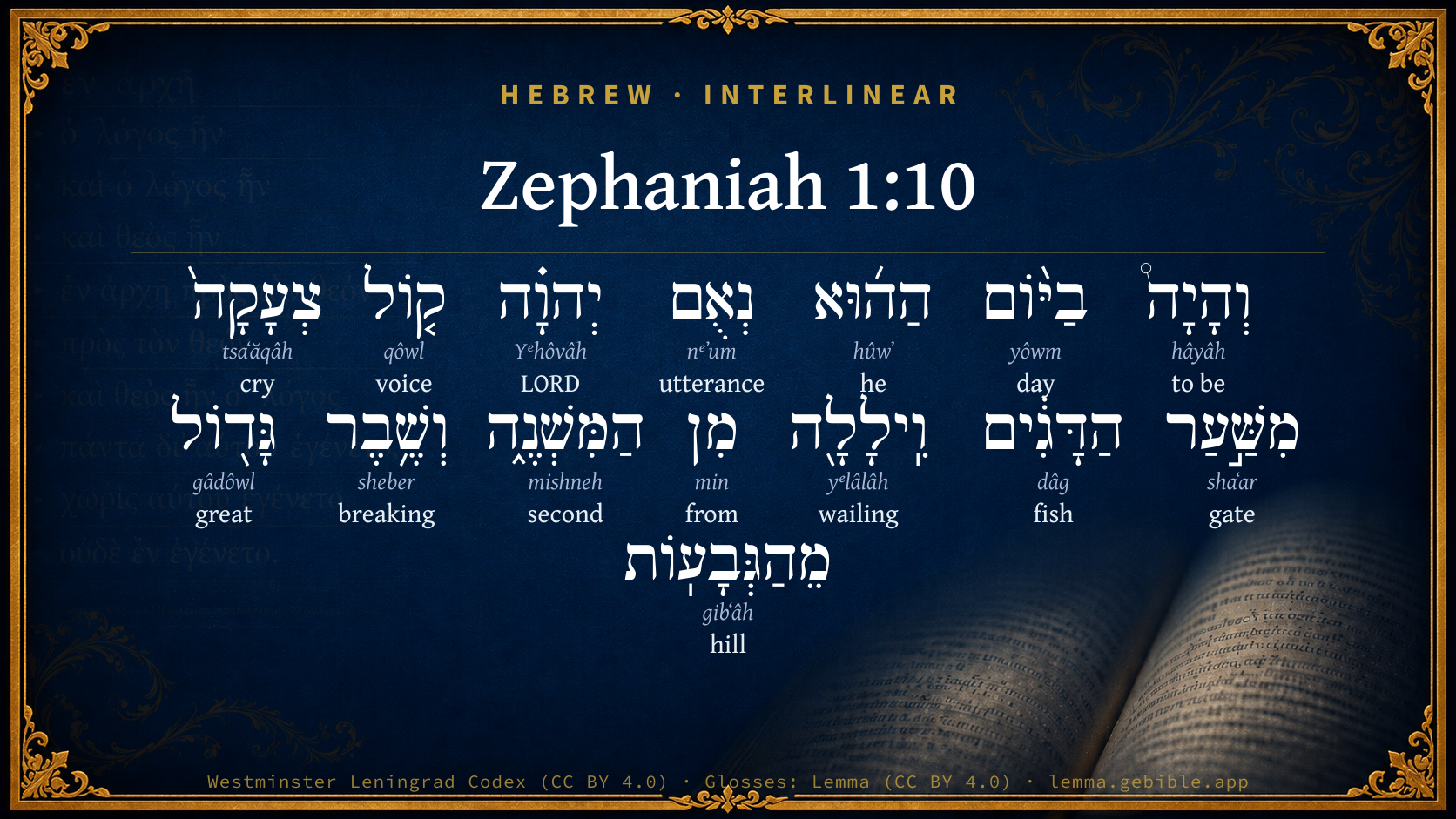
Hebrew (Westminster Leningrad Codex) Zephaniah 1:10 appears in the Hebrew Old Testament. The text above is from the Westminster Leningrad Codex. Each word links to its Strong’s number, a concise gloss, and parsing drawn from the Open Scriptures Hebrew Bible morphology. Click any word for its full Brown-Driver-Briggs (BDB) entry.
Download image
Cite this verse

Zephaniah 1:10 (World English Bible). Public Domain. Lemma interlinear Bible study tool, https://lemma.gebible.app/v/zephaniah/1/10.

Show BibTeX & RIS
BibTeX
RIS
English Translation
In that day, says Yahweh, there will be the noise of a cry from the fish gate, a wailing from the second quarter, and a great crashing from the hills.
World English Bible · Public Domain
Download a study sheet

One document with this verse’s original text, its word-by-word gloss line, the meaning frame, cross-references with their text, attributed commentary, and full source and license credits — printable, and it pastes into notes with its structure intact.

This verse Autodidact and up

Study sheet (.html) Plain text (.txt)

A passage Seminary Student

Up to 50 verses in one chapter. A passage sheet keeps up to 6 commentary sources and 12 cross-references per verse, in the order this page ranks them, and says so on the sheet whenever that leaves anything out. Ask for a single verse and you get the Autodidact verse sheet above.

Everything on this page stays free to read, with no account — the sheet is a download of what is already on screen, not access to it.

Want to remove ads? Support Godless Engineer
Compare translations 3

The same verse in 3 English versions, stacked beneath the original-language interlinear above. Click any original word for its lexicon entry.

Each is an independent rendering of the whole verse — the interlinear is not word-aligned to these translations.

Highlighted words mark where these versions differ — a whole-verse word diff, not a word-by-word alignment.

  • World English Bible Public Domain
    In that day, says Yahweh, there will be the noise of a cry from the fish gate, a wailing from the second quarter, and a great crashing from the hills.
  • King James Version Public Domain
    And it shall come to pass in that day, saith the LORD, that there shall be the noise of a cry from the fish gate, and an howling from the second, and a great crashing from the hills.
  • unfoldingWord Literal Text CC BY-SA 4.0
    And it will happen on that day” —the declaration of Yahweh— “the sound of a cry from the Fish Gate and a wailing from the Second and a great ruin from the hills.

unfoldingWord Literal Text — © unfoldingWord, licensed CC BY-SA 4.0. Word-aligned USFM3 via Door43 (git.door43.org/unfoldingWord/en_ult).

Versions to compare (up to 4)

3 of 4 selected

Show all 18 translations

Every available English version of this verse, each an independent rendering of the whole verse.

  • World English Bible Public Domain
    In that day, says Yahweh, there will be the noise of a cry from the fish gate, a wailing from the second quarter, and a great crashing from the hills.
  • Berean Standard Bible Public Domain
    On that day,” declares the LORD, “a cry will go up from the Fish Gate, a wail from the Second District, and a loud crashing from the hills.
  • Majority Standard Bible Public Domain
    On that day,” declares the LORD, “a cry will go up from the Fish Gate, a wail from the Second District, and a loud crashing from the hills.
  • King James Version Public Domain
    And it shall come to pass in that day, saith the LORD, that there shall be the noise of a cry from the fish gate, and an howling from the second, and a great crashing from the hills.
  • American Standard Version (1901) Public Domain
    And in that day, saith Jehovah, there shall be the noise of a cry from the fish gate, and a wailing from the second quarter, and a great crashing from the hills.
  • Revised Version (1885) Public Domain
    And in that day, saith the LORD, there shall be the noise of a cry from the fish gate, and an howling from the second quarter, and a great crashing from the hills.
  • Geneva Bible (1599) Public Domain
    And in that day, saith the Lord, there shall be a noise, and cry from the fishgate, and an howling from the second gate, and a great destruction from the hilles.
  • Douay-Rheims (1899) Public Domain
    And there shall be in that day, saith the Lord, the noise of a cry from the fish gate, and a howling from the Second, and a great destruction from the hills.
  • Young's Literal Translation Public Domain
    And there hath been in that day, An affirmation of Jehovah, The noise of a cry from the fish-gate, And of a howling from the Second, And of great destruction from the hills.
  • Literal Standard Version CC BY-SA 4.0
    And there has been in that day,” || A declaration of YHWH, || “The noise of a cry from the Fish Gate, || And of a howling from the Second [Quarter], || And of great destruction from the hills.
  • Unlocked Literal Bible CC BY-SA 4.0
    So it will be on that day—this is Yahweh's declaration— that a cry of distress will come from the Fish Gate, wailing from the Second District, and a great crashing sound from the hills.
  • unfoldingWord Literal Text CC BY-SA 4.0
    And it will happen on that day” —the declaration of Yahweh— “the sound of a cry from the Fish Gate and a wailing from the Second and a great ruin from the hills.
  • Darby Bible Public Domain
    And in that day, saith Jehovah, there shall be the noise of a cry from the fish-gate, and a howling from the second [quarter], and a great crashing from the hills.
  • World Messianic Bible Public Domain
    In that day, says the LORD, there will be the noise of a cry from the fish gate, a wailing from the second quarter, and a great crashing from the hills.
  • Webster's Bible Public Domain
    And it shall come to pass in that day, saith the LORD, that there shall be the noise of a cry from the fish-gate, and a howling from the second, and a great crashing from the hills.
  • Free Bible Version CC BY-SA 4.0
    On that day, declares the Lord, a cry of grief will come from the Fish Gate, a wailing from the Second Quarter, and a loud crash from the hills.
  • Bible in Basic English Public Domain
    And in that day, says the Lord, there will be the sound of a cry from the fish doorway, and an outcry from the new town, and a great thundering from the hills, and cries of grief from the people of the Hollow;
  • JPS Tanakh (1917) Public Domain
    And in that day, saith the LORD, Hark! a cry from the fish gate, and a wailing from the second quarter, and a great crashing from the hills.

Literal Standard Version (2020), Covenant Press — licensed CC BY-SA 4.0. Text via the HelloAO Bible API (eBible.org). Unlocked Literal Bible (unfoldingWord) — licensed CC BY-SA 4.0. Text via the HelloAO Bible API (eBible.org). unfoldingWord Literal Text — © unfoldingWord, licensed CC BY-SA 4.0. Word-aligned USFM3 via Door43 (git.door43.org/unfoldingWord/en_ult). Free Bible Version, Dr. Jonathan Gallagher — licensed CC BY-SA 4.0. Text via the HelloAO Bible API (eBible.org).

Word by word

More ways to search: Search by grammar → Find every occurrence → Compare this word →

Practice this passage: Drill this verse → Learn its vocabulary →

וִֽילָלָ֖ה
yᵉlâlâh
H3215
“and · wailing”
Conjunction + Noun, Common, Feminine, Singular, Absolute
Part of Speech
Conjunction + Noun
Type
Common
Gender
Feminine
Number
Singular
State
Absolute
Full BDB Definition

Origin: from H3214

TWOT: 868b

a howling (of distress), wailing
  1. וְהָיָה֩ hâyâh H1961 “and · to be” Conjunction + Verb, Qal, Sequential Perfect, 3rd Person, Masculine, Singular
  2. בַיּ֨וֹם yôwm H3117 “in/at the · day” Preposition, Determined + Noun, Common, Masculine, Singular, Absolute
  3. הַה֜וּא hûwʼ H1931 “the · he” Particle, Definite Article + Pronoun, Personal, 3rd Person, Masculine, Singular
  4. נְאֻם nᵉʼum H5002 “utterance of” Noun, Common, Masculine, Singular, Construct
  5. יְהוָ֗ה Yᵉhôvâh H3068 “LORD” Noun, Proper
  6. ק֤וֹל qôwl H6963 “voice of” Noun, Common, Masculine, Singular, Construct
  7. צְעָקָה֙ tsaʻăqâh H6818 “cry” Noun, Common, Feminine, Singular, Absolute
  8. מִשַּׁ֣עַר shaʻar H8179 “from · gate of” Preposition + Noun, Common, Masculine, Singular, Construct
  9. הַדָּגִ֔ים dâg H1709 “the · fish” Particle, Definite Article + Noun, Common, Masculine, Plural, Absolute
  10. מִן min H4480 “from” Preposition
  11. הַמִּשְׁנֶ֑ה mishneh H4932 “the · second” Particle, Definite Article + Noun, Common, Masculine, Singular, Absolute
  12. וְשֶׁ֥בֶר sheber H7667 “and · breaking” Conjunction + Noun, Common, Masculine, Singular, Absolute
  13. גָּד֖וֹל gâdôwl H1419 “great” Adjective, Adjective, Masculine, Singular, Absolute
  14. מֵהַגְּבָעֽוֹת gibʻâh H1389 “from · the · hills” Preposition + Particle, Definite Article + Noun, Common, Feminine, Plural, Absolute

About this verse

These counts appear in no published source. They are computed here, from the morphology-tagged text and Lemma’s own curated glosses. What Lemma adds →

15
words
15
distinct lemmas
Prophets
section

Notable vocabulary

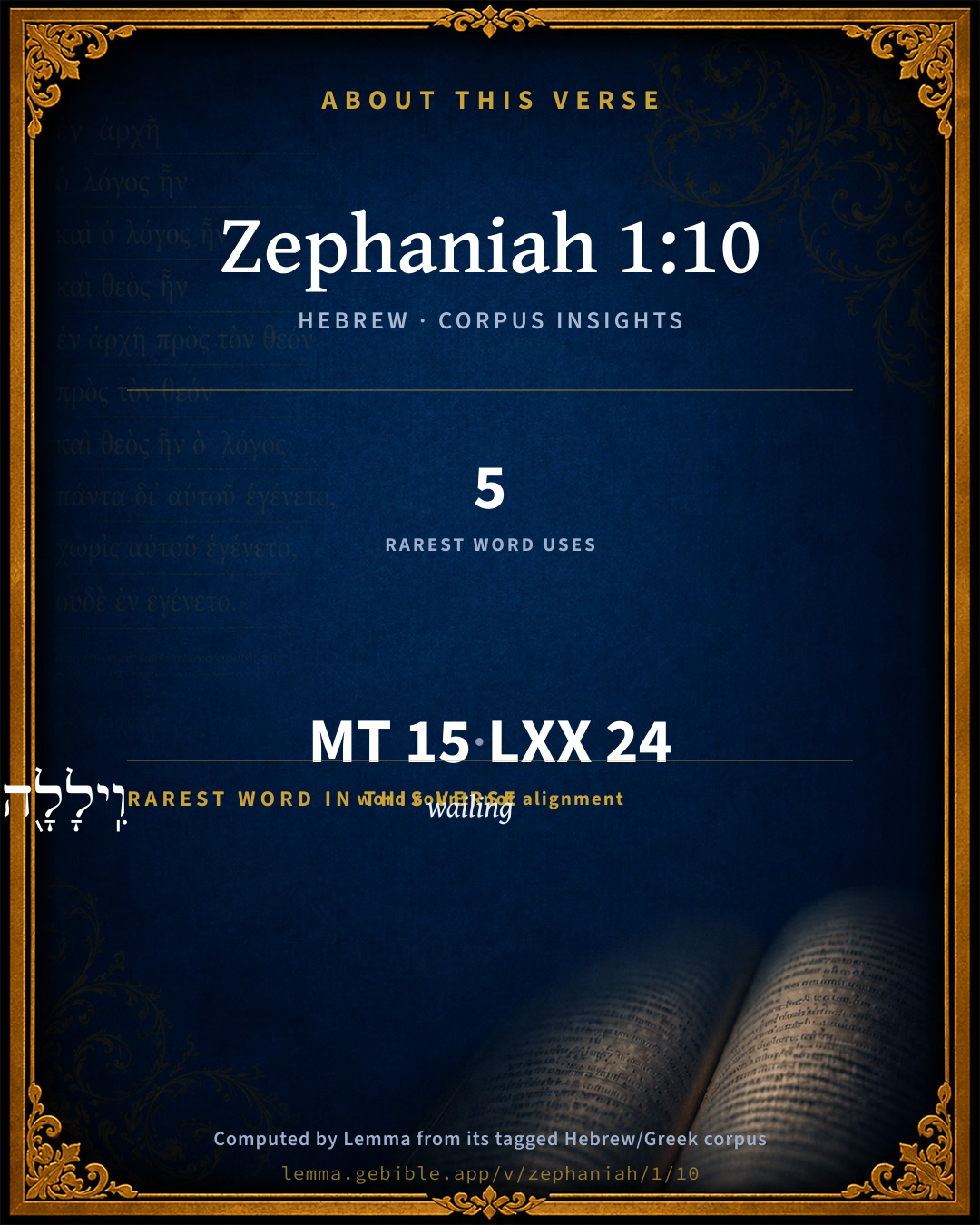
The rarest word here is וִֽילָלָ֖ה wailing H3215 — appearing just 5 times in the whole Hebrew Bible.

Shared distinctive vocabulary

וִֽילָלָ֖ה wailing H3215 occurs in 4 verses of the Hebrew Bible. Also found in:

Grammatical profile

  • 1 verb
  • 11 nouns
  • 1 adjective
  • 1 pronoun
  • 1 preposition

Verb forms

  • וְהָיָה֩ Qal · Sequential Perfect

Hebrew & Septuagint length

In English translation the verse runs 30 words from the Hebrew and 35 from the Septuagint (LXX English) — closely comparable.

A rough comparison of the two English renderings, which tokenize alike — not a word-level alignment.

Word counts can differ between the Hebrew and the Greek without any difference in meaning — e.g. the Hebrew direct-object marker אֵת has no separate Greek word, and Greek often adds the article ὁ.

In the original languages it is 15 Hebrew tokens and 24 Greek tokens — but the two are counted differently (Hebrew bundles its prefixes and suffixes into one token; the Greek is in lemma form), so that isn’t a like-for-like length.

Cross-references

15

Topical passages linked to Zephaniah 1:10 in the Treasury of Scripture Knowledge — connected by theme and wording, ordered by reader-vote popularity; previews shown in the World English Bible.

  • 2 Chronicles 33:14 Now after this he built an outer wall to the city of David, on the west side of Gihon, in the valley, even to the entrance at the fish gate; and he compassed Ophel about [with it], and raised it up to a very great height: and he put valiant captains in all the fortified cities of Judah.
  • 2 Kings 22:14 So Hilkiah the priest, and Ahikam, and Achbor, and Shaphan, and Asaiah, went to Huldah the prophetess, the wife of Shallum the son of Tikvah, the son of Harhas, keeper of the wardrobe (now she lived in Jerusalem in the second quarter); and they talked with her.
  • Amos 8:3 The songs of the temple will be wailings in that day," says the Lord Yahweh. "The dead bodies will be many. In every place they will throw them out with silence.
  • Nehemiah 3:3 The fish gate did the sons of Hassenaah build; they laid the beams of it, and set up the doors of it, the bolts of it, and the bars of it.
  • Jeremiah 4:19–21 My anguish, my anguish! I am pained at my very heart; my heart is disquieted in me; I can't hold my peace; because you have heard, O my soul, the sound of the trumpet, the alarm of war.
  • 2 Samuel 5:7 Nevertheless David took the stronghold of Zion; the same is the city of David.
  • 2 Samuel 5:9 David lived in the stronghold, and called it the city of David. David built round about from Millo and inward.
  • 2 Chronicles 3:1 Then Solomon began to build the house of Yahweh at Jerusalem on Mount Moriah, where [Yahweh] appeared to David his father, which he made ready in the place that David had appointed, in the threshing floor of Ornan the Jebusite.
  • 2 Chronicles 32:22 Thus Yahweh saved Hezekiah and the inhabitants of Jerusalem from the hand of Sennacherib the king of Assyria, and from the hand of all [others], and guided them on every side.
  • Isaiah 22:4–5 Therefore said I, Look away from me, I will weep bitterly; don't labor to comfort me for the destruction of the daughter of my people.
  • Isaiah 59:11 We roar all like bears, and moan sore like doves: we look for justice, but there is none; for salvation, but it is far off from us.
  • Jeremiah 4:31 For I have heard a voice as of a woman in travail, the anguish as of her who brings forth her first child, the voice of the daughter of Zion, who gasps for breath, who spreads her hands, [saying], Woe is me now! for my soul faints before the murderers.
  • Jeremiah 39:2 in the eleventh year of Zedekiah, in the fourth month, the ninth day of the month, a breach was made in the city),
  • Zephaniah 1:7 Be silent at the presence of the Lord Yahweh, for the day of Yahweh is at hand. For Yahweh has prepared a sacrifice. He has consecrated his guests.
  • Zephaniah 1:15 That day is a day of wrath, a day of distress and anguish, a day of trouble and ruin, a day of darkness and gloom, a day of clouds and blackness,

Cross-references courtesy of OpenBible.info (CC BY 4.0).

Hebrew and Greek witnesses Masoretic Hebrew ↔ Greek Septuagint

The same verse in the two great witnesses to the Old Testament, shown verse-for-verse.

These are two independent witnesses, not word-aligned to each other, and the Septuagint is shown in lemma (dictionary) form.

Hebrew Zephaniah 1:10 Masoretic · Westminster Leningrad Codex

וְהָיָה֩ בַיּ֨וֹם הַה֜וּא נְאֻם יְהוָ֗ה ק֤וֹל צְעָקָה֙ מִשַּׁ֣עַר הַדָּגִ֔ים וִֽילָלָ֖ה מִן הַמִּשְׁנֶ֑ה וְשֶׁ֥בֶר גָּד֖וֹל מֵהַגְּבָעֽוֹת

In that day, says Yahweh, there will be the noise of a cry from the fish gate, a wailing from the second quarter, and a great crashing from the hills.

World English Bible · Public Domain

Greek LXX Zephaniah 1:10 Septuagint · lemma form

καί εἰμί ἐν ἐκεῖνος ὁ ἡμέρα λέγω κύριος φωνή κραυγή ἀπό πύλη ἀποκεντέω καί ὀλολυγμός ἀπό ὁ δεύτερος καί συντριμμός μέγας ἀπό ὁ βουνός

And there shall be in that day, says the Lord, the sound of a cry from the gate of men slaying, and a howling from the second gate, and a great crashing from the hills.

LXX2012 (modern English Septuagint) · Public Domain

On this verse, The Pulpit Commentary discusses the Septuagint’s reading. Read the note in Commentary ↓

Hebrew: Westminster Leningrad Codex (CC BY 4.0). Greek: Septuagint (public domain); English from LXX2012 (modern English Septuagint) (Public Domain). How the Septuagint differs from the Hebrew →

Targum (Aramaic paraphrase)

1

The Targum is the ancient Jewish Aramaic paraphrase of the Hebrew Scriptures — an interpretive translation, not the Hebrew text itself. Onkelos (literal) and Pseudo-Jonathan (expansive) render the Torah, and Jonathan the Prophets. Coverage is partial: where no permissively-licensed English translation exists for a verse, only the Aramaic is shown. This is verse-level text, not a word-by-word alignment to the Hebrew.

  1. Targum Jonathan Prophets (Joshua–Malachi)
    וִיהֵי בְּעִדָנָא הַהִיא אֲמַר יְיָ קַל צְוַחְתָּא מִתְּרַע נוּנַיָא וִילָלָא מִן עוֹפָא וּתְבִירָא רַבָּא מִן גִבְעָתָא:

    (no public-domain English translation for this verse)

    Targum Jonathan — Aramaic: “Mikraot Gedolot” (public domain). English: “Sefaria Community Translation” (CC0 1.0 (public-domain dedication)); “London "Chaldee Paraphrase," 1871” (public domain). Text via Sefaria.

Commentary

Notes on Zephaniah 1:10 from classic Christian and Jewish commentators (each source and its license shown beneath its notes). The classic Christian expositions comment on the surrounding passage and are grouped to its opening verse, so a note may address several verses; the Jewish commentaries on the Tanakh (Rashi and others) are per-verse, so they appear only where the commentator wrote on this verse.

Lemma curates 59 commentaries, every one of them public domain or Creative Commons licensed, each selected and text-cleaned for this edition rather than reprinted as found. About our sources →

Trapp's Complete Commentary

John Trapp

Zep 1:10 And it shall come to pass in that day, saith the LORD, [that there shall be] the noise of a cry from the fish gate, and an howling from the second, and a great crashing from the hills.

Ver. 10. There shall be the noise of a cry from the fish gate] Called also the first gate, Zec 14:10, whereat the Chaldeans entered, and caused a great hubbub, as in such a case is usual.

And an howling from the second] Called by the Chaldee paraphrast the bird gate; there was also one called the horse gate, Jer 31:40. Some understand the text, not of any gate, but of the second part of the city: for there was the upper town and the lower town (whence Jerusalem is of the dual number, Jerushalajim), and the tower of David, on the hill of Zion. Others, of the college where Huldah dwelt, 2Ki 22:14, a school of learning, as the Chaldee interpreteth it, and called Mishneh, as you would say, a place of repetition, or of catechizing the younger sort; with whom nothing sticks but what is repeated to them over and over, as the knife goeth over the whetstone. Shanan et Shauah repetere, sicut in acuendo. See Deu 6:7.

And a great crashing (or shivering, Heb. shebhor) from the hills] Gareb and Goath, Jer 31:39, and the rest that were round about Jerusalem, Psa 125:2. The prophet’s scope is to show that all places shall be full of tumult and outcry upon the approach of the enemy. They, that would not listen to the sweet voice of God, inciting and enticing them to repentance, have now their ears filled with hideous and horrid notes and noises.

John Trapp, A Commentary or Exposition upon All the Books of the Old and New Testament (1647–1656) — public domain. Text from a community e-Sword module.

Joseph Benson's Commentary

Zep 1:10-11. In that day there shall be the noise of a cry from the fish- gate — Mentioned Neh 3:3. It was opposite to Joppa, according to Jerome, and at the entering of the city from that quarter. The sundry expressions of this verse are intended to describe the cries and shrieks that should arise from all parts of the city, upon the taking of it by the Babylonians. The great crashing from the hills might be intended to signify the noise that should be heard from the palace and temple, which were situated on the mountains, Zion and Moriah. Howl, ye inhabitants of Maktesh — The inhabitants of some particular part in or near Jerusalem. The Chaldee interprets it of the inhabitants near the brook Cedron. Bishop Newcome renders the clause, Howl ye inhabitants of the lower city, understanding it of the valley in Jerusalem, which divided the upper from the lower city, “This,” says he, “is agreeable to the etymology of the word, which signifies a hollow place, a mortar.” In this sense the word is understood by Buxtorf. For all the merchant people are cut down — All they who used to traffic with you shall be destroyed. All they that bear silver are cut off — All the money-changers: the rich merchants in general, or the money-changers in particular, may be meant.

Joseph Benson's Commentary on the Old and New Testaments (1811–1818) — public domain. Text from a community e-Sword module.

The Preacher's Complete Homiletical Commentary

Joseph S. Exell (gen. ed.)

CRITICAL NOTES.]

Zep_1:10.] Siege of Jerusalem. Gate] which stood near fish-market (2Ch_33:14; Neh_3:3). Second] A part of the city given (2Ki_22:14; 2Ch_34:22). Hills] within the walls, Zion and Moriah. Crashing] Breaking to pieces of what now exists, not merely fall of buildings, as Isa_15:6. A cry at the threat of utter destruction [Keil].

Zep_1:11. Maktesh] A rock in form of a mortar, where they hulled rice and corn. “The name probably chosen to express how their false hopes, grounded on the presence of God’s temple among them, while by their sins they profaned it, should be turned into true fears” [Pusey].

Zep_1:12. Candles] Diligently and thoroughly (Luk_15:8); the enemy would let no corner escape them. Lees] Quiet, retaining harshness, and growing turbid and thick. It denotes perseverance, confirmation in moral indifference (Jer_48:11). Say] Denied God’s providence, put him level with idols, who did neither good nor ill (Isa_41:23; Jer_10:5).

Zep_1:13.] God proved to be ruler and judge, by giving up their wealth to plunder, and punishing them as despisers of his name (Deu_28:30; Amo_5:11).

Zep_1:14]. The hint of Zep_1:7 carried out further; the nearness and terrible character of judgment described Great] in effects (Joe_2:11). Bitterly] For he cannot save himself from the foe; the might of the heroes and the city utterly fails.

Zep_1:15.] All the words supplied by the language crowded together to describe the terrors of judgment [cf. Keil]. He first, as the day of wrath (Isa_19:18). The effect of wrath, distress and pressure (Job_15:24): then a reduplication (cf. Nah_2:11); desolation, &c. (Job_30:3; Job_38:27). Lastly,

Zep_1:16.] “Indicating still more closely the nature of the judgment, as a day of the trumpet and the trumpet-blast, i.e. on which the clangour of the war trumpets will be heard over all the fortifications and castles, and the enemy will attack, take, and destroy fortified places amidst the blast of trumpets [Keil].

Zep_1:17.] No help nor counsel in this distress. Blind] Groping insecurely, or rushing headlong to destruction (Deu_28:29; Nah_2:6). Dust] Of as little value and in as great quantity (Gen_13:16; cf. 2Ki_13:7). Flesh] From a root to eat; equivalent to food (Job_20:23) [cf. Lange]. “Their flesh here called bread, because doomed to be the food of worms” [Drusius].

Zep_1:18.] With silver and gold they cannot save themselves. No heed given to riches by the enemy (cf. Isa_13:17; Jer_4:30; Eze_7:19). Fire] will devastate; cause speedy and complete destruction. “A consumption, and that a sudden one” [Calvin].

HOMILETICS

THE DOOMED CITY.—Zep_1:10-12

The vision of Divine judgment which swept the earth, and settled in dark clouds over the land of Judah, is now depicted as falling on the city. Jerusalem, the metropolis, the centre of national vice and luxury, is besieged by Nebuchadnezzar. The advance of the enemy, the ruin of the buildings, and the miseries of the inhabitants, are set forth in impressive figures.

I. The anguish at the gate. “A sound of crying from the fish gate.” Massive walls and iron gates cannot keep out Divine visitations in the city; wealth and grandeur are no barrier to retribution in the family. God can disturb our towns and markets, our business and societies, and create want and anguish on every hand.

II. The desolation at the centre. From the entrance the enemy goes on to the centre, or second part of the city. The second wall hinders not; the sacred temple and the school of the prophets are battered by rams and fall crash to the ground. When God assails, what can withstand! Neglect of duty and indulgence in sin will bring a fearful “cry of destruction” (Isa_15:5).

III. The conquest of the city. When God begins, he will make an end. Judgments penetrate most secret places, and destroy the highest citadel. The horrors of the siege increase. The storm sweeps everything before it. The inhabitants gather on the surrounding hills, and howl at the devastation before them. “A voice of noise from the city, a voice from the temple, a voice of the Lord that rendereth recompense to his enemies” (Isa_66:6).

IV. The destruction of the inhabitants. “Howl, ye inhabitants of Maktesh,” &c. Not only the city in its grandeur, but the people in their wickedness are all destroyed.

1. Wealthy merchants were overtaken. “All the merchant people are cut down.” The Maktesh (lit. mortar), in which they dwell, is a type of the method in which they suffer. They will be pounded and crushed. The silver with which they lade themselves will weigh them down to death. Abused prosperity makes judgments severe. It is folly to dream of safety in any place from which God is banished. Mercantile gains and heaps of silver cannot deliver men “in the day of the Lord’s wrath.” They shall cast their silver in the streets, and their gold shall be removed: their silver and their gold shall not be able to deliver them in the day of the wrath of the Lord,” &c. (Eze_7:19; Jas_5:1).

2. Men of business were carried off. “All they that bear silver are cut off.” The traders of the city had become very Canaanites in greed and gain (cf. Hos_12:7; Eze_16:3). The invaders seized the wealthy first, and carried away their booty (cf. Zep_1:13). Traffic and trade are good things, but are not the real basis on which a kingdom stands. When carried on by injustice and violence they will cause depression in business, failure in banks, and ruin in the country. God never allows any dishonesty to go unpunished. “By the blessing of the upright the city is exalted; but it is overthrown by the mouth of the wicked.”

DIVINE SCRUTINY AND RETRIBUTION.—Zep_1:12-18

God is not indifferent to human affairs. We may forget that God sees us, but the fact is not altered by our forgetfulness.

I. Human conduct is under Divine inspection. This indicates—

1. A thorough scrutiny. “I will search Jerusalem with candles.” When God comes forth—to make evil glare out by his fierce light—the secret sins and the secret sinners cannot be hidden. No hiding-place can keep out the light that makes manifest.

2. The detection of the guilty. “Men that are settled (curded or thickened). The imagery is taken from the process of preparing wine, and emphatically sets forth—(a) The evil of carnal self-satisfaction (Jer_48:11). Prosperity fostered pride; ease generated presumption; absence of dislodging changes resulted in aggravated spirit of impunity. This self-security should be detected; and (b) Practical atheism should be exposed. “That say in their heart, the Lord will not do good,” &c. Practical atheism was the outcome of debasing indulgence. God’s watchfulness, justice, and government were flagrantly ignored. His patience was thought to be unconcern. They talked in their hearts, held mental monologues, and charged God with being alike indifferent to do good or evil, to bestow blessing or visit with calamity. “Because sentence against an evil work is not executed speedily, therefore the heart of the sons of men is fully set in them to do evil.” Note the manifestation of a similar spirit in the days of the Apostle Peter (2 Peter 3).

II. Punishment is threatened for wrong-doing. “I will punish, because they have sinned against the Lord” (cf. Zep_1:12-17). God’s anger is not awakened by trifles, neither is it disproportionate to the offence. The same faithfulness and power are concerned in the fulfilment of great and terrible threatenings as of “exceeding great and precious promises.” The space mercifully allotted for repentance was nearly over. The day of grace was ending, and stern justice was drawing near.

1. The punishment would not be delayed. “The great day of the Lord is near, it is near and hasteth greatly.”

2. The punishment would be most exacting. “The curse causeless shall not come.” The penalty for sin may

(1) make the sinner’s labour profitless. “They shall build houses, but not inhabit them, and they shall plant vineyards, but not drink the wine thereof.” The advent of justice may

(2) render the offenders homeless. “Therefore their goods shall become a booty, and their houses a desolation.” Judgment may

(3) terrify with manifold alarms (Zep_1:15-17). Retributions

(4) make the whole land desolate. “The whole land shall be devoured by the fire of his jealousy.”

3. The punishment would not be evaded.

(1) There would be no exemption by purchase. “Neither their silver nor their gold shall be able to deliver them.”

(2) The doom would be inclusive and complete. “For he shall make even a speedy riddance of all them that dwell in the land” [Matt. Braithwaite].

THE DILIGENT SEARCH AND THE CERTAIN DISCOVERY.—Zep_1:12-14

God will now come in terrible judgment, go through the city, trying house by house, and man by man. “As the vintner goes through his cellars, torch in hand; or as the head of the household, taper in hand, searches every nook and corner of his house before the Passover, lest any morsel of leaven should be hidden in it, so Jehovah will ‘search Jerusalem with candles,’ hunting the evil out of every dark nook in which they have concealed themselves, suffering none to escape.”

I. The nature of the search. “I will search with candles.”

1. It is a determined search. An earnest and diligent search of persons and places; a sifting one by one in every corner until the thing searched be discovered. The woman “lit a candle, and swept the house, and sought diligently till she found” the lost coin (Luk_15:8; Psa_44:21).

2. It is a universal search. None can escape. Josephus tells in the destruction of Jerusalem how princes and priests were dragged out of tombs, pits, and caves, in which they had hidden themselves in fear of death. Ungodly men hate the light, would extinguish the candle, and hide themselves from punishment. But this is impossible. “Though they hide themselves in the top of Carmel, I will search and take them out thence.” (a) No bribe can avert it. (b) No strength can resist it. The might of the city and the courage of the warrior would fail. So irresistible would be the attack that “the mighty man” would abandon himself to shrieks of hopeless grief (Zep_1:14). There is only one way of escape for the guilty: to examine his own ways, to condemn his own offences, and abandon all pleas, to trust in Christ.

II. The design of the search. God searches the city, and penetrates the inward parts of the soul to expel darkness, discover guilt, and bring men to himself.

1. To rouse the spiritually hardened. Idleness and ease beget moral indifference. Men sit down upon their lees, draw themselves together, and get hardened in sin. They rest on the vilest, the sediment and refuse of their nature; become defiled by lusts, and confirmed in habitual wickedness.

2. To reprove the practically indifferent. Men who deny not God’s existence may reason themselves into atheism, may wish and believe in their hearts, and by acts inure themselves into the belief that God is far away from them; that he does not govern the world; and “will not punish men with eternal destruction for the sins of this short life.” God sits in heaven heedless of what men do or suffer, and will neither interfere in this world nor in the next. Why then fear him? Why not give themselves to lusts and pleasures? This spirit is rebuked by the prophet. If men do not see God in the merciful visitations, he will terrify them by judgments in life.

3. To punish the worldly-minded. Men pursue their ordinary course of labour and of sin, eat and drink, build houses and plant vineyards, until the day overtakes them, and deprives them of all they have (Mat_24:38-39).

(1) They hoard up and cannot keep. “Therefore their goods shall become a booty.” God refutes men’s notions by his providence, and makes them feel that he cares for what they do by taking what they possess, and leaving them homeless and penniless. “And their houses a desolation.”

(2) They labour and do not reap the benefit. They “build houses, but do not inhabit them; plant vineyards, but do not drink the wine thereof.” God proves the verity of the threatening by his execution, disappoints men of happiness and enjoyment by his justice. If we forget God in prosperity, get intoxicated with pleasure, and revolt in threatened punishment, we shall be convinced of our folly. God will visit our cities and marts, and search our shops and families. We shall be frustrated in our pursuits, and robbed of all our possessions. “Thou shalt build an house, and thou shalt not dwell therein; thou shalt plant a vineyard, and shalt not gather the grapes thereof” (cf. Deu_28:30; Amo_1:2).

HOMILETIC HINTS AND OUTLINES

The three acts of punishment. The first falls upon the princes who indulge in the customs of the heathen (Zep_1:8-9). The second falls upon the rich (Zep_1:10-11). The third falls upon the careless despisers (Zep_1:12-13) [Lange].

Zep_1:12-13.

1. Ease, prosperity, and lack of change, beget false security, disregard of God’s providence, and spiritual indifference.

2. God refutes the language, and makes practical atheists alarmed at his judgments.

3. When God strips any people of their possessions they will find that their enjoyment and abuse of them have been a snare to them. Therefore (i.e. because these things have had such an effect) “their goods shall become a booty.” “Religion and morality are two spheres which cannot be separated. An upright heart can only have one God, and in cherishing other gods besides God lies a falseness which bears its fruit in the field of morals. Whilst the heart, in its profoundest depths, is actuated by two diametrically opposite opinions, it is necessary that those influences should finally neutralise one another. In this way arises indifference towards motives drawn from eternal things. The indifference has a twofold result. First, temporal motives, among which the most powerful are pride (fashion) and avarice, take the place of eternal. In the second place, the other result of this fearless, practical atheism is: God does no good and no evil” [Lange].

HOMILETICS

THE GREAT DAY OF THE LORD.—Zep_1:14-18

To rouse the self-secure in their ease, Zephaniah carries out the hint of Zep_1:7, of the near approach and awful character of the judgment. The warning to Judah and Jerusalem should make sinners in Zion tremble. It is the day, the great day of the Lord, “a specimen of the day of judgment, a kind of doomsday, as the last destruction of Jerusalem by the Romans is represented to be in our Saviour’s prediction in Mat_24:27.”

I. A day of profound darkness. Darkness and gloominess, clouds and thick darkness. Everything looks threatening, and nothing encourages. No hope, no light. “The day of a darkness so profound, that day itself is changed into its very opposite and becomes a night, and a night wrapped in clouds through which no star can shoot a ray of hope.”

II. A day of Divine wrath. “That day is a day of wrath;” wrath treasured up for awhile, but now overflowing and irresistible—manifest, and felt in distress of every kind and degree, in calamity without relief. If the wrath of a king is like a messenger of death, how much more the wrath of an offended God? (Pro_16:14; Mal_3:2).

III. A day of material destruction.

1. The cities will be destroyed. “Against the fenced cities, and against the high towers” (Zep_1:16). Whatever the strength and structure of fortifications, they would afford no protection.

2. The land will be wasted. The blast of God will turn all fertility into waste. The dreary monotony of desolation appears everywhere. The earth is wasted with havoc, and broken into ruin. “A day of wasteness and desolation.”

IV. A day of human misery. “A day of trouble and distress” (Zep_1:15; Zep_1:17).

1. Great helplessness. (a) No escape by ransom; (b) no escape by flight. Men sink into anguish beyond expression; into misery beyond relief.

2. Great blindness. Hemmed in, they turn first to one place and then another; stagger like drunken men (Job_12:25); and walk like blind men. Bereft of counsel, strength, and hope, “they meet with the darkness in the day-time, and grope in the noon-day as in the night.”

3. Great slaughter. “Their blood shall be poured out as dust.” Life was of no value, blood would be utterly disregarded, treated as contemptible, and spilt in abundance (Psa_79:3). Their flesh would decay, putrefy, and become offensive, and lie like dung upon the land. All this “because they have sinned.” “The most offensive disgusting physical corruption,” says Pusey, “is but a faint image of the defilement of sin.”

4. Great despair. Amid darkness, distress, and murder, the war trumpet sounds louder and louder, strikes terror into every heart, and despair is read in every eye. The fire of jealousy devours the land, and “a speedy riddance is made of all them that dwell” in it. “He shall make an utter, yea, altogether (nothing but) a terrific destruction of all the dwellers of the earth” (cf. Psa_104:29; Isa_65:23).

V. A day of speedy approach. “It is near, it is near, and hasteth greatly.” Each hour tells the knell of approaching doom. Conscience, Scripture, and providence, like the voice of God, proclaim that it is near. Near, adds the prophet, to impress us the more. It is at hand to each. It hasteth greatly, and may come before we are aware. Nothing will hasten it more than carelessness in sin and security in judgment. Prepare now, before its voice is heard; arise, ye dead, and come to judgment. “For the great day of his wrath is come; and who shall be able to stand?”

“I see the Judge enthroned! the flaming guard!

The volume opened! opened every heart!

A sunbeam pointing out each secret thought!

No patron! intercessor none! now past

The sweet, the element mediatorial hour!

For guilt no plea! to pain, no pause! no bound!

Inexorable all! and all, extreme” [Young].

ILLUSTRATIONS TO CHAPTER 1

Zep_1:10-11. These verses describe the state of Jerusalem, when besieged by Nebuchadnezzar. Through the fish gate he entered the city. It received its name from the fish market, which was near it. Through it passed those who used to bring fish from the lake of Tiberias and Jordan. It answers to what is now called the Damascus gate [Henderson].

Zep_1:11. Maktesh, the mortar, a name applied to the valley of Siloam from its hollow shape [Jerome]. It is called by Josephus, “the cheese-maker’s valley,” and by the present inhabitants, el-Wâd, i.e. the valley, and also the mill-valley. The name “mortar” was probably coined by Zephaniah, to point to the fate of the merchants and men of money who lived there [Keil].

Zep_1:12-13. Neither the majesty of God, nor his government or glory, consists in imaginary splendour, but in those attributes which so meet together in him that they cannot be severed from his essence. It is the property of God to govern the world, to take care of the human race, to distinguish between good and evil, to relieve the wretched, to punish all crimes, to restrain unjust violence; and if any one would deprive God of these, he would leave nothing but an idol [Calvin].

“Even God’s providence

Seeming estranged” [Thos. Hood].

Zep_1:14-18. Day. When iniquity hath played her part, vengeance leaps upon the stage; the comedy is short, but the tragedy is long. The black guard shall attend you; you shall eat at the table of sorrow; and the crown of death shall be upon your heads, many glistering faces looking upon you [Hy. Smith]. You can muzzle your fear, and you can silence your conscience, and you can go on making money by ways which God abhors, and which every honest man ought to abhor, and you can, in the mean time, have comparative peace; but there is a great difference between staying off judgment now, and staving off revelation and judgment then [H. W. Beecher].

The Preacher's Complete Homiletical Commentary (gen. ed. Joseph S. Exell; Funk & Wagnalls, c. 1892) — public domain (pre-1929). A full-Bible homiletical/sermon-outline anthology covering 65 of 66 books (2 John is absent from the source module). Text from a community e-Sword module.

Keil & Delitzsch

C. F. Keil & F. Delitzsch

Even the usurers will not escape the judgment. Zep 1:10. "And it will come to pass in that day, is the saying of Jehovah, voice of the cry from the fish-gate, and howling from the lower city, and great destruction from the hills. Zep 1:11. Howl, inhabitants of the mortar, for all the people of Canaan are destroyed; cut off are all that are laden with silver." In order to express the thought that the judgment will not spare any one class of the population, Zephaniah depicts the lamentation which will arise from all parts of the city. קול צעקה, voice of the cry, i.e., a loud cry of anguish will arise or resound. The fish-gate (according to Neh 3:3; Neh 12:39; cf. Ch2 33:14) was in the eastern portion of the wall which bounded the lower city on the north side (for further details on this point, see at Neh 3:3). המּשׁנה (= העיר משׁנה, Neh 11:9), the second part or district of the city, is the lower city upon the hill Acra (see at Kg2 22:14). Shebher, fragor, does not mean a cry of murder, but the breaking to pieces of what now exists, not merely the crashing fall of the buildings, like za‛ăqath shebher in Isa 15:5, the cry uttered at the threatening danger of utter destruction. In order to heighten the terrors of the judgment, there is added to the crying and howling of the men the tumult caused by the conquest of the city. "From the hills," i.e., "not from Zion and Moriah," but from the ills surrounding the lower city, viz., Bezetha, Gareb (Jer 31:39), and others. For Zion, the citadel of Jerusalem, is evidently thought of as the place where the howling of the men and the noise of the devastation, caused by the enemy pressing in from the north and north-west, are heard. Hammakhtēsh, the mortar (Pro 27:22), which is the name given in Jdg 15:19 to a hollow place in a rock, is used here to denote a locality in Jerusalem, most probably the depression which ran down between Acra on the west and Bezetha and Moriah on the east, as far as the fountain of Siloah, and is called by Josephus "the cheese-maker's valley," and by the present inhabitants el-Wâd, i.e., the valley, and also the mill-valley. The name "mortar" was probably coined by Zephaniah, to point to the fate of the merchants and men of money who lived there. They who dwell there shall howl, because "all the people of Canaan" are destroyed. These are not Canaanitish or Phoenician merchants, but Judaean merchants, who resembled the Canaanites or Phoenicians in their general business (see at Hos 12:8), and had grown rich through trade and usury. Netı̄l keseph, laden with silver.

Keil & Delitzsch — Biblical Commentary on the Old Testament (1861–1891) — public domain (CC PDM 1.0). Text via the HelloAO Bible API. (Old Testament only.)

Tyndale Open Study Notes

Tyndale Open Resources

1:10 The Fish Gate was in the northern section of Jerusalem (Neh 12:39).

Tyndale Open Study Notes — © Tyndale Open Resources, licensed CC BY-SA 4.0. Text via the HelloAO Bible API.

Geneva Bible (1599)

Geneva Bible translators

Signifying, that all the corners of the city of Jerusalem should be full of trouble.

Geneva Bible (1599) marginal notes — public domain. Text via Bolls.life.

Jamieson, Fausset & Brown

Robert Jamieson, A. R. Fausset & David Brown

fish gate-- (Ch2 33:14; Neh 3:3; Neh 12:39). Situated on the east of the lower city, north of the sheep gate [MAURER]: near the stronghold of David in Milo, between Zion and the lower city, towards the west [JEROME]. This verse describes the state of the city when it was besieged by Nebuchadnezzar. It was through the fish gate that he entered the city. It received its name from the fish market which was near it. Through it passed those who used to bring fish from the lake of Tiberias and Jordan. It answers to what is now called the Damascus gate [HENDERSON].

the second--namely, the gate which was second in dignity [CALVIN]. Or, the second or lower part of the city. Appropriately, the fish gate, or extreme end of the lower part of the city, first resounds with the cries of the citizens as the foe approaches; then, as he advances further, that part of the city itself, namely, its inner part; lastly, when the foe is actually come and has burst in, the hills, the higher ones, especially Zion and Moriah, on which the upper city and temple were founded [MAURER]. The second, or lower city, answers to Akra, north of Zion, and separated from it by the valley of Tyropœon running down to the pool of Siloam [HENDERSON]. The Hebrew is translated "college," Kg2 22:14; so VATABLUS would translate here.

hills--not here those outside, but those within the walls: Zion, Moriah, and Ophel.

Jamieson, Fausset & Brown — Commentary Critical and Explanatory on the Whole Bible (1871) — public domain (CC PDM 1.0). Text via the HelloAO Bible API.

Adam Clarke's Commentary

Verse 10. A cry from the fish-gate] This gate, which is mentioned Ne 3:3, was opposite to Joppa; and perhaps the way in which the news came of the irruption of the Chaldean army, the great crashing from the hills.

The second] Or second city, may here mean a part of Jerusalem, mentioned 2Kg 22:14; 2Ch 34:22.

Adam Clarke's Commentary on the Bible (1810–1826) — public domain. Text from a community e-Sword/MySword module.

John Calvin's Commentaries

He confirms here the same truth, and amplifies and illustrates it by a striking description; for we know how much a lively representation avails to touch the feelings, when the event itself is not only narrated, but placed as it were before our eyes. So the Prophet is not content with plain words, but presents a scene, that the future destruction of Jerusalem might appear in a clearer light. But as I have elsewhere explained this mode of speaking, I shall not dwell on the subject now.

He says, that there would be the voice of crying from the gate of the fishes. He names here three places in Jerusalem, and afterwards he adds a fourth. But as we do not understand the situation of the city, sufficient for us is this probable conjecture,—that he refers to parts opposite to one another; as though he had said, that no corner of the city would be in a quiet state, when the Lord roused up war. Let us then suppose it to be triangular, and let the gate of the fishes be one side, and let the second gate or the school be on the other; and let the part nigh the hills form the third side. What some say, that the hills mean palaces, I do not approve of; nor is it consistent with the context: but we ought to bear in mind what I have already stated, that the Prophet here denounces ruin on every part of the city, so that the Jews would in vain seek refuges for themselves; for by running here and there, they would find all places full of crying and howling. There shall be then the voice of crying from the gate of the fishes. Why the Prophet calls it the gate of the fishes we cannot for certainty say, except that it is a probable conjecture, that either some fish-pond was near it, or that the fish-market was nigh.

As to the word משנה, meshene, the majority of interpreters think that it means the place where the priests explained the law and devoted themselves to the study of it; and they adduce a passage from 2 Kings 22:14, where it seems, as there is mention made of priests, the word is taken in this sense. But as gates are spoken of here, and as the Hebrews often call whatever is second in order by this word, as the second part in buildings and also in towns and in other places, is thus called, we may take it here in this sense, that is, as meaning that gate which was next to the first in general esteem. But as the subject has little to do with the main point, I dismiss it.

He says in the last place, that there would be a great breach in the hills. He refers, I have no doubt, to that part of the city which was contiguous to the mountains. However this may be, it was the Prophet’s object to include here the whole city, that he might shake off from the Jews all vain confidence, and show that there would be no escape, when the Lord stretched forth his hand to punish their sins. It now follows—

John Calvin's Commentaries (1540-1563) — public domain. Text from the Calvin Translation Society English edition (1840s-50s) via the Christian Classics Ethereal Library (ccel.org). Calvin's coverage is partial (roughly two-thirds of the Bible); uncommented books and verses are honest gaps, never fabricated. The 19th-century editor's footnotes and remarks are omitted so the notes are faithfully Calvin's own voice.

Ellicott's Commentary for English Readers

(10) The fish gate.—See Note on 2Ch_33:14; Neh_3:3.

The second.—The word “city” is to be supplied. The new or lower city is meant. The same expression occurs in 2Ki_22:14; Neh_11:9.

From the hills.—The “hills” are probably, Mount Zion and Mount Moriah, the sites of the old Davidic city and the Temple. Thus all parts of the city are to be included in this destruction.

A Bible Commentary for English Readers, edited by Charles John Ellicott (1878–1897) — public domain. Text from a community e-Sword module.

The Cambridge Bible for Schools and Colleges

gen. ed. J. J. S. Perowne

10. the fish gate] The gate may have received its name from its vicinity to the fishmarket. From Neh_3:1-3 it appears that the fishgate lay to the west of the tower of Hananeel; and in Neh_12:39 the procession starting from the south-west of the city and going round the walls north and east passed successively the gate of Ephraim, the old gate, the fishgate, the tower of Hananeel and the tower of Meah, halting at the sheepgate, which was near the Temple. The fishgate therefore was situated in the northern wall of the city, probably not far from the N.W. angle of the walls. In the days of Nehemiah (Neh_13:16), and possibly in the time of Zephaniah, the fishmongers were Tyrians, and their commodity was no doubt dried fish.

a howling from the second] Better as R.V. the second quarter, i.e. of the city. The second quarter may have been so called from its having been recently added to the city. In 2Ch_33:14 Manasseh is said to have built an outer wall extending as far as the fishgate. The second quarter in all likelihood lay on the north of the city; according to 2Ki_22:14 the prophetess Huldah had her house there.

great crashing from the hills] lit. great breach. The crashing is scarcely the noise of falling buildings, the expression seems rather to be elliptical for a cry of great destruction (Isa_15:5), parallel to “cry” and “howling” in the two previous clauses. The “hills” referred to are those on which Jerusalem was built, though especially those of the northern quarter.

The Cambridge Bible for Schools and Colleges (gen. ed. J. J. S. Perowne; Cambridge University Press, 1878–1918) — public domain. Text from a community e-Sword module.

John Gill's Exposition

And it shall come to pass in that day, saith the Lord, &c.] In the day of the Lord's sacrifice, when he shall punish the inhabitants of Judah and Jerusalem by the Chaldeans; which, as well as what follows, shall surely come to pass, because the Lord has said it; for not one word of his shall pass away, but all be fulfilled: [that there shall be] the noise of a cry from the fish gate; a gate of the city of Jerusalem so called, which suffered as the rest in the destruction of the city by the Babylonians, and, after the captivity, was rebuilt by the sons of Hassenaah, ( Nehemiah 3:3 ) according to Jerom, it was on the west side of the city, and led to Diospolis and Joppa; and was the nearest road to the Mediterranean sea, or any of the roads to Jerusalem, from whence fish were brought, and brought in by this gate; and very probably the fish market was near it, from whence it had its name; though Cocceius places it in the north corner of the east side of the city, and so was nearer Jordan, the sea of Tiberias, and the city of Tyre, from whence fish might be brought hither, and sold, ( Nehemiah 13:16 ) however, be it where it will, the enemy it seems would attack it, and enter in by it; upon which a hideous cry would be made, either by the assailants, the Chaldeans, at their attack upon it, and entrance through it; or by the inhabitants of it, or that were nearest to it, upon their approach, or both: and an howling from the second; either from the second gate; and if the fish gate is the same with the first gate, ( Zechariah 14:10 ) then this may be pertinently called the second. Jarchi calls it the bird gate, which was the second to the fish gate. So the Targum, ``from the bird, or the bird gate;'' though some copies of it read, from the tower or high fortress: or else this designs the second wall, and the gate in that which answered to the fish gate; for Jerusalem was encompassed with three walls; the fish gate was in the outermost, and this was in the second, to which the Chaldeans came next, and occasioned a dreadful howling and lamentation in the people that dwelt near it. Kimchi interprets it of the school or university that was in Jerusalem; the same word is rendered the cottage in which Huldah the prophetess lived, ( 2 Kings 22:14 ) and there, by the Targum, ``the house of doctrine or instruction;'' so then the sense is, a grievous outcry would be heard from the university or school of the prophets; the enemy having entered it, and were slaying the students, or seizing them in order to carry them captive: and a great crashing from the hills; either that were in Jerusalem, as Mount Zion and Moriah, on which the temple stood; or those that were round about it, as Gareb, and Goath, and others; though some interpret this of the houses of nobles that stood in the higher parts of the city, where there would be a shivering, a breaking to pieces, as the word signifies, of doors and windows without, and of furniture within.

John Gill's Exposition of the Whole Bible (1746–1763) — public domain (CC PDM 1.0). Text via the HelloAO Bible API.

Albert Barnes' Notes on the Bible

A cry from the fish-gate - “The fish-gate” was probably in the north of the wall of “the second city.” For in Nehemiah’s rebuilding, the restoration began at the sheep-gate Neh 3:1 (so called doubtless, because the sheep for the sacrifices were brought in by it), which, as being near the temple, was repaired by the priests; then it ascended northward, by two towers, the towers of Meah and Hananeel; then two companies repaired some undescribed part of the wall Neh 3:2, and then another company built the fish-gate Neh 3:3. Four companies are then mentioned, who repaired, in order, to the old gate, which was repaired by another company Neh 3:4-6. Three more companies repaired beyond these; and they left Jerusalem unto the broad wall Neh 3:7-8. After three more sections repaired by individuals, two others repaired a second measured portion, and the tower of the furnaces Neh 3:9-11.

This order is reversed in the account of the dedication of the walls. The people being divided “into two great companies of them that give thanks” Neh 12:31-38, some place near “the tower of the furnaces” was the central point, from which both parted to encompass the city in opposite directions. In this account, we have two additional gates mentioned, “the gate of Ephraim” Neh 12:39, between the “broad wall” and the “old gate,” and “the prison-gate,” beyond “the sheep-gate,” from which the repairs had begun. “The gate of Ephraim” had obviously not been repaired, because, for some reason, it had not been destroyed. Elsewhere, Nehemiah, who describes the rebuilding of the wall so minutely, must have mentioned its rebuilding. It was obviously to the north, as leading to Ephraim. But the tower of Hananeel must have been a very marked tower. In Zechariah Jerusalem is measured from north to south, “from the tower of Hananeel unto the king’s winepresses” Zec 14:10.

It was then itself at the northeast corner of Jerusalem, where towers were of most importance to strengthen the wall, and to command the approach to the wall either way. “The fish-gate” then, lying between it and “the gate of Ephraim,” must have been on the north side of the city, and so on the side where the Chaldaean invasions came; yet it must have been much inside the present city, because the city itself was enlarged by Herod Agrippa on the north, as it was unaccountably contracted on the south. The then limits of Jerusalem are defined. For Josephus thus describes “the second wall.” (B. J. v. 42): “It took its beginning from that gate which they called “Gennath,” which belonged to the first wall; it only encompassed the northern quarter of the city and reached as far as the tower of Antonia.” The tower of Antonia was situated at the northwest angle of the corner of the temple. The other end of the wall, the Gennath or “garden” gate, must have opened on cultivated land; and Josephus speaks of the gardens on the north and northwest of the city which were destroyed by Titus in leveling the ground (B. J. v. 32).

But near the tower of Hippicus, the northwestern extremity of the first wall, no ancient remains have been discovered by excavation ; but they have been traced north, from “an ancient Jewish semi-circular arch, resting on piers 18 feet high, now buried in rubbish.”

These old foundations have been traced at three places in a line on the east of the Holy Sepulchre (which lay consequently outside the city) up to the judgment gate, but not north of it .

The line from west to east, that is, to the tower of Antonia, is marked generally by “very large stones, evidently of Jewish work, in the walls of houses, especially in the lower parts” . They are chiefly in the line of the Via Dolorosa.

“The fish-gate” had its name probably from a fish-market (markets being in the open places near the gates (see 2Ki 7:1; Neh 13:16, Neh 13:19)) the fish being brought either from the lake of Tiberius or from Joppa. Near it, the wall ended, which Manasseh, after his restoration from Babylon, “built without the city of David, on the west side of Gihon, in the valley” 2Ch 33:14. This, being unprotected by its situation, was the weakest part of the city. : “The most ancient of the three walls could be considered as impregnable, as much on account of its extreme thickness, as of the height of the mountain on which it was built, and the depth of the valleys at its base, and David, Solomon and the other kings neglected nothing to place it in this state.” Where they had made themselves strong, there God’s judgment should find them.

And a howling from the second - city, as it is supplied in Nehemiah, who mentions the prefect set over it . It was here that Huldah the prophetess lived , who prophesied the evils to come upon Jerusalem, after Josiah should be “gathered to” his “grave in peace.” It was probably the lower city, which was enclosed by the second wall. It was a second or new city, as compared to the original city of David, on Mount Moriah. On this the enemy who had penetrated by the fish-gate would first enter; then take the strongest part of the city itself. Gareb Jer 31:39 and Bezetha were outside of the then town; they would then be already occupied by the enemy before entering the city.

A great crashing from the hills - These are probably Zion, and Mount Moriah on which the temple stood, and so the capture is described as complete. Here should be not a cry or howling only, but an utter destruction . Mount Moriah was the seat of the worship of God; on Mount Zion was the state, and the abode of the wealthy. In human sight they were impregnable. The Jebusites mocked at David’s siege, as thinking their city impregnable 2Sa 5:6; but God was with David and he took it. He and his successors fortified it yet more, but its true defense was that the Lord was round about His people” Psa 125:2, and when lie withdrew His protection, then this natural strength was but their destruction, tempting them to resist first the Chaldaeans, then the Romans. Human strength is but a great crash, falling by its own weight and burying its owner. “This threefold cry , from three parts of the city, had a fulfillment before the destruction by the Romans. In the lower part of the city Simon tyrannized, and in the middle John raged, and “there was a great crashing from the hills,” that is, from the temple and citadel where was Eleazar, who stained the very altar of the temple with blood, and in the courts of the Lord made a pool of blood of divers corpses.”

Cyril: “In the assaults of an enemy the inhabitants are ever wont to flee to the tops of the hills, thinking that the difficulty of access will be a hindrance to him, and will cut off the assaults of the pursuers. But when God smiteth, and requireth of the despisers the penalties of their sin, not the most towered city nor impregnable circuits of walls, not height of hills, or rough rocks, or pathless difficulty of ground, will avail to the sufferers. Repentance alone saves, softening the Judge and allaying His wrath, and readily inviting the Creator in His inherent goodness to His appropriate gentleness. Better is it, with all our might to implore that we may not offend Him. But since human nature is prone to evil, and “in many things we all offend” Jam 3:2, let us at least by repentance invite to His wonted clemency the Lord of all, Who is by nature kind.”

Albert Barnes' Notes on the Bible (1834–1885) — public domain. Text from a community e-Sword/MySword module.

Haydock's Catholic Bible Commentary

Gate, looking towards Joppe. (St. Jerome) --- The news of the defeat at Mageddo came this way, or the cries of the Philistines were heard. (Calmet) --- Second. A part of the city so called, (Challoner) built by Manasses on the same side of the city, 2 Paralipomenon xxxiii. 14. (Calmet)

George Leo Haydock (1774–1849), Haydock's Catholic Family Bible and Commentary, 1859 edition — public domain. Excludes Psalms (Douay-Rheims chapter numbering differs from Protestant) and Deuterocanonical books (Catholic canon only).

Matthew Poole's English Annotations

In that day: see Zep 1:9.

Saith the Lord; to assure us of the certainty of the thing.

The noise, Heb. the voice, of a cry, i.e. a very great outcry and lamentation, from the fish-gate, which was on the west side of Jerusalem, through which gate they brought in fish from Joppa and other sea towns on the west sea, or great sea, now the Mediterranean, at which gate the Babylonians are said first to enter into the city when they took it: thus it will be a prediction at what gate the enemy should enter.

A howling, the great, horrid, and confused lamentations of desperate and undone multitudes, crying out and bitterly bemoaning themselves, from the second gate, which was in the second wall of Jerusalem, which on that side was fortified with three walls; or second part of the city, or the middle city, for it was divided into three parts. Others read second as a proper name, and make it the school, college, or university, and so render, the howling of the university, i.e. of students either slaughtered or captivated by Chaldeans.

A great crashing; breaking in pieces, or the noise of what is broken into shivers; possibly the noise of doors, windows, closets, and chests broken up, or burning, in the houses of nobles, likened here to hills; or, more literally, in

Gareb and

Goath, on which the fleeing Jews, pursued by the Chaldees, lost what they carried with them, and their life too: so all places were full of miserable slaughter and outcries.

Matthew Poole's English Annotations on the Holy Bible (1683–1685) — public domain. Text from a community e-Sword/MySword module.

Whedon's Commentary on the Bible

Daniel D. Whedon

The terrors of the judgment, 10-13.

Zephaniah is so certain that the impending doom cannot be averted that he depicts in these verses the wailing that will ascend from all parts of the city in the day of judgment.

10. Noise of a cry — A loud cry, of anguish and despair.

Fish gate — Mentioned again in 2Ch_33:14; Neh_3:3; Neh_12:39. It is generally thought that it was in the north wall of the city, not far from the northwest angle of the same. Through this gate the fishmongers from Tyre are supposed to have come (Neh_13:16); if so, the fish market may have been located near it. Since the north was exposed more than the other sides of the city, hostile attacks might be expected to come from that direction. For this reason the prophet names localities in the northern section of the city as the places from which the cries of despair will be heard.

The second — R.V., “the second quarter”; Hebrews mishneh, which might be translated “new town.” It may be the name of a recent addition to the city proper. Its exact location is not known, but it is generally thought to have been situated on the hill Acra. According to 2Ki_22:14; 2Ch_34:22, the prophetess Huldah lived there.

Crashing — Or, noise. Since the word stands in parallelism with “cry” and “howling” in the preceding clauses, it should be understood not of the crash of falling buildings, but of the noise made by the terror-stricken inhabitants.

The hills — Upon which the city was built, but the prophet is thinking especially of the hills in the northern section of the city.

Daniel D. Whedon (gen. ed.), Commentary on the Old and New Testaments (1874–1909) — public domain. Text from a community e-Sword module.

The Pulpit Commentary

The second class which shall be smitten, viz. the traders and usurers, the enemy being represented as breaking in upon the localities where these persons resided. The fish gate. This is generally supposed to have been in the north wall of the city towards its eastern extremity, and to have been so called because through it were brought the fish from the Jordan and the Sea of Galilee, and there was a fish market in its immediate neighbourhood. (see Neh_3:3 Neh_12:39 2Ch_33:14) It was probably on this side that the Chaldeans entered Jerusalem, us Zedekiah seems to have escaped from the south. (Jer_39:4) The LXX has, apo pulhv apokentountwn , which Jerome notes as a mistake. From the second district, the lower city upon the hill Acra, to the north of the old town, Zion. This is so called, according to one rendering, in 2Ki_22:14, and Neh_11:9. A great crashing. Not merely the crash of falling buildings, but the cry of men when a city is taken and the inhabitants are put to the sword. The hills on which the greater part of the city was built. Keil thinks that the hills surrounding the lower city are meant, viz. Bezetha, Gareb, etc., as the hearer of the cry is supposed to be on Zion.

The Pulpit Commentary (1880–1919), ed. H.D.M. Spence-Jones & Joseph S. Exell — public domain. Text from a community e-Sword module.

John Wesley's Explanatory Notes

The noise - The great out-cry and lamentation. The fish gate - At which gate the Babylonians first entered into the city. The second - This gate was in the second wall of Jerusalem, which on that side was fortified with three walls. Crashing - Of things broken into shivers; possibly the noise of doors, windows, closets, and chests broken up. The hills - On which the city stood.

John Wesley, Explanatory Notes Upon the Whole Bible (1754–1765) — public domain. Text via the GEBible commentary corpus.

unfoldingWord translationNotes

Door43 World Missions Community

General Information:

Verses Zep 1:2-18 refer to Yahweh's judgment. Verses Zep 1:4-16 describe Yahweh's judgment on the people of Judah.

General Information:

In verses Zep 1:8-13, Yahweh is speaking. He alternates between using first person and speaking about himself in the third person. (See: First, Second, or Third Person)

on that day

"on the day of Yahweh." See how you translated this phrase in Zephaniah 1:9.

Yahweh's declaration

Yahweh speaks of himself by name to express the certainty of what he is declaring. AT: "what Yahweh has declared" or "what Yahweh has solemnly said" (See: First, Second, or Third Person)

Fish Gate

The Fish Gate was one of the gates in the Jerusalem city wall.

wailing from the Second District

"Mourn loudly from the Second District." The Second District was a newer part of Jerusalem.

a great crashing sound

This refers to the sound of buildings collapsing. This can be stated explicitly. AT: "a loud sound of buildings collapsing" (See: Assumed Knowledge and Implicit Information)

from the hills

This refers to the hills surrounding Jerusalem.

for all the merchants will be ruined; all those who weigh out silver will be cut off

These two phrases refer to the same people and are used to emphasize that business will be destroyed. AT: "for those who buy and sell goods will be killed" (See: Parallelism)

those who weigh out silver

This refers to merchants. Before coins were used, people weighed out silver or gold as payment for things they bought.

cut off

Destroying is spoken of as if it were cutting something off from what it was a part of. See how you translated this in Zephaniah 1:3. AT: "destroyed" (See: Metaphor)

translationWords

silver

unfoldingWord translationNotes — © Distant Shores Media and the Door43 World Missions Community, licensed CC BY-SA 4.0. Source: git.door43.org/Door43/en_tn.

Rashi

Rabbi Shlomo Yitzchaki (Rashi)

from the fish gate Jonathan renders: from the gate of the fish; there was a gate in Jerusalem called by that name.

from the second gate from the gate of the fowl, which was second to it [the fish gate].

Rashi on the Tanakh — English translations: “The Judaica Press complete Tanach with Rashi, translated by A. J. Rosenberg” (CC BY 4.0); “Pentateuch with Rashi's commentary by M. Rosenbaum and A.M. Silbermann, 1929-1934” (public domain); “The Metsudah Tanach series, Lakewood, N.J” (CC BY 4.0); and “The Book of Joshua, Metsudah Publications, 1997” (CC BY 4.0). Text via Sefaria.

Lesson kit

Teaching starters — assembled from the data on this page, not authored interpretation. Every prompt links to the verse data it draws on. Edit before teaching.

Zephaniah, in the Prophets, opens this verse with 15 words (15 distinct Hebrew lemmas). Its most distinctive word is yᵉlâlâh (“wailing”). A historical commentator’s framing appears above. Read the whole chapter for the surrounding context.

Discussion questions

  1. What does “wailing” (yᵉlâlâh) contribute to the verse as a whole?
  2. Isaiah 15:8 shares the word «wailing» with this verse. How do the two illuminate each other?
  3. The translations on this page render this verse differently — a whole-verse word diff, not a word-by-word alignment. What might account for the different wordings?
  4. The verb «וְהָיָה֩» is Qal Sequential Perfect. How does its form color the action?
  5. Reading how Trapp's Complete Commentary and Joseph Benson's Commentary read this verse, where do the two commentators agree and where do they part?

Things to notice

Reading settings

Reading text

Shown beneath each verse's original-language words.

Old Testament
Old Testament edition

Read the OT as the Masoretic Hebrew (MT) or the Greek Septuagint (LXX).

English shown for the Greek Septuagint (in the Hebrew ↔ Greek comparison).

Comparing translations? Open the Compare panel on any verse page to stack up to four side by side.